Frequency of the Unborn Hour
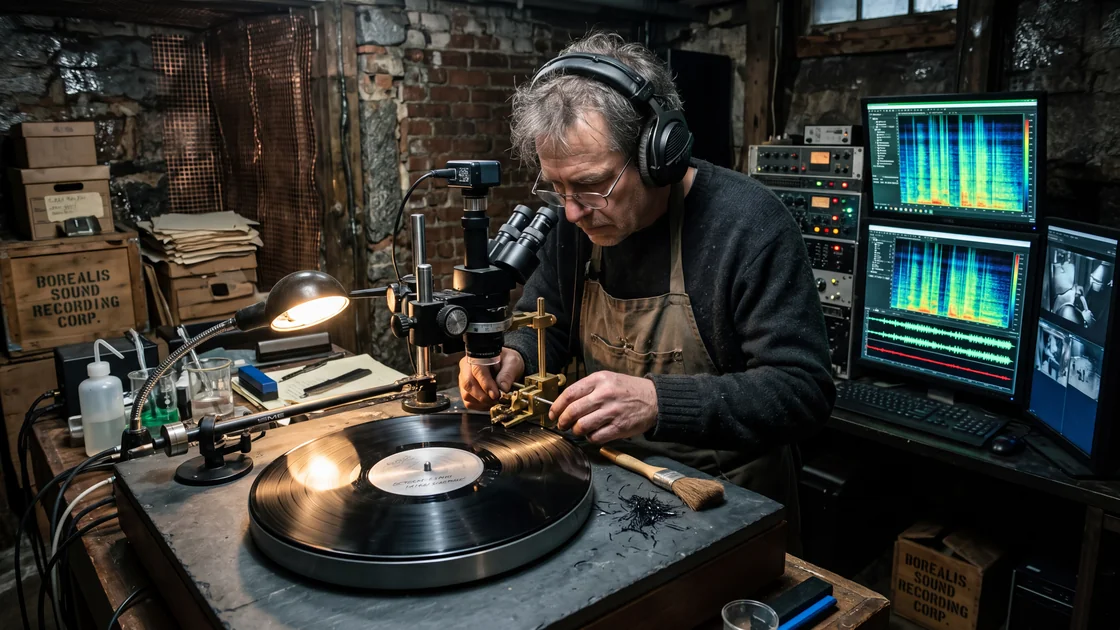
In a subterranean audio-restoration laboratory beneath the damp brick streets of Boston, a reclusive sound engineer named Arthur Finch uncovers an uncataloged 1968 transcription disc whose locked run-out groove hides an impossible acoustic artifact. Through weeks of surgical multi-band isolation and spectral deconvolution, Arthur strips away fifty years of mold, dust, and tape hiss, only to discover that the rhythmic sub-bass flutter beneath the music contains a dry, dispassionate voice reading the following morning's catastrophic news headlines. As his attempts to verify, intercept, and alter these printed tragedies begin to fracture his sanity and degrade the irreplaceable lacquer disc itself, Arthur is forced to confront the terrible physical cost of listening to a future that demands to be recorded.
Chapter I: The Architecture of Decay
Arthur Finch worked in the quietest room in New England, and it was driving him deaf.
The room was situated three levels below street level, in the vault of an eighteenth-century leather tannery that had spent the latter half of the twentieth century masquerading as an auxiliary archive for the Boston Public Library. To reach it, one had to descend a cast-iron spiral staircase whose steps had been worn into gentle, dished troughs by six generations of work boots and archivist slippers, pass through a dual-door airlock insulated with heavy horsehair batting, and step onto a floating concrete slab mounted on industrial neoprene dampers.
Here, inside a cage of copper mesh designed to shed the stray electromagnetic whispers of subway lines, cell towers, and fluorescent ballasts, the ambient noise floor sat comfortably below twelve A-weighted decibels. It was a silence so dense, so aggressively devoid of refraction, that the human ear, deprived of atmospheric reflection, began to manufacture its own frantic folklore. Within ten minutes of sitting motionless at the cedar mastering console, Arthur would hear the hydraulic valve-clicks of his own mitral valve; within twenty, the wet, sliding friction of his neck tendons; within an hour, the high, glassy, crystalline hiss of his own auditory nerves firing in the dark like dry grass before a thunderstorm.
Arthur welcomed the noise of his own machinery. It was the machinery of the dead he was hired to police.
His official title, printed on blue-gray letterhead that the trustees had not redesigned since 1974, was Master Audio Conservator to the Prescott Collection. In practice, he was a mortician for vanished air. Families of dead senators, forgotten radio evangelists, bankrupt regional orchestras, and experimental composers who had died of liver failure in cold-water flats would haul crates of rotting magnetic tape, warping shellac, and brittle nitrocellulose lacquers to his heavy steel door.
"They don't make the air like they used to, Finch," his old instructor at the Massachusetts Institute of Technology, a half-blind acoustician named Dr. Klaus Hauer, had liked to say while rolling a cigarette between nicotine-stained knuckles. "Every room in 1930 had plaster made of horsehair and lime. Every window had float glass with uneven density. When a tenor took a breath in Symphony Hall before the War, he was singing into a lung of stone and horse. You digitize it with your little silicon toys, Arthur, and you think you have captured the tenor. You haven't. You have merely preserved the corpse's measurements for a cheap suit."
Arthur remembered Hauer’s sneer every time he powered up the system. His desk was an uneasy DMZ between century-old mechanics and bleeding-edge digital forensic tools. To his left sat a custom-modified Technics SP-10MK3 direct-drive turntable, its thirty-pound gunmetal platter resting in a sixty-pound plinth of diamond-honed slate. Suspended above it was an SME 3012-R tonearm, counterbalanced with surgical micrometer weights, carrying an optical laser cartridge alongside a selection of custom diamond styli—truncated elliptical, micro-ridge, spherical, and conical tips ground to dimensions varying by tenths of a mil to ride above or below the catastrophic gouges left by steel needles and neglected phonographs. To his right hummed an array of Merging Technologies converters running at 384 kilohertz and thirty-two bits of floating-point precision, piped into three separate dual-redundant solid-state arrays that generated no audible fan noise, their heat led away through copper conduits into the cellar stone.
It was mid-October, a Tuesday that smelled of sea-salt damp and burning municipal leaves drifting down from the vents, when Box 114 arrived.
The wooden crate had not been delivered by a courier, but dragged down the spiral stairs by Marcus, the library’s daytime building superintendent, who dumped it against the acoustic baffling with a grunt that displaced several cubic feet of conditioned air.
"Estate clearance out of an attic in Dorchester," Marcus wheezed, wiping his palms on his twill trousers. "Belonged to an old bird named Vane. Died in a hospice in Danvers back in August. Niece sold the house to a developer who wants to knock out the joists for luxury lofts before the frost hits. She was going to dump these in the harbor if the library didn't sign the transfer receipt. I told her we only take rare New England pressings, but she claimed her uncle ran some kind of basement cutting lathe for the maritime boards back when the docks were union."
Arthur did not look up from his monitor, where he was currently painting out a four-millisecond dropout caused by a thumbprint left on a 1954 reel of acetate tape by a long-dead cellist from Pawtucket. "Did she leave an inventory?"
"She left a greasy envelope with twenty dollars for gas," Marcus said. "Have fun with the rot, Artie. Smells like a swamp in there."
When the heavy outer door sealed and the air settled back into its pristine, monastic hush, Arthur stood up, stretched his back until his vertebrae popped against the dead air, and approached the crate with a crowbar and a pair of goat-skin handling gloves.
The wood was untreated maritime pine, swollen with forty years of basement humidity and marked with stenciled lettering in faded black stencil ink: BOREALIS SOUND RECORDING CORP. – HIGH FIDELITY LACQUERS – RUSH TO CUTTING ROOM – BOSTON, MASS.
Inside, packed between yellowed sheets of 1971 editions of the Boston Globe, were twelve aluminum-core transcription discs, each twelve inches in diameter, housed in generic unbleached card sleeves that had turned the color of tea.
Arthur lifted the first sleeve. Most commercial records were pressed into vinylite plastic from nickel stampers under thousands of pounds of hydraulic pressure; they were durable, cold, and essentially industrial reproductions. But these were transcription discs—often called acetates or, more accurately, nitrocellulose lacquers. They were one-offs, cut directly in real time by a heated sapphire stylus slicing into a thin coating of castor-oil-plasticized cellulose nitrate layered over an aluminum disc. They were fragile, unstable, and volatile. If the plasticizer evaporated, the lacquer shrank, cracked into a mosaic of microscopic islands, and stripped away from the metal substrate in a process archivists called "crazing." Worse, as nitrocellulose decomposed, it liberated nitric acid, which reacted with the aluminum base to produce a fuzzy white bloom of aluminum palmitate that choked the grooves and destroyed whatever phantom oscillations had been carved into their walls.
Arthur slipped the disc from the card. He held it by the rim with his gloved palms, tilting it under the warm beam of a halogen inspection lamp.
It was miraculously intact.
No crazing. No white salt leaching from the center hole. The surface was a deep, glossy, obsidian pool that seemed almost wet under the bulb. But there was no label. Where the round paper center ought to have been glued, there was only the bare, circular mirror of brushed aluminum, scored with three concentric circles and an inscription scratched by a trembling human hand using a steel scribe:
OCTOBER 24 – SPEC. TR. – 19.4 KC DAMPED – DO NOT BROADCAST.
Arthur checked the sleeve. Empty, save for a slip of faded onionskin paper that had stuck to the inside lining. He drew it out with plastic tweezers. The text was typewritten on an old mechanical Remington, the ribbons so dry that the letters were merely pale purple indentations:
Source: North Atlantic Array / Local Sub-Carrier.
Calibration: RIAA de-emphasis bypassed. Play at standard 33 ⅓ with 1.2 mil micro-groove stylus.
Notice: The artifact is not in the signal. The artifact is the boundary.
Arthur raised his eyebrow. Audio engineering had always been plagued by eccentrics, mystics, and crackpots. In the 1920s, Thomas Edison had spent his declining years trying to build a valve receiver sensitive enough to catch the psychic vibrations of departed spirits; in the 1950s, tape enthusiasts believed that if you played magnetic reels backward at three times normal tape speed, the harmonic distortion patterns reflected the magnetic fields of angels.
"The artifact is the boundary," Arthur muttered aloud, his voice flat, dry, and immediately swallowed by the melamine foam panels lining the walls. "Meaning your cutting amp had a blown filter and you didn't know how to ground your lathe."
He carried the disc to the cleaning bench.
Before a stylus could touch those grooves, the disc had to undergo an ablution as meticulous as a surgical prep. He laid it upon the vacuum platter of his Keith Monks record cleaner. The machine groaned to life, its pump sucking the disc flat against velvet pads. A precision brass arm swung out, depositing a measured bead of laboratory-grade surfactant—pure deionized water, laboratory alcohol, and a non-ionic wetting agent designed to lift microscopic sediment without leaching the fragile plasticizers from the nitrocellulose. Arthur watched through a magnifying ring as the nylon thread on the vacuum suction nozzle slowly tracked across the surface, drinking the grey, oily fluid back into an internal flask.
Under the lamp, the disc dried instantly, revealing grooves so fine, so tightly pitched, that they looked less like sound tracks and more like the iridescent microscopic ridges on the wing of a mourning cloak butterfly.
He moved the clean disc to the Technics SP-10. He chose a 1.2-mil truncated elliptical stylus—broad enough to clear the bottom of the groove where forty years of dust might have settled, but sharp enough on its horizontal radii to read the micro-transients cut into the high-frequency lateral swings.
He calibrated the tracking force to precisely 1.85 grams using a digital load-cell scale. He leveled the tonearm until the spirit level showed zero variance in any axis. He engaged the vacuum hold-down system; the platter hissed as atmospheric pressure pinned the aluminum disc flat against the rubberized mat, eliminating even the half-millimeter warp that can introduce five-cycle wow into a transcription.
Arthur sat in his leather Aeron chair, pulled the boom arm of his Sennheiser HD800 headphones over his ears, and tapped the spacebar on his keyboard to start the 384kHz digital capture buffer.
He reached out his right hand, rested his index finger on the damped cueing lever, and let the diamond drop into the lead-in groove.
Chapter II: The Murmur in the Floorboards
The first sound was entirely ordinary: the dry, rhythmic scrick-tock, scrick-tock of the stylus navigating the rough entrance cut, followed by the dull, greasy roar of nitrocellulose surface noise—a sound like meat sizzling twenty feet away behind a closed door. It was the natural sound of friction, the tax that physical matter extracts when you drag a gemstone across an organic polymer.
Arthur closed his eyes, waiting for the audio to begin.
According to the crate, this was supposed to be a maritime recording—perhaps harbor traffic from the old Boston naval yards, morse code relays from the Cape Cod light stations, or an amateur radio broadcast captured off the ionosphere during an atmospheric inversion.
At seven seconds, the signal arrived.
It was music, but music played through a wall of cold mud. A piano, its middle octaves detuned and fluttering with catastrophic wow and flutter, was playing what sounded like a clumsy, amateurish rendition of Erik Satie’s Gymnopédie No. 1. The tempo was draggy, hesitant, as if the pianist’s fingers were stiff with salt rheumatism. There was no accompaniment, no voice, no room ambiance. It sounded less like a performance recorded in a studio and more like a test recording made on a cutting lathe with a failing governor motor, the pitch dropping half a semitone every four bars before catching itself with an audible mechanical clonk.
Arthur opened his eyes and leaned toward the triple-monitor array.
The digital transfer software displayed the stereo soundstage in real time: a Lissajous phase scope, a peak meter, and a rolling spectral waterfall display that painted sound as a river of colored light descending from the top of the screen to the bottom. Blue represented the floor of silence at minus-eighty decibels; green and yellow marked the meat of the mid-range piano notes; red and white showed the violent, clipped transients of dust clicks and surface gouges.
The waterfall display looked wrong.
The piano notes occupied a narrow, sickly smear between 200 Hz and 2.5 kHz. Above that, where the natural harmonic overtones of the piano strings and the room’s air should have bloomed into purple and gold, there was an absolute, unnatural desert—a brick-wall filter had cut off everything above 4 kHz with an aggression that was technically impossible for analog equipment in 1968.
"Passive LC filter?" Arthur murmured, squinting through his bifocals at the monitor. "No... an analog filter that steep would have ringed like a bell. You'd see the phase distortion smearing the transients all the way down to 500 cycles."
Then he looked at the bottom of the spectrum.
Beneath the piano, down in the subterranean cellar where human ears cease to hear pitch and begin to feel nausea, there was a brilliant, solid, unblinking streak of pure crimson.
It sat precisely at 19.4 Hertz.
It did not vary by a tenth of a cycle. It did not drift with the wow and flutter of the turntable motor. In an analog recording made in 1968, motor instability should have caused any low-frequency tone to wobble like a bicycle wheel with a broken spoke. But this line was mathematically straight, as if drawn with an architect's ruling pen across the bottom of the screen.
Arthur reached out and engaged a high-pass filter at 30 Hz to protect his monitoring speakers from the excursion that such a violent subsonic tone could cause. His twin ATC SCM50 active monitors—ten-thousand-dollar slabs of black ash and precision transducers—subsided, their woofer cones ceasing their slow, silent pumping.
He watched the counter. The piano continued its dreary, limping waltz for three minutes and twenty seconds. Then, without a final chord or the dampening of strings, the piano cut off mid-measure.
Silence followed. Not the silence of an empty studio, but the heavy, ungrounded hum of an open line.
The stylus reached the run-out groove. Instead of spiraling inward toward the center label to trip an automatic changer mechanism, the groove formed a closed circle—a locked groove. The diamond dropped into it with a dull thud, and the loop began:
K-chick... K-chick... K-chick...
Arthur moved his hand to the cueing lever to lift the arm.
As his fingers grazed the cold aluminum of the SME arm, a vibration passed through the carbon-fiber headshell, up the silver internal wiring, through the tonearm tube, and directly into his fingertips. It was not the mechanical vibration of the turntable motor; it was a rhythmic, erratic twitch, like an insect trapped inside an amber bead, hammering its wings against the perimeter.
In his headphones, the run-out loop was not repeating the same sound.
A standard locked groove repeats its one-second cycle indefinitely: a single click, a pop, a fragment of surface scuff, looping over and over until the human listener grows irritated and lifts the needle.
This locked groove was not repeating. The k-chick was there, serving as a metronome, but within the one-second space between each impact of the stylus against the inner wall, the background noise was evolving.
Arthur froze. He pulled his hand back from the arm.
He turned up the headphone monitor pot. The volume of the Sennheisers climbed: minus twelve decibels, minus six, zero. The hiss of the nitrocellulose became an oceanic surf, roaring in his skull.
Inside the surf, down near the 19.4 Hz marker, something was turning over.
It was like listening to someone trying to speak through a thick wool blanket while standing at the bottom of an empty swimming pool. It was a cadence—syllabic, structured, rhythmic—but buried so deeply beneath the mechanical rumble of the turntable platter and the chemical hiss of the degrading lacquer that his brain could only register it as an auditory mirage.
Arthur sat back, his heart beating a sudden, erratic counterpoint to the locked groove.
"Pareidolia," he told the empty room. "Auditory apophenia. You've been in the vault too long, Arthur. You’re hearing voices in the fan."
He clicked the mouse, opened his digital audio workstation, and highlighted a forty-second passage of the locked groove. He routed the audio into an experimental algorithmic processor—a bespoke piece of software developed by a sound design collective in Berlin that used machine-learning neural networks to separate mixed acoustic sources into individual spatial vectors. It was designed to pull a singer’s voice away from a stereo drum kit, or to strip the sound of an espresso machine out of a field recording made in a crowded café.
He set the parameters: Target: Formant extraction.
Carrier rejection: 50 Hz to 12 kHz.
Dynamic threshold: -55 dB.
Focus: 19.4 Hz sub-carrier phase modulation.
He hit the spacebar.
The computer took three seconds to process the pass. The multi-colored waveform on the screen blinked, collapsed, and reformed into a single, razor-thin white thread of data against a field of charcoal grey. The piano was gone. The surface hiss was gone. The rhythmic k-chick of the stylus was reduced to a dull, harmless tap, like a pencil tapping on a phone book three rooms away.
What remained was a voice.
It was not a ghost. It did not have the hollow, echoing theatrics of an EVP recording or a spirit-medium’s wax cylinder. It was dry, flat, and nasal. It was a man’s voice, speaking with the clipped, non-regional clarity of a mid-century wire-service broadcaster or an air-traffic controller reading weather coordinates into an aircraft headset. It sounded as though it had been recorded through a carbon-capsule telephone mouthpiece held two inches from the speaker's teeth.
The voice was reading numbers.
"...seven-two-point-four... three-one-point-eight... marker eight-eight-alpha..."
Arthur stopped breathing. He adjusted the headphone volume down two clicks; the voice was terrifyingly clear now, stripped of its nitrocellulose disguise.
"...re-clearing at sixteen hundred hours," the voice said, its tone devoid of cadence or emotion, reciting each syllable with the bored precision of an invoice clerk. "Woburn municipal storage. Unit four-B. Valve failure on industrial coolant manifold will discharge forty-five hundred gallons of liquid anhydrous ammonia into the Aberjona drainage basin. Three workers, non-respiratory masks, deceased at arrival: Miller, S.; Henderson, J.; Vance, C. Wind speed four knots south-southeast. High-pressure ridge holding over Middlesex County through the fourteenth. Index closes down fourteen points. Gold spot fixes at thirty-five dollars and twenty cents."
Arthur stood up so violently that his Aeron chair slammed into the cedar rack behind him, rattling a row of vintage Pultec tube equalizers.
The room was silent.
On the turntable, the diamond stylus continued its indifferent, circular march through the locked groove of the uncataloged disc, scraping the black nitrocellulose, one revolution every 1.8 seconds.
Arthur looked at the digital clock on the mastering rack.
It was Tuesday, October 13th, 2026.
The time was 11:42 PM.
He had grown up in Woburn. His father had worked forty years at the chemical works off New Boston Street before dying of mesothelioma in a hospice overlooking the marsh. He knew where the municipal maintenance depot was. It was three miles from the commuter rail tracks, bordered by a drainage canal that emptied into the Aberjona River.
Arthur stared at the screen. The waveform was still there, a pale, jagged incision across the software's black grid.
"Miller," the computer said again from the memory buffer, repeating the forty-second slice Arthur had isolated. "S. Henderson. J. Vance. C. Discharge at sixteen hundred hours."
Sixteen hundred hours. Four o’clock in the afternoon.
Tomorrow.
Chapter III: The Weight of Print
Arthur did not go home to his apartment in Brookline. He spent the night sitting on a folding stool in the vault airlock, his eyes burning under the white fluorescent strip, drinking bitter chicory coffee he brewed in a glass beaker over a laboratory hotplate.
By daybreak, the rain had turned into a cold, needle-fine mist that hung in the alleys like greasy lint. Arthur left the archive at seven, walking up the iron steps with his coat collar pulled up against his ears. He bought two newspapers from the kiosk outside the Park Street station: the Boston Globe and the Boston Herald.
He sat on a wet green bench on the Boston Common, his fingers gray with newsprint ink, scanning every line of the city sections, the business pages, the obituaries.
There was nothing about Woburn. There was nothing about anhydrous ammonia.
Of course there wasn't. It was eight in the morning. The clock had eight hours left to run before sixteen hundred.
He felt an intense, crawling shame behind his temples—the distinct, sour nausea that belongs to people who have caught themselves taking a horoscope seriously or lingering over an apocalyptic pamphlet handed out by a madman on a subway platform. He was an engineer. He held a master's degree in acoustic physics from MIT. He had spent his entire adult life debunking "audiophile" snake oil—demagnetizing stones, twelve-hundred-dollar directional power cords, and pseudoscientific vinyl mythologies. He dealt in test tones, calibration discs, capacitive load measurements, and the second law of thermodynamics.
A piece of lacquer cut in 1968 could not contain the names of three men who were going to die in a chemical warehouse fifty-eight years later. It was impossible. It violated every physical symmetry of information theory. Claude Shannon had proven that information cannot travel from an entropy well without an equal expenditure of energy; you could no more carve tomorrow’s news into yesterday’s lacquer than you could drop an egg into an iron skillet and watch it un-fry itself back into an unbroken shell.
"A coincident code," he said aloud to an old pigeon pecking at a soggy bagel crumb near his boots. "A numbers station. Some anti-war group in sixty-eight using maritime radio frequencies to broadcast coded logistics, and the names are pseudonyms for supply drops or dead couriers from the Vietnam draft resistance."
The explanation was tidy, elegant, and instantly calming.
During the late 1960s, Boston had been a hotbed of anti-draft militancy. Clandestine radio operations were everywhere. They used radio teletype, low-frequency maritime sub-carriers, and pirate transmitters hidden in church bell towers. A series of random letters and surnames—Miller, Henderson, Vance—could mean anything from a shipment of mimeograph ink to the license plate of a federal marshal's sedan. The "Aberjona drainage basin" was just a local geographical reference, a convenient landmark for a dead-drop.
Arthur crumpled the newspapers into a wire bin and walked back down the spiral stairs into the vault.
He had work to do. He had a 1928 recording of the Harvard Glee Club that needed to have forty-cycle electrical hum notched out before noon for a donor presentation.
He worked steadily until two in the afternoon. He kept his back turned to the Technics turntable, where the black disc still sat pinned to the platter under the brass hold-down weight like an insect pinned to a cork board. But by three, his eyes were straying from the Harvard Glee Club’s spectrogram.
At three-fifteen, he pushed his chair back.
He opened a browser on his diagnostic terminal—an isolated, air-gapped machine that he connected to the municipal broadband via an optical isolator to prevent network noise from entering the audio monitors. He loaded the real-time public safety dispatch logs for Middlesex County.
The monitor refreshed every thirty seconds, lines of green alphanumeric text rolling up the screen:
15:12 - WOBURN - RESIDENTIAL MEDICAL - CARDIAC - 44 BACON
ST.
15:22 - READING - TRAFFIC STOP - ROUTE 128 N.
15:38 - WOBURN - ALARM - COMMERCIAL - 110 OLYMPIA AVE.
15:49 - WILMINGTON - DISABLED MOTOR VEHICLE.
Arthur leaned in until his forehead nearly touched the glass. The air in the anechoic chamber seemed to thicken, dropping two degrees as the climate control cycled on to offset his body heat.
The clock on the mastering bridge clicked: 15:59:58... 15:59:59... 16:00:00.
Nothing.
He let out a long, ragged exhalation, feeling his shoulders drop two inches.
"Nonsense," he whispered. "Boring, clinical nonsense."
16:02:14 - WOBURN - HAZARDOUS MATERIALS INCIDENT - INDUSTRIAL -
90 NEW BOSTON ST - WOBURN MUNICIPAL WATER DEPT/STORAGE.
16:02:45 - WOBURN - INDUSTRIAL ACCIDENT - UNCONSCIOUS PERSONS (3) -
TANK RUPTURE.
16:03:12 - WOBURN - SECOND ALARM HAZMAT - EVACUATION ZONE RADIUS
1000 FT ABERJONA BASIN.
Arthur’s hand jerked on the desktop, sending an empty glass beaker crashing off the cedar console. It did not shatter on the floor; the acoustic neoprene floor covering merely bounced the glass twice with a dull, hollow thump.
He didn't look down. He grabbed the mouse, his hand shaking so violently he could barely hold the cursor within the terminal window. He clicked into the Middlesex County Fire and EMS audio stream, piping the live, distorted feed through his ten-thousand-dollar monitoring monitors.
A voice cut through the static, wild and breathless with panic, entirely unlike the cool, dry narrator on the vinyl:
"...Engine Two to dispatch, we’ve got a major rupture on the four-B line... ammonia cloud is across the south yard... we need three buses immediately, non-trauma, respiratory arrest... we got three workers down in the manifold bay, we can’t get in without Level A suits..."
"Command," the female dispatcher’s voice broke in, level but strained. "Do you have IDs on the casualties?"
"Negative on positive IDs, but the super says it’s the maintenance crew... Miller, Henderson, and Vance... get that hazmat perimeter out to the bridge now! The wind is pushing it down into the river!"
Arthur reached out and hit the power button on the master monitor strip.
The speakers died.
The silence returned to the vault with the force of an avalanche. It pressed against his ear drums, thick and greasy, smelling of cold solder and fifty-year-old castor oil.
In the center of the room, under the white halogen lamp, the black disc sat motionless on the slate plinth.
Arthur looked down at his own hands. They were white, the knuckles standing out like salt-cured cod bones. Slowly, deliberately, he walked over to the turntable. He did not use the cueing lever. He dropped to his knees, brought his face within six inches of the tone-arm, and stared at the diamond stylus where it rested in the lead-in groove.
The disc had not been recorded forty years ago.
Or, rather, it had been recorded forty years ago, and had sat in a pine box in a Dorchester attic while the men whose names were carved into its microscopic lateral swings were children eating oatmeal in kitchens that smelled of floor wax and lead paint.
Arthur reached out a finger and touched the aluminum edge of the platter.
"Who are you?" he asked the black vinyl.
The disc offered no reply. It merely smelled faintly of vinegar—the unmistakable, sharp scent of decomposing nitrocellulose beginning its final, irreversible decay.
Chapter IV: The Mechanical Prophet
Arthur did not call the police.
What would he say? Officer, I have an old piece of plastic that told me three men were going to die twelve hours before their valve cracked, and if you come down to my basement with a calibrated microscope, you can listen to tomorrow’s murders. They would have him in a psychiatric observation cell at McLean before he could finish explaining the difference between lateral and vertical groove modulation.
Instead, Arthur Finch did what he had done for thirty-five years when confronted with a reality he did not wish to inhabit: he turned it into a measurement problem.
He spent four hours disassembling his optical microscope—an Olympus metallurgical unit with a calibrated horizontal reticle—and mounting it to a heavy cast-iron laboratory stand directly over the Technics turntable. He wired a high-speed CMOS digital camera to the eyepiece, routing the feed to his central monitor.
He adjusted the coarse focus, then the fine micrometer dial.
The black landscape of the lacquer disc bloomed on the forty-inch screen at four-hundred-times magnification.
Seen at this scale, an audio groove is not a delicate line; it is a violent, jagged trench cut into a dark, bituminous plain—a canyon carved by a seismic plow. The walls of the groove were layered with micro-fractures, reflecting the halogen light in iridescent greens and purples.
Arthur moved the mechanical stage until the crosshairs hovered over the locked run-out groove.
He expected to see the standard mechanical artifacts of a direct-to-disc recording lathe: the steady, smooth sweep of the lateral guide screw, with occasional high-amplitude ripples where loud transients had forced the cutter head to swing wide.
What he saw instead made the hair on his forearms stand up against his wool sleeves.
The groove was not cut with a standard sapphire stylus.
A normal cutting stylus has a triangular face with burnishing facets ground onto its edges to polish the nitrocellulose as it cuts, leaving a mirror-smooth canyon wall that minimizes playback hiss.
The walls of this groove were serrated.
They were etched with thousands of microscopic, horizontal lines—regular, parallel, and spaced at distances that looked to be less than the wavelength of red light. It looked less like an audio track and more like a diffraction grating, or the magnetic fringe patterns Arthur had seen in electron microscope photographs of superconducting quantum interference devices.
He traced the locked circle. It was sixty-eight centimeters in circumference. At 33 ⅓ revolutions per minute, that represented precisely 1.8 seconds of linear time per pass.
He reset the playback system.
This time, he didn't just digitize the output of the optical cartridge. He set up an array of three separate pickups: the SME arm with the micro-ridge diamond; a second tonearm carrying an old-fashioned, heavy variable-reluctance pickup from 1952; and an experimental non-contact optical sensor that used a split-beam helium-neon laser to track the groove walls by triangulation without physically touching the delicate lacquer.
He started the turntable.
The three streams of data poured into the workstation, filling three parallel stereo tracks in the digital workspace.
Arthur brought down the room lights until only the green and blue LEDs of the processors cast long, watery shadows across the acoustic foam. He pulled his headphones over his ears, clicked the mouse, and began to advance the disc millimeter by millimeter, scrubbing the audio with the jog wheel like a film editor looking for a single frame of splattered blood.
The voice was not reading from an archive. It was a wire service that had never been wired.
Click...
"...transit authority board will vote five-to-two at eleven hundred hours to terminate the green line extension..."
Click...
"...closing quotation on transatlantic copper delivery: sixty-eight pounds, four shillings... exchange rate parity abandoned by the Bank of England at midnight..."
Click...
Arthur's finger jerked on the jog wheel. "Wait. Sixty-eight pounds? Shillings?"
He hit the reverse key. The voice scrubbed backward, a bird-like chatter of reversed consonants, then smoothed out as he played it forward at normal speed.
"...parity abandoned by the Bank of England at midnight... sterling drops eleven percent against the Deutschmark... Harold Wilson confers with the Chancellor at Downing Street..."
Arthur dropped his headphones around his neck.
Harold Wilson was the British Prime Minister in nineteen-sixty-eight.
He reached for the onionskin slip that had come out of the sleeve:
Source: North Atlantic Array / Local Sub-Carrier.
Calibration: RIAA de-emphasis bypassed.
The artifact is not in the signal. The artifact is the
boundary.
Arthur sat back, his heart hammering against his ribs like a bird in a chimney.
The disc was not recording the future.
The disc was recording the edge.
It was cut in October 1968. Whoever had sat at the controls of the cutting lathe had not been looking into a crystal ball; they had plugged their machine into something that was leaking across time like water through a cracked foundation. The lacquer had caught the high-frequency debris of two eras at once: the economic death-rattles of the British Empire in the autumn of 1968, and the chemical death of three municipal workers in Woburn in the autumn of 2026.
Both events were occurring simultaneously within the sixty-eight-centimeter perimeter of that locked groove.
"Non-linear temporal dispersion," Arthur said, the syllables feeling dry and ridiculous in his mouth, like chewing on gravel. "A closed time-like curve trapped in a mechanical hysteresis loop."
He had read about this once, in an old paper by an eccentric Russian astrophysicist named Kozyrev that Dr. Hauer had kept in a locked drawer at MIT. Kozyrev had claimed that time was not a dimension, but a physical medium—an elastic fluid that could be compressed, refracted, and reflected by violent irreversible processes: the burning of stars, the sudden death of living matter, the crystallization of metals, or the sudden, high-pressure mechanical shear of a jewel slicing into an amorphous plastic.
If you cut a groove into nitrocellulose while the world was vibrating with sufficient historical violence, Kozyrev had argued, the groove would not merely record the room's sound. It would become a dent in the riverbed of time, catching the flotsam of whatever had drifted down from upstream—or whatever was currently struggling against the current downstream.
Arthur leaned over the console.
"If it's a loop," he whispered, "then the loop has an end."
He put the headphones back on. He advanced the jog wheel past the British financial collapse. Past the Woburn disaster. Past an earthquake in an unpronounceable district of Peru that had happened in 1970.
The groove continued.
He was sixty-two seconds into the capture. The voice had not repeated itself once.
Then the timbre of the voice changed.
The dry, professional tone of the wire-service reader slipped. Arthur heard a sharp, wet intake of breath—the first human physiological sound the speaker had made in over an hour of continuous reading.
The voice was no longer flat. It was trembling.
"...zero-nine-hundred hours," the voice whispered. The background carrier hum—the steady, crimson line at 19.4 Hz—began to climb, its pitch rising through the low end like a siren approaching from five miles away across open water. "...Boston municipal zone. Prescott Memorial Archive. Vault level three."
Arthur’s hand froze on the jog wheel.
"...structural integrity failure of retaining wall four," the voice said. It was almost inaudible now, choked by an explosion of white, powdery distortion on the spectral display. "...subway drainage diversion from the Park Street modernization project breaches the eighteenth-century footings. Flooding is instantaneous. One occupant... Finch, Arthur... conservator..."
The voice choked on a mouthful of static.
"...recovered at forty-eight hours. Non-viable. Specimen preservation... zero percent."
The locked groove ended.
Not with a fade-out. Not with the run-out groove leading to the label.
On the screen, the microscopic image of the lacquer groove showed that the canyon simply vanished. The sapphire cutter had not been lifted by its operator; it had broken off. The trench terminated in a jagged, jagged crater where the aluminum base had been gouged down to its raw silver core, leaving a jagged tooth of metal pointing toward the center of the disc like a sundial's shadow at dusk.
Arthur Finch looked up at the wall in front of him.
Retaining Wall Four was the massive, unreinforced granite wall behind his master equipment rack. Behind it lay the cold, wet soil of the Boston Common, and beneath that, fifty feet away, the steel and concrete tunnels of the MBTA Green Line, where for six months the transit authority had been running jackhammers day and night on the deep-bore track stabilization project.
Above his head, through the copper mesh and the three levels of masonry, a low, leaden rumble shook the ceiling.
It was not the wind. It was the seven-fifteen inbound train from Boylston, dragging two hundred tons of steel through the wet dark beneath the city.
Chapter V: The Elasticity of the Scribe
Arthur Finch was not a hero. He was a man who spent forty minutes choosing the correct camel-hair brush to clean a single strip of Scotch recording tape from 1958. His virtues were patience, stillness, and an absolute submission to the documented past.
He did not pack a suitcase. He did not run up the cast-iron stairs into the cold October rain.
He sat in his Aeron chair, took off his gold-rimmed spectacles, and cleaned the lenses with the hem of his chamois smock.
"The recording is an artifact," he told himself, his voice sounding thin and small against the acoustic baffling. "An artifact cannot be an agent. An artifact is the record of an action that has already achieved equilibrium."
He replaced his glasses. He hooked the cable of his headphones onto the brass hook beneath the console.
Then he stood up and walked to Retaining Wall Four.
The wall was constructed of rough-split Quincy granite blocks, each the size of a shipping trunk, laid down in 1842 to hold back the tide-soaked marshland that had once formed the edge of the Charles River basin. The mortar had long since turned into a dry, gritty paste the color of wet cement, held in place only by the immense vertical pressure of the four floors of stone library above it.
Arthur laid his flat palm against the center stone.
It was ice cold. And it was vibrating.
It was not the high-frequency tremble of the subway—that familiar, reassuring rumble that Arthur had used to calibrate his sub-bass notch filters for thirty years. This was different. It was an erratic, hydraulic thudding, like the pulse of an artery inside a diseased limb.
Thump... thump-thump... thump.
Behind the stone, water was moving. Not trickling—accumulating.
He knew the geography of the street above. The city had been excavating the plaza outside the Park Street station for three weeks, opening a forty-foot trench to replace a high-voltage conduit. On Monday, it had rained three inches. Yesterday, two more. The ground was saturated, a vast, heavy sponge of glacial till and clay held back only by the old masonry of the colonial sewers and the retaining walls of the library vaults.
He looked at his watch.
It was 1:15 AM.
The voice had said: Zero-nine-hundred hours.
He had seven hours and forty-five minutes.
He returned to the mastering desk. He looked at the waveform on the central monitor.
The white line of the isolated voice lay across the screen like an electrocardiogram. Arthur zoomed in, expanding the horizontal time axis until a single second of recorded sound occupied the entire forty-inch width of the display.
At this resolution, the audio was no longer a wave; it was an alphabet of microscopic accidents.
Here was the sound of the word Finch.
It was an asymmetrical cluster of high-frequency transients—the f sound—lasting ninety milliseconds, followed by the complex, multi-resonant formant of the short i, and terminating in the explosive, clipped tooth of the nch.
Arthur reached for his mouse.
He had spent twenty years manipulating sound. He had taken the sound of Maria Callas coughing during a rehearsal in Chicago and surgically excised the cough while leaving the reverberant decay of her high C intact. He had reconstructed an entire lost stanza of an interview with Robert Frost by splicing together eighteen micro-phonemes harvested from other parts of the same magnetic tape.
What happened if you edited the transcript?
The thought was absurd. It was child's magic—voodoo on a hard drive. The audio file on his computer was not the disc. It was merely a digital shadow—a series of ones and zeros stored in volatile RAM, an interpretation of an optical reading of a lacquer groove cut during the Johnson administration.
You cannot stop a bullet by painting a cross over the hole in the target.
"The artifact is not in the signal," Arthur recited, his voice flat and hoarse. "The artifact is the boundary."
He looked from the screen to the turntable.
The disc was still there. The SME arm was still resting in the locked groove.
Arthur Finch did not touch the mouse. He reached into his tool drawer and pulled out his micro-manipulator: a Swiss-made mechanical jig used by watchmakers and ophthalmic surgeons, equipped with two counter-weighted brass arms that could be adjusted in increments of three microns using vernier thumbscrews.
He clamped the jig to the slate plinth of the turntable.
Into the right arm of the jig, he inserted a new, unused diamond cutting stylus—a sixty-degree triangular gem with micro-faceted edges, purchased ten years ago from an industrial supplier in Zurich and kept in a velvet box for a project that had never materialized.
He switched on the metallurgical microscope. He adjusted the halogen ring light until the crater at the end of the locked groove—the place where the voice had choked into static—filled the monitor.
The crater was a jagged valley of ripped aluminum. If the diamond stylus hit that obstruction at thirty-three revolutions per minute, it would skip, skate across the smooth, unrecorded land of the inner lacquer, and gouge the disc into silence.
The voice had ended because the groove had ended.
Arthur looked at his watch.
1:45 AM.
He leaned over the microscope. His right hand rested on the micrometer screw of the jig. His knuckles were chalk-white; his breath came in slow, measured sips that smelled of stale chicory.
He was not going to edit the digital file.
He was going to cut the groove forward.
Chapter VI: The Scribe's Counterpoint
To cut a groove by hand is an act of madness.
A professional mastering lathe, like the legendary Neumann VMS-70, weighs two tons. Its carriage is driven by a massive lead screw ground to tolerances measured in millionths of an inch, floating on oil bearings and controlled by an analog computer that calculates the amplitude of the incoming signal seconds in advance, widening the groove pitch during loud passages to prevent the canyon walls from colliding, and narrowing it during quiet passages to conserve space on the disc.
Arthur had no two-ton lathe. He had only a slate plinth, a direct-drive motor, a microscope, and a hand that had spent forty years learning not to tremble.
He set the SP-10's motor to its lowest speed: sixteen and two-thirds revolutions per minute.
At half speed, the linear velocity of the vinyl beneath the diamond would be halved, giving him twice as much physical room to work per second of time. But it also meant that any frequency he carved would be doubled upon normal playback. If he wanted to carve a human voice, he would have to cut it an octave down—a growling, guttural rumble that only a machine could recognize as language.
He didn't want to carve a voice.
He didn't have the tools, the time, or the wisdom to invent the acoustic equivalent of the future.
He wanted to cut a ditch.
A diversion. An acoustic levee.
If the 19.4 Hz frequency was the carrier wave—the boundary channel through which the future was bleeding into the lacquer—then the disaster at zero-nine-hundred hours was a high-amplitude transient that had overwhelmed the cutter head in 1968, causing the sapphire to bottom out against the aluminum plate and shatter its own suspension.
The future hadn't killed the voice. The noise of the future had broken the tool.
Arthur adjusted the micrometer screw.
Under the microscope, the diamond tip descended toward the black nitrocellulose plain. It touched the surface. A tiny, oily curl of black swarf—the hair-thin shaving of plastic that machinists call the chip—peeled away from the point, curling into a miniature spiral like a dried eyelash.
Arthur held his breath.
He touched the variable-speed jog dial on the SP-10's remote console. The platter began to crawl forward, one revolution every three point six seconds.
With his left hand, he governed the platter's rotation. With his right, he slowly, imperceptibly turned the vernier screw of the jig, leading the diamond stylus away from the jagged crater, carving a new, smooth, curving path through the unrecorded expanse of the inner rim.
He was not trying to write words.
He was trying to cut a bypass channel—a smooth, wide, unmodulated ditch that would carry the stylus past the wreckage of zero-nine-hundred hours without letting the diamond jump the track.
The swarf grew longer, a single, glistening black thread crawling across the mirror surface of the disc. In commercial mastering, this thread was sucked away by an industrial vacuum nozzle positioned half an inch behind the sapphire; if the thread touched the hot stylus or wrapped around the center spindle, it would foul the cut and ruin the master.
Arthur had no vacuum.
He held a dry camel-hair brush in his left teeth, his fingers entirely occupied with the micrometer. Every four seconds, he took the brush from his mouth, swept the delicate black filament away from the diamond’s shoulder, and returned the brush to his teeth without letting his chest heave.
His back began to spasm. The muscles along his lumbar spine knotted into cold, iron cables. His right eye, glued to the optical monocular of the microscope, burned with a red, gritty heat that blurred the reticle lines.
Under the lens, the diamond plowed on.
It was an ugly groove. It had none of the mechanical symmetry of the original track. It was rough-edged, its depth varying by tenths of a mil as the floor of the room vibrated under the passing of distant night-trains and municipal street-sweepers.
Around him, the vault was changing.
By four in the morning, the air had lost its neutral, filtered quality. It smelled of wet slate, old mortar, and something else—something metallic and sharp, like the smell of iron filings dropped onto an electric stove.
At four-fifteen, the first drop of water fell from the ceiling.
It struck the top of the master equipment rack with a hollow, metallic tink that sounded through the room like a pistol shot.
Arthur did not look up. He did not blink.
"Sweep," he whispered to himself.
He took the brush from his teeth, cleared the swarf, and turned the vernier screw another three degrees.
Beneath his boots, the floating concrete slab shifted.
The neoprene isolation pads beneath the floor—designed to dampen vibrations down to three cycles per second—let out a low, rubbery groan. The mass of the room had changed. The soil outside was no longer resting against the foundation; it was pressing, thousands of tons of saturated silt and sand liquefied by the broken water main beneath the Green Line trench, seeking a way into the low-pressure pocket of the vault.
Tink. Tink. Tink-tink-tink.
The water was coming through the conduit sleeves in Retaining Wall Four. It was not clean city water. It was black, greasy runoff that carried the stink of the subway tracks: old brake shoe dust, creosote, and the sour rot of dead weeds from the railroad bed.
Arthur looked at his watch.
6:30 AM.
On the platter, the diamond had completed two-thirds of a revolution. He had cut forty centimeters of new groove.
He was past the crater.
Under the microscope, Arthur could see the jagged tooth of aluminum where the 1968 cutting head had died. His new groove passed less than forty microns to the left of the wreckage—a hair's breadth in the acoustic realm, but a continental divide in the path of the diamond.
He reached for the lift lever on the jig.
He was about to raise the diamond and break the swarf when he stopped.
The original groove had not simply stopped.
Beyond the crater—past the ripped aluminum and the smeared nitrocellulose—there was something else.
Arthur lowered the focus of the microscope two turns.
On the other side of the impact site, three millimeters further toward the center of the disc, another groove was visible.
It had not been cut from the outside in.
It was an inside-out groove—a tracking path that began at the label clamp and ran outward toward the edge of the disc, its spirals widening as they approached the catastrophe like the rings of a tree growing outward toward a lightning strike.
Arthur stared through the eyepiece until his vision swimmed.
The inside-out groove was not empty.
Its walls were clean, sharp, and modulated with high-frequency ripples so complex, so dense, that they looked like the bark of a birch tree.
Someone else had sat at a lathe. Someone had started from the center, from the absolute silence of the spindle, and had cut their way back toward zero-nine-hundred hours from the other side.
The disc was not a one-way message.
It was a bridge that had collapsed in the middle.
Chapter VII: The Resonance of Ruin
At eight o’clock, the power went out.
The bank of triple monitors died with a faint, high-pitched whine that hung in Arthur’s ears for five seconds. The halogen inspection lamps blinked out, leaving the vault plunged into an absolute, suffocating darkness that Arthur had not experienced in thirty years.
The only sound was the water.
It was no longer dripping. It was a hiss—a wide, flat, continuous curtain of water pouring down the back of the granite blocks of Retaining Wall Four, splashing into the cable trenches beneath the cedar floorboards and rising through the floor vents like a black tide.
Arthur stood in the dark, his hand resting on the slate plinth of the turntable.
He did not panic.
His hand moved with the muscle memory of an animal that lives in caves. He reached out into the blackness, his fingers finding the toggle switch on the underside of his uninterruptible power supply—a bank of heavy lead-acid batteries he had installed under the cleaning bench to protect his converters from line spikes during summer storms.
He threw the knife-switch.
A low, square-wave hum filled the room as the DC-to-AC inverter kicked in.
Two small emergency LEDs—amber and dim—glowed on the front of the mastering rack, casting long, monstrous shadows across the melamine foam panels.
The Technics turntable was still humming.
Its direct-drive motor was powered directly from the DC bus; it had not lost a single revolution per minute during the transition. The heavy platter continued to spin, its gunmetal perimeter turning in the amber light like a millstone grinding the hours into meal.
Arthur looked at Retaining Wall Four.
The center granite block—the four-ton ashlar he had touched at midnight—had moved.
It was leaning inward three inches into the room, its top edge sheared away from the ceiling timber. From the gap between the stones, a thick, greasy tongue of gray clay was oozing down the face of the rock, pushed by a four-foot head of black water that was already pooling around Arthur’s work boots.
The water was cold. It smelled of dead rivers and sewer gas.
He checked his pocket watch by the light of the amber LED.
8:48 AM.
Twelve minutes.
Arthur Finch did not look at the door. He did not look at the cast-iron staircase that led up to the light of day, to the street where people were carrying umbrellas and buying coffees and boarding buses that would never arrive at the subway station.
He moved the SME tonearm.
He lifted it with his fingers, ignoring the cueing lever, and brought the stylus past the wreckage of his hand-cut groove, past the crater of raw aluminum, and set it down into the inside-out track near the center hole.
The diamond touched the lacquer.
In his headphones, powered by the dying batteries of the emergency bus, the voice did not arrive.
The silence was different now.
It was not the silence of the vault, nor the dead hush of the anechoic chamber. It was the vast, open silence of an empty field at five o'clock in the morning.
Then came a sound Arthur had never heard on any record in any archive on earth.
It was the sound of a room breathing.
Not a metaphor. The air inside the recording was moving in a long, slow, seven-second cycle, the ambient air pressure rising and falling with an audible, rhythmic sigh that set the diaphragms of the Sennheiser headphones fluttering against Arthur’s ears.
A woman’s voice spoke.
It was not the wire-service reader. It was not clipped or dry. It was low, cracked with age, and carried the flat, maritime vowels of coastal Maine.
"Arthur?" she said.
Arthur Finch dropped his hands to the slate plinth to keep from falling into the black water around his knees.
"Arthur," the woman repeated, her voice steady, coming from a great distance through a tunnel of old rain. "Take the needle off the wax."
Arthur reached out his hand, but his fingers would not close.
"Who are you?" he cried out. The dead room swallowed the sound, the wet foam panels muffling his voice into a dry bark.
"You know who I am," the record said. On the slate plinth, the stylus was tracking outward, the tonearm moving in reverse, creeping toward the crater from the inside. "I was twenty-four when they turned the lathe on in sixty-eight. My uncle held the microphone out the window over Atlantic Avenue until the police told him to pull the wires in. He thought he was catching the radio ships off the banks. He didn't know the lathe was cutting the other way."
"The crate," Arthur gasped, his boots submerged to the ankle in freezing water. "The estate clearance. In Danvers."
"I died two months ago, Arthur," the record said, the surface hiss rising around her voice like dry leaves blowing across an empty deck. "Or maybe I'm dying now. It's hard to tell from this side of the cut. The lacquer doesn't remember things the way we do. It holds the whole circle at once. The beginning, the middle, and the place where you dropped your little diamond into my uncle's run-out."
"The wall is coming down," Arthur said. "The voice... the man’s voice said I didn't get out."
A soft, dry laugh came through the monitors—a sound like two shells rubbing together in the surf.
"The man was reading what was printed, Arthur. He was a clerk from the Herald who came down to the cellar on his break to drink gin and read the wire copy into our cutter. He didn't know what he was reading any more than the needle knows what it's cutting. He read what was on the ticker. And the ticker was printed by people who hadn't found you yet."
Arthur looked at the granite block.
The gap was six inches wide now. A solid, curved sheet of black water was pouring through the opening, slamming into the back of his rack of vacuum-tube preamplifiers. A shower of blue sparks exploded from the top of the gear, the smell of ozone and burning transformer oil cutting through the stink of the silt.
8:56 AM.
"Why did the cutter break?" Arthur shouted over the roar of the water. "Why did the groove stop?"
"Because you stopped it," she said.
The voice was closer now. The stylus was approaching the boundary of Arthur’s hand-cut trench.
"You cut the ditch, Arthur. You thought you were saving yourself from the future. But the future was only the place where the machine got tired. My uncle didn't have enough aluminum to finish the turn. He ran out of lacquer. He had to stop the lathe before the cutter hit the clamp."
The tonearm was five millimeters from Arthur’s rough-hewn channel.
Through the gap in the stone wall, Arthur saw a dull, yellow eye of light.
It was not the sun. It was an emergency lantern, carried by a man in an orange rubber coat and a yellow safety helmet, wading through the knee-deep mud of the transit tunnel fifty feet away.
"Hey!" a voice bellowed through the crack, hollow and distorted by thirty yards of stone conduit. "Hey! Is there somebody down there? The library cellar is flooding! Get up the stairs! The whole plaza is going!"
Arthur did not answer.
He looked at the turntable.
The stylus had reached the junction.
It did not hit the crater. It did not shatter against the jagged tooth of raw aluminum.
It entered the ditch that Arthur had carved with the watchmaker's jig in the dark of four in the morning.
The sound in the headphones changed instantly.
The woman’s voice was gone. The hiss of the room was gone.
There was only the sound of Arthur's own hand: the rough, shuddering, irregular rumble of the sixty-degree diamond scraping through the unpolished nitrocellulose at sixteen revolutions per minute.
It was a hideous noise. It was devoid of music, devoid of prophecy, devoid of language. It was merely the sound of a human being dragging a stone across a plate of oil and salt, making a mark that meant nothing except: I was here, and I was frightened, and I did not stop.
The stylus followed the curving ditch, tracking smoothly past the ruined ground of zero-nine-hundred hours, and slipped into the clear, virgin blackness of the inner lead-out.
There, in the center of the disc, Arthur had cut no groove.
The diamond ran out of plastic. It skated across the glossy, unrecorded mirror of the nitrocellulose, reached the brushed aluminum clamp, and struck the brass center spindle with a bright, clean, musical chime.
The tone was precisely 440 Hertz.
A perfect, middle A.
The sound hung in the dead air of the vault, pure and uncorrupted by fifty years of mold or damp, lingering for two seconds before dissolving into the roar of the water.
The granite block behind the racks gave way.
With a sound like an artillery shell detonating in an open field, Retaining Wall Four collapsed inward, four tons of Quincy stone and twenty thousand gallons of black silt crashing through the cedar console, smashing the mastering monitors into three-inch fragments of black plastic and bent copper wire.
Arthur Finch was already on the third turn of the cast-iron stairs.
He did not look back. He did not look down at the black lake rising over his bench, swallowing his converters, his microscope, his boxes of horsehair batting, and his fifty years of cataloged silence.
Under his left arm, pressed tight against his ribs beneath his wet wool coat, he carried a single twelve-inch disc of aluminum and black nitrocellulose, its surface dripping with sea-salt and old oil, wrapped in a sheet of 1971 newsprint that was already turning to gray mush against his heart.
Chapter VIII: The Surface Noise
Ten days later, Arthur Finch sat on the porch of a rented clapboard cottage on the back side of Plum Island, where the Merrimack River empties into the cold, gray chop of the Atlantic.
The cottage was unheated except for an iron potbelly stove that smelled of drift-coal and dried pine cones. The floor was tilted three degrees toward the water, and the windows were so salted by the northeast gales that the horizon looked like an oil painting that had been scrubbed with mutton fat.
On the kitchen table sat an old portable phonograph—a schoolroom model from 1962 with a gray speckled rexine case, a heavy steel tonearm, and an internal four-inch speaker behind a stamped metal grille. It had cost twelve dollars at a junk shop in Newburyport. It had no optical converters, no micro-ridge diamonds, no software filters, and no neural networks.
Arthur sat in a wicker chair, a cup of black tea cooling between his palms, watching the tide go out across the salt marsh.
His boots were still damp. His right hand—the hand that had held the micrometer screw—was stiff with salt-rheumatism, the middle knuckle swollen to the size of a walnut.
The newspaper lay on the floor by his feet.
The front page of the Globe was four days old. It showed an aerial photograph of the Boston Common, where a crater sixty feet wide had opened between the Park Street station and the library foundations, swallowing two construction cranes and three hundred feet of eighteenth-century stone vaulting.
The headline read:
HISTORIC VAULTS LOST IN SUBWAY FLOOD; ARCHIVIST REPORTED MISSING FOUND SAFE IN SHORE TOWNS.
Arthur had not called the library trustees. He had not called his sister in Portland. He had walked from the Common to the North Station in the rain, bought a one-way ticket on the commuter rail to the end of the line, and walked east until he could smell the mud flats.
He reached out his swollen hand and lifted the lid of the gray record player.
The disc was on the spindle.
It was ruined.
The flood water had stripped the remaining castor oil from the nitrocellulose. The surface had "crazed" at last; a fine, milky web of micro-fractures covered every square inch of the glossy black plain, looking like ice that had been struck by a hammer. Along the inner rim, Arthur’s hand-cut ditch was visible as a pale, jagged scar that looked like a surgical incision through an old tattoo.
He turned the knob to 33.
The turntable began to spin, its cheap, rubber-idler motor groaning as it brought the heavy aluminum disc up to speed.
Arthur lifted the steel tonearm.
The needle was not a diamond. It was an osmium-tipped steel shank, thick as a sewing needle, designed to survive being dropped by six-year-olds onto discs of patriotic marching songs.
He dropped the needle into the lead-in.
The sound that came from the stamped metal grille was deafening.
It was not a voice. It was not music.
It was the roar of the world’s friction: the sound of a million tiny cracks in the nitrocellulose passing beneath a dull piece of metal at eighteen inches per second. It was the sound of salt drying on a stone; the sound of river mud settling into an empty room; the sound of an old woman breathing in an attic in Danvers while the radio ships drifted through the fog off George’s Bank.
Arthur listened to the roar.
He did not listen for numbers. He did not listen for names, or chemical formulas, or the closing prices of copper bars in a city that had forgotten its own kings.
He leaned his head against the cold wood of the window sash and watched three black-bellied plovers run across the sandbar, their tiny, needle-thin legs keeping them just ahead of the surf, their bodies turning together in the gray air like a handful of thrown rice.
The needle reached the center.
It hit Arthur’s hand-cut groove, gave one dull, heavy, wooden thunk, and jumped sideways into the empty run-out.
There was no locked circle left to catch it.
The steel point dragged across the bare, circular mirror of brushed aluminum, tracing one wide, lazy, irregular spiral across the silver floor, climbed over the edge of the lead-out, and came to rest against the cold brass of the spindle.
The motor stalled. The platter stopped turning.
In the little room, the only sound left was the river, sliding down through the grass toward the sea, carrying its dead water out into the clean, salt-heavy dark of the bay, where no one had ever cut a groove, and the air had no memory of what it was going to say next.