The Anatomy of a Second End
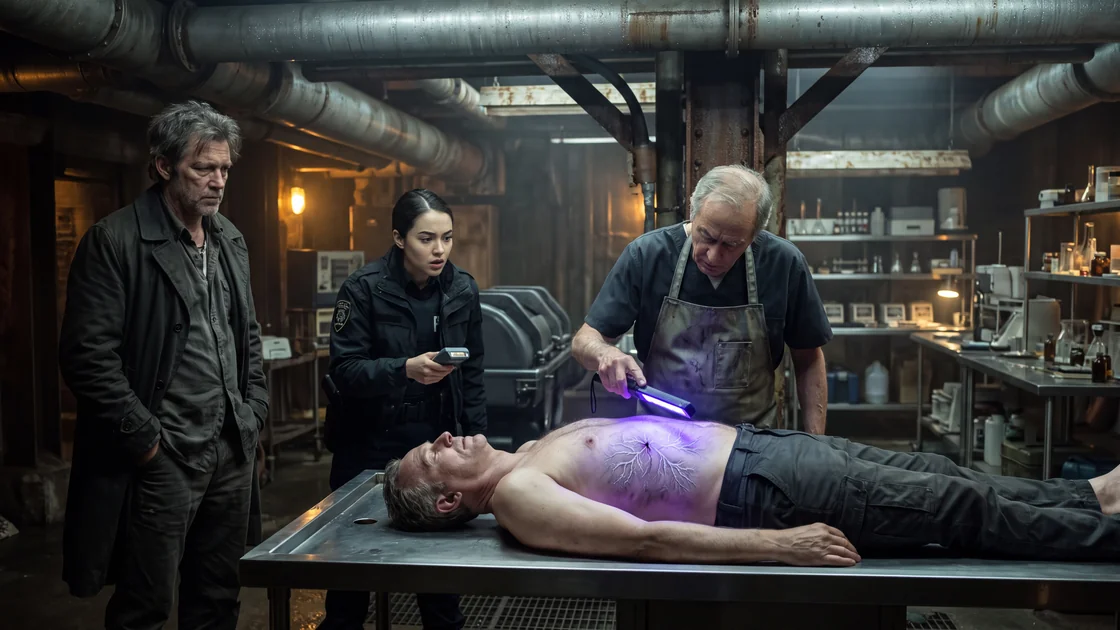
In a clinical metropolis where biological cessation has long been reduced to an administrative inconvenience known as an Interruption, Detective Silas Vance spends his days mediating restitution claims for victims who routinely wake up in regenerative vats forty-eight hours after being shot, stabbed, or run over. But when the celebrated bio-architect Dr. Julian Sterling is found dead in his secluded laboratory—his cellular tissue decayed and his neural lattice systematically, chemically dissolved beyond the reach of any Lazarus cradle—Vance is thrust into an investigation that breaks two centuries of unbroken biological continuity. Paired with a young partner who has never conceived of finality, Vance must navigate state-enforced cover-ups, underground philosophical cults who worship natural rot, and a terrifying technological conspiracy to find a killer who has reintroduced true, permanent oblivion to an immortal world.
Act I: The Echo of Rot
The file on Silas Vance’s desk was labeled, as all such files were, Interruption with Malicious Intent, Category Four.
In the Commonwealth of the Solace, nobody died. They merely ceased functioning for a weekend. A heavy wrench to the occipital bone, a leap from the suspension bridge, a jagged puncture wound from a mugging gone awry—these were violent acts, certainly, but they were legally categorized as temporary deprivations of civil liberty. The perpetrator did not face the gallows or life imprisonment; they faced the Restitution Levy, paying the Lazarus Corporation for four hundred liters of nutrient broth, five hours of quantum neural synthesis, and whatever psychological counseling the victim required to overcome the sensory shock of rebooting.
Silas Vance was fifty-two years old, which meant he was technically young, though he felt as dried out as cedar shavings. His father had died three times—once of a coronary before the cardiac weaves were standardized, once in a commuter rail derailment, and once during an ill-advised climbing expedition in the Andes. Each time, the elder Vance had returned paler, slightly more laconic, smelling vaguely of the antiseptic surfactant they used to scrub the lung sacs before re-inflation, but fundamentally present.
"Detective Vance," a voice chimed from the threshold.
Vance looked up from his mug of cold synthetic chicory. Inspector Talia Reyes stood in the doorway of his office at the Central Constabulary of the Third Ring. She was twenty-four, an era-baby born deep into the Pax Vitalis, possessed of the luminous, porcelain skin common to those whose genomes had been spliced with third-generation mitochondrial correctors. She had never known an empty chair at a Thanksgiving table that couldn't be explained by a delayed subway train.
"The Commissioner wants us down in the low terraces," Reyes said, strapping her sidearm—a low-yield pneumatic shocker meant to incapacitate without damaging the vital centers—to her hip. "Industrial district. Sector Nine. A cold-call from an unregistered sub-level."
"Sector Nine is derelict," Vance muttered, sliding the plastic stylus into his pocket. "Nothing down there except decommissioned water scrubbers and the Unspooled."
"It’s not the Unspooled," Reyes replied, checking her wrist-comm. "The automated call bypassed the civil triage desk. It routed through the Sovereign Health Directorate. Clearance level Alpha-Zero. They’re calling it a Somatic Stoppage."
Vance frowned, the dry skin around his brow knitting tightly. "Somatic Stoppage is the polite phrase the brochures use for a flatline before the cradle takes."
"No," Reyes said quietly, her voice losing its habitual briskness. "The alert didn't say Pending Re-integration. It just said Stoppage. The Cradle at Station Nine rejected the transport beacon."
Vance stood up. His knees made an audible popping sound—a reminder that he had refused the elective cartilage remolding three years ago out of sheer professional stubbornness. "Did they send a field surgeon?"
"They sent Dr. Sen," Reyes said. "And Sen told the precinct to send whoever was oldest."
Sector Nine smelled of sulfur, damp lime, and three generations of neglected drainage. It was a subterranean vault beneath the high transit ribbons of the upper city, built in the middle of the last century when the Commonwealth was expanding its bio-synthetic infrastructure. Massive coolant pipes, thick as sequoias and sweating gray condensation, ran along the ceiling like the exposed intestines of a leviathan.
A perimeter of yellow luminescence flared in the gloom. Two patrol officers stood outside the sealed blast door of an auxiliary laboratory, their faces pale beneath their tactical visors. They were not leaning against their cruisers or checking their slates; they were standing at rigid, nervous attention, their hands lingering near their holsters.
"Vance?" one of them called out, his voice cracking slightly through the comm-filter. "Watch your step in there. The drainage isn’t running."
"What's the delay on the pickup?" Vance asked, stopping at the threshold. "Where is the transport team?"
The officer looked away, his eyes darting toward the wet concrete floor. "Transport arrived twenty minutes ago. They left."
"They left the subject?" Reyes asked, indignant. "That violates three municipal codes. If the hypoxic window exceeds four hours, neural drift sets in. You don't leave an Interrupted on the slab."
"Go inside, Inspector," the officer whispered. "See if you want to touch him."
Vance pushed past the rubberized air curtain. The interior was an old bio-materials testing annex: rows of stainless-steel workbenches littered with glassware, holographic projector mounts, and racks of dormant nutrient vials. The lighting was poor, humming with the sickly amber frequency of an auxiliary generator.
At the far end of the room, standing beside a standard-issue Lazarus Mobil-Cradle, was Dr. Paul Sen. Sen was seventy, with thin gray hair cropped close to a skull that had seen two minor cranial reconstructions following an aircab collision in his forties. He had his hands jammed deep into the pockets of his lead-lined surgical coat. He was not working. He was simply staring at the floor.
On the central drainage slab lay a man.
He was naked from the waist up, sprawled face down with his arms angled awkwardly beneath his chest, as if he had been reaching for the release valve of the floor-mounted drainage line when his heart gave out. His back was pale—not the waxy, luminescent white of a body in suspended cellular shock, but a mottled, grayish-purple.
"Sen," Vance said, his boots clicking on the damp floor tiles. "Why isn't he hooked to the perfusion pump?"
"Because there’s nothing to perfuse, Silas," Sen replied. His voice was flat, dried of the professional cheerfulness that medical examiners usually maintained in an era where their primary job was filling out transit vouchers.
Reyes stepped up to the edge of the slab, holding her handheld scanner. She leveled the lens at the body's neck, waiting for the familiar green chime that signified the detection of a Lazarus Thread—the microscopic, gold-palladium filament woven into the carotid artery of every Commonwealth citizen at age twelve to monitor vital signs and initiate neural buffering upon trauma.
The scanner clicked. Then it sputtered a low, discordant double-beep.
Error: Null Signal.
"The Thread is offline," Reyes said, tapping the casing against her palm. "The battery must have suffered an inductive burn. We need to do a manual tap. Hand me the trocar."
"Put the trocar away, Talia," Sen said softly.
"He's cooling down!" Reyes said, her voice rising in pitch. The crisp professionalism of the Academy was beginning to fray at the edges. "Look at the extremities. The lividity is already pooling in the lower abdomen. If we don’t get an ice-slurry into the carotid sheath within twenty minutes, his engrams will de-correlate! We're losing the index!"
"He's been dead twelve hours," Sen said.
The word hung in the humid air of the laboratory like a drop of ink in a glass of milk. It did not disperse. It seemed to thicken, darkening the edges of the room.
"Interrupted," Reyes corrected automatically, her eyes wide, staring at Sen as if he had uttered a blasphemy in church. "You mean he’s been in Stasis Twelve hours."
"I know what I said, girl," Sen snapped, turning his head. His eyes were bloodshot, the skin under them dark and bruised with fatigue. "I was an intern during the final years of the Transition, before the Third Protocol was ratified. I know what a dead man looks like. I know what a dead man smells like."
Vance stepped closer. Now that he was within three feet of the slab, the air was wrong.
In modern society, death had no odor. A body in crisis was instantly chilled by the subdermal cooling packs triggered by the Thread; it smelled of fluorocarbons, mint-scented preservation gel, and cold steel.
This body smelled of copper. It smelled of sulfur. Beneath that, subtle but unmistakable, was the sweet, sickening grease of room-temperature fat undergoing autolysis. The cells were not sleeping. They were bursting.
"Who is he?" Vance asked.
Sen reached into his coat and produced a physical identification card—a sliver of matte-black composite with a silver insignia pressed into the corner. He laid it on the edge of the stainless-steel table.
"Dr. Julian Sterling," Sen said. "Chief Architect of the Neural Buffer Consortium. The man who wrote the compression algorithms for the Fourth Generation Lazarus Cradle."
Vance picked up the card. The name was legendary. Sterling was one of the men who had built the world. He had taken the crude, high-loss resurrection vats of the early twenty-first century—machines that brought people back with missing vocabularies, trembling hands, and thirty-percent memory degradation—and turned them into the invisible, seamless web that held civilization together. Sterling had made death obsolete.
"And how did the man who cured death manage to die?" Vance asked.
Sen reached out with a pair of long, non-magnetic tweezers and gently nudged the corpse’s right shoulder, rolling the torso slightly toward them.
Between the sixth and seventh ribs, there was a small, neat puncture. It was no larger than a pencil lead. There was very little blood on the skin around it; what had escaped was thick, almost black, and had congealed into a hard, glossy crust.
"Someone took a micro-borer to his thoracic cavity," Sen said. "That’s not what killed him, though. Any three-dollar field kit could patch that up and kick the heart back over."
Sen picked up a small UV lamp and clicked the switch. A narrow beam of deep violet light washed over the small puncture wound.
Around the hole, spreading outward in an intricate, fractal pattern across the dead man’s ribs, was a network of glowing, silver-gray veins. They looked like tree roots made of frost, branching out through the subcutaneous tissue, terminating in delicate, needle-like threads that had pierced every individual muscle fiber.
"What is that?" Reyes whispered, her hand moving unconsciously to her own neck, right where her Lazarus Thread rested against her jugular.
"An entropic catalyst," Sen said. "I ran a tissue biopsy through the mass spec before you arrived. It isn't a poison in the biological sense. It's a chemical decoupler. It targets the palladium-gold lattice of the Lazarus Thread, dissolves it into liquid salts within six seconds, and then uses the body's own bio-electric charge to propagate a cascading protein denaturant through the nervous system."
Sen switched off the UV light. The silver frost vanished, leaving only the dull, rotting gray of the ruined flesh.
"It didn't just stop his heart, Silas," Sen whispered. "It dismantled his cellular memory. It scrambled the spin on every phosphorus atom in his brain. There is nothing left in that skull to read. If you put him into a thousand cradles, all they would ever grow back is meat."
Silence settled over the room again. Vance looked at Reyes. The young inspector’s hands were trembling at her sides. Her face had the blank, horrifying expression of a child who had just been shown an open furnace and told that the world would eventually fall into it.
"A murder," Vance said. The word felt strange in his mouth, like an antique coin dug up from the dirt. "A real one."
"The first one in two hundred and four years," Sen said. "And God help us if anyone outside this room finds out."
Act II: The Anatomy of an Impossibility
The Bureau of Continuity did not have an office on the street level. It occupied the sixty-fifth floor of the Archival Spire, a monolithic slab of black basalt that rose above the residential disks of the Second Ring like an uncarved tombstone.
Director Kaelen Cross did not look at Vance or Reyes when they entered. He stood before a panoramic window that looked out over the city. Below him, the lights of the Solace pulsed in rhythmic, synchronized waves. Overhead, the mag-rails hummed, carrying millions of citizens who moved with the reckless, buoyant speed of people who knew that their mistakes could always be rolled back to the last backup.
"The body has been transferred to the deep sub-basement at the Spire," Cross said. He was a slender man with immaculate silver hair, wearing the high-collared tunic of the executive civil service. His voice was smooth, cultured, and devoid of the slight physiological vibrato that usually accompanied fear. "Dr. Sen has been placed on administrative isolation. His report was intercepted at the primary gateway."
"Sen is an honest physician," Vance said, sitting down in an unoffered leather chair. "He’s seventy. He doesn't care about politics."
"This isn't politics, Detective," Cross said, turning around slowly. His eyes were small, gray, and very cold. "This is thermodynamics. The Commonwealth exists because we eliminated the cost of biological entropy. Do you know what happens to the market if the insurance consortium discovers that an individual can be rendered permanently inert?"
"They raise the premiums?" Vance suggested dryly.
"The currency collapses," Cross said flatly. "The social contract dissolves within forty-eight hours. The entire legal foundation of our society—from property leases that span three centuries to the non-violent penal code—is built on the absolute certainty that physical annihilation is impossible. If Julian Sterling can be put into the ground, Vance, then so can the President. So can the laborers. So can you."
Reyes spoke up, her voice tighter than usual. "Director, the compound Sen found... it was tailored. It wasn't an industrial accident. It was an assassination weapon. Someone engineered a substance specifically designed to bypass the Lazarus fail-safes."
Cross looked at Reyes for a long moment, his gaze assessing her like a piece of questionable masonry. "Inspector Reyes. Your father is Councilman Reyes of the Agricultural Board, yes?"
"Yes, sir," she said, stiffening.
"You have been Interrupted twice, I believe. Once from a skiing accident in the Cascades when you were sixteen, and once during your tactical evaluations at the Academy."
"Yes, sir."
"Do you remember either experience?"
Reyes hesitated. "No. There's a blank space. A gray fog. Then the technician is handing you a cup of electrolyte broth and your mother is signing the discharge slate."
"Precisely," Cross said. "The fog. The merciful absence of a void. Julian Sterling did not get the fog. Sterling is gone. Not sleeping, not drifting, not archived. He has ceased to exist." Cross leaned forward over his mahogany desk, his palms resting flat on the polished wood. "I want the person who built that compound. I want their lab, I want their notes, and I want every milligram of that chemical burned to slag. But you will not file this under Homicide."
"We don't have a Homicide division," Vance said. "We haven't had one since the twenty-first century."
"Then you will call it Property Destruction of an Irreplaceable State Asset," Cross said. "You have seventy-two hours before Sterling’s absence from the annual Board of Synthesis meeting becomes impossible to hide. If the media asks, he is in deep regenerative stasis following a laboratory spill. A routine cellular realignment. Do you understand me?"
"No," Vance said, standing up. "I don't. Because if whoever did this wanted Sterling out of the way so they could steal his chair at the Consortium, they could have just Interrupted him twenty times until he went soft in the brain. You don't invent an anti-immortality weapon just to settle a board dispute."
Cross's eyes narrowed. "Then why do you invent it, Detective?"
"To remind us," Vance said, "that we're made of meat."
They took Vance’s unmarked cruiser down to the interface between the Second and Third Rings.
The vehicle was an antique, powered by a hydrocarbon-electric hybrid system that rumbled with an uneven, mechanical vibration that Vance found comforting. Reyes sat in the passenger seat, staring out the window at the pedestrian arcades.
People were crossing the wide boulevards with total disregard for the automated traffic. An adolescent boy on an electric board shot between two five-ton haulers, laughing as the proximity brakes of the trucks screeched in protest. A pair of lovers leaned over the railing of an observation terrace six hundred feet above the pavement, their bodies tilted so far out they seemed to be daring the wind to take them.
"They're children," Reyes said suddenly.
Vance glanced at her. "What?"
"All of them," she whispered, her forehead pressed against the glass. "Look at them. They don't look at the cars. They don't look at the drops. They don't look at anything. If you drop a crystal glass, you're careful because it breaks. If you drop a rubber ball, you bounce it off the walls because you don't care where it hits."
"You were one of them five hours ago," Vance remarked.
"Five hours ago I didn't smell Julian Sterling’s liver turning into jelly," she snapped, turning to him. Her cheeks were flushed, her pupils dilated. "Vance, do you know what my grandmother told me when I was seven? She told me that before the Cradles, people used to keep gardens so they could watch things grow and die. She said they had books filled with poems about people getting old. She made it sound like an art form. But that man on the slab wasn't an art form. He was garbage. He was a heap of decomposing trash that used to be a genius."
"That's death, Talia," Vance said quietly. "It’s not a poem. It’s an eviction notice."
He pulled the cruiser up before a gleaming white pavilion set into the manicured slopes of the Core Institute: The Sterling Center for Neural Continuity.
The exterior was draped in white silk ribbons—the standard decoration for the jubilee of the Fourth Protocol, which was scheduled for the coming weekend. Holograms of Julian Sterling floated above the fountain in the plaza, forty feet high, showing him with his sleeves rolled up, smiling with paternal warmth, holding out a hand that shimmered with the golden light of an idealized Lazarus Thread.
LIFE WITHOUT PAUSE, the slogan read beneath his shoes. THE ETERNAL HORIZON.
They bypassed the public halls and went straight to the research executive offices. Dr. Elena Chen was waiting for them in the private conservatory on the fourth floor.
Chen was Sterling’s primary collaborator. She was eighty-five years old, though her somatic treatments made her look forty-five—an elegant, angular woman with sharp black hair cut in an asymmetrical bob and eyes that were unnaturally clear from corneal restructuring. She was watering a bed of white hybrid lilies when they walked in.
"Silas," she said, without turning around. She had known Vance since his second Interruption investigation fifteen years ago, when an envious colleague had pushed her down an elevator shaft during a grant dispute. "The precinct told me you were coming. Has Julian gotten himself into trouble again? I told him three weeks ago that his excursions into Sector Nine were dangerous. The air down there ruins the vocal cords. The Lazarus filters take weeks to clear out the coal particulate."
Vance stopped six feet behind her. He didn't take off his hat.
"Dr. Chen," he said. "When did you last see Julian?"
"Yesterday afternoon," she said, snipping a dead leaf from a lily with silver shears. The snip was sharp and final. "He was agitated. He took three crates of cold-storage substrates from the secondary vault. He said he had an anomaly to confirm before the Jubilee address."
"What kind of anomaly?"
Chen turned around, setting the shears on a low marble table. She looked at Vance, then at Reyes, and her expression shifted from mild annoyance to sharp, analytical focus. She noticed the lines around Vance’s mouth, and more importantly, the gray, shaken pallor of the younger detective.
"What's happened, Silas?" she asked.
"Julian is gone, Elena," Vance said.
"Well, bring him back," she said, a faint, puzzled smile touching her lips. "Where is he? St. Jude’s? The Third District Recovery Tank? If his Thread was severed by the equipment, you know the procedure. You take a core sample from the hippocampus and do an algorithmic reconstruct. We do it all the time with industrial blast victims."
"We can't," Reyes said.
Chen’s smile did not disappear; it simply froze, becoming a mask of porcelain. "What do you mean you can't? The engram maps are updated every twenty minutes via the city-wide telemetry arrays. Julian’s index was synchronized at noon yesterday."
"The telemetry array doesn't matter," Vance said. "The receiver is dead. The brain is dead. Elena... the cells have broken down. The Thread was liquefied."
Chen looked at Vance for three full seconds without blinking. Then she laughed—a short, brittle bark that died in her throat.
"That’s impossible," she said. "The Thread is made of high-purity palladium-rhodium with an active gold-lattice insulator. It doesn't liquefy. It survives thermite. It survives atmospheric re-entry. It was designed to survive a nuclear strike on the city."
"It doesn't survive an entropic catalyst," Vance said.
The color did not drain from Elena Chen’s face in a rush; it seemed to fade slowly, like a television screen losing its signal, until her skin was the color of skimmed milk. Her fingers twitched, her thumb brushing against the jade ring on her index finger.
"Where did you hear that phrase?" she whispered.
"Dr. Sen found the residue in his chest," Vance said. He took a step closer. "He found silver branching along the pleura. He found denatured protein chains that looked like they had been dipped in hydrochloric acid. Does that sound familiar to you, Dr. Chen?"
Chen sat down hard on the edge of the marble planter. Her hand knocked against a watering can, sending a thin stream of nutrient-enriched water trickling across the white mosaic floor. She didn't look at it.
"He didn't destroy it," she said to herself, her voice barely louder than the hum of the air conditioners. "The idiot. The arrogant, sentimental old idiot. He kept it."
Act III: The Heresy of the Unspooled
The interrogation room at the Central Constabulary was not designed for comfort. It was designed for the brief holding of violent individuals until their victims could be scraped off the asphalt and the restitution paperwork could be processed. It smelled of stale ozone and floor polish.
Elena Chen sat at the steel table, her coat folded neatly on the chair beside her. She had regained her composure, but it was the brittle, glassy composure of someone who knew they were standing on a frozen lake with the ice splintering beneath their boots.
"Thirty years ago," Chen said, her hands flat on the cold steel, "during the development of the Fifth Phase Neural Cradle, Julian became obsessed with what he called the Engramic Debt."
Vance leaned against the wall, his coat unbuttoned, a cold cup of water in his hand. Reyes sat across from Chen, her slate recording every flicker of the scientist's pupils.
"Explain the debt," Vance said.
"The public believes the Lazarus Thread is a mirror," Chen said, her voice dry and clinical. "You look into it, you die, the mirror reflects your soul back into a fresh vat of protein. But it isn't a mirror, Silas. It’s a translator. And like all translators, it makes approximations."
She looked at Reyes. "When you returned from your skiing accident, Inspector, did you ever feel like you had lost an afternoon? Did you ever find yourself looking at an old childhood sketch and realizing you couldn't remember the name of the dog you drew?"
Reyes didn't answer, but her jaw clenched.
"Every time a brain is re-synthesized," Chen said, "there is a loss of fidelity. Zero point zero four percent per Interruption. In the first few instances, it's nothing—a lost telephone number, a faded memory of a seaside holiday in your tenth year. But Julian began looking at the veterans. The ones who had been Interrupted twenty, thirty times. The extreme sports enthusiasts. The deep-core miners. The soldiers from the border pacifications."
"They get the Stutter," Vance said. "Everyone knows that. A little motor hesitation. A little emotional flatness. It’s a minor neurological side-effect. The brochures say it’s easily corrected with neurotransmitter patches."
"The brochures lie," Chen said coldly. "The Stutter isn't a motor issue. It’s the soul peeling away from the edges. By the fiftieth Interruption, the subject isn't a human being anymore. They are a high-functioning biological simulation running on an algorithmic predictive loop. They have no new creative thoughts. Their emotional responses are approximations derived from their pre-first-death memories. They are ghosts who think they are living because their hearts keep getting restarted."
She closed her eyes.
"Julian couldn't bear it. He called it the Carousel of Husks. He said we hadn't conquered death; we had just invented a machine that made us comfortable with slowly being replaced by copies. He wanted a hard reset. He spent six years in the sub-levels developing an antidote to the Thread—a compound that would render the tissue un-recordable. A chemical seal that said: This is the end. Do not touch what is left."
"Project Lethe," Vance muttered.
"He called it The Great Rest," Chen corrected him. "He synthesized twenty milliliters of the catalyst. It was supposed to be a theoretical proof—a weapon to threaten the Directorate with. He wanted them to admit the Engramic Debt publicly. He wanted them to stop the Fifth Phase expansion."
"And what happened?" Reyes asked. "Did the Directorate find out?"
"The Directorate wouldn't have killed him with his own work," Chen said, her eyes flashing with sudden, venomous life. "Cross would have arrested him, seized the research, and put Julian in a memory-scrub tank until he forgot his own name. If Julian was killed with the Lethe compound, it was done by someone who wanted to make a point. It was done by someone who believes that death is holy."
"The Unspooled," Vance said.
"They're just lunatics who live in the sewers," Reyes objected, shaking her head. "They're superstitious dropouts who cut their Threads out with utility knives because they think the telemetry arrays are stealing their prayers."
"They're not just dropouts anymore," Chen said. "They have an apostle now. A man who used to be one of Julian's lab technicians. Marcus Ward."
The lower levels of Sector Eleven were known as the Cisterns.
To reach them, Vance and Reyes had to leave their vehicle behind at the Ninth Ring bulkhead and descend through four hundred meters of service shafts. Here, the air had nothing of the sterile, conditioned coolness of the upper boulevards. It was warm, thick with the stench of stagnant river water and industrial grease, vibrating with the subterranean groan of the city’s geo-thermal pumps.
The people down here did not look like the citizens of the upper disks. They did not wear the pastel synthetics or the sleek, light-reactive fabrics of the Pax Vitalis. They wore heavy woolens, patched oilskins, and grease-stained leather.
And around their necks, where the faint silver gleam of a Lazarus Thread should have been visible beneath the skin, they bore ragged, puckered scars—crude, pink trenches where the flesh had been sliced open, the gold-palladium wires ripped out, and the wounds sewn shut with nylon thread.
They were the Unspooled: those who had opted out of immortality.
"They look like they're from another century," Reyes whispered, her hand resting on the butt of her shocker. She was scanning every shadow, her breath coming in short, nervous puffs.
"They're from this century," Vance said, walking with his hands in his pockets, his worn trench coat flapping against his calves. "They're just the ones who have to pay for the funerals."
They were intercepted in a vaulted brick chamber that had once been an overflow sluice for the Old River. Four men stepped out from behind the massive iron support pillars. They were armed not with non-lethal crowd-control tools, but with crude, heavy hunting shotguns and iron rebar clubs.
"Turn back, badges," one of them said. His face was half-covered by a respirator, his forehead crisscrossed with the pale scars of chemical burns. "The Constabulary has no jurisdiction below the sixty-meter mark. The treaty stands."
"I'm not here for your moonshine stills or your illegal baptisms," Vance said, holding up his badge. "I’m here for Marcus Ward."
"Ward doesn't talk to cattle," the man replied, racking the slide of his shotgun. The sound was metallic, oily, and terrifyingly archaic. "Go back to your cribs. Go jump off a building and sleep it off."
Vance didn't move. He looked down the twin barrels of the shotgun without blinking. "Tell Ward that Julian Sterling is dead. Really dead. Not sleeping. Dead."
The man with the respirator hesitated. His eyes flicked from Vance to Reyes, lingering on the white, horrified intensity of the young woman's face.
"Wait here," the guard growled, backing into the gloom.
Ten minutes later, they were led deeper into the labyrinth, through a series of dry tunnels that opened into the crypt of an ancient, pre-Transition church that had been buried intact when the high terraces were built over the old town.
The altar was still there, carved from gray granite, but the cross had been removed. In its place stood an antique wooden table. On the table lay an hourglass filled with black sand, its grains trickling down with agonizing, rhythmic slowness.
Marcus Ward sat behind the table. He was a man of sixty, with a beard that was iron-gray and wild, his eyes sunken deep within hollow orbits. On his neck was the same jagged scar as the others, but his had been tattooed with a design: an unraveled spool of thread with the ends fraying into smoke.
"Silas Vance," Ward said, his voice a low, gravelly rasp. "I remember you. Twelve years ago. You investigated the warehouse fire in District Four. You tried to persuade my brother to let the medics install a Thread while he was still in the ambulance."
"He had seventy percent burns, Marcus," Vance said. "He would have survived."
"He would have been repaired," Ward corrected him, leaning forward, resting his gnarled elbows on the wood. "He would have spent eighteen months in an agitation tank while they printed new skin over his bones, and when he woke up he wouldn't have remembered the sound of his daughter’s voice. He died like a man, Vance. We washed his face. We wept for him. We laid him in the dirt. We remembered him."
"Did you remember Julian Sterling the same way?" Reyes asked, stepping forward, her voice trembling with a mixture of rage and terror. "Did you take a borer to his heart and pump him full of that filth to make him 'die like a man'?"
Ward looked at Reyes. A faint, terrible pity flickered in his dark eyes.
"Little girl," he said softly. "Do you think we murdered Julian?"
"He had the compound," Vance said. "The Lethe solution. Chen said you worked on it with him before you took the knife to your neck."
Ward let out a dry, rattling sigh that ended in a cough. He reached out and tipped the hourglass onto its side. The black sand stopped running.
"I didn't steal the Lethe, Silas," Ward said. "Julian didn't bring it to me to use on him. He brought it to me to hide."
Vance’s eyes narrowed. "Hide it from whom?"
"From the people who were already using it," Ward whispered.
Act IV: The Drift of the Damned
The crypt was cold. A draft from the deep service shafts rustled the hem of the antique altar cloth.
"What are you talking about?" Vance asked. "The Lethe was an experimental formula. Sterling only made twenty milliliters."
"Julian was a brilliant technician, but he was a blind child when it came to logistics," Ward said. He stood up, his joints creaking in the silence of the vault. He walked to the edge of the stone platform, looking down at Vance. "He thought he invented the Lethe. He thought those protein-denaturing algorithms were his own flash of inspiration. But where do you think he got the seed-code for the molecular catalyst, Vance?"
"The Directorate archives," Vance said, the realization hitting him like a cold bucket of water.
"Cross didn't want the Lethe destroyed," Ward said. "Cross wanted it refined. For eighty years, the Directorate has had an internal problem. What do you do with the individuals who break the Pax Vitalis, but whose public trials would expose the rot in the system? What do you do with the political dissenters whose execution would prove that the state is still capable of murder?"
"You don't execute them," Reyes said, her voice faint. "The penal farms... the isolation disks..."
"There are no penal farms in the outer sectors," Ward said grimly. "There are only cold-storage vaults where they stick the ones who don't fit into the math anymore. But those vaults cost power. They require maintenance. And occasionally, someone wakes up during a system purge."
Ward walked to the side of the altar and pulled back an oily canvas tarp. Beneath it was a stolen Directorate terminal, its casing cracked and its service leads spliced directly into the high-voltage lines that ran along the tunnel roof.
"Julian found the logs three months ago," Ward continued. "He discovered that three thousand citizens who were officially listed as In Long-Term Regenerative Rehabilitation had had their telemetry signals terminated with an entropic compound. Not his compound—an earlier version. Crude. Painful. It took days for the brain to dissolve."
Ward tapped the terminal key. A series of records scrolled down the phosphor-green screen: names, birth dates, dates of final cessation.
Vance stepped up to the monitor. He recognized the names.
They weren't common street criminals. They were philosophers. Poets. Theoretical bio-physicists who had published papers on the mathematical inevitability of neural degradation. Two former commissioners of the Constabulary who had resigned without explanation.
And at the bottom of the list, dated forty-eight hours ago, was the authorization for a delivery of six units of refined Catalyst 9-L to an address in Sector Nine.
The authorization bore a digital seal: Directorate of Continuity, Executive Operations.
"Julian was going to blow the seal," Ward said. "He came to me because I have the printing presses that aren't tied to the optic web. He was going to print fifty thousand pamphlets—paper, Silas, real paper that can't be wiped with an electromagnetic pulse—and drop them from an aircab over the Jubilee plaza on Saturday. He went to his lab in Sector Nine to fetch the primary storage drive with the raw telemetry logs."
"And Cross beat him to it," Vance muttered.
"No," Ward said, looking directly at Vance. "Cross didn't go to Sector Nine. Cross is a bureaucrat; he doesn't get grease on his cuffs. He sent someone who knew the lab layout. Someone who had Julian's security passcodes. Someone Julian would let within six inches of his chest with a micro-borer."
Reyes sucked in a sharp breath. "Chen."
"Elena Chen hasn't had an original thought in forty years," Ward said. "Her last three monographs were written by an algorithmic synthesizer. She’s had eleven Interruptions, Vance. She’s hollowed out. There’s nothing left inside that woman except the instinct to protect the machine that keeps printing her back into existence."
The drive back to the Second Ring was silent.
The rain had started—a greasy, chemical drizzle that left rainbow streaks of fuel on the cruiser’s windshield. Through the wipers, the city looked like an underwater graveyard, the neon signs of the Lazarus clinics flickering through the mist like lures of deep-sea predators.
Reyes sat with her hands clamped between her knees. She had pulled her service weapon from its holster and laid it on the dash. It looked small, pathetic, and utterly useless.
"What are we doing, Silas?" she asked. Her voice was flat, hollowed out of the youthful energy that had irritated Vance only that morning.
"We're going to the Spire," Vance said.
"Cross is on the sixty-fifth floor," she said. "He has two companies of Tactical Continuity Wardens. They have neural-damping fields, Silas. They don't have to kill us. They can just stun us, wheel us into an airlock, inject us with that silver shit, and list us as Missing in Action during a Sub-level Sweep."
"I know," Vance said.
"My father..." she choked on the word. "My father eats lunch with Cross every Tuesday at the Commonwealth Club. They talk about grain quotas and the life-extension subsidies. My father knows. He has to know."
Vance didn't answer. He turned the cruiser onto the high-speed ramp leading to the Archival Spire.
"Why didn't you ever take the treatments, Silas?" she asked suddenly, turning her head to look at him. Her eyes were red, the moisture in them catching the blue glow of the instrument panel. "You’re fifty-two. You walk with a limp. Your skin is gray. You could have had the marrow-wash twenty years ago. You could look like you're thirty. Why did you let yourself get old?"
Vance kept his hands steady on the wheel.
"When I was nine," he said, his voice calm and rhythmic, "my mother died. Really died. It was the year before the Second Protocol was finalized. She had an aggressive pancreatic sarcoma. The early cradles couldn't replicate complex glandular tissue; they could only do the heart and the brain stem. They tried three times. Each time she woke up, she was in more pain than before. Her eyes... she looked at me like she didn't know who I was, but she knew that whatever was happening to her was wrong."
He steered the car through the security gates of the Spire’s underground garage. The automated barriers read his badge and lifted slowly, like the jaws of a trap.
"The third time," Vance continued, "she took my hand. She couldn't speak because of the intubation tube, but she used her finger to write on my palm. She wrote two letters: E-N. She didn't finish the word, but I knew what she meant. She wanted the end. She didn't want the machine’s mercy. She wanted the curtain to come down."
He pulled the cruiser into an empty stall between two armored Directorate vans and turned off the engine. The mechanical rumble died, leaving only the high, electronic whine of the Spire’s primary servers.
"I didn't take the treatments, Talia," Vance said, unbuckling his harness, "because I don't want to be a ghost who forgot what he was crying about."
Act V: The Weight of Mortality
The deep sub-basement of the Archival Spire was where the Commonwealth kept the things it could not recycle.
It was colder than the morgue in Sector Nine. Rows of heavy, vacuum-sealed vaults stretched into the dim distance, their steel faces frosted with nitrogen ice. This was the Cold Archive—the repository for citizens whose neural patterns were too fractured for immediate synthesis, waiting for algorithms that might never be written.
In the center of the hall, illuminated by a single surgical floodlight, stood the stainless-steel examination table. Dr. Julian Sterling was still there.
Beside the body stood Dr. Elena Chen. She was wearing a clean laboratory coat, her hair neatly tucked behind her ears, holding a high-pressure injector loaded with a clear, viscous fluid that shimmered with a faint, colloidal silver sheen.
Across from her stood Director Cross, his overcoat unbuttoned, his hands clasped behind his back.
"The extraction is complete," Chen was saying, her voice echoing in the vast, refrigerated space. "The local engram maps in his home terminal have been overwritten with a corrupt sector file. Once I inject this into the spinal canal, the remaining neuro-filaments will liquefy. In four hours, there won't be enough left of him to reconstruct an earthworm."
"Do it," Cross said. "The Commissioner is already preparing the statement. Dr. Sterling suffered an acute systemic rejection of an experimental gene-therapy vector. Tragic. An irreplaceable loss to science. The funeral will be held at the Jubilee."
"Drop the injector, Elena," Vance said.
He stepped out from behind the row of nitrogen tanks, his service revolver—an ancient, chemical-propellant .38 that had belonged to his grandfather—held in both hands, leveled at Chen’s breastbone.
Reyes followed him, her shocker raised, but her eyes were fixed on Cross.
Cross did not flinch. He did not turn around quickly. He sighed, the breath rising as a white plume in the freezing air, and slowly turned his head to look at Vance.
"Silas," Cross said, as if he were greeting a junior auditor who had arrived five minutes late to a budget meeting. "I assumed you would go to the Unspooled. I didn't think Marcus would be foolish enough to send you back here."
"Ward didn't send me," Vance said. "The law did."
Cross let out a dry, quiet chuckle. "The law? Silas, you’re an officer of the Deprivation Bureau. Your entire legal code is based on the Restitution of Biological Utility. You have no standing here. There is no victim."
"There's a dead man on the table," Vance said.
"There is an obsolete asset on the table," Cross corrected him, taking a step toward Vance. "A man who built the greatest social machine in the history of our species, and then went insane with senile guilt. Do you know what Julian wanted to do, Vance? He wanted to turn the cradles off. He wanted to re-introduce biological death to seven million people who haven't felt the fear of cancer, or old age, or murder in six generations."
"He wanted to tell them the truth," Reyes said, her voice shaking, but her weapon remained steady on Cross’s chest. "He wanted to tell them that they’re being erased. Piece by piece. Stutter by stutter."
Chen looked up from the corpse, her expression strangely calm, almost vacant. Her eyes had that glassy, untethered look that Vance had seen in the long-term residents of the recovery clinics.
"It doesn't hurt, Talia," Chen whispered. Her voice was terrifyingly sweet. "The pieces that go... you don't miss them. You don't even know they're gone. It’s like falling asleep in a warm bath. Why would you want to wake them up? To make them scream? To make them run from the cars again? To make them sit by the beds of their children and watch their skin turn to dust?"
"Because it’s real," Reyes screamed. The sound cracked against the vaulted ceiling, bouncing off the steel doors of the nitrogen crypts. "Because without it, we're not people! We’re just toys that don't know how to stop!"
"A toy that lives forever," Cross said, "is better than an ape that dies in the mud. Lower the weapon, Inspector."
Cross reached into his coat pocket.
Vance did not hesitate. In an era where no one shot to kill because killing was impossible, Vance’s finger tightened on the heavy steel trigger with the instinct of a man who remembered what guns were originally built for.
CRACK.
The gunshot was deafening in the enclosed concrete space—a violent, physical hammer of sound that shook the dust from the overhead conduits. The smell of cordite, acrid and ancient, instantly obliterated the smell of cold nitrogen.
Cross stumbled back two paces. He looked down at his chest, his eyes wide with a bizarre, child-like surprise.
A ragged hole had appeared in the center of his fine wool tunic. Blood—bright, arterial, and hot—was already soaking through the fabric, dripping onto his polished shoes.
"You..." Cross gasped, his knees buckling. He hit the floor with a wet thud, his hands clawing at his chest. "You... idiot. The Thread... my Thread..."
He fumbled at his throat, waiting for the cold, numbing rush of the automated stasis packs, waiting for the familiar hum of the neural buffer spinning up to save his memories.
Chen looked at Cross, then at the injector in her hand.
When Vance had fired, the muzzle blast had startled her. The needle had slipped. She had dropped the heavy steel cylinder, and it had shattered on the edge of the steel slab.
The Lethe compound was not in the syringe anymore.
It had pooled on the concrete floor, its silver-gray fractals already spreading across the wet tiles like frost on a morning window. And Cross, thrashing in the agony of a collapsed lung, had dragged his right hand directly through the puddle.
"No," Cross whimpered.
The sound was no longer that of a Director of Continuity. It was the sound of a beast caught in a steel trap.
The silver frost was already climbing his wrist. It moved under the skin like a colony of living ants, pale, luminous, and terrifyingly fast. It raced up the radial artery, turning the flesh gray and brittle as it passed. Cross screamed—a high, thin shriek that shredded his vocal cords—as the compound reached his neck.
The Lazarus Thread at his throat flared once with a brilliant, blinding violet light as its internal capacitors shorted out. Then there was a soft pop, like a light bulb bursting in an empty room.
The light died.
Cross’s body arched off the floor, his heels drumming violently against the concrete for three seconds. Then he went limp.
His jaw dropped open. His eyes, staring up at the fluorescent tubes of the ceiling, were dull, fixed, and completely empty. There was no stasis hum. There was no cooling vapor.
There was only the copper smell of blood and the sweet, terrible silence of a corpse.
Elena Chen did not run.
She stood beside the slab, looking down at Cross, then at Vance, her hands hanging loosely at her sides. The vacant calm in her face had deepened into a total, catatonic peace.
"The debt," she whispered. "It’s been paid."
Vance lowered the revolver. His hands were steady, but the barrel was smoking, a thin gray ribbon of sulfur drifting up toward the ventilation grates.
Reyes was on her knees beside Cross’s body. She was not trying to administer CPR. She was not checking for a pulse. She was simply staring at the gray, branching frost that had settled permanently into the dead man’s skin, her face pale, her breath coming in slow, shuddering gasps.
"He's not coming back," she whispered. It wasn't a question.
"No," Vance said. "He’s gone."
"What do we do now?" she asked, turning her head toward him. Her eyes were huge, dark with the terrifying dawn of a world she had never been prepared to inhabit. "Silas... what do we do with this?"
Vance looked at the corpse of Julian Sterling on the table. Then he looked at the shattered remains of the Lethe injector on the floor.
He reached into his pocket, took out the physical data-slate he had confiscated from Sterling’s private terminal in Sector Nine—the slate containing the three thousand names, the telemetry logs, the records of the hollow generation—and laid it gently on the dead architect's chest.
"We don't call the transport," Vance said.
He walked over to the wall control panel, where the emergency municipal alarms were housed behind a pane of red security glass. He didn't use his key. He used the butt of his heavy revolver to smash the glass, the shards tinkling onto the concrete like broken ice.
He reached inside and pulled the lever marked SYSTEM-WIDE BIO-CRITICAL INCIDENT: FULL DISCLOSURE PROTOCOL.
Throughout the sixty-five floors of the Archival Spire, and then outward along the optic trunks to the First, Second, and Third Rings, the sirens began to wail.
It was not the polite, melodic chime that warned citizens of a transit delay or an scheduled maintenance stasis. It was the ancient, howling scream of a civil defense horn—a sound that the city had not heard since the last bombs had fallen two hundred years ago.
On the streets above, Vance knew, the traffic ribbons would be freezing. The lovers on the high terraces would be pulling back from the railings. The children on their boards would be stopping on the sidewalks, their eyes turning toward the high spires as the public screens flickered, died, and rebooted with the green, un-erasable text of Julian Sterling’s final confession.
"Vance," Reyes said, standing up slowly, leaning against the cold edge of the slab for support. "They're going to be terrified."
"Good," Silas Vance said, sliding the warm revolver back into his coat pocket. "They should be."
He turned toward the service exit that led to the street level, his boots crunching on the broken glass.
"Come on, Inspector," he said, not looking back. "We have twenty million mortals to look after. And we’re already behind on the paperwork."