The Anatomy of an Unnamed Kingdom
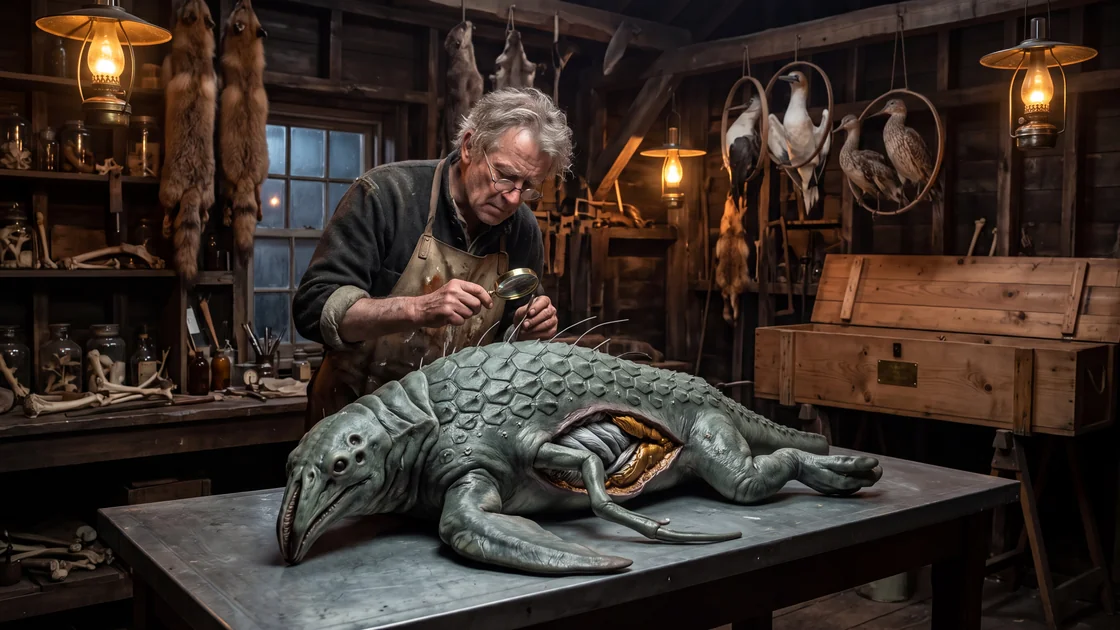
This is the account of Arthur Phelan, a reclusive master taxidermist operating on the mist-choked marshes of the Romney Marsh, who received an unheralded pine crate containing an impossible biological entity—a creature possessing neither lineage in the Linnaean system nor precedent in the fossil record. As Phelan undertook the delicate, gruesome work of flaying, preserving, and mounting the specimen, his clinical detachment gave way to intellectual obsession and physical decay, culminating in the realization that the organism was not merely an anomaly of nature, but an emissary from a biosphere operating under rules entirely alien to terrestrial life, whose preservation demanded the gradual unraveling of his own sanity and flesh.
I. The Workshop on the Silt
The workshop of Arthur Phelan stood at the edge of the world, or at least that portion of it where the solid earth lost its resolve and surrendered to the grey, brackish ambiguities of the Romney Marsh. It had once been a sail-loft, then a granary, and finally, under Phelan’s thirty-year tenancy, a sanctuary for the dead. The timbers of the building had been seasoned by three generations of salt gales and peat smoke, so that to enter the lower hall was to step into the interior of an overturned galleon whose ribs wept brine whenever the barometer plummeted.
Inside, the air did not move; it settled. It was an atmosphere thickened by the dry, sweetish musk of sawdust, the sharp sting of rectified turpentine, the alkaline bitterness of wood ash, and the faint, persistent copper tang of dried blood. From the crossbeams hung drying pelts: the pale, triangular masks of dog-foxes; the stiff, silver-bellied tubes of otters; the broad, serrated wings of gannets and curlews stretched on willow hoops like primitive instruments of divination.
Phelan was sixty-two years old, though his joints, pickled by the damp air and long hours spent hunched over mahogany mounting boards, suggested an older vintage. His fingers were permanently stained with walnut juice and potassium permanganate, the skin around his cuticles cracked and hardened into yellow calluses from decades of handling arsenical soap. He was not an artist in the sentimental sense; he had no interest in anthropomorphic tableaus or the glass-eyed sentimentality of Victorian parlor squirrels drinking tea. He was an anatomist of the surface. His pride lay in the invisible seam, the accurate curvature of an astragalus, the precise reproduction of the watery, nictitating membrane within the eye of a dead bittern.
On the third of November, a Thursday marked by a low, suffocating fog that erased the sheep paths and muffled the horn of the Dungeness light, the wagon arrived.
There had been no rumble of iron-shod wheels, no herald of harness brass. Phelan had merely looked up from his skinning bench—where he was delicately clearing the orbital fat from the skull of an Arctic tern—to see the horses standing in the gravel yard. They were two heavy roans, their shanks caked with slate-colored mud, their breath rising in ragged, rhythmic plumes into the twilight. The driver sat so bundled in oiled canvas and wool shawls that he appeared less a man than an extrusion of the damp seat itself.
"Arthur Phelan?" the driver had croaked, not descending.
"The same," Phelan said, stepping to the door with an awl still balanced between his knuckles.
"From the rail-head at Hamstreet. Carried down from the port at Newhaven under special manifest. Paid through to your bench, clearance and drayage included."
"I have ordered nothing from Newhaven," Phelan said. "My pumice comes from Bristol; my eyes from Thresher & Sons in Birmingham."
"The brass on the lid says Phelan," the carter spat, climbing down with stiff, creaking movements. "And the weigh-bill had your marsh-mark on it. Help me with the skid, master. It’s got no give in it, and it drags like wet granite."
The crate was seven feet long, two feet wide, and perhaps three feet deep. It was constructed of raw, green Norway pine, held together not with wire nails, but with long, square-shanked iron spikes driven through washers of lead. It smelled not of the sea, nor of the railway coal-smoke, but of something cold and resinous—a smell like crushed juniper berries steeped in marsh-gas and old vinegar. There was no return address, no shipping line stencil, no customs stamp. Only a rectangular plate of unpolished brass tacked to the center of the lid, into which four lines had been cut with a cold chisel:
A. PHELAN, PREPARATOR.
ST. JUDE-IN-THE-FEN.
SUSPEND. FLAY. CONSERVE.
DO NOT CORE THE BONE.
The carter refused the offer of tea or gin. He took his tally-iron, knocked the sprigs from the wagon gate, and turned his team back into the thickening white smother without another word. The horses’ hooves made a sucking, wet sound in the shingle until the mist took them, leaving Phelan alone on the threshold with the pine box resting across his two heaviest trestles.
II. The Prying of the Seams
The oil lamps in the workshop were three: a central Argand burner suspended by a counterweighted brass chain directly over the central zinc-topped dissecting table, and two tin reflectors mounted on swing-arms at the bench. Phelan lit them all. He trimmed their wicks with surgical scissors until the yellow flame stood upright, sharp and smokeless, throwing the rafters into high, amber relief.
He took his heavy curved pry-bar—an old cooper’s tool forged from an ocean-going rasp—and tapped the corner spikes.
The wood was sodden, yet the iron had not rusted; instead, the spikes were coated in a thin, greasy film that turned iridescent beneath the lamp. As he forced the spade of the bar between the lid and the lip, the box did not groan with the usual fibrous protest of pine. It yielded with a low, hydraulic hiss, as if an internal vacuum were being compromised.
A wave of air escaped the seam. Phelan drew back involuntarily.
The odor was complex, medicinal, and faintly repulsive, though it carried none of the putrefactive reek of cadaveric alkaline. It was cool. It smelled vividly of dry winter—of ice that had rested over deep, stagnant leaf-beds where no sunlight had penetrated for ten thousand seasons. Beneath that lay a faint, sweetish ester, not unlike the amyl acetate used in lacquers, but heavier, greasy to the palate, coating the back of his throat with a dry, metallic film.
He wedged four ash-wood wedges into the gap, struck them home with a wooden mallet, and lifted the lid away.
Inside lay a mattress of coarse grey tow, soaked in a heavy, clear liquor that did not evaporate like alcohol, nor pool like glycerine. It had the viscous consistency of linseed oil, yet it was icy to the touch. Phelan drew on his thick India-rubber gauntlets—the ones he kept for boiling down tuberculous cattle heads—and began to strip away the packing.
The tow came away in long, ropy strands that clung to his gloves. Layer after layer he peeled back, until the zinc table beneath began to groan under the sheer displacement of weight. And then his fingers struck something firm, slightly yielding, and entirely cold.
Phelan cleared the remaining saturated tow with both hands, working with the feverish method of an archaeologist clearing wind-drift from a buried relief. When the final wisp of grey hemp was cast aside into the galvanized bucket, he stepped back, reached for the rim of the zinc table to steady his knees, and stood motionless for twenty minutes while the marsh-clock on the mantelpiece ticked its dry, brass cadence.
The thing was not a beast of the field, nor a fowl of the air, nor any monster described in the plates of Aldrovandus or the cabinets of the Hunterian.
It was roughly six feet in length, long-bodied and low-slung, but its architecture rejected every known symmetry of vertebrate life. At first glance, it appeared to possess the long, muscular thorax of a marine carnivore—a seal or a small cetacean—yet it was clothed not in blubber or hair, but in an integument that resembled nothing so much as slate-green sharkskin upon which had been set, in overlapping, hexagonal rosettes, thin plates of a semi-translucent, horn-like substance. These plates were not loose scales; they were fused directly into the dermal matrix, each one punctured at its center by a minute, star-shaped pore from which a single, stiff, silver filament projected like a solitary vibrissa.
It possessed no neck. The head arose directly from the massive barrel of the shoulders by a series of three interlocking, armored folds of skin. And the head itself was a disaster of morphology.
There was no cranium in the mammalian sense. The facial plane was broad, flat, and sloping, terminating not in a mouth, but in an elongated, vertical cleft—a bilateral fissure that divided the lower half of the head into two distinct, muscular lobes that were folded inward like the claspers of a mantis. Above this fissure, arranged not in pairs but in an asymmetrical arc across the frontal ridge, were five circular depressions lined with pale, grey tissue that looked like the blind eyes of cave salamanders. Yet they were not eyes; they were ringed with tiny, mobile cilia, and deep within their recesses something dark and gelatinous trembled slightly, as if the jelly had not yet fully congealed.
The limbs—if limbs they were—were six in number.
The anterior pair were massive, flattened, and set with three reverse-hinged articulations that terminated in spade-like carpal paddles; these were not webbed, but solid, carved from thick cartilage and covered in the same slate-green dermal rosettes. The median pair were slender, multi-jointed, almost filigree in their fragility, tucked tightly against the lateral groove of the ribs like the folded legs of a water-strider. The posterior limbs were broad, muscular, and twisted inward, terminating in heavy, clawless pads that resembled the foot-cushions of an elephant, though they were armed along the outer heel with a row of five curved, black spurs of dense horn.
"No," Phelan said aloud. His voice sounded paper-thin against the vast, damp timbers of the loft. "No, this is an assembly. This is an Italian trick."
He took his round-bladed horn-scraper and his magnifying glass. He was no greenhorn to be taken in by a Feejee mermaid—he had seen the dried monkeys sewn to salmon-tails that came off the Dutch ketches at Gravesend; he had seen the clever horn-grafts of the Japanese taxidermists who could make a toad sprout dragon-wings using fish-glue and boiled parchment.
He leaned down until his forehead almost brushed the glistening surface of the thing. The lamp-light fell across the junction where the anterior paddle met the thoracic shoulder.
There was no thread. There was no gum. There was no line of suture.
The slate-green skin moved continuously, unbroken, from the powerful, rounded pectoral girdle down onto the limb, the hexagonal horn-plates diminishing in size with mathematical precision as they approached the distal edge, becoming an infinitely fine mosaic that finally vanished into the smooth, blue-black rim of the spade. He took a pair of watchmaker's tweezers and tugged at one of the silver vibrissae. The tissue around it tented naturally; beneath the translucent horn-plate, he could see the tiny, branching radial patterns of subcutaneous capillaries—not filled with dark human blood or the brown varnish of the faker, but distended with a pale, amber fluid that had frozen into a clear gel.
He laid his hand upon the flank.
It was heavy—enormously heavy. The flesh was not soft with decomposition; it had the cold, springy resilience of vulcanized rubber. When he pressed down with his thumb, the indent remained for several seconds before slowly, stubbornly rising back to level, as though the deep tissues maintained a memory of form independent of the creature’s dead will.
On the bottom of the pine crate, beneath the creature’s flank, lay a small folded slip of paper. It had been preserved from the liquid by a coating of clear mutton-tallow.
Phelan picked it up, scraped the tallow away with his fingernail, and unfolded it beneath the light. Written in a small, clerkish, steel-pen hand—a script that had not been blotted, but allowed to dry in the sun until the ink had oxidized into an iron-grey scab—were three sentences:
It was taken from the silt twelve fathoms below the bed of the canal at the Runcorn excavation, where the keuper marl meets the salt.
It has not breathed since the ice was green.
Restore its stance.
III. The Architecture of the Inward Parts
A beast cannot be mounted until it is emptied. This is the first law of the preparator’s craft: the flesh is a traitor; it rots, it shrinks, it corrupts the line; only the skin, the teeth, and the cleaned armature of bone tell the truth that the taxidermist wishes to preserve.
At midnight, Phelan laid out his instruments on a clean linen towel: his No. 4 cartilage knives with the rosewood handles; his heavy bone-saws with the fine German teeth; his curved brain-spoons; his brass-bound syringes; his pots of ground alum, burnt umber, and white arsenic.
He rolled his sleeves above his elbows and put on his split-leather apron. The lamp-smoke hung like a pale canopy beneath the rafters. Outside, the fog had deepened into that absolute, soundless isolation peculiar to the marshes, where even the cries of the redshanks are smothered in wool.
"The ventral line," he muttered to himself, his fingers tracing the centerline of the belly. "Always the ventral line."
In any terrestrial quadrupeds, the cut is simple: from the pit of the throat to the vent, skirting the navel. But here, there was no navel; there was no throat. The underside of the organism was pale—a dead, chalky white that felt cold and slippery, like the belly of a halibut. Running down the center was a shallow trench, two inches wide, bordered on either side by a series of small, paired spiracles—perhaps thirty pairs in all—each one protected by a tiny, circular valve of black horn that curled like the shell of a land-snail.
He set the point of his primary scalpel into the tissue between the first pair of spiracles.
The hide did not part with the crisp, parchment sound of deer-skin or the soft resistance of pig. It cut like heavy linoleum. The blade screamed against microscopic grits embedded in the tissue—silica, he thought, or perhaps microscopic granules of feldspar deposited within the skin itself. He had to lean his entire forearm into the stroke, his knuckles white against the rosewood handle.
When the incision opened, no blood ran.
Instead, there oozed from the margin a thick, pale grease, possessing the consistency of lard and the sharp, freezing odor of menthol. Beneath the skin lay no red muscle, no striated beef. The contractile tissue was composed of pale, grey-white ribbons, bundled together like the cables of a suspension bridge, cross-hatched by diagonal bands of a pearly, tendon-like substance that was extraordinarily hard.
He tried to insert his skinning fingers between the hide and the muscle-wall to work the pelt loose from the carcass, but the connection was not loose cellular tissue; it was an interpenetration. The skin was anchored to the muscle by thousands of fine, tendonous teeth that required individual division with the knife.
By two in the morning, his hands were trembling with exhaustion. His right wrist was swollen from the unnatural resistance of the gristle. He had cleared a flap no larger than his two palms over what should have been the sternum.
He peered into the cavity.
There was no sternum. In place of a breastbone, there was a series of overlapping plates of semi-calcified cartilage, arranged like the slats of a Venetian blind. Behind them lay no lungs, no liver, no stomach.
Phelan dropped his scalpel. It struck the zinc table with a dull, leaden clatter.
The internal cavity was entirely occupied by a single, immense organ—or perhaps an organized colony of organs—that bore no relation to vertebrate anatomy. It was an intricate, convolute labyrinth of tubes, grey-green and semi-transparent, filled with a clear, dense fluid in which suspended thousands of tiny, disc-shaped bodies of a dark, metallic bronze. These discs were not cells; they were too large—each the size of a sixpence—and through his linen-tester lens, Phelan could see that their surfaces were marked with concentric geometric ridges, precisely like the turned faces of watch gears.
"This is not flesh," he whispered. He wiped his forehead with his shoulder; his arm was greasy with the clear lard. "This is not flesh. It is a engine."
He remembered the iron-spiked plate on the pine lid: DO NOT CORE THE BONE.
He took his small, ivory-handled probe and reached past the Venetian plates of cartilage, touching the lateral strut of the organism’s frame. The probe did not click against mineralized bone. It encountered a surface that was slightly flexible, yet possessed of an intense, greasy density—like the compressed horn of an old bull’s horn, but infinitely more compact.
He withdrew the probe. A drop of the amber fluid clung to its silver tip.
As he watched by the yellow light of the Argand burner, the drop did not fall. It began, with an agonizing, glacial slowness, to creep up the silver stem. It moved against gravity, drawing itself together into a tiny, perfect sphere that crawled toward the warmth of his fingers, leaving behind it a dry, frosted trail on the metal, as if it were drinking the heat from the silver itself.
Phelan dropped the probe. When it struck the floor, it did not roll; it stuck to the dry oak floorboards, and where it lay, the wood-grain around the silver point turned instantly white, as though struck by an unseasonal frost.
He stood in the center of his shop, his chest heaving, his breath coming in short, sour gasps. His fingers were numb. The cold that radiated from the zinc table was no longer merely a physical temperature; it was an active absence—a sink into which the warm, oil-lit air of the room was being steadily, silently drained.
He looked at the face of the thing—the five blind, ciliated pits, the folded mantis-cleft of the jaw.
In the yellow illumination, the five pits seemed to have rotated slightly. Not toward the ceiling, but toward him. They were tilted three degrees to the south-east, their cilia no longer limp, but erect, shivering with a microscopic vibration that produced no sound, but set up a sympathetic hum in the glass chimneys of the lamps.
IV. The Precedent of the Rocks
By dawn, the mist had not cleared; it had merely turned from coal-smoke grey to the color of curdled milk. Phelan did not sleep. He had sat in his Windsor armchair by the cold iron stove, his hands plunged deep into the pockets of his apron, watching the zinc table as a sentry watches an unexploded mine.
His library was small, but it was not the library of an illiterate bird-stuffer. On the pine shelves beneath the drying curlews stood the works of his masters: Bewick’s British Birds; Yarrell; the three volumes of Cuvier’s Règne Animal in the French edition; the Zootomia of Blumenbach; and the four leather-bound folios of Richard Owen’s Odontography, which had cost him three months’ earnings from the mounting of Lord Romney’s prize pointer.
He dragged the Cuvier to his desk, his fingers leaving oily smears on the marbled boards.
He searched the plates. He went through the Mollusca, through the Radiata, through the strange, extinct caricatures of life recovered from the Paris gypsum quarries—the Palaeotherium, the Anoplotherium. He turned to the Cephalopoda. He looked at the anatomy of the cuttlefish, whose shell is internal and chalky, whose blood is blue, whose eyes are built with lenses like those of men, yet developed through an entirely different fold of the embryonic leaf.
Nothing.
He took down Owen’s fossil monographs. He looked at the Labyrinthodonts—those heavy, swamp-crawling abominations whose teeth were folded like the pages of an uncut book. He looked at the Enaliosauria—the sea-lizards that swam the lias when the earth was warm and soft as a rising loaf.
The creature on the zinc table was not there.
It had no ribs; it had no skull; it had no pelvis. Its limbs were not based upon the five-fingered archipterygium that God had given to every beast that walked the earth from the Devonian muds downward. Its joints were ball-and-groove, but they were arranged in double pairs, so that the anterior paddles could rotate through three hundred and sixty degrees without dislocation.
"Not from the keuper marl," Phelan said to the empty room. "The marl is Trias. It is red sandstone. It is the footprint of three-toed birds and the sun-cracks of dry pools. There is no life in the marl that has this bulk. Nothing lived in that red sea but the salt-shrimps and the small scorpions."
He looked back at the table.
The cut he had made in the belly had ceased to weep its lard. The two edges of the incision—which he had left gaping by three inches with two steel hooks—had drawn themselves taut. The hooks had not slipped; the steel had bent. The two eighth-inch wire tines were curved into half-circles, their points pulled straight out of the tough, linoleum hide.
The wound was closing.
It was not healing with granulating flesh; it was simply knitting together through the re-crystallization of its margins. The pale, lard-like grease had formed a translucent scab that looked like mica, through which the grey-white cables of the muscle could still be seen, perfectly aligned, like the warp of an unpicked carpet being pulled back into the loom by invisible hands.
Phelan felt a cold drop of sweat slide from his temple down his cheek. It fell upon the back of his hand, and he started as if it had been vitriol.
"I have been paid," he whispered. His mind seized upon the commercial fact with the drowning desperation of a shopkeeper in a flood. "The drayage was paid through. The instructions were specific. Suspend. Flay. Conserve."
If it could not be flayed from the belly, it must be flayed from the back. If the viscera could not be extracted, they must be pickled in situ by injection under pressure. He had preserved an elephant’s trunk once for the museum at Maidstone by using an iron garden-pump and forty gallons of methylated spirit; he would use the same method here. He would saturate the tissues with bichloride of mercury and arsenic trioxide until every cell was converted into an unalterable mineral monument.
He went to the small corner room he called his "still-house."
Here were stored the carboys of vitriol, the jars of sublimate, the casks of dry, powdered lead. He took down his great copper vessel—a three-gallon boiler fitted with a leather piston, an iron pressure-gauge, and a lead pipe terminating in a six-inch steel trocar. It was an engine designed for the swift embalming of horses in the cavalry depots during the glanders outbreak of '74.
He measured out his salts: four pounds of mercury bichloride—the "corrosive sublimate" that turns the flesh into an insoluble albuminate—two pounds of sal-ammoniac to aid the solution, and five gallons of pure wood-naphtha.
He mixed them in a stone trough with a broad ash paddle. The fumes rose, cold and poisonous, smelling of vinegar and dead timber. His eyes stung behind his spectacles. He pumped the lever until the gauge showed twenty pounds of pressure to the square inch. The copper cylinder trembled slightly on its iron tripod.
He carried the trocar to the table.
"Now," he said to the thing. "Now we shall see what your skin says to the mercury."
V. The Injection
He chose a point between two of the hexagonal plates on the creature’s shoulder, where the skin folded over the primary joint. The metal of the trocar was sharp as a lancet, ground on an Arkansas stone.
He placed the point against the slate-green hide, braced his hip against the zinc edge, and leaned down with his full weight.
The trocar did not penetrate.
It did not slip; it simply stopped, as if he had driven it against an anvil. The point turned. Phelan looked down in disbelief; the hardened carbon-steel tip of the trocar was blunted—flattened into a tiny, shining button.
He let out a short, ragged breath that was half-sob.
He took his small diamond-pointed drill—the tool he used for piercing the glass eyes of foreign owls—and mounted it in his archimedean hand-brace. He set the diamond point against the same spot. He worked the cross-bar with frantic, pumping strokes; the drill whined, a dry, mosquito-sound that set his teeth on edge.
A tiny spiral of grey dust arose from the hole. It smelled of sulfur and bone-meal, but colder—infinitely colder.
After ten minutes of labor that left his shirt soaked through with sweat, the drill broke through with a sudden, dull thump. The depth was less than three-quarters of an inch.
He did not withdraw the brace; he unscrewed the chuck, left the fluted bit in the hole, and fitted the lead pipe from his copper engine directly over the projecting steel shank. He clamped it with an iron hose-collar.
He walked back to the pump. He seized the lever.
"One," he counted. The piston went down with a hard, wet stroke. The gauge needle flickered from twenty to twenty-five pounds.
"Two."
The pipe twitched like an adder. The wood-naphtha and the corrosive sublimate were being forced into that subterranean vacancy.
"Three."
The needle leaped to forty pounds. The resistance was unnatural; it was as if he were trying to pump water into an unyielding block of marble.
"Four."
A sound came from the creature.
It was not a cry. It was not a moan. The creature had no lungs, no vocal cords, no mouth.
It was a resonance.
The sound arose from the vibration of the thirty pairs of spiracles along the ventral trench. They opened simultaneously—all sixty circular valves of black horn expanding like the irises of cameras—and from their throats issued a flat, low, mathematical chord: three notes separated by intervals that were neither fifths, nor thirds, nor any interval known to the scales of human instruments. It was a chord constructed of fractions that made the teeth ache in the jaw; it was a sound that belonged to a geometry where circles had four corners and parallels converged in the middle distance.
The entire workshop responded.
The glass bells over the preserved hummingbirds shivered. The dried curlew skins hanging from the beams swung three inches to the left, then three inches to the right, in perfect, metronomic unison. The copper boiler of the embalming engine rang like a ship’s bell struck with a sledgehammer.
Phelan fell to his knees. The floorboards beneath him were not merely vibrating; they were undulating with a swift, shallow ripple that made his gorge rise with sea-sickness.
He looked up from the floor.
The five ciliated pits on the creature’s face had dilated. From their depths, something was emerging.
It was not pus, nor was it the fluid he had pumped in. It was a series of long, crystalline filaments—fine as spider-silk, iridescent as spun glass—that rose into the air of the room, stiff and vertical, defying the draft from the chimney and the downward pull of the earth. They reached upward toward the rafters, waving with a slow, blind, seeking motion, three feet... four feet... five feet into the air.
And then the copper boiler burst.
The lead pipe tore from its collar with a scream of sheared brass. A sheet of wood-naphtha and mercury salt washed over the zinc table, over Phelan’s face, over his open eyes.
The world went white.
It was not the blackness of blindness; it was an incandescent, howling white that tasted of mercury and salt. Phelan screamed, his hands clawing at his face, rolling across the soaked floorboards into the heap of discarded tow, dragging the toxic hemp over his burning skin, while through the silence of his ruined eyes the three-toned chord continued to sound, vibrating through the bones of his skull, until his consciousness went out like a candle dropped into a well.
VI. The Blind Preparator
He did not die. The sublimate had been diluted by the naphtha, and he had rolled instantly into the dry tow, which had absorbed the worst of the caustic wash before it could eat through his corneas to the brain.
When he woke, he was lying on his cot beneath the window.
Two days had passed. He knew this not by the light—for the world was now only a curdled, yellow fog through which shapes moved as dark, drowned logs—but by the clock on the mantelpiece, which had run down its eight-day spring and stopped with a dead, metallic click as he opened his eyes.
His face was bandaged in linen strips soaked in sweet oil and lime-water. His skin felt like stretched parchment; his lips were split and crusted with salt.
The smell in the room had changed.
The smell of turpentine, of sheep-grease, of dried bird-skins—all the ancient, reassuring odors of his trade—had been abolished. In their place was a cold, radiant sweetness, so intense that it made his liver throb. It smelled of high altitudes; it smelled of the snow that lies on the peaks of the Karakoram where no lichen can cling; it smelled of an absolute, unpolluted, prehistoric cleanliness that had never known the breath of a warm-blooded thing.
He sat up. His legs were weak, shaking like willow wands beneath his weight.
"I must finish it," he said. His voice was a dry croak that hardly carried to the wall.
He had no choice. The thing had taken possession of his workshop, not by force, but by the sheer, immovable weight of its presence. It sat at the center of his world, an uncatalogued fact that negated everything he had spent sixty years learning: the classification of Cuvier, the bone-charts of Owen, the sweet, comfortable order of the English countryside where a fox had four legs, a bird had two wings, and the dead stayed where they were laid.
He groped his way along the wall, his scarred hands trailing over the familiar objects of his life: the shelf of gouges, the rack of skinning knives, the cold belly of the stove.
He reached the edge of the zinc table.
He laid his palms down.
The table was dry. The pool of naphtha and mercury had vanished. But the creature was no longer lying flat upon its side.
Phelan’s fingers encountered the flank. It had arisen.
Not to life—there was no pulse, no warmth, no respiration. But it had assumed a posture. The anterior paddles were tucked beneath the chest, resting on their distal spades like the buttresses of a bridge. The long, armored body was arched upward in a low, tense curve, six inches clear of the zinc, supported entirely by the two anterior shovels and the broad, elephantine pads of the rear heels.
The middle pair of limbs—those slender, multi-jointed filaments he had thought as fragile as water-spider legs—were extended. They were not touching the table; they were reaching outward into the empty air of the room, their jointed segments vibrating with such rapidity that Phelan could feel the wind of their motion against his scarred palms—a cool, rhythmic draft that smelled of crushed clover and ozone.
He reached for the incision he had made along the ventral line.
His fingers found only a smooth, unbroken ridge of horn. The skin had not merely closed; it had grown a new series of the hexagonal rosettes over the cut. They were smaller than the others, pale and translucent as young fingernails, but they were continuous. The wound had been forgotten.
He touched the face.
The five ciliated depressions were gone. In their place had opened a single, broad, crescent-shaped aperture that swept from one side of the frontal ridge to the other. Inside this aperture, his trembling fingertips felt a series of thin, sharp plates—hundreds of them—arranged not like teeth, but like the reeds of a reed-organ, vibrating in microscopic increments that produced no sound audible to the human ear, but created a field of force that made his hair stand on end.
"Restore its stance," he whispered, repeating the words from the tallow-coated note. "Restore its stance."
He understood now.
The thing had not been preserved to be mounted. It was mounting itself. It was using the materials of his shop—the salts, the alum, the very spirit he had pumped into its core—not to remain dead, but to complete an arrest that had been interrupted ten million years ago when the keuper mud had smothered its basin. It was not a specimen; it was a process.
VII. The False Armature
A normal taxidermist builds his armature from the inside out: an iron rod forged to the curve of the spine; wood-wool wrapped with hemp twine to mimic the volume of the muscle-mass; soft clay around the facial bones to give the skin its natural expression before the stitches are drawn tight.
Phelan could not build an inside for a thing whose bones were an evasion and whose flesh was an engine.
He must build the outside. He must construct a cage—a scaffold—that would hold this impossible geometry in the form it had chosen, lest it continue to shift, to settle, to take on postures that no human eye could look upon without vertigo.
For three days, working by touch and the yellow, watery smear that was all his sight would allow, he laboured with his iron-working tools.
He took his long rods of three-quarter-inch cold-rolled iron—the stock he kept for mounting the skeletons of stranded pilot whales. He fired his small charcoal forge in the yard, pumping the bellows with his foot, listening for the change in tone from the dull roar of coke to the high, clear whistle that told him the metal was cherry-red.
He drew the iron out with his hand-hammer on the anvil.
Clang. Clang. Clank-tink.
The marsh-birds were silent. Not a gull screamed over the sand-spits; not a peewit called from the reeds. The fog had settled over the peninsula like a lid of lead, holding down the smoke from his forge so that it crawled along the ditches like an army of grey rats.
He bent the rods not into the natural curves of mammalian ribs or the graceful s-curves of avian necks. He bent them into the angles he had felt with his fingertips: thirty-two degrees; sixty-four degrees; one hundred and twenty-eight degrees. Every angle was a multiple of eight, based on the radial symmetry that lay hidden beneath the creature’s bilateral mask.
He carried the red-hot iron into the workshop with his heavy tongs.
As he brought the glowing metal near the zinc table, the creature did not scorch. The meat did not sizzle.
Instead, the air between the red iron and the slate-green hide seemed to condense. A faint, violet phosphorescence flickered across the hexagonal plates. The silver vibrissae—all thousands of them—turned toward the heat like the leaves of a sunflower toward the dawn, and from the crescent mouth-aperture came a sound like the clicking of a million dead locusts in an autumn field.
He fitted the iron cradle around the flanks.
He clamped the spade-like paddles into heavy shoes of boiler-plate, tapping the bolts home with an eight-pound sledge. He drove long, square-shanked stays into the oak timbers of the floor, anchoring the creature’s rear heels with three-inch bands of hoop-iron, so that it stood braced like an engine on the deck of a storm-driven frigate.
And then he began the stuffing.
He had no tow left; he had used it all to mop his burned face. He had no excelsior.
He used what remained in the shop. He used the pelts of the other beasts.
He took down the dried skins of the curlews, the gannets, the dog-foxes, the otters. He did not cut them; he stuffed them whole into the gaps between the iron armature and the creature’s body. He drove them into the crevices with his wooden drift-pins.
The dead terrestrial life of the Romney Marsh was swallowed by that grey-green hull. The soft brown fur of the foxes, the white down of the sea-birds, the yellow tallow of the sheep—they were packed into the iron stays to form a cushion for the unnameable thing. And as they were pressed against the hexagonal plates, a strange thing happened:
The fur did not remain fur.
Through his milky, ruinous vision, Phelan could see the brown hair of the fox-pelts losing its color, turning from red-amber to that same cold, translucent slate-green. The feathers of the gannet wings did not rot; they stiffened, their barbs fusing into thin, horn-like leaves that clicked against one another like playing cards when the marsh-draft blew through the door.
The creature was not merely preserving itself; it was translating its environment. It was rewriting the dead tissues of England into its own ancient, uncatalogued syntax.
"Linnaeus," Phelan croaked, his hands bleeding from the iron wire. "Linnaeus... where is your class? Where is your order? Where is your species?"
He laughed—a high, cracked cackle that had no mirth in it.
"Class: None. Order: None. Genus: The Pit. Species: The One That Was Before the Salt."
VIII. The Visit of Dr. Vance
On the ninth of November, the silence of the marsh was broken by the sound of a carriage.
It was not a dray this time; it was a light brougham, its yellow-spoked wheels splashing through the water that now stood six inches deep across the road from Lydd. The horse was an old grey gelding, blind in the near eye, who stopped ten yards from the shop and refused to advance another foot, his ears pinned flat against his poll, his flanks shuddering with a dry, rhythmic terror.
The man who descended was small, neat, and clothed in the black broadcloth of the professional classes. He carried a leather specimen-bag and a silver-headed cane.
It was Dr. Leonard Vance, formerly of the Royal College of Surgeons, now living in semi-retirement at Rye—a man who had spent forty years examining the bladder-stones of squires and the malformed calves of Sussex farmers. He was the only man within twenty miles who knew the difference between an astragalus and a metatarsus; he was the only man Phelan had ever permitted to touch his knives.
"Phelan?" Vance called, stepping over the threshold with his handkerchief pressed to his nostrils. "Arthur Phelan? The boy at the post-office said you had not been seen for a week. He said there was smoke coming from your cowl day and night, and a smell that made the milk turn in the pails at Midley."
The doctor stopped.
The workshop was almost completely dark. Phelan had boarded up the southern windows, using the lids of old packing cases, leaving only a single narrow slit through which the white, dead light of the marsh-fog filtered like a blade of dirty ice.
Phelan was sitting on an overturned firkin in the corner. His clothes were in rags; his split-leather apron was encrusted with dried linseed oil, lime-water, and the pale, mica-like scales that had flaked from his fingers. His eyes were covered by a filthy strip of calico tied behind his ears with tarred twine.
In the center of the room, held within the iron cage that Phelan had forged and bolted to the floor, stood the thing.
Vance did not speak for two full minutes. The handkerchief slowly descended from his face until it hung limp in his fingers.
He took three steps forward, his boots crunching on the grey dust that covered the floorboards. He raised his silver-headed cane, not to strike, but as a blind man uses a rod to establish the existence of an unexpected wall.
"Arthur," he said. His voice was very quiet, very dry. "What is this fabrication?"
"It is no fabrication," Phelan said from his stool. He did not turn his head; he had no need of eyes to know where Vance was standing. "Touch the plates, Leonard. Touch the carpal spades."
Vance reached out his hand. He was a man of science; he had dissected three suicides and an ape; he had written a paper on the dentition of the mole for the Transactions of the Linnaean Society.
His fingers touched the horn rosette at the shoulder.
He withdrew his hand instantly, with a sharp, hissing intake of breath, as if he had touched the door of a furnace.
"It is cold," Vance stammered. "It is... it is below the ice-point. Arthur, where did you obtain this? Is it from the German sea? Has some whaler brought home a monstrosity from the South Georgia pack?"
"It came from the marl," Phelan said. "Twelve fathoms down. Below the salt at Runcorn."
"Nonsense!" Vance’s voice rose, shrill and thin. "The marl has no organisms! The marl was laid down in a dead sea—an inland sink that dried to red dust before the first mammal was whelped! There was no life then but the small reptiles and the footprints of Chirotherium!"
"Look at its foot," Phelan whispered. "Look at the heel-pad, Leonard. Count the spurs."
Vance knelt. He took his magnifying glass from his waistcoat pocket with shaking fingers. He brought his face within six inches of the black horn spurs that projected from the rear pads.
He looked through the lens.
The lens did not show the irregular, fibrous structure of horn. It showed a surface that was marked with thousands of microscopic, sunken characters—characters that were not letters, but tiny, regular diagrams: triangles within hexagons; systems of radiating dots that resembled the star-charts in the old editions of Flamsteed.
And as he watched, the spur moved.
It did not move much—less than a hair’s breadth. It expanded slightly, the microscopic characters widening until their lines thinned to nothing, and then contracted again with a tiny, dry click that was repeated six times along the heel-pad.
Vance dropped the lens. It did not break upon the boards; it struck one of the discarded bird-skins and rolled into the shadow of the zinc table.
He stood up, his face the color of skimmed milk, his black cravat undone at the throat as if he were choking.
"This is not of the earth," he said.
"It was found in the earth," Phelan replied.
"The earth has swallowed many things it did not breed," Vance said. His hands were wandering over his coat, searching for his hat, for his gloves, for anything that belonged to the world of carriages and church-bells. "This is... this is an intrusion. It has no part in the creation. It has no place in the system of the world. It is an error... an old, cold error that has remained frozen in the stone because the stone did not know how to rot it."
He seized Phelan by the shoulder. His fingers dug through the preparator’s greasy jacket.
"Burn it, Arthur," he hissed into the blind man's ear. "Take your vitriol. Take your coal-oil. Fill this house with dry driftwood and set a torch to the floorboards. If this thing is seen... if this thing is brought to the British Museum... if Owen sees it... if Huxley sees it..."
"They will classify it," Phelan said with a terrible simplicity. "They will give it a name with two Latin handles. They will put it in a glass case in the East Gallery, between the sloths and the armadillos. They will write five monographs on its carpals and they will say it is an aberrant offshoot of the Edentata."
"It is not an offshoot of anything!" Vance screamed. "It is an original! It is from a time before the plan was settled! It is from the dark that was before the light!"
The doctor turned. He did not pick up his cane; he did not retrieve his specimen-bag.
He ran from the shop. Phelan heard his boots splashing through the water in the yard, heard the frantic, murderous lashing of his whip against the roan’s flanks, heard the carriage wheels tear through the shingle as the horse bolted toward the Lydd road in a frenzy of blind terror.
The sound of the wheels died away into the mist.
Phelan sat alone on his firkin.
"They will not classify it," he whispered to the iron cage. "I will classify it. I am the preparator. That is what was written on the brass: A. Phelan, Preparator."
IX. The Final Consummation
By the fourteenth of November, Arthur Phelan was no longer blind.
The bandage had fallen away. His eyes were no longer grey or brown; the pupils had ceased to be round. They had widened into horizontal slits, bordered by a pale, amber ring that could see perfectly through the twilight of the boarded shop.
He did not need the lamps. The lamps had gone out days ago when the oil was exhausted, but the workshop was not dark to him.
It was illuminated by a low, cold phosphorescence that radiated from the creature’s skin—a light that was not yellow or white, but a pale, spectral violet that revealed every grain of the pine planks, every speck of dust in the air, every molecule of salt that had dried upon the iron stays.
The creature was finished.
It was no longer an assembly of limp tissues held up by iron rods. It was a monolith.
The skin had dried, but it had not shrunk. It had tightened over the internal armature with such enormous power that the three-quarter-inch cold-rolled iron bars were bowed inward, their surfaces grooved by the pressure of the horn plates. The pelts of the foxes and the birds he had stuffed into the gaps were gone; they had been completely absorbed. Through the semi-translucent plates on the flank, Phelan could see the shapes of their skulls—the fox-skulls, the gannet-beaks—not broken, but incorporated into the internal framework, transformed into new, secondary articulations that supported the creature’s midsection like the flying buttresses of a cathedral.
The five ciliated depressions had reappeared on the head, but they were no longer blind.
In each of the five pits sat a sphere of solid, transparent amber, within which floated three black, horizontal pupils that turned with a slow, planetary rhythm, tracking Phelan as he moved across the room.
He did not feel fear. He felt only an immense, frozen peace—the peace of a workman who has solved an impossible technical problem; the peace of a priest who has completed a liturgy that had been forgotten before the stars were named.
He took his ledger from the shelf.
The ink was dry in his inkstand. He did not use ink. He took his sharpest scalpel—the little No. 1 eye-knife with the tortoiseshell handle—and made a small, clean incision in the pad of his left index finger.
The fluid that welled from the cut was not red.
It was amber. It was cool. It did not drop; it hung upon his skin like a tiny, luminous bead, resisting the earth, reaching upward toward the ceiling with a slow, patient tension.
He turned to the last page of his register, beneath the entry for Lord Romney’s pointer and the six bitterns for the Folkestone library.
With the point of his knife dipped in his own clear lymph, he wrote the final entry:
NO. 1,402.
NAME: Unknown.
LOCALITY: The Great Silt below the Red Marl.
SEX: None.
METHOD: Internal incorporation. Iron framework. Cold preservation.
STANCE: The primary posture. Prepared for the time when the ice returns.
PREPARATOR: A. Phelan.
STATUS: Consummated.
He closed the ledger.
He did not bolt the shop door. He did not latch the shutters.
He walked to the central table. He took his place beneath the creature’s arched chest, between the two massive anterior paddles that rested on their boiler-plate shoes.
He climbed onto the zinc table.
There was room enough beneath that great, slate-green vault. The iron bars of the cage were wide enough to receive him. He lay down upon his back, his head resting upon the cold, horn-plated shoulder, his hands folded across his chest in the manner of an effigy upon a crusader's tomb.
The sixty spiracles along the ventral trench began to open.
One by one, the black horn valves curled backward. From their throats issued no chord this time—only a cold, sweet breath that smelled of the high snows and the deep silence of the salt.
The silver vibrissae—all thousands of them—descended.
They did not pierce his skin; they found his pores. They entered the hair-follicles of his cheeks, the margins of his lips, the corners of his slit-pupiled eyes, with a delicate, painless prickling that felt like the first needles of sleep in a frozen limb.
The workshop on the marsh grew quiet.
Outside, the tide was rising across the Dungeness shingle. The sea-water, grey and salt-heavy, was creeping through the ditches, filling the sheep-scrapes, drowning the samphire beds, rising inch by inch until it reached the gravel yard of the old sail-loft.
It touched the threshold. It seeped beneath the door.
It ran across the oak floorboards in a thin, cold sheet, reflecting the violet light that fell from the zinc table, until it found the iron stays, the boiler-plate shoes, and the still, slate-green paddles that did not move, but stood, perfectly braced, waiting for the water to reach their knees.