The Anatomy of Cast Shadows
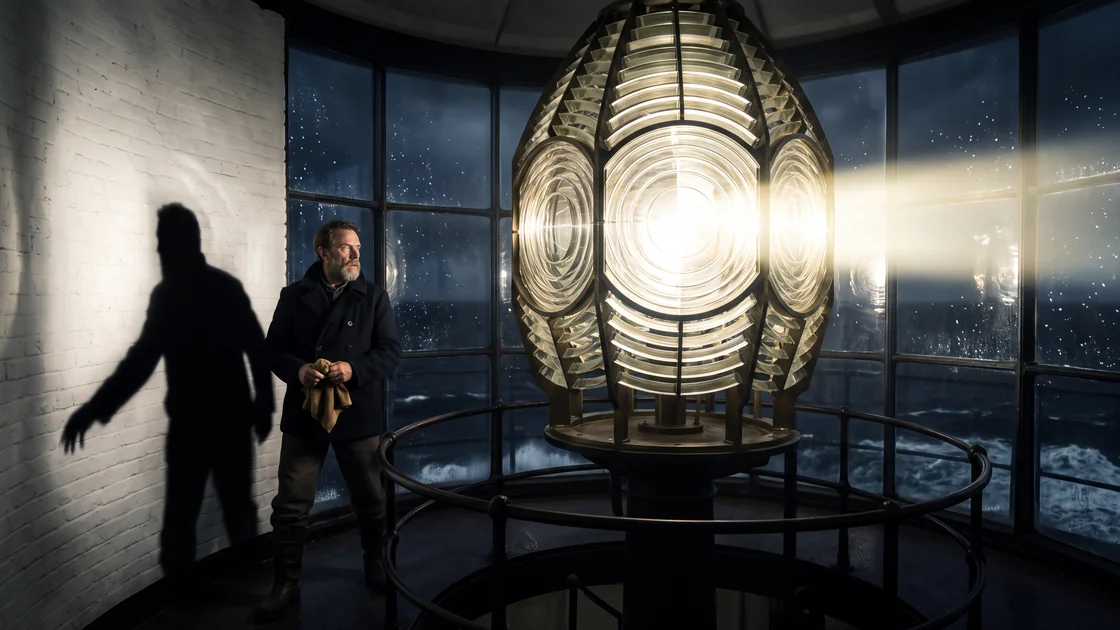
On the storm-beaten outcrop of Oakhaven Ledge, solitary lighthouse keeper Thomas Vance spends his days tending the great First-Order Fresnel lens, only to discover that the colossal beams cast across the Atlantic are producing silhouettes that disobey the laws of geometry and time. What begins as a subtle lag in the sweep of his own silhouette across the whitewashed granite soon spirals into an terrifying unraveling of physical reality, as the cast shadows of the tower, the surrounding jagged reefs, and Vance himself begin to live, watch, and peel away from the matter that birthed them, transforming his isolated sanctuary into a crucible where light does not dispel darkness, but grants it an alien, predatory independence.
I. The Mechanics of the Lantern
The lantern room smelled of sulfur, whale oil, and the bitter copper tang of polished reflectors. At five o'clock in the afternoon, the sun had already surrendered to the Atlantic, drowning beneath a horizon the color of bruised slate.
Thomas Vance began his climb.
One hundred and eighty-six spiral steps of perforated cast iron rose from the base of the tower at Oakhaven Ledge. Each step produced a hollow, musical ring beneath the hobnailed heels of his sea boots—a ringing that had, over seven years of solitary service, become the steady pulse of his waking life. He counted them out of habit, not because he feared losing his place, but because the numbers kept the wind from speaking too clearly through the granite joints.
Eighty-four, eighty-five, eighty-six.
At the ninety-seventh step sat the oil room, cold and sweating salt through the stone mortar. At the one-hundred-and-fortieth was the service room, where the clockwork drive hung suspended like the entrails of a bronze bird: brass counterweights weighing four hundred pounds, greased with neatsfoot oil, threaded through sheaves that disappeared into the central pillar.
One-hundred-and-eighty-six.
He pushed up the trapdoor with his shoulder. The heat hit him first—the stagnant, dry heat of an enclosed glass chamber that caught every stray calorie of sunlight during the day and trapped the fumes of combustion by night.
The lens was magnificent. It stood twelve feet tall, a hive of concentric annular prisms ground by Henry-Lepaute in Paris thirty years before Vance was born. It was a First-Order optic, big enough for three men to stand inside its central drum, floating upon a circular cast-iron trough containing four hundred pounds of pure, silvery mercury. Because of that frictionless bath of liquid metal, a child’s finger could set the six-ton assembly spinning.
Thomas drew his brass pocket watch from his waistcoat. The glass was scratched with the latitude of Portsmouth, but the hands were true.
"Five-seventeen," he murmured. His voice sounded like dry canvas being dragged across sand. He spoke aloud only when lighting the lamps; a man had to remind his throat that it was built for words, lest it forget and choke on silence.
He struck a sulfur match against the abrasive strip on the lamp pedestal. The flame flared blue, hissed, and caught the cotton wicks of the five-wick Trinity burner. He nursed the flame slowly, turning the brass thumbscrews until the blue base widened and the white-yellow cones of fire climbed into the draft chimney.
He released the mechanical escapement. The bronze weights in the hollow column groaned, the cable tightened, and with a tiny, wet sigh of displaced mercury, the six-ton mountain of glass began to turn.
One revolution every two minutes. Four flashes every sixty seconds. A signature written across forty miles of dark water: Oakhaven Ledge, beware, beware, keep off.
The light caught the first bullseye panel. Instantly, the lantern room vanished in a catastrophe of brilliance. The world outside the glass became an absolute void, while inside, the light was so dense it seemed to possess physical mass—a solid, rotating arm of incandescent silver that sliced through the room, carving Thomas Vance into two halves: blinding illumination and absolute, cut-velvet black.
He turned his back to the burner to wipe down the internal surface of the western glazing with a chamois leather. The wind was rising from the east-northeast, carrying with it the smell of dead kelp and Arctic ice. The glass was cold beneath his knuckles, vibrating like the skin of a drum.
As the northern beam swung across the room, it swept behind him. His silhouette was thrown forward, fifty feet tall against the white-painted brick of the curving parapet wall below the glass.
Thomas watched it, as he had watched it ten thousand times before. A black wedge with broad shoulders, slightly stooped at the neck, holding a square of cloth.
The beam moved on. The light traveled clockwise, sweeping south toward the open ocean.
His shadow should have traveled clockwise with it, stretching thin, sliding along the curve of the wall until the angle collapsed and the beam died into the sea.
It did not slide.
Thomas paused, the chamois motionless against the pane.
The beam had passed. The secondary flash was already igniting the outer fogbank. Yet on the southern curvature of the parapet, a smudge of darkness remained. It clung to the masonry like soot, holding the exact contour of his left arm and shoulder.
He blinked, rubbing his watering eyes with his sleeve. "Mercury vapors," he said to the empty room. "Take your sulfur pills, Thomas."
He turned back to the glass. But behind him, on the wall where no light was falling, something made the sound of dry paper shifting in a drawer.
II. Deviations in the Ledger
The keeper’s log was bound in heavy sheepskin, its pages ruled in pale blue ink. It lay on the walnut desk in the watch room below the lantern floor, alongside the barometer, the hydrometer, and a bottle of iron-gall ink that smelled like vinegar.
Thomas dipped his steel nib.
October 24, 1888.
Wind: ENE, Force 6, freshening to 8 by midnight.
Barometer: 29.42 inches, falling.
Precipitation: Sleet mixed with salt spray.
Optic: Functioning normally. Rotation regular: 120 secs per cycle.
Consumption: 1.4 gallons mineral oil since sundown.
Vessels sighted: One three-masted schooner standing out from Cape Ann, running before the gale under storm trysails. Heading SE.
He laid the pen across the brass groove of the inkstand. He did not write what he had seen at five-twenty. One did not record optical disturbances in an official logbook belonging to the United States Light-House Board. Inspectors were men of precision; they had no patience for keepers whose eyes saw lingering smudges on lime-wash. An inspector who read of "shadows that do not follow the beam" would not send an optician; he would send a steam tender with a replacement keeper and a ticket to the asylum at Danvers.
Thomas stood and walked to the narrow, deep-set window that looked south toward the reef known as The Sow and Pigs.
The light was sweeping outside. Every thirty seconds, the long white blade swung through the dark, cutting the rain into thousands of falling needles. When the beam hit the jagged crests of The Sow, the rocks cast immense, sprawling shadows across the white foam of the breakers.
He leaned his forehead against the damp glass.
The beam struck the reef. A black fang of rock threw its silhouette across the water toward the base of the tower.
Then the beam swept past, plunging the reef into blackness.
The shadow of the rock remained.
Thomas did not pull away from the window; he pressed harder, until the cold ache in his brow was sharp.
On the sea, amidst the tumbling gray water, a triangle of blackness—darker than the night itself, darker than the ocean—was sliding across the surface. It was moving against the wind. It traveled sixty yards over the swells, maintaining the crisp, jagged outline of the rock that had produced it, before it seemed to lose coherence and dissolve into the surf.
He took his pocket watch from his pocket. His hand was shaking slightly, the small silver lid clicking against his thumbnail.
"A wave," he told the glass. "A trough between waves. The foam creates the illusion of shape."
He waited for the next sweep.
The beam flared. The ocean lit up with that dead, surgical brilliance. The Sow and Pigs appeared: three black humps of basalt, slick with kelp, boiling with foam. Their shadows shot west, long and slender.
The beam passed.
The shadows did not disappear. They detached.
They slid off the rocks like three skins of black oil, floating upon the water. They lingered for three seconds—four—five. One of them, the largest, pointed directly toward the base of Oakhaven Light. It stretched toward the foundation stones, thinning out like an arm reaching across a counterpane, before the darkness of the overall night swallowed it whole.
Thomas Vance stepped back from the window. The room was cold, yet a bead of sweat rolled from beneath his greasy cap and stung his eyelid.
He went to the small shelf where his predecessor, an old Swede named Ericson who had kept the light for twenty-four years before dying of an apoplexy at the kitchen table, had left his library. There was a Bible; a volume of navigational tables from 1862; an English translation of The Architecture of the Heavens; and an old, grease-stained copy of David Brewster’s Treatise on Optics.
He pulled Brewster from the shelf. He sat beneath the brass whale-oil gimbal lamp, flipping through the engraved plates of prisms, lenses, and reflections.
A shadow is not an entity, Brewster wrote in his tidy, Scottish prose. It is merely the privation of light. It has no properties of its own; it possesses neither mass, nor velocity, nor friction. It is the geometric consequence of an opaque body interposed between a luminous point and a surface.
"The privation of light," Thomas read aloud. His voice was unsteady. "It has no properties."
Above him, the heavy weights of the clockwork dropped an inch through the floorboards. The copper escapement clicked: tick... tick... tick.
From the spiral stair below, where the darkness was usually complete save for the occasional lantern he carried, came a soft, scraping sound. It was the sound of something dragging itself up the iron steps—not heavy, like boots, but light, like the dry belly of a snake moving over rough slate.
Thomas closed the book. He took the brass hand-lantern from the table, turned up the wick, and walked to the open door of the watch room.
"Who’s down there?" he called.
The wind wailed around the lantern gallery, rattling the iron ties that anchored the cap to the masonry.
He held the lantern over the spiral well. The yellow light cascaded down thirty feet, catching the rust-eaten edges of the iron steps, the white-crusted weeping of the granite mortar, the black grease on the descent tube.
There was nothing on the stairs.
Yet, sixty feet down, where the yellow light of his lantern died into the damp gloom of the base, there was a patch of dark that did not fit the curves of the tower. It sat upon the landing like a man crouching with his chin against his knees.
As Thomas watched, the shadow did not flee from his light. It shifted. It turned its head toward him—a head that had no eyes, no nose, only the flat, clean-cut edge of an outline cast by something that was not there.
Then it slid around the curve of the pillar and was gone.
III. The Composition of the Glass
The morning brought no sun, only a thickening drift of yellow-gray fog that smelt of coal smoke from some unseen steamer far off the shoals.
Thomas did not sleep. The regulations required the keeper to extinguish the light at sunrise, trim the wicks, scrape the carbon from the burners, polish the brasswork, and wind the weights back to the top of the column for the night ahead. It was work that occupied four hours if done with the devotion the Board demanded.
He worked with an intensity that verged on violence.
He attacked the brass of the burner with rottenstone and whale oil until the metal shone like yellow butter. He wiped every one of the three hundred and twenty-four prisms of the Lepaute optic with alcohol, his fingers trembling behind the chamois. He climbed out onto the gallery—the narrow, iron-railed balcony that girdled the lantern eighty feet above the sea—and washed the salt-crust from the exterior panes with fresh water hauled up by bucket from the cistern.
The sea was flat and leaden, greasy with cold. The tide was at the ebb, exposing the black spine of Oakhaven Ledge: four acres of rotten granite, jagged as iron teeth, without a single blade of grass or clump of thrift. Only the barnacles lived down there, and the gulls that sat in rows upon the wet weed, facing the wind in silence.
As he worked on the south side of the gallery, he stopped and looked down at his own shadow.
The morning light was diffuse, filtered through two hundred feet of sea-fog; shadows should have been soft, gray smudges without distinct edges. But the shadow cast by the lighthouse tower was hard. It lay across the rocks below like a slab of black slate dropped into the weed.
And within that great shadow, something was moving.
Thomas set his bucket down. He leaned over the rail, his knuckles white against the wet iron.
The shadow of the tower stretched two hundred yards across the ledge toward the sea. But along its edges, the shadow was fraying. Small, dog-shaped patches of dark were detaching themselves from the main trunk of the shadow, running through the rock pools, leaping from boulder to boulder, then darting back into the main body of darkness.
They moved with the jerky, unnatural gait of creatures made of paper.
He rubbed his eyes. He pressed his palms against his temples until he saw stars. When he opened them, the shadow of the tower was merely a shadow—long, motionless, graying at the edges where the fog thinned.
"It’s the glass," he whispered.
He turned and looked through the windows at the massive Fresnel optic resting in its mercury basin.
The glass had not been made in America. The American foundries could not produce glass of such clarity; their flint was full of bubbles and green iron-striae. This glass had been cast in Saint-Gobain, ground in Paris under the direction of Augustin-Jean Fresnel himself before his lungs gave out, and finished in the workshops of Lepaute in 1854.
Thomas went back inside the lantern room, letting the iron door slam behind him.
He walked to the pedestal. Beneath the mercury bath was a small bronze maker’s plate, screwed to the cast-iron column with four square-headed bolts:
HENRY-LEPAUTE, INGÉNIEUR-CONSTRUCTEUR
Rue de Vaugirard, Paris, 1854
Système A. Fresnel. Optique de 1er Ordre.
N° 112.
Beneath that inscription, someone had scratched a line with a steel file. It was faint, nearly worn away by thirty years of brass-polish and waste-cotton:
Non lux sed umbra seminatur.
Thomas ran his thumb over the scratches. He had four years of Latin from his boyhood in Boston, before his father’s lumber yard went under and he had gone to sea as an oiler.
Not light, but shadow is sown.
"Ericson," Thomas said. "You old fool, what did you scrape into the brass?"
He went down to the watch room, kicked off his boots, and pulled Ericson’s trunk from beneath the bunk.
The trunk was pine, painted sea-green, with rope beckets at the ends. It had remained there since the morning the tender Iris had taken Ericson’s body off the rock. The Board had not cared about his personal effects; he had no kin listed in the register, and the new keeper was expected to burn whatever was left behind to keep the room clear of vermin. Thomas had never opened it, partly out of respect, partly out of that profound lethargy that settles into a man who lives alone with the sea.
The hasp was secured with a piece of tarred marline. Thomas cut it with his pocket knife.
Inside were four woolen shirts, stiff with salt; three pairs of socks mended with blue thread; an ivory shoehorn; a box of hard-tack that had turned to gray dust; and five small, octavo notebooks with covers of marbled paper.
Thomas took the notebooks to the table. He lit the small whale-oil wick, though it was barely noon, for the fog had turned the room into the bottom of a pond.
He opened the first book. It was dated 1864. The handwriting was huge, angular, and stiff, the writing of a man whose fingers were bent from hauling dory-painters and handling frozen hemp.
The early entries were ordinary: oil consumed, gales survived, barrels of pork received from the district depot.
Then, in July of 1872:
The lens was cleaned today with the new spirits sent from Boston. It is very pure. When the southern flash passes over the kitchen chimney, the shadow of the chimney does not move at the same speed as the beam. It falls behind. I timed it with the watch. It is four seconds slow.
Thomas turned the page.
August 3, 1872.
The shadows on the ledge are not empty. When I walk down to the slip to fetch the kelp for the garden-box, my shadow stays behind me on the granite when I turn. It catches on the barnacles. I have to pull to make it come away.
November 18, 1876.
It is the glass. M. Fresnel did not know what was in the sand. They took the sand from the forest of Fontainebleau, where the old quarries are. The sand has been underground since the world was dark. The light does not pass through it; the glass strips the skin off the light. What comes out of the front of the prisms is light. What comes out of the back, where the reflections cross, is what the light was holding down.
January 9, 1881.
I cannot go out on the gallery after sundown. They are standing there against the rail. They have no faces, but they know my coat. They wear the shape of my coat.
Thomas closed the book with a sharp snap. The marbled paper was cold, damp to the touch, smelling of old grease and dry-rot.
He sat in the chair, his hands flat on the sheepskin blotter.
"The man was mad," he said to the empty room. "Twenty years on this rock with no company but the gannets and the sea-pigs. A man invents things to look at. A man gives names to the cracks in the wall."
He reached for the iron-gall ink to make his noon entry.
As he dipped the pen, he looked at the shadow of his hand on the white paper.
The light came from the window to his right—the dim, uniform, gray light of the fog. His hand was motionless, the steel nib suspended an inch above the inkpot.
His shadow on the paper was not motionless.
The shadow of his index finger was tapping. Tap. Tap. Tap. A tiny, rhythmic twitch of the black silhouette against the blue ruled lines, though his actual finger was as still as stone.
Thomas let the pen fall. It rolled across the sheepskin, leaving a black smear across the date: October 25.
IV. The Acceleration of the Sweep
By nightfall, the fog had been torn to ribbons by a gale from the south-southeast. The sea had grown monstrous. Great green rollers, sixty feet from trough to crest, came marching out of the deep Atlantic, slamming into Oakhaven Ledge with a sound like artillery fire. The entire tower—two thousand tons of dressed Quincy granite—shivered in its bed of cement.
In the lantern room, the mercury in the iron trough sloshed rhythmically, small silver droplets leaping out and rolling across the iron floorboards like lead shot.
Thomas stood by the pedestal, holding the handrail to keep his feet.
The light was revolving. The four great beams were rigid spokes of fire revolving over a boiling, white-laced pit of black water. Because of the spray that rose eighty feet into the air, the light created enormous, sweeping halos that seemed to crush the tower within circles of incandescent mist.
He had to check the shadow.
He could have stayed below in the watch room, wrapped in his blanket with the Bible or his Brewster on his knees. But a lighthouse keeper is bound by an instinct stronger than fear: he must see the light work. He must verify the reach of the beam.
He went to the landward side of the lantern, where the beam swept over the low, submerged shoulder of the ledge before striking out toward the mainland six miles distant.
He waited for the second flash of the cycle.
Flash.
The light struck the iron davits on the lower platform—the two curved cranes used to hoist the keeper’s dory from the surf.
Their shadows were thrown violently against the boiling foam below.
The davits were curved like hooks, leaning slightly seaward.
Their shadows were straight. They stood upright like two men standing in the surf, with their arms raised above their heads.
And when the beam passed, those shadows did not vanish into the night.
The beam moved forty degrees north, illuminating the empty sea. Yet there, on the surface of the foam, illuminated only by the faint gray phosphorescence of the waves, the two shapes remained. They were black gaps in the white foam—holes in the water, silhouettes without a source.
They began to walk.
They did not swim; they moved through the breaking seas with a smooth, gliding momentum, sliding over the sixty-foot swells, maintaining their forms against the violent heave of the Atlantic. They moved along the base of the reef, heading toward the landing slip—the narrow, rock-cut ramp that led from the water up to the heavy oak door of the lighthouse base.
Thomas rushed to the landward windows, pressing his face against the glass.
The wind screamed through the ventilator balls atop the dome, a high, human shriek that varied with every gust.
"They are not reflections," he said. He did not recognize his own voice; it was high and cracked, the voice of a boy. "Reflections don't climb."
On the rocks below, two forms were coming up the slip.
They were completely flat. When they passed over a granite boulder, they did not climb over it; they draped themselves across it, folding at right angles like black cloth laid out to dry, then straightening as they reached the level platform where the oil barrels were lashed.
They were silhouettes of the davits, but they had changed. The hooks had become arms; the cross-braces had become torsos. They had no volume—they were two-dimensional absences of light, yet they moved with a purpose so absolute that the granite beneath them seemed to cringe.
They reached the great oak door of the tower.
Thomas felt a vibration through the iron floor of the lantern. It was not the slam of a wave; it was three distinct, measured impacts against the oak below.
Thump. Thump. Thump.
He stepped away from the window.
The lantern room was blinding. Every fifteen seconds, a beam crossed his eyes, leaving him with an orange-red retinal burn that blinded him for three seconds afterward. In those three seconds of blindness, the room was full of shapes.
Every prism in the First-Order lens was casting its own shadow.
Normally, the prisms cast only light; they were glass, transparent, perfectly pure. But now, the dark lead frameworks—the heavy brass armatures that held the concentric glass segments together—were throwing their shadows into the interior of the lantern instead of out into the night.
The floor was a web of black bars.
They crossed and recrossed like the ribs of a cage. And as the lens rotated, the cage did not rotate with it.
The six-ton optic turned upon its mercury bath, smooth and relentless. But its shadow—the black skeleton of the framework—hung motionless in the air of the room. It hung there like an iron scaffold suspended between floor and ceiling, through which the light passed without illuminating it.
Thomas Vance put his hand out.
He reached toward one of the black shadows of the brass struts that hung in the air before him.
His fingers touched it.
It was not cold. Cold is the absence of heat; this was something else. It was heavy. It felt like wet, greasy wool that had been dipped in vinegar. His skin didn't simply touch it; the skin of his fingertips seemed to pull toward it, his own flesh stretching slightly, drawn by an impossible, non-Newtonian attraction.
He yanked his hand back with a gasp.
On the pads of his fingers, the skin was white, dry, and shriveled, as if he had held them against caustic lime.
"The lamp," he whimpered. "Keep the lamp burning."
He looked at the Trinity burner.
The five concentric wicks were blazing, consuming the mineral oil with a steady, white roar. But the flame was no longer throwing off a yellow radiance. The center of the flame was black.
A core of absolute, velvety darkness was rising from the central wick, climbing up the inside of the glass draft-chimney like a second flame made of pitch. It flared where the light flared; it was focused by the annular prisms; it was magnified by the catadioptric rings above and below the center.
The lens was not throwing four beams of light into the storm.
It was throwing eight.
Four of light. Four of something that was not light—four broad, black avenues that swept through the sleet, carving paths through the rain where no water fell, paths of absolute, empty vacuum that reached out toward the sea like the legs of a turning spider.
V. The Marginalia of O’Shea
By three o'clock in the morning, the gale had reached hurricane intensity. The wind was clocked at eighty-four miles an hour by the Robinson anemometer on the roof before the cups were torn from the spindle and vanished into the night.
The ocean was no longer breaking in distinct waves; the top twenty feet of the sea had been sheared off by the wind and turned into a driving, horizontal sheet of salt-drift that blinded the lantern from the west.
Thomas did not go down to the lower rooms. He knew what was waiting on the iron stairs.
He sat on the small mahogany stool beside the clockwork governor, his knees drawn up to his chest, the heavy iron-handled cleaning wrench clutched in his right hand.
On the floor before him lay the third volume of Ericson’s log, its pages fluttering in the draft that whistled through the lead glazing-bars.
He had found the entry from 1883. It was not written in Ericson’s hand. The letters were smaller, sharper, written with an ink that had faded to the color of dried liver.
It was signed by Michael O’Shea, who had been assistant keeper for eleven months before he vanished from the ledge during a calm spell in August.
I have measured the prisms with the spherometer, O’Shea wrote. They are not parabolic. Lepaute lied, or Fresnel was blind. The curves are calculated according to another geometry altogether. If you stand in the focal point behind the central bullseye when the beam passes through the southerly arc, you do not see the sea. You see the place the light came from before it entered the world.
It is a garden of black stone. Nothing grows there but the shapes of things that have died on the water. Every vessel that has broken its ribs on the Sow and Pigs is there, but they are not wrecks; they are whole, made of black glass, and they sail across the rocks without wind.
The light does not illuminate them. The light creates them. Every candle a man lights is an eviction; it drives the dark out of its corner and forces it into a shape it did not want to take. And when you make a light as great as this—a light that can be seen from twenty miles—you make the shadows so thick, so dense, that they can no longer find their way back into the corners when the light is gone.
They have weight now. I weighed one on the oil-scales today. I trapped the shadow of the oil-can between two sheets of zinc. It weighed two ounces. It smelled of old bilge and zinc-flowers.
Vance is coming tomorrow on the tender. I will not tell him. If a man knows what is in the glass, his shadow begins to pull away from his heels sooner. It knows he is thinking about it.
Thomas dropped the wrench. It hit the iron deck with a flat, leaden thud that had no ring to it.
He looked down at his boots.
His shadow was gone.
He was sitting three feet from the Trinity burner. The five-wick flame was screaming behind its mica chimney, pouring thousands of candlepower through the room.
His feet rested on the cast-iron plates. There should have been a shadow—broad, dark, sharp-edged—thrown behind him against the wall of the service cupboard.
There was nothing.
The floor beneath his boots was as white and clean as if the light were shining through him from below.
He stood up. He held out his arms. He was a solid man, forty-two years old, two hundred pounds of bone and salt-pork and graying hair. He cast no more silhouette than a pane of clean window glass.
Then he saw it.
It was not behind him.
It was standing on the other side of the lantern room, inside the glass drum of the Fresnel optic itself.
His shadow was standing among the prisms.
It was flattened against the curved inner surface of the great central bullseye, twelve feet tall, stretched and distorted by the glass into a grotesque, elongated caricature of a man. It had his broad shoulders, his round cap, his heavy pea-jacket.
And it was working.
It was mimicry of the most terrible kind. It was going through the motions of his daily routine: it reached up to turn phantom thumbscrews; it polished the glass with a phantom cloth; it reached down to wind a phantom winch.
Every movement was four seconds ahead of him.
It raised its arm; four seconds later, Thomas felt his own arm rise, lifted by a sickening, mechanical tension in his shoulder muscles that he could not resist.
It leaned forward; his body leaned with it, pulled toward the great revolving hive of glass by an invisible cord that felt like cold wire hooked into his sternum.
"No," Thomas said. He set his heels against the raised rim of the iron floor-plates. "No. That is my coat. That is my shape."
The shadow in the lens stopped its mimicry.
It turned around.
In the flat, two-dimensional blackness of its head, two gaps opened. They were not eyes; they were pinholes of light—the blinding, naked light of the Trinity burner shining through the shadow from behind, focusing through the two tiny apertures into two thin needles of brilliance that struck Thomas directly in the pupils.
A scent filled the lantern room. It was not oil, not sea-spray, not ozone.
It was the smell of a cellar that had been closed for two hundred years—the cold, dry smell of earth that had never seen a weed, of stones that had never known the warmth of a noon-day sun.
VI. The Breaking of the Prisms
A scream tore through the sound of the storm, but it did not come from the wind.
Down below, the heavy oak door of the tower had given way.
Thomas heard it: the splintering of three-inch white oak, the shriek of wrought-iron strap-hinges torn from their lead-caulked sockets in the granite.
The sea did not rush in. If the sea had breached the door, there would have been the hollow, booming roar of hundreds of tons of water filling the basement, followed by the hissing of the forge in the workshop.
There was no sound of water.
There was only the sound of feet.
Scores of them. Hundreds of feet, flat and soft, slapping against the iron stairs with the rhythmic cadence of a retreating regiment. They were coming up the spiral. They were not climbing one by one; they were crowding the column, packing the iron well from wall to pillar, their edges scraping against the whitewash with the sound of a million dry husks being stirred in a granary.
Thomas looked around the lantern room.
There was no retreat. The gallery door led outside, eighty feet above the ledge, into a ninety-mile-an-hour hurricane that would pluck a man from the rail like a dry leaf and dash him into the foam on The Sow and Pigs.
The trapdoor from the service room was vibrating. The iron plate was lifting an eighth of an inch, then dropping back with a metallic clink.
Something was pressing against it from below.
Something flat. Something that had no thickness, but possessed the terrible, hydraulic strength of an expanding darkness.
A black line appeared along the seam of the trapdoor. It was not a finger; it was a ribbon of absolute blackness that squeezed through the gap between the iron door and the granite curb. It slid across the floorboards like ink spilled on grease-paper, heading toward the mercury trough.
Thomas Vance looked at the lens.
The great machine was still turning. Tick... tick... tick. The bronze governor spun, its little brass balls flying wide with the speed of the rotation. The four white beams and the four black avenues continued their mad waltz across the storm-choked Atlantic.
He understood now what Ericson had written.
The lens was not a tool for the light. It was an engine of separation. For thirty years, this engine had been distilling the dark, stripping it of its passivity, feeding it with thousands of gallons of whale oil and kerosene, giving it shape, giving it memory, giving it hunger.
Every light lit by man had a debt to pay. The bigger the light, the greater the bill.
And Oakhaven Light was the brightest beacon between Portland and Cape Cod.
He looked down at the iron-handled wrench in his hand. It weighed twelve pounds; it was made of forged Swedish iron, meant for loosening the two-inch nuts that secured the lantern framework to the granite parapet.
"A shadow is not an entity," he screamed into the roar of the burner. "Brewster! It has no mass! It has no properties!"
He leaped toward the revolving optic.
He did not strike at his own shadow. His shadow was no longer there; it had melted into the central prisms, staining the clear Parisian flint with a dark, purplish oily sheen that seemed to move beneath the surface of the glass like blood in a bruised vein.
He struck the central bullseye of the eastern face.
The blow landed with the sound of a cannon shot.
The thick, heavy glass—tempered to withstand the heat of five concentric wicks—did not shatter at once. It starred. A white spiderweb of fractures raced through the concentric rings, turning the brilliant, transparent prisms into an opaque, milky mosaic.
The light caught in the cracks. Instead of projecting a single beam, the fractured panel exploded into a million needle-like splinters of radiance that filled the room with a chaotic, blinding glare.
From the cracks in the glass, something screamed.
It was not a human voice; it was the sound of a vacuum being filled—the shrill, whistling hiss of air rushing into an empty cylinder, mixed with the dry rustle of silk being torn from end to end.
A black fluid—not oil, not mercury, but a cold, vaporous soot—poured from the fractures in the lens. It poured over his hands, over his sleeves, smelling intensely of ancient, sunless stone.
Thomas swung the wrench again.
Smash.
The central drum collapsed inward. Six of the annular prisms fell into the mercury bath with a heavy, muffled plonk.
The liquid mercury leaped from the iron trough, splashing over the hot brass burner.
Instantly, the lantern room was filled with a thick, white, sweet-smelling cloud of mercury vapor. It was deadly poison—Thomas knew it, every keeper knew it—a poison that rotted the teeth from the gums and turned a man’s brain into water within a dozen breaths.
He didn't care.
He swung the wrench like a madman, smashing the catadioptric rings, shattering the lower prisms, beating the great six-ton masterpiece of Henry-Lepaute into a jagged mountain of crystal shards.
With every blow, the light died.
Not because the flame was extinguished—the Trinity burner still roared upon its pedestal, its wicks spitting and smoking—but because the glass was no longer there to bend the world to its terrible geometry.
The black avenues across the ocean collapsed.
The shadows that were crowding through the trapdoor—the flat, paper-thin horrors that were sliding over the iron sill—lost their edges. They began to blur. They became gray, diffuse, trembling like soot suspended in water.
Thomas felt a hand on his ankle.
He looked down through the fog of mercury vapor.
His own shadow was lying on the floorboards beneath him. It was holding his boot with both hands. It had no eyes, no mouth, but its face was upturned toward his, its flat, black surface reflecting nothing—not even the white fury of the broken burner.
It was pulling him down. It was trying to drag his living flesh into the iron floor, to flatten him into the two-dimensional hell from which the glass had summoned it.
His legs were cold. The sensation was not that of ice, but of numbness—the creeping, painless death of circulation that comes before gangrene. He could see his boots through the shadow; his leather boots were becoming faint, translucent, their grain disappearing, their three dimensions flattening into a single, dark plane against the iron plates.
"The lamp," he gasped. His lungs felt as though they were lined with broken glass from the mercury fumes. "The light... must be... common."
He dropped the wrench.
He reached into his waistcoat with fingers that were rapidly losing their roundness, becoming flat, thin blades of flesh that could barely grip.
He found his brass pocket watch.
He did not look at the face. He struck the heavy silver casing against the corner of the iron pedestal with all the strength left in his flattening arm.
The glass face broke. The brass balance-wheel popped out, its tiny hairspring curling like a hair.
He took the jagged edge of the watch-glass—common glass, cheap American glass, full of sand from the Jersey shore and soda-ash from the works at Lynn—and drew it across the pressurized fuel tube that led from the oil reservoir down to the burner.
The soft lead tube parted.
A stream of refined mineral oil, pressurized by the four-hundred-pound weights in the column, shot across the room in a three-inch jet.
It struck the naked flame of the Trinity burner.
VII. The Report of the District Inspector
UNITED STATES LIGHT-HOUSE BOARD
Office of the Inspector, Second District
Boston, MassachusettsNovember 2, 1888
To the Chairman of the Light-House Board, Washington, D.C.
SIR:
I have the honor to report that on the morning of October 31, the tender Iris reached the station at Oakhaven Ledge, which had been reported dark by the master of the steamship Gate City on the night of October 26.
Upon arriving at the Ledge, Captain Henderson found the sea still running heavy, preventing a landing until the afternoon. When the boarding party reached the tower, the entrance door was found to be torn entirely from its fastenings, with the fragments lying upon the platform. The interior of the tower showed signs of an extensive fire, which appears to have originated in the lantern room and burned itself out for lack of fuel after destroying the wooden fittings of the watch room.
The First-Order optic is a total loss. Every prism has been shattered, apparently by the intense heat of the burning mineral oil, though certain fractures on the eastern frame suggest the impact of a heavy implement. The mercury trough was empty, the contents having been vaporized by the conflagration.
The keeper, Thomas Vance, was found dead upon the floor of the lantern room.
The condition of the body was unusual. Dr. Cranston, who accompanied the party from the Marine Hospital at Chelsea, reports that while the remains were partially charred by the oil fire, the cause of death was undoubtedly acute mercurial poisoning, accompanied by profound pulmonary edema.
The doctor noted a singular post-mortem phenomenon, which I feel bound to mention, if only to refute the sensational rumors currently circulating among the watermen of Gloucester.
The corpse of Vance, when lifted by the seamen, appeared to have undergone a remarkable degree of physical compression. Dr. Cranston remarked that the body was curiously thinned, as though it had been subjected to immense hydrostatic pressure, though the skeleton was intact and showed no signs of crushing by falling masonry. Furthermore, the skin of the deceased was marked by a uniform, dead-black pigmentation covering the entire anterior surface, while the posterior surface remained entirely white, exhibiting the pale, bloodless hue of an ordinary drowned man.
Captain Henderson found the logbook in the watch room, miraculously preserved beneath an overturned iron washstand. The last entry, dated October 25, is partially defaced by an ink-blot, but contains nothing unusual beyond the customary meteorological data.
I have appointed Mr. Caleb Howland, formerly first assistant at Whaleback, to the vacancy. A temporary fourth-order lens has been erected upon a wooden framework on the gallery, and the light was shown again last evening.
The fragments of the Henry-Lepaute optic have been gathered into twenty-two nail-kegs and will be brought to the depot at Boston by the next trip of the tender. They will be sold for cullet to the glassworks at Cambridge, as they are of no further use to the service.
I have the honor to remain, sir,
Your obedient servant,HORACE M. PEABODY
Commander, U.S.N.,
Inspector, 2nd Light-House District.
VIII. The Granary of Shadows
Caleb Howland did not like the smell of the tower.
He was twenty-eight years old, a sensible man from Maine who didn't hold with the notions of fishermen. He had served four years at Whaleback and two at the Graves, and he knew that every lighthouse smelled of whale oil, wet stone, and old boots.
But Oakhaven Light smelled of neither.
It smelled like an empty church built over a salt-vault. No matter how much pine-tar he burned in the iron stove, the stink remained: a thin, dry odor that made his tongue feel furry, like he had been licking slate pencils.
It was his third night on the rock.
The wind had died at sundown, leaving the ocean smooth and oily—the kind of sea the old men called a "mackerel glass." There wasn't enough breeze to lift the pennant on the flagstaff, but the swell was still coming in from the Banks, long and slow, five hundred yards between the crests, breaking against the foot of Oakhaven Ledge with a soft, heavy chug-boom that made the air in the flue vibrate.
Caleb sat in the lantern room.
The temporary fourth-order light was a miserable thing after the great Lepaute optic he had seen at Whaleback. It was a simple four-sided lantern with pressed glass panels made in Pittsburgh, turning on steel ball bearings that clicked like loose teeth every time the carriage completed a circuit.
Click-click. Click-click.
The light only reached twelve miles. It was enough to warn the coasters off The Sow, but it was nothing to be proud of. It cast a dull, yellow beam that flickered whenever the draft took the wick from the north.
Caleb had his boots off. He was darnng a gray woolen sock with a brass needle, his oil-lamp sitting on the iron tool-chest beside him.
The temporary light swung past.
Flash.
It illuminated the northern wall of the parapet—the fresh, clean whitewash that the Board’s painters had slapped over the soot from the fire that had killed poor Vance.
Caleb looked up from his needle.
The light had passed thirty seconds ago. The beam was now pointing south-by-west toward Minot’s Ledge.
Yet on the whitewashed wall, where the new paint was still tacky to the touch, there was a mark.
It wasn't a smudge of soot. It was too sharp for soot.
It was the shadow of a man’s hand.
It was pressed flat against the lime-wash, three feet above the floorplates, every finger spread wide. The palm was long; the thumb had a curious, backward curve at the joint, like the thumb of a clockmaker who had spent forty years pressing small gears into brass plates.
Caleb stood up, holding his sock in his hand.
"Howland," he said to himself. "You’ve been drinking too much of that chicory."
He walked to the wall. He reached out his bare toe to touch the plaster.
The shadow was not on the paint. It was behind it. It showed through the two coats of lime-wash like an old water-stain through wallpaper—black, sharp-edged, and completely still.
As he watched, the fingers of the shadow contracted.
They did not lift from the wall; they scratched against the stone from within. Caleb felt a tiny, cold vibration in the soles of his bare feet—the sound of fingernails being dragged across granite, very faint, very slow, like a man trying to find a purchase in the dark.
Then, from the other side of the room, behind the cast-iron column of the pedestal where the darkness was deepest, something spoke.
It did not use words. It was merely the sound of a lung drawing breath—a long, dry, whistling inspiration that rattled with the dry phlegm of a man whose throat had been coated with pulverized glass.
Caleb Howland did not reach for his boots.
He walked to the trapdoor. He opened it quietly, as if he feared waking an invalid in the next room.
He looked down the spiral well.
The iron stairs were dark. The District tender had not yet replaced the oil bracket-lamps along the column, and the basement was sixty feet of black air.
At the bottom of the well, where the oak door had been patched with rough hemlock boards, there was no light at all.
Yet the darkness was not uniform.
It was composed of thousands of vertical ribbons, each about the width of a man’s forearm, moving slowly around the central pillar. They were circling. They were going up the stairs, step by step, with a dry, rhythmic rustle that sounded like sheep moving down a lane between stone walls.
They had reached the eighty-fourth step.
They had reached the oil room.
Caleb Howland pulled the trapdoor shut. He sat down upon the iron plate. He placed his heels against the latch, his knees against his chin, and his arms wrapped around his shins.
He did not look at the lamp.
He did not look at the small fourth-order glass that clicked upon its steel balls.
Click-click. Click-click.
Above his head, the little yellow beam swung out over the Atlantic, forty feet long, twelve miles wide, searching the sea for something to strike.
And behind it, in every corner where the yellow rays did not fall, the night began to crowd closer to the flame, folding itself into the shapes of coats, and davits, and open, waiting mouths, until the lantern room was full to the glass, and there was no room left for anything that breathed to cast a shadow of its own.