The Anatomy of the Bench
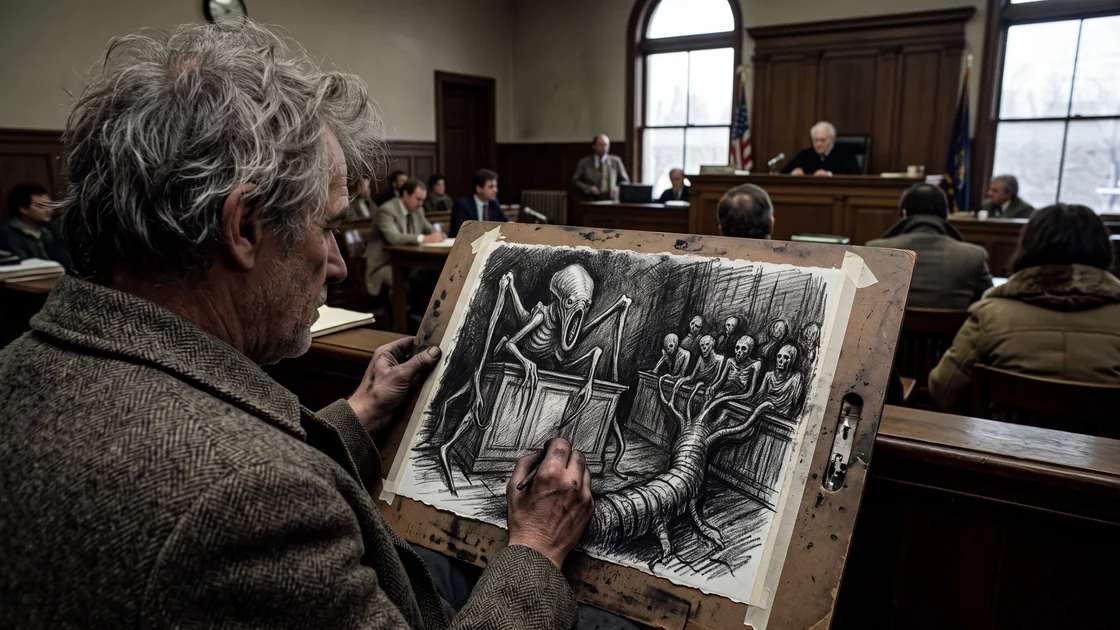
Arthur Vance had spent thirty-four years capturing the mundane degradation of county courts in soft, powdery willow charcoal, but it was during the triple-homicide trial of the quiet embalmer Julian Mercer that his sticks of burnt vine began to record an impossible physiology. Unbeknownst to the bailiffs, the press corps, or the spectators fanning themselves in the gallery, the strokes of Arthur’s hand ceased to obey the light reflected by mortal flesh, laying bare the ancient, non-Euclidean parasites that occupied the bench and the jury box: Judge Aloysius Harlan was not an aging jurist with a cardiac condition, but a multi-jointed entity of calcified parchment and blind mandibles, while the twelve jurors formed the segmented abdominal nodes of a singular, carrion-feeding organism rooted deep into the municipal foundations. As the trial progressed and his sketch pad became a trapdoor between two irreconcilable realities, Arthur discovered that his drawings were not merely passive records of the courtroom’s astral horrors, but a catastrophic act of exposure that turned the gaze of the court’s monstrous masters directly upon the artist himself.
I. The Tooth of the Paper
The paper Arthur preferred was an obsolete stock: fifty-pound French cotton rag, cold-pressed, with an uneven, velvet tooth that gripped carbon like dried silt. It was manufactured by a mill in the Vosges that had shuttered during the mid-seventies, and he had purchased forty remaining reams from the estate of a blind lithographer in 1989. For thirty years, this paper had borne the faces of arsonists, crooked county commissioners, dead-eyed stickup boys, and sobbing mothers whose sons had vanished into the state penitentiary system.
Arthur knew how to use the vine charcoal. He held the slender, brittle twigs of charred willow not as a draftsman holds an HB pencil, but loosely between the pads of his first three fingers, letting the weight of his wrist dictate the wash of shadow while the sharp, fractured edges defined the cut of a lapel or the downward hook of an exhausted mouth.
Courtroom 4B of the St. Jude County Courthouse smelled of wet overcoats, floor wax, and the dry, sweetish rot of old law reports bound in sheepskin. It was November, and the steam radiators clanked behind their decorative iron grates like iron shovels striking wet shale.
At the defense table sat Julian Mercer. Mercer was forty-one years old, a licensed mortician from the river district who was charged with three counts of aggravated murder and the unlawful disinterment of human remains. The regional press had taken to calling him the "Cold Storage Ghoul," though there was nothing theatrical about him. He wore an ill-fitting poplin suit that had lost its sizing, and his hair was combed flat against his skull with witch hazel. He did not blink with the frequency of normal men; his eyes simply hung open, dark and watery, fixed upon the polished mahogany rail of the bar.
Arthur sat in the first row of the press gallery, his knees wedged against the low gate that separated the observers from the actors of the law. His lap board was a sheet of quarter-inch masonite, scarred with years of tape residue and knife scores.
"All rise," muttered the bailiff, a retired state trooper named Callow with swollen ankles and an artificial hip that squeaked like a wet boot.
The gallery groaned to its feet. Arthur rose with them, balancing his board against his belly, his thumb securing a virgin sheet of the French rag.
Through the heavy oak door behind the bench entered Judge Aloysius Harlan. Harlan was eighty-one years old, a fixture of the county judiciary since the Eisenhower administration. He was an institution, legendary for his clipped, nasal rulings, his complete lack of patience for emotional rhetoric, and a trembling right hand that he perpetually concealed within the billowy black sleeve of his robes.
Arthur watched Harlan climb the three carpeted steps to the high-backed leather chair. The judge did not look at the gallery, nor at Mercer. He settled his weight, cleared his throat—a wet, rattling sound like gravel shaken in an empty paint can—and reached for his spectacles.
"Be seated," the bailiff droned.
Arthur sat. He placed his sticks of charcoal on the small brass ledge he had clamped to the masonite board: three grades of willow, a chunk of compressed Siberian soot for the darkest blacks, and a stale wedge of kneaded eraser that smelled faintly of almond paste.
The prosecutor, District Attorney Thomas Miller, was already standing, smoothing the crease of his trousers. Miller was an ambitious, flat-topped man whose skin always appeared slightly sunburned from weekend golf.
"May it please the court," Miller began, his baritone filling the high-ceilinged room. "The Commonwealth is prepared this morning to present State’s Exhibit Fourteen through Twenty-Two, being the forensic soil strata recovered from the cellar floor at the Mercer Funeral Home..."
Arthur was not listening to the soil strata. He was looking at Harlan’s left temple. There was a strange quality to the light in Courtroom 4B this morning. The tall, arched windows faced north, toward the slate roofs of the industrial basin, and the sky was the color of a bruised oyster. But beneath the gray daylight, there was another luminescence—a sulfurous, greasy shimmer that seemed to collect in the corners of the judge’s eye sockets and beneath the curved rim of his jaw.
Arthur set the edge of a soft vine stick against the paper. He began with the silhouette: the broad, sloping mantle of the robes, the withered neck rising from the stiff white collar, the blunt, square dome of the skull.
His fingers moved with the unthinking intelligence of long practice. For thirty years, his hand had translated light into darkness without consulting his conscious mind. He looked at the judge; his fingers twitched; the willow left its line.
Yet, three minutes into the sketch, something went wrong with the grain.
Arthur pressed the charcoal to define the hollow beneath Harlan’s left cheekbone, expecting the familiar, soft smudge of charcoal dust. Instead, the stick snagged. The charcoal did not glide; it dragged, as if the surface of the cotton rag had suddenly turned to wet, coarse salt.
Arthur frowned and looked down.
He had not drawn a cheekbone.
On the paper, where Harlan’s face should have been resolving into the familiar, sour lines of an old magistrate, there was a rent. Not a tear in the paper, but an ink-black aperture, rendered with a density of line Arthur had never achieved in his life. Out of this aperture protruded three jointed, needle-tipped appendages that resembled the legs of a sun-spider, though they were translucent, their segments held together by glistening drops of pale, amber fluid.
Arthur stopped. His breath hitched in his throat.
He looked up at the bench.
Judge Harlan was resting his chin on his knuckles, his rheumy blue eyes fixed on Miller, who was holding up an eight-by-ten evidence photograph in a plastic sleeve. Harlan looked entirely human. His skin had the yellowed, translucent quality of lard left out in the sun; his wisps of white hair were neatly parted; his silver-rimmed glasses caught the reflection of the fluted ceiling lamps.
Arthur looked back down at the sheet.
A slip, he thought. A muscle tremor. My sugar is low.
He reached for his kneaded eraser. He pressed the gray dough against the spider-like limb, intending to lift the charcoal back to the clean white of the rag.
The rubber touched the page, but the mark did not lift. In fact, the charcoal seemed to drink the eraser. The gray rubber turned slick, blackened, and crumbly in his fingers, disintegrating into tiny, oily pellets that fell into his lap like insect droppings. The drawing remained: dark, wet-looking, and sharp as an etching on copper.
Worse, his hand—operating outside his control, twitching with a frantic, cold vibration that started in his elbow—descended again.
The stick of vine did not break. It was slender—scarcely thicker than a goose quill—yet it ground into the heavy rag with the force of an iron burin.
Arthur watched his own knuckles whiten. He could not pull them back. The willow moved in short, violent jabs, hatching a dense thicket of shadows beneath the judge’s desk. It was not the carved walnut paneling of the bench that emerged; it was an armature of fused ribs, blackened as if recovered from a chimney, supporting a bloated, membranous sac that pulsed beneath the desk like the belly of a tick.
Above this sac, Harlan’s robes were not cloth. Arthur’s strokes crosshatched them into a mantle of wet, layered parchment—sheets of legal briefs, deeds of execution, and ancient municipal charters that had been macerated, soaked in gall, and stitched together with coarse animal hair. And from the neck of this parchment shroud, where the judge’s liver-spotted throat ought to have rested, the drawing revealed an elongated, blind cephalic mass that tapered to a vertical slit.
The slit was lined with tiny, needle-sharp teeth—dozens of them, arranged in concentric rings like the mouth of a lamprey.
Arthur felt a drop of sweat roll from his hairline, track through the gray bristle of his eyebrow, and splash onto the paper.
The drop of moisture did not smear the charcoal. It was absorbed instantly by the drawing, and for a split second—so brief he could have dismissed it as an optic migraine—the concentric rings of teeth in the sketch seemed to expand, drinking the salt of his sweat with a dry, papery rustle.
"Mr. Vance?"
A whisper, sharp as a switchblade, came from his right.
Arthur jerked his head around. His hand finally tore free of the paper, the charcoal stick snapping between his thumb and forefinger with a sound like a breaking sparrow bone.
Beside him sat Clara Bowles, the court reporter for the St. Jude Inquirer. She was a woman of fifty who smelled perpetually of clove mints and damp newsprint, her fingers hovering over the keys of her stenotype machine like spiders over a web. She was staring at his board.
"Are you all right, Arthur?" she whispered, her eyes wide behind her horn-rimmed glasses. "You’re gray as mutton."
Arthur looked down at his lap.
The masonite board was shaking. He had laid his forearm over the sketch, instinctively concealing it, but the heat coming off the paper was perceptible through the sleeve of his tweed jacket. It was not the heat of an iron; it was the faint, feverish warmth of a sick dog.
"Fine," he managed to croak. His throat felt full of cobwebs. "A spasm. Hand cramped."
"Well, keep it down," she murmured, her fingers already clattering again as District Attorney Miller entered another document into the record. "The old man’s in a mood today. He threatened to hold the Tribune guy in contempt just for his pager going off."
Arthur did not look at the bench. He could not.
Slowly, carefully, he lifted his forearm half an inch.
The sketch was there. It had not vanished into the normal world. The black lines were so deep they seemed to have cut through the cotton rag into the masonite itself. And there, perched upon the neck of the parchment-draped horror, the lamprey mouth was slightly open. From its center protruded a thin, segmented thread—a single line of charcoal, so delicate it was nearly invisible—that extended up the margin of the paper, off the edge of the board, pointing directly toward the ceiling above the witness stand.
II. The Root System
The luncheon recess was called at twelve-fifteen.
Judge Harlan brought his walnut gavel down with a single, dry tock that sounded less like wood on wood than a knuckle rapping against an empty skull.
"Court is adjourned until one-thirty," Harlan rasped. He did not look at the jury. He did not look at Mercer. He rose, his black robes billowing around his slight frame, and vanished through the private door behind the bench that led to his chambers.
The spectators began to shuffle out, their conversations breaking out in hushed, hungry murmurs. They were housewives who liked murder, retired dockworkers who wanted to stay out of the rain, and students from the local law school whose notebooks were filled with neat, sterile outlines of criminal procedure.
Julian Mercer was led away by two deputies. As the mortician passed the press rail, he stopped.
Callow, the limping bailiff, shoved him in the small of the back. "Keep moving, Julian."
Mercer did not stumble. He was surprisingly solid for an embalmer. He turned his heavy, moon-shaped face toward Arthur. His skin was the color of skim milk that had sat in a zinc bucket, but his eyes were clear—frighteningly clear.
They were not the eyes of a madman. They were the eyes of a diver who has gone down into three hundred feet of black water and seen what lives in the silt.
Mercer’s gaze dropped to the masonite board Arthur was clutching to his chest.
The mortician’s thin, colorless lips moved. He did not speak aloud; he merely shaped the words with his breath, his gray tongue tapping against the backs of his teeth:
The soot knows.
"Move it," Callow barked, his hand going to his service revolver.
Mercer was guided through the side door that led to the holding cells beneath the courthouse. The heavy steel door clicked shut, the brass lock turning with a heavy, double clatter.
Arthur remained in his seat until the gallery was empty. Clara Bowles had already packed her stenotype into its black leatherette case and hurried off toward the cafeteria to file her mid-day summary.
The room was vast, high, and cold. The radiators had ceased their banging; they now hissed softly, venting plumes of metallic-smelling steam into the stagnant air.
Arthur laid the board flat on the press rail.
He pulled the sheet from the masonite, peeling back the two strips of drafting tape that held the top corners. He had intended to tear the drawing into sixteen pieces and flush them down the porcelain bowl of the basement men’s room.
Instead, he turned the page over.
The back of the fifty-pound rag was pure, creamy white. He looked at the face of the sketch. The charcoal had settled into the fibers. It was not smudged, even though his sleeve had rested against it for forty minutes. It looked like an ink plate from an anatomical treatise published two centuries ago by someone who had been blinded for what he had seen.
Arthur reached into his coat pocket and pulled out a fresh twig of willow.
He did not want to draw. His hand ached; a dull, throbbing pain had settled into his carpal tunnel, radiating up into his bicep like an electric needle. His mouth was dry, tasting of tin and tallow.
He looked at the empty jury box.
During the morning session, he had ignored the jury. There were twelve of them, plus two alternates: five women, seven men. A cross-section of St. Jude County. Juror Number 3 was a middle-aged woman named Mrs. Grote, who worked the counter at a dry cleaner’s and wore lavender knit cardigans. Juror Number 7 was a retired machinist from the wire works, a man with grease stained permanently into the creases of his knuckles, who spent the proceedings staring intently at the floor between his boots. Juror Number 11 was a young man with a thin red beard who worked for the water department.
Arthur had sketched juries hundreds of times. They were usually the easiest part of the job: twelve heads in two rows, a few strokes of vine charcoal to suggest spectacles, a pattern of checks on a flannel shirt, a tired jaw resting on a palm.
He looked at the empty chairs. The jury box was paneled in quarter-sawn white oak, dark with eighty years of linseed oil and the friction of wool sleeves.
Arthur held the charcoal over the clean lower corner of his board.
I will draw the empty box, he told himself. Just the oak. The architecture. The way the light from the tall windows cuts across the empty leather seats.
He touched the charcoal to the tooth of the paper.
His hand did not draw the oak.
The willow twig snapped again, but he did not stop; he used the jagged, broken stump of the wood, dragging it sideways across the sheet.
A thick, oily smear of black opened across the page like a trench. Out of the trench rose the chairs, but they were not made of oak. They were constructed of pale, fibrous tissue that resembled the dried, compressed kelp used in Japanese screens, but thicker—an inch thick, ribbed with glistening white tendons that were pegged to the floor with three-inch spikes of yellowed bone.
And the chairs were not empty.
Though the jury had been led down the rear corridor to the jury room forty minutes ago, their forms were still there on the paper, lingering like greasy soot on a glass lantern.
They were not twelve individuals.
Arthur’s hand darted across the rag, the charcoal whistling as it scored the grain.
Mrs. Grote, the retired machinist, the young man from the water board—their upper bodies, their faces, their mortal clothes were present only as dried, empty skins, like the cast-off husks of cicadas clinging to the bark of an elm tree. These skins were withered, split down the dorsal seam, their interiors scooped clean and dry.
Beneath the skins, running through the slatted floors of the jury box, was a single, continuous trunk.
It was white, the color of an earthworm’s underside, and as thick as an oil drum. It was segmented every few inches by rings of purplish, vulcanized gristle. From each segment, a cluster of thin, transparent tubes—like the intravenous lines in an intensive care ward—rose into the hollow cavities of the twelve jurors, entering their skins through the soles of their shoes and the bases of their spines.
The trunk did not stop at the edge of the jury box.
Arthur’s hand followed it with frantic, sweeping strokes that blackened the entire lower half of the page. The trunk plunged down through the floorboards, through the joists, through the five feet of crushed limestone that formed the foundation of the 1894 courthouse.
Down there, in the lime-choked darkness where the old city jail had stood during the cholera epidemic of 1849, the trunk branched into thousands of hair-fine rootlets.
These rootlets did not feed on soil.
Arthur’s charcoal sketched what they were wrapped around: hundreds of small, rectangular boxes, stacked three deep like bricks in a kiln. Some of them were rotten pine, their lids collapsed under the weight of eighty years of clay. Some were zinc-lined crates from the county asylum.
The rootlets had bored through the wood. They filled the skulls of the forgotten dead like hair packed into an old horsehair sofa. They had drawn out the marrow, the calcium, the lingering, stubborn memories of the executed, the destitute, the stillborn children of women who had died in the workhouse, pumping that ancient, curdled despair back up through the floor, through the white gristle of the trunk, through the intravenous lines, and into the twelve empty skins that sat in the box each day to decide what was true and what was legal.
Arthur dropped the charcoal.
It rolled off his masonite board, fell through the ironwork of the press gate, and landed on the faded green carpet of the well.
His fingers were stained jet black, not with the dry dust of burnt willow, but with a grease that smelled of stagnant canal water and old dental fillings.
He stood up so fast his chair screeched against the parquet floor. The sound was monstrous in the silent room.
Across the courtroom, by the heavy door that led to the clerk’s office, a figure stepped out from the shadows.
It was the bailiff, Callow.
He was holding a half-eaten ham sandwich wrapped in butcher paper. He had a white paper napkin tucked into the collar of his uniform, making him look like an enormous, gray-haired infant waiting for his porridge.
"You’re still here, Vance?" Callow said. His voice was thick with mayonnaise. "Recess is another half hour. You ought to get some fresh air. You look like hell."
Arthur looked at Callow’s neck.
Above the paper napkin, just behind the bailiff’s left ear, there was a small, circular bruise—no larger than a ten-cent piece. In the center of the bruise was a clean, pale puncture, surrounded by a ring of dry, scaly skin.
Arthur felt his stomach heave.
"Just... just finishing up the morning sheet," Arthur whispered. He reached down, his hands trembling violently, and folded the heavy rag paper in half, then in half again, breaking the stiff cotton fibers with a dry, muffled crack.
He shoved the folded sheet into the inner pocket of his tweed overcoat. It pressed against his ribs like a slab of cold bacon.
"The Mercer boy," Callow said, taking another bite of his sandwich. His artificial hip gave its wet squeak as he shifted his weight against the oak rail. "He’s a weird one, ain't he? They found forty-two jars of formaldehyde in his pantry. Not the embalming room, mind you. His pantry. Right between the canned peaches and the cornmeal."
Arthur took his coat from the back of the chair. He did not look at Callow’s eyes; he could not look higher than the brass buttons on the man’s tunic.
"Did they?" Arthur said.
"They did," Callow replied, chewing slowly, his jaw moving with a heavy, circular grind. "Miller’s going to hang him. Well, not hang him—electric chair down at the state annex. Same difference. The jury’s already got their minds made up. You can see it in their faces, can’t you? Good people. Hard-working people. They know what needs doing with a man like that."
Arthur moved toward the double doors that led to the rotunda. His feet felt distant, as though he were walking on three feet of wet hay.
"Yes," Arthur said, his hand on the brass push-plate. "They look like very steady people."
III. The Provenance of Willow
He did not go to the cafeteria. He walked two blocks through the sleet to his studio on the fourth floor of the Montgomery Building—a narrow, brick wedge of a structure that sat between a pawnshop and an abandoned dry-goods warehouse.
Arthur had occupied the studio since his divorce in 1984. It contained a narrow iron cot, a two-burner gas hot plate, four thousand sketches tied in bundles with jute twine, and his materials.
He did not turn on the lights. The daylight from the soot-grimed skylight was dying, turning from oyster to the color of wet lead.
He laid his coat on the drafting table and pulled the folded drawing from the inner pocket.
The paper was cold—colder than the room. He unfolded it slowly, the crease lines resisting, then flattening out.
In the dim light, the charcoal was not gray or black. It had a faint, greenish undertone, like copper slag that had been buried in dung. The drawing of Harlan’s lamprey-mouthed head and the jury’s shared, segmented worm-body seemed to occupy a depth far greater than the fraction-of-a-millimeter thickness of the French rag. It was like looking down through an ice fisherman’s hole into thirty feet of black lake water where something massive was turning slowly on its belly.
Arthur sat on his stool and turned on the single swing-arm lamp clamped to the table. The hundred-watt incandescent bulb hummed.
He looked at the charcoal sticks he had left behind that morning.
There were four boxes of them on his shelf: three of standard Grumbacher willow, and one small, unlabeled wooden box made of unfinished pine, slide-lidded, which he had bought four months ago at an estate auction in the German Valley, forty miles up-river.
The German Valley had been settled in the 1740s by an obscure sect of pietists who had been expelled from the Palatinate for some heresy concerning the nature of the resurrection. They did not believe in the body’s rising; they believed that the flesh of the righteous was consumed by angels who nested in the rafters of the church, while the flesh of the damned was plowed into the orchards to feed the fruit trees.
Arthur had bought the box because of its age. Inside, nestled in dry wood shavings, were eight sticks of vine charcoal. They were unusually thick—nearly the diameter of his little finger—and had been wrapped in strips of linen that were rotted to the color of chicory.
The auctioneer had said they were from the cellar of the old parsonage, which had burned to its fieldstone foundations in 1912.
Arthur had used the first stick three days ago, when the Mercer trial began.
He picked up one of the remaining sticks from the pine box. It was extraordinarily light, weighing almost nothing in his palm, and cold to the touch. When he held it close to his ear, he could hear a faint, dry sighing, like the wind moving through sixty miles of dead corn.
It isn't vine, he thought, his thumb tracing the linen wrapping. It isn't grape. And it isn't willow.
He brought the stick to his nose. It did not smell of carbon or woodsmoke. It smelled of sulfur, dried blood, and the sour vinegar used to wash corpses before they are laid out in a parlor.
He set the stick down. He picked up an ordinary piece of Grumbacher charcoal—a clean, modern stick manufactured in New Jersey from cultured willow.
He took a scrap of newsprint and drew three rapid lines.
The Grumbacher produced a pale, powdery, gray mark. When he rubbed his finger over it, it smeared easily into a soft cloud, lifting away from the paper until only a smudge remained.
Then he took the stick from the German Valley.
He touched it to the margin of the newsprint.
It did not smear. The moment the black point touched the wood pulp, the paper seemed to suck at it. The line was jet black, greasy, and dense as printer’s ink. When he ran his thumb across it, the paper tore under his skin, but the line remained unmoved, perfectly sharp, smelling of wet limestone and ammonia.
The soot knows.
Arthur leaned back on the stool, his hands clasped between his knees.
He had been sixty-two years old last August. He had no children. His ex-wife lived in Boca Raton with an air-conditioning contractor and had not answered his Christmas cards since 1996. If he dropped dead on this linoleum floor, the landlord would not find him until the rent check failed to clear on the fifth of December.
He was not a brave man. He had spent his entire life in the margins of other men’s catastrophes: murders, divorces, bankruptcies, embezzlements. He had sketched them all with the same detached, competent gray washes, collecting his seventy-five dollars a day from the Morning Herald and his fifty from the television stations who needed thirty seconds of color to run behind the evening newsreader.
He was an instrument. A camera that used dust instead of lenses.
He looked at the drawing of Judge Harlan.
On the paper, the lamprey mouth was no longer static.
Arthur leaned closer, his pulse thumping in his teeth.
The needle-sharp teeth had shifted. They were rotated five degrees to the left. And the segmented thread that led from the throat off the top of the paper was thicker now, knotted with small, dark swellings like the ganglia of a dissected frog.
The creature was feeding.
Even now, while Harlan sat in his private chambers behind the bench, eating his lunch of poached flounder and dry toast while his clerk read him the citations from the Fourth Circuit, the thing that occupied his clothes was drawing something up through that thread.
Arthur reached out his thumb. Very gingerly, his heart hammering against his ribs, he touched the paper where the segmented thread disappeared off the upper edge.
A shock went through his hand.
It was not electrical. It was the sensation of plunging one’s fingers into a bowl of half-curdled milk that had been sitting in the sun. It was cold, oily, and heavy with a dull, rhythmic throb that matched the clanking of the radiators in the hall outside.
And in that instant, through the connection of the carbon, Arthur heard a voice.
It did not come through his ears. It came through the bone of his wrist, through his radius and ulna, vibrating in his clavicle:
...AND HE HATH NOT BROKEN THE MEASURE NOR TOUCHED THE BOUNDS OF THE COMMONWEALTH, YET THE MEAT IS LEAN... THE MEAT IS LEAN AND TAINTED WITH MERCURY... WE MUST HAVE THE FAT OF THE SMALLER BONES...
Arthur snatched his hand back.
He stood up, knocked the stool backward, and stumbled against the zinc-topped washstand. His mouth opened, but he could only make a dry, whistling sound, like a punctured bellows.
The lamp on the drafting table flickered. The hundred-watt bulb dimmed to a dull, orange wire, then flared back to white with an angry, blue pop that left spots dancing in his eyes.
On the table, the drawing lay still.
Arthur stood in the corner of his room, his shoulders pressed against the peeling wallpaper, breathing the smell of his own sweat and old linseed oil.
It was one o'clock.
The afternoon session began at one-thirty.
If he did not return, the Herald would hire young Peter Haws, the kid who drew caricatures at the county fair and used felt-tip markers that looked like clown makeup on the six o'clock broadcast. Haws would sit in Arthur’s seat. Haws would look at Judge Harlan and see an eighty-one-year-old man with a heart condition. Haws would look at the jury and see twelve citizens of St. Jude County doing their civic duty for twenty dollars a day and a cafeteria voucher.
And Mercer—Julian Mercer, who had kept forty-two jars of formaldehyde in his pantry between the peaches and the cornmeal—would be led to the chair, and the thing beneath the bench would eat whatever it was that Mercer had spent his forty-one years keeping safe from them.
Arthur wiped his face with a greasy rag from the washstand.
He picked up his stool.
He took his masonite board, three fresh sheets of the Vosges cotton rag, and the remaining seven sticks of charcoal from the German Valley. He did not put them in his pocket; he laid them in his wooden sketch-box, shut the brass latches, and buttoned his overcoat up to his throat.
IV. The Afternoon Session
The rain had turned to sleet by the time Arthur crossed the plaza.
The limestone facade of the St. Jude County Courthouse was streaked with black soot from eighty years of coal smoke, the statues of Justice and Prudence above the pediment eroded until their noses were mere knobs and their blindfolds had merged with their brows.
Inside Courtroom 4B, the air was warmer and smelled more strongly of damp wool. The radiators were screaming now, high and shrill, venting a thin, whistling scream from their air valves that set Arthur’s teeth on edge.
The press gallery was full. A woman from the local CBS affiliate had arrived, her camera operator setting up a bulky tripod in the aisle behind the rail.
Arthur squeezed into his seat. Clara Bowles was already there, sucking on another clove mint, her fingers resting lightly on the keys of her machine.
"You missed the sandwich wagon," she whispered, without turning her head. "They had egg salad. Tasted like engine oil."
"I wasn't hungry," Arthur said.
He laid his board across his knees. He taped down a fresh sheet of the French rag.
At one-thirty-two, the door behind the bench opened.
Judge Harlan entered.
Arthur looked at him. Really looked at him.
In the physical light of the room, Harlan seemed more fragile than he had in the morning. His steps were slower; he leaned heavily on the arm of the young bailiff who replaced Callow for the afternoon shift. His skin had that distinct, leaden grayness that precedes a massive stroke. When he reached the chair, he dropped into it with an audible grunt, his hands trembling as he arranged his water glass and his notepad.
Arthur opened his box. He picked up the third stick of the heretic charcoal.
He did not wait for the prosecutor to speak. He did not wait for the bailiff to call the room to order.
He touched the stick to the paper.
This time, there was no resistance. The charcoal went down like grease on hot iron.
His hand moved with terrifying velocity. Within thirty seconds, the physical facade of the bench was gone.
The drawing did not show Judge Harlan at all.
It showed the creature that had settled into his place. It had grown since the morning. The parchment mantle had unfurled, spreading its yellowed, legalistic wings until they reached from one side of the courtroom to the other, clinging to the mahogany wainscoting like the leathery skins of dead bats.
The blind, lamprey-mouthed head was turned toward the witness box.
A witness was sitting there: Dr. Edward Vance (no relation to Arthur), the county coroner. Dr. Vance was a portly, bald man in his late fifties who wore gold-rimmed half-glasses and spoke with the cheerful, whistling diction of someone who spent more time with the dead than the living.
"Dr. Vance," Prosecutor Miller said, standing at the lectern, "can you describe the state of the tissues recovered from the freezer unit in the Mercer basement?"
"Certainly," Dr. Vance chirped, adjusting his glasses. "The specimens were in a state of artificial preservation that I have never encountered in thirty-two years of forensic practice. They were not embalmed using standard formalin or glutaraldehyde solutions. They were... well, they were parched."
"Parched, Doctor?"
"Dehydrated from the interior outward," Dr. Vance said, glancing at his notes. "The cellular structure had been completely evacuated of water and lipids, yet the membranes remained intact. They had the consistency of dry parchment. If you struck them with a knuckle, they sounded like a cardboard box."
Arthur’s hand was moving.
On the paper, Dr. Vance was not human either.
Or rather, he was human, but he was occupied.
Rising from the crown of the coroner’s bald head was an appendage that looked like an iron stovepipe, five inches in diameter, extending straight up toward the ornamental plaster medallion in the ceiling. Through this pipe, a stream of dark, globular forms was being drawn upward—like coal slurry pumped through an intake line.
And the segmented thread from Judge Harlan’s head was tapped directly into the side of the pipe.
The lamprey mouth was sucking at it. The concentric rings of teeth were working, spinning in opposite directions, grinding the slurry into a fine, gray spray that drifted down over the entire courtroom like invisible ash.
Arthur looked up from his board.
He looked at the space between Dr. Vance and Judge Harlan.
To the naked eye, the air was clear. There was only the gray light from the windows and the yellow glow of the chandeliers. Prosecutor Miller was gesturing with his evidence folder; Dr. Vance was nodding cheerfully; Clara Bowles’s fingers were fluttering over the steno keys like dry leaves.
Arthur rubbed his eyes with his sleeve.
The moment he closed his eyelids, he saw it.
It was not a vision; it was an afterimage, burned into the rods and cones of his retinas by the charcoal dust. The room was not empty. The upper half of Courtroom 4B—the space between the level of the jurors' heads and the thirty-foot ceiling—was packed with a dense, fibrous web of gray cords, so thick that it resembled the interior of an enormous, calcified lung.
The cords were all connected. They ran from the witness to the judge, from the judge to the clerk, from the clerk down into the floorboards where the jury’s root-trunk lay coiled among the bones of the cholera victims.
And every single cord was pulsing with that slow, six-second rhythm:
Draw. Swallow. Filter. Excrete.
The whole courthouse was an engine. A digestive apparatus built of stone, law, and dead men’s names, designed to separate the soul from the meat and compress the leftover agony into something dense and dry enough for the entities above the ceiling to digest.
Arthur’s hand jerked.
A line of charcoal snapped across the paper, crossing the space between the bench and the defense table.
He looked down.
He had drawn Julian Mercer.
In the sketch, Mercer was the only figure that was solid.
The mortician was not a husk. He was not occupied by a stovepipe or tapped by rootlets.
Instead, Mercer was surrounded by an iron cage.
The bars of the cage were not drawn with straight lines; they were formed of numbers—dates, times, docket numbers, and statutes from the St. Jude County Penal Code, written in microscopic, cramped script that Arthur’s hand had produced without his eyes ever reading them: Section 11-A, Paragraph 4... Commonwealth v. Mercer... Habeas Corpus Denied... November 14, 1989...
The cage was shrinking.
With every stroke of Arthur’s charcoal, the numbers tightened their grip on the seated figure of the mortician. The bars were pressing into his poplin shoulders, biting through his wool trousers, cutting into the meat of his calves.
And Mercer was looking at Arthur.
Not in the room. In the drawing.
In the charcoal sketch, the tiny, two-inch-high figure of Julian Mercer had turned its head away from the bench. Its eyes—two specks of raw white where Arthur had picked the paper clean with his fingernail—were locked onto the lower right-hand corner of the sheet, where Arthur’s hand rested.
Arthur felt a cold drop fall onto the back of his hand.
He looked up at the ceiling.
There was no leak. The plaster was dry, decorated with molded garlands of acanthus leaves and gilded scales of justice that had tarnished to the color of wet liver.
He looked down at his hand.
On the skin of his knuckle was a single, greasy drop of clear fluid. It was not water. It was slightly viscous, like glycerin, and when he touched it with his middle finger, it burned with the cold intensity of dry ice.
He looked at the drawing again.
In the sketch, Judge Harlan’s head had stopped sucking at the coroner’s pipe.
The lamprey mouth had turned forty-five degrees.
It was no longer facing the witness.
It was facing the gallery.
It was facing Arthur.
V. The Contempt of the Court
The pencil snapped.
It was not Arthur’s pencil. It was District Attorney Miller’s yellow No. 2, which he had been tapping against his yellow legal pad.
The snap sounded like a rifle shot in the quiet room.
"Your Honor," Miller said, his voice dropping its rhetorical boom and taking on a strange, flattened tone, like an actor whose microphone has failed. "The Commonwealth... the Commonwealth wishes to enter a brief recess."
Judge Harlan did not move.
His chin remained anchored to his knuckles. His spectacles caught the north light, turning his eyes into two blank, silver disks.
"On what grounds, Mr. Miller?" Harlan said.
The voice did not come from the old man’s mouth.
Arthur was looking directly at Harlan’s lips. They were shut. They were dry, blue-gray, and completely motionless.
The sound came from the ventilation grille behind the bench—a deep, booming vibration that set the water in Arthur’s plastic cup shivering with circular ripples.
"The... the exhibits, Your Honor," Miller muttered. He looked confused. He was rubbing his forehead with his left hand, his flat-top haircut dark with sweat. "The chain of custody on Exhibit Nineteen appears to have... to have an irregularity."
Judge Harlan’s head tilted five degrees to the left.
The movement was mechanical, accompanied by a sound like dry firewood being crushed in an iron vice.
"There are no irregularities in this court," the voice boomed from the wall. "The chain is unbroken. The chain has been maintained since the founding of the parish. Mr. Miller, you will proceed with the cross-examination of the pathologist."
Miller swayed. His knees seemed to loosen inside his trousers. He looked down at his papers, his eyes rolling back slightly until only the whites showed beneath his blond lashes.
"Yes, Your Honor," Miller whispered. He turned back toward the witness box, but his limbs moved with a horrible, drunken hitch, as though his joints were being manipulated by cords attached to his collarbones.
Arthur looked down at his board.
The French rag was smoking.
A faint, blue haze was rising from the dense black patch where he had drawn the jury’s root system. The smell was unmistakable: the reek of burning sulfur and hair.
He tried to stand.
His trousers were pinned.
He looked down at his thighs. The dark green carpet of the press gallery had split. Two pale, translucent rootlets—no thicker than butcher’s twine, their tips glistening with amber bile—had crawled through the wool of his trousers and were boring into his flesh just above his knees.
There was no pain.
There was only a cold, heavy numbness, as if his legs had been plunged into an icy barrel of marsh water.
Beside him, Clara Bowles did not notice. Her hands were flying across the steno keys, her face vacant, her tongue protruding slightly from the corner of her mouth. The keys were no longer striking the ribbon; they were hammering the bare metal of the platen with a dry, insectile clack-clack-clack-clack that had no relation to any human language.
Arthur reached into his coat pocket.
He found the broken half of the German Valley charcoal stick.
His hand was shaking so violently he could scarcely grip the wood, but he did not try to pull his legs free. He knew that if he pulled, the meat would tear. The roots were already barbed, their microscopic hooks set into the fascia of his quadriceps.
Instead, he brought the point of the charcoal down upon the paper.
He did not draw the court. He did not draw Mercer or the judge.
He drew his own knees.
He drew them with three savage, gouging strokes that ripped the tooth of the Vosges rag: his own legs, his wool trousers, and the two pale cords rising from the floor.
Then, with the thumbnail of his left hand, he slashed a line across the drawing of the cords.
He pressed his nail into the carbon until the cotton fibers parted with a sound like a wet towel ripping.
In the room, beneath his knees, there was a muffled snap.
The sensation was that of two rubber bands breaking under tension. The numbness in his thighs turned to a burning, white-hot agony as the severed ends of the rootlets whipped back through his wool trousers and retracted into the carpet.
Arthur gasped, a mouthful of sour bile rising into his throat.
A drop of crimson fell from his leg, soaking through the tweed to form a dark, coin-sized circle on his knee.
On the bench, Judge Harlan’s head snapped all the way around.
Not five degrees. Not forty-five degrees.
The head turned one hundred and eighty degrees on the collar, until the silver spectacles were facing the walnut paneling behind the bench.
And there, on the back of the judge’s withered neck, where the collar of the black robe met the hairline, an eye opened.
It was not a human eye.
It had no pupil, no iris, no sclera. It was a hemispherical lens of polished, amber chitin, faceted like the eye of an enormous horsefly, each tiny facet reflecting a different section of Courtroom 4B: the spectators, the stenographer, the bailiff, the water pitcher, the flag.
And in every single facet, the figure of Arthur Vance was highlighted in brilliant, sulfurous yellow.
The amber eye blinked once—a dry, horizontal shutter of skin snapping across the facets with the sound of a dry leaf falling on a tombstone.
The voice did not come from the ventilation grille this time.
It spoke directly into Arthur’s skull, with the crushing weight of a steam hammer striking cold pig iron:
WHO GAVE YOU THE ASH?
VI. The Embalmer’s Measure
Arthur could not breathe.
The weight of the gaze was physical. It felt as if fifty tons of wet gravel had been dumped onto his chest, compressing his lungs until his ribs bowed inward against his heart.
Around him, the courtroom continued its pantomime.
Prosecutor Miller was holding up a clear plastic jar containing something gray and shriveled that looked like an ear. Dr. Vance was whistling his agreement, nodding his round head until his gold-rimmed glasses slipped down his nose. The gallery was silent, fifty people sitting in rows of four, their faces turned toward the witness box with the bovine, empty patience of cattle in a feedlot.
None of them saw the eye. None of them smelled the sulfur.
Only Julian Mercer saw.
The mortician was standing.
He had risen from the defense table, ignoring the young bailiff who sat three feet behind him with his hand on his holster. The bailiff did not move; he sat frozen, his eyes glassy, a thin line of saliva hanging from his lower lip like a silver thread.
Mercer walked toward the press rail.
His gait was strange—heavy, deliberate, his knees lifting higher than normal, like a man wading through a flooded basement. His poplin suit hung from his shoulders like wet canvas, the cuffs of his trousers stiff with old lime.
He stopped at the wooden gate, three feet from Arthur.
"You should have used the spruce," Mercer said. His voice was quiet, nasal, entirely conversational. "The willow is too soft. The willow always wants to speak. It has no discipline. It remembers the water."
Arthur clutched his masonite board to his stomach, his knuckles white, his breath coming in short, ragged wheezes.
"What are they?" Arthur choked out.
Mercer looked at the bench. He did not look at the amber eye on Harlan’s neck; he looked at the high leather back of the chair, where the leathery parchment wings had now spread until they touched the flags of the Commonwealth and the United States that flanked the bench.
"They're the jurisdiction," Mercer said simply.
"The... the jurisdiction?"
"The boundary," the mortician replied, resting his large, pale hands on the rail. His fingers were short, blunt, and yellowed around the nails from carbolic acid. "You think men made this county? You think three surveyors with iron chains walked out into the cedar swamps in 1782 and decided where the law was? They were guided, Arthur. The pins were set where the ground was already thin."
"You... you killed those people," Arthur whispered, his eyes darting to the jar in Miller’s hand.
Mercer smiled. It was the first time Arthur had seen his face break its dead, waxen mask. The smile was small, tired, and full of an infinite, desolate pity.
"I pickled them," Mercer said. "There is a difference. If they are wet, they can be eaten. The court only wants the wet ones. It needs the salt, Arthur. It needs the grease of their little sins—the petty larcenies, the drunken brawls, the bastards left in the lime pits, the women who took the turpentine. It drinks the salt to keep the skin on its face."
Mercer reached over the rail.
His cold, heavy fingers touched the edge of Arthur’s board.
"I dried them," Mercer whispered. "I dried them until there wasn't a drop of brine left in their marrow. I took them out of the wet ground and I boiled them in the parching liquor until they were like old cedar shingles. And when the court reached down with its little pipes... there was nothing to suck."
He looked into Arthur’s eyes.
"That's why I'm here," Mercer said. "Not for murder. The Commonwealth doesn't give a damn about the dead. I'm here for deprivation of revenue."
On the bench, the creature was rising.
It was no longer pretending to be Aloysius Harlan.
The mortal clothes were sloughing off like the skin of a rotten plum. The black silk robes split down the middle with a long, wet shriek, revealing the glistening, segmented thorax beneath—an immense, vaulted structure of ribbed cartilage that looked like the overturned hull of an ironclad warship, encrusted with barnacles of gray, weeping calcium.
The head had emerged fully from the collar: a six-foot column of translucent, purplish flesh that ended in three concentric rings of ivory mandibles, clicking against one another with the speed of a telegraph key.
From the base of the thorax, two great, jointed limbs—thin as telegraph poles, covered in stiff, reddish bristles—extended over the high desk and gripped the brass rail that separated the bench from the well.
The oak grooved beneath their tips.
The bailiff, Callow, who had returned from the corridor and was standing by the jury box, didn't scream. His face remained slack, his eyes fixed on the ceiling. But his body began to tremble, his artificial hip squeaking like a frantic cricket as his limbs locked into rigidity.
The jury was moving too.
The twelve skins in the box were no longer seated. They were hanging from the ceiling by their intravenous cords, their legs dangling limp and empty like empty stockings hung by a chimney. Beneath them, the great white trunk had heaved itself up through the slatted oak floor, five feet of its bloated, gristle-ringed girth exposed to the room, pulsing with frantic, rhythmic convulsions as it pumped a thick, black fluid upward into the creature above the bench.
ARTHUR VANCE, the skull-hammer spoke again.
The sound blew the glass out of the north windows.
Not inward—outward. The three tall, arched panes of 1894 plate glass exploded into the sleet-swept street in a shower of diamond-sharp dust, yet the wind did not enter. The air in the room remained dead, hot, and thick with the stench of an abattoir at midday.
YOU HAVE OBSERVED THE MEASURE, the voice intoned. YOU HAVE ENTERED THE RECORD WITHOUT AN OATH. THE RECORD MUST BE SEALED.
Arthur looked at Mercer.
"What do I do?" Arthur screamed, the blood now running freely from his nose, dripping off his chin onto his masonite board. "What do I do with the ash?"
Mercer reached into his poplin coat.
He did not pull out a weapon. He pulled out a small, glass vial with a ground-glass stopper, containing two ounces of a clear, pale fluid that had a faint, greenish luminescence, like the belly of a firefly.
"The fixative," Mercer said, pressing the vial into Arthur’s carbon-stained fingers. "I made it from the marrow of the three I dried. It doesn't wash off. It doesn't let things move."
"What does it do?"
"It holds the likeness," Mercer said, his voice fading as the air in the room grew thicker, turning to a gray, vitreous jelly that made every movement feel like swimming through cold tar. "A likeness is a cage, Arthur. You’ve been making cages for thirty years, but you always left the doors open so the press could see. Shut the door."
Mercer turned toward the bench.
The mortician’s back straightened. He raised his arms, his pale hands open, his fingers spread wide like a priest offering the sacrament to a congregation of swine.
"I am dry!" Mercer shouted into the teeth of the thing. His voice was no longer flat; it was high, wild, and ringing with a triumphant, metallic fury that shook the plaster laurels from the ceiling. "There is no broth in me! Drink the lime, you old dog! Drink the lime and choke!"
The central column of the creature lunged.
It did not move through the air; it folded the space between the bench and the defense table like a sheet of paper.
The ivory mandibles opened. They did not crush Mercer’s head; they descended over his entire upper torso, clamping around his ribs with a sickening, wet crunch that sounded like an iron grate falling into a grease trap.
A fountain of pale, yellow dust—not blood, but dry, calcified powder that smelled of sulfur and parched marrow—erupted from Mercer’s clothes, coating the mahogany rail, the evidence photographs, and Arthur’s lap board in a fine, white film.
The creature heaved its head backward, swallowing the dust with a dry, rattling roar that made the radiators scream like boiling pigs.
VII. The Seal
Arthur did not look at Mercer’s remains.
He knew that if he looked, his mind would snap like a dry pine twig, and he would join Clara Bowles in her mindless, chattering dance upon the metal keys.
He looked at his paper.
The French rag was covered in a layer of Mercer’s dust, mixed with the greasy soot of the German Valley charcoal.
The drawing on the board was alive.
It was not a representation anymore. It was an aperture.
On the page, the creature was still lunging, its parchment wings spread wide, its lamprey mouth buried in the chest of the mortician. The twelve jury-skins were swinging like drowned men from the ceiling, their root-trunk heaving among the limestone graves of the cholera victims.
Arthur pulled the stopper from the glass vial with his teeth.
The liquid inside smelled of bitter almonds, zinc, and the cold air that comes off a frozen river at midnight.
He did not pour it with a brush. He had no brush.
He spat the glass stopper onto the floor, tilted the vial, and emptied the contents across the surface of the sketch.
The fluid did not soak into the paper.
It hit the charcoal and exploded into a cold, emerald flame that did not burn the cotton rag, but spread across its surface in a skin of liquid glass.
Where the fluid touched the carbon, the lines froze.
On the paper, the creature’s mandibles stopped their chewing.
The parchment wings stiffened, their edges curling like dry leaves caught in frost.
The twelve swinging skins in the jury box halted in mid-air, their intravenous lines turning brittle, white, and crystalline, like icicles hanging from an eaves-trough.
And in the room—in the mortal, physical air of Courtroom 4B—the roar ceased.
The silence that fell was more terrible than the noise.
It was the absolute, dead silence of a deep mine after the air shaft has collapsed.
Arthur looked up.
The creature was still there.
It had not vanished. It had not retreated behind the veil of mortal light.
It was frozen.
The six-foot column of purplish gristle was locked in position three feet above the defense table, its mandibles wide, its concentric rings of teeth jammed with the dry, white dust of Mercer’s ribs.
The parchment wings were rigid, their three-foot span pinned against the mahogany wainscoting like specimens in an entomologist’s shadow box.
And Judge Harlan’s body—the mortal husk of the eighty-one-year-old jurist—was suspended six feet in the air beneath the thorax, its arms and legs dangling like the broken limbs of a marionette whose strings had been tied to an iron rafter.
Beside the bench, the jury box was a tomb.
The twelve skins were not human anymore, even to the naked eye. They were gray, shriveled cases of dried epidermis, their lavender knit cardigans and flannel shirts hanging from hollow armatures of dried bone, their faces collapsed inward until their noses touched their spines.
Beneath them, the white trunk was no longer pulsing.
It had turned the color of lard that had gone green with mold. It had split along its lateral seam, venting an ocean of thick, clear oil that ran down the three steps of the box and pooled around the bailiff’s boots.
Callow did not move. He was staring at the wall, his jaw slack, his eyes fixed on a portrait of the first governor of the state that hung between the windows.
Arthur stood up.
His legs held him, though his trousers were sodden with his own blood and the strange oil that had leaked from the floorboards.
He picked up his board.
The drawing was cold now. The emerald flame had died, leaving the surface of the paper covered in a hard, transparent varnish that felt like polished agate.
The likeness was fixed.
Every segment of the thorax, every needle of the mandibles, every rootlet wrapped around the skulls in the cholera pits—they were all there, locked into the fibers of the Vosges cotton rag by the parching liquor of the three dead men.
The court could not move.
As long as the paper held the lines, the forms were bound to the representation. The legal machinery of St. Jude County was pinned to the masonite board like a beetle on a cork strip.
Arthur walked toward the double doors at the back of the courtroom.
His boots made a wet, sucking sound in the oil that covered the parquet floor.
He passed the press rail. He passed Clara Bowles, whose fingers were still resting on the cold keys of her machine, her breath coming in slow, faint puffs that barely fogged her spectacles.
He pushed open the heavy oak doors.
The rotunda was empty.
The marble floor was gray under the skylights, covered in three inches of slush that had blown in through the broken windows of the second-tier balconies. The statues of Justice and Prudence stood on their plinths, blind and indifferent, their noses worn smooth by the northern weather.
No one stopped him.
The clerk’s office was dark; the deputies at the security desk were staring at the television monitor on the counter, which showed only static—a dancing storm of black and white needles that whispered like dry corn in a chimney.
Arthur walked down the broad granite steps into the sleet.
VIII. The Archives
The St. Jude County Courthouse did not reopen on Monday.
The local papers reported that an unprecedented structural failure—attributed to the settlement of the 1894 foundations into the old canal beds beneath the basement—had caused the evacuation of the building and the temporary suspension of all judicial proceedings in the district.
Judge Aloysius Harlan was reported to have suffered a catastrophic cerebral hemorrhage in his chambers over the weekend, dying without regaining consciousness. His obituary in the Inquirer ran forty-two column inches, praising his half-century of unbending devotion to the letter of the law and his instrumental role in the construction of the county correctional facility.
The trial of Julian Mercer was never resumed.
The prisoner had escaped during the confusion of the structural collapse, the sheriff’s department announced, having apparently slipped through a service tunnel that connected the courthouse cellar to the municipal storm sewers. A statewide warrant was issued, but after three years of silence from the river wards and the marshes, the name was struck from the active docket by an administrative order signed by Harlan’s successor.
Arthur Vance did not return to his studio on the fourth floor of the Montgomery Building.
He sold his four thousand sketches to a dealer in commercial ephemera from Chicago for twelve hundred dollars, packed his clothes into two canvas kit bags, and took a room on the third floor of a brick boarding house in Newcastle, fifty miles down the coast.
The room had a northern window that looked out over the salt marshes and the coal piers.
He did not buy any more French rag paper. He did not buy charcoal.
He worked as a night watchman at an ice plant near the docks, punching a brass clock twelve times between midnight and six in the morning, his shoes white with the frost that leaked from the ammonia coils.
The drawing remained with him.
It did not sit on an easel; it was wrapped in three layers of tarred paper, sealed with parcel tape, and screwed into the underside of the heavy pine chest where he kept his winter blankets and his dry socks.
Once a month, on the night of the new moon, Arthur would lock the door of his room, drag the chest away from the wall, and unscrew the brackets.
He would lay the board on the oilcloth table beneath the naked sixty-watt bulb.
The varnish had never dried completely. It remained slightly tacky, like the skin of a fresh apple, smelling faintly of almonds and old limestone.
In the center of the drawing, the thing that had been Judge Harlan remained frozen.
Its mandibles were locked three inches from Mercer’s breastbone; its parchment wings were stiff, their legalistic texts yellowing slightly around the edges where the light from the bulb struck them.
But the eyes—the tiny, horsefly facets on the nape of the judge’s neck—had not remained still.
Every month, when Arthur opened the tarred paper, another facet had turned.
They were rotating slowly, like the numbers on a water meter.
Of the three thousand facets in the amber hemisphere, forty-eight were now facing forward, their lenses no longer reflecting the empty well of Courtroom 4B, but the interior of the room in Newcastle: the iron cot, the zinc washstand, the frost on the window panes, and the stooped, gray-haired figure of Arthur Vance sitting at the oilcloth table with his knees wrapped in an old horse blanket.
Arthur did not look into the facets.
He would take a rag, dip it in kerosene, and wipe the glass-like surface clean of the dry, white salt that perpetually formed along the edges of the lines—the salt that the drawing had drawn up from the cotton fibers, or from the earth beneath the floorboards, or from the memories of the twelve people who had forgotten their own names before they were hung from the ceiling.
Then he would wrap the board again in the tarred paper, screw the iron brackets into the pine, and push the chest back against the cold baseboard.
He knew that the Vosges mill was closed.
He knew that the cotton rag would eventually decay; the acid in the wood of the masonite board would migrate into the fibers; the parching liquor would lose its bite; the brittle charcoal lines would soften under the damp salt air of the marshes.
And somewhere in the German Valley, fifty miles up-river, where the pietists had plowed their heretics into the roots of the apple trees, the willow was growing again.
The slender, brittle twigs were reaching up through the fieldstones of the burned parsonage, drinking the ground water, waiting for someone to cut them down, strip the bark, shut them into an iron pipe, and lay them in the fire until they were nothing but dust and ash that remembered how to see.