The Architect of Unmapped Horizons
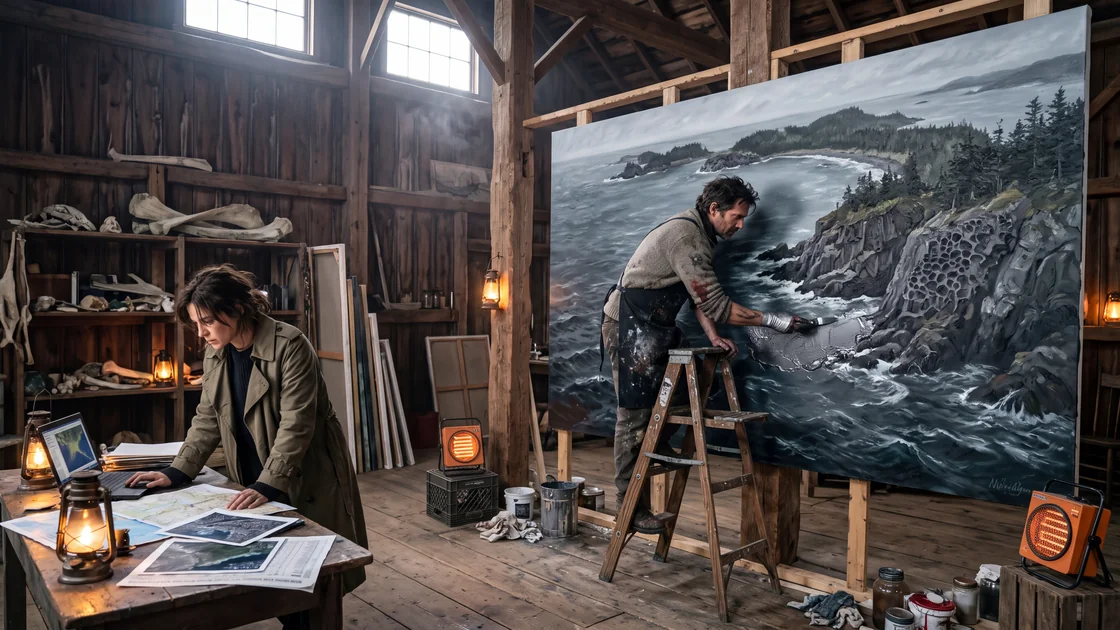
This is the story of Nicholas Thorne, a reclusive landscape painter living on the windswept headlands of northern Maine, who discovers that the purely imaginary wildernesses he invents upon his linen canvases physically manifest somewhere upon the Earth exactly forty-eight hours after completion. As newly forged mountain ranges, alien estuaries, and impossible mineral forests begin disrupting global tectonic balances and drawing the attention of an observant cartographer, Nicholas is forced to confront the terrifying boundary between creation and desecration, culminating in a desperate final work intended to heal a world buckling beneath the weight of his own dreams.
I. The Pigment of the Unseen
The studio smelled of damar varnish, cold woodsmoke, and the pungent, nutty bitterness of oxidized linseed oil. It was a cavernous space, converted from an eighteenth-century fish-curing barn that perched over the black slate ledges of Cape Split. Through the northern clerestory windows, the light arrived stripped of all warmth, filtered through the perpetual sea-fog that gnawed at the coast.
Nicholas Thorne stood before an easel constructed from salvaged ship timbers, his thumb hooked through the belly of a palette caked with twenty years of dried strata. He was forty-two, though his joints groaned like an old cutter when the barometric pressure fell, and his fingernails were permanently stained with Prussian blue and burnt sienna—tints that seemed to have migrated into his very capillaries.
For eighteen months, Nicholas had ceased painting from life. The local galleries in Portland and Boston still begged for his signature seascapes—the foaming granite spits, the salt-rimed spruce clings, the melancholy twilight over Casco Bay—but he had grown sick of observation. Observation felt like transcription, a petty sort of stenography performed with animal hair and vegetable grease.
Instead, he had begun to look behind his eyelids.
The canvas currently resting upon the easel was six feet across by four feet tall, stretched with heavy, unbleached Belgian linen. Nicholas titled it Basalt and Silt with Sinter Terraces. It depicted a landscape that did not, and could not, exist on any known terrestrial atlas.
In the painting, an immense, jagged fissure split an obsidian tableland. Down the center of the gorge ran a river not of white water or silt-brown mud, but of pale, milky turquoise, fed by tiered hydrothermal basins lined with blinding white silica. Along the margins of these pools grew thick, ruffled carpets of moss in a violent, improbable shade of cinnabar. The sky above was choked with low, bruised lenticular clouds that cast an eerie, bilious copper glow across the stone. There were no trees, no birds, no sign that any lung had ever drawn breath within that mineral silence. It was an arrangement of pure mass, tension, and color—an exercise in geological architecture.
Nicholas laid down his sable rigger brush. With the tip of a flexible palette knife, he touched the lower right corner, scraping in his diminutive monogram: N.T. — October 14.
A sudden, sharp headache blossomed behind his left temple—a dull, rhythmic pulse that had accompanied the finish of his last three major imaginary works. He pressed the heel of his hand against his brow, took a long, ragged breath, and stepped back.
"Done," he murmured to the empty barn.
He wiped his hands on a turpentine-soaked rag, extinguished the small kerosene stove that fought the encroaching damp, and locked the studio door. As he walked up the gravel path toward his saltbox cottage, the clock on his mantlepiece chimed half-past four in the afternoon.
Nicholas slept poorly that night. His dreams were filled with the sound of tearing canvas—a wet, fibrous screeching that seemed to emanate not from cloth, but from deep within the bedrock beneath his mattress. When he woke, his tongue tasted of dry sulfur.
The next day passed in the quiet, mundane stupor that inevitably followed the completion of a major piece. Nicholas walked into the village of Addison, purchased flour, tinned sardines, and a tin of tea from the general store, and exchanged few words with the proprietor. Returning home, he did not enter the studio. He had a rule, honed through two decades of labor: never look at a finished painting for at least thirty-six hours after the final stroke. The eye was a liar; immediately after labor, it saw only what it had intended, not what was actually there.
The forty-eight-hour mark arrived on October 16, at precisely 4:32 in the afternoon.
Nicholas was sitting at his kitchen table, oiling a pair of leather boots, when his shortwave radio—an old Hallicrafters unit he kept tuned to maritime weather and emergency frequencies—crackled violently. The speaker hissed with static, followed by the urgent, clipped voice of an anchor from the Canadian Broadcasting Corporation's maritime service:
“…repeating the bulletin from the Geological Survey of Canada and the United States Geological Survey. At approximately 4:30 PM Eastern Time, seismic monitoring arrays across the North Atlantic registered an anomalous low-frequency event centered in the Ungava Peninsula of northern Quebec. Satellite imaging providers, including Sentinel and Landsat, have reported an immediate and inexplicable topographical discrepancy in an uninhabited sector between the Leaf River and Ungava Bay.
Preliminary radar telemetry indicates a localized geological emergence. Where low-relief tundra and glaciated granite plains were surveyed as recently as this morning, early imagery shows a radical fissure system—estimated at over eleven miles in length—flanked by stepped terrace formations exhibiting anomalous thermal readings. Field teams from Kuujjuaq are currently being mobilized to confirm what appears to be an unprecedented tectonic upheaval…”
Nicholas dropped the tin of dubbin. It bounced off the linoleum floor, leaving a waxy smudge.
He stood motionless, his heart hammering against his ribs like a bird trapped in a flue. He did not immediately run to the studio. He remained frozen by the table, staring at the small, glowing dial of the radio as the broadcast continued, describing the "milky coloration" of the emergent drainage and the "curious red organic material" visible in high-resolution multispectral scans along the perimeter of the terrace pools.
When his legs finally moved, they carried him across the gravel yard in a frantic sprint. He burst through the studio door, leaving it banging wildly against the shingled exterior wall.
The painting rested upon the easel in the cold, gray light.
Nicholas approached it slowly, his breath coming in shallow, shuddering gasps. He leaned in until his nose was inches from the dry oil film. There was the fissure. There was the turquoise river. There were the stepped terraces of silica, their milk-white ledges catching the light, bordered by the impossible, feverish cinnabar of the moss.
It was not a likeness. A photograph could be a likeness. This was identity. The exact contours of the jagged basalt fracture, down to the triangular notch where his palette knife had slipped slightly near the canvas edge, were identical to the topographical maps the radio announcer was now describing with rising panic.
He had painted it. And forty-eight hours later, the Earth had bled it into being.
II. The Controlled Experiment
Nicholas did not sleep for two days. He sat in his wingback chair with a ledger on his lap, trying to assemble a rational defense against his own sanity.
Coincidence was the mind's favorite shelter. It was comforting, pliable, and infinite in its capacity to absorb statistical absurdities. One could point out that there were only so many geological shapes the world could take; that an artist steeped in the study of structural geology might intuitively predict the fault lines of an ancient craton; that the Ungava event was simply a freak hydrothermal eruption that happened to resemble an abstract landscape.
Yet Nicholas knew this was cowardice. He had felt the tear in his dreams. He had felt that deep, dull thrumming in his bones at the exact moment the forty-eighth hour elapsed.
"If it is real," Nicholas spoke aloud into the dark studio, "it is repeatable. If it cannot be repeated, I am simply mad, which would be a profound relief."
He took down a fresh, smaller canvas—twenty-four by thirty inches. He stretched it carefully, sizing the linen with rabbit-skin glue and coating it with two layers of lead-white primer. His hands were steady, but his skin was cold and clammy.
He needed an environment so wildly artificial, so aggressively foreign to any natural process on Earth, that no geological survey could ever explain it away as a delayed seismic anomaly.
He mixed his colors on a clean glass slab: viridian green, cadmium orange, dioxazine purple, and a synthetic, fluorescent yellow he had purchased years ago and never touched.
He began to paint.
He did not depict a valley or a mountain. He painted an immense, shallow basin of vitreous obsidian, shaped like an asymmetrical teardrop. Rising from the center of this black glass basin were seven spires of banded sandstone, each spire perforated by clean, perfectly circular geometric holes—voids that nature could never hollow out through the blind physics of wind and water. Around the base of the spires, he painted pools of liquid mercury that caught the inverted reflections of the holes. And along the southern rim of the basin, he carefully laid down three distinct, parallel ridges of pure, powdery sulphur, arranged like the furrows of an agricultural field.
As an added measure—a deliberate watermark—he used the tip of a fine needle to scratch into the still-wet paint of the central spire a precise mathematical sequence: the first eight digits of the Fibonacci series, etched into the stone face at a microscopic scale.
He signed it at precisely 9:00 AM on a Tuesday.
November 2, 9:00 AM.
He set a digital kitchen timer for forty-eight hours. The red numbers began their relentless descent: 47:59:59… 47:59:58…
Nicholas did not leave the studio. He dragged an army cot from the attic, placed it against the far wall, and watched the canvas. He barely ate. He watched the surface as the hours ticked away, waiting for some supernatural flicker, some shimmering heat-haze to rise from the paint.
Nothing happened. The oil simply dried. The linseed oil formed its tough, cross-linked linoxin skin. The glossy sheen turned matte in the colder drafts.
At forty-seven hours and fifty minutes, Nicholas sat on the edge of the cot, his fingers digged into his knees. His pulse throbbed behind his temples.
00:02:14… 00:01:03… 00:00:10… 00:00:05… 00:00:00.
A low, resonant sound—neither heard nor felt, but perceived through the dental fillings in his jaw—passed through the barn. It was the sensation of a vast mass of air being displaced hundreds of leagues away, a sudden vacuum instantaneously filled.
Nicholas did not move for an hour. Then, he rose, went into the house, and connected his desktop computer to the dial-up internet line he rarely used.
He waited through the screeching handshake of the modem, his breathing loud in the silent room. He opened the web browser and navigated to the global seismic alert servers maintained by the Incorporated Research Institutions for Seismology.
There was no major earthquake listed. He felt a momentary, dizzying wave of relief. He was mad. He had invented the connection. The Ungava event was a coincidence.
Then he opened the meteorological and satellite reconnaissance boards used by amateur orbital trackers.
A thread posted sixteen minutes prior was already pinned to the top of the forum:
ANOMALY: Western Sahara (Reggane Basin margin).
Nicholas clicked the link. The forum users were posting raw infrared and visible-spectrum tiles pulled from the European Meteosat satellite.
In the barren, flat gravel wastes of northern Mauritania—a region of hyper-arid desert where nothing had shifted for five thousand years except the wandering barchan dunes—a black spot had appeared.
The higher-resolution passes from a low-Earth orbit French commercial satellite followed thirty minutes later.
The image was crystalline.
A teardrop-shaped basin of reflective black stone, nearly four miles long. From its floor rose seven sandstone pillars, each pierced by immaculate circular perforations. The low desert sun shone directly through the stone tunnels, casting circular patches of light onto the black floor beneath. At the base of the pillars, pooling liquids reflected the sky like polished mirrors. Along the southern edge ran three crisp, parallel ridges of vivid yellow sulphur.
Nicholas pushed his chair away from the desk. The back of his throat closed.
He had not merely painted a picture. He had committed a spatial intrusion. He had carved four square miles of alien geometry out of the crust of the Sahara Desert from three thousand miles away, using a horsehair brush and twenty dollars’ worth of mineral paste.
He leaned forward, his face bathed in the blue cathode glow of the monitor, and whispered the question that would haunt every waking second of his remaining life:
"Where did the rock go?"
III. The Seam in the World
The answer to Nicholas’s question came from a woman he had never met, working in an office fifteen hundred miles to the south.
Dr. Miriam Calder was an anomaly within the National Geospatial-Intelligence Agency. She was not a military tactician or an intelligence operative; she was a structural topologist. Her specialty was the mathematical analysis of automated elevation models—the digital surface representations stitched together from radar satellites, aerial lidar, and orbital stereophotogrammetry.
For three weeks, Miriam had been living in a windowless room in Springfield, Virginia, surrounded by stacks of printouts that showed impossible arithmetic.
"Look at the datum," she said, leaning over a desk to point an unsharpened pencil at a terminal display.
Her supervisor, a career bureaucrat named Vance who smelled perpetually of stale peppermint and paper dust, squinted through his bifocals.
"I’ve looked at it, Miriam. It’s an error in the orbital interpolation. The satellite skipped a frame during the swath processing and the stitching algorithm filled the hole with garbage data."
"Satellites don't skip frames in identical geometric patterns across three different sensor platforms," Miriam said coldly. "Look at the Quebec rift. Now look at the Mauritanian basin. Forget what they look like for a second. Look at the perimeter."
She tapped a series of keys. Two topographical elevation cross-sections appeared on the screen, side by side.
"When an igneous intrusion occurs," Miriam explained, "or when a sinkhole collapses, the surrounding earth reacts. You get compression ridges. You get radial faulting. You get isostatic rebound. The volume of material remains constant; it just changes state or position. If four cubic kilometers of basalt punch through the crust in Quebec, the surrounding strata are displaced by exactly four cubic kilometers."
She zoomed in on the junction where the red-moss canyon met the ancient Canadian Shield.
"Look at the margin. There is no displacement. The granite doesn't buckle. The tundra doesn't wrinkle. The new land doesn't push the old land away, Vance. It replaces it. It’s as if someone took an exacto knife, cut a hole out of the surface of the planet, dropped a foreign piece of puzzle into the gap, and then caulked the seam."
"Caulked it with what?" Vance asked.
"That's the part that's making the guys at the USGS lose their minds," she whispered. "We got the core samples back from the Canadian rangers yesterday. Along the border between the native granite and the basalt fissure, there is a band three centimeters wide. It’s an amorphous, non-crystalline matrix. It’s composed of dried plant glycerides, calcium carbonate, and heavy metal oxides. Lead, cadmium, cobalt."
Vance frowned. "Industrial waste?"
"No," Miriam said, turning her chair to face him. "Artist's primer. It’s gesso, Vance. The entire geological formation is sitting on a bed of dry paint."
She did not wait for his dismissal. She pulled up a third image on her screen.
"And it's happened again. Five hours ago. In the interior of Iceland's Vatnajökull ice cap."
Nicholas had not been able to help himself. The compulsion had taken him like a fever. After the Mauritanian horror, he had sworn to break his brushes, to burn his canvas, to smash his palette. He had lasted nine days.
The silence of not painting had been worse than the terror of creation. The ideas did not stay politely in his mind; they began to curdle, rotting into terrifying, half-formed visual hallucinations that plagued his waking vision. He saw ridges across his bedroom walls; he saw waterfalls tumbling down the dark glass of his windows. The only way to stop the pressure in his skull was to externalize it—to purge the form onto linen.
He had tried to paint something harmless. He had painted an island of pale, translucent selenite ice, crowned with a copse of petrified trees whose branches were made of polished copper. He had painted it small—twelve inches square. A miniature. A toy.
He had finished it on Thursday at noon.
On Saturday at noon, forty square miles of the Vatnajökull glacier had dissolved in a hiss of steam as an island of solid gypsum rose through the ice, topped with towering dendritic formations of nine-hundred-and-ninety-nine-fine copper that hummed softly in the sub-polar wind.
Miriam Calder had been running an automated pattern-recognition algorithm across global satellite feeds, keyed to look for specific visual parameters: sudden high-contrast edges, improbable color signatures, and localized anomalies in surface roughness.
The Iceland event flagged instantly.
But Miriam had done something no one else in the intelligence community or geological surveys had thought to do. She had not looked at the event through the lens of geophysics. She had looked at it through the lens of composition.
Miriam had grown up the daughter of a curator at the Phillips Collection. She had spent her childhood wandering through rooms filled with Braque, Marin, and Ryder. When she looked at the false-color radar map of the Mauritanian basin, she didn't see an impact crater or an igneous plug.
She saw the brushwork of an impasto technique.
The ridges of sulphur weren't sand dunes; they had the characteristic scalloped, torn edge of paint pulled with a stiff-bristle flat brush. The circular holes in the sandstone spires didn't follow the fluid dynamics of wind erosion; they had the soft, rounded shoulders of a wet pigment lifted from a surface with a dry Q-tip or the thumb.
"Someone isn't building these things," Miriam muttered to herself in the quiet of her office, long after Vance had gone home. "Someone is executing them."
She ran a database query through the Copyright Office, the Art Loss Register, and digital catalogs of contemporary galleries, cross-referencing aerial elevation matrices of the three anomalies against digital scans of contemporary landscape art.
It took her thirty-six hours.
The match did not come from an active exhibition. It came from an obscure regional arts council archive in Augusta, Maine. A catalog published seven years ago: Nicholas Thorne: New Geologies of the Coast.
Miriam printed the artist's address, closed her terminal without logging out, and took the red-eye flight north to Bangor.
IV. The Arrival of the Compass
The fog had settled over Cape Split like a damp wool blanket, deadening the sound of the surf to a muffled, rhythmic heartbeat. Nicholas sat at his worktable, cleaning a set of palette knives with an oily steel-wool pad.
Every strike of the wool against the steel sent a jolt of nausea through his gut.
On the floor of the barn, turned toward the wall, were three completed canvases. He had not signed them. He had realized, through frantic trial and error, that the clock did not begin when the paint was laid down; it began when the work was concluded. The signature was the keystone that locked the arch of intention. As long as a canvas remained unsigned, unfinished in his mind, the earth held its breath.
Yet even unsigned, the paintings radiated an unbearable tension. They were like live artillery shells stored in a wooden shed. Nicholas could feel them humming behind him—an expanse of jagged, red-granite needles; a bay of black mercury that refused to ripple; a plateau carved with stepped labyrinths that defied three-dimensional perspective.
A car engine labored up the gravel lane, its tires crunching the loose stone.
Nicholas went rigid. He did not receive visitors. The mail carrier dropped his letters in a rusty box at the end of the paved road two miles south. The local fishermen avoided his headland; they thought him arrogant, or strange, or both.
A car door shut with a solid, metallic thunk. Footsteps approached the barn door—hesitant at first, then firm.
A knock sounded on the timber. Three raps.
Nicholas did not answer. He stood silently, holding the palette knife like a weapon, his heart thudding in his throat.
"Mr. Thorne," a woman’s voice called through the cedar planks. It was clear, exhausted, and remarkably steady. "My name is Miriam Calder. I am an analyst with the National Geospatial-Intelligence Agency. I drove six hours from Boston, and I didn't bring anyone with me. We need to talk about northern Quebec."
Nicholas felt the floor drop away beneath his feet. The world seemed to tilt on its axis, sliding toward an abyss.
He slowly walked to the door, slid back the heavy iron bolt he had installed three days ago, and pulled it open an inch.
The woman standing on the gravel was younger than he expected—perhaps thirty-five, wearing a rumpled olive trench coat over an unironed wool sweater. Her dark hair was pulled back into a messy knot, and she had dark, crescent-shaped bruises beneath her eyes that mirrored his own. She carried no briefcase, only a cardboard shipping tube tucked beneath her arm.
She looked at him—at his paint-stained hands, his hollow cheeks, the manic, hunted look in his eyes—and let out a long, ragged exhale that condensed in the freezing air.
"You're not mad," she said quietly. "Or if you are, your madness has a physical mass of approximately forty billion tons."
Nicholas stared at her for five long seconds. Then he opened the door and stepped aside.
Miriam walked into the barn. She didn't look at the rafters or the collection of dried sea-fans and whale bones Nicholas kept on his shelves. Her eyes went immediately to the easels, to the stretchers leaned against the wall, to the smell of turpentine that hung like an invisible fog in the cold room.
Without a word, she unscrewed the cap of the cardboard tube, pulled out a stack of high-resolution satellite prints, and spread them across the paint-spattered worktable.
Nicholas looked down.
There was the Vatnajökull copper grove, photographed in oblique sunlight from an altitude of four hundred miles. There was the Sahara basin, its circular perforations casting clean ellipses of shadow across the salt.
"How?" Nicholas whispered. It was the only word left to him.
"I was hoping you could tell me," Miriam replied. She leaned her knuckles on the table, her eyes scanning the prints. "From an engineering perspective, it's impossible. From a thermodynamic perspective, it violates every conservation law we have. The mass isn't being transported from anywhere else on the planet. I checked the global mass-balance data from the GRACE satellites. The Earth is getting heavier, Mr. Thorne. By very small, very precise increments. The planet is gaining weight."
Nicholas sank into his wooden chair, burying his face in his hands.
"I didn't want this," he sobbed, the sound muffled by his palms. "I only wanted to paint something that didn't bore me. I was so sick of rocks that just sat there. I wanted to see what was behind the eye."
Miriam walked around the table. Her movement was deliberate, calm, almost clinical. She reached out and touched the edge of a fresh canvas leaning against the wall.
"This one," she said. "Is it finished?"
"No," Nicholas gasped, looking up. "Don't touch it. It isn't signed. If I sign it, forty-eight hours from now, whatever is on that linen will punch a hole through the world."
Miriam knelt beside the canvas, tilting her head to inspect the work. It was a depiction of a vast, bone-white limestone shelf, completely flat, that terminated in an abyss of vertical needles resembling a petrified forest of icicles.
"Where would it go?" she asked.
"I don't choose," Nicholas said hopelessly. "I have never chosen. The first one was in Quebec. The second was in Africa. The third was in Iceland. It chooses places that are empty, I think. Or almost empty. As if it has some vestigial mercy."
"It isn't mercy," Miriam said, her voice dropping. "It's topology."
She stood up and pulled another map from her coat pocket—a global chart marked with complex red lines and mathematical annotations.
"I mapped the coordinates of the three emergence sites," she said, laying it over the satellite photos. "Quebec. Mauritania. Iceland. Do you know what connects them?"
Nicholas shook his head.
"They're nodes," she said. "On a harmonic strain tensor. If you treat the Earth’s crust as a vibrating drumhead, these are the points where the wave amplitudes cancel each other out. The nodal points. The places of least resistance. You aren't choosing empty places, Mr. Thorne. You are choosing the places where the crust is thin enough for your... your strokes to anchor themselves."
She turned to face him, her eyes burning with an intense, frightening lucidity.
"The problem is that the drumhead is running out of nodal points. Every time you drop twenty billion tons of non-native geology into the system, you increase the tension on the rest of the shell. The Earth can absorb a few rifts in Quebec and a few glass bowls in the Sahara. But the crust is beginning to ring like a struck bell."
She pointed to the seismic activity logs at the bottom of her chart.
"Three hours after your copper trees appeared in Iceland, the Mid-Atlantic Ridge experienced sixteen magnitude-five earthquakes along the Reykjanes segment. The seam didn't hold perfectly. The caulking is failing."
Nicholas looked down at his trembling, pigment-blackened hands.
"Then I will stop," he said. "I will never paint again. I’ll cut my hands off if I have to."
"You won't have to," Miriam said grimly. "Because stopping won't save us. You've already destabilized the plate boundary between the North American and Eurasian plates. The tension is stored in the stone, Mr. Thorne. It’s like a bow that has been drawn back. If you simply walk away, the bow doesn't unstring itself. It snaps."
V. The Weight of Silence
For four days, Miriam lived in Nicholas’s cottage. She slept on the lumpy sofa in the parlor, surrounded by her printouts and an array of battery-powered topographical instruments she had requisitioned from her office before disappearing.
The government did not know where she was. She had turned off her phone, abandoned her agency-issued vehicle at the Portland jetport, and rented an anonymous sedan with cash. She knew how the system worked. If Vance or the Pentagon realized what Nicholas was, they would not ask him to stop.
They would put a rifle to his head and force him to paint strategic harbors into the Arctic, or titanium-rich massifs into the Nevada desert. They would treat him like a piece of heavy machinery, oblivious to the fact that every square kilometer he conjured pulled the tectonic threads tighter until the entire tapestry would tear apart.
Nicholas did not touch a brush.
The agony of the abstinence was somatic. By the third day, a high-grade fever raged through his blood. His skin felt paper-dry, and his eyes were bloodshot and sensitive to light. When he closed them, he did not see darkness; he saw violent, incandescent visions of terrain that demanded to be realized.
He saw canyons of curdled milk; mountains that curled back upon themselves like the spiral shells of nautiluses; vast plains of magnetic iron sand that danced in rhythmic, hexagonal pillars beneath an unseen electrical current. The landscapes screamed in his head, fighting for egress, battering against the inside of his skull like birds against a lighthouse lantern.
"I can't hold them," he groaned, slumped over the kitchen table at three in the morning. His teeth were chattering. "Miriam, I can't hold them in. They're trying to get out."
Miriam sat across from him, sipping cold tea. She had not washed her hair in days, and her face was pale with fatigue, but her eyes were needle-sharp.
"If you paint them randomly, as you have been doing, where does the next one fall?" she asked.
She pulled her global map toward them. The red lines had been redrawn, recalculated using the latest seismic reports from the Global Seismographic Network.
"The strain has migrated," she said, her finger tracing a sweeping arc through the Pacific Basin. "The Atlantic nodes are locked. The drumhead is rigid there now. The next soft point... the next place where the crust will yield to your canvas... is here."
Her fingernail came to rest on the coast of Honshu, Japan.
Nicholas stared at the spot. "The Sanriku coast."
"A subduction zone," Miriam said. "The most unstable, densely populated tectonic convergence on the planet. If you manifest another four-mile basalt plug there—if you drop an obsidian plateau into that trench—the displacement will trigger a megathrust event. A magnitude nine. Maybe higher. The tsunami would scour the Pacific rim from Sendai to Valparaiso."
Nicholas pushed himself back from the table, retching dryly into his apron.
"Then I die," he gasped. "If I die, it stops."
"Does it?" Miriam asked, her voice dangerously quiet. "Are you sure? What if the landscapes aren't originating in your brain, Nicholas? What if your brain is just a relief valve? A conduit? If you die with three unfinished canvases in the studio, what happens to the pressure that’s already built up behind the dam?"
Nicholas thought of the three canvases facing the wall in the barn. Even now, through two walls of timber and across thirty yards of cold, fog-slick grass, he could feel their presence. They were not inert objects. They were spatial apertures that had been opened halfway and jammed with wedges. If he died, the wedges would rot away.
"What do we do?" he wept. He was no longer an artist; he was an engine running without an operator, shaking its mountings to pieces. "Tell me what to do, Miriam. You understand the numbers. I only know the paint."
Miriam stood up and walked to the window. The Atlantic was invisible in the darkness, but its roar against the slate ledges was louder than usual—a grinding, percussive smash that seemed to carry the weight of an entire shifting ocean.
"You have to paint," she said, without turning around.
"You just said it would kill millions!"
"You have to paint a solution," she said.
She turned to face him, the dim yellow light of the kitchen fixture catching the sharp angles of her jaw.
"Every landscape you've painted has been an assault. A fracture. A violent insertion of foreign geometry that ignores the preexisting curvature and stress fields of the Earth. You've been painting things, Nicholas. Objects. Walls. Plugs. Holes."
She walked to the table and tapped her finger on the blank back of a topographic survey sheet.
"You need to paint a reconciliation."
VI. The Geometry of Absolution
"Explain," Nicholas said. His voice was hoarse, his fever-bright eyes fixed on her face.
Miriam pulled a mechanical pencil from her pocket and began to draw on the margin of the survey sheet. She did not draw mountains or rivers; she drew vectors—arrows indicating the direction of tectonic drift, the compressive forces of the continental plates, the subduction gradients where the oceanic crust plunged into the mantle.
"The Earth isn't a blank piece of paper," she said. "It is an existing, dynamic composition. It has its own balance, its own rhythms, its own internal logic that has evolved over four billion years. When you painted that rift in Quebec, you painted it without regard for the lines of force already running through the Canadian Shield. You painted an imposition. You acted like a vandal tagging a cathedral."
Nicholas winced, but he did not argue. It was the truth. He had sought the bizarre, the monstrous, the impossible, purely to satisfy his own boredom with the mundane.
"If you paint a foreign mass that contradicts the regional stress field," Miriam continued, "the Earth rejects it like an infected splinter. That rejection is the earthquake. That rejection is the tsunami. But what if the landscape you paint isn't a splinter?"
"A suture," Nicholas murmured.
The word hung in the air between them, heavy with consequence.
"A suture," Miriam agreed. "A geological structure designed not to disrupt the strain, but to absorb it. A landscape that acts as an harmonic damper. If we know where the tension is greatest—if we can calculate the exact vector of the stress accumulating along the Pacific rim—can you paint a terrain that receives that stress and dissipates it?"
Nicholas closed his eyes. The fever-dreams surged against his retinas, but now he did not fight them. He let the shapes wash over him, filtering them through Miriam’s vectors.
He saw the Cascadia subduction zone—seven hundred miles of locked fault line running from Cape Mendocino to Vancouver Island. He felt the immense, terrifying silence of the Juan de Fuca plate as it ground itself into the belly of North America, sticking, buckling, storing three hundred years of compressed kinetic energy that was poised to tear the Pacific Northwest into driftwood and rubble.
"It can't just be a pretty hill," Nicholas whispered. His hands began to move in the air, unconsciously tracing forms. "It has to have mass. It has to have an internal architecture that yields without breaking. Like a ribcage. Or an accordion."
"Porous," Miriam said, her breath quickening. "A formation with high internal surface area. Something that can compress under lateral force without transmitting the energy to the surrounding crust."
"Pumice," Nicholas said, his eyes still shut. "No, not pumice. Pumice is too brittle. Reticulated basalt. A cellular network of stone... like the interior of a bone. With layers of ductile clay between the struts. Bentonite. Smectite. And water. Not a river, but a labyrinth of subterranean chambers that act as hydraulic baffles."
He opened his eyes. The fever was still there, but the madness had cleared. It had been replaced by the cold, terrifying clarity that comes to a surgeon before an impossible operation.
"How large does it have to be?" he asked.
Miriam looked at her charts. She did not flinch.
"Eighty miles long," she said. "Twelve miles wide. Minimum."
Nicholas felt a cold drop of sweat trace the path of his spine.
"The largest canvas I have ever painted was eight feet across," he said. "It took me three months. That was for an area of forty square miles."
"You have thirty-six hours," Miriam said. "The strain sensors in the Kuril Trench just went off the scale. The drumhead is about to tear, Nicholas. If you don't anchor this suture before the forty-eighth hour of the next tectonic shift, Japan falls into the sea, and Cascadia follows it forty minutes later."
Nicholas stood up. He did not look at the ledger. He did not look at the clock.
"Help me build the frame," he said.
VII. The Great Canvas
They worked through the remainder of the night by the yellow light of kerosene lanterns.
There was no time to order linen; there was no linen on the coast of Maine large enough for what they required. They ripped down the heavy sailcloth curtains that insulated the high northern windows of the barn. Nicholas seized a bolt of unbleached ten-ounce cotton duck he had stored in the loft twenty years ago, dry and stiff with age.
Using an antique crosscut saw and salvaged spruce studs from the barn's renovation, they built a stretcher frame twelve feet long by seven feet high. It dominated the studio, a vast, pale wall of timber and taut fabric that groaned when they hoisted it against the center king-post of the barn.
Nicholas did not use rabbit-skin glue; it took too long to dry. He boiled water on the kerosene stove and mixed industrial gesso with dry marble dust, working the paste into the weave with broad drywall scrapers until the cloth was primed with a chalky, toothy ground.
To dry it, Miriam rigged three electric space heaters on wooden boxes, their fans whirring as they blew dry, hot air against the canvas face.
While the primer set, Nicholas ground his pigments.
He knew that this could not be an ordinary painting. The physical materials mattered. The oil, the mineral origin of the dust, the chemical binders—they were the genetic code of the manifestation.
He took his mortar and pestle and began reducing raw minerals to powder. He did not use synthetic tubes. He used raw slate gathered from his own beach for the grays; bone black derived from charred cattle ribs; raw umber from Cyprus; green earth from Verona; and a heavy, dense chunk of galena—lead sulfide—that he crushed into a glistening, silver-gray dust that made his lungs ache when he breathed the air above the bowl.
"This is the skeleton," he said, dumping the pulverized galena into a gallon of cold-pressed linseed oil. He stirred it with a wooden lath until it formed a thick, sludgy, metallic gray paint that weighed fifteen pounds to the bucket. "This is the compressive core. The lead will give the stone its mass. The slate will give it its cleavage."
Miriam stood beside him, watching the slurry swirl. Her hands were black with charcoal dust; she had been calculating the coordinate grid that had to be embedded into the composition.
"The epicenter of the suture must fall here," she said, pinning a drafted coordinate diagram to the timber frame beside the linen. "Off the coast of Oregon. In the Blanco Fracture Zone. It has to bridge the gap between the Gorda Ridge and the San Andreas system. If you drop the suture there, it will act as a shock absorber for both systems."
"It will rise from the ocean?" Nicholas asked, his brush already poised.
"It has to," she said. "The ocean floor is where the plates meet. If you put it on dry land, the crust will simply shear around it. It must be anchored to the sea floor, rising through the water column to the surface. It will become an archipelago."
Nicholas nodded. He understood now.
He was not painting a picture of a place. He was painting a machine made of rock, sea, and moss.
He began at 6:00 AM on the morning of November 8.
The first marks were not delicate. Nicholas used an eight-inch wallpapering brush, dipping it into the leaden gray sludge and driving it into the canvas with the full weight of his shoulder. The barn echoed with the rhythmic, percussive thwack-slap of the stiff bristles hitting the taut cloth.
He laid down the foundation: an immense, subterranean trench of abyssal purple and iron-black, its walls stepped in retreating, parabolic curves designed to funnel and dissipate hydrostatic shock. He worked with a terrifying, mechanical speed, his body moving back and forth before the twelve-foot frame like a weaver at a loom.
Miriam stood at his elbow, tracking the time and the seismic tickers on her satellite terminal.
"Hour twelve," she announced. "The southern end of the Cascadia fault just registered three micro-events at twenty kilometers depth. The lock is slipping."
Nicholas did not answer. He was no longer speaking. He had entered that state of hyper-attentive trance where the boundary between the hand and the mind dissolves. His shirt was soaked with sweat; his breath came in rhythmic, wheezing rasps.
He climbed a wooden stepladder to reach the upper quadrants.
Here, he laid down the cellular basalt—not as solid stone, but as an intricate, hexagonal honeycomb, each cell filled with a glaze of sea-green glauconite and silty clay. He painted the chambers open to the sea, allowing the water to enter the stone, creating an infinite series of hydraulic pistons that would absorb the lateral thrust of the Juan de Fuca plate.
The scale of the labor was monstrous. A twelve-foot canvas required gallons of medium. The fumes of turpentine and linseed oil became so thick in the unventilated barn that Miriam’s eyes watered uncontrollably, and Nicholas’s lips turned an unearthly, cyanotic blue from inhaling the vaporized lead and mineral spirits.
By the twenty-fourth hour—dawn of the second day—Nicholas’s fingers had begun to seize. The tendons in his right forearm were swollen to twice their normal size, throbbing with acute tenosynovitis. Every movement of his wrist sent a white-hot line of pain from his knuckle to his elbow.
"Let me help," Miriam pleaded, seeing him drop his third brush. "Tell me where to lay the color. I can fill the flats."
"No," Nicholas spat, his voice like gravel grinding in an iron chute. "If your hand touches the cloth, the intention splits. The world can't read two minds at once. It has to be... coherent. It has to be one will."
He picked up a wide palette knife, bound it to his right palm with duct tape so his failing grip would not drop it, and continued.
He painted the surface of the archipelago.
It was not a barren wasteland like his earlier works. He realized, with a deep, instinctual certainty, that an empty landscape was a brittle landscape. A machine that absorbs energy must have life; life was the ultimate dissipative structure.
He painted forests of salt-tolerant shore pine, their roots not shallow, but plunging hundreds of feet into the basalt honeycomb, binding the stone together like rebar in reinforced concrete. He painted beaches of heavy, magnetic black sand that would break the velocity of the ocean surges. He painted shallow, sheltered sounds where the water was calm and thick with kelp—miles of giant bull-kelp whose air-bladders and rubbery stipes would act as viscous dampers against the seismic sea waves.
By hour thirty-six, the light had failed again. The studio was plunged into the amber gloom of the lanterns.
Nicholas was barely upright. He leaned against the ladder, his forehead pressed against the unpainted top margin of the canvas, his chest heaving. The paint was nearly dry in the lower sections, pulled tight by the heaters.
"The time," he whispered.
Miriam checked her terminal. Her face was gray in the screen's reflection.
"The seismic tremors have merged into a continuous harmonic tremor," she said softly. "The tremor frequency is 1.5 Hertz. That’s the precursor, Nicholas. When the frequency drops to 0.8, the fault unzips. We have less than twelve hours."
Nicholas looked at the painting.
The work was vast, terrifying, and strangely beautiful. It was an archipelago shaped like a crescent moon, eighty miles long in its implied scale, curving outward to meet the fury of the Pacific. It looked ancient. It looked as if it had been there since the Miocene, weathered by ten million storms, settled, heavy, and complete.
"It's not done," Nicholas whispered.
Miriam looked at the canvas. "It looks complete to me. The structures are there. The honeycomb is there. The coordinates are embedded."
"It's dead," Nicholas said. He turned his head to look at her, his eyes sunken so deep into his skull they looked like empty sockets. "It's an engine with no fire. It has no center of gravity."
"What does it need?"
"A witness," he said.
VIII. The Inhabitant
The concept had come to him not from science, nor from the mathematics Miriam had scratched onto her charts, but from the long history of landscape painting.
A landscape without a figure is an abstraction. It is an arrangement of light and matter that exists only in theory. In the classical tradition—in Poussin, in Claude Lorrain, in the great Chinese masters of the Song dynasty—there was always a traveler on the road. A solitary fisherman in a skiff. An old man leaning on a staff beneath an immense, overhanging willow.
The figure was not there for scale. The figure was there to complete the loop of perception. The figure was the universe looking at itself.
"I have to put someone on the island," Nicholas said.
His voice was faint, a dry rustle like dead leaves blown across flagstones. He was sliding down the rungs of the ladder, his knees buckling. Miriam caught him by the armpits, her own strength nearly spent, and lowered him to the floor.
"Nicholas, there are no people there," she said, kneeling beside him on the paint-spattered drop cloths. "It's forty miles off the coast of Oregon. It’s open ocean. If you put someone there, you're conjuring a human being out of nothing. You can't do that. You don't know what that would do."
"Not someone," Nicholas whispered. His eyes were drifting toward the ceiling timbers. "Not a stranger."
He held up his right hand—the hand bound to the steel knife with silver tape.
"Cut it off," he said.
Miriam stared at him, horrified. "What?"
"The tape. Cut the tape."
She pulled her pocketknife, slit the duct tape, and gently peeled it from his skin. The steel tool clattered onto the floor. Nicholas’s hand was a claw, the fingers curled inward, stiff with inflammation and stained with galena and lamp black.
"Help me up," he said.
"Nicholas, you can't stand."
"Help me up, Miriam, or let the world drown. Those are the two choices."
She set her jaw, hooked her arms under his, and heaved. Nicholas groaned—a sound of pure, animal torment—as his weight settled onto his swollen feet. He leaned against her shoulder, his body trembling with the rhythmic, uncontrollable shivers of advanced exhaustion and chemical poisoning.
He did not pick up a brush. He reached out with his left hand—the hand that was less ruined—and dipped his bare index finger into a mound of pure, unadulterated vermilion on the palette slab.
Vermilion: mercuric sulfide. Dense, brilliant, permanent, and toxic.
He dragged his feet across the floor until he was standing before the central island of the painted archipelago. There, on a high, wave-swept headland of cellular basalt, overlooking the immense, protective crescent of the bay, he leaned forward.
With the pad of his finger, he pressed a single, clean dot of scarlet onto the stone shelf.
Then, with the edge of his fingernail, he drew three tiny, hair-thin lines downward from the dot.
A figure. A solitary human shape, wrapped in an oilskin coat the color of dried blood, looking out to sea. Facing the oncoming storm. Anchoring the horizon with its gaze.
Nicholas pulled his hand back. He looked at the tiny red speck in the center of the twelve-foot sea of gray and green.
The figure was not anonymous. Though it was less than an inch high, the posture was unmistakable. It was the roundness of the shoulders; the slight tilt of the head to the left; the stubborn, rooted stance of a man who had spent twenty years standing before an easel on a windswept cliff, bracing himself against the northern gales.
It was Nicholas.
"Now," Nicholas whispered.
He did not use a knife. He did not use a pen. With his vermilion-stained finger, he reached down to the lower right-hand corner of the linen, where the unpainted white primer met the spruce stretcher bar.
He pressed his thumb into the cloth, leaving a clear, perfect whorl of red skin-ridges—an indelible biometric seal.
Beneath the print, using the bloody tip of his nail, he scratched:
N.T. — November 9, 6:00 PM.
The moment the final stroke was completed, the kitchen timer in the cottage did not need to be set.
The forty-eight-hour clock did not tick down in seconds. It ticked down in the marrow of their bones.
Nicholas collapsed. He did not fall forward onto the wet paint; he fell backward, into Miriam’s arms, his dead weight driving them both to the floor. Miriam sat in the turpentine-stink of the barn, holding the painter's head against her lap, his shallow, fluttering breath warm against her wrist.
The clock had begun.
IX. The Vigil of the Tide
The forty-eight hours of the final vigil were characterized by an unnatural, terrifying silence.
The weather over Cape Split cleared. The fog, which had hugged the headland for three weeks, was swept away by a dry, cold continental wind that descended from the northwest. The sky became a dome of immaculate, arctic blue, so clear that the stars at night did not twinkle; they burned like cold, steady holes drilled through the black vault of space.
Nicholas did not regain full consciousness. He lay on the cot in the barn, wrapped in three wool blankets, his breathing heavy and rattling. Miriam stayed by his side, forcing spoonfuls of warm sugar-water between his cracked lips and wiping the lead-dust from his forehead with a damp cloth.
She did not look at her satellite terminal often. She did not need to. The data had ceased to be an abstraction.
At hour twenty-four—sunset on November 10—she stepped outside the barn to fetch firewood.
The tide was out. The black slate ledges of the cape were exposed, draped in brown rockweed and kelp. But the sea was behaving strangely. It did not break in its usual short, chaotic chops. The water was flat, oily, and heavy. It rose and fell in immense, slow swells that had a period of nearly two minutes—a long, ponderous breathing that seemed to originate thousands of miles away, as if the entire North Atlantic basin were tilting on a giant pivot.
She returned to the barn. Nicholas’s eyes were open.
They were no longer feverish. They were clear, vacant, and enormous, reflecting the yellow flame of the lantern.
"Do you hear it?" he asked. His voice was a thread of sound, barely louder than the dry hiss of the spruce logs on the stove.
"I hear the water," Miriam said, sitting on the stool beside him.
"Not the water," he murmured. "The cloth. It’s stretching."
She looked at the twelve-foot painting.
In the dry heat of the studio, the oil had begun to oxidize rapidly. The surface was setting. But it was not setting evenly. Along the brushstrokes of cellular basalt—where Nicholas had piled the lead sludge inches thick—the canvas was pulling inward, creating deep, radial wrinkles that strained against the iron tacks holding the cloth to the frame. The spruce studs were groaning, their wood fibers popping with sharp, dry clicks like pistols fired under blankets.
"It's drawing the room in," Nicholas whispered. "It's hungry, Miriam. A landscape that big... it takes so much to fill it."
"Rest," she said, pressing her palm to his forehead. His skin was cold now—not the burning heat of fever, but the clammy, gray chill of a stone pulled from a river bottom.
"You have to be there," Nicholas said. He reached out with his left hand, his fingers surprisingly strong as they closed around her wrist. "When the time comes. You have to watch."
"I am watching," she said.
"Not here," he said, his eyes rolling toward the west. "The terminal. You have to see if the seam holds."
At hour forty-six—4:00 PM on November 11—the satellite terminal began to chime.
It was not the high-pitched alarm of an emergency alert. It was the continuous, rhythmic pinging of an automated data-ingest stream. The National Data Buoy Center’s Pacific network was reporting simultaneous pressure anomalies across eighteen deep-ocean tsunameters from Alaska to Monterey.
Miriam sat at the worktable, her eyes fixed on the display.
The ocean was dropping.
Station 46404, three hundred miles off the coast of Oregon, showed the sea-surface height falling by three meters... four meters... six meters. It was not a trough before a wave; it was a sustained, localized displacement of water, as if an enormous subterranean bladder were inflating beneath the sea floor, lifting the ocean on its back.
01:30:00 remaining.
Nicholas was no longer speaking. He had turned his face toward the painting. His breathing had slowed to four breaths a minute, long, shuddering inhalations that smelled of iron and linseed, followed by silences so prolonged that Miriam repeatedly reached for his pulse, convinced his heart had stopped.
Every time his chest rose, the canvas before him seemed to respond.
The wrinkles in the cloth were flattening out. Not because the tension was slackening, but because the fabric was being drawn forward, pulled by an immense, invisible vacuum toward the center of the painted bay. The spruce frame was bowing inward at the center, the twelve-foot horizontal beams bending like archery bows.
00:45:00 remaining.
The data from the seismic networks along the Pacific Rim had stopped updating. Not because the sensors had failed, but because the processing algorithms had encountered an arithmetic overflow. The entire Cascadia subduction zone was moving simultaneously.
Yet there was no shock.
The seismographs were not registering the sharp, vertical spikes of a fracture. They were drawing broad, smooth, sinuous curves that resembled the rolling undulations of a heavy cable being laid upon a deck.
The energy was being absorbed.
00:10:00.
Miriam stood up from the computer. She could not bear to look at the numbers anymore. She walked to the foot of Nicholas’s cot.
The barn was filled with a sound that she would never be able to describe to anyone, though she would live for forty more years. It was not wind. It was not thunder. It was the sound of a billion tons of dry, cold linen sliding across a billion tons of wet, salted earth. It was the friction of two surfaces—one made of thought and pigment, the other made of stone and magma—slipping into alignment along a seam that stretched across eleven time zones.
Nicholas raised his head from the pillow.
His face was entirely bloodless, white as the gesso ground that primed his cloth. He looked at the painting.
The figure in the red coat was gone.
Miriam blinked, rubbing her eyes with the heels of her hands. She stepped closer to the canvas.
The wave-swept headland was there. The cellular basalt was there, its hexagonal chambers catching the gray painted spray. But the scarlet mark—the dot of pure vermilion he had pressed onto the ledge with his finger—had vanished. In its place was a tiny, unpainted void, a pinprick of raw linen where the paint had simply lifted away, leaving nothing behind.
She turned back to the cot.
"Nicholas?" she called softly.
00:00:00.
The Hallicrafters radio on the kitchen shelf did not crackle. The lights did not flicker.
There was only a single, soft, wet thwack—like the sound of a heavy brush laden with oil being dropped onto a wooden floor from a height of an inch.
Then, silence.
X. The New Shore
The United States Coast Guard cutter Alert reached the coordinates forty-eight hours after the emergence, navigating through an ocean that smelled not of salt and brine, but of wet quarry dust and freshly cleaved stone.
The commander stood on the bridge wing, his binoculars pressed to his eyes, his knuckles white against the brass casing.
"It isn't on the charts," the executive officer whispered beside him, his voice trembling. "Captain, there’s twelve hundred fathoms of water supposed to be under our keel right now. The sounder says we're in thirty feet."
"All stop," the commander ordered. "Drop the lead."
Through the morning mist that rolled off the cold Pacific, the contours emerged.
It was not a reef. It was an archipelago.
Immense, curving headlands of a stone that looked like dark gray honeycomb rose seventy feet above the swells, their hexagonal pillars packed with dense, green glauconite clay that absorbed the impact of the surf with a dull, hollow thud, deadening the spray into a milky foam that drained instantly through millions of natural stone conduits.
Behind the outer barriers, the water was still as a millpond. Dense forests of shore pine—their needles an improbable, vivid emerald, their trunks thick and ancient as if they had weathered five hundred winters—crowded the lower margins of the islands. Long, sweeping spits of black, magnetic sand curved outward into the blue water, their beaches carpeted with tangled mats of giant bull-kelp that swayed in the clear shallows like the hair of drowned titans.
Along the entire eighty-mile perimeter of the formation, the immense tectonic strain that should have shattered the cities of the Pacific Northwest from Seattle to Portland had been arrested. The shock absorber had held. The honeycomb stone had compressed four inches to the mile, its clay baffles absorbing the energy of the moving plate, converting the kinetic fury of a megathrust earthquake into a gentle, harmless thermal pulse that raised the local water temperature by barely two degrees.
The world had not torn. The seam had been caulked.
The commander lowered his binoculars. His hands were shaking.
"Look there," he said, pointing toward the high, wave-swept bluff that anchored the central island. "On the crest."
The executive officer trained his glasses on the point.
Rising from the basalt tableland was a solitary structure—a small, square cottage built of cedar shingles that had been weathered to a deep, salt-silver gray by a lifetime of sea-winds. It sat perched over the cliff, its northern clerestory windows catching the pale morning light, looking out across the vast, calm expanse of the unmapped bay.
Beside the cottage, standing at the edge of the slate drop, was a figure.
Through the high-magnification lenses of the binoculars, the officer could see him clearly: a man of middle years, wearing an oilskin coat the color of dried vermilion, his hands shoved deep into his pockets, his back turned to the ship, his face turned toward the infinite horizon of the open sea.
"Shall we lower a boat, sir?" the officer asked, his voice hushed. "Send a landing party to see if he needs assistance?"
The commander stood motionless on the bridge wing, watching the figure through the thinning fog.
He watched the way the man stood—not with the panic of a castaway, or the confusion of an accidental traveler, but with the quiet, terrifying ease of a master who has walked through his own front door and closed it against the world.
"No," the commander said quietly, lowering his glasses. "Log the position. Inform District Thirteen that the hazard to navigation is permanent. And come about."
"Sir?"
"Come about, Lieutenant," the old sailor said, turning his back on the island. "We have no business on that shore. The man is already home."
XI. The Inventory of the Studio
In the late autumn of the following year, Miriam Calder returned to Cape Split for the last time.
She had resigned from the agency six months prior. The government had classified the "Cascadia Discontinuity" under seventy layers of national security seals, attributing the sudden appearance of the Thorne Archipelago to an "anomalous isostatic adjustment event associated with the Mendocino Triple Junction."
The scientific community had argued, published three thousand conflicting papers, and eventually moved on. The world had an immense capacity to normalize the miraculous once it became clear that the miracle was not currently attempting to kill them.
The barn was cold.
The ocean fog had returned, leaking through the chinks in the cedar shingles and coating the tools with a fine skin of orange rust. On the worktable, the jars of raw pigment remained where Nicholas had left them: the slate gray, the bone black, the green earth, and the empty, scraped saucer that had once held the vermilion.
In the center of the room, resting against the king-post, was the twelve-foot frame.
It was bare.
The cotton duck had not been cut away with a knife; the copper tacks still held their scraps of unbleached thread along the margins. But the center of the canvas was gone. Where the painting had been, there was only the cold, empty air of the studio, looking through to the rough-hewn boards of the back wall.
Miriam walked to the easel.
Resting upon the shelf was a single, small wooden palette—the one Nicholas had used for thirty years, its surface an inch thick with dried, petrified strata of every color he had ever mixed.
Beside it lay a small piece of heavy rag paper, torn from a sketchbook, weighed down with an oyster shell.
Miriam lifted the shell and picked up the paper.
There was no letter. There was no explanation. Nicholas had known that explanations were the refuge of people who did not understand the weight of a line.
There was only a small sketch, drawn with a stick of vine charcoal with the frantic, delicate economy that had been his gift before the fever took him.
It was an interior.
It depicted a barn, high-ceilinged and cold, with light falling through northern clerestory windows. In the center of the barn stood an easel, and upon the easel sat a blank, white rectangle of linen, waiting for its first mark.
And in the lower right-hand corner of the sketch, drawn so small that it could only be seen by holding the paper inches from the eye, was a window.
Through the window, one could see a headland of black slate, a cold, gray sea, and a single, white sail disappearing into the fog—not sinking, not struggling, but running before the wind toward an edge that had never been surveyed, upon an ocean that had no end.
Miriam folded the paper carefully, placed it in the breast pocket of her coat, and walked out of the barn.
She did not lock the door. She left it unbolted, swinging slightly on its iron hinges, so that the sea-fog, the salt, and the wind could enter whenever they pleased, carrying with them the smell of fresh linen and the slow, patient breathing of a world that was still learning how to hold its new shape.