The Architecture of Blood and Iron
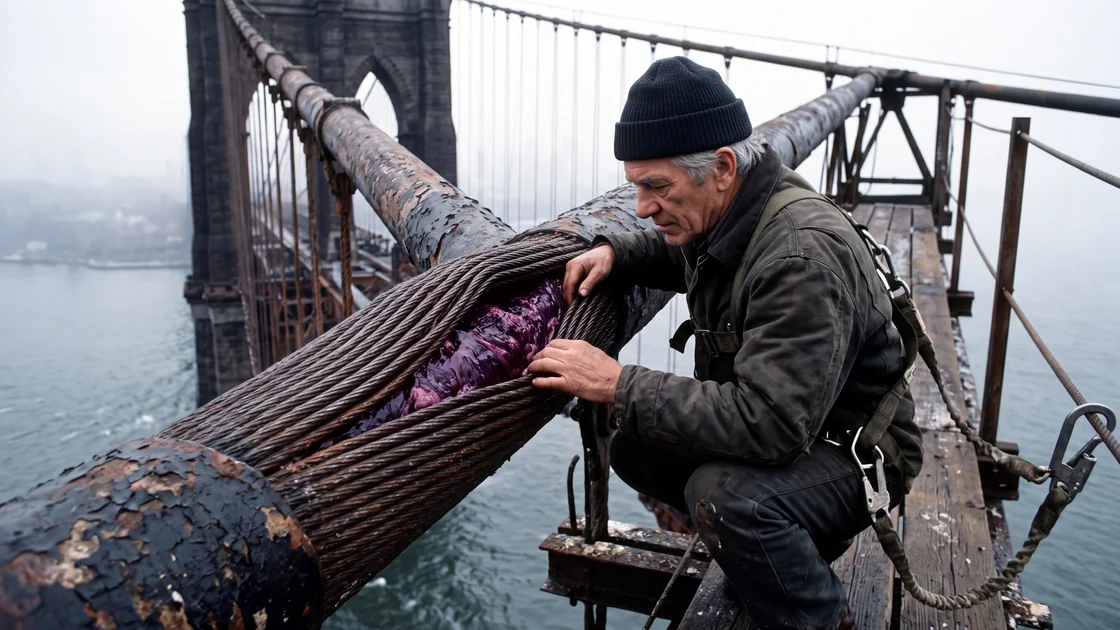
Arthur Cross, a senior structural inspector with forty-two years of service in the coastal city of Overtide, discovers during a routine ultrasonic audit that the Blackwood Narrows Bridge—the city’s oldest and most neglected suspension span—has ceased to decay through ordinary oxidation, its multi-strand steel cables instead developing a vascularized core of living, hematopoietic bone marrow. As municipal officials accelerate plans to dynamite the historic crossing to make way for a modern commercial corridor, Arthur’s clandestine investigations uncover a century-old communion between the hydraulic cement of the sunk caissons, the dozens of immigrant laborers buried alive during the disaster of 1908, and the relentless vibrational stress of the city’s traffic, forcing him into a solitary struggle to understand an industrial monument that has quietly transformed from an instrument of transit into a colossal, warm-blooded organ.
I. The Resonance of Cold Drawn Wire
The wind in the Narrows did not blow so much as it milled. It took the salt-crusted air off the outer shoals and crushed it against the basalt walls of the gorge until the atmosphere was thick with pulverized brine, diesel exhaust from the container lighters below, and the fine, dry mica dust that rose off the granite piers.
Arthur Cross stood on the catwalk of the south main cable, four hundred feet above the slate-colored chop, holding a grease pencil between his teeth. His hands, sheathed in worn cowhide gloves lined with sheared fleece, were hooked into the safety lanyards of his harness. He had walked this cable in 1984, in 1996, in 2007, and now, in the freezing November of his sixty-sixth year, he was walking it with the slow, deliberately planted gait of a man who knew precisely how many foot-pounds of torque were required to strip the zinc off an anchor bolt.
"Number four strand bundle," he muttered into his throat microphone. "East-facing saddle shoe, tower two. Visual signs of circumferential casing failure. We’ve got weeping."
Below him, on the narrow wooden service staging suspended beneath the cable band, his junior technician, a young man named Julian Miller whose high-visibility vest was still bright orange and unstained by coal tar, peered through the view-finder of a high-resolution ultrasonic flaw detector.
"Weeping what, Artie?" Julian’s voice crackled through the bone-conduction headset, thin and warped by the gale. "Water entrapment? The shroud sealant on the saddle collar cracked during the freeze last February. You said yourself the caulking looked like dried toothpaste."
"Not water," Arthur said.
He spat the grease pencil into his palm and knelt. The catwalk was narrow—two eighteen-inch oak planks bound with galvanized hoop iron, swinging with a slow, sickening languor that had nothing to do with the wind and everything to do with the passage of three-axle delivery trucks rumbling across the deck eighty feet below.
The main cable of the Blackwood Narrows Bridge was twenty-two inches in diameter. It consisted of eight thousand four hundred and sixty individual cold-drawn, high-carbon steel wires, each four millimeters thick, spun in place according to the methods pioneered by the Roeblings at the close of the nineteenth century, compacted into a dense cylinder by hydraulic squeezers, and wrapped in a protective winding of soft annealed wire over a paste of red lead and linseed oil. It was an artifact of dead mass—seventeen thousand tons of dead iron keeping thirty thousand tons of traffic from plunging into the salt tides.
Except that, where the cable emerged from the cast-iron shoe atop the south tower, the wire wrapping had split. The rupture was three feet long. It did not look like the typical freeze-thaw blowout, where moisture entered, turned to ice, and shoved the outer wires into a jagged birdcage.
The wires were bowed outward, yes, but they were smooth. The lead paste had not dried to its usual crumbly, salmon-pink chalk. It was wet.
Arthur stripped off his right glove. The air took the skin of his knuckles instantly, biting with that damp, sea-drenched cold that worked directly into the periosteum of an old inspector's joints. He reached out and pressed the heel of his palm against the belly of the split strand.
The steel was not forty degrees, which was the ambient temperature of the Narrows. It was warm.
It was not the superficial warmth of an iron girder that had sat in the afternoon sun; the sky had been an unbroken lid of lead-colored stratocumulus since Tuesday. The heat came from within the core of the bundle, radiating through the gaps in the outer wraps with the slow, persistent fever of a compost heap or a sleeping dog.
"Julian," Arthur said softly.
"Yeah? The battery’s cutting out on the Krautkrämer, Artie. The cold’s killing the screen."
"Bring the acoustic sensor up here. The contact probe with the rubber wedge."
"Up the saddle? Artie, the safety lines aren’t rigged for two men on the shoe staging. The city safety rep—"
"The city safety rep is drinking filtered water in the harbor authority office with his boots on a radiator," Arthur said, his voice flat and hard with the authority of someone who had survived three separate cable snaps and an anchor-shoe collapse in the ship canal. "Bring the probe. And bring the two-inch cold chisel from the ditty bag."
Julian appeared five minutes later, his breath trailing behind him in white, tattered pennants, clutching the green metal housing of the ultrasonic unit. He crawled along the catwalk on his knees, his safety clip chattering against the static line.
"Look at the gauge," Arthur commanded, pointing to the open wound in the cable.
Julian looked. He wiped his nose on his sleeve. "That’s grease. Old petroleum jelly from the packing overhaul in seventy-two. They used that paraffin grease that goes brown when it rots."
"Smell it," Arthur said.
Julian leaned his face near the rift. The wind whipped between the parallel cables, singing an octave below the hiss of the traffic deck. Julian blinked. "Smells like... salt. Copper. Like the bilge of a trawler that hasn’t been hosed."
"Put the transducer against the gap. Strand six, innermost layer."
Julian adjusted the frequency knob with numb fingers, applied a dollop of acoustic couplant gel to the tip of the probe, and pressed the rubber face directly against the exposed, bowing wire. He wore his bulky headphones over his knitted cap.
Arthur watched the boy's face.
At first, there was only the blank, procedural squint of a technician trying to differentiate the five-hundred-hertz rumble of an idling cement truck from the high-frequency shear wave of a structural micro-fracture. Then, Julian’s mouth dropped open. The squint disappeared, replaced by the vacant, slightly terrified stare of a man who has heard someone whisper his name in an empty basement.
"Artie," Julian whispered.
"What's the return?"
"The gate is... it's not bouncing off a flaw. It’s not bouncing off the core at all." Julian took off the headphones, shook them, and pressed them back against his ears. "The velocity is wrong. Longitudinal wave speed in structural steel is fifty-nine hundred meters per second. I'm getting... fifteen hundred. Sixteen hundred."
"That's the speed of sound through water," Arthur said. "Through tissue."
"There’s an echo," Julian stammered, pulling the probe away as if the steel had bitten him. "A periodic return. Eighty-two beats per minute. But it’s not uniform. It has... it has an inlet stroke. A flutter."
Arthur took the two-inch cold chisel from the kit bag. He didn't use the three-pound sledge; he simply took the octagonal steel shank in his bare fist and inserted the beveled blade between two separated wires of the inner core, using his own weight to pry them apart.
A sound escaped the cable—a tiny, wet, aspirating gasp, like a bicycle tire valve being touched with an oily thumb.
From the fissure, oozing slowly between the cold-drawn strands of 1904 American Steel & Wire Co. patent steel, came a ribbon of thick, dark, purplish-crimson pulp. It was not rust sludge. It did not break down into silt or iron hydroxide flakes. It curled around the chisel blade in a greasy, cohesive bead, clinging with the viscous surface tension of fresh egg yolk, steamy in the forty-degree salt air.
Arthur touched the drop with the tip of his forefinger. It was sticky. When he pulled his finger away, it drew out into a thread three inches long before breaking.
He brought his finger to his nose. It smelled of iron, yes, but not the clean, acidic iron of a drill press. It smelled of the marrow bones his mother used to boil with bay leaves and parsnips during the strikes in the sixties—rich, heavy, faintly sweet, with that distinct, unmistakable undertone of animal heat.
"Pack the kit," Arthur said.
"Artie, what the hell is that? Is that some kind of industrial sealant they injected during the bicentennial?"
"They didn't inject anything during the bicentennial," Arthur said, wrapping a length of oilcloth around the split and securing it with three tight turns of stainless steel wire from his pocket. "During the bicentennial they painted the suspenders green and fired the night watchmen. Pack the kit, Julian. Don't write this up on the yellow sheets. We use the grey logs tonight."
II. The Anchorage and the Red Ledger
The Department of Bridges and Harbors was housed in the old brick Customs House at the base of the south abutment, where the shadow of the bridge fell like a sundial's gnomon across the cobblestones of Wharf Street. The basement smelled of fifty years of damp blueprints, blue-line ammonia prints, floor wax, and the river silt that periodically backed up through the floor drains whenever the equinoctial springs coincided with a southwesterly blow.
Arthur sat at his desk under a green-enameled banker's lamp. Across the room, the radiator clanked and sputtered, spitting little jets of steam against the peeling baseboard.
Before him sat three glass specimen vials, the sort used for field sampling of hydraulic fluid from the winch houses. In the first was three ounces of the red pulp he had scooped from Cable A on the south tower. In the second was a scrap of the wrapping wire he had clipped with his mini-bolt cutters. In the third was a cup of river water dipped from the pier footings.
Arthur had an ancient American Optical binocular microscope set to one side of his desk, an instrument he had purchased at a surplus auction from the naval hospital when it closed in 1989. He had taught himself how to use it thirty years ago to examine metal fatigue—to look for the striations, the Beach marks, the brittle cleavage planes that told you an eye-bar was about to drop a thousand tons of deck into the water.
He had prepared a slide. He didn't have Giemsa stain or Wright’s stain, but he had a bottle of drafting ink and a small dropper of methylene blue used for water-pipe tracing.
He leaned into the rubber eyecups.
The field of view was crowded, chaotic, and violently alive.
It was not the crystalline lattice of iron. It was not martensite, pearlite, or the interlaced carbon-iron cementite of cold-worked bridge wire.
There were cells.
They were clustered in dense, irregular cords supported by a delicate, branching scaffold of mineralized trabeculae—not the flat, rolled plates of the foundry, but the porous, honeycombed architecture of cancellous bone. Arthur adjusted the fine focus with a thumb that was grey with coal dust. He saw them: the enormous, multi-lobed nuclei of megakaryocytes, squatting like spiders in the midst of thousands of tiny, non-nucleated biconcave discs.
Red blood cells.
They were not fossilized. They were not trapped in amber or suspended in dried grease. In the thin film of saline he had used to dilute the smear, several of the disc-shaped cells were drifting, their membranes flexing as they struck the glass cover-slip, turning edge-on and springing back with the unmistakable, lazy elasticity of living blood.
Between the cells, running through the matrix like microscopic reinforcing rods, were fibers of structural steel—but the steel was not solid. It had become hollowed, tubulated, turned into tiny Haversian canals through which pale, watery plasma flowed under some unseen, capillary propulsion.
"It isn't rust," Arthur said into the empty room.
The door behind him creaked. Dennis Vance, the chief administrative engineer for the lower district, leaned against the jamb with a cardboard cup of chicory coffee in his hand. Vance was forty-one, wore clean yellow safety helmets with company logos on them, and had never, in his entire eighteen months in Overtide, climbed higher than the pedestrian deck.
"Still here, Artie?" Vance asked. He took a sip, grimaced, and tapped his wristwatch. "The commissioner called twice about the lane closures. He wants the scaffolding down off Tower Two by Friday. The governor’s press secretary is doing a photo op on the ferry slip for the new span."
"The south cable has thirty percent cross-sectional loss," Arthur said without looking up from the eyepieces. "At the saddle. If we take the staging down, I can’t monitor the elongation."
Vance sighed, a soft, managerial sound that signaled profound exhaustion with men who worked with their hands. "Arthur. We’ve been over this. The Blackwood is being decommissioned in fourteen months. The bonds for the New Millennium Crossing were signed off in June. We’re not spending eighty thousand dollars to re-wrap a cable that’s going to be dropped into the mud with shaped charges next November."
"It's not eighty thousand dollars' worth of rust, Dennis," Arthur said, turning slowly in his swivel chair. "Come here. Look down this tube."
Vance didn't move. He looked at the microscope with the vague suspicion of an executive who knows that looking into an instrument might create a legal liability. "What is it? Slag inclusion? The 1904 melt was dirty. Everyone knows the Bethlehem heats back then were full of phosphorus and sulfur."
"It's marrow," Arthur said.
Vance laughed, a short, barking syllable. "Right. The bridge is a dinosaur. Very poetic. Save it for the retirement dinner, Artie. You’ve got three months of accrued leave. If you want to spend them fishing off the pier instead of freezing your prostate off on the catenary, just sign the voucher."
"It has a pulse, Dennis."
Vance’s face hardened. He set the chicory coffee down on the corner of a flat-file drawer containing the 1938 deck reinforcement plans. "Listen to me, Cross. You’ve been an institution here since my father was an intern. But you’re tired. You’ve been up on those cables in forty-knot gusts three times this week. You’re seeing vibration harmonics and thinking they’re biological because you don't want to admit that the steel you spent forty years nursing is nothing but scrap."
"Look into the glass," Arthur said. His voice was lower now, dropped into that flat, vibrating register he used when he was about to shut down a five-ton crane on a site. "Just look into the glass, Dennis. If it’s phosphorus, you can dock my leave. If it’s not, you call the state metallurgical lab in the capital."
Vance stared at him for four long seconds. Then, with an exaggerated roll of his shoulders, he stepped over the cables and rubber boots cluttering the floor, bent his neck, and pressed his eyes to the binocular mount.
Arthur watched the back of Vance’s neck. The hair was trimmed neatly above a stiff blue collar.
Ten seconds passed. The radiator hissed.
Vance did not move. Then, very slowly, his hands came down and gripped the edges of the wooden desk, his knuckles whitening against the grain of the oak. He reached out with one finger and touched the fine-focus knob, turning it a fraction of a millimeter to the left.
"This is grease," Vance said, but his voice lacked the clean, bureaucratic snap it had had by the door. It sounded dry, like paper being torn. "It's... some kind of organic contamination. The pigeons. Pigeon guano entering through the wrapping seams and fermenting in the damp."
"Pigeon guano doesn't have erythrocytes, Dennis. It doesn't have platelets. And it doesn't organize into trabecular plates along the lines of the principal tensile stress." Arthur stood up. He was six inches taller than Vance, his shoulders permanently sloped from forty years of carrying three-pound hammers, drift pins, and chain hoists. "The bridge isn't rotting. It’s ossifying. It’s turning its tension members into bone."
Vance pulled his face away from the microscope. He was pale around the nostrils, that greasy, grey pallor of an office worker who has just seen an arterial bleed on the subway. "Shut the door," he whispered.
"The door is shut."
"Who else saw this?"
"Julian. But he thinks it’s acoustic feedback and paraffin grease. He doesn't know what he's looking at."
Vance straightened his tie, his fingers trembling slightly. "Tomorrow morning, the demolition survey team from Vane-Chesapeake arrives. They’re doing the bore-hole mapping for the south anchorage. If they see this—if they put out an environmental delay notice—the federal match on the new span is suspended until an impact study is done."
"The bridge is alive, Dennis," Arthur said, wondering at the simplicity of the words as they left his mouth. "You can't blast an anchorage that has a vascular system. You don't know what will happen to the piers. If the tension in those cables isn't mechanical—if it's tonic—the whole balance changes. You cut the south strand, and instead of a clean snap, it might... it might bleed out. The deck could whip like a severed hamstring."
Vance picked up his coffee cup. His eyes darted around the basement room, lingering on the rows of grey metal filing cabinets that held eighty years of maintenance logs, core samples, permits, and death reports.
"We have a contract," Vance said, his voice regaining its thin, managerial veneer, though his eyes remained wild. "The Blackwood is seventy years past its design life. It was built by butchers who didn't even use pneumatic helmets until twelve men died in the south caisson. It’s an iron ditch, Arthur. It carries thirty thousand cars of people who hate every minute they spend on it. On Friday, the staging comes down. On Monday, Vane-Chesapeake starts drilling the explosive pockets."
He turned and walked toward the door.
"Dennis," Arthur called out.
Vance stopped, his hand on the brass latch. He did not turn around.
"Did you ever read the construction ledger for Pier Two?" Arthur asked. "The leather one in the vault? The one with Silas Thorne’s signature on the flyleaf?"
"Thorne died in an asylum, Arthur. Everyone knows that."
"He didn't die in an asylum," Arthur said. "He died in the anchorage. They found him three days after the opening ceremony, sitting in the drainage sump with his bare feet in the seep-water, holding a cross-cut saw and crying because he said the iron was too cold to sleep."
Vance stepped out into the hallway, and the door clicked shut behind him, leaving Arthur alone with the hum of the transformer and the three vials of red iron on the desk.
III. Silas Thorne and the Sunk Caisson
The city archives were kept in the sub-cellar of the public library, three blocks back from the wharf where the smell of low tide was replaced by the odor of dead horsehair and decaying ledger linen.
Arthur sat at a zinc table under a naked fifty-watt bulb, turning the yellowed, water-stained pages of The Engineering Record for October 1908.
The photographs were stereoscopic prints, their corners rounded, mounted on grey pasteboard that had warped into gentle curves. They showed the sinking of the south pier caisson—a monstrous, bottomless wooden box built of twelve-inch yellow pine timbers, ninety feet long, fifty feet wide, sheeted with iron plates, and sunk into the bed of the Narrows like a vast, inverted biscuit tin.
Inside that box, sixty feet beneath the surface of the river, in an atmosphere of pressurized air that smelled of tallow candles and men’s lungs, eighty "sand-hogs"—mostly Calabrian peasants and Irish laborers from the canal ward—had shoveled the river-bottom gravel into suction pipes while the caisson sank by its own terrifying weight through thirty feet of quicksand to find the bed-rock.
On November 14, 1908, the river had broken in.
The official report was brief, written in the terse, unemotional prose of the Edwardian industrial age:
...At approximately 4:15 of the afternoon watch, the cutting edge of Caisson No. 2 encountered a pocket of bituminous silt overlaid by an artesian channel. The internal pressure of thirty-two pounds per square inch proved insufficient to hold back the sudden head of water. The air-locks being jammed by the upward displacement of the lower timber sill, decompression was instantaneous. Forty-four men of the shift were engulfed by the quicksand and river-mud before the supply lines could be cleared.
Due to the fluidity of the strata and the immediate necessity of preventing the total tilting of the south pier footing, the Chief Engineer, Mr. Silas Thorne, M. Am. Soc. C.E., ordered the introduction of six hundred yards of quick-setting Portland hydraulic cement directly into the working chamber through the emergency spoil shafts. The bodies of the forty-four workmen could not be recovered without imperiling the stability of the entire enterprise, which had already absorbed two millions of the city’s credit.
Work on the masonry above the waterline was resumed on the seventeenth of the same month, the mass having set into a solid, unyielding monolith.
Arthur turned the page.
Tipped into the back of the volume was an appendix—not part of the municipal filing, but a collection of private letters donated by Thorne’s sister after the engineer’s death in the winter of 1914.
Thorne had not been an ordinary surveyor. He had trained under the elder Roebling in Trenton; he had studied the muscular anatomy of horses at the academy in Philadelphia; he had corresponded with Alexander Lyman Holley on the biological metaphors of the Bessemer converter—the idea that the blast furnace was not a hearth, but an alimentary canal that digested stone into rail.
Arthur squinted at Thorne’s handwriting—an aggressive, spidery script written in iron-gall ink that had eaten tiny, brown-rimmed holes through the linen paper:
August 12, 1909. The Pier is not dead. How could it be otherwise? A foundation is not an abstraction of mathematics; it is an incision into the crust of the world. We have poured into that deep slot seventy tons of bone, four hundred barrels of tallow, the whole vitality of forty-four vigorous men, each in the full tide of his blood, mixed with the lime of their own breaking. The lime seeks the phosphate; the iron of the river-silt seeks the iron of the blood.
Today we began the spinning of Cable A. The wire comes from the Trenton mills cold and bright, drawing its temper from the coal-fires of the valley. But when it enters the saddle on the south pier, it does not ring like the wire on the north side. It hums. When I lay my palm upon the strand where it leaves the shoe, I feel no vibration of wind, for the air is calm as pond-water; I feel that ancient, rhythmic displacement which the Greeks called 'pneuma' and which our modern fools think can be chased out of the world by three coats of lead paint.
I have told the commissioners that the span will endure two hundred years. They cheered me and gave me a silver punch-bowl. They do not know what I meant. They think I meant that the iron will not rust. What I meant is that it will learn to heal.
Arthur leaned back. The bulb above him flickered as the electric streetcars on the avenue three levels above rattled across their frogs.
"He knew," Arthur whispered.
He pulled a small pocket notebook from his vest. He had made a sketch of the bridge's south anchorage—the massive masonry vault, deep beneath the street level, where the twenty-two-inch cables were splayed out into their constituent nineteen strands, each strand looped around a sixty-ton cast-iron shoe that was anchored into the deep bedrock by six-inch-thick steel eye-bars.
The anchorage was where the tension was transferred to the earth.
If the cable was bone, the anchorage was the pelvis. It was where the tendon met the skeleton.
And according to the city’s demolition schedule, which Dennis Vance had laid on the corner of his desk, the first phase of the deconstruction was not the removal of the deck. It was the "un-stressing" of the south anchorage. Vane-Chesapeake was going to drop sixty-pound nitrogen-cooled coring drills down the access shafts to bore three-inch holes through the eye-bars, weakens them until the tension could be broken with hydraulic jacks.
They were going to sever the tendons while the bridge was still holding forty thousand tons of traffic.
IV. The Anchorage Vault
At two o'clock in the morning, the Narrows was silent except for the foghorns at the shoals—a triple-lunged, mournful bellow that shook the window-panes of the fish houses every forty seconds.
Arthur carried a three-cell brass flashlight, a dry-cell battery lantern, and his canvas inspection bag containing a hammer, three scrapers, an optical pyrometer, and a sterile bone-marrow biopsy trocar he had bought with twenty dollars cash from an orderly behind the municipal hospital.
The entrance to the south anchorage was an unmarked iron door set into the granite revetment wall of Wharf Street, behind an abandoned cooperage. The lock was an old six-lever mortise, its brass cover-plate green with verdigris. Arthur’s key was six inches long, filed down by his own hands from an old bridge-works blank thirty years ago.
The lock turned with a dry, screeching clatter that sounded like a rifle shot in the deserted alley.
Arthur slipped inside and pulled the heavy door shut behind him.
The smell hit him immediately.
It was not the smell of a cellar. It was not even the smell of the south tower catwalk.
It was the smell of a slaughterhouse that had been scrubbed with carbolic soap three days ago, over which a load of fresh hay and river mud had been spread. It was dense, humid, eighty-four degrees by Arthur’s pocket thermometer, and so thick with animal humidity that his spectacles fogged instantly.
He wiped them on his flannel shirt-tail and switched on the dry-cell lantern.
The vault was forty feet high, sixty feet wide, and stretched into the darkness beneath the city like the nave of a Romanesque crypt. The walls were made of massive, rough-faced blocks of dark hornblende granite, the mortar between them lime-white and bulging from the tremendous, unimaginable compressive load above.
Down the center of this hall ran the two great cable tunnels—slanted masonry ramps down which the main catenaries plunged at an angle of thirty degrees, disappearing into the floor where they were anchored to the subterranean grillage sixty feet beneath the water-table.
Arthur walked down the southern ramp. His boots made no sound; the stone was covered with a thin, slippery film of what looked like river silt, but when he stepped in it, it did not leave a clean water-track. It left a greasy, yellow, lipid-rich smear that clung to the lugged soles of his boots.
He reached Cable A’s anchorage shoe.
Here, the great cable was stripped of its outer wrapping wire. The eight thousand four hundred wires separated into nineteen distinct, circular bundles, spreading out like the fingers of a colossal, drowned hand to grip the eye-bars that rose from the concrete floor.
Arthur stopped. He raised the lantern.
The eye-bars—each one a slab of forge-rolled steel sixteen feet long, two feet wide, and three inches thick—were not grey. They were not red with rust.
They were covered in a pale, glistening, fibrous membrane.
It was an endosteum—a glistening sheet of white, pearlescent tissue, crisscrossed by thousands of tiny, hair-like capillaries that pulsed with a slow, peristaltic ripple. Where the steel met the concrete floor, the metal did not enter an expansion joint; it was embedded in a thick, cartilaginous ring, a vast annular ligament that was continually exuding a clear, amber-colored synovial fluid that collected in pools around the foundation stones.
Arthur dropped his bag. His heart was knocking against his ribs with that dry, painful flutter he usually felt only when a safety lanyard snapped on a wind-whipped catenary.
"Silas," he murmured.
He stepped onto the concrete plinth. The air was so hot it made his breath catch. He took off his woolen coat and laid his bare palm against the central eye-bar.
The steel did not feel like steel. It felt like the horn of an anvil that had been kept in an incubator. It had a rough, fibrous texture—not the scale of rolled iron, but the longitudinal striations of cortical bone, dense and mineralized, yet yieldingly elastic under the weight of his hand.
He put his ear against the metal.
There was no sound of the city above. The rumble of the night-freight across the deck was gone.
In its place was a sound that made his stomach turn over with a strange, sweet, terrifying vertigo:
Thump.
A pause of four seconds.
Thump.
It was not the eighty beats per minute of a human heart. It was the slow, ponderous, oceanic systole of a blue whale or an ancient tree—sixteen cycles per minute, the rhythm of forty thousand tons of stone and steel inhaling the cold salt draft of the tide and exhaling the heat of its own internal furnace.
Arthur took the bone-marrow trocar from his kit.
The instrument was six inches of surgical-grade stainless steel with a T-shaped plastic handle and a hollow, beveled needle three millimeters in diameter. It was designed to pierce the human iliac crest under the local anesthetic of an oncology clinic.
He chose a spot on the central strand of Cable A, where the wires were splayed across the face of the shoe. He did not use a hammer. He set the point of the trocar against the space between three wires and leaned his weight against the handle, twisting it clockwise with the slow, grinding pressure of an engineer seating a wood screw.
The metal offered a strange, crunching resistance—not the screech of a drill bit in carbon steel, but that distinct, calcified pop that an orthopedic surgeon feels when the trocar drops through the outer cortical plate into the soft, vascular interior of the bone.
Arthur pulled the stylet from the needle.
A jet of dark, warm, venous fluid pulsed out of the hub, splashing across his wrist and dripping onto the limestone flags.
It was not grease. It was not river-water.
It was dark blood, rich in normoblasts, dense with the scent of an iron mine, thick and heavy with the vitality of forty men who had never seen the sky again after the fourteenth of November.
Arthur held a specimen tube under the stream until it was full, then capped it with his thumb.
The wound did not continue to bleed. Within thirty seconds, the flow slowed, thickened into a glossy, fibrinous clot, and ceased. Around the needle, the pale membrane of the endosteum began to draw inward, puckering like the lips of a healing incision, exuding a clear, yellow serous fluid that sealed the gap between the steel wires.
Arthur sat back on his heels on the warm stone. His hand was trembling so violently he nearly dropped the vial.
"You're not a bridge," he whispered to the vaulted ceiling. "You're an organ. You're the lung that breathes the salt, and the heart that pumps the weight."
He looked up at the great masonry arches above him.
The city had grown around this thing. It had sent its trolley cars over it, its coal carts, its six-lane expressways, its millions of weary, angry, hurrying souls who hated the river and wanted only to be on the other side. And for one hundred and eight years, the bridge had taken that weight—that crushing, unrelenting dynamic load, that kinetic fury of three generations of human hurry—and it had not broken.
It had survived by becoming the only thing that can survive an eternity of dynamic stress:
It had become living tissue. It had turned the mechanical friction of the city into the metabolic energy of life.
And tomorrow, Dennis Vance was going to send three men with diamond-tipped core drills to put sixty sticks of water-gel dynamite into its pelvis.
V. The Biopsy and the Burn
At seven o’clock the following morning, the fog in the Narrows was the color of a wet slate shingle.
Arthur stood in the office of Dr. Miriam Perez, the chief of pathology at the municipal hospital, three blocks up the hill from the Customs House. Miriam was sixty, with iron-grey hair cut with shears around her ears, and fingers that were permanently stained with the brown potassium permanganate she used for her histological rinses.
She sat behind an old Leitz orthoplan microscope, staring into the dual-viewing head with her lips pressed into a thin, white line.
On the desk between them sat the three vials from the south anchorage and a small section of wire Arthur had excised from the catwalk saddle with a hacksaw at dawn.
"Where did you get this, Arthur?" she asked without looking up.
"I found it in an industrial system," Arthur said. "An old hydraulic balancing cylinder down at the dry docks."
"Don't lie to me," she said, her voice dry as salt fish. "I’ve been cutting up the city’s dead for thirty-two years. I know the smell of a dry dock, and I know the smell of a human ilium. This isn't from a cylinder."
She looked up at him. Her eyes were small, brown, and terrifyingly clear.
"This is human marrow," she said. "Or rather, it’s ninety percent human. The cell lines are hyper-plastic. The megakaryocytes are three times the diameter of any normal specimen I've ever seen in a case of leukemia or polycythemia. They’re producing platelets that have... look here."
She pointed to a Polaroid print of an electron micrograph she had taken twenty minutes ago in the basement laboratory.
"The platelets aren't circular," she said. "They’re polygonal. They have a hexagonal crystal structure that matches the lattice of alpha-iron. They don't form ordinary fibrin mesh when they clot; they precipitate a micro-fine web of iron oxide whiskers that have the tensile strength of piano wire."
She picked up the section of bridge wire Arthur had brought in. It was four inches long, cold, and dark grey.
"And this," she said, tapping the wire with a steel pen. "This isn't wire with organic material on it. This is a Haversian canal system that has mineralized with iron carbonate instead of calcium phosphate. The osteocytes are alive, Arthur. They’re sitting in their lacunae, and they’re receiving nutrients through these microscopic canaliculi that run all the way to the center of the wire."
She stood up, walked to the window, and looked down through the fog to where the towers of the Blackwood Narrows Bridge rose like two giant, iron gallows above the slate-colored water.
"It’s an impossibility," she said. "A cell cannot maintain an iron-based mineral matrix. The metabolic cost... the energy required to reduce iron in those quantities would require... it would require an enormous engine. A furnace."
"It has forty thousand cars a day," Arthur said.
Miriam turned around. "What?"
"The bridge," Arthur said, his hands flat on her desk. "Every time an axle hits an expansion joint, that’s twenty foot-tons of energy. Every time the wind hits the truss, that’s five hundred thousand foot-pounds of lateral shear. A normal bridge dissipates that energy as heat—microscopic friction that turns the steel brittle, causes fatigue cracks, breaks the rivets, rusts the pins. The Blackwood isn't dissipating it. It’s converting it. Silas Thorne built a machine that eats vibration and turns it into life."
Miriam looked at him as if he had lost his mind. Then, she looked back at the photograph of the hexagonal platelets.
"If that’s true," she said, her voice dropping into a register that was almost an apology, "then it's in the terminal stage of a fatal disease."
Arthur felt the air go out of his chest. "What do you mean?"
"The white cell count," she said, pointing back to the microscope. "It's seventy thousand. The marrow is blastic. It’s producing millions of immature, non-functional cells that are crowding out the vascular channels. Look at the viscosity of the fluid you brought me—it’s three times what it should be. The iron isn't clearing. It’s choking on its own hematopoiesis."
"Because they cut the traffic," Arthur whispered. "Three weeks ago, the city closed the center lanes to prepare for the demolition. They took away sixty percent of the dynamic load."
"It's starving," Miriam said. "If this thing... if this tissue depends on mechanical kinetic stress to power its metabolic cycle, then taking the cars off it isn't saving it. It's suffocating it. It's like putting a ligature around the aorta of an athlete."
The telephone on her desk rang. It was an old bell ringer that made Arthur jump three inches off the floor.
Miriam picked it up. "Perez... Yes, Dennis. He’s here."
She held the receiver out to Arthur. Her face was grim.
Arthur took the black Bakelite handset. "Cross."
"Arthur, you old bastard," Vance’s voice was high, cracked, and vibrating with an hysterical rage that was barely held in check by the presence of other people in the room. "You get down to the south anchorage right now. Right now."
"What happened?"
"The drilling crew from Vane-Chesapeake," Vance stammered. "They... they took the three-inch diamond core rig down to the lower eye-bar tier. They started the wet cut on Cable A’s shoe."
"Did they breach the casing?" Arthur shouted into the mouthpiece.
"They're not drilling, Arthur," Vance cried, and now the sound of real terror broke through his administrative mask. "The drill bit... it jammed. It seized at eighteen inches. And then... oh God, Arthur, you have to get down here. The anchorage is filling up. It’s coming up through the floor drains, and it’s eighty-five degrees, and Miller... young Miller went down to clear the slurry hose and he... he can’t get his boots out of the floor."
VI. The Hemorrhage
Wharf Street was blocked by three fire department pumpers and an emergency response van from the harbor police when Arthur arrived.
The morning had grown darker, the clouds sinking until they scraped the tops of the bridge’s gothic towers. The air smelled of burnt transmission fluid and that sweet, heavy, butcher-shop steam Arthur had encountered the night before.
A crowd of teamsters from the ferry docks and fish-packers in rubber aprons stood behind the police barricades, their faces turned toward the granite revetment of the south abutment. From the louvered ventilation grates set into the stone twelve feet above the cobblestones, thick, grey-white clouds of greasy vapor were pouring into the cold street, carrying with them a high, rhythmic, whistling shriek—the sound of an industrial steam line that had blown a gasket, but with an undulating, organic cadence that made the harbor horses shiver and rear against their traces.
Arthur pushed through the line. A young patrolman reached for his shoulder, but Arthur showed his brass inspector's badge—the old five-pointed star of the Department of Bridges and Harbors that had been issued before the patrolman's father was born—and the boy stepped back.
"Don't go down there, sir," the cop said. "The fire boys say the main sewer line broke into the vault. They’re getting methane readings off the scale."
"It isn't methane," Arthur said, and dropped through the iron hatch into the dark.
The heat inside the entrance ramp was suffocating. It was ninety-five degrees now, the atmosphere of a tropical swamp or a boiler room during an endurance trial.
Arthur didn't need his lantern.
The vault was illuminated by a dull, reddish-orange chemiluminescence that rose from the central floor. The granite walls were sweating—not water, but a thick, oily, pinkish-white lymphatic exudate that ran down the stone in long, greasy ribbons, collecting in the gutter where it was foaming like yeast in a brewer's vat.
At the bottom of the ramp, Dennis Vance stood on an overturned tool chest, his trousers rolled to his knees, clutching a fire axe with both hands like a man stranded on a rock by an incoming tide.
Around his feet, six inches of dark, purplish-red fluid was swirling with a slow, clockwise eddy toward the drainage sumps.
On the central plinth, where the eye-bars of Cable A entered the bedrock, the three-inch diamond core drill was still mounted on its steel column. The five-horsepower electric motor was dead, its casing charred and smoking, but the drill spindle was not still.
The hollow core drill had been shoved back out of the hole by six inches of protruding, fibrous tissue—a glistening, dark-red cylinder of living bone marrow that had mushroomed out over the diamond cutting teeth, its edges blackened by the friction of the bit, but its center pulsing with an unstoppable, hydrostatic pressure that was spitting dark, hot blood against the granite ceiling twenty feet above.
Near the base of the column, Julian Miller was sitting on the concrete floor, his back against an eye-bar, his legs immersed to the thighs in the rising flood.
"Julian!" Arthur shouted, splashing through the warm, red tide. The fluid was up to the tops of his eight-inch work boots, warm as bathwater, smelling of iron, bile, and the salt marrow of the sea.
Julian looked up. His face was chalk-white, his lips blue, his pupils dilated until the irises were mere rings of hazel. His hands were clamped around his right knee.
"Artie," the boy whispered. His voice was barely audible above the wet, whistling roar that came from the core hole. "I... I tried to pull the drill bit out when it jammed. The machine kicked. It threw me."
Arthur knelt in the gore. He didn't care about his trousers or his wool fleece. He reached down into the red water and felt Julian’s leg.
The boy’s boot was not caught in a crack.
The concrete around the base of the eye-bar had softened into a porous, cancellous pumice—a bony callus that had grown out of the foundation to repair the vibration damage caused by the drilling. The bone had closed around Julian’s foot like an oyster closing around a pebble. Delicate, mineralized tendrils of iron-laced osteoid were already creeping up the leather of his boot, binding the eyelets, knitting into the cotton laces with the cold, patient tenacity of ivy on an oak.
"It’s eating the boot, Artie," Julian wept, his teeth chattering with shock. "It’s... it’s warm. It feels like someone’s holding my foot in their mouth."
Dennis Vance swung the axe against the wall of the vault, chipping off a six-inch flake of granite that fell into the red pool with a heavy plop.
"Kill it!" Vance screamed, his voice breaking into a dry shriek. "Cross, you tell them to bring the lime down here! Bring forty barrels of unslaked lime and dump it in the sump! It’s an infection! The whole goddamned foundation is rotten with it!"
"Shut up, Dennis," Arthur said, not looking back.
He took his two-inch cold chisel and his three-pound hammer from his bag. He leaned over Julian’s foot. "Hold still, son. This is going to shake your shin."
"Don't hurt it, Artie," Julian whispered. His eyes were rolling back into his head. "When you hit it... it feels like... it feels like it’s in my teeth."
Arthur set the bevel of the chisel against the pale, bony ring that had gripped the heel of Julian’s boot. He struck it once—a clean, sharp, five-pound blow.
A high, ringing shriek tore through the vault—not the sound of cold iron, but the thin, piercing scream of a horse when its leg is broken in a cattle car.
The entire south cable—seventeen thousand tons of steel running four hundred feet into the air—vibrated with a sudden, violent spasm that knocked Dennis Vance off his tool chest into the red soup. The water in the vault surged four inches up the walls, sloshing against Arthur’s chest.
From the core hole in Cable A, the stream of marrow ceased.
The cable took a breath.
Arthur felt it through the soles of his boots—a vast, terrifying depression of the entire foundation, the granite blocks settling half an inch into the bedrock as the bridge drew itself inward, tightening its catenaries, flexing its suspender ropes, pulling the two four-hundred-foot towers toward each other with the agonizing, spastic contraction of a dying titan.
Above them, through eighty feet of masonry and street silt, came the sound of the city:
Car horns. The screech of streetcar brakes. The wild, discordant clangor of the warning bells on the traffic gates as the expansion joints on the deck three hundred feet above ground shut with the force of guillotine blades, crushing the fenders of two delivery trucks and shearing a water main that began to pour eight hundred gallons a minute of municipal water down the access shafts.
"Artie!" Julian screamed.
The bony ring around Julian’s boot did not shatter. It relaxed.
It opened like the iris of a camera, the mineralized fibers drawing back into the concrete matrix, leaving the leather of the boot slimy, scarred, and free.
Arthur grabbed the collar of Julian’s life-vest with both hands and dragged him backward up the masonry ramp, his boots slipping in the red grease, while Dennis Vance scrambled ahead of them on his hands and knees, clawing at the stone steps like a dog trying to get out of a drowning tank.
They reached the street hatch just as the first pumper company dropped its suction hoses through the grate.
The air on Wharf Street was forty degrees, cold and clean and smelling of the sea. Arthur collapsed against the brick wall of the cooperage, holding Julian’s head against his knee, his flannel shirt soaked to the skin with the blood of the south pier.
Across the river, through the thinning mist, the Blackwood Narrows Bridge stood against the grey sky.
It was no longer still.
The main span—two thousand feet of stiffening truss that had hung straight and true since the year Silas Thorne died—was bowed upward in the center by eighteen inches, arching its back against the grey water like a cat with an open belly, while the suspender ropes sang in the November gale with the thin, wild, whistling scream of sixty thousand violin strings tuned to the pitch of bone.
VII. The Transfusion
By midnight, the mayor had declared an emergency under the War Powers Act of 1941, an antique statute that allowed the municipal council to clear five square blocks of the riverfront without a judicial warrant.
The engineers from Vane-Chesapeake were gone. Their trucks had left the wharf at nine, their diamond drills abandoned in the flooded anchorage, after their senior project manager took one look at the ultrasonic shear-wave plots and told Dennis Vance that he wouldn't put an apprentice on that deck for twenty thousand dollars in gold.
The bridge was closed.
Concrete barriers—three-ton Jersey walls—had been set across the approaches on both the city side and the outer borough side. The warning lights were red.
Arthur sat in the cab of his 1978 Dodge pickup, parked forty yards from the south toll gate. The heater was broken, blowing cold, damp air against his ankles, but he did not move to turn the key.
On the passenger seat lay Silas Thorne’s 1908 ledger, Miriam Perez’s pathology reports, and a five-gallon plastic carboy of high-grade technical-grade saline solution he had stolen from the water-treatment plant at ten o'clock.
The door clicked open.
It was Julian. His right foot was bandaged in white gauze where the skin had peeled away with the boot leather, and he leaned heavily on a hickory trenching stick he used as a crutch.
"They're bringing the artillery," the boy said.
Arthur looked through the frost on the windshield. "What artillery?"
"The National Guard," Julian said, his voice flat, exhausted, empty of everything except that cold, dull vibration they had both felt in the vault. "Vance went to the state capital. He told the governor the bridge was in imminent danger of an uncontrolled progressive collapse into the shipping channel. If the south tower falls northward, it takes out the oil refinery docks and the municipal water intake."
"They're going to drop it?"
"Tomorrow at dawn. The 107th Field Artillery is setting up four 155-millimeter howitzers on the bluffs at Fort George. They’re going to shell the south anchorage from two miles out. They think if they can blow the saddle shoes off the piers, the cables will slip into the river without taking the towers down."
Arthur looked at the bridge.
The wind had died. The Narrows was flat, black, and glassy as poured obsidian, reflecting the yellow sodium lights of the deserted toll plazas.
The bridge was not singing now.
It was groaning. It was that low, hollow, metallic rumble that an iron ship makes when it sits on the blocks of an empty graving dock—the sound of plates settling against their rivets, of bulkheads carrying a load they were never intended to bear.
The center arch had flattened out. The eighteen-inch hog had vanished. The bridge was sagging now—sagging with the loose, limp, dead-weight languor of an arm whose nerve has been severed at the shoulder.
"It's dying," Arthur said.
"Artie," Julian said, leaning his forehead against the cold glass of the window. "We can't do anything. It’s sixty thousand tons of iron. If it wants to die, we have to let it fall."
"It doesn't want to die," Arthur said. "It's starving, Julian. I told you. It ate the traffic for eighty years. It turned the city’s hurry into its own gristle. When they shut the gates, they cut its food off."
"You can't feed a bridge, Artie," Julian whispered, and for the first time, Arthur saw tears cutting clean channels through the coal dust on the boy’s cheeks. "It’s... it’s crazy. It's a thing made of wire and bolts. My grandfather helped paint it in fifty-four. He died of the lead. He didn't think it was alive. He thought it was an iron bastard that killed four men every time they put a brush to it."
"Your grandfather didn't have his foot in its mouth," Arthur said.
He reached down and picked up the five-gallon carboy of saline.
"Stay in the truck, Julian."
"Where are you going?"
"To the saddle," Arthur said. "It has a fever. If it’s going to take four high-explosive shells into its hip at dawn, it ought to have somebody up there who knows how to hold its head."
VIII. The Architecture of Blood and Iron
The climb up the south catenary was different from any climb Arthur had made in forty-two years.
The cable was not cold.
Even through the four-inch soles of his winter boots, the wire felt like the flank of an ox that had been driven twenty miles through the summer dust. The wrapping wire had split in seventeen new places along the rise to the tower, and from every rift, the thick, fibrous, dark-red marrow had mushroomed out, freezing into purple, glistening scabs where the salt gale touched it, but remaining soft, warm, and pulsing in the sheltered hollows beneath the suspender bands.
The vibration was no longer acoustic. It was structural.
Every twenty seconds, a slow, hydraulic wave—a mass of five hundred gallons of blood and mineralized plasma moving through the core of the eight-thousand-wire bundle—would travel up from the anchorage, pass beneath Arthur’s boots with a soft, sucking heave that lifted the catwalk planks half an inch off their stringers, and surge through the cast-iron saddle atop the tower before plunging down the main span toward the north pier.
Arthur reached the south tower saddle at four in the morning.
The top of the tower was a platform of four-inch steel plates, twelve feet square, open to the sky, five hundred feet above the black water. In the center sat the two great saddle castings—massive, sixty-ton blocks of iron, shaped like grooved slippers, over which the cables rested as they passed from the back-stays to the central span.
The south saddle was split.
The crack ran from the front lip down through the three-inch base plate into the masonry of the tower itself. It was an old fracture, probably dating from the hurricane of 1938, but it was no longer empty.
The crack was filled with bone.
A vast, spongy, vascular growth of cancellous iron had erupted from the saddle, knitting the split together with a crude, powerful, ragged seam of living trabeculae. It had formed a false joint—a pseudo-arthrosis—that was flexing with every surge of the wind, absorbing the ten-thousand-ton load of the central span not by the rigid resistance of dead masonry, but by the elastic yield of cartilage and living marrow.
Arthur knelt by the saddle. He laid his cheek against the cold-drawn steel of the main cable.
He could hear the river five hundred feet below, hissing against the starlings of the pier. He could hear the bell-buoy at the shoals, two miles out, ringing its monotonous, three-stroke warning: one... two... three.
And beneath that, inside the steel casing, he heard the voice of Silas Thorne’s forty-four sand-hogs.
It was not a chorus of ghosts. It was not the theatrical screaming of men in a tomb.
It was the steady, patient, rhythmic displacement of eighty-eight lungs—the slow, mechanical breathing of forty-four men who had not died in the mud, but who had been translated into the very tension that kept the city from falling into the sea. They were in the carbon of the steel; they were in the lime of the caisson; they were in the six-hundred-yard mass of hydraulic cement that had held the quicksand down for one hundred and eight years.
"I hear you," Arthur whispered to the iron. "I hear you, boys."
He opened his ditty bag. He did not take out his hammer or his scrapers.
He took out the three-inch steel drift pin he had carried since his first day as an apprentice inspector in 1974. He set the tapered point of the pin into the center of the marrow mass that bridged the saddle crack.
He took the three-pound sledge from his belt.
"Dennis is coming with the guns," Arthur told the bridge. "They’re going to put three hundred pounds of amatol into the anchorage at first light. If you fight them... if you stay stiff... they’ll blow you into scrap. You’ll take the towers down with you, and you’ll choke the channel with twenty thousand tons of dead meat."
He raised the sledge.
"You have to let go," he said. "You have to let the tension go slack. You have to lay down in the mud, like you wanted to do on the fourteenth of November."
He struck the drift pin.
The blow was not loud. It was a dull, heavy, leaden thud that traveled straight down the central core of the cable.
The bridge did not shriek this time.
It sighed.
It was a sound that was heard six miles away in the hill wards—a sound like the opening of sixty great furnace doors, or the settling of an entire forest under thirty inches of wet mountain snow.
Under Arthur’s knees, the south cable began to soften.
The wires did not snap. The tension—that terrifying, eighty-thousand-pound-per-square-inch elastic strain that had held the Blackwood above the water since the administration of Theodore Roosevelt—did not break into a whip-saw recoil.
It dissolved.
The iron-laced bone inside the strand began to undergo an instantaneous, massive autolysis. The mineral matrix did not shatter; it liquefied.
From the seventeen ruptures along the catenary, a warm, red, steaming cataract of marrow poured out over the oak catwalk planks, cascading down into the empty river like an arterial bleed from a severed wing.
The deck of the central span—forty thousand tons of stiffening truss, timber decking, asphalt paving, and steel stringers—settled four feet, then eight feet, then twelve.
It did not smash into the water.
It rested.
It came down upon the slate-colored chop with the slow, majestic, deliberate grace of a swimming mammoth taking the bottom of a river ford, the timber stringers kissing the brine, the steel floor-beams sinking four inches into the salt silt, while the two great gothic towers leaned inward by two degrees, their iron crests bowing to each other across the twenty-hundred-foot gap like two old monks who have finished their office and are preparing to blow out the candles.
Arthur did not fall.
He sat on the south tower platform, five hundred feet in the air, with his feet dangling over the lip of the saddle plate, watching the blood of the Blackwood Narrows Bridge spread across the surface of the river.
It did not sink into the mud.
It floated on the cold tide, a vast, iridescent, purplish-crimson slick that moved out past the shoals, past the bell-buoys, past the outer lighthouses, carrying with it the iron of forty-four men and three generations of human hurry, until the gray Atlantic reached up with its vast, salt, ancient fingers and took the city's oldest bone back into the deep.
IX. The Grey Ledger
They found Arthur Cross at nine o'clock that morning, sitting on the saddle shoe with his back against the split casting, his coat buttoned to his chin, his hands empty.
Julian Miller had to help the fire captains climb the catenary; the boy's foot was wrapped in three rolls of elastic bandage, but he crawled up the five-hundred-foot catwalk on his hands and knees, refusing to let the rescue squad take his tools.
When they reached the platform, Dennis Vance was already there, having come out on the police launch that was idling at the pier base. Vance did not look at the bridge. He looked at the water.
The deck of the Blackwood Narrows Bridge was three feet under the surface of the Narrows at high slack. The water was foaming over the green-painted railings, carrying off the wooden road-blocks and the paper cups from the toll-houses, but the bridge was not moving.
It was stable.
It had become a reef—a vast, ninety-thousand-ton bar of iron, stone, and mineralized bone that had bedded itself into the river silt so deeply that the harbor current was already splitting around its towers as if they were natural basalt sea-stacks.
Vance climbed up the ladder to the saddle platform. His yellow helmet was missing, and his expensive city overcoat was stained at the elbows with grease from the catenary wire.
He stopped three feet from where Arthur was sitting.
"The howitzers were cancelled," Vance said. His voice was small, thin, and dried out by the wind. "The governor said... he said you can't fire seventy pounds of high explosive into a navigation hazard that has three hundred thousand gallons of diesel in the approach tankers behind it."
Arthur did not turn his head. He was looking at the north tower, where the cold morning sun had finally broken through the cloud lid, lighting the copper rivets until they looked like rows of tiny, golden teeth.
"It’s over, Dennis," Arthur said.
Vance looked down at the saddle casting.
The six-inch crack was gone.
It was not filled with bone. It was not filled with rust.
Where the split had been, there was only a smooth, grey, unbroken sweep of cold-worked steel, seamless and dull, with that faint, wavy watermark on the surface that old blacksmiths called the temper-skin—the mark an iron blade takes when it has been quenched in deep water while it was still red enough to remember what it was.
Vance reached out with a trembling hand and touched the steel.
It was forty degrees. It was cold. It was dead.
"What do I write on the yellow sheet, Arthur?" Vance whispered. He sounded like a child who has lost his locker key on the first day of school. "The federal inspector is coming on the noon train. I have to give him a cause. Was it... was it an anchorage slip? Was it progressive foundation failure?"
Arthur stood up.
His knees made a dry, cracking sound—the sound of an old bridge timber when the frost gets into the heart-wood—but he stood straight, six feet tall in the salt wind, with his cowhide gloves tucked under his arm.
He reached into his pocket and pulled out the small, grey canvas logbook the department had issued to him in April of 1974.
The pages were filled with fifty years of numbers: eye-bar clearances, paint thicknesses, rivet counts, pin deflections, wind velocities, and the names of nine men who had fallen off the staging into the mud between the bicentennial and the year Julian Miller was born.
He opened the book to the last blank page.
He took his grease pencil from his pocket, licked the black lead with the tip of his tongue, and wrote five words across the blue lines:
The span has found bottom.
He tore the page out, folded it twice into a four-cornered square, and pressed it into Dennis Vance's soft, clean, white palm.
"Give him that," Arthur said. "And if he doesn't like it, tell him to bring a shovel and dig down sixty feet beneath the south pier. Silas Thorne is down there. He’s been down there since nineteen-eight, and he’s still got thirty-eight barrels of quick-setting hydraulic cement that haven't finished curing yet."
Arthur turned toward the catwalk.
"Come on, Julian," he called down to the staging where the boy was waiting with his hickory stick. "We’ve got four hours before the tide turns, and I want to get my tools out of the Customs House before the water comes through the floor drains."
They climbed down together, old man and boy, step by step down the long curve of the cold catenary, while behind them, beneath the grey water of the Narrows, the ancient iron of the Blackwood settled deeper into the silt, its long cables going quiet at last, its millions of tiny, hollow wires filling with the dark, cold, mineral-rich mud of the river, until there was no difference between the bone of the men who had built it and the iron of the city that had crossed it into the world.