The Architecture of Loss
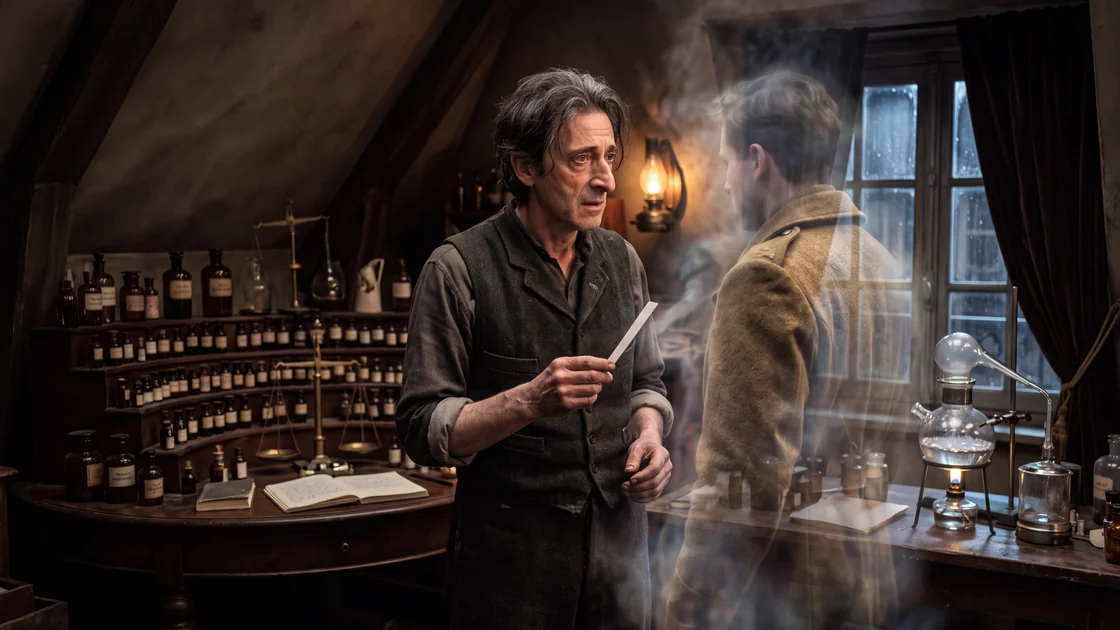
This is the account of Gaspard Vane, an aging master perfumer in the winding alleys of Montmartre, who discovered that the biochemical compounds of true human bereavement possessed a solvent quality capable of dissolving the boundary between the material world and the departed; by harvesting the saline secretions of profound sorrow and binding them with rare botanical fixatives, he produced L’Étreinte, a fragrance whose vaporous sillage condensed the air into warm, palpable flesh, granting the living the miracle of physically embracing those they had buried; yet as Paris’s grief-stricken elite flocked to his shuttered atelier, trading their fortunes and sanity for fleeting quarter-hours in the arms of tangible phantoms, Gaspard was forced to confront the horrific parasitic cost of his masterpiece—that each application hollowed out the flesh of the living to feed the skin of the dead, driving him toward a devastating reckoning with his own unwept mourning and the ghost of the woman he could not bear to release.
Chapter I: The Solute of Sorrow
In the winter of 1922, Paris smelled predominantly of damp lime-wash, coal briquettes, and the stale iron of woolen greatcoats that had dried too close to tin stoves. It was an unwashed, wounded city, hollowed by the war and polished with a thin, desperate veneer of ethyl alcohol and American jazz. But inside the laboratory of Gaspard Vane, tucked beneath the mansard eaves of the Rue des Saules, the air was suspended in an antique and terrible clarity.
Gaspard did not work with the loud, bright modern synthetics—the fatty aldehydes that Monsieur Beaux was then using to mimic the sharpness of arctic snow for the fashionable houses of the Place Vendôme. Gaspard was fifty-four, his fingernails permanently stained a dull walnut hue by oakmoss absolute and tincture of castoreum. His nose was long, slightly crooked, and possessed of a frightening, predatory intelligence. Where another man smelled merely tea, Gaspard identified the altitude of the hillside, the copper content of the drying pans, and the sweat of the picker’s palm.
And for four years, Gaspard had been obsessed with the chemistry of human fluid.
It began with his wife, Clara. When she perished during the final wave of the Spanish influenza in the damp November of 1918, Gaspard had not shouted. He had not torn his linen. Instead, as her breath rattled into the dry silence of their bedchamber, he had leaned down, caught between the horror of a widower and the relentless curiosity of a master craftsman, and smelled her eyelid.
There was, of course, the vinegar of fever and the sweetish, sickening odor of dying cellular respiration. But on the wet margin of her lower lash, pooling in the tiny valley of the lacrimal punctum, sat a single, unspilled drop. He touched it with the tip of an ivory spatula. He placed it upon the back of his hand and inhaled.
It did not smell like sea water. It did not smell like the saline droplets he had distilled from onions or cold winds. It carried an astonishing density—a scent that was dark, faintly alkaline, weighted with leucine, urea, and a strange, narcotic musky note that he could only describe as the smell of an empty room where a fire had just burned out. It smelled, precisely, of absence.
For forty months, while the rest of the quarter rebuilt their shops and attended seances in darkened drawing rooms, attempting to hear the tapping fingers of dead sons through mahogany tables, Gaspard worked in the gloom behind drawn velvet drapes.
"The medium is vulgar," he muttered to himself one Tuesday morning, adjusting the low flame beneath a custom-blown, double-necked alembic. His voice was gravelly from years of inhaling nitric fumes and pulverized resins. "The medium uses cheesecloth and phosphorus. She demands credulity. She demands belief. The nose, however, does not believe. The nose merely reports."
To understand a tear, one had to understand that not all tears were born of the same mother. A reflex tear, shed while chopping leeks or facing a gust of coal smoke from the Gare du Nord, was ninety-nine percent water, containing little more than lysozyme and sodium chloride. It was thin, sharp, volatile; it evaporated leaving only a dry white ring upon the skin.
Emotional tears—specifically the tears shed at the precise threshold where the intellect finally collapses before the reality of permanent extinction—were chemically distinct. They were heavy with protein. They contained prolactin, adrenocorticotropic hormones, and an unmapped, dense lipid chain that clung to organic surfaces like an ambergris tincture. They were nature’s fixatives. They were the body’s attempt to excrete the sheer physical weight of love that had lost its object.
The problem, Gaspard found, lay in the harvest.
He could not use his own. Try as he might, sitting alone in the cold room before Clara’s unwashed housecoat—which still smelled of dried lavender, bitter chicory, and the faint, sweet almond scent of her hair oil—his eyes remained dry, hot, and barren. His grief was of the calcified variety; it sat in his chest like an unexploded mortar shell, hard and mute.
He required raw material. Fresh, hot, unadulterated by vanity or theatricality.
He began to frequent the Cimetière de Montmartre, carrying with him a physician’s satchel lined with velvet-cushioned slots. Inside were small, sterilized capillaries of flint glass, each tipped with a microscopic bulb, and tiny ground-glass vials sealed with paraffin.
He was discreet. He did not approach the great family vaults where black-veiled cousins traded gossip through their crepe. He sought the peripheral plots, the cheap concessions where the clay was still raw and yellow, where the widows of infantrymen knelt until their stockings were soaked through with mud, their shoulders shaking in the terrible, silent convulsions of those who have returned to an empty hearth.
He would kneel beside them, Muriel or Thérèse or Madeleine, his worn overcoat blending into the gray winter fog. He did not speak of God. He did not speak of glory. He spoke only with the practiced, terrifying softness of an old apothecary.
"Let me take it, Madame," he would whisper, leaning in close, extending the fine glass tube toward the trembling cheekbone. "Do not let it fall into the clay. The clay does not care. I will preserve it."
Most were too numb to resist. They perceived him perhaps as an angel, perhaps as an eccentric official of the bureau of burials, or perhaps merely as a hallucination brought on by cold and hunger. The capillary would kiss the damp skin below the orbit, and with a faint click of capillary action, the drop would climb the tube: three hundred microliters of pure, unadulterated, catastrophic bereavement.
In exchange, he would press a fifty-franc note into their chilled, chapped palms, or a loaf of fresh sourdough, or a tin of condensed milk.
"Go home," he would say. "Boil water. Drink it."
Then he would hurry back through the descending dusk, his hand clutching the satchel against his ribs, feeling the vials warm through the wool against his chest—dozens of individual griefs, vibrating with the volatile frequencies of the lost.
Chapter II: The Extraction of the Form
In the language of the perfumer, a composition is divided into the head, the heart, and the base.
The head is the introduction: volatile, flirtatious, transient. It lasts five minutes, perhaps ten. It is the citrus, the mint, the light herb—the surface smile of a stranger.
The heart is the narrative: the heavy florals, the spices, the geranium, the jasmine. It beats for hours. It is the conversation, the shared dinner, the warmth of the room.
The base is the lingering consequence: the woods, the musks, the resins that sink into the pores and remain on a woolen collar for weeks, months, years. It is memory itself.
Gaspard sat before his organ—a semicircular stepped table containing over seven hundred small bottles of essences, balsams, and isolates. But he was not building an ordinary perfume. An ordinary perfume merely decorated the air; it stood between two bodies as a pleasant mediator. Gaspard was building an evocation.
His notebook, bound in calfskin and filled with his cramped, spidery hand, lay open beside a precision balance.
Entry 14, November 1922: The tears of Madame Vane (deceased) remain unattainable. Substituted the saline collection from subject No. 9 (Widow of a telegrapher, drowned in the Seine). Quantity: 1.4 ml. The lipid profile demonstrates an extraordinary affinity for high-grade tincture of Civet (natural, unbleached, aged twelve years) and the absolute of Orris root (Florentine, stored six years to allow the irone concentration to peak). Hypothesis: The irone molecule, possessing an earthy, rhizomatic architecture that evokes dry clay, violet leaf, and cool stone, forms an electrostatic cage around the hormone residues of the tear. If introduced into the distillation apparatus at precisely 41 degrees Celsius—the temperature of high fever—the bond does not snap. It tightens.
He stood over his water bath. The alembic was made of Jena borosilicate glass, clear as mountain ice, allowing him to observe every stage of the reflux.
Inside the bulb boiled a bizarre, delicate broth. He had avoided alcohol as the primary carrier; grain alcohol was too sharp, too modern, too violent. It tore the soul out of subtle compounds. Instead, he had prepared a base of ultra-rectified grape spirit that had been washed repeatedly with sweet mountain rainwater and left to sit over beds of dried white moss collected from the north-facing bark of cemetery cypresses.
To this, he added the tear harvest of three distinct women: First, the tears of a mother whose seven-year-old daughter had died of scarlet fever (a high, piercing note, chemically saturated with the metabolic fire of sleeplessness). Second, the slow, cold drops of an eighty-year-old man who had outlived his three sons and his wife (a base note of profound density, bitter as walnut husks, heavy with the minerals of age). Third, the wild, frantic tears of a young girl whose fiancé had been blown into vapor at Verdun, a specimen collected while she stood screaming at the memorial wall (an erratic, high-pressure fraction that smelled faintly of copper and cracked flint).
Gaspard adjusted the wick of the spirit lamp.
The vapor rose through the swan-neck tube. It did not behave like common distillate. It did not rise in brisk, uniform rings. It moved like heavy smoke, clinging to the interior walls of the condenser coil, rolling and tumbling with an almost sentient reluctance.
When the drops began to fall from the end of the serpentine tube into the small receiver, Gaspard did not see clear liquid. The distillate had an iridescent, mother-of-pearl sheen. It was slightly viscous, falling with a heavy, muted thip-thip into the receiver.
It was two in the morning. Outside, a sleet storm had begun to lash the skylight above his head, the icy pellets rattling against the glass like the fingernails of a crowd demanding admittance.
Gaspard took a clean smelling-strip—a spill of porous white blotting paper. He dipped it into the receiver, withdrawing it with a steady hand. He allowed the excess to run off against the lip of the glass.
He closed his eyes. He waved the strip three inches beneath his nostrils.
The first sensation was not olfactory. It was a drop in barometric pressure. The hairs on his forearms rose, standing stiff against his wool sleeves. His ears popped, as if he had been lowered rapidly into a deep mine shaft.
Then came the scent.
It was not pleasant. It was monstrously, terrifyingly beautiful.
It was the smell of a bedroom in the late afternoon, with the curtains half-drawn, sunlight filtering through dust motes, the smell of warm cotton sheets that had been slept in by two bodies, the faint trace of lavender laundry starch, the salt-tang of healthy skin, the slightly metallic sweetness of spit on a collarbone, the breath of someone who has just laughed into the hollow of your neck.
It was the scent of presence.
Gaspard felt a sudden, sickening vertigo. The smelling-strip began to tremble in his fingers.
He opened his eyes.
Across the room, beside the cold cast-iron stove, the air was not empty.
It was not a vision. It was not a glowing, luminous specter such as the spiritualists described. It was a disturbance in the refractive index of the atmosphere—a thickening, like oil poured into water. The light from the gas lamp bent around it.
Gaspard did not breathe. He held his hand out, the paper strip still gripped between his thumb and index finger.
The thickening moved. It took three steps toward him. The floorboards did not creak, but the air in front of Gaspard grew suddenly warm—not with the artificial heat of the stove, but with the radiant, ninety-eight-degree heat of a living animal.
A scent bloomed from the distortion: it was not Clara. It was someone else. It smelled of wet flannel, brown soap, and cheap caporal tobacco—the scent profile of the young infantryman whose lover had wept at the memorial.
A hand materialized first.
It did not appear like a drawing being filled in. It appeared because the vapor condensed into matter. The moisture in the air gathered around the scent molecules, solidifying into pores, into fine golden hairs, into cracked, blackened fingernails with dirt embedded beneath the cuticles.
The hand reached out. It rested against Gaspard’s forearm.
Gaspard let out a strangled, animal sob.
The weight was real. The fingers pressed through his thick woolen sleeve, sinking into the muscle of his arm with the distinct, heavy firmness of a young man’s grip. He felt the pulse—slow, steady, rhythmic—thumping against his wrist. He smelled the sulfur of the trench matches, the tallow on the man’s boots.
"Julien?" Gaspard croaked, using the name written on the vial from which the tears had come.
The figure did not answer with words. The mouth was there, half-formed, gray-lipped, parted in a soundless sigh. But the eyes—the eyes were terrifyingly complete, brown and wet, staring not at Gaspard, but past him, searching the empty corners of the room for the girl who had cried for him.
For sixty seconds, the laws of the universe lay broken across the laboratory workbench. Gaspard stood locked in the grip of a dead soldier, feeling the heat of lungs that had long since rotted in the chalk mud of the Champagne front.
Then, the top notes failed.
The volatile fraction of the perfume completed its evaporation. The scent of the caporal tobacco turned sharp, then sour, then thinned into the cold smell of stale air.
The hand did not vanish; it disintegrated. The skin dried into a fine, gray dust that drifted down through the lamplight, vanishing before it touched the floor. The warmth collapsed like a punctured balloon. The atmospheric pressure normalized, and Gaspard was left standing alone in the icy laboratory, his sleeve still crushed and indented where the dead fingers had gripped him.
He dropped the paper strip. His heart was hammering with such violent speed that spots danced before his eyes.
He looked at the receiver. There were three hundred milliliters of the mother-of-pearl liquor remaining.
"It is not an illusion," he whispered to the dark corners of the room. He sank to his knees, his hands trembling as he touched the dry indentation on his wool sleeve. "It is an accord. It is simply an accord that demands completion."
Chapter III: The Consultation on the Rue des Saules
Gaspard did not sell his creation to the department stores. He did not bottle it in crystal by Lalique, nor did he give it a silly, romantic name like Nuit d’Orient or Brise d’Amour.
He named it simply L’Étreinte—The Embrace.
He did not advertise. He did not need to. In the Paris of 1923, grief was a brotherhood more tightly knit than the Freemasons. It traveled through whispers exchanged between black veils at the morning mass at Saint-Roch; it was muttered in the waiting rooms of nerve specialists where weeping mothers went to receive injections of bromide.
His first client was Madame Duhamel.
She arrived on a Thursday afternoon, her town car idling at the foot of the hill, its exhaust plume white in the freezing air. She was fifty, the wife of a silk importer from Lyon, but she walked like an old woman whose spine had turned to dry chalk. Her son, Henri, had been lost in the skies over Saint-Mihiel; his SPAD had gone down in flames, and not so much as a bone had been returned to her.
She stood in Gaspard’s narrow consulting room, her gloved fingers clutching an alligator-skin purse as if it were a lifesaver in a storm. The room was sparsely furnished: two high-backed chairs of dark walnut, an Aubusson carpet worn threadbare in the center, and a heavy mahogany console upon which sat a single, unadorned atomizer of frosted glass.
"They say you are a charlatan, Monsieur Vane," she said. Her voice was flat, dried out by years of salt. "They say you are a ghoul who preys upon the women of the sixteenth arrondissement."
"They are correct, Madame," Gaspard said mildly, standing behind the console. He was dressed in a clean, black frock coat. His collar was stiff and white. "I am an artisan of decay. If you wish for comfort, I can direct you to the church of Saint-Jean-de-Montmartre. The curé is a very eloquent man."
She looked at him with eyes that were sunken, red-rimmed, and utterly exhausted. "The curé tells me Henri is in Abraham’s bosom. I do not care about Abraham’s bosom. I want to straighten his necktie. I want to feel the scar on his knuckle from when he fell from his pony at seven years old."
"That will cost you five thousand francs," Gaspard said without blinking.
She did not flinch. She opened the alligator purse and laid a thick bundle of Bank of France notes upon the wood. "I have twenty thousand more in the car."
"This is not a transaction for time, Madame," Gaspard warned her, his voice dropping into a solemn, mechanical cadence. "It is a distillation. The application lasts twelve minutes. No more. If you attempt to hold him past the dry-down, you will cause him injury, and you will cause yourself a worse agony than the one you carry now."
"Show me," she whispered.
Gaspard picked up the frosted atomizer.
He had personalized this vial. Two weeks earlier, he had visited Madame Duhamel’s house under the pretense of taking inventory of her son’s effects. He had collected three hairs from Henri’s silver-backed brush; he had scraped the lint from the seams of his pilot’s jacket; and, most importantly, he had spent an hour with Madame Duhamel while she looked through her son’s schoolbooks, collecting the great, silent tears that spilled from her eyes and fell upon the pages of his Virgil.
He had distilled those tears back into the master base, marrying her current agony to the dead boy’s remnants through a bridge of bitter almond, cold metallic aldehydes (to represent the engine of the aircraft), and the dry, powdery orris that simulated the skin of the forehead.
"Sit," Gaspard commanded.
She sank into the high-backed chair. Her hands rested on her lap, trembling so violently that the jet beads on her bodice clicked against one another.
Gaspard stepped back. He did not spray the perfume into the air. He sprayed it upon Madame Duhamel herself—two precise mistings onto her throat, and one upon the empty air three feet in front of her.
The mist hung in the air like a veil of spun silk.
For three seconds, there was only the smell: the cold, oily stench of castor oil used to lubricate airplane rotaries, followed instantly by the clean, sharp scent of lavender water and English shaving soap.
Madame Duhamel inhaled sharply, a hitching gasp that sounded like a drowning diver reaching the surface.
"Henri?" she cried.
The air in front of her curdled.
It did not begin with light; it began with heat. The room’s temperature, kept low to preserve the essences, surged upward in a localized column. The sunlight coming through the high window warped.
Then came the texture.
Out of the shimmer emerged the shoulder of a flight tunic—rough, khaki wool, bearing the insignia of the Lafayette Escadrille. Then the neck, pale, corded, the skin showing the tiny red nicks of a dull safety razor.
And then Henri was there.
He was not floating. He stood solidly upon the Aubusson carpet. His flying boots pressed down into the wool pile, flattening the nap. He was twenty-one years old, his hair rumpled, his face smudged with soot around the eyes where his goggles had sat.
Madame Duhamel did not scream. She rose from the chair with a movement so fluid and young it belonged to a woman thirty years her junior.
She reached out. Her bare, trembling hand touched the wool of his chest.
Her fingers did not pass through.
The fabric crumpled beneath her knuckles with a dry, woolly resistance. She let out a sound that Gaspard knew well—the sound of an animal whose trap has been sprung, not in violence, but in release. She stepped into him.
She buried her face in the boy’s neck.
"Henri, Henri, my boy, my sweet boy..."
The phantom did not speak, but his arms came up. Gaspard watched with the cold, diagnostic eye of the chemist: the boy’s arms, solid, muscular, their movements governed by the slow diffusion of the heart notes, wrapped around the woman’s black-crepe shoulders. The hands—wide-palmed, with the white scar on the second knuckle precisely where she had said it would be—pressed into her back, drawing her close.
Gaspard looked at his pocket watch. He clicked the crown.
One minute.
Madame Duhamel was sobbing, her tears soaking into the fabric of the boy’s uniform. And as her fresh tears touched the vaporized essence that clung to his coat, something horrifying and miraculous happened: the phantom became more solid. The skin of his neck took on the flushed, pink hue of active blood vessels; Gaspard could hear the coarse friction of the boy’s breath passing through his nostrils.
Four minutes.
"Listen to me," Madame Duhamel was babbling, her hands frantic, touching his ears, his jaw, running through the short, brown bristles of his hair. "I didn't sell the horses. I kept the chestnut mare, Henri. She is in the lower paddock. She still looks for you at the gate. I haven't touched your room. The books are where you left them..."
The boy smiled. It was a faint, sleepy smile, the expression of an exhausted child waking from a long afternoon nap. His hand moved up to touch her cheek, his skin dry, warm, and tasting of the wind.
Eight minutes.
Gaspard cleared his throat. "Madame," he said gently. "You must prepare."
"No," she snarled, not looking back. Her face was pressed against the boy’s throat, her mouth open, inhaling him with a terrifying, starving ferocity. "No, he is here. He is here! Look at him! Feel him! He is warm!"
"Madame Duhamel. Step back."
Ten minutes.
The base notes were beginning their terminal degradation. The Florentine orris, having held the volatile human proteins in suspension for six hundred seconds, was losing its grip. The molecular bonds were cleaving under the influence of the room’s air.
The boy’s hair began to lose its sheen, turning into the dry, matte gray of ash. The smell of the aviation oil turned rancid, smelling of scorched tin and scorched pork—the reality of the crash breaking through the romantic memory.
"Henri?" she whispered, feeling his arms begin to loosen.
"Step away from him," Gaspard commanded, his voice cold and hard as iron. "If you are holding him when the transition completes, you will pull the dregs into your own tissue."
"I don't care!" she shrieked. "Henri!"
The boy did not resist her, but he was no longer looking at her. His eyes had turned flat, clouded with the milky opalescence of blindness. The skin of his face was thinning, the bone of the zygomatic arch showing through the translucent dermis like marble beneath water.
Eleven minutes, forty seconds.
Gaspard lunged forward. He seized Madame Duhamel by the waist, using all the strength in his leathery, aging frame to wrench her backward.
She fought him like a wildcat, clawing at his wrists, her nails drawing blood through his cuffs. "Let me go, you monster! Henri!"
As she was torn away, the boy’s form collapsed.
It did not fade like a shadow. It deflated. The clothes fell inward as the flesh beneath them dissolved into a cloud of pale, microscopic dust that hung in the lamplight for a second before being sucked toward the ceiling vent. The empty flight tunic seemed to hang in the air for an impossible heartbeat before dropping to the carpet—a pile of dead wool, empty and cold.
Madame Duhamel fell to her knees upon the rug, her fingers scrabbling at the empty cloth, lifting the sleeves, smelling them, licking them, wailing with a sound so primal, so raw and ragged, that it shook the vials upon their shelves in the next room.
Gaspard stood over her, his chest heaving, his cuff torn, blood dripping from three long scratches on his forearm.
He looked down at his watch.
Twelve minutes, fourteen seconds.
He reached into his waistcoat, drew out a small crystal vial containing pure ammonia, and waved it once under her nose to keep her from swooning completely.
"The balance of your payment," Gaspard said, his voice entirely devoid of pity, "may be sent by your driver tomorrow morning. Good day, Madame."
Chapter IV: The Parasite’s Organon
By the spring of 1923, Gaspard Vane was wealthy beyond the dreams of any merchant in the capital. But his laboratory had ceased to resemble an atelier of high perfumery; it had become an abattoir of spirits.
The money meant nothing to him. It sat in bundles of fifty-thousand francs inside a green iron safe behind the desk, untouched except when he needed to purchase rare materials: twenty ounces of absolute of ambergris from a New Bedford whaler, or a jar of wild musk grains from the mountain tribes of Yunnan, which cost more than their weight in platinum.
The work was changing him.
He was no longer merely extracting the memories of others. The constant exposure to L’Étreinte had begun to warp his own sensory architecture. When he walked down the Rue Lepic to buy his morning bread, he no longer smelled the yeast or the flour; he smelled the phantom limbs of the baker, whose left leg had been amputated at the hip, yet whose missing flesh still projected an oily, phantom presence into the bakery air—a phantom that Gaspard’s nostrils registered with nauseating clarity.
He saw that the dead did not go away. They hovered at the margins of the living, suspended in the greasy residues of the clothes they had touched, the banisters they had gripped, the pillows upon which they had spent their final fevers. They were like desiccated seeds waiting for rain.
And the tears—the tears were the rain.
His clients were changing, too.
Madame Duhamel returned not once, but three times a week. She had sold her diamonds. She had sold her country house at Évian. Her husband had threatened her with an asylum, but she had merely laughed at him with the cracked, dry mirth of a creature who had seen heaven and found the earth disgusting.
She sat in the high-backed chair, but she no longer looked like an aristocrat. Her hair was wild and uncombed; her skin was an unnatural, waxy yellow, the color of old church candles.
"He was cold today, Monsieur Vane," she murmured one afternoon, her fingers twitching against her skirt. Her eyes were fixed on the frosted atomizer. "Henri’s lips were cold. Why were they cold?"
Gaspard was cleaning a glass pipette with pure ether. "The raw material is degrading, Madame," he said without looking at her. "Your grief is no longer fresh."
She blinked at him, uncomprehending. "My grief? I weep for him every hour. I weep until my throat bleeds."
"You weep out of habit now," Gaspard said, his tone biting and clinical. "You weep out of memory of weeping. The chemistry is entirely altered. The prolactin levels have fallen. The adrenocorticotropic peptides are gone. Your tears are becoming watery, Madame. They are becoming reflexive. They are no better than if you had held an onion to your eye."
She lunged from the chair, catching him by the lapels of his coat. Her breath smelled of coffee and chloral hydrate. "Then give me more! Double the dose! Make him stay twenty minutes! Half an hour! I will give you the deeds to the silk mills in Lyon!"
"If he stays twenty minutes," Gaspard whispered, looking directly into her dilated pupils, "he will not dissolve cleanly. Do you know what happens to flesh that has been held across the veil by an expired fixative? It rots, Madame. It does not disappear; it decomposes in your arms. Do you wish to hold your son while his nose drops into your hand like soft tallow?"
She recoiled, her hand over her mouth, gagging.
"Go home," Gaspard said. "Wait three weeks. Let the sorrow accumulate. Let it become heavy again. You are milking a dry cow."
When she was gone, Gaspard went to the mirror that hung beside his drying cabinets.
He looked at his own face.
The skin around his eyes was dark, almost bruised. The bridge of his nose was swollen, chronically inflamed by the volatile animalic compounds he handled daily. But his eyes—his eyes were still dry.
Why could he not weep?
Clara had been dead for five years. Five years of silence. Five years of waking in the middle of the night, reaching his hand across the cold linen, and finding only the smooth, empty mattress.
He went to the secret drawer at the bottom of his organ. He pulled out a tiny, silver-stoppered bottle. Inside was less than half a milliliter of an extraction he had never dared to test: Accord No. 0.
It was Clara’s formula.
He had her hair. He had the scrapings of her cedar chest. He had the dry extract of the tea roses she had cultivated on their balcony. He had everything—except the solvent.
He had never been able to shed the tears required to unlock her. He had attempted every trick of the trade: he had used pepper, he had used horse-radish, he had forced himself to read her letters, to look at her tintypes, to kneel before the dress she had worn on their wedding day in the church at Passy.
Nothing. A dull, throbbing headache behind the temples, but his tear ducts remained sealed, like dry limestone wells in a drought.
He could summon the sons of bankers, the husbands of laundresses, the dead daughters of whores—he had summoned them all, watched them touch their weeping survivors in this very room, watched the embraces, the kisses, the desperate, clawing reunions.
He had become the gatekeeper to the underworld, the Charon of the olfactory nerve, charging his obols to ferry the dead back across the Styx for twelve minutes at a time.
Yet he could not cross his own threshold.
The bell at the street door jangled.
It was an unusual sound for seven in the evening. Gaspard did not take clients after sunset; the ambient moisture of the night air interfered with the volatility of the top notes, making the manifestations unpredictable and prone to curdling.
He walked down the narrow, uncarpeted stairs to the front entrance. Through the frosted glass panel, he saw the silhouette of a tall man wearing an Inverness cape and a high silk hat.
Gaspard opened the door two inches, leaving the iron security chain engaged.
"The atelier is closed," he said.
"Monsieur Gaspard Vane?" The voice was deep, aristocratic, and possessed of a strange, whistling timbre, like wind blowing through an iron grating.
"I do not receive visitors without an introduction from Dr. Charcot or Monsieur Duhamel," Gaspard replied, preparing to shut the door.
A heavy, silver-topped cane caught the door before it could seat into the frame.
"I have no need of Charcot," the man said. "And Duhamel is an idiot whose wife has gone mad in your parlor. I am the Comte de Morlaix."
Gaspard paused.
The Comte de Morlaix was not an ordinary aristocrat. He was an industrialist whose family owned the deep iron pits of Briey and half the foundries in the Lorraine. More importantly, he was a member of the Académie des Sciences—a man who had financed the early research into radiography before the war. A man of cold, hard, merciless intellect.
Gaspard looked through the gap. The Count was tall, sixty, with a beard trimmed into an aggressive spade shape, white as salt. His eyes were small, gray, and devoid of the soft, moist grief that usually characterized Gaspard’s patrons.
"I do not sell miracles to the curious, Monsieur le Comte," Gaspard said.
"I am not curious," the Count replied. "I am a widower. And unlike the fools who come here to weep over dead infantrymen, I have brought my own laboratory."
He gestured with his gloved hand toward the curb.
Behind his private carriage sat a second vehicle—a dark, windowless panel van bearing the discreet livery of the Compagnie Minière de l’Est.
"Open the door, Monsieur Vane," Morlaix said softly. "I have something that belongs to you. Or rather, something you have been looking for across the whole of Paris."
Chapter V: The Raw Material
The Comte de Morlaix did not sit in the client’s chair. He stood in the center of the laboratory, his Inverness cape thrown back, his gloved hands resting on his silver cane, examining the alembics, the balances, and the rows of brown-glass reagent bottles with the cool, appraising eye of a factory inspector.
"Primitive," Morlaix murmured, tapping the glass of the Jena condenser with his knuckle. "Effective, but artisanal. You are working with fractional distillation when you should be using vacuum evaporation under low pressure. You are burning your lipids, Monsieur Vane."
"My lipids perform as they are required to do," Gaspard said, standing with his back against his organ, his arms crossed over his chest. "State your business, Monsieur. The night is damp, and my time is expensive."
"My wife," the Count said, "was Vivienne de la Tour d’Auvergne. She died eleven days ago."
Gaspard nodded slowly. "I read of it in Le Figaro. A fall from the terrace of your chateau in Picardy."
"A tragic accident," the Count said without a change in tone. "Her horse bolted. Or perhaps she was careless. The terrace is fifty feet above the parterre. Her skull was crushed."
"My condolences," Gaspard said, though his voice was entirely empty of sentiment. "If you have come for L’Étreinte, you are too late. The extraction requires materials collected within seventy-two hours of the cessation of life. The dermal residues have already broken down; the cellular memory is cold."
"I am not interested in her dermal residues," Morlaix said. He turned his cold, gray gaze upon Gaspard. "And I have no need for your cheap theatricals—the twelve-minute parlor trick that leaves old women shrieking on your carpet."
"Then why are you here?"
"I have read your papers," Morlaix replied, stepping closer. "Not the nonsense you tell your clients. The notebooks you kept in 1916, when you were working for the Ministry of War on the persistence of vesicant vapors. You understood before anyone else that certain chemical groups do not merely irritate the mucous membranes; they bind to the neural receptors of the thalamus. They project somatic realities into the sensorium."
"Those papers were classified," Gaspard said, his hand dropping toward the pocket of his frock coat.
"I was the Deputy Undersecretary of Armaments, Monsieur Vane. Nothing was classified from me." The Count smiled—a thin, cruel line that did not disturb his white beard. "You discovered that the tear is an externalized hormone. It is a pheromonal anchor. You have been using it to create a temporary condensation of the atmospheric envelope around the observer."
"It is not merely the observer," Gaspard said, a spark of professional pride escaping his caution. "The manifestation is objective. It displaces air. It registers weight on a balance."
"Precisely," Morlaix whispered, his eyes gleaming for the first time. "It is matter. A temporary, low-stability polymer of air, moisture, and volatile proteins, held together by the field of the scent. And why does it dissolve?"
"The evaporation curve," Gaspard said. "The top notes leave. The heart oxidizes. The base notes cannot sustain the architectural field alone. The system collapses."
"Then you make the base notes permanent," Morlaix said.
"That is impossible!" Gaspard spat. "To make the base permanent, you would need an infinite fixative—something that does not oxidize, something that bonds with the ambient nitrogen itself. Nature does not produce such a thing."
"Nature does not," the Count agreed. "Industrial chemistry, however, does."
He reached into his breast pocket and drew out a small, lead-shielded cylinder. He unscrewed the cap with a leaden twist, revealing an interior ampoule of thick quartz glass.
Inside was five milliliters of a clear, dense, faintly yellow liquid. It did not splash against the glass when he moved it; it rolled like cold honey.
"What is that?" Gaspard asked, his nose twitching involuntarily, trying to analyze the air across six feet of space.
"It is a derivative of radium bromide, synthesized in my laboratories at Briey," Morlaix said. "It has been organically complexed with a fluorinated benzyl alcohol. Its half-life is sixteen hundred years. It does not evaporate. It does not oxidize. It bombards everything in its immediate vicinity with a continuous, low-energy alpha radiation that prevents the cleavage of peptide bonds."
Gaspard stared at the ampoule. The instinct of the master perfumer screamed within him: Poison. Abomination. Anathema.
Perfume was defined by its mortality. It was the art of that which must die. A scent that did not evaporate was not a scent; it was a stone. It was a prison.
"It will destroy the biological matrix," Gaspard whispered. "The radiation will burn the scent. It will smell of ozone and rotten marrow."
"Not if the solvent is pure enough," Morlaix replied. "Not if the tear is collected not from a passive, weeping mourner, but from a grief so intense that the endocrine system is operating at the absolute limit of human tolerance."
"I have seen the limit of human tolerance," Gaspard said. "I have visited the military hospitals. I have seen the mothers whose sons were buried alive in shell holes."
"Peasants," the Count sneered. "Their grief is dull. It is bovine. It is mixed with the desire for soup and the fear of winter. I am talking about an absolute grief—a grief that has no past, no future, no thought of bread or God. A grief that has been created under laboratory conditions."
Gaspard felt a cold, oily dread slide down the back of his neck. "What have you done, Morlaix?"
The Count walked to the front window, drew back the velvet drape an inch, and looked down at the dark panel van idling in the street.
"Bring them up," Morlaix said, speaking not to Gaspard, but to the driver who stood waiting on the pavement below.
Five minutes later, the door to the atelier opened again.
Two men in the gray dust-coats of industrial mechanics entered. Between them, they carried an iron chair, bolted to two timber skids.
Strapped into the chair was a girl.
She could not have been more than eighteen. She was dressed in the uniform of an institutional orphan—a coarse, unbleached smock of gray linen, stained at the cuffs with lime. Her head was shaved, the stubble pale against a skull that was terrifyingly fragile.
Her eyes were wide, white-ringed, and fixed in an expression of such total, catastrophic madness that Gaspard felt his knees weaken.
She was not screaming. She had screamed past the capacity of her vocal cords; her mouth was open, dry, flecked with a brown, dried foam at the corners, emitting only a faint, rhythmic rasp—huff, huff, huff—like a dying bellows.
Her hands were bound to the arms of the iron chair with wide leather straps. But it was not the straps that held her. It was the apparatus on her head.
It was an iron crown, lined with lead, from which two brass conduits descended, terminating in small, suction cups fitted over her temples. From the rear of the crown ran a bundle of insulated copper wires that connected to a square, ebonite box carried by the second mechanic—an induction coil, its spark-gap crackling with an intermittent, blue-violet light.
"Her name is Geneviève," Morlaix said, his voice entirely conversational. "She was the kitchen maid at my chateau. Her infant child—a bastard boy of four months—was unfortunately smothered in his crib three nights ago."
Gaspard stepped forward, his fists clenched, his voice rising in an outraged shout. "You killed her child?"
"I did not kill it," Morlaix said, not blinking. "My bailiff may have been clumsy with a bolster. That is irrelevant. What is relevant is that for seventy-two hours, through the application of precise electrical stimulation to the emotional centers of the cortex, we have prevented her from sleeping, from forgetting, from rationalizing."
He gestured to the mechanics. One of them tapped the ebonite box.
The girl’s entire body arched against the leather straps. Her spine curved like a bow; her bare feet curled, the toes digging into the floorboards. Her rasping breath caught in her throat, turning into a high, whistling whine of agony that seemed to come not from her lungs, but from the marrow of her bones.
And from her eyes, down cheeks that were raw and excoriated from constant salt, gushed two thick, milky torrents of fresh tears.
They were not clear. They were almost gelatinous, dense with the catastrophic proteins of an absolute, unbuffered horror.
"Look at that viscosity, Monsieur Vane," Morlaix murmured, leaning down, his face inches from the weeping girl. "The specific gravity must be at least 1.08. It is saturated. It is ready for the radium."
"You are a devil," Gaspard whispered. He felt the bile rising in his throat.
"I am a patron of the arts," the Count corrected him. "And you are going to distill this for me. You are going to use this base, combined with my radium isolate, to summon Vivienne."
"And if I refuse?"
The Count drew a heavy, blued-steel revolver from beneath his Inverness cape. He did not point it at Gaspard. He pointed it at the girl’s ear.
"If you refuse, I shoot this animal through the brain. Her tears will stop. I will then shoot you through the knee, take your notebooks, and perform the extraction myself. I am, as I told you, a member of the Académie. My hand is not as delicate as yours, but with sufficient raw material, I will succeed."
He cocked the hammer. The click was loud and dry in the quiet room.
"Or," Morlaix added softly, "you perform the distillation. You take half of the radium base for yourself. You use it on your Clara. You keep her, Monsieur Vane. Not for twelve minutes. Not for a quarter-hour while the room grows cold. You keep her forever."
Gaspard froze.
The word hung in the air between them, heavier than the musk of the civet, more intoxicating than the night-blooming jasmine:
Forever.
To touch Clara’s hand and never have it dissolve into gray dust. To have her sit beside him at the organ, her breath moving the hairs of his beard, her shoulder warm against his side through the long winter nights, while Paris rotted outside their window.
He looked at the girl.
Geneviève was looking at him. Through the red, ruined mask of her eyes, past the agony of the electric current and the animal terror of the iron chair, something human reached out to him. It was not a plea for life. It was a plea for cessation.
Gaspard looked at the silver-stoppered vial in his drawer. Accord No. 0.
"The distillation," Gaspard said, his voice dropping into a register so low it sounded like gravel shifting under water, "will take four hours. Clear the room. The fumes of the irradiated solvent are lethal in a closed space."
The Count smiled. He lowered the hammer of the revolver.
"I will wait in the carriage," Morlaix said. "Do not disappoint me, Monsieur Vane. I have Vivienne’s hair in my pocket. And she is very impatient to return."
Chapter VI: The Masterwork of the Damned
The mechanics carried the iron chair and the girl into the rear preparation room, bolting the door from the outside as Gaspard instructed. He would collect the tears through a lead conduit passed through the keyhole; he would not look at her face again.
The laboratory was silent now, save for the low, predatory hiss of the gas burner and the faint, regular click-click of the radium balance.
Gaspard did not wear gloves. He worked with his bare hands, his long, scarred fingers moving with the precise, rhythmic ballet of forty years of mastery.
He set up the great alembic—not the glass one, but the triple-walled vessel of pure, beaten silver that had belonged to his grandfather, an instrument designed to distill the delicate enfleurage of orange blossoms without bruising the ethereal esters.
Into the silver belly, he introduced the components: First, the base: six hundred milliliters of the irradiated benzyl alcohol provided by Morlaix. The liquid gave off a faint, bluish luminescence in the dim laboratory, casting sharp, unnatural shadows against the whitewashed ceiling. Second, the floral heart of Vivienne de Morlaix: absolute of tuberose—the most carnal, the most indecent of all white flowers, smelling of bruised petals, raw meat, and damp earth; combined with the bitter, green sharpness of galbanum to represent the high, cruel arrogance of her bloodline. Third, the tears of Geneviève.
He collected them in a chilled silver cup. There were nearly forty milliliters—an astonishing, monstrous volume of human sorrow, thick as egg-white, faintly cloudy, smelling of an iron furnace that had burned out its fuel.
As he poured the tears into the silver alembic, the liquid did not mix quietly with the irradiated base. It hissed.
A puff of vapor escaped the neck of the retort—a vapor so dense, so cold, that when it touched Gaspard’s bare wrist, the skin immediately went white with frostbite.
And with that vapor came a sound.
It was not a metaphor. It was not his imagination. The vapor, vibrating at the molecular frequency of the girl’s torture, produced an acoustic resonance in the room. A high, singing tone, like a wet finger circled around the rim of a crystal goblet, filled the laboratory. It rattled the tiny glass stoppers in their rows; it made the mercury in the barometer oscillate up and down by half a millimeter.
Gaspard ignored the pain in his wrist. He did not fetch the salve.
He moved to the small safe behind the desk. He dialed the combination. He reached into the back, past the stacks of useless bank notes, and pulled out the tiny, silver-stoppered vial: Accord No. 0.
His hand was steady now. The tremor that had plagued him for five years had vanished.
He uncorked Clara’s vial.
He poured it into a separate, smaller apparatus—a micro-still of quartz glass that he linked to the primary alembic by a three-way stopcock.
He was going to split the run.
Half of the distilled grief would go to Morlaix’s tuberose monster. Half would go to Clara.
"One for the tyrant," he whispered to the boiling silver pot. "And one for the widower."
He struck a match. He lit the main burner beneath the silver vessel.
The temperature rose.
40 degrees. 41 degrees.
The boiling point of grief.
The laboratory filled with a smell that no human nose had ever registered since the expulsion from the Garden. It was not a perfume. It was a tear in the fabric of the sensory universe.
It smelled of every nursery that had ever burned; every ship that had gone down with all hands in the black Atlantic; every soldier who had cried for his mother while the crows pecked at his eyes; every wife who had turned to the cold side of the bed and realized that the world was entirely, hopelessly empty.
It was an odor so dense that Gaspard could taste it upon his back teeth—a taste of copper, salt, and wet clay.
The serpentine tube began to sweat.
Drops began to fall into the two receivers: one of thick green glass for Morlaix; one of clear crystal for himself.
The distillate was no longer mother-of-pearl. It was a pale, glowing violet, pulsing with the faint, steady luminescence of the radium. It was thick, syrup-like, falling with slow, heavy thuds into the vessels:
Thump. Thump. Thump.
Each drop sounded like a heartbeat on the floorboards.
Outside, the horses attached to the Count’s carriage began to scream.
It was a terrifying sound—the high, shrill whinny of horses that have smelled an approaching forest fire or a pack of wolves. Gaspard heard the driver cursing, the crack of a whip, the rattle of iron wheels against the cobblestones as the team tried to bolt.
The laboratory door downstairs burst open.
Heavy, booted footsteps climbed the stairs three at a time.
The door to the atelier was kicked inward with such violence that the latch tore through the jamb, sending splinters of dry pine flying across the floor.
Morlaix stood in the doorway. He was hatless now. His white hair was wild, his eyes bloodshot, his teeth bared in an expression of animal fury. In his hand, the blued-steel revolver was cocked.
"The girl is dead," Morlaix snarled, his voice whistling through his beard like an iron saw. "The current was too high. Her heart burst."
Gaspard did not turn around. He was watching the last three drops fall from the serpentine tube into the crystal receiver.
"Then she is fortunate," Gaspard said quietly. "Her part in your science is finished."
"Is it done?" Morlaix demanded, stepping into the room. He smelled the vapor. He stopped, his eyes widening, his chest heaving as the monstrous, radioactive grief struck his olfactory bulb.
He staggered. He dropped his cane; it clattered across the floorboards. He clutched his throat with his left hand, his face turning a dark, congested purple.
"God..." Morlaix wheezed, his knees buckling. "What... what have you made?"
"What you asked for," Gaspard said. He turned now, holding the green glass receiver in his right hand, and the crystal vial in his left. "The absolute base. The permanent anchor."
Morlaix reached out a trembling hand toward the green bottle. "Give it to me."
"Do you know what she will be, Morlaix?" Gaspard asked, his voice deathly calm. "Your Vivienne? She did not die weeping. She died in terror, falling through fifty feet of air, her brain smashed upon the stones. And you are binding her with the tears of an electric murder."
"Give it to me!" the Count shrieked. He raised the revolver, leveling it at Gaspard’s forehead. "Give it to me or I will paint this wall with your brains!"
Gaspard looked at the revolver. Then he looked at the green bottle.
"Catch," Gaspard said.
He did not hand it to him. He threw the green glass receiver against the center of the Count’s chest.
The glass shattered.
The thick, violet syrup exploded across Morlaix’s wool waistcoat, soaking through the linen of his shirt, splashing across his bearded throat, and pooling upon the floorboards between his feet.
The revolver discharged with a deafening roar in the enclosed room, the bullet tearing through the ceiling, showering them with plaster and dry lath.
The gun dropped from the Count’s hand.
Morlaix fell to his knees, his hands clawing at his chest, trying to scrape the syrup away, but the irradiated solvent did not behave like ordinary liquid. The moment it met the warmth of his skin and the ambient air of the room, it detonated.
Not with fire. With form.
A wall of scent rose from the shattered glass: the tuberose, but not the tuberose of a salon—the tuberose of a charnel house, amplified ten thousand times by the radium, screaming through the nostrils with the force of a locomotive.
The air above the puddle did not merely curdle; it erupted.
A shape materialized—not slowly, not with the delicate, hesitant step of the soldier or the son. It tore its way into the room with a sound like wet canvas ripping from stem to stern.
It was a woman.
She was seven feet tall. Her neck was twisted at an impossible, ninety-degree angle, her cheek resting against her left shoulder, her skull crushed on the right side, showing the white, splintered edge of the parietal bone through a tangle of blood-matted golden hair.
She wore an evening gown of emerald silk, but the silk was shredded, stained with the gray mud of Picardy and the dark, dry crust of arterial blood.
"Vivienne..." Morlaix croaked, his hands out, his eyes bulging from his head.
The thing that had been Vivienne did not speak. It did not have a lower jaw; it had only a jagged, dangling ruin of bone and muscle that leaked a thick, violet mist.
And it was permanent.
The radium was already working. The alpha particles were bombarding the surrounding atmosphere, stitching the nitrogen and the moisture into a permanent, calcified shell around the scent. The flesh was not soft; it was hard as vulcanized rubber, cold as marble, vibrating with a high, mechanical buzz that made Gaspard’s teeth ache in his gums.
The thing lunged forward.
Its arms—long, pale, the fingers tipped with broken, pearl-enameled nails—clutched Morlaix by the hair.
It did not embrace him with love. It embraced him with the blind, mindless weight of a dead thing that has been nailed to the living world against its will. It pulled his head down against its broken shoulder, its ruined neck pressing into his throat, its cold, hard, rubbery flesh sealing over his mouth and nostrils.
Morlaix screamed, but the scream was muffled, swallowed whole by the tuberose-scented corpse.
They rolled upon the floorboards, thrashing among the broken glass and the burning alcohol from the knocked-over spirit lamp. The Count was beating at the thing’s back with his fists, his blows landing with the dull, wooden thud of a mallet striking a side of salt beef.
The creature did not flinch. It only tightened its grip, its cold legs wrapping around the Count’s hips, its weight bearing him down into the pool of radium and tears.
Gaspard did not watch them die.
He turned to his workbench.
The crystal vial—Clara’s vial—still sat upon the zinc table, undamaged.
Beside it, the flames from the overturned spirit lamp were already licking at the calfskin notebooks, the paper strips, the wooden organ shelves. The dry oakmoss absolute caught with a sudden, hissing whoosh, sending a column of thick, fragrant black smoke toward the rafters.
The laboratory was burning.
Gaspard picked up the crystal vial. He uncorked it with his teeth.
He looked at the bed of flames creeping across the workbench toward the great carboys of ether and rectified spirit. In two minutes, perhaps three, the Rue des Saules would disappear in a ball of chemical fire that would take the mansard roof and half the block with it.
He held the crystal vial to his nose.
He did not spray it. He poured the entire contents over his own head—over his hair, his eyes, his cheeks, letting the cool, violet liquor soak into his beard and run down into his open collar.
He closed his eyes.
He inhaled.
Chapter VII: The Dry-Down
The fire did not smell like smoke.
To Gaspard, the roar of the burning laboratory ceased to exist. The thrashing of the Count and his dead, rubbery bride upon the floorboards faded into a distant, underwater murmur.
The room grew suddenly, miraculously cold.
It was the cold of a Sunday morning in November, fifty years earlier, when he was a boy walking through the damp woods near Fontainebleau with his father, looking for chanterelles beneath the oak leaves.
Then, the cold narrowed.
It focused into a single point of absolute, crushing warmth against his chest.
Gaspard opened his eyes.
He was not in the burning atelier. He was sitting on the floor of their old apartment in the Rue de Douai, the one they had rented when they were twenty-five and had only two copper pots and an iron bedstead.
Clara was sitting in front of him.
She was not the Clara of the hospital bed, with the yellow skin and the cracked lips and the sour iron of the influenza in her hair.
She was twenty-four. Her hair was down, falling across her bare shoulders in long, dark, chestnut waves that smelled of rain, sunlight, and the cheap almond water she used to buy from the cart on the Boulevard de Clichy.
She looked at him. Her eyes were not cloudy. They were clear, dark hazel, flecked with gold, crinkling at the corners with that tiny, skeptical amusement she always displayed when he took his essences too seriously.
"Gaspard," she said.
Her voice was not an acoustic vibration in the air. It was a direct, physical touch upon his auditory nerve—clear, low, slightly husky from the mornings she spent singing along with the barrel organ in the courtyard.
He reached his hands out.
His leathery, chemical-stained fingers touched her cheeks.
Her skin was soft. It yielded beneath his thumbs with the precise, elastic resilience of living tissue. He felt the tiny, downy hairs on the side of her jaw; he felt the coolness of her earlobe; he felt the heat of her breath—actual, warm, moist breath—spilling across his knuckles.
It smelled of fresh bread and sweet butter.
"You took a very long time, Gaspard," she whispered, her hands coming up to cover his own.
Her fingers were warm. They were so warm that the frostbite on his wrist stopped aching. The numbness in his chest—the hard, calcified stone of five years of dry-eyed silence—shivered.
"Clara," he wept.
And then, finally, the dam within him broke.
It did not break with a metaphor; it broke with a chemical cataclysm. The lacrimal glands behind his orbits, dry for sixty months, surged with fluid. The tears did not merely drop; they poured down his cheeks, hot and scalding, falling upon her hands, upon her wrists, upon her upturned face.
And as his own tears touched her—the true tears, the unforced, long-delayed tears of a man who has finally surrendered his pride, his craft, his intellect, and his life—the violet glow of the radium vanished.
The room was not filled with an unnatural, eternal stone.
She did not become a monster of rubber and bone like the thing that was crushing the Count on the floor behind him.
His tears were washing away the poison. They were dissolving the radium, neutralizing the unnatural, industrial fixative with the only solvent the human soul had ever truly possessed: the absolute, clean, mortal sorrow of the living who love the dead.
She was dying again.
He could feel it. The warmth in her cheeks was beginning to slip. Her skin was softening, turning from the firmness of noon into the delicate, translucent tenderness of dusk.
"Stay," he begged, his voice cracking into the sob of a child. "Clara, stay. I have the formula. I can fix it. I can make it hold..."
She smiled. She leaned her forehead against his, her breath mingling with his tears.
"No, Gaspard," she murmured. Her voice was already growing thin, airy, like the sound of dry leaves blown across an empty pavement. "Do not fix it. A perfume is not a monument. Let it dry down."
"I will have nothing," he wept, clutching her shoulders, feeling the linen of her nightdress turn to smoke beneath his palms. "I will have only the empty bed."
"You will have the smell of the rain," she whispered. Her lips touched his—a kiss that tasted of salt, almond, and cold air. "You will smell the bread in the morning. That is enough for a man with a nose like yours."
The top notes fled.
The bergamot vanished into the heat of the fire.
The heart notes—the roses, the warm cotton, the lavender starch—wavered, thinned, and dissolved into the ascending smoke.
The base notes remained for one final, glorious second: the smell of her skin, clean and human, the scent of the woman he had loved before the world had gone mad with iron and war.
Then, she was gone.
There was no dust. There was no ruin. There was only the empty air between his arms, and the heat of the laboratory fire roaring around him.
The ceiling beams were crashing down now, showers of orange sparks cascading into the room like shooting stars. The carboys of alcohol against the northern wall were whistling, their iron bands expanding, ready to burst.
Gaspard did not run for the stairs.
He sat on the floorboards, his back against the burning organ. His hands lay open in his lap, palms upward, covered with his own clear, clean, unharvested tears.
Across the room, the Count de Morlaix lay still beneath a fallen beam, his dead eyes reflecting the orange fury of the flames, his chest crushed beneath a mass of blackened, calcified silk that would never rot and would never speak again.
Gaspard inhaled.
The air was full of smoke, of burning oak, of sulfur, and of dying chemicals. But beneath it all—underneath the cedar, underneath the benzoin, underneath the tragedy of the Rue des Saules—he smelled something else.
It was the smell of the damp earth beneath the cobblestones, waiting for the rain.
It was the smell of a world that was entirely empty, entirely mortal, and entirely free.
He did not close his eyes. He watched the fire reach the ether carboy. He smiled—a small, tired smile that smoothed away thirty years of ambition and grief—and breathed the dry-down to the very end.