The Architecture of Silence
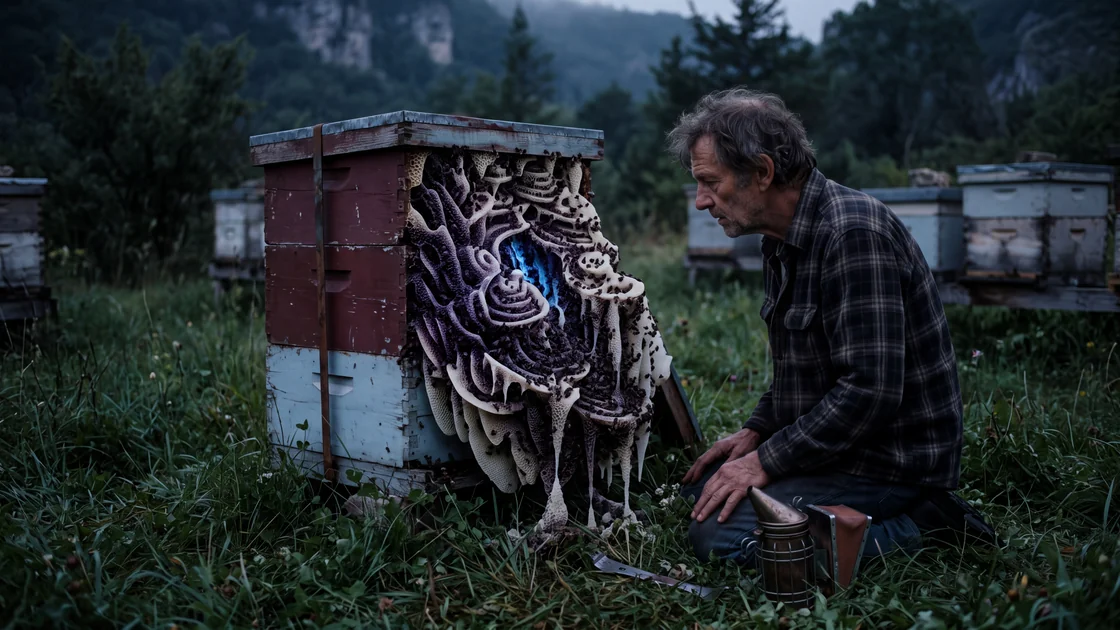
Elias Thorne had lived alone in the wind-scoured hollow of the Oakhaven valley for eleven years, tending thirty-two Langstroth hives in deliberate exile from the world of human designs, until the colony he designated Hive Seven ceased producing hexagonal brood combs and began weaving an intricate, impossible wax metropolis of non-Euclidean spires, cyclopean plazas, and radial thoroughfares that mapped the dying capital of a civilization orbiting an unmapped star. What follows is the chronicle of his isolation, the gradual decipherment of the bees’ celestial blueprint, the sensory unraveling induced by their luminescent honey, and the quiet cosmic communion that turned a forgotten mountain apiary into the final transmission tower of a world light-years dead.
I. The Apiary at Blackwood Verge
The valley was shaped like an upturned pelvic bone, bleached and chalky at the limestone rims, pooling into dark loam and ancient peat where the river choked on willow roots. Elias had chosen it because the roads ended three miles north, degenerating into gravel washouts and then into deer paths that dissolved against the shale slopes. No high-voltage power lines buzzed across the canopy; no commercial aircraft corridors crisscrossed the immediate sky, save for the occasional silver needle catching high-altitude sunset twenty thousand feet above his smokehouse.
His thirty-two hives sat on tiered pine benches facing south-southeast, angled to catch the first pale warmth of the dawn through the scrub oak. They were standard ten-frame boxes, painted in weathered washes of lead-free titanium white, pale sky blue, and oxblood red—colors chosen not for aesthetics, but to assist the returning foragers in field orientation when the autumn mist rolled down the bluffs.
Beekeeping, for Elias, was not a rustic romance; it was an exercise in rigorous, monastic humility. Before the valley, he had spent twenty years in urban planning and cadastral cartography for the municipal transit authority of a sprawling eastern megalopolis. He had lived among the deadening abstraction of easements, utility corridors, tax parcels, and traffic-flow simulations. He had resigned the day his wife, Clara, died of an aneurysm in the quiet produce aisle of a supermarket, realizing that his entire life had been an attempt to superimpose straight lines upon an uncaring, curved world that would eventually swallow all his grids in weeds.
In the bees, he had sought an antidote to human geometry. A bee’s comb was an absolute perfection, yet it was born of soft flesh, warm wax scales scraped from abdominal sternites, chewed with mandibular secretions, and pulled into shape in absolute darkness by the trembling consensus of ten thousand blind workers. The regular hexagon was nature’s greatest economy: the maximum volume enclosing the minimum perimeter, requiring the absolute least amount of costly wax to store the maximum amount of honey and brood. It was safe. It was finite. It was five hundred million years older than the human mind.
Spring arrived that year not with a rush of green, but with a wet, iron-colored cold that lingered deep into May. The apple orchards on the lower benches were late to bloom, their buds holding tight against the frost like clenched knuckles. When the dandelions finally erupted across the pasture, Elias fired up his smoker—a battered copper cylinder packed with dried sumac bobs, burlap scrap, and pine needles—pulled on his sailcloth veil, and began his seasonal inventory.
Hives One through Six were robust. Their bottom boards were clean of chalkbrood mummies; the queens had laid concentric ellipses of pearlescent worker eggs right to the bottom wire; the stores of capped honey smelled of clover, wild mustard, and damp forest floor.
Then he reached Hive Seven.
Hive Seven had always been his most temperate colony. While Hive Twelve was chronically defensive, pinging against his veil like thrown gravel the moment he lifted the outer cover, Seven was calm, almost languid. Its lineage derived from a feral swarm he had cut out of a hollowed cedar near the abandoned slate quarry five years prior. Their workers were unusually dark, their bands of golden hair thin and subdued, their wings producing a pitch half an octave lower than the high, fretful whine of the Italian packages he had imported from Georgia.
Elias pried the outer telescoping lid free with his hive tool. The propolis—the sticky, resinous tree-glue with which the bees sealed their home against drafts—did not snap with its usual dry, brittle crack. Instead, it yielded like soft bitumen, pulling into long, iridescent black threads that smelled sharply of cold slate, crushed juniper berries, and something metallic, like the ozone after an electrical discharge.
"Quiet girls," he murmured, his voice rusted from days without speech. "Just checking the stores."
He puffed two gentle clouds of cool white smoke into the inner cover’s oval hole and waited forty seconds for the alarm pheromones to be masked. When he lifted the inner board, he expected to see the tops of the ten pine frames lined with neat seams of workers festooning between the bars, their soft bodies linked leg-to-leg to form living plumb lines.
Instead, he found the frames frozen together in an architecture he did not recognize.
The bees had not built comb within the wooden boundaries of the frames. They had consumed the wax foundation sheets he had provided them—sheets stamped with the embossed hexagonal template of standard commercial apiculture—and had completely discarded the grid. They had gnawed the wax down to the supporting wires, and from those wires, they had suspended structures that did not hang vertically.
They were building horizontally, obliquely, radially.
Elias set the smoker down on a flat stone. He pulled his goatskin gloves tighter at the wrists, leaned over the open super, and stared.
Between the fourth and seventh frames, where the brood nest should have formed a warm, spherical cluster of hexagonal cells filled with curled white larvae, there sat a series of concentric, terraced rings made of dark, almost purplish-black wax. The cells were not six-sided. Some were heptagons, pinched and elongated; others were narrow, curved corridors no wider than a pencil lead, spiraling downward like subterranean ramps toward a central, sunken amphitheater.
The workers were not milling in the frantic, disorganized Brownian motion typical of an exposed hive. They were stationary. Thousands of them clung to the ridges of the dark terraces, their abdomens tilted upward at an identical, unnatural forty-two-degree angle, their wings held flat and shivering in micro-oscillations that produced no audible buzz, but rather a thrumming vibration that rattled through the pine box and traveled up the shank of Elias’s metal hive tool into his wrist bones.
At the center of the terrace, in the sunken depression where no queen should ever be, rested a single, perfect dome of translucent wax, thin as an onion skin, illuminated from beneath by a faint, chemical phosphorescence.
II. Anomalies in the Comb
That evening, the Oakhaven valley vanished into a dense, river-born fog that smelled of wet shale and decaying leaves. Elias sat at his heavy oak trestle table under the hiss of an Aladdin kerosene mantle lamp, his magnifying loupe screwed into his right eye socket, peering at the single scrap of comb he had dared to excise from the outer perimeter of Hive Seven.
The comb was cold. Normal honeycomb freshly removed from a hive retained the core warmth of the colony—roughly ninety-three degrees Fahrenheit, maintained by the continuous metabolic furnace of the workers' thoracic flight muscles. But this fragment, which he had clipped from an aberrant spur running against the interior wall of the brood chamber, felt like chilled stearin.
Under twenty-times magnification, the geometry ceased to be merely strange and became monstrously deliberate.
Standard comb cells meet at an angle of roughly one hundred and twenty degrees, three rhombuses forming the pyramidal base of each cell, interocking with the cells of the opposite side to maximize structural rigidity with minimal material.
The cells before Elias did not interlock. They were offset by precise, fractional degrees that defied planar tessellation. He adjusted the brass focus knob of his dissection microscope. The walls were shaved to a thickness of eighty microns—half the thickness of normal worker comb—yet when he touched them with the steel tip of an architectural divider, they did not yield or deform. The wax had been tempered with some foreign substance; it possessed the elastic tensile strength of high-grade vulcanized rubber and the surface slickness of polished horn.
More disturbing were the streets.
Between the raised clusters of cells ran polished channels no wider than a millimeter, flanked on either side by tiny, raised curbs of propolis. These channels did not follow the natural curves of bee-space—the precise three-eighths-of-an-inch clearance that bees instinctively leave for passage throughout a hive. They were cut like arterial avenues through a dense, vertical metropolis. Every twelve millimeters, these avenues intersected at sharp, sixty-seven-degree angles, feeding into star-shaped roundabouts centered around sunken, circular basins.
"It’s not comb," Elias whispered to the dark corners of the cabin. "It’s a ground plan."
He stood, his knees cracking in the silence, and walked to his drafting cabinet—a twenty-drawer flat-file salvaged from the county surveyor’s office thirty years ago. He pulled out a pad of vellum tracing paper, an 0.3mm technical pencil, and a set of steel engineer’s scales.
Carefully, his hands steady with the muscle memory of forty years of draftsmanship, he began to survey the comb fragment.
He measured the distances between the sunken basins. He calculated the radius of the outer terraced avenues. He transferred the coordinates to the vellum. As the mechanical pencil scratched across the tooth of the paper, the pattern revealed itself not as an organic accident or a disease-induced madness of the nervous system, but as a system of immense urban density.
The sunken basins were not brood cradles; they were retention reservoirs, mathematically proportioned to catch runoff from steep, parabolic slopes that did not yet exist. The narrow corridors were transit corridors, complete with baffle-walls designed to break the velocity of prevailing winds. But winds of what speed? In a hive, ventilation was achieved through fanning workers at the entrance. In this wax model, the aerodynamics suggested a structure designed to withstand supersonic crosswinds on an exposed, atmospheric cliff-face.
He worked until his eyes burned and the kerosene in the lamp reservoir ran dry, leaving him in the blue, predawn shadows of the kitchen.
When he went back out to the apiary at daybreak, the valley was silent. The thrushes and vireos that usually sang from the elderberry thickets were absent, as if the sound had been drawn out of the air.
He approached Hive Seven without his veil. He wore only his flannel shirt and heavy denim work trousers. He did not bring the smoker. Smoke was a tool for pacification, an obscuration of signal; whatever was happening inside that box, Elias knew with a surveyor’s cold clarity that he could not afford to introduce noise into the transmission.
He lifted the outer lid.
In the sixteen hours since he had closed the hive, the colony had expanded the structure through the bottom boards. They had chewed a smooth, circular aperture through the three-quarter-inch pine floor of the bottom super, and descending into the dead airspace beneath the screened bottom board was an inverted spire of black wax, three inches long, tapering to an impossibly fine point that hovered two millimeters above the damp ground.
Clustered around this stalactite were hundreds of workers, but they were not depositing wax.
They were carving it.
Using their mandibles like fine chisels, they were excavating bas-reliefs into the exterior walls of the downward-reaching spire. They worked with terrifying speed and total synchronization, dozens of bees moving in unison across a single face, shaving flakes of wax finer than talcum powder, which were immediately gathered by another rank of workers and transported up into the interior corridors.
Elias sank to his knees in the clover, bringing his face within six inches of the spire.
The bees did not sting. They did not even flare their abdomen tips in warning. They moved around his breath, parting around the thermal plume of his nostrils like water flowing around an anchored boulder.
Etched into the surface of the descending wax spire were thousands of micro-apertures: windows. Columned colonnades. Massive, cyclopean portals framed by tapered lintels that bowed under imaginary, tectonic weight. And linking these vertical facades were hairline aqueducts, arches leaping across canyons of empty air to anchor against the next descending pillar.
It was an arcology. A city built not outward across a plain, but downward into an abyss, suspended beneath some titanic, planetary shelf.
III. The Royal Calculus
By the end of the second week, Hive Seven had ceased all normal apicultural functions.
The other thirty-one colonies in the apiary were operating at the furious peak of the spring dandelion-and-willow flow. Their workers returned from the meadows loaded with fat, butter-yellow pellets of pollen packed into their corbiculae; their landing boards were crowded with nectar-distributors and young nurses taking their orientation flights in the warm noon sun.
Hive Seven brought home no yellow pollen.
Elias spent hours seated on an overturned milk crate beside the hive entrance, observing the field force. The foragers left at dawn, but they did not fly east toward the clover pastures or south toward the riverbanks where the wild plum was breaking into fragrant white froth.
They flew straight up.
They emerged from the entrance, crawled to the edge of the landing board, turned their heads toward the zenith, and launched themselves vertically into the blue, climbing at an angle so steep that they were lost to human sight within seconds. When they returned hours later, their flight was heavy, unstable, their wings frayed as if they had navigated through storms of glass dust.
The pollen they carried was not yellow, orange, or white.
It was an ash-grey, granular powder that had a faint, violet luminescence under the shadow of the hive overhang. When Elias touched a grain of it to his tongue, his mouth filled with a taste like cold galvanized iron, wet slate, and the numbing bitterness of ground peach pits. Within twenty seconds, a sharp, cold ache blossomed behind his eyes, and the sound of the Oakhaven river three hundred yards away suddenly seemed to separate into sixteen distinct acoustic frequencies, each vibrating in a different chamber of his inner ear.
He spat, rinsed his mouth with water from his canteen, and sat shaking on the turf until the vertigo receded.
The colony did not want his sugar syrup. When he placed an entrance feeder filled with a one-to-one cane sugar solution at their door, they coated the glass jar in a thick, opaque lacquer of black propolis within two hours, sealing the nozzle shut and ignoring it entirely.
Inside the hive, the original ten pine frames had been completely obliterated.
The bees had chewed through the soft basswood top bars, dissolving the wood fiber with an enzymatic salivary fluid that softened the lignin, reshaping the pulp into a dark, fibrous composite material resembling carbonized paper. From this reinforced ceiling, the city hung like a massive, petrified lung.
It had expanded down through three hive bodies. Elias had been forced to add supers not to give them room for surplus honey, but to prevent the descending towers from grounding out on the soil.
The structure was now twenty-eight inches deep, twenty inches wide, and consisted of over eighty identifiable structural districts.
Elias had converted his kitchen table into a full cartographic station. He had purchased five hundred yards of high-grade architectural tracing paper from a mail-order clearinghouse in Philadelphia, along with fine-line technical pens, mechanical proportional dividers, and a surveyor’s theodolite, which he had mounted on a low tripod directly beside the opened hive.
He was mapping the colony’s construction millimeter by millimeter.
"The scale," he wrote in his field ledger on the night of June 4th, "is roughly one to ten thousand. If this assumption holds, the primary central spire—which now extends eighteen inches into the lower super—represents an engineering work approximately three miles in height, suspended from an overhead strata of indeterminate geology. The architecture is not human, nor is it terrestrial. It lacks the post-and-lintel conventions of our vertical building, nor does it employ the tensile catenary curves of our suspension bridges.
"The load is distributed entirely through parabolic vaulting that utilizes torsional shear. The material of the comb is three times denser than typical cappings wax; they are mixing their abdominal secretions with pulverized quartz and shale, which they are mining from the floor of the abandoned slate quarry. I followed a flight line today. They are not visiting flowers. They are descending into the deepest fissure of the quarry pit, where the water pools over the black slate veins, and harvesting the mineral silt."
He stopped writing. His oil lamp flickered.
Outside, the valley was pitch black, but from the apiary came a sound that made the hairs on the back of his arms rise.
It was not the collective hum of a hive cooling itself. It was rhythmic.
It was a triple-meter pulse, like the distant, subterranean thud of a steam-hammer operating deep within a mine shaft. Thump-thump... thump. Thump-thump... thump.
He left the cabin without a lantern, guided only by the cold stars of the summer solstice: Vega burning cold and white at the zenith, Cygnus flying south through the milk of the galaxy.
Hive Seven was glowing.
The light did not come from any fire or chemical spark; it leaked through the entrance slot and through the hand-holds of the wooden boxes in long, pale blades of faint, cerulean luminescence. It was the violet light of the grey pollen they had stored in the high galleries.
Elias approached the box. The wood was cold to the touch, vibrating with that strange, three-stroke rhythm. He knelt and peered into the entrance.
The bottom board had been cleared of all debris. Across the clean pine floor, thousands of bees had arranged themselves into concentric rings that slowly rotated in opposite directions, like the cogs of an astronomical clock. At the hub of these living gears sat the queen.
Elias had caught only brief glimpses of her in previous seasons. She had been an ordinary Carniolan-cedar cross: long-bodied, dark bronze, moving with the heavy, regal dignity of her caste.
She was no longer bronze.
Her thorax had swelled to twice its normal volume, its chitinous plates separating to reveal an underlying membrane that pulsed with a deep, liquid violet light. Her wings were gone, chewed down to chitinous stubs by her attendants to allow for the growth of her abdomen, which had elongated into a segmented, cylindrical ivory column nearly two inches long.
She was not laying eggs.
She was drawing lines.
Held between her front legs was a stylus—a sliver of black slate carved to a needle-point. With agonizing slowness, guided by the micro-nudges of the workers that pressed their heads against her flanks, the queen was scratching microscopic vectors into a polished disc of propolis that lay flat upon the floor.
As she scratched, the workers in the rotating rings raised their wings and vibrated them, producing the triple-meter thrum that Elias had heard from his cabin. They were reading the vibrations through the subgenual organs in their legs, encoding the coordinates, and carrying them upward into the dark towers of the wax city above.
Elias did not breathe. He remained on his knees on the damp grass until the dawn light washed the cerulean glow from the wood, his eyes watering, his knees locked in agony, his mind suspended in an awe so absolute it felt like terror.
IV. The Geometry of the Void
By mid-July, the transformation had reached an acute, unsustainable threshold.
The local wildlife had completely abandoned the hollow around Blackwood Verge. The black bears that typically raided his apiary in mid-summer, smashing boxes to gorge on brood and honey, would not come within half a mile of the perimeter. Elias found bear tracks near the creek: the prints showed where a large boar had been running at full tilt toward the hives, had suddenly dug its claws deep into the mud to stop itself, turned in a frantic, skidding circle, and fled uphill through the briars, leaving clumps of fur on the wire fences.
The weather around the apiary had begun to warp.
On days when the rest of the county was sweltering under a ninety-degree mid-Atlantic heatwave, the air immediately surrounding Hive Seven was twenty degrees cooler. A perpetual downdraft seemed to cascade from the top of the pine boxes, carrying a faint scent of liquid air, cold stone, and desiccated vegetation that had never seen a sun.
Elias no longer went into town for groceries. He lived off his root cellar—potatoes from the previous autumn, canned venison, dried beans—and the small, bitter wild plums that grew near the spring.
His hair had grown long and matted; his clothes hung loose on his shrinking frame. He spent eighteen hours a day at his drawing table, his ledger now filling the third volume of what he called The Cartography of the Seven.
Through careful cross-sectioning and orthographic projection, he had reconstructed the entire wax model on paper. It hung across the walls of his cabin like the blueprints of a dead empire: twelve massive sheets of vellum, six feet long, inked in India ink and technical red wash.
The city was not built for human beings.
The scale of the thoroughfares, the incline of the ramps, the clearance of the subterranean vaults—all were proportioned for beings that were long, low-slung, and multi-limbed. The living spaces were not rooms, but interconnected nodes arranged in three-dimensional lattices, like the interior of a crystalline sponge.
There were no temples. There were no monuments to individuals. There were, however, enormous, sunken circular structures that Elias, with his old surveyor’s intuition, recognized as gravitational anchors.
"The metropolis," he noted in an entry dated July 22nd, "is situated upon the underside of an overhanging tectonic plate—perhaps an oceanic crust suspended above an interior mantle void, or the subterranean roof of a cavernous world. The entire engineering logic assumes an inverted gravitational field that is not constant, but tidal.
"The buildings are designed to withstand periodic reversals of gravitational acceleration. When the field is positive (drawing toward the ceiling), the structures act as hanging stalactites in tension. When the field reverses (drawing toward the floor of the void), the secondary parabolic buttresses engage, locking the spires into compression towers.
"The bees know this. They are not inventing it. They are remembering it. But how does a lineage of hymenoptera carry the architectural memory of a planet with an oscillating gravitational core?"
He found the answer three days later in the library of his own mind, sparked by an old memory of his university days studying biological systematics.
He remembered the concept of the extended phenotype—the idea that an organism’s genetic code does not end at the boundaries of its skin, but extends outward to shape its environment: a beaver’s dam, a caddisfly’s stone case, a termitarium’s complex ventilation shafts.
What if the code did not originate on Earth?
What if the ancestral genome of the honeybee—an organism that had appeared suddenly in the fossil record during the Cretaceous, fully formed, with social structures already intact—contained non-coding sequences of vast, dormant informational density? Junk DNA, the biologists called it. Introns that had sat silent through ninety million years of terrestrial flowering, waiting for an environmental key to unlock them.
And what was the key?
Elias walked to the window and looked out at the night sky. The Earth had recently entered the orbital path of the Perseid debris stream, but the meteors that scratched across the atmosphere this year were different. Several times over the past week, he had observed high-altitude flashes of an unusual violet duration—not the quick, white-hot ionization trails of iron-nickel pebbles, but slow, trailing blooms of emerald and violet that took four or five seconds to fade against the velvet black.
Some form of atmospheric seeding. Cosmic dust from a disrupted extrasolar system, filtering down through the stratosphere, settling on the mountain laurel, washing into the quarry springs, ingested by the foragers, and unlocking the ancient, dormant subroutines in the queen’s mandibular glands.
They were not building an apiary.
They were building a monument. Or perhaps, a distress flare.
V. The Blue Nectar
In the first week of August, Hive Seven produced its first and only batch of honey.
Elias discovered it during his routine morning inspection. The uppermost super, which had previously been reserved for structural buttressing, had been converted into six massive, circular storage vaults constructed of an almost glass-like, transparent propolis.
Inside these vaults, the bees had deposited roughly three quarts of a liquid that defied every physical property of terrestrial honey.
It was not golden, amber, or brown. It was an intense, optical cobalt blue, clear as lens-grade sapphire, yet possessing an extraordinary specific gravity. When Elias tilted the box, the fluid did not flow with the lazy, viscous crawl of supersaturated sugar. It moved with the rapid, silent slickness of liquid mercury, its surface forming a convex meniscus that seemed to repel the wax walls that contained it.
It gave off no floral odor. It smelled of deep frost, dried pine needles, and the clean, metallic bite of absolute zero.
He took an eye-dropper from his field kit, drew up three drops of the blue liquid, and released them into a small watch glass.
The fluid did not spread out. It drew together into a single, perfect sphere that sat on the glass like a ball bearing. When he brought a small pocket compass near it, the needle did not point north; it swung erratically through three hundred and sixty degrees, finally locking onto the drop of honey as if it were a magnetic pole.
Elias sat at his desk, staring at the blue sphere.
His hands were trembling. His skin felt paper-thin, his heartbeat hollow in his ribs. For two months he had observed, measured, drafted, and categorized. He had remained the surveyor, the cartographer, the detached observer standing on the bank of the strange river.
But cartography has its limits. A map is not the territory; it is merely an admission of distance.
"If I do not taste it," he said aloud to the empty room, "I am only an archivist of shadows."
He lifted the watch glass. He did not use a spoon. He tilted the glass toward his mouth and allowed the single blue sphere to roll across his lower lip and onto his tongue.
The impact was instantaneous and total.
It did not register as taste. It was an explosion of sensory translation that short-circuited his brain’s parietal lobes.
First came the cold—a cold so profound that his teeth felt like dry chalk that would shatter if he tapped them together. Then came the sound.
The walls of his cabin did not fall away; they became transparent to wave-forms. He could hear the micro-fracturing of the shale strata three miles down in the Earth’s basement; he could hear the acoustic resonance of the sap rising through the xylem of every hemlock on the mountain, a roaring, oceanic hiss of capillary pressure; and above that, piercing down through the atmosphere like steel piano wires, he could hear the radio emissions of Jupiter, the whistling aurorae of the poles, and the dry, dead crackle of the pulsar in the heart of the Crab Nebula.
Then his vision split.
He was no longer looking through the circular lenses of human eyes. His field of view opened to three hundred and twenty degrees. The world was rendered in four hundred thousand distinct, hexagonal facets, each processing polarized light, ultraviolet gradients, and magnetic flux lines.
He saw the valley not as trees and earth, but as an energetic topography. The Oakhaven River was a braided vein of deep emerald thermal inertia; the limestone bluffs were white-hot radiators of stored solar radiation; and the sky above him was not blue, but a dizzying tapestry of polarization rings centered on the unseen sun, crisscrossed by the shimmering, silver-grey flight lines of his own bees.
And down these flight lines, descending from the upper atmosphere like silk threads tossed from an airship, came the memory.
It was a world without an exterior.
A planet whose crust was seventy miles thick, hollowed out by ancient, artificial excavation into a series of nested, concentric underworlds. A dying sun—a tiny, smoldering red dwarf—sat at the center of the hollow, casting a permanent, bloody twilight across the inverted cities that hung from the ceiling of the world.
He saw the city of Hive Seven.
It was not miniature. It was cyclopean. The spires he had mapped in wax were three miles long, carved from single blocks of basalt and reinforced with lattices of cold-forged iridium. Millions of beings—beings with long, segmented bodies, armored in dark chitin, moving with the terrifying, beautiful grace of mantises—crawled across the vertical facades, their antennae twinned in constant, telepathic calculus.
They were dying.
The sun at the core was cooling, its magnetic field collapsing, triggering catastrophic gravitational oscillations that caused the hanging cities to groan and snap. The basalt spires were shearing off, falling thirty miles through the central void into the dead embers of the star below.
They had no ships. They had no rockets. Their technology was not mechanical, but biological, architectural, genetic.
In their final centuries, as the spires fell one by one, they had gathered in the great sunken basins—the very basins Elias had drawn on his vellum—and had encoded their history, their architecture, their mathematics, and their soul into the only vessel capable of surviving the interstellar crossing: a dormant retro-virus, embedded within the reproductive genome of a common, social insect they had seeded across three thousand star systems millions of years before.
They had launched their memory into the dark on the solar wind, pushed by the dying flare of their star.
And now, after six hundred million years of drift through the galactic spiral, a fragment of that code had drifted down through the atmosphere of a third-rate terrestrial planet, caught in the rain, absorbed by the roots of a wild mountain plum, gathered by the foragers of Hive Seven, and translated back into wax.
The bees were not building a home.
They were building an epitaph.
VI. The Swarm of the Spire
Elias woke three days later on the pine floorboards beneath his drafting table.
His tongue was dry, coated in a white, chalky fur. His joints were stiff, his hands clawed as if he had been gripping an edge over an abyss. Outside, the rain was falling—not the gentle summer drizzle of the valley, but a violent, cold, autumnal downpour that stripped the leaves from the ash trees and beat the pasture into yellow mud.
He pulled himself up by the leg of the table, his muscles screaming with lactic acid.
The blueprints on the wall were stained with dampness, the India ink bleeding at the margins. On the table, the watch glass was empty, save for a microscopic ring of white, crystalline salt where the blue sphere had rested.
He staggered to the door, shoved it open, and stumbled out into the apiary.
The cold rain soaked through his flannel shirt instantly, plastering the cloth to his ribs. The smell of the apiary had changed. The warm, yeasty scent of brood and propolis was gone, replaced by an absolute, sterile absence of odor.
Hives One through Six were shut tight against the rain, their entrance boards deserted, their internal hum low and conservative.
Hive Seven was dead silent.
The bottom three supers had burst. The lateral pressure of the expanding wax metropolis had sheared the three-quarter-inch pine dovetails at the corners; the wooden sides had splayed outward like the staves of a broken barrel, held together only by the rusting steel hive straps Elias had wrapped around them in June.
Through the split wood, the city was visible.
It was complete.
The central spire had reached the earth. It had driven its needle-point two inches into the shale soil of the valley floor, anchoring the entire three-foot structure in stone. Every arch, every aqueduct, every micro-colonnade was finished. The wax had cured from deep violet-black to a pale, bone-white alabaster that did not melt or soften under the driving sheets of cold rain.
The bees were not inside the cells.
They had come out to the surface.
Tens of thousands of workers, along with hundreds of heavy, blunt-headed drones, covered the exterior of the white spires like a living, shivering pelt. They were not moving. They were dying where they stood, their heads pointed downward toward the earth anchor, their legs locked around the miniature balustrades and buttresses in the grip of their final rigor mortis.
And at the summit of the primary tower, clinging to the parapet of the highest terrace, was the queen.
She had evacuated her body.
Her segmented, ivory abdomen was shriveled, an empty husk of transparent chitin that fluttered in the wet wind like a torn flag. Her head and thorax were still anchored to the wax by her front claws, her unseeing compound eyes fixed upon the slate quarry bluffs three miles away.
Elias fell to his knees in the mud beside the ruins of the box.
The rain beat down upon his bare head, running down his neck, mixing with the sweat and the salt on his cheeks. He did not put out his hand to touch the comb. He knew that if he touched it, the structure would be as cold as the rock beneath it.
The transmission was over.
The memory had been unpacked, rendered into three dimensions, recorded in the only physical medium the messengers possessed, and now, the messengers were spent.
He knelt there for hours, until the rain slowed to a low, grey mist and the shadows of the bluffs reached out across the pasture to cover the apiary in premature twilight.
VII. The Siphon
The weeks that followed were marked by a silence so complete that Elias found himself listening to the sound of his own fingernails scraping against his denim trousers just to confirm that he had not lost his hearing.
He did not dismantle Hive Seven.
He built a protective shelter around it—a timber shed with an open south face, roofed with cedar shakes he split himself from a fallen log. He enclosed the white wax metropolis within walls of fine copper wire mesh, not to keep anything in, but to prevent the field mice and yellowjackets from desecrating the empty galleries.
The other thirty-one hives continued their seasonal descent into winter.
Elias worked with the mechanical, efficient precision of a ghost. He fed them sugar syrup medicated with fumagillin to protect against winter dysentery; he reduced their entrances with notched wooden blocks to keep out the shrews; he wrapped the outer supers in black roofing felt to absorb the winter sun and shed the snow.
He harvested thirty pounds of honey from Hive Four and Hive Nine—pale, sweet, terrestrial honey that smelled of goldenrod, aster, and clover. It tasted of the valley, of sunlight, of life that was simple, round, and earth-bound.
When he ate it, he felt nothing but a dull, hollow grief.
The blue honey had spoiled him. It had permanently altered the wiring of his sensory cortex. In the evenings, sitting before his wood stove, he would find his gaze drifting toward the corner of the room where the drafting sheets hung, their red ink lines fading in the dry winter air.
He could still see the facets.
If he relaxed his focus, the single yellow flame of his kerosene lamp would multiply into four hundred thousand points of cold violet light. He could still hear the subterranean groan of the shale beds beneath the valley floor; he could still feel the faint, rhythmic tug of the Galactic Core as the solar system climbed through its twenty-thousand-year wobble above the galactic plane.
In late January, the deep snows arrived.
The valley was buried under four feet of powdered drift that leveled the contours of the pasture, turning the apiary into a series of white hummocks resembling burial mounds. The temperature dropped to twenty below zero. The trees in the forest cracked in the night with sounds like rifle shots as their remaining sap froze and expanded.
Elias did not leave the cabin for three weeks.
He spent his time reading his own ledgers, over and over, tracing with his index finger the delicate, terrifying lines of the hanging city. He knew every street. He knew the capacity of the retention basins; he knew the resonant frequency of the primary buttresses; he knew the angle at which the great central spires would shear when the gravity inverted for the final time.
He had become the only living citizen of a world that had ceased to exist before the first trilobite crawled out of the Cambrian mud.
On the night of February 14th, the sky cleared to an ice-blue clarity. The stars hung over the Oakhaven valley like shards of broken plate glass, so sharp and close that they seemed to hum.
Elias put on his heavy shearling coat, his felt boots, and his snowshoes, and took his battery lantern out to the shed.
The snow had drifted high against the north wall of the shelter, but the open south face was clear, swept by the prevailing downdraft from the bluffs.
Inside the copper mesh enclosure, the city of Hive Seven sat untouched by the frost.
Snow had blown onto the edges of the timber base, but it had not settled on the white wax. The air within the enclosure was dry, crisp, and faintly, impossibly warm.
Elias knelt before the mesh. He clicked off his lantern.
In the starlight reflecting off the four-foot snowdrifts, the city was visible in every exquisite detail. The bodies of the dead bees had dried into tiny, dark husks that clung to the facades like gargoyles, their wings translucent and glittering with micro-crystals of hoarfrost.
He sat on his haunches, his breath plume rising white into the frozen air.
Then he saw the worker.
She was crawling along the lowest terrace of the primary spire, three inches above the frozen ground.
She was small, slow, her movements stiff with the impossible cold, but she was alive. Her chitin was not the dark, feral bronze of the old lineage; it was a pure, matte black, absorbing the starlight so completely that she looked like a hole cut into the fabric of the night.
She reached the base of the spire. She turned, her antennae sweeping the cold air in slow, rhythmic figure-eights, until they aligned with Elias’s face.
She did not fly. She could not fly in that air.
She crawled off the wax, down the wooden timber, across the three inches of drifted snow—her six legs punching tiny, neat holes into the crust—and onto the toe of Elias’s felt boot.
She climbed.
She climbed with the agonizing, patient slowness of an explorer summiting an icy peak, her tarsal claws catching the rough wool fibers of his trousers, rising up his shin, past his knee, across the leather belt of his shearling coat, up to the lapel, until she stood upon the warm skin of his throat, just above the pulse of the carotid artery.
Elias did not move. He did not blink. The cold seemed to have stopped at the perimeter of the shed; his heart was beating with a slow, heavy, three-stroke rhythm: thump-thump... thump. Thump-thump... thump.
The bee extended her proboscis.
She did not sting. She touched the soft, moist tip of her tongue to the thin skin over his pulse.
And in that contact, Elias Thorne received the final entry of the survey.
It was not a map of the city.
It was a destination.
The city was not an epitaph after all. It was an anchor.
The workers had not built a model; they had built a receiver—a three-dimensional, physical harmonic antenna that had now, through the anchor driven into the shale, tuned the entire Oakhaven valley to the vibrational frequency of a dying world’s final refuge.
A world not lost in the past, but waiting in the deep, cold silence between the stars, suspended in the dark void where the dead sun had once burned, waiting for an atmosphere, waiting for a soil, waiting for an eye capable of seeing its geometry.
The bee drew back her proboscis.
She did not crawl away. She curled her legs inward, tucked her head against the rough wool of his collar, and died against the warmth of his neck.
VIII. The Foundation
When the spring thaw finally came to the Oakhaven valley, the runoff was the heaviest in thirty years.
The river rose twenty feet, drowning the willow thickets, sweeping away the rotten corduroy roads, and cutting off the upper hollow from the world for nearly two months. When the county road crew finally worked their way up to the Verge with a grader in late May, they found the apiary abandoned.
The thirty-one standard hives were thriving. Their supers were heavy with wild cherry and locust honey; their entrance boards were bustling with millions of bright, healthy, terrestrial bees that flew out across the greening meadows in high, singing clouds.
The house was empty.
The draftsman’s table was clean, swept of all dust, the technical pens resting in their velvet-lined cases, the ink bottles stoppered with red sealing wax. The twelve great sheets of vellum had been carefully rolled, placed into zinc surveyor’s tubes, and left on the center of the table, addressed to no one.
In the shed beside the apiary, Hive Seven was gone.
The pine boxes had been neatly disassembled and stacked against the cedar wall.
Of the great white wax city, not a single trace remained upon the surface of the ground.
There was only a hole.
A circular, perfectly vertical aperture in the shale floor of the valley, eight inches in diameter, extending downward into the black rock beyond the reach of any surveyor’s plumb line. The walls of the hole were not chipped or drilled; they were as smooth as polished obsidian, cut through the quartz and slate with a micro-metric precision that human tools could not replicate.
And from deep within that shaft, rising through the cool, damp earth into the May sunlight, came a faint, rhythmic sound that the road crew foreman could only describe, when he spoke to his wife that evening, as the sound of ten million tiny chisels working in the dark, building something immense beneath their feet.