The Architecture of Silver and Dust
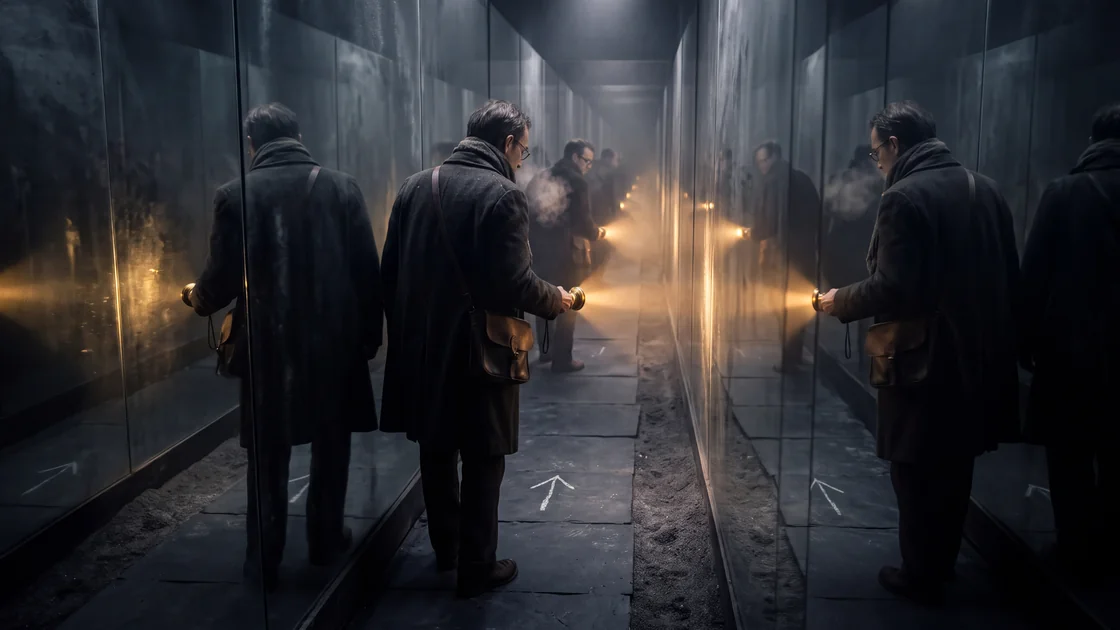
When Arthur Finch was appointed probate executor of Blackwood Chase, he anticipated nothing more taxing than the slow cataloging of an eccentric recluse’s suffocating hoard, but behind a seventeenth-century oak armoire in the master bedchamber, he discovered a mortised iron door that led into a subterranean labyrinth composed entirely of beveled glass and silver leaf; there, amidst miles of impossible refractions and out-of-sync echoes, Arthur found himself unraveling the obsessive life of the late Thaddeus Vane, only to discover that the maze was not merely an architectural folly, but a ravenous optical instrument designed to trap the reflections—and eventually the souls—of those who dared to look too closely.
Chapter I: The Paperwork of the Dead
The letter of appointment had arrived in a manila envelope sealed with unrefined red wax, carrying the faint, rancid scent of damp wool and mutton tallow. Arthur Finch was accustomed to the must of expired lives. For seventeen years, he had served the firm of Pargeter, Morne & Croft as their chief estate clerk, a specialist in the domestic wreckage left behind by intestate bachelors, reclusive spinsters, and wealthy paranoiacs who mistrusted their cousins unto the grave.
Arthur was thirty-nine years old, a dry, narrow-shouldered man whose waistcoat pockets always contained two stubby pencils, a jeweler’s loupe, a bone folder, and a tin of menthol lozenges to counteract the stench of mildewed parchment. He did not possess a vivid imagination; he regarded this deficit as his greatest professional asset. Where an imaginative man might see an abandoned parlor and dream of the laughter that once rang within it, Arthur saw thirty-eight yards of faded horsehair carpeting (nominal salvage value), two mahogany pie-crust tables with water rings (grade three restoration required), and a bracket clock by a minor Clerkenwell maker whose escapement was frozen in dried whale oil.
Yet, as the hired motor-car turned off the rutted coastal track and mounted the gravel spit leading to Blackwood Chase, Arthur felt a dull contraction in his temples.
The house stood upon a promontory of dark shale that jutted into the North Sea, some six miles north of Alnmouth. It was an ungainly, sprawling edifice of sodden sandstone, built in an incoherent mixture of Jacobethan and mock-Gothic styles. Its turrets were too short; its windows were narrow, lancet slits with leaded panes so clouded by salt spray that they looked like cataract-blinded eyes. The chimneys, eleven in all, leaned against the grey October sky like the crooked teeth of an old skull.
"I won't be coming up to the porch, sir," the driver said, his hands clamped tight on the vibrating steering wheel of the Humber. "The road’s soft as curd, and Mr. Vane’s dogs used to run the verge."
"Mr. Vane has been dead for three weeks," Arthur replied in his flat, dry register, pulling his wool scarf tighter around his throat. "And the court order mentions no livestock."
"Doesn't mean the road’s any harder," the man grunted. "I’ll drop you at the lower gate. If you’re not back by five, I take it you’re sleeping under the roof, and I’ll see you on Friday."
"Five o’clock on Friday will do," Arthur said. He stepped out into the biting sea wind, lifting his leather kit-bag and a reinforced wooden crate of ledger books from the luggage rack.
The heavy iron gates hung half-open, their hinges rusted into an immovable shriek. Arthur walked the two hundred yards of weed-choked drive alone. The silence here was singular; it was not the peaceful quiet of the countryside, but the muffled deadness of a space over-packed with matter. Even the surf, breaking against the cliffs two hundred feet below, sounded faint and pulpy, as though the air itself had been stuffed with horsehair and old blankets.
Thaddeus Vane had died at the age of eighty-one, leaving no will, no spouse, and seventy-four thousand pounds in Consols, along with the freehold of Blackwood Chase. The public trustee had spent a fortnight attempting to locate an heir before discovering a third cousin twice removed who worked in a jute mill in Dundee and who had promptly signed away all administrative authority to the probate court in exchange for an immediate advance of two hundred pounds.
It fell to Arthur to catalog the personal effects, assess the condition of the real property, and identify items of value for the auctioneers in Newcastle. It was an ordinary commission, save for one detail noted in the margin of Mr. Pargeter’s briefing papers: The deceased was known to local authorities as a chronic accumulator. Caution is advised regarding floor-load limits in the upper stories.
Arthur reached the portico. The front door was four inches of solid bog-oak, banded with strapwork. Beside the knocker hung a brass padlock, already clipped and dangling from an official Ministry of Justice seal. He produced his brass skeleton key, worked the heavy mortise lock, and pushed.
The door resisted, groaning against a drift of matter within. Arthur planted his boot against the stone sill and put his shoulder to the oak. With a dry, papery crunch, the door yielded two feet, releasing a gust of air that made his throat seize.
It smelled of vinegar, zinc shavings, dried elderberries, unwashed wool, paraffin, and that cold, metallic perfume that clings to ancient glass.
Arthur clicked on his battery torch, its pale beam cutting through a suspended haze of dust. The entrance hall was twenty paces wide, but it had been reduced to a narrow trench running between cliffs of stacked rubbish. To his left rose a sheer wall of tied bundles of the Illustrated London News, dating from 1888 to the Great War, their twine biting deep into yellowing margins. To his right stood seventy or eighty wooden crates, their stenciled marks indicating they had once contained Dutch gin, safety matches, and zinc oxide; now, they were filled to overflowing with thousands of round tin canisters, glass bottles with their stoppers waxed down, bundles of willow twigs, brass carriage-clocks lacking their pendulums, and leather boots tied together in pairs with copper wire.
"Lord," Arthur murmured, not in shock, but with the weary recognition of a surveyor surveying an unexpected mountain of ballast.
He set his kit-bag on the lowest stair, which was clear only because someone had recently swept it with coarse salt, and pulled out his first ledger.
Entry 1: Ground floor entrance hall. Linear footage: approximately forty. Obstruction level: extreme. Composition: mixed ephemera, newsprint, dry domestic salvage, trade packaging. Structural integrity of floor: sound, stone flag.
He clicked his pen, adjusted his spectacles, and began to work.
Chapter II: The Sediment of Eighty Years
For the first three days, Arthur Finch saw neither the sky nor another human face. He lived by the rhythm of his pocket watch and the hiss of a portable Primus stove he had set up in the scullery, which was one of the few rooms where the floor was not bowed beneath the weight of Vane’s acquisitions.
Thaddeus Vane had not been a collector; a collector possessed discernment, taxonomy, and an appetite for completion. Vane had been an accumulator, which was an entirely different species of animal. To the accumulator, value was not defined by rarity or beauty, but by presence. Everything that had crossed the threshold of Blackwood Chase appeared to have been preserved simply because it had ceased to be outside.
In the morning room, Arthur cataloged four hundred and twelve brass curtain rods, none of them straight, all sorted by diameter into empty butter firkins. In the library, where three thousand fine calf-bound volumes of theological tracts were crushed behind stacks of newer timber, he found sixty-six tea chests packed with broken paraffin lamps, forty-eight gross of steel nibs still in their damp-stained cardboard trade-boxes, and seventeen identical copies of an 1894 railway timetable for the North Eastern line.
Yet, as Arthur worked his way deeper into the house, a peculiar system began to suggest itself beneath the chaos. It was not order as a clerk understood it, but rather a species of mineral stratification.
The outermost layers—the hallways, the sculleries, the cold morning rooms—held the coarse detritus of daily life: newspapers, empty tins, split coal sacks, scrap lumber. But as one moved inward, toward the core of the house, the nature of the materials shifted.
On Wednesday afternoon, Arthur cleared a path through the secondary drawing room on the first floor. Here, the hoarded goods were optical.
He sat on an upturned crate of mineral water, his loupe screwed into his eye socket, examining a drawer full of convex lenses that had been carefully wrapped in greaseproof paper. The room was cold enough that his breath plumed across the glass.
There were hundreds of them. Not sets, but individual pieces, ranging from minute microscope objectives no larger than a grain of rice to massive, heavy disks of green-tinted crown glass, eight inches thick and ground with crude, deep curves. Along the walls, instead of books or prints, leaned stacks of silvered plates: daguerreotypes on copper, tintypes, and large sheets of plate glass from which the backing had been partially scraped away with a razor blade.
"Curious," Arthur muttered to himself.
He picked up a leather-bound notebook from a stack resting on a rosewood prie-dieu. Its cover was stamped with the words: CATOPTRICS & MEMORANDA: 1904–1912.
He opened it, expecting household accounts or the paranoid grievances typical of such men. Instead, the pages were covered in a cramped, crabbed hand, filled with mathematical calculations, optical diagrams, and strange, repetitive aphorisms:
May 14, 1906: The plane mirror is an error of vulgar geometry. It presumes the world is flat because the surface is flat. But the silver does not reproduce; it receives. Where does the surplus image go when the candle is extinguished? Matter cannot be destroyed. Light is matter. Therefore, the reflection remains within the amalgam, compressed like dry flowers in an unread folio.
August 3, 1908: To accumulate is to prevent dispersal. If I keep the chairs, the bodies that sat in them cannot entirely disperse into the churchyard. If I keep the glasses, the light that struck them is held prisoner. A prison of silver is cleaner than a grave of loam.
November 19, 1911: The angle of ninety degrees produces three images. The angle of sixty produces five. The angle of zero—two plates parallel, facing inward—produces infinity. But infinity is not a number; it is an emptiness. If a man steps between them, he divides the emptiness into measurable portions. Each reflection is slightly colder than the one before it. Measure the temperature of the tenth bounce: it is three degrees below ambient. The fiftieth bounce: ice. What lies at the ten-thousandth?
Arthur turned the page. There were several pages of trigonometric tables, followed by a series of rough sketches showing what appeared to be an intricate architectural plan: a honeycomb of long, narrow cells, each wall marked with the symbol for a reflecting surface (\(\mathbb{R}\)) and an angle of incidence.
"An eccentric folly," Arthur said aloud, his voice dropping flatly into the cold room. "Common enough in the nineties. Catoptric gardens. Maze-building."
He closed the notebook, labeled it Lot 44: Two bundles manuscript notebooks, scientific and philosophical, by the late T. Vane, and set it atop a barrel of brass screws.
By Thursday evening, Arthur had reached the second floor: the master bedchamber.
Chapter III: The Sealing of the Wardrobe
The master bedchamber was the most heavily barricaded room in the house. It took Arthur three hours with an iron crowbar simply to force the door wide enough to admit his hips. The obstacle was not furniture, but a sheer wall of rolled-wool carpeting, standing upright like the trunks of a cedar forest, bound with rotten hemp rope and wedged between floor and ceiling.
When he finally squeezed through, the air was so thick with the smell of dried lavender, camphor, and old human grease that he had to suck upon two menthol lozenges simultaneously to keep from retching.
The room was vast, high-ceilinged, and completely devoid of daylight. The three lancet windows had been shuttered from within, the shutters screwed to the frames with three-inch wood screws, and the recesses then packed with bricks laid without mortar.
In the center of this gloom stood a four-poster bed, stripped to its bare horsehair ticking. Surrounding it, like the palisade of a fortress, were fourteen wardrobes of every shape, age, and timber: Victorian mahogany breakfronts, slender Georgian walnut presses, cheap pine cupboards painted with chalky green milk-paint, and, towering over them all against the north wall, an immense Dutch armoire of seventeenth-century oak.
This last piece was magnificent, though blackened by coal smoke and neglect. It stood nine feet high, its cornice carved with grinning cherubim whose cheeks were bloated like the gargoyles of a cathedral, its double doors carved in high relief with scenes from the Book of Genesis: the Expulsion, the Ark resting on Ararat, the Destruction of Sodom.
Arthur approached it with his tape measure. "Magnificent," he whispered. "Flemish, likely. Late sixteen-eighties. Worth four hundred pounds if the panels aren't split."
He tried the brass drop-handles. The doors were locked.
He took his ring of utility keys from his pocket, tried three, and found the fifth—a heavy, heart-shaped bit of wrought iron—turned with a dry, mechanical clack.
Arthur pulled the doors open.
Inside, there were no coats, no linens, no moth-eaten furs. The interior of the armoire had been entirely gutted; its shelves, hanging pegs, and cedar linings had been sawn away.
Instead, the back panel of the wardrobe had been removed, revealing the cold stone of the north party wall. And in that stone wall, set into a reveal of dark, hydraulic mortar, was an iron door.
It was not a household door. It was three feet wide, five feet high, and made of rolled boiler-plate, fastened with eleven heavy, square-headed rivets around its perimeter. In the center was a brass wheel-handle, such as one might find on the watertight bulkhead of a steamship, and a keyhole of unusual proportions—long, thin, and vertical.
Arthur frowned. He held his torch close to the iron. The metal was clean; it had been wiped with neatsfoot oil within the past month. Around the seam between the door and the frame ran a thick gasket of vulcanized India-rubber, white with chalk powder to prevent sticking.
"What were you keeping in the wall, Mr. Vane?" Arthur murmured. "The silverplate? The family plate isn't in the cellar..."
He remembered the key. On the nightstand beside the stripped bed, he had cataloged a small, silver snuffbox containing three dead beetles, a bone-handled penknife, and a single, four-inch-long key made of cold-rolled steel, its bit ground into an intricate, saw-toothed profile that resembled a comb with missing teeth.
He retrieved the key from the pocket of his tweed overcoat.
He inserted it into the vertical slot. It slipped home with a silky, greased precision that startled him; in a house where every hinge screeched and every drawer jammed, this mechanism moved like the balance-wheel of an expensive chronometer.
Arthur turned the key. There was a dull, musical chime from inside the iron—the sound of three heavy tumbler pins falling back against brass guides. He seized the brass wheel-handle and pulled.
With a soft, pneumatic shhh, the rubber seal released.
The door swung inward.
Arthur expected the dead, moldy stink of a blind cellar or the wet-slate draft of a well-shaft. Instead, what spilled out of the aperture was a breeze of extraordinary dryness and purity, cold as the air atop an alpine peak, smelling faintly of ozone and ground quartz.
He ducked his head, held his torch before him, and stepped through the wardrobe.
Chapter IV: The Geometry of Nullity
The beam of Arthur's torch did not strike a wall. It did not strike an end.
He was standing on a floor of unpolished slate slabs, perfectly level, precisely twenty-two inches wide. To his left and to his right, rising from the slate to a ceiling lost in the overhead gloom, were sheets of mirror.
They were not domestic mirrors. They had no frames, no bevels, no clips. They were massive slabs of heavy plate, their seams joined with such microscopic tolerances that Arthur could not slide the edge of his bone folder between them. The glass was silvered with extraordinary brilliance; where modern mirrors threw back a greenish, watery tint, these were cold, neutral, and terrifyingly clear.
Arthur pointed his torch to the left. The beam leaped between the surfaces, multiplying into an infinitely receding colonnade of light. A thousand torches flared in the dark, marching away into an impossible distance until they dwindled into a single, needle-thin point of white fire.
He pointed it forward. The corridor of slate ran straight ahead for thirty feet, then met another mirrored surface at an angle of precisely forty-five degrees, turning sharply to the right.
"A catoptric vault," Arthur said. His voice was instantly swallowed.
The acoustics of the corridor were bizarre. There was no reverberation. In a stone corridor, his shoes would have clicked, the sound slapping back from the walls; here, the sound hit the glass and seemed to vanish into the visual depth. The glass was so rigid, or the space behind it so deadened, that his voice dropped at his feet like a dead sparrow.
He looked back. The open iron door sat framed within the back of the Dutch armoire, a square of warm, dingy, yellow light showing the dusty clutter of Vane's bedchamber: the edge of the horsehair mattress, the stacks of carpets, the brown wallpaper peeling in strips.
"I ought to log this and inform the district surveyor," Arthur said.
He did not turn back.
There was something in the precision of the ironwork that appealed to him. After four days of wading through rotting newspapers, grease-stained boxes, and the chaotic detritus of mental decay, this subterranean corridor was clean. It had the sanity of an equation. It was an inventory of pure space, bounded by light.
He took a stick of French chalk from his pocket—the chalk he used to mark furniture lots—and drew an arrow on the slate floor just inside the door, pointing back toward the wardrobe.
Arrow 1.
Then he stepped forward into the gallery.
At the first turn, thirty feet in, the corridor did not simply bend; it divided. The slate path split into three narrow walkways, each barely sixteen inches wide, suspended over a dark, six-inch depression filled with coarse, grey silica sand. Each path plunged into its own mirrored channel.
Arthur stood at the junction.
In the walls around him, his own figure was multiplied fivefold, then twenty-fivefold, then into thousands. He saw himself from the left profile: a thin man in an ink-stained waistcoat, his spectacles slipping down his narrow nose. He saw himself from the rear: the thinning hair at his crown, the fraying collar of his flannel shirt. He saw himself from perspectives he had never in his thirty-nine years witnessed: from slightly above, from below the knee, from an angle that made his eyes seem deep-set and predatory.
Every Arthur Finch held a torch. Every Arthur Finch had a stick of chalk in his right hand.
"A simple prism maze," he remarked. His voice sounded like paper tearing.
He chose the central path. He walked twenty paces.
The air grew perceptibly colder. He drew his woolen scarf tighter. He checked his watch; the second hand was sweeping steadily through its circle. 3:14 PM. He had two hours before the light outside failed, though here, two floors beneath the shale or within some artificial cavity scooped from the cliff, the sun had never existed.
He reached a second junction. Here, the mirrors were set not vertically, but inclined inward at an angle of roughly five degrees.
The effect was dizzying. His reflections no longer stood upright; they leaned toward him from both sides like a guard of honor bowing over a corpse. As he moved, the crowns of their heads seemed to converge above him, creating the illusion of an infinite glass vault that receded both upward and downward.
Arthur stopped.
He reached out a hand and touched the mirror to his left.
The glass was dry, smooth, and shockingly cold. It felt less like silica than like solid ice that had been chemically prevented from melting. Through the surface, he felt no vibration, no dampness—only an absolute, unyielding rigidity.
He leaned his forehead against the plate to peer into its depth.
In ordinary glass, one sees the faint green double-image caused by the refraction of the front surface and the silvering behind. Here, there was no double-image. The silvering appeared to be on the front face, yet it had none of the delicate fragility of front-surface mirrors; his fingernail did not scratch it, nor did it leave a greasy smudge.
And then, as he held his face three inches from the surface, he noticed the reflection's eyes.
In the glass, his reflection was looking at him.
It was, of course, looking at him; that was the nature of optics. If you look into a mirror, the eye that returns your gaze must align with your own line of sight.
Yet Arthur felt an inexplicable, prickling cold at the base of his spine. The reflection's pupils were dilated wide, black as ink, whereas his own—struck by the direct back-scatter of the six-volt electric torch—should have been contracted to pinpoints.
He blinked.
The reflection blinked.
Arthur drew back. The reflection drew back.
"Nerves," he said to the slate floor. "Fatigue from dust inhalation. The lung tissue becomes irritable; the optic nerve shares the vagus pathway. A well-documented phenomenon among probate clerks."
He bent down and marked a second arrow on the slate.
Arrow 2.
He took the left-hand path this time. It sloped downward at an angle of four or five degrees. The silence deepened until he could hear the wet, rhythmic clicking of his own saliva as he swallowed, and the high-pitched, metallic whine of his own auditory nerves working in the absence of sound.
Chapter V: The Strata of Silver
After forty minutes of walking, Arthur had marked eighteen arrows on the slate. He had turned left seven times, right eleven times, and crossed three small, hexagonal chambers where the walls were six-sided prisms that threw back his likeness in shattered, kaleidoscopic star-bursts.
He had not found an end.
Blackwood Chase was a large house, but its footprint was not immense; its frontage was eighty feet, its depth sixty. Even allowing for the garden and the stable yard, Arthur should have emerged into the open air or struck the outer perimeter of the shale cliff twenty minutes ago.
Yet the path continued to descend.
The floor was no longer slate. It had transitioned, without a visible seam, into a smooth, dark composition material that had the hardness of basalt but none of its grain. The air had grown colder still; his lozenges were frozen into brittle lumps in his pocket, and when he breathed, the vapor did not disperse—it hung in the narrow aisle like strips of muslin, drifting slowly toward the intersections as if drawn by a faint, imperceptible suction.
Then he saw the first object.
It was resting on a low plinth of green-tinted plate glass set into a recess where two mirrors met at an acute angle.
Arthur approached it, his boots making no sound on the basalt path.
The object was an umbrella. It was a gentleman’s carriage umbrella of black silk, with a carved horn handle in the shape of a hunting dog’s head. Its ferrule was brass, worn down on one side as if its owner had leaned heavily upon it with a right-handed limp.
Tied to the handle with linen thread was a small, parchment label. Arthur leaned close, holding his torch beam upon it.
The writing was Thaddeus Vane’s:
Item 412. Recovered from the corridor of third reflection, Oct 9, 1899. Believed to belong to Mr. C. H. Pargeter, who did not return from his inspection of the west foundations. The horn is carved from stag. Note the wear on the left rib: it has ceased to cast an independent shadow.
Arthur caught his breath.
Mr. C. H. Pargeter.
Christopher Pargeter had been the founder of Pargeter, Morne & Croft. In the firm’s centenary history, published in 1921, there was a brief, discreet paragraph concerning the founder’s disappearance: In the autumn of 1899, Mr. C. H. Pargeter, while engaged upon private business in the north of the county, was overtaken by the tide near Dunstanburgh, his remains never being recovered.
Arthur touched the umbrella.
The silk was dry. It did not possess that fragile, powdery feel of old cloth; it felt new, resilient, and shockingly cold. He tried to lift it from the plinth.
It would not move.
It was not glued; there were no clamps. Yet it resisted his hand with the absolute, dead inertia of a mountain. He pulled until his knuckles cracked, his boots slipping on the smooth basalt; the umbrella did not shift by a millimeter. It was as though it had become a structural part of the floor, or as though its mass had been multiplied by ten thousand.
He let go, his chest heaving. His heart was knocking against his ribs with a frantic, irregular rhythm.
He looked up at the mirror behind the plinth.
In the glass, the umbrella was there. Its reflection stretched away into the infinite depths, thousands of black umbrellas with horn handles, receding toward the vanishing point.
Except that in the third reflection—the one three removes back from the front surface—the umbrella was open.
Arthur stared. He pulled his spectacles down his nose and leaned his face toward the glass until his breath formed a tiny, frost-rimmed circle on the cold plate.
In the front reflection, the umbrella was rolled, tied with its silk band. In the second, it was rolled. In the third, the band was undone, and the ribs were flared outward like the wings of a crow. In the fourth, a hand was gripping the horn handle—a pale, white hand with swollen knuckles and an onyx signet ring on the third finger.
Arthur knew that ring. It was depicted in the oil portrait of Christopher Pargeter that hung over the mantelpiece in the firm’s boardroom in Lincoln’s Inn Fields.
In the fifth reflection, there was a man holding the umbrella.
He was standing on the slate path, his back turned to the viewer, his frock coat covered in a fine layer of white rime. His head was cocked at an unnatural angle, as if he were listening for something that had just ceased to make a sound.
Arthur stumbled back. His heel caught the edge of the silica sand-trench, and he fell heavily onto his left hip.
His torch flew from his hand. It struck the basalt floor with a sharp clack, rolled three feet, and went out.
Chapter VI: The Refraction of Time
The darkness was not black.
That was the first horror. Total darkness should be an absence of all sensation, a velvety void in which the mind eventually creates its own phosphenes.
Here, the darkness was silver.
It was a dim, phosphorescent twilight that had no discernible source. It seemed to leak from the mirrors themselves—not light, but the exhausted memory of all the light that had entered that place over fifty years, bouncing back and forth between the plates until its wavelengths had been ground down into a cold, ash-colored shimmer.
Arthur sat on the floor, his palms pressed against the basalt.
He could see his own hands. They looked grey, like the hands of a plaster statue. He could see the narrow aisle running between the walls of plate glass. He could see his own reflections, extending in every direction, sitting on the floor with their knees drawn up, an army of grey, ink-stained clerks staring back at him with hollow eyes.
"Find the torch," he whispered.
His voice did not carry. It was deadened before it reached his teeth.
He crawled forward on his hands and knees. The basalt was as smooth as oil. His fingers brushed the brass cylinder of the torch; he picked it up, unscrewed the base, shook the dry cells, and screwed it tight again. He clicked the switch.
The yellow filament flared to life.
The comfort of the yellow light was so intense that he let out a dry, sobbing gasp. It was the light of the upper world—the light of paraffin, of coal gas, of the sun through coal-smoke. It cut through the silver twilight like a blade through grease.
Arthur stood up, his legs trembling so violently that he had to lean against the wall to keep his balance.
He looked at the slate floor for his chalk mark.
There was no mark.
He had drawn an arrow at every turn. He had marked eighteen junctions with heavy, double-stroked lines of French chalk.
He looked down. Where the chalk should have been, there was only a pale, greasy smudge, as though someone had wiped a moist thumb across the stone. Beside the smudge were two words, written in a spidery, antique hand that was not his own:
NOT YET.
Arthur felt the skin of his scalp contract. He swung the torch around.
The corridor behind him did not look like the corridor he had descended. The walls were closer together now; they were barely eighteen inches apart. If he extended both elbows, his tweed sleeves brushed the cold glass on either side.
And the reflections were no longer synchronized.
When he turned his head to the right, the reflections on his right turned with him. But the reflections on his left were slow. They turned a fraction of a second later, their movements lagging behind his own with a hideous, oily deliberation.
He raised his left hand.
The reflection directly across from him did not raise its hand. It stood still, its arms hanging at its sides, its spectacles reflecting the yellow beam of his torch so that its eyes were replaced by two blank, blazing discs.
Then it smiled.
It was not a wide smile; it was the thin, polite grimace Arthur used when an executor asked if the firm’s commission could be reduced on compassionate grounds.
Arthur turned his back on the thing and ran.
Chapter VII: The Velocity of Frost
He did not heed his chalk marks now. He had no chalk marks to heed.
He ran down the narrow channels of glass, his heavy boots slipping on the basalt, his shoulder-blades striking the plates on either side. Each impact produced a dry, crystalline ping that seemed to travel through the glass for miles, echoing away into the catacombs like the sound of ice cracking on a winter pond.
The maze had ceased to be an arrangement of right angles. It had become an engine of acceleration.
The paths sloped steeper and steeper. He was no longer walking through corridors; he was plunging down a helical shaft lined with millions of tiny, square mirrors, each no larger than a postage stamp. In these, he was no longer a man; he was an explosion of components—an eye, an ear, an ink-stained finger, a brass button, a patch of grey tweed—scattered across a thousand faceted planes.
He saw other things in the glass.
They were not behind him; they were in the mirrors, embedded in the silver like insects in Baltic amber.
In one panel, he passed a woman in a crinoline dress of green watered silk, sitting in a low wicker chair with her back to him. Her hair was dressed in the style of the eighteen-sixties, caught in a black chenille net. She was pouring tea from a silver pot into a porcelain cup, but the stream from the spout was not liquid—it was a thin, spiraling thread of clear glass that pooled in the cup without filling it.
In another panel, three feet further down the descent, he saw a boy of twelve or thirteen, dressed in the sailor suit of the Edwardian era. The boy was kneeling on the floor, playing with a set of lead soldiers. He did not look up as Arthur stumbled past, but Arthur saw that the lead soldiers were not soldiers at all; they were tiny, perfectly cast figures of probate clerks, each carrying a ledger and a bone folder.
"Vane!" Arthur screamed. "Vane, you damned lunatic!"
The sound of his voice hit the glass and rebounded as an icy spray of air.
The temperature had fallen far below zero. The sweat on his forehead was turning to a crust of salt and ice; his knuckles were so numb that he could no longer feel the corrugated barrel of the torch. The beam was yellowing, dying down to an orange filament as the cold drained the chemical life from the cells.
He reached a level space.
It was a vast, domed chamber, thirty paces across. The ceiling was lost in a swirling fog of frozen vapor. The walls were not flat mirrors; they were composed of twenty-four colossal, concave reflectors, each twelve feet high, ground from thick, bottle-green glass and silvered with something that had the dark, oily sheen of mercury.
In the center of the chamber sat a desk.
It was an ordinary clerk’s desk of varnished pine, with eight drawers and an inclined writing surface covered in green baize.
Sitting behind the desk was Thaddeus Vane.
Arthur stopped ten feet away, his chest heaving, his breath tearing from his throat in ragged, white plumes.
Vane did not look eighty-one. He did not look dead.
He was dressed in a suit of black broadcloth that looked twenty years out of fashion, with a stiff, celluloid collar and a narrow, black cravat pinned with a tiny pearl. His hair was iron-grey, parted precisely in the middle, and his face had the dry, waxy complexion of a turnip that had spent the winter in a root cellar.
He was writing in a ledger with a steel-nibbed dip pen.
The pen made no sound on the paper. There was no inkpot on the desk. The nib was dry, scratching dryly across dry rag-paper, leaving no mark save an indentation in the grain.
Arthur raised the torch. The orange beam fell across Vane’s hands.
They were not flesh.
Through the skin of the fingers, Arthur could see the white bones, and through the bones, he could see the green baize of the desk. The man was a transparency—a photographic plate that had been exposed three times too often, until the image was thin as greaseproof paper.
"Vane," Arthur rasped.
The old man did not raise his head. He continued to move the dry nib across the blank page.
"You are deceased," Arthur said, the language of the probate court rising in him like a vomit of dry ashes. "Administration has been granted to the trustee. You have no legal standing in this estate."
Vane spoke. His lips did not move. The voice came from the twenty-four concave reflectors behind him, focusing twenty-four identical whispers into a single, sharp point at the center of Arthur’s skull.
"The inventory is incomplete," the mirrors said.
"I have logged eighty-four lots," Arthur said, his hand trembling as he reached into his pocket for his ledger. "The furniture, the scrap metal, the newsprint. The auctioneers will clear the house by the end of November."
"The house is nothing," the mirrors whispered. "The house is the husk. The spider does not live in the leaf it wraps around its prey. It lives in the thread."
Vane dipped his dry pen into the dry air.
"Seventy-four years," the mirrors said. "My father brought the first plate from the Paris Exposition of 1867. A catoptric condenser. It was meant to concentrate the light of lighthouses, to throw a beam forty miles across the Dogger Bank. But it did not concentrate the light. It concentrated the gaze."
The old man turned a page. The paper rattled like dried leaves.
"A man looks into a mirror," the voice continued, smooth as clock oil, "and he leaves a fraction of a grain of himself behind. A skin of light. A minute deposition of visual grease. If he looks once, it is nothing; the wind blows it away. But if he looks ten thousand times? If he traps the reflection between two plates so that it cannot escape? It thickens. It becomes an accretion. Like the scale in a kettle."
Arthur took a step forward. "I have the key. I have the court order. Let me out of this vault."
Vane looked up.
His eyes were not eyes. They were two tiny, circular mirrors, set into his orbital sockets, reflecting the dying filament of Arthur’s torch.
"You came in through the wardrobe," Vane said. "Every clerk comes through the wardrobe. Pargeter came through the wardrobe. His clerk, Mr. Garrow, came through the wardrobe in nineteen-twelve. The young man from the Board of Trade who came to verify the coal-stocks in nineteen-twenty-six—he too."
Vane raised an arm and pointed a grey, transparent finger toward the perimeter of the room.
Arthur turned his torch toward the twenty-four concave reflectors.
In each reflector, a figure was standing.
They were not reflections. They were specimens.
In the first stood Christopher Pargeter, his black frock coat stiff with frost, his horn-handled umbrella tucked under his arm, his mouth open in an eternal, silent shout.
In the second stood an elderly woman in a nurse's uniform from the time of the Boer War, her hands clasped over a bundle of lint bandages that had turned to stone.
In the third stood a young man in the uniform of the Royal Flying Corps, his leather helmet buckled under his chin, his goggles pulled down over his eyes, his boots half-submerged in the silica sand that filled the base of the plinth.
And in the twenty-fourth—the reflector directly across from the desk—stood Arthur Finch.
Chapter VIII: The Specimen in the Glass
The Arthur in the glass was better dressed than the Arthur who held the torch.
His waistcoat was pressed; his spectacles sat straight upon his bridge; his pencils were sharpened to needle-points in his pocket. He was not sweating; he was not trembling. He held a leather ledger under his left arm, and his right hand was extended in an attitude of professional competence, as though he were about to present an account to the High Court of Chancery.
"That is Lot 85," Vane whispered.
"No," Arthur said.
"The final lot," the mirrors said, their voices overlapping now until they sounded like the rustle of a thousand silk skirts. "The firm of Pargeter, Morne & Croft has served this estate for sixty years. It is only fitting that the firm be represented in the permanent collection. We have the founder. We have the junior partner. Now we have the chief clerk."
"I am alive," Arthur said. He reached down and pinched the meat of his left forearm through the tweed. It hurt; the sharp, sweet pain of bruised nerve endings. "I have a sister in Ealing. I have a subscription to the Connoisseur. I have thirty-four pounds in the Post Office Savings Bank."
"You have thirty-four pounds in the Post Office Savings Bank," Vane agreed, his voice infinitely gentle, "and by Friday evening, when the driver from Alnmouth returns to the lower gate, you will have been overtaken by the tide. Or perhaps you will have walked off the shale cliff in the fog. It is the customary determination. The coroner in Berwick is a very reasonable man; he has signed three such certificates for this house already."
The figure in the twenty-fourth mirror stepped forward.
It did not step out of the glass. It stepped against the glass from within, its palms flat against the front surface, pressing so hard that the pale flesh of its fingers turned white.
Arthur felt his own palms burn.
He looked down at his hands.
The skin of his knuckles was turning smooth, hard, and translucent. When he held his hand between his face and the dying torch, he could see the orange filament through the meat of his palm.
"The process is not painful," Vane said, returning his pen to the paper. "It is merely an exchange of properties. The silver takes the form; the form gives up its density. You will find that you no longer require menthol lozenges. You will no longer suffer from that persistent catarrh you contracted in the registry basement in nineteen-thirty-one."
"Stop," Arthur said.
"It is already done," Vane said. "Look at your ledger."
Arthur reached into his coat. He pulled out the black leather notebook.
The pages were no longer paper. They were thin, flexible sheets of mica, bound with silver wire. Across them ran lines of microscopic, silver writing—an inventory not of chairs and tables, but of every minute Arthur Finch had spent upon the earth:
Item 1,412,089: The light falling through the stained glass of St. Jude’s on the third Sunday after Trinity, 1902.
Item 2,118,440: The reflection of a gas-lamp in a puddle of horse-urine outside the Royal Courts of Justice, November 14, 1916.
Item 4,891,002: The face of Arthur Finch, aged thirty-nine, as seen in the shaving glass of the Station Hotel, Alnmouth, October 12, 1938.
"No," Arthur said again.
It was not a scream. It was the dry, stubborn negative of a clerk who has found an error of two pence in an account of seven thousand pounds.
He did not look at Vane. He did not look at the twenty-four concave reflectors.
He looked at his own shoes.
They were still leather. They were still dirty with the grey coal-dust and salt-sludge of the Northumbrian road. They had mass; they had grit; they had the coarse, vulgar filth of the outer world.
He raised his right boot and slammed the heavy iron-shod heel into the pine desk.
Chapter IX: The Breaking of the Plane
The sound was not an echo. It was a fracture.
The pine desk was not wood; it was an illusion of wood maintained by the focused tension of the twenty-four mirrors. When Arthur’s iron heel struck it, the surface did not dent; it shattered like a sheet of ice struck by a pick.
A high, thin, whistling shriek filled the chamber—the sound of air rushing into an absolute vacuum.
Vane’s figure wavered, like a reflection in a pond that has been stirred with an oar. The dry pen flew from his hand, turning into a spiral of silver dust before it touched the floor.
"Mr. Finch," the twenty-four mirrors cried out, their voices no longer smooth, but jagged and shrill with panic. "The inventory—the integrity of the collection—"
Arthur did not answer. He turned to the twenty-fourth reflector—the one containing his own likeness.
The other Arthur was still there, its palms pressed against the glass, its eyes wide with a cold, terrifying hunger. It was trying to draw him in; Arthur could feel a physical suction, like the pull of a mud-hole, dragging at the buttons of his waistcoat, at the grease of his skin, at the pupils of his eyes.
He did not use his hands. He took the heavy, steel-cased torch—the dead torch, whose dry cells had frozen into a solid block of lead and ammonium chloride—and swung it with all the strength in his narrow clerk’s shoulders.
The glass met the steel.
For a fraction of a second, the mirror resisted. It felt like striking a tire of vulcanized rubber; the shock traveled up Arthur’s arm, jarring his elbow and his teeth.
Then the plate failed.
It did not break into shards. It broke into light.
A sound like the discharge of twelve-pounder artillery tore through the vault. The mirror cracked from corner to corner in a dazzling, dendritic star of white fire. From the fissures leaped a gale of wind—not cold, but warm, smelling of salt water, wet coal, rotting seaweed, horse-droppings, and rain.
The real world.
The suction reversed.
Arthur was not drawn into the glass; he was blown backward by an immense, pneumatic heave. The floor seemed to dissolve beneath his feet into a cascade of dry sand and silver flakes. The twenty-four concave reflectors were cracking one by one, like glass chimneys on lamps turned too high, their silvering peeling away in great, curling skins that drifted through the silver twilight like the moltings of giant snakes.
He saw Christopher Pargeter fall forward from his niche, his horn-handled umbrella turning to black powder as he struck the basalt.
He saw the woman in the crinoline dress dissolve into a spray of green glass beads that rattled against the floor like hail.
He saw Thaddeus Vane’s ledger fly apart, its mica pages spinning into the vortex like leaves in an autumn gale, each page reflecting for a single, blinding instant a face, a room, a street, a year—and then vanishing into nothingness.
Arthur scrambled across the shifting floor on his knees.
He found a slate path. He did not know if it was Path 1, or Path 7, or the path of the third reflection.
He ran.
He did not look at the walls. He closed his eyes.
He was a clerk; he did not need his eyes to navigate a space that had been surveyed. He ran with his fingers touching the wall on his left, his heels striking the slate, counting his paces in his head:
One, two, three, four... sixty-two, sixty-three, turn forty-five degrees right.
One, two, three... twenty-eight, turn ninety degrees left.
Behind him, the catacomb was falling in upon itself. It was not stone that was falling; it was the geometry. The mirrors were buckling as the silver failed, their surfaces warping from plane to curve, throwing back monstrous, elongated shadows that had no bodies to cast them. The air was full of the sound of millions of wineglasses being crushed under the wheels of a traction engine.
One, two, three... fifteen, incline five degrees up.
The air was warming. The ozone stink was being replaced by the thick, comforting stench of camphor, mouse droppings, and rotting carpets.
One, two, three... eight.
His forehead struck wood.
Hard, oily, seventeenth-century Dutch oak.
Arthur lunged forward with both hands. His fingers caught the brass wheel-handle of the iron bulkhead door.
It was jammed. The rubber gasket had swollen in the warm air of the bedroom.
Behind him, something was coming up the channel.
It made no sound of footsteps, but the air at the back of his neck turned to ice, and he saw, cast upon the relief carving of the Expulsion on the inside of the wardrobe door, a shadow.
It was the shadow of a man with two pencils in his waistcoat pocket and his spectacles slipping down his nose.
The shadow reached for him.
Arthur screamed—a thin, reedy, clerk’s scream—and threw his entire weight against the brass wheel.
The bolt slipped.
The iron door swung forward into the bedroom, carrying Arthur with it. He tumbled over the sill, striking the floor with his ribs, knocking over a stack of rolled carpets that came down upon him in a smothering avalanche of dusty wool.
He did not pause to breathe. He scrambled out from under the carpets, seized the iron door, and slammed it shut.
He took the four-inch steel key from his pocket, inserted it into the keyhole, and turned it until the mechanism screamed and the bit snapped off flush with the plate.
Then he closed the oak doors of the Dutch armoire, seized a length of three-quarter-inch gas-pipe from a heap of scrap near the bed, and wedged it through the two brass drop-handles, binding them together with three turns of copper telegraph wire he tore from a nearby coil.
He sat down on the floor, his back against the bed-post, his chest heaving, his hands pressed between his knees.
The room was silent.
The dust was settling in the beam of daylight that leaked through a crack in the shuttered lancet window. It was yellow. It was dirty. It was five minutes to four on Thursday afternoon.
Chapter X: The Final Inventory
On Friday at five o'clock, the Humber motor-car was waiting at the lower gate of Blackwood Chase.
The driver was leaning against the radiator, smoking a Woodbine, when Arthur Finch came down the drive.
Arthur was carrying his leather kit-bag and his box of ledgers. His tweed overcoat was torn at the left shoulder, and his collar was missing its stud, held together instead with a bent brass paper-fastener. His face was extraordinarily pale, and he wore a pair of dark motoring goggles he had salvaged from the morning room, despite the fact that the sky was an overcast, leaden grey that promised snow before nightfall.
"You look like you've seen a ghost, mister," the driver said, tossing his cigarette into the thistle-bed and taking the ledger-crate.
"The house is severely damp," Arthur said. His voice was thin and dry as birch-bark. "The air is deleterious to the bronchial tracts. Let us proceed to the station."
"Find much of value?"
"Very little," Arthur said, climbing into the rear seat of the Humber and pulling the wool rug over his knees. "A great deal of scrap iron. A substantial quantity of waste paper. Three tons of spoiled mirrors that have lost their amalgam and are fit only for the cullet-heap."
"What about that big cabinet you was talking about? The Dutch one?"
"Dry rot," Arthur said, staring straight ahead through his dark lenses. "Internal decay of the structural timbers. It cannot be moved without disintegrating. I have recommended that it be burned on site to prevent the spread of the spore."
The driver grunted, cranked the engine, and climbed behind the wheel. The car turned onto the coast road, leaving Blackwood Chase behind on its spit of dark shale, its short chimneys leaning against the cold salt wind.
Arthur did not look back.
He reached into his waistcoat pocket and pulled out his gold pocket watch—the watch that had belonged to his grandfather, with its double case of hallmarked Chester silver.
He pressed the release. The front cover sprang open.
Inside the cover was a small, round mirror of polished steel, designed to allow the owner to adjust his necktie.
Arthur looked into it.
The reflection was there. The thin nose, the grey eyes, the paper-fastener at the throat.
Arthur raised his right hand and touched his chin.
In the steel disc, the reflection raised its left hand and touched its cheek.
Then, very slowly, while Arthur's face remained entirely still, the reflection's lips parted, and it winked.
Arthur did not drop the watch. He did not cry out.
He sat in the rear of the vibrating motor-car, his goggles dark against the grey sea-light, his thumb resting upon the hinge.
With a soft, metallic click, he snapped the watch shut, returned it to his waistcoat pocket, and pulled out his pencil and his bone folder, ready for the six-fifteen train to Newcastle.