The Architecture of the Frozen Surge
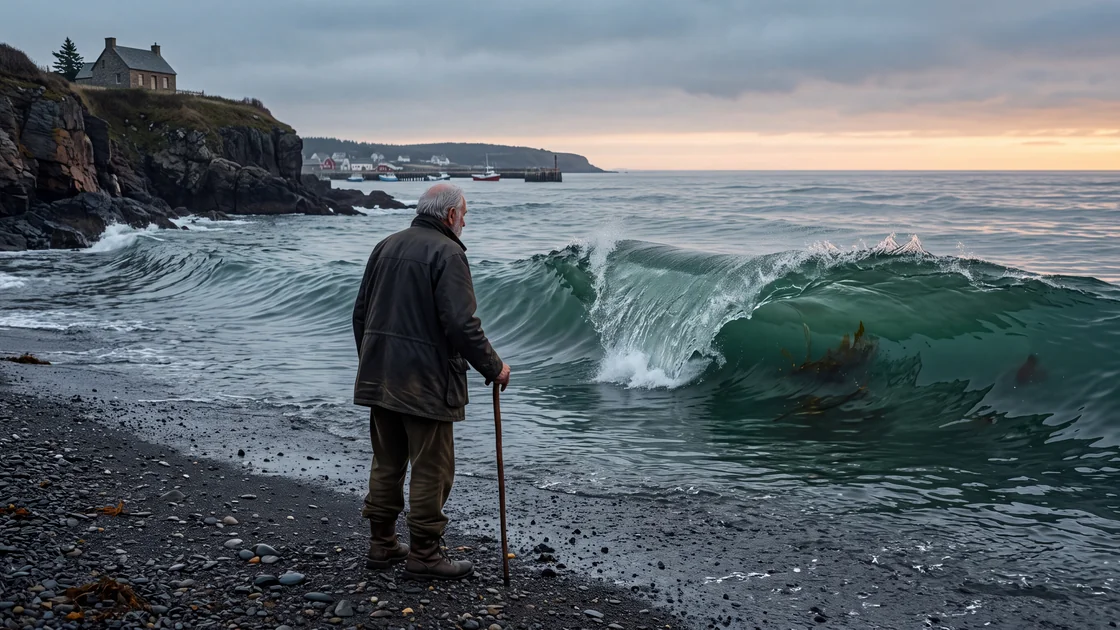
This is the account of Arthur Vance, a retired coastal surveyor living on the isolated headland of Morwen’s Cove, who awoke on a Tuesday in late October to find the Atlantic Ocean entirely paralyzed—its roaring swells, breakers, and windblown whitecaps turned into an immensity of rigid, blown-glass sculptures. Over the course of seven days, Arthur explored this silent, crystalline expanse, observing the town's descent from bewilderment to mercantile frenzy and theological dread, while venturing miles out into the vitrified deep across frozen troughs and translucent crests to confront the stillness that had claimed the water, his grief for his late wife, and the terrifying, fragile mechanics of time itself before the sea finally resumed its violent, inevitable surge.
Part I: The Dawn of Silences
The absence was what broke his sleep, though at first his mind could not identify the shape of the void.
For forty-two years, Arthur Vance had slept inside a house that shuddered. The cottage stood on the granite shoulder of Morwen’s Cove, eighty feet above the tide line, constructed of dry-stacked fieldstone, tarred pitch-pine, and iron bolts sunk deep into the metamorphic rock. It was an old house, built by a customs officer in the late nineteenth century, and it possessed the acoustics of an upturned cello. When the autumn gales wheeled out of the North Atlantic, the cellar hummed with the percussion of the surf; the windowpanes trembled in their lead came; the brine gathered in greasy, salt-crusted films against the seaward glass before trickling down into the zinc drip-trays Arthur emptied every morning.
He woke at 5:14 a.m. His eyes opened to the dark, beadboard ceiling.
The house was not vibrating.
There was no rhythm. Even on mornings of total dead calm, when the water was like slate and the fog came in low and yellow, there was always the heavy, pneumatic suck of the groundswell dragging cobbles through the undertow at the foot of the bluffs—a cyclical hush-shuck, hush-shuck that set the tempo for his breathing, his tea-kettle, his blood.
Now, there was only the dry click of his brass alarm clock on the nightstand, the faint respiration of the woodstove cooling on its brick plinth, and the high, thin whine of his own tinnitus.
Arthur swung his legs out from beneath the wool blankets. His ankles were stiff; seventy years of coastal damp had ground the cartilage from his joints like emery paper. He felt for his slippers with his toes, pulled his thick flannel robe over his shoulders, and walked down the short, drafty hallway toward the kitchen.
The room was blue with the twilight of false dawn. Through the eastern sash window, the ocean should have been an indeterminate charcoal heave, punctuated every ten seconds by the creamy smudges of breakers folding over the sandbar.
Arthur filled the enameled kettle at the tap, set it over the gas ring, and struck a match. The blue flame blossomed with a soft pop. While the water heated, he took his chamois cloth from the drawer, approached the seaward bay window, and wiped away the condensation left by his breath.
He looked down.
He did not gasp. He did not drop his spectacles or call out to a god he had abandoned during the long, sterile months of Martha’s illness. Shock, in men who have spent their lives measuring coastal margins with theodolites and plumb bobs, tends to manifest as a stubborn, irritable disbelief in the instruments of perception.
"The light is bad," Arthur murmured to the empty kitchen.
He leaned closer, pressing his forehead against the chilled pane.
The tide was three-quarters full, caught precisely at the moment of an energetic flood against the northern horn of the cove. A set of three large groundswells—originating, he had noted on the barometer the night before, from an offshore low pressure system spinning six hundred miles south of Greenland—had been advancing into the channel when something had seized them.
They were not moving.
They were not frozen in the manner of arctic water; there was no rind of milky slush, no pancake ice jostling in the margins, no white, opaque crust of frost. The ocean was not ice. It was liquid made mineral, or rather, liquid that had surrendered its motion while retaining the absolute clarity, the internal refraction, and the frantic morphology of violent displacement.
Directly below the bluff, the leading wave was poised in the act of pitching. Its lip, curled forward like the scroll of a violin, hung suspended seven feet above the wet gravel of the beach. Thin, filigreed ribbons of sea-foam—what surfers called "feathering"—stood out from the crest like spun sugar, stationary against the gray sky. A gust of northeasterly wind struck the face of the cliff, whistling through the telephone wires, yet the foam did not bend, did not disperse, did not drop a single atom of mist toward the stones below.
Arthur took off his spectacles, cleaned them vigorously with the hem of his robe, put them back on, and stared again.
The wave remained. It was a solid, curving vault of jade-green bottle-glass, thirty yards wide, caught in the microsecond before its collapse, so transparent that he could see the individual pieces of brown kelp suspended inside its belly, their fronds splayed like pressed flowers in an herbarium.
Behind it, the second swell rose higher, a dark green ridge ten feet tall, its face combed into vertical ribs by the offshore breeze, every wrinkle and capillary of surface tension preserved with the fidelity of an engraving. Behind that lay the third, and beyond them the Atlantic stretched out toward Europe, not as a plane of surging movement, but as an endless, petrified landscape of peaks, troughs, ripples, and chop—an unmoving desert of polished silica that caught the first, cold orange spear of the sunrise and fractured it into ten million blinding, motionless needles of light.
The kettle on the stove began to whistle. Arthur did not move to silence it until its shriek had filled the kitchen, bounced off the stillness of the bay, and rattled in his teeth like an accusation.
Part II: The Shoreline of Vitreous Salt
By six o’clock, Arthur was dressed in his heavy corduroy trousers, his oilskin coat, and his heavy lug-soled boots. In his right hand he carried an iron-headed walking stick that had belonged to his father; in his canvas rucksack he had packed a surveyor’s brass pocket-rule, a mechanic’s ball-peen hammer, a magnifying loupe, and an empty mayonnaise jar.
The path down the cliff was steep, cut into the shale by three generations of fishermen who had maintained dory-winches on the gravel beach before the fishery failed in the nineties. The shale was damp and slick with salt-drizzle from yesterday’s forgotten weather. Arthur took his time, placing his heels with deliberate care, his eyes fixed not on the path, but on the impossible tableau below him.
The silence grew heavier as he descended. Usually, the base of the cliff was a theater of deafening noise: the rhythmic thud-boom of the water compressing air inside the sea-caves, the rattling clatter of millions of round stones dragged down the shelf by the backwash, the cries of gulls banking through the updrafts.
Today, there were no gulls.
He found them fifty feet down, perched in long, disordered rows along the upper lip of the slate bluffs. Hundreds of herring gulls, black-backs, and kittiwakes sat with their necks tucked deep into their plumage. They did not scream. They did not launch themselves into the wind. They turned their heads occasionally, their pale yellow eyes fixed upon the ocean with a blank, dull incomprehension that seemed to mirror his own. When Arthur’s boot sent a shower of shale skittering down the path, not a single wing rustled.
He reached the foot of the cliff.
The high-tide wrack-mark was forty feet behind the current water line. Here, the sand was damp, littered with dried bladderwrack, crab carapaces, and driftwood. Arthur walked slowly across the gravel, his boots crunching loudly in the preternatural quiet.
He stopped twelve inches from the lip of the suspended wave.
Up close, the illusion of glass was so complete that his brain struggled to parse the scale. The curling breaker was not smooth; its surface was a complex topology of thousands of smaller ripples, each one fixed with impossible crispness. He leaned in until his nose was four inches from the face of the wave.
He could smell it: the familiar, sharp odor of low-tide brine, cold kelp, and decayed plankton. The air coming off the water was not cold in the manner of an iceberg; it was simply the ambient temperature of the morning—about forty-eight degrees Fahrenheit. There was no frost along the edges of the spray.
Arthur raised his right hand. He hesitated, his fingers trembling slightly. The instinct of a lifetime spent on this coast warned him that if he touched the face of a nine-foot wave, it would fall on him, that twenty tons of saltwater would break his neck and grind his body into the shingle.
He reached out. His index finger made contact with the swell.
It was neither wet nor dry in any way he understood. The surface did not yield. It did not coat his skin with moisture; his finger did not pierce the meniscus. It felt exactly like the belly of a heavy soda-lime glass carboy—cool, profoundly smooth, yet with that microscopic, dragging drag that clean silica exerts on human skin.
He pressed harder. He put his palm flat against the green curve of the breaker.
It was as immovable as the granite shoulder of the headland behind him. He pushed with all his weight, leaning his seventy-year-old frame into the belly of the wave until his shoulder ached. Nothing. The wave was an arch of liquid stone.
"God in heaven," he whispered.
He pulled his hand away. His palm was clean, marked only by the pale red indentations of the tiny ripples he had leaned against.
Arthur knelt on the shingle and peered upward into the hollow of the wave. The curl formed a barrel six feet across—a tube of green, liquid amber through which the low morning sun cast a watery, emerald shadow across the beach. Suspended within this barrel, three inches below the ceiling of the arch, a juvenile sand lance, no longer than Arthur’s little finger, was frozen in mid-undulation. Its silver flanks caught the sun; its gills were flared; its tiny eye, bright and black, seemed to look down at him through the vitrified ceiling.
Arthur took the ball-peen hammer from his rucksack.
He held the handle lightly, cocked his wrist, and tapped the face of the wave with the flat iron head.
Tink.
The sound was clear, high-pitched, and musical. It was the tone of a crystal goblet struck with a silver knife at a wedding dinner. The sound did not die away immediately; it seemed to travel through the wave, radiating outward along the curvature of the lip, echoing back from the depths of the swell with a dry, glassy vibration that hummed in Arthur’s dental fillings.
He tapped it again, harder this time.
Tink-tonk.
A microscopic white dot appeared beneath the point of impact—a percussion cone, perfectly conical, like the impact of a BB pellet on a shop window. But no cracks spread. No water leaked from the wound. The ocean held its form, immune to the laws of hydraulics, clinging to an architecture that had no business existing beyond the shutter speed of a high-speed camera.
He stood up, turned his back to the water, and looked south toward the town.
Morwen’s Cove sat in a horseshoe bite between two headlands. Three miles down the coast, past the low salt marshes, the white clapboard houses of the village rose up the hill toward the square granite tower of St. Jude’s. From this distance, he could already see things that were wrong.
The harbor was full of masts. Normally, at six in the morning, the small fleet of lobster boats—the Martha C., the Two Brothers, the Sea Venture—would be long gone, out past the whistling buoy to haul their gear before the afternoon chop came up.
Today, the lobster boats were there. But they were not swinging at their moorings.
Arthur reached into his rucksack, pulled out his marine binoculars, and focused the brass wheels.
The harbor was a junkyard of tilted hulls. The Two Brothers, an old thirty-six-foot wooden-hulled vessel owned by Enoch Davies, was caught mid-roll in the wake of something that had ceased to exist. She was heeled over at twenty-five degrees to port, her red bottom-paint exposed to the sun, her lines slack, held in the petrified basin of the harbor like a toy pressed into paraffin wax. On the town dock, a half-dozen small figures in bright yellow oilskins were standing in a knot, their arms waving wildly, their faces turned toward the mouth of the bay.
Arthur lowered the glasses.
He looked back at the wave in front of him. Then, with a slow, deliberate movement that surprised him with its absence of fear, he lifted his right boot and placed it upon the lower curve of the swell.
The sole of his boot found purchase on the hard, glassy slope. He brought his left foot up.
He was standing on the Atlantic Ocean.
Part III: The Village of Salt and Bell
The walk to town took Arthur two hours, for he did not take the road along the bluffs. Instead, he walked the perimeter of the sea.
He stayed on the sand at first, but the curiosity—that cold, dry, professional itch that had sustained him through decades of mapping coastal erosion—overcame him. By the time he reached the salt marshes of the marsh-creek, he was walking directly upon the water.
It was unlike walking on lake ice. Lake ice groaned; it had expansion cracks, milk-white leads, pressure ridges, and the uneasy, drum-skin resonance of a membrane stretched over a liquid that still breathed below.
This had no breath. The water under his soles was as solid as the basement rocks of the Canadian Shield. When he walked across the crest of a roller, he was five, ten, twelve feet above the sandy floor of the shallows. Beneath his feet, through five inches of perfectly transparent, solidified brine, he could look down into the beds of eelgrass. The ribbons of grass were all leaned in the direction of the flood tide, bent over like wheat under an August squall, yet as rigid as wrought iron. A school of mummychogs was caught in the act of scattering from a striped bass; the bass was frozen in a predatory curve, its mouth half-open, its dorsal spines erected like silver needles, suspended four feet below the surface in an amber eternity.
When Arthur reached the municipal pier at Morwen’s Cove, the church bells at St. Jude’s were ringing.
It was not the measured, liturgical tolling of Sunday morning, but the wild, arrhythmic clanging of the emergency clapper—the tocsin that hadn't been sounded since the fish-processing plant burned down in the dry summer of 1974.
The town dock was crowded. Nearly eighty people—half the permanent winter population of the village—were gathered along the pilings. They were dressed in a patchwork of sleepwear and wet-weather gear: barn jackets over flannel pajamas, rubber boots without socks, thermal undershirts.
At the center of the crowd stood Enoch Davies, his face the color of salt pork, clutching a gaff-hook as if it were a weapon. Beside him was the town’s sole constable, young Terry Miller, who was holding his service belt with both hands, looking down into the harbor with the expressions of a man who suspected he was being filmed for a cruel television program.
"I tell you, you can’t get an auger through it!" Davies was bellowing. His voice had the cracked, shrill edge of hysteria. "I took the three-inch ice auger from the shed, Terry! I put the bit right to the slipway! It spun twice, caught the metal, and stripped the gears out of the transmission! It didn't even leave a shaving! Not a goddamned shaving!"
"Enoch, calm down," Miller said, though his own voice was unsteady. "The State Police are on the line. Well, they were, before the trunks went down. The dispatcher in Ellsworth said the whole coast is calling in. Mount Desert, Rockland, Portland. They’re saying... they don’t know what they’re saying."
"Look!"
A woman shrieked. It was Mrs. Albright, who kept the post office. She pointed a trembling, arthritic finger toward the harbor entrance.
Arthur Vance was rounding the breakwater.
He was not using the walkway. He was walking directly across the harbor mouth, his iron-tipped stick clicking rhythmically against the frozen crests of the swells, his coat tails flapping behind him in the dry autumn wind. He stepped from the crest of an eight-foot surge down into the trough with the steady, unhurried gait of an old surveyor crossing a plowed pasture, his head down, watching his boots.
The crowd on the dock fell into a silence so profound that Arthur’s stick-strikes could be heard three hundred yards away: clack... clack... clack.
He reached the pilings of the town pier. The tide here was arrested halfway up the creosoted timbers, where the green carpet of barnacles and blue mussels normally spent half their lives drowning. The mussels were all closed, their black shells shining beneath a skin of transparent, motionless glaze.
Arthur looked up at the sea of pale, staring faces peering down over the heavy wooden bull-rail.
"Morning, Terry," Arthur said, nodding to the constable. "Morning, Enoch."
Enoch Davies stepped forward, his mouth opening and closing three times before any sound emerged. "Arthur? What... what the hell are you doing down there?"
"Walking," Arthur said simply. He raised his hand, pointing his iron stick back out toward the bay. "The surface is solid. All the way from the headland. At least three miles out. It bears weight without deflection."
"Is it... is it ice?" Terry Miller asked. He dropped to his knees, leaning his stomach over the bull-rail, his eyes bulging as he inspected the place where Arthur stood. "Did some chemical spill out of a tanker? Some kind of polymer?"
"It’s not ice," Arthur said. "Ice has a crystal structure that expands; it has milky inclusions; it melts when you touch it. My hands have been on it for two hours. It doesn't melt. It’s Atlantic water, Terry. It’s got the salinity of forty-two parts per thousand. It’s got the plankton in it, the silt, the diesel oil from Enoch’s bilge. It just... stopped."
"Stopped?" Enoch cried. "Water don't just stop! It’s the tide, man! It’s the moon! The moon’s still up there, ain't it?"
Everyone instinctively looked up at the sky.
The sky was a pale, hard, washed-out blue, swept clean of clouds by the gale. Low in the southwest, the gibbous moon was still visible—a pale, white wafer of chalk hanging between the chimney-pots of the village. It looked entirely normal. It looked indifferent.
"Reverend Crane is in the church," someone from the back muttered. "He’s reading from the Book of Kings. He says it’s the Red Sea. He says the vials are being poured out."
"Tell Crane to come down here with an axe," Enoch snapped, though he crossed himself with a quick, jerky motion of his thick fingers. He turned back to Arthur. "Can you get to my boat? Can you see if the hull’s breached?"
"The hull isn't breached, Enoch," Arthur said gently. "She’s not resting on anything hard. She’s resting on herself. The water is holding her the way a block of resin holds a fly. If you want to get your gear off her, you can just walk out to the slip. You don't need the tender."
Nobody moved.
The idea of stepping off the dock—of placing the soles of their boots onto the surface of an element that had drowned their fathers, their grandfathers, and their sons since the seventeenth century—struck them with a horror that was ancient and religious. The sea was the great devouring maw; it was the thing that demanded respect, caution, and fear. To walk upon it was to commit an act of obscene insolence, a violation of the boundary between the living earth and the deep dead.
Finally, young Tommy Cleary, who was nineteen and had three drinks in him from the night before, swung his leg over the rail.
"Tommy, don't you dare!" his mother screamed, lunging for his jacket.
She missed. Tommy dropped.
It was a four-foot fall from the low water deck to the frozen surface of the slip. He landed with both feet.
Clang.
The impact produced that same strange, crystal ring Arthur had heard at the base of the bluff. The sound rippled through the slips, vibrating against the hulls of twenty-two lobster boats, making their bronze propellers hum like tiny tuning forks.
Tommy stood there. He bounced twice on his heels. His eyes went wide, white rings showing around the irises.
"Jesus," Tommy whispered. "It’s like concrete. It’s like marble, Ma."
He took three running steps, slipped on a smooth patch of a frozen wake, slid ten feet on his hip, and came to rest against the rudder of the Sea Venture. He reached out, grabbed the blade of the rudder, and burst into a wild, high-pitched laugh that sounded very close to tears.
"It’s a highway!" Tommy screamed, his voice bouncing off the granite warehouses along the quay. "It’s a bloody turnpike! We can walk to Nova Scotia!"
The crowd did not laugh with him. They watched him with a cold, pale dread, as if waiting for the hand of God to reach out of the sky and snap him between two fingers for his blasphemy.
Part IV: The Anatomy of a Suspended Breaker
By noon, the world had begun to intrude upon Morwen’s Cove, though only in strange, disjointed fragments.
The long-distance telephone lines were dead—not severed by wind, but overwhelmed by an infinite cascade of busy signals and routing errors that had crashed the regional exchanges in Bangor. The radio, however, still functioned, though the dial was a hysterical choir of emergency broadcasts, military static, and the voices of terrified announcers who seemed to be losing their grip on syntax.
Arthur sat in his kitchen, listening to a battery-powered Zenith transistor while he drank black coffee and cleaned his tools.
"...reports from Cape Hatteras to the Grand Banks indicate the phenomenon is uniform," a voice from Boston crackled through the small speaker. "...repeat, the Coast Guard has issued an absolute prohibition on maritime traffic, though it is currently impossible for any craft to leave port. The First Naval District has mobilized units from Groton, but vessels attempting to clear the Thames River report water conditions... we are using the word 'vitrified'... conditions are solid at the mouth of the harbor. Radar systems are returning solid ground clutter from what should be open water. Scientists from MIT and Woods Hole are currently en route to the North Shore, where the ocean is reported to be... ladies and gentlemen, we are receiving unconfirmed reports that the phenomenon has also begun in the English Channel, though the French coast is reporting..."
Arthur clicked the radio off.
The silence returned, clean and heavy.
He didn't care about Boston, and he didn't care about the English Channel. He was a surveyor; he had spent fifty years learning that truth was always local, bounded by specific benchmarks, specific angles of elevation, and the particular weight of the rock beneath one’s feet.
He picked up his tools: the ball-peen hammer, three cold chisels of hardened carbon steel, a high-intensity jeweler’s lamp, a plumb bob, and his late wife’s field microscope—an antique brass instrument she had used to examine the silica shells of diatoms during her summer fellowships at the marine laboratory.
Martha had been dead sixteen months.
Her absence in the cottage was not a void; it was an architecture. It was the specific height of the kitchen shelves she could not reach; the small, blue pottery jug on the mantelpiece that still held three dried sprigs of lavender she had picked in the summer of her diagnosis; the faint smell of cedar and cold cold cream that lingered in the drawers of the highboy.
Arthur had survived her death by retreating into measurement. He measured the firewood he split with a steel yardstick, stacking it in cubes of exact thirty-six-inch dimensions. He recorded the daily rainfall to the hundredth of an inch in a leather-bound ledger. He checked the tension of the guy-wires on his radio aerial every Saturday morning at nine.
He took his rucksack, went out the kitchen door, and walked back down the cliff to the breaker he had claimed as his own.
The wave had not changed.
The sun was high now, a pale, cold eye at the zenith. The light did not penetrate the wave as it had in the morning; instead, it hit the curving lip at an angle that created a brilliant, blinding caustic along the sand beneath it—a bright, curved band of concentrated light that looked like a burning ribbon of mercury.
Arthur set his rucksack down on the gravel, knelt, and adjusted his jeweler’s loupe.
He leaned in until the glass was an inch from the surface of the wave’s face.
At ten times magnification, the water was not smooth. It possessed a micro-texture that was breathtakingly complex. It was composed of millions of tiny, interlocked terraces—infinitesimal ridges that looked like the growth rings on an oyster shell, or the concentric circles left by raindrops on a pond, frozen at the instant of their maximum interference.
He looked for molecular boundaries. He looked for the hexagonal geometries of ice.
There were none.
Ice was an orderly lattice, full of fractures, internal air pockets, and the milky inclusions of gas driven out of solution by crystallization. This material had none of that. It was water that had simply forgotten how to slide.
Arthur held a six-inch cold chisel against the crest of the lip, angled at forty-five degrees. He brought the hammer down with a solid, five-pound strike.
Chink.
A sharp, metallic shock traveled up his wrist, jarring the elbow. The chisel did not bite into the material; it did not gouge it. Instead, a tiny chip—no larger than a dried lentil—flaked off the lip and fell into the gravel with a faint, dry rattle.
Arthur dropped the hammer, fell to his hands and knees, and searched the stones until he found it.
He picked the chip up with his tweezers.
It was completely clear. It had the weight of glass—heavy, dense, cold. He held it between his bare thumb and forefinger, waiting for the warmth of his blood to soften its edges.
One minute passed. Two minutes.
The chip remained rigid. Its edges were so sharp they scored the whorls of his fingerprint, drawing a tiny, bead-like drop of dark red blood that smeared against the facet. The blood did not dilute; it sat on the surface of the chip like oil on glass.
Arthur reached into his pocket, took out his brass Zippo lighter, flicked the wheel, and held the blue-and-yellow flame directly beneath the chip.
The soot from the wick blackened the lower surface. Arthur held the flame there until the metal of the tweezers grew too hot to hold.
He dropped the chip onto a flat shale stone, took out his handkerchief, and wiped the soot away.
The chip had not melted. It was not soft. It was not even warm to the touch; it had absorbed the heat and dissipated it with an efficiency that was physically impossible.
"It’s not ice," Arthur said again, this time to the gulls who still sat upon the bluffs, watching him with their yellow, dead eyes. "It’s not glass. It’s... an end."
He sat down on the gravel with his back against the petrified wave.
He thought of Martha’s last three days in the hospital in Ellsworth. The machines had been turned off because there was nothing left for them to measure. Her breathing had slowed, growing shallow and wide-spaced—the Cheyne-Stokes respiration that the nurses spoke of in low, professional voices.
Arthur had sat by her bed, holding her left hand. Her fingers had grown cold at the tips first, then the nails had turned a faint, dusky lilac, like the skin of a Concord grape. He had watched the intervals between her breaths stretch from five seconds to ten, then to twenty, then to forty-five.
He had waited for the final breath, believing that there would be a moment—a clear, distinct threshold—between the presence of Martha and her absence.
But it hadn't been like that. The breathing had simply become so thin, so infrequent, that he had been unable to tell which one was the last. He had sat there for twenty minutes after she was already gone, still holding her hand, waiting for a movement that had already passed into history.
Looking out now at the frozen Atlantic, Arthur recognized that same terrible ambiguity.
The ocean had not died; it had simply stopped its breath between one wave and the next. It had been caught in the pause—the terrible, infinite interval where everything is poised, everything is potential, and nothing can ever happen again.
Part V: The Gathering of Scholars and Drifters
By Thursday, forty-eight hours after the Arrest, the world had arrived at the edges of Morwen’s Cove.
The highway from Bangor, usually empty in late autumn except for logging trucks and delivery vans, had choked with an irregular, frantic migration. First had come the state troopers, their cruisers parked bumper-to-bumper along the scenic turnouts, their blue lights flashing endlessly against the gray granite cliffs. Then had come the media—vans with satellite dishes bolted to their roofs, their crews dragging thick black cables across the shingle like deep-sea divers trailing their air lines.
Then came the others.
They came on foot, on bicycles, in station wagons loaded with children and sleeping bags. They were people who had seen the broadcasts before the television networks went off the air—images of the harbor at Boston, the piers at Brooklyn, the boardwalk at Atlantic City, all of them fronting an emerald desert that did not move.
Arthur stood on the porch of his cottage, his binoculars raised to his eyes.
Below, the beach at Morwen’s Cove looked like an encampment from an ancient war. A hundred small fires were burning on the shingle, fed by driftwood, lobster traps, and furniture dragged from summer cottages that had been broken into during the night. The smoke hung low over the frozen water, flattened by the cold air, smelling of pine pitch and old varnish.
A group of men in bright orange survival suits—scientists from the oceanographic institute at Woods Hole, Arthur had heard from Terry Miller—had set up an aluminum tripod on the crest of the third swell, five hundred yards out from the shore. They were drilling.
They had brought a diamond-tipped core-drill, powered by a sputtering Honda generator that sat on the surface of the sea like a lawnmower on a frozen lawn. The sound of the drill was an unbearable, high-frequency scream that echoed off the cliffs: reeeeeeeeeeeeeeee-chitch-reeeeeeeeeeee.
Arthur walked down the cliff path. He was wearing his old surveyor’s coat, the pockets weighted with his ledger and his instruments.
The beach was loud with voices. The fear of the first day had curdled into something stranger: a carnival atmosphere tinged with the manic, fragile hysteria of people who suspected that tomorrow might not exist.
Near the mouth of the marsh-creek, an enterprising man from Ellsworth had set up an iron griddle over a propane burner, selling fried dough and instant coffee to the rubberneckers for ten dollars a cup. Further down, near the rocks of the southern horn, a circle of people—some in church clothes, some in dirty parkas—were kneeling on the stones, their arms raised toward the petrified horizon, singing hymns that Arthur recognized from his childhood:
"Will your anchor hold in the storms of life, When the clouds unfold their wings of strife? When the strong tides lift, and the cables strain, Will your anchor drift, or firm remain?"
Arthur passed them without stopping. He walked out onto the frozen sea, heading toward the aluminum tripod.
Nobody stopped him. Nobody questioned him. The ocean had become a public common—a vast, unlegislated continent that belonged to anyone with the nerve to step onto its back.
He reached the Woods Hole team. There were four of them: two young men with red, wind-burned faces and expensive Gore-Tex jackets; a middle-aged woman with a gray braid tucked into a wool cap, who was kneeling over a steel tray; and an older man who stood with his back to the drill, his hands buried deep in his pockets, staring out toward the horizon with a look of exhausted, scientific disgust.
"You're wasting the bit," Arthur said as he approached.
The older man turned his head. His eyes were small, watery behind thick horn-rimmed glasses, and surrounded by rings of purple exhaustion.
"What's that?" the man asked.
"The diamond matrix," Arthur said, pointing with his iron stick to the drill-head. "It’s fifty-grit, isn't it? Industrial synthetic. You're glazing the stones. The water isn't abrading; it’s stripping the nickel-plating right off the core-barrel. Look at your slurry."
The man looked down. The tray beside the drill contained no core-samples. It held only a thin, silver-gray paste—not pulverized rock or pulverized water, but the powdered alloy of the drill-bit itself, ground to dust against the immovable skin of the ocean.
The gray-braided woman looked up from her knees. "Who are you? A surveyor?"
"Arthur Vance. Retired. Thirty years with the Department of the Interior. Coastal Geodetic Survey."
The older man let out a short, dry bark that might have been a laugh. "Leonard Vance’s boy? The one who did the bathymetric work on the Grand Manan Channel back in seventy-eight?"
"I am," Arthur said.
The man pulled a gloved hand from his pocket and offered it. "Dr. Peter Hallowell. Geological Survey. Or what's left of it. We drove twenty hours from Woods Hole without fuel stops. We had to siphon gas from abandoned cars on Interstate 95."
"What is it, Doctor?" Arthur asked. He didn't ask it with fear; he asked it with the cold curiosity of a colleague who has found an anomaly in a leveling-loop.
Hallowell took off his glasses, breathed on them, and wiped them with a piece of lens paper. His eyes were red-rimmed and empty.
"It’s water," Hallowell said.
"That's not an answer."
"It's the only answer the mass spectrometers give us," the woman said, her voice trembling slightly. "We got a five-milligram flake off the breakwater with an explosive rivet-gun. We ran it through the gas chromatograph in the mobile van. Deuterium-hydrogen ratio is normal. Oxygen isotopes are normal. Salt content is three-point-four percent. Trace minerals: sodium, chlorine, magnesium, sulfur, calcium, potassium. It’s Atlantic water, Mr. Vance."
"Then why isn't it running?" Arthur asked.
"Because the hydrogen bonds have stopped rotating," Hallowell said. He looked out over the endless, jagged field of petrified waves. "Water isn't a liquid because of what it’s made of; it’s a liquid because the molecules are constantly breaking and re-forming their bonds with their neighbors. Trillions of times a picosecond. It’s a dance. It’s an endless, Brownian shuffle. If the molecules stop trading partners... if they just decide to hold onto the neighbor they have at any given tenth of a femtosecond..."
He stopped. He rubbed his temples with his gloved knuckles.
"Why would they do that?" Arthur asked.
"They shouldn't," Hallowell said. "To make water do this, you would need a pressure of two gigapascals—twenty thousand atmospheres—or a temperature approaching absolute zero. But it’s fifty degrees out here. The pressure is twenty-nine-point-nine inches of mercury. The laws that govern the electronic shell of the oxygen atom haven't changed; the air around us is still nitrogen and oxygen, and it’s behaving itself. The light is traveling through it at three hundred thousand kilometers a second. But the sea..."
He looked down at his boots.
"The sea has undergone a phase change for which there is no thermodynamic vocabulary," Hallowell whispered. "It’s not ice. It’s not glass. It’s an arrested liquid. It has simply lost its velocity. Not its speed through space—the earth is still spinning, thank God—but its internal velocity. The movement of its parts."
"Is it spreading?" Arthur asked.
Hallowell didn't answer for a long time. He looked south, toward the low, gray spit of Cape Cod, five hundred miles away.
"The cables are all dead now," he said quietly. "The transatlantic telegraphic lines... the fiber-optic arrays on the seabed. They went out one by one between four and six this morning. The last telemetry we had from the UK was from the Lizard Lighthouse in Cornwall. They said the English Channel was three feet below the high-water mark, and they were walking across the Solent to the Isle of Wight."
He looked Arthur in the eyes.
"It’s not just the North Atlantic, Vance. It’s the Mediterranean. The Baltic. The Gulf of Mexico. We don't know about the Pacific yet. The satellites aren't relaying. But if it’s the global ocean..."
He trailed off.
A younger technician by the drill cursed loudly. A high, ringing ping snapped through the air. The core-barrel had sheared off at the collar, the diamond-toothed head left welded to the unyielding green surface of the wave like a broken tooth.
"Pack it up," Hallowell said wearily. "Pack it up, Sarah. We’re not getting anything out of this."
"And go where?" the woman asked. She sat back on her heels, her face pale, looking at the older man with something close to hatred. "Go where, Leonard? Boston is on fire. People are looting the stores along the harbor because they think the water is never coming back. They think the earth is drying out from the edges inward."
"We go back to the station," Hallowell said, though his voice had no conviction in it. "We write the reports. We wait."
Arthur Vance turned his back on them.
He didn't want to hear about Boston, and he didn't want to hear about reports. He looked out past the tripod, past the three-mile line that marked the territorial waters of the United States, toward the gray horizon where the Atlantic met the pale, empty sky.
The sea was calling to him.
Not with its voice—for it had no voice now—but with its silence. For seventy years it had been an obstacle, a margin, a boundary that turned men back toward the land. Now, it was an invitation. It was an infinite, empty boulevard that led out into the white, lonely middle of the world.
Part VI: The Walk Across the Abyss
Arthur did not tell anyone in the village what he was planning.
On Friday morning, before the fires on the beach had died to charcoal, he prepared his kit. He was seventy years old, but his legs were wiry and his heart had been hardened by decades of climbing coastal ranges with thirty pounds of brass and spruce-wood on his back.
He packed with the ruthless economy of an old surveyor:
- Six tins of sardines in oil.
- A two-pound slab of dry, salted pilot-bread.
- Two one-quart canteens of tap-water (for the sea, he knew, was now an arid stone).
- A small compass in a brass hunter-case.
- His pocket surveyor’s aneroid barometer.
- A box of wax-dipped matches.
- A heavy wool sweater, an extra pair of rag-wool socks, and his oilskin sou'wester.
- His iron-headed walking stick.
He left the cottage at 5:00 a.m. He did not lock the door. If the looters from the highway came up the hill, they were welcome to the furniture, the books, and the chipped china. None of it would save them.
He did not go down to the village beach. Instead, he scrambled down the rocks at the northern point—the razor-like ledge known as the Devil’s Pulpit, where the water dropped off immediately into twelve fathoms.
He stood on the ledge. Below him, the deep-water swell had been arrested while running against the cliff. A twenty-foot hill of water, black-green and smooth as basalt, rose directly beneath his feet.
Arthur stepped off the ledge.
His boot landed on the shoulder of the swell with a dry, hollow thump. He did not slip. The surface had enough microscopic tooth to hold the rubber lugs of his boots securely.
He set his course by the compass: eighty-four degrees east. Due toward the Azores; due toward the mid-Atlantic ridge; due toward the deepest water between North America and the Old World.
The first three miles were familiar.
Arthur had charted these waters for the government in the seventies. He knew every ledge, every gravel bank, every drowned hill of the continental margin. He walked across the top of the Outer Rip, where the tidal current usually ran at five knots, churning the sea into a brown, foam-streaked washing-machine. Now, the rip was an extraordinary garden of frozen spires. The turbulence had been preserved down to its smallest vortex; the water looked like a forest of blown-glass funnels, twisted spirals, and suspended white plumes that stood six feet above the main level of the sea like monuments in a graveyard of light.
He walked over the Old Man’s Ribs—a submerged ledge where the bottom came up to within twenty feet of the surface.
Here, looking down through the transparent floor, the world was startlingly clear. The light of the morning sun penetrated thirty feet into the green depth, illuminating a landscape that no living human had ever seen without the distorting medium of a dive-mask or the portal of a bathysphere.
The bottom was covered in pink coralline algae, looking like crusts of sugar on the gray stones. Sea anemones, their tentacles flared like chrysanthemums, stood open in the green dusk, their petal-like arms rigid in the water. A large monkfish, its wide, grotesque mouth fringed with fleshy barbs, lay on the sand, its dorsal lure curved forward toward a school of herrings that hung three feet above it, suspended in the medium like glass beads strung on invisible wire.
Arthur knelt on the water, his knees pressed against the crest of a three-foot wave.
He put his face down to the surface, shielding the glare with his hands.
"Are you alive?" he whispered to the monkfish.
The fish did not blink. Its small, cold, golden eye was fixed on the herrings. Arthur could see the gills—the delicate, crimson combs of tissue inside the operculum—completely motionless. No water passed through them. No oxygen was being stripped from the brine.
Yet it was not dead. Dead things in the sea turned their bellies to the sky; they softened; they were visited by hagfish and crabs. This fish was held in a state that was neither life nor death—it was paused, like a clock whose pendulum has been caught by a child's finger at the apex of its swing.
If the water softened... if the dance of the molecules began again... would the monkfish snap its jaws? Would the herrings scatter? Would the gills resume their slow, red pumping?
Or had the soul of the thing—that tiny, cold spark of fish-awareness—evaporated during the long, terrifying silence of the Arrest?
Arthur stood up and continued east.
By noon, the land had begun to sink into the haze behind him.
The lighthouse on Petit Manan was reduced to a white needle on the horizon; the blue, rounded shoulders of the Mount Desert mountains were flattening into the sea. Around him, the ocean was changing its character.
Near the coast, the waves had been shaped by the bottom—choppy, irregular, steep-faced. Here, five miles off the shelf, the Atlantic was composed of the true, deep-ocean groundswell: immense, long-period waves that rose twelve, fifteen, twenty feet high, their crests separated by two hundred yards of wide, gently curving troughs.
Walking them was like walking the rolling hills of the Yorkshire Moors, but a moors made of green, translucent marble.
Arthur would climb the long, slow slope of a swell, his thighs burning with the incline, his breath coming in short, white puffs in the cold air. At the crest, he would pause, looking out over a wilderness of identical, parallel ridges that stretched away to the north and south as far as his eye could reach. Then he would descend into the trough—a long, green valley of profound, terrifying isolation, where the horizon was cut off on all sides by walls of immovable water, and the only sound was the scrape of his own boots and the dry clicking of his brass compass in his pocket.
In the troughs, the light was strange.
It was filtered through twenty feet of salt water on either side, casting a rich, emerald-toned gloom over the floor of the valley. The sky above was reduced to a narrow strip of pale blue between the wave-crests. Arthur felt like an ant crawling across the fluting of an infinite, classical column that had been felled across the world.
At three in the afternoon, seven miles from shore, he came upon the whale.
It was a finback—a young male, fifty feet long, caught in the middle of a feeding run. It had been lunging upward toward a ball of krill near the surface when the water had set.
Its massive, pleated throat was expanded like an accordion, ballooning with hundreds of gallons of water and pink shrimp that showed through the stretched, black-and-white skin of its lower jaw. Its head had broken the surface; the twin blowholes were open, flared like the nostrils of a winded horse.
A twenty-foot spout of spray—a towering, feathery plume of vapor and mucus—stood over its head, completely solid.
Arthur walked up to the beast.
He had seen finbacks before, from the decks of survey steamers, but always as brief, dark curves on the horizon, accompanied by the wet, explosive sound of their breathing. He had never seen one still.
He stood beside the creature’s left eye.
The eye was the size of a teacup, set deep in the dark, rubbery skin behind the corner of the mouth. It was dark brown, almost black, with a large, oval pupil.
Arthur looked into the eye.
There was no light in it, yet it was not the dull, glazed marble of a dead whale on a beach. It was an eye that was looking at something. It was looking at the light; it was looking at the surface; it was looking at the air it had been three feet away from reaching when the world became stone.
Arthur reached out and touched the skin of the whale’s brow.
It was cold, firm, and slick, like the wet inner tube of a truck tire. But through his fingers, through the thick leather of his gloves, Arthur felt—or believed he felt—something that made his hair stand up on his arms.
It was not a heartbeat. It was not a breath.
It was a tension. A pressure so vast, so immense, that it felt like the humming of a high-voltage transformer. The entire body of the animal was straining against the paralysis of the water, every muscle fiber locked in an infinite, isometric struggle against an adversary that had no mass, no weight, and no mercy.
"Don't," Arthur whispered to the skin. "Don't fight it. It won't let go."
He pulled his hand away.
He looked up at the frozen plume of the blowhole. The spray was a work of art that defied every sculptor who had ever lived: thousands of individual, teardrop-shaped beads of water, each one connected to its fellows by an infinitesimal thread of liquid glass, suspended in the air like the branches of a weeping willow made of crystal.
Arthur took out his sketch-pad—the small, oil-cloth notebook he used for triangulation—and a pencil.
With slow, careful strokes, his fingers stiff with the cold, he began to draw the architecture of the spout. He drew the angles of the droplets; he noted the elevation of the crests; he recorded the barometric pressure (thirty-point-two inches, rising).
He worked until the light began to fail.
The sun went down behind the Mount Desert hills, which were now only three tiny, purple teeth on the western rim of the sea. The sunset was not the soft, rose-colored glow of summer; it was a violent, angry slash of crimson and cadmium orange that struck the frozen Atlantic from the side.
The ocean did not reflect the light; it ingested it.
Every swell became a prism. The green water absorbed the red light and turned it into an unearthly, burning purple. The crests of the waves glowed like the neon tubes of a tavern sign; the troughs were filled with pools of liquid shadow that looked like ink. For twenty minutes, the Atlantic Ocean looked like an expanse of burning amethyst, jagged and sharp, stretching to the edge of the night.
Then the light died.
The stars came out—not one by one, but in their millions, sharp and cruel in the clear, gale-scrubbed air.
Arthur Vance sat down in the trough of a twenty-foot swell, eight miles from the nearest human being, pulled his wool blanket over his knees, opened a tin of sardines with his pocket knife, and ate his supper in the center of the silence.
Part deployment of Part VII: The Cathedral of the Low Shelf
He slept for three hours, curled in the angle where the floor of the trough met the rising wall of the next wave.
It was not a good sleep. He dreamed of Martha.
In the dream, she was standing at the end of the breakwater in Morwen’s Cove, wearing her yellow oilskin coat, the one she had lost during the storm of ninety-two. She was calling to him, but the wind was blowing her voice back into her throat, so that her mouth was opening and closing like the mouth of the monkfish on the rocks, producing only a faint, dry clicking like the mechanism of a grandfather clock that has run down its weights.
Arthur woke with his heart hammering against his ribs.
He was freezing. His toes were numb inside his boots, and his beard was stiff with the frost of his own breath.
He sat up.
The moon had risen. It was nearly full, riding high in the south, casting a cold, silver glaze over the slopes of the frozen swells. The world was no longer green or purple; it was monochrome—an endless landscape of silver and lead, silent as the craters of the moon.
Arthur stood up, his joints popping like dry kindling. He stamped his feet on the hard water until the blood began to prickle in his toes.
He looked at his watch: 2:40 a.m.
He did not want to go back. If he went back to Morwen’s Cove, there would be the state troopers, the scientific teams with their ruined drills, the smell of burning lobster pots, and the frantic, hopeless voices on the radio. There would be his empty cottage, the ticking clock, and the ledger with no more numbers to put in it.
He adjusted his rucksack, picked up his walking stick, and turned east again.
He walked through the night.
The character of the ice—or the stone, or whatever the sea had become—grew stranger as he moved toward the edge of the continental shelf.
Ten miles out, the groundswell began to interact with the deep-water currents that usually swept north toward the Bay of Fundy. Here, the ocean was not a series of orderly ridges; it was a chaotic field of clapotis—standing waves produced by the collision of opposing swells.
They rose up around him like the ruins of a gothic city: spires of water twenty, thirty, forty feet high, their tips twisted into gargoyles and finials by the wind that had been blowing at the moment of the Arrest.
Arthur walked through them as if through the aisles of a cathedral.
The moonlight filtered through the towers of translucent brine, casting long, geometric shadows across the floor of the troughs. The silence was no longer merely the absence of sound; it had become an active presence—a high, cold, ringing pressure that filled the ears like water.
In the center of this maze of towers, Arthur found the dory.
It was an old Banks dory, sixteen feet long, built of white pine over oak frames, painted the pale buff color that the old fishermen used because it was visible in a fog. Her name, stenciled in black lead on the transom, was The Albatross.
She was caught on the crest of a pyramid of water twelve feet high. Her oars were in their crutches, their blades dipped three inches into the frozen face of the swell. In the stern sat a man.
Arthur stopped at the base of the wave. His breath caught in his throat.
"Hello?" he called out.
The word sounded flat, dead, swallowed instantly by the vast, glassy halls of the sea.
The man in the dory did not move.
Arthur climbed the slope of the wave, his boots digging into the hard green wall, using his walking stick as an ice axe. He reached the gunwale and looked in.
It was not a living man. It was not even a whole man.
It was a skeleton, dressed in the rotted, blackened remnants of wool trousers and a heavy canvas jumper. The skull was tilted back, its empty orbits turned toward the stars; the hands, reduced to brown, leather-wrapped finger-bones, were curled around the handles of the oars. The bottom of the boat was empty except for three inches of petrified water that held a rusted cod-lead, a broken gaff, and a stone gallon jug of rum with its cork still wired down.
Arthur stared at the boat.
He knew her. He had seen her name in the parish register at St. Jude’s when he had been researching the boundaries of the town common for the 1968 cadastral survey.
The Albatross. Lost off the Grand Manan Banks in the October gale of 1883. Four men drowned; one dory drifted off into the east, never recovered.
The boat had been wandering the Atlantic for ninety years—a ghost of wood and salt, waterlogged, heavy, sinking by inches, preserved by the cold brine and the loneliness of the deep water. And then, at the moment of the Arrest, the wave had lifted her up, holding her toward the sky like an offering, and the ocean had hardened beneath her keel, turning her tomb into a monument.
Arthur reached out and touched the wood of the gunwale.
The pine was soft, spongy, completely saturated with salt, yet as hard as petrified wood. He looked at the skull of the man from 1883.
"You waited a long time," Arthur said.
The skull grinned at the stars, its teeth white and regular in the moonlight.
Arthur looked down at his own hands. They were spotted with age, the veins blue and knotty over the knuckles, the skin dry as parchment from the wind. He was seventy years old. He had spent his life measuring boundaries that did not exist—lines between the high-water mark and the low-water mark, lines between the township of Morwen’s Cove and the township of Gouldsboro, lines between what was land and what was sea.
And what had they amounted to?
The sea had wiped them out every winter with the gales; the tides had moved the gravel banks three feet to the east every decade; the headland was falling into the water at the rate of four inches a year. Martha had lived sixty-eight years, and then the chemistry of her cells had failed, and she had become a photograph on a mahogany highboy and a name carved into a slate stone behind the church.
Now, the sea had done what Arthur had spent his life trying to do: it had fixed the boundary. It had established the benchmark. It had created a world that would never change, never decay, never wash away.
A world without motion was a world without loss.
If the ocean never moved again, no more dories would be lost on the Grand Manan Banks. No more fishermen would be dragged through the shingle by their own nets. No more cottages would fall from the cliffs into the surf. The monkfish would keep its bait; the sand lance would keep its youth; the whale would hang forever between the sea and the sky, an eternal lungful of cold air waiting in its throat.
And Arthur... Arthur could stay here.
He could sit on the gunwale of The Albatross, beside this old man from the nineteenth century, and watch the stars wheel across the sky until his canteens were empty and his heart had slowed to the tempo of the frozen brine. He would not have to go back to the empty house. He would not have to watch the blue lavender dry into dust on the mantelpiece.
He sat down on the thwart of the dory.
The wood did not creak beneath his weight. The oars were immovable in their sockets. Arthur rested his elbows on his knees, put his chin in his hands, and looked out across the silver plains of the mid-Atlantic.
For the first time since Martha died, he felt a profound, terrifying peace.
Part VIII: The First Fracture
He stayed in the dory for twenty-four hours.
He watched the moon set; he watched the dawn come—a cold, yellow line that cut the sky like a razor; he watched the sun climb through a sky that had no clouds, no birds, and no airplanes.
The world was dying of thirst.
Arthur could see it now. The wind, which had blown from the northeast for three days, had begun to fall light. The air was dry—dryer than any air he had ever breathed on this coast. It had the parched, electric feel of the desert.
The ocean did not evaporate. It did not give up its moisture to the air. The clouds that had been over the continent had drifted off into the east, and no new clouds were forming behind them. Without the immense, planetary engine of the sea—without the trillions of gallons of water lifted into the atmosphere every hour by the sun—the hydrological cycle had broken its mainspring.
The sky was becoming a vacuum.
On Saturday afternoon, as Arthur sat on the crest of the wave beside the dory, he heard the sound.
It was not a loud noise. It was a faint, sharp snick, like the sound of a fingernail clipping falling onto a marble table.
Arthur stood up.
He looked down at his feet.
A foot away from the keel of The Albatross, a line had appeared on the surface of the green wave. It was three feet long, as thin as a spider’s silk, completely vertical.
Arthur knelt. He took out his loupe and pressed it to the line.
It was a fracture.
It did not go deep—perhaps two inches—but its edges were jagged, bright, and sharp. As he watched through the lens, another sound came:
Ting.
The crack jumped. It leaped twelve inches to the north, zig-zagging like a fork of lightning, then branched into three smaller fingers that ran down the face of the swell toward the trough.
Arthur stood up, his heart suddenly cold.
He looked around him.
The horizon was no longer silent. From the north—from the direction of the Grand Banks, where the water was deep and the ice had been heaviest—a low, rhythmic murmuring had begun. It was not the roar of the surf; it was the sound of a million panes of plate glass being crushed under an iron roller:
Crk-crk... crrrrr-k... ping... ping... clink.
The sounds were individual at first, separated by seconds of dreadful quiet. But within an hour, they had joined together into a continuous, glassy cacophony that seemed to be coming from the sky, from the sea, from the bones of Arthur’s own skull.
The ocean was under stress.
The earth was still spinning on its axis, twenty-four thousand miles a day; the moon was still dragging its gravitational net across the hemisphere, pulling at the mass of the planet. For four days, the water had resisted. It had held its crystalline form against the pull of the cosmos, an unnatural, petrified rebel against the mechanics of the solar system.
Now, the strain was reaching the breaking point.
Arthur looked back toward the west.
Morwen’s Cove was twelve miles away—an invisible indentation behind the horizon. If the sea broke... if thirty thousand square miles of vitrified Atlantic water surrendered its coherence at once...
He didn't think of the water returning to liquid.
He thought of the energy. He was a surveyor; he understood the mathematics of work. To hold an ocean in stasis was to wind a spring of infinite size. If that spring snapped—not by melting, but by shattering—what would become of the man who was standing in the middle of the gear-works?
Arthur didn't run. A man of seventy does not run across twelve miles of frozen waves.
He picked up his walking stick. He looked at the skeleton in The Albatross.
"Time to go," Arthur said.
The skeleton said nothing. Its hand-bones remained curled around the oars, its skull tilted toward the empty, dried-out sky.
Arthur turned his back on the dory and began to walk west.
Part IX: The Shattering and the Return
By five o’clock on Saturday evening, Arthur Vance was five miles from shore.
The world had become an acoustic nightmare.
The fractures were no longer hairline cracks; they were chasms. They were six inches wide, three feet deep, running in vast, hexagonal patterns across the troughs and crests like the crazing on the glaze of an old teapot. Every step he took required calculation; he had to jump across fissures that revealed the dark, unmoving green depths below, their edges so sharp they could slice through the rubber of his boots like a razor.
The sound was no longer a series of pings. It was an earth-shaking roar that had no water in it—a dry, screeching, crystalline thunder that vibrated through the soles of his feet with such violence that his knees shook.
CRACK-ANK.
A fissure opened fifty feet to his left, running five hundred yards in a straight line toward the coast. A spray of tiny, needle-sharp glass shards shot into the air from the fracture, hissing like steam as they fell back across the surface.
Arthur pulled his sou'wester low over his ears, turned up the collar of his oilskin coat, and leaned into the wind.
The wind had returned, but it was not the wind of the sea. It was a cold, violent downdraft that smelled of ozone and hot rock—the atmospheric shockwave of the fractures miles to the east.
He reached the Outer Rip, three miles from the cove.
Here, the spires were already collapsing. The glass trees were falling. As he watched, a forty-foot tower of frozen turbulence three hundred yards ahead of him shivered, developed an intricate spiderweb of white fractures through its core, and then exploded outward with a sound like a cannon shot.
It did not fall as water. It fell as a thousand tons of shattered crystal, tumbling down the slopes of the swells with a deafening shhhhh-clatter-shhhhh, piling into great, jagged drifts of translucent gravel in the troughs.
Arthur had to climb through the debris.
The glass shards were everywhere—heaps of them, three, four feet deep. They were not light like snow; they were heavy, dense, razor-sharp. He dragged his legs through the drifts, his corduroy trousers shredding at the cuffs, his boots being scored and gouged by the edges.
He fell once.
He went down on his hands and knees in a trough filled with shattered brine. A shard of the frozen wave pierced the palm of his heavy leather glove, sinking deep into the flesh at the base of his thumb.
Arthur cried out—a thin, dry sound that was swallowed instantly by the roaring of the sea.
He pulled his hand back. The shard remained in the wound. He took it between his teeth, pulled it free, and spat it out onto the stones.
His blood fell onto the fragments.
This time, the blood did not sit on the surface like oil.
Arthur stopped. He knelt in the drift of glass, his injured hand pressed against his chest, his eyes fixed on the shard he had just spat out.
The red smear of his blood was spreading.
The edges of the shard were losing their sharpness. They were rounding, softening, turning from the hard, brilliant facets of cut silica into the wet, blunt curves of melting paraffin.
Beneath his knees, the drift of glass shivered.
It was not the shivering of a fracture. It was a change in density. The hard, dead resistance that had held him for four days was softening into an immense, greasy slush.
Arthur looked up.
The leading wave at the harbor mouth—the nine-foot breaker he had touched on Tuesday morning—was three hundred yards away.
Its face was white with a million fractures. But as he watched, the fractures did not spread. They dissolved.
The green bottle-glass of the lip was turning gray, then milky, then dark, living jade. A single droplet of spray—one droplet that had been suspended seven feet in the air since Tuesday dawn—quivered, fell three inches, and struck the water below with a soft, liquid plop.
The sound was tiny, but to Arthur Vance it was louder than the thunder of the fractures.
Plop.
Then another.
Then a trickle.
Then, from the whole five-mile expanse of the bay behind him, came a sound that was neither glass nor stone, but the immense, deep-chested, terrifying roar of five hundred billion gallons of water remembering how to fall.
"Move, Vance," Arthur said to himself. His voice was steady, flat, stripped of everything except the will to live. "Move, you old fool."
He ran.
He did not run with the grace of his youth; he ran with the ugly, shambling, desperate gait of an old man whose lungs are bursting and whose boots are full of blood. He scrambled over the melting drifts, his feet sinking now—six inches, eight inches, twelve inches—into an icy, heavy porridge of salt and slush that dragged at his ankles like wet cement.
The waves were beginning to lean.
The three groundswells that had been caught in the harbor were losing their internal architecture. They were slumping—ten thousand tons of water collapsing into their own basements with a low, hydraulic whuff that sent sheets of white foam boiling across the shallows.
Arthur reached the shingle beach at the base of Morwen’s Cove.
He did not stop at the tide line. He threw his walking stick aside, grabbed the roots of an old birch tree that hung from the lower lip of the path, and hauled himself up onto the shale shelf three feet above the gravel.
He turned.
The Atlantic came back in a single, catastrophic heartbeat.
It did not come back as a gentle thaw. It came back as an impact. The immense pressure that had been locked within the water for ninety-six hours released itself in an explosion of hydraulic force that shook the headland to its granite foundations.
The wave that had been suspended at the mouth of the cove did not simply drop; it detonated.
A wall of white water and green brine fifteen feet high roared across the shingle, sweeping the fires, the tents, the abandoned folding chairs, and the fried-dough griddle into a churning soup of debris. The wave hit the base of the cliff with a concussion that sent spray flying eighty feet into the air, drenching Arthur where he clung to the shale path, blinding him with the familiar, stinging, bitter taste of cold North Atlantic salt.
He held onto the birch root with both hands, his eyes shut tight, his mouth full of brine, the water dragging at his legs with the furious, hungry backwash he had known his entire life.
Hush-shuck.
The sound went through the stones.
Hush-shuck.
The gravel rattled. Millions of round stones were dragged down the shelf by the undertow, rolling over one another in the dark, grinding their edges down, smoothing their faces, reporting to the land that the master had returned.
Arthur Vance opened his eyes.
The harbor was full. The water was gray, turbid, violent, covered with a thick blanket of brown foam that was already being torn into long ribbons by the rising northeasterly gale.
Out at the slipway, the Two Brothers was no longer heeled over on her side. She was upright, her bow lunging against her heavy hemp moorings, her red hull rising and falling five feet with every surge, her diesel exhaust coughing a blue ring into the rain as Enoch Davies, screaming with laughter, fought the helm.
Arthur looked down at his right hand.
The cut on his thumb was bleeding freely now, the red blood washed thin and pale by the sea water that was running from his sleeves. He reached out and let the falling spray wash the wound clean.
It stung. It was cold. It hurt with an intensity that made his breath catch in his throat.
It was the pain of the living world.
Epilogue: The Ledger of the Tide
The gale blew for three days after the Return.
It was an ordinary storm—a classic Maine "three-day blow" that brought two inches of rain, tore the shingles from the roof of the post office, and drove three empty lobster boats ashore on the sandbar. Nobody complained. The townspeople stood on the quay in their yellow oilskins, letting the rain beat against their faces, watching the wild, chaotic, beautiful mess of the gray water with the expressions of people who had been granted a reprieve by an executioner who had changed his mind at the foot of the scaffold.
By Wednesday of the following week, the scientists had all gone home.
They had taken their sheared-off drill bits, their mobile vans, and their empty sample jars back to Cambridge and Woods Hole. Arthur heard later that they had published sixteen papers in Nature and Science within three months—papers full of phrases like "spontaneous meta-stable dipole alignment" and "transient macro-scale quantum coherence."
None of them explained why the water had stopped. None of them explained why it had started again.
Arthur Vance sat at his kitchen table.
The house was vibrating.
The cellar hummed with the percussion of the surf; the windowpanes trembled in their lead came; the zinc drip-trays beneath the seaward bay were full of salt-water Arthur had already emptied twice since morning.
His ledger was open before him on the oilcloth.
On the left-hand page, his entries were neat, regular, and chronological:
- Oct 21: High tide 05:14. Barometer 29.82. Wind NE 15 kts.
- Oct 22: Arrest observed 05:14. Water non-fluid. Depth 12 fathoms (static).
- Oct 23: Solid field extends beyond visibility. Compression tests: negative.
- Oct 24: Core drill failed. Internal temperature 48°F.
- Oct 25: Traversed to shelf edge (84° E). Specimen observed (Balaenoptera physalus).
- Oct 26: Return observed 17:12. Wave height 15 ft. Surge impact severe.
Arthur held his steel dip-pen above the page.
The ink was black—Higgins India ink, the same ink he had used to draw the boundary lines on the county maps in the winter of 1954.
He looked through the bay window.
The sun was going down behind the hills, casting a cold, lilac light across the water. The Atlantic was huge, messy, and disorganized. A seven-foot sea was running from the southeast, the waves crossing each other at awkward angles, the crests tumbling over in messy, white heaps that dissolved into gray foam before they reached the foot of the bluffs.
It was not a sculpture. It was not a cathedral. It was an engine of perpetual destruction, an immense, careless weight that was grinding the North American continent into powder, one grain of shale at a time.
Arthur dipped the pen into the ink.
Beneath the entry for October 26th, he did not write any numbers. He did not write the height of the flood, or the barometric pressure, or the direction of the wind.
He thought of the finback whale, thirty miles out in the deep water, somewhere between the shelf and the abyss.
He wondered if the whale had reached the surface in time. He wondered if the great lungs had taken in the air, or if the water had collapsed before the blowholes could clear the foam, drowning the beast in the very element that had held it safe for four days.
He would never know. The sea did not keep records; it only kept time.
Arthur brought the nib down to the heavy linen paper.
"The tide," he wrote, his handwriting small, crabbed, and firm, "has resumed its work."
He did not blot the ink. He left the ledger open on the table, stood up, walked to the stove, and turned the valve to light the gas beneath the kettle.
Outside, the first breaker of the flood tide hit the base of Morwen’s Cove with a dull, heavy boom that rattled the teacups on the dresser, and Arthur Vance, who had walked upon the stillness of the deep, stood in his warm kitchen and waited for the whistle to blow.