The Argent Slumber
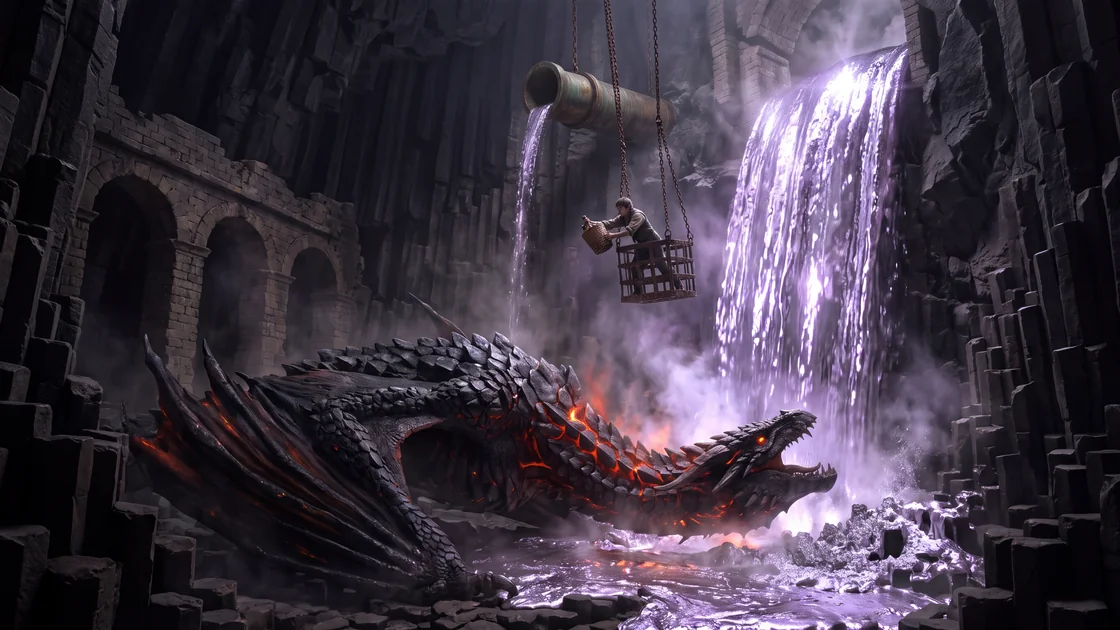
When an overambitious alchemist’s apprentice named Nicholas accidentally drops an unstable lunar catalyst into the aqueducts of Oakhaven, the entire mountain reservoir is transmuted into a vast, shimmering sea of pure liquid silver. Far beneath the stone foundations of the city, an ancient subterranean dragon named Caelithrax—whose volcanic slumber depends entirely on the constant, freezing cascade of mountain runoff to cool its incandescent core—is scalded awake by the suffocating, heat-trapping metallic deluge. As the earth buckles beneath metallic tremors and the city above threatens to slide into the abyss, Nicholas must plunge into the suffocating, mirrored depths of the subterranean aqueducts with an idiosyncratic valve-keeper, racing to reverse the transmutation before the dragon’s agony reduces the valley to ash.
Act I: The Salt of the Moon
The alembic did not merely whistle; it screamed with the voice of a dying tern.
Nicholas adjusted the damp linen wrapped around his palms, his thumbs raw from days of scraping vitriol from the salt-pans. The laboratory of Master Balthazar smelled of burnt elderberry, wet slate, and the faint, sweet decay that accompanied unsuccessful distillations of spiritus vini. It was three hours past midnight, the hour when the mountain winds above Oakhaven turned inward, whistling down the drainage chimneys and rattling the copper stopcocks of the great alembics.
Before Nicholas stood the Pelikan—a rotund, double-necked vessel of Bohemian glass that held Master Balthazar’s life’s work. Or rather, Balthazar’s stolen work. Nicholas had spent six months transcribing the margins of the master’s leather-bound journals, decoding the cryptic notation where lepus meant antimony, ciconia meant calcined tin, and the small, crowned viper stood for the unstable precipitate known as the Seventh Salt of the Moon.
"Only a drop," Nicholas whispered to the empty room. His shadow, thrown long and trembling across the damp masonry by a single tallow candle, nodded back at him. "A single tincture in the secondary condensation tube. It will clear the turbidity. He will return from the Guildhouse at dawn, find the liquor crystallized into the true Lunar Stone, and realize who truly understood the treatise of Geber."
It was the hubris of nineteen years and an empty stomach. For two years, Nicholas had swept floor sweepings, washed carboys in lye, and endured the flat-handed cuffs of Master Balthazar whenever a crucible cracked under uneven firing. He was tired of being the broom; he wished to be the fire.
In his left hand, cradled in a nest of sheep’s wool within a brass thimble, rested the catalyst: a grain no larger than a lentil, iridescent, pulsing with a faint, violet luminescence that seemed to chill the ambient air. It was hyper-saturated argent-seed, designed to reorganize base hydrates into noble matrixes. In theory, it required twenty barrels of boiling aqua regia to activate.
In practice, Nicholas had not accounted for the laboratory’s drainage system.
Under the floorboards of Balthazar’s shop ran the high-level conduits of the Grand Aqueduct of Oakhaven. The town had been built against the sheer limestone cliffs of the Mount of Cisterns, fed by the glacial runoff of the Gray Fang glacier. The mountain’s heart was hollowed into a natural limestone reservoir—the Lacus Frigidus—containing millions of cubic yards of black, bone-cracking ice-melt. The laboratory tapped into this conduit via a lead intake pipe for cooling jackets, and an open stone sluice through which excess runoff washed down into the main intake shaft that fed the city’s public fountains and lower sluice gates.
Nicholas mounted the stool. The Pelikan hummed, its belly boiling with a milky broth of mercury, silver nitrate, and liquefied sal ammoniac. The pressure within the neck was rising too fast; the glass was clouding with a greasy, pearl-like condensate that blocked his view of the meniscus.
He picked up the silver-plated forceps. His knuckles struck the cold edge of the iron mantle.
A mundane, miserable jerk of the elbow.
The brass thimble tipped. The lentil-sized seed of the Seventh Salt did not fall into the Pelikan’s narrow funnel. It bounced off the curving glass shoulder with a bright, crystalline tink, skittered across the slate bench, slipped through a gap between two floorboards, and dropped twenty feet down the vertical inspection flue straight into the main subterranean culvert.
Nicholas froze, the forceps suspended in mid-air.
He held his breath. For three seconds, there was only the hiss of the charcoal burner and the distant, rhythmic thud of the mountain water rushing through the stone pipes below.
"Nothing," he murmured, his ribs aching with terror. "It’s too cold. The volume is too vast. It will dilute. It will simply settle as silt."
Then came the sound.
It was not an explosion. It was a vast, sliding sigh, like a mile-wide sheet of silk being drawn across a marble floor. Beneath his boots, the stone slabs vibrated—not with the rough, tumbling rumble of water over gravel, but with a dense, oily thrum that made the copper pans on the walls ring in harmonic unison.
Nicholas dropped the forceps and threw open the trapdoor to the inspection shaft.
He expected to see the familiar, dark, frothing torrent of black mountain water that roared day and night beneath the city. Instead, he saw a mirror.
Rising silently through the dark shaft, moving with the sluggish, terrifying grace of heated honey, was an ascending column of liquid silver. It was not water reflecting light; it was entirely metallic, opaque, brilliant, reflecting the glow of his solitary candle with such blinding, immaculate clarity that it looked as though the moon itself were being pushed up from the bowels of the earth by a hydraulic ram.
"Gods of the furnace," Nicholas choked.
He leaned further. The air rising from the shaft was not wet. It was dry, ozone-sharp, and faintly warm, smelling of crushed pennies and molten zinc. The liquid struck the stone lip of the overflow weir. Where the mountain water usually broke into white foam and noisy spray, this fluid moved without a splash, curling over the ledge in a thick, seamless ribbon of quicksilver, heavy enough to bend the iron grating like rotten twigs.
The catalyst had not diluted. It had found the great, still belly of the mountain reservoir—millions of tons of mineral-rich, calcium-heavy glacial water—and chained its molecules into a continuous, self-propagating crystalline lattice. It was converting the Lacus Frigidus from water to liquid argentum vivum at a rate of a thousand gallons a second.
Act II: The Heavy Wells
By sunrise, the catastrophe had ceased to be Nicholas’s private terror and had become the city’s strangling reality.
Oakhaven did not wake to water. The kitchen maids who turned the brass petcocks of the high town’s fountains found nothing emerging but a dry, sucking hiss, followed by a heavy, metallic plug that extruded from the spouts like grey sausage meat, dropping into the stone basins with dead, ringing thuds that cracked the slate.
In the lower market, where the great fountain of the Three Nymphs usually cascaded down five tiers of travertine, there was only a horrifying, silent sheet of mirror. The silver had backed up through the conduits under immense hydrostatic weight. Because silver was nearly ten times heavier than the water it had replaced, the pressure inside the ancient Roman-era masonry was catastrophic.
Stone joints groaned. Lead pipes, designed to withstand three atmospheres of alpine runoff, swelled into grotesque, bulbous tumors before splitting lengthwise with sounds like musket shots, vomiting sluggish, glittering ribbons that pooled in the gutters, refusing to sink into the mud.
Master Balthazar returned at the seventh hour, his velvet robes smelling of pipe-weed and the stale wine of the Guildmaster’s table. He found his apprentice sitting on the front stoop of the apothecary, his knees pulled to his chest, staring at the street.
"Nicholas," the master barked, shaking rain-colored dust from his cloak. "Why are the shutters unbarred? Why is the furnace unlit? The Guild has approved our grant for the distillation of—"
Balthazar stopped. He looked down at the gutter.
A stray hog was attempting to drink from the drainage channel. Its snout pushed against the surface of the silver, but the surface did not break. It was a dense, fluid floor that supported the beast’s snout; when the pig shoved harder, the metal parted with heavy resistance, coating the animal’s nostrils in a glistening, impervious mask. The pig squealed, suffocating on the unbreathable, unswallowable weight, and bolted down the cobblestones with silver foam dripping from its jaws.
Balthazar’s face went the color of curdled milk. He looked from the gutter to the trapdoor inside the shop, then at Nicholas’s right hand, which was still stained with the indigo grease of the Seventh Salt.
"What did you touch?" Balthazar whispered. His voice was not loud; it was thin, hollowed out by the instant realization of gallows-iron.
"The... the dry residue in the long-necked receiver," Nicholas said, his voice flat with shock. "I thought it was the caput mortuum. I sought to wash it down the sump."
Balthazar took three steps forward, grabbed Nicholas by the wool of his doublet, and hauled him into the workshop, slamming the heavy oak door behind them.
"You fool," Balthazar hissed, his eyes bulging against his red-veined cheeks. "You miserable, gutter-crawling idiot! You think that was silver? It is an autocatalytic mercuric-argent lattice! It does not stop! It consumes every hydrogen-oxygen bond that holds dissolved salts! It will turn the cisterns to lead-heavy argentum!"
"It... it has already done so," Nicholas stammered. "The fountain of the Nymphs has cracked. The lower aqueduct is weeping metal from its mortar."
"The aqueduct?" Balthazar laughed, a high, ragged sound that bordered on lunacy. He released Nicholas, staggering against the workbench and sweeping a tray of bone-spatulas to the floor. "You think the aqueduct is our grave? Boy, what do you think lies beneath the Lacus Frigidus?"
Nicholas blinked. "The bedrock. The roots of the Gray Fang."
"The Deep Vent!" Balthazar shrieked, slamming his fist onto a map pinned to the wall—a hand-drawn survey of the mountain’s interior, cross-hatched with charcoal and sealed with red wax. "The mountain is not an extinct cone! It is a hearth! A lung of the deep earth! For four hundred years, the city has stood here only because the glacial lake drains downward through the Black Chasm, drowning the mantle of Caelithrax!"
The name fell into the room like a block of lead.
Nicholas had heard the old wives’ tales, of course. Every child in the valley knew of Caelithrax, the Great Drake of the Basalt Floor, who had burned three duchies during the Age of Iron before an order of saint-engineers diverted the ancestral glaciers of the Gray Fang into the mountain’s throat, turning the dragon’s volcanic nest into a drowned tomb. The legends said the wyrm slept under a million leagues of ice-water, its belly-fires chilled to a dim, slumbering ember by the perpetual waterfall.
"Legends," Nicholas whispered.
"Engineering!" Balthazar corrected, his finger digging into the paper until it tore. "It was the Guild of Hydraulics in the third century! They didn't kill it; they chilled it! The dragon’s internal furnace requires two thousand cubic feet of freezing water every minute to absorb the radiant heat of its vents! The water boiled, rose as steam through the fumaroles, condensed on the high peaks, and fell back as snow—a closed engine! A balance!"
Balthazar gripped his own hair with both hands.
"Water has a high specific heat, boy! It absorbs fire! But liquid silver? Silver has no heat capacity compared to water! It conducts! It reflects! It is ten times heavier! It will not seep through the cooling vents—it will crush them! It will seal the steam valves with forty thousand tons of molten metal, and it will reflect the beast’s own core-heat back into its liver!"
As if in answer to the master’s words, the stone floor gave a sudden, sickening heave.
It was not the sharp snap of an earthquake. It was a low, rolling, fluid swell, as if the entire mountain had inhaled. From the inspection shaft, a jet of dry, superheated gas whistled through the floorboards, carrying with it a sound that made Nicholas’s marrow ache: a long, subterranean groan that was half the screech of tearing tectonic plates and half the bellow of a creature whose lungs were filling with hot grease.
The candle flame on the bench turned blue, then went out.
Act III: The Keeper of the Valves
Outside, the bells of the Cathedral of St. Jude began to toll—a wild, irregular clanging that signaled fire, though no smoke could be seen above the slate roofs.
Nicholas and Balthazar burst into the street. The town was already in chaos. Citizens in nightshirts were crowded around the public troughs, trying to scoop the silver with wooden buckets, only to find the buckets could not be submerged. The wood bobbed on the dense surface like corks; when men thrust iron shovels into the troughs, the shovels were wrenched from their hands by the sheer mass of the fluid current moving through the pipes beneath.
"Clear the way!" a voice shouted from the upper terrace.
Down the steep, stepped lane came a small, square woman riding a heavy-wheeled handcart loaded with bronze wrenches, leather gaskets, and tallow-pots. She wore an apron of boiled leather studded with copper rivets, her arms bare despite the freezing morning wind, gray hair bound in tight, greasy braids around her ears.
"Greta!" Balthazar called, stumbling toward her. "Greta, close the intake at the High Gate! By the Saints, shut the sluice before the pressure splits the main barrel!"
Greta, the Master of the Subterranean Sump, pulled her cart to an abrupt halt by jamming an ash-wood brake lever against the iron-shod wheel. She spat onto the cobblestones; her spit hit a pool of silver and skittered across it like water on a hot skillet.
"Close the High Gate?" she rasped, glaring at the alchemist with eyes squinted from thirty years of lantern-smoke. "You think I haven't tried, you puffed-up ink-licker? The gate is bronze, four inches thick, set in ashlar granite. The metal got into the screw-threads an hour ago! The weight has stripped the cogs! The lower barrel has already burst in the tanners' quarter. Five houses collapsed when the basement retaining walls buckled under the sludge!"
"You don't understand," Nicholas interrupted, his voice cracking. "It’s not just the flooding. The beast. The deep drainage..."
Greta turned her cold, soot-rimmed eyes upon the apprentice. She did not ask how he knew. She was the one who lived in the wet tunnels beneath the bells; she was the one who listened to the mountain’s ribs.
"It’s awake," she said simply. "The thermometer in the Deep Sluice cracked twenty minutes ago. The mercury boiled out of it. The floor of the Sump is heating up like a baker’s oven, and the drainage isn't draining. That gray muck is too heavy to pass through the rock filters. It’s pooling on top of its back."
The ground shivered again. This time, the water in the street fountains didn't merely hum—it leapt. Small, mirror-bright globes of silver detached from the troughs and bounced across the cobbles like shot.
A hundred yards up the slope, the street opened.
The great flagstones of the Via Aqueductal, laid down by the ancients to carry the city’s traffic over the subterranean conduits, bowed upward. The mortar between the stones turned to white dust, hissed, and then a great jet of superheated silver erupted sixty feet into the morning air. It did not disperse into rain; it rose as a cohesive, glittering curtain, folded upon itself in the wind, and crashed through the timber roof of the Guildhall of Weavers, crushing the beams under hundreds of tons of dead, shining weight.
The screaming began in earnest.
"The whole terrace is going to drop," Greta said, her voice dropping to a low, grim cadence. "When that silver hits the magma chambers beneath the dragon’s belly, it won't boil away like water. It will conduct the whole heat of the abyss directly into the limestone beds. The mountain will blow its cap like a clogged retort."
Nicholas looked at Balthazar. His master had dropped to his knees in the gutter, his fine velvet robes dragging in the silver-stained mud, his fingers clutching his holy medals.
"It is irreversible," Balthazar was whimpering. "The affinity is absolute. The Seventh Salt cannot be unbound without an equal volume of the Quintessence of Tartar and forty days in a reverberatory furnace... We are dead. The city is dead."
"Shut up," Nicholas said.
Balthazar blinked, his jaw slack. "What?"
"Shut your mouth," Nicholas said, his pulse pounding in his temples with the fury of a man who has already seen his own head on a spike. "The catalyst requires cold to maintain its crystalline lattice. In the laboratory, the texts said it was unstable above the boiling point of lead! If it gets hot enough—"
"If it gets hot enough, it doesn't revert to water, you idiot!" Balthazar screamed. "It calcines! It becomes an argent-glass slag that seals everything it touches like cement! If that happens down in the vents, the dragon will have no water and no breath! It will tear the mountain apart with its claws to reach the air!"
"Then we don't let it calcine," Nicholas said. He turned to Greta. "You have the keys to the Old Sump? The drainage tunnels that bypass the municipal reservoirs?"
"Aye," Greta said, her hand going to an iron ring at her belt hung with massive, three-pronged keys. "The Roman overflow bypass. But it was dry-walled fifty years ago."
"We need black powder," Nicholas said, turning back toward the workshop. "And every carboy of spirit of vitriol and crude sal ammoniac in the cellar. We have to open the ancient dry-bed before the silver levels reach the lung-vents, or the beast will come up through the cathedral floor."
Greta looked at the boy, then at the master weeping on his knees, then down the slope where the weavers' roof was still groaning under its argent load.
"Move, apprentice," she said, reaching for her heavy sledgehammer from the cart. "The air is already turning to sulfur."
Act IV: The Iron Sluice
The entrance to the Under-Cisterns lay beneath the crypt of the Church of the Silent Hermits, a squat, windowless redoubt built against the bare rock of the cliff.
The church had long since been abandoned to the damp, its icons covered in a thick fur of greenish-gray mold. As Nicholas and Greta descended the winding spiral stair of cold slate, carrying wooden crates of acid carboys between them on a rope sling, the air ceased to be damp. It was becoming dry, baking, and filled with a terrifying, rhythmic thump-thump-thump that made Nicholas’s teeth chatter in their sockets.
"That's not the water-hammer," Nicholas muttered, his shoulder bruised where the crate’s pole rested.
"That's its heart," Greta replied, her voice echoing in the narrowing stone well. "Normally it beats once every three minutes. Like an old oak tree creaking in the frost. Now listen to it. It’s beating like a coursed hare."
Thump-thump. Thump-thump.
At the bottom of the spiral stair lay the vaulted bypass gallery. Here, the ancient engineers had carved a service path beside the main subterranean conduit—a gallery eight feet wide, framed with semicircular arches of dry-laid granite.
On their right ran the conduit. Usually, Nicholas knew from Greta’s muttered explanations, this was a sunken channel through which six feet of black glacial water moved with a deep, gurgling chuckle.
Now, it was full to the brim with a sluggish, mirror-smooth snake of silver. There was no ripple on its surface, no foam, no spray. It was so silent that it seemed dead, yet the air two inches above it was wavering with intense heat. The friction of millions of tons of heavy metal being forced through the rough-hewn rock channel by the mountain’s head of pressure had heated the liquid silver until it was hot to the touch, though still far below its true melting point—it was fluid only by virtue of the alchemical corruption that had replaced its natural nature.
"Look at the joints," Greta held her lantern high.
The granite blocks were weeping. The mortar had turned to a white, crumbly mush, pushed out by the silver that was seeking every micro-fissure in the rock. The stone itself was ringing, emitting a high-pitched, singing note like an overloaded iron chain.
"The Roman Wall is two hundred paces ahead," Greta said, her boots crunching on fallen spalls of rock. "If we blow the wall, the silver will bypass the Deep Vent and dump into the Great Sink—five miles of limestone caves that run down toward the valley plain. The town will lose its water for twenty years, but the dragon’s nest will be spared the load."
"And if the wall doesn't give?" Nicholas asked.
"Then the silver keeps dropping down the vertical sinkhole straight into Caelithrax’s gullet," she said simply. "And you and I will be melted down and cast into coins before the sun hits the noon-mark."
They reached the dry-wall. It was a massive barrier of ashlar masonry, ten feet high and six feet thick, built by long-dead dukes to prevent the mountain floods from washing out the silver mines that had originally given Oakhaven its name.
The air here was suffocating. Nicholas pulled his wool neck-cloth over his nose. The heat was radiating through the floorboards; small, sulfurous yellow tongues of flame were licking through the gaps between the paving stones. The dragon’s presence was no longer a myth or an alchemical deduction—it was a sensory bludgeon. It smelled like a thousand smithies: burnt horn, iron scale, superheated grease, and the ancient, reptilian stink of deep-earth musk that had not seen the sun since the continents cooled.
From the other side of the stone came a sound that made both of them drop the crate of vitriol.
SKREEE-CH.
It was the sound of diamond scraping on slate, amplified a thousand times. Something was moving on the other side of the mountain’s rib—something vast, armored, and frantic. A heavy weight struck the rock from beneath; the shockwave traveled up Nicholas’s shins and knocked him against Greta’s shoulder.
"It’s trying to clear its vents," Greta said, her voice shaking for the first time. "The silver is pouring into its chamber from the main culvert. It’s drowning it."
"Give me the auger," Nicholas demanded.
His fingers were blistered from the acid carboys, but he seized the five-foot iron drill from Greta’s cart. Together, they drove the bit into the mortar joints of the Roman Wall, Greta swinging the sledge with mechanical, iron-armed fury while Nicholas held the bit steady, his palms burning as the shock of each blow traveled through the metal.
The stone was hot. Not warm—hot enough that when Nicholas accidentally brushed his wrist against the auger, it raised an instant, white blister.
"Again!" he shouted over the subterranean roar. "Again, Greta!"
The iron bit bit deep. Five inches. Ten inches. A foot.
On the thirteenth blow, the bit punched through.
It did not find air.
A jet of pressurized liquid silver, white-hot and glowing with a hellish, phosphorescent violet light, spat through the drill hole. It struck the iron sledgehammer in Greta’s hands; the tool was torn from her grip as if an invisible bull had kicked it, clattering against the opposite wall with its head already half-melted, the iron drooping like hot wax.
"The bypass is full!" Greta screamed, scrambling back. "The silver has backed up from below! It’s already rose fifty cubits above the grate!"
Nicholas stared at the hole. The stream of silver was thick as a man’s wrist, arching across the gallery, eating into the limestone floor with a fierce, crackling hiss that released dense clouds of suffocating, white arsenical smoke.
"It’s not just backing up," Nicholas said, watching the violet light that danced within the jet. "It’s boiling. The dragon’s furnace has heated it past the threshold. The Seventh Salt is reaching its third state!"
"And what does that mean for us, schoolboy?" Greta cried, hauling him backward by his collar as the floor where he had stood began to flake and crumble under the heavy, corrosive wash.
"It means," Nicholas whispered, "it’s looking for a salt-sink. It’s looking for the cold."
Act V: The Drowned Hall of Caelithrax
There was no choice left. They could not breach the Roman Wall; the bypass was already an iron-choked trap.
"The sluice gate to the belly-wells," Nicholas said. "Can we reach the main cavern? The dragon’s actual vault?"
Greta looked at him as if he had grown a second head. "The Lower Cistern? That's fifty fathoms down the vertical stair. Even if the steps haven't sheared, the heat will bake the meat from your ribs before you reach the bottom platform."
"The vitriol," Nicholas said, pointing to the two remaining wicker-wrapped carboys of acid. "Master Balthazar’s texts—the third gloss on the Emerald Tablet. Argentum vivum born of lunar salts can be dissolved by vitriolic phlegm if it is introduced at the point of maximum thermal opposition! If we dump the acid directly into the throat-vent where the cold runoff hits the beast’s plates, the reaction will break the lattice! It will precipitate the silver out as solid flakes! It will turn back into water!"
"Or it will explode and blow the heart out of the mountain," Greta barked.
"Do you have a better plan?" Nicholas screamed, the roar from beneath now so loud they could barely hear each other. The very air was vibrating; dust was falling from the roof in sheets, and the arches of the gallery were leaning like drunken men.
Greta stared at him through the yellow gloom, her leather apron smoking from the stray drops of silver that had spattered her chest.
"You're a mad little bastard," she said. "Pick up the carboy."
They ran.
The descent to the Lower Cistern was a nightmare of spiraling stone and choking gas. The steps were narrow, carved directly into the basalt of the mountain’s core, curving around the central drainage chimney like the threads of an enormous screw.
Here, the scale of the ancient works was revealed. The chimney was sixty feet across—a vast vertical pipe down which, for centuries, the white torrent of the mountain’s excess had plunged into the depths. Now, there was no torrent. There was only a terrifying, continuous column of silver, silent as a fallen star, sliding down the center of the shaft. It did not touch the walls; it fell as a single, coherent cylinder of mirror-metal, so dense and heavy that the displaced air created a screaming downdraft that tore at their clothes and sucked the breath from their lungs.
And from below came the light.
It was not firelight. It was the deep, sullen cherry-red of an iron furnace, mixed with the blinding, cold violet of the corrupted silver.
They reached the observation gallery—a narrow stone shelf projecting over the great natural cavern at the base of the chimney. Two hundred feet below them lay the floor of the world.
Nicholas gripped the rusted iron rail, his knuckles white, his hair plastered to his forehead with grease and sweat.
The cavern was vast enough to swallow the cathedral, spire and all. The walls were columnar basalt, black and hexagonal, glistening with sheets of ancient salt. But the floor was not rock.
The floor was a dragon.
Caelithrax was not the slender, winged serpent of the illuminators’ books. It was a lithic titan, a creature born of the earth’s primitive crust. Its body was broader than a barge, sixty paces long, plated in thick, overlapping tiers of black basaltic scales that looked like slate slabs fused together with slag. It had no wings; in their place were enormous, shovel-shaped digging spurs, tucked tight against ribs that were now expanding and contracting with violent, convulsive heaves.
Its head was wedge-shaped, like an adder’s, but armored in horn-crests four feet thick. Around its neck and flanks ran the vents—not gills, but deep, vascular fissures lined with incandescent orange flesh, through which the creature breathed the sulfur-fires of the mantle.
Normally, the glacial cataract fell directly into a deep trench before these vents, creating a boiling lake that cooled the beast’s flanks while the steam escaped through the natural chimneys into the upper sky.
Now, that trench was full of liquid silver.
The metal had covered the dragon’s lower body. Because of its unnatural density, the dragon could not submerge its vents to cool them, nor could it shake the fluid off. The silver had coated the beast’s back like a skin of molten lead, reflecting its own incredible heat back into its tissues. The creature was thrashing in agony, its great, clawed limbs gouging furrows six feet deep into the cavern’s granite floor, its wedge-shaped head slamming against the stone walls with impacts that made the entire mountain shiver above them.
From its throat came a sound that Nicholas felt in his bowels rather than his ears—a long, bubbling, metallic scream. Its nostrils were running with liquid argentum; it had inhaled the heavy fluid, and its lungs were drowning in silver.
"It can't vent!" Greta yelled, pointing to the great fissures along the beast's neck. "The silver is sealing the gills! Once they slag over, its furnace will burst!"
The dragon’s neck arched back. Its eyes—two vast, milky orbs of cataract-filmed fire—rolled toward the tiny gallery where Nicholas and Greta stood. It smelled them. Or perhaps it simply felt the small, cold interruption to its world of agony.
A blast of dry heat, hot enough to singe Nicholas’s eyebrows to ash, rushed up the shaft.
"The carboy!" Nicholas shouted. "We need to hit the main fissure! The one behind the neck crest!"
"We're forty paces too high!" Greta cried, looking over the rusted rail. "If we drop it from here, the glass will shatter on its scales and the acid will burn away in the air before it touches the metal!"
Nicholas looked at the descending delivery pipe—an ancient bronze pipe, three feet in diameter, that hung from the ceiling above the gallery, used by the old builders to direct cold runoff directly into the dragon's trench during the dry summer months. The pipe was dry now; the silver was falling through the central chimney, leaving the auxiliary bypass pipe empty.
"The winch," Nicholas said, pointing to an iron chain that hung from a rusted block-and-tackle above the auxiliary tube. "Lower me."
"Are you insane?" Greta shrieked. "The pipe is an oven!"
"The pipe is cold compared to the floor!" Nicholas screamed back, his voice cracked with smoke and terror. "Lower me down the tube with the carboys! If I can drop the vitriol into the intake funnel at the base of the pipe, the acid will discharge directly into the neck-fissure! It will dissolve the silver plug!"
Greta looked at the boy, then down at the thrashing, basalt god that was cracking the foundations of her city.
"You have five minutes," she said, her teeth bared in an animal snarl. "After that, the heat will anneal the chain, and it'll snap like dry grass."
Act VI: The Salt and the Core
Nicholas did not remember getting into the iron basket. He only remembered the smell of the grease on the winch drum as Greta knocked the ratchet loose with the heel of her boot.
The descent was an eternity of red light and screeching metal. The bronze pipe was narrow, barely wide enough for the iron basket and the two wicker carboys. The bronze walls were so hot that whenever Nicholas’s knees brushed them through his wool trousers, the cloth scorched and his skin hissed.
He looked down through the floor of the basket.
Directly below him was the nape of the dragon’s neck. Up close, the scale of Caelithrax was paralyzing. Each basalt scute was larger than a tavern table, encrusted with needles of orange sulfur and deposits of white alum. Between the scutes, the soft flesh of the vents was visible—not skin, but an exposed, vascular labyrinth that glowed with the color of a blacksmith’s hearth at full bellows.
The silver had pooled in the hollow behind its skull. It was three feet deep, a boiling, iridescent puddle that had turned a sickly, curdled purple-gray. The Seventh Salt had reached its critical mass; it was no longer merely liquid metal, it was beginning to vitrify. Long, needle-like crystals of argent-slag were shooting across the surface of the pool, knitting into an impenetrable, metallic scab that was pinching the dragon’s breathing vents shut.
The beast gave another convulsive heave. Its tail, a mountain-cleaving column of segmented rock, slammed into the basalt wall sixty feet below.
The shockwave snapped three links in the suspension chain above Nicholas. The basket dropped five feet with a bone-jarring clack, swinging wildly like a pendulum over the red-hot crater.
"Now, boy!" Greta’s voice drifted down the pipe, tiny and thin as a spider’s silk. "The link is pulling!"
Nicholas kicked the wicker wrapping from the first carboy.
The green Bohemian glass was thick, but it was already clouding from the heat. Inside, the spirit of vitriol—distilled sulfuric acid of the highest concentration—was boiling under its wax seal. If the glass failed now, he would be flayed to the bone in an instant.
He seized the iron wrench from his belt. He did not pull the stopper; he could not. The wax had melted and baked into the lead fitting.
He swung the basket toward the beast’s nape.
"Forgive me, Master!" he screamed into the roaring abyss—not to Balthazar, but to the ancient dead philosophers whose books he had mutilated. "The dissolution precedes the coagulation!"
He smashed the iron wrench into the neck of the first carboy.
The glass shattered. A gallon of concentrated vitriol, accompanied by a blinding cloud of white, choking acid gas, dropped straight into the center of the silver pool behind the dragon’s head.
For two seconds, nothing happened.
Then, the mountain screamed.
It was not the dragon. It was the reaction.
The vitriolic phlegm struck the superheated argent-lattice at the very moment of its calcination. The acid did not merely dissolve the metal; it attacked the unstable Seventh Salt with the furious hunger of an opposite affinity. The sulfur in the acid demanded the silver; the silver, starved of hydrogen, tore the water molecules from the surrounding air with such violent energy that a concussive wave of cold-flame blossomed across the beast’s neck.
CRACK.
A sound like the snapping of an iceberg echoed through the cavern.
The purple-gray scab did not melt. It shattered. The silver lattice, corrupted by the sudden introduction of the concentrated sulfate, lost its fluid cohesion. In an instant, the liquid metal around the dragon's neck did not run—it precipitated. It turned into a vast, frothing mass of white, crystalline silver-sponge, light as pumice, brittle as dry bone, releasing the millions of gallons of bound water in a sudden, explosive burst of superheated steam.
The steam erupted upward.
It caught Nicholas’s basket like an iron fist. The basket was hurled toward the roof of the cavern; the chain snapped completely, but the force of the ascending steam-column carried the basket upward through the bronze pipe like a ball from a cannon.
Nicholas was pinned to the floor of the basket by the G-force, his lungs filled with steam that was, miraculously, not dry fire, but wet, scalding, life-giving water.
Below him, he heard the dragon inhale.
It was a sound like the sea rushing into a dry cave. The beast’s neck vents, cleared of the heavy, suffocating argent-sponge, opened wide. The released water, freed from the alchemical lattice, cascaded down into the vascular fissures of the dragon’s core.
The creature’s internal furnace did not extinguish; it cooled. The cherry-red glare along its flanks subsided to a deep, healthy, dull orange. The violent, erratic thrum of its heart slowed—thump... thump... thump—each beat dropping further apart, returning to the ancient, geologic rhythm of the earth’s crust.
The steam-column collapsed.
Nicholas’s basket, its upward momentum spent, fell back into the mouth of the bronze pipe, jamming securely into the flared rim of the upper gallery with an ear-splitting crash of bronze on iron.
Strong, calloused hands seized his collar and dragged him from the twisted metal before the basket could slip back down the shaft.
Nicholas lay on the cold slate of the gallery, his face covered in soot, his shirt torn away, his chest heaving with air that tasted of wet gravel and ancient sulfur.
Greta stood over him, her hammer resting on her shoulder, her face blackened with coal-dust, looking down at him with an expression that was halfway between murder and a grin.
"The water’s running black again in the lower conduit," she said, nudging his boot with her toe. "You broke the seed, apprentice."
Act VII: The Veins of the Mountain
Three days later, the bells of St. Jude were rung not for fire, but for the dead.
Only seven citizens had died—mostly weavers caught beneath the collapsed timber roof of their hall—but the city of Oakhaven would never wear its old face again.
The great fountains were running once more with the black, icy water of the Gray Fang, but the water was no longer pure. It carried with it a fine, silvery silt that settled in the bottom of every basin, a gray-white sand that the housewives of the lower town gathered with goose quills and dried in iron pans. It was not true silver; it was the precipitated dross of the great reaction—argentum vegetabile—soft, easy to work, and sweet to the touch, but forever barren of alchemical seed.
In the market square, three hundred soldiers of the Duke’s Guard were working with levers and draught-horses, hauling away the great, solidified ribbons of silver that had burst through the flagstones of the Via Aqueductal. The metal was porous, brittle, and full of air-holes, like frozen gray sea-foam.
Master Balthazar was no longer in his shop.
When the Duke’s bailiffs had arrived at the laboratory on the morning after the tremors stopped, they found the master alchemist gone. He had fled across the western pass with three mules laden with stolen manuscripts, leaving behind only his empty carboys, his cracked alembics, and a formal decree from the Guild of Apothecaries declaring Nicholas of Oakhaven an outlaw and a practitioner of illicit arts.
The decree, however, had never been served.
Nicholas sat on the low parapet of the High Sluice Gate, four hundred feet above the red-tiled roofs of the city. The sun was setting behind the Gray Fang, turning the snowfields to the exact shade of violet that had haunted his dreams for seventy-two hours.
Beside him sat Greta, her leather apron scrubbed clean of sulfur, her hands busy with a file, sharpening the teeth of a massive iron cog.
"The Duke wants to appoint you Court Mechanist," she said without looking up from her work. Skritch. Skritch. Skritch. "Five hundred guilders a year and a house in the High Crescent. He thinks you found a way to mine silver without picks."
"He doesn't know the silver is hollow," Nicholas said, turning a small, brittle lump of the white metal between his stained fingers. "It’s dead metal, Greta. It has no spiritus. If you melt it, half of it burns away to gray ash."
"A guilder’s a guilder to the tax-man," she grunted. "And the Duke has a war to pay for in the Lowlands."
Nicholas looked down at the deep, black throat of the mountain intake.
Through the iron grating, he could hear the water moving again—vast, heavy, cold, a mile of black silk rushing through the stone lungs of the city. But beneath that sound, beneath the gurgle of the sluices and the distant clatter of the market square, there was another note.
A low, deep, rhythmic rasp.
Hsssss-ah. Hsssss-ah.
The dragon was sleeping.
Its vents were clear, its basalt plates chilled by the glacial flood, its magma-core quieted to a slow, ancient simmer. But Nicholas knew that the silver had not entirely disappeared.
Down in the great drowned cavern of the Lower Cistern, forty thousand tons of solid argent-sponge had fused into the basalt walls. It had filled the cracks; it had plated the rocks; it had crept into the very marrow of the mountain’s roots. The cavern was no longer stone; it was a silver hall, a glittering, subterranean shell that held the beast’s heat like a mirrored furnace, reflecting its fiery breath back into its sleeping eyes for all eternity.
"I’m not staying," Nicholas said softly.
Greta stopped her filing. She rested the flat of the tool across her knee and squinted at him through the purple dusk.
"You're a fool, then," she said. "The Duke would give you three rooms in the palace and all the goose-meat you could stomach."
"The Duke doesn't have to listen to it," Nicholas said.
He stood up, walking to the edge of the stone platform. He looked down into the inspection shaft—the same shaft down which he had dropped the thimble three nights ago. The water was roaring there, black and cold, but around the rim of the lead pipe, where the spray could not wash it clean, ran a thin, perfect, unbreakable ring of solid, polished silver.
A signature.
"It knows my name, Greta," he said. "The dragon doesn't care about the Guild or the Duke’s paper. But down there, in the dark, where the cold water hits the fire... it remembers the taste of the salt."
He pulled his leather pack over his shoulders. It was light; it contained only three blank notebooks, a single pair of brass calipers, and a loaf of hard rye bread he had taken from the laboratory larder.
Greta looked at him for a long time. Then she reached into her pocket, pulled out a small, square piece of folded sheepskin, and tossed it to him.
Nicholas caught it. It was heavy, smelling of lamp-black and tallow.
"What is this?"
"The bypass keys," she said, picking up her file again. "Not the city keys. The old ones. The ones that open the drainage vents under the Low Mountain, three leagues down the valley. If you're going to wander the earth like a half-cooked clerk, you might as well know where the chimney exits."
Nicholas held the cool iron key against his palm. He looked back at the city—at the broken roofs, the shining gray gutters, the public fountains where the people were laughing and washing their linen in water that had almost burned the world to a cinder.
"Thank you, Master Greta," he said.
"Get out of here, apprentice," she spat, though her eyes were not unkind. "And if you ever drop an alembic near my pipes again, I’ll take this sledge and drive your legs through your collarbone."
Nicholas smiled—his first smile since the moon-salt fell.
He turned his back on Oakhaven, on the High Sluice, and on the great, mirrored sea that lay locked in the dark heart of the Gray Fang, and began the long walk down the mountain road, keeping his boots to the soft dirt, far away from the singing stones of the aqueduct.