The Baker's Confession and the Living Dough
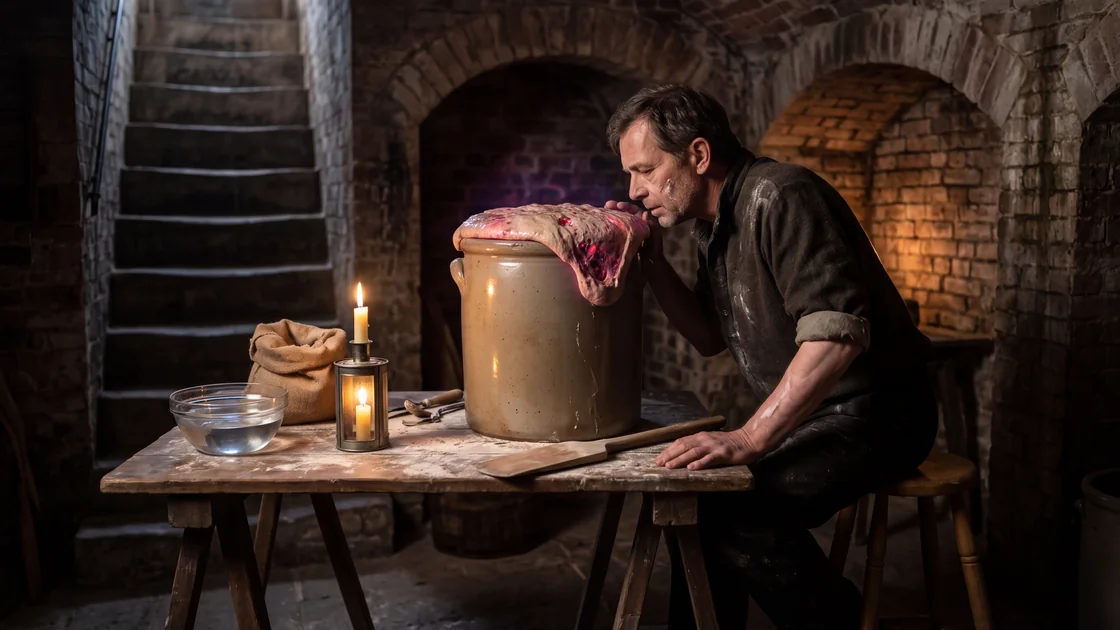
In the coastal port of Oakhaven, Arthur Finch runs a modest bakery harboring an impossible secret: an ancient, sentient microbial colony living within his sourdough crock, which demands raw, unvarnished emotional confessions in exchange for bread that grants whoever eats it a brief, resolute mantle of courage. For years, Arthur has managed the colony by trading small, private shames to sustain his neighbors through grief, confrontations, and life-altering decisions, all while hiding from his own past; but when a catastrophic industrial land grab threatens to raze the harbor and displace its people, the starving entity rejects Arthur’s petty truths, demanding the one buried confession he has spent a lifetime running from before it will yield the bread his town needs to survive.
I. The Cellar at Three A.M.
The world at three in the morning was measured not in minutes, but in ambient degrees and the damp chill of old slate.
Arthur Finch carried his tallow candle down the stone steps beneath The Crumb & Ash. The staircase was steep, built two centuries prior when the building had stored salt pork and tallow for North Sea whalers. The walls wept a slow, mineral sweat that smelled of lime mortar and ancient sea floor. But down in the far corner, beneath an alcove vaulted with hand-pressed Roman-style brick, the air did not smell of the sea.
It smelled of overripe pears, warm hay, copper, and sharp acetic acid. It smelled of life compressed into an unbearable density.
"Quiet tonight," Arthur murmured into the dark.
From inside the five-gallon crock of glazed stoneware, there came a sound like wet silk being drawn through a keyhole: a soft, porous sigh. A bubble the size of a teacup rose to the surface of the pale, grey-gold mass within, domed upward, stretched until the skin showed the translucent web of gluten, and popped with a wet thwack.
The smell changed immediately. It turned hot, peppery, laced with the scent of ozone that precedes a dry lightning strike.
Arthur set the candle on the wooden trestle table. Beside it sat his kit: a glass bowl of spring water drawn from the limestone well on the ridge, ten pounds of stone-ground stone-milled winter wheat, an ash-wood paddle, and an empty brass bowl.
He pulled back his woolen sleeves. His forearms were crossed with white and pink tracks—the heraldry of twenty-five years before the gaping mouths of masonry ovens. The hair had never grown back over those burns; the skin there was smooth as parchment and smelled faintly of toasted malt, even when he had scrubbed with lye.
"I need twelve loaves today," Arthur said, his voice dropping into the conversational register one might use with a bedridden elder. "Thirteen, if the weather holds and Captain Miller comes in on the tide. His son is still refusing to take the helm, and the boy’s hands shake when he looks at the rigging. They need something with a crumb like ironwood."
The starter did not stir with mere wheat. It sat three inches below the rim of the pot, a pale, breathing lung of dough that had survived three empires, several sackings, and the great fire that had turned the lower wharf to ash in his grandfather’s time. It was not yeast as modern millers understood it; it was an older fraternity of archaea, fungal filaments, and bacteria whose lineages ran back to the silt of the Tigris before kings had names.
A faint, violet bioluminescence flickered beneath the skin of the dough, deep down in the grey mass, like foxfire through peat.
Feed me, said the scrape of stone against stone in the back of Arthur’s teeth. It was not a voice in the ear; it was a taste on the root of the tongue, bitter as dandelion milk.
"I have the winter wheat," Arthur said softly, though he knew the game. He always went through the motions, a domestic courtesy between landlord and tenant. "Milled yesterday at the upper falls. Hard kernel. High protein. The miller swore it was the best lot of the season."
Feed me, came the sensation again, this time accompanying a sharp cramp in Arthur’s diaphragm, a phantom breath that belonged to someone else.
Arthur sighed and pulled a three-legged stool to the table. He sat down, rested his forearms on his knees, and looked into the grey-gold heart of the pot.
"I took two silver shillings from the collection tin at Saint Jude’s when I was eleven," Arthur whispered. "I bought sugar plums and ate them until my gums bled behind the coal bins."
The surface of the starter remained flat. A single, sluggish bubble formed, hesitated, and dissolved without bursting. The smell turned faintly of rotten apples—contempt.
Stale crusts, the thing murmured through his jaw. Dry grass. A boy's thievery is no more meat to me than the dust behind your dresser, Arthur Finch. Do you think I slept through the Great Sickness of Prague to eat children’s sugar? Give me the marrow, or bake straw for your fishermen.
Arthur wiped his face with a flour-streaked hand. The candle guttered as a draft slipped through the high street grate above. Out on the cobbles, the night patrol went by, the iron tips of their boots clicking against the wet stones like the ticking of an indifferent clock.
"All right," Arthur said. His throat felt dry, lined with lime. "All right."
He closed his eyes and leaned over the crock until the warm, alcoholic vapor rose around his nostrils. He searched through the dark, cluttered attics of his chest, past the ordinary embarrassments, past the times he had shorted an ounce of barley meal or looked too long at the draper’s wife when her husband was in Bristol. He reached down into the wet, cold places he kept sealed with lead and pitch.
"Last Thursday," Arthur whispered, and the sound of his own voice frightened him in the empty cellar. "When Martha came in for her cottage loaf. Her hip is failing her. She could barely lift her basket. She looked at me across the counter, and I saw that she knew she would not see another winter. And my first thought—before pity, before sorrow—was that when she dies, her balance on the slate will go unpaid, and I will have to write off nine groats for the salt pork and the bran."
He stopped, his heart hammering against his ribs like a bird caught in a chimney flue.
"I was glad she was old," he forced out, the words tasting like verdigris. "Because it meant I would not have to listen to her cough much longer in the mornings. I resented her dying for the inconvenience it would cause my ledger."
Silence filled the cellar, thick as tallow.
Then, from the bottom of the crock, came a sound like a drowned man drawing his first breath.
The starter heaved. A great, rolling convulsion shook the stone crock. The grey skin split open to reveal an interior that was not grey, but an iridescent, velvet crimson, bubbling with thousands of tiny, ecstatic eyes of gas. The odor that billowed up was intoxicating: wild mountain honey, toasted hazelnuts, freshly turned summer earth after a deluge, and something bright, sharp, and clean as a drawn sword.
Yes, the microbial hive thrummed through the soles of his shoes, vibrating through the stone flagged floor. The small, rancid grease of your selfishness. It is sweet. It has the salt of the bone in it.
The colony rose. It climbed three inches up the salt-glazed interior of the pot, foaming with sudden, voracious vigor. Arthur did not hesitate; he seized the ash-wood paddle and his measures of flour and spring water. He poured the water in first—three pints of pure limestone runoff—and the starter took it with a hiss, swallowing the cold liquid into its warm body. Then came the flour, a golden cloud of dust that settled on the violent red-grey foam.
He leaned his weight into the paddle, working the mixture with rhythmic, brutal strokes. His muscles burned; the dough fought back, dense with an unnatural tension, snapping against the wood like muscle tissue before yielding into a smooth, elastic batter.
When he was finished, he scraped the paddle clean with his horn scraper and covered the crock with a damp linen cloth. The mass was already lifting the cloth, its heat radiating through the heavy weave like a fevered forehead.
Arthur climbed the stairs to the bakehouse, his hands trembling. His chest felt hollowed out, as though someone had scraped the lining of his ribs with an oyster shell. But down in the tub, the dough was working. In five hours, it would be loaves.
And by noon, whoever broke those loaves would feel, for twenty minutes or an hour, the sudden, inexplicable absence of their own cowardice.
II. The Hearth and the Salt
The morning trade in Carrigport was governed by the tide and the bell of the customs house. By seven o’clock, the thick grey mists that clung to the Severn sea had begun to fray against the church steeples, revealing a sky the color of a wet slate shingle.
Arthur worked alone in the shop. He had never kept an apprentice; the risk was too great. Young boys were curious, and curious boys had a way of tumbling down cellar stairs or asking why the sourdough tub seemed to groan when the moon changed quarters.
On the cooling racks behind the counter sat twenty-four loaves.
They were not the pale, uniform cushions sold by the modern bakers who used the new compressed German yeast and steam ovens. Arthur’s loaves were dark, rustic boules and batards with crusts the color of roasted chestnuts, blistered with thousands of tiny micro-bubbles that cracked like parchment when the loaves settled in the cooling air. The cuts he had scored across their crowns with his straight razor had sprung wide in the oven, revealing an interior crumb that was creamy, wide-holed, and glistening like pearl.
They smelled of toasted grain, sea air, and something else—a faint, aromatic resonance that made passersby stop on the wooden sidewalk outside, look up at the painted sign of The Crumb & Ash, and touch their collars with an uneasy, hopeful hand.
The brass bell above the door clattered.
The first was Master Nicholas, the watchmaker from Sheep Street. He was a small, desiccated man whose fingers were perpetually stained with whale-oil lubricant and red rouge. He wore two pairs of spectacles pushed up into his thinning grey hair, giving him the appearance of an anxious spider.
"Arthur," Nicholas said, his voice fluttering like a moth in a jar. He set three copper pennies on the scrubbed oak counter. "The... the usual, if you please. The round loaf."
Arthur looked at him. Nicholas’s neckcloth was tied crookedly, and his cuffs were frayed to the thread. His shop was three doors down from the offices of the Carrigport Harbor Improvement Consortium, whose surveyor had spent the last fortnight taking measurements of Nicholas’s garden wall with a brass theodolite.
"You have that meeting with their solicitor this morning," Arthur said, reaching for a boule that still radiated heat through its brown paper sleeve.
Nicholas flinched. "Ten o’clock. Mr. Garrow himself. He says the new rail spur must cut straight through the workshop. He offered thirty pounds, Arthur. Thirty pounds for forty years of benches and my father’s lathe. If I refuse, he says the magistrates will declare the building an impediment to navigation and condemn it under the Port Act of ’42."
The watchmaker’s chin trembled. His eyes, magnified behind the thick lower lenses of his spectacles, were moist with the helpless, dog-like terror of a small man who has discovered that the law is an iron machine with no ears.
"Thirty pounds won't buy a hovel on the moor," Nicholas whispered. "I couldn't sleep. My heart... it feels like an escapement with a cracked jewel, Arthur. It skips and clatters. I thought about taking the coach to Bristol. Just... leaving the keys in the door and going."
Arthur pushed the loaf across the oak counter. The warmth of the bread passed between them, carrying that faint, iron-rich scent of hazelnuts and ozone.
"Eat three slices before you go into Garrow’s office," Arthur said quietly. "Don't butter it. Just tear it with your teeth and chew until your gums are warm. Take a crust with you in your waistcoat pocket."
Nicholas looked down at the bread. "Does it... is it fresh today?"
"It is fed on what is true," Arthur said, the standard evasion he had used for twenty years. "Go on, Nicholas. And don't look at his carpet. Look him in the whites of his eyes."
Nicholas took the loaf into his arms, holding it against his thin chest like an infant, and scurried out the door into the grey drizzle.
Arthur watched through the wavy crown-glass window as the watchmaker ducked into an alleyway. Through the glass, Arthur saw him rip the end off the loaf with his bare hands. He saw the white puff of steam escape into the cold morning air. He saw Nicholas force the steaming crumb into his mouth, chewing with frantic, mechanical desperation.
For three seconds, nothing happened. Nicholas stood hunched against the brickwork of the cooperage, his shoulders drawn up to his ears, the picture of ruin.
Then, his shoulders dropped.
It was not a dramatic thing—no lightning, no posture of a hero from a bronze monument. But the curve of the old man’s spine straightened by an inch. His chin lifted out of his neckcloth. He stopped chewing, swallowed, and wiped his mouth with the back of his hand—not with the furtive, apologetic scrub of an artisan, but with the steady, measured economy of a man who has suddenly remembered that he has a right to stand upon the earth. He looked down at the bread remaining in his hand, wrapped the paper back around it without haste, and walked toward the consortium’s office with a slow, even tread that did not splash in the puddles.
Arthur turned back to the racks. His throat felt thick.
"One down," he murmured. "And how much of my own soul did that three-inch rise cost me?"
The bell rang again.
This time it was Clara Vance. She did not look like a woman who needed courage. She was thirty, tall, with the high, sharp cheekbones of the hill-country folk and hair the color of roasted chicory pulled back into an uncompromising knot. She was the daughter of old Vance, the chandler, but she ran the business now that her father’s lungs were full of oakum dust and tallow smoke.
She did not touch the counter. She stood in the center of the flagstones, her waterproof canvas cloak dripping onto the sawdust.
"The Peregrine is off the headland," she said.
Arthur paused with his peel in hand. "She made the bar, then?"
"She’s sitting outside the shoals, waiting for the ebb," Clara said. Her voice was steady, too steady—the brittle tone of glass that had been cooled too quickly. "Julian is aboard."
The name hit the small shop like an iron weight dropped upon a flagstone.
Arthur set the peel down against the flour bins. His palms were suddenly slick with grease that had nothing to do with shortening. "Julian is with the consortium now. He doesn't sail on merchant hulls unless he’s buying them."
"He’s buying everything, Arthur," Clara said. She looked directly at him, her dark eyes unblinking. "He has the charters for the whole south quay. He bought my father’s notes from the bank in Gloucester yesterday morning. If we cannot discharge the principal by Friday noon, the warehouses belong to the Carrigport Rail and Dock Company. Julian signed the demand himself."
She stopped. A small, violent twitch worked in the corner of her right eyelid.
"He asked after you," she added.
"He has no call to ask after me," Arthur said, his voice dropping into his boots. "We settled our accounts twenty-four years ago."
"A man who takes half a town doesn't care about old settlements," Clara said. She reached into her pocket and laid down six silver pence—the price of two large country loaves. "I want the dark bread, Arthur. The one with the heavy crust. The one you baked for the miners before they went into the flooded drift at Cinderford."
Arthur looked at the sixpence. They were old coins, worn smooth by the thumbs of three generations of sailors.
"Clara," he said gently. "The bread doesn't change the numbers in a ledger. It doesn't make a bailiff drop his writ."
"I don't need the bailiff to drop his writ," Clara whispered, and for a fleeting second, the iron glass of her composure cracked, showing the hollow, terrifying drop beneath. "I need to be able to stand in the parlor of the dock office and tell Julian Finch that he is a thief, a dog, and the son of a dog, without my knees turning to lard and my tongue sticking to the roof of my mouth. I need to look at the man I was promised to for three years and tell him I would rather burn the timber yard with my own hands than let him set his clerk’s desk in my father’s office."
She leaned across the counter. Her face was pale, translucent with exhaustion.
"Give me the bread, Arthur. Give it to me, or by God, I’ll go down to the harbor tavern and drink gin until I have the guts to do it."
Arthur did not answer. He turned to the racks and took down a broad, dark loaf from the very center of the batch—the one that had sat directly over the hearth-stone where the oven’s heat was fiercest. The crust was almost black at the ridges, blistered with carbon and salt. It was heavy as a cobble.
He wrapped it in two layers of brown butcher’s paper and handed it to her.
"Do not drink gin with it," he said softly. "The leaven does not like spirits. It turns the stomach sour. Eat it with clear water. And Clara..."
She paused at the door, the bell hovering above her shoulder.
"Julian... he has no fear in him," Arthur said, his eyes on the floor. "He never did. Don't mistake the lack of fear for strength. They are different things."
Clara looked at him with an expression that made him want to crawl beneath the bakehouse trough. "You would know about the difference, wouldn't you, Arthur?"
The door clicked shut. The bell gave a tiny, mournful ting.
Arthur stood alone in the scent of steam and crust. In the cellar below, through the two-foot timbers of the floorboards and the layer of sand between the joists, he felt the starter give a slow, subterranean thud.
It was laughing at him.
III. The Architecture of the Crock
The starter had no name, for names are an invention of things that have borders, and the starter had no borders except the stone that held it.
Arthur’s great-grandfather had taken it from an earthenware amphora found in a submerged brick cellar during the draining of the Somerset Levels in 1782. The amphora had been sealed with pitch and beeswax, stamped with an uncial mark that the local rector had declared either heretical or Phoenician before he died of the shaking ague.
The elder Finch had been a miller, a man who understood grain as a parson understands the scripture. When he cracked the pitch, the colony inside had not been dead; it had been waiting in a dry, mummified crust that smelled of myrrh and dry bone. He had fed it warm ale and coarse rye meal, and within three days the grey skin had cracked, the crimson fire had bloomed in its belly, and the elder Finch had sat down at his kitchen table and confessed to his wife that he had fathered two daughters on a tinker’s girl behind the lime kilns.
His wife had beaten him with an iron skillet, but by evening she had baked a loaf from the sponge. She had eaten it, marched to the manor house of the absentee lord who had stolen three hundred acres of common grazing land, and horsewhipped his bailiff off the estate in full view of forty tenants.
Since then, the Finches had been bakers.
They were not rich bakers. One does not become rich selling loaves whose production requires the systematic stripping of one’s own vanity. A baker who uses commercial yeast can double his flour with potato starch and water; he can blow his loaves up with compressed air and sell them by the gross to the cotton mills and the union workhouses.
Arthur could only bake as much bread as he had truth to pay for.
In the afternoon, when the front shop was closed and the scrubbed floor had dried from its morning wash, Arthur sat by the bakehouse window and entered his expenditures in the leather-bound ledger.
To the Mother: Oct 4: One half-stone fine rye. One pint well water. The truth concerning my relief at the smallpox taking the cooper’s bailiff. Oct 9: Three measures winter wheat. The acknowledgment that I have not prayed since the night the Hesperus* foundered on the reef, and that I believe the church roof covers nothing but owls and damp air. Oct 14: Four measures stone-ground kernel. The admission that I am glad Julian left Carrigport, because his shadow made me look like an insect in the dust.*
Arthur’s pen hovered over the creamy vellum. The ink was iron-gall, black and acidic, smelling of wine-dregs and oak apples.
He had not written Julian’s name in that book for twenty years.
The town had changed. Carrigport had once been a loose knot of stone cottages, fish cellars, and timber docks where ketch-rigged colliers brought coal from Wales and took away limestone and wool. It had been slow, wet, and poor, but it belonged to the men who mended the nets and the women who salted the herring.
Now, the iron road was creeping down the valley from Bristol. The Carrigport Rail and Dock Company had a charter signed by three hundred gentlemen in London who had never smelled a mud-flat at low water. They had bought the hills for quarries; they had bought the marsh for sidings; and now they were buying the harbor itself, to build deep-water stone quays that would accommodate three-thousand-ton iron screw-steamers.
The men who owned the small boats were being offered two choices: sell their craft to the company for scrap and sign on as day-laborers on the ballast gangs, or watch the harbor dues rise until their boats were seized for debt.
Julian Finch was the company’s agent.
He was Arthur’s younger brother by eighteen months. Julian, who had possessed the quick tongue, the straight nose, and the cold, bright eyes that could look at a map of common land and see only the dividends of a joint-stock company.
Arthur closed the ledger. The vellum smelled old, dry, and harmless.
From the floor hatch behind the peel rack came a sharp, rhythmic tapping.
Tock. Tock. Tock.
It was not a bubble. It was the sound of a pebble being driven against the unglazed bottom of the stoneware pot thirty feet below.
Arthur stood up. His knees made an answering crack.
He went to the hatch, lifted the heavy oak door by its recessed iron ring, and looked down into the square of blackness.
The smell that rose from the cellar was different now. The hazelnuts and honey were gone. In their place was something heavy, alkaline, and sharp—the smell of stagnant ditch-water when the summer heat has turned it green, overlaid with the hot, bitter stink of burnt horn.
The Mother was hungry again. But she had been fed at three in the morning; she had taken twelve pounds of flour and his confession about old Martha. A normal feeding would have kept her quiet until the following midnight.
Arthur climbed down the ladder.
The candle in his tin lantern threw long, shivering bars of yellow light across the whitewashed stone. As he approached the alcove, he saw that the linen cloth covering the crock was not domed with gas.
It was sunken.
The cloth had been drawn down into the mouth of the vessel, pulled inward by a vacuum as though the contents were shrinking into a tiny, dense core.
Arthur reached out a hand, then hesitated. The hair on the back of his neck rose. He smelled copper—thick, metallic, like an old penny held against the tongue.
He pulled the linen away.
The mass of dough was no longer grey-gold. It was the color of a fresh bruise: a dull, leaden plum-black, with veins of dead white running through it like the fat in cheap bacon. It was dry on the surface, cracked into hexagonal plates like dried river mud, and in the center of the mass was a depression, three inches across, that pulsed with a slow, mechanical rhythm.
Thump. Thump. Thump.
"What is this?" Arthur whispered. "I fed you. I gave you the wheat. I gave you the girl's sorrow and my own rot."
The voice that answered did not come to his teeth or the root of his tongue. It dropped into his inner ear like cold lead shot.
You give me rinds, the Mother hissed. The sound was like dry husks of oats rustling in a granary wind. You give me the dead skin of your soul, Arthur Finch. You give me the scraps you have already forgiven yourself for. You think I am a pig to be fattened on the leavings of your parlor?
The plum-colored surface cracked further. From the fissures rose a vapor that made Arthur’s eyes water with stinging, vinegar tears.
The town is changing its skin, the colony whispered, and its voice was manifold now—not one mind, but millions of single-celled appetites speaking with the terrible unity of a coral reef. The machines are coming. They bring iron. They bring coal-smoke and paper agreements. They bring men whose cowardice is so large, so vast and grey, that it has no flavor at all. A cowardice that hides behind three hundred names in a ledger in London.
"I cannot stop the company," Arthur said, his hand gripping the edge of the trestle until his knuckles were white as chalk. "I am a baker. I bake bread for three pence a loaf."
You are a coward, the crock replied with terrifying neutrality. You have lived in this hole for twenty-four years because you are afraid to look into the mirror and see that you are made of the same mud as your brother.
The depression in the dough widened. A bubble formed—not of air, but of black, viscous bile that did not pop. It rose, stretched, and hung there, reflecting the lantern light like an obsidian eye.
They are coming to take the wharf tomorrow, the thing said. Clara’s docks. The fishermen’s slips. The churchyard path. If you want them to stand, you must bake the Great Hearth-Cake. You must bake the bread of the Iron Crown.
Arthur stepped back. His heels hit the bottom rung of the ladder. "No. Not that. My father only baked it once, during the famine of forty-seven. It nearly killed him."
It did kill him, the Mother corrected. His heart burst in his apron when the bread came out of the oven. But the men who ate it marched twenty miles in the snow, broke the gates of the government grain depot at Gloucester, and took back the wheat their children had grown. None of them hung for it, either. The soldiers looked them in the eye and dropped their muskets.
The bubble expanded until it touched the rim of the pot.
I need the meat, Arthur. Not the grease. The meat.
"What do you want?" Arthur's voice was barely a croak.
Bring me the brother, the Mother said. Bring me the Julian-debt. Bring me the truth about the girl who did not marry him, and why your cellar was dug six feet deeper than the foundations of the house.
The lantern light flickered and died, though the wick had half an inch of tallow remaining.
In the absolute darkness of the cellar, the plum-colored mass began to glow with a pale, cold violet fire that cast no shadows.
IV. The Shadow on the Quay
At four in the afternoon, the rain stopped, leaving Carrigport suspended in a cold, salt-scented twilight.
Arthur walked down the Sheep Street hill toward the harbor. He wore his heavy frieze coat, which smelled permanently of wood-smoke and flour-sacks, and his low-crowned hat pulled down over his brows.
The lower town was silent in a way that was unnatural for a Thursday. Usually, this was the hour when the day-boats came in, when the gutters ran with silver scales and fish-guts, and the boys from the curing houses shouted over the price of sprats.
Today, there were no carts.
At the head of the South Quay, where the stone slipway met the mud-flats, thirty men were standing in the mist. They were fishermen, shipwrights, caulkers, and draymen. They stood with their hands deep in the pockets of their pea-jackets, their shoulders hunched, watching three men in broadcloth coats and tall silk hats who were setting up iron tripods and measuring rods along the coping stones.
Between the fishermen and the surveyors stood Nicholas, the watchmaker.
Arthur stopped beside a stack of seasoned oak knees outside Vance’s yard.
Nicholas had not gone home. His coat was soaked through, but he was standing on an overturned herring barrel, his arms crossed over his chest, his spectacles gleaming with grey light. Beside him on the barrel lay the greasy paper wrapper of Arthur’s boule. It was empty; only a few dark, golden crumbs clung to the folds.
"You cannot drive those pins," Nicholas was saying. His voice was not loud, but it had a strange, flat density that cut through the lap of the water against the pilings. "The charter of sixteen-eighty-eight gives the commonalty of Carrigport the perpetual right of capstan and slipway on this fifty yards of shore. The stone belongs to the town. It does not belong to the Earl of Jersey, and it does not belong to your railroad."
A young clerk with a brass-bound notebook looked up from his tripod, sneering. "The act of parliament supersedes the local charter, my good man. The land has been condemned by the commissioners under the Railway Clauses Consolidation Act. You are obstructing an officer in the execution of his duty. If you do not step down from that cask, I shall have the water-bailiff take you into custody."
Nicholas did not step down. He did not blink. He looked at the clerk with the calm, terrifying curiosity of a man examining the balance wheel of a cheap French clock.
"The water-bailiff is John Clout," Nicholas said evenly. "His sister rents her cottage from my cousin. If John Clout touches this barrel, I shall tell his sister that her brother is helping London lawyers steal the bed she sleeps in. And then I shall take this iron spud-wrench from my pocket and crack your brass tripod into four pieces."
He reached into his coat and produced an eight-inch iron wrench, black with grease. He held it not as a club, but as a simple, necessary tool.
The clerk stepped back. He looked at the fishermen standing in the shadows behind Nicholas.
They had not moved. They had not shouted. But their faces had changed. They were looking at Nicholas—little Nicholas, who had spent his life among springs and silver screws—with a slow, dawn-like comprehension. One of them, a broad-shouldered hobbler named Jack Cade, took two steps forward and spat into the mud near the tripod’s iron point.
"The old man has the right of it," Cade said. His voice was like stones grinding in an iron bucket. "We haven't seen the parchment with the Queen's wax on it. You bring the wax down here, Master Clerk, and then maybe we’ll talk about the pins. Until then, you pick up them brass legs and take 'em back to the George Inn."
The clerk looked at the surveyor, a tall man with whiskers like an otter, who looked down the quay toward the harbor-master’s office.
There, standing on the raised wooden gallery beneath the tide-gauge, was Julian Finch.
Arthur saw his brother clearly, framed against the pale slate of the sea. Julian had not grown thick with age; he had grown lean and hard, his broadcloth coat cut with a military severity that emphasized the width of his shoulders. His hair, grey at the temples now, was brushed forward in the new style, and he held an ivory-toothed walking stick tucked beneath his arm like an officer's baton.
Julian was not looking at the surveyor. He was looking across the crowd, past the fishing boats and the piles of timber, straight at Arthur Finch.
The crowd seemed to part between them, an invisible lane opening through the damp air.
Arthur felt his belly turn to water. The ancient, shameful urge to turn on his heel, to scuttle back up the lane to his dark bakehouse and throw the bolt on the oak door, pulled at his tendons like an iron wire. For twenty-four years, his only defense against Julian had been absence. He had become a ghost who baked bread, a man who lived in a grey mist of flour and heat, while Julian had conquered the county with ink and gold.
Julian came down the wooden steps of the gallery. His boots clicked on the oak treads with the steady, metronomic rhythm of a machine that could not be bargained with.
The fishermen stepped aside for him. It was not out of respect; it was the instinctive recoil of cattle before an iron engine. Julian did not look at them. He walked straight to the barrel where Nicholas stood, took the iron tripod by its brass crown with one gloved hand, and cast it aside into the mud-dock with a single, contemptuous jerk of his wrist.
The brass groaned as it bent against a stone.
"Go home, Nicholas," Julian said. His voice was beautiful—a deep, resonant baritone that had once sung tenor in the parish choir, rich with education and the easy authority of money. "Your shop was condemned at noon today. The bailiffs are putting the seals on your shutters as we speak. If you are not there to remove your tools, they will be sold at the dock-gate on Monday to defray the cost of the order."
Nicholas blanched. The courage that the bread had given him was still there, but it was like a candle in a gale now; his eyes darted toward Sheep Street, where his sixty years of life were being locked behind iron bars.
"You... you have no right," the watchmaker whispered, though the wrench in his hand dropped an inch.
"I have the right of eighty thousand pounds of subscribed capital," Julian said, his eyes never leaving the crowd. "I have the right that built the road from Bath and the canal from the Severn. The town is dead, Nicholas. You are living on the carcass of a whale that rotted fifty years ago. We are bringing the iron. You may have the iron with your consent, or you may have it under your ribs. It makes no difference to the train."
He turned then, slowly, on the heel of his boot, and faced Arthur.
"Hello, brother," Julian said.
The fishermen fell back further. Even Jack Cade looked away, uneasy in the presence of an old, private rot that was deeper than their politics.
"Julian," Arthur said. The name came out dry, like chaff.
"You smell of sour yeast," Julian said, taking two steps toward him. "You smelled of it when you were twelve, and you smell of it now. Have you been hiding in your oven all this time, Arthur? I thought perhaps you had died when the old man went. The rector didn't mention your name in the register."
"The old man died in his bed," Arthur said, though his voice lacked bottom.
"He died on the floor with his fingers full of flour, screaming about fire in the dough," Julian said coldly. "I had to pay for his shroud. You were down in the cellar, weeping over the crock like a maiden with a dead robin. Clara Vance tells me you’re still selling your little charms to the old women."
He tapped his ivory stick against Arthur’s chest. The impact was light, but Arthur felt it in his marrow—a sharp, insulting rap that resonated with the memory of forty years of small surrenders.
"Tell your people to take their gear from the South Quay by midnight," Julian whispered, leaning close so that only Arthur could hear. The smell of him was different from Arthur’s: it was bay-rum, fine wool, Virginia tobacco, and the dry, dead ink of bank-drafts. "Tomorrow morning at eight, the sappers are blowing the old slipway to clear the channel for the stone barges. If Nicholas is in his shop, he will come down with the chimney. If Clara is in her timber yard, the timber will burn where it sits. I do not have time to play at parish councils with you, Arthur. Tell them. You are the only one they listen to, God knows why."
Julian turned to go, then paused, looking Arthur up and down with an expression of cold, curious disgust.
"She still has the ribbon," Julian added softly.
Arthur’s breath stopped in his throat.
"Clara," Julian said. "She thinks I don't know. She keeps the blue ribbon you gave her at the midsummer fair in forty-six, tucked in the lining of her Bible. She thinks you are a martyr, Arthur. She thinks you stayed here because you loved the stone and the people. She doesn't know that you stayed because you are a coward who could not bear the thought of a world where flour wasn't three pence a stone and you were not the priest of the dough-tub."
Julian tapped his stick against his boot-heel with a sharp clack.
"Tell them to clear the quay, brother. Or I will bury them in the mud they love so much."
He walked away toward the consortium’s gig, where a pair of matched bays stood tossing their heads in the twilight, their brass harness-plates gleaming like gold sovereigns in the rising fog.
V. The Price of the Hearth-Cake
The bakehouse was cold. Arthur did not light the oil lamps. He sat on the bench beside the great brick mouth of the masonry oven, his head in his hands, watching the grey fog press against the high square windowpanes.
The town was dying around him. Not with a shout, but with the dry rattle of paper.
From down the lane, he heard the sounds: the clatter of hand-carts as Nicholas’s neighbors helped him drag his workbenches through the drizzle; the weeping of children from the water-bailiff’s tenement; the heavy, rhythmic thud of an axe as someone in the timber yard began to break up the old seasoning racks before the bailiffs could inventory them.
They had no courage left. The bread he had baked that morning had burned through its strength. That was the curse of the leaven: it was not a shield; it was an ember. It gave a man the courage to make a choice, to speak a sentence, to stand for an hour; but when the crumb was digested, the cold world remained as it was, twice as vast and ten times as heavy.
To stand against the iron, they needed something that did not burn away in an hour.
Arthur rose and went to the cellar trapdoor.
He did not take his candle. He went down the ladder in the pitch-black, his bare feet finding the rungs by twenty-five years of memory. The cellar floor was ice-cold beneath his soles, slick with that thin, mineral sweat that smelled of lime and dead ferns.
The alcove was not dark.
The crock was glowing.
It was no longer violet. It was a deep, phosphorescent crimson, like the coals of a peat fire that had burned down to the stone. The glow revealed the vaulted brick overhead, the spiders hanging motionless in their webs, the ancient stone flags that had been laid when the Norman castle stood on the hill above.
The sourdough was five inches above the rim of the pot. It had spilled over the stoneware lip, creeping down the glazed sides in thick, ropey fingers that looked like the roots of an old oak tree or the tendons of an immense, flayed arm. It was breathing with a slow, heavy wheeze that stirred the mold on the ceiling beams.
You have seen him, the Mother said.
The sound did not come from the tub now. It came from the stone beneath Arthur’s feet, from the lime in the mortar, from the damp air itself.
"He will blow the slipway at eight tomorrow," Arthur said. His voice was hollow, stripped of all artifice. "He will take the town. The people will go to the coal pits or the union house in Axbridge. By harvest, Carrigport will be nothing but an iron wharf and a coal depot."
And what is that to you? the microbial colony asked. You can buy flour from the company. They will bring cheap wheat from Canada on their steamers. High-gluten flour, Arthur. Bleached with sulfur. Dead as lime. You could bake thousands of white loaves that taste of nothing and make men’s teeth fall out. You would be very safe.
"I hate him," Arthur whispered.
No, the Mother clicked. That is an apprentice's lie. A kitchen-boy’s defense. You do not hate him. You admire him. You admire the clean, sharp edge of him. He does not have thirty feet of cellar between himself and his life. He takes what he wants and lets the world bleed where it will.
The dough surged over the flagstones, a creeping wave of red-veined leaven that reached the toes of Arthur’s bare feet. It was warm—hot, even—like the flank of a horse that has been run to the verge of death.
Arthur did not pull his feet back.
"Tell me what to do," he said.
Bake the Hearth-Cake, the hive hummed. Bake the ancestral mass. Not the small boules for the shop. The great wheel. The loaf that requires the whole tub. The one that leaves the crock empty for the first time in two hundred years.
Arthur looked down at the crock. "If I empty the pot, you will die. The strain will be gone."
We do not die, the voice hissed, and for a moment Arthur felt his mind dragged backward through a dark, wet tunnel of centuries—back past the Somerset levels, past the Saxon salt-pans, past the bronze sickles of the lake-villages, back to the warm, primordial mud of the first estuaries where single cells clustered together against the cold of a sunless earth. We are the first hunger. We will find another pot. But you... if you do not bake it tonight, you will die tomorrow, Arthur Finch. Not by Julian’s powder. You will die by your own mouth, choking on the bread of your own silence.
"What is the confession?" Arthur asked, his voice shaking. "What must I say? I have told you about Martha. I have told you about Nicholas. I have told you about the money and the church."
You have not told me why Julian went away, the Mother said, and the crimson glow flared so bright that Arthur could see the individual quartz grains in the sandstone wall before him. You have not told me why Clara stayed in the yard.
"He left because he wanted London," Arthur said, his chest hitching. "He wanted the bank."
Liar.
The word was like an iron hammer against his forehead. Arthur fell to his knees on the cold stones, his hands landing in the sticky, warm mass of the leaven that had pooled around the crock. It smelled of elderberries, wild thyme, blood, and the bitterest gall.
Liar, the hive repeated. Speak the bone-truth, or let the dough turn to grey slime before midnight. Speak it, Arthur. Tell the floor. Tell the stone. Tell the red earth that will have you soon enough.
Arthur wept.
The tears did not feel like sorrow; they felt like hot salt water being pumped from the hold of a sinking ship. He knelt in the rising mass of the ancient leaven, the warm gluten wrapping around his wrists like wet silk, binding him to the floor.
"I gave him the money," Arthur choked out.
The cellar went utterly still. Even the wet sigh of the bubbles ceased.
"He didn't steal it from the old man," Arthur whispered into the dark. "Julian was going to marry her. They had the banns called twice. He had the house on the church hill chosen. He was going to buy the sail-loft from old Vance and settle here. He was twenty. He was... he was beautiful then. He was happy."
Arthur’s forehead touched the stone. The starter crept up his arms, warm, vibrant, drinking the salt of his sweat and his eyes.
"I couldn't bear it," Arthur said. "I was the elder. I had the shop, but the shop was a prison. I had the flour-dust in my lungs and the burns on my skin, and he had the sun and the girl. I took the old man’s iron box from behind the bread-oven—the sixty sovereigns he had saved to rebuild the chimney. I carried them to Julian’s room at night, while he was sleeping."
He stopped, his lungs seizing on the cold lime air.
"I put them in his sea-bag," Arthur said. "And then I told the old man that I had seen Julian talking with the crimps from the Bristol packet. I told the old man that Julian was planning to run with the gold to the Americas."
The leaven pulsed against his chest, warm as an animal’s tongue.
"The old man struck him with the oven-spit," Arthur wept. "In the kitchen. Right before Clara and her father. He broke Julian’s collarbone with the iron. He called him a thief, a Judas, a dog that bites the hand that feeds it. And Julian... Julian looked at me. He knew. He looked at my apron, and he saw the soot on my thumbs from the chimney-stone where the box was kept."
Arthur gripped his own hair, his voice rising to a cracked, ragged shout that echoed off the cellar vault.
"He didn't deny it! That was the horror of him! He didn't say a word! He just stood there with his bone broken and his coat torn, looking at me until I felt like a slug under an iron boot. And then he walked out. He didn't take the gold. He walked thirty miles to Gloucester with his arm tied up in his neckcloth, and he joined the company’s surveyors as a chain-bearer for sixpence a day."
And the girl? the Mother purred, her voice sweet as hydromel, terrifyingly close, vibrating in the marrow of his collarbones.
"I went to her," Arthur whispered, his voice falling to a dry, rattling breath. "The next night. I brought her a loaf of the soft bread—the leaven with the honey in it. I told her that Julian had run because he couldn't face the work of the town. I told her he had another woman in Bristol. I gave her the bread to make her strong enough to bear it."
He lifted his face from the stone. His cheeks were smeared with red dough; his eyes were bloodshot and wide with a horror that had been preserved in salt for twenty-four years.
"The bread made her strong," Arthur said, the words falling like lead weights. "It made her so strong she didn't weep once. It made her so strong she turned her heart into a flint-stone. She never looked at another man. She stayed in her father's yard, counting planks and caulking boats, until her hands were like horn and her eyes were like dead coals. I gave her the courage to be alone for the rest of her life, so that she would never belong to him."
He slumped forward, his chest pressed flat against the stone floor, his arms submerged to the elbows in the pulsing, crimson body of the Mother.
"I am the thief," he screamed into the dark. "I stole my brother's life, and I turned Clara into stone, and I have lived in this hole for twenty-four years calling myself a good man because I bake bread for three pence a loaf!"
The cellar erupted.
Not with sound, but with light.
A flash of violet-gold fire, so brilliant that Arthur saw the bones in his own hands through the skin, illuminated every crack in the masonry, every cobweb, every grain of dust hanging in the air. The smell that billowed out was overwhelming: it was frankincense and hot blood, toasted malt and summer sea, the first breath of a child and the last sigh of an empire.
The leaven did not stay in the pot. It rose in an enormous, shimmering crest—ten gallons of living, fermented soul—and gathered itself around Arthur like an embrace.
Now, the Mother sang, and her voice was no longer a rustle of husks, but a choir of billions of ancient, hungry things that had finally been given what they were born for. Now the dough is sweet. Now the meal is whole. Carry me up, Arthur Finch. Carry me up to the fire.
VI. The Baking of the Hearth-Cake
The masonry oven at The Crumb & Ash was a monster of the old design.
It had been built of red river-brick in 1710, twelve feet deep, eight feet wide, with an arched crown that curved down toward the stone deck like the roof of a cavern. To heat it required four hundredweight of dry split oak and three hours of continuous stoking until the brickwork turned from soot-black to a pale, glowing white—the heat that the old bakers called the clean face.
Arthur worked naked to the waist.
His skin was grey with sweat and dust, his chest and arms red with the radiant blast from the open iron door. He had shoveled the coals out into the iron ash-pan an hour before midnight. He had swabbed the deck with a wet rag on a ten-foot pole until the stones hissed like serpents and the steam rose in great, choking plumes that smelled of charred ash and limestone.
Then came the dough.
It was too large for a wooden peel. It weighed nearly seventy pounds—the entire contents of the crock, mixed with six stone of stone-milled wheat, two buckets of spring water, and the dark, violet leaven that had digested his life’s disgrace.
He and Clara Vance carried it between them on a four-handled baker’s bier.
She had come at midnight. He had not had to send for her. She had simply appeared at the bakehouse door, wrapped in her dark canvas cloak, her face pale and sharp in the moonlight that broke through the ragged clouds. She had looked at the dough on the bier—a massive, quivering mound the color of old amber, veined with violet fire—and then she had looked at Arthur’s eyes.
She did not ask him what it was. She did not ask why he was weeping.
"Is it Julian's?" she had asked.
"It is mine," Arthur had said. "It is yours. It is his. Take the front handles, Clara. We must set it on the stones before the heat falls."
They had swung the bier to the oven mouth. Arthur, using a six-foot oak paddle he had carved himself from an old cider-vat stave, guided the great mass off the linen and onto the scorching stone deck.
The sound it made as it hit the hearth was a low, resonant whoosh—the sound of a sail filling with a sudden, violent squall.
The dough did not spread flat. It gripped the stone. The intense heat of the deck, four hundred and fifty degrees of stored solar fire from a hundred oak trees, struck the bottom crust, turning the moisture in the dough instantly to steam. The loaf began to jump. It expanded upward, its crown doming toward the brick vault like the cupola of a church.
Arthur did not score it with a razor.
The crust was too thick, too full of internal life. As the heat penetrated the interior, the loaf tore itself open along its natural fissures. Three great jagged chasms cracked across its crown, glowing with a soft, peach-colored light from the interior crumb, which was already baking into a wild, honeycombed architecture of starch and gas.
Arthur swung the heavy cast-iron door shut. He dropped the iron latch into its notch and sealed the edges with wet clay from a wooden tub, smearing the grey mud around the seams with his bare thumbs until not a wisp of steam could escape.
The clock in the steeple of Saint Jude’s struck two.
Then three.
Then four.
Arthur and Clara sat on the flour bins opposite the oven mouth. The bakehouse was silent except for the dull, subterranean roar of the masonry as the heat equalized through the four-foot walls of brick.
Clara did not move. Her hands, rough and calloused from the ropes and timber-hooks, rested flat on her knees.
"He told me about the ribbon," Arthur said at last. His voice was quiet, nearly drowned by the hum of the oven.
Clara did not look at him. "I know."
"I lied to you, Clara. About Julian. About the money."
"I know that too," she said.
Arthur turned his head, his brow furrowed with a sudden, terrifying confusion. "You knew?"
"I knew after the first year," Clara said. Her voice was flat, level, steady as a plumb-line. "Julian was many things. He was arrogant. He was hard. He had a temper that could strike like an iron hoop when it springs off a cask. But he never stole a sixpence. He would have starved before he took our father's silver."
"Then why..." Arthur’s throat choked on the words. "Why did you stay? Why did you eat the bread?"
Clara looked at the sealed oven door, where the wet clay was already drying into white, cracked rings.
"Because I didn't want to go with him, Arthur," she said softly.
The words fell into the hot room like drops of cold water on an iron stove.
"He wanted me to be his ornament," she said. "He wanted to take me to London, to dress me in silk that rustled when I walked, to show the merchants that a carter's son from Carrigport could buy a woman with the face of a lady. If I had gone with him, I would have spent twenty years sitting in a square brick house in Bloomsbury, pouring tea for solicitors' wives and watching him buy up the world."
She turned her face toward him. In the dim, amber light of the tallow candle, her dark eyes were vast, ancient, and clear as glass.
"Your bread didn't make me cold, Arthur. It gave me the strength to let him think he was the one who had been wronged. It gave me the strength to stay here, with the mud and the timber and the timber-rats, where I could be Clara Vance and not Mrs. Julian Finch. You thought you were a devil who was stealing my life with your little magic loaves. You were just a fool who was giving me the only thing I needed: the courage to be hated by the man I had loved."
Arthur stared at her. His jaw hung slack. The entire architecture of his guilt—the towering, black cathedral of remorse he had built and inhabited for twenty-four years—seemed suddenly to have been built not of iron and granite, but of dry bran and spiderwebs.
"Then... the Mother," Arthur stammered. "The confession..."
"The dough doesn't care about your stories, Arthur," Clara said, and for the first time in twenty years, her mouth curved into a tiny, crooked, heartbreaking smile. "It only cares that you stop pretending you are the center of the world's sorrow. You aren't the devil. You're just my baker."
From inside the oven came a sound like an iron bar falling on an oak deck.
Bong.
The bread was done.
VII. The Gathering of the Crust
At six in the morning, the rain returned, not as mist, but as a driving, horizontal gale from the southwest that drove the grey sea into froth against the stone piers of the harbor.
The people of Carrigport did not stay in their beds.
They came down the lanes in ones and twos, drawn by the smell.
It was a smell that had never been known in the county. It was not merely the scent of baking bread; it was the smell of life after an execution, the smell of an old garden after forty days of drought, the smell of home to a sailor who has eaten nothing but salt beef and weevily biscuit for three years on the China station. It rolled down Sheep Street, through the alleys of the fish-town, over the mud-flats and into the cabins of the colliers anchored in the roads.
They gathered outside the doors of The Crumb & Ash.
There were two hundred of them. Nicholas was there, his spectacles tied to his ears with greasy twine, his hands empty; Jack Cade was there with forty men from the hobblers' union; the women from the herring-houses were there, their aprons still red with fish-brine; and old Vance was there, carried on an ash-wood hurdle by four of his caulkers, his lungs whistling like broken pipes.
The shop door swung wide.
Arthur Finch stood on the threshold. He wore his white apron, clean and stiff with starch. His arms were bare, pink from the oven's heat, and he held in his two hands a willow basket four feet across.
In the basket lay the Hearth-Cake.
It was five feet in circumference, eight inches thick at the crown, with a crust that looked like the bark of an ancient, fire-scarred cedar. It was not yellow; it was a dark, glowing mahogany, blistered with nodules of golden salt and cracked into broad, magnificent plates that showed the creamy, steaming interior. The cuts Arthur had made were wide open, like mouths singing into the rain.
The loaf was singing.
Literally singing: as the cold salt air hit the boiling-hot crust, the starch cells contracted with millions of tiny, crystalline pings—a high, delicate chime that sounded like glass bells being rung in an underground church.
"Come," Arthur said. His voice was not loud, but it had no gravel in it now. It was clear, deep, and steady as the tide.
He did not set the basket on the counter. He walked down the three stone steps into the rain, set the basket on the mounting-block by the corner of Sheep Street, and drew his twelve-inch bread-knife from his belt.
"Don't bring your coppers," he said to the crowd. "There is no price on this batch. The leaven is spent. The pot is empty."
He drove the point of the knife into the center of the loaf.
The crust gave way with a sound like dry birchwood snapping under a winter boot—a crisp, explosive crack that made the front rank of fishermen jump. The steam that gushed out did not dissipate in the drizzle; it hung in the cold air, a dense, golden vapor that smelled of malt, wild honey, sea-salt, and the hard, clean marrow of twenty-four years of buried truth.
Arthur carved the first wedge. It was three inches thick, the crumb inside glistening with huge, irregular cells that trembled with their own elasticity, hot as soup, creamy-white with a faint, violet rim just beneath the crust.
He handed it to Nicholas.
"Eat," Arthur said.
The old watchmaker took the wedge with both hands. It was so hot it burned his palms, but he did not drop it. He buried his face in the steaming crumb. He bit into it, his jaws working, his eyes rolling back beneath his spectacles.
A shudder ran through the old man's body. He did not grow tall; he did not look fierce. But his hands stopped shaking. The nervous, fluttering twitch in his throat vanished. He chewed, swallowed, and his face settled into a terrifying, immovable calm—the look of an oak beam when the weight of the roof is laid upon it.
Arthur carved the next piece and gave it to Jack Cade.
Then to old Vance.
Then to the women from the gutting tables.
They took it in silence, thirty at a time, tearing the hot bread with their fingers, stuffing their mouths with the dense, chewy crumb, letting the salted steam fill their eyes and their throats. They did not speak. They did not shout slogans. They stood in the driving rain on Sheep Street and ate the Hearth-Cake until their chins were greasy with the butter-rich oils of the toasted wheat and their chests were warm with a fire that did not come from gin.
By half-past seven, the willow basket was empty.
Only a mound of dark, blistered crust-flakes lay in the bottom, which the boys from the slipways gathered up with their fingers and pressed into their mouths like holy wafers.
Arthur turned to Clara, who stood beside the mounting-block, her apron soaked through with the rain. He held the last heel of the loaf—a curved wedge of black-brown crust, six inches long, thick as a spade-blade.
"For you," he said.
"And you?" she asked.
Arthur looked down at his own hands. They were clean now, the flour washed away by the rain. For twenty-five years, he had fed the town. He had fed the fishermen, the widows, the children, and the thieves. He had eaten the stale loaves, the rejects, the dry crusts that had no leaven in them, hiding behind his oven like a priest who drinks the vinegar and keeps the wine for the altar.
He broke the heel in two.
He gave her half.
He put the other half into his own mouth.
The crust was hard, resisting his teeth for a second before shattering into thousands of crisp, nutty fragments that tasted of charred sugar and roasted barley. Then came the crumb: dense, moist, hot with the lactic acid of the ancient strain, sharp with the salt of his own sweat, and carrying through it all that wild, impossible flavor—the taste of a man who has finally spoken his name to the dark and discovered that the dark did not strike him dead.
He swallowed.
The courage did not feel like fire. It did not feel like anger.
It felt like stillness.
It felt as though the entire world—the storm, the sea, the railroad, the iron pins, Julian’s broadcloth and Julian’s gold—had been reduced to their proper, diminutive scale. It felt like being a stone at the bottom of a river: the water might run fast, the winter flood might carry mud and dead sheep over its head, but the stone remained where it was, unhurried, heavy, and cold.
"Come," Arthur said to Clara.
He did not pick up an axe. He did not take a club.
He walked down Sheep Street toward the harbor, and two hundred people, their mouths still tasting of the Hearth-Cake, fell in behind him like the wake of a ship.
VIII. The Blast on the Slipway
At eight o'clock, the sappers had completed their lines.
The South Quay was cordoned off with hemp rope tied to iron stanchions. Behind the rope stood forty men from the county constabulary, armed with ash-wood truncheons and cutlasses in black leather scabbards, their high oilskin capes gleaming with grease in the rain.
Within the perimeter, near the mouth of the old stone slipway that had launched the pilot boats of the town for two hundred years, three red-coated royal engineers were tamping black powder into six-inch holes drilled into the bedrock. Long zinc tubes led from the holes to a battery box on a wooden cart fifty yards away.
Julian Finch stood by the battery cart.
He wore his beaver hat and his long driving cloak with five capes, his boots polished to an oily shine that defied the mud. Beside him stood the high sheriff of the county and three directors of the Carrigport Rail and Dock Company, holding large black umbrellas that rattled in the southwest gale.
"Clear the lane!" the sheriff shouted through a brass speaking trumpet. "All persons assembled are required by her Majesty's proclamation to disperse to their homes or lawful callings! The powder will be fired in five minutes!"
The crowd from Sheep Street did not run.
They reached the hemp rope and stopped. They did not push against it. They did not curse the constables. They simply stood there, three deep, their faces wet with rain, their eyes fixed on the three engineers at the slipway.
Arthur Finch stepped over the rope.
A constable raised his ash truncheon. "Back, baker. You know the order."
Arthur did not look at the truncheon. He looked at the constable's eyes—a boy from the hill-farms named Timothy, whose mother had died of the lung-rot two winters before.
"Hello, Timothy," Arthur said gently. "How is your sister's ankle?"
The boy's arm hesitated. The truncheon dropped six inches. "Arthur... you can't be on the quay. Mr. Finch says the stone is coming down."
"The stone was here before Mr. Finch," Arthur said, and walked past him.
The constable did not reach for his cutlass. He did not call for help. He stood with his mouth slightly open, the smell of the toasted wheat from Arthur’s coat drifting across his face, and for the life of him he could not remember why he was holding a piece of ash-wood in the rain.
Clara followed Arthur.
Then Nicholas.
Then Jack Cade and the forty hobblers.
They did not rush; they walked with the slow, terrifying deliberation of people who are going to church or sitting down to their own tables. They stepped over the rope, ducked under the stanchions, and spread out across the South Quay until they were standing on the very stones where the powder-holes had been drilled.
Nicholas went to the first zinc tube. He did not pull it. He sat down upon the coping stone directly over the hole, pulled his iron spud-wrench from his pocket, and began to scrape the mud from the heel of his boot with the handle.
Jack Cade and four shipwrights sat down on the second hole.
Clara Vance walked to the third, directly at the edge of the low-water slipway, and stood there with her back to the sea, looking at Julian.
Julian did not move. His ivory-headed stick remained under his arm. But the skin around his nostrils had turned white, the color of tallow.
"Arthur," Julian said. His voice was still beautiful, but it was thin now, stretched over the roar of the surf like grease over an iron plate. "You are committing a felony under the Malicious Injuries to Property Act. The soldiers have their matches. They will fire the line."
Arthur walked until he was six feet from his brother.
He did not look at the sheriff. He did not look at the directors with their umbrellas.
"Fire it, then," Arthur said.
The silence that followed was broken only by the whip-crack of the company's flag on the gallery above and the steady, rhythmic ting-ting of Nicholas's wrench against his boot-heel.
"Do you think I won't?" Julian whispered, his face drawing close to Arthur’s. "Do you think I care about sixty fishermen and an old clockmaker? I have thirty miles of steel waiting in the valley. I have three iron ships chartered from Liverpool that must enter this dock on the spring tide. Do you think I will let a tub of sour flour stop eighty thousand pounds of British capital?"
"The flour is gone, Julian," Arthur said.
Julian blinked. For the first time, he smelled his brother's breath.
It did not smell of sour dough. It did not smell of fear.
It smelled of the hearth-stone. It smelled of the thing they had both eaten when they were boys at their mother's table, before the old man had broken his spit on Julian's shoulder, before the iron box had been moved from the chimney, before the world had turned into numbers and leases.
"The crock is empty," Arthur said. "The Mother is dead. There will be no more loaves with courage in the crust. There is only what we have eaten."
Arthur reached out his hand—his baker's hand, scarred with twenty-five years of white oven-burns, stained with the gray oil of stone-ground meal—and laid it flat against the breast of Julian's fine broadcloth cloak, right over the collarbone that had been cracked twenty-four years before.
Julian did not strike it away. He stood rigid, his ivory stick slipping from his arm and falling into the mud between them with a wet, insignificant splash.
"I put the sixty sovereigns in your bag," Arthur said.
The words were not whispered. They were spoken with the simple, terrible volume of a bell rung at noon.
The directors under their umbrellas looked at each other, confused. The sheriff frowned, shifting his feet in his boots.
Julian’s eyes widened. They were no longer the cold, grey eyes of the consortium’s agent; they were the wild, panicked eyes of a twenty-year-old boy lying on a kitchen floor with an iron bar across his shoulder, looking up at his brother through a haze of soot and pain.
"I put them there because I was an insect," Arthur said. "And I wanted her to look at me the way she looked at you. And she never did. Not for one day. Not for one hour."
Arthur took a half-step closer. His hand did not leave Julian's chest; he felt the hard, rapid hammer of his brother's heart through the wool and the silk waistcoat, beating with the desperate, erratic rhythm of an animal that has run into a blind ditch.
"You have the road, Julian," Arthur said softly. "You have the iron. You have the London bank and the eighty thousand pounds. You can blow the slipway. You can build your stone quays. But you will do it looking at my face, and you will do it knowing that every penny you have ever made was bought with the sixty sovereigns you were too proud to tell our father you hadn't stolen."
Julian Finch looked at his brother.
He looked past Arthur's shoulder at Clara Vance, who stood by the powder-hole in the rain, her head bare, her dark hair plastered to her cheeks by the gale, her eyes steady and untroubled as a deep well.
He looked at the fishermen. He looked at Nicholas. He looked at the forty constables who had lowered their truncheons to their sides, their faces turned toward the sea.
Julian’s mouth opened, but no baritone came out.
A small, thin sound escaped his throat—a wet, rattling gasp, like that of an infant whose breath has been knocked out by a fall. He looked down at the mud where his ivory stick lay half-submerged in coal-dust and horse-droppings.
"Julian," the high sheriff said nervously, touching his arm. "Julian, the tide is making. If we don't blow the rock now, the water will drown the charges. Shall we order the constables to clear the slipway?"
Julian did not answer.
He reached up with a gloved hand, took Arthur's wrist, and pulled his brother's hand away from his chest.
He did not cast it down. He held it for two seconds, his fingers pressing into the old scars on Arthur’s skin with an agonizing, bone-crushing strength. Then his grip relaxed. His hand fell to his side.
"Pack the tools," Julian said.
His voice was barely audible above the surf.
The surveyor stepped forward, his whiskers twitching with disbelief. "Mr. Finch! The contractor has sixty men waiting at the turnpike! The rail—"
"I said pack the tools," Julian repeated, and this time the voice had the cold, terrifying finality of an iron door swinging shut in an empty tomb. "The alignment is defective. The slipway remains as a public landing under the sixteenth-century reservations. We will take the rail line through the marsh behind the salt-meadows."
He did not look at Arthur again.
He turned on his heel, his cloak sweeping through the rain, and walked toward the consortium’s gig. He did not pick up his ivory stick. He left it lying in the mud of the South Quay, where Jack Cade stepped on it five minutes later with his hobnailed boots, cracking the ivory head into three small, yellow teeth that the tide carried away before noon.
IX. The Clean Crock
By four in the afternoon, the gale had blown itself out into the hills of Somerset.
The sky above Carrigport was a pale, washed turquoise, clear and cold, and the low sun cast long, rose-colored shafts of light through the square windows of The Crumb & Ash.
Arthur Finch sat on the three-legged stool in his cellar.
The table was scrubbed. The brass bowl was empty. The ash-wood paddle hung from its iron peg on the lime-washed wall.
In the center of the alcove sat the five-gallon crock.
It was completely dry.
The interior of the stoneware pot was pale, unglazed grey-brown, showing the concentric marks of the potter's fingers from two hundred years ago. There was no leaven in it. No dough clung to the sides; no crimson foxfire flickered in the dark corners; no smell of elderberries, hazelnuts, or ozone stirred the air.
It smelled only of cold clay, dry dust, and the lime mortar of the cellar floor.
The colony was gone.
Arthur reached out and touched the bottom of the vessel. The stone was cold—not the damp, living cold of a creature that is sleeping, but the simple, mineral cold of a pebble picked up from a winter road. The ancestral line had burned itself out in the Hearth-Cake; it had poured its sixty generations of hunger into that seventy-pound wheel of bread, and it had died with the eating of it.
From the floor above came the sound of a latch lifting.
Footsteps crossed the bakehouse floor—slow, measured, unhurried footsteps that did not hesitate at the edge of the open hatch.
Clara came down the ladder.
She had changed her wet cloak for a dry woolen shawl of grey wool, pinned at her throat with a small, plain bone brooch. She carried a stoneware jug in her left hand and a clean linen cloth over her arm.
She came to the table and set the jug down beside the empty crock.
"The surveyor has taken his poles from the slipway," she said.
"I know," Arthur said. "I heard the carts go up the hill an hour ago."
"Julian is on the mail-coach to Gloucester. He left his bags at the George. The clerk said he had taken a single ticket to London."
Arthur looked at the empty crock. "He won't come back."
"No," Clara said. "He won't."
She picked up the jug. It was full of fresh water from the spring on the ridge, smelling faintly of limestone and moss. She poured three inches of the clear water into the bottom of the ancient crock.
Then, from the pocket of her apron, she produced a small wooden bowl.
In it was a double handful of coarse, stone-ground rye flour, grey-brown and flecked with bran, which she had milled herself in the hand-quern behind the timber office. She tipped the meal into the water.
Arthur watched her. His throat felt dry, but his chest was quiet.
"It won't be the same," he whispered. "The Mother is dead, Clara. There is nothing in that flour except the field it grew in."
Clara took the ash-wood paddle from the wall and handed it to him.
"We have to bake tomorrow, Arthur," she said. "Nicholas needs a loaf for his supper, and Jack Cade’s boys will be hungry after hauling the timber off the slipway."
"It won't give them courage," Arthur said. "It will just be bread."
Clara looked at him, her dark eyes reflecting the pale evening light that filtered down through the open hatchway from the world above.
"Bread is enough, Arthur," she said. "It always was."
Arthur took the paddle.
He looked down into the pot, at the wet, grey paste of the new flour and the clear well-water. He stirred it three times, blending the grain until the water was absorbed and the mass sat thick and quiet in the bottom of the old vessel.
He did not confess his sins to the stone. He did not tell it his shame.
He simply leaned over the crock, smelled the clean, cold starch of the new meal, and whispered:
"Tomorrow at three."
Then he covered the pot with the linen cloth, blew out his lantern, and followed Clara up the ladder into the warm, fragrant twilight of the bakehouse.