The Blood Ledger of Canary Wharf
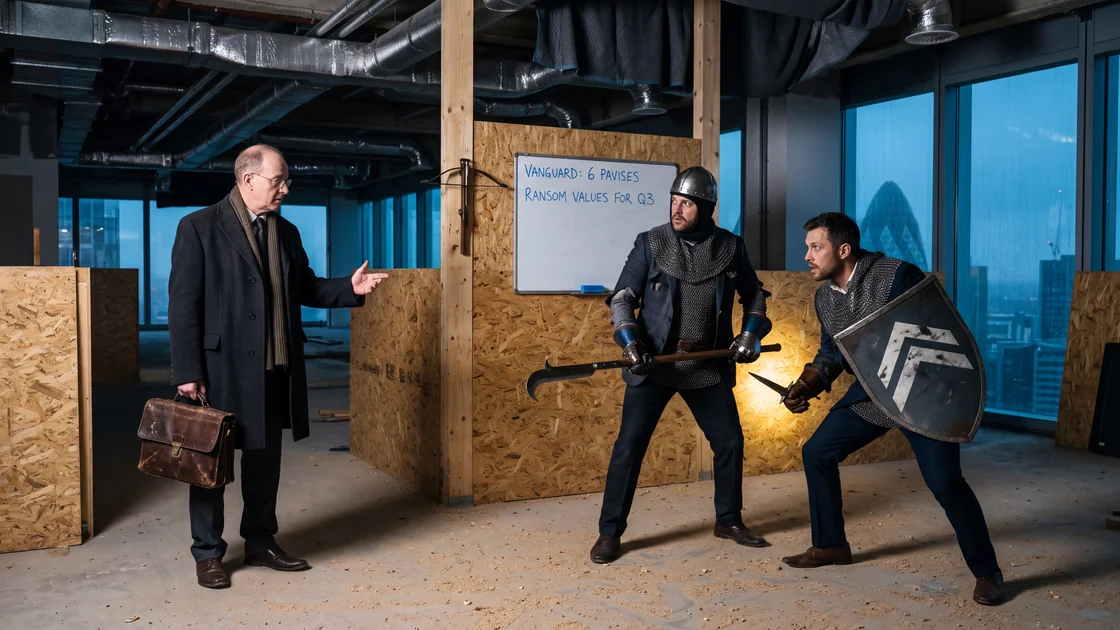
When senior forensic auditor Arthur Finch discovered a recurring seven-figure inventory discrepancy in the books of a Bermudan shell company, he expected to find garden-variety tax evasion, money laundering, or sanctions-busting; instead, his search for phantom logistics led him past the double-glazed security perimeters of London’s financial district into an ancient, subterranean reality. Across dozens of leased, dark-windowed floors in the world’s most prestigious office towers, two feudal dynasties have spent three centuries waging an unacknowledged war of cold steel, shield-walls, and siegecraft, funded through offshore vehicles and fought by armored retinues in cubicle mazes, entirely hidden behind commercial nondisclosure agreements, soundproofed drywall, and corporate acquisitions.
Chapter I: The Variance in Account 409
The invoice was filed under Facilities Maintenance: Non-Standard Structural Reinforcement, billed to an entity named Valois-Aquitaine Logistics (Bermuda) Ltd., and drawn against an escrow account at a private bank in Zurich. It called for four hundredweight of high-carbon spring steel, quenched in oil, tempered to fifty-four on the Rockwell C scale, and delivered not to a machine shop or an automotive plant, but to Suite 1400 of the Northgate Spire on Bishopsgate.
The Northgate Spire was forty-two stories of blue-tinted, energy-efficient glass, occupied primarily by asset managers, maritime reinsurers, and three floors of commercial litigation solicitors. It did not have a freight dock equipped for metallurgy. It had a subterranean loading bay managed by an outsourced logistics contractor whose primary duties involved signing for crates of fair-trade espresso pods, ergonomic lumbar supports, and laser toner.
Arthur Finch took off his spectacles, wiped them with the hem of his necktie, and replaced them. The discrepancy remained.
"It’s an asset transfer," his junior associate, Peter Miller, said from across the partition. Peter was twenty-four, drank cold-brewed coffee from an insulated flask, and still believed that people committed financial fraud for interesting reasons. "Look at the parent corporation. Dunstan Capital Partners. They buy distressed industrial supply firms, gut the pension funds, and park the physical plant in holding companies before liquidating the scrap. It’s just scrap steel on paper to inflate the balance sheet before the quarter ends."
"You don’t temper scrap steel to fifty-four Rockwell, Peter," Arthur said mildly. His voice had the dry, rustling texture of onionskins turned over in a cool cellar. "If you want to fake inventory value, you bill for molybdenum alloy or medical-grade titanium. You don’t order fifty dozen custom leaf-springs and bill them under Sub-floor Dampening Components. And you certainly don’t pay sixteen thousand pounds extra for carriage by unliveried, unmarked Luton vans with cash-on-delivery fuel surcharges."
Arthur tapped the ledger. His monitor displayed three years of general ledger entries for Dunstan Capital, extracted via court order after a secondary mortgage vehicle collapsed in the Cayman Islands. Most auditors would have skimmed the procurement tabs; they were looking for missing billions in synthetic debt obligations. But Arthur was fifty-eight years old, had spent thirty-one of those years within the Serious Fraud Office and private risk consultancies, and knew that the grandest abstractions of theft always left greasy fingerprints in the petty cash.
He cross-referenced the Northgate delivery with three other leases held by Dunstan subsidiaries: an entire empty floor in the Broadgate Tower, three levels of an old brutalist concrete complex on London Wall that had ostensibly been slated for asbestos remediation since 2018, and four contiguous storeys of the iconic, chisel-topped monolith at 8 Canada Square in Canary Wharf.
In each case, the pattern held. High rents paid six months in advance. No sub-tenants listed. Utilities usage showing zero consumption during business hours, followed by sharp, inexplicable spikes in chilled water circulation and heavy-duty ventilation between 1:00 AM and 4:30 AM on alternating Thursdays.
And then there were the pharmaceutical invoices.
"Peter," Arthur called out without looking up. "What is an irrigation-grade hemostatic matrix?"
"Celox or QuikClot," Peter replied after a moment of clattering keys. "Surgical gauze treated with kaolin or chitosan. It stops high-pressure arterial bleeds in trauma bays. Why? Is Dunstan running an illegal aesthetic surgery clinic in the Wharf?"
"At three thousand units a quarter?" Arthur muttered. "They’d have to be doing liposuction with a broadsword."
He leaned back in his swivel chair. The springs groaned in sympathy with his lumbar spine. Outside his third-floor window in Gray’s Inn Road, the London rain was coming down with that particular greasy persistence that made the brickwork look like bruised liver. The sky was the color of a wet cement sack. It was 5:15 PM on a Tuesday in November, the hour when office workers throughout the city began their slow, packed, umbrella-shielded migration toward the Underground, their badges dangling from lanyards, their minds focused on dinner, mortgages, and television.
Arthur clicked through the purchase orders for the Canary Wharf property.
Item 884-B: White oak staves, dried, knot-free, six feet two inches. Qty: 200. Item 902-C: Linen twine, unbleached, beeswaxed, seventy-pound tensile. Qty: 40 spools. Item 114-K: Industrial floor sealant, non-porous, enzymatic, protein-dissolving. Qty: 50 drums.
A man who spent thirty years auditing crooked shipping companies develops an instinct for the smell of a lie. A lie about money is always soft; it rounds off numbers, it hides behind complex acronyms, it attempts to blend into industry averages. But this lie was hard. It had sharp edges. It had the weight of timber and the reek of slaughterhouses hidden behind the crisp, sanitary typeface of an SAP enterprise software export.
"I’m going down to Bishopsgate," Arthur said, reaching for his wool overcoat.
"Now?" Peter asked, turning from his monitor. "The partner wants the preliminary Dunstan audit summary on his desk by nine tomorrow."
"Then tell him I am conducting a physical verification of real property assets," Arthur said, buttoning the coat over his slight, narrow chest. "The books say there are four million pounds of fixtures and fittings installed on the fourteenth floor of the Northgate Spire. I should like to see the color of the upholstery."
Chapter II: The Inspection of the Void
The lobby of the Northgate Spire smelled of expensive white lilies, polished limestone, and ozone from the revolving doors. A security turnstile with optical scanners chirped at intervals as the last stragglers from the day shift presented their fobs.
Arthur did not have a fob. He had an old leather briefcase containing his Institute of Chartered Accountants credentials, a copy of the High Court discovery order against Dunstan Capital Partners, and a laminated inspector’s pass issued by the City of London’s Building Control department—a relic from an old project regarding structural fire ratings that he had never quite remembered to return.
The security guard at the console was young, bearded, and wore a blazer with silver-toned crest buttons that signified nothing.
"Dunstan Capital," Arthur said, laying his credentials on the granite counter with the dry authority only an elderly man with bad knees and an unfashionable haircut can muster. "Fourteenth floor. There’s an unnotified variance in the HVAC secondary intake filters. We need to verify the dampers before the district surveyor’s report tomorrow morning."
The guard looked at the court order, which was covered in enough red wax stamps and chancery script to intimidate a much more experienced man, and then frowned at his terminal.
"Dunstan’s marked as a dark tenancy, sir," the guard said, tapping a screen. "No personnel badges issued. They pay the full service charge, but access is restricted to their own key-holders."
"Precisely," Arthur said, peering over his spectacles with a look of pained condescension. "Which is why the building management is currently non-compliant with Regulation B-Four of the Fire Safety Act. If the secondary dampers are locked from the inside, the whole riser fails pressurization. Do you want to sign the refusal register, or shall I wait for the Fire Brigade’s duty officer to bring the hydraulic spreaders?"
Ten minutes later, Arthur was in Service Elevator C, ascending smoothly through the core of the tower. The elevator did not ding; it simply whispered as its motors took him past asset funds, private equity syndicates, and German re-insurance operations. The indicator panel went blank between twelve and fifteen. When the doors slid back on Fourteen, the air that met him did not smell like the rest of the building.
The lobby downstairs had smelled of air-freshener and wet mackintoshes. This floor smelled of beeswax, cold mutton tallow, iron filings, and something faintly sweet and sour that Arthur’s memory, dredged up from his national service days in a field ambulance unit forty years ago, recognized with an involuntary clenching of his gut: stale sweat dried into heavy wool, and the copper tang of spilled blood that had been scrubbed with vinegar.
The lights were off.
Arthur stepped out into the lift lobby. His rubber-soled brogues made no sound on the floor, but the surface beneath them was wrong. It wasn’t the low-pile industrial nylon carpet found in commercial leases. It was rough, thick linoleum, laid down roughly over the raised access flooring, and sprinkled with a thin, even layer of fine, dry sawdust.
He pulled a small LED torch from his coat pocket and clicked it on.
The beam cut through the darkness, illuminating a cavernous, open-plan space. The suspended ceiling tiles had been completely removed; the galvanized air ducts and sprinkler pipes ran exposed through the gloom fifty feet above, hung with what looked like heavy lengths of felted horsehair blanket, evidently positioned to muffle sound.
There were no desks. There were no computers. There were no ergonomic task chairs.
Instead, the floor had been partitioned with four-inch thick barriers of stacked, glued oriented-strand board, reinforced with cross-braces of raw timber that had been bolted directly into the concrete floor-plates with heavy expansion anchors. The layout was not an office; it was a labyrinth of ninety-degree blind turns, choke-points, and narrow corridors barely wide enough for two men to walk abreast.
Arthur moved forward, his heart knocking with a strange, hollow rhythm against his ribs.
At the first junction, the beam of his torch caught something bright on the wall. It was a corporate whiteboard, standard dry-erase, mounted to the timber barrier. Written on it in blue marker, in a neat, clerkish hand, was a list:
Vanguard: 6 pavises, 8 bills. Flank Guard (Stairwell B): 4 men-at-arms, mail with brigandine. No pollaxes—clearance insufficient. Ransom values for Q3: - Junior Analysts (Bachelors): £5,000 or equivalent in bullion. - Senior Associates (Knights): £25,000. - Managing Directors (Bannermen): By direct treaty only. Escrow via Geneva.
Arthur stared at the whiteboard for a long time. His thumb ran down the aluminum frame. Beside it, driven three inches deep into the timber framing, was an iron bolt—short, square-headed, with stiff vanes made not of feathers, but of stamped sheet brass.
He shone his torch down at the floor. In the sawdust near the corner, the grey wood-shavings were clumped together in dark, purple-black nodules. Someone had dragged something heavy toward the service core. The trail ended at a set of double steel doors marked Freight Lift 2 – Emergency Operation Only.
From behind the wall to his left came the unmistakable sound of steel striking steel—not the ring of cutlery or the clatter of dropped tools, but the heavy, bone-jarring thwack of a blade hitting wood covered in rawhide, followed by a low, guttural grunt of physical exertion.
Arthur did not run. He was too old to run without calculating the strain on his hips, and his mind was still trying to balance the entry. A discrepancy of sixteen thousand pounds for spring steel. Two hundred oak staves. Forty spools of waxed linen.
He turned the corner, his torchlight dipping, and found himself standing at the edge of an open clearing in the cubicle maze—a space where twenty workstations should have been, cleared down to the concrete slab.
Two men were fighting there.
They were not young men playing at sport. They were dressed in long-sleeved, high-collared charcoal-grey charcoal tunic coats that looked, from the cut, like bespoke Savile Row wool, but beneath the unbuttoned wool of their chests gleamed the interlocking links of fine, oil-darkened chainmail. Each wore heavy leather gauntlets that extended halfway up the forearm, reinforced along the knuckles with overlapping plates of blued steel.
One carried a broad, flat-topped shield painted not with a knightly beast, but with the stylized three-chevron logo of De Bohun Asset Management, one of Dunstan’s oldest shell vehicles. The other held a three-foot bar of iron with a beak-shaped pick at one end and a square hammer-face at the other—a lucerne hammer, shortened for work in low ceilings.
They moved with a terrifying, economical silence. There were no shouts, no battle cries. Only the scuff of leather soles on sawdust, the ragged whistle of breath through nostrils, and the dull, wet clack as the pick struck the rim of the shield, splintering the plywood.
The man with the shield stepped inside the arc of the hammer, his right hand coming up from his hip. He was holding a six-inch rondel dagger, its triangular blade ground to a needle point. He didn't slash; he drove it with the heel of his palm toward the narrow gap between the other man’s mail collar and his jawline.
"Stop that," Arthur said.
The voice was not loud. It was the tone he used when a junior clerk brought him an unreferenced reconciliation sheet or when someone tried to expense a bottle of vintage port under Office Sundries.
Both men froze.
The man with the hammer did not lower his weapon, but his eyes, peering out from beneath the rim of an unpolished steel skullcap strapped with modern nylon webbing, flicked toward Arthur. The man with the dagger held his blade an inch from his opponent's throat. His breath smelled of dried beef and peppermint lozenges.
"Who cleared this floor?" the hammer-wielder hissed. His accent was public school, clipped and precise, the voice of a man who spent his weekends rowing for a selective Oxford college and his weekdays analyzing leveraged debt. "The bell isn't until seven. The non-combatant clearance is absolute until the markets close."
"I am from the court-appointed auditors," Arthur said, holding his leather briefcase like a small, flat shield against his midriff. "And you are causing extensive, unamortized damage to the landlord's structural fixtures."
Chapter III: The Articles of the Spire
The man with the dagger withdrew his blade, stepped back three paces, and wiped his face with a linen handkerchief produced from the pocket of his tailored suit trousers. Underneath the wool, his mail coat chimed like a bag of loose sixpences.
"Auditors," he said. He was perhaps forty, with thinning sandy hair, a sharp nose that had clearly been broken and reset by a surgeon who charged by the guinea, and the cold, gray eyes of an equity partner. "Dunstan's people, or the liquidator's?"
"The High Court of Justice, Chancery Division," Arthur said. "Re: Dunstan Capital Partners versus the Kingdom of the North Sea Holdings Ltd. I have an order for physical inspection of all assets registered under Schedule Three."
The man with the hammer spat on the sawdust, leaned his weapon against an oriented-strand-board redoubt, and unbuckled his skullcap. His hair was plastered to his forehead with sweat. "I told them the shell wouldn't hold through the quarter, Hugh. I told the Seneschal. You can't run two hundred thousand pounds of armaments through a Bermudan retail conduit without some bloody pencil-pusher smelling the iron."
"Be quiet, Christian," the older man—Hugh—said. He tucked his handkerchief back into his cuff. He looked at Arthur with a curious, analytical detachment. "You're Finch, aren't you? Arthur Finch. You handled the audit of the Baltic timber fraud in ninety-eight."
"I did," Arthur said. "And the invoices were cleaner than yours. Who authorized the construction of a palisade on the fourteenth floor of a Class-A commercial building?"
"The tenant," Hugh said simply. "We hold the head-lease through 2044. Under the terms of the covenants, the interior configuration is at the tenant's discretion, provided we do not compromise the structural integrity of the floor slabs. Which we haven't. We've load-tested every timber bulkhead against the building's engineering schematics. We even had a team from Arup consult on the stress vectors under the guise of high-density server racking."
He gestured with the rondel dagger toward a door set into the core wall, marked Private – Mechanical Services.
"Come inside, Mr. Finch. You're five minutes away from the end of the truce period. At six o'clock, the lilies come up from the twelfth floor via Stairwell C, and I can assure you that their billmen do not check identification badges."
Arthur hesitated. Then he looked at the sawdust on his shoes, considered the forty-two stories of steel and glass hanging above him in the London drizzle, and followed the man with the dagger through the door.
The room behind the mechanical door had been an executive conference room. The floor-to-ceiling glass windows offered a panoramic view of the City: the Gherkin glowing like an illuminated pickle in the gloom, the lights of Tower Bridge strung across the dark river like yellow beads, the endless red river of brake lights crawling down Leadenhall Street.
The conference table, twenty feet of burr walnut, was still there, but it was covered in maps. Not ordinary maps: these were architectural blueprints of the financial district, layered over with translucent vellum sheets inked with old heraldic devices.
A man sat at the head of the table. He was well over sixty, wearing a charcoal three-piece suit of unmistakable Savile Row cut, though his cuffs were turned back to reveal wrists bound in thick, scarred leather bracers. A pair of gold-rimmed half-moon spectacles sat on his nose, and before him lay an enormous, bound leather ledger with iron clasps, flanked by a Bloomberg terminal and a half-empty glass of single malt.
"We have a trespasser, Sir John," Hugh said, closing the door and dropping an iron bar across its brackets. "An auditor from the Chancery action."
The old man looked up from the terminal. His eyes were like polished flint. "The Chancery action was stayed by an ex-parte order from the Master of the Rolls this morning at ten."
"The order was defective," Arthur said automatically, setting his briefcase on the corner of the walnut table. "The affidavit failed to disclose the ultimate beneficial ownership of the offshore conduits. Rule 39.4. The stay is void until the beneficial owners are deposed."
Sir John stared at Arthur for three long seconds. Then, slowly, the corners of his mouth twitched beneath a neatly trimmed white mustache.
"A formalist," he said. "God deliver me from clerks. Sit down, Mr. Finch. Have some whisky. Or would you prefer to inspect the inventory of our ordinance?"
"I would prefer," Arthur said, remaining standing, "an explanation for why twenty-four tons of tempered spring steel, four miles of bowstring twine, and enough surgical coagulant to treat an infantry brigade have been delivered to three commercial addresses in the square mile under the guise of office fit-outs."
Sir John sighed. He reached out with a manicured finger and tapped a key on his Bloomberg keyboard. A chart appeared on the monitor—not of stock movements, but of commercial square footage leased across London, Frankfurt, and Zurich.
"Tell me, Mr. Finch," Sir John said. "What is a corporation?"
"A legal fiction," Arthur answered without hesitation. "A distinct persona created by statute, capable of holding property, entering into contracts, and suing and being sued in its own name."
"A fiction," the old man repeated, savoring the word. "Quite. A vessel. An artificial man created by royal charter or statutory instrument. And what was the original purpose of the charter, Mr. Finch? In the time of the Plantagenets? In the time of the Great Charter?"
"To grant privileges," Arthur said. "Monopolies. Franchises. Sovereign immunities."
"To manage the King's peace," Sir John corrected him softly. "And to allow those houses that held the land to settle their disputes without burning down the harvests of the common folk. In twelve hundred and fifty-eight, after the Provisions of Oxford, my ancestors—the Bohuns—and the house of Saint-Clair found themselves in possession of certain conflicting claims regarding the wool staple and the tithes of the Marches. The King could not settle it without a war that would have bankrupted the exchequer. And so, a concordat was struck."
He pointed toward the floor beneath their feet.
"A private jurisdiction. A perpetual war of tenure. To be waged by the retinues of the blood, within defined bounds, with weapons of steel and bow, without firearms, without common tumult, and without injury to the King’s customs or his trade. For five hundred years, we fought in the marshes of Essex, in the enclosed deer parks of the north, in the stone cellars beneath the old guildhalls."
He looked around the sleek, climate-controlled conference room with its acoustic-panel ceiling and high-speed data feeds.
"And then came the twentieth century. The deer parks were subdivided into commuter suburbs. The cellars were filled with telephone exchanges and district line tunnels. We were running out of room, Mr. Finch. You cannot draw a longbow in a housing estate without the Constabulary taking an interest. And so, we did what any sensible landed interest does."
"You incorporated," Arthur whispered.
"We securitized," Sir John said, his eyes glittering. "We established investment trusts. We floated property development funds. We acquired commercial leases in long-term leasehold. The law of England is a marvelous thing, Mr. Finch: it regards a man’s leased premises as his castle, absolute against all the world, provided the rent is paid and the exterior windows remain unbroken."
He swept a hand toward the blueprint on the table.
"Four floors in Bishopsgate. Five in Canary Wharf. Three in Frankfurt's Westend. All held through shell companies in Road Town, Jersey, and Curacao. We pay our service charges. We employ night cleaners who have signed seventy-page non-disclosure agreements backed by feudal oaths and offshore trusts for their children’s education. And here, in the dark hours, between the close of the Nikkei and the opening of the London Stock Exchange, we contest the livery of the realm."
Arthur looked at the man. Then he looked at Hugh, who was methodically tightening the leather straps of his arm-harness with his teeth.
"You're having a medieval war," Arthur said, "in an office building."
"We are conducting high-intensity asset management," Sir John corrected him. "The fourteenth floor represents seventy million pounds in convertible debentures. The Saint-Clairs—operating under the name of Caelum Capital—currently hold the twelfth. If they take the riser in Stairwell C before Michaelmas, the covenants convert, their nominees take the board seats, and we forfeit the holding in the port of Antwerp. If we push them back down to the tenth, we take the voting shares in the gas pipeline."
Arthur felt a strange, cold clarity settle over him. The numbers. The invoices. The blood-clotting agents.
"Account 409," Arthur muttered. "The four hundredweight of spring steel."
"Crossbow prods," Sir John said proudly. "One hundred and fifty-pound draw weight. Custom forged by a firm in Sheffield that used to make locomotive springs. They fit through a standard suspended ceiling cavity and can clear a hallway in three seconds without tripping the acoustic sensors on the exterior glass."
Arthur took off his spectacles again. He looked down at his own neat, blue-inked notes in his ledger.
"Your accounting," Arthur said, "is an absolute disgrace."
Chapter IV: The Audit of the Retinue
Sir John blinked. "I beg your pardon?"
"Your logistics conduit," Arthur said, stepping closer to the table and tapping the vellum map with the blunt end of his ballpoint pen. "You’ve routed the Sheffield steel through a freight forwarder in Rotterdam, transshipped it to Tilbury, and then billed it as structural shoring components through an unfunded loan facility in Port Vila. You have three distinct transfer-pricing violations in that chain alone. If HMRC’s Large Business Directorate ever looks at the VAT reconciliation between your Bermudan entity and your UK operating company, they won't find your little knights in mail coats, Sir John. They will issue an immediate third-party freezing notice for four million pounds in unpaid import duties."
The old man’s mouth remained slightly open. For the first time, the flinty certainty in his eyes wavered.
"The lawyers assured us..." Sir John began.
"Your lawyers are chancery pleaders who think money is something that happens to a bank account when a judge nods," Arthur snapped. "They don't understand ledger integration. And this—" he pointed to the dry-erase board through the window, "—this schedule of ransoms. Junior Analysts: five thousand pounds. How are you settling that? In cash?"
"Gold sovereigns," Hugh said from the door. "Struck at the Royal Mint. Carried in the boot of an Audi."
"Unreported taxable benefits in kind," Arthur said, his voice rising in professional indignation. "You're liable for Class One National Insurance on every single squire you ransom from the Saint-Clairs. If one of those boys gets a crossbow bolt through his calf and you compensate him with twenty ounces of bullion, you have created an unrecorded payroll liability. It’s negligence. It’s gross, culpable negligence."
Sir John sat back in his leather executive chair. The terminal beside him chirped—a notification from the building management system that the elevators to the lower floors had been locked out by manual key-switch.
"Mr. Finch," the old man said softly. "Are you telling me that my ancestors have fought the House of Saint-Clair for seven hundred years, survived the Black Death, the Wars of the Roses, the Commonwealth, and the Blitz, only to be brought down by a PAYE assessment?"
"I am telling you," Arthur said, "that the Serious Fraud Office doesn't care about your grandfather’s charter. They care about the missing twelve million in Dunstan’s capital reserves. Which, if I am not mistaken, you have been siphoning off to pay for oak staves, beeswax, and private orthopedic surgeons who don't ask questions about broadhead wounds."
A heavy, metallic crash echoed from the end of the corridor outside. It was followed by the high-pitched, harmonic whine of an industrial fire door being forced against its magnetic seals.
"They're early," Hugh said, his hand dropping to the hilt of his sword. He pulled a black balaclava over his head, followed by his steel skullcap, which he buckled tight under his chin. He snatched up his shield. "They took the freight elevator. They must have bypassed the secondary breaker on the ninth floor."
Sir John did not move. He looked at Arthur with an expression that was no longer amused, but desperately calculating.
"The audit is scheduled for completion at the end of the month," the old man said. "The liquidator is a nominee of Caelum Capital—of the Saint-Clairs. If Dunstan is broken up by the court, our leases are forfeit. The bailiffs will take possession of the Spire. The Saint-Clairs will consolidate the holding, and the House of Bohun will be extinguished from the roll of the realm."
He leaned forward, his rings clicking against the walnut.
"You found the thread in Account 409, Mr. Finch. Can you tie it off?"
"I am an officer of the court," Arthur said stiffly.
"You are an auditor," Sir John countered. "You want the books to balance. If Dunstan collapses, forty million pounds of legitimate commercial debt goes into default. Two thousand people who work for our logistics subsidiaries in Leeds and Northampton lose their pensions. The Saint-Clairs don't care about the subsidiaries; they want the square footage. They want the slaughter."
Another crash shook the drywall—closer this time. The sharp, whip-like thump of a crossbow discharge rattled the conference room’s glass partition. A man cried out—a short, wet bark of agony—followed by the heavy, rhythmic thud of wooden pavises advancing in locked formation down the carpeted hallway.
Thump. Thump. Thump.
"They have twelve bills in the vanguard," Hugh muttered, his eye to the security monitor beside the door. "And they've brought three men in plate. Full harness. Italian work, sixteenth century, looks like. Modern articulated joints. You can't stop them with daggers in these corridors, Sir John. We don't have the frontage."
Sir John looked at Arthur. "Ten thousand guineas, Mr. Finch. Deposited in any jurisdiction of your choosing. Or the equivalent in tax-free sovereign debt."
"I don't want your guineas," Arthur said. He picked up his briefcase, opened it, and pulled out his favorite mechanical pencil—a 0.5mm Pentel with an internal brass clutch—and a pad of green-ruled ledger paper. "And I don't take bribes. But I have spent three weeks trying to make Dunstan's procurement schedules balance, and I will not have my working papers spoiled by an unverified physical asset transfer conducted by men wearing iron skirts."
He pointed the pencil at Sir John.
"Where is your lease agreement for the twelfth floor?"
Sir John blinked. "The twelfth? We don't hold the twelfth. The Saint-Clairs lease it through a subsidiary called Lilywhite Holdings."
"Who is the managing agent?" Arthur demanded. "Quickly, man! The building management company!"
"Broadgate Properties Ltd.," Sir John said. "A joint venture between..."
"They use standard British Property Federation commercial leases," Arthur said, his eyes scanning the architectural drawing on the table. "Clause 14.2: The tenant shall not execute any alteration or modification which impairs the design efficiency of the building’s centralized life-safety or environmental management systems."
Arthur looked up at the ceiling. He pointed his pencil at the heavy horsehair blankets hung from the structural steel.
"You covered the primary airflow sensors to muffle the sound of your shouting," he said. "Which means the localized variable-air-volume boxes are running on default static-pressure settings. If the twelfth floor is occupied by forty men in fifty-pound suits of armor, their metabolic heat output alone must be twenty-five thousand BTUs over design specification."
He reached into his pocket, pulled out his mobile phone, and dialed a number from memory.
"Who are you calling?" Sir John asked, rising from his chair.
"The district surveyor's automated emergency reporting line," Arthur said, pressing the phone to his ear. "And the facilities engineer for the Northgate Spire."
Chapter V: The Logistics of Attrition
The battle in the hallway was not like anything seen on a cinema screen. It was small, cramped, filthy, and smelled intensely of scorched dust and hot lard.
Arthur stood behind the half-opened door of the mechanical room and watched through the gap.
The corridor was eight feet wide, bounded on both sides by the modular drywall of the "office" partitions. Moving down this narrow trench was an iron wall: three broad, rectangular shields made of curved plywood faced with cold-rolled steel plate, bolted together with overlapping leather flaps. Behind each shield crouched a man in a quilted gambeson covered by a sleeveless coat of plates, his face hidden behind an iron visor shaped like an inverted sugar-loaf.
From behind this wall projected four billhooks—eight-foot ash poles tipped with hooked, cleaving blades and top-spikes. They jabbed through the gaps between the shields with the rhythmic, mechanical precision of an industrial loom, searching for feet, throats, and groins.
Opposing them were four of Sir John’s retainers, Hugh among them. They were losing ground. They had no room to swing their swords; every blow caught the drywall, sending showers of white gypsum dust into the air, blinding the men and making them cough.
"Hold the corner!" Hugh roared, his voice muffled by his balaclava. "Don't let them establish the pivot! If they get the bill into the drywall, they'll flank the stairwell!"
A Saint-Clair billman hooked his blade around the edge of Hugh’s shield. With a vicious, downward wrench, he dragged the shield down, exposing Hugh’s neck. A second bill flicked forward like a snake’s tongue, its point aiming straight for the hollow of Hugh’s collarbone.
Arthur stepped through the door.
He was not carrying a weapon. He was carrying his laminated City of London Building Control pass and an emergency fire-warden’s air-horn—a pressurized red cylinder with an orange plastic trumpet that he had unclipped from the wall bracket behind Sir John's desk.
He held the horn two inches from the ear-slit of the leading Saint-Clair knight and depressed the lever.
The sound in the enclosed, drywall-lined corridor was not a noise; it was an atmospheric displacement. At one hundred and thirty decibels, the blast did not merely ring the eardrum—it liquefied the balance centers of the inner ear.
The knight with the bill dropped his weapon, his hands flying to his iron helmet, and collapsed onto his knees in the sawdust, vomiting instantly from sudden, violent vertigo.
The billwall shuddered. The men behind the shields, their ears unprotected beneath their steel caps, stumbled as the blast bounced between the concrete slab and the steel ductwork.
"Building inspection!" Arthur shouted through the temporary silence that followed the horn’s blast, his voice carrying the terrifying, non-negotiable weight of a man who could shut down a construction site with a single rubber stamp. "All operations will cease immediately pending verification of the environmental control systems! Drop that pole, young man, or I will cite you for an uncertified hot-work hazard under Section Twelve!"
The billmen did not drop their weapons, but they hesitated. You do not spend thirty years training to be a corporate litigator or a private equity partner without developing an involuntary, spinal obedience to men with clipboards and high-decibel safety equipment.
One of them—a tall man in beautifully fluted German plate with gold damascening along the elbow-cops—stepped forward, his visor lifting to reveal a lean, aristocratic face with a thin mustache and skin the color of old parchment.
"Who the devil are you?" he demanded. His voice had the flat, imperious ring of an earl who also sat on the board of three sovereign wealth funds. "This is private property. We are the Lilywhite tenancy."
"You are in breach," Arthur said, stepping between the two lines with his pencil poised over his green-ruled pad. "Clause Fourteen. You have ninety men between this level and the twelfth floor. You have exceeded the design occupancy by four hundred percent. You have obstructed the secondary fire escape with two tons of timber bulkheads. And your variable-air-volume dampers have just been locked open by the central building computer."
As if on cue, the round vents in the ceiling began to hiss—not with a gentle whisper, but with a rising, mechanical shriek.
A blast of freezing air, drawn directly from the November storm forty stories above and accelerated by the building's high-efficiency chillers running at maximum emergency purge rate, poured down into the corridor. The temperature dropped five degrees in three seconds.
In an office environment, forty degrees Fahrenheit is an annoyance that produces complaints to the facilities manager. To a man wearing sixty pounds of iron plate over wool padding, soaked through with sweat from twenty minutes of hand-to-hand combat in a confined space, it is an immediate physical catastrophe.
The cold hit the steel plates first. The metal sucked the heat out of the iron harness like a sponge.
The knight with the gold damascening gasped as the icy draft penetrated his mail. His breath blossomed into a white cloud before his face. Behind him, his billmen, their linen tunics soaked through with perspiration, began to shiver violently.
"You can't do this," the knight hissed, his teeth clicking together. "The compact... the concordat..."
"The concordat of twelve-fifty-eight did not contemplate computerized building automation systems," Arthur said mildly. "Nor did it include a waiver for the Climate Change Levy. Do you have any idea what the energy surcharge is for running three secondary chillers at full capacity during peak grid hours? It is forty-four pence per kilowatt-hour, my lord. Billed directly to Lilywhite Holdings Ltd."
He turned to Sir John, who was watching from the conference room door with his mouth twitching into something like awe.
"Sir John, if you hold this floor for another twenty minutes, Lilywhite’s electricity bill for the current billing cycle will exceed their liquid reserve balance at Coutts. I’ve seen their balance sheet. Their short-term debt is leveraged against their receivables from the Antwerp docks. If they incur a seventy-thousand-pound utility penalty before midnight, their covenants fail. They will be insolvent by breakfast."
The knight in the fluted plate stared at Arthur. His visor dropped an inch, then lifted again. He looked at his men, who were already huddling together, their iron-shod boots clattering on the cold linoleum like loose stones in a chute.
"Finch," the knight whispered. "You're the liquidator's man."
"I am nobody's man," Arthur said, clicking his Pentel pencil. "I am an auditor. And your numbers do not balance."
Chapter VI: The Parliament of Canary Wharf
The treaty was signed at 3:30 AM in the executive dining room on the thirty-eighth floor of 8 Canada Square.
Outside the floor-to-ceiling glass, the towers of Canary Wharf rose like glowing geometric pillars out of the grey sea of the London night. Far below, the Thames curved like a broad, black ribbon of wet slate through the docks, reflecting the blinking red warning lights of the air-traffic beacons atop the skyscrapers.
The table was spread with linen, not blueprints. A silver tea service sat between Sir John de Bohun and Lord Thomas Saint-Clair. Neither man was wearing armor now; both were dressed in bespoke dark suits, their hair brushed back, their cuffs immaculate. Only the dark purple bruises along Saint-Clair’s jawline and the stiffness with which Sir John held his left shoulder gave any indication of what had occurred six hours earlier on the fourteenth floor of the Northgate Spire.
Arthur sat at the end of the table. Between his teacup and his buttered toast lay four thick manila folders, each containing thirty pages of reconciled general ledgers, corporate structure diagrams, and cross-border lease assignments.
"It is quite simple," Arthur said, his voice flat and measured as he pointed with the back of his spoon to a flow-chart. "The current model is unsustainable. You cannot continue to fund a fourteenth-century war of attrition through twenty-first-century private equity conduits. The administrative drag alone is eating up forty percent of your gross yield."
Both men looked at him in silence. Across the room, Hugh and a young knight from the Lilywhite retinue—a lad who looked as though he had been rowing for Eton three weeks ago—stood guard by the service doors, their hands resting easily on the hilts of their sheathed arming swords.
"What do you propose, Mr. Finch?" Lord Thomas asked. His voice was hoarse from the freezing air Arthur had dumped into the corridor.
"Consolidation," Arthur said. "You have twenty-two shell companies in five jurisdictions, all competing for the same commercial leases in the City and the Isle of Dogs. You are driving up your own square-footage costs. The rental market in London is already absurd without two ancient Norman families outbidding each other for empty floors in order to fight over wool tithes that were commuted to cash payments in fifteen-forty."
He flipped a page in the ledger.
"Under the scheme I have prepared, Dunstan Capital and Lilywhite Holdings will merge their property management assets into a single UK-domiciled Real Estate Investment Trust—a REIT. Under the provisions of the Corporation Tax Act 2010, a REIT is exempt from corporation tax on its property rental business."
Sir John frowned. "A joint trust? With the Saint-Clairs? Our charter..."
"Your charter is currently held as an encumbered asset by a bank in Liechtenstein that was placed under administration on Monday," Arthur said without looking up. "I bought the debt this afternoon for eighty-four thousand pounds, using the surplus from your own undeclared reserve account."
He looked over his spectacles at Sir John.
"You now owe me forty-two thousand pounds, Sir John. At five percent over base. I expect monthly installments."
Lord Thomas let out a short, bark-like laugh that ended in a cough. "And the combat, Finch? The livery of the realm? The tenure of the Marches? You expect us to settle seven hundred years of blood with a dividend distribution?"
"Certainly not," Arthur said. "You will continue to fight. The covenants will require it."
He turned the page.
"The fourteenth floor of Northgate, the ninth floor of the Broadgate Tower, and the entire basement complex at London Wall will be leased by the REIT to a non-profit company limited by guarantee: The Society for the Preservation of Corporate Governance and Physical Culture. The combat will take place within designated, soundproofed testing facilities certified under British Standard EN 1522 for ballistic and forced-entry resistance."
"Testing facilities?" Lord Thomas repeated, horrified.
"Ergonomic stress-testing," Arthur said smoothly. "We will bill it to your tenants as an ongoing research and development program into high-intensity physical conflict within modern open-plan office layouts. It is fully deductible under current HMRC R&D tax credit schemes. For every billhook you break over a Bohun retainer, the trust will receive a thirty-three percent cash rebate from the Treasury."
Sir John leaned forward, his spectacles slipping down his nose. "A tax rebate? On bills?"
"And on crossbow prods," Arthur said. "Provided they are manufactured by an enterprise located within an English Development Area—which Sheffield conveniently is. You will save one point two million pounds in logistics overhead in the first fiscal year alone."
He closed the folder with a dry, papery snap that sounded like a small gavel falling in an empty courtroom.
"Furthermore, the ransom schedule is to be formalized. No more gold sovereigns in the boots of motorcars. All captures will be settled via electronic funds transfer within thirty days of the encounter, categorized as Executive Outplacement and Dispute Resolution Fees. The captive will be returned to his parent company without prejudice to his holiday entitlement, and his PAYE records will reflect a standard educational sabbatical."
Silence descended on the thirty-eighth floor.
The two old men looked at each other across the linen. Behind them, the first grey light of dawn was beginning to touch the needle of the Shard across the river, turning the glass from ink-black to a pale, cold lavender.
"And your fee, Mr. Finch?" Sir John asked softly. "I presume you do not perform these... administrative reconciliations... out of a pure love for the King's peace."
Arthur picked up his briefcase, opened it, and neatly stowed his Pentel pencil, his green ledger pad, and his spectacle case.
"I have appointed myself Senior Independent Comptroller to the Trust," Arthur said, clicking the brass locks shut. "With an annual retainer of ninety thousand pounds, index-linked, and exclusive access to the third-floor records room at Bishopsgate. I have observed several irregular depreciation schedules in your armor accounts that I intend to audit before the half-year."
He stood up, buttoned his wool coat over his narrow chest, and pulled his knitted scarf tight around his throat.
"Good morning, gentlemen. If you are going to kill each other on the ninth floor of the Broadgate Tower this evening, please ensure your squires use the service entrance. The freight lift has just been re-carpeted, and the management company charges fifty pounds an hour for steam-cleaning."
Chapter VII: The Balance Sheet of the Night
It was 7:15 AM when Arthur Finch descended the escalators into the Canary Wharf Underground station.
Around him, thousands of men and women in dark overcoats were pouring out of the Jubilee line trains, their faces grey and neutral in the artificial glare, their shoes clicking in a vast, subterranean unison on the granite tiles. They looked like an army—silent, disciplined, moving under invisible banners toward their towers of glass and steel.
None of them looked at Arthur. He was just another elderly clerk in an unfashionable mackintosh, carrying a battered leather briefcase that had seen the death of three merchant banks and four corporate reorganizations.
He reached into his pocket and his fingers brushed against something hard, cold, and square.
It was the brass vane from the crossbow bolt he had pulled from the timber bulkhead on the fourteenth floor of the Northgate Spire. He had notched it with his pocket-knife to mark the measurement of the shaft.
He thought of the two men in their tailored suits, sitting in the high tower, signing the share-transfer covenants that converted seven centuries of feudal slaughter into an eight-percent yielding real estate trust. He thought of the young men in the cubicle maze, their mail coats clinking softly beneath their suits, waiting for the market-close bell to draw their bills and form the shield-wall among the photocopiers.
The world was not rational, Arthur knew. It had never been rational. It was merely double-entered.
If a man had blood in his veins, he would find an excuse to spill it; if he had gold in his vault, he would find a way to hide it; and if he had an office tower sixty stories high, he would eventually find a way to turn it into a fortress against the night.
Arthur stepped onto the train, found an empty seat near the door, and opened his briefcase.
He pulled out his ledger pad, clicked his mechanical pencil, and turned to a fresh, white page. At the top, in his neat, copperplate script, he wrote:
The Sovereign Trust (Consolidated). Audit Period: Michaelmas to St. John’s Day. Schedule A: Fixtures, Fittings, and Retinues.
He paused, looked out the window as the dark tunnel walls rushed past, and then wrote the first entry:
To: One dozen billhooks, standard pattern, ash-handled. Credit: Account 101 (Cash at Bank). Debit: Account 409 (Office Equipment & Hardware).
Arthur Finch smiled, adjusted his spectacles, and began to balance the books.