The Cartographer of Unborn Stone
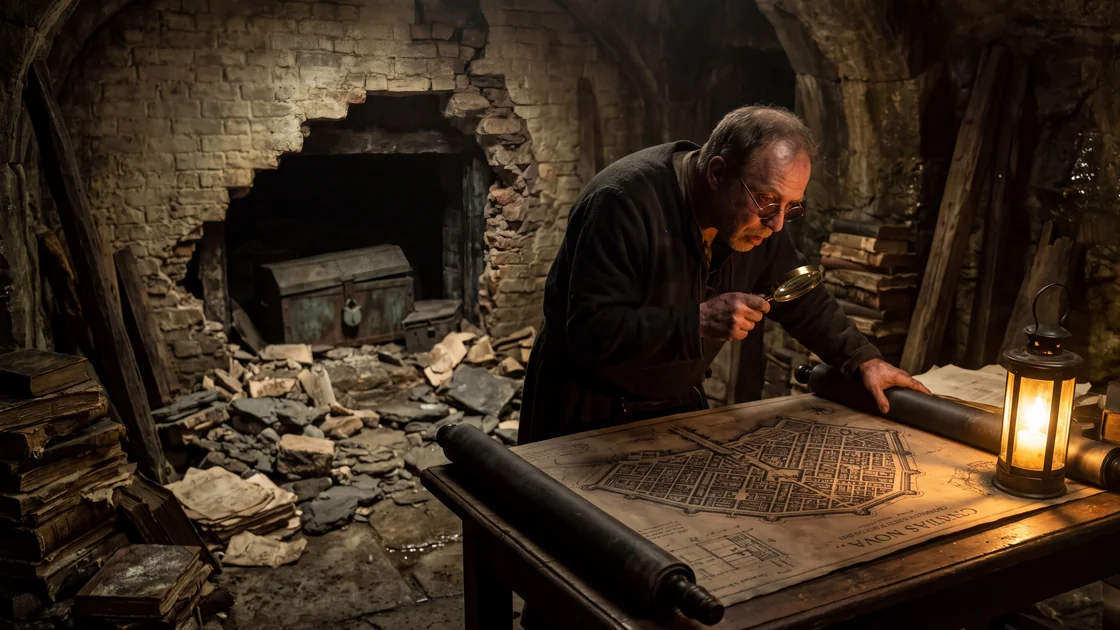
This is the account of Silas Varos, a senior cataloger in the subterranean Great Depository of Veridia, who, while auditing long-abandoned archives in the sunless foundations of the earth, discovered a set of centuries-old maps delineating vast, technologically staggering metropolises that had not yet been built. As Silas unravels the provenance of these impossible charts, he is drawn into a clandestine conflict against both his dogmatic superiors and the terrifying realization that history is not a wake trailing behind humanity, but a wake trailing before a design already drawn, surveyed, and waiting to be inhabited.
I. The Sediment of Paper
The Sump was not meant for men who loved the sky. It lay nine tiers beneath the cobbles of the capital, below the crypts of the Iron Kings, below the dry cisterns of the plague centuries, and two fathoms lower than the seepage-line where the subterranean River Morne wept rust through the shale. Down here, the air tasted of sulfur, dried tallow, and the powdery, sweetish rot of pulped rag-paper that had not seen a summer breeze since the third dynasty.
Silas Varos was fifty-one, though his spine had taken the curve of a reading-desk when he was thirty, and his eyes, behind spectacles ground from lead-tinted beryl, were permanently dilated to drink in the meager light of whale-fat lanterns. His official title within the Bureau of Inscription was Collationist Third-Class, a designation that carried no stipend to speak of, but granted him the right to carry an iron ring bearing forty-two notched keys, a pair of vulcanite tweezers, and an ivory bone-folder yellowed with the grease of a hundred thousand folios.
His domain was Sector Seven-Omicron: the sediment.
When a province fell to famine, its parish registers were hauled here in salt-crusted hampers. When a guild of clockmakers or glass-blowers went bankrupt under the trade tariffs, their patents, liens, and apprentice rolls were loaded onto freight-skiffs, lowered through the steam-driven winches of the North Shaft, and trundled into the damp corridors to stiffen in the dark. For twenty-four years, Silas had been sifting this alluvial drift. He lived by the catalog-slip and the gum-pot. His fingers were permanently stained with nigrosin ink and gall-extract, the blackness worked so deeply into the whorls of his thumbs that he often thought his very blood had begun to run dark and acidic.
On the Tuesday that broke the rhythm of his life, the draft from the ventilating flues brought with it a smell of dead pine.
It was not the damp, spongy rot of native Veridian oak, but the resinous, dry musk of high-altitude cedar, timber that had cured in the cold winds of the northern spine. Silas raised his head from a mundane audit of excise receipts from the salt-pans of Ostra. He adjusted his lantern, the flame sputtering as a droplet of condensate pinged against its tin reflector.
At the far end of Corridor Twelve, where the limestone walls narrowed until a broad-shouldered man had to walk sideways, a ceiling-prop had surrendered.
The crash had been muffled by centuries of dead cellulose, sounding no louder than a sack of oats dropped into dry flour. Silas took his ash-wood cane, his lantern, and his iron keys, and picked his way through the rubble. The shale had calved along a natural fault-line, shearing away an expanse of lime-washed brick that had been considered solid wall since the reign of King Alden the Mute.
Behind the fallen brick lay a void—a horizontal seam barely four feet high, choked with gray dust that rose like smoke the moment the lantern's draft touched it.
Silas did not call for the trench-boys. The trench-boys were half-wild urchins employed by the Ministry to clear rubble and trap blind rats; they were clumsy, illiterate, and had a habit of stealing the lead seals off consular dispatches to sell to pewter-smiths. Instead, he dropped to his knees, his woolen trousers drinking up the chalky moisture of the floor, and thrust the lamp into the breach.
The chamber beyond was small, dry, and shaped like the inside of a wedge. It was lined not with the cheap deal shelving of the upper stacks, but with plates of hammered lead, bolted to the stone with squarish iron rivets. In the center of this lead-lined sanctuary rested five low chests of beaten zinc, their hasps secured with padlocks the size of turnips, cast in the likeness of hooded owls.
Silas leaned forward, his spectacles slipping down the bridge of his grease-sheened nose.
"Lead-shielded," he murmured to the dead air. "Lead against water. Lead against mites. Lead against light."
He wiped the dust from the nearest chest with the cuff of his smock. Upon the lid, etched with an acid-pen in the neat, cramped hand of the late Renaissance, ran an inscription:
CARTOGRAPHIA SUPPRESSA. EXEMPLA NON DATA. ANNO DOMINI 1411.
Silas sucked in a lungful of stale lime. Fourteen-eleven. Four hundred years before the present era. A time when the Kingdom was nothing more than eight warring baronies huddled along the Morne, armed with iron-tipped ash spears and burning peat for warmth.
He tried his keys. None of the forty-two fit the archaic, four-bitted keyway of the owl-lock. He stood, his knees cracking like dry twigs, walked back to his desk, retrieved a small steel crowbar he kept for prying apart glued ledgers, and returned to the gap.
The zinc was soft with age. With three sharp, levering thrusts that echoed down the empty corridor like distant musket-fire, the hasp shrieked and parted from the carcass.
Inside, wrapped in oily horsehair cloth and padded with dried lavender that had long since lost its color and turned to gray tinder, lay a stack of rolled documents. They were neither parchment nor the coarse rag-paper of the fourteenth century. When Silas touched the margin of the outermost roll, his fingers encountered a surface as cool, slick, and grainless as the inner skin of a bird's egg.
It was vellum, but vellum of an unnatural perfection—uterine vellum from some creature bred without blemish, stretched to the thinness of an insect's wing, yet so tough it resisted the nip of his steel fingernail.
He lifted the roll. It was heavy, weighted at both ends with slender rods of turned ebony.
Silas carried it to his reading table, cleared away the salt-pan excise books, wiped the oilcloth with his sleeve, and set four brass paperweights upon the corners. Then, with breath held between his teeth, he unrolled the scroll beneath the circle of the lamp.
II. The Grid of the Unborn
The map was sixty inches wide by forty deep. It was executed in ink so intensely, brilliantly black that it seemed to absorb the tallow light rather than reflect it.
The title across the northern margin was lettered in a pristine, humanist lapidary hand, touched with vermilion at the capitals:
CIVITAS NOVA TRANS-MORNUM: SEU AURORA INTERIOR. (The New City Beyond the Morne: or, The Interior Dawn.)
Silas bent low, his nose barely three inches from the surface. He knew the geography of the Morne valley with an archivist’s pedantic intimacy. He knew every oxbow, every willow-skirted island, every limestone bluff where the robber-knights had raised their keep-towers before the central kings pulled them down with teams of oxen.
The river was there. The great S-bend where the water slowed and deposited its gray mud was rendered with absolute cartographic fidelity. The three bluffs of St. Jude were marked. The salt-marshes to the west were shaded with delicate, microscopic cross-hatching.
Yet there was no city of Veridia upon the bluffs.
In place of the sprawling, chaotic hive of slate roofs, timber gables, and open sewage rills that Silas had walked through that very morning, the map depicted something monstrous, orderly, and grand.
The bluffs had been leveled into five terraced steps of white stone. Across the river—a span where currently only two rickety wooden bridges and a ferry-rope existed—the map showed seven immense spans of triple-arched masonry, each wide enough to accommodate four lanes of carriage-traffic and flanked by raised promenades lined with double ranks of stylized trees.
Silas followed the avenues inland. They did not curve or branch like the cow-paths of the old town; they cut through the topography with the terrifying certainty of Euclidean proof. They radiated from a central octagonal plaza three hundred rods across, in the middle of which sat the ground-plan of an edifice labeled: Aedes Machinarum—The Hall of the Great Engines.
Silas brought his magnifying glass down over the Aedes.
The detail was maddening. The draftsman had not merely indicated the walls; he had drawn the interior partitions, the foundations, the underground conduits, and the drainage channels. Beneath the building, at a depth indicated by tiny marginal scales marked in passus metrici, ran a series of subterranean vaults.
Silas froze. His thumb twitched against the brass rim of his glass.
He recognized the geometry of the vaults.
The central pillar. The radial corridors labeled One through Eighteen. The small, wedge-shaped chamber tucked behind the foundation wall of Corridor Twelve.
He was sitting inside the map.
He was sitting in a room that, according to the date on the box—1411—would not be dug for another two hundred and sixty years. For the Sump had been excavated under the direction of the Grand Master of Works in 1675, during the height of the Great Coalition War, to shelter the national tax rolls from the artillery of the Dukes of the Coast.
Silas turned his eyes to the lower right corner, seeking the cartographer’s signature.
There was no guild crest. No royal privilege. Just three lines of text, penned in the same relentless black ink:
Delineated by Jonas the Geometer, from the Sight of the Eye, during the three-day Fever of St. Martha, 1409. Verified by computation. The ground is dry; the people are yet smoke; the stone awaits its quarrying. Let him who looks upon this measure his days, for the line does not waver.
Silas raised his head. The library around him was utterly silent, save for the rhythmic, bronchial sigh of the ventilation stack three corridors away. A beetle, small and blind from the dark, crawled across the rim of an inkwell, its antennae questing through the gloom.
"Jonas," Silas whispered.
The name was not in the Registry of Masters. Silas had indexed the rolls of the Guild of Scriveners, Limners, and Chart-Makers twice in his career. There had been a Jonas of Ghent, who drew sea-monsters on the margins of Icelandic rutters, and a Brother Jonas of the Abbey of the Thorn, who illuminated missals until his eyes burst from the strain. But neither of them drew like this.
This was not illumination. This was not the work of a monastic dreaming of the New Jerusalem with pearl gates and weeping seraphim.
This was an engineer's working survey. The street widths were given in fractions of a unit Silas had never seen before—units divided into tenths and hundredths rather than inches and chains. The names of the quarters were functional, devoid of saints’ names or royal flatteries: The Quarter of the Iron Foundry; The Basin of the Distillations; The Great Southern Grain Silos.
In 1409, the land south of the river had been a desolate peat bog where outlaws boiled bark to tan wolf-skins. Even now, in Silas’s own time, it was mostly brick-kilns and hovels. Yet here, upon this skin that smelled of nothing, the bog was occupied by eight immense rectangular basins, each labeled: Reservoirs for the Clarification of City Water through Sand and Charcoal.
"Sand and charcoal," Silas murmured, his voice dry as split reeds. "We only began using gravel-beds at the South Water Gate five years ago..."
He rolled the map back three inches, his hands shaking so violently that one of the brass paperweights slipped and rolled across the flagstones with a dull, hollow clatter.
He reached into the zinc chest again.
There were four more rolls.
He pulled the second one into the light. It was smaller, executed on a slightly yellowed ground, and bore the label:
PORTUS NOVI COLOSSI: SECUNDUM ORDINEM FATO DESIGNATUM. (The Port of the New Colossus: According to the Order Designated by Fate.)
He unrolled it. It did not depict the Morne, nor any river in Veridia.
It showed an island—a hook-shaped spit of sand that Silas recognized after a moment’s disorientation as the uninhabited reef of Cape Desolation, three hundred leagues to the south, in the teeth of the Great Ocean. It was a place where nothing grew except salt-grass, where whalers sometimes went ashore to boil blubber on the beach before the winter gales drove them into the sea.
The map showed the reef enclosed by two monumental stone breakwaters, three miles long, each terminating in an octagonal lighthouse. Behind the breakwaters lay berths for sixty deep-draft vessels. And along the shore of what was currently wind-scoured shingle stood a city of eighty thousand souls, its districts organized in concentric rings around a dry dock large enough to hold three first-rate men-of-war end-to-end.
The date in the cartouche was 1398.
The draftsman was the same.
Jonas the Geometer. The ground is dry; the people are yet smoke.
Silas pressed his cold knuckles against his teeth. He felt a sudden, sickening vertigo, as if the floor beneath his desk had melted away into the black, roaring space of the abyss.
A man could invent an imaginary city. Romances were full of them: islands of copper towers, palaces of crystal where philosophers sat upon thrones of amber. The poets produced them for the coronations of kings.
But poets did not calculate the cross-sectional camber of sewage gutters.
Poets did not mark the position of the hydrants.
Poets did not calculate the high-water drainage of the docks with tables of sines and tangents, nor did they note, in a small, arid hand along the western jetty: Here the silt will gather three inches every five winters; let the dredging-wheel be placed upon the pontoon marked C.
This was not a dream. This was an assignment.
III. The Salt of the Reef
For three days, Silas did not file his collation slips.
He locked the heavy oak wicket that separated Corridor Twelve from the rest of Sector Seven-Omicron, hanging upon it the standard tin placard that read: INSPECTION AND FUMIGATION AGAINST BOOK-WORM BY ORDER OF THE CURATORS.
No one came to dispute it. In the Sump, a man could die at his desk and dry out into a parchment mummy before the Collation Bureau noticed his absence, provided the quarterly manifests were not overdue.
Silas worked by the light of three lanterns now, having scavenged two from the empty stalls of Sector Nine. He had brought down his instruments: a pair of English brass dividers, a boxwood rule marked in standard imperial ells, and a notebook bound in limp calfskin.
He laid Portus Novi Colossi upon his slate drafting-slab.
Beside it, he placed the latest naval admiralty charts of the Southern Sea, surveyed by Captain Karswell two summers before and printed by the Royal Hydrographer in the Upper City.
He set the point of his divider upon the landmark known as the Crow’s Beak, the only high rock on the barren reef of Cape Desolation. On Karswell’s chart, it was marked with a crude cross and the note: Grave of six seamen of the brig Hester, died of scurvy, 1794.
He brought the divider to Jonas’s map of 1398.
The Crow’s Beak was there. But it was not a cross. It was the base of an artillery platform—a bastion with six embrasures, designed for cannons of enormous caliber.
Silas noted the angle between the Beak and the Southern Shoals.
Thirty-two degrees, forty minutes.
He checked Karswell’s chart.
Thirty-two degrees, forty-one minutes.
A difference of one minute of arc over four hundred years—the difference accounted for by the slow, secular precession of the magnetic needle, which Jonas had apparently understood and corrected for centuries before the Academy in the Upper City had even recognized its existence.
"Who were you?" Silas whispered to the stones of the vault. "Who bought your ink?"
He left the Sump at noon on Friday. It was the first time in eighteen months he had ascended to the surface during daylight.
The light of the Upper City was an insult to his eyes. It was a pale, greasy autumn noon, the sun hanging like an unscrubbed copper kettle behind the coal-smoke of the river wards. The air was full of the roar of iron-tired drays, the shrieks of fishwives selling gray haddock from the estuary, and the hollow, mournful tolling of the bell from the Church of the Holy Sepulchre.
Silas walked with his head down, his coat buttoned tightly across his narrow chest, one hand pressed against the hard rectangular shape of his calfskin notebook inside his pocket. He smelled the horse-dung, the cheap tallow from the chandlers, the sour mash of the gin-shops—the filthy, squalid vitality of a city that had grown like a tumor across the mud of the Morne.
He made his way to the Admiralty Office, a squat building of Portland stone near the Customs Wharf.
His archivist’s pass, though dusty, was honored at the side door. The clerk in charge of the Hydrographic Office was a young man named Povey, whose hair was combed with sweet-oil and who wore cuffs of clean, starched linen that filled Silas with a strange, defensive shame.
"Mr. Varos?" Povey said, looking at the ancient, ink-blackened fingernails of the old man. "Sector Seven? Good heavens, I didn't know they let you people out into the daylight. What’s amiss? Has the rat-catchers’ account from the Seven Years' War gone missing?"
"I require the log-books," Silas said. His voice was thin and dry from disuse, like the rustling of dry onion skins. "The logs of the merchant skippers who put in from the Southern Reach within the last thirty days."
Povey sneered, but the Registry Laws were absolute: a Collationist of the Great Depository had the right to inspect any state paper filed before noon of the current day.
"They’re on the third table," Povey said, waving a languid, scented hand. "The brig Mermaid, the barque Crest, and the government cutter Argus. Arrived Tuesday. Nothing in them but seal-skins and whale-oil."
Silas ignored the young man. He sat at the table, took out his spectacles, and opened the canvas-bound journal of Captain Thomas Crane of the Argus.
He turned the leaves until he came to the entry for the fourteenth day of August.
Anchored off Cape Desolation in six fathoms, Crane had written in a sprawling, salt-stained hand. Sent the long-boat ashore for fresh water, but found only brackish puddles in the shingle. The third mate reports a party of Dutchmen or Germans have landed on the western point. They have pitched three marquees of green canvas and are driving piles into the sand with a heavy iron ram.
Silas’s heart skipped a beat against his ribs.
I went ashore to inquire their business, the log continued. Spoke with a man who called himself an Engineer-Agent of the New Antwerp Company. He showed me a parchment warrant signed by the Emperor himself, granting them the sole right to the roadstead for ninety-nine years.
When I asked him what he meant to build upon a sandbank that is underwater three days in seven during the winter gales, he laughed and told me they were laying the foundations of the Western Mole.
He had with him fifty stone-masons from the Rhine and three barges of cut basalt. He showed me their plans. They are mad. They intend to build a mole eighty cubits wide, with a light-tower at the head. I told him the first south-wester would roll his basalt into the trench like walnuts, but he showed me an old drawing—done on very fine, thin skin—which he said showed the bottom of the bay was not sand, but blue clay over granite at twelve feet down.
We sounded with the iron rod, and found the blue clay precisely where his chart had marked it.
Silas closed the log-book. His hands were ice-cold.
"Mr. Povey," he said softly.
"Yes, Mr. Varos?"
"The New Antwerp Company. When was it chartered?"
Povey glanced up from a dispatch he was sand-blotting. "Last spring, I think. A joint-stock affair. Very grand, very secretive. They say half the ministers on the King's Council have shares in it. They claim they will make the southern passage safe for the spice trade by building an artificial harbor."
"And their engineer," Silas whispered. "Who drew their survey?"
"Some foreign fellow, I suppose," Povey said with a shrug. "Or an old map from the archives in Madrid. God knows the Spaniards spent enough gold trying to find a harbor down there two hundred years ago."
"Not Madrid," Silas said, rising from his chair.
"What's that?"
"Nothing," Silas said. "A collation error. Good day, Mr. Povey."
IV. The Archive of the Unbuilt
That night, Silas did not sleep in his truckle-bed beneath the stairs of Corridor Nine.
He brought down from the surface a sack containing six loaves of hard ship-biscuit, a jar of pickled herrings, and four pounds of tallow candles. He dragged two empty packing cases across the gap in Corridor Twelve to seal the breach from the inside, leaving only a slit through which he could squeeze his thin frame.
He lit all five lanterns. The wedge-shaped vault of lead glowed with a dull, yellowish radiance that turned the sweat on his forehead to gold.
He opened the remaining three zinc chests.
There were twenty-eight rolls in all.
They did not merely describe cities. They described an entire geography that did not exist—or rather, that did not exist yet.
There was a map of the valley of the Rhine, but the castles on the crags were marked with black crosses and the word RUINA, while the flat fields between the hills were covered with vast, geometric iron-works labeled Officina Vulcania, each linked to the next by double black lines labeled Viae Ferreae—Roads of Iron.
There was a map of the marshland around the fishing hamlet of Paris, dated 1402.
The hamlet was gone. In its place lay a city of stone blocks so vast they dwarfed the Colosseum of Rome. Broad boulevards, three hundred yards across, cut through the medieval maze like knife-wounds through lard. In the margins, the draftsman had sketched the elevations of the buildings: seven-story facades of uniform stone, with mansard roofs of zinc and iron balconies that repeated the same spiral leaf-pattern every thirty cubits with mechanical precision.
Silas laid his magnifying lens over the margins of the Paris map.
There, in a small, square inset, was a drawing of a monument: four arched legs of open iron framework, tapering to a single needle that pierced the clouds. The scale indicated a height of one thousand feet.
One thousand feet.
The highest spire in Christendom, the Cathedral of Strasbourg, was barely four hundred and fifty, and its stone masons had prayed for divine grace every time they laid a course of ashlar, lest the devil cast it down.
Yet this needle of iron had been calculated not with prayers, but with diagrams of wind-pressure and tensile moments. The math was written out in the margin: Greek letters, unknown symbols for integration, columns of figures that Silas, who had once mastered the arithmetic of the Treasury, could only follow for four or five steps before the logic leaped into a dark, terrifying light.
"He was not dreaming," Silas said. He was talking aloud to the lead walls now, his voice crackling like dry straw. "A man cannot dream a stress-diagram. A man cannot dream the logarithmic decay of a river’s scour."
He moved to the fourth chest.
Here the maps were different. They were not cities of stone and iron. They were cities of something else.
One was labeled: CHRYSEIA IN VALLIBUS LUNA.
The ground-plan was not rectangular, nor circular. It was an irregular, branching structure like the frost that forms on a window-pane in January, or the silver veins in the ores of Potosi. The scale was not marked in cubits, nor in meters, but in Micro-Stadia.
The buildings were not separated by streets; they were continuous. A single, porous mountain of cellular honeycombs, twenty miles long, through which ran arteries labeled Venae Lucis—Veins of Light.
And on the margin of this sheet, Jonas had abandoned his Latin.
In the lower corner, written in a crabbed, modern hand that seemed to have struggled with the stiff pen, ran four lines in English—not the English of Chaucer's court, nor the English of the present day, but an English that sounded like iron filings ground between two stones:
The steel was too soft for the lower pylons. We had to melt the bells from the old city to make up the antimony. It will not hold past the seventh century of the third turn. Tell the Master the water is coming in through the seal-seams. We are drawing the plans now, before the salt ruins the glass.
Silas stared at the words until the letters seemed to detach themselves from the vellum and float like midges in the tallow smoke.
We are drawing the plans now...
He touched the surface of the vellum.
It was not cold.
He pulled his hand back as if he had laid it upon a hot griddle. He held his fingertips to his lips. They were warm. The skin of the scroll had the faint, unmistakable warmth of a living palm that had just been lifted from a table.
He leaned down and smelled the vellum.
It did not smell of lavender. It did not smell of cedar.
It smelled of ozone. It smelled like the air after a lightning-stroke has split an oak in an open meadow.
V. The Visitor in the Lower Scriptorium
The sixth day of his isolation was a Sunday.
Silas knew it was Sunday because the water-pipes that drained the palace latrines above Corridor Seven had ceased their intermittent splashing; the court was at chapel, listening to the Bishop preach upon the vanity of earthly ambitions.
Silas sat at his table, his eyes bloodshot, his beard white with two weeks of salt-dust and bread-crumbs. He had organized the twenty-eight rolls into a sequence.
The sequence was not chronological according to their dates of execution. Jonas had dated them all between 1395 and 1415.
The sequence was chronological according to their content.
First came the cities of timber and brick, where the medieval walls were replaced by the low, star-shaped bastions of the artillery era. These Silas recognized: they were the cities of the seventeenth century—cities that had actually been built, stone for stone, just as Jonas had drawn them. He found a map of the fortress-town of Lille, dated 1401, that matched the fortifications raised by the French marshal Vauban nearly three hundred years later, down to the exact half-angle of the ravelins.
Then came the cities of iron: the great, smoking basins of the industrial valleys, the rail-grids, the high chimneys, the ports with their hydraulic cranes. Silas had lived to see the first awkward beginnings of these things in the northern shires, where the coal-pits were already using steam-pumps to keep the sumps dry. But Jonas had drawn them in their full, monstrous maturity—landscapes of soot and steel where the rivers were encased in stone gutters and the sky was crossed by webs of copper wire.
Then came the cities of concrete and glass: towers that stood like crystalline prisms in landscapes stripped of trees, cities where the earth had been paved over until not a blade of grass could poke its head through the gray crust.
And then, at the end of the sequence, came the cities that had no names.
Cities that were circular craters, three miles wide, with their edges vitrified into green glass, around the margins of which were drawn tiny, neat rows of wooden huts labeled: Camp of the Survivors. Water bitter. Do not drink from the ditch.
And beneath that, in Jonas’s calm, terrifying hand:
Anno Urbis Nostrae 2240. The stone has returned to the quarry. The smoke has returned to the fire.
A sound broke the stillness of the corridor.
It was not the dropping of shale. It was the distinct, metallic scrape of an iron key turning in the lock of the outer wicket.
Silas did not move. He sat with his hands resting upon the map of the glass craters, his spectacles reflecting the three yellow lantern-flames.
Footsteps approached. They were deliberate, measured, and accompanied by the soft tap-tap of a silver-tipped malacca cane.
A man appeared in the breach between the two packing cases.
He was tall, thin, and wore the violet-trimmed cassock of an Arch-Curator of the Bureau of Inscription. His wig was powdered with fine starch that smelled of dried orris-root, and his gray eyes, behind gold-mounted lenses, were cold and clear as well-water.
It was Master Nicholas Corvus, President of the College of Archivists and First Secretary to the King’s Remembrancer.
Corvus did not look surprised to see Silas sitting in the dust behind a breastwork of zinc crates. He did not look at the fallen brickwork. His eyes moved directly to the four brass paperweights holding down the vellum upon Silas’s desk.
"You have been absent from the Collation Table for seven working days, Mr. Varos," Corvus said. His voice was melodious, low, and completely devoid of irritation. It was the voice of a judge who has already signed the writ.
"I found a void, Master," Silas said. His voice sounded like dry leaves scraping over gravel. "A wall fell. The brick was not bonded to the stone."
"The brick was bonded quite adequately," Corvus said, stepping delicately through the gap, his silk stockings rustling against the broken shale. "It remained in place for four hundred and twenty years. That is three hundred and ninety years longer than most houses in the North Ward remain upright."
He stopped at the edge of the desk. He did not look at the map of the glass craters. He kept his eyes fixed upon Silas's face.
"You should have sent for the trench-boys, Silas," Corvus murmured. "A basket of lime, two hods of mortar, twenty minutes with a trowel. It would have saved your pension. It would have saved your eyes."
Silas pointed a trembling, ink-crusted finger at the sheet before him.
"He drew them," he whispered. "He drew the Vauban forts before Vauban was born. He drew the New Antwerp docks. They are driving the piles at Cape Desolation today, Corvus. They are driving them into the blue clay at twelve feet, just as he said!"
Corvus sighed. He took a gold snuff-box from his pocket, clicked the lid open with his thumb, and took a small pinch between his finger and thumb. He did not offer it to Silas.
"The New Antwerp Company," Corvus said, "is a very well-managed enterprise. The King's brother has eight hundred shares. The Prime Minister has twelve hundred."
"Then they have this map!" Silas cried, his voice cracking into a shrill shriek that made the lanterns shudder. "They have Jonas's survey!"
Corvus closed the snuff-box with a sharp snap.
"They do not have this map, Silas," he said softly. "They do not need it."
"Then how—"
"Because Jonas does not invent," Corvus said. He reached out with the tip of his malacca cane and tapped the edge of the vellum. "Nor does he prophesy. Prophesy is a vulgar business, Silas. It smells of goat-guts and hysterics in the woods. Jonas was a surveyor."
"A surveyor measures what is there!" Silas shouted. "There is nothing on the reef of Cape Desolation but seal-grease and graves! There is nothing on the bluffs of the Morne but pig-pens and our own miserable roofs!"
"Not yet," Corvus agreed.
"Then how could he measure them?"
Corvus looked down at the old man. For the first time, Silas saw something in the Arch-Curator's face that was not bureaucratic chill: it was an immense, ancient weariness, a fatigue so profound that it seemed to hollow out the sockets of his eyes until he looked like a skull wrapped in church-silk.
"Have you ever considered, Mr. Varos," Corvus said, "how a building comes into being?"
Silas blinked. "A... an architect draws the plans. Then the masons dig the foundation. Then the carters bring the stone."
"Precisely," Corvus said. "The plan comes first. The plan is drawn in an empty room, upon a dry table, by a man who has never touched the stone that will be quarried fifty miles away. The plan exists before the house. Is that not so?"
"Yes... but..."
"And where does the plan come from?"
"From the mind of the architect!"
Corvus smiled a small, bitter smile. "And who puts it into the mind of the architect?"
Silas sat frozen. The lamp-flame hissed as a pocket of tallow grease boiled over the wick.
"You think the world is an accident, Silas," Corvus whispered, bending down until his powdered wig touched the shoulder of Silas’s dirty coat. "You think men wander across the grass, and say, 'Here is a pleasant river, let us build a ditch; here is a hill, let us build a keep.' You think the cities grow like weeds in an unweeded garden, pushed up by the blind lust of farmers and the greed of merchants."
He shook his head slowly.
"If they grew like weeds, Silas, how could there be order? How could the stone know its place? How could the empires fall on the very day their grain-reserves failed, with the precision of a water-clock emptying its last dram?"
He reached out and took the map of the glass craters by its corner. He did not pull it, but let his thumb rest upon the ink.
"The Bureau of Inscription is not an archive, Silas," Corvus said. "It has never been an archive. We are the Registry of the Specifications."
VI. The Engine in the Well
The silence that followed was longer than the silence of the crypts.
Silas looked down at his own hands. The ink beneath his fingernails seemed suddenly dark, not like the juice of oak-galls, but like something heavier—like the lead that sealed the walls.
"Specifications," he repeated.
"The universe is an edifice," Corvus said. His voice had taken on the dry, rhythmic cadence of a lecture delivered in the high halls of the Sorbonne. "It is not being constructed by chance. It is being erected according to an estimate, a bill of quantities, and a set of working drawings. The Great Architect does not sit upon a cloud and watch the mortar dry; he provides the elevations, the sections, and the profiles. Then he leaves the site."
"And Jonas?"
"Jonas was one of the Clerks of Works," Corvus said. "There have been twelve of them since the Foundation. One in Babylon. One in Memphis. One in Alexandria. Jonas worked here, in this valley, when the river was still wild."
"Why did he hide them?" Silas demanded, his voice rising again. "If they are the drawings... if they are the Law... why seal them behind brick in a hole where only rats go?"
"Because," Corvus said, straightening his back and adjusting his lace cravat, "a workman must not see the section of the whole house. If the mason laying the cellar-brick knows that the third floor will catch fire three hundred years after he dies, will he strike his level true? Will he mix his lime with sharp sand, or will he say: 'What matters it? The fire is already drawn; let the wall be crooked'?"
Corvus tapped the floor with his cane.
"A city must be built by men who believe they are building it for their grandchildren," he said. "They must build it with sweat, with greed, with small, pathetic hopes of rents and titles. If they knew that every street, every sewer, every arch was merely a line drawn on uterine vellum five centuries before their great-grandfathers crawled from the marsh, the work would stop. The stone would stay in the hill. The world would freeze in its quarry."
"And the destruction?" Silas cried, pointing at the circular craters of 2240. "Is that specified too? The vitrified glass? The poison water? Is that an elevation?"
"It is the clearance of the site," Corvus said without blinking. "The contract has a term. Every lease expires, Silas. You are a Collationist; you have audited the tenures of the abbey lands. When the eighty years are up, does the Abbot leave the tenants in the cottages? He pulls them down. He clears the ground for the sheep."
He looked at the zinc chests.
"These were not meant to be found until the seventh tier was reached," Corvus said. "The excavation of Sector Seven was scheduled for the year 1880. You are seventy years ahead of the program, Silas. You have created an... administrative irregularity."
Silas felt a cold drop of sweat trace its way down his spine, cold as an iron needle.
"What are you going to do with them?" he asked.
"They will be returned to the Lead Chamber," Corvus said. "The brick will be relaid. This time, we will use Roman cement. It does not yield to water."
"And me?"
Corvus looked at him with an expression that was almost tender.
"You are fifty-one years old, Silas. You have spent your life among papers that have already happened. You are not equipped for the papers that have not yet occurred. It produces a... a looseness in the judgment. A man who knows the shape of the city of 1900 cannot be trusted to file the excise receipts of 1750. He begins to see the gaps. He begins to see that the ink was dry before the wool was shorn."
Corvus turned toward the gap in the wall.
"Come, Silas," he said softly. "The Grand Curator wishes to see you. There is a room in the Upper Tower—a very pleasant room, with a window that looks out upon the northern hills. There are no maps there. Only the lives of the saints, and the chronicles of the kings who died before the Great Pestilence. Safe books. Books whose lines have ceased to move."
Silas did not move.
His hand had slipped beneath the desk.
His fingers found the handle of the small steel crowbar he had used to force the locks of the zinc chests. It was eight inches long, octagonal in section, and tipped with a wedge of hardened iron.
"Corvus," he said.
The Arch-Curator turned back, his brows slightly lifted. "Yes, Silas?"
"You said Jonas surveyed from the Sight of the Eye."
"That is his phrase, yes."
"Whose eye?" Silas asked.
Corvus remained silent for a long moment. The lantern-flame behind him cast his shadow across the lead-sheathed wall—a long, thin shadow that looked like the gnomon of a sundial pointing toward the dark.
"There is only one Eye," Corvus said at last. "The Eye that measures the foundations before the light is let in. Come now. It is cold down here."
Silas did not rise. He looked down at the map of Civitas Nova Trans-Mornum—the city that was to replace the filthy, beloved hive where he had lived his fifty-one gray years.
He saw the Aedes Machinarum. He saw the grand avenues. He saw the octagonal plaza.
And then, with his magnifying lens still resting upon the margin, he saw something he had missed during his three days of feverish measurement.
In the lower corner of the plan of Veridia, tucked into the shadow of the fifth terrace of the bluff, where the river swept against the limestone, there was a tiny mark. It was not a building. It was not a drain.
It was an erasure.
Someone had taken a scraper—an ivory scraper like the one Silas carried in his own waistcoat pocket—and had shaved the surface of the vellum until it was thin as a spider's silk. And over the scraped area, in an ink that was slightly grayer, slightly more hesitant than the rest, someone had written four words:
NON FIET. HIC MANEO. (It shall not be. Here I remain.)
Beside the words was a tiny sketch—not an architect's elevation, but a crude, microscopic drawing of a man sitting at a desk, holding a steel crowbar in his right hand, with a pair of spectacles slipping down his nose.
Silas's breath stopped in his throat.
The date beside the erasure was not 1409.
It was October the Twelfth, 1810.
The date of tomorrow.
VII. The Line That Breaks
Corvus saw the change in Silas’s eyes.
For all his courtly grace, the Arch-Curator was swift. He lunged forward, his malacca cane coming up like a fencer's foil, its silver tip aimed directly at Silas's throat.
"You have read too far, Mr. Varos," he said, his voice no longer melodious, but flat and hard as a paving-slab. "The specification cannot be amended."
Silas did not parry the cane. He did not jump back.
He seized the corner of the map of the Civitas Nova—the great, perfect, terrifying survey of the city of stone and iron—and he did what no archivist in the four-hundred-year history of the Bureau of Inscription had ever done to uterine vellum.
He tore it.
The sound was not like the tearing of paper. It did not rip with a dry, fibrous tear.
It shrieked.
It was the sound of a bow-string snapping under two hundred pounds of tension; the sound of an iron cable parting under the weight of a suspended crane. A smell of intense, burning cold burst from the rent—not the cold of winter, but the cold of the empty spaces between the stars, where no stone had ever been thought of, where no line had ever been drawn.
Corvus stopped. His cane wavered.
A look of sheer, unadulterated horror passed over the Arch-Curator's face—a horror that Silas had never seen in any human countenance.
"What have you done?" Corvus whispered. His wig had slipped askew, showing the gray, bristly stubble on his temple. "The line... the line was surveyed..."
Through the gap in the vellum, where the tear had cut through the Aedes Machinarum, something was leaking.
It was not ink.
It was light.
A light so white, so pure, so completely devoid of warmth that it made the tallow lanterns look like greasy red smears. It did not illuminate the room; it erased it. Where the light touched the lead plates of the wall, the lead did not turn gray—it ceased to have a surface. It became a void, an opening into an infinite, unquarried stone-field that had never heard the hammer of the mason.
Above them, through nine tiers of stone, through the crypts of the Iron Kings and the cellars of the wine-merchants, a sound began to roll.
It was not an earthquake. The ground did not shake.
It was the sound of re-calculation.
It sounded like a million abacuses clicking at once in the dark; like ten thousand iron pens scratching across dry bone; like the creak of an immense balance whose weights were being lifted, ounce by ounce, and tossed into the sea.
Corvus dropped his cane. He fell to his knees upon the broken shale, his hands clutched over his ears, his mouth open in an animal howl of agony.
"The coordinates!" he screamed. "They are slipping! The bluffs... the bluffs are returning to the mud!"
Silas stood.
He felt no fear. For the first time in fifty-one years, the ache in his lumbar spine was gone. The smell of the Sump was gone.
He took his steel crowbar. He did not strike Corvus.
He walked to the five zinc chests. One by one, with five methodical, deliberate swings of his arm, he smashed the remaining rolls of vellum into the white light that was pouring from the tear.
He threw in the port of Cape Desolation.
He threw in the city of the mansard roofs.
He threw in the iron needles that pierced the sky.
He threw in the circular craters of green glass.
As each roll touched the beam, it did not burn. It did not turn to ash.
It simply un-happened.
The light drank the ink. The light smoothed the vellum until it was nothing more than the skin of an unborn calf that had never died, never been scraped, never received the terrifying certainty of the human will.
And as the last map—the map of the vitrified earth—fell into the beam, the light did not expand.
It contracted.
It pulled itself inward with a soft, sucking sound, like a candle-flame dying in a bell-jar, until it was nothing more than a spark the size of a mustard-seed sitting upon the center of Silas’s slate drafting-slab.
Then it went out.
VIII. The Sediment of the Living
The darkness that followed was total.
All five lanterns had been snuffed by the draft. The tallow was cold.
Silas sat in the dark for what might have been an hour, or three centuries. He heard the slow, steady drip-drip-drip of the River Morne leaking through the shale above Corridor Twelve.
It was a wet, muddy sound. A chaotic sound. The sound of water that did not know where it was going, that had no culvert to direct it, no hydraulic engineer to calculate its fall, no King’s Remembrancer to record its volume.
After a long time, there was a sound of groaning from the floor.
Nicholas Corvus was crawling through the rubble. He was weeping—not with the dignified grief of an Arch-Curator, but with the slobbering, helpless terror of a child that has been dropped into a dry well.
"Where is the road?" Corvus whimpered, his hands scratching at the broken brick. "I cannot find the line. The curb... the curb was fifty feet from the corner... where is the curb?"
Silas did not answer him.
He reached into his pocket. He found his brass tinder-box, his flint, and his scrap of charred linen.
He struck the steel against the flint.
The spark caught. He blew upon the tinder until it glowed red, then touched it to the sulfur-dipped tip of a pine-splint.
The yellow flame sprang up, small, smoky, and frail.
The lead plates upon the walls were gone.
They had not been torn away; they simply were not there. The walls were nothing more than the native limestone of the valley, wet with slime, cracked by roots, through which the gray silt of the Morne was slowly, patiently oozing.
The zinc chests were gone.
The slate drafting-slab was gone.
There was only a heap of common, damp dirt, upon which Nicholas Corvus lay with his fine violet cassock smeared with black mud, his gold-rimmed spectacles broken in the gravel, his fingers clawing at the earth as if he were trying to find an inscription that had been washed away by rain.
Silas held the splint high.
On the floor, half-buried in the silt, lay a single scrap of parchment.
It was not the uterine vellum of Jonas the Geometer. It was a common scrap of sheepskin, torn from the margin of an ordinary tax-register of the fourteenth century.
Upon it, written in the clumsy, irregular, ink-blotted hand of a clerk who had probably died of the sweat-fever before his first beard had grown, were three lines of dog-Latin:
Anno Domini 1399. The rain fell for six weeks. The bridge at the North Gate was carried away by the flood. We know not who will build it again. The mud is very deep.
Silas picked up the scrap.
He blew the silt from its surface. He smelled it.
It smelled of sheep-grease. It smelled of wood-smoke. It smelled of old, stupid, un-calculated human life.
He looked down at Corvus, who was still muttering numbers into the mud—latitudes, longitudes, tangents, cubic yards of cut ashlar that had nowhere to fall.
"Come, Master," Silas said gently.
He reached down with his ink-stained hand—the hand that had known sixty years of dead letters—and took the Arch-Curator by the elbow.
"The library is over," Silas told him. "The shift is ended."
"The city..." Corvus gasped, his eyes rolling blankly in the sulfur light. "The city was drawn... it was drawn so clean..."
"It will be dirty," Silas said. "It will fall down. The roofs will leak. The people will build their walls crooked because the masons will be drunk on small beer, and the streets will twist like pig-tracks because the butchers will throw their bones into the ditch."
He helped the broken old man through the breach in the fallen wall.
They walked slowly down Corridor Twelve.
The corridor was not straight. It had never been straight. It curved to follow the fault in the shale, dodging the hard spots of the flint, turning where the ancient diggers had grown tired and decided to go around an oak-root rather than cut it through.
They climbed the stone steps.
One flight. Past the crypts of the Iron Kings, where the lead coffins were rotting into gray meal.
Two flights. Past the cellars of the merchants, where the new wine was souring in the wood.
Three flights. Through the heavy iron wicket, which Silas did not bother to lock behind him, leaving the keys hanging in the escutcheon like an old iron weed.
They came out into the courtyard of the Bureau of Inscription.
It was dawn.
The sun was not a brass disk surveyed by computation. It was a red, ragged wound rising through the coal-smoke of the river wards, painting the chimneys with a greasy, uncertain light that flickered in the river mist.
The bluffs were there.
Upon them sat the city of Veridia—wretched, beautiful, chaotic, and alive.
A butcher was driving six sheep through the North Gate, his dog barking its lungs out in the chill air. A girl was emptying a bucket of dirty suds into the kennel from an upper window, singing a tune that had no meter, a tune that had been learned from an old grandmother who had forgotten where the words came from.
Down at the riverbank, the two rickety wooden bridges still stood, their willow piles black with green slime, shuddering beneath the weight of a dray loaded with turnips.
Silas stood upon the threshold, his coat open to the morning wind, his spectacles in his pocket, his tired eyes squinting into the cold, gray light of the unborn day.
He took the scrap of fourteenth-century sheepskin from his cuff, held it between his thumbs, and let the river wind take it.
It danced once in the sulfur draft from the chimney, turned three circles over the cobbles, and then fell into the mud, where the butcher's sheep trod it deep into the mire, leaving upon it only the round, messy, un-measured mark of a split hoof.
Silas turned his face toward the river, where the men were already shouting at the ferry-ropes, and began to walk down the hill into the city that had forgotten its design.