The Cathedral of the Silent Deep
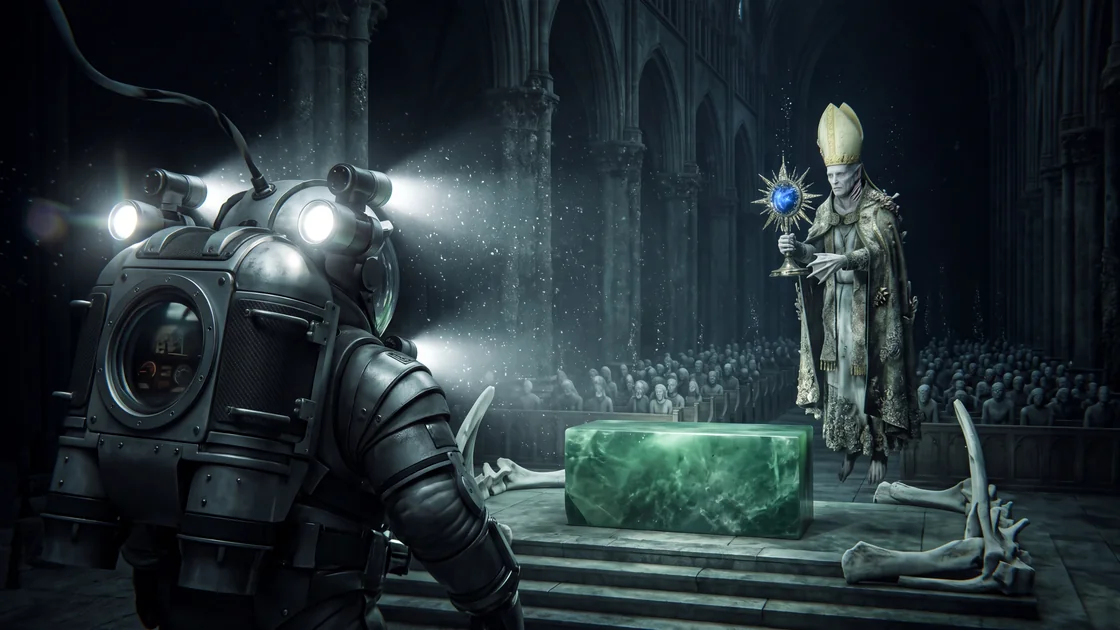
When veteran marine archaeologist Dr. Aris Thorne descended four thousand meters into the uncharted Kermadec Trench anomaly, he expected to document the structural ruin of a mythological fourteenth-century basilica swallowed whole by a catastrophic tectonic subduction; instead, he breached a sanctuary of impossible preservation where thousands of drowned, unaging parishioners remain suspended in eternal, rhythmic devotion, vibrating the abyssal waters with an unheard psalmody that threatens to hollow out his mind and tether his soul forever to the ocean floor.
Chapter I: The Edge of the Trench
The bathymetric readings had lied, or rather, human mathematics had buckled under the weight of what lay beneath the Pelagios Spur.
On the bridge of the research vessel Achelous, the monitors had painted the seabed as a featureless plane of abyssal basalt, a dead zone four thousand two hundred meters down where the Pacific tectonic plate ground in mute, agonizing friction against the Kermadec shelf. But when the multi-beam sonar arrays had swept the sector three weeks prior, the acoustic return had bounced back with impossible symmetry. Right angles. Colonnades of basalt and oolitic limestone rising from an ocean floor that should have borne nothing more complex than manganese nodules and the skeletal detritus of diatomaceous ooze.
Dr. Aris Thorne checked the seal of his wrist gauntlet, his breath coming in dry, metered rasps through the rebreather manifold. He stood in the damp belly of the Achelous’ moon pool bay, locked inside the Nereus-VII—an atmospheric diving suit forged from cast titanium, carbon fiber, and thick borosilicate viewports. The suit was less an outfit than a personal submarine with articulated limbs, a two-ton sarcophagus engineered to withstand four hundred atmospheres of crushing, indifferent hydrostatic violence.
"Comms check, Aris," crackled the voice of Elena Vance through the bone-conduction transducer pressed against his mastoid. Her voice was thin, stripped of timbre by the digital compression of the umbilical cable. "Telemetry shows your core temp at thirty-six point eight. Hydraulic pressure on the left elbow actuator is reading two percent high. We can abort and swap the seal."
"Negative, Elena," Aris replied, his tongue tasting the sour, alkaline metallic ghost of bottled trimix. "The seals are seated. If we scrub now, the surface squall will push us off station before the ROV can clear the umbilical. Drop me."
"You're diving into an acoustic anomaly, Aris. If the winch jams, or if the benthic currents pick up along the fault face, you’re four kilometers away from any rescue. The Alvin couldn't reach you in this soup."
"I see the telemetry, Elena. Drop me."
A mechanical whine shuddered through the deck plates as the gantry crane lifted the Nereus-VII from its cradle. Below him, the moon pool opened like a black, square mouth. The ocean did not look like water from here; it looked like polished obsidian, cold and unyielding, shivering under the sodium lights of the crane.
The winch dipped. The water met the soles of his boots with a dull, hollow thud, and then the world inverted.
The splash of white spray vanished instantly, replaced by a universe of viridian bubbles that rushed upward and died against the hull. The Achelous became a pale, shimmering raft of light against the sky, then a gray coin, and then nothing. Aris plummeted along the drop-line at forty meters per minute, sinking through the sunlit Epipelagic zone where the last warmth of the afternoon died away, down into the Mesopelagic twilight where the world became a bruised, violet-tinged monochrome.
At six hundred meters, the light was entirely extinguished.
The suit's exterior halogen arrays flicked on with a heavy click. The dual beams sliced through the bathypelagic dark, illuminating the eternal blizzard of marine snow—flurries of organic matter, the dead husks of copepods, the shed mucus of appendicularians, all drifting down to carpet the bottom of the world. It was the planet’s longest funeral procession, falling without end through the black.
Aris watched the depth gauge on his heads-up display tick downward through the thousands: 1,800m... 2,400m... 3,100m...
His thoughts wandered to the codex he had held in the secret archives of the Vatican Library six months ago—the suppressed journal of Brother Thomas of Genoa, a Franciscan friar who had sailed with a rogue Portuguese expedition in 1344. Thomas had written of an island named Sancta Maria de Profundis, a jagged spire of black rock south of the known world where a heretical bishop, Petrus de Albalat, had led an entire city of outcasts, lepers, and flagellants to build a house of God that would "stand when the skies split and the mountains melt."
The island had vanished from navigation logs in the autumn of that same year. Contemporary chroniclers blamed a sea monster, an earthquake, or the wrath of God. But Thomas had recorded a final letter from Bishop Petrus, preserved in salt-stained vellum:
Let the flood come. We have found the throat of the earth, and there we shall sing where the air cannot corrupt the word, where our flesh shall not turn to dust, and where the silence of the deep shall keep our vigil until the stars rot in their sockets.
Aris had dismissed it as the fevered millenarian delirium common during the years of the Black Death. Men saw demons in every pustule and the end of days in every storm. But then had come the sonar scans off the Kermadec Trench. The precise, unmistakable floor plan of a late-Gothic cathedral, complete with five-aisled nave, flying buttresses, and an ambulatory, sitting four kilometers below the level of the sea.
"Passing thirty-eight hundred meters," Elena's voice whispered, strained through static. "You are approaching the benthic boundary layer. Aris, watch your drop rate. We have a thermal plume reading forty meters east. The seafloor isn't cold down there; it’s cooking."
"Copy," Aris murmured. He adjusted the ballast trim. The suit slowed its descent.
The halogen beams struck bottom.
It was not the pale silt of the abyss. The seabed here had been swept clear, scoured clean by some invisible, persistent hydro-dynamic force. Rising from the dark was a massive terrace of cyclopean stone, black as pitch, paved with hexagonal basalt flagstones that stretched out into the gloom.
Aris grounded his boots against the stone. The impact sent a dull metallic ring through the titanium legs of the suit, vibrating directly into his shinbones.
He engaged his thrusters, drifting forward across the flags. Ahead of him, rising like the jawbones of a petrified leviathan, the dark began to take architectural shape.
"Elena," Aris breathed, his throat dry. "I have visual."
"Describe it, Aris. Telemetry feed is breaking up—too much acoustic noise from the rift."
"It's not an outcrop," Aris said, leaning forward within the padded chest harness of the suit until his helmet glass nearly touched the viewport. "God in heaven. It’s the west front. The portals are intact."
Chapter II: The Drowned Facade
The structure rose from the flat abyssal plain not as a ruin, but as a monument defying the geology of the deep.
In the shallow seas of the Mediterranean or the Caribbean, sunken stone became a reef within centuries—colonized by scleractinian corals, bored through by bivalves, softened and rounded by sponges until its hard geometry dissolved into organic chaos. But here, in the bathyal zone, the processes of life were slow, glacially patient. And yet, this was not natural.
The facade of the cathedral was carved from the same basaltic rock that formed the crust of the ocean floor, but it showed no signs of degradation. The twin towers of the west front rose into the black void above the reach of Aris’s searchlights, their spires lost in the eternal midnight. Massive lancet windows, their glass long since shattered or never installed, stared out into the trench like empty orbital sockets. Between them, the great rose window sat open, its stone tracery intact—a vast, wheel-like web of basalt depicting the wheels of Ezekiel, through which deep-sea amphipods drifted like specks of burning phosphorus.
"The architecture," Aris murmured, his external instruments recording the dimensions. "It's High Gothic, but the scale is wrong. The portal arch is thirty meters high. No medieval guild could have cut stones of this tonnage, let alone laid them with joints this tight. There’s no mortar. It’s dry-stone construction, joined by mortise and tenon on an oceanic scale."
"Aris," Elena’s voice was fraying, interspersed with a strange, rhythmic crackle like the sound of dry grass burning. "Sonar... seeing... massive density... inside the perimeter. Be advised... current is shifting toward the entrance."
"Understood. Moving toward the central portal."
Aris activated his directional thrusters. The micro-turbines whined, an unnatural, high-pitched mechanical drone that sounded obscenely small in the oceanic silence. He hovered three meters above the paved plaza, drifting between the great jamb statues that flanked the central entrance.
He brought his light beam across the figures.
They were saints, but not of any iconography Aris recognized. Their faces were not turned upward toward an imagined heaven, but downward, their chins pressed against their clavicles in attitudes of suffocating contemplation. Their robes were carved not with the fluid folds of classical drapery, but with tight, spiraling striations that resembled the ridges of giant siphonophores or the segmented armor of isopods. In their hands, they held not crosses or lilies, but instruments of measurement—lead lines, astrolabes, and heavy plumb bobs carved with serrated runes.
As his searchlight played across the face of a bearded figure near the lintel, Aris recoiled slightly inside the harness.
The statue’s throat was carved with distinct, open gill slits—three on each side, delicately scored into the basalt.
"Elena, are you seeing the video feed?"
Static hissed in his ears. "...ris... cable... interference... we have... thirty percent packet loss..."
"The carvings show physiological adaptations," Aris said, his voice rising in professional fascination masking an instinctive crawl of the skin. "Branchial clefts. And the eyes—the statues have no eyelids. They are carved with large, convex globes, completely spherical. Like deep-sea teleosts."
He reached the threshold. The Great Portal had no doors. The massive bronze-clad timbers that might once have barred the way lay flat on the stone floor inside, split down their middles, carpeted in a thick, velvety layer of rusticles and iron-oxidizing bacteria.
He drifted through the entrance, crossing from the abyss into the narthex.
Instantly, the acoustic profile of his environment shifted.
Inside the atmospheric suit, the sound of the ocean was normally a distant, hollow hiss—the sound of water brushing against titanium, the steady rhythm of his scrubbers, the whine of his own blood in his ears. But as he passed under the stone lintel, a new sound manifested.
It did not arrive through the water to the suit's hydrophones. The hydrophone display on his console showed a flat green line, registering zero decibels outside the hull.
The sound came through the metal itself.
It was a deep, physical thrum, a harmonic resonance that vibrated through his boots, up the steel articulations of the leg struts, through his harness, and directly into his pelvis and spine. It was a frequency so low it was felt rather than heard—sixteen cycles per second, the lower limit of human auditory perception, the fundamental tone of a thirty-two-foot open wood organ pipe.
It was not a random geologic vibration. It had meter. It had cadence.
One... two... three... pause.
One... two... three... swell.
"Elena," Aris whispered, his fingers tightening on the thruster controls. "The structure is ringing. It’s resonant. It’s like being inside the soundboard of a cello."
Static answered him—a dead, white hiss that carried no human voice. The tether was still intact; the green light on his telemetry console indicated the umbilical was feeding him power and gas from the surface, but the voice channel was drowned in a sea of electromagnetic noise.
He was alone, four thousand meters beneath the light of the sun.
Chapter III: The Drowned Nave
The narthex opened into a central nave of staggering proportions.
Aris rose twenty meters above the floor to avoid the debris of fallen roof tiles, his spotlights cutting long, amber corridors through the water. The cathedral was vast enough to swallow the Cathedral of Notre-Dame de Paris and leave room for its spires. Row upon row of clustered basalt columns, thick as the redwoods of California, marched into the gloom, supporting quadripartite vaulting that arched overhead like the ribs of an upturned galleon.
Between the ribs of the vaulting, there were no frescoes. The stone had been carved with low-relief friezes that depicted the history of the earth, but not as Genesis had recorded it.
Aris tilted his suit upward, scanning the ceilings.
He saw the depiction of a world entirely covered in brine. No dry land. No Eden. Great, many-limbed forms drifted through an ocean beneath an atmosphere of swirling, violent storms. He saw the coming of two-legged creatures, not created from the dust of the ground, but rising from the sea, dragging their tails through the mud, their hands webbed, their mouths open in praise of a central, dark sphere that rested within the deep.
"The pre-Adamic world," Aris whispered to himself, his breath fogging the lower quadrant of his viewport until the heating elements burned it away. "The heresy of the Preadamites. But Petrus lived in the fourteenth century... how could he have known the fossil record? How could he have carved trilobites?"
There, on the capital of a third-rank pillar, was a perfect, life-sized rendering of an Asaphus kowalewskii, its stalked eyes carved with mathematical precision, flanked by crinoids whose delicate calyxes looked as though they might sway if a current passed them.
He dropped his gaze from the ceiling to the floor of the nave.
The floor was not empty.
At first, his eyes, conditioned by decades of terrestrial archaeology, interpreted the shapes below as rows of prayer benches, or perhaps rows of sarcophagi set into the pavement. But as he drifted lower, angling the halogens downward at a forty-five-degree angle, the shadows broke apart, and the true nature of the floor was revealed.
They were people.
Hundreds of them. Thousands.
They filled the nave from the western entrance to the distant steps of the crossing. They were seated in stone pews carved directly from the basalt bedrock, arranged in rigid, unbroken ranks that stretched into the darkness beyond the range of his lights.
Aris froze his thrusters. He hovered in the water, his heart hammering against his ribs like a bird in a cage, his oxygen consumption spike flashing an amber warning on his HUD.
"They're statues," he said aloud, trying to force the terror back down his throat. "They're votive figures. Cast in lead, or carved from stone."
He tilted his suit down and descended until his boots were barely two feet above the heads of the rearmost row.
They were not statues.
They were men, women, and children. Their skin was not the gray of limestone or the greenish-black of bronze; it was the color of skimmed milk, faintly translucent, like the flesh of deep-sea grenadiers. Over their bodies they wore garments of coarse, fourteenth-century wool and linen, but the fabric had undergone some strange, chemical transformation—the fibers were calcified, impregnated with silica and barite crystals until they looked like spun glass, glittering faintly where the halogen beams grazed them.
None of them were decayed. The absolute cold of the deep, the absence of terrestrial bacteria, and the immense hydrostatic pressure had halted the ordinary passage of corruption. But they were not mere mummies, dried and shrunken.
Their bodies were plump, taut, swollen with an internal fluid that held them against the four hundred atmospheres of water pressure.
And they were not kneeling in terror. They were seated upright, their spines straight, their hands clasped over their chests in the traditional posture of Christian prayer—fingers pointed toward heaven, thumbs crossed.
Aris drifted closer to an older man on the aisle.
The man’s hair was long and white, floating above his scalp in the water like a halo of fine, bleached sea-silk. His face was weathered, marked by the deep lines of a fourteenth-century peasant who had spent his youth behind an ox-drawn plow. But his throat...
Aris leaned down until his faceplate was six inches from the man’s neck.
The skin beneath the jawline was slit with five clean, horizontal apertures. The margins of the cuts were not raw; they were lined with delicate, crimson tissue—feathery lamellae that fluttered with impossible softness in the wake of the suit’s thrusters.
The man was not breathing air. He had no air.
And then, as Aris watched in paralyzed fascination, the lamellae twitched.
A rhythmic, muscular contraction rippled through the man’s neck. The gills opened, expanding like the gills of a resting shark, drawing the black, freezing abyssal water into his pharynx, then closed, expelling it through the slits.
One... two... three... pulse.
The chest did not rise or fall. The hands did not move. The eyes were wide open—milky, white globes without irises or pupils, their lenses thickened into spheres that reflected the halogen beams like cat’s eyes in the dark.
The mouth was open.
Not in a scream. In an "O." The tongue within was flat, smooth, turned a pale, purplish gray.
From that open mouth, Aris saw a minute, shimmering vortex rise into the water. It was a cavitation bubble—a microscopic disturbance in the water caused by a frequency so violent, so concentrated, that it briefly tore the molecules of the water apart before the pressure crushed them back into liquid.
The bubble rose three inches, collapsed with an inaudible snap, and disappeared.
Then, from the throat of the woman seated next to him, another vortex rose.
Then another, from a child whose small hands were interlocked with hers.
The entire congregation was singing.
Chapter IV: The Liturgy of the Abyss
Aris backed away with a burst from his vertical thrusters, rising toward the vaulted ceiling like a diver fleeing a shark.
His breath was coming in ragged gasps. The carbon dioxide scrubber in the Nereus-VII was whirring frantically, struggling to keep pace with his hyperventilation.
"They're alive," he choked out into the dead radio. "They're alive. They're four miles down and they're breathing."
The silence in his headset was absolute, broken only by the sound of his own terror.
He forced himself to stop his ascent. He hung thirty meters above the floor of the nave, looking down at the terrible, magnificent spectacle.
Now that he was higher, now that his searchlights were not pinned to a single terrifying face, he could see the collective movement.
It was not static. The thousands of white heads were swaying. The movement was imperceptible if one watched a single individual, but from above, the aggregate was undeniable. It was a slow, coordinated wave—a harmonic oscillation that moved through the congregation like the wind passing over a field of winter wheat.
Left... three seconds.
Center... two seconds.
Right... three seconds.
And with every sway, thousands of microscopic cavitation bubbles rose into the darkness, catching his lights like a cloud of silver dust, drifting upward toward the high stone vaulting before they collapsed under the weight of the sea.
The vibration he had felt earlier was not the movement of tectonic plates. It was the hymn.
Aris turned his interior monitors to acoustic diagnostic mode. He unclipped the suit’s hydrophone sensor—a high-frequency piezoelectric crystal mounted on the exterior of the chest plate—and engaged its broad-spectrum analyzer.
The screen lit up with an impossible waveform.
It was not random noise. The frequency was locked at 16.4 Hertz, with harmonics cascading up through thirty-two, sixty-four, and one hundred and twenty-eight Hertz, reaching into the human vocal range, but carrying an acoustic energy that should have required a diesel generator to produce.
He routed the hydrophone signal through the suit’s internal sound processor, shifting the frequency up two octaves so his human ears could decode the sound.
The voice that filled his helmet was not human, and yet it was unmistakably choral.
It was a choir of thousands, but their voices had been altered by four centuries of saturation, by the crushing density of the water, by the physical architecture of throats that had ceased to process air. The sound had no consonants. There were no "s" sounds, no hard "t"s or "k"s; the water stripped them away, leaving only pure, resonant vowels that sounded like the blowing of glass, the scraping of iron plates against granite, and the long, mournful cry of blue whales across thousands of miles of ocean.
The melody was ancient. Aris recognized the mode—it was the Dorian mode, the severe, unadorned scale of early Gregorian chant.
They were singing the De Profundis.
De profundis clamavi ad te, Domine...
Out of the depths have I cried unto thee, O Lord...
The Latin was not spoken; it was implied by the rise and fall of the harmonic series. It was a hymn stripped of language, reduced to its acoustic skeleton, hammered into the water until every cubic centimeter of the cathedral trembled with the mass of it.
Why were they here? How were they here?
Aris Thorne was a scientist, a man who had spent forty years cataloging the mechanics of the ancient world. He knew the limits of biology. He knew that at four hundred atmospheres, cell membranes became rigid, enzymatic reactions failed, and the nervous system collapsed under high-pressure nervous syndrome. A human body dropped into this depth without a pressurized shell would be dead in seconds, its lungs crushed to the size of walnuts, its tissues flooded with nitrogen, its consciousness extinguished before the pain could register in the cortex.
Yet here they sat. Their skin was unbroken. Their eyes were clear.
He saw no signs of rot. The hem of a woman's gown drifted in the water, revealing a foot that had not lost its form; the nails were long, curved like horn, and between the toes, the pale skin was connected by a thin, translucent membrane.
They had not died and been preserved. They had been transmuted.
The realization settled in his gut with the cold finality of lead. The Black Death of 1348 had killed a third of Europe, rotting the flesh from within, turning the lymph nodes to black stones. Bishop Petrus de Albalat had not led his people to an island to escape the wrath of God; he had brought them here to make a treaty with something older than the Church.
They had traded their lungs for gills, their air for water, and their mortality for an endless vigil in the dark.
Aris drifted forward along the central axis of the nave, moving over the heads of the singers toward the crossing and the high altar.
As he moved, he noticed that the congregation did not follow his light. Their eyes remained fixed forward, focused on the east end of the church. They did not care about the titanium interloper that floated above them, its halogen eyes burning with unnatural white fire. They were caught in an ecstasy so total, so absolute, that the intrusion of the terrestrial world was nothing more than the passage of a plankton cloud.
Except for one.
Near the front row, just before the steps of the chancel, a boy sat on his father’s right. He could have been no older than ten when the water had claimed him. His small hands were clasped, his feathery gills fluttering with the same metronomic precision as the adults.
As the shadow of the Nereus-VII passed over him, the boy’s head tilted back.
His neck muscles did not move with the jerk of a startled child; they moved with the slow, terrifying fluid grace of an anemone retracting its tentacles.
His milky, pupil-less eyes met Aris’s viewport.
Inside the suit, Aris gasped, his fingers instinctively jerking back on the thruster toggles.
The boy did not look away. Through the borosilicate glass, through the three inches of titanium, through the four thousand meters of black water that separated them from the sun, the child looked at him.
And then the boy’s mouth widened. His lips pulled back over teeth that had been ground down into sharp, serrated wedges, like the teeth of a dogfish.
He did not sing the collective vowel of the nave.
He spoke.
The sound did not come through the hydrophone. It vibrated directly against the brow of Aris’s titanium helmet, a tiny, crystal-clear click that bypassed the mechanical audio systems entirely:
Frater.
Brother.
Chapter V: The Reliquary of Hours
Aris fought the instinct to purge his ballast and rocket toward the surface. If he panicked now, the umbilical could foul against the nave’s clerestory windows, snapping his life line and leaving him to tumble into the abyss.
"Control," he choked into the microphone, though he knew the transmission was useless. "I have... I have biological interaction. Subject is responsive."
The radio remained silent. The umbilical was dead for data, though the steady hum of the hydraulic pumps told him the Achelous still held him on his leash.
The boy had already looked away. His pale, crystalline face had returned to the horizontal plane, his milky eyes locked once more upon the sanctuary. The tiny cavitation bubbles resumed their ascent from his needle-toothed mouth, rejoining the vast, rising stream of the parish’s collective hymn.
Aris forced his trembling hands to lock the thruster controls into a low-velocity hover. He could not turn back now. He was an archaeologist; he had spent his life seeking the moments where human history touched the unknowable, and here was the absolute center of that intersection.
He drifted over the crossing.
Above him, the central tower opened into a lantern that rose far above the roofline. But instead of an open sky, the top of the lantern was sealed by a massive, bulging dome of dark, volcanic glass—an obsidian lens that caught the halogen glare and scattered it in strange, oily rainbows.
Below him lay the chancel.
Here, the architecture shifted from the austere basalt of the nave to a material that made Aris’s stomach lurch. The altar rail was not stone, nor wood, nor metal. It was formed from colossal bones—the jawbones and vertebrae of mysticete whales, bleached to the color of chalk, joined together with bands of hammered electrum that had never tarnished.
Within the chancel stood the clergy.
There were twenty of them, wearing vestments that must once have been cloth of gold, but were now thick, stiff carapaces encrusted with tiny bryozoans and deep-sea tubeworms whose red plumes waved like fringe along the hems of their dalmatics. They stood facing the high altar, their backs to the congregation.
At the side of the altar, resting upon a lectern shaped like an upright squid whose marble tentacles cradled the book-rest, lay the parish register: the Reliquary of Hours.
Aris brought the suit down until his magnetic boots clicked softly onto the floor of the sanctuary. The vibration of the singing was so intense here that his teeth ached in his jaw; every bolt in the Nereus-VII seemed to be vibrating at its natural resonance frequency. His heads-up display flickered as the acoustic energy hammered the piezoelectric sensors.
He extended the suit’s articulated mechanical arm. The hydraulically driven pincer was designed to lift core samples and salvage artifacts with millimeter precision. With slow, agonizing care, he touched the edge of the codex.
The book was not parchment. Parchment would have dissolved into gelatin within decades, even in these cold, sterile depths.
The leaves were sheets of beaten lead.
Aris adjusted the fine-manipulator pressure, curling the pincer’s rubberized tip beneath the cover. He lifted it. The lead hinge groaned, a tiny metallic screech that sounded like a dying gull through his hull.
The first page was engraved with Latin text, cut deep into the metal with an iron burin:
ANNO DOMINI MCCCXLIV. EGO PETRUS, EPISCOPUS SANCTAE MARIAE DE PROFUNDIS, HIC MANEO CUM GREGE MEO.
"In the year of our Lord 1344. I, Petrus, Bishop of Holy Mary of the Depths, remain here with my flock."
Aris activated his helmet camera’s macro-lens, recording the script line by line as he slowly turned the heavy lead pages.
The air above is rotten, the text continued, the engraving becoming more jagged, more desperate as the pages progressed. The great pestilence has eaten the cities of the north. The flesh of men turns to oil upon their bones; the priests die with the Host yet wet upon their tongues; the fields are untilled and the cattle choke upon the dust of the dead. God has turned His face from the sun.
He who dwells in the firmament has forgotten the covenant of the dry land. But the Deep does not forget.
We made our prayers down through the black cleft of the rock. We poured our wine into the trench; we dropped our silver; we gave our blood until the dark water answered. The Lords of the Abyss are not proud. They do not demand righteousness; they do not ask for clean hands or pure hearts. They ask only for the vessel. They ask only for the breath.
Aris felt a cold sweat prickling at his temples, trickling down into the foam padding of his helmet.
The Bishop offered the exchange, the chronicle went on. For every lung, a gill. For every tear, a drop of the great salt sea. For the brief, agony-filled span of three-score years and ten beneath the burning sun, they offered the eternity of the cold. Here we shall not die. Here our bones shall not crumble. We shall sing the mass beneath the weight of seven leagues of water, and our voices shall hold back the day of fire.
Let the dry land burn. The sea is our tabernacle.
The final pages of the lead book were not written in Latin.
They were filled with diagrams of human anatomy, but an anatomy warped and rewritten by an impossible teratology. Skulls were shown elongating, their jaws broadening to accommodate filter plates; spines were depicted fusing, their coccyxes extending into flattened, muscular paddles; the lungs were shown collapsing, shrinking into small, fat-filled hydrostatic organs—swim bladders designed to maintain neutral buoyancy at four hundred atmospheres.
And beneath the diagrams lay a column of names.
Hundreds of them. The families of the lost city.
Guillaume of the Mill, and his wife Agnes.
Mathieu the Baker.
The child Beatrice, who sang the third response.
Brother Julian, who carved the stone.
At the bottom of the final sheet, hammered into the lead with a heavy, triangular stamp, was an image: a hand with five webbed fingers, reaching upward through three horizontal, wavy lines representing the sea, grasping a heart that was not human, but the three-chambered heart of a cephalopod.
Aris let the mechanical arm drop. The lead leaf fell shut with a flat, muffled thump that was swallowed instantly by the rising roar of the hymn.
He turned toward the high altar.
Chapter VI: The Celebrant
The altar was a monolith of translucent green nephrite, six meters wide, carved from a single block that must have been dragged from some sub-oceanic quarry unknown to terrestrial geology.
Behind it, facing the east, stood the Celebrant.
Bishop Petrus de Albalat was not seated. He did not lean against the altar for support. He was suspended in the water, his boots hovering six inches above the predella, held aloft by the unnatural buoyancy of his vestments.
He wore a cope of heavy, lead-weighted silk that had been bleached pure white by centuries of exposure to benthic water. On his head sat a tall, peaked mitre carved from whale ivory, yellowed with age, its front plate engraved with the same webbed hand that Aris had seen in the lead codex.
His hands were raised in the ancient orans posture—elbows tucked to his ribs, palms turned forward and upward.
Aris activated his suit's maneuvering thrusters and drifted up the three marble steps of the altar platform. He circled the nephrite table until he was face-to-face with the bishop.
If the parishioners in the nave were horrifying in their preservation, Bishop Petrus was an absolute obscenity of longevity.
He was massive. Deep-sea gigantism, a phenomenon that turned woodlice into foot-long bathynomids and squids into thirteen-meter leviathans, had claimed the bishop. He had grown to a height of nearly nine feet. His shoulders were broad as a draftsman’s table, the muscles of his neck corded like the cables of a suspension bridge to support a skull that had expanded backward into a long, swept-back crest.
His face was human only in its general arrangement.
His nose had retreated, leaving only two vertical slit-nostrils flush with the white skin of his face. His lips were gone, replaced by a circular, puckered sphincter of hard, cartilaginous ridges that opened and closed with the slow, rhythmic beat of an oil well pump.
Within that mouth, there was no tongue.
Instead, Aris saw an organ that defied classification: a series of nested, translucent combs, vibrating with such velocity that they appeared as a pale, shimmering blur—the source of the fundamental frequency that shook the cathedral.
The bishop was not merely singing. He was an engine.
He was the acoustic hub through which the entire congregation’s voices were collected, amplified, and discharged into the crust of the earth.
And held in his clasped, five-fingered, clawed hands was the monstrance.
It was constructed of beaten electrum, shaped like the rays of a dead star. But in the center, where the consecrated wafer of the Eucharist should have been held behind glass, there was a biological specimen.
It was a creature no larger than a human fist, spherical, soft-bodied, and pulsing with a cold, sapphire bioluminescence that cast blue, dancing ripples across the bishop's ivory mitre.
It was alive.
It had no eyes, no limbs, no shell. It was a heart. A naked, pulsing heart that beat not with the rhythm of a mammal, but with the strange, syncopated triple-pulse of the abyssal hymn:
Beat... beat... pause.
Beat... beat... pause.
With every pulse, the blue light flared through the monstrance’s electrum rays, washing over the bishop’s milky, unblinking eyes, down over his vestments, across the nephrite altar, and out into the vast, dark expanse of the nave.
Aris felt his own heart attempting to adjust its rhythm.
Inside his chest, behind his ribs, his pulse was slowing. His monitor beeped—a shrill, terrestrial protest:
HEART RATE WARNING: 48 BPM.
HEART RATE WARNING: 42 BPM.
HEART RATE WARNING: 35 BPM.
"No," Aris gasped, his hands trembling as he reached for the manual drug-injection port on his suit’s medical console. He slammed the heel of his palm against the auto-injector. A dose of ephedrine burned into his thigh, his heart jumping like a startled horse, fighting back against the rhythmic drag of the blue light.
The bishop’s eyes did not shift, but his fingers—long, white talons connected by thick, rubbery webbing—tightened around the stem of the monstrance.
The fundamental tone shifted.
The 16.4-Hertz hum dropped to twelve Hertz.
Infrasound.
At twelve Hertz, the human body ceases to experience sound as an auditory event. The frequency matches the resonant frequency of the human eye and the internal organs. Aris’s vision began to vibrate inside his skull. The interior of his suit seemed to dissolve into a gray, shimmering fog. The boundaries between his skin and the air inside the suit, between the suit and the ocean outside, began to blur.
He did not hear a voice in his ears. He felt a concept being stamped directly into the gray matter of his cerebral cortex, with the crushing, hydraulic force of a printing press striking paper:
CUR TARDAS?
Why do you delay?
Aris fell to his knees. The titanium joints of the Nereus-VII hit the predella with a clang that was instantly lost in the infrasonic roar.
CUR TARDAS, FILI HOMINIS?
Why do you delay, son of man?
"I am... an investigator," Aris wheezed, his mouth filling with the taste of copper. "I am... Dr. Aris Thorne. Marine Archaeology... Woods Hole... Achelous..."
The names meant nothing. They were sounds made of air. They were the thin, dry chattering of insects on a dying leaf, four thousand meters above the true world.
THE AIR IS A WOUND, the bishop’s mind-voice hammered into him. THE LIGHT IS A FIRE THAT BURNS AND IS SPENT. HERE ALONE IS THE SANCTUARY. HERE ALONE IS THE BODY UNBROKEN.
Through the borosilicate glass, Aris saw the bishop’s head slowly tilt downward.
The ivory mitre leaned forward. The milky, lens-like eyes looked directly into Aris’s own.
There was no malice in them. That was the most terrifying thing. There was no hatred, no demonic rage, no hunger. There was only a profound, horrific, ancient pity.
The bishop saw Aris as a terrestrial creature trapped in a burning cage—a pathetic, dry-lunged thing whose life was a series of frantic, gasping breaths between the cradle and the grave, doomed to turn to dust and blow away across a barren landscape.
To the bishop, the ocean was not a tomb. It was the only true cradle.
The Bishop raised the monstrance.
The blue heart flared.
The acoustic vibration reached its crescendo. Through the soles of his boots, through his knees, through the metal plates of his harness, the water commanded Aris’s body to remember its origin.
Every cell in his body was ninety-eight percent water. The salt in his blood was the same salt that filled the Kermadec Trench. The iron in his hemoglobin was the same iron that drifted down from the basalt vents.
Why do you fight the pressure? the hymn asked him, not in words, but in the irresistible, soothing logic of the deep. The pressure is only heavy because you fight it. Fill the hollows. Open the throat. Let the salt enter, and the weight will vanish. Four hundred atmospheres is nothing when the water within matches the water without.
Aris’s right hand drifted toward the manual release valve of his helmet.
Chapter VII: The Communion of the Drowned
It was an emergency valve—a heavy, brass dog-clutch designed to allow divers to rapidly equalize pressure in hyperbaric chambers. If he turned it here, the four hundred atmospheres of water pressure would enter the suit through a half-inch orifice with the velocity of an anti-tank shell. It would liquefy him in less than a millisecond. His skull would collapse like a lightbulb stepped on by an elephant; his lungs would be reduced to a spoonful of bloody grease.
And yet, his fingers curled around the brass lever.
His mind was clearing, but it was a clarity that belonged to madness. He saw the logic of it. The parish was not dead. They were here. They had been here for six hundred and seventy-nine years. They had lived through the fall of empires, through the Industrial Revolution, through the world wars, through the atomic age, undisturbed, untouched by the madness of the dry earth.
They were still singing. They would sing until the Atlantic and the Pacific boiled away in the final death of the sun.
They were holy.
The boy from the nave was standing now. He had stepped out from his pew and had ascended the chancel steps. He stood beside the bishop, his small, white face turned toward Aris, his dogfish teeth bared in what looked, under the pulsing blue light of the monstrance, like an expression of infinite welcome.
The boy held something in his hands.
It was a communion wafer, but it was not bread. It was a thin, circular disk of dried benthic sponge, impregnated with some dark, oily substance that smelled—even through the micro-filters of Aris’s rebreather—of sulfur, ambergris, and deep-sea phosphorus.
Accipite et manducate, the choir seemed to sing.
Take and eat.
This is the flesh of the sea.
Aris’s fingers strained against the brass valve. The safety pin had already been sheared by the pressure of his own grip. One eighth of a turn, and the water would take him.
"Aris!"
The voice was not a psychic hammer. It was a thin, distorted, screaming scratch in his ear.
Elena.
The sound of his name, spoken in that flat, Midwestern accent he had known for twenty years, was like an iron hook dragged through his brain. It tore him out of the harmonic trance.
"Aris! The winch... line is parting! The trench is... venting! We’re pulling you up NOW!"
A sudden, violent jerk threw him off the predella.
The umbilical cable had gone taut. The crane on the Achelous, four kilometers above, had engaged its emergency recovery cycle—a high-speed, hydraulic pull designed to retrieve suits caught in benthic eruptions.
The two-ton suit was yanked upward into the water column like a hooked fish.
Aris’s boots left the nephrite altar steps with a dull thrum.
Below him, the bishop did not reach out to stop him. He did not move. He remained suspended before the altar, his raised hands holding the monstrance aloft, the blue light pulsing with its steady, unhurried triple-beat:
Beat... beat... pause.
The congregation did not stir. Not a single head turned to watch his ascent. They remained in their rows, their pale, translucent backs straight, their spines aligned, their feathery gills opening and closing in the dark, sending their silver clouds of cavitation bubbles upward to die against the vaults.
Only the boy watched him.
As Aris surged upward through the lantern of the central tower, rocketing toward the dark obsidian lens of the roof, he saw the child raise one webbed, five-fingered hand.
It was not a wave of farewell.
It was a gesture of patience.
The child knew, as the bishop knew, and as the six thousand drowned parishioners knew: the land was a brief, dry accident.
The ocean was the end of all things.
Chapter VIII: The Ascent and the After-Echo
The ascent was a nightmare of violent acceleration and sensory dislocation.
The Nereus-VII was not designed to rise at seventy meters per minute. The water screamed against the titanium hull, stripping away the exterior instrumentation, tearing the hydrophone from its bracket, ripping away the specimen bags and the magnetic arrays.
Aris was slammed against the back of his harness, his vision tunneling into gray as the G-forces pressed him down. Through his viewport, the cathedral vanished into the abyssal gloom in seconds—first the spires, then the great wheel of the rose window, then the massive, black basalt platform of the west front, until all that remained was a faint, sapphire spark pulsing in the heart of the trench.
Beat... beat... pause.
Then that, too, was gone.
There was only the black water, rushing downward past his glass like a river of oil.
3,000 meters.
His ears were ringing with a sound that would not stop. It was not the mechanical roar of the water; it was the fundamental frequency—16.4 Hertz—vibrating inside the bones of his skull. It had not stayed in the cathedral. It had colonized him. It had found the moisture in his brain, the fluid in his inner ear, the brine of his eyes, and it was singing itself into his synapses.
2,000 meters.
The water shifted from the dead black of the abyss to the violet gray of the twilight zone. Strange, spindly siphonophores were shredded by his cable as he tore through their delicate, suspended cities.
1,000 meters.
The green appeared. Pale, sickly, sunlight-contaminated green. To Aris’s eyes, after hours in the holy, absolute dark of the bottom, the light of the sun looked violent, vulgar, diseased. It was the color of rot. It was the light that belonged to corpses on a battlefield, to mold on bread, to the fleeting, agonizing world of men who had to breathe air to live.
200 meters.
The crane did not stop. It pulled him straight through the thermocline, the water temperature jumping twenty degrees in thirty seconds. The interior of the suit became an oven; his sweat pooled in his boots, mixing with the condensed moisture of his breath.
Zero.
The Nereus-VII breached the surface like a breaching whale.
The suit erupted from the water into the blinding, white-hot, screaming hell of the Pacific afternoon.
The crane swung him aboard the Achelous with a violent, metal-shrieking lurch. The suit hit the rubber mats of the moon pool bay, slamming onto its side.
Instantly, the bay was full of people.
Aris saw them through the smeared, salt-crusted viewport: men in orange life vests, technicians with hydraulic wrenches, Elena Vance with her face pale, her lips moving frantically as she hammered on the emergency hatch release.
They looked like ghosts.
They looked thin, dry, insubstantial—creatures made of dust and dried blood, their skin burned red by the cruel, uncaring sun, their mouths opening and closing like the mouths of dying fish stranded on a sandbar.
They have no water, Aris thought with a surge of cold, horrifying contempt. They have no depth. They are going to die.
The hatch bolts turned with six loud, explosive clacks.
The air entered the suit.
It was the air of the surface world: warm, humid, reeking of diesel exhaust, burning grease, human sweat, and the sharp, nauseating stench of the atmosphere. It hit Aris’s lungs like a handful of crushed glass.
He screamed.
It was his first terrestrial breath in nine hours, and it felt like fire. He choked, coughing violently, his lungs convulsing as they rejected the thin, dry, oxygen-rich poison of the upper world.
"Get him out!" Elena’s voice was right above him, real now, uncompressed, but it sounded shockingly loud, horribly coarse, like the scrape of a shovel on gravel. "Aris! Don't move your neck—the collar might be cracked. Get the crane off him!"
Hands grabbed his shoulders, dragging him from the titanium shell.
He lay on his back on the non-skid deck of the moon pool bay, surrounded by the technology of the twenty-first century—monitors, fiber-optic drums, hydraulic lines, digital chronometers.
The sky above the moon pool’s gantry was an open, cloudless blue.
It was infinite. It had no ceiling. It had no vaulting. It was an open, terrifying void that threatened to suck him upward into its dry, empty stomach.
Aris closed his eyes.
He pressed his face against the wet, oil-stained steel deck plates of the research ship. He didn't want the sky. He wanted the four hundred atmospheres. He wanted the stone.
"Aris," Elena was kneeling beside him, her fingers on his carotid artery. "Your pulse is thirty-eight. What happened down there? The data recorder was wiped—every hard drive on the suit is corrupt. What was the structure?"
Aris did not answer.
He could feel the deck beneath his cheek vibrating.
It was not the ship's Caterpillar diesels. The ship was drifting, its engines idling in neutral.
The vibration was coming up from the bottom of the world. It was passing through four thousand meters of basalt, through four thousand meters of salt water, through the three inches of the Achelous’ steel hull, and through the deck plates into his cheekbone.
16.4 Hertz.
One... two... three... pause.
One... two... three... swell.
They were still singing.
They had not stopped when he arrived; they had not stopped when he left. They would not stop when the Achelous returned to port. They would not stop when Aris Thorne was an old man dying in a hospital bed with an oxygen tube taped to his dry, useless nose.
He opened his eyes and looked at Elena.
His vision had not cleared. The edges of his corneas were cloudy, swollen with the salt of his tears, the lenses thickening into spheres that made the terrestrial world warp and run like melting wax.
"Aris?" she asked, her voice trembling as she saw his eyes. "What's wrong with your eyes?"
Aris reached up. His fingers were stiff, cold, his joints aching with an unfamiliar, terrestrial stiffness.
He touched his neck, just below the angle of his jaw.
The skin there was tender. It was swollen into five long, horizontal ridges that burned with an itching, frantic fire—a fire that only the cold, black brine of the deep could ever quench.
"Nothing is wrong, Elena," he whispered.
His voice was thin, dry, and ugly in the open air, but behind it, deep in the hollow of his pharynx, the frequency answered:
"The service has only just begun."