The Chronology of Sacrifice
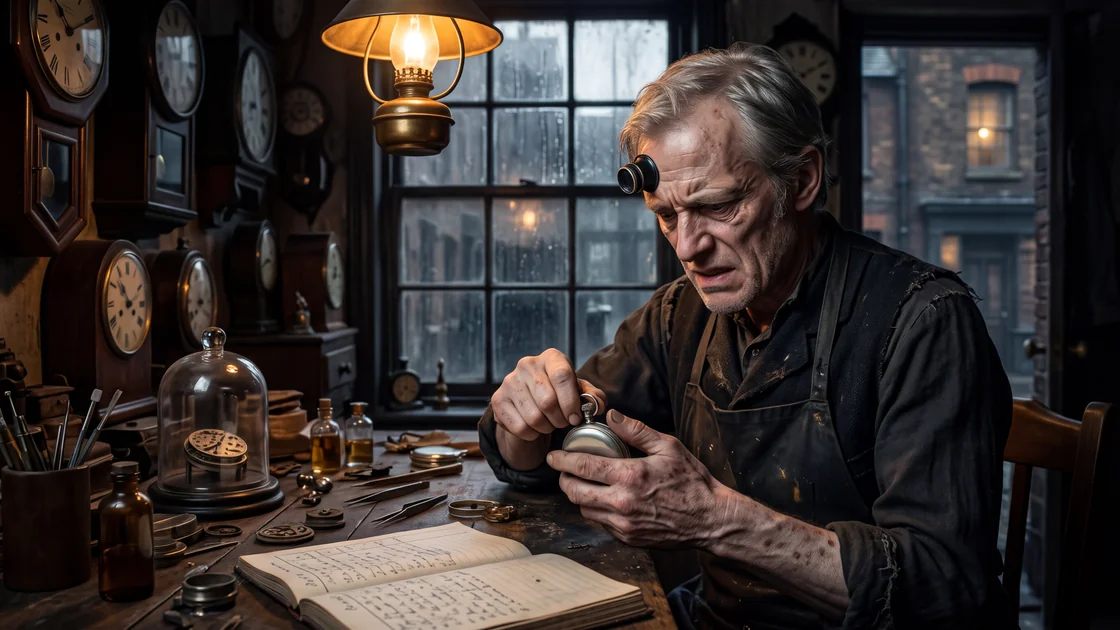
Arthur Finch, an exacting and reclusive horologist working out of a damp, gas-lit shop in Clerkenwell, inherits an unsigned eighteenth-century pocket watch from his grandfather, only to uncover a terrifying metaphysical mechanism hidden beneath its chased silver cuvette: each complete turn of its fluted winding crown subtracts exactly five minutes from his own biological future and transfers them instantaneously into the lifespan of whoever occupies his thoughts. What begins as a terrified curiosity turns into an obsessive moral calculus as Arthur attempts to act as a quiet, benevolent god for those around him—reviving an apprentice’s crushed dog, extending the lucid moments of a dying mentor, and ultimately attempting to buy back the life of Clara Henslowe, a neighbor suffering from a wasting illness of the lungs. As Arthur’s youth is systematically devoured by his own fingers—leaving him prematurely gray, arthritic, and hollowed out—he discovers that gifted time does not cure decay, nor does it escape the cruel irony of destiny; rather, it merely forestalls the inevitable at the expense of the giver’s soul and marrow. Trapped between the addiction of rescue and the horror of self-annihilation, Arthur is forced to choose between the preservation of his own dwindling existence and a final, catastrophic act of winding that will empty his ledger forever.
Chapter I: The Architecture of Deadbeat Escapements
The street outside Arthur Finch’s workshop did not believe in time so much as it believed in weather. Rain in Clerkenwell had its own calendar; it fell straight, or it fell sideways off the slate eaves of St. Jude’s Passage, pooling in the oily depressions between cobbles and turning the soot into a fine, black lacquer that coated the lower windowpanes of his shop.
Behind those panes, Arthur kept the dead alive by making them tick.
He was thirty-four years old, though his trade had already imposed upon him the posture of a much older man: a curved spine, a right shoulder permanently lower than the left from hours spent leaning over a watchmaker’s staking tool, and a squint that had etched three sharp crow's-feet at the corner of his dominant eye. His fingers, however, were miraculous. They were long, pale, and stripped of hair, possessing that extraordinary independence of movement peculiar to men who routinely manipulate screws no larger than the head of a flea.
On the third Tuesday of November, 1891, a courier brought the cedarwood box.
It was bound with brass wire that had oxidized into green crust at the corners, bearing a customs seal from Antwerp and an address written in the sprawling, tremulous hand of his late grandfather’s solicitor. Julian Finch had died six weeks earlier in a boarding house near the docks in Ostend, leaving behind two trunkfuls of pawn tickets, a collection of broken hairsprings, and this single parcel.
Arthur did not open it immediately. In watchmaking, haste was an insult to the balance wheel. He finished repivoting an English lever for a clerk from the Bank of England, immersed the movement in benzine, dried it with elder pith, and laid it under a glass bell jar. Only then did he snip the brass wire with his heavy diagonal cutters.
Inside the cedar box, bedded on dry wood shavings that smelled faintly of salt water and tobacco, lay a pocket watch of unusual proportions.
It was an open-faced watch, heavy and broad, measuring nearly fifty-five millimeters across. The case was silver, but silver of an extraordinarily pale, cold alloy, unhallmarked and devoid of decorative engraving save for seven shallow indentations along the perimeter of the bezel, like finger-marks pressed into soft wax. The dial was white grand feu enamel, completely free of cracks or hairlines, bearing Roman numerals painted with such hair-thin precision that Arthur needed his four-power loupe to confirm they were not printed.
"Unsigned," he murmured to the empty shop.
He took his case knife from the rack, inserted the dull steel blade into the lip of the snap-back, and applied gentle pressure. The back swung open on an invisible five-leaf hinge, revealing an inner cuvette of polished silver-gilt.
Here, an inscription had been scratched with a graver—roughly, as if the craftsman’s hand had been shaking:
Tempora non mutantur in vacuo; caro carnem emit. (Time does not change in a void; flesh buys flesh.)
Arthur frowned, the Latin settling cold in his throat. He eased open the cuvette.
The movement was unlike anything he had ever seen, though he had studied the masterworks of Harrison, Arnold, and Breguet. It was not a conventional movement driven by a spring barrel acting upon a train of brass wheels. The bridges were cut from blued steel, polished to a mirror finish that seemed to swallow the yellow gaslight of his bench. At the center lay what appeared to be an inverted duplex escapement, but its impulse wheel was double-tiered, fitted with teeth so small they resembled the serrations on the leg of an insect.
Most baffling was the mainspring barrel. It was enclosed, but through an aperture cut into the barrel cap, Arthur could see that the spring inside was not made of Swedish carbon steel or tempered iron. It was a pale, fibrous ribbon that gleamed with an iridescent, pearlescent sheen, coiled tightly like the intestine of a fish.
The watch was dead. The balance wheel—a solid disc of white metal uncut for temperature compensation—hung motionless between its ruby endstones.
Arthur picked up the watch. It felt abnormally dense, as though its interior were filled with quicksilver rather than air. He brought the crown between the thumb and forefinger of his right hand. The crown was fluted, cut with deep, sharp checkering that bit into his calloused flesh.
He applied clockwise pressure.
There was a peculiar, hydraulic resistance. Unlike the rhythmic click-click-click of an ordinary clickspring riding over a ratchet, this movement offered a smooth, heavy drag, like dragging an oar through thick syrup.
He forced it.
Click.
The click was not loud, but it had an extraordinary acoustic quality; it resonated through the bones of his wrist, traveling up his radial nerve, settling in the crook of his clavicle with the weight of a sudden drop in barometric pressure.
In the very instant the tooth dropped into place, a sensation tore through Arthur’s chest. It was not pain, strictly speaking. It was the sensation of a cold vacuum suddenly opening beneath his sternum, a breathless hollow that sucked at his heart for the space of a half-second. He stumbled back against his stool, the loupe tumbling from his right eye and clattering against the oilcloth.
He clutched his ribcage, gasping.
"What was that?" he whispered.
The sensation passed as quickly as it had arrived, leaving behind a faint, metallic taste on the back of his tongue, like the copper tang of a penny held against the gums.
On the bench, the watch had come alive.
The balance wheel did not swing with the hurried, nervous vibration of a modern pocket watch—five beats a second, three hundred a minute. It swung with an impossible, majestic slowness: precisely one oscillation every two seconds. Tick. Tock. It was the cadence of a resting pulse, heavy and deliberate, the deadbeat seconds hand leaping from marker to marker with a mechanical finality that made the hair on the back of Arthur’s neck stand up.
As he watched it, his heart still hammering from that phantom spasm, his gaze drifted to the corner of his bench.
There, in a cracked porcelain saucer, lay a cluster of watercress he had purchased three days earlier from a coster girl on Rosebery Avenue. It had withered into brown, slimy threads, dry and dead, forgotten beside his bottles of neat’s-foot oil.
Arthur blinked.
One of the pale green shoots near the rim of the saucer was standing upright.
It had not been upright five minutes ago. As he stared, leaning forward until his breath fogged the edge of the plate glass, the shriveled green skin of the shoot visibly tightened, drawing water from the air, plump with moisture. A brown, curled leaf unrolled by a fraction of a millimeter, its veins filling with pale emerald sap.
Arthur did not move for three full minutes. The room was utterly silent save for the glacial thump... thump... thump of the unsigned watch.
He looked at the watch. He looked at the watercress. He looked at his own right hand, where the fluted crown had left an indentation in the flesh of his index finger.
Chapter II: The Mathematics of the Pulse
A sane man would have thrown the watch into the Thames. A religious man would have carried it to a priest or crushed it beneath a cobbler’s lapstone.
Arthur Finch was neither. He was a horologist. To him, the universe was not an arena of miracles or demons; it was an infinite series of geared interactions, governed by laws of friction, inertia, leverage, and potential energy. If an effect occurred, an equal and opposite cause existed to account for it. The only sin was bad measurement.
That night, he locked the outer door of the shop, drew the green baize curtain across the display window, and lit three additional gas jets above his workbench.
He sat with a clean sheet of ledger paper, a dip pen, and his most accurate regulator clock—a mahogany wall regulator made by Dent of London, which varied by less than half a second a month.
"Observation One," he wrote, the ink shining wetly on the ruled paper. "The mainspring resists winding with a torque roughly three times greater than that of an eighteen-size pocket chronometer. Ratchet wheel possesses sixty teeth. One click equals one tooth. One full revolution of the arbor equals twelve clicks."
He paused, his pen hovering.
He remembered the watercress. When he had forced that single click, what had he been thinking of?
He closed his eyes, reconstructing the exact microsecond before the arbor turned. He had felt the sharp steel teeth against his skin; he had felt annoyed by the coldness of the brass box; and his eyes had been resting—vaguely, without intent—upon the saucer of withered greens on the corner of the bench.
He looked at the watercress again. The single stalk remained green, while its companions lay dead and blackened.
"The recipient," he muttered. "The object of focus."
To test a theory, one needed a subject capable of displaying unambiguous physiological change, yet small enough that any error would not constitute a tragedy.
In the cellar beneath his shop, amid the crates of old timber and obsolete clock cases, Arthur kept a wire cage. A grey barn rat, trapped two days prior by the grocer next door and given to Arthur to drown, lay curled in the sawdust. It had not been drowned because Arthur had forgotten it. It was dying of dehydration; its flank barely rose, its eyes were gummed shut with milky crust, and its skin had lost all elasticity.
Arthur brought the cage up into the light of the gas jets. He placed it upon the bench, beside the unsigned watch.
He dipped his pen.
"Subject: Rattus norvegicus. State: Moribund. Estimated survival without intervention: Less than one hour."
He laid down his pen. He picked up the watch.
His hands were cold, but they did not shake. He placed his thumb and forefinger upon the crown. He looked steadily at the dying rat, focusing the entirety of his consciousness upon its tiny, parched skull, its whiskers that twitched feebly against the wire mesh.
He applied pressure.
The heavy, hydraulic resistance pushed back. Arthur gritted his teeth and twisted.
Click.
The sensation hit him like a punch to the solar plexus.
Arthur gasped, his knees buckling. He caught himself against the edge of the bench, sending a rack of pivot broaches clattering to the floor. The cold void tore through his chest—a sudden, violent draining, as if someone had uncorked an artery near his heart and drained away a cup of warm life, replacing it with slush. The copper taste returned, sharper now, bitter as verdigris.
He coughed—a dry, rasping cough that rasped in his bronchial tubes.
He forced himself to stand upright. He looked at the cage.
The rat had not merely moved; it had leapt.
It was standing on its hind legs against the wire, sniffing the air with frantic vigor. Its eyes were clear, bright, and black as beads of obsidian. The milky film had dissolved. Its coat, which had been dull and matted, possessed a sleek sheen. For forty-five seconds, it ran circles around the perimeter of the cage, gnawing at the pine shavings, before settling down to wash its snout with furious, healthy paws.
Arthur checked the Dent regulator.
Five minutes.
From the moment the ratchet clicked until the rat’s frantic burst of activity subsided into normal respiration, precisely five minutes had elapsed on the regulator’s seconds dial.
Arthur picked up his pen. His fingers felt curiously stiff, the knuckle of his right index finger aching with an unfamiliar, deep-seated ache, like the onset of winter rheumatism.
He wrote:
"Result: Revivification instantaneous. Vitality sustained."
Then he looked at his own hand.
He held it under the gaslight. He had always known his hands intimately; every scar, every burn from molten solder, every patch of calloused skin was mapped into his consciousness.
On the back of his right hand, traversing the tendon between the index finger and the thumb, lay a tiny, pale brown freckle.
It had not been there that morning.
He brought the magnifying loupe to his eye and examined the mark. It was not a freckle of youth, born of sunlight. It was a lentigo senilis—a liver spot. A flat, circular patch of hyperpigmentation, the unmistakable hallmark of an aging body.
He sat down heavily on his three-legged stool.
The room seemed to shrink, the walls of pendulums and movements pressing inward like the ribs of an iron bull.
"Five minutes," he whispered.
The arithmetic laid itself out in his mind with the cold, unyielding simplicity of an epicyclic gear train.
One click did not create time out of nothingness. The watch was not a fountain; it was a pump. It was a transfer mechanism. It drew five minutes of vitality, of cell division, of heartbeat, of metabolic breath from the winder—and injected it, pure and uncorrupted, into the marrow of the subject held within the winder’s thoughts.
He touched the liver spot with the tip of his finger.
He had not merely lost five minutes of an afternoon; he had lost five minutes from the end of his life. Five minutes of his future had been cut away, excised from his eighty-year or seventy-year or sixty-year balance, and compressed into the rat.
The rat squeaked, clawing at the wire.
Arthur looked from the animal to the watch, and for the first time, he felt the true, freezing terror of the machine: it worked with absolute perfection.
Chapter III: The Ledger of Little Deaths
A week passed in total isolation.
Arthur did not wind the watch again. He locked it within his iron safe, behind a combination lock and three tumblers of hardened manganese steel, hiding it beneath bundles of unpaid invoices and spare lever escapements.
He tried to resume his work. He took in a French carriage clock with an erratic strike train; he replaced a broken mainspring in a lady’s gold pendant watch; he cut a new balance staff for a parish curate’s pocket chronometer.
Yet the silence of the shop had changed.
Before the arrival of the unsigned watch, the collective ticking of his shop—forty clocks of various sizes, beating out their differing periods—had been a comfort to him. It had sounded like a multitude of voices murmuring in an agreeable chorus, proof that human ingenuity could impose order upon the formless drift of the cosmos.
Now, that murmur sounded like a slaughterhouse.
Every tick was an excision. Every swing of a pendulum was a scythe cutting through an invisible wheat field. He would sit with his tweezers suspended over an escape wheel, his breath held, hearing the Dent regulator beat: one second gone. Two seconds gone. Three.
He began to observe the people who passed his window with a new, horrifying clarity.
There was Mrs. Abernathy, the baker’s widow, whose knuckles were so swollen by gout that she cried when she carried a sack of flour across the street. There was old Mr. Peake, the shoemaker, who coughed black phlegm into his apron and whose skin had taken on the greasy, grey cast of tallow. There was the boy who sold evening broadsheets, whose bare feet were blue with frostbite in the November slush.
They were all running down. Their mainsprings were uncoiling, tooth by tooth, click by click, toward the stop-work.
On the twenty-eighth of November, Clara Henslowe came into the shop.
Clara lived on the second floor of the tenement opposite Arthur’s workroom. She was twenty-two, the daughter of a master engraver who had died of the phthisis five years before, leaving her with three younger sisters, a collection of burins, and a modest commission to engrave visiting cards and bookplates for stationers in the Strand.
She carried a small rosewood mantel clock whose brass escapement had jammed.
"Mr. Finch," she said, setting the clock upon the counter. Her voice had the thin, breathy timbre of someone who had climbed the stairs too quickly, though there were only two steps leading down from the street into his shop.
"Miss Henslowe," Arthur said, rising so abruptly that he knocked a small wooden box of pegwood to the floor. He dropped to his knees to gather them, his face flushing crimson behind his apron.
"I didn’t mean to startle you," she said, leaning against the counter.
As she leaned, she coughed.
It was not an ordinary cough. It was a hollow, wet rattle that came from deep within the base of her left lung—a sound Arthur knew with terrifying intimacy, for it was the sound his own mother had made during the long, damp winter of 1874. It was the sound of tissue dissolving.
Clara brought a white linen handkerchief to her lips. When she lowered it, Arthur, still on his knees, saw the corner: a tiny, star-shaped smudge of bright arterial scarlet.
She tucked the handkerchief into her sleeve with a practiced, furtive motion, her eyes darting to his face to see if he had noticed.
"The clock stopped on Tuesday," she said, her voice strained. "The striking train works, but the hands refuse to advance past quarter-past four. My sisters rely on it for their school hours."
Arthur stood up, his hands full of wooden pegs. He did not look at her face; he looked at her throat. Beneath the pale, almost translucent skin, her jugular vein was throbbing at a furious, frantic pace—one hundred and twenty beats a minute, the desperate sprint of an organism fighting against internal suffocation.
"I can repair it," he said. His voice was thick. "It is likely only a gummed pallet. Two shillings will suffice."
"I have eighteen pence today," she said quietly, looking down at her gloved fingers. The wool of her gloves was darned at the index finger with gray thread. "Could I bring the remainder when I collect it?"
"The eighteen pence is sufficient," Arthur said. "The eighteen pence is... entirely sufficient, Miss Henslowe."
She smiled. It was a fleeting, exhausted transformation of her face, illuminating the hollows beneath her high cheekbones and the dark, lavender shadows pooled under her gray eyes.
"You are very kind, Arthur," she said.
She had never called him Arthur before. She had always called him Mr. Finch.
She turned and left the shop, the brass bell above the door jangling with a bright, merry sound that felt like a mockery.
Through the glass, Arthur watched her cross the street. Her walk was unsteady; she favored her right side, her shoulders hunched against the damp wind that swept down St. Jude’s Passage. Halfway across the cobbles, she paused, caught by another spasm of coughing, steadying herself against the cast-iron lamppost before disappearing into the dark maw of the tenement doorway.
Arthur did not return to his bench.
He stood in the center of the shop, the smell of whale oil and old dust filling his lungs.
"Five minutes," he whispered to the silence.
What was five minutes to a girl whose lungs were turning to liquid? Five minutes was nothing. It was an insult. A raindrop thrown into a blast furnace.
He went to the safe.
He knelt before the iron door, his fingers flying through the combination: twenty-two left, forty-seven right, thirteen left. The heavy bolts slid back with an oiled thud.
He reached into the dark interior and drew out the cedarwood box.
The silver pocket watch was cold, colder than the surrounding air, as if it had been kept in a cellar of ice. He laid it upon his bench, beside Clara’s broken rosewood clock.
He sat down. He did not light a cigarette; he did not pour a dram of spirits. He sat with his hands resting flat upon the oilcloth, looking at the unsigned dial, at the pale ribbon of the spring visible through the barrel aperture.
"A life," he said aloud, "is not an abstraction. It is a sum of seconds."
An average human lived seventy years.
Seventy years was twenty-five thousand, five hundred and fifty days.
Six hundred and thirteen thousand, two hundred hours.
Thirty-six million, seven hundred and ninety-two thousand minutes.
Arthur was thirty-four years old. Assuming he possessed an ordinary constitution, he had lived roughly seventeen million minutes. He had seventeen or eighteen million minutes remaining in his personal reserve.
Eighteen million.
Five minutes was one part in three million, six hundred thousand.
It was a grain of sand brushed from a mountain. It was an imperceptible droplet evaporated from an ocean.
He reached out his right hand. His thumb and forefinger closed around the fluted crown.
He closed his eyes.
He did not think of humanity in the abstract. He did not think of the sick in the hospitals or the dying soldiers in colonial trenches. He thought of Clara Henslowe standing against the lamppost in the rain, her fingers clutching the damp iron, her lungs screaming for oxygen that could not penetrate the fluid in her bronchial trees. He thought of the gray darned wool on her glove. He thought of the small, scarlet star on her linen handkerchief.
He turned the crown.
Click.
The cold vacuum tore through him. His breath caught; his ribs felt as though an iron hoop were being tightened around them with a windlass. The copper taste flooded his mouth, so intense this time that he retched, swallowing bile.
He did not let go of the crown.
Click.
The second blow struck his heart before the first had subsided. Arthur cried out, a muffled grunt that died in his teeth. His vision blurred, yellow rings shimmering in the gaslight like the halos around streetlamps in a fog. A cold sweat broke across his forehead, running down his nose and dripping onto the ruled ledger paper.
Click.
Click.
Click.
He wound it five times. Twenty-five minutes.
When his fingers finally slipped from the fluted steel, he fell sideways off the stool, his forehead striking the pine floorboards.
He lay there for a long time, listening to the Dent regulator. Tick. Tock. Tick. Tock. It seemed to be laughing at him, its deadbeat escapement dropping each second into an abyss from which nothing could ever be retrieved.
His joints ached with an excruciating, dull throb. The muscles of his thighs felt hollowed, spent, as if he had run twenty miles uphill through wet sand.
Slowly, using the edge of the workbench as a brace, he dragged himself to his feet.
He leaned over the bench and looked into the shaving mirror he kept hung upon the wall beside his lathe.
He stared at his reflection.
His skin, usually ruddy from the heat of the gas jets, had taken on a faint, papery parchment texture across the cheekbones. But the most terrifying change was at his temples:
A cluster of hairs—perhaps twenty or thirty strands, which had been as black as walnut husk when he rose that morning—had turned the pure, chalky white of bone.
He reached up with trembling fingers and touched them. They were brittle. They felt dead.
He had paid twenty-five minutes of his biological destiny. But the transaction was not linear; the body did not shed time like water from a tap. The shock of the excision had left a physical scar, an accelerated degradation of the tissues that had been forced to surrender their future.
He turned toward the window.
Across the street, on the second floor of the tenement, a lamp had been lit behind the thin muslin curtains of the Henslowe apartment.
Through the glass, Arthur saw a silhouette.
Clara was standing by the window. She was not leaning against the sill; she was standing upright, her head thrown back, her arms raised as she pinned her hair into a knot.
Then, she moved.
She did not shuffle. She did not pause to clutch her chest. She walked across the room with a light, swift, rhythmic stride, carrying a stack of books, her movements effortless, fluid, alive.
Through the damp air of St. Jude’s Passage, Arthur could hear—faintly, like music carried across a lake at dusk—the sound of her voice.
She was singing.
It was an old air, something about lavender and the summer harvest. Her voice was clear, round, and unbroken by a single cough.
Arthur sank back onto his stool. He looked down at his right hand, where the skin between the fingers was dry and marked by two new senile lentigines.
He picked up his pen. His hand was shaking so badly he could barely form the characters, but he forced the steel nib into the paper:
"November 28. Five clicks. Subject: C.H. Remission instantaneous. Cost to self: Twenty-five minutes, manifested as local tissue senescence (hair, dermis). Efficiency: Absolute."
Then, beneath the entry, he wrote a single word:
Worth.
Chapter IV: The Market of St. Jude
The descent into madness is rarely a precipice; it is an inclined plane, polished like an agate bearing, down which a man slides with the smoothest mechanical ease.
Arthur Finch began to keep two ledgers.
The first was the shop ledger, a leather-bound folio containing the mundane commerce of his trade: mainsprings replaced for two shillings; balance staffs turned for three and six; clocks cleaned, oiled, and adjusted for half a crown.
The second was a small, black notebook bound in oilcloth, which he kept inside his waistcoat pocket, directly over his heart.
In this book, he recorded the commerce of his marrow.
December 4: One click. Subject: The drayman’s horse on Clerkenwell Road. Slipped on ice, fractured hock, in agony while waiting for the slaughterer’s poleaxe. Result: Five minutes of painless lucidity before the knacker arrived. Cost: Slight stiffness in left knee.
December 9: Two clicks. Subject: Mrs. Abernathy. Paroxysm of angina pectoris outside the bakery. Result: Pulse restored to regular rhythm; breathing eased. Cost: Loss of acuity in left eye (corrected by 0.5 diopter lens).
December 14: Four clicks. Subject: The infant child of the washerwoman at No. 4. Croup. Choking upon phlegm. Result: Spasm relaxed, air passages cleared, sleep induced. Cost: Receding gumline behind lower incisors.
He became an invisible phantom of mercy in the parish of St. Jude.
He did not speak to the people he helped. He never revealed the instrument of their salvation. He understood that to reveal it would be to destroy its sanctity; it would turn him from a quiet mechanic into a monster, a target for every desperate mother, every bankrupt gambler, every dying scoundrel in London.
Instead, he observed them from the shadows of his shop doorway, his fingers slipped inside his heavy wool overcoat, caressing the fluted steel crown of the watch.
Whenever he saw an agony he could not bear—a child crushed beneath a beer wagon, an old woman weeping on the church steps from the cold of her bones—he would close his eyes, fix the image of the sufferer in the dark lens of his mind, and turn the arbor.
Click.
Click.
Every click was an act of communion. Every click was an agony and an ecstasy. The cold vacuum that tore through his chest became familiar, like the sting of a strong spirit swallowed after a long fast. He learned to brace himself against doorframes, to bite the inside of his cheek until the copper taste was drowned by his own blood, to ride the wave of sudden exhaustion that washed through his limbs.
He was trading his life for theirs. It was the only pure trade that had ever existed on the earth.
In the market of London, men bought labor with money; they bought bodies with bread; they bought souls with promises of heaven. But Arthur Finch bought time with flesh. He bought breath with his own lungs.
By the end of December, the toll had ceased to be subtle.
He had wound the watch forty-eight times since November.
Two hundred and forty minutes. Four hours.
Four hours of his biological future had been amputated. But the physical reaction was far worse than the mathematical loss. The body is not a machine that can be disassembled and reassembled without wear; the repeated shocks of cold extraction had aged his physical vessel by at least ten years.
He was thirty-four, but he looked forty-five.
His hair was no longer merely streaked with gray; it had turned the color of lead, thin and dry at the crown. His shoulders had rounded into a permanent stoop, his neck jutting forward like that of an elderly vulture. His eyes, once bright and clear behind his spectacles, had sunk into their orbits, ringed by dark, bruised circles of permanent sleeplessness. His fingers—those miraculous instruments—had begun to knot at the first joints, the cartilage thickening, making the delicate work of seating an escape wheel an ordeal of gritted teeth and silent cursing.
His regular customers began to notice.
"You are working too hard, Mr. Finch," said Mr. Lowndes, the stationer, as he brought in his silver hunter for its annual cleaning. "You have a look about you. The cemetery look, my mother used to call it. Clerkenwell air is full of sulfur and bone-dust. You ought to go to Margate for a fortnight. Take the sea baths."
"I am quite well, Mr. Lowndes," Arthur replied, his voice thin and dry as paper. "A slight winter catarrh. It will pass with the equinox."
"You won't see the equinox if you don't take care," Lowndes grumbled, counting out his shillings. "You look older than my brother George, and George was at Balaclava."
Arthur did not go to Margate.
He went to the window.
Clara Henslowe was walking down the street.
She was carrying a basket of laundry. The improvement in her health had not been temporary; the twenty-five minutes Arthur had granted her in November had acted like a bridge, carrying her system across the critical threshold of the infection. Her cheeks had filled out; they were stained with a delicate, healthy peach color. Her step was light. She wore a woolen scarf of deep crimson, and when she laughed at something a neighbor said, the sound was whole, unclouded by the terrible rattle of decay.
Arthur leaned his forehead against the cold glass of his windowpane.
She is alive, he thought. She is breathing my air. My minutes are moving her limbs. She is walking on the path I paved with my own blood.
A fierce, terrible joy surged through his chest, so intense that he forgot the knot in his knuckles, forgot the white hair at his temples, forgot the bitter copper taste that never quite left his tongue.
She looked up.
Her eyes met his through the glass.
She did not smile immediately; an expression of profound shock, followed by a wave of pity, passed over her face. She set down her laundry basket on the curb and took two steps toward his shop door.
Arthur panicked.
He did not want her to see him in the light. He did not want her to look at his ruined hands, to see the gray phantom he had become.
He turned from the window and retreated into the dark, coal-smelling alcove behind the partition, hiding himself among the pendulums and the weights, holding his breath until he heard the shop bell ring, heard her call his name twice—"Arthur? Mr. Finch?"—and heard her light, hesitant footsteps retreat back into the passage.
Only when the street was silent did he emerge.
He sat at his bench, his heart beating with a thin, reedy flutter, like a dry leaf caught in an autumn draught.
He looked at the iron safe.
"She needs more," he whispered to the shadows. "The winter has only just begun. January is coming. January kills the weak. She will not survive January."
He rose, his joints popping like dry twigs, and walked toward the safe.
Chapter V: The Arithmetic of Clara
January of 1892 was remembered in London as the month of the Iron Frost.
The Thames froze solid at Blackwall; the fog did not lift for nineteen days, settling over the city in a dense, yellow-black shroud of sulfur dioxide, soot, and pulverized manure known as the "pea-souper." It was an atmosphere that suffocated the strong and slaughtered the delicate. Horses dropped dead in the traces, their nostrils plugged with frozen snot; old men died in their beds with their clothes on; and the bells of the parish churches tolled so incessantly that the vestries finally ordered them silenced to prevent mass hysteria.
In the middle of that frozen dark, Clara Henslowe collapsed.
Arthur learned of it from the apothecary’s boy, who came into the shop to buy a pair of steel tweezers for pulling splinters.
"The engraver’s girl across the way," the boy said, blowing into his red, chapped fists. "Old Henslowe’s daughter. Blood came out of her mouth like beer from a tap this morning. Dr. Thorne says both lungs are consolidated. She won't last the night. They’ve sent for the curate from St. Jude’s."
Arthur did not give the boy the tweezers. He did not say a word. He pushed past him, bolted the outer shop door, and ran into the rear workroom.
His chest felt as though it were clamped in an iron vise. He could not breathe.
"No," he said. The word was not a prayer; it was a refusal. A mechanic’s rejection of a flawed blueprint. "No."
He tore open the safe. He seized the unsigned watch.
He brought it to the bench, under the full glare of the three gas burners.
The watch was ticking its slow, magnificent deadbeat: thump... thump... thump. It seemed indifferent to the frost, indifferent to the fog, indifferent to the dying girl thirty yards away.
Arthur laid his black ledger open on the bench.
He dipped his pen.
"Dr. Thorne says: less than one night. Twelve hours. Seven hundred and twenty minutes."
Seven hundred and twenty minutes.
To grant Clara twelve hours of life would require one hundred and forty-four clicks of the winding crown.
Arthur looked at his hands.
Could he survive one hundred and forty-four clicks?
The five clicks in November had aged him ten years. Forty-eight clicks over six weeks had turned him into an old man.
One hundred and forty-four clicks would not merely age him; it would annihilate him. It was seven hundred and twenty minutes of future life excised from an engine that was already sputtering, its bearings dry, its oil fouled.
He closed his eyes.
He saw her face—not as it had looked in the street with the laundry basket, but as it had looked when she stood before his bench, with the worn gray gloves and the small scarlet star upon her linen handkerchief. He remembered the sound of her voice: You are very kind, Arthur.
No one had ever called him by his Christian name with that quiet, unadorned tenderness. He was Arthur Finch, the watchmaker, the mole who lived among the wheels, the hermit of St. Jude’s Passage. To the world, he was an instrument for the calculation of other men’s business.
To her, he had been a man.
"What is my life?" he asked the empty room.
He had no wife. He had no children. He had no God. He had only forty clocks on the walls, measuring out the decay of a world he did not love.
If he lived another thirty years, what would those years contain?
Thirty years of seating pivots in jewel holes. Thirty years of breathing the fumes of turpentine and benzine. Thirty years of watching the rain fall sideways down the cobbles of Clerkenwell, until his eyes failed completely and his hands shook so badly that he would be cast into the workhouse at Holborn, to die among the idiocy and the lice.
Or:
He could burn his remaining capital in a single, magnificent flare. He could buy her a life. He could give her the spring, the summer, the smell of hay in Kent, the sound of her sisters’ laughter, the touch of a husband’s hand who was not a crippled mechanic.
"One hundred and forty-four," he said.
His voice was steady now. The trembling had left him.
He took the watch in his left hand. The pale, cold silver felt warm against his skin, as if it had been waiting for this moment, as if the mysterious ribbon of its mainspring were hungry for the feast he was about to offer it.
He placed his right thumb and forefinger upon the crown.
He closed his eyes.
He visualized Clara Henslowe lying in the narrow bed beneath the sloping ceiling of the tenement attic. He saw her pale skin, the dark hair matted with sweat against her brow, the blood drying upon her lower lip, the shallow, frantic lift of her ribs as she drowned in her own fluids.
He held that image with a terrifying, crystalline intensity.
"Take it," he whispered to the watch. "Take all of it."
He turned the crown.
Click.
The first shock hit him. The floor seemed to drop away. Arthur fell to his knees, his forehead pressing against the sharp edge of the bench, but his fingers did not leave the fluted steel.
Click.
Click.
Click.
The room dissolved into a roaring sea of gray noise. He could no longer hear the Dent regulator; he could hear only the rushing of his own blood, loud as a millrace, draining away through a fissure in the floor of the universe.
Click. (Four: twenty minutes).
Click. (Five: twenty-five minutes).
Click. (Six: thirty minutes).
Pain—pure, unadulterated, incandescent pain—ripped through his central nervous system. It was not a localized agony; it was the sensation of every cell in his body being forcibly unwound, like a cord of hemp being unbraided by a team of horses. His skin burned as if he had been plunged into a vat of lye. His joints ground together, the synovial fluid drying up in an instant, bone gnawing on bone with a dry, screaming friction.
Click.
Click.
Click.
He was at twelve clicks. One hour.
He looked up through the red fog of his eyes at the mirror across the room.
The transformation was horrific.
His face was collapsing in real time. The cheeks were falling inward, the flesh shrinking back against the zygomatic arches like fruit drying in an oven. The skin beneath his chin went slack, hanging in crepe-like folds. His white hair was falling out, drifting in pale, wispy tufts onto the shoulders of his black apron, leaving behind a scalp that was mottled with brown liver spots and crisscrossed by blue, tortuous veins.
Keep going, his mind screamed. It is only an hour! An hour will not save her!
Click. (Thirteen).
Click. (Fourteen).
Click. (Fifteen).
He could no longer breathe through his nose; his nasal passages had shrunk, dry as bone. He dragged the freezing London air through his open mouth, his lungs wheezing with a high, whistling sound that matched Clara’s death rattle. His eyesight was failing; the three gas jets above the bench had smeared into three dull, orange smudges, surrounded by great, concentric rings of darkness.
Twenty clicks.
Twenty-five clicks.
His right index finger—the finger that turned the arbor—split open.
The skin across the knuckle, stretched taut over the swollen, arthritic joint, tore like wet paper under the immense hydraulic resistance of the crown. A thick, dark, venous blood began to smear across the fluted steel, but Arthur did not stop.
The blood acted as a lubricant. The crown slipped in his grip.
He cursed—a sound that was nothing more than a wet croak—and pressed the crown against his waistcoat, using the rough fabric to catch the metal, forcing the arbor to turn with the weight of his whole, dying torso.
Click.
Click.
Click.
Fifty clicks. Four hours and ten minutes.
He was blind now in the left eye. A gray cataract had formed over the pupil, thick as a layer of lard. The hearing in his right ear had died, replaced by a high, unvarying whistle, like the steam valve of a locomotive.
His heart did not beat with a rhythm; it fluttered. It felt like a small, frantic bird trapped within an iron cage, throwing itself against his ribs in an irregular, dying frenzy: thump-thump... pause... thump... thump-thump-thump...
"More," he gargled. The blood from his bitten tongue was choking him. "Clara... more."
Sixty clicks. (Five hours).
Seventy clicks. (Five hours and fifty minutes).
Eighty clicks.
At eighty clicks, the physical resistance of the watch changed.
The heavy, hydraulic drag suddenly vanished. The arbor turned with a sickening, effortless looseness, spinning freely beneath his bleeding fingers.
Arthur collapsed onto the floorboards, the unsigned watch clattering against his skull as he fell, rolling into the pool of his own blood beneath the bench.
He could not move his legs. They were cold, dead logs, devoid of sensation from the pelvis down. His hands were curled into rigid, claw-like spasms, the tendons locked by the massive, systemic stroke that had just ripped through his brain.
He lay in the sawdust, staring upward with his one good eye at the ceiling.
The Dent regulator was still ticking.
Tick.
Tock.
Tick.
It was three o'clock in the morning.
Outside, the Iron Frost held the city in its teeth.
Arthur Finch lay dying. He had wound eighty clicks. Four hundred minutes. Six hours and forty minutes.
It was not twelve hours. It was not seven hundred and twenty minutes. His engine had failed before the contract could be completed.
He had failed.
A single tear—cold, salty, and heavy—squeezed out of his right eye and tracked its way through the deep, ancient canyons of his cheek, mingling with the blood upon the floorboards.
"Clara," he whispered into the sawdust.
Then, through the dead silence of the frozen passage, he heard the sound.
It was a window opening.
Across the street, on the second floor of the tenement, a sash was thrown upward, its wooden frame groaning against the frost.
Then came a voice—the voice of Dr. Thorne, clear and resonant in the icy night air:
"It is extraordinary! I have never seen such a thing in forty years of practice! The pulse has stabilized! Her lungs are clearing! The crisis has broken!"
Then, another sound: the sound of Clara’s younger sisters weeping, followed by the sound of Clara herself—speaking, weak but clear, alive, breathing, human:
"The window... please, open the window. I want to smell the cold."
Arthur Finch heard it.
The sound entered his one working ear, traveled through the dying ruins of his temporal lobe, and reached the center of his consciousness.
A smile—ghastly, terrible, and radiant—parted his bloody, toothless lips.
"Six hours," he breathed into the dark. "Six hours... is enough... to see the morning."
Chapter VI: The Phantom of the Workroom
Arthur Finch did not die that night.
The body, when subjected to violence, has an obstinate, animal tenacity that defies all rational calculation. He lay upon the cold floorboards for two days, unable to rise, his consciousness drifting in and out of a gray, feverish fog where the ticks of his forty clocks sounded like the footsteps of giants marching across an iron plain.
On the third morning, Mr. Lowndes, the stationer, concerned by the shuttered shop and the absence of smoke from the chimney, forced the lock on the back door with a crowbar.
He found an ancient man, curled in a dried pool of blood and urine beneath the workbench, his fingers locked around a silver pocket watch.
"Merciful God," Lowndes whispered, dropping his lantern. "Finch? Is that... is that your father, Finch?"
It took three men to carry Arthur to his bed in the garret above the shop.
Dr. Thorne was summoned—the very same Thorne who had attended Clara Henslowe. He stood over Arthur’s bed, his great silver spectacles perched upon his nose, smelling of carbolic acid and brandy.
He examined the patient for twenty minutes, tapping the sunken chest, listening with his wooden monaural stethoscope, peeling back the lids of the ruined eyes.
When he finished, he turned to Lowndes, who stood by the door holding his hat.
"He is eighty-five if he is a day," Thorne declared, shaking his head. "Advanced arterial sclerosis. Complete calcification of the aortic valve. Severe senile arthritis with bilateral contractures. A massive cerebrovascular insult affecting the left hemisphere. How he survived the night on that floor is beyond medical science."
"But Doctor," Lowndes stammered, his face white. "That is Arthur Finch. The watchmaker. He was thirty-four years old at Michaelmas!"
Thorne looked at the stationer with the cold, irritated pity that men of science reserve for the hysterical.
"Mr. Lowndes, I have been a physician in this parish for three decades. I do not know what game you are playing, or what tragedy has occurred in this family, but this man is an octogenarian. Look at his skull! Look at the absorption of the alveolar ridge in his jaw! A man does not lose forty years of bone mass between Michaelmas and Epiphany. If this is Arthur Finch, then the Arthur Finch you knew must have been his son, and this is the grandfather, returned from the grave."
Arthur lay beneath the horsehair blanket, listening.
He could not speak. The right side of his face was paralyzed, his mouth pulled down into a permanent, drooping sneer. But his mind—trapped within the calcified, ruined cage of his skull—was as sharp, as cold, and as clear as a diamond chip.
He knew what he was.
He was the living ledger. He was the sum of eighty clicks.
The doctor left some drops of digitalis and an ointment of belladonna, charging Lowndes three shillings for the visit, and departed, promising to send the parish beadle to arrange for the old man’s removal to the St. Pancras Infirmary.
"The workhouse," Lowndes muttered when the doctor had gone. He looked at Arthur with a mixture of revulsion and awe. "God help you, Finch. If you are Finch. God help you."
He set a jug of water by the bed, laid a loaf of bread on the stool, and left, locking the door from the outside.
Arthur did not touch the water. He did not touch the bread.
With an agony that caused the blood to leak from his nose once more, he dragged his right arm across the blanket.
His hand was clenched into a fist.
Slowly, tendon by screaming tendon, he forced the fingers open.
In his palm lay the unsigned watch.
It was undamaged. The fall from the bench had not cracked its enamel; it had not bent its balance staff; it had not disturbed the poise of its white balance wheel.
Through the silver-gilt cuvette, Arthur felt the pulse of the machine.
Thump... thump... thump.
It was still running. The spring was not uncoiled. The eighty clicks he had forced into its arbor had not been dissipated; they had been stored, or they had been transferred, or...
He stopped.
He looked at the aperture in the mainspring barrel.
The pale, iridescent ribbon was no longer thin. It was thick, swollen, gorged with light, glowing with an internal, pearlescent luminescence that illuminated the dark underside of the blanket.
The watch was not empty.
The watch was full.
Arthur stared at it with his one working eye.
A horrifying, terrible truth began to dawn within the dark recesses of his paralyzed brain.
The watch had not merely transferred his life to Clara. It had mediated it. It had acted as a condenser. It had taken eighty clicks from his body—four hundred minutes—and it had fed them into Clara’s system drop by drop, like a physician administering an intravenous infusion.
How much had Clara consumed to survive the crisis?
The crisis had lasted from three in the morning until dawn. Three hours. One hundred and eighty minutes.
Thirty-six clicks.
Clara had needed only thirty-six clicks to throw off the mantle of the phthisis.
The remaining forty-four clicks—two hundred and twenty minutes of Arthur’s future life—were still inside the barrel.
They were trapped in the ribbon. They were hovering between heaven and earth, neither his nor hers, suspended in the mechanical purgatory of the unsigned movement.
And more:
The hydraulic resistance that had broken his body at the eightieth click—what had caused it?
He remembered the click. It had not been a stop-work engagement. It had felt like a valve snapping shut.
He brought his eye closer to the movement, holding the watch two inches from his face.
On the perimeter of the barrel cap, partly hidden beneath the winding arbor, was a tiny, sliding detent of blued steel, held in place by a jewel screw no larger than a grain of salt.
Beside the detent, engraved in characters so small they could only be read by a man who had spent his youth with an eight-power loupe strapped to his brow, was a second inscription:
Ad arcam reditus. (The return to the chest.)
Arthur’s breath caught in his throat.
A reverse escapement.
The watch did not merely wind forward. Under certain conditions—if the detent were tripped, if the clickspring were disengaged from the ratchet—the mainspring could run backward through the arbor.
It could discharge its potential energy back into the hand that held the crown.
Chapter VII: The Temptation of the Grave
The realization did not bring him joy. It brought him a horror that was colder and deeper than the Iron Frost.
If the watch could discharge in reverse...
He could take it back.
He could take back the two hundred and twenty minutes that remained in the barrel. He could take back his forty-four clicks.
What would forty-four clicks do for a body that had been shattered by eighty?
It would not restore his youth. It would not turn his white hair black again; it would not unknot the arthritic joints of his hands; it would not dissolve the cataract in his left eye. Time, once consumed by the furnace of the tissues, leaves behind ash, and ash cannot be reassembled into wood.
But it would clear his brain. It would restore the movement to his paralyzed leg. It would give him five years—perhaps ten years—of quiet, manageable, elderly survival. He could live. He could keep his shop. He could sit in the sun at the back of St. Jude’s Passage and watch the swallows return in May.
And what of Clara?
He looked toward the window.
Through the grime-encrusted glass of his garret, he could see the second-floor window across the way.
Clara was sitting by the pane. She was wrapped in a blue shawl, a mug of steaming tea held in her hands.
She was pale, yes; but it was the pale recovery of an invalid who has passed the valley of the shadow and is climbing the green hill on the other side. Her eyes were bright. Her sisters were fluttering around her like sparrows, brushing her hair, laughing, showing her sheets of engraved paper.
If he tripped the detent...
If the watch ran backward... where would the energy come from?
Would it merely drain the unconsumed surplus from the barrel?
Or would it create a siphon?
A mechanical pump, once primed and reversed, does not stop until the chamber is dry. If he opened the valve between his marrow and the watch, would it not pull the life back from the object upon which his mind was fixed?
Would it not pull the breath from Clara’s throat, through the cold air of the passage, through the brickwork of his tenement, through the cedarwood box, and back into his own decrepit, rotting breast?
To save himself, he would have to become a cannibal.
He would have to drink her spring to buy himself a miserable, shivering autumn.
He looked down at the watch.
His paralyzed right hand was lying on the blanket, five inches from the crown. His left hand—the hand that still possessed movement—held the steel case knife he had taken from his waistcoat pocket before he collapsed.
He could trip the detent. The blade of the knife was thin enough. One touch upon the jewel screw would release the click.
He raised the knife.
His hand shook with a violent, erratic palsy. The blade hovered over the movement, its polished steel catching the yellow, sulfurous light that filtered through the garret window.
Tick. Tock. Tick. Tock.
The watch seemed to mock him. Choose, it whispered through the vibration of its plates. Choose between the girl and the grave. Choose between the sunlight and the worm. What is she to you? She is an engraver’s daughter who paid you eighteen pence for a clock repair. She will marry a clerk from the docks. She will bear his children. She will forget the name of the old watchmaker who died in the garret across the street. She will walk past your grave in St. Jude’s churchyard on her way to the market, and she will not even pause to read the moss upon your stone.
Take it back.
Drink the minutes.
Live.
Arthur brought the knife down.
The point of the blade touched the blued steel detent.
He felt the tension of the spring beneath the metal. The forty-four clicks were humming in the arbor, desperate to escape, like compressed steam hammering at the flange of a boiler.
He closed his eyes.
He thought of Clara Henslowe.
He did not think of her as an object of desire; he was an eighty-five-year-old ruin, and she was a girl of twenty-two. He thought of her as the only beautiful work he had ever completed in his miserable, meticulous life.
He had spent thirty-four years repairing the works of other men. He had polished their pivots; he had adjusted their escapements; he had cleaned their dirt from their balance springs.
He had never made anything of his own.
He had never created a work that could stand before God and justify the air he had consumed.
Clara Henslowe was his masterpiece.
Her pulse was his balance wheel. Her breath was his train of wheels. Her laughter was his striking work, chiming the hours of a life that he had bought, paid for, and delivered with his own hands.
If he took back her time, he would be smashing his own clock. He would be an artist who slashes his own canvas because he has grown cold and needs the stretcher-bars for firewood.
"No," he said.
The word was clear this time. It did not come from his paralyzed throat; it came from the iron center of his will.
"No."
With his left hand, he turned the knife around.
He did not trip the detent.
He inserted the hardened steel blade into the teeth of the winding ratchet, between the arbor and the clickspring.
Then, with all the remaining strength of his shoulders, using the weight of his whole torso as he had done on the floor of the shop, he drove the blade downward into the heart of the escapement.
Chapter VIII: The Great Unwinding
There was an explosion—not of fire, but of motion.
The blued steel bridges shattered under the immense, unnatural leverage of the blade. The jewel endstones exploded into microscopic red dust. The balance staff snapped with a crack like a pistol shot, the white balance wheel tearing free from its pivots and flying across the garret, striking the plaster wall and embedding itself half an inch deep into the lath.
And the spring—
The pale, pearlescent ribbon, freed from the constraints of the escapement, uncoiled in a fraction of a millisecond.
It did not merely expand; it unwound through the world.
A wave of concussive force struck Arthur Finch in the chest, throwing him back against the headboard of the bed. The garret filled with a blinding, incandescent white radiance—a light so bright that the sulfur fog, the grime on the windows, the peeling wallpaper of the room were utterly bleached away into an absolute, timeless void.
In that light, Arthur saw everything.
He saw the centuries. He saw the unsigned watch being forged in a workshop in Prague three hundred years before, its silver smelted from coins taken from the mouths of plague victims. He saw his grandfather, Julian Finch, sitting in a tavern in Antwerp, his face pale with terror as he wound the arbor to save his own skin from a knife-thrust in an alleyway.
He saw the ledger of the world.
He saw that time was not an arrow flying from the past into the future; it was a great, coiled spring, wound by the hand of an incomprehensible necessity, each living thing lending its tension to the next, a vast, interdependent mechanism where no second could ever be stolen without an equal debt being entered into the balance of the universe.
And he saw Clara.
He saw her sixty years into the future.
He saw her as an old woman with white hair—white like his own, but soft and surrounded by children—sitting in a garden near the sea, watching the ships move toward the horizon under a pale blue sky. He saw her chest rise and fall with an effortless, majestic peace, her lungs whole, her heart beating with the slow, steady rhythm of a Dent regulator that would never run down until the full measure of her eighty-four years had been expended.
The forty-four clicks were not lost.
They had not returned to him. They had not returned to her.
They had dissolved into the atmosphere of the room, into the rafters, into the rain that was beginning to fall upon the slates of Clerkenwell, into the future of the earth.
The white light faded.
The roar subsided into silence.
The garret returned. It was cold, gray, and smelling of coal gas.
On the blanket lay the carcass of the watch.
The silver case was split open, blackened as if it had been passed through a blacksmith’s forge. The movement was a ruined tangle of twisted steel, broken screws, and powdered ruby. The pale ribbon of the spring had shriveled into a handful of gray ash, indistinguishable from the soot that drifted down from the chimney.
Arthur Finch lay upon his pillows.
The pain had left him.
The cold vacuum in his chest was gone, replaced by a strange, profound lightness, as if his heart had finally ceased to fight against the law of friction.
He looked at his hands.
They were still the hands of an old man—spotted, knotted, ruined. But the trembling had stopped. The fingers were relaxed, resting upon the coarse wool of the blanket with the easy, graceful curve of a craftsman who has laid down his tools at the end of a long Saturday.
He heard footsteps on the stairs.
The latch clicked.
The door opened, and Clara Henslowe stood on the threshold.
She was wearing a black cloak over her gray dress, her cheeks flushed with the climb up the two flights of stairs. She carried a small basket covered with a white napkin.
"Mr. Finch?" she said softly, peering into the dimness of the garret. "The stationer told me you were ill. I brought some broth."
She walked toward the bed.
Arthur did not turn his head. He could not. But his one good eye saw her as she entered his field of vision.
She stopped beside the bed.
She looked at him—really looked at him—not with horror, not with revulsion, but with that same deep, bewildered tenderness he had seen in the shop when she had called him by his name.
She did not ask who he was. She did not ask where the young watchmaker had gone.
Women who have stood at the edge of the grave possess an instinct for the geography of that country; they recognize its citizens, no matter what mask they wear.
She set down the basket upon the stool.
She reached out her hand—her long, pale hand, whose skin was plump with the minutes he had bought for her—and laid it gently upon his forehead.
Her skin was warm. It smelled of soap and cold rain.
"Arthur," she whispered.
A single tear fell from her cheek, landing upon the back of his withered, liver-spotted hand, directly over the scar where the index finger had split against the steel crown.
Arthur looked up at her.
He could not speak. The paralysis held his tongue in its iron grip.
But he looked at her with the whole of his being. He looked at the pulse throbbing in her throat—steady, slow, perfect—and he felt the great, unyielding mechanism of the universe settle into its beat.
Deadbeat.
No recoil.
No error.
The Dent regulator down in the empty shop below struck the hour.
Twelve strokes of the heavy brass hammer, echoing up through the floorboards, through the joists, through the rafters of St. Jude’s Passage.
One.
Two.
Three.
With each stroke, the room grew slightly brighter, the winter sun finally breaking through the pea-soup fog over Clerkenwell, casting an oblong of pale, silver light across the foot of the bed.
Ten.
Eleven.
Twelve.
On the final stroke, the mainspring of Arthur Finch’s heart reached the end of its barrel.
The click slipped from the ratchet.
The balance wheel swung through its final arc, paused for the fraction of an imperceptible second at the limit of its elastic restitution, and did not return.
Clara Henslowe bowed her head in the cold room, her fingers resting upon the dead man’s brow, while outside the window, the bells of London—forty churches across the river and the city—began to ring together, chiming the noon hour for a world that still had time to spare.