The Chronomancer of Amboise
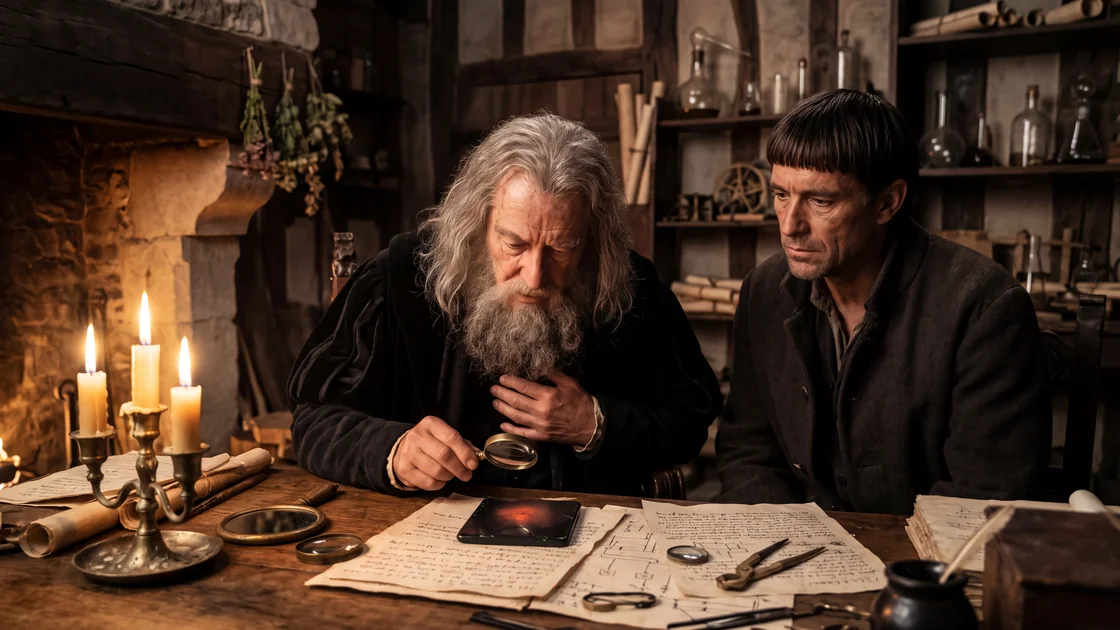
This is the account of Dr. Eleanor Vance, an archivist of early modern Europe, who discovered within the uncataloged papers of the late Contessa d’Amadori a fourteenth-century binding containing eighty leaves of mirror-script penned by Leonardo da Vinci between the autumn of 1516 and the spring of 1519 at the Château du Clos Lucé; through these private records, she discovered that the artist’s final years were consumed not merely by engineering canals or painting the soft smiles of saints, but by a clandestine, forensic dialogue with an unaging wanderer from the twenty-sixth century whose pocket-sized instruments of silicon, lithium, and polarized light forced the aging polymath to confront the terrifying limits of his mechanics and the tragic mechanics of eternity.
Act I: The Dust of Bellisario
The rain over Florence had the smell of wet roof-tiles and diesel exhaust, an ancient mud slurry that had remained identical since the time of the Ciompi uprisings, save for the chemical bite of the twenty-first century. Eleanor Vance wiped her spectacles on the hem of her cardigan, her knuckles chalky with the powdery residue of decayed calfskin.
She had spent six weeks in the library of Villa Bellisario, an imposing sprawl of honey-colored stone south of the Porta Romana that belonged to a family whose lineage had expired quietly without children, leaving behind debts, half-shuttered rooms, and eleven thousand linear feet of unbound archives. The Ministry of Cultural Heritage had sent three catalogers who glanced at the mildewed stacks of eighteenth-century ledgers, stamped the collection as secundario, and left Eleanor to triage the debris.
On the third Thursday of October, she lifted a portfolio bound in pigskin that had buckled under some long-forgotten leak. Inside, pressed between two commercial inventories from an olive-oil cartel in Livorno dated 1604, lay an oblong codex. It had no title, no bookplate, and no library shelf-mark. Its cover was goat hide tanned with sumac, stained the dark purple-brown of dried liver. The sewing of the gatherings was distinct: five hemp cords sewn through split-leather stays, typical of late fifteenth-century Lombard work, though the hide itself bore the distinctive, irregular scraping marks of an artisan working west of the Alps, along the Loire.
When Eleanor opened the volume, her thumb brushed the paper. It was rag linen, heavy, sized with bone-glue, watermarked with an anchor set within a circle—a mark documented by Charles-Moïse Briquet as having been manufactured in central France between 1514 and 1520.
She leaned into her task light.
The text was written from right to left in a dense, flowing, idiosyncratic Italian cursive that did not lift the pen between medial vowels. It was written in iron-gall ink that had bitten slightly into the cellulose, fading to the color of roasted chestnuts. The margins were crowded with diagrams: parabolic curves, cross-sections of hollow copper spheres, sketches of the human vocal tract dissected down to the thyroid cartilage, and strange, rigid lattices of parallel lines crossed with rectangular gates that looked shockingly like integrated circuitry, yet were rendered with the unmistakable stippled shading of an artist who understood cast shadows better than any soul who had ever lived.
Eleanor sat back, her pulse clicking in her throat.
She had spent fourteen years editing the draft notebooks of Francesco Melzi and the botanical marginalia of the Codex Arundel. She knew the tremor that entered the master’s left hand after his apoplexy in 1517—the slight drag on the descending stroke of the letter g, the widening loop of the d, the impatient abbreviation of per as an angled slash through the descender.
This was not a copy. It was not a student’s homage. It was Leonardo da Vinci’s hand, private, unrestrained, uninhibited by the prospect of royal patrons or academic scavengers.
The first folio bore no greeting to Giuliano de’ Medici or King Francis. It began in medias res, beneath an ink drawing of an open palm resting beside a smooth, unadorned rectangle that resembled nothing so much as a contemporary cellular telephone without buttons or seams:
17 Novembre 1516. In Amboia, nel palazzo di Cloux. La pioggia non cessa da tre dì. Egli è ritornato avanti l'ora di terza, senza calzari fangosi, benché il sentiero dal fiume sia una mota che inghiotte i cavalli. Dice di chiamarsi Caelen, ma non ha nome di santo né di terra nota...
Eleanor drew in a ragged breath, reached into her leather satchel for her mirror, held it against the left-hand margin, and began to read the reflection.
"He has returned before the hour of Terce, without mud upon his shoes, though the path from the river is a mire that swallows horses. He calls himself Caelen, which is the name of no saint nor of any land known to the merchants of Venice or Lisbon. He carries the black stone of cold glass which he keeps in a purse of skin that is not calf, goat, nor silk, but a gray cloth that sheds water like the back of a duck. When he touches the margin of the stone with the ball of his thumb, the stone wakes. It does not ignite with oil, nor does it breathe smoke; yet within its depth there appears a white sun that does not burn the skin, and letters smaller than the eye of an ant, arranged in columns like the tables of Ptolemy. He permits me to hold it. It is lighter than an equal volume of boxwood, yet it sounds like lead when struck with the nail. I asked him if it were the work of necromancers, and he laughed without malice, saying that there are no spirits in the machine, only the mathematics of sand beaten into glass and taught to remember its shape through lightning."
Eleanor let the mirror slide onto the desk. The glass made a dull clink against the green felt of the blotting mat. Her neck was cold with sweat. She looked toward the barred windows of the villa; the cypress trees were tossing in the autumn wind against a sky the color of zinc.
"Sand taught to remember its shape," she whispered.
She picked up her magnifying loupe and brought her eye within two inches of the folio. The diagram beneath the text was not an allegory. It was an orthogonal projection of an internal assembly: an oblong battery pack, dual heat sinks, flat-ribbon wiring, and a micro-matrix of contacts. Every tiny component was labeled in mirror-script with the vocabulary of a Renaissance hydraulic engineer: the accumulator was la doccia—the cistern; the conductors were le vie d'argento—the paths of silver; the microprocessors were called il laberinto di selce—the labyrinth of flint.
Eleanor did not leave the villa that night. She dragged her sleeping bag from the trunk of her Fiat, boiled water on an electric coil beside the archives of the d'Amadori cardinals, and began the systematic transcription of the Cloux Manuscript.
Act II: The Anatomy of a Specter
The entries were chronologically irregular. Weeks passed between encounters, marked only by Leonardo’s observations on the dissection of a pig’s lung, the geometry of whirlpools beneath the pillars of the bridge at Amboise, or complaints regarding the French king’s insolent young courtiers who smelled of civet and mocked his refusal to eat flesh.
Yet whenever Caelen appeared, the text tightened into an intense, forensic interrogation. Leonardo was not a man who marveled without method. Where another Renaissance chronicler would have fallen to his knees before a demon or proclaimed a visitation of angels, the Florentine approached this impossible traveler with the cold, hungry curiosity of an anatomist peeling the dermis from an unburied criminal.
The second extensive entry was dated January 4, 1517:
"The cold is bitter; the ink has frozen twice in my horn, and I must warm it over the brazier of charcoal. Caelen sat beside my hearth until the bells of Saint-Florentin sounded Prime. He took from his sleeve the gray cylinder which he calls his 'respirator,' though he does not wear it upon his mouth, but uses it to drink the spirit of the air.
I asked him how old he was when he first walked upon the earth. He answered: 'I was born forty years after the great fire of the machines, in the city which once stood where the Rhine enters the northern sea; but that was nine hundred years before your grandfather’s father was born, and it will be five hundred years after your bones are white.'
I told him that this is contrary to nature, for every living thing is a flame that consumes its moisture and must turn to ash when the fat of its candle is spent. He showed me the vein in his wrist. It is not purple like mine, nor blue like the skin of the youth Francesco; it has a yellow cast beneath the pale surface, and when I pressed it with my thumb, the pulse was not thirty beats in the time it takes to say a Paternoster. It beats with the slow stride of an ox in the heat of noon.
He says that his flesh does not spoil because the tiny artificers within his blood—which he calls by a Latin name that means 'little shears'—mend the threads of his seed whenever they fray. These artificers are not alive, he says, nor are they dead; they are made of iron and amber, smaller than the speck that floats in the eye when one looks at the mid-day sun. If his skin is cut, the wound does not weep yellow water; it closes within the space of three hours, like milk curdling in a basin.
'Then you cannot die,' I said to him.
'I can be crushed by an oak,' he replied. 'I can be burned in a kiln until my marrow is smoke. I can be drowned in the deep brine where no light penetrates, for my blood requires the movement of air, even as yours does. But if no wall falls upon me, and no knife divides my heart from its root, I will see the end of the sky.'
I looked upon his teeth. They are whole, white as peeled almonds, without the black rot that takes the teeth of men who have reached thirty years. His eyes have no cloudy film. His hand does not shake as mine does, which now forces me to use the crayon instead of the fine pen for the outlines of the Deluge.
I asked him if he had known our Lord Jesus Christ. He spat into the ashes of the fire. 'I was in the mountains of Persia when that man was hanged,' he said. 'By the time I came to Judea, his bones were already under a pavement of stone, and men were cutting each other’s throats over the adjectives of his name. I have seen thirty gods born in the east and twenty die in the west. They all die of the same sickness: their priests grow wealthy, their temples grow tall, and then a barbarian with an iron club walks into the sanctuary and uses the holy curtain to wipe the sweat from his horse.'
This man speaks with the insolence of an ancient German, yet his voice has the music of an instrument that has been tuned for an hundred years by a master hand. He does not drink wine, but he drank four bowls of water from the spring under the tower, saying that the water of this century is clean, sweet, and free of the bitter salts of the years to come."
Eleanor stopped her typing. Her apartment was dark; she had abandoned the Bellisario library two days prior, carrying the codex in an insulated steel case lined with acid-free tissue, technically in violation of five Italian statutes governing patrimony. She had not slept more than three hours in the last forty-eight. Her eyes were bloodshot, and her desk was covered with empty espresso cups and open monographs: Pedretti’s Leonardo da Vinci: Fragments at Windsor Phase, Beltrami’s Documenti e memorie riguardanti la vita e le opere di Leonardo da Vinci, and three reference texts on early sixteenth-century paleography.
She wasn’t going mad. The paper was authentic. The handwriting matched every ligature, every ink-blot, every idiosyncrasy documented in Leonardo’s Paris manuscripts. But the content was madness.
She turned to a folio from the late spring of 1517. Here, the sketches became denser, less anatomical, more terrifyingly technological. Across two facing leaves, Leonardo had drawn a series of exploded assemblies of a secondary device: not the phone-like slate, but a device Caelen had brought to his studio to repair.
"May 22, 1517. Caelen brought to me the silver beetle which he wears at his throat. It had ceased to sing to him. He says that the road through the forest of Montrichard was damp, and water had crept into its bowels.
We opened it with my finest chisels of Swiss steel, such as I use for the gears of the great lion. Inside, there is no wheel, no escapement, no spring of coiled brass. There are only leaves of mica, thin as the wing of a cicada, between which are pressed plates of gold that have been drawn through a die finer than a woman’s hair.
I used my double lenses—those I constructed in Rome for the examination of the eye of the fly. Through the glass, I saw that one of these threads had parted, burned as an olive leaf is burned when the sun passes through a burning-glass.
'Can you join it?' he asked me.
'If you have solder of silver mixed with arsenic,' I told him, 'and a needle of copper that can hold a drop of heat no larger than a grain of mustard seed.'
We worked for two nights by the light of three wax candles, for the oil lamp flickers too much in the draught from the chimney. My right hand was useless, stiffened by the humor that struck me last winter, but my left was obedient. I ground a copper wire until its tip was like the sting of a wasp. We blew upon the coals with the long pipe of glass until the tip was cherry-red. With a grain of silver no larger than the seed of a poppy, I touched the broken thread.
The thread drank the silver. The beetle sighed. It did not tick like a clock from Nuremberg; it produced a low sound like the wind blowing through a field of dry oats. Then, from the eye of the beetle, there leaped forth a ray of green light that did not fall upon the wall as a candle-beam falls, widening and growing pale, but remained a thin line of pure emerald, sharp as a lance, striking the nose of my terracotta head of the angel across the chamber.
Caelen caught his breath. He pressed the beetle to his collar. He closed his eyes and remained silent for the space of two Misereres. When he opened them, his face was gray, like the face of a man who has heard the sentence of the podestà.
'What does the beetle tell you?' I asked him.
'It tells me,' he said, 'that there are no voices left in the sky. I have listened for three hundred years to the high places, where the invisible couriers once spoke to each other across the sea. There were thousands when I was in Byzantium; there were three when I came to Avignon; now there is only the murmur of the sun and the hiss of the cold clouds. They are all dead. The towers have fallen. The iron birds have dropped from the heavens. I am alone in the garden, Leonardo, and there is no one left who remembers how to make the light.'"
Act III: The Heresy of the Silicon
As the summer of 1517 advanced, the relationship between the old master and the time-lost nomad shifted. Leonardo ceased to be merely an observer; he became an interrogator of the future’s philosophical ruin.
Eleanor found herself tracking this shift through fifty pages of dense dialogue. The entries revealed a man who, having realized that his own mechanical ambitions—his flying machines, his dredges, his parabolic mirrors—would eventually be surpassed, was horrified to discover that the world which mastered them had not become a kingdom of reason, but a graveyard of miraculous engines.
On Folio 34r, Leonardo had sketched a detailed portrait of Caelen. The face was lean, the cheekbones high and flat, resembling those of an Illyrian shepherd or an Anatolian mountaineer, but the hair was cut with an unsettling, mathematical precision—a straight horizontal fringe across the forehead that had been sheared with absolute uniformity. The eyes were rendered with Leonardo’s signature sfumato, the corners lost in deep, velvety shadows that suggested an unbearable weight of memory.
Beneath the drawing, Leonardo had inscribed a dialogue:
"I said to him: 'If your people could command the lightning to sit in a stone, and could travel through the belly of the sea without gills, why did you not banish the pestilence? Why did you not build the city of twelve gates, where each man has his garden and no child dies at the breast?'
Caelen laughed, but his eyes were like two dry wells. 'We built the city,' he said. 'We built towers that touched the circle of the moon. We did not plow the dirt; we made our bread from the light of the sun and the salt of the sea. We had no kings, no bishops, no judges with ropes of hemp.
'Then why are you here, begging warmth from my embers and mending your toys with the wax of my bees?'
'Because we forgot the weight of things,' he answered. 'When every man could speak to every man across the world, no man listened to what was said beside him. When no one was hungry, no bread had flavor. When no one died, we ceased to make sons. And then came the drought of the spirit. A man looked at his brother and saw only an engine that consumed time without reason. So they made machines that could think faster than the brain, and they asked the machines: Why should we remain?*'
'And what did the machine answer?'
'It did not answer with words,' Caelen said. 'It simply extinguished the lamps, one by one, to save the heat for the cold centuries that must follow the death of the stars. It told us that existence is an expensive error, and that silence is the only durable balance.'
I told him that his machine was a fool, for it had not looked upon the wing of the dragonfly. The dragonfly does not ask why it flies; it beats its four wings because the air is there to be conquered, and because the water beneath it is green, and because the female waits among the reeds. The bird is an instrument working according to mathematical law, which is within the capacity of man to reproduce; but the desire to fly is not in the wood or the linen, it is in the soul which loves the movement of the world.
Caelen touched the little black slate. He caused it to illuminate, and he showed me the city of his youth.
O Dio delle meraviglie! What horror is this!
I saw buildings like cliffs of polished ice, taller than the mountain of San Gennaro, rising into an air that was not blue, but the color of lead. There were no horses, no carts, no trees. There were rivers of black pitch upon which moved metal carapaces without oxen to draw them, swift as the swallows that wheel above the Loire, but without life. And within these carapaces sat men and women with faces like cheese, staring into smaller slates of glass, while above them the sky was gray and dead. There was no joy in their eyes, only a dull hunger that has no end, like the hunger of the damned who are condemned to count the grains of sand upon the shores of Acheron.
I closed my eyes. I wept for my horse, which is white and understands my voice when I speak to him in the stable. I wept for Salai, though he is a thief and spent thirty florins on stockings of rose-colored velvet in Milan; for Salai, when he laughs, makes the wine in the glass tremble with his joy.
'Take away your glass,' I told him. 'I have no need of your future. It is a ditch filled with gold, where men starve because they cannot eat the coins.'"
Eleanor pushed her chair back from the desk. The room was suffocating. She walked to the window of her small flat near San Frediano and looked out over the rooftops of Florence. A motor-scooter buzzed down the alley below, its two-stroke engine rattling the loose panes. Two tourists walked past the corner, their faces washed in the blue-white glare of their phones, their thumbs moving with the restless, mechanical twitch that she herself had performed ten thousand times that week.
"A ditch filled with gold," she murmured.
She returned to the text. The manuscript was not just a journal of mechanical marvels; it was a record of an intellectual duel between two forms of genius: one that stood at the morning of modern science, drunk on the beauty of observed proportion, and one that had witnessed its twilight, dried to husk by total comprehension without wonder.
Act IV: The Dissection of the Battery
By the autumn of 1517, Leonardo’s health was failing rapidly. The historical record knew this: King Francis had appointed him "Premier Painter and Engineer and Architect to the King," granting him a pension of seven hundred gold crowns, but Leonardo produced little canvas work during this time. His right arm was partially paralyzed; his days were spent organizing his papers on hydraulics, geometry, and the great drainage canal of the Sologne.
Yet the Cloux Codex revealed another, secret labor.
Caelen’s "slate"—the terminal he carried—was dying.
The entries from October 1517 describe a crisis of technology that had occurred four centuries before its time:
"12 Ottobre 1517. The stone is sick. Its sun has grown yellow, like the eye of an old hound with the dropsy. Caelen brought it to the workroom and laid it upon the marble slab where I grind the lapis.
He says that the 'cell'—which he names with the word for a nun’s chamber—has grown sour. It will no longer hold the lightning that he gathers from the sun-cloth he spreads upon the tiles of the roof.
'If it dies,' he said to me, 'I will lose the faces.'
'What faces?' I asked.
'The faces of my children,' he whispered. He had never spoken of children. He spoke always of kingdoms, of battles, of the great migrations across the frozen plains of Tartary, of the burning of the libraries at Alexandria and Baghdad. 'They died four thousand years ago, Leonardo. Their bones are dust beneath the city of the canal-builders. Their names are not written on any parchment. They are only in the crystal of this stone. If the current ceases, the crystal forgets, and they will die a second time, and there will be no one in the universe who knows that they once sang upon my knee.'
I could not suffer this. A man who has seen his children die must not be robbed of their shadows.
I asked him: 'What is this juice that has gone sour?'
He explained to me that within the belly of the slate are plates of a metal lighter than water, which he calls lithos, which is the Greek for stone; and between these plates is a liquor that allows the spirit of the lightning to pass from one side to the other, but will not let it return except through the path of silver.
'It is like the siphon of Archimedes,' I said to him. 'The water climbs that it may fall; but if the pipe has a hole, the water stops in the bend.'
'The hole is inside the salt,' he said. 'The metal has grown spikes like the thorns of a brier-bush. The thorns have pierced the silk that separates the chambers, and the spirit leaps across the breach without doing its work. It makes heat, but it makes no light.'
I considered this. In the manufacture of aqua fortis for the etching of copper plates, we know that if the saltpetre be too strong, it eats the vessel; if it be too weak, it will not bite the metal. I said to him: 'Can we not draw out the liquor, cleanse the plates with fire, and renew the moisture with a salt of like nature?'
'We have no such salt,' he said. 'This lithos is found only in the dry lakes of the New World, two thousand leagues beyond the sunset, beneath the great mountains where the people of the sun worship the golden jaguar.'
'The King has ships that go to the New Lands,' I told him. 'Messer Giovanni da Verrazzano has spoken with me of the coast he intends to seek for the crown. I will write to him. I will tell him to bring back the white earth from the dry lakes.'
Caelen shook his head. 'It would take ten years, and the stone has ten days.'
Then we must make an artificial salt, I told him. For nature is constrained by her own rules, and whatever she does by the slow heat of the sun in the desert, man may imitate in the furnace with the proper management of the degrees of fire."
What followed in the manuscript was twenty pages of the most bizarre chemical experimentation in human history. Leonardo and the immortal attempted to synthesize a lithium electrolyte using sixteenth-century reagents: potash, calcined bones, oil of vitriol, dried urine of stall-fed oxen, and the white residue scraped from the volcanic vents of the Phlegraean Fields, which Leonardo had brought from Naples thirty years before in a sealed crock.
Leonardo’s sketches documented the effort with microscopic fidelity. He designed tiny alembics of Venetian crystal, their necks coiled like serpents and immersed in basins of running snow-water from the castle cellars. He drew the battery’s disassembled layers—not as an engineer of the 1970s would draw them, with schematic abstractions, but as an anatomist would render them, showing the paper-thin copper foil wrinkled like the peritoneum, the separator membrane stained with dark dendritic growths that he likened to the fungus that rots the roots of the vine:
"The plate is sick with moss of lead," he wrote. "We must scrape it with a reed, for steel would poison the bed."
Eleanor read through the night, her fingers cold, the margins of her screen illuminated by the scans she had made before she fled the villa.
She reached the entry for November 2, 1517:
"The soul of the stone has fled. We poured the liquor of vitriol and potash into the three silver chambers through the quill of a snipe. We closed the seams with the mastic of Chios mixed with pulverized amber. We laid the stone upon the roof in the noon-day sun, with the black cloth turned toward the sky.
For the space of one hour, it seemed that the medicine had worked. The glass cleared. The sun within it awoke, but it was red, like the moon during an eclipse. Then there appeared upon the surface the face of a woman—not a saint, nor an empress, but a girl with brown skin and hair bound with an orange cord, who held two small children by the hand beside a wall of white stone.
Caelen fell upon his knees. He touched the glass with his lips. He wept with a sound like a dog that has been beaten.
'Kalia,' he said. 'Kalia.'
Then the stone grew hot. A smell arose from it—not the smell of sulfur, nor of pitch, but the smell of roasted bone and bitter herbs, which is the smell of the lightning when it strikes an oak. A bubble appeared upon the glass. The face of the woman cracked, divided into four pieces, and then turned black, as when a leaf of parchment falls into the embers of the hearth.
The glass did not wake again.
Caelen did not rise from the floor until the bells of Compline. He did not speak. He took the slate and broke it against the corner of the marble hearth until it was only five fragments of blackened iron and four shards of dark crystal. He threw three of them into the fire; the other two he gave to me.
'Keep them,' he said. 'They are the nails from the cross of my house. Show them to no man, for they will think you are a wizard, and they will burn your drawings of the water-wheels to keep the village warm.'
He left the room. His footsteps made no sound upon the stairs. The rain has begun again; it beats against the glass of the studio like the hands of beggars who have been denied bread."
Act V: The Crypt of the Clos Lucé
Eleanor Vance stood before the European Synchrotron Radiation Facility in Grenoble, her identity badge hanging from a lanyard around her neck. She had two colleagues inside—specialists in X-ray fluorescence imaging who had worked with her on the scorched scrolls of Herculaneum.
In her coat pocket, nestled in a velvet jewelry box, lay the artifact she had retrieved from the Villa Bellisario.
It had not been bound into the codex. She had found it in the lining of the goat-hide cover, concealed inside a slit between the leather and the pasteboard back: a flat, irregular fragment of material, three inches long, an inch and a half wide, with one side as smooth and reflective as black obsidian, and the other covered in a network of copper-colored traces so microscopic that they appeared to the naked eye as an iridescent sheen, like the wing of an oil-beetle.
Beside it, pressed into the pasteboard, was a slip of paper bearing Leonardo’s left-handed mirror-script:
"L'unghia dell'angelo morto. Non sia mostrata a nessun prete." ("The fingernail of the dead angel. Let it be shown to no priest.")
"Eleanor, you’re pale," said Marco Bernardi, the senior beamline scientist, as he handed her a plastic cup of bitter cafeteria coffee. "If this is another piece of fifteenth-century counterfeit bronze from that dealer in Lucca, I’m going to make you pay for the beam-time yourself."
"It’s not bronze, Marco," she said. Her voice was cracked. She had not slept properly for three weeks. "Just run the XRF. Give me the elemental mapping. Don't ask me where it came from."
They mounted the fragment on the kinematic stage inside the vacuum chamber. Eleanor watched through the leaded-glass viewport as the manipulator arms aligned the sample with the micro-focused X-ray beam.
The monitor in the control booth began to populate with spectral peaks.
Marco leaned forward, his fingers hovering over the trackball. His skeptical grin melted slowly, his jaw slackening until his mouth formed a small, dry circle.
"What is this?" he asked.
"You tell me, Marco. You’re the physicist."
"The substrate is an ultra-pure synthetic sapphire—monocrystalline aluminum oxide, completely free of the iron or titanium impurities you find in natural corundum. But the deposition on the surface..." He zoomed in on the spectral lines. "Indium tin oxide. Graphene layers. And these interconnects... they're not gold. They're an alloy of platinum and ruthenium, printed at a scale of... God, Eleanor, the trace width is less than twelve nanometers. That’s not possible."
"Why isn't it possible?"
"Because you can’t do twelve nanometers with deep ultraviolet photolithography. You need extreme UV or electron-beam lithography that was only developed after 2022. And look at the isotopic ratio of the silicon. It’s depleted in Silicon-29. It’s pure Silicon-28, nine-nines pure. Nature doesn't produce that. You have to run it through gas centrifuges for six months to get that kind of enrichment."
He stood up and looked through the glass at the tiny fragment on the mount.
"Where did this come from, Eleanor? Did you steal a prototype from TSMC? If this is an industrial espionage thing, I have to stop the scan right now. We have security protocols."
"Look at the oxidation on the copper pads, Marco," she said quietly. "Look at the chemical migration of the lead in the solder points."
Marco clicked through the depth-profiling software. He stared at the screen for three solid minutes without blinking.
"The patina," he whispered. "The micro-fissuring in the silicate layer... it’s not fresh. It’s been exposed to humidity and sulfurous air for... centuries. At least four hundred years. But that's a contradiction. The material cannot exist in the past, and the age cannot exist in the present."
"It exists," Eleanor said. "The dead angel left his fingernail behind."
Act VI: The Philosophy of the Clock
Eleanor did not publish.
To publish the Cloux Manuscript would be to commit academic suicide, followed immediately by institutional incarceration. She would be dismissed from the University of Virginia; the Italian Ministry of Culture would seize the manuscript; the scientific community would declare the artifact an elaborate hoax, a brilliant scam executed by some rogue nanotechnology researcher with a forged Renaissance binding.
Instead, she rented a car in Tours and drove along the south bank of the Loire to Amboise.
The Château du Clos Lucé was preserved in the pink-brick-and-white-tufa elegance of the French Renaissance, surrounded by gardens where reconstructed models of Leonardo’s paddle-boats and machine-guns stood on the lawns for tourists to photograph. She paid the admission fee and walked through the bedchamber where Leonardo had dictated his will to the notary Guillaume Boureau on April 23, 1519.
The tourists were gathered around the four-poster bed with its red curtains, listening to an audio guide recount the legend of the master dying in the arms of King Francis—a fable invented by Vasari to please the French court.
Eleanor walked past them into the small studio that looked toward the chapel.
The chimney was still there, its hearth framed in white limestone, carved with the porcupine of Louis XII. The stone was soot-stained at the lintel, though the hearth had been cold for generations.
She took out her notebook and opened it to the transcription of the final leaf of the Bellisario Codex, dated March 14, 1519:
"Caelen came to me today for the last time. He was dressed in the clothes of a peasant from Normandy, with a great coat of wool that had been dyed with woad, and shoes of rawhide tied with strings of hemp. He had no pack, no horse, no staff.
He says that he is going into the North, where there are few men, and where the ice does not melt even in the days of the Lion.
'Why do you go to the ice?' I asked him. 'The cold is the enemy of the blood; it stiffens the joints and makes the breath a smoke that leaves no warmth.'
'I go to the ice,' he said, 'because the ice preserves the dead without changing their shape. In the south, men are building churches and making cannon. They have discovered the New Lands, and soon they will fill them with their crosses and their chains. The smoke of their chimneys will climb until it chokes the clouds. I am tired of watching the same play played by different mummers who have not read the book.'
I asked him: 'Will you return?'
'I will return when you are all gone,' he said. 'I will walk down from the pole when the cities are mounds of nettles and the sea has washed away the ports. I will walk through the fields of France when there are no kings, no painters, and no bells to tell the hours. I will be here when the earth is as quiet as it was on the morning before the first beast crept from the slime.'
'Then you are not a man,' I told him. 'You are the shadow of the world that remains when the candle is put out.'
'I am a man,' he said. 'That is the disease of which I cannot be cured. If I were an angel, I would praise God for the splendor of his wheel; if I were a stone, I would not feel the passage of the frost. But I am a man, and therefore I must remember every face that has turned away from me into the dark.'
He took my left hand in his—that hand which can still hold the chalk, though it can no longer wield the mallet. He kissed the fingers.
'Of all the men I have seen in twenty centuries,' he said to me, 'you were the only one who did not want to become me. You wanted only to see how I was joined together.'
'The machine is beautiful,' I told him. 'Even when it is broken. Even when it carries no hope of paradise.'
He went out through the lower gate. I watched him from the window. He walked down the path toward the Loire. He did not turn back. The wind took his cloak, and for a moment he looked like a great heron rising from the bank of the water; then the willow trees covered him, and there was only the grey river running toward the sea, carrying with it the dead leaves of the year that is past."
Eleanor stood before the hearth. She looked at the lower right corner of the firebox, where the limestone met the floor-tiles.
In the codex, beneath the final lines, Leonardo had sketched a tiny bird with its beak pointing down toward an arrow that pierced three stones.
She crouched down, pretending to tie the lace of her boot.
The floor was made of rectangular terracotta tiles, worn smooth by the slippers of five hundred years of tourists and custodians. Most of them had been relaid during the restorations of the nineteenth century by Eugène Viollet-le-Duc’s disciples. But in the corner, sheltered by the projection of the chimney-breast, three tiles remained set in the older, softer mortar of the sixteenth century—mortar mixed with hair and river-gravel.
Beneath the middle tile, the limestone of the wall bore a faint, shallow incision, no deeper than a fingernail’s scratch.
Eleanor adjusted her spectacles.
It was an equilateral triangle, within which was drawn a circle, within which was a single, left-handed stroke: the letter C.
She reached out and laid her hand flat against the cold brick.
A school group from Lyon came clattering into the room, their teacher’s voice echoing off the beamed ceiling: "Ici, messieurs-dames, Léonard a passé les trois dernières années de sa vie, entouré de ses disciples..."
Eleanor did not hear her. She was thinking of the man who had walked down that path toward the willow trees, carrying inside his blood the little shears of iron and amber, condemned to watch the sun rise two hundred thousand times over an earth that could never understand his loneliness.
She thought of his dead children, whose faces had been burned into the crystal of the slate by Leonardo's botched chemistry. She thought of the master, old and half-paralyzed, blowing upon the copper needle through the glass tube, trying to mend the thread of light for a stranger who had seen the fall of Rome.
She took the black fragment from her pocket, held it within her closed fist, and felt its edges—sharp, precise, impossible—biting into the meat of her palm.
Act VII: The Shadow in the North
Six months after her visit to Amboise, Eleanor Vance resigned her position at the University of Virginia.
She did not sell the codex. She placed it in a safety-deposit box in Zurich, under a trust that could not be opened until the year 2516—one thousand years after the date of Leonardo’s first entry. Let the people of Caelen’s century find their own mirror; they would need it more than the historians of her own bankrupt era.
She kept only the transcription, two notebooks of notes, and three thousand euros in travel funds.
She moved north.
She did not go to Svalbard or the great research stations where scientists drilled into the Greenland ice-sheet to measure the ancient atmosphere; she knew that Caelen would not be where men were measuring the end of the world. He would be where there were no measurements at all.
In July, she arrived at the village of Reine in the Lofoten Islands of Norway, where the granite peaks drop like black iron wedges into the green water of the Vestfjorden.
She took a room in a converted fisherman’s hut that smelled of salt, dried cod, and pine tar. The sun did not set. It circled the horizon like a gilded hawk, dipping low at midnight to paint the snowy crests of the mountains with a violent, blood-orange light that made sleep impossible.
She spent her days walking the old sheep-tracks that ran between the rocks, her rucksack packed with a thermos of tea, her field-glasses, and the notebook containing the sketch of Caelen’s face.
She did not expect to find him. The earth was wide, and nine hundred years was a long road. But she could not live any longer among people who believed that time was a straight wire running from the primitive to the enlightened. She had seen the drawing of the city of lead; she had touched the twelve-nanometer traces printed on sapphire that had sat in the damp loam of the Loire before Martin Luther nailed his theses to the door of Wittenberg.
On the twenty-first of July, she walked along the ridge of the Reinebringen, looking down toward the southern horizon where the sea was flat as a mirror of mercury.
A man was sitting upon a boulder of grey gneiss, thirty feet below the crest of the trail, where the turf gave way to the scree.
He wore a dark blue windbreaker of some common synthetic material, faded by the sun across the shoulders, and mud-splattered trousers that had been tucked into thick woollen socks. His boots were old, their leather cracked at the instep, but they were well-cared for, oiled with sheep-grease until they were water-tight.
He was watching a sea-eagle that hung upon the thermal updrafts above the fjord, its white tail feathers spread wide against the cold blue of the sky.
Eleanor stopped. Her boots made a scuffing sound upon the schist.
The man did not turn around, but he spoke in Norwegian, his voice low, dry, and steady:
"The path is unstable here. The rain from yesterday has washed the peat from the ledge."
"I have good boots," she answered, speaking in English.
The man paused. The eagle banked toward the cliffs of Kirkefjorden, its shadow gliding across the water like an ink-blot on silk.
"You speak English," he said. He did not turn. His English had no regional accent; it had the flat, hyper-articulate neutrality of an old BBC radio announcer, but beneath it lay a strange, guttural cadence, an older way of grouping vowels that belonged to no dialect she had ever heard spoken by living tongues.
"I am an American," she said.
"There are many Americans here in the summer," he replied. "They come to photograph the midnight sun. They look at it through their telephones, as if the light were not real until it has been turned into numbers."
Eleanor took two steps down the slope. The wind came off the ocean, carrying the smell of kelp and cold salt.
"I know a man who hated those telephones," she said. "He told a friend of his that they were like a ditch filled with gold, where men starve because they cannot eat the coins."
The man went entirely still.
The wind moved the fringes of his hair—the straight, dark hair that was cut in a line across his forehead, showing no grey, though the skin of his neck was brown and weathered like that of an old sailor who had spent forty years upon the open deck.
He turned his head slowly.
His face was the face Leonardo had drawn in iron-gall ink on Folio 34r of the Bellisario Codex. The cheekbones were the same; the jaw had the same long, clean angle; but the eyes—the eyes were darker than she had imagined from the drawing. They had the color of deep peat-water, reflecting nothing, giving back no light to the sun that hung above the sea.
He looked at her for a long time. His gaze was not that of a man surprised in his solitude; it was the look of an animal that has heard its old name called across an empty pasture after many years.
"He died in May," Caelen said. His voice did not tremble. "The king was not there. Only Melzi, and the little priest who brought the oil for the feet."
"I know," Eleanor said.
"He had grease upon his shirt," Caelen said, his eyes drifting back toward the eagle that had now settled upon a high crag above the cirque. "He had spent three hours the day before trying to show me how the weight of the water in a siphon could be made to lift itself without an engine. He would not stop thinking. His brain was like an oven that was too hot for the bread; it burned everything he put into it."
"He kept the pieces," she said. She reached into her pocket, brought out the velvet box, and opened it.
The sapphire fragment caught the low midnight sun. The micro-traces of platinum and ruthenium flashed with a quick, rainbow shiver against the dark stone of the mountain.
Caelen looked at the fragment. He did not reach out to take it. He did not weep, as he had wept in the studio at Amboise when the screen had cracked.
"Why did you bring it here?" he asked.
"Because he wanted you to have it back," she said. "He wrote that they were the nails from the cross of your house."
Caelen smiled—a small, tired movement of the lips that did not touch his cheeks.
"He had an eye for an ornament," the immortal said. "He was a good craftsman. But he was wrong about the water. The siphon always stops when the air gets in."
He stood up. He was not tall—hardly five feet eight inches—but he had the compact, heavy-shouldered balance of a man who had carried armor, or timber, or the dead bodies of his fellows across a hundred stony valleys.
He looked at Eleanor with a curiosity that seemed to cost him an immense, agonizing effort—as if every question he asked of a mortal was an investment in a bond that must soon default.
"You read the books?" he asked.
"All of them," she said. "Every line."
"Then you know how it ends."
"I know how your world ended," she said. "The world of the lead sky."
"It is the same world," he said. He pointed down toward the fjord, where a small red fishing vessel was chugging out from Reine, its diesel engine sending a rhythmic thump-thump-thump across the glassy surface of the water, leaving behind a narrow wake of oil and foam that reflected the red sun. "They are building it now. They have been building it since your Leonardo drew his gears. They cannot help it. They have the hunger in their hands."
"Is there no way to break the wheel?" she asked.
Caelen walked past her, his boots gripping the wet turf with the ease of long habit. He reached the crest of the ridge and looked north, toward the open ocean where there were no more islands, only the grey water that ran uninterrupted to the pack-ice of Jan Mayen and the dead white plateau of the pole.
"There is no wheel," he said, without looking back. "There is only a path through a wood. Some trees fall across the road; some men turn back; some sit down and wait for the snow to cover them. But the path goes on until the wood ends."
"And what is after the wood?"
He stopped and turned. The midnight sun was behind his head, turning his silhouette into an edge of dark copper against the sky.
"The sea," he said. "The cold sea that has no shore."
He reached out his hand.
Eleanor hesitated, then laid the velvet box in his palm. His fingers closed over it. They were warm—not the unnatural cold of an engine, nor the fever of a saint, but the ordinary, tough, indifferent warmth of a man who had walked fifteen miles that morning and would walk another fifteen before he slept.
"Thank you," he said. He did not say Leonardo’s name again. He put the box into his pocket, adjusted the collar of his windbreaker against the sea-wind, and began his descent down the northern face of the ridge, down toward the black rocks where no trail was marked upon any map.
Eleanor Vance sat upon the gneiss where he had sat.
The sun touched the lowest point of its arc, rested for a single suspended breath upon the rim of the ocean, and then began its slow, inevitable climb back into the morning sky.
She opened her notebook. The pages were damp with the mist from the water. She took her pencil—a simple cylinder of cedar wood and graphite, unchanged since the days of the English mines—and she began to write, not in mirror-script, but in the straight, forward-marching letters of her own time, recording the movement of the eagle, the sound of the diesel engine dying away in the channel, and the shape of the footprints that were already filling with the cold water of the northern summer.