The Chronometer of Broken Truths
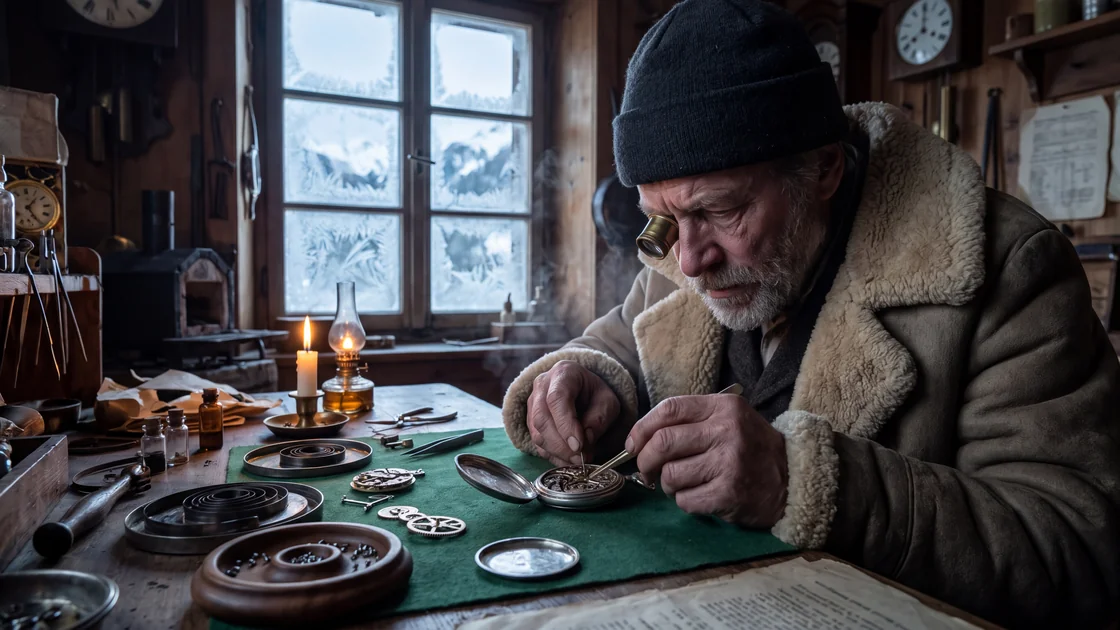
In the snow-locked hamlet of Kaltbrunn, perched precariously upon the jagged ridges of the Northern Hook, a solitary clockmaker named Tobias Vane constructed an extraordinary pocket watch designed to recoil into the past whenever a falsehood was uttered within its brass-rimmed presence. What began as a grieving craftsman’s quest to settle the ambiguities of his late wife’s final words soon exposed the delicate architecture of polite deceptions, sacred omissions, and communal pretense that kept the isolated village from devouring itself. As the ticking turned against the current of time, Tobias was forced to confront not merely the deceit of his neighbors, but the fragile, merciful necessity of human illusion.
I. The Escapement of Doubt
The frost upon the workshop windows of Tobias Vane did not form in feathers or stars, but in thin, paralytic needles that crept from the frame toward the center of the glass, choking the gray mountain light down to a dull, milky thumbprint.
Tobias sat hunched over his bench, a loupe screwed into his right eye socket, his breath condensing in faint, rhythmic puffs over a dish of oil and pulverized ruby. Before him lay the viscera of three dozen clocks: disassembled verge escapements, teeth fine as insect hairs, tempered blued-steel springs coiled like sleeping vipers, and an array of microscopic screws resting in the hollow of a turned walnut tray. He was fifty-eight years old, though the damp cold of the alpine valley made his knuckles swell like the knots on a hazel rod, giving his hands the appearance of an older man's tools—battered, seasoned, yet unerringly steady when holding the tweezers.
For seven months, since the thaw had closed the lower pass with mud and then the early autumn had sealed it shut again with blue ice, Tobias had spoken to almost no one save the dry-goods merchant and the baker. His wife, Klara, had died in the third week of the previous November. She had slipped away not with a shriek or a sudden fever, but like water soaking slowly into dry lime, paling by degrees until her breath simply failed to bridge the gap between twilight and full dark. Her final words to him, murmured into the collar of his woolen smock while the church bells of Saint Jude tolled vespers through the drifting sleet, had been: “Tobias, I never regretted a single day in this valley with you.”
He had believed her. He had lived by those words for forty days of mourning, repeating them to the empty kettle, whispering them into the cold ticking of the longcase clock that stood by their matrimonial bed. But grief is an acid that eats first through certainty. By midwinter, he had begun to remember the way her mouth had tightened at the corners; how she had looked toward the southern crags, where the road led out toward the cities of the plain, every time the mail-coach failed to arrive; how she had kept a tin of lavender water hidden beneath her sewing box, never using it, merely unscrewing the stopper to smell an air that had not been breathed by peasants in sheepskin coats.
The doubt had not arrived as a thunderclap; it had come as an imperfection in an anchor escapement—a microscopic friction that loses half a second a day until the entire month is thrown into chaos. Did she mean it? Or had she offered him a counterfeit penny to buy his peace of mind while she slipped away into the uncontradictable dark?
It was from that unendurable question that the watch was born.
He had not set out to build a moral engine. Tobias was a mechanic, not a theologian. He believed that the world was composed entirely of weight, lever, incline, and friction. If a heart faltered, it was because the hydraulic pressure of the blood had failed; if a man wept, it was the venting of vapor from an overheated vessel. Yet he also knew, through forty years of measuring the passage of the unseen, that human emotion produced physical currents. A man telling a lie inhaled differently than a man speaking truth; the skin of his throat tightened; the pulse against his collar leaped with a minute, fugitive flutter; the micro-tremors of his voice disturbed the air in waves that were fractionally sharper, jagged at the crest, than the rounded troughs of candor.
For three hundred nights, while the wind howled through the chimney like a wolf trapped in a flue, Tobias worked upon the Palinode—the name he had scratched into the inside of the back cover.
Its case was turned from an alloy of silver and bell-metal, cold to the touch and slightly pale, like the skin beneath a wedding band after it has been removed. The escapement, however, was where the heresy lay. Instead of a single balance wheel governing an escape wheel with standard club teeth, Tobias had designed a dual-train system linked by a floating differential made of hardened phosphor-bronze. The first train ran forward under the tension of a traditional mainspring, moving the hand—for it had only one, a blued-steel lance—in the clockwise journey from the Roman numeral I to XII.
The second train was governed by an inverse hairspring, counter-weighted by an extremely fine diaphragm of hammered pig-bladder stretched across an acoustic chamber within the cuvette. This diaphragm was linked to a hair-thin needle of osmium that rested against the counter-poise of the pallet fork. When the acoustic atmosphere remained harmonious—when the vibrations of the human voice possessed the unhurried resonance of sincerity—the pallet engaged normally, tick-tick-tick, five beats to the second, forward.
But when a spoken untruth struck the diaphragm, the erratic frequency of the air caused the osmium needle to kick. It tripped the differential. The primary escape wheel was thrown out of gear, and the secondary, reverse train engaged with a dull, dry snap.
The watch would tick backward.
It did not merely stop. It unwound the recorded minutes. A lie told in its presence would force the single lance to retreat across the silver dial, subtracting seconds from the accumulated ledger of the day, as if the universe itself were embarrassed by the assertion and sought to erase the interval in which it had been uttered.
On the third of February, Tobias seated the final screw into the balance cock. His fingers were stiff with cold, but his loupe did not tremble. He brought the balance wheel into motion with the gentlest puff of air from his lips.
Tick, tick, tick, tick.
The lance moved forward, smooth, indifferent, righteous.
Tobias leaned his face down until his lips were an inch from the exposed works. The smell of sweet whale oil and cold silver filled his nostrils.
“I am thirty years old,” he whispered.
A sharp, metallic clack sounded deep within the belly of the movement. The balance wheel shuddered, seized for a fraction of an instant, and then the escapement began to flutter with a strange, frantic cadence—not the dignified march of time, but the sound of dry grasshopper legs scraping against slate. The single hand jumped backward: three seconds, four, five.
Tobias stared, his breath caught in his ribs.
“I am an old man,” he said softly.
The mechanism caught itself with another click. The frantic scraping ceased. The hand settled, paused, and resumed its forward drift. Tick, tick, tick.
A drop of sweat fell from Tobias’s brow, splashing against the brass edge of the movement ring. He wiped it away with the corner of his apron, his heart thumping against his breastbone like a bird trapped in an attic. It was not a toy. It was an ear that could not be flattered, an eye that could not be blinded by affection.
He shut the outer hunter case with a soft snap. He slipped the heavy silver disc into his waistcoat pocket, threaded the gold-washed chain through his buttonhole, and reached for his beaver-skin cap and his wool-lined coat.
Outside, the village of Kaltbrunn lay under three feet of crusty, refrozen snow, silent as an unstrung dulcimer.
II. The Currencies of the Square
The market square of Kaltbrunn was not an open plaza, but a claustrophobic well formed by the leaning, half-timbered gables of the merchant houses, their third storeys jutting so far into the middle air that neighbors across the alley could lean from their dormers and strike a match against each other's sills. At the center stood the fountain of Saint Jude—dry since November, its stone basin filled with drifted snow and frozen cabbage leaves.
Tobias walked slowly, his boots crunching through the rime. The air was twenty degrees below freezing, so sharp that each breath felt like swallowing crushed glass, but his fingers remained wedged deep in his right waistcoat pocket, his thumb resting upon the cold, smooth contour of the silver case. He felt the steady, subterranean pulse through his glove: one, two, three, four. Forward. Always forward.
He stopped first at the stall of Master Gemp, the butcher, whose breath rose around his red, pork-like face in vast steam clouds as he hacked through a frozen side of mutton with an iron cleaver.
“Morning, Tobias,” Gemp barked, not looking up. His cleaver thudded into the birch block with an earth-shaking shudder. “Cold enough to freeze the devil’s toes. You want the neck? Or the flank? I’ve kept the flank for you. Freshly hung. Not four days dead from the high meadow pastures.”
Beneath Tobias’s thumb, inside the wool and the lining, the watch gave a tiny, spastic shudder.
Snap-tick-a-tick-a-tick.
Tobias kept his hand motionless. He felt the lance wheeling backward. Four seconds. Five.
“The high meadows have been buried under five feet of snow since Martinmas, Master Gemp,” Tobias said mildly, keeping his voice level.
Gemp paused, the cleaver suspended mid-air, a thin line of red grease glistening along the blade. His small, hog-bright eyes darted to Tobias, then down to the blue mutton fat.
“Well,” the butcher grunted, his shoulders hitching, “the boy brought them down to the lower cellar before the hard frost, didn't he? It’s prime meat, Vane. You won’t find better flesh between here and the valley basin. I wouldn't sell it to the Burgomaster for less than eight groschen, but for you—because Klara was always kind to my little girl—I’ll call it five.”
Clack-tick-a-tick-a-tick-a-tick.
The recoil was longer this time. The watch was eating its own morning. In the space of two sentences, Gemp had cost the world nearly fifteen seconds of progress.
“I will take three leeks and two turnips from the dry-cellar instead,” Tobias said, pointing his cane toward the wooden bin.
“They’re sweet as apples,” Gemp snapped.
Tick-a-tick. Two seconds lost.
Tobias paid with two copper pfennigs, took his cold roots wrapped in greasepaper, and turned away. He did not feel triumphant; he felt an odd, hollow nausea in the pit of his stomach. It was one thing to suspect that the butcher salted his weights or stretched the pedigree of his ewes; it was another to feel the physical reality of the man’s petty falsehoods grinding the gears of a machine against their natural axis.
He walked toward the church. Outside the cooperage, Frau Mallow was leaning over her gate, speaking to the young schoolmistress, Fräulein Liese, whose fingers were red and raw through her knitted mittens.
“You look wonderfully hale today, child,” Frau Mallow was saying, her head cocked with that specific, predatory pity that passes for charity in small places. “The color in your cheeks is just like a rose. The winter agrees with you, it truly does.”
Tobias paused three paces away, pretending to adjust the buckle of his boot.
In his pocket, the Palinode went into a sudden, frantic reverse. The lance retreated twenty seconds in a single burst. Fräulein Liese was grey-skinned, hollow-eyed, her collarbone protruding like an axe-blade beneath her threadbare shawl—she was clearly spitting blood into her handkerchief before breakfast, and both women knew it.
“Thank you, Frau Mallow,” Liese whispered, looking down at her boots. “I feel very strong. The cough is entirely gone.”
Clack-tick-a-tick-a-tick.
Another fifteen seconds dissolved into the ether.
Tobias stood upright. The two women glanced at him, their faces freezing into that guarded, suspicious neutrality that mountain people reserve for men who live alone with tools and dead wives.
“Good morning, Tobias,” Frau Mallow said, her mouth stretching into an arch that lifted her cheeks but left her cold, grey eyes dead as river pebbles. “We were just saying how well you are looking, despite the house being so large and cold without poor Klara. We were saying only yesterday that you bear your cross with Christian fortitude.”
The watch did not merely tick backward; it hissed. The osmium needle seemed to vibrate in an agony of rejection. The hand flew counter-clockwise, retreating through a minute, two minutes, sweeping past the Roman figures with the frantic haste of a spider fleeing fire.
Tobias took his hand from his pocket. He did not pull out the watch. He looked Frau Mallow in the eyes—those pale, milky discs that had watched his wife’s coffin being lowered into the lime-pit—and felt a sudden, terrible clarity.
“You were saying no such thing,” Tobias said. His voice was very quiet, but it had the flat, hard density of an anvil strike. “You were telling your sister that I have grown eccentric and filthy, and that if I do not take a woman into the house to scour the floorboards, the parish ought to inventory my property before I lose my wits entirely.”
Frau Mallow’s chin wobbled. The color surged into her neck like boiling wash-water. “I never! How dare you, Tobias Vane! The idea that I would speak ill of a neighbor in his affliction—”
Tick-a-tick-a-tick-a-tick-a-tick.
The watch was spinning backward now with such violence that Tobias could feel the gyroscopic vibration through the cloth of his coat. If she continued for another minute, the instrument would be back to midnight.
“Good day, Frau Mallow,” he said. “Keep your woolens dry, Fräulein Liese, or you will not see the crocuses.”
He turned on his heel and strode toward the church of Saint Jude, leaving the two women frozen by the palings—one purple with indignance, the other pale as lard.
III. The Confessional of Brass
The Church of Saint Jude was the oldest structure in the parish, built three hundred years earlier when the valley was first settled by miners who sought silver in the slate and found only iron pyrites and lung-rot. Its walls were fieldstone, four feet thick, mortared with lime and cattle hair, and the air within was colder than the street, smelling permanently of damp tallow, old wool, and the peculiar, sweetish stink of dry-rot behind the reredos.
Father Jerome was sweeping the altar steps with a broom of birch twigs. He was a small, round-shouldered man whose cassock had been mended so many times with thread of different dyes that his back resembled an irregular map of foreign provinces. He stopped his sweeping as Tobias’s iron-shod heels clicked against the flagstones of the nave.
“Tobias,” the priest said, leaning on his broom. His voice had the dry, pleasant rasp of two shingles rubbing together. “You have come to look at the tower clock? It has been dropping three quarters of an hour every night since the frost hardened. The sexton says the pendulum bob is catching the draft from the belfry hatch.”
Tobias took a seat in the front pew, setting his basket of leeks and turnips upon the kneeler. He did not take off his cap; his head felt feverish, though his feet were like blocks of river ice.
“The tower clock drops time because the escapement is worn down to the brass, Father,” Tobias said. “The teeth are hooked like thorn-bushes. When the cold contracts the wheel, the pallets cannot clear the drop. It has nothing to do with the sexton’s hatch.”
“Ah,” Jerome smiled, his round, wrinkled face folding into a map of benevolent surrender. “Well, I know nothing of pallets. Only that the bell rings for Prime when the sky is already pink, and the farmers complain that their milk-pails are confused. Can you mend it before Sunday?”
“I could,” Tobias said. He withdrew the Palinode from his waistcoat. He laid it flat upon the carved oak rail of the pew between them.
The silver back of the watch caught the dim light of the single candle burning before the icon of the Mother of Sorrows. Through the crystal, the single lance was currently creeping forward past the figure IV.
Tick, tick, tick, tick.
Father Jerome laid aside his broom and stepped down from the sanctuary, his cassock whispering against the stone. He looked down at the instrument with a mild, childish curiosity.
“A new piece?” he asked. “It is very plain. Not like the gold-chased turnip you made for the Burgomaster’s jubilee.”
“This is not for the Burgomaster,” Tobias said. “Listen to it, Father.”
The priest bent his grey head. The small, regular respiration of the watch rose into the great vaulted chill of the nave: tick, tick, tick, tick.
“It has a sweet voice,” Jerome said. “Clear. Not like the great bell above, which has had a crack in its skirt since the year of the murrain.” He looked at Tobias with gentle, patient eyes. “You have been very lonely this winter, my son. I have seen the candle burning in your garret at three in the morning. Grief is an artisan that works only in lead; if you let it, it will cast an image of your wife that will crush your chest while you sleep.”
Tobias did not look at the priest. He looked at the lance.
“Do you believe that Klara is in the company of the blessed, Father?”
Jerome’s expression softened into that practiced, universal tenderness that Tobias had seen him wear over forty years of infant graves and gangrenous limbs. He placed a warm, dry hand over Tobias’s knuckles.
“I know she is,” the priest said firmly. “She was an innocent woman, Tobias. Pure in thought, patient in her trials, and devoted to the altar. Her soul is as white as the snow upon the crest of the Needle. At this very hour, she kneels before the throne of our Redeemer, interceding for your peace.”
Clack.
The sound was as loud as a dry hazel twig snapping under an iron heel.
Father Jerome’s hand jumped on Tobias’s coat.
Beneath the crystal, the lance did not merely recoil; it went mad. It whirled backward through III, through II, through I, past the XII, spinning like a leaf in an eddy. The tiny escapement emitted a high, singing whine as the phosphor-bronze differential dumped the tension of the reverse train. The hand spun backward three full revolutions—three hours of time unmade, rejected, cast out into the silence of the church.
Jerome drew back his hand as if he had touched a hot stove. His jaw fell open. His pale eyes widened until the whites showed all around the iris.
“What... what is that?” the priest whispered. “What is wrong with the movement?”
“Nothing is wrong with the movement,” Tobias said. His voice was completely devoid of inflection. It sounded like two stones being ground together at the bottom of a well. “The movement is the only thing in this parish that is functioning according to the laws of God.”
Jerome looked from the spinning hand to Tobias’s hollow, grey face. The priest’s throat bobbed. He swallowed twice.
“Why did it do that?”
“You told me three lies in a single breath,” Tobias said. “You do not know she is with the blessed. You do not know if she was pure in thought. And you know perfectly well that she did not care for your altar—she came to church because the house was small and her father had taught her that an empty pew brought bad luck upon the hay-harvest.”
Jerome’s mouth worked, but no sound came out. He backed away a half-step, his cassock catching upon the corner of the wooden desk.
“Tobias,” he said, his voice dropping an octave, losing its liturgical smoothness, becoming thin, dry, and old. “Tobias, what devilry have you brought into the house of God?”
“It is not devilry,” Tobias said, rising to his feet and picking up the watch. “It is an escapement. A balance. A hairspring. It does not know the devil. It knows only what is spoken. When the voice speaks what the soul knows to be an untruth, the air carries a tremor. The tongue cannot hide it from a sufficiently fine balance. The watch does not judge, Father. It merely subtracts what never should have been added.”
The priest’s face had gone the color of parchment that has lain too long in the sun. He looked at the instrument in Tobias’s hand not with anger, but with an absolute, primitive horror.
“Put it away,” Jerome whispered. “Put it in your pocket, or throw it into the snow-drift outside the porch. You do not know what you are doing.”
“I am seeking my wife’s last words,” Tobias said.
“Your wife is dead!” Jerome hissed, stepping forward, his hands clenched into knots. “She is in the earth! The earth does not tick, Tobias! It waits for the trumpet! Do you think you can dig her up with a screwdriver and a balance cock?”
“She told me she never regretted coming here,” Tobias said. His voice cracked for the first time, a dry split like seasoned pine under an axe. “She told me that while the bells were ringing. I have to know if she was lying to me to save my heart, or if she died with that poison in her throat.”
Jerome closed his eyes. Two tears squeezed themselves from between his wrinkled lids, lodging in the deep runnels of his crow’s-feet.
“And if she lied?” the priest asked, his voice shaking. “If she hated every winter of her twenty years here? If she hated the smell of your whale oil, and the sound of your hammers, and the dark of this valley that the sun only touches for two hours in December? What will you do with that truth, Tobias? Will you make a clock out of it? Will it keep you warm when the wood runs out?”
Tobias did not answer. He turned the watch over in his hand. The lance had stopped its wild retreat and was standing at VIII—eight hours before dawn, deep in the previous night’s silence. It had begun to tick forward again, slowly, painfully, dragging its blued-steel weight back toward the present.
“Fix the tower clock, Tobias,” Father Jerome said, his voice dropping into a dry, broken murmur as he picked up his twig broom. “Fix the tower clock so the people know when to eat their cabbage. And leave the rest to the mercy of God. For if God were as precise as your watch, there is not a soul in this valley who would live to see the noon-day.”
IV. The Bailiff’s Balance
By the second week of February, the cold did not lift; it tightened like an iron band shrunk onto a wagon wheel. The mountain passes were now completely impassable, buried under eight cubits of dry, flour-like drift that would not bear a horse or a snow-shoe. Kaltbrunn was closed within its stone throat like a kernel inside a peach stone.
And inside that stone, the Palinode was doing its work.
Tobias had not intended to make an exhibition of the piece. He had intended to keep it in his waistcoat, an oracle for his own private torment. But a village is a small room with many ears, and the incident in the market with Frau Mallow, followed by the sexton’s report that Father Jerome had spent two hours on his knees before the altar after the watchmaker’s visit, had set the grease to the pan.
They came to his shop under various pretexts.
First came Master Hauer, the wheelwright, whose third daughter was being courted by the Miller’s eldest son. He stood by the bench, smelling of pine shavings and horse-grease, his cap twisted between his thick, scarred thumbs.
“They say you have a gauge, Tobias,” Hauer muttered, his eyes wandering over the racks of broaches and pivot-steels. “A gauge from Nuremberg that measures the grade of an oath.”
“I have a watch,” Tobias answered without looking up from his oilstone.
“The miller says the boy will have forty silver thalers from the mill at Michaelmas,” Hauer said. He leaned closer. “And that the mill is clear of debt to the bailiff. Tobias... just let me bring him in here. Just let him say it once while you’re checking the timing of his father’s turnip. That’s all. Just five minutes.”
“I am not a magistrate,” Tobias said.
“No, but you’ve got the machine!” Hauer’s voice rose, cracking with a father’s thin, desperate fury. “You think I want to see my Martha married to a beggar who’ll have her hauling grain-sacks like an ox because the bailiff has seized the millstones? If he’s lying, I want to know before the banns are read!”
“And if he believes his father, but his father is lying to him?” Tobias asked. “The watch does not know what is written in the bailiff’s ledger. It knows only what the throat confesses to the heart. If the boy believes the lie, the watch will tick forward like an angel.”
Hauer spat upon the sawdust. “Then what good is the damned thing?”
“None,” Tobias said. “None at all.”
Yet they kept coming.
They came because suspicion is the natural condition of an alpine winter. Cut off from the world, huddled over dying embers with the salted lard turning rancid in the crocks, the mind turns upon itself like a dog with the mange. Old land disputes that had slept since the great frost of forty-two began to twitch in their graves. Did the stone wall behind the tannery truly belong to the widow Kurtz, or had her grandfather moved the boundary markers three links of a chain to the west after the landslide? Had the parish bull broken into the lower clover through his own vigor, or had young Peter unlatched the hurdle to spite his uncle?
They brought their grievances to the clockmaker’s shop, not because they loved Tobias, but because they hated the ambiguity of their own spite.
On a Thursday afternoon, the door was flung back so hard that the little brass bell above the lintel gave a dry, strangled shriek. The Burgomaster himself, Otto Klein, entered the room, his great coat of wolf-pelts dusted with crystals of dry snow, his three-cornered hat clamped firmly down over his fat, purple-veined temples. Behind him came the Bailiff, Herr Vane—no relation to Tobias, but a dry, ink-stained cousin from the lower Rhine who had been sent three years ago to manage the Prince-Bishop’s quit-rents—and three of the village aldermen.
The shop was small. With five large men in wet fur, the temperature rose immediately, the air thickening with the smell of wet dog, stale beer, and sulfur matches.
“Tobias,” the Burgomaster bellowed, though he was not three feet away. “Lock the door. Slide the bolt. We are on the business of the commune.”
Tobias laid down his tweezers. He placed the Palinode upon the center of his green baize work-mat. It was resting on its back, its blued-steel lance marking the half-hour past two.
Tick, tick, tick, tick.
The Bailiff eyed the silver disc with a look of intense, bureaucratic disgust. He was a man with teeth like small, square wedges of yellow boxwood and eyes that seemed never to leave the margins of whatever paper he was holding.
“This is the instrument?” the Bailiff asked. “The so-called retrograde balance?”
“It is a pocket chronometer,” Tobias said. “Made by my own hand.”
“It is an unlicensed mechanism,” the Bailiff said, pulling a slip of blue paper from his cuff. “Under the statutes of the High Bailiwick of 1712, all measures, scales, weights, and instruments of verification used in public commerce or the settlement of dispute must bear the stamp of the Elector’s foundry at Mainz. This watch has no mark. It is contraband.”
“It is not used in commerce,” Tobias said. “It is on my bench. You are in my house.”
“Enough of that, Bailiff,” Burgomaster Klein interrupted, waving a vast, mittened hand that looked like a side of bacon. “We aren’t here about Mainz stamps. Tobias, we have a crisis at the granary. You know the store-house behind the maltings? The communal rye?”
Tobias nodded. “The rye that was meant to carry the cottagers through until the April melt.”
“Two tons are gone,” the Burgomaster said. His broad, blustering face seemed to sag at the wattles, the festive red of his cheeks fading into an unhealthy, curdled gray. “Vanished. Not through the doors—the great padlocks are unbroken, and the seal of the council is intact on the bar. But the bin has been tapped from the floorboards below, through the old cellar that connects to the brewery.”
A heavy silence settled over the room. The only sound was the watch: tick, tick, tick, tick.
“There are only three men who have the keys to that brewery,” Klein continued, his voice dropping into a harsh, rattling whisper. “Myself. Master Gemp, as councilor of the stores. And old Heinrich, the cooper. We have questioned the carters. We have questioned the malt-man. They all swear to God and their mothers’ graves that they know nothing. But the rye is gone, Tobias. And if we cannot find who has it—or who sold it down the valley before the pass closed—half the families along the stream will be eating boiled pine-bark before the snow melts.”
The Bailiff leaned over the bench, his narrow nostrils twitching. “We intend to conduct an examination. Here. Under the eye of this... this device.”
Tobias looked at the five men. Their faces were taut, their eyes glittering with the desperate, cruel hunger of men who see starvation coming like a slow wagon down the road and are determined that someone else shall be crushed beneath the wheels.
“The watch cannot find the rye,” Tobias said.
“No,” the Burgomaster said, “but it can find the thief. We will bring them in, one by one. Starting with Heinrich. Then Gemp. Then the store-keepers. Every man will place his hand on your bench and state his accounts. If the watch ticks forward, he goes home. If it runs backward, he goes to the lock-up in the gatehouse until he shows us where the sacks are hidden.”
“And if you do not like what the watch says?” Tobias asked.
“The truth is the truth!” Klein shouted, his fist coming down upon the bench with a force that made the tiny oil-cups dance. “The commune cannot starve for the sake of a rogue’s feelings!”
Clack.
The watch recoiled.
It was not a long retreat—only three seconds. Just enough to show that the Burgomaster’s sudden passion for the commune was not entirely what it seemed.
The Bailiff noticed it. His boxwood teeth clicked together. “See? Even your machine doubts you, Burgomaster.”
“It was a draft!” Klein roared, his face flushing purple again. “The door isn't sealed! A puff of air caught the wheel!”
Clack-tick-a-tick-a-tick.
Another five seconds vanished.
Tobias reached out his hand, picked up the watch, and placed it inside his waistcoat. He buttoned his coat up to the chin, one bone button after another, until the silver chain was completely hidden beneath the wool.
“Get out of my shop,” Tobias said.
The Burgomaster stared at him, his small eyes bulging from their fat sockets. “What did you say?”
“I said, get out,” Tobias repeated. He did not raise his voice; he spoke with the flat, immutable finality of an iron weight reaching the end of its drop cord. “You do not want the truth, Otto Klein. You want a stick to beat your neighbors with. You want to know where the rye went, but you do not want to know who took the gold for it three weeks before the frost. You do not want to know whose ledger has been altered, or which alderman has a cousin with three extra mules in the lower valley.”
The Bailiff’s hand went instinctively to the ink-stained pouch at his belt. His eyes narrowed into two dry slits.
“You are interfering with an officer of the Prince-Bishop, clockmaker,” the Bailiff whispered. “That is a high offense. It carries the pillory. It carries the seizure of goods.”
“Then bring your bailiff’s men and seize them,” Tobias said, turning his back on them and picking up his eyeglass. “You will find seven dozen balance springs and three bushels of beech charcoal. But you will not find the watch. For if you take another step toward my bench, I will drop it into the forge-pot, and you will have to govern this valley with the wits God gave you—which, from what I have seen this winter, will not buy you a basket of turnips from Master Gemp.”
For ten seconds, the only sound in the room was the heavy, raspy breathing of five frightened, angry men. Then the Burgomaster spat onto the floorboards, turned, and dragged his wolf-skin coat through the door. The others followed him, the Bailiff lingering on the threshold just long enough to fix Tobias with a look of cold, predatory calculation.
“We have ways of measuring time without you, Master Vane,” the Bailiff said softly. “The Bishop’s law has a very long spring.”
The door shut. The bell gave its little broken chime.
Tobias took the watch from his coat. The room was cold again, but the lance was still trembling, caught in a tiny, spasmodic twitch between the III and the IV—as if the sheer volume of deceit that had occupied the room had bent the very teeth of the escape wheel, leaving the metal sick with a fever that no whale oil could cool.
V. The Autopsy of an Hour
The night was not silent; the cold made the mountain groan. High above Kaltbrunn, upon the sheer slate faces of the Needle, the ice expanded in the fissures, splitting boulders of three hundredweight with cracks like artillery fire that rolled down through the chimney flues and shook the crockery in the cupboards.
Tobias sat by his hearth. He had not lit the forge; he could not afford to burn his beech charcoal merely for his own warmth, and the mountain pine he had stacked in the lean-to was green and filled with wet pitch that hissed and spit blinding white smoke into the room. He wore his sheepskin coat, his woolen gloves with the finger-ends cut away, and three pairs of socks inside his grease-soaked boots.
On the small table beside his chair sat three objects: a tallow candle in a tin saucer, a cup of weak chicory water that had already filmed over with a delicate skin of ice, and an iron deed-box that had belonged to his wife’s family.
He had opened the box.
Inside were four packets of letters, tied with faded pink ribbon that had grown stiff and brittle with age; three silver groschen from the reign of the old Emperor; a dried sprig of edelweiss wrapped in silver paper; and a small, leather-bound volume with marbled endpapers—Klara’s journal, which she had kept during their first five years of marriage and had then, seemingly, abandoned.
Tobias had never read it. He had been a proud man in those days; he had believed that a husband who looks into his wife’s desk is like a clockmaker who forces a case open with an oyster-knife because he does not understand the spring-catch. He had respected her silence, believing that her silence was the same as his own—a quiet room where love was assumed, like the oil in the pivots, invisible until it failed.
He picked up the watch.
He laid it beside the candle. The lance was resting at XII. He had wound it with his gold key three hours ago. The mainspring was at full tension, the clicks seated firmly into the ratchet teeth.
Tick, tick, tick, tick.
Forward. The watch was at peace. The room was empty save for him and the memories that crawled across the walls like the shadows of the pine branches outside the window.
Tobias took the first letter from the packet. It was dated August 14th, 1812—the year they were betrothed. It was written in a fine, spidery hand that used the old script, the ink faded now to the color of dried walnut juice.
He read aloud. His voice was hoarse, dry, the voice of a man who has not used his vocal cords for days.
“‘My dear Tobias,’” he read. “‘The days until the feast of Saint Michael seem very long to me. The village is quiet now that the reapers are in the lower fields, and I sit by the brook and think of the house you are building by the mill-race. My father says you are a man of steady habits and great skill, who will never let his wife want for bread.’”
Tobias paused. He looked down at the watch.
Tick, tick, tick, tick.
Forward. Steady. The blued lance crept past the first minute marker. She had not lied; her father had said it. The old wheelwright had been obsessed with bread and steady habits.
Tobias turned the page.
“‘I think of your hands,’” he read. “‘How small and neat they are when they hold the silver wire. I think that a man who can make a watch that tells the phases of the moon must be able to understand the heart of a girl who has seen so little of the world.’”
Clack.
The watch did not spin wildly, but it gave a single, unmistakable hitch. The lance retreated two seconds.
Tobias’s heart felt as though an icy thumb had been pressed into its center.
She had not thought that. Even then, before they had stood before Father Jerome’s predecessor, before she had carried her three linen chests up the stone path to his door, she had known that his neat, small hands understood nothing but brass and phosphor-bronze. She had written the sentence because girls who are to be married to comfortable artisans must write such things; because her mother had stood over her shoulder with a candle and suggested that a compliment to a mechanic should concern his craft.
Tobias dropped the letter. His fingers were shaking so violently that he nearly upset the chicory water.
“It is nothing,” he whispered to the cold hearth. “A flourish. A polite turn of the quill. What girl of nineteen knows what she thinks of a man’s hands?”
He picked up the small, leather-bound volume.
The leather was cracked along the spine, the gold lettering—Tagebuch—rubbed down to faint, yellow smears. He opened it at random. The paper was thicker here, rag paper that had survived the damp better than the letter sheets.
June 2nd, 1818. They had been married four years then. It was the year of the great flood, when the torrent had carried away the lower bridge and Tobias had spent three months rebuilding the water-wheel for the commune’s sawmill.
“‘Tobias came home at midnight,’” he read. “‘He was wet to the hips and smelled of river mud and spruce gum. He did not speak to me. He ate the cold porridge from the kettle, took off his boots by the hearth, and went to his bench to file an arbor for the sawmill rack. I sat in the bed and watched his back through the curtain. His back is like a wall of grey slate. If I threw myself against it, I would break my wrists, and he would only turn around to ask if I had dropped a pivot-pin.’”
Tobias stopped reading. He did not look at the watch. He could hear it:
Tick, tick, tick, tick.
It did not recoil. It marched forward with a steady, terrible, triumphant indifference.
It was the truth. Every word of it was the pure, unadulterated, crystalline truth. He remembered that night. He remembered the exact shape of the arbor he had been filing—a three-inch pin of cast steel, hardened in horse-oil. He remembered thinking that if he did not finish the arbor before the six-o'clock bell, the mill would not be able to cut the timbers for the bridge, and the valley would remain divided. He had thought he was being a hero. He had thought that a man who works until his hands bleed while his wife sleeps in clean linen is a pillar of the world.
He turned fifty pages.
October 19th, 1826.
“‘The carter brought the French fabric today from Strasbourg. Three yards of blue wool with a watered silk edge. Tobias paid the carter forty groschen without a word. He told me it was a gift for my name-day. When he gave it to me, he smiled—that little twitch of his left cheek that he uses instead of a laugh. I told him it was the most beautiful stuff I had ever seen, and that I would make a gown for the winter assembly that would make the Burgomaster’s wife look like an owl in a brush-heap.’”
Tobias looked down. The lance was moving backward.
Tick-a-tick-a-tick-a-tick.
It retreated thirty seconds. A whole minute.
He had remembered that dress. She had worn it twice, and then she had folded it into the cedar chest with camphor leaves, saying the church was too cold for such fine wool, that the drafts from the gallery ruined the silk.
She had hated it. It was too heavy; the blue was the dull, dead blue of an Austrian soldier’s tunic, not the sky-blue she had seen in the fashion plates that the linen-draper’s wife had brought from Basel. She had lied to him because he had stood there with his forty groschen spent and that pathetic, hopeful twitch in his cheek, waiting for her to tell him that he was not an old man who smelled of whale oil and lived in an attic.
“Klara,” Tobias groaned, leaning his forehead against the oak rail of the table.
The wood was ice-cold against his skin.
He turned to the very back of the book. There were many blank leaves—ten years of empty white paper, yellowing at the edges, where the days had passed without a mark, each day identical to the last: the water freezing in the kettle, the bread growing mold in the crock, the pendulum swinging fifty-four times to the minute between the kitchen and the shop.
On the final inscribed page, there was an entry dated November 12th, three days before her death. Her hand had been so weak that the pencil lines looked like the tracks of a dying fly across the paper.
Tobias held the book close to the candle. His loupe hung around his neck, bouncing against his ribs like an iron heart. He did not need the glass; the letters were large, sprawling, desperate.
“‘Tobias sits by the fire. He is making a lever escapement for the little clock from the parsonage. He thinks that if he works very quietly, I will not know that he is counting my breaths. He does not know that I have counted his steps for twenty years. Every step from the bench to the window, from the window to the forge. If I tell him the truth now—that I have been dead since the year the frost killed the walnut trees—he will have nothing left to wind up. I must tell him something that will run for an hour after I am gone.’”
Tobias’s breath caught in his throat.
He did not read it aloud. He could not. The words sat upon his tongue like two lead fishing weights.
He looked down at the watch.
The Palinode was ticking. Tick, tick, tick, tick. Forward.
Because he had not spoken, the mechanism was silent. It was waiting. It did not care about the twenty years of silence; it did not care about the blue wool from Strasbourg; it did not care about the frost that had killed the walnut trees in 1819. It was merely a balance wheel and an osmium needle, waiting for the air to tremble so that it could measure the depth of the betrayal.
Tobias took the watch in his hand. He held it an inch from his mouth.
“She loved me,” he said.
The word was loud in the frozen room.
Clack.
The reverse train engaged with a scream that sounded almost human. The lance whirled backward—not seconds now, but hours. It spun across the silver dial, round and round, the teeth of the phosphor-bronze differential shrieking under the torque of the reverse spring. It unmade the night. It unmade the evening. It unmade the afternoon with the Burgomaster and the morning with Frau Mallow. It spun backward until the mainspring, unable to vent its tension through the jammed reverse pallets, gave a sudden, muffled, sickening thwack inside the barrel.
The lance jumped twice, quivered like a horse that has broken its leg in a ditch, and stopped.
The balance wheel did not swing. The osmium needle was bent double, wedged between the pallet arms like a crushed rib.
In the small, frozen room, the silence that followed was not the peaceful quiet of an alpine night; it was the absolute, dead emptiness of a vault that has been opened after a hundred years to reveal only a handful of dry hair and two bronze buckles.
VI. The Council of the Broken Dial
The dawn did not bring light; it brought a heavy, sulfur-colored fog that rolled down from the glaciers, filling the valley from rim to rim with a choking, frozen smog that tasted of peat smoke and iron.
By nine of the morning, a crowd had gathered outside Tobias Vane’s shop.
They did not knock. They stood in the alleyway, sixty or seventy people—the men in their long sheepskin coats with the fleece turned inward, their fur caps pulled down to their eyebrows; the women with their shawls pinned over their mouths with iron bodkins, their wooden pattens clicking upon the cobbles as they shifted from one frozen foot to the other.
They had not come to buy watches. They had come because the granary was empty, because the Bailiff had spent the night with the Burgomaster, and because the word had spread through the alleys that Tobias Vane possessed an instrument that could smell a thief through an oak plank.
When Tobias opened the door to throw out his cold ashes, the crowd surged forward, their breath rising in a single, vast cloud of gray steam that smelled of turnip water and stale pipe tobacco.
At the front stood Master Gemp, his butcher’s apron tied over his coat, his hands thrust deep into his greasy pockets. Behind him was Heinrich, the old cooper, his beard yellowed with snuff, his rheumy eyes watering in the sulfur air.
“Give it to us, Tobias!” a voice shouted from the back—a young carter whose child had died of the croup three nights before. “Bring it out! Let’s have it on the church steps!”
“The Bailiff has the keys to the cellar!” another cried. “He says the commune took the grain, but he has three barrels of white flour hidden in his own stable-loft!”
“Liar!” screamed a woman from the draper’s lane. “The Bailiff bought that flour in October! It was Gemp! Gemp has the bacon! He has sixteen sides salted down in the salt-house that never paid the Prince’s octroi!”
The Burgomaster pushed his way through the press, his three-cornered hat askew, his wolf-skin coat unbuttoned at the neck despite the murderous cold. He looked like a man who had not slept; his skin was the color of a turnip that had spent two winters in the cellar, and his eyes were bloodshot, their lids swollen with brandy and terror.
“Tobias,” Klein panted, seizing the door-post to steady himself. “You must bring it out. The people will not disperse. The Bailiff has threatened to send a rider through the lower gap—if a horse can break through—to bring up the dragoons from the fortress at Sankt Goar. If the soldiers come, they will live on the village until Easter. They will eat every pig, every goose, every sack of seed-barley. You have to settle it!”
Tobias looked at the Burgomaster. Then he looked over the heads of the crowd to where Father Jerome stood upon the church steps, fifty yards away, his cassock tucked into his belt, his arms crossed over his chest like an image of a saint on a tomb-slab. The priest was not shouting. He was watching Tobias with eyes that were hollow, dark, and filled with a sorrow that was older than the parish registers.
“The watch is broken,” Tobias said.
The crowd went silent. The steam from their mouths continued to rise, but the shifting of their pattens ceased. The only sound was the wind, which had begun to rise from the north, whistling through the weather-vanes with a thin, iron piping.
“What did he say?” someone hissed in the third row.
“He says it’s broken,” Gemp barked, his face turning an ugly, purplish brown. “He’s lying! He’s been bought! The Bailiff has given him ten thalers to put the thing out of gear!”
“I am not lying,” Tobias said. He reached into his coat and pulled out the Palinode.
He held it high above his head, suspended by its gold-washed chain. The silver case was dull, smeared with the grease of his fingers and the black soot of his dead hearth. Through the crystal, the single lance hung dead between the VIII and the IX, bent at the tip where it had struck the stop-stud during its final, frantic retreat.
“The watch was not made for you,” Tobias said. His voice was not loud, but the frost gave it a strange, ringing edge that carried across the square to the church porch. “It was made for me. It was made to answer a question that had no business being asked. It was made because I was too cowardly to live with a dead woman’s kindness, and too proud to believe that she could pity me without hating me.”
The crowd stared at him. To these people, who lived on the price of barley and the weight of cheese, his words were like the Latin of the Mass—sounds that had the weight of authority, but no handle for a sensible hand to grasp.
“We don’t care about your wife!” the young carter screamed, his voice cracking with rage. “We care about the rye! Put the watch on the table and bring out the Bailiff! Let him speak!”
“Look at it!” Tobias roared, stepping out onto the threshold, his eyes sweeping the crowd with a sudden, terrible ferocity that made the front rank recoil against the butcher’s bulk. “You want the truth? You want to know what this village is made of? It is made of three hundred people who have spent seventy years lying to each other so that they do not have to cut each other’s throats before the snow melts!”
He pointed a long, grease-blackened finger at Master Gemp.
“You tell your customers the meat is fresh when it has been dead since the first frost, and they pretend to believe you so that their wives do not weep over the dinner-pot! And you—” He swung his finger toward Frau Mallow, who was cowering behind her husband’s broad shoulder. “You tell the schoolmistress that her cheeks are like roses because you are terrified that if she dies, you will have to teach the children their catechism in the freezing vestry!”
He turned upon the Burgomaster, who backed away two paces, his boots slipping upon the rime.
“And you, Otto Klein! You stole forty bushels from the common bin three weeks before the hard freeze to pay your brother’s debts in the valley, and you let the council look for an invisible rogue because you know that if the village knows you are a bankrupt, they will throw you into the horse-pond and elect a man who will double their labor-rates!”
A collective gasp went up from the square—not a shout, but a great, whistling inhalation that seemed to draw all the cold air out of the street.
The Burgomaster’s mouth worked soundlessly. His fat hands fluttered against his wolf-skin coat like two wounded ducks.
“And you want my watch?” Tobias laughed—a dry, rattling bark that had no mirth in it, only the bitter scour of an old boiler being scraped clean of lime. “If I set this watch on the altar of Saint Jude and forced every man and woman in this square to speak nothing but the truth for one single hour, there would not be three roofs left standing in Kaltbrunn by sunset! You would burn each other’s houses to warm your fingers! You would kill the dogs for their fat! You would find that your fathers were cowards, your mothers were unfaithful, your sons are thieves, and your daughters are dying of the rot!”
He looked down at the dead instrument in his palm. The silver case was warm now, heated by the frantic circulation of his own blood.
“The truth is not bread,” Tobias said, his voice dropping into that quiet, terrible density that had silenced the priest. “It is a knife. And there is not one of you who has the stomach to use it for anything but murder.”
He laid the watch upon the stone mounting-block beside his door.
He did not use a hammer. He did not use his cold-chisel. He simply raised his right foot—shod in its heavy, iron-pegged mountain boot—and brought his heel down upon the crystal.
The sound was small. A thin, crystalline crunch, like a man stepping on a frozen puddle in a garden path.
The bell-metal case did not shatter, but it flattened into an irregular oval. The silver bezel burst from its groove; the dial, painted with its neat Roman numerals, buckled into three white flakes; and the dual train—the balance, the phosphor-bronze differential, the reversed hairspring, and the osmium needle that had been fine enough to feel the twitch of a woman’s heart—was crushed into a tiny, tangled nest of blued steel and crushed ruby, no thicker than a copper pfennig.
Tobias took his foot away.
A scrap of white paper—the backing that had held the silver dial to the plate—fluttered in the rising wind, caught on a splinter of the mounting-block, and was torn away, tumbling across the snow until it vanished into the frozen mouth of the Saint Jude fountain.
The crowd did not move.
For a long minute, sixty people stood in the sulfur fog, looking down at the greasy smear of brass and glass upon the stone. Then, slowly, without a word, Master Gemp turned his back and began to walk toward his butcher’s stall. Frau Mallow followed him, her head down, her shawl pulled so tight across her face that only her cold, frightened eyes were visible. The Burgomaster lingered for three seconds, his jaw still slack, looking at Tobias with the terrified, resentful gratitude of a criminal whose executioner has dropped the axe into the river. Then he, too, turned and scuttled away toward the town hall, his heavy boots throwing up little spurts of gray crust behind him.
Only Father Jerome remained upon the steps of the church.
The priest did not come down. He raised his hand—the hand that had held the broom, the hand that had signed forty years of falsified parish registers to protect the names of bastards and suicides—and made the sign of the cross in the sulfur air. It was not a blessing for the watchmaker; it was the absolution of an accessory after the fact.
Tobias did not return the gesture. He turned back into his house, shut the door, and slid the iron bolt into its keeper.
VII. The Escapement of Mercy
The great thaw did not come until the second week of April.
When it arrived, it was not the gentle spring of the southern valleys, but a violent, brown inundation that turned the streets of Kaltbrunn into roaring torrents of mud and melting slate. The roof-trees groaned as the weight of the snow slipped from the shingles; the gutters spouted yellow water that smelled of dead moss and chimney soot; and the mountain above them began to cast down its winter accumulation of dead branches and shattered rock with hollow, echoing thuds that shook the foundations of the village.
Tobias Vane sat by his open window.
The air was still cold, but it had the smell of wet earth in it—the bitter, clean odor of things that have survived the dark and are preparing to rot in the sun.
Upon his bench lay a new movement.
It was not a pocket watch; it was the escapement for the tower clock of Saint Jude. Tobias had forged the pallets himself from Swedish iron, case-hardened in leather-meal, their faces ground with emery until they were as smooth and bright as mirrors. There was no differential. There was no reverse train. There was no acoustic chamber made of hammered bladder, and no osmium needle to catch the fugitive tremor of a voice.
It had only one job: to let the wheel drop one tooth at a time, sixty times a minute, three thousand six hundred times an hour, whether the world below was speaking the truth or drowning in its own polite fabrications.
A soft knock came at the door. It was not the Burgomaster’s bluster or the butcher’s kick. It was three light, hesitant taps, like a woodpecker testing a dead hemlock.
“Come in,” Tobias said.
The door opened. Fräulein Liese, the schoolmistress, stood upon the sill.
She was still thin; her collarbone still showed like an adze-mark beneath her woolen collar, but she had a bundle of dried chamomile flowers in her apron, and her boots were clean of mud, having been scraped upon the stone horse-block outside.
“Master Vane,” she said, her voice small and clear in the damp room.
“Fräulein Liese.”
She stepped into the shop, her eyes darting to the corner where the bench stood, then down to her own mittened hands.
“The Burgomaster has sent the school-pence for the quarter,” she said, laying five copper coins upon the edge of his table. “He said... he said that as you are the council’s surveyor of weights, you must check them to see that they have not been clipped.”
Tobias did not touch the money. He looked at the five little discs of copper—thin, greasy, worn smooth by forty years of peasant thumbs. Every one of them had been clipped with a shears around the edge; any child with an eye could see that they were light by at least two grains.
“They are good coins,” Tobias said. “Full weight. Take them to the baker and get your bread.”
The girl looked at him. Her eyes were very clear, brown as hazel-nuts, and for the first time in five months, she did not lower them.
“They say you had an instrument that could tell when a person spoke what was not in their heart,” she said softly.
“I had an instrument that was badly designed,” Tobias answered, picking up his file and bringing its edge against the steel face of the pallet. Skreigh-skreigh. A small shower of gray dust fell onto the baize. “It was made by an artisan who did not understand the materials he was working with.”
“What materials?”
“Men,” Tobias said. “And women.”
Fräulein Liese stood by the door for a moment longer. The wind through the window stirred the loose hair at her temples—hair that was still the color of dry hay, but had begun to take on a faint, watery gloss in the spring light.
“Frau Mallow brought me two eggs this morning,” the girl whispered. “She told me that she had them from her cousin in the lower parish, and that she had kept them for me because she knew I had a weakness in my chest. She told me she had always loved my mother.”
Tobias paused his file. “Did she?”
“My mother was her cousin’s servant,” Liese said. “Frau Mallow would not speak to her on the church path for twenty years.”
“And the eggs?”
“They were fresh,” Liese said. “I boiled them with the chamomile. They were very sweet.”
She turned to go, then paused upon the threshold, looking back at the old man hunched over his bench, the magnifying glass screwed into his eye, his knotty, swollen fingers moving with that ancient, microscopic patience among the teeth and springs.
“Thank you, Master Vane,” she said.
“For what?”
“For breaking it,” she said.
She went out into the lane, closing the door gently behind her. The little brass bell above the lintel gave its small, cheerful chime—not a warning, not a judgment, merely the report of an iron tongue striking a brass rim because a door had been opened and shut in the ordinary course of the day.
Tobias took the loupe from his eye.
He walked to the window. In the mounting-block below, the snow had completely melted from the stone. The greasy smudge where the watch had been crushed was gone, washed clean by three days of brown, mountain rain that had carried the bits of brass, the broken crystal, and the bent lance down the gutter, through the culvert, and out into the roaring, swollen gray waters of the torrent.
By now, the differential was probably ten miles down the valley, buried under six feet of river gravel at the bottom of the gorge. In a hundred years, perhaps, an angler would find a tiny speck of blued steel caught in the gills of a trout, or a boy hunting for agates would pick up a flattened disc of bell-metal and wonder what kind of creature had worn such an oyster-shell upon its breast.
Tobias reached into his waistcoat pocket.
His fingers found the small, oval leather case that held his wife’s pencil—the little cedar stick, no longer than his little finger, that she had used to write her twenty years of silence in the book with the marbled covers.
He brought it to his lips.
It smelled of nothing. Not lavender water. Not whale oil. Not even the dry, bitter dust of the mountain pine. It smelled only of wood that had been cut a long time ago, and had remained dry in the dark.
“Klara,” he said to the empty room.
He did not ask if she had loved him. He did not ask if she had regretted the valley, or the house by the mill-race, or the gray slate back that had spent twenty years between her and the light.
“The tower clock is ready,” he whispered.
The air in the room did not tremble. No balance wheel recoiled. No osmium needle kicked against its stop. The words went out into the damp, thawing air of Kaltbrunn, drifted past the dripping gables, rose over the gray, fieldstone tower of Saint Jude, and were lost in the great, indifferent roar of the melting snow as it rushed down toward the plains—imperfect, unmeasured, and entirely forgiven.