The Chrysalis of the Void
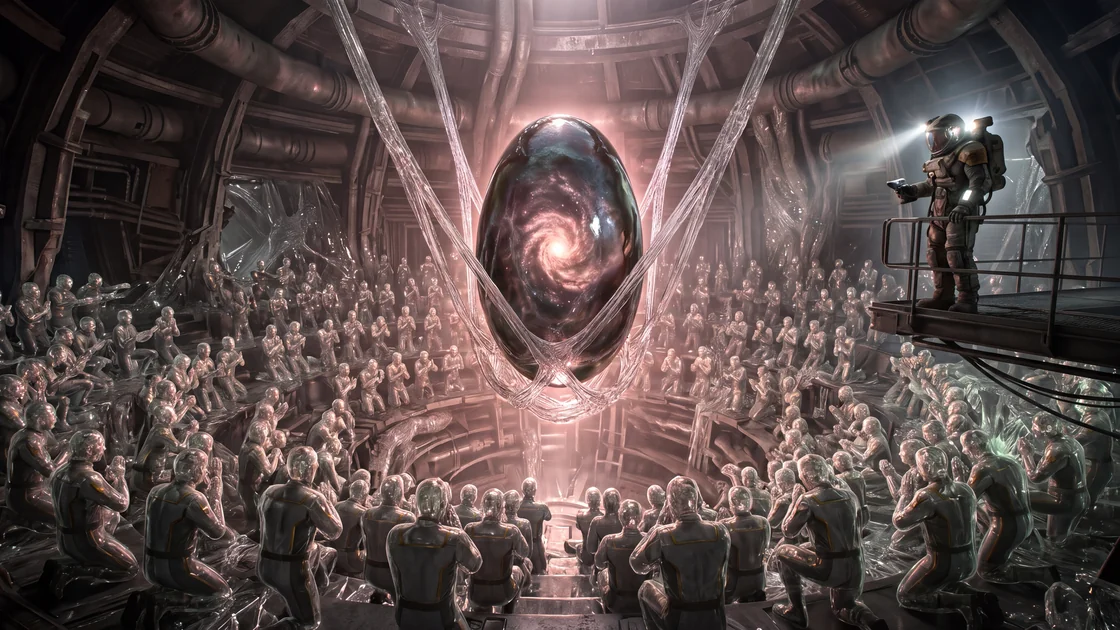
When veteran salvage contractor Cassian Drake latched his battered tug onto the hull of the Aethelgard—a flagship exploratory dreadnought missing for near eight decades in the unmapped graveyard beyond the Perseus Veil—he anticipated an easy fortune in legacy fusion cores and rare avionics; instead, he breached a tomb of impossible preservation, discovering thousands of missing crew members suspended in immaculate, self-propagating prisms of vitreous crystal, all arranged in silent, reverent adoration around a twelve-meter cosmic embryo that pulsed with the primordial heartbeat of a nascent universe.
Act I: The Drift and the Grapple
The Oort fringe of the UX-7729 system did not possess weather in any terrestrial sense, yet Cassian Drake felt an icy draft crawling through the inner thermal seal of his EVA rig. It was an illusion born of conditioning. When the telemetry sensors of the Cinder-Drift flashed amber, signaling an anomalous mass signature nestled within an agglomeration of prehistoric methane ice, his body had reacted before his conscious mind caught up. His pulse had surged, his skin had prickled with the bitter chill of adrenaline, and his breath had hitched against the stale, scrubbed air of his cockpit.
UX-7729 was a red dwarf on the verge of total exhaustion, a smoldering cinder throwing off barely enough ultraviolet wash to illuminate its own dust skirts. Ships did not come here. Pirates did not lurk here; there were no trade lanes to intersect, no orbital transfer relays to plunder. There was only three billion miles of primordial debris, dead cometary bodies, and silence so heavy it felt like an atmospheric pressure against the hull.
Yet there she hung.
Cassian leaned forward, the magnetic clasps of his flight harness creaking against his sternum. Through the thick, triple-laminate viewport of the Cinder-Drift, the silhouette resolved against the starfield. It was not the jagged, chaotic profile of a nickel-iron asteroid. It was a spearhead—a brutal, architectural chevron of dark, heat-treated plasteel and ablative composite tiles, measuring nearly two kilometers from its prow-mounted ram to its sprawling, dead sub-light bell nozzles.
"Identify," Cassian muttered, his voice gravelly from three weeks of speaking only to maintenance logs.
"Signal match is ninety-nine point four percent," the synthetic intelligence of the Cinder-Drift, known simply as Kite, replied. Her voice had the flat, dry inflection of a low-grade trade-hub cogitator. "Profile matches the Imperial Exploratory Cruiser Aethelgard. Registry number: EX-009-Sovereign class. Commissioned under the Third Expansion Mandate. Disappeared from active telemetry during the Great Scythe Sweep, Standard Era 2142."
"Eighty-four years," Cassian whispered. He wiped a smear of condensation from the console face. "Eighty-four years adrift in the outer dark. The salvage covenants give full finder’s title after thirty."
"Assuming she is abandoned, Captain Drake," Kite noted. "The salvage code requires proof of vacancy, total abandonment, or death of all registered complement prior to the ignition of salvage beacons."
"Look at her, Kite. Not a single beacon. No running lights. Her radiators are cold enough to match the cosmic microwave background. If there’s anything alive on that ship, it’s been chewing on vacuum and drinking reactor coolant since before my grandfather was born."
He eased the thruster controls forward. The Cinder-Drift, a five-hundred-ton industrial mule whose pitted hull bore the scars of a hundred desperate operations, responded with a low, mechanical shudder. Reaction control thrusters spat bursts of hypergolic propellant, aligning the salvage ship with the colossal spine of the derelict.
As they closed the distance, the true scale of the Aethelgard crushed down upon Cassian’s senses. She was a leviathan from an era when humanity built its deep-space ships not out of economic prudence, but out of sheer imperial hubris. Her flanks were terraced with observation galleries, macro-sensor blister domes, and defensive point-defense turrets designed to ward off the ghost-fleets of forgotten colonial wars. But she bore no battle damage. No kinetic penetration craters pocked her armor; no thermal blooming had scorched her paint. She was pristine, preserved like an insect in a drop of black, frozen resin.
"Approaching dorsal airlock three-alpha," Cassian said, checking his suit readouts. The suit was a heavy-duty Goliath-7 pressure rig, reinforced with lead-foil interlacing and hydraulic servos along the joints. "Kite, prep the umbilical. Prepare the magnetic drill clamps. I want a clean seal on the personnel airlock. Don't touch the main cargo bays yet; if her interior bulkheads are dry-rotted, I don't want a sudden decompression tearing her guts out into my face."
"Magnetic grapples deployed," Kite confirmed.
A dull, structural clang echoed through the hull of the Cinder-Drift as the heavy neodymium pads struck the skin of the Aethelgard. The recoil vibrated through the floorboards, traveling up Cassian's boots, through his shins, and settling into his teeth. For a second, the two ships swung together in the void, locked in an uneasy mechanical embrace.
Cassian unstrapped himself, rising into the low gravity of the tug. He pulled on his helmet, twisting it until the bayonet seals engaged with a decisive, pneumatic hiss. The visor display flickered to life, bathing his vision in pale emerald telemetry: oxygen purity 98%, scrubbers optimal, internal suit pressure at 1.05 atmospheres, radiation levels nominal.
He reached for his toolkit—a heavy, reinforced chest containing plasma cutters, hydraulic spreaders, diagnostic shunts, and a bandolier of magnesium flares. He slung his kinetic carbine across his shoulder—not because he expected monsters, but because ninety years in the deep black had taught the salvage guilds that sometimes pirates used derelicts as dead-man traps, and sometimes the machines left inside had gone mad from radiation.
He stepped into the transition tube. The flexible accordion corridor linked his ship’s port hatch to the ancient emergency egress of the Aethelgard. At the far end, the cruiser’s outer hatch stared at him: a round slab of oxidized titanium, its manual override wheel recessed beneath a layer of glittering micro-meteor dust.
Cassian set his boots against the decking, took a deep breath, and clamped his mechanical spreader into the override mechanism.
"Cracking the seal," he reported.
"Sensors detect zero internal pressure on the immediate airlock chamber," Kite replied in his ear. "Prepare for potential blowout if the inner seals have failed."
Cassian grunted as he leaned his weight into the pneumatic lever. The manual wheel resisted, its grease long since sublimated into the void, turning the metal into cold-welded iron. He ignited his micro-torch, sending a pencil-thin lance of violet flame against the locking ring. Frost flared away in a puff of microscopic crystals that vanished instantly into the vacuum. The metal groaned, expanded, and yielded.
With a harsh, scraping shriek that transmitted through the hull into his gloves, the wheel turned. One rotation. Two.
Cassian hauled back on the emergency lever. The hatch swung outward on heavy counterweights, yawning open into a square of utter, absolute blackness.
He raised his shoulder-mounted searchlights. Twin beams of high-intensity white light cut through the dark, carving a path into the belly of the beast.
Act II: The Vitreous Frost
The airlock interior was coated in a substance Cassian had never seen in twenty years of wreck-diving.
It was not rust. It was not the greasy, black soot left behind by an electrical fire, nor was it the velvety, necrotic frost that formed when an atmospheric breach vented moisture across frozen plates. It was crystalline.
A fine, translucent growth covered the walls, the ceiling, and the manual cycle controls. It looked like silica frost, but it did not branch like water ice. Its needles grew in perfect, logarithmic spirals—tiny, nautilus-like whorls of clear mineral matter that refracted the white glare of his headlamps into needle-sharp rainbows.
Cassian stepped inside, his magnetic boots clacking against the treaded deck. He touched a wall with his armored thumb. The crystals were hard—extraordinarily hard. His tungsten-tipped glove scratched against them with a dry, glassy squeal, failing to shear off even a single spire.
"Kite, I’m in the primary lock," he said, stepping through to the inner hatchway. "Interior is dry. But there’s mineral buildup. Doesn't match standard atmospheric condensation or coolant leaks. It looks like... silicates. Or quartz."
"The Aethelgard was not documented to carry unrefined crystalline cargo," Kite answered. "Her manifest was exploratory. Atmospheric probes, deep-mantle seismic drills, sensor arrays, and biological containment capsules for exo-microbiology."
"Well, something leaked."
The inner hatch was already half-open, its pneumatic pistons frozen midway through a stroke. Cassian slipped sideways through the gap, his oxygen tanks grazing the jamb with a hollow scrape.
He emerged into Deck Four: the main lateral access corridor for the forward command section.
The air here was not vacuum. His suit sensors chirped, alerting him to an ambient pressure of approximately 0.4 atmospheres. Cassian paused, checking the atmosphere composition readout.
"Kite, verify this. My HUD says sixty percent nitrogen, thirty percent noble gases, and... trace organic compounds. No carbon dioxide. Almost zero oxygen."
"Sensors on your telemetry umbilical confirm. Pressure is stable. There is no active decompression. The bulkheads are sealed."
"Copy that. Keeping my helmet locked. I’m not breathing whatever’s in here."
He advanced slowly down the corridor. The ship was vast. The ceiling vaulted six meters above him, crossed by exposed conduits and heavy structural girders that resembled the ribcage of an ancient whale. The silence was profound—not the neutral silence of space, but the heavy, expectant silence of a tomb that had been waiting for an intruder.
Every surface was coated in the same vitreous growth. On the floor, it formed a brittle carpet that crunched beneath his magnetized soles with the sound of breaking sea-glass. As he walked, his lamps cast long, skittering shadows across the walls. The crystalline spirals seemed to drink the light, trapping it within their internal geometries, so that when he looked back, the path he had trodden glowed with a faint, residual phosphorescence—a trail of pale, ghostly green footprints lingering in the dark.
He reached the primary mess hall. The hatch had been pinned open by a manual wedge.
Cassian stepped through, sweeping his carbine light from left to right.
"Sweet mother of void," he whispered.
The mess hall was populated.
Dozens of people sat at the long, communal mess tables. There were men and women in the grey-and-gold duty jumpsuits of the Third Mandate Exploration Corps. Some sat with their arms crossed over the metal tables; others were leaning back, their heads tilted toward the ceiling vents as if caught mid-conversation. Near the automated dispensing bank, three crewmen were gathered, one pointing toward the selection screen with a half-extended finger.
None of them were dead in any way Cassian recognized.
There was no bloating. No desiccated skin stretched tight over grinning skulls. No hollow eye sockets.
They were entombed in pure, seamless crystal.
The vitreous mineral had not merely grown over them; it had emerged from within them. It encased their bodies in form-fitting sarcophagi of diamond-clear glass, five or six inches thick, perfectly preserving every stitch of fabric, every hair on their brows, every crease and wrinkle in their skin.
Cassian walked toward the nearest table, his boots heavy, his breath loud and ragged in his helmet. He approached a woman sitting alone. Her rank pins marked her as a junior lieutenant—Logistics. Her face was young, perhaps twenty-five, with high cheekbones and dark hair pulled back into a neat, regulation bun.
Her eyes were wide open.
Cassian lowered his light, aiming it directly into her face. The iris was clear, pale hazel, the pupil dilated to its absolute limit. But the surface of the eye was not organic anymore. It had been replaced by a faceted, jewel-like lens. Deep within the vitreous humor of her eye, tiny, microscopic prisms glittered in the glare of his headlamp.
Her expression was not one of terror. She did not look like someone who had choked to death on fire-suppressant gas or watched a bulkhead blow out into the vacuum. Her lips were slightly parted, curved upward at the corners in a delicate, serene smile. She looked like someone who had just heard a long-awaited note of music, or stepped out of the cold into a warm room.
"Kite," Cassian said, his voice dropping to an involuntary whisper. "The crew... they're here."
"Explain, Captain. Are there survivors?"
"No. They’re... they’re statues. They’re preserved in some kind of vitreous stasis. It’s like they were coated in quartz while they were sitting here eating breakfast."
"Biometrics?"
Cassian pulled a medical scanner from his utility belt and tapped the sensor head against the crystal shell covering the lieutenant’s arm. The device clicked twice, spun its diagnostic cycle, and beeped with an error code.
"Nothing," Cassian said. "The crystal is completely opaque to standard radio frequencies and ultrasound. Wait... let me try the harmonic resonance scanner."
He adjusted the dial, sending a micro-vibrational pulse through the tip of the probe.
The device hummed against the glass. For a second, the display scrambled, lines of static dancing across the green LCD screen. Then, a single, clear readout stabilized.
Not a flatline.
It was a frequency. A continuous, perfectly balanced sine wave oscillating at exactly 3.2 Hertz.
"Kite, I’m getting a signal. It’s not brainwaves, and it’s not a pulse. But it’s an active harmonic. The whole body... the crystal lattice... it’s vibrating."
"Unknown environmental phenomenon," Kite said. "Captain, I advise caution. We do not know the etiology of the silicate contamination. If it is an infectious agent—an exotic silicon-based spore or nanotech array—your suit seals may not offer indefinite protection."
Cassian looked around the room. There were at least eighty people here. All of them still. All of them smiling that same, tranquil, terrible smile. On one table, an open metal tray held what had once been bread and synthetic fruit; both had been transformed into sparkling, calcified ornaments, every crumb turned to glass.
"They didn't fight it," Cassian said. "If the life-support failed, they would have scrambled for masks. If there was a breach, they would have run for the pressure bulkheads. They just... sat down and let it happen."
He stepped away from the table, his heart thumping against his ribs. He felt the urge to turn around, to go back through the airlock, cast off the Cinder-Drift, and burn out of this system until UX-7729 was just another forgotten pinprick behind him. That was the smart thing to do. The safe thing.
Then he saw the terminal at the back of the mess hall.
It was an administrative station, its screen miraculously alive, casting a dim, amber rectangle of light through a thick crust of crystal needles. Cassian walked toward it, his boots crunching over the glassy floor. He tapped the surface with his armored knuckle. The screen flickered, the crystals acting as light-pipes, distorting the text into broken ribbons of amber.
He pulled a scraper from his belt and carefully cleared a patch of the display.
The system was running on emergency auxiliary power, drawing from a source deep within the ship's keel. A single log entry remained open, stamped with the date of the cruiser's final recorded day:
LOG: 882-EX-AETHELGARD
OFFICER: Dr. Maya Lin, Chief Astrometrician
SUBJECT: Object designated 'The Core Seed'The gravitometric shear is gone. It ceased the moment we brought the core aboard from the rift. The crew describes a sound—a pressure behind the temples, like the drone of a pipe organ heard through water. Commander Vance ordered the primary laboratory quarantined, but the seals are irrelevant. The glass is growing through the conduits. It does not use carbon as a substrate; it uses the wave function of the light itself. It is restructuring our matter to receive the signal.
I saw it pulse today. It is not an artifact. It is an egg. The mother is not in the system, but the egg knows where it is going. It needs a nest. We are providing the heat. We are providing the bones.
I do not want to sleep anymore. When I close my eyes, I can see the light through the back of my eyelids. It is so very warm.
The log ended there. No signature, no distress call. Just a final, system-generated note: TERMINAL LOCKED BY EXECUTIVE ORDER 00.
Cassian swallowed. "Kite. Where is the main laboratory on a Sovereign-class?"
"The exploratory core is situated in the central axial hub, Deck Nine, directly beneath the secondary bridge and adjacent to the primary reactor housing. Why?"
Cassian looked at the frozen crew. In the refracted light of his headlamps, their glassy eyes seemed to follow him, shimmering with subtle, polychromatic fires.
"Because," Cassian said, "that’s where the money is. And that’s where whatever killed this ship is sitting."
Act III: The Descent into the Spire
To reach Deck Nine, Cassian had to traverse the great axial lift shaft.
When he reached the transit tube, he found the elevator cab itself had been pinned at the top of the shaft, its steel hoisting cables swollen to three times their normal thickness by massive, cascading rimes of crystal. They looked like frozen waterfalls of clear quartz, plunging down into an abyss that stretched hundreds of meters through the core of the cruiser.
"Elevator is dead," Cassian said, peering over the edge into the vertical shaft.
He unclipped his descent line from his harness, looping the carabiner through a structural eye-bolt rated for heavy cargo. He checked his friction brake, clicked his kinetic carbine to his breast-rig, and kicked off from the ledge.
He descended in stages, his headlamp cutting through the vertical dark.
The air grew colder—or at least, his suit’s external temperature sensors registered a steady drop. By the time he passed Deck Seven, the hull thermometer read sixty Kelvin. The metal of the shaft was brittle with cryogenic chill, yet there was no ice made of water here. Only the endless, intricate lattice of crystal.
As he went deeper, the architecture of the ship began to warp.
It was not physical damage from an explosion; it was geometric distortion. The walls of the elevator shaft were no longer straight. They bowed outward in smooth, parabolic curves, as if the steel had softened like warm wax and re-solidified under the influence of an impossible gravitational field. In some places, conduits had split open, not with jagged edges, but with clean, crystalline planes, like sheared basalt columns.
"Captain," Kite’s voice broke through his headset, fractured by bursts of static. "Readings... crackle... fluctuating. My telemetry umbilical is... fizz... picking up severe electromagnetic distortion. You are entering a zone of localized spatial curvature."
"Speak plain, Kite," Cassian grunted, his boots swinging out as he kicked away from a crystalline outcrop.
"The space inside the central hub is larger than the ship’s exterior hull dimensions," the AI replied, her voice thinning as interference chewed away at the signal. "By approximately fourteen percent. Deck Nine should measure sixty meters across. My internal radar reflections suggest a chamber volume exceeding four hundred meters in diameter."
"That’s impossible. You can't fold space without a Class-A jump drive running at terminal redline."
"I am merely reporting the sensor returns, Captain. There is also a gravitational gradient. Local gravity at your position is zero-point-two G. At Deck Nine, it is approaching one-point-one G. It is originating from the center of the ship, not the hull-mounted grav-plates."
Cassian didn't answer. He had reached the access hatch for Deck Nine.
The door had not been blown or forced; it had been dismantled. The heavy armor plates had been unscrewed, stacked neatly against the corridor wall, and fused together beneath a thick glaze of crystal. The opening was a tall, vaulted archway, framed by what looked like crystalline ribs that arched overhead to meet in an intricate, groined ceiling.
Cassian unclipped himself from the descent rope. As his boots touched the floor, the gravity took hold of him with sudden, sickening weight. He stumbled forward, his knees buckling under the unexpected load.
"Suit grav-dampers," he gasped, adjusting the dials on his hips. The servos in his thighs whined as they compensated for the full Earth-normal weight.
He stood in an antechamber that had once been a high-security research bay. The consoles were gutted. The scientific instruments—spectrometers, particle counters, quantum-state traps—had been stripped of their casings. Their internal copper windings and gallium-arsenide wafers had been woven into the crystalline formations that grew from the floor like stalagmites.
It was not random growth. It was an antenna.
Thousands of thin, hair-like crystal filaments stretched from the walls toward the central chamber, trembling with a faint, high-frequency vibration. The sound was audible now, not through his radio, but through the structure itself, traveling through the soles of his boots, through his frame, and humming in his jawbone.
Wuuuum. Wuuuum. Wuuuum.
It was a deep, infrasonic pulse, vibrating at roughly three cycles per second. It was the rhythm of a heart, but its scale was monstrous—it felt less like an organ pumping fluid and more like a massive pendulum swinging through the deep foundations of the world.
Cassian moved forward through the archway.
He entered the central astrometrics dome, and what he saw there took whatever words he had left and crushed them into dust.
Act IV: The Cathedral of the Seed
The compartment was no longer an exploratory bay. It was a cathedral carved from the marrow of the ship.
The bulkheads, the decking, the multi-tiered observation platforms had all been stripped away or bent back to create a vast, spherical amphitheater. Thousands of metric tons of armor plating had been peeled open like the petals of a flower, exposing the structural skeleton of the Aethelgard to the soft, impossible glow that radiated from the center of the room.
And there, arranged in concentric, tiered rings that descended down toward the spherical floor, was the rest of the crew.
There were hundreds—no, thousands of them. The entire remaining complement of the Aethelgard. Technicians, ensigns, gunners, navigators, scientists, and cooks. They were kneeling.
Every single one of them was encased in that flawless, vitrified quartz, their forms locked in various stages of genuflection. Their hands were clasped before their chests, or outstretched toward the center with palms upturned, like supplicants before an altar. Their heads were raised, their crystal-faceted eyes fixed upon the center of the sphere.
Between the bodies, linking them together like the vines of a vast, petrified briar, ran the crystalline lattice. It flowed from the bases of their stone-like spines, branching across the metal decking to join with the conduits, the conduits joining the bulkheads, the bulkheads converging at the central floor. They were not just spectators; they were components. They were capacitors, heat sinks, biological nodes in an immense, organic processing array that spanned the entire belly of the cruiser.
And at the center of it all, floating suspended in a cradle of woven crystal cables ten meters above the deck, was the Egg.
It was twelve meters tall from pole to pole, a perfect, seamless ovoid of dark, oily iridescence.
It did not have a solid shell. Its surface was a churning, fluid boundary—a membrane of compressed space-time that shifted between the deep, absolute black of an event horizon and the blinding, prismatic fire of an active accretion disk. As Cassian stared, he could see constellations through its skin—not the constellations of the UX-7729 system, but ancient, alien star patterns, swirling in miniature galaxies beneath the translucent mantle.
Thump.
The pulse came from the Egg.
When it beat, the entire ship trembled. The light in the room dimmed, sucked inward toward the surface of the ovoid, before rebounding outward in a wave of soft, rose-gold luminescence that made the crystalline crew glow like thousands of human-shaped lanterns.
Cassian fell to his knees. The force of the pulse didn't strike his ears; it struck his consciousness.
For a fraction of a second, his visor display went blank, overloaded by an electromagnetic pulse that carried no charge, only pure, uncompressed information. In that instant, he saw:
He saw stars being drawn together like sheep into a fold, their coronas peeled away by gravity lenses of impossible scale. He saw vast, abyssal nurseries drifting between the galaxies, cold and empty for billions of years, waiting for a seed to drop from the dying branches of an older universe. He saw the Aethelgard, tiny and blind, stumbling into a tear in the fabric of the Scythe Rift, dipping its steel nets into the deep water, and bringing up something that did not belong to this age of the cosmos.
He saw that the crew had not been murdered. They had been adopted.
They had been cold, and the Egg had offered them an end to the cold. They had been fragile, decaying things made of water and carbon, bound to seventy years of grease and fear in the dark, and the Egg had offered them diamond. It had offered them permanence. It had offered them a place in the nursery.
Cassian pulled his hands up to his helmet, gasping for air. His own breath sounded wild, wet, and terrified inside his suit.
"No," he muttered, grinding his teeth until they ached. "No, you don't. You're an engine. You're just an engine that hasn't finished firing."
He forced himself back to his feet. The salvage pilot’s instinct—the low, cynical survival drive that had kept him alive through thirty years of debt, pirate crossfires, and decompression scares—screamed at him.
The Egg was worth more than the gross domestic product of five solar systems. A single shard of that casing, a single scrap of the technology that could warp space-time without an anti-matter bottle, would buy him his own moon, his own private fleet, a lifetime of luxury on the pleasure gardens of Core Prime.
Or it would kill every mind that touched it.
He raised his scanner. His hands were shaking so violently he could barely hold the diagnostic grip.
"Kite," he choked out.
Static roared in his ears, a chaotic wash of white noise that slowly resolved into a broken, distorted voice: "...Drake... hiss... gravitational shear at... crackle... hull breach warning... you have to... screee..."
"Kite, shut up and listen. The core... it’s an embryo. An entity. It’s drawing power from the ship’s primary fusion plant through the crystal lattice. The crew... their neural architectures have been integrated into the ignition sequence."
He stepped closer to the edge of the pit.
Directly below the floating ovoid, on an elevated command dias that had been dragged into the center of the bay, stood a single figure.
It was the captain of the Aethelgard. His uniform was that of a Fleet Admiral: high-collared, heavy with gold braid that had been turned into crystalline wire. His face was weathered, sixty years of hard decisions carved into his brow, now preserved forever beneath three inches of sparkling silicate.
He was holding the primary manual ignition key for the cruiser's main jump drives.
The key was inserted into an improvised console constructed entirely of glass and bone. The Admiral’s hands were frozen around the grip, his fingers welded to the dial by crystalline bridges that pulsed in synchronization with the Egg’s heartbeat.
Thump.
The wave of rose-gold light washed through the Admiral's body. His chest lit up from within, revealing the faint, luminous trace of his skeletal system, his ribs shining like the hoops of a barrel, his skull glowing like an ivory lamp.
And then, through the glass of his face, the Admiral’s eyes moved.
Act V: The Awakening Lattice
Cassian froze, his boots anchored to the deck plates.
The movement had not been a trick of the light. The faceted, quartz-like pupils of the Admiral had rotated three degrees to the left. They were locked onto Cassian.
Through the com-link, which had been silent save for the roar of background cosmic noise, came a voice. It did not use radio waves. It bypassed the antenna entirely, inducing an electrical current directly into the copper coils of Cassian’s suit earphones, sounding thin, metallic, and ancient:
"...salvage... unit... identified..."
Cassian raised the kinetic carbine, the heavy barrel leveled at the Admiral's chest. "Step away from the console," he said, knowing as he spoke how utterly absurd the command was.
"...the... fuel... is... insufficient..." the voice continued, ignoring him. It was not one voice; it was a choral weave of thousands of voices, whispers upon whispers, some young, some old, all carrying that terrible, smooth serenity that Cassian had seen on the face of the girl in the mess hall. "The mass... must... be... consolidated. The hull... is... cold. We... require... more... carbon."
"Kite!" Cassian bellowed into his mic. "Fire the thrusters! Break the umbilical! Get the Cinder-Drift off this hull right now!"
"Negative... Captain..." Kite’s voice was fading fast, drowned in the rising tide of interference. "Docking... clamps... will not... release. The crystal... it has... crossed the bridge. It is... into my... outer hull. It is... drinking the... capacitors."
Cassian cursed, his blood running cold.
He looked down at his own boots.
A spider-web pattern of fine, hair-like glass needles was creeping up the steel heels of his Goliath-7 suit. They did not attack the metal with acid; they converted it. Where the crystal touched the dull grey plasteel, the plasteel became clear, glassy, and luminous, its molecular structure reorganized into the same geometric, non-Euclidean lattice that held the crew.
The suit’s telemetry screen began to flicker with garbage data:
PRESSURE: OPTIMAL / VITREOUS TRANSITION: 1.2%
CORE TEMP: 290K / VITREOUS TRANSITION: 3.8%
NEURAL FREQUENCY MATCH: 3.2 HZ
"Get off me!" Cassian roared.
He reversed the carbine and slammed the tungsten butt of the rifle down onto his boot. The crystal shattered with a sharp, high-pitched ping, showering his greaves in sparkling shards that dissolved into fine, odorless dust before they hit the floor. But where the glass broke away, the steel underneath was thin, pitted, and brittle.
Thump.
The Egg swelled.
Its diameter expanded by half a meter, the oily, spatial boundary stretching thin. Cassian could see what lay inside the outer membrane.
It was not a bird, nor a dragon, nor any biological creature born of planetary mud. It was an intelligence made of folded dimensions. It looked like an endlessly unfolding origami of pure, incandescent vacuum—a kaleidoscopic knot of geometric angles that hurt his brain to perceive, rotating across five or six axes simultaneously. Every time it turned, it drew the light, the heat, and the very concept of distance into its center.
The ship was not just sinking into an anomaly; it was being consumed as the egg’s outer yolk.
And the Admiral’s hands were turning the key.
The improvised console began to scream with the sound of a jumping drive spooling up without an exit vector. Deep within the keel of the Aethelgard, the massive, eighty-year-old fusion reactors—kept in stasis all this time—finally flared into life. But their plasma was not being directed into the sub-light nozzles; it was being routed upward through the crystalline conduits directly into the astrometrics chamber.
Riverlets of white-hot deuterium fire bled through the floor, contained within transparent tubes of thick crystal that turned the deadly radiation into a blinding, golden dawn.
"The cradle... is... complete..." the Admiral's voice echoed in Cassian's ears. "Welcome... contractor. Lay down... the tools. The cold... is over."
From the tiered benches, the thousands of crystalline crew members began to rise.
Their movements were not fluid. They moved with the jerky, mechanical rhythm of clockwork automatons, the crystal joints of their limbs groaning and squealing as they sheared through the mineral formations that had anchored them for eighty years. Glass cracked; splinters flew like diamond rain.
They turned their faceted, jewel-like eyes toward Cassian.
They did not look angry. They looked welcoming. They opened their arms to him, stepping down the tiers with slow, deliberate, crystalline thuds.
Crunch. Clack. Crunch.
"Keep back!" Cassian fired.
The carbine thundered in the pressurized chamber. A burst of three high-velocity kinetic penetrators slammed into the chest of an advancing technician. The rounds did not punch through flesh; they struck the crystal armor and detonated, blowing the technician’s torso into a cloud of sparkling, diamond-bright shrapnel.
The body fell, its internal structure revealed: not meat, not organs, but solid, shimmering, rose-tinted quartz throughout.
And from the stump of the shattered neck, new needles were already sprouting, growing like hyper-accelerated sea anemones, weaving the neck back together, reaching toward the head that lay five feet away on the deck.
Cassian turned and ran.
Act VI: The Severing
The ascent through the vertical shaft was a nightmare of failing gravity and lung-tearing exertion.
Cassian did not wait for the descent line’s winch. He grabbed the rope with his armored gloves and hauled himself upward, hand over hand, his boots kicking against the crystalline rime that coated the shaft walls.
Below him, the astrometrics dome had become an open furnace of impossible light.
The infrasonic heartbeat had accelerated.
Thump-thump. Thump-thump. Thump-thump.
It was the cadence of a predator preparing to strike, or an infant preparing to break its shell. The spatial distortion was spreading. As Cassian climbed past Deck Seven, the shaft seemed to stretch like hot glass, the walls narrowing until his shoulders scraped against both sides, then suddenly yawning out into cavernous spaces where the shadows moved against the direction of his lights.
The crystalline crew was following him.
They were not climbing with ropes. They were walking up the vertical walls. Their fingers, transformed into sharp, faceted stilts of mineral glass, punched into the metal bulkheads with terrifying strength, driving deep into the cold plasteel, hauling their glittering, preserved bodies upward with relentless, synchronized precision.
They were singing.
The frequency was no longer 3.2 Hertz. It was climbing the scale, rising into an audible, crystal-clear soprano that rang through his teeth: a hymn without words, composed of pure, mathematical harmonics that described the curvature of black holes and the cooling rates of dying stars.
"Kite! Kite, answer me!"
"Cassian... crackle... the hull... it’s... entering the event... shhhhh..."
"Blow the charges!" Cassian screamed, swinging himself onto the Deck Four catwalk. "The emergency umbilical cutters! Blow the magnesium pins! Don't wait for the seals!"
"If I... blow the... pins... the decompression... will..."
"Blow them, damn you!"
Cassian hit the Deck Four corridor at a dead sprint.
His Goliath-7 suit was screaming warnings at him. The vitrification had reached his left thigh; the servos were locking up, the hydraulic fluid crystallizing into a thick, sugar-like paste that ground the gears to a halt. He had to drag his left leg behind him, hitching his hip with every step, his boots sliding through the brittle, glassy carpets that now covered the walls from floor to ceiling.
Behind him, the airlock door he had traversed an hour ago was changing.
The opening was closing like a healing wound. The crystal needles were bridging the gap, weaving together in an intricate, criss-crossing portcullis of diamond-bright fibers.
He threw himself through the shrinking aperture.
His oxygen tank struck the descending crystal lattice with a sickening crunch. The glass sheared through the outer thermal blanket, biting into the alloy pressure cylinder. Cassian twisted his torso, the servos in his right arm screaming as he forced himself through the narrowing gap, leaving behind his carbine, his salvage kit, and half of his lead-foil armor plating.
He tumbled into the docking umbilical.
The accordion tube was shaking violently. Outside, the Cinder-Drift’s thrusters were firing at emergency overpressure, their chemical plumes washing against the flank of the Aethelgard in a futile effort to tear the two ships apart. But the crystal had already crossed the bridge.
The flexible fabric of the umbilical had been turned into a rigid, hollow tunnel of ribbed glass. It looked like the throat of a glass leviathan, its interior lined with millions of vibrating, hair-thin cilia that brushed against Cassian’s faceplate as he crawled on his belly.
At the far end, through the inner hatch of his own ship, he could see the cockpit.
The consoles of the Cinder-Drift were infected. Amber warning lights were dying, replaced by the pale, rose-gold luminescence of the Egg’s harmonic. On the main navigation display, Kite’s synthetic avatar—normally a stylized, wireframe face—was freezing, its lines snapping into geometric prisms that refused to blink.
Cassian reached his belt. He had one piece of gear left: an industrial-grade plasma torch used for cutting through capital-class reactor bulkheads.
He didn't aim it at the Aethelgard. He aimed it at the docking collar of his own ship.
"Cassian..." Kite’s voice came one last time through the speaker. It was no longer flat; it had that same terrifying, peaceful cadence. "Do not... cut. The pattern... is so... very... complete..."
"I like my edges rough, Kite," Cassian snarled.
He thumbed the ignition.
A two-meter jet of pale cyan plasma roared from the nozzle, striking the umbilical release ring. The heat was monstrous, reflecting back into his faceplate, blistering the laminate layers, turning the HUD into a smear of melted liquid crystals. The vitreous growth fought back; as the heat hit it, the glass didn't melt—it shattered, throwing off high-velocity splinters that peppered his suit like buckshot.
One shard pierced his left shoulder, punching through the lead-foil and three inches into his trapezius.
Cassian yelled, a sound that was half pain and half pure, animal defiance. He didn't drop the torch. He dragged the roaring flame around the circumference of the collar, cutting through titanium, through copper conduits, through the glass fibers that held the two vessels together.
The metal groaned. The collar buckled.
THUMP.
The Egg fired its final, pre-birth pulse.
The wave struck the Aethelgard, and the two-kilometer dreadnought ceased to be a ship. Her bulkheads collapsed inward, not under the pressure of an explosion, but falling into a newly created gravitational singularity at the center of the astrometrics dome. The prow folded back toward the bridge; the massive engine bells crumpled like paper cups, sucked down the long, tapering throat of the hull toward the radiant, hungry embryo at its core.
The recoil of the spatial collapse did what the thrusters could not.
With a sound like the snapping of a planetary spine, the last crystal bridges linking the two ships sheared apart.
The Cinder-Drift was flung backward into the void, spun like a dead leaf caught in the draft of an erupting volcano. Cassian was thrown against the bulkhead of his transition bay, his head striking the rim of the inner hatch with a dull, sickening crack that sent his vision spinning into an abyss of black and gold.
Through the rapidly closing emergency pressure hatch, he caught one last glimpse of the Aethelgard.
She was no longer there.
In her place hung a sphere of pure, unbroken light—a newborn star no larger than a city, encased in a shimmering, geometric shell of interlocking crystal facets. It hung in the center of the UX-7729 system for one brief, impossible second, illuminating the cometary debris with a brilliance that had not been seen since the Big Bang.
And then, it folded.
It did not accelerate away. It did not enter hyperspace. It simply turned inward along an axis that Cassian’s human eyes could not follow, vanishing from three-dimensional space with a silent, blinding implosion that left behind only a perfect, spherical vacuum and the fading whisper of a three-hertz tone.
Then, the darkness returned.
Act VII: The Cold Edge
The Cinder-Drift drifted for sixteen days before an automated regional recovery vessel, following an anomalous radiation trail picked up by the deep-sky relays at Fort Briggs, caught her in its magnetic net.
They found Cassian Drake in the primary cabin.
He was sitting in the pilot’s chair, his helmet removed and resting on the floorboards between his feet. The ship was cold—barely five degrees above absolute zero—her fusion reserves dry, her life-support running on the final, desperate trickle of her chemical backup batteries.
The salvage inspectors from the Guild did not board immediately. Their scanners had picked up an anomaly on the Cinder-Drift’s hull: a sixty-foot patch around the docking port that was composed of an unknown, ultra-dense crystalline silicate that defied diamond drills and laser-spectrometry.
When they finally broke the manual latch and stepped inside, their rifles drawn and their hazard lights cutting through the freezing cabin, they found him awake.
He was staring at his left hand.
The inspectors stopped three paces back, their weapons lowering slightly as their suit lamps illuminated him.
"Drake?" the lead inspector called through his external speaker. "Cassian Drake? You’re registered as lost with all hands. What happened to the Aethelgard?"
Cassian did not look up. He slowly curled his fingers into a fist, then opened them again.
The skin of his palm was normal, rough and calloused from decades of handling steel cables and hydraulic wrenches. But his ring finger and his pinky—from the second knuckle to the tips—were not made of flesh anymore.
They were carved from flawless, rose-tinted crystal.
They did not bleed. They did not hurt. When he tapped them together, they produced a clear, ringing clack, like two fine wine glasses meeting in a toast. And deep within the mineral lattice of his own fingernails, invisible to the inspectors' instruments but clear to the man who carried it, a tiny, faint light pulsed.
One. Two. Three.
"Drake?" the inspector repeated, stepping closer, reaching for his shoulder. "Are you compromised? Is there a contaminant on board?"
Cassian slowly turned his head. His eyes were bloodshot, his beard greasy with salt and sweat, his face lined with the deep, permanent exhaustion of a man who had walked through the fire and found it cold.
He looked at the inspector’s pristine, carbon-fiber suit, then out through the cracked viewport at the stars—the dead, ancient, unchanging stars that wheeled across the infinite dark.
"There's no salvage," Cassian said. His voice was hoarse, rattling in his throat like gravel in a dry pan.
"What do you mean, no salvage? We tracked the mass signature. A Sovereign-class cruiser doesn't just evaporate. Where are the cores? Where is the crew?"
Cassian lowered his hand, letting the two crystalline fingers rest against his knee, catching the white beam of the inspector’s lamp and splitting it into a thousand tiny, laughing rainbows that danced across the frozen metal of the cabin floor.
"They hatched," Cassian whispered. He closed his eyes, and behind the lids, the light was still there—warm, waiting, and patient as the grave. "And God help us when the mother comes looking for the rest of the nest."