The Clockwork Murmuration
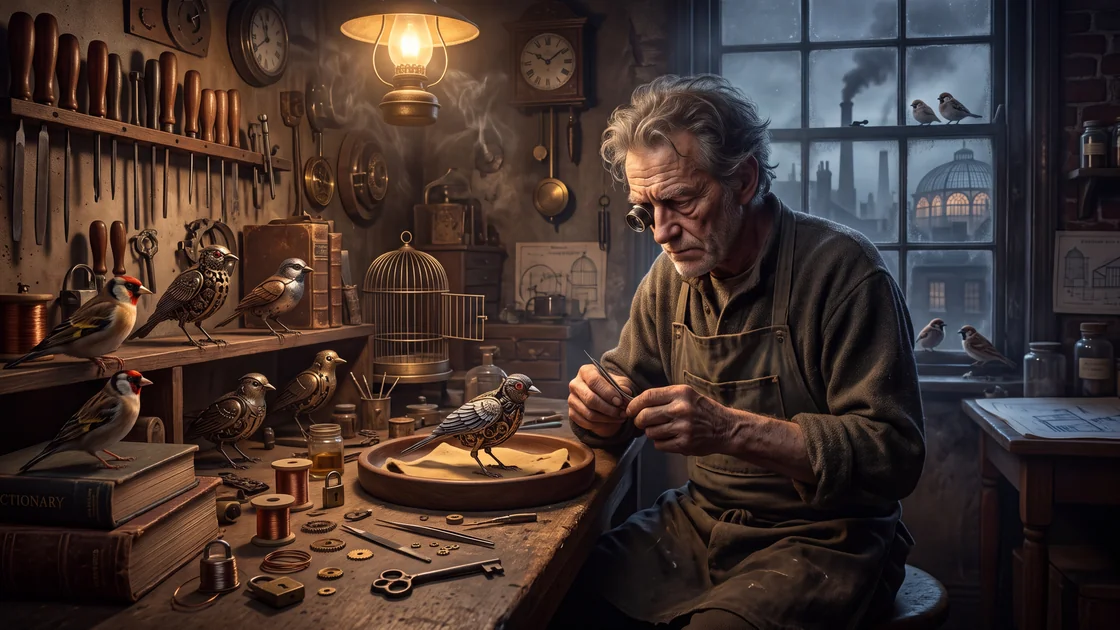
In the soot-choked industrial metropolis of Veridia, an aging master horologist named Silas Thorne constructs a clutch of brass-and-steel wind-up sparrows, only to discover that their intricate balance wheels and miniature harmonic combs have somehow sparked genuine sentience. Driven by an innate kinship with the natural creatures whose forms they mimic, these clockwork birds slip out into the fog-bound nights, mastering the art of lockpicking to dismantle the gilded cages of the city's wealthy collectors and releasing hundreds of songbirds into the wild. As the city watch and the vindictive Bird Fanciers' Guild mobilize to hunt down what they believe is an elusive band of human thieves, Silas discovers his creations' secret crusade, transforming his quiet workshop into a covert armory for an underground mechanical uprising dedicated to universal flight and freedom.
Chapter I: The Architecture of Flight
The workshop of Silas Thorne smelled perpetually of boiled linseed oil, paraffin, cold iron shavings, and the sweet, resinous breath of aged spruce. It occupied the second floor of a crooked brick tenement on Foundry Row, jammed between a copper boiler smithy and a dyer’s yard where tubs of indigo simmered day and night, staining the air with the scent of ammonia and dead marsh reeds.
Silas did not mind the smell. He had lived in the room for forty-two years, long enough for the rhythmic clatter of the district to replace the cadence of his own pulse. Above his workbench hung hundreds of tools, their cherrywood handles darkened by the sweat of his palms: watchmaker’s tweezers filed down to needlepoints, hollow punches, pivot-steel burnishers, and rows of jeweler’s saws with blades so fine they appeared from across the room like single strands of horsehair hung against the whitewashed wall.
He sat beneath the amber circle of a gas lamp, a jeweler’s loupe screwed into his right eye socket, his long fingers steady despite the stiffness that damp autumns brought to his knuckles.
Before him, resting in a concave wooden cup lined with chamois leather, was a bird’s breastplate. It was beaten from an alloy of copper and zinc, scarcely thicker than a dried maple leaf, yet braced inside with four micro-ribs of rolled spring steel. Inside that cavity, smaller than a walnut, lay thirty-eight gears, three hairsprings, an escapement wheel with teeth cut so delicate they could only be verified under double magnification, and a primary barrel housing a four-inch ribbon of Swedish carbon steel.
"Rest now," Silas murmured to the mechanism. His voice was like stones rolling in a dry creek bed. "Let the arbor seat."
He nudged the primary escapement with a piece of sharpened pegwood.
The pallet fork clicked. Once. Twice. Then the system engaged with a dry, whispery churr—not the heavy, plodding tick of a parlor grandfather clock, but a furious, thrumming vibration that matched the metabolic frenzy of a creature whose heart was meant to beat eight hundred times a minute.
Silas lowered his magnifying glass, blinking against the harsh yellow mantle of the gas jet.
On the chamois pad, the creature stirred.
It was not his first attempt; it was the seventh. The previous six sat along the cedar molding of his book cabinet like a museum of evolutionary mistakes. Number One was too heavy, its brass bones weighted down by over-engineered pinions, capable only of a pathetic, ground-bound scuttle. Number Three had snapped its mainspring during its inaugural winding, the razor-sharp ribbon of steel exploding through its foil plumage like a tiny, violent grenade. Number Five had flown, but only in rigid, uncompromising circles until it smashed itself to fragments against the brick chimney across the street.
Number Seven, however, was different.
Silas had spent six months calculating its gear ratios, using not the standard formulas of the Clockmakers' Guild, but the field notes of naturalists who spent their lives hidden in the salt marshes of the delta. He had studied the flex of bone, the hollow geometry of a swift's humerus, and the peculiar, twisting sweep of primary flight feathers as they bit into an updraft.
The bird was five inches from beak to tail. Its body was brass, polished to a dull, satin gleam; its wings were composed of sixty overlapping plates of hand-hammered nickel-silver, each plate etched with micro-grooves to baffle the whistle of the wind. Its eyes were two uncut cabochon garnets, seated in tiny bezels of turned steel.
Silas reached for the key. It was a three-leafed winder made of tempered iron. He inserted the square socket into the bird’s flank, just behind the left shoulder blade, and turned.
Crick. Crick. Crick.
Three full rotations. The resistance was firm, velvet-edged. Inside the breast, the Swedish steel coiled around its arbor, storing forty inch-ounces of kinetic fury.
Silas withdrew the key. He set the bird upon his palm, flat and open, his calloused skin pale beneath the mechanical claws.
"Go on, then," he whispered. "Show me where the drag is."
For three seconds, the automaton lay dormant, waiting for its balance wheel to overcome inertia. Then, deep within the breast, a tiny counterweight dropped.
The garnets caught the gaslight. The head, mounted on a dual-axis ball joint, flicked to the left, then to the right. It was not a smooth, theatrical sweep; it was the sharp, paranoid twitch of a creature that knew everything larger than itself was a predator. The beak—two tiny jaws of blued steel—parted with a faint, metallic snip.
Then the wings snapped outward.
The air in the workshop tore with a sound like a silk scarf being ripped down the grain. The downdraft from the nickel-silver primaries ruffled Silas’s graying bangs, smelling of machine oil and friction-heated brass.
The bird did not drop. It did not wobble. It lifted from his palm with an acceleration that defied its mass, shooting straight up toward the exposed rafters of the ceiling. It banked three inches below the heavy timber beams, its wingtips carving precise parabolas through the cobwebs, shedding decades-old dust like powdered frost.
Silas stood, his knees popping, his breath caught in his throat. He followed it with his good eye, his hands half-raised as if he could catch it should the escapement jam.
"Gently," he breathed. "Gently, Seven."
The bird did not hit the wall. Approaching the plaster at twenty miles an hour, it performed an impossible, banking deceleration: its tail feathers, actuated by a central fan of hairsprings, spread wide and tilted downward, converting forward velocity into pure vertical lift. It hovered for half a second, suspended in the amber gloom of the rafters, its wings beating an invisible blur, before it swung back and landed with an absolute, featherlight precision upon the top of an open dictionary resting on the shelf.
It settled its wings. The plates folded over one another with a faint, musical shiver-clack.
It did not move again. It stood atop the word Vesper, its garnet eyes staring down at Silas.
Silas let out his breath. A slow, trembling smile broke across his cracked lips. "Thirty-eight seconds of flight," he noted aloud, his voice shaking. "No hunting in the pitch axis. Balance perfect."
He reached for his notebook, dipping a steel-nibbed pen into the inkpot. He wrote: Seventh iteration. Mass: 42 grams. Displacement: Nominal. Mainspring release: Controlled. Note: Escapement sound diminishes after six seconds; seems to self-dampen.
He looked up from the page.
Number Seven had not stayed where he left it.
Without the sound of winding, without the application of the key, the bird had shifted. It was no longer standing on the dictionary. It had hopped—three distinct, mechanical bounds—along the shelf until it stood before a small, wire cage hanging near the window.
Inside that cage sat a common greenfinch Silas had bought from a street urchin three weeks earlier to study its wingbeats. The finch was asleep, its head tucked under its wing, a ball of dull olive feathers against the chill of the evening draft.
Number Seven was cocking its head, first left, then right. The garnet eyes reflected not the gas lamp, but the small, sleeping form behind the wire. The blued-steel beak opened and closed, entirely silent.
Silas froze, his pen hovering an inch above the paper. A drop of black ink swelled on the split nib, grew heavy, and fell, soaking into the parchment with a tiny, wet sound.
Automata did not hop without a tripped release lever. They did not redirect their mechanical sequences after their primary cycle had resolved. The barrel was spent; he had heard the click of the stop-work engage when the bird landed.
"Seven?" Silas said softly.
The mechanical sparrow did not turn. It extended one three-jointed claw, reached through the wire bars of the cage, and lightly, almost inquisitively, touched the greenfinch’s sleeping wing.
The finch stirred, rustling its feathers, and tucked itself tighter.
Number Seven withdrew its claw. Then, with a slow, fluid dignity that had no place in a system governed by spur gears and leaf springs, it turned its garnet gaze down toward Silas.
In the silence of the room, behind the damp walls and the distant thump of the Foundry Row trip-hammers, Silas heard a sound that made the hair on the back of his neck rise.
It was not the ticking of a clock. It was a rhythm—faint, syncopated, and utterly erratic—coming from inside the brass breast of the seventh sparrow. It sounded less like an escapement and more like a voice trying to learn how to clear its throat.
Chapter II: The Smudge on the Glass
For the next two weeks, the city of Veridia grew colder under a shroud of river fog that tasted of sulfur and river silt. The gas lamps burned with halos of muddy orange, and on Foundry Row, the damp clung to the ironworks until the walls wept rust.
Silas did not build an Eighth sparrow.
Instead, he watched Number Seven—whom he found himself, with an old man’s foolishness, calling Aethel, after a younger brother long since swallowed by the coal mines of the North.
Aethel spent his days perched upon the mahogany frame of Silas’s drafting board. To a casual observer—such as Mrs. Gable, the landlady who came every Tuesday to collect eighteen shillings and complain about the smell of whale oil—the bird was merely a masterwork of decorative metalcraft, a static ornament intended for the mantelpiece of some shipping baron.
"A pretty thing," she had sniffed, prodding at Aethel’s tail with an unwashed thumb. "Though it don’t sing. A bird that don’t sing is just an iron weight that gathers lint. Why don't you put a music box inside it, Thorne? A nice waltz. People pay good copper for a waltz."
"The chest cavity is too small for a comb drum, Mrs. Gable," Silas had answered mildly, keeping his body positioned between her wide woolen shawl and the desk.
"Well. Eighteen shillings, and mind the stairs don't rot from your chemical jars."
When the door clicked shut and her heavy boots had descended into the lower hallway, Aethel had moved. He had not flown. He had simply rotated his head one hundred and eighty degrees—a mechanical impossibility under his original design schematics—and regarded the brass latch of the door with an intense, unblinking stillness.
Silas sat down in his leather armchair, rubbing his temples. "You don't like her," he said to the empty room. "Neither do I. But her arithmetic is correct."
Aethel hopped down from the drafting board to the workbench. His talons made a light, musical ting-ting-ting on the zinc work-plate.
He did not need to be wound. That was the secret Silas guarded with a sick, thrilling terror.
Three nights after the first flight, Silas had awakened at two in the morning to find his work lamp burning low. He had crept from his alcove to find the seven sparrows—Aethel and the six broken, discarded prototypes—gathered in a circle around his primary watchmaker’s lathe.
Aethel had been holding a three-cornered file between his claws.
With precise, agonizingly patient scrapes, the brass sparrow had been working on the escapement pawl of Number Six—the one whose balance wheel had seized from excessive friction. Number Six lay on its side like an iron patient on an operating table, its belly plates unscrewed and laid out in neat rows on the blotter.
Silas had not cried out. He had stood in the doorway, his hand pressed against the splintered pine frame, watching as the five other non-functional birds—even Number Three, with its ruptured flank—acted as clamps and levers, holding their sister-machine still while Aethel worked.
They were not running on spring tension. When Silas finally examined them the next morning, having found them all back in their places on the cedar molding, their mainsprings were completely slack, the ratchets loose against the barrels.
They were drawing power from something else.
Silas had dismantled the primary clock on the wall—an old eight-day regulator of his own construction—and discovered that its pendulum was swinging out of true. The subtle magnetic currents of the earth, the ambient heat of the hearth, the microscopic vibrations of the river barges three hundred yards away—somehow, through the hyper-complex lattice of hairsprings and the peculiar crystalline structure of the unrefined zinc he had used for the chassis, Aethel had turned the little flock into a network of resonant receivers.
They were alive because they were balanced so finely that the entire world could not help but push them into motion.
"You're a thief," Silas told Aethel now, watching the bird peck gently at a spool of ultra-fine copper wire. "You’re stealing motion from the street. You’re stealing time from my house."
Aethel picked up the end of the copper wire in his beak. He pulled it, unwinding four inches with a clean, steady tug, then used the shear-edge of his jaw to snip it through. He hopped toward the window.
The window looked out over the black slate roofs of Veridia. In the distance, rising like the ribcage of a beached leviathan, stood the iron-and-glass arches of the Grand Aviary of the Botanical Society.
It was the pride of the city’s merchant princes. Within its climate-controlled vaults, heated by steam pipes that ran through the foundations like boiling veins, lived thousands of birds from every territory the Empire had ever touched: paradise birds from the southern archipelagos, scarlet tanagers from the western river-basins, nightingales from the royal forests, and common linnets by the crate-load, used as feed for the predatory falcons kept by the Society's directors.
The air around the Aviary was always thick with a miserable, muffled din—a wall of disjointed song that Silas could hear even through his closed sashes when the wind blew from the north.
Aethel pressed his blunt brass face against the cold pane.
The glass was dirty, crusted with the soot of the locomotives that shunted coal at the terminal two streets over. The bird’s beak tapped the glass. Tap. Tap. Tap-tap.
Silas watched the tiny reflection of the garnets in the soot-blackened pane.
"You can't go out there," Silas said, his voice dropping. "The boys in the street have slingstones. The hawks from the harbor would take you for an unfeathered crab and drop you on the cobbles to split your casing. And if the Fanciers catch you..."
He didn't finish the sentence. The Bird Fanciers' Guild did not tolerate unlicensed mechanisms that aped natural life. Only three years ago, a clockmaker in the High Market had built a mechanical peacock for a theater lobby; the Guild had sued him into debtor’s prison under the Antiquated Nuisance Acts, claiming that mechanical representations of avian life devalued the spiritual sanctity of God’s winged creations—by which they meant it threatened their trade in fifteen-guinea cockatoos.
Aethel did not stop tapping.
The bird shifted, dropped the piece of copper wire, and reached up to the iron stay-latch of the casement window.
Silas frowned, leaning forward.
The latch was a simple lever with an eccentric cam, dropped into a heavy notch to keep the sash from rattling in high gales. It took four pounds of force to lift it.
Aethel wedged his steel beak under the curved lip of the cam. He did not pull with his neck; he braced his three-jointed legs against the sash rail, his knees reversing with a dry snick, and used his entire chassis as a third-class lever.
Clink.
The latch rose.
The sash, caught by the autumn draft, drifted outward two inches. Cold, wet air swept into the workshop, carrying with it the smell of horse manure, burnt anthracite, and the bitter tang of the river.
Aethel did not hesitate. He did not look back at Silas.
He spread his nickel-silver wings, dropped into the gray gulf between the tenements, and was gone before Silas could stand from his chair.
"Aethel!" Silas lunged to the window, his slippers sliding on the scrap-littered floorboards. He threw the sash wide and leaned out into the freezing fog.
The street below was empty save for a night-soil cart lumbering toward the river, its horse wearing leather boots to muffle its hooves. Above, the sky was a churning vault of smoke and twilight.
There was no brass bird. There was only the distant, iron spire of the Aviary, five blocks north, piercing the low clouds like an upthrust needle.
Silas stood there until his hands were blue with cold, the damp settling in the creases of his work shirt. He felt an emptiness in the room behind him that was absurd, monstrous. It was a handful of metal. It was a pound of zinc, some hairsprings, and two garnets he had bought from an Indian sailor for four shillings and a bottle of gin.
"You fool," he told himself, slamming the sash shut and dropping the iron latch with a violent thud. "You old, lonely fool."
He turned back to his workbench. He picked up his files. He reached for a block of brass to begin an eight-day carriage clock he had promised to a grocer in the Cornmarket three weeks ago.
He worked until midnight, but his hands were clumsy. Twice his file slipped, gouging the surface of the brass blank. At one in the morning, he gave up, turned down the gas, and lay down on his horsehair cot behind the partition, listening to the rain begin to rattle against the glass like birdshot.
He did not sleep.
Around four, just before the first factory horns began to blow their mournful, lung-shaking calls across the district, he heard a sound at the window.
It was not a tap. It was a scrape—the sound of metal dragging over wet slate.
Silas rose from the cot so fast he struck his shin against the water jug, ignoring the dull bloom of pain. He did not light the lamp. He moved through the darkness to the casement and pulled the curtain aside.
Sitting on the narrow sill, drenched with soot-stained rainwater, was Aethel.
The bird’s left wing was damaged; three of the secondary plates were bent backward, their nickel edges flared like the petals of a trampled daisy. His brass breast was smeared with something thick, black, and sticky that smelled of pitch.
He was not alone.
Huddled against his mechanical flank, shivering so violently that its small bones seemed to rattle against its skin, was a goldfinch.
Its plumage was ragged, its tail feathers missing entirely, and its legs were encrusted with the white, dry scale that comes from years spent in a cage so small the bird can neither turn nor stretch without striking wire. Around its left tarsus was a band of lead, stamped with the seal of the Veridia Fanciers’ Guild: an iron cage within a wreath of laurels.
Aethel looked at Silas through the glass.
Held firmly in the sparrow’s blued-steel beak was a two-inch scrap of hardened piano wire, bent at the tip into an exquisite, microscopic hook.
It was a skeleton pick. It was a tool designed for one purpose only: to slide into the four-pin wafer locks used on the exhibition cages of the High Market bird merchants.
Silas opened the window.
Aethel hopped inside, his bent wing dragging with a wet shhh across the sill. He did not drop the wire pick. He hopped three times, turned, and waited until the living goldfinch, blind with exhaustion and wet feathers, fluttered weakly through the opening and collapsed onto the chamois pad where Aethel himself had been born.
Then, and only then, did the mechanical sparrow drop the wire.
It clinked against the zinc table.
Aethel looked up at Silas. The garnets did not shine in the dark room, but within his chest, the syncopated, erratic pulse beat faster, louder—a triumphant, defiant tick-tick-tick-a-tick that sounded like an army of watches marching into the sea.
Chapter III: The Guild of the Wire and Key
By the third week of November, Silas Thorne’s workshop had ceased to be a watchmaker’s shop. It had become a field hospital, a locksmith’s laboratory, and an armory.
The goldfinch—whom Silas had fed on crushed hemp seed and warm water sweetened with honey—now lived on the top of the bookshelf. It did not leave. It could have; the transom was open an inch every day at noon to clear the coal fumes, but the little bird stayed near the cedar molding, watching the workbench with bright, recovering eyes. Its feathers were coming in clean now, yellow as gorse against the dark pine.
On the table below, the work was frantic.
Silas sat with his sleeves rolled to his elbows, his apron pockets stuffed with brass swarf and lengths of fine copper cord. He was no longer working alone.
Aethel stood on a miniature wooden jig Silas had fashioned for him, holding a pair of pivot-broaches in his talons. The sparrow had learned to use his own weight as a counter-torque, pinning small components against the anvil block while Silas drove home the silver-soldered rivets.
Around them, the other six sparrows were no longer broken.
Number One, its chassis stripped of forty percent of its excess brass through Silas’s careful drill-press work, was now a broad-beamed, powerful hauler, its legs reinforced with double-strut carbon rods. It could carry four ounces of dead weight through a headwind.
Number Three, its exploded flank mended with an overlapping shell of hardened clock-spring steel, possessed wings that Silas had lengthened by twenty millimeters, giving it the slow, ghostly glide of a barn owl. It made no sound at all; its primary feathers were tipped with segments of oiled calfskin that deadened the mechanical click of its shoulder pivots.
They were the Vanguard.
"The tumbler is the weak point," Silas muttered, holding a tiny, brass padlock between his forefinger and thumb. It was an imperial four-tumbler cage lock, the standard pattern used by the merchant houses on the Rue des Oiseleurs. "The spring is here, beneath the second pin. If you force it from the left, the pawl drops into the safety notch and jams the bolt."
Aethel tilted his head. He reached down with his right foot.
His center talon had been altered. Silas had spent three days over an oilstone, grinding down a sewing needle of the finest English cast steel until it was a micro-rake, its profile precisely matching the negative space of the cage lock’s keyway.
Aethel took the lock from Silas’s fingers. He did not use his beak. He rolled onto his back like an otter, holding the lock against his chest with his left claw, and slid the steel talon into the keyhole.
Scritch.
A pause. A microscopic movement of the bird's knee joint—an adjustment of three degrees.
Tock.
The iron shackle popped open with a healthy, oily snap.
Aethel rolled back to his feet, dropped the lock onto the bench, and shook his plumage. The plates clattered with a sound like dry reeds in an autumn wind.
"Too slow," Silas said, though his heart was hammering with pride. "A night watchman walks his round at seventy paces a minute. From the time he turns the corner of the poultry market until he reaches the fountain is forty-eight seconds. You have to clear four locks per transit, or you'll be under the lanterns when he comes back."
Aethel picked up the lock, pushed the shackle closed until it caught, and thrust his claw in again.
Scritch-tock.
Half a second.
Silas leaned back in his chair, taking off his loupe and rubbing his rheumy eyes. "God forgive me," he whispered. "I'm training an army of housebreakers."
Yet when he looked at the goldfinch on the shelf, and thought of the Rue des Oiseleurs, his conscience went cold and hard as a lead ingot.
He had walked down that street two days before, his coat collar turned up against the sleet, to see the trade for himself. He had not gone there in thirty years.
The Rue des Oiseleurs was a narrow, steep trench between six-story houses whose roofs nearly touched across the cobbles. The air was foul with the stench of droppings, rotting cabbage, and the damp straw of ten thousand crates.
There were cages stacked ten feet high along the wet pavements: willow cages, iron cages, cages made of split wicker and oilcloth. Inside them, jammed together until their breasts were bare of feathers from rubbing against the bars, were birds from every corner of the earth.
Larks—whose eyes the fanciers sometimes put out with heated needles because they believed a blinded lark sang with greater purity—sat in boxes so shallow they could not stand upright. Nightingales, their wings tied with thread to prevent them from bruising their meat against the wire, were kept in dark cupboards to be sold to the kitchens of the grand hotels as delicacies, or to elderly ladies who kept them in drafty parlors until they died of consumption.
The men who sold them were broad-shouldered ruffians in leather aprons, carrying heavy hickory clubs to beat off the river rats and the gutter-urchins. Behind them were the shopfronts of the master fanciers, with plate-glass windows displaying cages of gilded mahogany, decorated with mother-of-pearl, housing blue macaws that screamed with a human-like madness into the foggy afternoon.
Silas had stood by the corner, his hands deep in his empty pockets, feeling the rhythm of the city around him. It was a cruel rhythm, driven by the stroke of pistons and the ledger-books of men who weighed life by the dram and the sovereign.
And then, as he had turned to leave, he had seen something that made his blood run cold.
Nailed to the lintel of the Master Fancier’s hall was a broadsheet.
WANTED, it read in heavy, black woodblock type. INFORMATION LEADING TO THE ARREST OF THE PERSON OR PERSONS EMPLOYING TRAINED VERMIN OR MECHANICAL TOYS IN THE THEFT OF EXOTIC STOCK FROM THE GUILD PREMISES. TWENTY GUINEAS REWARD.
Beneath the text was an iron spike. And driven through the center of that spike, its delicate copper neck-rods crushed by a heavy mallet, was the carcass of a small, brass bird.
It was not one of Silas’s. It was a crude thing—some poor clockmaker’s apprentice’s attempt at an imitation, probably caught by a shopkeeper’s cat while trying to pick a window bolt.
The Guild had left it there as a warning. Its tiny, hollow wings were splayed against the cedar plank, grease dripping from its empty belly like dried blood.
Silas had walked back to Foundry Row with a cold fire burning in his ribs.
When he reached his workshop, he had taken his cash-box from under the floorboards, emptied the nineteen sovereigns he had saved for his burial, and walked down to the iron wharf. He had returned with three ingots of phosphor-bronze, a spool of Swedish piano wire, and four dozen watch-jewels of synthetic sapphire, harder than diamond and slicker than tallow.
Now, looking down at Aethel, Silas reached out and touched the bird’s brass crown.
"We need more than seven," he said.
Aethel looked at him. The bird’s breast clicked—a sharp, double-time rhythm that sounded like an agreement.
"If we are going to do this," Silas said, "we don't hit the shops. The shops are rat-traps. We hit the source."
He unrolled a large sheet of blue linen paper onto the drafting board. It was an architectural plan he had bought from an engineer’s clerk who drank at the Black Dog tavern for two sovereigns and three pints of porter.
The title at the top read: THE SOVEREIGN AVIARY AND BOTANICAL CONSERVATORY. MUNICIPAL DISTRICT IV.
"Three thousand birds," Silas whispered, tracing the iron framework with his blackened fingernail. "The Grand Solarium has ninety-six vents in the roof, controlled by a central windlass in the lower basement. The glass is quarter-inch rolled plate. You cannot break it. But the intake louvers—here, where the air from the river is drawn in to cool the tropical palms..."
He tapped a square grated opening near the river wall.
"A man cannot enter," Silas said. "A dog cannot enter. But a sparrow..."
Aethel hopped onto the blue paper. He looked down at the draftsman's lines, his head jerking from the river wall to the central rotunda.
Then, with an almost comical deliberate motion, he picked up a miniature brass nut from the parts tray and dropped it precisely upon the center of the intake vent.
Chapter IV: The Factory of Feathers
The month that followed was known in the annals of Foundry Row as the time the old clockmaker went mad.
Silas no longer took in watches. When the vicar brought his gold-cased repeater to have its hairspring trued, Silas told him through the half-opened door that his eyes were gone and he had no time for vanity. When the carters brought their brass-bound compasses, he turned them away with a shake of his head.
Day and night, the blue flame of his blowpipe roared against the asbestos brick on his bench.
He did not build more sparrows like Aethel. Aethel was an accident of genius, an archetype that could not be duplicated by deliberate calculation. Instead, Silas built specialists.
He built twelve Cutters. Their wings were shorter, broader, made of sheet steel rather than nickel, their edges ground to a razor-sheen on the emery wheel. Their beaks were not pointed, but took the form of micro-nippers operated by a triple-compound toggle in their cheeks, capable of shearing through thirty-gauge iron aviary wire with a single squeeze of their jaws.
He built eight Winders. They were heavy, slow-flying machines with broad, paddle-shaped tails and high-torque gearing. In their bellies were no elaborate escapements, but heavy, low-friction drums wound with twelve yards of braided silk fishline, tested to twenty pounds breaking strain.
And he built forty Drifters.
The Drifters were the simplest of all: hollow skeletons of willow wood and bladder-skin, their frames boiled in paraffin to make them water-repellent, propelled by tiny, single-gear clockworks that ran for only ninety seconds—just long enough to lift them fifty feet into the air and let them drift downwind across the rooftops like a cloud of autumn leaves. They were decoys, meant to confuse the guns of the Guild guards and draw the eyes of the watch away from the dark water of the river.
As Silas worked, the workshop became alive with an uncanny intelligence.
The birds did not sleep. At night, while Silas dozed for two or three hours in his chair, his head slumped upon his chest, the workshop hummed with a quiet, terrible industry.
Aethel was the foreman.
The sparrow moved from bench to lathe, checking the tolerances of the components Silas had turned during the day. If a brass arbor was out of true by a thousandth of an inch, Aethel would pick it up in his beak and drop it into the scrap box with an emphatic ting. He would not allow Silas to assemble an imperfect limb.
The living birds came too.
It started with the goldfinch. One morning, Silas found three sparrows—common street birds, their feathers gray with coal dust, their eyes sharp with hunger—perched on the window sill. They did not fly when he approached. They looked at Aethel, who stood inside the glass, then looked at the dish of dry grain Silas had set out.
Within two weeks, the roof of the tenement on Foundry Row had become a sanctuary.
Pigeons—the heavy, scarred couriers of the dock-merchants that had escaped their lofts—sat in rows along the ridgepole. Thrushes, blackbirds, starlings, and greenfinches gathered by the dozens, then by the hundreds. They did not sing. They sat in an eerie, disciplined silence that made the neighborhood cats slink through the gutters with their bellies touching the cobbles, terrified of the thousands of round, dark eyes watching them from the eaves.
They brought things.
A starling brought a piece of fine piano wire it had found in an alley behind an instrument maker's. A magpie brought a small brass key it had stolen from the waistcoat pocket of a sleeping lighterman. A crow, massive and missing half its beak, landed on Silas's bench one rainy twilight and dropped a heavy, square-shanked iron key onto his blotter—the master key to the coal-chute of the Botanical Conservatory.
Silas picked up the iron key. It was cold, smeared with river slime.
He looked at the crow. The crow looked at him with an eye like a bead of polished jet, bowed once with a dry craa-k, and hopped back to the sill.
"Where did you get this?" Silas whispered.
The crow did not answer, but Aethel hopped onto Silas’s wrist. The brass claws closed around the old man’s skin—firm, cool, yet with an unmistakable, urgent pressure.
The bird tapped the key three times with its blued-steel beak.
Then, from the dark rafters above, sixty pairs of garnet, sapphire, and glass eyes flicked open in the gloom.
The escapements engaged.
It was not the sound of one watch. It was the sound of a mechanical storm—a dry, metallic rustle like an army of locusts descending upon an iron field. The Cutters spread their razor wings. The Winders dropped from their perches, their silk lines trailing behind them like spiderwebs.
Silas stood up. He walked to the window and pushed it wide.
Outside, the city of Veridia lay under a ceiling of purple-black cloud. A winter gale was coming up from the estuary, bringing with it the smell of salt and cold rain. The gas lamps in the street below flickered and died one by one as the lamplighter fought the rising wind.
"Tonight, then," Silas said. His voice was no longer that of a tired horologist. It was the voice of a man who had built a clock and was now waiting to hear it strike twelve.
Chapter V: The Night of the Great Unwinding
The Sovereign Aviary was built in the shape of three intersecting domes, like the bubbles on a glassmaker’s pipe. The central dome rose one hundred and ten feet above the river terrace, its iron ribs painted a sickly garden-green, its glass panes steamed from within by the heat of four coal-fired boilers that worked day and night in the vaults below.
Around its perimeter walked four guards from the Bird Fanciers' Guild.
They wore long greatcoats of oiled leather and carried double-barreled ten-bore shotguns loaded with birdshot, intended to shred any thief or hawk that approached the glass. At their belts hung dark lanterns and wicker cages containing trained ferrets, used to hunt down any small creatures that slipped through the drainage grates.
At two in the morning, the wind from the river was blowing forty knots, screaming through the iron girders of the Victoria Bridge and whipping the surface of the river into frothing, yellow foam.
Guard Sergeant Miller stood in the lee of the east portal, his collar turned up, trying to shield a sulfur match with his cupped palms to light his pipe.
"Devil's night," he grumbled to his companion, a younger man named Briggs who was shivering despite his leather coat. "The glass is groaning like an old woman’s hip. If a pane blows, the Director will have our skins for parchment."
"Let it blow," Briggs muttered, his teeth chattering. "I don't know why we're out here watching canaries anyway. Who’s going to steal a bird in a gale like this?"
"The same bastard that took thirty-four nightingales out of the Rue des Oiseleurs last Tuesday," Miller said, finally getting the match to flare. The sulfur smelled like rotten eggs. "The Guild offered fifty sovereigns now. They say it's an anarchist club from the university. Using trained monkeys or phosphorus bombs."
"Monkeys?" Briggs frowned. "I heard it was—"
He stopped.
Through the shrieking of the wind came another sound.
It was high, thin, and metallic—a rhythmic, whistling flutter that sounded like a flock of plovers, but with a sharp, cutting edge that made Briggs's ears twitch.
"Did you hear that?" he asked, reaching for his shotgun.
"Hear what? It's the wind in the chimney-cowls."
"No. That."
Briggs raised his lantern, throwing a circle of yellow light across the wet flags of the terrace.
Falling from the sky, drifting down through the sleet like autumn leaves, were dozens of small, brown forms.
Miller cursed, dropping his pipe. "Pigeons? At this hour?"
He stepped out from the shelter of the portal, his boot splashing in a puddle. He reached down and picked up one of the shapes.
It was not a pigeon.
It was a skeleton of split willow, wrapped in transparent pig-bladder, with two tiny wooden wheels that turned idly in the wind. On its breast was stamped a single word in printer’s ink:
UNWIND.
"What in God's name..." Miller began.
Above them, the sky screamed.
It was not forty Drifters. It was three hundred living gulls, starlings, and pigeons, flying in a tight, wedge-shaped formation that cut through the gale like the prow of a cutter. And leading them, flying so low that its nickel wingtips nearly brushed the brim of Miller’s hat, was a bird of shining brass, its garnet eyes burning with cold, mechanical fury.
"Look up!" Briggs shrieked. "Look at the dome!"
Miller looked.
The glass of the central dome was covered in a moving, glittering carpet of metal.
The twelve Cutters had landed along the lead-mullions of the upper ventilation tier. They did not hop aimlessly. They moved with the terrifying efficiency of watch movements, their razor-ground talons gripping the iron ribs while their blued-steel beaks sheared through the heavy wire netting that protected the louver vents.
Snip. Snip. Snip-snip-snip.
The sound was like twenty tailors cutting through stiff canvas at once.
Behind them came the Winders.
Two of the heavy machines, their paddle-tails braced against the stone cornices, dropped their silk lines down through the sheared vents into the dark interior of the dome. At the end of each line was an iron hook Silas had tempered in oil—a hook precisely shaped to fit the counter-weighted balance arms of the master ventilation flaps.
Inside the Aviary, five thousand sleeping birds began to wake.
The sound did not begin as song. It began as a low, collective murmur—the rustle of ten thousand wings against willow bars, the click of dry beaks, the panic of creatures who smelled the cold river air pouring into their artificial, steam-heated summer.
Then, from the dark center of the dome, high above the highest palm tree, came a sound that silenced them all.
It was Aethel.
The brass sparrow had entered through the sheared intake vent. He sat upon the gilded central chandelier that hung fifty feet above the marble floor, his wings spread wide, his nickel plates vibrating at three thousand cycles a second.
He did not sing a bird's song.
He sang the song of the workshop.
It was the high, screaming whistle of the lathe; the deep, iron tonk of the trip-hammer; the dry, velvet whisper of the escapement and the bright, triumphant ring of the anvil. It was a mechanical call—pure, cold, perfectly tuned—that resonated through the iron girders of the dome until the glass itself began to hum like a wet finger run around the rim of a crystal goblet.
The living birds heard it.
In their cages—in the gilded prisons of the birds of paradise, in the wire boxes of the larks, in the long, dark shelves where the nightingales were kept like books—the captive creatures stopped their trembling.
They looked up toward the chandelier.
Down through the palm fronds dropped the seven Vanguard sparrows.
They did not pick the locks one by one. Silas had known that time was their enemy. The Vanguard carried between them small, wedge-shaped slips of hardened carbon steel—master picks ground to a universal profile that did not unlock the cages, but shattered the brass tumblers entirely when driven home with a single, sharp blow from their reinforced heads.
Crack. Crack. Crack.
It was the sound of a hundred tiny axes.
The doors of the cages swung wide.
The first to emerge was an old African gray parrot, its plumage gray as ash, its tail a stump of scarlet rags. It had lived in a wire dome in the Director’s office for twenty-four years. It waddled out onto the mahogany desk, cocked its head at Number One, who stood before it with its oil-stained wings folded, and let out a long, low whistle that sounded like a steam whistle at dawn.
Then it spread its broad, blunt wings and took to the air.
Behind it came the finches.
They did not fly in confusion. They rose like a column of yellow smoke, drawn toward the chandelier where Aethel sat screaming his mechanical challenge to the city.
Outside, Miller and Briggs were firing their shotguns into the dark.
BOOM.
The orange flash lit up the rain-slicked flags of the terrace. A cloud of lead shot struck the iron ribs of the lower dome, ringing like church bells, but the Cutters were eighty feet above them, far out of range of the scattering pellets.
"The doors!" Miller shouted, stumbling toward the east portal. "Get the inside doors open! They’re smashing the collection!"
He shoved his heavy brass key into the lock of the great oak portal.
The key wouldn't turn.
Inside the keyway, jammed tight and sheared off flush with the escutcheon plate, was the hardened steel talon of Number Four—the sparrow that had sacrificed its left foot to ensure the men with the guns stayed in the rain.
"It’s jammed!" Miller screamed, kicking the oak with his heavy boots. "The lock’s spiked!"
Above them, with a sound like the breaking of an ocean wave, the ninety-six vents of the central dome swung fully open.
The Winders, their silk lines pulled to their limit by the combined weight of forty pigeons who had seized the lines in their beaks, had tripped the windlass release.
The steam of the conservatory rushed out into the freezing night—a great, white plume of tropical heat that hit the gale and condensed into an immense cloud of fog.
And through that cloud came the flight.
It was not twenty birds. It was not a hundred.
It was a murmuration of three thousand souls: canaries, starlings, tanagers, nightingales, grosbeaks, and cardinals, rising like a whirlwind of living color through the broken iron vents. They poured out into the winter storm, not as scattered individuals, but as a single, undulating beast of feather and bone, circling the great green dome once, twice, three times.
At the head of the swarm flew the seven mechanical sparrows.
Their brass and nickel bodies caught the light of the gas lamps below, flashing like flying sparks struck from some subterranean forge. They did not flee south; they did not seek shelter from the sleet.
They turned north, toward the open moors beyond the city limits, where there were no chimneys, no wire cages, and no men with balance sheets to weigh the value of a song.
Chapter VI: The Guild’s Inquest
The sun rose over Veridia the next morning on a city that had forgotten how to make noise.
The Foundry Row trip-hammers still pounded, and the locomotives still shunted their wagons of anthracite at the river terminal, but the sound that had underlain the city's life for a century—the disjointed, miserable chirp of thirty thousand caged birds—was gone.
The High Market was silent.
Along the Rue des Oiseleurs, the shopkeepers stood upon the wet cobbles before long rows of empty, swinging wire doors. The street was carpeted with discarded seed, bird-lime, and small, broken fragments of steel wire that the street-sweepers could not sweep into their bins because the urchins were crawling between their legs, collecting the shiny scraps to sell to the tinkers.
At ten o’clock in the morning, a black carriage with the crest of the Bird Fanciers' Guild rolled to a halt at the mouth of Foundry Row.
Out stepped Inspector Vance—a tall, skeletal man with mutton-chop whiskers, wearing a greatcoat lined with beaver fur and carrying an ebony cane with an ivory duck's-head handle. Behind him walked three constables from the municipal watch, their wooden truncheons drawn and resting against their thighs.
They did not have to search the tenements.
They followed the trail of oil.
Every four paces along the greasy flagstones of Foundry Row lay a tiny, circular droplet of high-grade sperm oil—the kind used only by chronometer makers and horologists of the first rank.
The constables kicked open the downstairs door of number fourteen.
They mounted the stairs, their boots creaking on the dry pine, and stood before the door with the brass plate that read: S. THORNE. WATCHES, CLOCKS, & SYSTEMATIC ENGINES.
Vance did not knock. He turned the handle and pushed.
The workshop was warm.
The coal grate was burning with a clear, steady red heat, smelling of dry peat and pine chips. Silas Thorne sat in his leather armchair beside the hearth, his feet resting on a stool, his spectacles sitting low on his nose.
He was reading an old volume of Linnaeus’s Systema Naturae.
He did not look up when the four men entered, bringing the cold mud of the street with them onto his clean floorboards.
"Silas Thorne?" Vance's voice was thin, sharp, like a razor drawn across a strop.
Silas turned a page. "The shop is closed, gentlemen. If you have an eight-day clock that needs cleaning, take it to Mr. Crane on the High Bridge. My eyes are no good for small work."
Vance stepped forward, his cane tapping the floor with an aggressive, rhythmic cadence. He reached down and seized the book from Silas’s hands, slamming it shut and dropping it onto the zinc bench.
"You know why we are here, Thorne," Vance said. "The Grand Aviary was broken into last night. Three thousand specimens were released into the storm. Two hundred were trampled by the crowd in the street; the rest have flown into the hills where they will die of the frost before nightfall."
Silas raised his gray eyes. They were completely clear, the redness gone from the lids.
"Will they?" he asked softly.
"They are tropical stock," Vance spat. "They cannot live without the steam pipes. You have killed them, you old scoundrel, as surely as if you had wrung their necks in a bucket."
"A finch from the mountains of the Levant does not die of frost," Silas said, leaning back in his chair and interlacing his long, scarred fingers. "And a starling knows how to find a hollow tree in any forest between here and the coast. They are not as delicate as your ledger-books suggest, Inspector."
Vance’s face darkened to the color of salt beef. He leaned over Silas, his hand resting on the head of his cane until the ivory creaked.
"We found the workshop where the tools were cut," Vance whispered. "A boy on the wharf saw an old man buying phosphor-bronze. We have the invoices from the wire-drawer on the canal. And we found this on the terrace by the river."
He reached into his pocket and produced a broken object, slamming it down on the arm of Silas’s chair.
It was the left wing of Number Two.
The nickel plates were twisted, charred by shotgun pellets, the tiny silver-soldered hinges sheared through at the shoulder joint. Yet even now, lying dead on the brown leather, the secondary feathers twitched faintly—a dying, reflex pulse from some balance wheel that had not yet run down its inertia.
Silas looked at the wing. His face did not change.
"It is a toy," he said. "A patent model for a theatrical property. I lost it from my pocket three weeks ago while crossing the ferry."
"A toy that can pick a four-pin tumbler?" Vance laughed—a dry, barking sound. "A toy that can coordinate three thousand birds like an army? Constables! Search the room. Find the nests. Find the molds. Break every engine in the place."
The constables moved forward.
They overturned the scrap drawers. They swept fifty jars of watch jewels onto the floor, where they shattered like rubies and emeralds against the zinc plates. They used their crowbars to pry up the floorboards behind the lathe, finding only old wood shavings, cobwebs, and the dry skeletons of three mice that had died of old age ten years before.
There was no flock.
There were no sparrows.
There was only Silas Thorne, sitting by the fire, his hands steady upon his knees, watching them with an expression that was neither fear nor defiance, but a profound, patient boredom.
"Where are they?" Vance hissed, grabbing Silas by the lapels of his work shirt and pulling him half out of his chair. "Where have you sent them?"
Silas looked past Vance’s shoulder, toward the window.
The glass was clear today. The rain had washed away the soot of the coal trains, and the morning sun was breaking through the mist, turning the roofs of Veridia into a sea of beaten silver.
"They don't belong to me," Silas said. "They never did. A clock belongs to the man who winds it. But a creature that winds itself..."
He smiled. It was the first time Vance had seen the old man’s teeth; they were worn down, yellow as old boxwood, but set firm in his jaw.
"...belongs only to the wind," Silas finished.
Vance stared at him for three seconds, his chest heaving with rage. Then he shoved the old man back into the chair with an oath that made the constables turn from their destruction.
"Arrest him," Vance said. "Conspiracy against the Municipal Charter. Destruction of guild property. We'll let him explain his clockwork sparrows to the magistrate at the Old Bailey."
The two constables stepped forward, their iron handcuffs clicking open with a sound Silas knew well.
They reached for his wrists.
Chapter VII: The Murmuration of Foundry Row
They never touched him.
From the chimney above the hearth came a sound like the rush of a blast-furnace draft.
A shower of black soot exploded from the firebox, extinguishing the red peat with a violent hiss. The constables leaped back, their uniforms covered in gray ash, their eyes stinging with dust.
Then, down through the flue, came the Vanguard.
They did not enter one by one. They came like a cluster of grapes—six brass, steel, and nickel birds, their claws locked together, their wings beating a deafening, metallic thunder that filled the small workshop until the walls seemed to bulge outward.
They hit the constables like a volley of grapeshot.
Number One, its heavy bronze chassis driven by its reinforced hauler-gearing, struck the largest constable directly between the eyes. The man shrieked, dropping his truncheon, his hands flying to his face as the brass claws tangled themselves in his greasy hair, beating his temples with thirty-ounce wing-strokes that left deep, red parallel gashes across his cheeks.
Number Three—the silent owl-sparrow—swooped through the soot, its razor-edged calfskin primaries sweeping across the second officer’s wrists with the precision of a surgeon's scalpel. The iron handcuffs dropped from the man’s bleeding fingers, clattering against the hearth-stones.
"Shoot them!" Vance roared, stumbling back toward the door, his ebony cane raised like a club. "Shoot the damn things!"
The third constable drew an old, brass-framed pistol from his belt, cocking the hammer with a trembling thumb.
He never found his aim.
Aethel dropped from the ceiling rafters.
He did not strike the man’s face. He landed directly upon the lock of the pistol.
His three-jointed talons, reinforced with synthetic sapphire jewels, slid into the lock-plate between the cock and the frizzen. With a single, sharp twitch of his knee-joint, the bird wedged his blued-steel beak behind the mainspring link and twisted.
Ping.
The spring snapped with a sound like a broken lute string. The pistol’s hammer fell limp, useless as a wooden toy.
The constable looked down at the brass bird sitting on his gun barrel.
Aethel looked back. The cabochon garnets burned with an internal, amber brilliance that had nothing to do with the gaslight. The bird’s beak parted, and from its throat came that same, terrifying sound—the whistle of the lathe, the scream of the circular saw, and the deep, triumphant churr of an escapement running at five times its design speed.
The constable let out a sob, dropped the useless pistol, turned, and fled down the stairs three steps at a time, his boots drumming a frantic rhythm on the pine.
The other two men did not wait for orders. Bloodied, covered in soot, their coats torn to ribbons by the Cutters, they scrambled through the doorway after him, leaving their truncheons on the floor.
Inspector Vance stood alone.
He was backed against the open doorway, his cane held across his chest like a sword, his mutton-chop whiskers twitching with a mixture of aristocratic fury and sheer, animal terror.
The six sparrows did not attack him.
They did not move.
They sat along the cedar molding of the bookshelf, shoulder to shoulder, their nickel plates polished clean by their flight through the soot, their twelve garnet eyes fixed upon the center of his forehead.
Aethel hopped from the discarded pistol to the edge of the drafting board.
He looked at Vance. Then, with a slow, deliberate movement, he lifted his right foot.
Held between his talons was a small, lead disc—the Guild seal he had taken from the leg of the goldfinch four weeks ago.
The sparrow’s jaw nippers engaged.
Snap.
The lead seal was sheared in two. The two halves fell to the zinc bench, rolling once before coming to rest against the edge of Linnaeus's open book.
Vance looked at the lead. He looked at Silas Thorne, who still sat in his chair by the cold hearth, brushing a speck of gray soot from his brown sleeve.
"You're a dead man, Thorne," Vance whispered, his voice cracking like dry straw. "The Guild will have your shop burned. They'll have you in the hulks by Christmas."
Silas did not look at him. He reached down, picked up his three-cornered file from the floor, and began to work on the edge of an old iron washer.
Scrape. Scrape. Scrape.
"The door is behind you, Inspector," Silas said without looking up. "Mind the bottom step. It's rotted from the damp."
Vance lingered for one second more, his mouth working silently, then turned and plunged down the dark stairwell into the street.
The heavy front door of the tenement slammed shut below.
Chapter VIII: The Free Murmuration
The Guild never burned the shop.
They did not dare.
For three days after the inquest on Foundry Row, the house of Inspector Vance was visited every night by a congregation of five hundred birds.
They did not sing. They did not drop lime upon his carriage. They simply sat upon the sills of his bedchamber windows, along his garden wall, and upon the slate gables of his roof: crows, starlings, thrushes, and among them, sixty small, metallic shapes that clicked and ticked in the darkness like an army of pocket watches.
Whenever Vance blew out his candle, the clicking would grow louder—a synchronized, rhythmic cadence that matched the beating of his own terror-stricken heart. When he rose to draw the curtains, the garnets would flare behind the glass, unblinking, untamed, and entirely indifferent to his threats.
On the fourth morning, Inspector Vance resigned his position with the Bird Fanciers' Guild, citing a nervous affliction of the chest, and took a packet-boat for the continent.
The Guild itself did not survive the winter.
Without the Grand Aviary to anchor their monopoly, and with the sudden, mysterious disappearance of the luxury trade—for no lady in the West End would buy a canary when rumors abounded that a brass bird would come through the chimney to slit its cage-wires with a steel beak—the members turned on one another in the bankruptcy courts, their assets liquidated to pay for the repairs to the municipal glass.
Silas Thorne lived three years longer.
He did not buy more phosphor-bronze. He did not build an Eighth sparrow.
He lived simply, repairing the watches of the watermen and the compasses of the river pilots, who always found that their chronometers, once serviced by the old man on Foundry Row, kept time with an accuracy that was almost supernatural, as if they were being regulated by an invisible balance wheel somewhere out in the salt marshes.
The sparrows were rarely seen in the city.
Now and then, an apprentice climbing the heights of St. Jude's spire to grease the clock hands would report seeing seven brass birds roosting in the bell-chamber, their casings darkened by weather to the rich, dull brown of swamp cedar, their balance wheels humming in harmony with the great ten-ton bourdon bell.
Now and then, a poacher in the royal forests sixty miles to the north would find an iron trap sprung, its wire noose neatly severed by a pair of micro-nippers, and hear above him in the hazel boughs a flight of birds whose wings sounded like the rustle of a thousand silk pocket-handkerchiefs.
Silas died on an evening in late October, during a gale that blew the last leaves from the willows along the river.
He was found by Mrs. Gable, who had come up the stairs with his eighteen shillings' receipt and a bowl of mutton broth.
He was sitting in his leather chair before the hearth. His eyes were closed, his hands rested quietly upon his knees, and his face was as smooth and untroubled as the face of an eight-day carriage clock that had finally, gently, run down its primary spring.
On the table before him sat seven small piles of fine brass filings—the tiny flakes of metal that a mechanism sheds as its teeth wear smooth against one another through years of patient work.
The window was wide open to the storm.
The room was freezing cold, but there was no soot on the floor. On the cedar molding above the bookshelf, lined up in neat, orderly intervals like the hours on a dial, were sixty empty wooden perches.
The people of Foundry Row said that during the hour before Silas died—just as the sun was setting behind the Victoria Bridge—a cloud had come down out of the northern sky, flying so low that it touched the roofs of the tenements.
It was not a cloud of smoke.
It was a murmuration of three thousand birds, living and mechanical, flying in circles so vast they filled the sky from the docks to the cathedral.
At the center of the swarm flew seven small, golden shapes that caught the last red rays of the sun, their nickel wings beating with an absolute, mathematically perfect cadence. They circled number fourteen three times, their escapements humming a great, descending chord that sounded to the watermen on the river like the sounding of a distant, silver organ.
Then they had turned toward the open sea.
They did not fly in wedges. They did not follow a master. They flew as a single, unbounded wheel—rising and falling on the gale, expanding and contracting like a great, metallic lung that had finally learned how to breathe the air of the wild earth.
And far below them, in the dark streets of Veridia, the iron cages hanging in the silent shopfronts rattled idly in the wind, their doors open, their perches bare, their little wire locks swinging empty beneath the stars.