The Cloud Keeper of Blackwood Lane
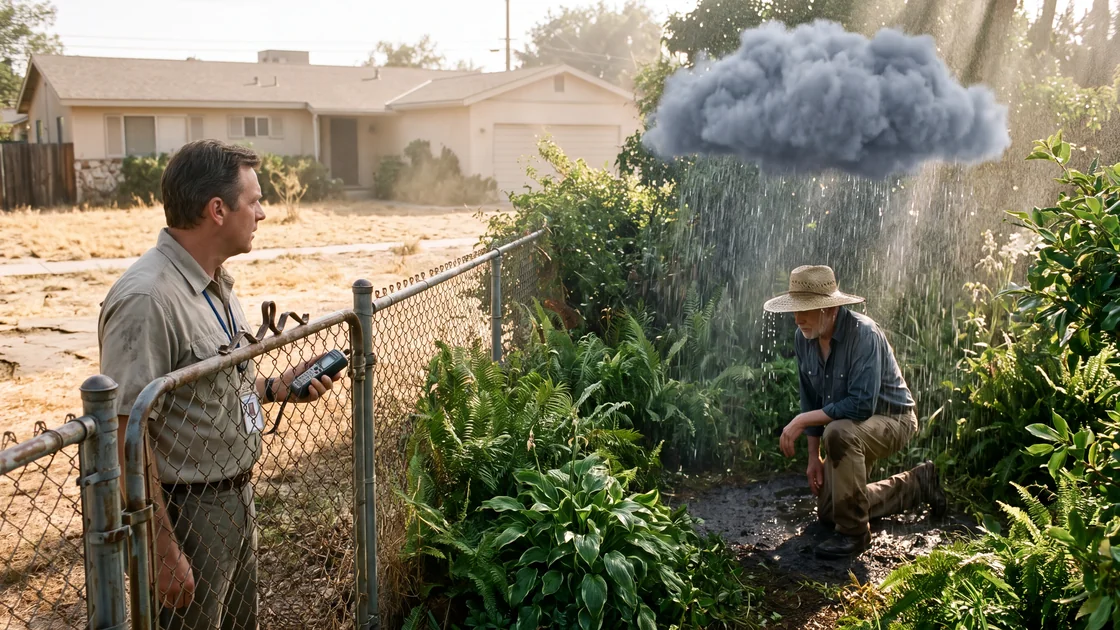
This story chronicles the quiet obsession of Dr. Arthur Phelan, a disillusioned municipal meteorologist who discovers a stationary, perpetual micro-raincloud hovering precisely above Julian Vane, an utterly mute gardener tending an overgrown lot in an arid suburban valley. What begins as an urgent scientific inquiry into an impossible thermodynamic violation gradually transforms into an intimate study of grief, silence, and the atmospheric weight of human memory. As Arthur moves from distant radar telemetry to hands-in-the-dirt companionship, he protects Julian from suspicious neighbors and municipal authorities during a catastrophic summer drought, ultimately discovering the profound, bittersweet truth of what keeps the private storm alive and what must happen when its waters are finally released.
I. The Radar Artifact
In the subterranean annex of the Tri-County Environmental Monitoring Station, forty miles east of the Pacific coast, the world was reduced to false-color sweeps of phosphor green and cobalt blue. Dr. Arthur Phelan had spent sixteen years interpreting those sweeps. He knew the erratic coastal eddies that snagged on the pine-crested ridges of the Santa Ynez range; he knew the thermal plumes kicked up by asphalt shopping malls at three in the afternoon; he knew the phantom echoes born of migratory thrushes, high-altitude chaff from naval exercises, and the shimmering ground-clutter of dry-season dust devils.
Arthur preferred radar to weather. Radar was clean. It arrived in quantifiable decibels of relative reflectivity, stripped of the sticky discomfort of humidity, the headache-inducing glare of unclouded high-noon skies, and the smell of dead grass baking in suburban cul-de-sacs.
It was a Tuesday in early June when the anomaly first refused to disappear.
At 08:00 hours, during the morning scan calibration, Arthur spotted the pixel. It sat nestled in the residential hem of Blackwood Valley—a dry, sun-scraped basin where summer precipitation was historically zero. The pixel was a solitary dot of deep, saturated indigo, indicating intense, localized droplet condensation. According to the WSR-88D dual-polarization data, the reflectivity value hovered steadily at forty-five decibels, the signature of a moderate, soaking downpour.
Arthur tapped the glass of the monitor with the plastic cap of his pen. "Sensor glare on the south-facing array," he muttered to himself. He initiated a diagnostic sweep, expecting the recalibrated beam to flatten the pixel into the ambient yellow-orange wash of the seventy-degree morning.
The sweep completed. The indigo pixel remained.
Arthur frowned, pulling up the differential reflectivity and correlation coefficient products. The returns were not metallic. They were not synthetic. The hydrometeor classification algorithm insisted, with mathematical certainty, that liquid water was falling from the sky at coordinates 34.4319° N, 119.7824° W.
The footprint of the phenomenon was less than ten meters across.
"Arthur, you’re squinting at the screen like it owes you money," said Clara Diaz, the junior hydrologist, who had just entered carrying a ceramic mug that smelled of chicory.
"Look at the Blackwood sector," Arthur said without turning. "Tell me what that looks like to you."
Clara leaned over his shoulder, her brow furrowing. "A hardware glitch. Or somebody set up an illegal agricultural mister on an avocado orchard."
"It’s not an orchard," Arthur said, toggling the geographic information overlay. Street names materialized over the topographical contours: Larkspur Drive, Sycamore Crest, Blackwood Lane. "It’s a half-acre residential lot. Number forty-four. And misters don't generate a vertical column of droplet condensation reaching five hundred feet with an internal cyclonic drift."
"Then it's an echo from the cell tower on the ridge," Clara offered, taking a sip.
"The cell tower is two miles north-northwest. And its return is fixed, rigid, and dry. This thing has an internal dew point depression of zero. It has an updraft. It has..." Arthur zoomed in to the maximum allowable resolution. "It has precipitation dynamics. It’s raining on somebody’s garage."
"Call the district water board," Clara shrugged, wandering toward her desk. "They'll send a clerk out to fine them for running sprinklers during a tier-three drought."
Arthur did not call the water board. A true meteorologist lives with a secret, buried hunger for the sky to misbehave. The atmosphere is a machine of unimaginably vast proportions, ruled by the immutable laws of fluid dynamics, solar radiation, and thermodynamic equilibrium. Clouds do not linger over single addresses like domestic pets. They are transient beasts, born of pressure differentials, swept along by the prevailing winds, condemned to dissipate the moment their moisture equilibrium is breached.
A cloud that stayed where it was told was not weather. It was an insubordination.
Arthur waited until his shift concluded at five o'clock. The sun outside was a brazen copper disc suspended in an enamel-blue sky. The heat had baked the parking lot asphalt until it smelled of petroleum and scorched iron. The ambient humidity was nineteen percent—crisp, desert-dry, completely incapable of supporting condensation.
He unlocked his eleven-year-old station wagon, tossed his field hygrometer and an infrared thermometer onto the passenger seat, and drove toward the valley floor.
II. The Perimeter of Lot 44
Blackwood Lane was a relic of early-1970s suburban optimism that had long since surrendered to the brutal economics of drought and neglect. The houses were low-slung, single-story ranch homes clad in sun-faded cedar siding and peeling stucco. Lawns that had once been Kentucky bluegrass were now brittle expanses of pale yellow thatch, punctuated here and there by gravel landscaping and desperate clumps of rosemary.
Arthur drove with his window rolled down. The air that buffeted his arm was like the exhaust of an industrial tumble-dryer.
As he rounded the bend where Larkspur met Blackwood, he saw it.
It did not look like an artifact of radar chaff. It did not look like a spray rig.
Directly above the rear yard of number forty-four, suspended in the bright, dry air like a low-hanging chandelier of slate-gray wool, was a cloud.
It was roughly nine feet in diameter, pillowed at the top into tiny, boiling cauliflowers of cumulus form, but dark and ragged along its flat underside. It hung precisely eleven feet above the ground, maintaining a steady, undulating composure. And from its belly, falling in a dense, shimmering veil of gray needles, was rain.
Arthur pulled his car to the curb and killed the engine. The silence of the cul-de-sac settled around him, broken only by the distant whir of an air conditioner condenser and the rhythmic, hollow plink-plank-plush of falling water.
He sat motionless for three full minutes, his hands gripping the steering wheel. As a scientist, his immediate instinct was to search for the trick. Was there a crane? A high-tensile wire strung between two eucalyptus trees supporting a specialized misting nozzle?
He stepped out into the heat. The air against his face was ninety-two degrees Fahrenheit.
He walked along the cracked sidewalk toward the chain-link fence of lot forty-four. The property was an island of terrifying, unnatural green. While the neighboring parcels were bleached skeletons of dead sod and parched bougainvillea, this yard was a jungle. Enormous, broad-leafed hostas spilled over the property line, their emerald skins varnished with living moisture. Ferns—ostrich ferns, maidenhairs, staghorns—clung to the bark of stunted citrus trees. The air around the fence smelled of moss, wet loam, crushed mint, and petrichor—that ancient, metallic perfume released when rain strikes dry stone.
In the center of the garden stood a man.
He was tall, slightly stooped at the shoulders, and appeared to be in his late sixties. He wore heavy canvas trousers caked in dried river mud, a faded chambray work shirt whose sleeves were rolled to the elbows, and a wide-brimmed hat woven of split palm fronds.
The cloud was not hovering above the yard.
The cloud was hovering above him.
As the man moved with a slow, deliberate shuffle from a patch of purple-flowered nightshades to a bed of wild mint, the cloud slid with him. It did not lag behind. It did not trail like smoke. It drifted smoothly, its invisible tether holding it centered directly over the crown of his palm-frond hat. The perimeter of the rain extended exactly two feet beyond the span of his shoulders.
Water streamed from the brim of his hat in four steady rivulets. It darkened the shoulders of his shirt, ran in clear sheets down his forearms, and dripped from the tines of the rusted hand-trowel he held in his left fist. The ground beneath his heavy work boots was a soft, squelching porridge of black leaf-mold, while four inches to the right of his boots, the soil was pale, hard-packed adobe clay, crisscrossed with drought cracks like dry skin.
Arthur leaned against the chain-link gate. His chest felt tight, the rational corridors of his brain struggling to accommodate the geometry of what he was witnessing.
"Excuse me," Arthur called out.
The sound of his own voice seemed absurdly thin in the heavy afternoon air.
The gardener did not jump. He did not freeze. He simply paused his digging, the trowel buried in the dark earth, and slowly turned his head toward the gate.
His face was lined like a dried plum, weathered by decades of sun that had clearly once beaten down upon him before the cloud had taken up its station. His eyes were a startling, translucent gray, the color of wet slate under a winter sky. Around his neck, suspended on a knotted length of braided nylon cord, hung a small wooden whistle, its surface worn smooth by the friction of skin.
"Hello," Arthur tried again, lifting an identification badge on a lanyard. "My name is Dr. Arthur Phelan. I’m with the Regional Atmospheric Monitoring Project. I was... well, I was looking at our radar sweeps this morning."
The man looked at Arthur. He did not speak. He did not blink. His expression was neither defensive nor welcoming; it possessed the vast, indifferent patience of a boulder resting in a stream.
"Your... your irrigation," Arthur stammered, feeling like an idiot. He pointed upward.
The gardener raised his chin slightly, glancing up at the underbelly of the little gray mass hovering three feet above his head. A drop of water fell from his hat brim and struck him squarely on the bridge of his nose. He didn't wipe it away. His mouth remained a closed, firm line, tucked inward at the corners as if sealed with wax.
He returned his gaze to Arthur, held it for five agonizing seconds, and then looked back down at the patch of soil. He knelt, the wet knees of his canvas trousers sinking into the moss, and began to work the earth with his fingers, unearthing the pale, bulbous roots of a wild iris.
"Can you hear me?" Arthur asked, approaching the latch of the gate.
A neighbor appeared from around the corner of the adjoining house—number forty-two. She was a middle-aged woman wearing rubber gardening gloves and a wide sun visor, carrying an empty plastic watering can like a weapon.
"Don't bother," she shouted across the dry driveway. "He doesn't talk. Hasn't said a single word since he bought the place eight years ago."
Arthur stopped, his hand resting on the warm galvanized steel of the fence. "He doesn't speak at all?"
"Mute as a carp," she said, coming to the property line. She cast a look of pure, unadulterated venom at the emerald thicket of lot forty-four. "And crazy, too. Look at that mess. Look at the water waste! I’ve reported him to the district three times this month. My lawn looks like cardboard, my prize tea roses are dying on the cane, and this lunatic has some kind of high-pressure misting installation running twenty-four hours a day. You're from the county? Write him a summons."
Arthur looked at the woman, then back at the cloud. "You think that's an installation?"
"Of course it’s an installation!" she snapped, jabbing a finger at the sky. "What else could it be? Magic? He’s got pipes running up an invisible mast or something. He’s stealing city water from the main. Look at him! He’s drowning in it!"
Arthur looked up into the space between the cloud and the sky. The air above the cloud was crystalline, shimmering with radiant heat. There was no mast. There were no guy-wires. There were no plastic supply lines. There was only a self-contained, micro-atmospheric cell, converting ambient moisture—or something else entirely—into seventy gallons of precipitation per hour.
"What is his name?" Arthur asked quietly.
"Julian Vane," the woman spat. "And he’s a public nuisance. If the city doesn't cut his line, some of the folks on the neighborhood council are going to come over here with wire-cutters and do it themselves."
She turned and stalked back to her dry porch, the screen door slamming behind her with a sound like a pistol shot.
In the garden, Julian Vane continued to plant his irises. The rain fell upon his back with a soft, steady patter, the only wet thing for ten square miles.
III. Thermodynamics of the Impossible
Arthur returned the following morning at dawn, carrying an aluminum pelican case packed with fifty thousand dollars’ worth of portable meteorological hardware.
He had not slept. He had spent the night scouring the digital archives of the American Meteorological Society, the Royal Geographical Society, and four disparate databases of atmospheric anomalies. He had found reports of "raining trees" in Peru (subsequently debunked as the excretions of cicadas), ball lightning phenomena that lingered over specific geographical contours, and stationary orographic clouds pinned to mountain peaks by constant wind shears.
None of those explanations applied to a cloud nine feet wide that adjusted its lateral vector whenever an old man stepped to the left to avoid a snail.
Blackwood Lane was silent when Arthur arrived. The dawn light was lavender and cold, though the soil promised another day of scorching heat.
Arthur set up his tripod on the public parking strip just outside Julian’s fence. He mounted the sonic anemometer, the infrared radiometer, and an aspirating psychrometer.
The cloud was still there.
In the dim morning light, it appeared darker, a deep, bruised charcoal, clinging closer to Julian’s head—now hovering barely two and a half feet above his hat. Julian was sitting on an overturned wooden crate near the rear patio, drinking something from a chipped enamel mug. Even seated, the cloud was positioned over him, its rain pattering into his lap, into the mug, onto the moss-grown flagstones between his feet.
Arthur aimed the infrared radiometer at the cloud’s belly.
"Eighty-four point two degrees outside," Arthur muttered, scribbling into his field log. He pointed the laser at the base of the vapor mass. "Cloud base temperature: forty-one point six."
That was an impossible differential for a distance of nine feet without an insulated mechanical barrier. The thermal gradient should have caused violent, turbulent convective mixing. The warm ambient air should have rushed in, torn the fragile vapor apart, and swallowed it within milliseconds.
Instead, the boundary layer of the cloud was razor-sharp. It was as if the rain and vapor were held within a flexible, invisible bladder of surface tension.
Julian lowered his mug. He looked across the small garden, his gray eyes catching the lavender dawn. He did not seem surprised to see the tripod or the lenses.
Arthur cleared his throat. "Mr. Vane?"
Julian did not answer, but he set the mug down on the flagstones.
"I have a thermal imaging camera," Arthur said, speaking slowly, his voice carrying over the gentle hiss of the shower. "I’m not from code enforcement. I’m not here to cut your water off. I’m a meteorologist. Do you understand what that means? I study... this. I study what you have above your head."
Julian reached out with one broad, dirt-encrusted thumb and brushed a caterpillar from the stem of a nearby fern. He did not nod, but his posture relaxed slightly.
"May I come in?" Arthur asked. "Just onto the path. I need to take a hygrometer reading at three feet."
Julian looked at the gate, then back at Arthur. He picked up his wooden trowel and rested it across his knees. He didn't make a gesture of invitation, but neither did he retreat into the small, dark house behind him.
Taking that as permission, Arthur clicked open the latch.
The transition across the threshold was physically shocking. The moment Arthur stepped inside the fence, the temperature dropped fifteen degrees. The dry, iron-tasting air of the valley vanished, replaced by an intoxicating, refrigerated lungful of wet earth, crushed pine needles, and cold water. It felt like stepping out of a blast furnace and into an alpine grotto.
Arthur stepped carefully along the flagstones, mindful not to tread on the wandering tendrils of mint or the fat, pale garden slugs that moved boldly across the wet stones.
He stopped five feet from Julian.
Here, the edge of the downpour was distinct. Arthur reached his hand out, palm upward.
At five feet, his skin was dry.
At four feet, the air became perceptibly cooler.
At three feet, his fingertips crossed an invisible line and were instantly soaked by heavy, freezing drops of water.
Arthur pulled his hand back, staring at his wet palm. The water was real. It wasn't mineral oil; it wasn't chemical spray. He brought his fingers to his tongue. It tasted exceptionally pure—distilled, completely devoid of the chlorine, fluoride, and calcium salts typical of the municipal reservoir. It tasted like snow harvested from the top of the troposphere.
"Mr. Vane," Arthur whispered, his scientific detachment cracking. "How are you doing this?"
Julian looked up at him through the falling water. Under the broad brim of the frond hat, his face was shadowed, but Arthur could see the delicate, webbed lines around his mouth. The silence that came from the man was not an empty absence of speech; it was heavy, dense, and deliberate, like the pressure at the bottom of a lake.
Julian reached into his shirt pocket and pulled out a small, water-damaged notebook with a stub of graphite pencil tied to its spine by a length of sewing thread.
With slow, deliberate movements, his fingers stiff from years of cold moisture, he wrote three words on the damp paper, tore the slip from the wire binding, and held it out across the boundary of the rain.
Arthur took the paper. The pencil marks were pressed so hard into the pulp they had nearly cut through.
It doesn't stop.
Arthur looked from the paper to the cloud. "When did it begin?"
Julian held up his hands, spreading his fingers once, twice, three times, four times, then held up two fingers.
"Forty-two days ago?" Arthur asked.
Julian shook his head. He pointed to his hair, which was iron-gray, and made a sweeping downward motion toward the earth, as if describing a tree that had grown from a sapling.
"Forty-two years?" Arthur breathed.
Julian gave a single, slow nod. He closed the notebook, tucked it back into his pocket, picked up his trowel, and stood.
As he rose, the cloud rose with him, ascending three feet to maintain its precise, unvarying elevation above his head. The rain shifted slightly as a morning breeze pushed through the yard, but the cloud did not yield to the wind; instead, the wind seemed to part around it, slipping over its gray flanks like water over a submerged stone.
Julian turned his back on Arthur and began to weed a bed of wild, black-leafed calla lilies that were drinking the falling sky with a ravenous, glistening joy.
IV. The Archive of 1982
Arthur did not go into the office that day. He called in sick—a personal first in his sixteen-year career—and drove directly to the public library in the county seat, where the local newspaper, The Blackwood Herald, was preserved on microfilm.
Forty-two years ago was 1982.
Arthur sat in the air-conditioned gloom of the basement archive, the green glow of the microfilm reader illuminating his tired face as he spun the plastic reels. He searched the spring and summer editions.
Blackwood Valley in 1982 had been different: mostly walnut groves, citrus packing plants, and a few newly carved subdivisions for commuters working at the aerospace plants down the coast. The weather that year had been catastrophic. A brutal winter freeze had killed forty percent of the orange trees, followed immediately by an unprecedented spring heatwave that caused the local irrigation canals to run dry by early May.
Arthur spun the reel through June.
Then, in the July 14 edition, tucked on page six below an advertisement for agricultural diesel pumps, he found the headline:
RESERVOIR ACCIDENT CLAIMS DAUGHTER OF COUNTY HYDRO-ENGINEER
Arthur’s heart gave an irregular thud. He leaned closer to the scratched glass screen.
“A tragic accident occurred yesterday afternoon at the Blackwood Canyon Spillway. Clara Vane, seven years old, daughter of lead project engineer Julian Vane, drowned after slipping from the service catwalk into the high-pressure intake flume during an emergency release operation. Mr. Vane, who was supervising the release of three thousand acre-feet of irrigation water to downstream orchards, reportedly dove into the conduit in an attempt to recover the child. While Mr. Vane was pulled from the lower drainage basin by maintenance crews three hours later, suffering from severe hypothermia and trauma, the child was swept into the submerged subterranean conduits. The search for her remains was suspended late Tuesday evening due to zero visibility in the floodways.”
Arthur sat back, the breath rushing out of his lungs.
He looked at the grainy black-and-white photograph accompanying the article. It showed a young man in his mid-twenties, his hair dark, his jaw sharp and rigid, standing beside the concrete balustrade of the massive dam. His eyes had the same hollow, unblinking slate-gray intensity Arthur had seen that morning across the chain-link fence.
A follow-up article two weeks later noted that Julian Vane had resigned his post as chief hydro-engineer for the county water authority. He had refused to testify at the municipal safety inquiry. The paper noted: “Mr. Vane has maintained an absolute silence since his rescue from the reservoir basin, communicating with authorities and family members only through brief written statements, before vacating his municipal residence.”
Arthur switched off the microfilm reader. The motor whined down into silence, leaving only the sound of his own breathing in the dusty library basement.
He understood the physics now. Or rather, he understood why the physics had failed.
In meteorology, rain is caused by an adiabatic process: warm, moist air expands and cools as it rises; as it cools, it can no longer hold its water vapor; the excess vapor condenses around microscopic nuclei—dust, salt, soot—until the droplets become too heavy for the updraft to support them, and they fall.
It is a mechanism of release. A cloud is an accumulation of tension that can no longer sustain its own weight.
Julian Vane had spent forty-two years carrying three thousand acre-feet of water in his lungs, his throat, his closed mouth. He had lived in an internal saturation so absolute, so dense, that the sky above him had finally been forced to surrender to his interior climate. His grief was not a memory; it was a weather pattern.
V. The Siege of Blackwood Lane
By the middle of July, the drought had deepened into a regional disaster. The governor had declared a state of emergency for four southern counties. The reservoir that Julian had once managed was down to nine percent capacity—a cracked mud bowl surrounded by white bathtub rings of mineral deposits. Lawns across the valley were dead; the citrus groves on the hillsides were shedding their yellow leaves; brush fires were sparking along the margins of the highway with terrifying regularity.
In the midst of this brown, crisp dying, Lot 44 was an outrage.
The neighboring woman, whose name was Mrs. Gidley, had mobilized the neighborhood association. They gathered on the sidewalk in groups of four or five every evening, their arms crossed over their chests, glaring through the chain-link fence at the emerald ferns, the weeping willows whose tips trailed in the mud, and the solitary, rain-drenched figure working among the calla lilies.
Arthur began spending his evenings there.
He brought no more instruments. He left his anemometer, his hygrometer, and his cameras at the office. Instead, he brought a pair of heavy leather gloves, a garden fork, and two sacks of organic compost he had bought with his own money.
The first time Arthur pushed open the gate and took up a trowel without asking, Julian had stopped working and watched him for a long time. Arthur had not said a word. He had simply knelt in the wet dirt, four feet away from Julian—just inside the perimeter where the cool air gathered—and began pulling the bindweed that was threatening to choke the wild mint.
Julian had watched him for perhaps two minutes, the rain drumming its eternal rhythm on the brim of his hat. Then, he had reached down, picked up his trowel, and joined him.
They worked in silence.
It was an extraordinary kind of work. To weed in Julian’s garden was to be clean and cold in a world that was filthy with heat and dust. When the sweat began to sting Arthur’s eyes, he had only to lean twelve inches closer to Julian, and the fringe of the cloud’s precipitation would wash his forehead with pure, ice-cold water that tasted of winter altitudes.
They established an unspoken routine. Arthur arrived at five-thirty after his shift at the monitoring station. Julian would have a spare wooden crate waiting for him near the ferns. They would clear dead leaves, stake top-heavy hydrangeas that had no business growing in this zone, and turn the compost into the dark, sodden earth.
They never spoke. Arthur found that after the third day, the desire to speak evaporated. Speech was for people who lived in the dry air, people who needed words to build bridges across the desert between them. Under the cloud, the rain was the only language necessary: it fell with the regularity of a heartbeat, cool, unyielding, and totally indifferent to the opinions of the street.
On a Thursday in late July, the front gate rattled violently.
Arthur looked up. Two men in county code enforcement uniforms stood at the fence, accompanied by an officer from the sheriff's department and Mrs. Gidley. One of the code enforcement officers was carrying a yellow clipboard and a pair of industrial pipe-locating wands.
"Julian Vane?" the lead officer barked through the mesh.
Julian did not look up. He was carefully tucking the roots of a bog violet into a mossy crevice between two stones.
"Mr. Vane!" the officer repeated, louder. "I am Inspector Miller from the County Division of Water Resources. We have three citations against this address for non-compliance with the emergency drought ordinance, and a warrant to inspect the property for unmetered subterranean water tapping."
The sheriff’s deputy rested a hand on his utility belt. "Open the gate, sir, or we will remove it from the hinges."
Arthur stood up, wiping the dark loam from his trousers. He stepped toward the gate, stepping out from beneath the canopy of cool rain into the suffocating, ninety-eight-degree wall of evening heat.
"Inspector," Arthur said, holding up his state identification card. "I’m Dr. Arthur Phelan. Senior Research Climatologist with the State Environmental Monitoring Network."
Miller blinked, looking at Arthur’s mud-stained clothes and his badge. "Dr. Phelan? What the hell are you doing in there?"
"I’m conducting an extended atmospheric field study," Arthur said smoothly, his voice flat and authoritative. "This parcel is currently designated as an active meteorological study site under Section Twelve of the California Water Science Code."
Miller frowned, looking down at his clipboard. "I don't have any record of an exemption for this parcel. Neighbors report continuous water discharge. Thousands of gallons a day. Look at this—the whole yard is a swamp! He’s running an unauthorized line from the aquifer."
"There is no line," Arthur said.
"Then where's the damn water coming from?" Mrs. Gidley screeched from the sidewalk. "Tell them! Tell them about the pipes in the trees!"
Arthur pointed directly upward, above Julian’s head.
The sun had sunk low enough that its golden rays struck the top of the cloud, lighting its small, boiling vapor-domes into a brilliant, gilded white, while its underside remained a dark, slate-bottomed engine of precipitation.
"It’s coming from the troposphere," Arthur said. "Look for yourselves."
The three men and the woman looked up.
For a long moment, nobody spoke. The only sound was the steady, rhythmic plink-plop of rain hitting the broad hosta leaves around Julian’s boots.
The sheriff’s deputy squinted, took off his sunglasses, rubbed his eyes, and put them back on. "Is that... is that a balloon?"
"It’s a localized convective cell," Arthur said, using every ounce of his academic authority to mask the impossibility of his words. "A micro-scale condensation vortex created by an extreme temperature differential rooted in the underlying geology of this lot. If you enter the property and disturb the canopy, you risk collapsing the thermal inversion layer and precipitating an unpredictable microburst event that could damage the surrounding structures."
Miller looked at Arthur as if he were insane. Then he looked at the cloud. Then he looked at Julian, who had just stood up.
Julian walked toward the compost pile near the fence.
As he walked, the cloud glided with him, its edge crossing over the gate.
A sudden, freezing splash of rain struck Inspector Miller across the face and soaked the front of his starch-stiff uniform shirt. The deputy jumped backward into the gutter as if he had been scalded by boiling oil.
Miller stood frozen, his mouth slightly open, feeling the drops on his cheeks. He looked up into the underbelly of the dark mass hovering eight feet above him. There were no wires. There were no pipes. There was only the cold, grey wool of vapor and the smell of high mountain snow.
"What... what is this?" Miller stammered, wiping his face.
"It’s an atmospheric anomaly," Arthur said quietly. "And it is under state observation. If you serve a citation for water theft, you will have to prove in a municipal court that Mr. Vane owns the sky above his hat. Does the county claim ownership of rainfall before it touches the soil?"
Miller stared at Arthur, then at Julian, who stood three feet away, looking at him with those gray, unblinking eyes. The water streamed from Julian’s hat brim, forming a little curtain between them.
The inspector’s face twitched. Suburbia had no protocol for this. The municipal code had rules for unmetered irrigation, for unclipped hedges, for derelict vehicles parked on front lawns, but it had no provision for a man who carried his own private rainstorm like an umbrella made of sky.
"This isn't over," Miller muttered, though his voice lacked conviction. He stepped back onto the dry asphalt, his boots leaving two small, wet prints that the dry heat evaporated in thirty seconds. "I’m filing a report with the Department of Health. You can't just... you can't have this here. It’s not sanitary."
He turned and marched toward his truck. The deputy followed, shaking his head and muttering under his breath, while Mrs. Gidley stood on the sidewalk for another minute, trembling with a fury so pure she seemed unable to articulate it, before retreating into her air-conditioned home.
Arthur let out a long breath.
He turned back to the garden.
Julian was standing near the path. For the first time in the forty-two days of Arthur’s surveillance, the corners of Julian’s mouth moved. They twitched upward, by perhaps three millimeters, in the faintest ghost of a smile.
He reached into his pocket, took out his whistle, and held it between his calloused fingers for a moment before letting it fall back against his soaked chambray shirt.
Then he reached into his other pocket, retrieved his waterlogged notebook, and wrote:
Thank you, Arthur.
It was the first time Julian had used his name.
Arthur looked at the slip of paper. His eyes felt hot and dry in comparison to the air around them.
"You're welcome, Julian," Arthur said aloud.
VI. The Anatomy of Drought
August came like an executioner.
The temperature in Blackwood Valley did not drop below eighty degrees even at midnight. By noon, the air was a flat, white hammer of one hundred and six degrees. The birds stopped singing; the crickets died in the parched grass; the leaves of the great valley oaks along the ridge turned brown and rattled in the hot winds like sheets of tin.
The monitoring station was in a state of perpetual panic. Wildfires were burning seventy miles north in the Los Padres forest, and the air was thick with a fine, yellow haze of woodsmoke that stung the throat and made the sunsets look like open wounds.
Arthur spent his days at the radar console, but his attention was never on the fire sweeps or the coastal marine layer that retreated further and further out to sea each morning. His eyes were constantly drawn to the single, defiant indigo pixel over lot forty-four.
It was shrinking.
Arthur noticed it first on the tenth of August. The reflectivity had dropped from forty-five decibels to forty-one. The footprint, which had consistently measured eight to ten meters across, was down to six.
That evening, Arthur didn't wait until five. He left the annex at three, his car’s air conditioner screaming as it fought the murderous glare of the afternoon.
When he arrived at Blackwood Lane, the heat was so thick it felt like an oily film on the skin. The cul-de-sac was deserted; everyone was locked inside behind drawn blinds, their electricity meters spinning wildly as the power grid groaned under the strain of thousands of cooling units.
Arthur pushed open the gate.
The garden was struggling.
Even with the perpetual moisture, the monstrous heat of the surrounding air was pressing inward, curling the edges of the big hosta leaves, turning their tips to a brittle, brown lace. The ferns looked tired, their fronds heavy and dark.
Julian was not working.
He was sitting on the wooden bench beside the porch, his back leaning against the peeling cedar siding of the house. His frond hat lay on the flagstones beside him, soaked through and limp.
The cloud was there, but it was changed.
It had lost its crisp, boiling cumulus contours. It was lower—hovering barely eighteen inches above Julian’s head—and it had thinned to a pale, frayed circle of mist, like a wet rag that had been wrung out too many times. The rain it produced was no longer a steady, cold downpour; it had degraded into a weak, fitful drizzle, falling in erratic, spitting bursts.
Julian looked old. In the harsh light of the afternoon, stripped of the shadow of his hat, his face was gray. His skin was pale and waxy, the skin of a man who had lived forty years in a cellar. His breathing was shallow, his chest rising and falling with a faint, rattling whistle that sounded like dry leaves scraping over concrete.
Arthur dropped his bag and knelt beside the bench.
"Julian," he said, forgetting the silence. "Julian, are you sick?"
Julian turned his head slowly. His eyes were sunken, their slate-gray iris clouded by a milky ring around the cornea—the arcus senilis of old age. He looked at Arthur, and for the first time, Arthur saw an infinite, crushing fatigue in that gaze.
It was the fatigue of a man who has held his arms above his head for half a century to keep the ceiling from falling.
Julian reached out with a trembling hand and tapped his own chest, then pointed upward at the fraying vapor mass.
Arthur understood.
The cloud was not fed by the sky. It was fed by Julian. It had always been fed by Julian. For forty-two years, the reservoir engineer had been a human condensation nucleus, his refusal to speak, his refusal to let go of that terrible afternoon at the spillway, acting as an open siphon between his body and the atmosphere.
He had become a closed hydrological cycle: drinking the water that fell from his own grief, using it to grow a sanctuary for the child who had vanished into the wet dark of the flume, sweating it out through his pores, condensing it through his silence, and catching it again as rain.
He had kept her alive in the only way he knew how: by never permitting the water that took her to dry.
Every leaf in this garden, every moss-covered flagstone, every drop that had cooled Arthur’s face during the long summer evenings was an atom of Clara Vane’s memory, suspended in an eternal, localized storm.
But the machine was wearing out.
Julian’s heart was failing. The biological engine that generated the pressure differential was slowing down. And as the internal pressure dropped, the surrounding world—the cruel, baking, indifferent desert of Blackwood Valley—was rushing in to balance the equation.
"Let me take you to a hospital," Arthur said, reaching for his phone. "They can give you fluids. They can..."
Julian’s hand shot out with surprising strength. His fingers, cold and damp as river stones, clamped around Arthur’s wrist.
He shook his head once, with absolute finality.
He reached down to the flagstones, picked up the wooden whistle that lay beside his hat, and pressed it into Arthur’s palm.
Arthur looked down at the whistle. It was carved from willow-wood, gray with age, its air-hole stained dark by decades of breath that had never been turned into words.
Julian pointed to the whistle, then pointed to the garden, and finally made a sweeping gesture that encompassed the sky, the dry roofs of Blackwood Lane, the parched hills beyond the valley, and the white, pitiless sun.
He pulled his notebook from his pocket. The pencil was gone, lost somewhere in the garden beds. Using his thumbnail, he scored a single mark into the soft, wet cardboard cover:
A circle, unbroken and complete.
Then he closed his eyes.
His hand fell from Arthur’s wrist, resting limp on his knee.
Above his head, the little cloud seemed to shudder. Its frayed margins expanded, turning from pale gray to a curious, translucent violet. The rain stopped falling in drops; it became a fine, suspended aerosol—a cloud of breath that hung between Arthur and the old man’s face, catching the dying rays of the sun like millions of microscopic mirrors.
Julian took one long, slow breath. His chest rose, fell, and did not rise again.
VII. The Microburst
Arthur did not call an ambulance. He knew with absolute certainty that if paramedics entered this gate with their defibrillators, their sirens, and their rubber gloves, the fragile equilibrium would shatter instantly.
He stayed on his knees beside the bench, holding the wooden willow whistle in his fist.
For five minutes, nothing happened. The garden was utterly silent. The air was dead, hot, and smelled of smoke.
Then, the cloud began to fall.
It did not dissipate. It did not drift away on the thermal currents. Without the living, beating core of Julian’s grief to hold it aloft, the column of vapor surrendered to gravity.
The cloud sank toward the earth, settling over Julian’s body like a shroud of damp flannel. It covered his shoulders, his still face, his hands resting on his knees.
As it touched him, the temperature in the garden plummeted.
Arthur felt it first on the back of his neck—a sudden, glacial downdraft that smelled of deep river mud, crushed watercress, and ancient ice. The leaves of the weeping willows began to tremble, then to thrash.
The little cloud was condensing into itself, collapsing toward a single mathematical point in the center of Julian’s chest.
"Arthur," a voice seemed to whisper—not in his ear, but in the sudden change of barometric pressure that made his eardrums click.
The barometer in Arthur’s pocket, which he had carried out of long habit, began to beep a shrill, rhythmic warning. The digital readout was dropping with a speed that was physically impossible: 1014 millibars... 1002... 985... 960.
A hurricane pressure in an area twelve feet wide.
Arthur scrambled backward on his hands and knees as the air began to roar.
It was not the sound of wind. It was the sound of a spillway opening. It was the roar of thousands of tons of water screaming through a concrete throat, forty-two years delayed, finally reaching the daylight.
The pale violet mist over Julian’s body began to spin. A tight, violent vortex, three feet across, rose from his chest like an inverted funnel, reaching up toward the sky. It tore the dead leaves from the hostas; it ripped the fronds from the ferns; it sucked the stagnant, baking heat of the suburban cul-de-sac into its freezing throat and converted it into a torrent of white, pressurized spray.
Arthur threw his arms over his head, curling into a ball beside the garden wall.
The sky above Lot 44 exploded.
It was not a metaphor. The microburst hit with the force of an artillery shell. A solid column of cold, pure, torrential water slammed downward into the yard, flattening the chain-link fence, ripping the gutters from the eaves of the house, and sending a wall of muddy, foam-flecked water rushing across the flagstones toward the street.
The rain was so dense Arthur could not breathe. He choked on the spray, his clothes instantly saturated, the cold bruising his skin like gravel fired from a sling.
Through the whiteout of the downpour, he looked toward the bench.
Julian was no longer there. Or rather, the form of Julian was dissolving, his canvas clothes and his silver hair blurring into the white column of water that was shooting upward now, a reverse geyser of moisture punching through the dry thermal lid that had suffocated Blackwood Valley for five months.
The column rose fifty feet, a hundred feet, five hundred feet.
It pierced the blue sky like a needle.
And then, as if an invisible dam in the upper atmosphere had finally crumbled, the sky answered.
The white woodsmoke haze that hung over the valley was suddenly seized by a massive, cyclonic inflow. Clouds—real clouds, vast, dark, lumbering shelves of maritime stratocumulus that had been trapped fifty miles out at sea by the high-pressure ridge—felt the sudden vacuum created by the collapsing microburst.
They rushed into the void.
The sky turned from copper-white to purple, from purple to bruise-black, from black to an ocean of descending gray.
Arthur stood up in the roaring gale, his boots submerged to the ankles in rushing, foam-capped water. The fence between Lot 44 and Mrs. Gidley’s yard had collapsed under the weight of the flash flood. A torrent of cold, clean, life-giving water was pouring across her dry, dead lawn, filling the drought-cracks, drowning the parched roots of her dying tea roses, pooling around her foundation in an emerald mirror.
Mrs. Gidley was standing on her porch, her face pale, the screen door banging against its frame in the rising wind.
A drop of rain—a heavy, cold drop that did not come from Julian’s nine-foot cloud, but from the vast, dark belly of the sky itself—struck her on the forehead.
Then another.
Then ten thousand.
The sky broke.
It fell not just on Lot 44, but on Blackwood Lane, on Larkspur Drive, on the dried-up walnut groves, on the parched highway, on the baking mountain ridges where the brush fires were suffocated in their cradles by five inches of cold, unyielding rain.
It was the greatest summer storm the county had recorded since 1982.
Arthur stood in the middle of the ruined garden, his head thrown back, his mouth open to the torrent. The water tasted of willow bark, of clean mud, of things that had been lost for a very long time and had finally found their way back to the sea.
In his hand, he still held the small wooden whistle.
He brought it to his lips.
He blew into the hole.
The whistle did not make a shrill, piercing sound. It made a low, resonant, hollow note, like wind blowing across the mouth of an empty bottle, or the sound of water rushing through an open conduit under the earth.
The sound rose into the storm, mingled with the thunder that was now rolling down from the Santa Ynez mountains, and was carried away.
VIII. The Hydrology of Memory
They found Julian Vane’s body two hours later, when the municipal drainage crews finally arrived to clear the debris that had clogged the storm drains on Blackwood Lane.
He was lying peacefully on the wet flagstones where his bench had stood, his hands folded across his chest. The medical examiner later noted that his lungs were completely clear of fluid—he had died of natural heart failure—though his clothes and skin were so saturated with water that his body weighed fifteen pounds more than his lean frame would have suggested.
The neighborhood was transformed.
The flash flood had caused two million dollars in minor property damage—flooded garages, drowned carpets, washed-out gravel driveways—but nobody sued. Nobody filed a complaint.
When the storm cleared thirty-six hours later, the heatwave was broken. The reservoir in Blackwood Canyon had risen eleven feet. The hillsides were covered in a faint, green haze of newly germinated winter rye.
Lot 44 was empty.
The house was eventually condemned by the county and purchased by the municipal water district at an auction. They had planned to bulldoze the overgrowth and turn the lot into an equipment storage yard for the maintenance division.
Arthur Phelan did not let them.
He resigned his post at the monitoring station that autumn. He cashed out his state pension, sold his home near the coast, and bought the half-acre parcel on Blackwood Lane from the district.
He did not rebuild the house. He left the ruins of the cedar-shake cottage as they were, letting the wild ivy and the clematis swallow the blackened boards until it looked like an ancient green mound.
He kept the garden.
The cloud never returned. The radar sweeps from the annex, which Arthur occasionally looked at when Clara Diaz sent him screen captures, showed only the normal, predictable patterns of coastal California: long, dry summers, brief, violent winter fronts, and the white, indifferent glare of the sun.
Arthur lived in a small, cedar-sided trailer parked at the rear of the property. He spent his mornings clearing the weeds, dividing the hostas, and pruning the weeping willows that had grown so tall their branches formed an emerald dome over the entire half-acre.
He became the neighborhood’s silent man.
He did not stop speaking entirely—he would say good morning to the mail carrier, and he occasionally spoke with Mrs. Gidley, who had surprisingly planted an enormous bed of bog irises along the boundary line where the water had once broken her fence—but he spoke sparingly, using words only when they were as necessary as water.
On hot afternoons in late July, when the valley turned dry and the scent of dust crept back into the air, Arthur would sit on the wooden bench beneath the willow canopy.
He would take the willow whistle from his pocket and hold it in his hand, feeling the smooth, worn wood against his calloused skin.
He would look up through the green leaves into the white sky.
And sometimes, just before the heat became unbearable, a single drop of cold, sweet water would fall from the clear, empty blue above him, striking him precisely on the bridge of his nose, followed by another, and another, until the air smelled of mint and memory, and the garden began to drink again.