The Cold Case of Alistair Vance
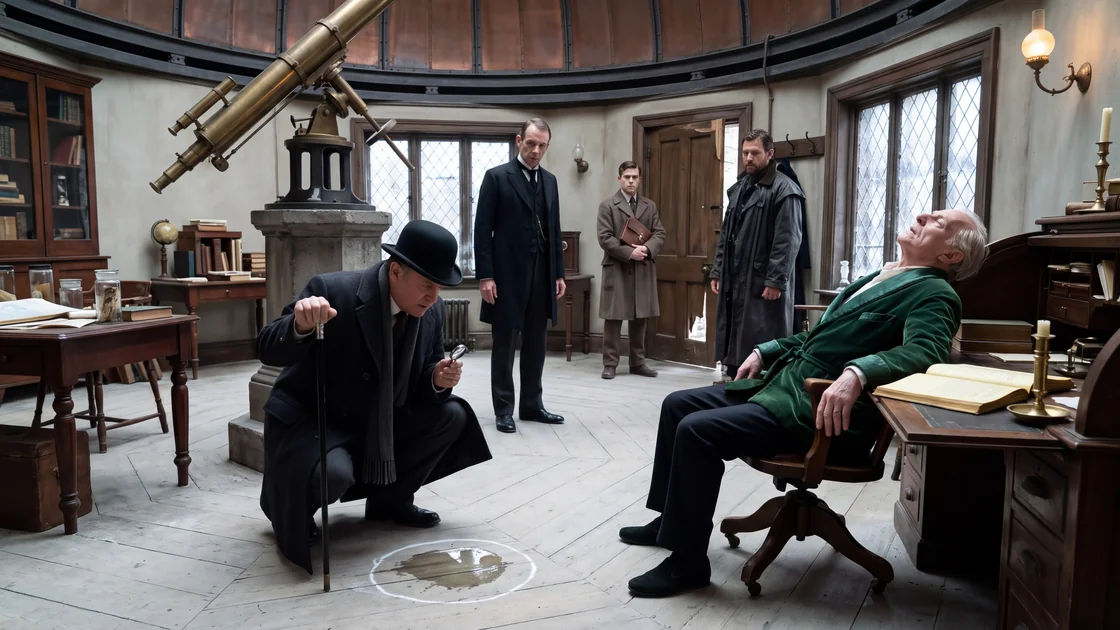
Detective Inspector Thomas Callow is summoned to an isolated cliffside estate to investigate the murder of Lord Alistair Vance, an eccentric explorer found with a crushed throat inside an observatory hermetically sealed from within. With no signs of forced entry, no missing valuables, and no weapon left behind, the sole piece of physical evidence is a small pool of melted snow upon the cedar floorboards—a pool that defies the intense heat of the hearth and all physical laws by stubbornly refusing to evaporate. Through methodical deduction, forensic pathology, and the dark history of a tragic Arctic expedition, Callow uncovers a tale of stolen science, geographic obsession, and a chillingly calculated mechanism of vengeance.
I. The Chamber on the Crag
The carriage wheels churned through five inches of late-November slush, throwing up grey sprays of grit against the black carriage doors as Inspector Thomas Callow climbed the winding coastal road toward Vance Crag. Below, the Irish Sea broke against the jagged teeth of the headland in rhythmic, thunderous sighs, its spray freezing into needle-sharp rime upon the stunted gorse.
Callow drew his wool muffler tighter about his chin. His knee, shattered a decade earlier by a dockyard looter’s lead pipe, throbbed with a dull, metronomic ache that always predicted frost.
Beside him, Constable Peter Briggs gripped his leather dispatch case with knuckles whitened by the chill. Briggs was young, barely two years out of the recruit depot at Preston, and his breath puffed into the carriage cab in nervous, irregular plumes.
"The telegram from the local sergeant was quite specific, sir," Briggs said, shouting slightly over the rattle of the iron rim on stone. "Lord Vance was found at six this morning by his manservant, Mr. Fletcher. The master had been dead since at least midnight, according to the apothecary who came up from town. But it is the room, sir. They have not moved the body, nor have they touched the bolts."
"The bolts," Callow murmured, his gaze fixed through the salt-crusted glass upon the silhouette of Vance Manor.
The house was an architectural monstrosity—a mid-Victorian gothic shell onto which Lord Alistair Vance, upon returning from his third Greenland expedition in 1894, had grafted an octagonal astronomical tower of dressed granite. The tower rose five stories into the slate sky, terminating in a copper dome now turned the dull turquoise of a verdigris penny. It looked less like an observatory than a lighthouse built by a madman who expected the sea to rise three hundred feet and submerge the heather.
"The doors were barred from within," Briggs continued, consulting his notebook by the dim yellow glow of the carriage lantern. "A single leaf of solid English oak, three inches thick, secured by an iron drop-bar set into stone sockets. The windows are three-quarter-inch plate glass, framed in bronze and caulked against maritime gales. Every window was latched, the thumbscrews driven home and sealed with beeswax against drafts. No chimney flue larger than a four-inch stovepipe, and that fitted with an iron spark-arrestor on the exterior."
"And the ceiling?" Callow asked dryly.
"A hemispherical copper dome. The observing slit is worked by an endless chain and bronze pinion gears. It was closed, sir. Bolted and chained from the floor."
"A tomb," Callow said. "Men often construct their own tombs, Briggs, though they usually have the courtesy to die of apoplexy rather than violence inside them."
"The sergeant reported violence, sir. Definite violence."
The carriage lurched as it crested the final rise, the horses’ hooves clattering over the cobbles of the carriage sweep. Vance Manor loomed above them, dark save for three amber-lit windows on the ground floor and the pale, dead eye of the observatory turret high above.
Sergeant Aldous of the county constabulary stood beneath the portico, his heavy oilskin coat dripping with half-melted sleet. He stepped forward to open the cab door before the wheels had fully ceased their revolutions.
"Inspector Callow?" Aldous asked, his face ruddy and raw from the maritime wind. "Thank God Scotland Yard saw fit to send you on the morning train. It’s an unholy business up there. We’ve kept the servants out, and her ladyship is sequestered in the morning room with her smelling salts. The local surgeon, Dr. Finch, is with the corpse, but he hasn't dared shift it."
"You did well to preserve the room, Sergeant," Callow said, stepping down onto the slush. He leaned heavily on his silver-topped malacca cane, allowing his stiff leg to take his weight before turning his eyes up to the granite tower. "Tell me of the entry. Did you break the door?"
"Had no choice, sir," Aldous said, leading the way through the cavernous entrance hall, where stuffed musk-oxen and framed navigational charts lined the oak-paneled walls. "Fletcher—that's the valet—brought up the morning tea at half-past six. Knocked. No answer. Knocked again until eight, when he grew alarmed. Lord Vance was a man of furious punctuality. Fletcher fetched the gamekeeper, a great bull of a man named Croft, and together with two estate hands, they brought a twenty-pound iron crowbar to the oak door."
Callow followed the sergeant up the winding stone staircase that spiraled around the hollow core of the observatory tower. The air grew colder with every riser they ascended; the central heating pipes that warmed the lower floors did not extend into the upper sanctuary. Lord Vance, Aldous explained, had demanded absolute atmospheric stability for his brass refractors; heat currents from radiator grates distorted the celestial clarity of the lens.
At the fourth landing, the stone gave way to a narrow catwalk of cast iron, terminating before a battered oak portal. The jamb on the left was splintered; heavy gouges in the granite showed where the iron drop-bar had been forced out of its mortise by sheer mechanical leverage.
"We forced it just wide enough for Croft to slip his arm through and lift the bar," Aldous said, pointing to the mangled timber. "Look at the catch, sir. Clean iron. No wires, no trip-strings. The bar fell into the cradle from within, and when we shoved through, the bar was resting square in the iron shoes."
Callow knelt, his coat hem sweeping the grit. He examined the stone threshold, the splintered oak, and the interior floorboards.
The study floor was composed of tight-grained northern white cedar, unfinished and scrubbed pale with lye. Directly inside the threshold, the dust of the forced entry—tiny flakes of whitewash and dried oak splinters—lay undisturbed, save for the heavy boot-prints of the constables who had entered that morning.
Callow stepped carefully, placing his boots precisely within the prints already made.
The observatory study was forty feet across. In the center stood a great Cooke equatorial telescope, its eight-inch brass tube pointing blind against the curved interior of the copper dome. Surrounding it were mahogany tables cluttered with brass micrometers, navigational almanacs, dried botanical specimens from Baffin Bay, and jars containing pale, pickled worms from the ocean floor.
At the far side of the room, seated before a massive roll-top desk of Canadian walnut, sat Lord Alistair Vance.
He was a man of sixty, with hair like sheared sheep’s wool and a broad, weathered forehead furrowed by decades of squinting across pack ice. He was dressed in a quilted smoking jacket of green velvet and heavy tweed trousers tucked into sheepskin boots. His head was thrown back at an unnatural, sickening angle over the low walnut backrest of his swivel chair. His eyes, bulging and clouded with the milky film of death, stared directly at the brass compass rose set into the ceiling dome.
Callow did not look at the face immediately. He looked at the neck.
The purple-black bruising was catastrophic. The thyroid cartilage had been completely crushed, flattened inward against the cervical vertebrae as if seized by an iron vice or the heel of an enormous boot. Yet the velvet lapels of his jacket were unrumpled, his silk cravat remained pinned with a small gold harpoon, and his hands rested upon the blotter on either side of an open logbook, the fingers curled loosely, holding neither pen nor weapon.
"Good afternoon, Inspector," said a quiet, dry voice from the shadows near the telescope pier.
A thin man of fifty in a dark morning coat stepped into the light of the gas bracket. He was drying his long, nicotine-stained fingers with a linen towel. A black leather medical bag sat open on a nearby stool, its nickel instruments gleaming dully against dark velvet.
"Dr. Finch, I presume?" Callow said, tipping his bowler hat.
"The same. I have made no incision, Callow. I know the Yard's prejudices regarding the sanctity of the scene. But I can tell you this: Alistair died between ten o'clock last night and two o'clock this morning. Death was instantaneous, or nearly so. The hyoid bone is splintered into five pieces. The trachea was pulverized. The force required was extraordinary—far beyond what an ordinary man could exert with his bare thumbs. It is as if he were struck by a falling spar or gripped by an industrial press."
"And yet," Callow said, walking slowly around the desk, "there is no mark upon his chest. No bruising upon his shoulders to suggest he was pinned down. His waistcoat buttons are intact. No sign of a struggle."
"None," Finch agreed. "His pen was found in the brass tray. He appears to have been reading."
Callow leaned over the walnut desk. The open logbook was dry, its paper yellowed with age. It was not a contemporary diary, but an expedition journal from 1894, stamped upon the buckram cover: H.M.S. Erebus II – Disko Bay to the Melville Inland Ice. The page open before the dead man contained entries detailing meteorological observations from October of that year: barometric readings, temperature logs registering fifty degrees below zero, and brief, cryptic notes regarding "the anomalous blue drift in the lower stratification of the Nunatak."
"He was looking back thirty years," Callow murmured.
"He lived in the past," Dr. Finch remarked, snapping his bag shut. "Since Lady Clara ceased speaking to him five years ago, he spent his nights here, staring at the stars or reading his old charts. A cold man, Callow. Harder than the rocks he chipped his specimens from."
Callow nodded, but his eyes were no longer on the dead lord. His gaze had dropped to the floor, three feet to the left of the mahogany desk, halfway between the dead man’s chair and the cold cast-iron stove that sat against the western arc of the wall.
Upon the pale, scrubbed cedar floorboards lay a pool of clear liquid.
It was roughly oval, eighteen inches along its major axis and a foot wide. In the gray daylight filtering through the high northern window, it had the glassy, leaden sheen of meltwater.
Callow walked toward it. The constables' footprints had skirted it carefully; Aldous had drawn a circle of carpenter’s chalk around its perimeter, some two inches back from its margin.
"What is this?" Callow asked, crouching down until his nose was six inches from the timber.
"Snow, sir," Sergeant Aldous offered from the threshold. "Or melted hail. Must have been tracked in by the boots of whoever done it."
Callow did not reply immediately. He took off his right glove, touched the tip of his forefinger to the edge of the puddle, and brought it to his tongue.
"It is not salt," Callow said. "Pure, sweet water. Cold. Remarkably cold."
"The room is freezing, Inspector," said Finch with a slight shrug. "The stove went out before midnight. The draft from the masonry is like a cellar."
"Yes," Callow said, his eyes narrowing. "The room is cold now, Doctor. But when did Fletcher build the morning fire?"
"At eight o'clock, sir," Aldous said. "As soon as we got the door down, I told Fletcher to fire up that cast-iron monster. Her ladyship was coming up, and the room was like a meat locker. That stove was red-hot from half-past eight until noon, when Dr. Finch arrived and asked us to bank it down to preserve the body."
Callow stood up, his joints popping with a dry, wooden sound. He pointed his malacca cane at the floorboards beneath the water.
"Cedar," Callow said, "is a soft, thirsty wood when scrubbed with lye. Look at the edges of this puddle, Doctor. Look at the chalk mark Sergeant Aldous laid down three hours ago."
Finch stepped forward, adjusting his spectacles. He frowned, leaning down.
The white chalk line, drawn at nine o'clock that morning, sat exactly two inches from the liquid's edge. But the water had not expanded to meet it, nor had it receded by a fraction of an inch.
The edge of the puddle did not feather into the grain of the wood. It did not soak into the dry, porous cedar. Instead, it sat perched atop the timber like a drop of quicksilver on polished glass, held in place by an impossibly high, convex meniscus that seemed to defy the pull of gravity and the capillary hunger of the dry timber beneath it.
"That's odd," Finch muttered. "The air in this tower was dry as tinder when the stove was roaring. With that much heat, a puddle of ordinary water this shallow should have evaporated in two hours. At the very least, the wood should have darkened with absorption."
Callow took a clean linen handkerchief from his breast pocket. He touched the corner of the linen to the edge of the pool.
The linen did not wet.
The white cambric rested against the clear liquid as though it were resting against a sheet of solid, transparent mica. Callow pressed harder. The liquid yielded slightly, dimpling beneath the pressure of his thumb, but no moisture climbed the fibers of the cloth. When he withdrew the handkerchief, the corner came away as dry and crisp as if it had been drawn from a drawer of lavender.
"Sergeant," Callow said, his voice dropping into that quiet, rhythmic register that his subordinates knew well, "fetch me a piece of scrap paper from that waste-basket. And bring that candle from the desk."
Aldous scrambled to obey. Callow took a strip of dry rag paper, lit the candle, and touched the paper to the flame until it was charred and smoking. He held the glowing ember an inch above the center of the pool.
No steam rose. No hiss sounded. The surface of the liquid remained glass-still, reflecting the orange ember with cold, diamond-like brilliance.
"It is melted snow," Callow whispered, his eyes dark with a sudden, strange intensity. "Look at the debris at the bottom."
Finch knelt beside him. In the center of the puddle, resting against the pale wood beneath half an inch of water, lay three tiny specks of something dark and granular.
Callow drew a silver pocket-scalpel from his waistcoat—a souvenir from a case in Whitechapel—and gently slid the blade under the largest speck. He lifted it out.
The speck was not soot. It was a microscopic fragment of blue-green lichen, perfectly preserved, attached to a grain of pinkish granite no larger than a grain of sand.
"That lichen," Dr. Finch said, his voice suddenly dry, "does not grow in Cumberland. That is Cetraria nivalis. The snow-moss of the high north. Alistair brought tons of it back from Cape York thirty years ago."
Callow looked down at the puddle. The water remained motionless, its meniscus thick, heavy, and obstinate.
"A dead man whose neck was crushed by an engine of impossible power," Callow said softly, looking back at the corpse in the swivel chair. "A room bolted with three inches of oak from the inside. Windows latched and sealed with wax. And a puddle of meltwater that refuses to wet the floor, refuses to dry in the heat, and refuses to leave."
II. The Widows and the Nephews
The morning room of Vance Manor was suffocatingly warm. Two coal fires blazed in grates of Italian marble, their heat trapped by heavy velvet portieres and flock wallpaper of deep crimson.
Lady Clara Vance sat in a high-backed armchair near the bay window, through which the grey sea could be seen thrashing itself into lather against the cliffs. She was forty-five, fifteen years younger than her late husband, with the pale, aristocratic bone structure of the Northumberland Vanes. Her hair was black, streaked at the temples with sharp bolts of silver, pulled back into a severe chignon that seemed to pull the skin of her cheekbones taut.
She did not hold a handkerchief. She was drinking black tea from a porcelain cup that did not clatter against its saucer.
"Alistair was an unbearable man, Inspector," she said, her voice clear and devoid of tremor. "I have no intention of performing a widow’s hysteria for the benefit of Scotland Yard. If you seek tears, you had better interview Mrs. Gable, the cook. She had a sentimental regard for his bluster."
Callow stood before the fire, his hands clasped behind his back, his cane resting against the fender. Briggs sat at a walnut side-table, his pencil scratching methodically across the blue lines of his ledger.
"I seek only the sequence of the night, Lady Clara," Callow said. "When did you last see your husband alive?"
"At seven o'clock yesterday evening. We dined together in the great hall. It was a silent meal, as our meals have been for a decade. He ate boiled mutton and read a monograph on the bathymetrical surveys of the Norwegian Sea. At half-past seven, he took his paraffin lamp and ascended to the tower. He did not come down."
"Did you hear nothing during the night?"
"The wind was blowing a gale from the north-east, Inspector. It rattles every sash in this wretched barracks. The tower is three stone walls and an iron catwalk away from my bedchamber. If Alistair had fired an elephant gun, I should have thought it merely another chimney-pot tumbling into the sea."
"And your relations with him?" Callow asked mildly. "I understand there was... an estrangement."
Lady Clara set her teacup down with a small, sharp click.
"My husband was a thief, Inspector Callow. Not the sort who picks pockets or steals plate from the sideboard, but the sort who steals lives and names. When he married me, he was already married to the 80th parallel. He spent my entire dowry—forty thousand pounds from my father’s coal concerns—on three ships, thirty-six Greenland dogs, and an army of carpenters to build that absurd dome above our heads."
"And the return on your investment?"
"Pebbles," she said with cold venom. "Pickled sea cucumbers. A volume of self-aggrandizing memoirs published by the Royal Geographical Society, and thirty years of his intolerable company. He treated this house as an encampment. He slept on an iron cot in the observatory with three wool blankets, while I lived here among the velvet."
"Was he in fear of anyone?"
"Alistair was incapable of fear. He had the thick hide of a walrus. He was, however, expecting a visitor."
Callow’s eyes flickered toward her. "Indeed? He did not mention this to the servants."
"He would not. He received a letter on Tuesday. It bore no postmark; it had been delivered by hand to the porter’s lodge at the north gate. He burned the envelope in the dining room grate, but I saw the handwriting. It was a spidery, antique hand, written with iron gall ink that had turned brown. When he read it, he didn't shout or bluster as was his habit. He went quite white. He put his fingers to his throat—an odd, defensive gesture—and went directly to his study."
"Did you see the signature?"
"I did not," Lady Clara said. "But he muttered a name when he rose from the table. He said: 'The Disko ice has broken.' That was all."
"The Disko ice," Callow repeated.
Before he could pursue the question, the morning room door swung open without a knock.
A young man entered, bringing with him a gust of tobacco smoke and damp wool. He was perhaps twenty-eight, tall and loose-limbed, with the watery blue eyes and receding chin that often characterized the later generations of the Vance bloodline. His tweed jacket was cut in the loud, boxy style of the London sporting clubs, and his brown boots, though expensive, were caked with the orange clay of the lower headland.
"Aunt Clara," the young man said, barely glancing at Callow. "They told me the Yard was here. Is it true? Was the old boy really murdered?"
"Inspector Callow," Lady Clara said without looking up, "this is my late husband’s nephew, Julian Vance. He arrived from London three days ago to beg for another mortgage on his racing stables."
Julian Vance flushed, his pale ears turning a dark, mottled crimson. "There was no need for that, Clara. I came to discuss family business."
"Mr. Julian Vance," Callow said, stepping forward. "You were in the house last night?"
"I was not," Julian said quickly, drawing an enameled cigarette case from his pocket with shaking fingers. "I couldn't bear the atmosphere. The old boy was in one of his black moods, and Aunt Clara was playing the martyr. I took the dog-cart down into the village at eight o'clock. Drank gin at the Anchor and Crown until closing time, then slept in the tavern’s guest room. You can ask the landlord, old Barnaby. He’ll tell you I was unconscious in his feather bed by midnight."
"We shall certainly ask him," Callow said. "And your boots, Mr. Vance? The clay upon them is fresh. The road from the village is limestone macadam, but the cliffs behind the observatory are red sandstone and orange marl."
Julian looked down at his feet, his jaw working as if he were chewing a bitter stone.
"I took a stroll this morning," he muttered. "Up along the headland. Heard the church bells ringing, wondered what the row was. When I got to the gate, the groom told me Uncle Alistair had been found with his head twisted backwards."
"His neck was crushed, Mr. Vance," Callow corrected gently. "From the front. By an extraordinary force."
Julian laughed—a high, brittle sound that had no mirth in it. "Well, then you'd better look for Croft the gamekeeper. Or a bear. Uncle Alistair brought two polar bear skins back from the Melville Bay. Maybe one of them came back to life to collect its pelt."
"Julian," Lady Clara said in a voice like freezing iron. "Go to the library. You smell of cheap spirits and wet horse."
The young man glared at his aunt, then at Callow, before turning on his heel and slamming the heavy mahogany door behind him.
Callow stood in silence for a moment, listening to the grandfather clock in the corner drop its heavy seconds into the room.
"Lady Clara," Callow said, "was there anyone else in this house who shared your husband's memories of Disko Bay?"
The woman paused, her hand hovering above her teacup.
"Only Gabriel Thorpe," she said.
"Dr. Thorpe? The glaciologist?"
"He lives in the village," she replied, her eyes drifting toward the window. "In that wretched cottage by the salt-marsh. He was Alistair’s assistant on the Erebus II. He went north a brilliant young fellow from Cambridge; he came back a cripple who cannot bear the sight of an open fire. He and Alistair had not spoken in twenty years. They had an argument—a terrible, screaming business in the library—in the winter of ninety-six. But yesterday afternoon... yesterday afternoon, I saw Gabriel Thorpe standing at the edge of the carriage road, looking up at the observatory tower."
"Did he speak to Lord Vance?"
"Alistair went out to him," Lady Clara said, her voice dropping to a whisper. "I watched them from this very window through my opera glasses. They did not shake hands. Gabriel gave Alistair a small wooden box—no larger than a tobacco tin. Alistair took it, turned on his heel, and walked back inside without a word. When he passed through the hall, his face was the color of a wet slate."
Callow bowed. "Thank you, Lady Clara. You have been admirably lucid."
As he turned to leave, she spoke once more, her voice catching him at the threshold.
"Inspector?"
Callow turned. "Yes, my lady?"
"Whatever killed my husband," she said, her fingers tightening around the arms of her chair, "do not bring it into this room. I have spent thirty years trying to keep the cold out of this house. I will not have it brought down from that tower."
III. The Anatomy of an Anomaly
Back in the tower observatory, Dr. Finch had not left the room.
The physician was sitting on a three-legged stool near the great brass telescope, a notebook balanced on his knee. He had laid a sheet of glass—an old photographic dry-plate stripped of its emulsion—over the strange puddle on the cedar floor.
"Look here, Callow," Finch said as the detective entered with Constable Briggs. "I have been conducting an experiment while you were downstairs with the family."
Callow approached, his boots clicking on the cedar. "What have you discovered, Doctor?"
"I placed this plate of glass over the water an hour ago," Finch said, tapping the cold surface of the glass with a thumbnail. "Ordinary evaporation, even at fifty degrees Fahrenheit, produces condensation upon a cold glass plate placed within a quarter of an inch of a water surface. The vapor rises, meets the colder glass, and forms a film of micro-droplets."
Callow leaned down. The underside of the photographic glass was dry, pristine, and crystal-clear.
"Not a drop," Callow remarked.
"Not an atom," Finch said, his eyes glittering with the intense, morbid curiosity of the natural philosopher. "Furthermore, I managed to procure a pipette from Vance’s chemical bench. I attempted to draw up five minims of the liquid for chemical analysis."
"And?"
"The pipette could not lift it," Finch said flatly.
Callow frowned. "The bore was blocked?"
"The bore is clean. I tested it with alcohol immediately afterward. The liquid possesses an anomalous surface tension—an internal cohesion so monstrous that the atmospheric pressure cannot force it up the tube. It behaves like liquid mercury, yet it is completely transparent. It has no viscosity; it is thin as ether, yet it clings to itself with the tenacity of cold lead."
Callow took out his magnifying loupe—a triple-lens Bausch & Lomb glass he carried in his waistcoat pocket. He knelt directly beside the puddle, ignoring the cold ache in his knee.
Through the magnification, the puddle’s surface was not flat. It was composed of millions of microscopic geometric facets, shifting and sliding over one another like the scales of an albino snake. It was not merely water; it was an aggregate of crystalline liquid—water existing simultaneously in two states, balanced upon a knife-edge of thermodynamics that no textbook in London had ever described.
"Sergeant Aldous," Callow said without looking up. "Did Lord Vance keep any ice upon the premises?"
"Ice, sir? In November? There's no ice-house on the grounds. Lord Vance hated the sight of it. He wouldn't even have it in his claret. Said he’d seen enough ice in ninety-four to last him until the day of judgment."
"And yet," Callow said, "someone brought ice into this room. A great deal of it. Or perhaps... very little."
He stood and walked to the walnut desk.
The corpse of Alistair Vance sat as before, the sightless eyes fixed upon the brass compass rose above. Callow examined the blotter.
To the right of the open logbook lay an inkstand of carved serpentine stone, a brass tray containing two steel-nibbed pens, a box of sealing wax, and a brass candlestick whose tallow candle had burned down to a greasy pool in the saucer.
Callow picked up the candlestick. The tallow had cooled into an opaque, yellowish cake. Embedded in the tallow was a circular depression, two inches in diameter, perfectly flat at the bottom, as if a heavy cylinder of metal had rested there while the tallow was still molten.
"Finch," Callow said. "Come here."
The doctor rose and joined him.
"Look at this impression in the candle fat," Callow pointed out. "Something round was set into the hot wax. Something that cooled it instantly, causing the wax to set around its base in this sharp, vertical collar."
"A seal?" Finch suggested.
"Too large for a personal signet. It is two inches wide. And look at the blotter."
Callow moved the candlestick aside. On the dark green felt of the desk blotter, directly beside the open journal, was a faint, circular ring—not of ink, but of crushed vegetable fiber. The nap of the green wool had been pressed flat, and in the center of the circle lay a single, dried pine needle.
Callow picked up the pine needle with his scalpel.
"Larch," he said, turning it to the light. "A Siberian larch needle. They do not grow on this coast. Vance had several pressed specimens in his cabinets, but this is fresh. It still carries the scent of resin."
He turned back to the corpse. He unbuttoned Vance’s green velvet smoking jacket, then the tweed waistcoat beneath it. He parted the collar of the flannel shirt, exposing the dead man's chest.
Dr. Finch took a sharp, hissing breath.
Upon the pale, freckled skin of Vance’s sternum, directly over the breastbone, was an impression. It was not a bruise; there was no extravasation of blood into the subcutaneous tissue, no redness, no swelling.
It was a frost-mark.
The skin was dead-white, blanched and hard as tallow, in the distinct shape of an equilateral triangle, three inches on a side. Within the triangle, the pore structure of the skin had been frozen into a delicate, lace-like pattern of hexagonal crystals, as if a block of carved dry ice had been pressed against the naked flesh with murderous force.
"My God," Finch breathed, his fingers hovering over the dead skin. "This wasn't done through the clothing. The shirt was buttoned, the waistcoat was closed, the velvet jacket was fastened with three horn buttons. How could you freeze the sternum without scorching the wool?"
"You could not," Callow said, his voice flat and hard. "Not unless the cold was inside him when he died."
Callow reached out and took Vance’s jaw between his thumb and forefinger. He forced the dead man's mouth open.
The teeth were yellow and sound, but the tongue was retracted into the pharynx, shriveled and blackened. And from the dark cavity of the throat, as Callow tilted the head toward the grey northern daylight, there rose a faint, sickly odor.
It was not the smell of putrefaction. It was the smell of ancient bogs—the scent of deep peat unearthed after ten thousand years beneath the permafrost, mixed with the faint, metallic sweetness of ozone.
"Constable Briggs," Callow said, stepping back and wiping his fingers with his handkerchief.
"Sir?"
"You will remain in this room. You will touch nothing. You will allow no one—not Lady Clara, not the nephew, not Sergeant Aldous himself—to cross that threshold. And you will watch that puddle."
"Watch it, sir? What should I watch it for?"
"Watch to see if it moves," Callow said. "For if it does not evaporate, Briggs, it must do something else. Water never stays still in an English November."
IV. The Hermit of the Salt-Marsh
The path to Gabriel Thorpe’s cottage led down from the limestone crags into the low, sodden estuary where the River Esk bled into the sea. Here, the landscape was stripped of all grandeur; there were only mudbanks, black ditches choked with rotting bladder-wrack, and the skeletal frames of abandoned cockle-boats half-buried in the silt.
Thorpe’s dwelling was a squat, single-story hovel built of ship’s timbers and beach stones, thatched with coarse marram grass that whistled mournfully in the wind. No smoke rose from the stone chimney.
Callow knocked on the door with the brass head of his cane.
For a long time, there was no sound save the cry of a curlew out over the mudflats. Then, from within, came the dragging, uneven scrape of an iron patten upon stone, followed by the clanking of three separate chains.
The door opened six inches.
A face peered through the gap. It was a face that might have been forty or seventy; the skin was like pemmican—brown, dry, and crisscrossed with white, glossy furrows where frostbite had carved away the subcutaneous fat of the cheeks. The man’s left eyelid was dragged down by a pale scar that ran from the temple into the white beard, exposing a rim of watery red conjunctiva.
"I have no money for the chapel," the man said in a harsh, cracked voice that sounded as if it had not been used since the spring. "And the parish council can burn the roof over my head if they want the rates. I have nothing."
"Dr. Gabriel Thorpe?" Callow said, presenting his card through the opening. "I am Inspector Callow of the Criminal Investigation Department. I have come from Vance Crag."
The single eye widened slightly. The white scar on the cheek twitched, puckering the skin.
"Alistair is dead," Thorpe said. It was not a question.
"He was found this morning," Callow said. "May I come in, Doctor? The air off the estuary is not kind to my leg."
Thorpe stood still for several seconds, his chest rising and falling beneath a stained jersey of blue Guernsey wool. Then he unhooked the remaining chain and swung the door back.
"Come in, then," he spat. "Though you'll find no fire here. I don't burn coal. I don't burn turf. I don't like the light."
The interior of the cottage was freezing—colder, Callow thought, than the open air outside. The windows were shuttered with thick boards, sealed with strips of pitch-soaked canvas. The only light came from a single iron lantern containing a candle of pale tallow, set upon a long workbench that dominated the room.
The room smelled of hydrochloric acid, mutton tallow, and wet dog.
Around the walls were shelves packed with glass jars, each containing a pale, grey-green core of stone or ice, suspended in clear kerosene to prevent disintegration. At the back of the room stood an apparatus that Callow recognized from his reading: a modern Cailletet-type compressor, its heavy bronze cylinders and manometer gauges gleaming in the tallow light, connected to a series of copper coils submerged in a lead tank.
"You produce your own refrigeration, Doctor," Callow observed, leaning his cane against the bench.
"I study the physics of the cryosphere," Thorpe replied, limping to the bench. His right leg was rigid, encased in an archaic brace of hammered hoop-iron and greasy leather. "The Royal Society took away my fellowship in ninety-seven because I told them their theories of glacier flow were children's fables. They think ice is a solid. Idiots. Ice is a fluid with an ungodly memory."
"A memory?"
"It remembers the pressure that made it," Thorpe hissed, leaning his knuckles on the table. His hands were deformed; the terminal joints of three fingers on his left hand were missing, healed over into smooth, pink knobs. "Two miles down beneath the Greenland ice-cap, Inspector, the snow does not fall and freeze as it does in Cumberland. It is pressed by the weight of ten thousand winters until the air is driven out of the lattice. The atoms are crushed together until the crystalline structure changes its nature."
"Phase transformation," Callow murmured, recalling his consultations with the professors at University College.
Thorpe glanced at him, his single sound eye narrowing with a sudden, feral respect. "You have read Tyndall? Or Amagat?"
"A policeman must read everything, Dr. Thorpe. Especially when he finds a dead man whose throat has been crushed in an empty, bolted room, leaving only a pool of water that refuses to evaporate."
The old man went completely motionless. His hands, braced on the rough deal of the table, did not tremble; they seemed to turn to stone.
"A pool," Thorpe whispered. "He... it left a pool?"
"A pool of water eighteen inches across," Callow said, watching the man’s face with microscopic attention. "It sits upon scrubbed cedar floorboards. It does not soak into the grain. It does not evaporate, though the room was heated to seventy degrees for three hours. And at the bottom of the water lie three grains of pink granite and a leaf of Cetraria nivalis."
Thorpe let out a long, ragged sound that was half-sob and half-laughter. He turned away from the table, dragging his iron leg across the flags, and sank into a low chair of unpeeled willow.
"The Disko specimen," Thorpe said to the shadows. "He couldn't leave it in the dark. He had to look at it. Thirty years I kept the container in the salt-cellar, under six feet of brine and ice. And he demanded it back."
"You visited Lord Vance yesterday afternoon," Callow said, taking a step toward the seated man. "Lady Clara saw you give him a wooden box."
"The key was in the box," Thorpe said, his voice dropping into a dull, monotonous chant. "The brass key to the zinc cylinder. We brought it down from the Nunatak in eighty-four. August of eighty-four. Nicholas Eames found it first."
"Nicholas Eames," Callow said. "The third man on the expedition."
"The first man," Thorpe corrected fiercely, his head snapping up. "Nicholas was the mind! Alistair was only the pocket—the rich man with the yacht and the social ambition who wanted his name on a mountain range. Nicholas was the geologist. He took us up onto the Inland Ice, fifty miles beyond where the Esquimaux said it was safe to go."
"And what did Nicholas find?"
"A fissure," Thorpe whispered. "A blue throat in the ice that went down twelve hundred feet into the basement granite of the continent. The ice at the bottom wasn't white. It wasn't blue. It was black—black as obsidian, dense as bell-metal, formed during the great pre-Cambrian freeze before life crawled out of the slime. It was under such enormous lithostatic pressure that it had ceased to behave like water."
Thorpe leaned forward, the candle-light catching the red rim of his ruined eye.
"When water is compressed beyond twelve thousand atmospheres, Inspector, it does not melt at thirty-two degrees. It remains solid at eighty degrees! It becomes Ice Seven—dense, heavy, unnatural. But Nicholas found something worse. He found an organic brine within the ice—a subterranean reservoir that had remained liquid under the pressure of two miles of glacier, saturated with prehistoric salts and ancient, anaerobic cryptobiotes."
"The blue drift," Callow murmured, remembering the phrase from Vance's open logbook.
"Nicholas called it the Vitreous Silt," Thorpe continued. "It had a surface tension like liquid glass. It could absorb heat without changing temperature; it could sit in a forge and remain at forty degrees until it had consumed every calorie in the coals. Nicholas took three cylinders of it. He sealed them in zinc."
"And what happened to Nicholas Eames?" Callow asked, though he already knew the shape of the answer.
Thorpe’s face collapsed into a mask of ancient, unhealed agony.
"We were coming down the glacier. The sledges were heavy. The dogs were dying of the red water. Alistair wanted the glory. If Nicholas returned, the Royal Society would give the Gold Medal to him. Nicholas was the surveyor; Nicholas wrote the charts. Alistair was only the patron."
"Vance cut his line?"
"He didn't cut it," Thorpe wept, the tears running down the white troughs of his scars. "He just... didn't hold it. We were crossing the great crevasse at the tongue of the Jacobshavn glacier. Nicholas slipped. The sledge went over the lip. Nicholas was dangling fifty feet down, shouting for us to belay the rope around an ice-spur."
Thorpe covered his face with his ruined hands.
"Alistair stood there. He had the rope in his mittens. He looked at me. He said: 'Gabriel, the provisions will only last two men to the coast.' And then he opened his fingers."
The silence in the cold hovel was absolute, save for the rhythmic lap of the tide in the salt-ditches outside.
"And you?" Callow asked softly. "What did you do, Dr. Thorpe?"
"I held my tongue," the old man whispered. "Alistair gave me five thousand pounds and bought me this cottage. He gave me one of the zinc cylinders and kept two for himself. We swore an oath on the expedition Bible that we would never open them—that the world wasn't ready to know what lay beneath the Inland Ice. But Nicholas had a daughter."
Callow stiffened. "A daughter?"
"A child of four when we sailed from Dundee," Thorpe said, looking up through his fingers. "Her mother died of the lung-rot two years later. The girl was raised in an orphanage in Leith. We thought she knew nothing. We thought the name of Nicholas Eames was buried under eighty feet of blue firn in Greenland."
"What was her name?" Callow demanded, stepping forward and gripping the edge of the table.
"Eileen," Thorpe said. "Eileen Eames. But she didn't call herself that when she came to this coast three months ago."
"What does she call herself now?"
Thorpe looked at Callow, his ruined mouth parting in a grotesque, mirthless smile.
"Ask Dr. Finch," he whispered. "Ask Finch who grinds his powders and washes his specimen jars at the village dispensary."
V. The Chemistry of Guilt
Callow did not take the carriage back to Vance Crag. He left Briggs at the house and walked the two miles along the coastal cliff path, his cane digging deep into the wet turf. The wind was rising from the north-west, bringing with it the smell of an Arctic gale—a clean, sharp, ozone-laden chill that tasted of iron and salt.
His mind worked not with the brilliant, intuitive flashes of the story-book detectives, but with the slow, grinding mechanical precision of an iron clockwork.
Item: A room sealed from within. The drop-bar was down, the windows latched from the inside, the observing slit chained.
Item: Alistair Vance, a powerful man of violent temper, killed without a struggle at his desk. His neck crushed from the front with hydraulic violence. His sternum marked with a triangle of frost. His lungs smelling of ancient peat and ozone.
Item: A pool of liquid that would not soak into cedar, would not evaporate in seventy degrees of heat, and contained debris from the Greenland interior.
Item: A brass candlestick with a circular depression in the cooled tallow.
Item: A Siberian larch needle on the blotter.
Item: Gabriel Thorpe, an accomplice broken by guilt, living in an artificial winter with an apparatus for liquefying gases.
Item: Eileen Eames.
When Callow reached the gates of Vance Crag, he did not enter the main house. He turned toward the stable yard, where the carriage houses and the small estate mortuary were situated.
A light was burning in the tack-room. Through the window, Callow saw Dr. Finch standing over a zinc-lined table, his coat off, his shirtsleeves turned up to his elbows. A gas jet roared beneath an iron tripod supporting a copper retort.
Beside him, her back to the window, stood a young woman in a coarse linen apron, her auburn hair tucked neatly beneath a white cambric cap. She was washing test tubes in an earthenware crock, her movements economical, silent, and precise.
Callow entered without knocking.
The latch clattered; Dr. Finch looked up, startled, a glass rod poised in his hand.
"Inspector," Finch said, lowering the rod. "You startled us. I have been attempting to analyze the scrapings from Vance’s neck. The tissue is... peculiar. Highly peculiar."
Callow took off his hat and set it upon a harness-peg. He looked not at the doctor, but at the girl.
She had turned around slowly. She was twenty-five, with clear, grey eyes that held neither fear nor curiosity. Her face was pale, dusted across the bridge of the nose with tiny, pale-brown freckles, and her hands, though red from the washing water, were long, slender, and remarkably steady.
"Miss Eames, I presume?" Callow said.
The girl did not flinch. She did not drop the glass tube she held. She merely wiped it dry with a clean linen cloth and set it into the wooden rack upon the bench.
"My name is Mary Wright, Inspector," she said in a cool, low voice with only the faintest burr of the Scots coast in its vowels. "I am Dr. Finch’s assistant."
"You were Mary Wright in Edinburgh," Callow said, stepping closer to the bench. "You were Eileen Eames when your father took you aboard the Erebus II in the Victoria Dock at Leith in June of 1884, and let you touch the brass binnacle before he sailed north to die."
Dr. Finch dropped his glass rod; it shattered with a sharp, musical ping upon the flags.
"Callow," Finch stammered, his eyes darting between the detective and the girl. "What nonsense is this? Mary has been in my employ for three years. Her father was a schoolmaster in Roxburghshire."
"Her father was the finest glaciologist in Europe," Callow said, his eyes never leaving the girl's face. "He was left at the bottom of a crevasse on the Jacobshavn tongue by Alistair Vance and Gabriel Thorpe. And yesterday afternoon, Gabriel Thorpe gave his partner in murder a brass key to a zinc cylinder that had been buried in a salt-marsh for thirty years."
Eileen Eames took off her linen apron, folded it with methodical neatness, and laid it upon the corner of the zinc table.
"You are very clever, Inspector," she said. Her voice was entirely devoid of tremor. It had the flat, terrifying calm of a frozen lake. "More clever than Lord Vance. He thought I was merely the girl who brought his digitalis from the dispensary twice a month."
"Mary!" Finch cried, reaching out a hand toward her arm. "What have you done?"
"Do not touch me, Dr. Finch," she said, not unkindly. "You have been very good to me. You gave me work when the hospitals in Edinburgh would not let a woman into their laboratories. But you know nothing of this."
Callow leaned his hands upon his cane. "You killed him, Miss Eames. But you did not enter the room."
The girl looked at him, her grey eyes chillingly bright. "Did I not? The room was locked, Inspector. You Scotland Yard gentlemen are famous for your locked rooms. Tell me how I broke the laws of nature to twist that monster’s neck."
"You did not break the laws of nature," Callow said. "You used them. You used your father’s discovery—a discovery Vance and Thorpe were too cowardly to understand, and too greedy to destroy."
Callow walked to the copper retort on the bench. He turned down the gas tap until the roaring blue flame died to a silent yellow tip.
"Dr. Finch," Callow said, "when you examined Vance’s body this morning, you noted that the sternum bore a triangular frost-mark. You noted that the neck had been crushed with enormous mechanical force—not by fingers, but by something that acted like an industrial press. And you found that the lungs smelled of peat and ozone."
"Yes," Finch whispered. "The tissue of the neck was completely desiccated—devoid of cellular fluid, as if the water had been drawn out of the flesh by an impossible hygroscopic agent."
"And the puddle," Callow said, turning back to Eileen. "The puddle of melted snow that will not evaporate. It sits upon the cedar floor, three feet from the desk. It has not shrunk by a dram. It has not soaked into the wood."
Callow reached into his pocket and drew out the Siberian larch needle he had taken from the blotter.
"A Siberian larch needle," he said, holding it before the girl’s eyes. "Larix sibirica. A tree that does not grow in England. But it grows in the botanical garden at Edinburgh, where you studied chemistry, Miss Eames. And it grows in the small tub beside Gabriel Thorpe’s door."
"A needle proves nothing," she said.
"It proves an association," Callow countered. "Thorpe did not give Vance the box yesterday out of fear. He gave it to him because you compelled him to. What did you show Gabriel Thorpe to make that broken old drunkard surrender the key?"
Eileen’s pale lips thinned into a line as straight as a razor-cut.
"I showed him my father's pocket-watch," she said. "The silver pocket-watch Thorpe stole from my father’s kit-bag while he lay sixty feet down in the blue ice. Thorpe sold it to a pawnbroker in South Shields in eighty-six. I spent six years tracking that watch, Inspector. When I set it upon his workbench, he fell to his knees and begged me to kill him."
"And you said you would spare him—if he gave you the cylinder."
"I did not need his cylinder," she said proudly. "I had my father's journals! The Royal Geographical Society refused to publish them because Alistair Vance was a peer of the realm and Nicholas Eames was only an itinerant surveyor from Aberdeen. But my father wrote down the mathematics of the Vitreous Silt. He understood the phase-inversion."
"Explain it, Miss Eames," Callow said quietly. "Not for the court. For me."
The girl looked at the cold copper retort, then out the window toward the granite tower rising against the darkening sea.
"Water," she said, her voice taking on the rhythmic, instructional cadence of a lecturer, "is the only substance on this earth that expands when it freezes. It expands with a pressure of thirty thousand pounds per square inch—enough to split granite cliffs, enough to burst the iron cylinders of hydraulic docks. My father discovered that when the Vitreous Silt is brought to forty degrees below zero, it undergoes a secondary crystallographic collapse. It does not expand; it contracts into a hyper-dense solid. But when it warms... when it warms past the freezing point of ordinary water, Inspector, it does not melt immediately."
"It expands," Callow said, the clockwork in his mind clicking into its final, terrible position.
"It expands with a velocity approaching detonation," Eileen whispered. "Yet it does not explode like gunpowder. It has no fire. It has only the irresistible, expanding hunger of cold iron."
VI. The Mechanism of the Meniscus
Callow stepped back from the bench, his cane clicking softly against the flagstones. He turned to Dr. Finch, who was staring at his assistant in horror.
"Fetch Sergeant Aldous, Doctor," Callow said. "And tell him to bring Croft the gamekeeper and a heavy sledge-hammer. We are going back to the tower."
"Callow," Finch said, "you aren't going to arrest her now?"
"There is nothing to arrest her for, Finch," Callow replied coldly, "until I can prove the agency. An English court cannot hang a woman for an impossible puddle of water."
Ten minutes later, the party stood once more in the octagonal study beneath the copper dome.
The room was freezing now; the wind from the sea shrieked through the tiny leaded joints of the high northern windows, and the brass telescope creaked on its trunnions like an old ship in a swell. The corpse of Alistair Vance had been removed to the estate mortuary, but the chalk circle upon the floor remained, surrounding the glassy, motionless pool of meltwater.
Briggs stood at the threshold, his face pale with cold, his notebook held in stiff, blue-tipped fingers.
Callow walked directly to the walnut desk.
"Constable Briggs," Callow said, "when Vance sat here last night, he was reading his old journal. The candle was lit. Dr. Finch noted that the candle had burned down to its saucer. But look at the iron stove."
Callow pointed to the small, cylindrical cast-iron stove that sat against the curved wall, eight feet behind the desk chair.
"The stove," Callow said, "was not used last night. The ashes inside are cold; they are the grey clinkers of Wednesday’s fire. Vance did not light it because he wanted the room cold. Why did he want the room cold, Miss Eames?"
Eileen stood between Sergeant Aldous and Dr. Finch, her hands clasped before her in her dark wool cloak. She did not answer.
"He wanted it cold," Callow continued, "because he was experimenting with the cylinder Gabriel Thorpe had returned to him. He opened the zinc case with the brass key. Inside was a container of the Vitreous Silt—or perhaps a core of the ancient Arctic ice Thorpe had preserved in his compressor."
Callow turned to the desk. He picked up the heavy brass candlestick.
"Earlier today, I noted a circular depression in the cooled tallow of this candlestick," Callow said. "Two inches in diameter. I thought something had rested there. But that was an error. Something had not rested there; something had been cast there."
He set the candlestick down upon the blotter, precisely over the faint ring in the wool nap where the larch needle had been found.
"Miss Eames," Callow said, "you visited Vance yesterday evening. Not by the door. Not by the stairs."
Sergeant Aldous frowned. "Inspector, that's impossible! I checked the catwalk myself. There is no other stair to this tower."
"Look up, Sergeant," Callow said, pointing his malacca cane toward the hemispherical ceiling.
The copper dome was ribbed with heavy arcs of riveted iron. At the apex was the observing slit, two feet wide, closed by a pair of curved copper shutters that slid horizontally on bronze runners.
"The observing slit," Callow said. "It is worked by an endless chain from the floor. But the chains do not lock. They are merely looped over an iron cleat beside the telescope pier. Anyone on the roof—anyone who had climbed the exterior service ladder that leads from the lead gutters of the main house to the dome platform—could pry those copper shutters open six inches with an ordinary cold chisel."
"And drop down forty feet?" Aldous scoffed. "She'd have broken her neck on the telescope tube!"
"She did not drop down," Callow said. "She dropped nothing down that was larger than a two-inch cylinder of ice."
Callow turned to Eileen. Her grey eyes were fixed upon him, cold and unblinking.
"You knew Vance’s habits," Callow said. "You knew that on clear, freezing nights, he opened the observing slit to view the transit of the circumpolar stars. You knew he sat at that walnut desk, directly beneath the northern arc of the dome, with his back to the telescope. And you knew what Gabriel Thorpe had given him."
Callow took a piece of paper from the desk and laid it on the blotter.
"You did not use gunpowder. Gunpowder leaves smoke; it leaves the stench of sulfur; it leaves lead or iron shot embedded in the skull. You used your father's discovery. You took a charge of the Vitreous Silt, frozen into a solid cylinder in Thorpe’s compressor at forty degrees below zero. At that temperature, it was stable—as hard as tempered steel, but contracted to its minimum volume."
"And the shape?" Finch asked, his medical curiosity overcoming his horror.
"A triangle," Callow said, looking at the doctor. "An equilateral triangle with sharp, knife-like edges—the shape of the frost-mark upon Vance’s breastbone! But it was not dropped as a solid projectile. Miss Eames, tell them what happens to the Vitreous Silt when it is enclosed in tallow."
The girl remained silent, but her breathing had grown shallow and fast.
"Tallow," Callow said, "is a non-conductor of heat. A thin jacket of mutton fat—cast in an ordinary candle-mold—would keep the core of hyper-dense Arctic ice from expanding for twenty minutes. Just long enough for a woman to climb down the exterior ladder, walk across the terrace, and enter the village road."
"Inspector," Finch cried, "this is madness! If she dropped a piece of ice through the roof, how could it crush his throat? A falling piece of ice two inches long could not break a man's hyoid bone!"
"It did not break his hyoid bone by falling," Callow said.
He stepped behind the desk chair. He reached out and touched the low walnut backrest.
"Look at the back of this chair," Callow said. "There is a horizontal groove carved into the walnut—an ornamental rebate, two inches above the leather seat. And look at the stone pier of the telescope directly behind it."
He pointed to the heavy cast-iron mounting of the Cooke refractor. The pier was set into four yards of solid granite masonry, bolted to the very bedrock of the tower.
"Vance was sitting in this chair," Callow said, his voice dropping into a low, terrifying whisper. "The room was cold—below freezing. He was examining the logbook. The cylinder fell from the dome above. It did not hit him. It fell behind him, into the narrow gap between the back of his chair and the telescope pier—a gap of barely three inches."
Callow looked at Eileen.
"Or did it fall, Miss Eames? No. It was lowered. Lowered on a line of fine gut—the Siberian larch needle was caught in the tallow jacket when you prepared it in Thorpe’s cold-room. You swung it through the observing slit like a pendulum, until it rested directly against the nape of his neck, wedged between his velvet collar and the cast-iron pier."
"And then?" Finch whispered.
"Then," Callow said, "the tallow warmed. The temperature in this room, even without the stove, was thirty degrees higher than Thorpe’s brine tank. The Vitreous Silt reached its critical threshold—the point of phase-inversion."
Callow brought his cane down upon the cedar floor with the crack of a pistol shot.
"It did not melt into water! It expanded. It expanded with the force of fifty tons of hydraulic pressure, seeking to return to its natural volume. Behind it was the immovable granite of the telescope pier. In front of it was the back of Lord Vance’s neck!"
Dr. Finch made a strangled sound in his throat and reached for the back of a chair to steady himself.
"The back of the chair was driven forward two inches," Callow said, pointing to the scraped floorboards beneath the walnut legs. "Vance was crushed against his own desk! His throat was driven into the walnut rim of the roll-top. The hyoid bone was shattered not by a blow from the front, but by his own larynx being flattened against the desk edge as his body was propelled forward by the expanding mass of ancient ice!"
The silence in the tower was deafening. The only sound was the howling of the wind outside the copper dome and the faint, rhythmic clinking of the shutter chain against the stone.
"And then," Callow said, turning slowly toward the chalk circle on the floor, "the ice completed its cycle. Once the pressure was released by the destruction of the neck and the splintering of the chair back, the crystalline structure collapsed. It melted. It became liquid once more."
He walked to the puddle. He stood over it, looking down into its clear, Faceted depths.
"It rolled off the desk," Callow whispered. "It pooled here, upon the cedar boards. And here it remains. Because, as Nicholas Eames wrote in the journals Vance stole from him, the Vitreous Silt has an anomalous vapor pressure. It cannot evaporate at the atmospheric pressure of sea-level. It can only evaporate at twelve thousand atmospheres—or when it is returned to the absolute zero of the Greenland ice-cap."
Callow raised his head. He looked directly into the eyes of Eileen Eames.
"A locked room," Callow said. "A door barred from within. Windows latched and sealed. The murderer was on the roof fifty feet above, using the sky as her entry and the ancient ice of the North as her lever. And the weapon... the weapon dissolved into eighteen inches of impossible water that will not leave the scene of the crime until the world itself turns cold."
VII. The Law of the Silt
Sergeant Aldous looked from the Inspector to the girl, his face mottled with confusion and distress.
"Sir," Aldous stammered, his hand hovering over his truncheon pocket. "Do I... do I caution her? Do I put the irons on her?"
Callow did not answer immediately. He walked to the northern window and looked out.
The dusk had come down upon the Irish Sea. The water was no longer grey; it was black, flecked with white foam where the breakers tore themselves to pieces upon the granite ribs of the headland. In the far distance, beyond the horizon, lay Scotland, the Hebrides, Iceland, and the vast, white, indifferent desert of the Inland Ice where Nicholas Eames’s bones lay pickled in forty fathoms of blue firn.
"Miss Eames," Callow said, without turning around. "Where is the rest of it?"
The girl did not move. "In the estuary," she said, her voice clear and calm. "I took both cylinders from Thorpe’s house last night, after I left the roof. I took them out in a cockle-boat to the deep channel where the current meets the sea. I pulled the zinc bungs and dropped them into thirty fathoms of salt water."
"Then there is no more of it on land?"
"None," she said. "Only that puddle on the floor."
Callow turned back to the room. He looked at Dr. Finch.
"Doctor," Callow said, "in your professional opinion as the medical officer of this district, what was the cause of Lord Vance’s death?"
Finch blinked, his spectacles reflecting the pale, dying light from the copper dome. He looked at Eileen, whose face was still as marble, then at the chalk circle on the cedar planks.
"He... his neck was broken, Inspector," Finch said, his voice unsteady. "The hyoid bone was crushed."
"By what agency?"
Finch swallowed. "In the absence of a weapon... in the absence of any human presence in this room... I should be compelled to testify that he was struck by a falling timber, or that he suffered an apoplectic seizure accompanied by violent spasmodic contractions of the cervical musculature."
"A seizure," Callow repeated flatly.
"No jury in England," Finch said, his voice gaining strength, "would accept that a man was murdered by a drop of water that fell from the stars and refused to dry."
Callow walked to the desk. He took up his bowler hat, brushed a speck of mortar from the brim with his sleeve, and set it firmly upon his head.
"Constable Briggs," Callow said.
"Sir?"
"Close your notebook."
The young constable looked up, astonished. "Sir? But the report for the Chief Constable—"
"The report," Callow said, "will state that Lord Alistair Vance died by misadventure—the result of a sudden structural failure of his observing equipment, which has since been dismantled."
Sergeant Aldous’s jaw dropped. "Inspector! You can't mean to let this stand! A peer of the realm!"
"A peer of the realm," Callow said, his voice cutting through the chill of the room like a steel saw, "who left his comrade to starve in a hole in the ice thirty years ago, and lived on the profits of his theft until the ice came back to collect the debt. The law of England, Sergeant, stops at the low-water mark. What happened on the Nunatak in eighty-four was outside our jurisdiction. And what happened in this room last night was outside our science."
Callow turned to Eileen Eames.
"Miss Eames," he said.
She looked at him, her grey eyes softening by the fraction of a degree. "Yes, Inspector?"
"You will take the morning train to Leith. You will not return to Cumberland. And if I ever find a grain of pink granite or a Siberian larch needle in your possession again, I shall forget that I am an old man with a ruined knee, and I shall see you hanged at Carlisle."
Eileen did not curtsy. She did not thank him. She merely bowed her head—a single, sharp inclination of the neck that was more like a soldier’s salute than a culprit’s submission.
"The train leaves at six," she said.
She turned and walked out of the room, her boots making no sound upon the iron catwalk outside the splintered door.
VIII. The Pool That Remained
Sergeant Aldous and Constable Briggs left an hour later, their carriage lamps flickering down the serpentine road toward the village like two dying glow-worms.
Callow remained in the tower.
He had sent Fletcher down to the cellars for a bucket of dry lime, a bag of Portland cement, and three tallow candles. The manservant had obeyed in terrified silence, his eyes rolling toward the ceiling as if he expected the dead explorer to drop from the copper dome to demand his tea.
Now, by the yellow light of the three candles set upon the walnut desk, Callow knelt once more beside the chalk circle.
The room had grown so cold that Callow’s breath formed thick, white clouds that hung motionless in the air before him. The ink in the serpentine inkstand had frozen into a black, convex button. The water in the floral wash-basin by the door was a solid disc of yellow ice.
Yet the puddle did not freeze.
It sat upon the cedar floorboards, clear as rock crystal, its thick, convex meniscus glistening in the tallow light. The three grains of pink granite and the tiny leaf of Arctic lichen rested at the bottom, undisturbed, magnified by the anomalous refraction of the liquid until they looked like jewels resting upon a plate of silver.
Callow took a pinch of the dry lime and let it fall toward the surface of the pool.
The white powder did not mix with the liquid. It did not sink. It struck the meniscus and skittered across the surface like dry dust blown across a sheet of plate iron, tumbling over the rounded margin to land upon the bare cedar boards beyond.
"A fluid with an ungodly memory," Callow whispered to the empty room.
He stood up, leaning heavily upon his malacca cane, his knee screaming with the cold that rose from the stone foundations of the tower.
He walked to the observing slit chain. He seized the iron links with his gloved hands and hauled downward with all his weight.
Above him, the bronze gears groaned, stiff with grease that had turned to tallow in the frost. The copper shutters shrieked as they moved along their tracks, closing inch by inch, until the two lips of metal met with a heavy, hollow thud that echoed through the copper dome like the closing of a lead coffin.
The draft ceased. The howling of the gale was muted to a low, rhythmic rumble, as if the tower were a great sea-shell held to the ear of a giant.
Callow took the bag of Portland cement. He did not mix it with water. He poured the dry, grey powder in a circle around the puddle, six inches deep, building a rampart between the liquid and the rest of the room. Then he took the bucket of lime and covered the clear pool completely, burying it beneath a white, caustic mound that smelled of the quarry and the kiln.
"Rest there, Nicholas," Callow said into the dark. "It is as close to the glacier as we can give you."
He blew out two of the candles, took the third in his hand, and walked to the splintered door.
At the threshold, he stopped. He looked back across the expanse of pale cedar floorboards to the walnut desk, the Cooke telescope, and the white mound of lime rising like a miniature nunatak in the center of the octagonal chamber.
Beneath the lime, through the white dust, a faint, pale-blue light was glowing.
It was not the reflection of the tallow candle. It was the cold, phosphorescent luminescence of the deep firn—the light that sleeps beneath two miles of Arctic ice, where no sun has shone since the creation of the world.
Callow pulled his hat down against the cold, turned his back upon the light, and pulled the battered oak door shut behind him, leaving the mountain to the dead.