The Coldest Tumbler
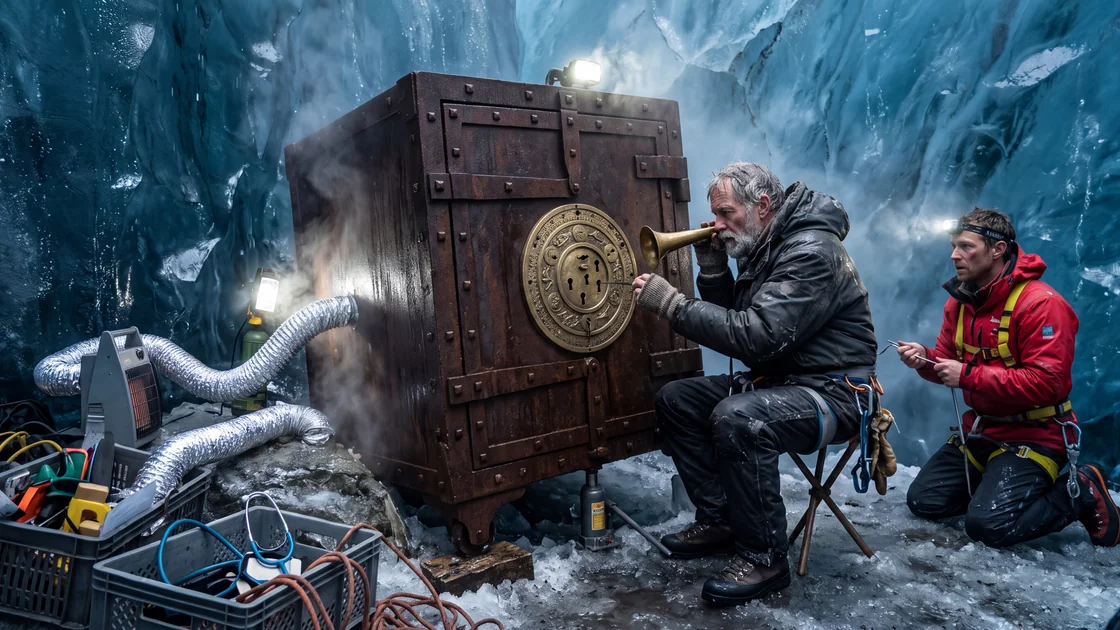
Patrick Vane, an aging master locksmith whose delicate hands were failing him with rheumatoid aches, was flown to the Isormen Ice Shelf in Svalbard to accomplish a task bordering on the absurd: to crack the lock of a massive, pre-industrial iron safe discovered suspended inside a rapidly collapsing glacier. With geothermal venting and an unprecedented summer heatwave liquefying the ancient blue ice around the monolith, Vane had fewer than seventy-two hours before the entire grotto calved into the freezing Arctic fjord below, destroying the safe, its unrecorded centuries-old secrets, and anyone desperate enough to stand before its frozen dial.
Act I: The Salt and the Sleet
The Twin Otter banked hard over the jagged spine of Spitsbergen, its twin turboprops roaring against a wall of freezing fog. Patrick Vane sat with his leather case between his boots, his hands buried deep inside his shearling-lined pockets. His fingers were curled into tight, defensive balls, rubbing against the small, warm spheres of heated soapstone he kept there. If his knuckles seized up in the damp, all the precision steel in Europe would be useless.
Beside him, Dr. Aris Thorne leaned over a topographical map printed on greaseproof paper, his thumb pinning down a contour line marked with a red grease pencil. Thorne was forty, half Patrick’s age, with the hollowed-out, wind-burned face of an glaciologist who had spent too many winters eating tinned beef in canvas tents.
"The thermal plume isn't natural," Thorne said for the third time since they had left Tromsø. He had to shout over the rattle of the fuselage. "The ice core data shows a localized temperature spike that originated beneath the cirque. The snout of the Isormen Glacier is calving at thirty meters a day. It isn't just creeping toward the sea, Patrick; it’s dissolving from its belly."
"Iron doesn't burn, Dr. Thorne," Patrick replied, his voice thin and dry like paper shavings. "And it doesn't rot if it's kept dry. If this thing has been in the ice as long as your photographs suggest, it isn't the cold I'm worried about. It’s the moisture. If water gets into the wheel-pack and refreezes, the pins will weld themselves to the casing with frost. Then we might as well use dynamite."
"Dynamite will detonate whatever is inside," Thorne snapped. "You saw the radiograph. The shadow behind the primary bolt-work isn't hollow. There are vials. Glass, ceramic, or lead—we don't know. If the casing experiences an explosive shockwave, the contents will be vaporized, or worse, poisoned by whatever anti-tamper charge the builder laid inside."
Patrick looked out the scratched acrylic window. Below them, the Barents Sea was the color of a bruised plum, choked with white rafts of sea ice. Ahead, the glacial snout rose like the battlements of a drowned empire, towering eighty meters above the surf. The ice was not white; it was an eerie, suffocating sapphire, bruised with bands of ancient volcanic ash and compressed under millions of tons of weight until it had squeezed out every microscopic bubble of air. It was old ice—thousands of years old.
Yet according to the satellite scans and the initial exploration team Thorne had guided three weeks prior, sixty feet beneath the surface of that primeval tongue, nestled within a newly melted fissure, sat a cubic block of wrought iron measuring six feet on each side. It bore neither manufacturer’s mark nor royal seal, only an intricate circular escutcheon of hammered brass and seven eccentric keyholes grouped around a central dial.
The plane touched down on a gravel strip scraped out of a moraine two miles inland. When the cabin door dropped, the Arctic air struck Patrick like a slap from a wet glove. It smelled of sulfur, pulverized shale, and the dead, rotten salt of the retreating ocean.
A tracked snowcat was idling at the edge of the strip, its diesel exhaust curling into the white sky like gray wool. Two men in high-visibility suits loaded Patrick’s gear: three wooden crates containing his customized tension tools, four battery-powered induction warming plates, a brass acoustic horn, two medical stethoscopes, an array of long-shank picks forged from Swedish spring steel, and several liters of anhydrous isopropyl alcohol mixed with light whale oil.
"We don’t have seventy-two hours anymore," Thorne said, checking a handheld transceiver as they climbed into the vehicle's cab. "The seismic monitors in the lower grotto registered an ice-quake forty minutes ago. The main archway has dropped four inches. The ice is moving, Patrick. It wants to spit that safe out into the fjord, or crush it like an egg."
"Locks do not care about urgency," Patrick said softly, pressing his aching wrists against his knees. "A lock is an argument between two minds: the maker and the intruder. If you rush your premises, you lose the debate."
Act II: The Throat of the Ice
The descent into the Isormen was like crawling into the throat of an extinct sea beast. The fissure had opened along a fault where warm water had bored upward from a geothermal vent, carving out a vertical cathedral of glass-smooth ice that dripped with constant, torrential runoff.
Patrick was strapped into a heavy nylon harness, descending through a narrow crevasse on a steel cable winch. The sound was deafening—a deep, subsonic thrumming that vibrated in the soles of his boots, accompanied by the ceaseless chock-chock-chock of falling meltwater. Everywhere he looked, the blue ice glistened with sheets of running liquid. The air was thick with mist, hovering precisely at thirty-four degrees Fahrenheit—just warm enough to melt, just cold enough to numb the flesh to the bone within minutes.
At eighty feet down, the cable stopped. Patrick swung gently out over a wet ledge cut directly into the ice shelf.
There it was.
The safe sat wedged within a cradle of compacted firn and rock, tilted slightly on its axis at an angle of roughly twelve degrees. It did not belong to this world. Its corners were reinforced with heavy iron straps secured by square-headed rivets, each the size of a walnut. The metal was not modern rolled plate; it bore the subtle, rippled texture of charcoal-hammered iron, blackened with animal fat and beeswax to prevent rust, though in the wet atmosphere, orange veins of fresh corrosion were already creeping across the hinges.
The face of the door was a marvel of dark ingenuity. At its center was a massive wheel-lock mechanism surrounded by a raised bronze ring engraved with astronomical symbols—not the familiar zodiac, but celestial coordinates based on an older, Ptolemaic sky. Seven keyholes, each no wider than a quill, formed an irregular circle around the hub.
"Look at the footings," Thorne said, his voice coming through Patrick’s radio headset. The glaciologist was standing on the ledge beside him, pointing a halogen lamp into the crevice behind the safe. "The ice behind it is rotten. It's 'candle-ice'—hollow needles held together by surface tension. Once the sun reaches its zenith today and the air temperature at the surface rises past eight degrees, the meltwater will lubricate this entire shelf. When that happens, the ice under our boots will shear away from the bedrock."
"How long?" Patrick asked, unbuckling his tool roll and laying it out on an insulated foam pad.
"Thirty-six hours. Maybe thirty. If you haven't released the deadbolts by then, we have to cut the anchors and let it drop into the bay. We can't drag it out. It weighs seven tons. The ice bridge above us won't support an extraction crane."
Patrick walked up to the iron face. He took off his heavy outer gloves, exposing his thin, pale hands protected only by fingerless wool mitts. He touched the iron.
It was colder than the surrounding air, radiating a dense, ancient chill that made his joints burn. He closed his eyes and ran his fingertips across the central boss. The metal was smooth, but he could feel the microscopic imperfections: the strike of the fuller, the scrape of the file where some artisan had spent weeks trueing the edges of the bronze casing.
"Who made you?" Patrick whispered.
"We found traces of sixteenth-century copper smelting in the ice layers immediately adjacent," Thorne said, leaning in. "A Dutch expedition went missing north of Spitsbergen in 1596. Barentsz survived, but another ship, the Zwarte Leeuw, disappeared with all hands. Rumor had it she carried the treasury of an Antwerp banking family that had fled the Spanish Inquisition. But this... this isn't an Antwerp merchant chest, Patrick. Look at the balance of the plates. Look at the tolerances."
Patrick brought his face within three inches of the escutcheon. His breath plumed against the dark iron, forming tiny feathers of white frost that instantly melted into beads of water. The tolerances between the safe door and the frame were less than the thickness of a fingernail. No sixteenth-century blacksmith had forged this by hand alone; whoever built it had used water-powered lathes, micrometric screw-cutting engines, and steel tempered with precision that rivaled nineteenth-century Swiss watchmakers.
"The lock is active," Patrick said. He pointed his pocket light into the lowest keyhole. "Look inside. The wards aren't iron. They're bell-metal bronze. They haven't rusted. But the ice has got into the chambers."
Deep within the dark apertures, glistening plugs of clear rime held the internal components fast. To turn a pick in there now would be like trying to turn a key in solid granite; the fragile bronze wards would shear off, permanently sealing the mechanism.
"The heaters," Patrick ordered. "We need warm air, dry and low-pressure. If you heat the outer plate too quickly, the iron will expand while the internal bolts remain frozen, and the whole door will bind on the rebate. We must thaw it from the inside out."
Act III: The Anatomy of the Mechanism
By midday, the grotto had become a steamy, echoing chamber of horrors. Two portable propane heaters hummed at the far end of the ice ledge, their flexible aluminum ducts blowing dry, eighty-degree air directly across the safe’s faceplate.
Patrick sat on a three-legged camp stool, his brass acoustic horn held against the iron just above the central hub. His right hand held a long, needle-thin bronze probe with which he was testing the elasticity of the internal springs through the third keyhole.
Click.
It was not a clean click; it was the wet, dull slap of a steel leaf-spring releasing from an icy matrix. A thin trickle of water drained out of the fourth keyhole, running down the face of the door like a tear.
"The springs are pig-tail pattern," Patrick muttered into his collar microphone. "Tempered steel. High carbon. They're still lively, but brittle. The cold has made them glassy."
"The shelf just dropped an inch," Thorne’s voice warned over the radio. Patrick didn't look up. Looking up did not help; looking up only showed the thousands of tons of fractured, translucent ice hanging like guillotines above their skulls.
"Be quiet, Aris," Patrick whispered. "Listen."
He gently rotated a heavy steel tension wrench inserted into the central hub. The resistance was enormous. A standard safe lock operated on a leverage ratio of three or four to one; this felt as though he were trying to rotate a millstone submerged in cold honey.
"The lock has three distinct systems," Patrick said, his eyes unfocused, staring into the dark grain of the iron. "It is not a modern combination lock, nor is it a simple warded lever lock. It is a compound chronometer escapement coupled to an anti-friction disc detainer. The keyholes aren't for seven different keys. They're for setting seven eccentric wheel registers."
"A puzzle lock?"
"No," Patrick said. "A puzzle implies a game. This is a fortress. If the seven registers aren't oriented to their exact bitting depth before the primary arbor is rotated, a set of spring-loaded dog-bolts will drop into deep mortises cut into the solid stone behind the jamb. If that happens, thirty men with sledgehammers couldn't open this door."
He withdrew the bronze probe and picked up his first working tool: a custom-made feeler pick forged from an antique corset stay, its tip thinned to half a millimeter and polished to a mirror finish with jeweler’s rouge. He dipped the tip into the alcohol mixture and slid it into keyhole number one.
The interior of a lock is a dark country, a landscape built entirely of touch and sound. Patrick had lost the sharpest vision of his youth thirty years ago, but his fingers possessed an unnatural, almost photographic literacy. Through the slender spine of the steel wire, he could feel the terrain inside the chamber: first, a shallow lead-in ward; then an obstruction—a circular brass baffle designed to turn away straight picks; then the first tumbler.
He touched the wafer. It was stuck.
"Alcohol syringe," he held his hand back without looking.
Thorne placed the brass syringe in his palm. Patrick inserted the curved needle through the baffle and injected two drops of the warm, alcohol-oil solution directly into the pin chamber. A faint hiss emerged from the keyhole as the rime dissolved.
Patrick re-inserted the feeler. He applied the faintest feather of upward pressure to the wafer.
Tick.
The wafer rose against its spring, found a gate, and dropped into an undercut notch. The tactile sensation traveled up the six inches of spring steel, through the bone of Patrick's index finger, and struck the nerve at the base of his wrist like a tiny electric current.
"One," Patrick whispered. "A serrated gate. The bastard who cut this was suspicious. He left false gates to catch an amateur's pick."
"Patrick," Thorne said, his voice taut. "We have water pooling around the footing. Look at the left corner."
Patrick glanced down. A steady stream of grey-green meltwater was bubbling up from beneath the iron baseboard, carrying with it small pebbles and black silt. The ice supporting the rear left corner of the safe was eroding. The safe was beginning to list, throwing its seven-ton weight unevenly onto the lower right hinge.
"If the hinges bind under the strain of the sag," Patrick said, his heart beginning to beat with a hollow, rhythmic thud against his ribs, "the bolts won't withdraw even if I pick the pack. We need a hydraulic jack under the lower corner. Keep it level. If this box twists even three millimeters, the lock will pinch the bolt tongues against the strike-plate."
"I don't have a three-ton jack down here!"
"Then find one, Dr. Thorne," Patrick said without raising his voice, his pick already moving into the second keyhole. "Or find a boat to carry you away when this shelf drops, because I am not leaving until these tumblers fall."
Act IV: The Language of Iron
Hours dissolved into the rhythmic drip of water and the metallic scrape of Patrick's picks. By nightfall—though the Arctic summer sun never left the horizon, casting a sick, yellow glare through the mouth of the fissure—he had mapped five of the seven cylinders.
They were not identical. Each represented a different tradition of locksmithing, as if the creator had collected the most devilish masterworks of different civilizations and compressed them into a single machine.
Keyhole three was an Italian disc lock, requiring Patrick to feel along the circumferential edges of four rotating bronze plates, aligning their peripheral notches with an internal fence that he could not see. Keyhole four was a Bramah-type slider mechanism, an impossibly early example of the design, containing six radial sliders that had to be depressed to six distinct, non-linear depths against the pressure of a central helical spring.
His hands were trembling now. The cold was a patient predator; it crept up his forearms, dulling the sensory receptors in his fingertips until he had to press them against his own cheeks to warm them back to life.
"The sixth," Patrick murmured. His beard was crusted with salt from his own sweat and the mineral mist of the ice cave. "It isn't taking the pick. It’s too tight."
He leaned his forehead against the freezing metal face of the safe. His brass acoustic horn was wedged between his ear and the cold iron. He tapped the exterior casing with a small wooden mallet.
Tung...
The note was low, clear, and died slowly, choked by the tons of ice flanking the iron sides. But beneath the fundamental tone, there was another sound—a faint, rhythmic clicking, like the dry legs of an insect crawling across glass.
Patrick froze. "There’s an escapement running."
Thorne, who had returned with an orange hydraulic jack and was frantically pumping it beneath the sagging left corner, stopped. "What did you say?"
"There’s a balance wheel inside. It’s alive."
"That’s impossible," Thorne whispered. "It’s been entombed in a glacier for hundreds of years. No mainspring holds tension that long without annealing or snapping."
"It isn't a spring," Patrick said, his ear glued to the acoustic cone. "Listen to the period. It's too slow for a hairspring. Tock... tock... tock... It’s a gravity pendulum. The tilt. When the safe leaned over on the ice, the list released a counterweight."
The realization settled in his gut like a stone. The maker had anticipated this. If the safe were moved—if it were pried out of its resting place, tipped onto a carriage, or hoisted into the hold of a ship—the change in level would trip an internal balance.
"It’s an anti-tamper run-down," Patrick said, his voice rising in panic for the first time. "The sixth cylinder isn't a lock. It's a trip-line. The escapement is winding a secondary bolt into place. If that weight reaches the bottom of its travel before the other registers are aligned, it releases the acid."
"How much time does the pendulum have?" Thorne dropped the jack handle and scrambled to the safe door.
"Look at the travel of the weight," Patrick pointed his flashlight at a narrow, vertical slit he had previously dismissed as a drainage hole beneath the dial. Inside, a thread of braided brass wire was slowly descending, carrying a dark lead sphere through a narrow tube filled with tallow. The tallow had frozen centuries ago, which had saved them; it had held the weight motionless. But the warm air from their propane heaters had softened the grease. The weight was sinking.
It had less than two inches left to fall.
"Turn off the heaters!" Patrick yelled.
"If I turn them off, the lock-pack will freeze solid again within fifteen minutes!"
"Turn them off! The tallow is melting! Direct the air only at the seventh keyhole—now!"
Thorne lunged for the duct, wrenching the flexible hose away from the main door and aiming its mouth strictly at the lower quadrant, where the final cylinder sat encased in frost.
Patrick's hands were shaking violently now. He took a deep, jagged breath through his nose, smelled the burning kerosene and the dead, blue ice, and forced his shoulders to drop. He closed his eyes.
Focus.
He was no longer in the Arctic. He was sixteen years old again, in the damp, coal-smoke basement of his master’s shop in Bristol, with his nose six inches from the guts of an eight-day bracket clock, learning how to judge the squareness of an arbor by the balance of its shadow on white linen.
The iron is your friend, the old man had told him, forty years ago. It does not lie. It has no malice. It obeys the laws of the universe with absolute fidelity. If it resists you, it is not because it hates you; it is because you have not yet learned how to ask it the right question.
Patrick inserted a curved hook into keyhole five. He found the first slider. He pushed it.
Click.
Second slider. It resisted. He gave it a microscopic tap with the tension bar. It slipped into place with a dry, sharp snap.
Click.
The lead weight was one inch from the bottom of its channel. Through the acoustic horn, the ticking of the escapement was louder now, a frantic, mechanical heartbeat echoing within the hollow chamber of the safe.
Tock. Tock. Tock.
Keyhole six was dead—it was the path of the falling weight, locked beyond human touch. But keyhole seven was the master gate. It was not a tumbler system; it was a rotating barrel that had to be turned simultaneously with the central dial while all other five picked cylinders were held under tension with five separate bypass pins.
"I need your hands, Aris," Patrick said. His voice was deathly calm.
"I don't know how to pick a lock, Patrick," Thorne stammered, his fingers trembling inside his wet gloves.
"You don't pick it. You just hold the tension. Take this tool." Patrick handed him a three-pronged steel fork whose tines were wedged into the first three cylinders, holding the picked tumblers in their open gates. "Press it inward. Exactly two pounds of pressure. If you push too hard, you bend the bronze pins. If you slip, the springs will throw them back, and we begin again. And we don't have time to begin again."
Thorne knelt in the mud and meltwater. He took the steel fork with both hands, his knuckles whitening as he leaned against the faceplate. "I have it."
"Keep it true. Don't look at the ice. Look at the pins."
Patrick took his two longest picks in his left hand, crossing them like chopsticks to bridge cylinders two and four, wedging them with his pinky and ring finger. His index finger and thumb were left free to work the tension wrench in the central dial. His right hand took the master probe—a heavy, hooked steel bar with a knurled handle.
He slid the probe into the seventh hole.
The ice above them shivered. A sound like a cannon shot rolled through the crevasse as a fracture opened fifty feet up the blue wall. A shower of sharp, ice-gravel cascaded down upon their backs, ripping Thorne's hood from his head. Thorne flinched, but he kept his hands jammed against the steel fork.
"Don't move," Patrick hissed.
The seventh cylinder had three concentric rings of pins. He could feel them: outer, middle, inner. They were spring-loaded with staggered resistance.
He touched the outer ring. He bound it. Tick.
He moved to the inner ring. It was stuck fast on a lip of rime.
The lead weight was a quarter of an inch from the release trip. In the acoustic horn, Patrick could hear the pallet-fork beginning to skip across the teeth of the escape wheel—the run-down was reaching its terminal velocity.
He did not use the alcohol. There was no time.
Patrick took the heavy knurled pick and braced his thumb against the brass escutcheon for leverage. He didn't just feel the metal; he threw his mind into the microscopic crystalline interface where the bronze pin met the steel ledge. He applied pressure—not steady pressure, but a rapid, rhythmic vibratory flutter, drumming his fingernail against the shank of the tool like the wing of a moth.
Vibrate. Shear. Lift.
The tiny sliver of ice inside the chamber sheared under the sonic frequency of the flutter. The pin popped up into its chamber.
Clack.
The central arbor gave way. It jumped forward three degrees under Patrick’s thumb.
"Now!" Patrick screamed. "Turn the dial!"
Act V: The Great Wheel Turns
With his right hand, Patrick seized the heavy bronze rim of the central astronomical dial. It was ice-cold and crusted with verdigris, its edges cutting into the skin of his palms.
He threw his entire weight against it, turning it clockwise toward the sign of the Scorpion.
For a second, nothing happened. The safe remained an impenetrable cubic block of frozen iron, silent and immovable.
Then, deep within its seven-inch-thick door, something groaned.
It was the sound of sixteen square-headed steel bolts, each as thick as a man's wrist, sliding out of their mortises through beds of tallow and powdered graphite that had been dry for four centuries. A series of deep, subterranean thuds echoed through the ironwork:
THUMP.
THUMP.
THUMP.
The lead weight in the sixth cylinder hit the trip-lever with a sharp ping, but the master bypass had cleared the channel; the acid vials remained upright in their sprung gimbals.
The primary wheel spun freely in Patrick’s hands.
"Step back!" Patrick shoved Thorne by the chest, sending the younger man sprawling backward into the slush.
The safe door did not swing open gracefully. Under the immense pressure of the list and the thousands of pounds of internal springs, the seven-ton door popped off its seal with a hydraulic gasp that sprayed four hundred years of trapped air into the grotto. It smelled of sulfur, dried lavender, sealing wax, and the dry, metallic breath of a forge extinguished during the reign of the Tudors.
The door swung outward four inches, then jammed on its sagging lower hinge.
Above them, the ceiling gave way.
A slab of blue ice the size of a hay wagon detached itself from the lip of the crevasse and plummeted straight toward the ledge. It struck the rear corner of the safe with a sickening, earth-shaking crash. The impact sheared the remaining ice footing entirely away.
"The winch!" Thorne screamed, scrabbling across the wet shale toward the hoist cable. "Patrick, the shelf is gone!"
The safe was falling. The ice beneath it had dissolved into a roaring slide of slush and scree. The iron monolith began to tip backward into the abyss, sliding toward the sheer vertical drop that ended in the boiling sea sixty feet below.
Patrick did not run for the cable. He lunged forward, throwing his torso into the four-inch gap between the door and the frame.
"Patrick, no!"
Patrick thrust his arm into the dark, dry interior of the chest. His fingers scraped against velvet, then smooth, cold timber, and finally closed around a heavy, rectangular object wrapped in oiled pigskin and bound with hemp cord.
He pulled. The package was wedged inside a bronze retaining bracket.
Behind him, the iron safe shrieked as its baseboard ground across the edge of the stone ledge. The entire cubic mass tilted forty-five degrees into the void. Patrick was pulled forward, his ribs slamming against the jagged edge of the iron door rebate with a sound like snapping branches.
He didn't let go of the bundle. He planted his boots against the exterior faceplate, kicked backward with all the strength left in his sixty-year-old legs, and wrenched the pigskin package from its cradle just as the safe tore itself free from the glacier.
The machine fell in silence for two full seconds.
Then came the detonation from the fjord below—a towering spout of white foam, fractured ice, and displaced seawater that rose forty feet into the pale Arctic air, followed by the dull, thundering boom of seven tons of iron striking the floor of the Barents Sea.
Patrick lay on his back on the remnant of the ice ledge, his boots dangling over the precipice. Cold water was pouring over his face, soaking through his beard, his clothes, and his skin. In his arms, pressed hard against his broken ribs, was the pigskin parcel.
Thorne was on his knees beside him, his face white as salt, his hands hooked into the carabiner of Patrick’s safety harness, hauling him back inch by inch onto the solid stone shelf.
"You're mad," Thorne was sobbing, half laughing, half choking on the freezing mist. "You're an absolute bloody lunatic, Patrick."
Patrick didn't answer. He lay on the wet stone, staring up through the gaping tear in the ice where the sky had suddenly appeared—pale, cold, and infinite. He held the bundle against his chest and listened.
There was no sound now except the steady, indifferent roar of the waterfall and the distant cry of a fulmar circling the calving front.
Act VI: What the Ice Kept
In the galley of the expedition ship anchored in the sheltered waters of the fjord three miles south, the air smelled of burnt coffee and diesel fuel.
Patrick sat at the mess table, his right wrist wrapped tightly in elastic bandages and his ribs bound with tape beneath a dry woolen sweater. His fingers were still stiff, blue-gray at the tips, but the fire had returned to his eyes.
On the stainless-steel table between him and Thorne lay the pigskin package.
The glaciologist had not touched it. He had placed two surgical scalpel kits, three pairs of nitrile gloves, and a notebook beside it, waiting for the locksmith to give the nod.
"It wasn't an Antwerp merchant chest," Patrick said quietly. He was sipping warm tea from a tin mug, his hands cupped around the metal for warmth. "The steel in those bolts... it had chromium in it. Natural chromium from a specific iron ore vein that was only mined in the Ural mountains until the late seventeenth century."
"Open it," Thorne said.
Patrick picked up a scalpel. He did not cut the leather; he carefully slit the aged hemp cord that bound the pigskin, teasing the dry knots apart with the tip of his fine tweezers. He folded back the yellowed, greasy skin.
Inside was a case of dark, dense boxwood, bound with silver wire and inlaid with mother-of-pearl script. The language was not Latin, nor Dutch, nor Russian. It was the mathematical notation of John Dee—the cryptographic language of the Elizabethan astronomers who believed that the true architecture of the earth was written in geometry and the motions of the hidden spheres.
Patrick eased the boxwood lid open on its tiny silver hinges.
Nested within a fitted bed of dried moss and lambswool lay an instrument of brass, crystal, and dark meteoric iron. It was a mechanical sphere, twelve inches in diameter, consisting of nine concentric, nested rings that turned on jeweled pivots of uncut garnet. Inside the innermost sphere was a suspended needle of dark lodestone, floating not in water, but held in dynamic equilibrium between two opposing magnetic nodes of polished iron.
Around the equator of the outer sphere were engraved the coastline of an ice-free Arctic: bays, straits, and mountain ranges mapped with impossible, terrifying precision—features that lay buried beneath two miles of Greenland firn and the polar cap, depicted with the clarity of a modern radar scan.
And tucked beneath the sphere was a single leaf of vellum, inscribed with black iron-gall ink that was as dark and crisp as the day it was set down:
To him who hath the wit to pass the seven gates without breaking the seal: Look not for gold where the earth turns upon its axle. What is frozen here is not the land, but the hour. Turn the third ring against the sun, and know when the ice will claim the world again.
Thorne reached out a trembling finger, his breath caught in his throat. "It's... it’s an antediluvian map. They didn't lock it away to hide a treasure, Patrick. They locked it away to preserve a clock."
"Not a clock," Patrick Vane said, leaning back against the steel bulkhead, his bruised ribs aching with every breath, his tired hands resting motionless upon his knees. He looked at the intricately cut gears of the sphere, recognizing the same eccentric bitting he had spent seven hours tracing with his steel picks in the dark grotto.
"It’s not a clock, Aris," the locksmith whispered, closing his eyes against the brightness of the galley lamp. "It's a keyhole. And we have just unlocked the first tumbler."