The Confessional Bloom
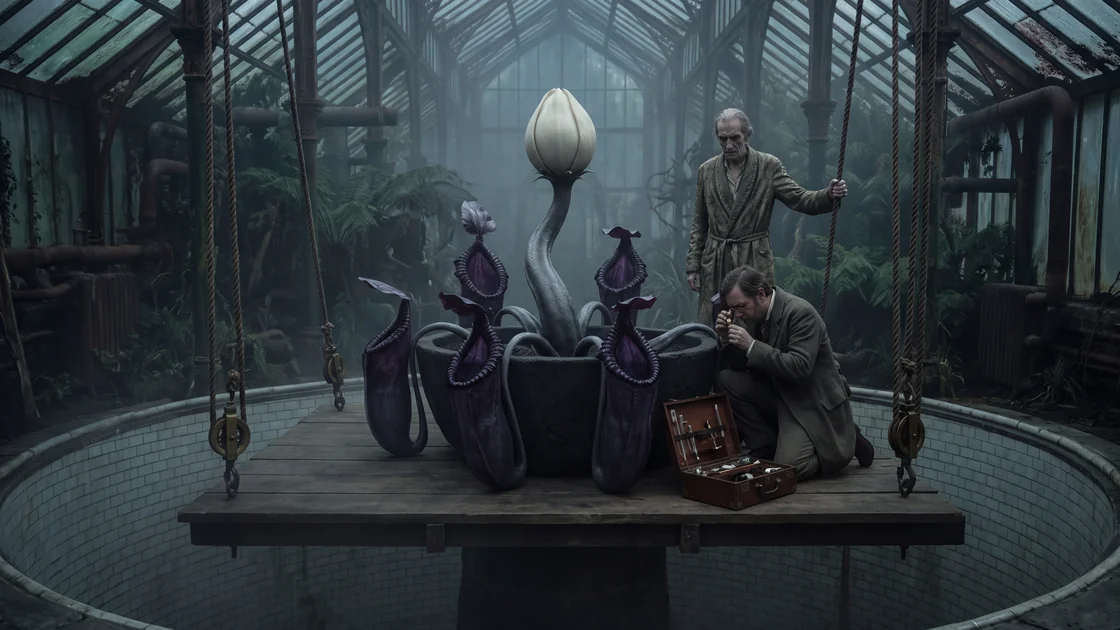
When the disgraced botanist Arthur Vance accepts a clandestine commission from the reclusive industrialist Julian Garrow, he expects to nurse a rare, temperamental orchid within the cavernous, fog-choked conservatories of Blackfell Manor; instead, he is tasked with cultivating Nepenthes taciturna, an ancient, subterranean pitcher plant whose petrified central bud refuses water, carrion, and sunlight, stirring toward anthesis only when fed the acoustic vibrations and atmospheric shifts of an unburdened human secret. Bound by financial ruin and scientific vanity, Vance descends into an escalating cycle of whispered transgressions that steadily restores the monstrous flora to life, only to discover that the plant does not merely digest the spoken shame of its caretakers—it demands the catastrophic exposure of the rot at the center of both men's lives.
I. The Iron Ribs of Blackfell
The coach from High Wycombe deposited Arthur Vance at the rusted perimeter gates just as the November twilight began to curd into sea-fog. There were no footmen, no lantern-bearers, only a brass plate tarnished to the green of verdigris, bearing the single surname: Garrow.
Vance adjusted the strap of his brass-fitted field chest. The mahogany case contained his entire worldly estate: two microtomes of German steel, three dozen calibrated glass pipettes, an antique brass saccharometer, seven jars of mercuric chloride for specimen preservation, and four hundred and twelve pounds of unpaid debts from his expelled fellowship at the Linnean Society. Behind him, the coachman had already wheeled his pair around, the horses’ breath steaming like vents in a peat bog as they retreated down the switchback road, eager to put distance between their hooves and the estate.
The path through the grounds was choked with unpruned rhododendrons that had grown to the height of timber trees, their leathery leaves blackened by some maritime blight. Above this encroaching wilderness rose the conservatory—not a modest Victorian ward of filigreed iron, but a megalith of soot-stained furnace brick and ribbed cast-iron rafters that curved over the hillside like the skeleton of a beached rorqual whale. The glass panes were thick, bottle-green, and filmed with decades of sulfur smoke drifted inland from Garrow’s copper smelters down along the estuary.
A bell pull hung beside an iron-banded oaken door set directly into the conservatory’s masonry foundation. Arthur pulled it. Far within the structure, a lead counterweight dropped with a dull, subterranean thud.
The door was opened not by a servant, but by Julian Garrow himself.
The industrialist was a man cast in vertical lines: unnaturally tall, with wrists that protruded from frayed linen cuffs like dry birch boughs, and eyes that held the watery, yellowed sheen of larders kept too long in the dark. He carried no lamp, only a long-necked watering can of beaten lead, which dripped an oily, coppery fluid onto the slate flagging between his slippers.
"You are late, Mr. Vance," Garrow said. His voice was thin, possessing the dried-husk sibilance of dead rushes rubbing together in a ditch. "The autumn drop has already chilled the peat beds. Three days more and the root-crown would have callused irrevocably."
"The railway at Morpeth was flooded, Mr. Garrow," Arthur said, stepping past the threshold into the air of the conservatory.
The atmosphere inside hit him with the force of an unventilated sickroom. It was not the clean, humid green of Kew or the Chelsea Physic Garden; it smelled of bog iron, fermented tannin, ammonia, and an undercurrent of something singularly animal—like the fleece of wet sheep dried too close to a coal fire. The temperature was stifling, kept aloft by iron pipes that hissed and groaned through the mulch beneath the walkways.
"Excuses are the mulch of mediocre scholarship," Garrow murmured, turning his back and walking down the central nave of the glasshouse. "Your monograph on the Bornean Dischidia was brilliant, Vance. That was eight years ago. Your subsequent paper on the mimicry of carnivorous bracts was an embarrassment—a desperate attempt to invent teleology where only blind hunger exists. That is why your peers stripped your chair. That is why your pockets are lined with bailiff notices."
Arthur felt the blood rush to his cheekbones. "I was told my duties here were horticultural, Mr. Garrow, not biographical."
"Here, they are the same thing," Garrow replied, not looking back. "Follow the pipe-line. Mind the drainage grates; the slate is slick with tallow."
They walked beneath canopies of dead and dying vegetation. Garrow was evidently a collector of immense wealth and complete indifference to health; he possessed specimens of extraordinary rarity—giant Amorphophallus corms rotting in split teak tubs, hanging curtains of Nepenthes rajah whose pitchers had collapsed into desiccated, brown parchment bags, and sprawling cycads whose fronds were coated in a fine down of gray scale. It was a cemetery of exotics, kept at slaughterhouse temperature.
At the center of the conservatory, where the iron ribs converged into a soaring lantern eighty feet above, the flagged floor ended.
In its place was a pit.
It was circular, thirty feet across, its sheer sides lined with glazed salt-tile to prevent the ingress of garden soil. Suspended over this abyss by an elaborate system of brass pulleys and counter-balanced ship’s ropes hung a wooden platform. In the center of the platform sat a single tub carved from a solid block of volcanic basalt.
From the tub grew the organism.
Arthur stopped at the pit’s edge, his botanist’s eye involuntarily parsing its morphology. It was unmistakably a pitcher plant, but of a form that defied every taxon he had cataloged in Sumatra or the highlands of Madagascar. The central axis was as thick as an oarsman's thigh, barked in a gray, fibrous peel that resembled the skin of an eel. From this trunk radiated six arching tendrils, each as thick as a hawser, supporting pitchers of terrifying proportion.
They were not the bright, mottled crimson of N. bicalcarata or the chartreuse lanterns of the common alata. These vessels were the color of bruised plums submerged in pond-ice—a dark, translucent violet-black through which one could see thick, branching vascular bundles pulsing with an imperceptible hydrostatic rhythm. The mouth of each pitcher was flared like a funnel, the peristome scalloped into rows of fine, inward-pointing teeth that glistened with an unctuous fluid.
Yet it was not the pitchers that commanded the eye.
From the very crown of the central stem arose a single peduncle, topped with an unopened bloom. It was roughly the size of a bull’s heart, armored in overlapping sepals of a dead, matte ivory. These sepals were clamped together with such mechanical tightness that their margins had fused into white ridges, like the healed seams of a surgical incision.
"It has not put forth a new leaf in sixteen months," Garrow whispered, stepping onto the hanging platform. The ropes groaned under his weight, the basalt tub swaying an inch to the north. "Its fluid levels drop three cubic centimeters per lunar cycle. When the liquid dries completely, the taproot will self-digest. I have tried everything within the purview of the royal societies."
Arthur stepped onto the platform, his boots vibrating with the sway of the suspended garden. He knelt beside the basalt basin, his fingers hovering half an inch above the ivory bud. He felt no warmth, but the air immediately surrounding the sepals was strangely still—an acoustic vacuum where the persistent hiss of the steam pipes seemed to fall flat, swallowed by the waxy density of the plant.
"What is its origin?" Arthur asked, his professional detachment reasserting itself over his unease.
"An uncharted karst depression in the Annamite Range," Garrow said. "A fissure five hundred feet below the forest floor, reached only by ropes through a sinkhole where no light penetrates. The local tribesmen call it the Thach Thao—the stone-tongue. They did not harvest it. They abandoned the entire valley two hundred years ago because of it."
"What have you fed it?"
"Everything that has a pulse," Garrow said coldly. "Blood meal from the Newcastle abattoirs. Live swifts. Weasel kits. The nectar glands of three dozen species of orchid. It drinks nothing. It produces no digestive acid. It sits in its own stagnant liquor, starving."
Arthur leaned closer to the ivory bud. Along the seams where the sepals met, he noticed microscopic trichomes—not the coarse hairs of an insectivorous trap, but exquisite, fan-shaped silver cilia, vibrating with a high-frequency shudder that was completely out of proportion with the dead air of the dome.
"These hairs," Arthur murmured, reaching into his pocket for a brass jeweler's loupe. "They are not secretory. They are auditory. They are tympanic membranes."
Garrow let out a sound that was half-giggle, half-gasp—a dry, rattling convulsion of his narrow chest.
"You see it," the old man hissed, his fingers gripping the basalt rim until his knuckles whitened to bone. "You see what those dunces in Edinburgh could not. It does not eat meat, Vance. Meat is merely the ballast for its cistern. It feeds upon the only thing an animal possesses that is entirely non-physical."
Arthur raised his eyes from the loupe. "And what might that be, Mr. Garrow?"
"The thing you are keeping from the men who hold your notes in London," Garrow whispered. "The thing you did in the laboratory at Cambridge when your mentor’s ledger went missing. A truth you would rather strangle your own mother than see printed in the Gazette."
II. The Calibration of Shame
The quarters assigned to Arthur were located in the west wing of the manor, directly beneath the copper eaves. The room was furnished with a narrow iron cot, a washstand whose basin was crazed with hair-thin fractures, and a bookshelf containing twelve volumes of the Annales des Sciences Naturelles, all of them gnawed at the margins by woodlice.
For the first four days, Arthur did not speak to the plant.
He was a scientist, not an occultist. He approached the Nepenthes with the rigid, mechanical skepticism that had once made him the youngest corresponding member of the Royal Horticultural Society. He set up his field station upon the swaying platform: three spirit lamps, a mercurial manometer to measure the hydrostatic pressure of the vascular bundles, and a battery of glass reagents.
He took scrapings of the waxy exudate from the peristome. Under his microscope, the droplets did not reveal the common sugars—glucose, fructose, sucrose—that typically lure the diptera and hymenoptera into a pitcher’s maw. Instead, the fluid was composed of complex, long-chain alkaloids reminiscent of concentrated belladonna, cross-linked with a proteinaceous gum that remained liquid only when exposed to air of a very specific acoustic frequency.
"It is a transducer," Arthur wrote in his log on the third evening, the oil lamp smoking beside his elbow. "The plant is constructed as an organic resonator. The hollow chambers of the six major pitchers act as Helmholtz cavities, tuned to the lower register of the human vocal tract (approx. 100 to 140 Hertz). The tympanic hairs on the floral bud appear to react not to sound pressure alone, but to the micro-tremors characteristic of psychological stress: vocal fry, laryngeal micro-spasms, and the altered humidity of respirations expelled during acute autonomic arousal."
He blotted the entry. He was trying to sanitize the horror of it. He was trying to turn Garrow’s madness into Latinate physiology.
On the fifth morning, Garrow appeared on the rim of the pit. He was dressed in a dressing gown of greasy yellow brocade, holding an iron kettle of scalding tea.
"You have been measuring its bile, Vance," Garrow called down. The voice echoed off the glazed salt-tiles. "You have measured its skin. You have spent eighty hours treating it as if it were an unruly turnip. Have you seen a single sepal lift?"
"The plant’s cambium is dormant, Mr. Garrow," Arthur said stiffly, without looking up from his micrometer. "I am establishing a baseline. If I force growth without knowing the osmotic threshold of the roots, the tissues will lyse."
"It does not have an osmotic threshold, you fool," Garrow snapped. He stepped onto the rope bridge, his gait heedless of the fifty-foot drop below into the dark mulch cistern. He came to the edge of the basalt tub and looked down at the ivory heart. His face was gray with sleeplessness; deep purple troughs had opened beneath his eyes.
"Watch," Garrow said.
The industrialist leaned down until his lips were barely an inch from the tympanic hairs of the unopened bud. His posture was grotesque—hunched like a gargoyle, his hands hooked into his dressing gown pockets.
"In the winter of sixty-four," Garrow whispered, his voice descending into a rough, grating murmur that made the hairs on Arthur's forearms prickle, "when the miners struck at the Morfa shaft... I did not merely hire the scabs from Glamorgan. I knew the ventilation flue in the western gallery had collapsed three feet below the water table. I knew the damp was gathering behind the wooden bulkheads. I told the bailiff to fire the signal gun anyway. Twelve boys drowned in the drift. I charged their mothers for the unreturned boots."
Arthur stared at the old man in revulsion. "Garrow—"
"Silence!" Garrow hissed.
Arthur looked down at the bud.
The effect was instantaneous and hideous. The silver cilia along the seams of the ivory petals did not merely twitch; they stiffened, standing perpendicular to the flesh like the hairs on a dog's spine. A shudder ran down the thick central stem, causing the basalt tub to chime against the hanging chains. Then, with a sound like the tearing of wet linen, the outermost margin of the topmost sepal separated from its neighbor by the width of a knife blade.
From the fissure issued a breath of perfume.
It was not floral. It was an odor of astonishing complexity: it smelled of cold well-water, iron shavings, dry parchment, and an intoxicating, narcotic sweetness that caused Arthur's mouth to fill instantly with saliva. At the bottom of the six surrounding pitchers, the stagnant black fluid began to churn with tiny, silver bubbles, as though a low fire had been lit beneath the stone basin.
Garrow stood upright, his face flushed with a triumphant, feverish pink. "You see?" he gasped, his chest heaving. "A hundredweight of guano could not do that. A tank of calf's blood could not do that. It wants the marrow, Vance. It wants the grease from the wheel of the soul."
"That is... that is not nutrition," Arthur stammered, though his scientific mind was already racing, cataloging the sudden release of volatile terpenes from the opening sepal. "It is a neuro-chemical reaction triggered by the unique acoustic profile of guilt. The exhalation of a man under acute moral distress contains elevated levels of acetone, ethanol, and autonomic pheromones. The plant is simply responding to an atmospheric trigger—"
"Then you trigger it," Garrow sneered, thrusting his face into Arthur's. "You have sins enough to make it flower like an apple bough in May. Do you think I did not read the confidential reports from the University Senate? You did not merely fail to credit young Master Hollingsworth in your paper on the Sundews. You broke into his cabinet. You took his wet-mount slides. You threw his field notebooks into the Cam when you saw he had proved your morphology wrong."
"That is a libel!" Arthur shouted, his hand dropping to the brass handle of his microtome.
"It is the truth," Garrow whispered, his yellow eyes wide and unblinking. "And this plant does not care about your libel laws. Tell it. Tell it what you did with Hollingsworth’s slides. Or pack your brass instruments into your box and go back to the debtors' ward in Newcastle. The bailiffs are already informed of your presence here; I hold three of your original bonds, Vance. I bought them from the bank for sixpence on the pound. You work for me, or you rot in the Fleet."
Garrow turned and walked off the platform, leaving the bridge swinging in wide, lazy arcs.
Arthur stood alone over the basalt basin. The fissure in the bud was already beginning to tighten, the ivory lip drawing back toward its fused seam as the volatile exhalation dissipated. The six great pitchers had grown still again, the silver bubbles dying into the dark, plum-colored depths.
He looked at his own hands. They were trembling. He thought of the cold, lime-washed stones of the debtor’s prison; he thought of his name, scratched out with iron-gall ink from the rolls of the Linnean Society; he thought of the damp rooms in Lambeth where he had eaten dry bread for seven months while his teeth loosened in his gums.
He leaned down over the ivory bud.
The perfume from the tiny crack was still faint in the air—cold, tempting, smelling of things that had been buried deep in peat before the coming of the Romans.
"I took them," Arthur whispered into the silver hairs.
The plant did not move.
Arthur swallowed. His heart was hammering against his ribs like a bird in a wicker cage. He realized, with a cold shock of clarity, that the plant knew the difference between performance and contrition. A spoken fact was not enough; it required the actual, internal tearing of the tissue of pride.
He closed his eyes. He forced himself to smell the damp river mud of the Cam on that rainy midnight nine years ago; he forced himself to see the neat, meticulous handwriting of Julian Hollingsworth—a boy five years his junior, a boy who had trusted him with the keys to his workroom—curling into black ash in the grate of his study stove.
"I did not merely steal them," Arthur breathed, his voice cracking, the vibration dragging across his larynx with the scrape of a rusted hinge. "I knew his lungs were weak. I knew he had spent three months in the fens collecting the specimens, coughing blood into his handkerchief every night. I knew that if he lost the priority of publication, his fellowship would not be renewed. And when he went home to his parish in Shropshire to die of the consumption that winter... I told the council he had abandoned the work because his observations were flawed. I knew he was too sick to write a rebuttal. I was glad when he died."
A silence fell over the conservatory so complete that Arthur could hear the condensation drop from an iron bolt seventy feet above—ping, ping, ping—into the ferns below.
Then, from the center of the basalt tub, came a long, low, resonant thrum.
It sounded like the lowest C-string of an ancient violoncello played with a heavy bow. The ivory bud did not merely twitch; the entire outer whorl of three massive sepals peeled backward with a moist, succulent sigh, exposing the secondary layer beneath: petals of an intense, velvety vermilion, patterned with intricate, maze-like veins of sulfur-yellow.
The aroma that erupted from the opening flower was so violent, so intensely narcotic, that Arthur fell to his knees on the damp boards of the platform. His head swam; his vision tunneled until he could see only the pulsing red heart of the plant, which was now oozing a thick, clear syrup from its central nectary.
Beneath the platform, in the dark cavities of the six surrounding pitchers, the liquid began to rise. It rose three inches in thirty seconds, bubbling with a clear, rhythmic effervescence that sounded like a dozen small mouths whispering at the surface of the water.
Arthur stayed on his knees, weeping silently into the mulch, until the twilight faded and the conservatory was swallowed by the cold, black night.
III. The Architecture of Carnivory
By the second week, the relationship between the botanist, the collector, and the specimen had assumed the rigid, inescapable symmetry of an interrogation.
Arthur moved his cot from the west wing down into the conservatory itself. He could not bear the drafty silence of the manor house, where Garrow wandered the corridors like an unquiet ghost, his slippers dragging across bare parquet boards. More importantly, Arthur could not leave the plant.
Nepenthes taciturna—he had finally entered the name in his private journal, though he knew no Linnean index would ever publish it—had entered a phase of ravenous, monstrous growth. The three outer sepals had reflexed entirely, curling down around the peduncle like the parings of an apple. The secondary vermilion petals were six inches long, their margins fringed with long, glandular hairs that wept drops of clear, viscous nectar.
This nectar was not passive.
Arthur observed that when a common field mouse, attracted by the intoxicating sweetness, managed to scale the salt-tiled walls and jump onto the basalt platform, it would approach the dripping petals as if in a trance. It would lap at the syrup, its little whiskers quivering with apparent ecstasy. Within three minutes, the animal’s motor nerves would fail; its hind legs would drag; its eyes would glaze over with a milk-white cataract. Then, with a slow, deliberate movement that looked horrifyingly like a choice, the rodent would crawl away from the flower, drag itself to the lip of the nearest pitcher, and slide into the plum-colored maw.
The plant did not drown its prey immediately.
Arthur brought his field lamp to the rim of the pitcher to watch. Through the semi-translucent wall of the urn, he could see the mouse suspended in the liquor. The fluid was extraordinarily viscous—more like liquid vitreous humor than water. The animal did not thrash; it floated upright, its small paws tucked against its chest, its nostrils just below the surface. Tiny bubbles continued to emerge from its snout for hours, as though the plant were slowly, gently extracting the air from its lungs, replacing it drop by drop with its own digestive enzyme.
"It does not dissolve the flesh first," Arthur noted in his log, his hand trembling so hard the steel nib repeatedly tore through the vellum. "The hair, the teeth, the bone remain intact for days. What is digested first is the nervous system. The brain and spinal column are liquefied within six hours of immersion. The plant appears to absorb the neural salts—the electrical residue of the creature's final terror. It leaves the musculature untouched until the last trace of cerebral activity has ceased."
"A tidy executioner," Garrow’s voice remarked from the shadows of the catwalk above.
The collector had taken to watching Arthur from the high iron galleries, leaning over the handrail like a carrion crow perched on a yardarm. His physical deterioration had accelerated; his skin was now the yellow-white of lard, and his breathing was accompanied by a wet, rattling whistle that spoke of advanced pulmonary edema.
"It is not an executioner," Arthur said without looking up, his eyes fixed on the drowned mouse. "It is a parasite that has forgotten its host. In its native karst, it must have lived in association with something far older than Rattus norvegicus."
"It lived with man," Garrow called down, his voice echoing through the glass dome. "The Annamites did not abandon that valley because the plant was poisonous, Vance. They abandoned it because they could not stop talking to it. A village cannot survive when every man knows the secret malice of his neighbor’s heart. They threw their adulterers, their thieves, their cowards into the sinkhole to keep the peace. The plant ate their confessions and grew fat on their shame."
Garrow descended the spiral iron stairs, the steps ringing beneath his slippers like church bells. He walked onto the platform, his yellow dressing gown trailing through the damp moss. He was carrying an old, leather-bound ledger with brass corners.
"The vermilion layer is open," Garrow said, standing over the basin. "But the core remains shut. Look."
Arthur looked. Inside the vermilion petals was a third, innermost whorl—a cluster of five petals that were not red, but a dead, light-swallowing black. They were shaped like cupped palms, pressed tightly together over the central pistil like hands joined in frantic prayer. From between their seams, no perfume emerged—only a cold, faint draft that smelled of lime kilns and wet slate.
"It has reached a plateau," Arthur said, consulting his manometer. "The vegetative stimulation from your confession and mine has been metabolized. The rate of vascular flow has dropped twenty percent since yesterday morning. It requires another stimulus, or the vermilion petals will abscise."
"Then feed it," Garrow whispered.
"I have nothing left to tell it," Arthur said, a cold sweat breaking across his forehead. "I have told it the worst thing I have ever done."
Garrow laughed—a wet, bubbling sound that ended in a violent fit of coughing. He pulled a linen handkerchief from his pocket, spat into it a clot of dark, venous blood, and inspected it with detached curiosity before stuffing it back into his sleeve.
"Do not lie to me, Arthur Vance," Garrow said, leaning close. "A man who has lived forty years in the mud of this world has more than one murder in his heart. Tell it about your sister."
Arthur stiffened as if an iron needle had been driven into his spine. "Leave Clara out of this."
"Why?" Garrow whispered, his yellow eyes glittering with malice. "Did you leave her out of your calculations when you took her inheritance to finance your expedition to the Moluccas? Did you think of her when she was forced to take a position as a governess in the household of that beast, Sir George Brand? Did you think of her when she threw herself into the weir at Bishop’s Stortford because she could no longer bear his nighttime visits to her garret?"
"Stop it," Arthur breathed. His vision went gray at the edges.
"She wrote to you three times," Garrow continued, his voice relentless, dropping into the low, resonant frequencies that the basalt basin amplified like a soundboard. "The letters were found in your rooms at Cambridge, Vance. Unopened. You were in the taverns behind St. John's, buying gin for German morphologists with the money she had given you to pay her lodging. Tell the plant, Vance. Tell it how you burned those letters without breaking the seals because you knew what was in them, and you could not bear to have your grand tour delayed by a woman’s weeping."
"I was twenty-two!" Arthur screamed, lunging at the old man.
Garrow did not flinch. He stood his ground, his emaciated frame surprisingly rigid, his lips drawn back over yellowed, peg-like teeth in a grin of ecstatic hatred.
"Do not tell me," Garrow hissed, pointing a long, dirty finger down into the basalt tub. "Tell her."
Arthur fell forward, his palms catching the cold, slimy edge of the stone basin. His chest felt as though it were being compressed by an iron band. He looked into the black, cupped petals of the inner core. The tympanic hairs were standing straight out, vibrating so rapidly they appeared as a silver haze along the margins of the black flesh.
The words did not come from his intellect; they were torn from the wet, bloody floor of his memory, where they had festered in the dark for twenty years.
"I knew," Arthur whispered into the black petals. "I knew what Brand was. The whole county knew. I sent her there because Brand had promised to speak to the trustees of the Botanical Garden on my behalf if I provided him with a girl of good breeding who had no family to defend her. I sold her for a recommendation to the chair of Cryptogamic Botany."
He did not weep. The confession was too heavy for tears; it came out like an evacuation of bile, leaving his mouth dry and his tongue tasting of copper.
The basalt tub did not merely hum; it shrieked.
The sound was like the tearing of metal plates. The five black petals did not peel back gently; they snapped outward with the violent recoil of steel springs, striking the inner walls of the vermilion whorl with a series of wet slaps.
The central chamber of the flower was exposed.
It was not a pistil. It was not a cluster of stamens.
In the center of the bloom sat an organ of fleshy, naked pink, shaped with the terrifyingly accurate morphology of a human larynx. Its false vocal cords, formed of glistening white cartilage, were stretched across an oval aperture that descended deep into the main axis of the stem. From this throat rose a single, long column of pale, phosphorescent steam that drifted upward toward the glass lantern eighty feet above.
The perfume that accompanied this final revelation was so concentrated, so devastatingly sweet, that Arthur lost all control of his limbs. He slipped from the edge of the basin and collapsed onto the platform, his cheek pressed against the wet wood.
Through the fog of his dissolving consciousness, he heard Garrow laughing above him—a high, cracked, triumphant crowing that echoed through the vast, iron ribcage of the conservatory.
"The bloom!" Garrow shouted. "The third whorl! It has opened the third whorl! Look at it, Vance! Look at the throat of it!"
Arthur forced his head to turn.
The plant was no longer merely bubbling. The six pitchers, now engorged to the size of beer tierces, were pulsating with a steady, peristaltic rhythm. Through their bruised, purple skins, Arthur could see the shadows of something inside—not mice, not birds, but thick, knotty masses of vascular tissue that were shifting, rearranging themselves, rising and falling like the chambers of an exposed heart.
And then, from the naked, pink larynx at the center of the black petals, came the sound.
It was not a scream. It was not an animal's cry.
It was a voice.
It was faint, muffled as though heard through twenty feet of saturated peat, but its timbre was unmistakable. It was the voice of a young man, light and clear, bearing the soft, rounded vowels of a Shropshire parish.
"...the morphology is incorrect, Vance..." the throat whispered, the white cartilage cords vibrating with the passage of the phosphorescent steam. "...you have taken the slides from the third drawer... the fens were cold, Vance... the fens were so cold..."
Arthur covered his ears with his hands, but the voice did not come through the air; it resonated through the oak planks of the platform, through the bones of his elbows, through his teeth.
"Hollingsworth," Arthur whimpered into the wood. "Dear God, Hollingsworth."
"No," Garrow whispered, stepping over Arthur's prone body, his eyes fixed on the vibrating larynx with an expression of religious adoration. "Not Hollingsworth. Hollingsworth is bone dust in a churchyard in Ludlow. It is the echo, Vance. It is the vibration of the guilt that you have carried in your cells for twenty years. The plant does not merely drink the truth. It sings it back."
IV. The Ledger of Morvath
For three days, the conservatory was filled with the choir of Arthur Vance’s dead.
The voice of Julian Hollingsworth would fade as the morning sun warmed the glass panes, replaced by the thin, high, drowning cry of Clara Vance—a sound that was not words, but the liquid gurgling of a girl whose mouth was filled with the silt of the Bishop’s Stortford mill-race. The plant sang without ceasing, its pink cartilage throat opening and closing with an obscene, rhythmic regularity, while the six giant pitchers around it digested the air of the glasshouse, turning the atmosphere so thick and sugary that the bluebottle flies that managed to crawl through the cracked panes died in mid-air, their wings gummed together by the falling mist of volatile terpenes.
Arthur did not leave his cot. He lay on his back, his eyes fixed on the iron rafters, his body soaked in cold sweat. He had stopped shaving; his graying beard was matted with dried saliva; his hands shook with such violence that he could not hold a water tumbler to his lips without spilling half of it down his collar.
He was being hollowed out.
Every time the plant spoke Clara’s name, Arthur felt a corresponding physical sensation—a sharp, dull ache in his liver, a coldness in his extremities, as though the plant were not merely using the sound of his confession to stimulate its growth, but were actively drawing the iron from his red corpuscles, the calcium from his teeth, the marrow from his shins.
Garrow, by contrast, seemed possessed by a demonic vitality.
The industrialist had brought a brass-bound mahogany desk down into the conservatory, setting it up on the flagstones just at the edge of the pit. He sat there for eighteen hours a day, surrounded by stacks of yellowing ledgers, promissory notes, and legal briefs. He dipped his steel pen into an inkstand of black glass, writing with a furious, scratching speed that competed with the whistling of his own lungs and the whispering of the flower.
"Listen to her," Garrow murmured on the third night, not looking up from his accounts. "Listen to the little sister. She is asking why you did not look at her shoes when they brought her body home. She had on the green Morocco slippers you bought her with your scholarship money. The toes were eaten away by the pike."
"Be quiet, Garrow," Arthur croaked from his cot. His voice was almost entirely gone, reduced to a dry rasp.
"Why should I be quiet?" Garrow said, his pen flying across a sheet of blue foolscap. "This is the most magnificent scientific achievement of the century! We have passed beyond the dry, dead taxonomy of Linnaeus and Jussieu. We have discovered the Moral Organism. We have found the bridge between the spiritual degradation of the species and the physical laws of the vegetable kingdom!"
"It is an abomination," Arthur said.
"It is a ledger!" Garrow shouted, slamming his hand down onto the open book before him. The blow sent a cloud of dry paper-dust into the humid air. "A perfect, incorruptible ledger! For forty years, Vance, I have built mines, I have bought ironworks, I have crushed competitors. I have had three wives—did you know that? Three. The first died in an asylum in Fishponds because she could not bear the silence of this house. The second died of an overdose of laudanum that I measured for her with my own hand when she threatened to expose the contracts for the Crimean transport iron. The third... the third was a simple creature. She took a groom into her bed. I had him pressed into the naval service; he died of the yellow fever off Vera Cruz. She spent thirty years in the east wing, sitting by the window, watching the sea-fog come in, until her knees froze into her petticoats and she ceased to eat."
He stood up, his tall, skeletal frame swaying over the desk. He picked up the heavy ledger and walked toward the platform.
"The plant has three whorls," Garrow said, his eyes glittering in the lantern-light like wet slate. "The ivory. The vermilion. The black. But there is a fourth."
Arthur turned his head on the greasy pillow of his cot. "There are no more petals. The central organ is exposed. The flower is complete."
"It is not complete," Garrow whispered, stepping onto the rope bridge. The chains screamed against their iron staples as his weight shifted them. "Look at the base of the larynx, Vance. Look beneath the cartilage."
Arthur did not want to look, but some dreadful, professional compulsion—the dying ember of the curiosity that had ruined his life—forced him to swing his legs off the cot and crawl on his hands and knees to the edge of the pit.
The light from Garrow's lantern fell into the open throat of the bloom.
Beneath the pink, vibrating vocal cords, deep in the dark interior of the peduncle, there was a fourth structure. It was not petal tissue; it was a single, long, spiraled column of bone-white carpels, tightly interlocked like the fingers of two hands gripping each other in terror. At the tip of this column was a small, dark depression, no larger than a child's ear, that pulsed with a slow, heavy, hydraulic contraction.
"The seed-vessel," Arthur breathed.
"The ovary," Garrow corrected him, his voice trembling with an ecstasy that was almost religious. "It has received your sins, Vance. It has fed upon your miserable, academic thefts and your pathetic domestic cowardice. But it cannot set seed on such thin gruel. It requires the master truth. It requires the capstone of the arch."
"You," Arthur said, looking up from the floor at the old man.
"Me," Garrow whispered. He held the heavy ledger against his chest like an infant. "I am seventy-four years old. My lungs are full of stone-dust and coal-smoke. The doctors give me three weeks before the water fills the pleural cavity entirely and I drown in my own bed. I will not die like an old cow in a ditch, Vance. I will not have my work forgotten. I will have this thing bloom to its ultimate anthesis. When the fourth whorl opens, it will set seed. And those seeds... those seeds will be carried to every conservatory in Europe. A race of plants that will make the hypocrites of this world tear their own bellies open rather than walk past their leaves!"
"Do not do it," Arthur said. He reached out and caught the hem of Garrow's greasy dressing gown. "You do not know what the seed-stage requires. An organism of this scale... if it sets fruit, the vegetative parts will need more than sound. It will need nitrogen. It will need the whole mass."
"Let it take the whole mass!" Garrow screamed, kicking his hem from Arthur's grasp. "What is this carcass worth? A bushel of bone-dust to spread over the turnip fields! I have built an empire of iron, and it will end in an iron flower!"
The old man dropped the heavy ledger into the basalt tub. It struck the edge of the plant’s stem with a heavy, wet thwack, the pages splaying open like the wings of a shot owl.
Garrow fell to his knees on the platform. He reached out with both hands and grasped the two sides of the pink, vibrating larynx.
"Listen to me, you stone-tongue!" Garrow howled into the throat of the flower. "Listen to Julian Garrow!"
V. The Anthesis of Julian Garrow
The glasshouse seemed to contract.
The hissing of the steam pipes, the distant rumble of the smelters along the estuary, the persistent drip of condensation from the iron girders—all of it ceased, swallowed whole by the dreadful, unnatural silence that rushed into the pit.
Garrow began to speak.
It was not a confession of individual sins; it was a catalog of systematic ruin. He spoke of forty years of balance sheets: the iron that had been cast with air-pockets to save two pence on the hundredweight, iron that had gone into the girders of the Tay bridge, into the keels of emigrant ships that had foundered in the Bay of Biscay without a survivor; the wages docked from men who had lost their arms in his stamp-mills; the bribes paid to the inspectors of mines who had looked the other way while the water gathered behind the timber walls of the Morfa pit.
He spoke without shame. That was the horror of it. His voice was filled with a cold, triumphant pride, the vanity of a man who had treated the entire human species as combustible fuel for his own furnaces.
And the plant drank it.
The six pitchers did not merely pulse; they swelled until their waxy skins became so thin that Arthur could see the yellow fat and the black bones of the long-dead animals within, turning in the churning, digestive soup. The basalt basin began to crack, hair-thin lines spidering across its volcanic stone under the pressure of the expanding root-crown.
The white, spiraled carpels in the center of the larynx began to unscrew themselves.
With a sound like the grinding of millstones, the fourth whorl opened.
It was not petals. It was a ring of nine long, segmented, bone-hard tentacles, lined on their inner surfaces with rows of curved, amber-colored hooks. They did not look like plant tissue; they were armored in the shiny, jointed chitin of deep-sea isopods, yet they grew directly from the floral axis, weeping a yellow, pungent oil that smelled of burnt sugar and petroleum.
"Yes!" Garrow shrieked, his face inches from the opening jaws of the central carpel. "Yes! Take it all! Take the whole column!"
"Garrow, step back!" Arthur cried, trying to drag himself upright by the ropes of the platform. "It is not a flower! It is an entrapment mechanism!"
The tentacles did not lash out violently.
They moved with a terrifying, slow, deliberate grace. The two outermost hooks caught the lapels of Garrow’s brocade dressing gown, drawing the fabric taut with the gentle firmness of a tailor adjusting a seam. Then, before the old man could cry out, the remaining seven tentacles wrapped themselves around his neck, his shoulders, and his ribcage.
The amber hooks did not merely pierce the cloth; they sank through the linen, through the yellow parchment skin, deep into the intercostal muscles between his ribs.
Garrow let out a long, wheezing gasp. It was not a scream of pain, but a sound of immense, catastrophic release—the sound of a steam boiler whose safety plug had blown out.
The plant did not pull him into the central throat—the opening was far too small to receive a human body. Instead, it drew him down until his chest was pressed flat against the naked pink larynx, his mouth aligned with the oval aperture of the cartilage cords.
The amber hooks began to work.
Arthur, frozen in terror on the platform, watched as the segmented tentacles began to pump. Through the translucent, chitinous walls of the appendages, he could see a thick, dark, scarlet fluid being drawn out of Garrow’s body—not merely blood, but a dense, dark slurry of dissolved tissue and marrow that pulsed through the tentacles and down into the main axis of the stem.
Garrow’s body did not thrash. His arms hung down into the basalt basin, his long, ink-stained fingers trailing in the digestive liquor of the nearest pitcher. His eyes remained wide open, staring up through the glass lantern at the cold, gray morning sky that was just beginning to break over the North Sea.
His mouth was moving.
He was still confessing. But he was no longer using his own lungs.
The plant’s vascular system had taken over his respiration. Arthur could hear the hydraulic rhythm of the stem forcing the air up through Garrow’s trachea, drawing the last, dark, unuttered truths from the dying brain, vibrating the human vocal cords and the plant’s cartilage larynx in a single, monstrous, synchronized duet.
"...the fire in the north shaft..." the combined voices whispered, a sound that was half the old man's dry rattle and half the moist, subterranean hum of the stone-tongue. "...it was not the damp... I sent the boy with the naked candle... I wanted the insurance on the timbering... forty thousand pounds from the Norwich Union... forty thousand..."
The skin of Garrow’s face was collapsing inward, the flesh being absorbed from the bone with an agonizing, visible speed. The cheeks hollowed into dry pockets; the temples fell into deep, triangular depressions; the yellow lard of his eyes turned clear, then gray, then sank back into the bony sockets like melting lard in a skillet.
Yet the voice continued, growing lower, thicker, more resonant, until the entire conservatory—the glass panes, the iron girders, the brick foundation—vibrated with the frequency of his damnation.
Arthur Vance covered his face with his coatsleeves and screamed until his own throat tore.
VI. The Fruit of the Karst
The silence that returned to the conservatory at midday was not the silence of peace, but the silence of an empty tomb.
Arthur lay on the edge of the pit for hours, his face pressed against the cold slate flags. He did not move until the November sun, weak and pale as lard, reached its zenith above the soot-stained glass.
Slowly, his joints screaming with the cold and the residual poison of the plant’s perfume, he dragged himself up onto his knees.
The platform was still swaying—a slow, microscopic oscillation caused by the settling of the great organism in the basalt tub.
Julian Garrow was gone.
What remained upon the central axis was not a corpse, but an exuvia—a dry, translucent husk of skin and bone, light as the shed skin of a grasshopper, bound to the stem by thousands of gossamer-fine silver rootlets that had erupted from the plant's bark and penetrated every pore of his linen and his flesh. The clothes were empty; the slippers hung from the dry, white sticks of his ankle bones over the dark water of the pit.
And the plant had set fruit.
The three outer sepals had withered into brown, papery ribbons that hung down the flanks of the basalt tub like rotting ropes. The vermilion petals had dropped their flesh, leaving only a skeletal framework of yellow veins. The black inner whorl had dissolved entirely into a pool of dark, oily bitumen that coated the rim of the basin.
In their place, arising from the center of the now-silent larynx, was a single, monstrous seed-vessel.
It was the size of a man’s head, perfectly spherical, and covered in a thick, leathery pericarp of an intense, luminescent blue—the color of an electric spark in an evacuated tube. The skin was translucent; inside, suspended in a clear, gelatinous albumin, floated seven seeds.
They were not plant seeds.
They were shaped like small, convoluted human brains, no larger than walnuts, carved from some dense, dark wood that held a high, metallic polish. Even through the leathery wall of the fruit, Arthur could see them moving—tiny, microscopic convolutions shifting across their surfaces like the thoughts of a sleeping infant.
And from the fruit came no sound.
No whispers. No cries of drowning girls. No dying accusations of defrauded boys.
It was completely, utterly quiet. The plant had eaten the memory of the sins; it had converted the moral rot of two men’s lives into the cool, silent, physical reality of tissue, carbohydrate, and seed.
Arthur stood up.
His body was broken; he had the dry, shuffling gait of an octogenarian, and his breath whistled in his throat with the same wet, rattling sound that had preceded Garrow’s destruction. He knew, with the cold diagnostic certainty of his profession, that the plant’s volatile alkaloids had done their work on his lungs; he would not see another autumn.
He looked around the conservatory.
The ledgers still lay on the desk: forty years of robbery, murder, and arson, recorded in Garrow’s neat, mercantile hand. Beside them lay his own journal: three weeks of meticulous, scientific observation detailing the cultivation of an organism that should have remained five hundred feet beneath the earth in the dark limestone fissures of the Annamite Range.
If he took the fruit to London...
He closed his eyes. He saw the great hall of the Royal Society: the rows of raked mahogany benches, the gaslight hissing in the chandeliers, the Duke of Sussex in the president’s chair, the applause, the reinstatement of his fellowship, the medals, the gold, the historical priority. The Vance Pitcher. Nepenthes vanceana. His name would be carved into the stone lintels of the museums beside Darwin, Hooker, and Brown.
He would be forgiven. The world would not care about Julian Hollingsworth; it would not care about Clara Vance; it would not care about the twelve boys who had drowned in the Morfa shaft. Science does not inquire into the provenance of the specimen; it only asks for the description of the type.
He opened his eyes.
He walked over to Garrow’s desk. He picked up the heavy brass inkstand and the tin of lucifers.
He did not touch the ledgers. He did not touch his journal.
He walked back to the rope bridge, his boots ringing on the wet slate. He crossed the swaying platform until he stood directly over the basalt basin, looking down at the blue, luminescent fruit that pulsed with its seven silent brains.
He struck a lucifer on the sandpaper strip of the box.
The sulfur flare was small and blue in the pale daylight of the conservatory.
"No," Arthur said. His voice was steady now. It did not hold the laryngeal tremor of guilt; it did not possess the high, cracked vanity of Garrow’s pride. It was simply the voice of a man who had reached the bottom of his own grave and found it dry.
He dropped the burning match into the open, plum-colored maw of the largest pitcher.
For a second, nothing happened.
Then, the volatile terpenes that filled the digestive liquor—the concentrated, flammable essence of twenty years of digested sins—caught.
A column of blue, incandescent flame shot thirty feet into the air, striking the central iron girder of the dome.
The heat was instantaneous and terrible. The waxy, oil-saturated tissues of the Nepenthes did not burn like wood; they exploded like a magazine of turpentine. The six great pitchers became six roaring blowpipes of blue and yellow fire, their heat cracking the salt-tiled walls of the pit and boiling the water in the cistern below.
Arthur did not run.
He stood on the platform as the ropes caught fire above him, the hemp fibers hissing and snapping like dry twigs. He watched the leathery blue pericarp of the fruit blacken, split, and curl into ash. Inside, the seven small, brain-shaped seeds did not burn; they shriveled, their delicate, wooden convolutions popping with the sound of small pistols as the steam within their cells blew them into gray powder.
The glass above him began to rain down in sheets, shattered by the thermal shock of the conflagration.
Huge slabs of thick, green-tinted plate glass fell through the smoke like the blades of guillotines, smashing into the iron galleries and slicing through the dead fronds of the giant cycads.
As the hanging platform finally gave way, the iron chains parting from their molten staples, Arthur Vance felt the floor drop beneath his feet. He fell into the white-hot pit of the basalt basin, into the heart of the roaring furnace he had built with his own mouth, surrounded by the falling iron, the shattered glass, and the clean, silent, roaring flame.
VII. The Verdigris Garden
The ruins of Blackfell Manor were surveyed six months later by the agents of the Court of Chancery, who had been appointed to administer the vast, ownerless estate of the late Julian Garrow.
Their report, which remains in the archives of the Public Record Office in Chancery Lane, noted that the central conservatory had been completely destroyed by an internal fire of extraordinary intensity—evidently caused by the explosion of an over-pressurized heating boiler situated in the subterranean cellar.
The iron ribs had buckled inward, creating an impenetrable thicket of blackened metal that had, in the intervening spring, been completely covered by common English brambles and wild bryony. Of the eccentric industrialist and the disgraced botanist who had briefly resided there, no recognizable trace was ever recovered, though the searchers noted several fragments of calcined bone fused into the slag of a broken stone cistern at the bottom of the drainage pit.
The only item of botanical interest collected from the site was a common specimen of Taraxacum officinale—the garden dandelion—which had taken root in a heap of gray ash between the cracked salt-tiles.
Its yellow flower was small, stunted, and completely ordinary. When the Chancery clerk plucked it to press between the leaves of his inventory, it made no sound at all; it gave off no perfume beyond the faint, bitter smell of cold milk; and when he breathed upon its white, feathery clock, the seeds scattered into the sea-fog, completely indifferent to whether the breath that blew them was that of an honest man or a scoundrel.