The Darkening Below
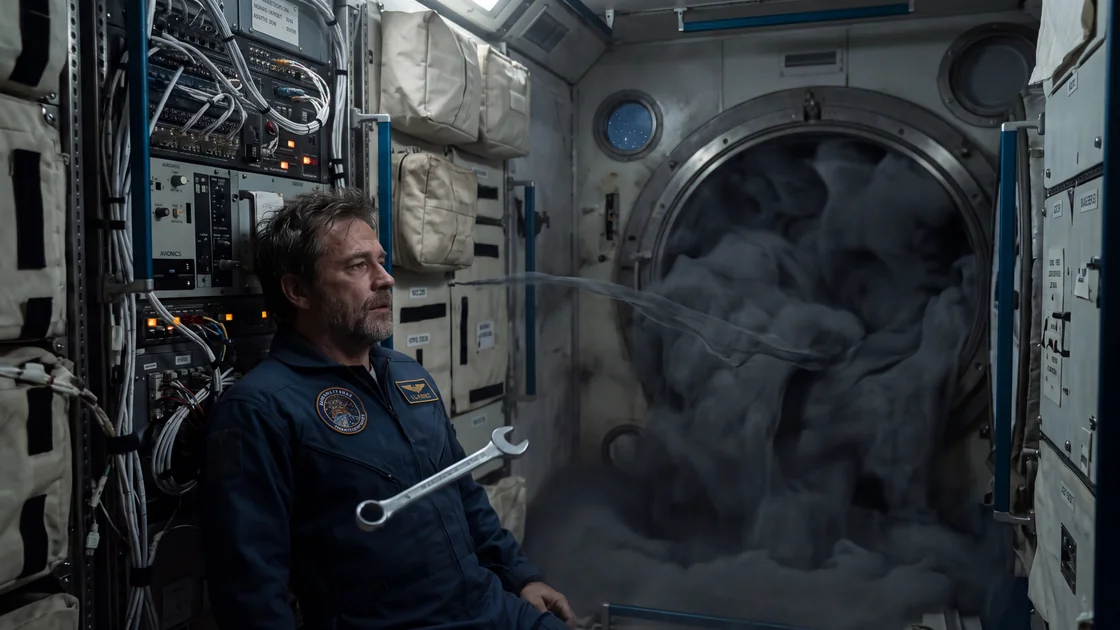
This is the account of Dr. Arthur Vance, the sole remaining specialist aboard the orbital platform Aethelgard, who was left suspended four hundred kilometers above an unravelling world when routine communications severed without warning. Over the course of twenty-four agonizing days, Vance documented the methodical, sector-by-sector extinction of human artificial light across the continents below, transforming the vibrant nocturnal globe into a dead marble of silent obsidian. Left entirely alone with dwindling oxygen, decaying gyroscopes, and the absolute quiet of the upper thermosphere, Vance reconciled himself to being the final witness to human civilization, only for his solitary vigil to be shattered when an unmistakable, rhythmic knocking sounded from the vacuum-sealed outer hull of the primary airlock.
I. The Architecture of the Drift
The station did not sleep, though it possessed a rhythm that mimicked the pulse of an animal held under surgical anesthesia. Every ninety-two minutes, the sun rose with an abrupt, blinding violence that burned the frost from the quartz viewports of the forward observation cupola, and every ninety-two minutes it plunged behind the curved rim of the Pacific, leaving the hull in a blue-tinted bath of absolute dark.
Arthur Vance measured his life by those transitions. In the microgravity of the Destiny module, he slept strapped to an aluminum bulkhead inside an insulated bivouac, his arms tucked through elastic loops so they would not drift into the avionics racks while he dreamed. When his eyes opened at 05:00 UTC, the station was already murmuring to him. It spoke in the language of brushless fans, the low, mechanical drone of the carbon dioxide scrubbers cycling through their zeolite canisters, and the high-pitched, dentist-drill whine of the control-moment gyroscopes spinning at six thousand revolutions per minute within the station's spine.
"Station, this is Houston on Space-to-Ground One," his radio had said on the morning the trouble began, three weeks before the silence took root. "Arthur, we’re showing a five-millibar drop across your secondary nitrogen accumulator. We need you to pull the kickplate on Rack Seven and verify the manual valve seat."
That had been Martin’s voice. Martin was thirty-eight, had three children in League City, and smelled perpetually of chicory coffee whenever they did pre-launch debriefs in Texas. Martin had an easy, laconic drawl that could make an atmospheric re-entry burn sound like an afternoon drive down an empty farm-to-market road.
Arthur had pulled the kickplate. He had verified the valve. He had reported back, his voice flat, professional, preserved in the sterile amber of orbital protocol.
"Valve seat is nominal, Houston. Looks like an errant transducer. I’ll run a recalibration on the loop before lunch."
"Copy that, Arthur. Take your time. We’re... looking at some anomalous telemetry on our end down here, not related to the stack. Might have some schedule adjustments later this afternoon."
That had been the first fracture. Martin’s voice had lacked its usual cadence. Behind him, through the live channel, Arthur had heard a murmur that did not belong in Mission Control—not the steady clatter of keyboards and flight controllers cross-talking on loops, but a distant, sharp sound like a dropped metal chair, followed by someone shouting a phrase that the audio compression algorithm turned into wet, indistinct syllables.
Then the channel closed.
The secondary crew—Commander Helena Ruiz and Flight Engineer Jin-Soo Park—had departed twelve days prior on the Shenzhou-18 return vehicle, following Jin-Soo’s acute abdominal catastrophe. His appendix had threatened to rupture, and protocol was absolute: an appendectomy in zero-gravity was a butcher’s lottery. They had left Arthur behind to supervise the station’s automated transition into an unmanned drift configuration, a three-week protocol of flushing fluid loops, venting excess hypergols, and aligning the solar arrays with the sun-tracking beta angles. A relief craft, an automated cargo tug launched from the Plesetsk Cosmodrome, was supposed to have brought his replacement crew and twelve hundred kilograms of dried provisions, fresh filters, and letters from a wife who had long stopped asking him when he was going to come down for good.
The relief craft had never cleared the pad.
By the fourth day of the comm-break, the S-band antenna on the Z1 truss had ceased tracking the TDRS communications satellites. Not because the tracking mechanism had jammed, but because the satellites were falling silent one by one, their transponders going dark as their ground-uplink stations ceased broadcasting their ephemeris data.
Arthur sat in the cupola, his bare feet hooked under the restraint bar, a silver thermal pouch of lukewarm black tea floating inches from his collarbone.
Below him, the planet was rolling through the long shadow of its own body.
II. The First Hemispheric Fade
The human eye does not understand the scale of the world until the lights begin to go out.
From four hundred kilometers up, an urban center is not a collection of buildings or roads; it is an organic, bioluminescent colony. Cities look like lichen blooming in the cracks of damp stone, branching along river valleys and pooling against mountain ranges in sprawling networks of amber, gold, and cold mercury-vapor white. The Boston-Washington corridor—the old megalopolis—was usually a solid ribbon of incandescence, so bright that during clear-sky perigees Arthur could see the glow cast upward onto the gold foil of the station's radiator panels.
On the fifth night after Houston cut out, the northeastern seaboard looked as though someone had taken an artist’s damp sponge and drawn it down the coastline.
Arthur leaned forward until his brow touched the thick inner pane of the fused silica window. The cold of the deep hull seeped into his skin, an ache that lived just behind the frontal bone.
"Houston, Aethelgard," he said aloud. His microphone was hot, clipped to the breast pocket of his flame-retardant blue flight suit. The vox-relay clicked, a lonely insect in his ear. "I’m looking at Sector Four-Alpha. Can you confirm a grid failure across the Northeast corridor? New York is... I don't see New York, Houston."
No response. The static was uniform, a flat, dry hiss that had no shape. It was not the static of an untuned radio station that occasionally caught the phantom warble of an overseas broadcast; it was the cosmic background itself, the unfeeling microwave noise of the universe washing over an ungrounded copper wire.
He pulled the handheld Nikon from its Velcro caddy on the side of the console. The camera had an 800mm telephoto lens with a heavy fluorite element that shifted the center of mass in his hand, feeling like an anvil in the absence of gravity. He braced his shoulders against the cupola ring and peered through the optical viewfinder.
Where Manhattan should have been—that sharp, glittering needle of pure diamond light bordered by the dark ribbons of the Hudson and East rivers—there was only an empty throat of gray silt. Long Island was gone. The grand sweep of the Verrazzano-Narrows Bridge was extinguished. The entire island was a void, framed only by the pale, frothing phosphorescence of the Atlantic surf breaking against the barrier islands of New Jersey.
He lowered the camera. He checked his mission clock. 21:14 UTC.
It was not a blackout caused by a transformer fire or a tripped line at a substation. When a grid failed naturally, it collapsed like a row of dominos: bright bursts of blue-white electrical arcs flashing across the clouds as breakers exploded, followed by isolated islands of diesel-backed illumination—hospitals, municipal buildings, military installations—maintaining their stubborn pockets of light against the surrounding dark.
This was not that.
This was as if the current had simply been unstitched from the soil. The lights had not blown; they had ceased to be supplied, or they had been turned off by fingers that worked with terrifying synchronization across three thousand miles of infrastructure.
By midnight, the darkness had crawled westward across the Appalachians.
He watched the Ohio Valley die. Chicago, usually a blazing sunburst against the southern tip of Lake Michigan, shrank into a faint, dying ember over the course of twenty minutes. A line of headlights on Interstate 90—a thin, yellow filament of cars fleeing westward—crawled for three miles before the filament snapped, its components veering into the median or simply coming to an unmoving, frozen halt.
"Helena?" he called out, his voice cracked with the residue of unswallowed tea. "Jin-Soo? If you're on the terrestrial network, if you're reading down-links on the backup recovery frequency... the board is red down here. The board is completely red."
The cabin fan whistled. A solenoid clicked behind the avionics bay in Node 1. The sound was like a knuckle cracking in an empty church.
Arthur did not sleep that night. He stayed in the cupola, watching the terminator line sweep forward, dragging the velvet mask of night over a continent that was no longer waking up. When dawn came over the Great Plains, the daylight did not bring comfort. Through the telephoto lens, the cities looked identical to their normal daylight forms—gray concrete grids, brown-roofed suburbs, the silver veins of rail yards—but there was no movement.
On the interstate highways, the tractor-trailers were lined up like dead ants. On the rivers, barges drifted sideways against the piers of suspension bridges, their rudders untended, their wakes vanished.
There were no plumes of smoke. That was what made Arthur's stomach tighten into a hard, cold fist against his ribs. There were no burning refineries, no oil depots throwing black palls across the stratosphere, no artillery scars blooming in the soil. There was no war. A war was loud. A war left grease and soot on the atmosphere.
This was an erasure. A neat, clinical subtraction of whatever it was that made the copper wires sing.
III. The Vanishing of the East
By the ninth day, Arthur had stopped using the radio for scheduled check-ins. He left the receiver on, its volume turned to its maximum threshold, so that the high-frequency squawk of emergency beacons would wake him if any remained active.
None did.
The emergency locate transmitters (ELTs) of downed aircraft, the automated marine EPIRBs that triggered when ships took on seawater, the military transponders that pulsed on dedicated UHF guard channels—all of them had stopped. The spectrum was as flat and clean as the surface of a polished mirror.
He took to eating his meals in the dark to conserve the auxiliary battery packs. The station's primary solar arrays were still generating twelve kilowatts of direct current, but the nickel-hydrogen battery cells in the P6 truss were growing temperamental. Cell Three was showing an internal short, heating up by three degrees every orbital noon. If it ruptured, it would vent ammonia into the truss cavity and likely trigger an automated isolation of the starboard power bus. If the starboard bus died, half his scrubbers went with it.
He sat with his knees pulled to his chest, drifting four inches above the floorplates of the Japanese Experiment Module, Kibo.
Kibo was the quietest place on the station. It had the thickest micrometeoroid shielding, and its air vents had been baffled with acoustic foam until the air made only a polite, sighing sound as it entered through the overhead diffusers.
At 14:30 UTC, the Aethelgard passed over the Pamir Mountains, descending across the Tibetan Plateau toward the coastal plains of China.
This was historically the densest, most ferocious carpet of light on the planet. The Yangtze River delta, the Pearl River basin, the endless, sprawling constellation of cities that housed four hundred million people across five hundred miles of low-lying wetlands—it was usually an ocean of light that competed with the full moon.
Arthur drifted to the small nadir window in Kibo’s airlock section.
There was nothing.
The coast of Asia was defined only by the absence of stars. Where the sea met the land, there was only the cold, bioluminescent wash of breaking waves against the dark continental shelf. Shanghai was gone. Guangzhou was a patch of charcoal between two black hills. Hong Kong, whose harbor usually cut through the night like a shattered chandelier, was a blind eye.
He watched for thirty minutes as the Asian continent unrolled beneath his boots.
Tokyo was an inkwell. The Japanese archipelago, usually an arching spine of gold floating in the ink-blue sea, was completely invisible. He only knew it was there because it blotted out the reflection of Sirius on the surface of the Pacific.
"Are you still there?" he whispered.
He didn't know who he was asking. His wife, Sarah, had lived in a small, clapboard house near Exeter, in the southwest of England. Two orbits earlier, he had searched for Devon. He had found the blunt finger of Cornwall, outlined by the pale foam of the Celtic Sea, but Exeter was not there. Plymouth was not there. The lightship at the mouth of the English Channel, which had blinked every twelve seconds since the reign of Queen Victoria, had stopped blinking.
"Sarah," he said.
The name sounded absurd in the module. It had no weight. It was a five-letter sequence that had no physical referent in three-dimensional space. If the house in Exeter was dark, if the streetlamps along the canal were dark, if the hospital where she worked as an oncology pharmacist was dark, then where was she? People were their actions, their movements, the light they cast into the world around them. When a city went out, did the people remain in the dark like actors standing frozen on a stage after the stagehands had killed the spots?
Or had they simply stopped?
He drifted back to the Node 2 passageway, where he kept his logbook taped to the bulkhead. He had stopped using the electronic terminal. Every byte of solid-state memory felt precious, a finite resource that belonged to the station's dying computers. He used an ordinary graphite pencil, its tip kept sharp with a small plastic sharpener he emptied meticulously into a zip-top bag so the shavings would not get into the electronics.
Day 11, he wrote. His handwriting, normally small and upright, had become loose, the letters sprawling across the blue-lined margins.
No visual evidence of energetic events down-range. No atmospheric particulates consistent with high-yield nuclear detonations. Cloud formations remain typical for a spring transition. Auroral activity in the north is high—G3 class geomagnetic storming noted on the magnetometer, but no ground return.
The lights in the Southern Hemisphere are now entirely gone. Johannesburg went out between passes 162 and 163. Buenos Aires died yesterday at approximately 08:00. Melbourne and Sydney were dark by 12:00.
The planet is black.
Not quiet. Black. I don't know what it looks like from the moon, but from here, it looks like an iron cannonball dropped into a bucket of grease.
I have forty-two days of potable water remaining if I throttle the condensate reclamation loop to eighty percent. I have two hundred and ten days of food if I reduce intake to twelve hundred calories. Oxygen is not the limiter. The Sabatier is holding. The limiter is the orbit.
Without ground-guided station-keeping burns from the Progress thrusters, drag is eating us.
He stopped writing. He calculated the decay in his head.
The thermosphere was not a vacuum; it was an extremely thin soup of atomic oxygen and nitrogen. Every time the Aethelgard smashed through an orbital apogee, the wisps of gas grabbed at its four-hundred-ton bulk, dragging its velocity down by a fraction of a millimeter per second. It was a patient, relentless theft.
Without the ground sending the telemetry strings to fire the station's service module engines, the Aethelgard was descending forty meters every day.
In six months, the drag would become an appetite. In eight months, it would become a fire.
IV. The Phantom Radio
On the sixteenth day, the radio spoke.
Arthur was half-submerged in the maintenance access bay beneath the treadmill in the Node 3 module, his knuckles grazed, his hair matted with sweat that wouldn't fall from his forehead. He had been replacing a shredded drive belt on the exercise unit, working by the yellow beam of an LED headlamp.
The sound did not come from the primary intercom. It came from an auxiliary UHF receiver—an old, handheld aviation transceiver he had left Velcroed to the wall near the water dispenser, set to the international distress frequency of 121.5 MHz.
It did not come as speech. It was a rhythmic, clicking tone, like the sound of a mechanical clock whose escapement was dragging through thick oil.
Tock. Tock. Tock.
Arthur froze. A twelve-millimeter spanner slipped from his wet fingers and hovered beside his ear, rotating slowly along its longitudinal axis.
He pulled himself out of the hatchway with a violent heave of his shoulders, not caring that his hip struck the aluminum latch of the lower locker. He grabbed the transceiver, his thumb jamming down on the squelch override.
"Station Aethelgard! Station Aethelgard reading you! Transmit your call sign, transmit your location!"
The clicking stopped.
For five seconds, there was only the clean, hiss-less hush of the carrier wave. The signal was strong—the S-meter on the liquid crystal display was pegged to the right, all five bars black. Whatever was transmitting was not three thousand miles away through an ionized atmosphere. It was close. It was within line-of-sight.
Then, a voice.
It was not Martin. It was not Sarah. It was not a voice that had any age or gender Arthur could parse. It sounded like an assembly of human phonemes cut from tape and glued together with very small, very precise margins.
"...zero... seven... four... niner..." the voice said. It did not speak through a throat; it seemed to be a modulation of the static itself, as though the noise was being folded over on itself by a machine. "...azimuth... three... three... zero... elevation... negative... eight..."
"Who is this?" Arthur shouted into the small rubberized microphone. He pushed his face toward the window of the side hatch, looking out into the void between the station’s truss and the black curve of the earth below. "Identify yourself! Are you a military bird? Are you ground-based?"
"...the... ground... is... cleared..." the voice said.
The transmission did not fade; it was terminated with a hard, electrical pop.
Arthur held the radio against his ear until the plastic case grew hot from the battery. He did not let go of the transmit button for two minutes, screaming into the void until his vocal cords tore and the taste of iron filled the back of his mouth.
"Say again! Say again! I am an unarmed civilian researcher! I am stranded in low Earth orbit! My station is decaying! Answer me!"
The radio remained silent.
He spent the next three hours running diagnostic scans on the station's radar transponder. The Aethelgard was equipped with a Ku-band proximity radar used to guide automated supply ships during their final fifty-meter approach. The radar display—a green, circular CRT screen tucked into the corner of the Russian-built service module—showed only the station's own solar arrays and the long, spindly arm of the robotic manipulator.
There were no targets within five hundred kilometers.
There were no military spaceplanes, no orbital debris clusters, no high-altitude balloons.
Nothing.
He drifted through the long modules, his headlamp cutting through the gloom. To save power, he had turned off all the overhead fluorescent tubes. The station had become a cathedral of shadows. Every handhold, every hatch ring, every yellow warning placard about explosive decompression had become a relic of a culture that no longer existed.
He went to the small pantry locker in the mid-deck. He had one bar of chocolate left—a dark, bitter block that Jin-Soo had smuggled aboard in his personal effects bag, wrapped in heavy gold foil.
Arthur peeled the foil back with his fingernails. The sound was monstrously loud in the dead station. He put a small square on his tongue and let it melt against his palate without chewing.
The sugar hit his bloodstream like an electric shock, followed immediately by a heavy, sick wave of grief that forced him down into the corner of the locker space. He curled into a ball, his knees pressed against his chest, his face buried in the rough fabric of his trousers.
He did not cry for the world. The world was too large; eight billion people was an abstraction that the human cortex was not built to comprehend. When eight billion people died, or vanished, or were switched off, it was not an tragedy; it was a thermodynamic shift.
He cried for the chocolate. He cried because someone had grown the cacao beans in Ghana, and someone had roasted them in a factory outside Basel, and someone had wrapped them in foil and put them in a cardboard box that had been loaded onto an airplane that flew through blue skies over the Alps. A thousand hands had touched that small brown bar before it reached his mouth in the vacuum of space.
And every single one of those hands was now cold.
V. The Great Obsidian
By the twentieth day, the Earth had ceased to look like a planet.
Without the lights, it was merely an obstruction. It was a hole cut into the stars. When Arthur looked out the cupola during an orbital night, he could see the Milky Way with a terrifying, crystal clarity that no human being had ever witnessed from the surface: the Great Rift in Cygnus was a dark, branching lung; the Magellanic Clouds were furious, swirling storms of pearl-white dust; the nebulae around Orion were faint, pink thumbprints against the infinite velvet.
And in the middle of this glory lay the corpse.
The Earth did not reflect the stars. Its oceans absorbed the light; its continents, stripped of their electric veins, were vast expanses of nothingness. The only thing that marked the presence of the world below was the horizon: a sharp, curved blade where the stars simply ceased to be.
As he watched, an aurora began to bloom over the Antarctic circle.
It was not the soft, dancing curtain of green he had often photographed over the southern ocean. It was a violent, jagged tear of deep violet and rust-red that seemed to cling to the magnetic field lines like grease on a hot wire. It did not ripple; it pulsed with a slow, rhythmic cadence that matched the clicking he had heard on the radio four days before.
One... two... three...
The red light threw long, distorted shadows through the cupola windows. It turned Arthur’s pale, bearded face into a copper mask. It illuminated the dust motes floating inside the cabin—skin cells, fabric lint, small crystals of dried sweat that drifted through the air filters like snow.
He looked down at the center of the auroral eye.
There was something moving in the upper atmosphere.
It was not a cloud. It was a disturbance in the airglow layer—that thin, faint band of green luminescence that hangs eighty miles above the earth, caused by the recombination of nitrogen and oxygen atoms split by solar radiation during the day.
The airglow was being pushed aside.
A furrow was being plowed through the mesosphere, fifty miles wide, stretching from the Ross Ice Shelf toward the center of the South Pacific. It looked like the wake of a keel drawn through phosphorescent water. The scale of it was impossible—it moved at thousands of miles an hour, yet it had no sound, no combustion, no ballistic shockwave that Arthur could detect on the station's external microphones.
He watched it until the station entered the orbital dawn.
The sun hit the Aethelgard with a hammer-blow of heat. The metal skin of the hull expanded with a series of sharp, structural groans—the "morning pops" that every astronaut knew.
Arthur climbed out of the cupola and moved toward the airlock.
His mind was no longer entirely orderly. He knew this. The lack of human voices, the caloric deficit, the high concentration of carbon dioxide—he was letting the scrubbers run longer between cycles to save the motors, and the gas had crept up to seven millimeters of mercury—had given his thoughts a greasy, circular quality.
He kept thinking about a museum he had visited in Berlin when he was twenty. There had been an exhibit of items recovered from a peat bog: an iron-age man with leather skin, his hair turned red by the tannic acid, his lips parted in an expression of mild surprise. The bog had preserved him not out of love, but out of an absolute refusal to provide the conditions for decay.
The station is a bog, Arthur thought. I am floating in the tannic acid of the vacuum. I will not decay. When the orbit brings me down, I will burn, but until then, I am the better-preserved specimen.
He checked the pressure hull in the Quest airlock.
The Quest airlock was a two-chamber cylinder made of welded aluminum, wrapped in multi-layer insulation and covered with Kevlar debris shields. It was the door to the void. To the left was the Equipment Lock, where the two bulky, white Extravehicular Mobility Units—the spacesuits—hung from their bulkheads like headless executed kings. To the right was the Crew Lock, a small, circular chamber barely large enough for two men to crouch in while the pumps sucked the air down into the holding tanks.
Arthur ran his hand over the inner hatch wheel.
The steel was cold. Not frozen, but cold enough to draw the heat from his palm in a few seconds.
The gauge on the hatch showed zero differential across the inner seal. Inside the Crew Lock, the pressure was 14.7 psi.
Outside the Crew Lock, against the outer hatch that faced the trailing edge of the station's flight path, the pressure was 0.0 psi.
Absolute zero. The great vacuum that went on for four billion light-years until it bumped into the edge of everything.
He rested his forehead against the painted metal of the hatch.
"Sarah," he said again.
It was a talisman. A word that had no meaning other than that it had once meant something else.
He closed his eyes.
And then, from the other side of forty millimeters of solid aerospace-grade aluminum, through the double-sealed silicone gaskets, through the thermal blanket and the micrometeoroid shield, something knocked.
VI. The Percussion on the Hull
Rap.
Rap.
Rap.
Arthur did not jump. He did not cry out.
The human nervous system has a threshold beyond which terror ceases to be an emotion and becomes a physical weight, like the sudden onset of five gravities on a centrifuge run. His heart did not race; it seemed to miss three consecutive beats, the blood pooling in his vena cava, cold and heavy as lead shot.
He stayed with his brow pressed to the hatch wheel, his eyes wide, staring at the small, scratch-marked inspection window set into the center of the seal.
The sound had not been an internal groan.
When the station's truss expanded in the sun, it sounded like an empty oil drum being hit with a rubber mallet—dull, resonant, booming through the structural members of the modules. When a micrometeoroid hit the debris shielding, it was a sharp, high-velocity ping, like a pellet rifle hitting a tin can, followed by the immediate, shrill wail of the automated depressurization alarms if the pressure wall was breached.
This was neither.
This was bone on metal. Or metal on metal.
Three deliberate, evenly spaced impacts. The interval between them was precisely one second.
One.
Two.
Three.
The sound had carried through the aluminum because the object—whatever it was—was in direct physical contact with the outer hatch frame. Sound cannot travel in a vacuum, but it travels with terrifying efficiency through solid metal. The vibrations had passed through the outer door, through the air inside the lock chamber, through the inner door, and into the bone of Arthur’s forehead.
He pulled his head back. He was trembling so violently that his stockinged feet slipped from the Velcro strips on the floor, and he drifted into the center of the airlock vestibule, his arms splayed like a spider caught in a draft.
"No," he said.
It was an engineering judgment. It was impossible.
The Aethelgard was traveling at twenty-seven thousand six hundred kilometers per hour. That was seven point six kilometers every single second. At that speed, there was no such thing as an approach. If an object intersected the station's orbit with a velocity differential of even fifty miles an hour, it would not knock; it would detonate with the kinetic energy of an anti-tank missile. It would shred the Quest module into ribbons of smoking foil and confetti before the human optic nerve could register the image of its approach.
To knock on the hatch, an object had to have matched the station's inclination to within a hundredth of a degree. It had to have matched its orbital period to within a millisecond. It had to have executed a rendezvous maneuver of such exquisite, impossible precision that it had brought its relative velocity to zero at the exact moment of contact with the hull.
And it had to have done it without thrusters.
The station’s proximity sensors had not chirped. There had been no plume of hydrazine gas to fog the windows. There had been no flare of ion engines against the black.
Arthur looked at the pressure differential gauge on the inner hatch.
The needle had not moved. 14.7 psi.
He reached out toward the manual equalizing valve—the small, brass-handled petcock that allowed an astronaut to bleed air between the Equipment Lock and the Crew Lock in the event of an electrical failure.
His fingers were two inches from the metal when the sound came again.
RAP.
RAP.
RAP.
Louder this time. The entire hatch assembly hummed with the strike. A fleck of dry white paint, loosened from the dog-leg hinge by the vibration, floated free and drifted between Arthur’s face and the window.
He looked through the quartz pane.
The Crew Lock was five feet long. At the far end was the outer hatch—the circular bulkhead that led into the void.
The Crew Lock was dark. The auxiliary lighting in the lock had been cut off days ago to preserve the P6 bus. But through the thick, multi-pane window of the outer hatch, there should have been stars.
At this point in the orbit, the Aethelgard was passing over the North Atlantic, heading northeast toward the coast of Ireland. The outer hatch faced the zenith—upward, away from the Earth, directly into the cold heart of the galaxy. The window should have been a circle of deep, brilliant diamond dust against velvet.
It was not.
The window was gray.
It was a smooth, matte, unreflective gray that seemed to have no texture and no depth. It filled the entire circular frame of the outer viewport, pressed flush against the outer glass like a hand pressed against the window of a warm room in winter.
Arthur stopped breathing.
The gray was not static. It had a faint, sluggish movement, like cold tallow or mercury held near its freezing point. It shifted across the quartz, leaving no smear, no grease, but displacing the vacuum with an obscenity of physical presence.
Then, the inner equalizing valve began to turn.
VII. The Mechanics of Entry
The valve was mechanical. It was not wired to the station's computers. It was a heavy, four-inch screw-spindle made of beryllium-copper, designed so that a crew member wearing pressurized spacesuit gloves could grip it with both hands and turn it against five hundred pounds of air pressure.
It required eighty foot-pounds of torque to break the seal.
The brass handle began to rotate counter-clockwise.
Slowly. With the steady, terrifying patience of a screw being driven into hardwood by a pneumatic press.
Creeeeak.
The metal groaned. A microscopic gap opened in the valve seat.
A thin, shrill hiss of air cut through the silence of the Quest module—the sound of 14.7 psi air escaping from the Equipment Lock into the depressurized void of the Crew Lock.
Except the Crew Lock was not depressurized.
Arthur looked at the differential gauge. The needle was not dropping. It was rising.
The pressure inside the Crew Lock was not zero. It was twenty pounds. Twenty-five. Thirty.
The thing on the other side of the outer hatch was not venting the station’s air into space. It was pumping. It was forcing something in.
Arthur backed away from the hatch. He did not fly; he crawled along the handrails, his knuckles white, his heels kicking wildly against the lockers of Rack Two. He reached the bulkhead between Quest and Node 1—the forward node that connected the airlock to the laboratory modules.
He grabbed the hatch door—the massive, square-edged hatch that could isolate the airlock in the event of a catastrophic hull puncture.
"Close," he whispered, his thumbs fumbling for the mechanical dogs. "Close, god damn you, close—"
The hatch would not swing.
The alignment pins—half-inch cylinders of titanium that dropped into the sill to lock the door in place—were jammed. They had not jammed because of a mechanical fault; they had been sheared. The metal pins were sheared clean through, their cut faces bright and silvery as though they had been sliced by an industrial cold-saw.
Through the hatchway, he looked back into the airlock.
The inner hatch wheel—the four-spoke wheel that locked the twelve perimeter dogs of the Crew Lock—was spinning.
It did not spin slowly. It spun with a violent, blurring speed, throwing off a screech of unlubricated bronze that filled the station from truss to keel. The dogs retracted with a series of twelve synchronized, metallic claps: CLACK-CLACK-CLACK-CLACK.
The door did not swing inward.
It remained in place for one second, held by the friction of its silicone seal.
Then, with the dreadful, stately deliberate-ness of a vault door swinging open in a sunken bank, it began to part from the frame.
The air that came out of the airlock was not cold.
Space was supposed to be cold. Space was two point seven Kelvin, the temperature of liquid helium, a cold that would freeze the moisture on your eyeball before you could blink.
This air was hot.
It was hot and wet, and it smelled of wet garden soil after a July thunderstorm. It smelled of ozone, of rotting leaves, of fresh river silt, of horse manure and cut clover and the sour, metallic tang of iron ore dug out of a wet trench. It smelled of everything that had ever lived and decayed on the surface of three hundred million square miles of dirt.
It was the smell of the world.
Arthur Vance sat on the floorplates of Node 1, his back pressed against the avionics rack, his legs splayed out before him in the zero-gravity drift. He had no weapon. There were no weapons on the International Space Station; there were two survival shotguns in the Russian descent module, packed into a sealed container beneath the Commander's seat, intended to protect the crew from Siberian wolves if they landed off-course. They were three modules away, behind twenty locked hatches and six hundred pounds of gear.
He had a twelve-millimeter spanner.
He held it in his right hand, his thumb pressed against the chrome-vanadium stamp on its shank.
Through the open door of the airlock, the gray came in.
VIII. The Witness
It did not have tentacles. It did not have eyes. It was not a machine of polished steel or an insect with chitinous limbs.
It was a substance that occupied space without displacing it. It had the color of an overcast sky in London when the coal smoke used to mix with the sea fog—a dull, leaden gray that seemed to have no edge. Where it touched the aluminum bulkheads of the station, the metal did not buckle; it simply ceased to be cold. The frost that had coated the rivets melted instantly, the water droplets not scattering into the air, but soaking into the gray like ink into a dry sponge.
It filled the Equipment Lock. It moved through the hatchway into Node 1 with the slow, pouring motion of oil poured into a clear glass jar.
Arthur raised the spanner. His arm felt as though it were moving through honey.
"I am Arthur Vance," he said. His voice was not loud. It had no resonance in the moist, heavy air that now filled the cabin. "I am... I am the flight engineer. This is Aethelgard."
The gray stopped two feet from the tips of his socks.
It did not speak with words.
It spoke with memories that were not his own.
Arthur saw the lights go out.
Not from the station. Not from the cold, clinical distance of four hundred kilometers.
He saw the lights go out from a kitchen in Valparaíso, where an old woman was frying plantains on a gas ring, and the ring simply failed to provide flame, the blue cone shrinking to a pinprick and then vanishing, leaving only the smell of cold garlic and the sound of the ocean outside the window.
He saw the lights go out from an operating theater in Munich, where the backup generators did not catch, the diesel fuel in their lines turning into an inert, clear jelly that would not burn, while the surgeons stood with their bloody hands held in the air, looking at the silent heart-lung machine whose monitors died without a flicker.
He saw three billion people look up at the sky at the exact same second, not because there was a flash or a thunderclap, but because the great, silent current that had carried the species forward for ten thousand years—the invisible wire that ran from the first campfire in the Olduvai Gorge to the primary bus of the Aethelgard—had simply been reeled back in.
The harvest was not of bodies.
The bodies were still there. They were sitting in their darkened houses, they were standing on their unmoving trains, they were lying in their beds listening to the absolute, terrifying quiet of a world that had had its nervous system removed.
They were being preserved.
Like the man in the bog.
The Earth had not been killed; it had been stopped. It had been placed into an airtight jar and lowered into the cellar of the universe, protected from the fire of its own sun, protected from the friction of its own history, protected from the catastrophic, stumbling crawl toward its own inevitable combustion.
And you, the gray told him, without a sound, without a syllable, using only the cold pressure of its presence against his optic nerves. You were outside the jar.
Arthur looked down at his spanner.
He had dropped it. It was floating three inches from his knee, its chrome surface reflecting the dull, leaden light of the thing that filled the station.
"Why?" he asked.
The gray did not explain. A gardener does not explain the cellar to the potatoes. A museum curator does not apologize to the bronze axe for putting it behind the glass.
The gray reached out.
A single, slender thread—no thicker than the copper wire inside a radio antenna—separated from the mass and drifted toward his forehead.
It smelled of rain. Not the rain that falls on cities, greasy with soot and sulfur, but the rain that falls on the mid-Atlantic, thousand miles from any shore, where the water is five miles deep and the clouds have never seen a chimney.
It smelled of home.
Arthur Vance did not move his head. He did not blink.
He watched the thread approach through the warm, moist air of the dying station. He looked past it, through the small, circular window of Node 1, out into the great, black curve of the earth below.
The auroras had gone out.
The stars were gone.
There was only the quiet. The absolute, perfect, unblemished quiet of a world that would never have to turn on another light.
"All right," he said.
The thread touched his skin between his eyes, right at the bridge of his nose, where the bone is thin and the nerves run deep into the dark.
And the station, at last, went out.