The Empty Throne of Asteroid 88-Demetrius
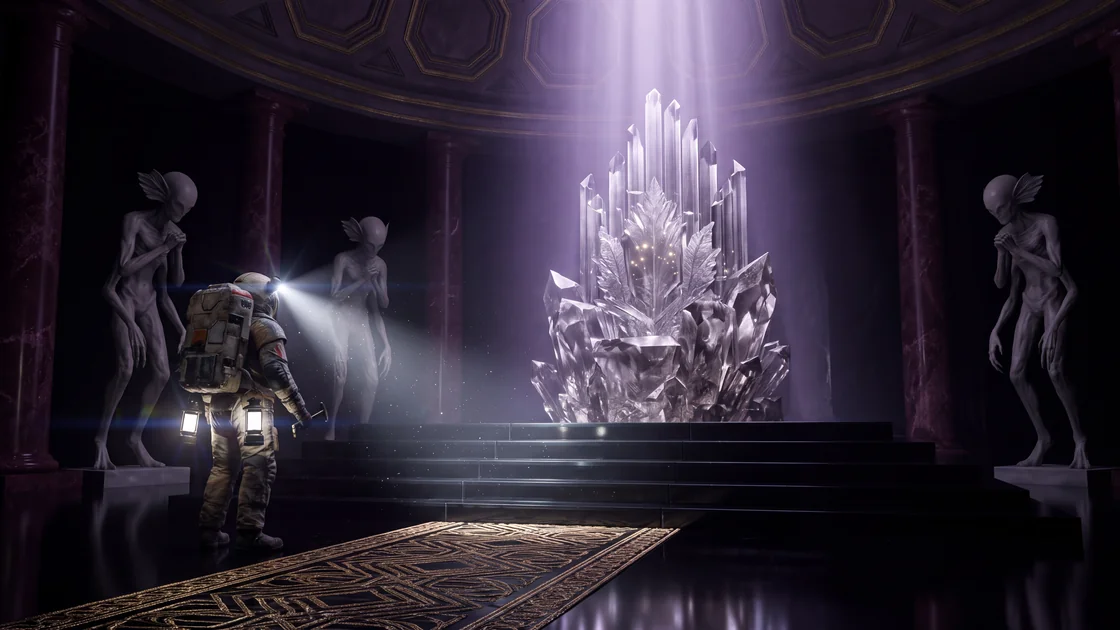
When industrial-grade deep-space prospector Callan Vance bored through three kilometers of dense nickel-iron into the interior of Asteroid 88-Demetrius, he expected to find a rich deposit of platinum-group metals to clear his generational debts with the Jovian Combine; instead, his diamond-tipped rotary drills punched through into an unnatural, hollowed cavern containing a monumental hall of ageless obsidian and spun gold, at the center of which stood an impossibly faceted, unoccupied crystalline throne waiting silently in the absolute cold of the void.
Part I: The Mechanics of Solitude
The Geryon smelled of scorched copper, boiled oats, and the particular sour tang of sweat that had been recycled through three stages of synthetic zeolite before being pumped back into the crew compartment as lukewarm moisture. Callan Vance did not mind the smell. In fact, on the rare occasions he docked at the refit spindles around Ganymede or Ceres, the sanitized, floral-scrubbed scrub-air of the commercial hubs gave him a dull, thumping migraine behind his left eye. He was a man shaped by close bulkheads and low ceilings, his posture permanently angled forward from years of stooping through maintenance conduits, his shoulders knotted like seasoned hemp.
Callan was fifty-four Jovian-standard years old. His knuckles were swollen from sub-zero hydraulic fluid leaks, and his left ear whistled with a phantom harmonic whenever the main reaction mass heaters spool-cycled. He had signed his first indentured mining contract when his beard was still patchy and black; now his beard was the color of lunar dust, shot through with patches of iron-rust grey, and his teeth felt loose in his gums whenever the gravity centrifuge began its groaning decelerations.
"Current penetration depth: two-thousand-eight-hundred-forty meters," the ship’s primary logic core, a clipped and dry voice named Matthew, stated through the overhead transducer. "Rotary torque is spiking twelve percent above nominal parameters, Callan. The basaltic mantle has given way to an anomalous compression phase. Sensor returns indicate an alloy density that should not exist in an uncompressed body of this mass class."
Callan spat into the waste-intake funnel beside the console, wiped his mouth with the back of a greasy canvas sleeve, and adjusted the hydraulic feed needles with cautious, featherweight taps of his fingers.
"Show me the acoustic echogram again, Matthew," Callan said. His voice was naturally gravelly, a tool worn down by disuse. Weeks would pass out in the Scattered Disc without him speaking aloud, save for curses aimed at stripped bolts or murmurs to the telemetry monitors.
The primary CRT screen flicker-stepped, drawing green line-traces across a spherical wireframe.
Asteroid 88-Demetrius was not large—barely six kilometers along its longest axis, shaped like an irregular, pitted molar drifting through the Kuiper Belt’s inner fringes. By rights, it should have been a loose rubble pile of primordial silicates, frozen ammonia, and low-grade iron nodules, nudged out of the resonant orbits by Neptune’s ancient migrations and forgotten for two billion years. But three weeks ago, during a desperate, low-burn sweep across Sector 12-B, the Geryon's long-range neutrino array had picked up a gravitational signature that had made Callan drop his ration tin.
The rock had mass, but its center of gravity was wrong. It wobbled on its axis like a loaded die.
"The acoustic returns are still clean," Callan murmured, leaning closer to the amber sweep. "Look at those refraction angles. That’s not a solid core, Matthew. That’s an interface. A boundary layer."
"The acoustic signatures suggest a boundary, yes," the machine replied evenly. "However, the primary mantle is absorbing forty percent of the pulse energy without returning secondary compressions. If this were a pocket of heavy metals—osmium or iridium—the shear waves would reflect back with a distinctive high-register signature. Instead, the waves are dying. As if they are falling into an open throat."
"Or a void," Callan said.
"Nature does not maintain stable void cavities three kilometers down inside an uncompacted chondrite of this size," Matthew noted. "The internal lithostatic pressure, while minimal under microgravity, is more than sufficient over geological timescales to collapse any structural vesicles."
"Nature didn't sign my fuel-debt chits to the United Jovian Syndicate either," Callan grunted. He reached out and notched the drill feed forward another three centimeters per minute. "Increase slurry cooling to the diamond crown. Kick the microwave pulsers up four percent. If there’s a vug down there full of native platinum crystals or void-sintered diamonds, I’m not letting the drill head weld itself to the collar."
Outside the hull, through three kilometers of utter vacuum, the mechanical beast worked. The Geryon was essentially nothing more than a pressurized cockpit welded to the ass-end of a three-thousand-ton continuous boring rig. Out in the deep dark, three hundred million kilometers from the nearest warm hearth or green tree, the ship was anchored to 88-Demetrius by four harpoon-cables of woven tungsten carbide, cinched down so tight the winch drums groaned in sympathy with the asteroid’s sluggish spin.
Between the ship’s nose and the rock face, a three-meter-wide drive shaft spun with brutal, relentless purpose. The head of the drill was a nightmare crown of industrial polycrystalline diamond teeth, backed by high-frequency ultrasonic fracturing horns and low-yield microwave emitters that flash-boiled the micro-deposits of water ice in the rock, cracking the stone from within an instant before the diamonds tore it to flour.
A deep, bone-rattling vibration thrummed through the Geryon’s frame. Callan felt it not with his ears, but through the heels of his magnetic boots and the base of his spine. It was the rhythm of his life: the slow, grinding conversion of planetary refuse into trade-weight.
"Two thousand nine hundred meters," Matthew recited. "Temperature at the cutter face is rising: six hundred Kelvin... seven hundred. Slurry return is dry. Callan, the drill is no longer producing particulate exhaust."
Callan froze. He rested his palm on the emergency clutch lever. "What do you mean, no exhaust? Did the feed pipe clog?"
"Negative. Flow sensors in the return conduit register zero back-pressure. The material is not backing up into the shaft. It is disappearing."
"Disappearing where?"
"Beyond the bit."
Callan squinted at the analog pressure gauges. The needle monitoring the hydraulic resistance of the cutter face had not just dropped; it had bottomed out against the stop-peg. The vibration in the deckplates altered instantly, changing from that deep, teeth-grinding thud to a high, frictionless whine as the drive shaft spun without load.
"Cutter load zero," Matthew stated with mechanical calm. "The bit has breached the boundary."
Callan killed the rotary drive. The sudden silence that slammed down on the cockpit was louder than the machinery had been. The only sound remaining was the wet, rhythmic hiss of the life-support scrubbers and the rapid, shallow cadence of his own breathing.
"Did we hit a gas pocket? Is there a pressure differential?"
"Internal cavity pressure is absolute zero," Matthew said. "Sensors in the drill head report no atmosphere, no volatile venting, no outgassing. But Callan... the bit has traveled forward twelve meters into the void without contacting a floor."
Callan sat back in his harness, his thumb tracing the worn edge of his control yoke. Twelve meters of empty space inside a dirty snowball. It was impossible. Even if a bubble of trapped gas had blown out during the asteroid's formation eons ago, the impact of micrometeorites over billions of years would have shattered the ceiling, collapsing it into rubble.
"Can you push the optical line through?" Callan asked softly.
"Extending the borescope fiber now. Engaging auxiliary illuminators."
The center monitor switched from the wireframe schematic to a raw camera feed. At first, there was only the jagged, gray-black interior of the borehole—a spiraling tunnel of torn stone, slicked with pulverized basalt dust that floated in the static-rich vacuum like gray snow. The drill bit itself was visible at the bottom of the feed: a massive, blunt cylinder of darkened steel, crowned with rows of blackened industrial teeth, still glowing dull orange from the friction of the descent.
Beyond the teeth, the bore ended.
The camera extended past the crown, sliding out on an articulated snake-arm of segmented titanium. Its searchlight clicked on—a five-thousand-lumen burst of harsh, daylight-white LED glare.
The beam did not strike rock.
It pushed out into an ink-dark emptiness so vast that the light simply died before finding a wall. The dust from the drill-shaft did not settle; it spilled over the jagged lip of the borehole and drifted downward in long, silver ribbons, illuminated like motes of dust dancing across a cathedral nave, until it vanished into the blackness below.
"Matthew," Callan whispered, his skin prickling with an ancient, mammalian terror that had nothing to do with low oxygen or failing thrusters. "How big is that chamber?"
"The sonar ping is returning reflections, Callan. But the geometry is... incorrect."
"What does 'incorrect' mean to a machine with a four-petabyte logic array?"
"The acoustic wavefront is returning from flat surfaces at ninety-degree angles. The primary chamber measures roughly six hundred meters in length, one hundred and twenty meters in width, and eighty meters from what appears to be a ceiling to what appears to be a floor."
Callan stared at the empty black monitor. "That’s not a vug. That’s not a geological fault."
"No," Matthew said, the synthetic voice dropping into a register that sounded, to Callan’s frayed ears, almost like hesitation. "It is an excavation. Or an architecture."
Part II: The Descent
The suit was an old Mk-IV Armstrong Heavy Work-Rig—a reinforced, lead-lined sarcophagus designed for clearing slag out of smelter ducts and setting high-explosive charges in radiation-soaked Jovian rings. It smelled of scorched neoprene, sweat, and five years of Callan's own life. It weighed one hundred and forty kilograms in Earth gravity, but here, suspended over the heart of 88-Demetrius, it was weightless, a bulky exoskeleton that made every movement deliberate, heavy, and loud inside his helmet.
Callan checked his seals. He checked his oxygen mix: twenty-two percent O2, seventy-eight percent nitrogen, pressurized to nine-tenths of an atmosphere. He tapped the pressure seals on his chest-plate, verified the nitrogen reserves in his small maneuvering thruster pack, and hung two long, battery-powered survey lanterns from his tool-harness like iron lanterns on a medieval night-watchman.
"You have four hours of scrub-time before the lithium hydroxide canisters begin to saturate," Matthew reminded him through the suit’s bone-conduction headset. "Callan, the regulations of the United Jovian Syndicate explicitly dictate that any discovery of non-standard structural anomalies must be immediately reported to the sector surveyor, with all exploration deferred to licensed corporate salvage teams."
Callan snorted, his breath fogging the inner laminate of his visor before the gold-leaf heater wires cleared it. "The sector surveyor is three months away at high burn, Matthew. By the time an exploratory cruiser got out here, the Syndicate would classify my ship as an operational asset, repossess my core, and give me a ten-thousand-credit finder's fee minus the dockage tax. I’d be sleeping in a dormitory tube on Callisto till the day I die."
"The risk profile of this action is outside calculable bounds."
"Everything past Mars is outside calculable bounds. Open the drill-shaft service hatch."
The service tunnel through the center of the Geryon's main boring shaft was barely seventy centimeters wide—a narrow, grease-coated crawlway designed for technicians to replace cutting teeth without uncoupling the entire assembly. Callan entered it feet-first, pulling himself along with gloved hands on the recessed maintenance rungs. The steel around him was cold, radiating the profound chill of deep space through the insulation of his suit. He could hear the metal tick and pop as it cooled from the fury of the drilling.
Down he went, meter by meter, rung by rung. The light of the ship’s small airlock above him faded to a pinprick, then vanished as he negotiated the first dogleg joint. Ahead was only the dark, smelled only through his suit’s recirculated stale air, and the rhythmic, rasping sound of his own lungs working against the low-pressure mix.
He passed the final hydraulic seals, the cooling lines running like dead veins through the casing, and then his heavy, square-toed magnetic boots kicked through the empty center of the drill bit.
He dropped.
In microgravity, dropping was a slow, surreal slide into nothingness. He triggered his chest thrusters for a half-second, their brief nitrogen hiss barking through his shoulder joints, arresting the spin he had acquired while clearing the teeth.
Callan reached down, unclipped one of the industrial survey lanterns, and twisted the collar.
A cone of brilliance tore through the dark.
Callan stopped breathing.
He was not hanging in an unformed cavern. He was floating beneath a ceiling of cyclopean stone that had been carved into endless, interlocking hexagonal panels, each recessed half a meter into the rock and bordered by thin ribbons of what looked like beaten gold. The work was so precise, so sharp-edged, that even with the drill’s violent breach having ripped through four of the panels, the surrounding stone showed not a single hairline fracture, not a single fissure of stress.
He looked down.
Eighty meters below him, illuminated by the wide spill of his lantern, lay a floor. It was not the jagged rubble-bed of an asteroid interior. It was a vast expanse of polished, mirror-black stone—obsidian, or some basaltic glass refined beyond any human industrial standard—unbroken by joints or mortar. It stretched away into the gloom like a frozen sea of black ice.
"Matthew," Callan whispered. His voice was a flat, frightened scrap inside his helmet. "Are you getting this telemetry?"
"The optical feed is degraded by high-frequency electromagnetic interference," the ship’s voice replied, its tone flattened by static. "I am receiving the carrier wave, but the image is... fractured. What do you see?"
"It’s a hall," Callan said, twisting slowly on his axis as his thrusters stabilized his attitude. "A king's hall. It’s... God in heaven, Matthew, it’s big enough to park three ore-freighters inside."
"There are no geological records of human habitations in this sector prior to the Gold-Rush of '42," Matthew said. "And no corporation has ever transported masonry of that scale past the Jovian orbit."
"This isn't corporate," Callan said. "This isn't human."
He triggered the downward thruster, drifting toward the floor at half a meter per second. As he descended, the scale of the space opened around him, swallowing the small sphere of his lantern’s light.
The walls were not bare stone. Flanking the vast, elongated nave were rows of colossal pillars—monoliths of deep, blood-veined porphyry, each twenty meters in diameter, rising straight from the floor to meet the hexagonal vaulting above. They were carved not with smooth fluting, but with bas-reliefs that seemed to writhe and shift in the sweeping beam of his light.
Callan drifted past one of the pillars, his glove reaching out, hovering millimeters from the surface without daring to make contact.
The relief depicted celestial bodies, but they were not the neat, orderly ellipses of the Sol system. He saw stars caught in the throes of violent, asymmetrical death—supernovae with tongues of matter lashing out like hooked claws; clusters of black spheres bound together by web-like filaments that looked sickeningly organic; and sweeping, helical formations of ships, or perhaps creatures, that had no engines, no bridges, no rudders, only vast, multi-tiered arrays of oars or spines that pierced the void like sea-urchins.
The level of detail was psychotic in its perfection. Every grain of the stone had been worked. There were no chisel marks, no water-jet striations, no laser-pitting. It looked as if the stone had been brought to a liquid boil, molded with micro-geometric stamps, and then frozen in an instant into absolute permanence.
His boots touched down.
The contact made no sound in the vacuum, but through the heavy soles of his boots, Callan felt a strange, elastic thrum—a faint, ringing vibration that traveled up his shins, through his knees, and settled in the small of his back. It was not the mechanical rumble of the Geryon's life-support pumps three kilometers above. It was deeper, slower—a pulse that beat once every four or five seconds, like the idling heart of a sleeping Leviathan.
"Callan," Matthew's voice crackled through the static, sounding thinner now, warped by the sheer mass of the stone and metal between them. "I am... reading an increase... ambient radiation... not lethal, but... structured. The waveform is... repetitive."
"Understood," Callan said, though he barely heard the machine. His eyes were locked on the far end of the hall.
There was a processional path. Down the dead center of the obsidian floor, a wide carpet of spun metal had been laid out. It was not cloth; it was a mesh of hair-thin platinum and brass wire, woven into complex, maze-like geometric labyrinths that seemed to lead the eye forward, pulling the consciousness into an irresistible vanishing point toward the darkness at the end of the nave.
Callan began to walk.
In the microgravity of the asteroid, walking was a delicate art. He could not stride; if he pushed off too hard, he would launch himself thirty meters into the air and spend two minutes drifting uselessly back down. He had to slide his boots forward, keeping his magnetic soles lightly engaged with whatever faint ferromagnetism existed in the black glass beneath him.
Clack. Slide. Clack. Slide.
The sound of his magnetic soles locking onto the dark floor echoed inside the metal armature of his suit. Each step was a desecration. For billions of years, this place had slept in the purest, most undisturbed silence in the universe—a tomb wrapped in ice and stone, drifting along the forgotten rim of the solar system, unseen by sun or star. Now, an old, grease-stained prospector from the slums of Ganymede was dragging his heavy, muddy boots across its floor, breathing moist, carbon-heavy air into a spacesuit that smelled of old soup.
He passed pillar after pillar. Forty pillars on the left. Forty on the right.
Between the pillars were alcoves, and within the alcoves stood statues—or what Callan desperately hoped were statues.
They were tall, four meters at least, slender to the point of emaciation, carved from an unreflective, milk-white substance that swallowed his lantern light without bouncing it back. They had long, multi-jointed limbs that folded against their bodies like the legs of a mantis. Their faces were smooth, blank ovals, lacking eyes, noses, or mouths, but the sides of their elongated heads were ribbed with delicate, fan-like structures that resembled the external gills of an axolotl.
They did not face the center of the path. They faced the far end of the hall. Every single one of them was bowed slightly forward, their hands—possessing seven slender, needle-like fingers each—clasping their chests in an attitude of profound, terrifying subservience.
"What were you waiting for?" Callan breathed into the darkness.
No answer came from the radio. Matthew was lost now, buried under three kilometers of stone and the creeping veil of static that hissed like dry leaves inside his earphones.
He was alone. Truly alone, in a way no human being had been alone since the first ape crawled out onto the open savanna and looked at the distant, uncaring moon.
Then, the floor began to rise.
Part III: The Dais
The processional path did not end at a wall. It ascended a monumental flight of stairs—thirty-three steps of black glass, each step three times wider and deeper than would accommodate a human stride. Callan was forced to use his small maneuvering thrusters to hop from one tier to the next, rising above the floor of the nave like a fly climbing the steps of a cathedral altar.
With every step he climbed, the air inside his helmet felt colder. It was an illusion, he knew; his suit’s internal environmental systems were steady, the thermal indicators glowing reassuringly green on his fore-arm display. But the psychological reality was undeniable: the cold here was not merely the absence of thermal energy. It was an active force, a heavy, patient presence that had soaked into these walls before the Earth had cooled, before the first oceans had formed, before life had dared to assemble its first fragile chains of acid.
At the thirty-third step, the platform opened into a vast, semicircular apse.
The ceiling here was not stone. It was a dome of deep, lead-dark crystal, through which no starlight penetrated—save for one single, impossible shaft of illumination that did not come from any lantern Callan carried.
It was a column of pale, spectral violet light, falling from the apex of the dome straight down onto the center of the platform. There was no projector visible, no lens, no emitter. It was simply a cylinder of coherent luminance, barely two meters wide, suspended in the vacuum like a pillar of ionized vapor.
And in the center of that light stood the throne.
Callan stopped at the edge of the dais, his boots frozen to the glass.
The throne was not carved from stone. It was not assembled from metal. It appeared to have been grown, like an enormous, complex single crystal of deep, smoky quartz or diamond, shooting up from the obsidian floor in jagged, hyper-precise facets that caught the violet light and split it into thousands of needle-sharp refractions.
It was massive—easily four meters high, its backrest soaring into the air like an arrangement of crystalline organ pipes or frost-hardened ferns. The seat was wide, deep, and carved with a complex series of hollows and depressions that matched no human anatomy Callan had ever seen. There were indentations for multiple joints, long grooves along the armrests that seemed designed to hold slender, elongated appendages, and a high, tapered headrest that rose to a narrow point, as if to accommodate a skull that extended far backward from the neck.
It was empty.
It was not merely unoccupied; it looked as if it had been waiting for an occupant for an eternity, with a patience that made the surrounding asteroid seem fleeting and ephemeral.
There was no dust on the seat. In a vacuum, there could be no dust, save for the faint gray drift that Callan had carried down from the borehole, and none of that had reached this high sanctuary. The crystal was immaculate, its inner facets gleaming with a dark, oily fire that seemed to move even when Callan held his lantern completely still.
"Matthew," Callan croaked.
Silence. The static was a steady, rhythmic hiss—shhh-shhh-shhh—like the sound of the sea heard through an old tin can.
Callan took a step forward. Then another.
The violet light did not warm his suit as he entered its perimeter; if anything, the temperature reading on his external sensors dropped another four degrees Kelvin. It was cold light, the light of dead stars, the light that lingers at the edge of event horizons where time itself is torn to shreds.
He stood directly before the throne.
Now that he was close, he could see that the crystal was not uniform. Deep within its heart, encased in the glassy, translucent depths of the backrest, were tiny, microscopic points of brilliant gold light. They were moving. They were not bubbles; they were motes of something incandescent, drifting in slow, looping orbits like a miniature galaxy contained within the mineral block.
They moved with purpose. As Callan watched, his eyes wide and burning behind his visor, the golden motes aligned themselves. They shifted from a random swarm into a pattern—a three-dimensional geometric glyph that pulsed once, twice, and then dissolved, only to reform into another, more complex configuration.
It was a clock. Or a call.
On the right armrest of the throne, carved into the cold crystal, was a single depression shaped like a hand.
Not a human hand. It had seven long, segmented indentations, radiating out from a narrow, diamond-shaped palm like the spokes of an asymmetrical wheel. At the tip of each indentation was a small, circular recess, no larger than a pea, within which lay a drop of dark, iridescent liquid that did not freeze, despite the ambient temperature being less than twenty degrees above absolute zero.
Callan raised his own hand.
His heavy, insulated EVA glove looked grotesquely fat, clumsy, and primitive against the sleek, impossible precision of the crystal. His suit was covered in patches of gray sealant, smeared with black molybdenum grease, its knuckles scraped down to the bare fiber from weeks of hauling rusted chains and tightening hydraulic nuts.
He was a scavenger. A parasite living in the fur of an ancient, sleeping universe, chewing on the dead scabs of rock that circled a mediocre yellow star.
What if I touch it?
The thought did not come from his own mind. It slid into his consciousness with the smooth, oiled ease of a piston entering a cylinder. It did not sound like his own inner voice, which was always tired, always complaining of the cold, always calculating the cost of fuel and water.
This voice had no sound. It had only weight.
The seat is vacant.
"No," Callan said aloud, his voice bouncing wetly off the inside of his visor. "No, it's not mine. This isn't mine."
The house was built for the one who enters. The one who has the hand to turn the key. Are you not the one who came through the stone?
"I didn't come through the stone," Callan muttered, his heart hammering against his ribs like a trapped bird. "I had a drill. I had an eighteen-hundred-kilowatt rotary head with polycrystalline diamond tips. I broke the ceiling. I broke into your tomb."
There are no tombs here. There is only the station.
Callan looked down at the armrest. The dark, iridescent droplets in the seven recesses were trembling. They were rising from their seats, floating a millimeter above the crystal, suspended by some minute surface tension or magnetic field that had just switched on.
The golden motes inside the throne’s spine were moving faster now, their orbital loops tightening, drawing together into a dense, blazing core of light that began to cast long, frantic shadows across the obsidian floor behind him.
The hall was waking up.
Through his boots, the thrum had changed. It was no longer a slow, four-second pulse. It had become a continuous, low-frequency hum—a singing tone that vibrated through the steel soles of his boots, through the pins in his broken ankle, through the plates in his pelvis, until his whole skeleton felt as if it were being tuned like an iron fork.
The statues down in the nave—the milk-white, blind things with their mantis-limbs folded across their chests—were not moving, but the light was catching them differently now. The purple glow from the apse was spilling down the stairs, washing over their elongated heads, and in the shadows between their folded fingers, Callan saw the faint, answering glimmer of gold.
"Matthew!" Callan screamed into his microphone. "Pull me up! Matthew, winch the umbilical! Get me out of here!"
Only static.
Krrrr-shhhh-krrrr.
And then, out of the static, a sound that made Callan’s blood turn to slush.
It was not Matthew’s voice. It was a sequence of notes. Pure, high, clear tones, like the chiming of silver bells, repeating at intervals that matched precisely the shifting of the golden motes in the crystalline throne.
The throne was communicating with the ship.
Or rather, the ship was answering the throne.
Part IV: The Claim
Callan Vance had spent thirty years learning one fundamental rule of deep-space survival: When the rock speaks, you run.
If a seam of ice groaned inside a fissure, you dropped your tools and bolted, because within five seconds the whole face would blow out in an explosive decompression. If a hydraulic line shrieked, you let go of the valve, because forty thousand pounds of pressure would take your arm off at the shoulder before your brain could register the pain.
Everything in his body, every animal instinct honed by three decades of living on the knife-edge of death, told him to turn his back on that throne, activate his thrusters, and burn for the ragged hole in the ceiling.
He did not run.
He stood there, hypnotized by the cold, beautiful madness of it.
If he left—if he crawled back up that shaft, sealed the hatch, uncoupled the Geryon, and burned back to Callisto—what was he returning to?
A bunk three meters long, stacked two deep above a hydro-reclaimer that dripped gray water into his blankets. A tablet screen filled with red numbers: docking fees, oxygen taxes, medical levies for the radiation sickness that was slowly chewing through his marrow, interest on a fuel loan that had been bought and sold five times by banks on Earth that he had never seen and never would see.
A lifetime of hauling stones so that men with smooth hands and silk jackets could build pleasure gardens in the clouds of Venus, while he choked on recycled sweat in the Scattered Disc.
And here...
Here was a room that had survived the birth and death of empires.
Here was a chair that had been carved before the first lungfish pulled itself onto the mud of an empty world.
Callan took off his right glove.
It was an act of complete insanity. The suit’s pressure seal hissed violently as he broke the wrist collar, the safety valve shrieking as the small volume of air inside the forearm sleeve escaped into the vacuum with a sharp pfft.
The cold hit him instantly.
It was not the cold of winter; it was the cold of absolute nothingness. The moisture on his skin vanished in a micro-second, flash-boiling away into the vacuum, leaving his flesh parchment-dry, his knuckles turning instantly white, then a bruised, mottling blue. The blood in his superficial capillaries froze within three seconds, his skin pulling tight across his knuckles like cured hide.
He had perhaps thirty seconds before the tissue damage became permanent; forty-five before his hand became an inert block of frozen meat; sixty before the seal failure compromised the rest of his suit’s life-support loop and blew the pressure out of his torso, collapsing his lungs.
He reached out his bare, freezing hand.
He did not place his hand on the alien indentations. He could not; his fingers were human, five-pointed, short, blunt, and broken by labor.
He slammed his bare palm flat against the center of the crystalline armrest, directly over the cold, diamond-shaped hollow.
The shock was not pain. It was information.
It hit his central nervous system like an arc-weld straight to the brainstem.
Callan did not see stars; he saw the mechanics of stars. He saw the gravitational warp-wells of the outer planets not as mathematical diagrams, but as deep, yawning whirlpools in a fabric of dark liquid, through which massive, needle-shaped vessels slid without sound, propelled by the simple, terrifying manipulation of mass.
He saw 88-Demetrius not as a rock, but as an egg.
The asteroid was an armor plate, three kilometers thick, grown around this hall by design, dropped into the belt to drift until the orbit of the fourth planet reached a specific evolutionary threshold. It was a listening post. A throne for an observer who had left his seat to walk between the stars, promising to return when the signals from the inner systems changed from the chaotic noise of lightning and volcanoes to the structured, rhythmic emissions of intelligence.
The throne had been waiting for its owner.
It did not find its owner.
It found Callan.
The machine-mind of the throne—if it was a machine, if it was a mind—did not care about the shape of his hand. It did not care that he had five fingers instead of seven, that his blood was based on iron instead of copper, that his thoughts were small, dirty, and full of fear.
It cared only that an entity had climbed the thirty-three steps, stood in the violet light, and pressed warm, wet flesh against the interface.
Recognition failed, the impression came through his freezing nerves, not in words, but in a sudden, cold sense of structural disappointment. Variant biological agent detected. Clearance level: Null. Lineage: Primitive.
Override requested.
Callan’s teeth clicked together so hard a piece of an enamel molar sheared off and rattled against the inside of his visor. The violet light around him shifted, deepening into an angry, ultraviolet glare that made his eyeballs ache behind their lenses.
The occupant is absent, the silence whispered into his marrow. The sector remains unadministered. The tribute has accumulated for nine hundred million periods.
Do you submit the claim?
Callan’s hand was stuck to the crystal. The moisture of his flash-frozen skin had welded him to the faceted surface. If he pulled away now, he would leave his skin and the meat of his palm behind, cemented to the armrest forever.
He looked at the empty seat.
He saw himself sitting there. Not in this filthy, grease-stained Mk-IV suit, but stripped of his rags, his body cured of its aches, his eyes opened to the full, terrifying spectrum of the cosmos. He could sit here in the dark, surrounded by forty milk-white sentinels who would bow to him forever, while the fleets of humanity crawled like ants through the inner rings, never suspecting that the true master of the Scattered Disc was an old, bankrupt prospector sitting on a throne of diamond inside a dirty snowball.
He could be the King of the Nothing.
"No," Callan gasped, his lungs burning as the suit’s emergency regulators fought to keep the pressure from blowing through his torn wrist-seal.
"No?" the cold impression returned, faintly amused, or perhaps merely indifferent.
"I’m a miner," Callan spat, and the blood from his broken tooth sprayed against the plastic of his visor, spotting the violet light with drops of dark, human crimson. "I don't... sit on things. I dig 'em up. I sell 'em. I move on."
He brought his left hand—still encased in the heavy, lead-lined armored glove—around with all the strength left in his shoulders.
He smashed the heavy steel knuckle-guard down onto his own frozen right wrist.
Crack.
The sound was dull, like a frozen branch snapping in a winter gale.
The frozen skin and dead tissue of his right palm tore away, remaining stuck to the armrest, while the stump of his arm, already sealed by the brutal, instantaneous frostbite of the vacuum, jerked backward into the sleeve of his suit.
Callan shrieked—a high, thin sound that had no air to carry it, dying in his own throat—as he slammed his left hand over the open wrist-collar, tripping the manual emergency iris-seal with his thumb.
The iris snapped shut, biting into the sleeve, sealing the arm off from the vacuum. The suit’s pressure stabilizer gave a frantic, whistling gasp as it pumped the remaining air reserves into his torso, slamming nine pounds of pressure back against his chest.
The connection was broken.
The violet light did not fade; it exploded.
A shockwave of sheer electromagnetic force ripped through the dais. It did not push Callan with air; it pushed him with pure induction, grabbing the iron in his suit’s frame, the lead in his chest-plate, the titanium in his pack, and hurling him backward off the thirty-third step like a leaf caught in a furnace draft.
He tumbled through the microgravity, head over heels, the vast, vaulted ceiling spinning around him in dizzying, terrifying revolutions.
He saw the throne shrinking into the distance—a solitary, blazing shard of violet diamond, standing alone on its black altar, its golden galaxy of motes swirling with frantic, frustrated energy.
He saw the rows of milk-white statues.
Their heads had turned.
They were no longer facing the throne. As Callan floated through the cavernous nave, eighty meters above the obsidian floor, eighty pairs of blank, eyeless faces were tilted upward, tracking his trajectory through the dark, their fan-like ears vibrating with a sound that shook the very foundations of the asteroid.
Callan did not look back again.
He fired his thruster pack—a wild, uncontrolled three-second burst that sent him rocketing toward the ceiling, toward the jagged, torn hole where the diamond teeth of his boring head still hung like an iron pendant in the stone.
Part V: The Slagging
"Callan! Callan, the core is destabilizing!"
Matthew’s voice was no longer a thin thread; it was screaming through his headset, saturated with alarms, sirens, and the frantic, red-line chatter of five different structural failure monitors.
Callan slammed into the mouth of the borehole, his left elbow taking the brunt of the impact. The pain was blinding, a sharp, white-hot lance that cut through the numbness of his shock, but his boots found the steel rungs of the cutter head.
He didn't climb. He hauled himself up using his single good arm, his knees, his chin, dragging his body through the grease-slicked casing of the shaft like a worm retreating into a hole.
Below him, from the depths of the hall he had desecrated, came a sound that was not sound.
It was gravity.
The Geryon's anchor cables, four strands of woven tungsten carbide three inches thick, snapped with reports like artillery fire. The ship—three thousand tons of industrial machinery—was jerked downward toward the rock, its landing pads groaning as the suspension struts collapsed to their stops.
"The internal cavity is undergoing gravitational collapse," Matthew shouted. "Callan, the mass of the asteroid is increasing. The sensors are registering five... ten... twenty times the theoretical mass of this body! It is generating an artificial horizon!"
"Blow the charges!" Callan roared, his helmet banging against the narrow steel conduit as he scrambled into the Geryon's lower airlock.
"The bore is not clear—"
"Blow the collar charges, Matthew! Sever the head! Disengage the anchors!"
Callan tumbled into the airlock chamber. He didn't wait for the cycle. He didn't wait for the pressure to equalize. He hit the manual hatch-lever with his boot, kicking it down, and the outer door slammed shut, slicing off the bottom three inches of his suit’s left foot-plate, sealing him inside the coffin-sized box just as the primary severance charges fired.
THUMP.
The entire ship jumped, as if it had been kicked by an angry god.
The shaped charges around the base of the main boring shaft detonated simultaneously, cutting through the three-meter steel drive-shaft and turning the lower cutter assembly into free-floating scrap.
Callan was thrown against the inner airlock door, his helmet cracking against the observation glass.
Through the starred, spider-webbed viewport, he saw the rock face of 88-Demetrius.
It was no longer gray.
The cracks radiating from his borehole were glowing with a sick, curdled purple. The dust—the billions of tons of primordial debris that had covered the asteroid for an eternity—was not drifting away; it was being pulled inward, sucked down into the fractures like water down a drain.
The asteroid was collapsing in on itself, not because it was broken, but because the room at its center was folding its walls.
The throne was packing its house.
"Main thrusters at one hundred and ten percent," Matthew announced, the voice strained by the massive electrical loads surging through the ship's buses. "Inertial compensators have failed. Hold on, Callan."
The acceleration did not push Callan into his seat; it pinned him to the airlock floor like an insect under a boot.
The Geryon's old chemical-fusion engines, never meant for tactical maneuvers, screamed their agony into the void. A plume of superheated deuterium plasma three kilometers long erupted from the ship’s stern, tearing through the debris cloud, scarring the face of the dying asteroid with a stroke of man-made lightning.
Through the airlock's cracked window, Callan watched the end.
88-Demetrius did not explode. It did not shatter into a cloud of navigational hazards to be cataloged by the Jovian authorities.
It simply folded.
The stone buckled along lines of impossible geometry, the nickel-iron plains sliding over one another like the leaves of an enormous mechanical iris. The purple light flared once—a brilliant, silent flash that blinded the Geryon's aft sensors and burned the last remnants of the external camera arrays into dead silicon—and then there was nothing.
Where an asteroid six kilometers wide had drifted three seconds before, there was only empty space.
No rubble. No dust. No gas.
Only the cold, clean stars of the Kuiper Belt, shining down with the absolute, indifferent clarity of a universe that had not noticed the opening or the closing of an eye.
Part VI: The Account
Three weeks later, the Geryon limped into the orbital shadow of Ganymede’s third defensive redoubt, trailing a thin plume of vaporized coolant and running on three of its six maneuvering quads.
The ship was dead in the water, its reaction mass tanks dry, its life-support filters clogged with the black dust of an unrecorded world, its hull scorched by radiation that the station's quarantine cutters couldn't identify on their spectrographs.
A salvage tug with the yellow-and-black livery of the United Jovian Syndicate hooked them by the nose, dragging them into the quarantine dock at Station Twelve like a drowned dog being pulled from a canal.
The Syndicate’s claims officer was a small, round-shouldered man named Varley. He wore a crisp, synthetic-silk uniform that had never known the inside of an airlock, and his fingernails were clean, pink, and neatly filed. He sat across the small steel table in the station's inspection bay, a datapad resting between his elbows, looking at Callan Vance with the tired disgust of a landlord inspecting a damaged room.
Callan sat in a plastic chair. He was wearing a gray, paper-thin hospital smock. His right arm ended three inches above the wrist in a thick, bulbous club of white synth-flesh and regenerative gauze, through which the phantom throbbing of his missing fingers felt like an electric wire being dragged through salt.
"You dropped three hundred tons of equipment," Varley said, not looking up from his screen. "You blew the main shaft. You burned out two pre-injection coils on the primary drive. And your ship’s log... well, Vance, your log is a mess of corrupted sectors and sensor hallucinations."
Callan said nothing. He stared at the small, square window in the office door, through which he could see the gray, industrial sprawl of the Ganymede refineries—the smokestacks that didn't smoke, the tanks of liquid methane, the endless lines of ore-shuttles dropping down from the sky like bloated flies.
"The core is gone," Varley continued, tapping a finger against the glass of his pad. "According to the orbital beacons, Asteroid 88-Demetrius isn't there anymore. Did you set off an unauthorized nuclear charge in the core, Vance? Did you try to fragment a class-four body without an extraction permit?"
"It wasn't a class-four body," Callan said. His voice was almost gone, a dry, papery rattle that sounded like gravel sliding down a chute.
"The chart says it was."
"The chart is wrong."
Varley sighed, leaning back in his chair and rubbing the bridge of his thin nose. "Look, Callan. You’re an old hand. You know how this works. You’re eighty-two thousand credits in the hole for the fuel loan. The replacement cost for the Geryon's boring head is another one-forty. Even if we liquidate your hull for scrap, you’re never going to see the outside of a company hab again. You’ll be sorting scrap on the low-line belts until you’re seventy, and then you’ll go into the municipal reclaimer like every other drift-miner who couldn't balance his ledger."
He leaned forward, his small, dark eyes narrowing.
"Unless there's something you didn't put in the log. The sensor returns from the station's long-range array picked up an energy spike in Sector 12-B before your transponder went dark. A high-frequency emission. Non-standard. It looked like a resonance burst from a heavy-element synthesis lab."
Varley tapped his desk.
"Did you find something out there, Vance? Did you find a cache? An old Martian black-site? A Combine weapons dump from the rebellion?"
Callan looked down at his right arm.
He could still feel it.
He could feel the cold. Not the cold of Ganymede’s refrigerated corridors, but that deeper, older cold—the cold that sat between the stars, waiting for the lights to go out.
He could feel the shape of the crystal against his palm. He could feel the seven long, needle-like depressions, and the dark, oily drops that had floated above them, waiting for a king who had never returned.
And he knew that if he told this man—if he told the Syndicate, if he told the Combine, if he told the whole, greedy, ravenous, pathetic swarm of humanity that was crawling out from the sun—they would send their cruisers. They would send their dreadnoughts and their survey ships, with their diamond drills and their corporate flags, to hunt through the dark for the hall of obsidian.
They would look for the throne.
They would want to sit in it.
And whoever sat in it—whoever had hands small enough, or cruel enough, or greedy enough to let the crystal drink their blood—would not be a miner. They would not be an emperor.
They would be a servant. Just like the milk-white things with the folded limbs, doomed to stand in the dark for a billion years, bowed toward an empty seat, waiting for a master that had forgotten they were ever made.
"Vance?" Varley prompted, his voice sharp with irritation. "I asked you a question. What did you find down there?"
Callan Vance looked up at the claims officer. He smiled, and his mouth, missing two teeth, was a dark, jagged hole in his bearded face.
"Nothing," Callan said. "Just an empty pocket. Just slag and ice, Varley. That's all there ever is out there."
Varley stared at him for a long, cold second, then sneered, his fingers already flicking across the pad, signing the warrants that would strip Callan of his ship, his license, and his name.
"That's what I thought," the bureaucrat said. "Just another dead rock."
Callan stood up, his balance slightly off with the missing weight of his hand, and walked out into the corridor.
He did not look at the ships docked at the gantries. He did not look at the advertisements for the inner worlds, with their blue oceans and their green meadows that he would never see.
He looked up, through the thick, radiation-cracked plasteel dome of the station, out toward the Scattered Disc—out toward the infinite, beautiful blackness where an empty seat of cold diamond was drifting through the silence, patient as a spider, waiting for the end of the world.