The Fissile Galleon
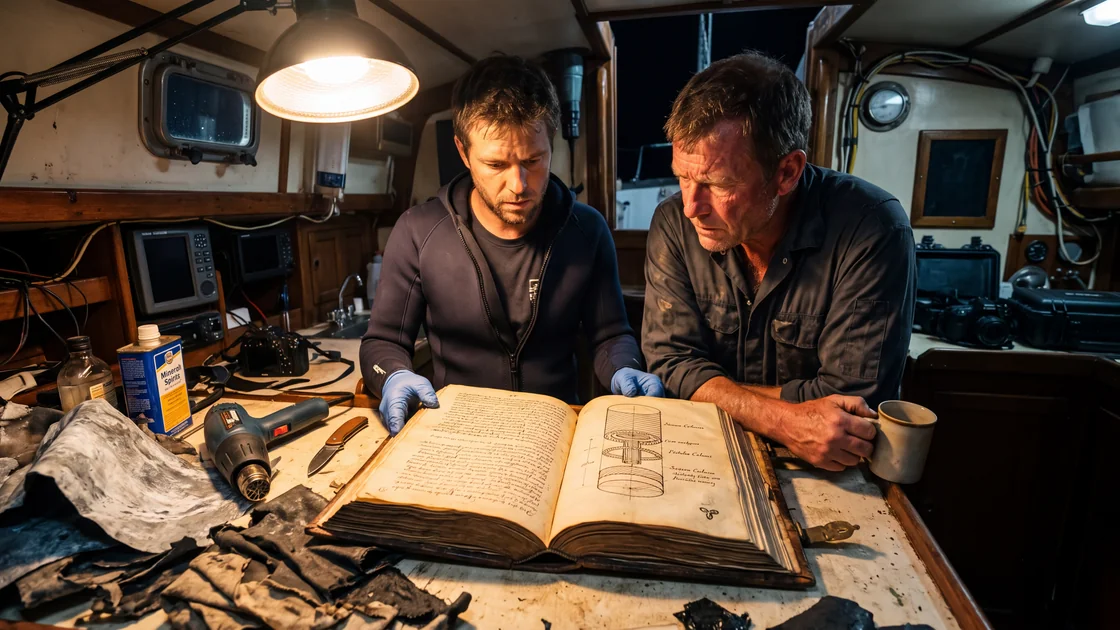
When commercial salvage diver Nathan Ward hauled a waterlogged, lead-wrapped coffer from the shattered hold of the Nuestra Señora del Rosario—a Spanish vessel lost to a hurricane in 1641—he expected to find the usual remnants of colonial extraction: silver escudos, uncut emeralds, or the church plate of a forgotten Franciscan mission. Instead, preserved beneath three centuries of melted animal pitch and oilcloth, he discovered a vellum ship's log written in archaic Castilian that contained not navigational charts or cargo manifests, but rigorous, mathematically coherent engineering schematics for a graphite-moderated nuclear reactor and a pressurized-water steam turbine. What follows is the chronicle of that recovery, the forensic verification of its contents, and the quiet, terrifying realization that three hundred years before Fermi split the atom in an idle squash court in Chicago, someone in the royal shipyards of Havana was building an engine to harness the fire of the stars.
Part One: The Cold Floor
The fathometer was an old, green-phosphor Furuno unit that ticked like a dying clock in the wheelhouse of the Relentless. It showed a jagged ledge of coralline limestone dropping away into the Florida Straits, two hundred and eighty feet below the keel. At that depth, daylight ceased to be an ambient comfort and became a pale, greenish ghost, filtered through millions of tons of plankton-rich Atlantic water until it lost all warmth and direction.
Nathan Ward sat on the dive platform at the stern, the weight of the twin 100-cubic-foot back-gas cylinders pressing his shoulder harness into his collarbones. He was breathing an 18/45 Trimix—eighteen percent oxygen, forty-five percent helium, the balance nitrogen—through his primary regulator, tasting the dry, chemical metallic tang of gas pressurized to three thousand pounds per square inch. Behind him, Mac sat on a scarred milk crate with a pair of crescent wrenches in his lap, his knuckles calloused and permanently stained with diesel grease.
"Current is kicking south-southeast at half a knot," Mac said, shouting through the roar of the auxiliary generator. "You’ve got twenty-five minutes of bottom time, Nathan. Not twenty-six. You blow that shelf, and you’re looking at four hours on the deco line with black water underneath you and bull sharks coming out of the Gulf Stream. Hear me?"
Nathan nodded once. He reached up, spit into his glass mask, rubbed the film across the interior lens with his thumb, and rinsed it in the bucket of fresh water lashed to the transom. "If I find more ballast stone, I’m coming straight up. We’re down to our last drum of fuel oil, Mac."
"You won't find ballast," Mac said, squinting through the heat shimmer toward the horizon where the pastel flats of Key West were nothing more than a faint smudge beneath a wall of trade-wind cumulus. "The magnetometer doesn't lie. There’s iron down there. Tons of it. Spanish didn't carry that much pig iron on a light merchant vessel unless they were ballasting something heavy in the keel. Something they didn't want shifting in a blow."
Nathan slid the mask over his eyes, bit the mouthpiece, and checked the secondary poppet on his chest rig. The needle on his SPG stood rock-still. He rolled backward off the platform.
The surface world vanished in a white explosion of bubbles that roared past his ears before smoothing into the familiar, deafening quiet of the deep ocean. He swung his fins in long, rhythmic sweeps, descending down the anchor line into the gloom. The temperature plunged through three distinct thermoclines. At fifty feet, the sea turned from turquoise to jade; at one hundred and twenty, the jade dissolved into indigo; by two hundred feet, the world was a uniform, suffocating violet.
His wrist-mounted dive computer glowed a steady, pale blue: 210 FT... 240 FT... 275 FT.
The bottom was not sand, but a terrace of carbonate pavement swept clean by the relentless scouring of the loop current. Long ribbons of black sea-whips whipped in the surge. And there, half-swallowed by three centuries of encrusting bryozoans and calcified mud, lay the bones of the Nuestra Señora del Rosario.
She had not died gently. Her ribs—massive knees of live oak from the Cuban forests—stuck out of the silt like the picked skeleton of a dead whale. The storm had broken her back over the limestone reef, spilling her gut across two hundred yards of trench before the hulk slid into deep water. Nathan reached the wreck site, his fins hovering six inches off the sediment to avoid kicking up a blinding "white-out" of carbonate silt.
He unclipped the two-thousand-lumen umbilical light from his harness and swung the beam through the debris field. Scattered copper bolts, green as verdigris, lay half-welded to the stone floor. He moved past the fragmented remnants of the midships hold. He had spent six months researching the archival manifests in Seville—reading through microfilms of the Contratación documents smuggled out of Madrid during the Civil War—and he knew where the master’s locker had been located: abaft the mainmast, below the water line, protected by the heaviest framing of the hull.
He found the locker not by sight, but by geometry. A line of dead-eyes, their lignum vitae wood still miraculously hard, formed an arc toward a collapsed bulkhead.
Beneath the timber lay a mound of what appeared to be dark, vitreous slag. Nathan pulled a heavy titanium dive knife from his calf sheath and tapped the surface. It did not produce the dull, ringing scrape of limestone. It thudded, soft and dead.
Lead.
He knelt, the dry mix cold in his lungs, his heart rate sitting at an economical fifty beats per minute. He took his short-handled trenching spade from his d-ring and began to clear the silt from the perimeter. The lead was not an ingot; it was a sheet, an eighth of an inch thick, wrapped like an apothecary’s parcel around a rectangular form roughly eighteen inches long, a foot wide, and four inches deep. The seams had been beaten together with wooden mallets and then coated in a thick, bituminous pitch that had resisted three hundred and fifty years of salt water, sulfurous bacteria, and hydrostatic pressure.
The lead box was lashed to an oak standard with heavy copper wire—an anomaly that sent a cold prickle through the back of Nathan's neck. The Spanish of the 1640s used hemp rope for lashings; copper wire was ruinously expensive, reserved for scientific instruments or the rigging of royal yachts.
He took out his shears, notched the copper wire, and twisted. The ancient metal, annealed by time and pressure, sheared with a muffled snap.
He grasped the lead bundle. It was extraordinarily heavy—perhaps fifty pounds out of the water, though neutral enough in the brine that he could cradle it against his chest. As he lifted it, the sediment beneath exhaled a gray plume of anaerobic mud that smelled, even through his gas mix, of ancient decay.
He checked his computer: BOTTOM TIME: 22 MIN. CEILING: 40 FT. DECO: 42 MIN.
Time had run out. Nathan clipped the lead coffer into a canvas recovery sling, attached his lift bag to the bridle, and cracked the valve on his pony bottle. A burst of air flared into the yellow vinyl bladder. The bag surged upward, its tether taut, dragging the parcel off the limestone floor. Nathan kicked upward, matching the bag's ascent rate, keeping his eyes fixed on the blue-gray void above him where his small boat swung like a speck in the sky.
Part Two: The Wax and the Pitch
The decompression stops were an exercise in slow, freezing discipline. Nathan hung from the trapeze at forty feet, then thirty, then twenty, listening to the metallic hum of the Relentless’s hull above him and the slow, rhythmic rasp of his own lungs. At fifteen feet, he switched to pure oxygen, watching the timer count down the minutes as the nitrogen and helium dissolved out of his blood like soda water clearing its fizz.
When his hand finally broke the surface, the Florida sun struck him like a physical blow. The air felt thick, humid, and impossibly sweet.
Mac leaned over the gunwale, his face lined with sunburn and salt crust, his arms already reaching down for the lift bag. "Tell me it’s not an anchor shank," Mac grunted, heaving the lead package over the rail.
Nathan climbed the ladder, the twin tanks feeling twice as heavy as they had on the way down. He collapsed onto the deck bench, spat his mouthpiece into his lap, and stripped the mask away. "Lead," Nathan breathed, his chest heaving. "Double-wrapped. Pitched seams. It was lashed to the inner skin of the keel with heavy copper."
Mac knelt beside the dripping parcel, his pocketknife already out. The lead was gray-white, oxidized to a chalky powder on the outside, but underneath, where the knife scraped, it shone bright and soft as butter. "This isn't silver, Nate. This is plumbing."
"They didn't lead-wrap silver bars, Mac. They shipped silver in raw pigs or wooden crates that rotted away two centuries ago. You wrap something in lead when you want to make sure the salt never touches it. Or when you’re trying to keep something inside."
"What does that mean?"
"Bring the hot-air gun and the mineral spirits," Nathan said, unzipping the sleeves of his neoprene suit. "And get the camera running. If this is paper, the second air hits it, it could crumble into ash."
They cleared the workbench in the tiny, cluttered galley. The boat rocked gently in the five-foot swells as Nathan worked with surgical slowness. For three hours, using an electric heat gun powered by the generator, he softened the ancient pine pitch that sealed the overlapping folds of lead. The scent filled the galley—not the petroleum stink of modern tar, but the sharp, balsamic perfume of Spanish turpentine, mixed with the tallow and beeswax of the seventeenth century.
Layer by layer, the lead peeled back like the rind of a heavy fruit. Beneath the metal lay a secondary sheath of oiled sailcloth, still greasy to the touch, waterproofed with boiled linseed and mutton fat. Beneath the sailcloth was an inner box of dark, dense lignum vitae, held shut by four wooden dowels.
Nathan tapped the dowels through with a bronze drift. He lifted the lid.
Inside lay a volume.
It was bound in heavy, vegetable-tanned pigskin, stained the color of dried walnut husks. The covers were held shut by two brass clasps, their hinges wrought in the form of coiled serpents. The edges of the leaves were gilded—a thick, bright leafing that had kept the moisture from penetrating the text block. Across the cover, pressed into the leather with a heated iron and inlaid with silver wire that had tarnished to black, was a single line of Latin:
DE MOTU ET FORMA PRIMORDIALIS IGNIS
"The Motion and Form of the Primordial Fire," Nathan murmured, his fingers hovering half an inch above the hide. He did not touch it with his bare skin; he reached into a drawer and pulled out a pair of powder-free nitrile gloves.
"A bible?" Mac asked, peering over his shoulder with a mug of black coffee in hand.
"No," Nathan said. "Bibles from the Casa de la Contratación were stamped with the cross of the Order of Santiago or the seal of the Holy Office. This is private. Look at the lower corner."
In the lower right quadrant of the leather binding, a stamp no larger than a ducat showed a circle bisected by three radiating lobes—a pattern that looked, with horrifying, impossible clarity, like a crude trefoil.
Nathan unhitched the serpent clasps with a tiny, dry click.
The paper inside was not the spongy, mechanical pulp of the modern era. It was heavy rag vellum, beaten from linen cuttings, creamy and stiff. The ink was iron-gall, still dark purple-brown, laid down in a tiny, exquisite humanistic script that ran in tight, disciplined lines across the ruled pages.
The first fifty pages were standard for an officer of the Carrera de Indias: tables of declination for the sun, distances measured between the Capes of San Antonio and the Dry Tortugas, observations on the seasonal shift of the Trade Winds, and an inventory of beef barrels, hardtack, and casks of water loaded at Havana in July of 1641. The journal was kept by one Fray Cristóbal de la Cueva, a friar of the Order of Calatrava and personal naturalist to Don Gaspar de Guzmán, the Count-Duke of Olivares.
Then, on page sixty-three, the language shifted from Spanish to Latin, and the drawings began.
Nathan froze. His breath stopped in his throat.
Mac leaned down, his brow furrowing as he stared at the page under the swinging halogen lamp. "What the hell kind of astrolabe is that?"
"That’s not an astrolabe," Nathan whispered.
The drawing occupied a full folio. It was an orthographic projection executed with a fine-point drafting pen, the circles drawn with a compass that had left tiny, prick-like center points in the heavy vellum.
It depicted a thick-walled cylinder constructed of interlocking blocks, labeled in the margins as Saxum Carbonis—stone of coal, or graphite. Through the center of these carbon blocks ran a series of vertical conduits labeled Fistulae Calami—reed-tubes. Inside these conduits, depicted in cross-hatching, were rods of an unknown substance designated Metallum Malignum de Potosí—the Evil Metal of Potosí.
At the base of the cylinder, a complex series of double-check valves, plumbed with pipes labeled Hydrargyrum—mercury—led to a secondary boiler shaped like an alembic, surrounded by cooling coils wrapped in spiraled copper.
In the center of the drawing, where the core should have been, the author had drawn a detailed cross-section of a control mechanism: square rods that slid vertically into the graphite matrix, raised and lowered by a rack-and-pinion gear system connected to counterweights. The margin note beside this mechanism, written in the cramped hand of the Calatrava friar, was entirely legible to anyone with a rudimentary grasp of mechanical Latin:
Tolerantia moderatoris per separationem radiorum: si virgae descendunt, cessat furor; si ascendunt, ignis generatur sine flamma.
Nathan translated aloud, his voice cracked and unsteady: "'The tolerance of the moderator through the separation of the rays: if the rods descend, the fury ceases; if they rise, the fire is born without flame.'"
"That’s a reactor," Mac said, his voice flat, completely stripped of its usual nautical skepticism. "Nate, you’re looking at a pressurized thermal reactor. With graphite moderation and liquid metal heat exchange."
"Look at the date," Nathan said, pointing his gloved finger at the head of the folio.
Beneath an ink-drawn coat of arms bearing the lions and castles of Castile, the script read:
Die XVI Junii, Anno Domini MDCXLI. In Civitate Havanna.
June 16, 1641.
Part Three: The Paleographer’s Room
They docked in Key West three hours after sunset, running without running lights down the Northwest Channel to avoid the casual curiosity of the live-aboards moored off Fleming Key.
Nathan took the coffer, the leather log, and three external hard drives containing high-resolution macro scans of every page to a small, two-story frame house on Elizabeth Street. The house belonged to Dr. Aris Ruiz.
Aris was seventy-eight years old, a retired professor of colonial Atlantic history from the University of Salamanca who had spent the last two decades living in self-imposed exile among five thousand volumes of Spanish maritime records, surviving on filtered water and dry sherry. He was a small man, shriveled by arthritis, with eyes that possessed the bright, manic lucidity of an owl.
When Nathan laid the scanned prints on the dining room table beneath a pair of high-intensity daylight bulbs, Aris did not speak for ten minutes. He reached for a pair of linen tongs, picked up the high-resolution enlargement of folio 74, and held it three inches from his thick spectacles.
"Where did you steal this?" the old man finally rasped.
"A deep reef. Three miles south of the Marquesas drop-off. The wreck is the Rosario."
"The Rosario was a courier ship," Aris said, not looking up. "She sailed ahead of the Tierra Firme fleet in the summer of 1641 to carry the secret dispatches for Olivares and the King. She was listed as lost with all hands during the hurricane of September twenty-first. Philip the Fourth had three masses sung for her in the Cathedral of Seville. But not for the gold, Nathan. The manifest recorded only ninety thousand pesos of silver."
"Who was Cristóbal de la Cueva?" Nathan asked.
Aris took off his glasses and rubbed his eyes until the skin turned red. "A monster. A genius. A heretic who died without the Holy Viaticum because no priest would enter the room where he was dying."
The professor walked to a tall, cedar bookcase, pulled down an unbound manuscript bound in blue sugar-paper, and leafed through its yellowed leaves.
"In the 1620s," Aris said, "the Spanish Viceroy in the Viceroyalty of Peru received reports of an anomaly from the silver mines of Potosí. The native workers in the deep shafts of the Cerro Rico were dying of an unknown disease—not the silicosis, not the mercury poisoning from the patio process, but a strange rot of the blood where the hair fell out, the teeth loosened, and the skin turned black without burn. They had broken into a lower vein that did not contain silver. It contained a dense, pitch-black ore that the Quechua called Pacha-Kuti—the Earth-Inverter."
"Pitchblende," Nathan said. "Uraninite."
"To the miners, it was slag," Aris continued, his voice dropping to a theatrical, dry hiss. "It fouled the silver extraction. But one of the overseers, a German Jesuit named Father Johann Schreck, noticed that this black stone was warm to the touch. Even in the damp cold of the deep shaft, two thousand feet down, it sat in the hand like a fresh egg from a hen. Schreck sent boxes of this mineral to the royal laboratories at the Escorial in Madrid. And there it was given to Cristóbal de la Cueva."
Aris tapped the blueprint of the reactor core with a crooked finger. "De la Cueva did not work with the mysticism of the alchemists. He was not looking for the Philosopher’s Stone or the transmutation of lead into gold. He was a mechanical disciple of Archimedes and the Toledo clockmakers. He began to experiment with the density of this pitch-stone. He discovered that if one purified it—if one removed the sulfur, ground it into dust, and formed it into cylinders with an amalgam of silver and antimony—it would generate heat in direct proportion to its volume."
Nathan leaned forward over the table, his hand resting on the edge of the printed schematic. "Look at the equations, Aris. Turn to folio eighty-one."
Aris flipped the high-res print.
The page was covered in calculations. But instead of modern mathematical notation—there were no integrals, no differential operators, no Roman letters representing unknown variables—the friar had used the geometric language of Euclid's Elements, combined with the astronomical notation of Ptolemy.
The flux of neutrons was described as Radius Fissionis—the ray of cleavage. The critical mass was calculated not through algebraic equations, but through a sequence of nested golden ratios, comparing the surface area of a sphere of purified pitchblende to its mass measured in Castilian libras.
"He didn't have the neutron," Nathan said, tracing the Latin script. "He didn't have the concept of an subatomic particle. But look what he did: he treated it like a light wave that could not be seen. He calculated the mean free path of the radiation through graphite by measuring the rate at which heat was generated in different thicknesses of charcoal blocks. Aris, this is an empirical derivation of Fermi’s pile. He built an experimental critical assembly three hundred years before the Manhattan Project."
"No," Aris whispered, looking up from the page with his eyes wide behind his lenses. "He did not just build an assembly, Nathan. Read the marginalia on page eighty-nine. He didn't just build it to see if it would burn. He was building an engine."
Part Four: The Iron Galleon
The logbook was not merely a notebook of physics; it was a fabrication log. As Nathan and Aris worked through the night, translating the archaic Castilian and technical Latin, a monstrous narrative emerged from the vellum.
In 1636, the Spanish Empire was bleeding to death. The Thirty Years' War was consuming the wealth of the Indies faster than the galleons could unload it at the Torre del Oro in Seville. The Dutch were strangling the Atlantic trade lanes, their agile fluyts running circles around the lumbering, timber-heavy Spanish naos. King Philip IV, desperate for an advantage that would preserve the hegemony of the House of Austria, granted Cristóbal de la Cueva an absolute royal warrant, sealed with the Gran Sello de la Purísima Concepción.
The friar was given a secret shipyard on the southern coast of Cuba, in the mangrove swamps near Batabanó. There, away from the eyes of foreign merchants and the spies of the English Crown, he began the construction of a vessel called the Salamandra.
She was not a sailing ship. The drawings in the third section of the log showed a hull forty varas in length—roughly one hundred and ten feet—with lines that looked less like a seventeenth-century galleon and more like the low-profile ironclads of the American Civil War. The hull was double-sheathed in thick planks of teak, between which were sandwiched hammered plates of soft lead two inches thick.
"The engine," Nathan muttered, studying Folio 102. "Look at the boiler."
The design was an engineering marvel of pre-industrial metallurgy. De la Cueva could not build high-pressure centrifugal pumps; he lacked the machine tools to make precision impellers. Instead, he designed a system of thermal siphons—pumps without moving parts that circulated liquid lead-bismuth eutectic through the reactor core by the sheer force of natural convection.
The hot liquid metal passed through a bank of U-tubes submerged in sea water that had been triple-distilled through charcoal filters. The resulting high-pressure steam was not fed into a modern bladed turbine, but into a series of stepped, double-acting piston cylinders modeled after the mine-draining pumps of the German engineer Georgius Agricola, but made of phosphor-bronze.
The pistons drove a massive, counter-rotating pair of bronze screws set into the deadwood of the stern.
"The screw propeller," Aris said, his hands shaking as he poured himself another finger of dry sherry. "Fray Cristóbal invented the screw propeller fifty years before Hooke, a hundred and fifty years before John Fitch."
"Because he had to," Nathan said. "You can't drive a paddle wheel with an engine that puts out three thousand shaft horsepower. It would tear a wooden hull to matchsticks. He needed the torque buried deep in the water."
"And did it work?" Aris asked, staring at the schematic of the screw. "Nathan, in the name of God, did this thing ever touch the water?"
Nathan turned the scanned folios until he reached the final entries, written in August of 1641.
The handwriting, previously so steady, so elegant in its monastic discipline, had become erratic, spiked with tremors and wild ink-blots.
August 12, 1641: > "We have laid the thirty-sixth stone into the heart of the engine. The metal from the Potosí mine, which the Germans called Pechblende, was washed in the spirit of nitre and cast into cylinders of forty pounds each. When the fourth cylinder was lowered into the well of charcoal, the air in the chamber began to shine with an unnatural azure light, like the glow of sea-worms in a warm harbor. Brother Tomas, who stood above the mouth of the vessel with the bronze calipers, fell to his knees and vomited his breakfast. He cried out that he could taste copper upon his tongue, though he had touched nothing."
August 18, 1641: > "The engine has drunk the water. The valves of the second alembic were opened at dawn. Without wood, without coal, without horse or wind, the iron shaft began to turn with such a terrible majesty that the shipwrights fell upon their faces and crossed themselves, believing that the Devil himself had entered the oak timbers. The shaft turned at fifty revolutions in a minute. The boiling water from the chimney was so hot it killed the crabs and fish for thirty paces around the dock."
August 29, 1641: > "A great sickness has fallen upon the yard. Tomas is dead; his bowels turned to water and blood, and his skin peeled away from his cheeks like wet parchment. The two Portuguese founders who cast the lead casing cannot stand upon their feet; their breath smells of copper and dead leaves. The King has sent an order by the fast caravel from San Juan: the Salamandra must be brought to Spain at once. Olivares writes that the French have broken through in Artois and the Dutch have blockaded the mouth of the Guadalquivir. The machine must be demonstrated before the Council of State."
September 3, 1641: > "I cannot stop the blue light. The rods of silver-faced lead, which were meant to quench the fire when lowered into the carbon, have swollen in their sleeves. The stone has grown so hot that the pitch in the hull seams is bubbling like porridge. We have loaded the logbook, the small instruments, and the spare core components aboard the Rosario. I will sail in her, accompanying the Salamandra as she attempts the passage under her own power. If the great engine does not crack her ribs before we clear the Bahamas, we shall show the world that the Crown of Spain commands the very breath of Creation."
That was the last entry.
Nathan pushed the paper away. The silence in the small room was absolute, broken only by the hum of the air conditioner and the distant, dry rattle of palm fronds in the night breeze off the Gulf.
"The Salamandra wasn't behind the Rosario," Nathan said softly. "The Rosario was escorting her. And when the hurricane hit them on September twenty-first..."
"They didn't sink together," Aris concluded, his old eyes fixed on the drawings. "The Rosario was a wooden ship; she broke upon the reef because she could not beat against a northeast gale. But the other one... an iron-sheathed hull with three thousand horsepower and no masts to catch the wind?"
"She wouldn't break on the reef," Nathan said. "She would run through it. Or she would suffer a thermal excursion when the cooling intakes sucked in carbonate sand, the core would melt through the lead bottom, and she would go down like an anvil into the deep trench."
"Where?" Aris asked.
Nathan stood up and walked to the window, looking out toward the dark water beyond the Key West roofs. "The deep trench south of the Tortugas. The Florida Straits drop to three thousand feet out there. If she's there, she's sitting on the abyssal plain. And she’s not carrying silver, Aris. She’s carrying an active, natural-uranium, graphite-moderated reactor designed by a seventeenth-century friar who had no idea what a half-life was."
Part Five: The Men with No Accents
Nathan left Aris's house at four in the morning, carrying the hard drives in a water-resistant Pelican case beneath his arm. He left the original vellum log with the old man, locked inside a nineteenth-century fireproof cast-iron safe that stood in Aris’s pantry.
As he walked down Caroline Street toward the marina, the town was dead. The humidity hung like a wet wool blanket over the gingerbread houses, and the streetlights cast sulfurous yellow pools on the cracked asphalt.
He noticed the sedan two blocks before he reached the dock.
It was a gray, late-model Chevrolet Impala, rental plates, sitting with its engine idling at the curb near the corner of Eaton. There were no lights on inside the cabin, but the faint, rectangular glow of a dashboard computer lit the cheekbones of the man in the passenger seat.
Nathan didn't run. Running down a deserted street in Key West with a heavy plastic case was an invitation to a confrontation. He turned down an alleyway between two old shingle cottages, his feet moving silently in his deck shoes, and came out behind the boatyard through a gap in the chain-link fence.
Mac was sitting on the aft deck of the Relentless, smoking a cigarette in the dark, the orange cherry waxing and waning with his breath.
"We have company," Nathan said, stepping over the gunwale.
Mac didn't move his head. "They’ve been here since two. Two guys in suits that don't fit the weather, standing at the head of the pier asking questions about our fuel receipts. They asked the harbor master how much bottom time you logged yesterday."
"Government?"
"Didn't look like Coast Guard," Mac said, flicking the butt into the oily water between the hull and the pilings. "Too clean. Shoes had rubber soles that didn't leave marks. One of them had an earbud with a coiled acoustic tube running down his collar. DEA doesn't use that kind of gear down here unless they’re looking for a semi-submersible."
Nathan set the Pelican case on the deck hatch. "They’re not looking for cocaine, Mac. They’re looking for the log."
"How bad is it?"
"If someone had told you yesterday that Christopher Columbus had a pocket calculator, how bad would that be?"
"I’d tell them they were crazy," Mac said.
"It’s worse than that. The calculations in that book aren't primitive. Cristóbal de la Cueva didn't just stumble onto this; he had access to a high-grade ore deposit that doesn't exist anymore, and he worked out the mathematics of chain reactions using classical geometry. It’s clean, Mac. There are solutions in that text for neutron moderation using simple graphite purifications that modern nuclear programs spent thirty billion dollars to figure out during the Cold War."
Mac stood up, his heavy frame silhouetted against the lights of the charter fleet across the basin. "We burn the fuel and we run for international water. We can be across the line in an hour."
"And go where? The Bahamas? Cuba? If these people know we found it, they have the coordinates of the wreck site. They probably had a satellite pass over us while we were on the deco line."
Before Mac could answer, a soft, dry voice spoke from the shadows of the dock above them.
"Mr. Ward. Mr. McIntyre. It would be remarkably counterproductive to start those Caterpillars."
A man stepped down from the stringer onto the boat's boarding ladder. He was forty-five, perhaps fifty, with thinning gray hair cut short as a wire brush and the lean, ascetic face of a career bureaucrat who spent sixty hours a week in windowless basements. He wore a rumpled linen shirt with the sleeves rolled up, revealing forearms as clean and hairless as a swimmer's.
Behind him, two other men remained on the pier, their hands folded across their waists in the neutral, ready posture of professional security details.
"My name is Miller," the man said, stepping onto the teak deck without asking permission. He didn't offer a hand. "I’m with the Department of Energy’s Office of Secure Transportation. Specifically, the Nuclear Emergency Support Team."
Nathan felt a cold heaviness settle in his stomach. "NEST doesn't have jurisdiction over seventeenth-century salvage, Mr. Miller. That’s Admiralty Court. The wreck is outside territorial waters."
Miller gave a small, humorless smile that barely moved his lips. "Mr. Ward, if you had found twenty tons of gold doubloons, you could litigate it with the Kingdom of Spain until you were both ninety years old in an admiralty court in Tampa. We wouldn't give a damn. But you didn't find gold. You found the documentation for the Rosario’s cargo."
"How do you know what was on the Rosario?" Nathan asked.
Miller walked over to the workbench, his fingers brushing the lead shavings that still littered the grain of the wood. He picked up a curled strip of lead, sniffed it, and dropped it back down.
"Because we’ve had three hundred and fifty years to read the copies de la Cueva left in the Escorial," Miller said. "Because Thomas Jefferson bought three folios of his correspondence from a French collector in 1787 and spent five months trying to decipher the cipher before he realized what the geometry meant. Because we’ve had a benthic monitoring array sitting on the wreck of the Salamandra since nineteen-seventy-four."
Nathan stared at him. "The Salamandra survived the reef."
"She didn't just survive it," Miller said. "She made twelve knots into the teeth of the gale. She was ten miles south of the Dry Tortugas when the steam pipes let go. The crew died in their bunks from the radiation before the ship ever slipped under. She’s sitting in eight hundred and forty meters of water, Mr. Ward. Her lead cladding has kept the isotopic signature contained for three centuries, but the metallurgy isn't stable anymore. The sea water has been leaching through the bismuth seals since nineteen-ninety-two."
"Then why come after us?" Mac growled. "If you already know where it is, what do you want with a diver’s log?"
Miller turned his gray eyes on Nathan. "Because de la Cueva didn't put the final calculations in the Escorial archive. He didn't trust Olivares. He knew that if the King had the complete method for the enrichment of the Potosí ore, the Crown would build twenty of these engines, put them into three-deckers, and turn the Atlantic into an open furnace. He kept the third volume with him on the voyage. Folios one hundred through one hundred and forty."
Miller held out a hand, palm up. "The enrichment chapter. The part where he explains how he separated the fissile component of the pitchblende using only copper cylinders, centrifugal force, and liquid mercury amalgams."
Nathan didn't move. The Pelican case was four inches from his right hip. "That’s impossible. You can't centrifuge uranium hexafluoride without modern metallurgy. The speeds required—"
"He wasn't using uranium hexafluoride, Mr. Ward," Miller interrupted, his voice dropping to an urgent, icy whisper. "He was using a low-temperature mercury-uranium amalgam that separates under four thousand gravities. A process that requires no high-vacuum pumps, no specialized maraging steel, and no electrical grid. A process that could allow any rogue regime with a high school machine shop and a hundred tons of raw pitchblende to produce fifty kilograms of weapons-grade material in six weeks."
Miller took a step closer. Nathan could smell the tobacco on the man's breath, dry and stale.
"Where is the book, Nathan?"
Part Six: The Fire of the Escorial
Nathan thought of Aris Ruiz sitting in the pantry on Elizabeth Street, his crooked fingers tracing the serpent clasps of the pigskin volume.
"It’s safe," Nathan said.
"Nothing is safe in this town," Miller said. "My associates have already secured Dr. Ruiz's house. The safe was... not a significant obstacle for our technicians."
Nathan took half a step forward, his fists balling at his sides, but Mac caught him by the elbow with a grip like an iron vise. "Easy, Nate," Mac muttered. "Look at the pier."
The two men on the stringer had moved. They were no longer standing with their hands folded; one of them had his hand inside his coat, his body angled toward the deck of the Relentless.
"Dr. Ruiz is unhurt," Miller said, though there was no warmth in the assurance. "He is currently being debriefed by our technical staff at the Naval Air Station on Boca Chica. He is an old man, Mr. Ward. He was remarkably cooperative once we explained the radiological implications. But there is a discrepancy."
Miller pulled a small, laminated sheet from his breast pocket. It was a photographic copy of the log's index.
"The logbook you recovered has seventy folios missing from the rear," Miller said. "The stitches were cut with a sharp instrument. Recently. The thread fibers were still white, not stained by the leather tannin."
Nathan felt a strange, cold calm descend over him—the same psychological detachment that took hold when he was two hundred and fifty feet down, his primary gas line failed, and he had twelve seconds to switch to his stage bottle before his brain starved of oxygen.
He remembered the lead box. He remembered the small, secondary compartment beneath the lignum vitae tray—a false bottom that had been sealed not with lead, but with a sheet of beaten gold that he had shoved into his dive bag without opening, thinking it was nothing more than an ornamental divider.
"I don't have them," Nathan said.
Miller stared at him for four long seconds. The silence was thick with the hum of the marina's refrigeration units and the slap of the tide against the hulls.
"Mr. Ward," Miller said, his voice entirely reasonable, "do you know what happens to a man who handles seventeenth-century uraninite that has undergone high-neutron irradiation in an unshielded reactor core?"
Nathan didn't answer.
"His chromosomes don't merely break," Miller said. "They shred. The damage doesn't show up on a dosimeter until it’s far too late. Cristóbal de la Cueva died of bone necrosis in his cabin three days before the Rosario foundered. His teeth had fallen out into his soup. His fingers were so swollen he had to hold the pen between his two palms like a child with a stick."
Miller pointed toward Nathan's hands. "You spent four hours over that logbook with a heat gun. You breathed the dust from the pigskin. You breathed the oxidized pitch that was in direct contact with the inner gold foil."
Nathan looked down at his fingers. Beneath the nails, in the soft tissue of the quick, there was a faint, bruised discoloration—not the blue-purple of a mechanical pinch, but a sickly, yellow-brown stain that looked like iodine.
"The missing folios aren't engineering, Nathan," Miller said. "They are the recipe for the fire. The friar realized, in the final days of his life, that the engine was not a machine for the glory of Spain. It was a plague. He cut the pages out so that Olivares would have the shell of the tortoise, but not the meat. He hid them where he thought no Christian would ever look."
"Where?" Nathan whispered.
"With the ballast," Miller said. "Inside the lead casing of the fuel elements that went down with the Rosario."
Miller turned toward the pier and raised his hand. A dark, unmarked Ford van with heavy suspension backed down the wooden ramp toward the slipway, its tires squealing against the damp timber.
"You're going back down, Mr. Ward," Miller said. "The navy has a saturation habitat arriving on site in six hours. You’re going to show our divers the exact frame where that lead standard was bolted to the keel. And then we’re going to pour forty tons of hydraulic grout over the Nuestra Señora del Rosario until she’s nothing more than a concrete tomb on the bottom of the shelf."
Part Seven: The Return to the Trench
The USNS Grasp was an ocean salvage ship of the United States Navy, three thousand two hundred tons of dull-gray steel equipped with a forty-ton derrick, twin decompression chambers, and dynamic positioning thrusters that could hold her over a fixed point on the ocean floor within an accuracy of three inches, regardless of wind or current.
Nathan stood on the diving deck of the Grasp eighteen hours later, wearing a hot-water suit that hissed with a steady circulation of pumped, surface-heated sea water. A heavy, commercial diving helmet—a Kirby Morgan 37 with a stainless steel bezel and an integrated communications head-set—sat on the bench beside him.
He was not using Trimix from double tanks. He was on umbilical: an eighty-foot hose bundle containing his gas line, hot water, communications wire, and a pneumofathometer that monitored his depth to the tenth of a foot from the control van three decks above.
Beside him stood Master Chief Daniel Vance, a veteran navy saturation diver whose face looked like it had been carved out of salt-pork and cured in diesel fumes. Vance was checking the radiation dosimeters taped inside the wrist seals of Nathan's suit.
"You read high on the gate monitor before you even got in the rack," Vance said, his voice flat through his broken nose. "What the hell were you playing with down there on your little skiff?"
"Old books," Nathan said.
"Books don't make the quartz fiber in a Victoreen pencil jump twenty divisions in three seconds," Vance said. "Keep your hands inside the gauntlets. If we hit the casing down there and the meter on the ROV goes into the red, you do not touch the metal with your bare gloves. You use the bronze tongs. You drop it straight into the transfer flask. If you drop it on the floor, we leave it, we drop the clump-weight, and we don't go back. Clear?"
"Clear," Nathan said.
Miller stood in the doorway of the dive control station, wearing an offshore foul-weather jacket with the hood up, his hands buried in his pockets. He didn't look at Nathan. He was watching the bank of monitors that displayed the live feed from the Curv III—the massive, boxy remote-operated vehicle that hovered sixty feet below the Grasp, its hydraulic manipulators folded like the claws of a praying mantis.
The monitor showed the wreck of the Rosario.
In daylight, under the four thousand watts of metal-halide lights mounted on the ROV, the wreck was even more terrifying than Nathan had remembered. The limestone ledge was white, stark, and desolate. The ribs of the galleon looked like the broken cage of a bird, and among them, the sediment had been blown clear by the thrusters of the ROV, exposing the lower spine of the keel.
And there, nestled in the oak timbering where the ship's mast-step had been, lay the fuel vault.
It was not a box. It was a lead-sheathed chest three feet on a side, its lid held shut by massive bronze bands that had been pinned with heavy iron rivets. The iron had rusted into swollen mounds of orange hydroxide, but the bronze was intact, green and clean.
"Descent in five," the dive supervisor’s voice crackled through Nathan's headset. "Hat the diver."
Vance swung the heavy Kirby Morgan helmet over Nathan's head. The latch clicked into place with a definitive, mechanical thud. The noise of the deck vanished, replaced by the deep, cavernous roar of the gas flow through the demand regulator. Nathan reached up, tested the free-flow valve, and gave the thumb-up sign to the tender.
The winch lifted him from the deck in the recovery cage, swung him out over the white water churning in the Grasp’s moonpool, and lowered him into the sea.
The descent through the three hundred feet was instantaneous and terrifying compared to the slow swim on his own fins. The cage plunged through the water column at a hundred feet a minute, the green light collapsing into violet, the violet dying into absolute, ink-black nothingness until the lights of the ROV appeared below him like the windows of a submerged city.
"Diver on the bottom," Nathan reported, his voice high and nasal from the helium in the gas mix.
"Copy that, diver. ROV has the area illuminated. Proceed to the keel step. Be advised: background counts are thirty millirem per hour at twenty paces. Keep your distance until the flask is swung into position."
Nathan stepped out of the cage onto the hard limestone terrace. The water was forty-two degrees Fahrenheit, but inside the neoprene skin of his suit, the hot water washed over his thighs and chest in a constant, soothing tide.
He walked with the slow, high-stepping gait of a man moving in six-tenths gravity, his umbilical trailing behind him like an umbilical cord through the silt.
He reached the lead vault.
The ROV hung ten feet above him, its thrusters humming with an angry, high-pitched whine that vibrated through the metal of his helmet. The light was so bright it cast sharp, black shadows behind every limestone outcropping.
"The lid is secured by four pins," Nathan said. "The iron is rotten. I can shear them with the pry bar."
"Do it," Miller’s voice came over the circuit from the surface. "Carefully, Ward. Do not crack the lead."
Nathan unholstered the thirty-inch beryllium-copper pinch bar from his harness. He set the chisel point beneath the first bronze band, right where the swollen iron pin held it to the oak framing. He leaned his weight into the bar.
The ancient iron didn't break; it powdered. The bronze band sprang back with a metallic twang that rang through the water. He moved to the second, then the third, then the fourth.
The lid of the lead chest was loose.
"ROV is moving in with the suction arm," the supervisor said. "Stand back, Nathan."
The yellow robotic arm of the Curv III extended, its rubberized suction cup seating against the top of the lead plate. The hydraulic pump whined, and the arm drew upward.
The lid peeled away like the top of a sardine tin.
Inside the vault, nestled in hexagonal cells carved from solid graphite blocks, were twenty-four cylinders of black stone.
They were not uraninite ore. They were polished, machine-turned cylinders, six inches long and two inches in diameter, each one stamped at its terminal end with the royal seal of Philip IV: the castle of Castile and the letters C. C.—Cristóbal de la Cueva.
They had been sitting in the cold sea water for three hundred and fifty years. But they were not cold.
As Nathan stepped closer, the water above the graphite cells shivered. It was not the cold mixing of currents; it was the delicate, rippling heat-shimmer of a radiator on a winter morning. The water thirty inches above the cylinders was wavering, refracting the intense white light of the ROV into shimmering bands of prismatic color.
"My God," Vance’s voice came over the line from the surface, stripped of all military authority. "The array is critical."
"Negative, Master Chief," Miller's voice was cold, razor-sharp. "It’s not critical. It’s sub-critical multiplication. The sea water is acting as a reflector. Ward, look at the center of the graphite matrix."
Nathan leaned over the edge of the lead vault, his heart hammering against his ribs like a bird in a wicker cage.
In the center of the twenty-four cylinders, resting in a carved trough of polished white marble that had resisted the salt, was a cylinder of thin, beaten gold, rolled into a tight scroll no thicker than a man’s thumb.
The missing pages.
"Get the cylinder," Miller commanded. "Do not touch the graphite. Use the non-magnetic forceps. Lift the scroll and back away to the cage."
Nathan reached to his tool harness and pulled the twelve-inch surgical tongs from their sheath. His hands were shaking. He could see the dosimeter on his right wrist: the tiny needle, which had been sitting at zero when he stepped into the moonpool, had already crept past fifty rads.
He extended the tongs. The tip of the metal crossed the boundary into the lead vault.
A strange sensation bloomed across his palate—the taste of clean, sour tin, mixed with the sharpness of lemon juice and the smell of ozone after a lightning strike on a golf course. His eyes flickered; in the corner of his peripheral vision, tiny, microscopic pinpricks of white light were snapping in the jelly of his retina like miniature stars dying in a private sky.
Cerenkov radiation.
The particles were passing straight through the stainless steel of his helmet, through his skull, through the lenses of his eyes.
He closed the tongs around the gold scroll.
The gold was soft, almost greasy under the pressure of the bronze tips. He lifted it. It came free of the marble bed with a faint, sucking release.
At that moment, the shelf failed.
It did not collapse with a roar. Under two hundred and eighty feet of water, sound travels four times faster than in air, and a structural collapse sounds like a dull, distant thump inside a closed barrel.
The limestone ledge beneath the sternpost of the Rosario, undercut by three centuries of loop currents and further weakened by the trenching wash of the ROV’s thrusters, sheared off along a thirty-foot fracture line.
The entire aft section of the wreck—the live-oak keel, the two-ton lead vault, the graphite matrix, and thirty tons of carbonate stone—slid sideways into the blue-black abyss of the Florida Straits.
"Nathan! Jump!" Mac’s voice screamed through the link, breaking protocol.
Nathan kicked backward with both fins, slamming the thruster valve on his buoyancy harness. The air bladders expanded instantly, dragging him off the stone pavement just as the ledge sheared away beneath his boots.
He hung suspended in the black water, thirty feet above the shelf, his umbilical line vibrating like a guitar string as the suction from the descending mass drew a hurricane of silt and crushed shells downward into the deep.
Below him, tumbling through the blue light of the ROV's lanterns, the lead vault rolled once, twice, and then fell into the vertical drop-off toward the three-thousand-foot trench.
As it fell, the graphite blocks broke free from their lead sleeves. The twenty-four cylinders of Potosí ore tumbled through the clear Atlantic water, scattered by the current like seeds cast onto a field.
And then, five hundred feet down in the violet dark, where no light had reached since the birth of the ocean, a pale, sapphire blossom opened.
It was not an explosion. There was no fire, no steam, no roar of displaced water. It was a single, silent, terrifying burst of pure, clean blue—a point of light that held for three seconds in the deep void, illuminating the limestone walls of the submarine canyon with the color of an electric arc, before the cold, high-pressure brine crushed the geometry apart, dispersed the mass, and swallowed the fire back into the freezing night of the abyss.
"Telemetry lost on the ROV," the supervisor’s voice was hollow, trembling. "Diver... diver, do you have the package?"
Nathan hung on the tether, his chest heaving against the cold rubber of the suit, his mouth full of the taste of copper and dead leaves.
In his right hand, crushed tightly within the jaws of the bronze tongs, was the gold scroll.
He looked down into the black water where the blue light had died.
"No," Nathan said, his voice flat and steady through the microphone. "The shelf took it all. It’s gone. It’s in the deep trench."
A long pause on the wire. The only sound was the rhythmic, mechanical pulse of the surface compressor and the hiss of the Trimix through his valve.
"Confirm, diver," Miller’s voice cut in, cold and suspicious. "Did you lose the gold cylinder?"
Nathan opened the tongs.
The gold scroll, heavy and soft, fell from the tips. It did not tumble like a leaf; it dropped like a plumb-bob, straight down through the violet water, down past the three-hundred-foot line, down past the reach of any diver without a submarine, down into the silence where Cristóbal de la Cueva’s iron ship lay waiting for her master’s final words.
"Confirmed," Nathan said, his eyes watching the tiny yellow glint vanish into the black. "I dropped it. There’s nothing down here but sand."
Part Eight: The Dry Shore
They kept Nathan in the hyperbaric chamber on the stern of the Grasp for thirty-six hours, soaking out the inert gas on a Table 7 schedule.
Every four hours, a naval medical officer in a white lab coat crawled through the airlock with a syringe to draw his blood, check his platelet counts, and shine an ophthalmoscope into the back of his eyes. They gave him heavy doses of potassium iodide, intravenous chelating agents that smelled like rotten cabbage, and bags of saline that left his skin feeling puffy and cold.
Miller stood outside the circular viewport of the chamber, looking through the thick acrylic glass with his hands clasped behind his back. He never spoke through the intercom. He only watched, his gray eyes noting every time Nathan rubbed his gums with his finger or leaned his forehead against the painted steel wall to cool the low-grade fever that burned behind his ears.
On the third morning, the chamber was brought back to surface pressure with a long, hissing exhale of air that smelled of machine oil and neoprene.
The door swung open. Vance stood there with a clean set of navy dungarees and a pair of canvas deck shoes.
"Get dressed," the Master Chief said. "You’re being discharged to the naval hospital at Key West for observation."
Nathan stood up. His legs were weak, his knees aching with a deep, dull arthritic soreness that he knew would never entirely leave him. He put on the clothes; they were two sizes too large across his shoulders.
When he reached the quarterdeck, the sun was blinding. The Grasp was tied to the mole at the Truman Annex in Key West, her engines shut down, her salvage cranes resting in their cradles.
Miller was waiting at the foot of the gangway, standing beside a black government sedan with its doors open.
"Your boat has been impounded, Mr. Ward," Miller said, as Nathan stepped onto the concrete pier. "Mr. McIntyre has been released. He was sensible enough to sign a nondisclosure agreement under the National Security Act of 1947. He is currently at the marina, preparing the Relentless for sale."
"And Aris Ruiz?" Nathan asked.
"Dr. Ruiz has accepted an emeritus consulting position with the Naval Historical Center in Washington," Miller said, without a trace of irony. "He will have full access to the colonial records in the Library of Congress. His health is... frail, but his housing will be provided for."
Nathan looked past the sedan toward the town. The palms were blowing in the southwest breeze; tourists were riding bicycles along the waterfront; somewhere down the beach, a steel-drum band was playing a sluggish, tinny version of an old calypso tune.
"You knew it was going to slide," Nathan said.
"We knew the shelf was unstable," Miller admitted. "We did not anticipate that de la Cueva had achieved a sub-critical configuration in the storage locker. The historical records in the Escorial did not include the final assembly diagrams for the courier transport."
Miller took a step closer, his eyes scanning Nathan's face, looking for the tiny, tell-tale petechiae—the broken blood vessels—that were already beginning to form beneath the skin of his cheekbones.
"Did you read the scroll before you dropped it, Nathan?"
Nathan looked him straight in the eyes. His mouth tasted of iron, but his gaze didn't waver.
"I can't read Latin, Miller. I’m a salvage diver. I look for iron and silver."
Miller stared at him for a long, quiet moment. Then he reached into his pocket, pulled out an official Department of Energy envelope, and tucked it into Nathan's shirt pocket.
"A stipend from the Admiralty Discretionary Fund," Miller said. "It will cover your medical treatments for the next five years. Go to the clinic at Bethesda once every six months. Do not go to a civilian oncologist. If you do, the paperwork will simply disappear, and you will find your insurance cancelled by administrative error."
Miller turned and opened the door of the sedan. He paused with his hand on the roof.
"The world was not ready for that machine in 1641, Mr. Ward," Miller said quietly. "It isn't ready for it now. A horse that can run without grass is a wonder; an engine that can burn the earth down to the water line is a sin. De la Cueva knew that before he died. That’s why he sailed into the hurricane."
The car door shut with a heavy, airtight thunk. The sedan pulled away from the mole, its tires crunching over the gravel, and turned down the boulevard toward the highway.
Part Nine: The Ledger of the Deep
Nathan did not go to the hospital. He walked along the seawall, his canvas shoes scuffing against the coral concrete, until he reached the marina.
The Relentless was still in her slip, but the yellow police tape across her companionway had been cut and left fluttering in the breeze. Mac was on the aft deck, his toolbox open between his feet, stripping the fuel injectors from the starboard engine with a rusted twelve-millimeter socket.
Mac didn't look up when Nathan's shadow fell across the deck. "They took the hard drives," Mac said, his voice flat as a ditch. "They took the backups, they took the scan prints, and they took every scrap of lead we scraped off that box. They left us twenty gallons of diesel and a notice that our commercial salvage license has been suspended pending an environmental review by the state of Florida."
Nathan stepped down onto the deck. He sat on the bench, leaning his head back against the cabin bulkhead, feeling the warm, salt-scented air fill his lungs.
"We don't need the license, Mac."
Mac stopped his wrench. He looked up, his face lined with grease and twenty years of sun damage, his eyes squinting into Nathan's pale, gray face.
"You look like hell, Nate."
"I took some rems," Nathan said. "Not enough to kill me today. Enough to make sure I don't need to worry about a retirement fund."
"Did they find the other part?"
"No," Nathan said. "The trench has it. Three thousand feet of water and six hundred tons of mud. In twenty years, the silt will be ten feet deep over the whole site. Even a nuclear sub won't be able to pick up the gamma return through that much limestone."
Mac laid the wrench in the grease-tray. He sat back on his heels, reached into his shirt pocket, and pulled out a small, flat object wrapped in a greasy red shop rag.
"The old man gave me this before they put him in the gray car," Mac said.
Nathan took the rag. Inside was not the gold scroll, and not the vellum folios.
It was a small, octagonal compass, its case made of hammered brass, blackened with age. In the center, beneath a cracked pane of natural mica, a tiny steel needle floated on a brass pivot.
Around the rim of the compass, instead of the thirty-two points of the mariner’s card—North, North-East, East—the maker had engraved twelve Latin words, corresponding to the hours of the day and the houses of the zodiac.
And at the southern point, where the needle would point if one stood in the high latitudes of the north, was a single, tiny word, cut with a graver’s tool so fine it could barely be read without a glass:
IGNIS
Nathan held the compass flat in his palm.
The needle did not point north toward the pole. It didn't point toward the magnetic field of the iron shipyard cranes or the diesel blocks in the bilge.
The needle swung three degrees to the south-southwest, toward the open water of the Straits—toward the deep trench where the Salamandra sat on the floor of the world, her lead ribs holding the fire of an empire that had died before it could learn how to burn.
Nathan closed his hand over the brass.
"Throw it in the channel, Nate," Mac said softly, his voice cracked with age and salt. "Throw the damn thing in the channel and let's go get a drink."
Nathan stood up, walked to the rail, and looked down into the clear, green water of the harbor. He could see the bottom, ten feet down—the beer cans, the discarded anchor chains, the small gray snapper darting through the shade of the pilings.
He looked at his fingers. The yellow-brown stains beneath his nails were still there, like the mark of a burn that had occurred before he was born.
He put the compass in his pocket.
"No," Nathan Ward said, looking out toward the violet line where the Gulf Stream met the sky. "Keep it on the shelf, Mac. We’ll keep it on the shelf. Just in case someone forgets why the sea is cold."