The Flight of the Iron Meridian
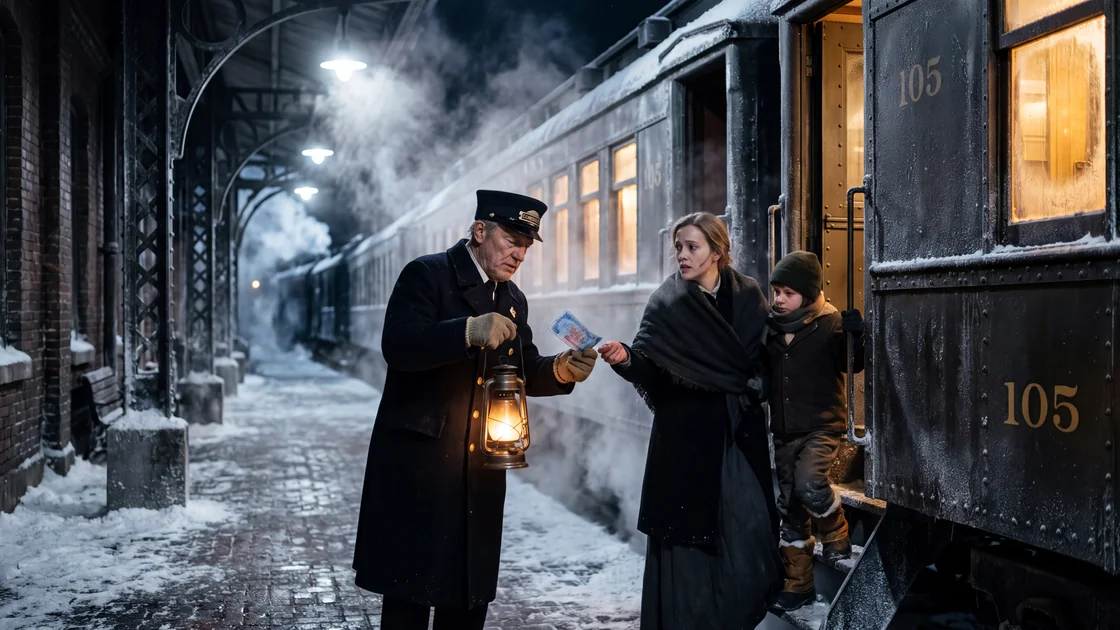
On a midwinter crossing from the Atlantic terminal at Port Osprey to the Pacific terminus at Cape Desolation, Arthur Cross, a veteran conductor of thirty-two years, discovers through torn tickets, whispered secrets, and identical legal papers that every soul aboard the Iron Meridian is fleeing the reach of the exact same man—an insidious, ubiquitous financier named Orville Brand—forcing Arthur to choose between the cold obedience of the railroad company's rulebook and the survival of a trainload of hunted strangers as they barrel toward a desolate mountain switch where Brand awaits them.
Act I: The Manifest at Platform Four
The steam at Port Osprey did not rise; it curdled. The frost was so sharp against the iron belly of Engine No. 9 that the condensation froze into long, pale claws before it could drip to the ties.
Arthur Cross stood by the vestibule of Car 103, his pocket watch resting heavy in the palm of his wool-gloved hand. A Hamilton 992B, twenty-one jewels, adjusted to six positions. Its ticking was not a mechanical sound to him; it was a pulse, an extension of his own steady heart. The second hand leaped with military dispassion toward the vertical numeral twelve. Five minutes to midnight.
"Tickets, please. Watch your step on the metal plates. Mind the frost, ma'am."
His voice was a low, seasoned baritone, raspy from thirty winters of breathing coal grit, soft coal soot, and the dry, overheated air of Baker heaters. He took the ticket slips between his calloused thumb and index finger, his silver punch flashing under the platform lamps. Click-clack. Chink. The confetti of punched paper gathered in the reservoir of the nickel-plated tool.
The passengers who boarded the Iron Meridian that night did not look like the passengers of the summer runs. In July, the Meridian carried wheat speculators in cream-colored linen, families with wicker baskets bound for the inland lakes, and young men smelling of dry goods and cologne, eager to seek timber claims in the western territory.
Tonight, there were no wicker hampers. There was very little luggage at all.
The first was a woman in an oiled cloth coat that had seen better days, carrying a carpetbag that seemed weighed down with flat, rectangular iron. Her hair was tucked under a dark knit cap, dyed an uneven, desperate black that showed bright copper at the roots. Her eyes flicked across Arthur’s brass buttons, his peaked cap, the dark recess behind him, and then out toward the snow-swirled platform.
"Carriage 104, Compartment B, Miss Sallow," Arthur said, checking the manifest against the slip. "First door on your right past the water closet. The steam is up, but I’d keep your coat on until we clear the coastal swamps. The draft comes up through the trucks."
"Does this train stop at High Gap?" she asked. Her voice was like gravel turned over with a trowel.
"Water only, ma'am. No passengers taken or discharged between Grand Junction and the western notch. You’ve through-passage to the coast."
She let out a breath that smelled faintly of peppermint and clove oil—the sharp scent of someone trying to disguise the metallic tang of fear. "Good. Don't let anyone in. I have the lock."
"Every compartment has a brass bolt, Miss Sallow. The porter and I carry the only master skeleton, and neither of us uses it without knocking twice."
She nodded once, jerkily, and vanished into the warm, varnished darkness of the corridor.
Next came an old gentleman whose tweed suit hung from his shoulders like canvas over an easel. He carried no bag, only two rectangular wooden cases with brass handles and perforated zinc sides, through which came the faint, earthy reek of wet peat and vegetative rot. His fingers were stained with dark tincture, iodine or printer’s ink, and he held his ticket in his teeth while he adjusted his grip on the cases.
"Dr. Finch," Arthur murmured, squinting at the ticket stub under the platform lantern. "Carriage 102, Upper Berth 6."
"The zinc cases," the old man said, his voice fluttering like a dry leaf. "They cannot be placed in the baggage van. The temperature in the van drops below freezing over the Divide. The mosses will crystalize. If the mosses crystalize, forty years of hybridization are gone."
"Keep them at the foot of your berth, Doctor. Just keep the lids latched. We have an inspector from the Agricultural Board who occasionally rides the caboose out of Grand Junction, and he is particular about unlisted botanical samples."
"He won't be aboard," Finch said with a flat, chilling certainty. "He was retired on Tuesday. By executive order."
Arthur looked up from the punch. Finch’s eyes were rheumy and bloodshot, the eyes of an owl dragged into noon, but behind the wet film was an electric, vibrating terror.
"Is that so?" Arthur said.
"The whole bureau," Finch whispered. "Dissolved. The assets sold for scrap before the morning editions were on the stands." He snatched his ticket back with trembling, liver-spotted fingers and scuttled up the iron steps, the zinc boxes bumping against his shins.
Arthur frowned. He made a small pencil mark on the edge of the yellow manifest sheet. Finch—excess baggage—berth 6.
A gust of wind tore across the platform, driving a veil of granular snow through the gap between Car 103 and the station canopy. The engine gave its two-minute warning—a short, abrasive hiss from the cylinder cocks, followed by the deep, brassy thrum of the whistle. The sound bounced off the wet brick warehouses of the rail yard, mournful and definitive.
Down the platform, almost running, came three figures: a young woman clenching the hand of a boy of seven or eight, and a tall, stooped man in a threadbare beaver-skin coat who trailed ten paces behind them, his shoulders hunched against the gale.
The woman was pale, her cheeks marked with two round, feverish spots of crimson. Her wool shawl was wrapped twice around the child, who wore oversized galoshes that flopped against the salt-streaked boards.
"Hold the gate!" she gasped. "Please. We have the draft. We have the passage."
"Take your time, ma'am," Arthur said gently, stepping down to the bottom tread to offer his arm. "The Meridian doesn't move until I raise the lantern to the cab. Watch the boy's boots."
She thrust the ticket into his hand. It was not a standard ticket issued by the Port Osprey central wicket. It was an emergency voucher, printed on heavy blue banknote bond, stamped with an oval seal in vermilion ink. The ink was barely dry; it had smeared against her thumb.
Celia Vane and child. Carriage 105, Drawing Room A.
"Drawing Room A," Arthur said, his eyebrows rising slightly. That was the master suite, the one with the private lavatory and the mahogany drop-leaf table, usually reserved for regional directors or lumber barons. "You’re well accommodated, Mrs. Vane."
The boy looked up. His face was pinched with cold, his eyes enormous and unblinking. "We left the clock behind," he said.
"Hush, Leo," the woman snapped, though her hand tightened on the boy’s small shoulder until the knuckles went white. "Conductor, the rear carriage—is it empty?"
"Car 106 is an express sleeper, ma'am. Booked light tonight. Only four berths occupied between here and the foothills."
"And the doors? Can they be locked between the carriages?"
"Fire regulations forbid the deadbolting of vestibule doors while the train is in motion, Mrs. Vane. Company rule sixty-four."
She stared at him, her dark eyes hollow, the skin around them stretched tight over fine, aristocratic bone. "Then your company rules are written by men who have never been hunted."
Before Arthur could answer, she pulled the boy up the stairs. The boy’s boots made a dull thump-slap against the mahogany-and-linoleum floor of the hallway.
The man in the beaver-skin coat was the last. He did not give Arthur his arm. He hauled himself up by the brass handrail with a low grunt of physical effort. He was missing the little finger of his left hand; the wound was old, the scar a puckered purple star beneath a coarse woolen mitt. His breath was thick with rum and bitter almond oil.
"Vance," he said, not waiting for Arthur to ask. "Julian Vance. Car 104, Berth 9."
"Ticket, Mr. Vance."
The man produced his stub. It was the same blue banknote paper. The same vermilion stamp.
Arthur held it under his lantern. His thumb traced the edge of the voucher. "The Provident Trust of the North," Arthur read aloud from the oval mark. "Curious. I haven't seen a voucher from the Provident Trust since the bank holiday three years ago. I thought their charter was revoked."
Julian Vance leaned down. His teeth were long, yellow, and irregular, like the keys of a neglected upright piano. "Their charter wasn't revoked, Conductor. It was bought. Every ledger, every mortgage, every scrap of chattel paper. Every drop of ink."
"By whom?"
Vance didn't answer. He looked back over Arthur’s shoulder into the white swirl of the empty platform. The clock on the station wall stood at 11:59. The porter, young Jesse Cole, was already walking the length of the train from the rear, swinging his green lantern to signal that the ground was clear.
"Are we leaving?" Vance asked, his voice dropping into a harsh rasp. "Are the pins pulled? Are the switches thrown?"
"Right now, sir."
"Then blow your whistle, old man," Vance muttered, turning toward the vestibule. "Blow it until your lungs burst."
Arthur stepped down to the platform ballast, raised his lantern above his head, and inscribed three wide, deliberate circles in the freezing air. High in the cab, nearly two hundred yards forward through the blizzard, the engineer, old Silas McCrae, cracked the throttle.
The slack ran out of the couplers with a series of iron crashes that echoed down the line like artillery—clonk-clonk-bang-bang—and the Iron Meridian leaned into the dark.
Act II: The Anatomy of a Voucher
By two in the morning, the city of Port Osprey was four score miles behind them, drowned beneath four inches of coastal slush, and the Meridian was boring into the Black Spruce woods. The rhythm had settled: the hypnotic, double-jointed click-click... clack-clack of wheels crossing the thirty-nine-foot rail joints, the long, groaning heave of the trucks as the carriages took the reverse curves through the river bottoms, and the periodic shudder-thrum of the coach floorboards whenever the engine bit into a bank of drifted snow.
Arthur Cross sat in the conductor’s corner of Car 101, the crew coach. A green-shaded kerosene lamp hung from a gimbals above his desk, casting a clean circle of light over his paper kingdom.
Before him lay the punch receipts, the ticket stubs, and the passenger manifest.
Arthur was a creature of system. He had entered the service of the Grand Continental in the days of wood-burners and link-and-pin couplers, when a conductor lost two fingers his first season or died of gangrene from a pinned knee. He had survived by reducing the world to columns: Mileage, Car Number, Consignee, Origin, Destination, Fare.
He picked up the ticket of Miss Nora Sallow.
It was standard cardstock, but pasted to the reverse was an authorization slip—the same light-blue paper he had seen in the hands of Mrs. Vane and Julian Vance.
Arthur pulled a magnifying glass from his vest pocket. The glass had a silver frame, worn smooth at the heel from forty years of rubbing against his keys. He held the blue slip under the lamp.
The text was engraved in a delicate, spider-web copperplate:
Authorized for transit under the liquidation provisions of the Northern Maritime Syndicate. Non-transferable. Clear passage guaranteed through all rail districts without attachment or garnishment.
In the lower left-hand corner was an endorsement in iron-gall ink. The handwriting was exceptional. It possessed none of the hasty slashes or lazy loops of modern rail clerks. It was upright, cold, and needle-sharp, the letters formed with the geometry of surgical instruments.
O. B.
Arthur reached into the pigeonholes above his desk and pulled down the rest of the night’s collection.
There were twenty-eight passengers in the four sleeping cars. On a normal Tuesday in January, there might be fifteen: commercial travelers carrying trunks of samples, a cattleman returning from the Chicago stockyards, perhaps a surveyor for the mining companies.
Arthur laid the tickets out on the green baize of his folding table like a deck of tarot cards.
Ticket twelve: Dr. Alistair Finch. Blue bond backing. O.
B.
Ticket fourteen: Julian Vance. Blue bond backing. O. B.
Ticket sixteen: Elena Varga. Carriage 103, Roomette 4. Blue bond
backing. O. B.
Ticket twenty-one: Marcus Vane (occupying Carriage 105 with Mrs. Vane
and child). Blue bond backing. O. B.
Ticket twenty-four: Gideon Stone. Carriage 106, Berth 2. Blue bond
backing. O. B.
Arthur sat back. His uniform coat creaked. The silver watch in his vest ticked against his ribs with the persistent, rhythmic warning of an alarm bell heard through deep water.
Every single first-class and second-class passenger between the engine tender and the observation car held a voucher endorsed by the same hand.
"Jesse," Arthur called out.
The curtain to the crew bunk parted, and Jesse Cole emerged. The young porter had his dark coat unbuttoned, his collar off, showing the thick tendons of his brown neck. He was twenty-four, born in a railway shanty in the river bottoms, with hands as quick and light as sparrows. He had been on the line two years and could make up an upper berth in forty-five seconds flat.
"Yes, Mr. Cross?"
"Did you take the water service through Car 103 and 104?"
"Did." Jesse leaned against the mahogany partition, rubbing the red marks left on his forehead by his service cap. "Weird bunch tonight, Mr. Cross. Usually folks want their ginger beer or their ice water, or they want to know what time we hit Grand Junction so they can send a wire to their cousins. Tonight? Not a one."
"None?"
"None. Miss Sallow in Car 104 wouldn't even let me set the tray down on the shelf. She cracked the door two inches. Kept the chain on. Handed me two bits through the slot and told me to make sure the end-door curtains were drawn."
"Did she say why?"
"Said the snow was too bright," Jesse replied, shaking his head. "It’s two in the morning, pitch black outside, snowing hard enough to bury a cow, and she says the snow is too bright. And that young girl in Car 103—the one with the violin case under the berth."
"Miss Varga?"
"She isn't sleeping. She was sitting on the edge of the mattress with her boots on. I asked her if she wanted the bolster turned. She didn't look up. Just had her hands out over her knees, working her fingers. Like she was playing a fiddle that wasn't there. Silent. Her knuckles were raw red, like she’d been scrubbing stone floors with lye."
Arthur turned the magnifying glass in his fingers. The brass frame caught the light from the lamp.
"What about Car 106? The big fellow in Berth 2?"
"Gideon Stone?" Jesse’s expression changed. His shoulders lowered slightly, adopting the guarded neutrality he used when the yard bulls came around the shacks with clubs. "That man isn't a traveler, Mr. Cross. He’s got coal dirt under his skin that’s five years old. Real miner's skin. But he’s wearing a collar three sizes too small that looks like it came out of an undertaker’s basement. He had a copy of the Port Osprey Gazette spread out on his lap, but he wasn't reading it. He’d cut every single picture out of it with a razor. Every portrait. There was just twenty little square holes in the paper."
"Did he speak to you?"
"Asked me if the train stopped at the river crossing before the timber line. I told him we only stop at the water towers. He asked me if the ice on the river would hold an automobile."
Arthur leaned forward. "An automobile? In this weather?"
"That’s what he said. I told him nothing moves on the old county road past November except timber sleds and six-horse teams. He looked at the holes in his newspaper and said, 'He doesn't use horses.'"
Arthur stood up. He smoothed the creases of his blue trousers, adjusted his belt, and took his master keys from the hook. The bunch was heavy—twenty iron and brass keys on a cold-rolled steel ring, representing every pantry, locker, signal box, and sleeping berth between the coal tender and the rear platform.
"Jesse, get your cap on."
"Something wrong with the cars, Mr. Cross?"
"I don't know yet," Arthur said, sliding the vouchers into his breast pocket, directly over his heart. "Keep the tea hot in the galley. I’m going through the train."
Act III: The Whispering Gallery
The vestibule between Car 101 and 102 was an iron lung of ice and roar. The rubber diaphragms that connected the cars groaned like dying oxen as the Meridian took an S-curve through the Black Spruce cut. Arthur stepped across the overlapping steel floorplates; snow had drifted in through the canvas accordion folds, forming a fine, powdery sugar that crunched beneath his thick-soled leather shoes.
He opened the door to Car 102.
The atmosphere changed instantly. The smell of the sleeper was an ancient, familiar compound: moist wool drying over radiator pipes, paraffin oil from the night-lights, old cigars trapped in velvet drapes, and the faint, sweetish undertone of human sweat held in close quarters.
The green baize curtains of the lower and upper berths were all drawn, swaying together in unison like the robes of a choir bowing toward the engine.
Arthur moved down the narrow carpeted aisle, his tread soundless.
From behind Berth 6 came a dry, rhythmic rustling, like mice in a grain bin.
Arthur paused. He did not pull the curtain—a conductor respected the passenger’s six-by-three-foot territory as sacred ground—but he stopped by the brass number-plate.
"Dr. Finch?" he whispered.
The rustling stopped. A sharp intake of air.
"Who is that?"
"Cross. The conductor. Just checking the steam lines. Your berth warm enough, sir?"
A pause. Then the curtain twitched back three inches. Dr. Finch’s face appeared in the gap. He had taken off his spectacles; his eyes were small, red-rimmed pits in a parchment mask. In the dim light of the aisle lamp, Arthur could see one of the zinc cases open upon the lower sheet. Finch was not sleeping; he was holding a magnifying lens of his own over a cluster of gray, fibrous lichen that grew from a split piece of river slate.
"The temperature is adequate," Finch said. His breath was sour, like vinegar. "Do we maintain speed?"
"Sixty miles an hour across the flats, Doctor. We’ll reach the foothills by eight tomorrow morning."
Finch’s hand came out through the curtains. It was a scholar’s hand, long-fingered and delicate, but the skin across the back was scratched with dozens of small, scabbed incisions. "He was at the university at four o’clock," the old man murmured.
Arthur tilted his head. "Who was?"
Finch smiled, a terrible, dry movement of the lips that did not reach his eyes. "You don't know the name? They didn't tell you whose vouchers you were honoring?"
Arthur drew the blue slip from his pocket and held it so the faint aisle light caught the copperplate script. "It’s endorsed O. B. The Provident Trust."
Finch let out a short, rattling cough that sounded like dry beans shaken in a gourd. "Orville Brand doesn't need a trust, Conductor. A trust is an instrument for men who recognize the courts. Brand only recognizes the balance sheet."
"Your patron?" Arthur asked gently.
"My executioner," Finch said, and for a moment the old man's voice lost its tremor, becoming clear and cold. "Three years ago, my department required a greenhouse. A simple glass conservatory for the classification of high-altitude flora. The state legislature had cut the grant. A gentleman in an iron-gray broadcloth coat called upon my rooms. He did not ask for interest. He asked for an option."
"An option on what?"
"On my signatures. On every description of every organism I identified for the remainder of my natural life. I thought he was an eccentric collector. I thought he was a merchant who wished to corner the market on medicinal barks." Finch leaned closer; his fingers brushed the brass buttons of Arthur’s coat. "He didn't want the bark, Mr. Cross. He wanted the patents on the extracts that kill the sheep-rot. Last month, thirty-four thousand tenant farmers in the southern basin found their flocks rotting on their feet. The only compound that neutralizes the rot was patented under my name, transferred to his holding company. He tripled the price. When they couldn't pay, the mortgages fell due. He took twelve hundred farms in thirty days."
Finch reached back into his berth and touched the gray lichen. "I took the mother culture from the laboratory vault yesterday afternoon while his auditors were inventorying the furniture. Without this, his chemists cannot brew the culture. He has the land, but the rot will run until June unless he gets this stone back."
"You’re going to the coast?"
"I’m going to the Pacific," Finch said. "There is a steamer for Vladivostok on Sunday. If I reach salt water, the culture survives. If he catches this train..."
"He won't catch the train, Doctor," Arthur said, though his own voice sounded thin to his ears against the iron rumble of the trucks below. "The Iron Meridian has the right of way over everything between here and the ocean. We don't take sidings for anything less than a silk train or a presidential special."
"He doesn't need a siding," Finch whispered, and pulled the curtain shut.
Arthur stood in the aisle for a long time.
He felt the train lurch—a sharp, sideways heave as the flanges struck a frosty turnout at a logging junction. The wood paneling of Car 102 groaned; the brass light fixtures chimed against their mounts.
He walked toward Car 103.
In Roomette 4, the light was not out. A thin line of gold showed beneath the mahogany door.
Arthur tapped twice with his pencil. "Miss Varga?"
The response was immediate, as if she had been standing with her ear to the wood. "Go away."
"It’s Cross, the conductor. I have your border customs declaration to sign. We cross the territorial line before daybreak."
A key turned in the brass lock. The door slid open three inches, held by the heavy safety latch.
Elena Varga was no more than twenty-two. Her skin was the color of skimmed milk, and her black hair was dragged back into an untidy knot held with bone hairpins. She was not looking at him; she was looking at the small space of hallway behind his left shoulder.
"You’re alone?" she asked.
"Always alone on my rounds, miss."
She looked at his uniform, at the silver stars on his sleeve that marked each decade of service. "You’ve worked for the railroad a long time."
"Long enough to remember when these cars were lit with tallow candles."
"Can a man buy a train while it’s moving?"
The question was so strange, delivered with such flat, unblinking intensity, that Arthur paused with his pencil suspended over his pad. "The Grand Continental is a publicly traded corporation, Miss Varga. Its stock is held by the pension funds and the banks in Montreal and New York. No single man can buy a line."
She reached down to the small mahogany washstand beside the door. Her violin case lay upon it, but it was not the fine, molded leather case of a concert soloist. It was a rough wooden box, nailed shut with horseshoe nails around the seams, like an infant’s coffin.
"He doesn't buy the railroad," she said. "He buys the men who hold the paper on the track. He bought the orchestra in September."
"The Municipal Philharmonic?"
"He bought the hall first," she said, her voice dropping into a rhythmic, trance-like cadence. "Then he bought the instrument makers. My Guadagnini... my father bought it in Vienna before the war. When my father died, the estate owed four hundred dollars in probate fees to the North Harbor Savings Bank. Mr. Brand’s bank. I went to pay the four hundred dollars. They told me the interest had been recalculated under a charter from 1842. The debt was not four hundred dollars. It was four thousand."
Arthur felt a cold draft against his ankles. The train was climbing now; the sound of the engine was deeper, a slow, lung-splitting haff-haff-haff as it dragged eight hundred tons of steel up the first tier of the northern plateau.
"What did he want, Miss Varga?"
"He wanted me to play for him," she said simply. "Every Thursday evening. In his library at the top of the grain elevator. Just him, sitting in an armchair made of green leather, with a glass of seltzer water on a silver tray. No music on the stands. He wanted me to play the mistakes."
"The mistakes?"
"The passages where the hand slips. The discords. The notes that make the teeth ache. He sat there and watched my fingers bleed when the steel E-string bit down. He told me that human perfection was a vulgarity. He said anyone with five years of discipline could play Bach, but it took a soul in total ruin to play truly modern music."
She raised her hands. In the lamplight, Arthur could see the yellow-white calluses on her fingertips, cross-hatched with dozens of tiny, dark lines where the steel strings had cut through the meat to the bone.
"I pulled the bridge off the wood yesterday," she whispered. "I smashed the soundpost with a claw hammer. I put the pieces in this box. I took the voucher from his desk while he was in the washroom. The ticket agent didn't even look at me; when he saw the blue paper and the O.B., he gave me the best roomette on the train and backed away from the wicket like I had the cholera."
She leaned toward the crack in the door. "He has men in every telegraph tower from here to the coast, Conductor. He knows which carriage I’m in. He knows which berth."
"He doesn't know this train," Arthur said, and for the first time that night, his voice carried the old, hard arrogance of the iron road. "On the Meridian, Miss Varga, nobody touches a passenger without my authorization. Not the provincial police, not the marshals, and not a banker from Port Osprey. You lock this door and go to sleep."
She looked at him for a second longer, her dark eyes searching his wrinkled face for some sign of deceit or weakness. Then she closed the door. The brass bolt slammed home with a decisive, oily snap.
Act IV: The Web in the Wilderness
Arthur did not return to Car 101. He walked back through the train, car by car, the weight of the silver punch in his pocket feeling heavier with every yard.
Car 104 was dark. Miss Nora Sallow’s compartment was silent, but when he passed the louvered door, he caught the faint, unmistakable smell of singed paper. She was burning letters in her washbasin.
In Car 105, the drawing room door was cracked an inch.
Arthur did not intend to look, but the boy’s voice stopped him.
"...is he behind the trees, Mama?"
"No, darling. There are no trees where he lives. Only stone."
"Why did he take Papa’s coat?"
"Because Papa didn't need it anymore."
Arthur peered through the hinge gap.
Mrs. Vane was sitting on the horsehair sofa, her coat off now. Her dress was of fine silk, but the hem was caked with dried mud from the Port Osprey docklands. Opposite her sat the tall, broken-nosed man he had seen on the platform—not her husband, as Arthur had first assumed, but the actor, Marcus Vane, whose name had once appeared on the playbills of the Grand Opera House.
Marcus was staring at his hands—those hands with the missing finger. On the drop-leaf mahogany table between them lay a heavy, brass-bound ledger.
"It’s not enough to run, Marcus," the woman said. Her voice was flat, dried of tears. "He has the sheriff at High Gap. He has the land commissioner at the border."
"The border is five hundred miles," Marcus croaked. "Silas McCrae is at the throttle. Silas doesn't stop for sheriffs. I’ve seen him split a snowdrift eight feet deep without touching the brake."
"Silas McCrae has a son," she said.
Marcus went still.
"His boy works the roundhouse at Grand Junction," she continued, her voice a knife slipping between ribs. "Do you think Brand doesn't know that? Do you think Brand hasn't already bought the boy's mortgage? He doesn't need to stop the engine with an iron bar, Marcus. He stops it with an envelope."
Arthur stepped back from the door. His throat felt dry, filled with the taste of sulfur and old brass.
He turned toward Car 106—the rear sleeper.
This was the oldest car in the consist, an old wooden-bodied Pullman that the company hadn't yet replaced with all-steel construction. The timbers groaned under the stress of the curves, a long, low creaking like the ribs of an old ship sailing into an arctic gale.
Gideon Stone was not in his berth.
He was sitting in the small smoking compartment at the rear of the carriage, where the leather armchairs were cracked and the spittoons were green with verdigris.
The miner sat with his heavy, broad shoulders wedged into the corner, his boots braced against the brass railing of the footrest. He had a small kerosene lantern on the table beside him, its wick turned down to a smoky blue bead.
In his hand was a large pair of tailor's shears.
Around him on the floor lay the mutilated pages of the Port Osprey Gazette. Small, neat squares of newsprint, each bearing the likeness of a city councilman, a bank director, a judge, or a shipping agent, were arranged in rows on the red plush seat beside him.
Arthur entered the compartment. The iron door latch clicked behind him.
Stone didn't jump. He didn't even turn his head. He merely continued his work, the shears making a dry, crunching sound as they cut through the cheap paper: snip... snip... snip.
"You’re creating a fire hazard, Mr. Stone," Arthur said quietly.
"Paper burns fast," Stone replied. His voice was deep, coming from the depths of a chest that had inhaled twenty years of granite dust. "Not like coal. Coal takes time. Coal holds the heat until the whole hill falls in."
Arthur sat down in the armchair opposite him. He took off his peaked cap and set it on his knee. For the first time in thirty years on the road, he felt old—not simply tired, but outpaced by a world that had abandoned iron and steam for ink and debt.
"What was your pit, Stone?"
The miner stopped his shears. He looked up. His eyes were small, gray, and flat, like two lead slugs hammered into stone.
"Number Four. The Black Ledge. Near the border."
"Good coal," Arthur said. "Steam coal. The Grand Continental used to buy six thousand tons a month from the Black Ledge."
"Until October," Stone said. "October the eighth. The shift was coming off. Brand bought the drainage rights for the lower gallery from the widow of the founder. He didn't work the pumps. He turned the valves off."
"Why?"
"To see how long the water would take to rise," Stone said simply. "We had forty men on the lower level. He sent a clerk down with an agreement. Five cents less on the ton, and he’d turn the pumps back on. We held out twelve hours. The water was up to our armpits. The mules drowned first. You ever hear a mule drown in a dark hole, Conductor?"
"No," Arthur said.
"They sound like women. High-pitched. They scream through their noses." Stone picked up one of the paper squares. It was a picture of a man with round, steel-framed spectacles, thin lips, and hair parted with geometric precision down the center of a wide skull. "We signed. Every man of us signed his new agreement. When we came up the cage, he had the company store locked. He told us the five-cent reduction was retroactive to July. We owed him forty dollars a head for the tools we’d used to dig his coal."
Stone laid the shears down on the table. The iron blades clicked against the marble top.
"I hit his clerk with an iron drill-steel," Stone whispered. "I felt his collarbone go like dry hemlock. Then I walked three nights along the ties to Port Osprey. A man in the shanties gave me this blue paper. Said it was the only ticket that would get a man across the mountains before the telegraph caught up with him."
Arthur reached into his pocket. He took out the stack of vouchers. He fanned them out on the table between them—twenty-eight blue slips, each bearing the identical red seal, each with the needle-sharp signature: O.B.
Stone looked down at them. His breath came short and harsh.
"He gave these to you?" Stone asked.
"No," Arthur said. "He gave them to you. To all of you."
Stone stared at the vouchers. A slow, terrible dawn of understanding broke across his battered, gray-featured face. "He didn't miss us," he whispered. "He... he packed us."
"A train," Arthur said, his eyes fixed on the blue slips, "is the only place where a man cannot turn aside. The rails only go where the switches let them. Between Port Osprey and Cape Desolation, there are four hundred miles of spruce swamp and five hundred miles of granite. No towns. No roads. Only the single track."
"He put us all in one box," Stone said. His huge hands curled into fists that looked like granite paving stones. "He didn't lose his ledger. He just balanced it."
Act V: The Wire at White Fall
At 4:15 in the morning, the Iron Meridian slowed for the water tank at White Fall.
There was no town at White Fall—only a two-story timber shack where the pump-man lived, a red-painted cedar water tank on stilts, and a telegraph bay that projected from the station shanty like the eye of an insect.
The snow had ceased falling, but the wind had risen. It came down from the high passes with a shrieking, dry fury, whipping the snow off the roofs in long, blinding sheets that obliterated the red tail-lights of the train.
Arthur stood on the bottom step of Car 101, his lantern held low. The cold hit him like an iron plate against the face. His mustache froze into a solid, brittle hedge before he had taken three breaths.
The engine was taking water with a hollow, rushing roar, the canvas spout groaning in the gale as Silas McCrae held the chain.
From the door of the telegraph shanty, a figure came stumbling through the drifts. It was not the station agent; it was a boy, no more than sixteen, wrapped in an old cavalry blanket, his ears bundled in flannel rags.
"Mr. Cross?" the boy screamed against the wind. "Arthur Cross?"
"Here!" Arthur jumped down into the knee-deep snow, his boots finding the frozen ballast with a dull crunch. "What have you got, son?"
"Priority wire!" The boy held out a yellow envelope, stiff with frost. "Came through from Grand Junction twenty minutes ago. The wire was jumping so bad with the wind I had to take it by sound on the brass tongue. The line to the west is dead—trees down in the notch, likely—but this came from the East."
Arthur ripped the envelope open with his thumb. He turned his back to the wind and held his lantern over the thin yellow strip:
DISPATCH 44 - PORT OSPREY YARDS TO CONDUCTOR CROSS TRAIN NO 9
HOLD ALL PASSENGERS AT BLIND RIVER SIDING MILEPOST 214.
DO NOT ENTER SENTINEL PASS.
SPECIAL COMMISSIONER EN ROUTE BY INSPECTION ENGINE 104 TO ASSUME CUSTODY
OF ALL CHATTEL AND PERSONS UNDER PROBATE WRIT 881.
ALL VOUCHERS CANCELLED BY ORDER OF PROVIDENT TRUST.
CONFIRM RECEIPT AT WHITE FALL.
(SIGNED) O. BRAND, RECEIVER.
Arthur looked at the paper.
The ink was black, printed by the trembling siphon recorder of the western wire.
Special commissioner en route by inspection engine.
That meant an engine running light—a high-wheeled Atlantic-type with only a cab and a tender, carrying three or four men, moving at seventy miles an hour over the clear track behind them. With no train of heavy cars to drag, an inspection engine could run down the Meridian before she cleared the Sentinel Notch.
And at Blind River, forty miles ahead, was the only passing siding before the grade began. A spring switch. A lonely stretch of track where the winter timber trains were laid up to let the flyers through.
If the Meridian took the siding, the switch would lock them into the hole. And once they were in the hole, the light engine would pull across the frog, and the trap would be shut.
Silas McCrae came walking back along the running board of the tender, a five-foot oiling can in his mittened hand. His goggles were pushed up onto his grease-spotted cap; his white beard was yellowed around his mouth with tobacco juice.
"Arthur!" Silas barked. "We’re full of water and the coal's running good. But the injector on the left side is freezing up. We need to get moving before the valves seize."
Arthur handed him the dispatch.
The old engineer took it, holding it close to the flame of his lantern. His eyes moved slowly across the lines. He spat a dark stream of tobacco juice into the snow; it hissed as it hit the hot cinders under the firebox.
"Orville Brand," Silas said. He did not sound surprised. He sounded like a man who has found dry rot in his cellar beams—disgusted, but resigned to an ancient enemy.
"You know him, Silas?"
"He holds the paper on the Grand Junction shops," Silas said, staring into the dark along the engine's steel flank. "My boy Tommy... Tommy was five hundred dollars short on his apprentice bond when he started. Brand’s clerk took the note. Tommy gives them fifteen dollars a month out of his wage. He’s been paying it for seven years. Last week, Tommy told me the principal had gone up to eight hundred."
The wind screamed through the telegraph wires overhead—a high, singing drone like a thousand violins playing an endless, unresolvable discord.
"He tells us to go into the hole at Blind River," Arthur said.
"If we take the siding," Silas said, "we’re done. The grade out of Blind River is two percent. If I stop eight hundred tons of train on that grade in this frost, the sanders won't hold. We won't start again until the rotary plow comes down from the summit in April."
"And if we don't take the siding?"
Silas looked up at the high cab of Engine No. 9. Steam was whispering from the safety valves—a thin, white plume that vanished instantly into the black sky.
"The switch at Blind River is a spring switch, Arthur. It’s set for the main line. But it’s padlocked. The section men lock it open for the timber trains so the snow don't pack the points. If the lock is in, we can't blow through it without splitting the rail and dropping the trucks into the ditch."
"Who has the key?"
Silas reached down and touched the small brass key that hung from his own neck on an oiled shoestring. "Every runner has one. Every conductor has one. But somebody has to be on the ground to throw the iron and pull the pin before the pilot hits it, or we’re off the iron."
"No," Arthur said. His voice was suddenly very calm. The cold had stopped biting his face; he felt only a strange, crystalline clarity, like the air at ten thousand feet. "The dispatch says an inspection engine is behind us. How much time do we have?"
Silas checked his watch—an old silver Elgin, forty years on the road. "If they left Port Osprey at three, running light with seventy-inch drivers? They’re fifty miles back. They’ll be on our markers by the time we hit the river flats."
"Then we don't take the siding," Arthur said.
Silas looked at him, his old, rheumy eyes wide behind his grease-smeared spectacles. "Arthur, that’s company property. You’re talking about running a dispatch order. That’s prison. That’s five years in the penitentiary at Stony Mountain."
"There are twenty-eight people back there, Silas," Arthur said, nodding toward the dark, varnished cars of the Meridian. "A little girl. A boy. An old man who loves moss. A girl who broke her own fiddle so an old man couldn't watch her bleed. They aren't company property."
Silas stared at his conductor for three long seconds. The wind tore at his beaver coat, flapping the heavy wool against his knees.
Then the old engineer turned, took two strides toward the cab ladder, and hauled himself up onto the steel plate.
"Get aboard, Arthur!" he shouted down over the hissing steam. "Get aboard and tell that boy of yours to shovel every lump of hard coal he can find into the firebox. I’m going to run this engine until the side-rods whistle."
Act VI: The Council of the Fugitives
The Iron Meridian did not pick up speed gently.
When Silas opened the throttle, the drive wheels slipped on the frosted iron with a scream of tortured metal that shook the entire train from tender to observation platform. A shower of yellow-orange cinders erupted from the stack, flying back like a trail of angry stars against the black spruce forests. Then the sanders bit. The steel tires grabbed the rails, and the train lunged forward with a violent, bone-snapping jerk.
In Car 103, Arthur walked down the aisle, his lantern swinging from his elbow.
The passengers were no longer in their berths.
The sudden, brutal acceleration, the continuous, shrieking blast of the whistle as Silas cleared the timber crossings, and the wild, rolling gait of the carriages had brought them all out into the narrow corridors.
They stood like ghosts in the dim lamplight: Dr. Finch clutching his zinc boxes to his chest; Elena Varga with her coat half-buttoned over her nightdress, the nail-studded wooden box held beneath her arm; Julian Vance leaning against the mahogany bulkhead, his yellow teeth bared in an unconscious snarl; Nora Sallow, her dyed hair wild and tangled around her pale face; and Gideon Stone, filling the doorway of the vestibule like a mountain of coal-dirt and wool.
Mrs. Vane stood at the entrance to Car 104, her son Leo hidden behind the folds of her silk skirt.
"We aren't stopping at Grand Junction," Julian Vance said, his voice shaking with a mixture of rage and terror. "We took the curve at seventy. I know the sound of the frogs at the Junction. We ran the board!"
"We ran it," Arthur said, stopping in the center of the car. He set his lantern down on an upturned luggage crate.
"The wire?" Nora Sallow asked. She pushed her way forward, her fingers digging into the wool of Arthur’s sleeve. "The wire came through, didn't it? He’s behind us."
"An inspection engine," Arthur said. He did not raise his voice, but the entire carriage went so quiet that the only sound was the dry, singing roar of the wheels beneath the floorboards and the deep, laboring chug-chug-chug of the engine two hundred yards ahead. "Running light. With three marshals and Mr. Brand himself."
A low, collective moan went through the corridor—a sound not quite human, like the wind in an empty grain elevator.
"He won't take us back," Gideon Stone said. He held the tailor's shears in his right hand, the blades closed, forming a twelve-inch iron dagger. "I’ll drop the bridge at the gorge first."
"You won't drop anything, Mr. Stone," Arthur said sternly. "This train belongs to the Grand Continental Railroad. It doesn't belong to Orville Brand, and it doesn't belong to a mob of scared travelers."
"Then why are we running?" Elena Varga asked. Her voice was small, but it pierced through the heavy air of the car like a needle. "If you are with the company, Conductor, why didn't you put us in the siding at White Fall?"
Arthur took his peaked cap off. He held it in both hands, his thumbs tracing the silver embroidery of the company crest: two crossing rails, an eagle, and the motto Per Ardua ad Mare—Through hardship to the sea.
"Thirty-two years ago," Arthur said, "I took an oath to this line. I swore to protect the passengers, the express mail, and the rolling stock, in that order. The company has forgotten the order. They think the stock comes first, the mail second, and the people are just freight that pays its own way."
He looked around at their faces—the old botanist whose hands were scarred with his own work; the girl who had ruined her music to keep her dignity; the miner who had breathed stone until his lungs were slate; the mother whose boy was staring at the floor with wide, deadened eyes.
"You all hold blue paper," Arthur said, drawing the stack of vouchers from his coat. "You thought you were buying your way to the ocean. You weren't. He gave you those vouchers because he wanted you all in one consist. He wanted the moss, he wanted the patents, he wanted the miner's confession, he wanted the ledger, and he wanted the girl. If you were scattered across four provinces, it would have taken his lawyers five years and fifty thousand dollars to round you up. This way? He only had to buy one train."
Julian Vance sank into an armchair, his head in his hands. "We walked into the pen," he sobbed. "We paid for our own slaughter-tickets."
"No," Arthur said. "He bought the train. But he hasn't bought the crew."
From the front of the carriage, the door opened, admitting a swirl of freezing snow and Jesse Cole. The young porter was black with coal dust; his shirt was torn at the shoulder, and his eyes were wide and bloodshot from the heat of the firebox.
"Mr. Cross!" Jesse shouted over the roar of the trucks. "Silas says the light engine is past White Fall! He saw their headlight on the long straight behind the marsh! Five miles and closing!"
Arthur put his cap back on. The leather sweatband was cold against his brow.
"How far to Blind River siding?"
"Ten miles," Jesse said. "Eight minutes at this run. But the switch, Mr. Cross... Silas says the snow is drifted six feet deep over the switch-stand. If the points don't lay flat, we’ll climb the rail and pile up in the timber."
Arthur turned to Gideon Stone. "Mr. Stone, how much weight can you throw?"
The miner looked down at his own huge, calloused hands. "I’ve thrown twelve-hundred-pound timber cribs when the roof was coming down."
"Jesse," Arthur said, "take Mr. Stone forward to the engine cab. Silas has two track bars and an iron maul on the tender deck. When we hit Blind River, we aren't going into the siding. We’re going to spike the switch for the main."
"Spike it?" Julian Vance looked up, his face gray with horror. "If you spike the switch, his engine can't take the siding either! He’ll run straight into our markers!"
"No," Arthur said. "He won't run into our markers. Because when we clear the switch, we’re going to throw the iron behind us and drop the switch-points into the river gorge."
Act VII: The Stand at Blind River
The Blind River bridge was an ancient timber trestle that spanned a three-hundred-foot cleft in the granite plateau. At the eastern approach to the bridge lay the siding—a thousand yards of rusty iron used for the winter tie-trains, ending in a rock bluff.
The Iron Meridian came out of the Black Spruce cut like an iron projectile.
The storm had returned with a strange, screaming intensity, not as falling snow, but as high, ground-level drift that moved across the track in blinding white waves. Through the gloom behind them, two miles back, a single eye of fierce, electric brilliance flickered against the trees—the high-mounted searchlight of the inspection engine.
It was running without a train, sixty tons of steel mounted on four six-foot drive wheels, leaping over the joints like a wolf on the scent of a wounded deer.
Arthur stood in the open gangway between the tender and the cab of Engine No. 9.
The heat from the firebox door was an orange furnace that scorched the wool of his trousers, while the wind from the left side froze the sweat on his cheek into a mask of ice. Silas McCrae stood with his left hand frozen to the brass throttle, his right hand resting on the air-brake handle, his teeth clamped so hard on his tobacco plug that his jaw muscles twitched like cables.
Beside him, Gideon Stone leaned against the coal boards, his beaver-skin coat discarded, wearing only a sleeveless flannel shirt that showed the thick, corded muscles of his back, black with soot and wet with sweat.
"There’s the board!" Jesse yelled from the fireman’s seat, pointing through the front cab window.
Through the blizzard, a single red lantern appeared, swinging wildly from the top of an eight-foot timber mast: the approach signal for Blind River.
"She’s set for the siding!" Silas bellowed. "Some bastard’s been here before us! The switch is thrown for the hole!"
Arthur leaned out into the screaming slipstream.
The switch-stand was fifty yards ahead, nearly buried in a white drift that had formed against the cedar ties. The switch-target—a sheet-iron arrow painted white—pointed dead into the siding, toward the dark rock wall where the track ended.
If they hit it at fifty miles an hour, the train would fold like a paper accordion against the stone.
"Silas!" Arthur shouted. "Reverse the gear! Give her the sand!"
Silas grabbed the massive steel lever of the Johnson bar—the reverse gear that controlled the engine’s valve timing. It took every ounce of his weight and Arthur’s shoulder behind him to drag the heavy steel latch out of its forward notch and haul it back across the quadrant into reverse.
Clank-clonk-bang!
The engine shuddered as if it had struck an anvil. Silas cracked the throttle.
Steam entered the cylinders against the motion of the pistons; a sound like the world cracking in two erupted beneath the floor plates as the eight drive wheels locked, screamed, and began to spin backward against the iron rails, throwing two continuous fountains of white-hot steel shavings twenty feet into the dark.
The speed dropped—forty miles an hour... thirty... twenty.
"Gideon!" Arthur yelled. "Now!"
The miner did not wait for the train to stop.
With the heavy steel track bar in his right hand, Gideon Stone jumped from the bottom step of the cab into the six-foot snowdrift beside the switch.
He vanished entirely in a white explosion of powder, then his broad shoulders erupted from the drift like a bear breaking out of a den. He scrambled up the ballast on his hands and knees, dragging the steel bar behind him.
The cowcatcher of Engine No. 9 was less than twenty yards from the switch-points. The engine was sliding, its wheels locked, its sand pipes spewing red river sand onto the ice-slick rails, but eighty tons of train cannot be halted on a two-percent grade by iron alone.
Gideon reached the switch-stand.
The iron mechanism was frozen solid, encased in three inches of blue, hard river ice. The padlock was a lump of lead-colored frost.
Gideon didn't reach for a key. He didn't look for a cold-chisel.
He raised the sixty-pound track bar above his head with both arms, his boot heels braced against the frozen ties, his chest heaving with a great, sobbing roar of effort, and brought the chisel end down directly upon the padlock.
CLANG!
The sound was like a church bell struck with a sledge. The brass lock shattered into four jagged yellow teeth that flew into the snow.
Gideon dropped the bar, grabbed the heavy iron throw-lever with both hands, and threw his whole weight backward toward the gorge.
The mechanism didn't move. The points were packed with hard, drifted snow.
"Arthur!" Silas screamed from the cab window. "We’re on the points! We’re on the points!"
Arthur leaped from the cab steps. He hit the ballast ten feet behind Gideon, the breath driven from his lungs in a sharp, gray gasp as the frozen stone smashed against his ribs.
He scrambled to his feet, threw himself across the lever beside the miner, and together they threw their weight down toward the snow.
Beneath the front wheels of the engine, the points groaned. The thin, wedge-shaped rails of the switch fought against the ice, ground against the steel plates, and then, with a sharp, hydraulic snap, the snow gave way.
The points slammed home against the stock rail.
The main line was open.
The pilot of Engine No. 9 cleared the switch by six inches. The massive steel flanges struck the newly aligned points with a deafening screech, the engine heaved three inches to the left, settled back into the groove of the main line, and rolled slowly onto the timber bridge, its reverse wheels slowly grinding to a halt on the high trestle.
Arthur lay in the snow, his face pressed against the icy ballast, his heart hammering against his ribs like a bird in an iron cage.
Above him stood Gideon Stone, his chest bleeding where the iron lever had scraped through his shirt, his breath rising in great white plumes toward the stars that were beginning to break through the torn belly of the blizzard.
Behind them, three hundred yards down the track, the light engine screamed.
Act VIII: The Face at the Throttle
The inspection engine had not slowed.
Its high, seventy-inch drivers were built for the level raceways of the eastern plains, not for the steep grades of the Sentinel Notch, and its runner had not seen the red lantern until he was already inside the braking zone.
Arthur scrambled to his feet.
The light engine was coming on with the terrifying, single-minded speed of a cannonball. Its headlight illuminated every cedar tie, every spray of snow, every hair on the collar of Arthur’s coat with the clarity of a midday sun.
Behind the plate glass of its cab stood two men.
One was the runner, his hands wrestling frantically with a brake wheel that had seized in the cold.
The other was a man in an iron-gray broadcloth coat with an astrakhan collar. He wore no cap; his iron-gray hair was parted with mathematical precision down the center of his skull, and his round, steel-framed spectacles caught the light of his own engine’s firebox, turning his eyes into two blank, circular mirrors of burning gold.
Orville Brand.
He was not holding a weapon. He was not shouting.
He held a thin, black-leather pocketbook in his left hand, and his right index finger was pressed against the page, as if he were checking an account that was five minutes overdue.
"Arthur!" Gideon bellowed, reaching for the track bar. "The switch! Throw the points!"
Arthur grabbed the bar from the miner's hand.
He did not throw the lever toward the siding—to do so would be to send three men to instant death against the rock face.
Instead, he wedged the chisel end of the sixty-pound tool between the switch-rail and the heavy timber tie, directly behind the brass throw-rod. He took two steps back, swung his heavy conductor’s boot, and kicked the steel bar deep into the mechanism, jamming the points in an impossible, half-open throat.
"Run!" Arthur shouted.
They threw themselves down the embankment into the hemlock scrub.
The light engine hit the switch at forty miles an hour.
The front pony truck took the main line, but the massive, high-mounted drive wheels struck the jammed steel bar. The sixty-pound tool did not bend; it acted as an inclined plane.
The left-side driver of the inspection engine climbed the iron, rose three inches into the air, and dropped off the outside of the rail into the frozen ballast.
CRASH-CRUSH-SCREEECH.
The sound of the derailment was not an explosion; it was the long, horrifying screech of heavy steel tearing through wood and stone. The ties snapped like dry kindling—crack-crack-crack-crack—as the engine dragged its tender fifty yards through the snow, leaning further and further to the left, until its steel flank struck the soft, vertical wall of the rock cutting.
With a final, muffled roar of escaping steam and pulverized shale, the inspection engine came to a halt.
It did not roll over. It did not explode.
It sat tilted at a thirty-degree angle, its left wheels buried to the axles in ballast, its right drivers spinning uselessly in the cold air, trapped in the ditch like an iron bull with a broken leg.
The steam pipe to the whistle had split in the crash; it let out a low, dying hiss that sounded like a tea kettle left on an abandoned hearth.
Arthur rose from the hemlocks, brushing the white crust from his wool uniform.
The cab door of the derailed engine was wedged against the rock wall, but the right-side window had been kicked out.
A man climbed through the opening.
His astrakhan coat was torn at the elbow, and his round spectacles were missing, showing two small, pale, watery eyes that blinked in the glare of the Meridian’s distant markers.
Orville Brand stood on the running board of his ruined engine, his boots braced against the hot steel of the boiler jacket.
He did not look at his runner, who was crawling out of the coal bunker with a broken wrist. He looked down the track toward the wooden bridge, where the Iron Meridian stood with its eight carriages, its steam up, its wheels whole, its road clear to the coast.
Then he looked at Arthur Cross.
Arthur walked slowly up the ballast until he was standing five paces from the cab. His silver watch was out. He checked the face under the cold stars.
"Five-fifteen, Mr. Brand," Arthur said. His voice was steady, the voice he used when calling out the stops at the provincial capital. "You’re off your schedule."
Brand did not scream. He did not curse.
He reached into his pocket and drew out a fountain pen with a gold nib and a flat sheet of blue bond paper.
"Cross," Brand said. His voice was precise, dry, and thin, like parchment scraped with a dull razor. "Arthur. Conductor, first class. Grand Continental Division Four. Employee number 1,104."
"That was my number," Arthur said. "Until three o’clock this morning."
"Your pension," Brand said, his pen hovering over the paper. "Thirty-two years of service at forty-five dollars a month. That’s seventeen thousand two hundred and eighty dollars in prospective value. Held by the Western Maritime Trust. I bought that trust on Thursday, Mr. Cross."
Arthur looked at the thin, gray man on the engine flank.
He looked at the pen, the paper, the neat, upright handwriting that had turned forty farms into dust and broken the hands of an artist who only wanted to play what was true.
"You have no jurisdiction on this road, Mr. Brand," Arthur said softly. "The Grand Continental runs from sea to sea. You only run from bank to bank."
Brand leaned forward. A strange, small smile appeared at the corners of his thin, bloodless mouth.
"Do you think they are free of me?" he whispered. "The girl with her broken wood? The miner with his drill-steel? The old fool with his weeds? The mother? Do you think the coast is an end, Conductor?"
He raised his left hand, pointing his gold pen out toward the west, toward the dark, jagged teeth of the Sentinel Range that rose five thousand feet into the starlit sky.
"Every harbor on that coast is surveyed," Brand said. "Every slip is registered. Every ship that clears for China or the islands carries a bill of lading that passes through my office at Port Osprey. If they cross the mountains, they will find my clerks at the wharf. If they take ship, they will find my notes in the captain’s safe. There is no land beyond the ledgers, Cross. The world is surveyed. The boundaries are closed."
Arthur reached into his vest pocket.
He took out the twenty-eight blue vouchers. He did not look at them.
He held them out in his open hand toward the steam that hissed from the split valve of the boiler.
The hot, wet vapor caught the thin paper. The ink softened; the blue bond curled, blackened at the edges from the heat of the firebox casing, and dissolved into a soft, gray pulp that blew away on the wind, scattering across the snowdrifts like the wings of dead moths.
"The track is open to the sea, Mr. Brand," Arthur said. "That’s as far as my run goes. What they do when they get to the water is their own business."
He turned his back on the financier.
He did not run. He walked with the slow, measured stride of a man who has six thousand miles of track behind him and only three miles to the summit.
"Cross!" Brand’s voice cracked for the first time, losing its dry, administrative rhythm, becoming shrill and thin against the wind. "Cross! I will have your name removed from the board! You will never ride an iron car again!"
Arthur did not turn around.
He reached the timber trestle. Gideon Stone was waiting for him at the rear platform of Car 106, his great, coal-stained hand held down to help the old man up the iron steps.
Arthur took the hand. He swung himself up onto the platform, turned to the brake wheel, and checked the chain.
"Jesse!" Arthur called into the dark.
"Sir!"
"Signal the cab."
Jesse Cole leaned out from the vestibule of Car 105, his white lantern swinging in three broad, triumphant circles that cut through the mountain air like arcs of cold fire.
High on the bridge, Engine No. 9 answered.
Two long, deep blasts of the brass whistle—WHOOO-WHOOO—shook the rime from the timber braces of the trestle. The couplers clanked; the slack ran out; and the Iron Meridian moved out onto the high iron, suspended between the frozen granite and the morning stars, gathering speed as she leaned into the long descent toward the western sea.
Act IX: The Pacific Notch
They cleared the Sentinel Notch at dawn.
The sun did not rise with a golden flare; it came as a thin, silver edge along the eastern peaks, illuminating a world of pure, unblemished white. Below them, forty miles down the western slopes, the clouds lay in a flat, pearlescent floor that stretched all the way to the blue horizon where the Pacific waited.
Arthur Cross sat at his desk in Car 101.
His uniform coat was off, hanging from its brass hook. He wore a clean white shirt, the sleeves rolled to the elbows, showing the blue anchor tattooed on his forearm when he was a boy in the merchant service.
Before him lay the daily report sheet.
He did not use the blue ink of the Provident Trust. He used the common, violet company ink from the stone jar in his drawer.
TRAIN NO. 9 - THE IRON MERIDIAN
DATE: JANUARY 14
MILEPOST 412 - SENTINEL SUMMIT
DELAY AT BLIND RIVER: 18 MINUTES.
CAUSE: FROST ON SWITCH-POINTS AND UNAUTHORIZED OBSTRUCTION ON MAIN LINE.
OBSTRUCTION CLEARED WITHOUT CASUALTY TO PASSENGERS OR CONSIST.
ALL BERTHS OCCUPIED.
DESTINATION: CAPE DESOLATION TERMINUS.
REMARKS: RUNNING ON TIME.
A soft knock came at the office door.
"Come," Arthur said.
Elena Varga entered. She was wearing her coat, but her head was bare. Her dark hair was combed smooth, caught with a simple copper clip behind her neck.
In her hands, she did not carry the wooden coffin.
She carried an instrument.
It was not a Guadagnini; it was an old, cheap German trade fiddle that Jesse had found in the bottom of a crew locker, its varnish scratched, its pegbox held together with brass wire, its strings made of common gut.
"The wood is rough," she said.
"It belonged to a brakeman who died of the influenza in ninety-eight," Arthur said. "He played reels at the water tanks. It isn't concert timber, Miss Varga."
She raised the instrument to her chin.
Her left hand, still marked with the tiny, dark scars of the steel strings, found the neck with a strange, hesitant tenderness. Her right arm, holding an old horsehair bow that Jesse had greased with rosin from the pine trees, rose into the morning light that streamed through the train window.
She did not play a discord.
She did not play the errors that made the teeth ache.
She played a slow, wide, singing melody—an old Hungarian air that Arthur remembered hearing from the immigrant girls who worked the wheat camps thirty years ago. It was not a song of sorrow, and it was not a song of triumph; it was the song of an engine moving through an empty country, the iron wheels finding the rhythm of the ties, the sound of people who had been weighed, measured, and sold, but who had somehow slipped through the margins of the page.
Down the hallway, the door to Drawing Room A opened.
The boy, Leo, came out into the corridor, his mother behind him. He did not look at the windows; he sat down on the carpeted floor with his back against the mahogany wall, his small knees drawn to his chin, listening to the gut strings sing against the pine wood.
Dr. Finch came out next, his zinc cases left open behind him in the berth, his spectacles on his nose, holding a single green leaf between his fingers that had not died in the pass.
Gideon Stone did not come out. He stood in the vestibule between Car 105 and 106, with the door open to the western air, his bare chest cooling in the wind that smelled of cedar, salt water, and wet hemlock.
Arthur Cross leaned back in his chair.
He reached into his vest pocket, took out his Hamilton watch, and clicked the case open.
Seven o'clock.
The grade was dropping now—one percent... two percent... the train rolling with a long, rhythmic, cradle-like heave as Silas McCrae shut off the steam and let eight hundred tons of steel drift downward toward the coast under their own weight.
Arthur picked up his silver punch.
He did not have any tickets left to cancel. The vouchers were gray ash somewhere back in the snow at Blind River, and the company records would show that Car 101 through 108 had run empty from the mountains to the sea.
He looked at the empty space at the bottom of the manifest, where the conductor was required to certify the run before the train entered the terminal yards.
Arthur Cross dipped his steel pen into the violet ink.
He did not write O. Brand. He did not write Grand Continental.
He wrote three words in the bold, round, steady script of a man who had seen forty winters on the iron, and who knew that while the rails may belong to the men who hold the paper, the train belongs only to the people who ride her through the night:
All accounts cleared.
He laid the pen down on the baize, closed the watch with a soft, decisive click, and turned his face to the window as the first smell of the sea came through the vents.