The Geometry of Fortune
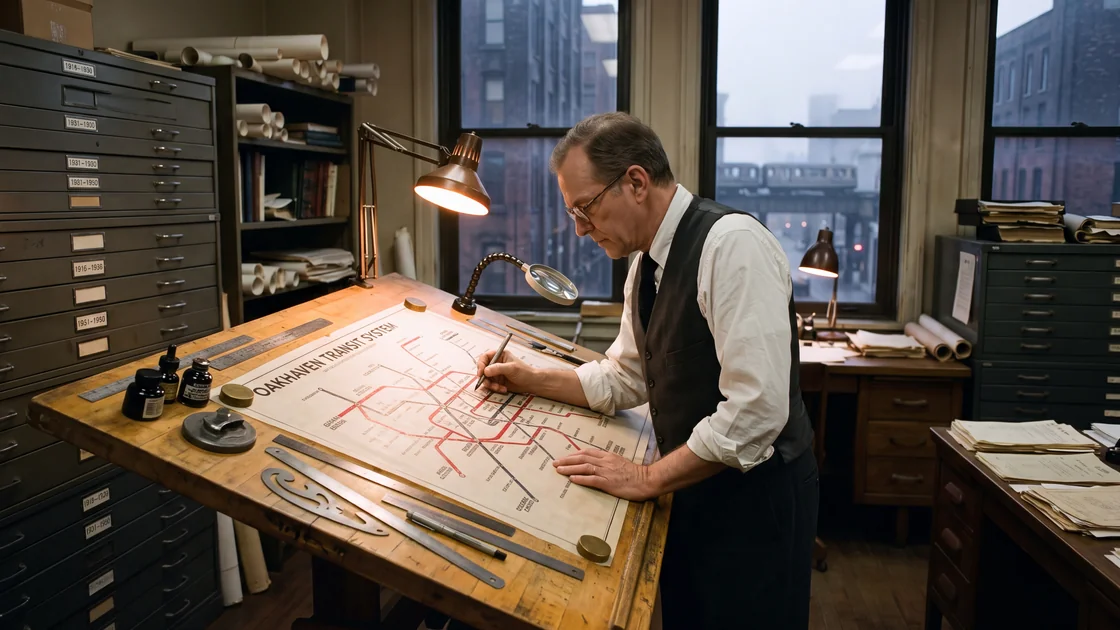
When Julian Vance, a meticulous cartographer for the Department of Subterranean Transit, smoothed the jagged, dog-legged vector of the neglected Ash Line to satisfy his aesthetic craving for symmetry, he unwittingly inverted the economic bedrock of the metropole. What began as a routine drafting exercise to modernize the city’s iconic, eighty-year-old subway map revealed a terrifying metaphysical reality: the city did not dictate the layout of the transit diagram; rather, the diagram dictated the flow of capital, land value, and human prosperity across the urban grid. As billionaire enclaves disintegrated into squalor within hours of a line being thinned, and condemned tenement basins sprouted sudden, miraculous fortunes whenever their connecting nodes were given topological prominence, Julian found himself holding the pen that could make or unmake millions of lives—a power that quickly attracted the attention of predatory financiers, desperate community leaders, and the department's shadowy directorate.
I. The Clean Line
The drafting table in Office 414-B was four inches thick, carved from cured northern rock maple, and tilted at an unyielding thirty-degree angle that had permanently ruined Julian Vance’s thoracic spine. Over fifty years of municipal employment had worn two distinct indentations into the hardwood edge where generations of senior draftsmen rested their forearms. Julian fit into those grooves as naturally as an axle into a greased sleeve.
Outside the tall, narrow casement windows, the city of Oakhaven groaned through another November afternoon. It was an imperial beast of a city, built on coal dust, deep-water commerce, and high-frequency equity trading. From the fourth floor of the Transit Authority Building—a soot-blackened neoclassical monolith perched on the rim of the Old Basin—Julian could hear the rhythmic clatter of the elevated trains crossing the Verrazano Viaduct, mingled with the low, continuous rumble of the deep-bore lines vibrating through the bedrock.
Julian ignored the noise. He was staring through a four-diopter magnifier at a square inch of sixty-pound vellum.
"The legibility is offensive," he murmured, his mechanical pencil hovering over the paper.
"It is standard municipal issue, Vance," said Miller, who occupied the neighboring desk and spent his days cataloging bus turnaround times in the outer boroughs. Miller did not look up from his ledger. He never looked up. He was forty years into a pension plan and smelled faintly of menthol cigarettes and damp wool. "The public does not require beauty. The public requires to know whether the D train stops at 86th Street."
"The public is being brutalized by bad geometry," Julian said.
He tapped the tip of his 0.3mm drafting lead against the vellum. On the current official map—the so-called 'Halsey System Diagram' of 1974—the metropolis was depicted with a clumsy, literal-minded fidelity to geography. The rail lines kinked and buckled where the underwater tunnels met the slate shelves beneath the harbor. They bundled into an ugly, thrombotic knot around the Financial Citadel, then sprawled across the northern river like spilled ink into the industrial flats of the Lowreach.
Julian’s predecessor had loved realism. Julian despised it. Julian was a disciple of the modernist purists: Beck, Vignelli, the Dutch structuralists who understood that a passenger underground does not inhabit physical space, but a topological system. In the dark, distance is an illusion. What matters is sequence, connection, and rhythm. Forty-five-degree angles. Ninety-degree turns. Equidistant station dots that reassured the commuter that the universe was governed by rational intellect rather than raw geological violence.
The worst offender was the Old Basin interchange.
For seventy years, the line known as the Cinnabar Trunk—which served the Old Basin, a district of diamond merchants, maritime insurance syndicates, and generational brownstones—had been depicted on the map as a thick, regal line of cadmium red. It sliced through the city’s center like a royal sash, straight, clean, and dominant.
By contrast, the Pale Line—an electric shuttle that ran south into the Ash Docks, a blighted sprawl of scrap yards, tallow boilers, and overcrowded tenements—was rendered as a sickly, hyphenated gray stroke. Worse, to accommodate the geographic bend of the salt marshes, the draftsman had forced the Pale Line through three cramped, apologetic right-angle jogs before terminating it in a visual dead-end that made the district look like a withered limb.
"It lacks equilibrium," Julian muttered.
"Don't do it, Julian," Miller muttered back, turning a page. "Every time you move a stop, the printers in Long Island City threaten a wildcat strike."
"I am not moving a stop. The track remains where the track has been since the Great Drainage of 1912. I am merely harmonizing the visual weight."
Julian picked up his razor-scraper. With microscopic delicacy, he began to lift the dry transfer ink of the Pale Line from the vellum.
He worked for two hours in total silence, suspended in that calm, hyper-focused state known only to cartographers and watchmakers. He erased the humiliating jogs. He took a French curve and re-routed the Ash Docks vector so that it swept upward in a glorious, sweeping arc of pure sixty-degree confidence. To balance this sudden surge of southern movement, he had to tuck the Cinnabar Trunk inward, bending its thick red corridor around a tight, clumsy dog-leg to make room for the new transfer node.
Where the two lines crossed, he replaced the staggered, offset station marks with a single, massive, double-ringed interchange bullseye: Grand Basin-Ash Concourse.
Julian stepped back, took off his wire-rimmed glasses, and rubbed the red bridge of his nose.
The page sang. The visual tension that had choked the lower quadrant of the map for fifty years had evaporated. The Ash Docks now appeared as a powerful, vital terminus, an anchor of metropolitan movement, while the Cinnabar Trunk looked... well, it looked secondary. Constricted. A bit choked by the turn, but aesthetically necessary to hold the composition together.
"Miller," Julian whispered. "Look at it."
Miller didn't turn around. "You're wasting your life, Julian. They're going to use the 1974 plates until the copper turns green."
"The master print is tonight," Julian said, checking his watch. "The midnight run for the morning fleet. The central server pulls the dynamic PDF at 11:30 PM. I am saving this to the production queue."
"It's your funeral," Miller said.
Julian sat down at his computer terminal, a clunky workstation connected directly to the MTC's central phototypesetter and the metropolitan digital kiosk array. He set his flatbed scanner to 1200 DPI, scanned the corrected vellum section, dropped it into the master vector file, hit Compile, and went home to his studio apartment on Tenth Street to boil an egg.
II. The Morning Ledger
Julian woke at 6:30 AM to the sound of sirens.
This was not unusual for Tenth Street, which sat close enough to the harbor to catch the sirens from the waterfront precints, but this morning the noise was relentless. It had an erratic, panic-stricken tempo, three or four engines screaming simultaneously from different directions, their sirens warbling against the brick tenements.
Julian dressed in his standard uniform: gray charcoal trousers, an ironed white poplin shirt, a knitted black tie, and his heavy woolen overcoat. He picked up his umbrella, checked his pocket watch, and walked down the four flights of creaking stairs into the street.
The air was bitter cold, smelling of brine and burnt sugar.
He walked to the corner of Tenth and Market to buy his usual copy of the Daily Chronicle from the kiosk outside the subway entrance. The kiosk was run by an old man named Sal, who had sat in that cubicle since the Korean War, surrounded by packs of menthol cigarettes and towers of newsprint.
Sal was not in his kiosk. The metal grate was half-pulled down, rattling in the wind.
A small crowd of people in expensive coats had gathered around the display rack. They were not buying papers; they were staring at the front page as if it were an unexploded bomb.
Julian squeezed through the coats. He was a small man, light on his feet, accustomed to navigating narrow drafting rooms. He caught a glimpse of the banner headline:
CINNABAR COLLAPSE: MORNING FLASH PANIC SHUTS LOWER BASIN Sub-Bourse Loses 40% in Pre-Market Trading; Historic Brownstone Vaults Report Structural Subsidence
Beneath the headline was a photograph of the intersection of Cinnabar Street and High Wharf. Julian knew the corner intimately; he had drawn its distinctive transit portal a thousand times. In the photograph, the street was in chaos. A deep, diagonal fissure had opened across the cobblestones, running directly through the portico of the Century Trust Bank. Luxury towncars were stalled bumper-to-bumper, abandoned by their chauffeurs, while men in silk-faced overcoats stood on the curb, weeping into handkerchiefs or clutching leather briefcases to their chests.
Julian frowned. Structural subsidence? On High Wharf? The district sat on a shelf of Pre-Cambrian granite that had not shifted since the retreat of the glaciers.
He turned toward the subway entrance. Above the stairwell, the city had installed the new backlit digital vitrines two years ago—crisp, high-luminance screens that displayed the system map and real-time train arrivals.
Julian’s new vector was live.
There it was, five feet tall and radiant against the morning gray: the Ash Docks line sweeping out of the south in an immaculate, unbroken arc of charcoal-gray authority, and the Cinnabar Trunk, pinched, crooked, and visibly strained where it fought its way around the dog-leg.
Julian felt a quick, proud flutter in his chest. It really is much better, he thought. The visual hierarchy is undeniable.
He walked down the concrete steps into the station.
The subway platform at Tenth Street was usually quiet at this hour—mostly janitors returning from night shifts and early-morning retail clerks heading for the department stores on the Mid-Tier. But today the platform was crowded, and the dynamic was wrong.
A group of dockworkers—men with salt-crusted watch caps, oil-stained canvas coats, and heavy steel-toed boots—were standing near the center pillar. They were laughing, their voices booming off the glazed tile. One of them, a broad-shouldered man with a scarred jaw, was holding a newly printed legal notice on cream-colored parchment.
"I’m telling you, Tommy, the broker called the hall at five," the man was shouting over the rumble of an approaching train. "Six thousand an acre. They're turning the old drydock into a deep-water container exchange. A syndicate out of Zurich. They bought out the lease on the whole basin before breakfast."
"You're full of horse manure, Greg," another man said, though his eyes were wide. "That ground’s been poison since the battery works burned down in fifty-six. You couldn't give an acre of the Docks to a dog."
"Go look at the board yourself," the big man laughed, slapping the parchment against his thigh. "The land registrar at City Hall opened early. There was a line around the block by six. They’re tearing down the shanties at Slip Four to build a banking terrace. My uncle's lease on the salt warehouse just paid out eighty grand on the buyout."
The train screamed into the station.
It was the Pale Line local, coming up from the south. Julian stepped through the rubber doors into the car.
Usually, the Pale Line trains were rattling museum pieces: cracked linoleum, dim incandescent bulbs that flickered through the switches, and seats of scratched fiberglass that smelled of damp grease and mildew. But this car was clean. Not new—it was still the old 1968 St. Louis Car Company stock—yet the air was crisp, smelling faintly of ozone and expensive carnations. The light fixtures were burning with a sharp, steady white glare that revealed no grease on the window glass.
Julian sat down in an empty corner seat. Opposite him, two men in worn wool caps were looking at the map above the door.
One of them pointed a grease-stained thumb at the glass.
"Look here," the man said. "They fixed it."
"Fixed what?"
"The run. We ain't an offshoot no more. We're the main trunk."
"That’s just a picture, you idiot."
"It ain't just a picture," the man replied stubbornly. "Look at it. It goes straight through to the harbor. It’s got the double ring. That means priority signaling. That means the freight follows the line."
Julian leaned forward, his hands resting on his umbrella handle. "Excuse me," he said mildly. "The signaling system hasn't changed. That's merely a graphic revision to improve the informational ergonomics."
Both men turned to look at him. They looked at his ironed poplin collar, his neat knit tie, and the thin leather satchel on his lap.
"Informational what?" the first man said.
"Ergonomics," Julian repeated. "The diagram was cluttered. It created visual fatigue for passengers attempting to calculate transfer penalties at the interchange. The physical rails are identical to yesterday."
The man spat a shred of tobacco onto the floor. "I don't know about no physical rails, mister. But my landlord tried to raise my rent thirty bob this morning because he said the district had been re-chartered as a Class-A transit corridor. Said the banks downtown just re-indexed the tax zone."
The train lurched, then accelerated out of the station with an unfamiliar, silky smoothness that pressed Julian back into his seat.
III. The Inversion
Julian spent the morning at his desk, pretending to audit the maintenance manifests for the Crosstown Tram.
The drafting room was unusually quiet, but the air was charged with a static nervousness. Across the hall, in the Executive Suite, doors were slamming. Every twenty minutes, a messenger boy with a leather satchel would sprint past the frosted glass of Office 414-B, his heels clicking frantically on the marble floor.
At 11:00 AM, Miller finally spoke.
"Julian."
"Yes, Miller?"
"Have you looked out the west window?"
Julian stood up and walked across the room to the casement window that faced toward the Old Basin.
From this elevation, one could normally see the elegant skyline of the Gilded Terrace—the two-hundred-year-old quarter where the founders of the city had built their limestone palaces and private banking houses. It was a district of slate mansards, wrought-iron gas lamps, and pristine limestone facades that looked down with imperial disdain upon the smoky flats of the bay.
A dark, yellowish plume of smoke was rising from the center of High Wharf.
"A gas main broke," Miller said, his pencil still moving across his ledger. "Then a second one. At nine o'clock, the foundation of the Merchant's Exchange dropped six inches into the cellar. The marble pediment cracked right down the middle, through the motto. They had to evacuate the trading floor into the rain."
Julian adjusted his spectacles. "It’s an old quarter. The infrastructure has been neglected for decades. It was bound to fail eventually."
"They don't neglect the Gilded Terrace, Julian," Miller said softly. "They spend forty percent of the municipal maintenance budget on those four square miles. The sewers are lined with glazed porcelain. They have their own steam plant."
Miller stopped writing. He laid his pencil down with deliberate, terrible care.
"And do you know what they're saying on the radio about the Ash Docks?"
"The dockworkers mentioned a land purchase," Julian said, feeling a curious, cold prickle at the back of his scalp.
"Not a purchase," Miller said. "A boom. The municipal water board discovered an untapped artesian spring under the old tallow works at dawn. Ten million gallons a day of pure, mineral-grade water, right beneath the marsh. The chemical works announced they’re closing the smelting plant to build a high-purity pharmaceutical laboratory. The value of land along the slip has increased by twelve hundred percent since midnight."
Julian looked down at his vellum draft, which still lay pinned to the maple table by four brass weights.
The clean, majestic charcoal arc of the Ash Line.
The squeezed, choked dog-leg of the Cinnabar Trunk.
A coincidence, he thought. A grotesque, statistical convergence. The market was overleveraged in the Basin; it was due for a correction. The infrastructure was aged. The water table simply rose.
He sat back down. His fingers were trembling slightly.
He reached for his ink stone, his ruling pen, and a fresh sheet of drafting film.
"Miller," he said.
"Don't ask me questions, Julian. I am cataloging bus turnarounds."
"If a diagram is mathematically harmonious," Julian whispered, "it reflects the natural order of the city, doesn't it? A map isn't an arbitrary invention. It is an idealization of reality. If the idealization is correct, the city ought to feel... relief."
"A map is a piece of paper that gets stepped on by drunkards on Saturday nights," Miller said. "Stop thinking like a priest."
That night, Julian waited until the office was empty.
The cleaning crew—an elderly woman with a mop bucket and a young man with a rolling trash hamper—came through at seven, their voices murmuring in the hallway. Julian kept his head down, his green eyeshade pulled low over his forehead, until their footsteps faded toward the freight elevators.
At 8:30 PM, the building was dead.
Julian walked over to the flat files where the historical masters were stored. The drawers were three feet deep, made of heavy sheet steel, labeled by decade: 1890–1900, 1901–1915, 1916–1930.
He pulled open the drawer for 1930–1940.
Inside lay the original blueprints for the system’s initial consolidation under Commissioner Robert Vane. Julian flipped through the stiff, yellowed sheets until he found the master plan for 1934—the year the Great Depression had mysteriously released its grip on Oakhaven five years earlier than the rest of the nation.
He carried the 1934 map to his drafting table and laid it under the magnifier.
It was drawn in the hand of Alistair Finch—the legendary chief draftsman whose portrait hung in the ground-floor rotunda. Finch had been an eccentric, an associate of the English occultists and an obsessive student of sacred geometry.
Julian examined the line weights.
In 1933, the district known as The Hollows had been an infamous sewer of crime, typhus, and desperate poverty, while the northern plateau of Bellerophon was a thriving colony of textile mills and wealthy burghers.
In Finch’s 1934 revision, the line through Bellerophon had been deliberately thinned, its line weight reduced from 1.2 millimeters to 0.4 millimeters, and forced through an unnatural, zigzagging chicane that looked like a broken bone. Meanwhile, the line cutting through The Hollows had been widened, rendered in bright vermilion, and given an unbroken, sixty-degree diagonal slash that linked it directly to the Central Post Office.
Julian knew the history. In the winter of 1934, Bellerophon's mills had mysteriously shuttered within forty-eight hours after a sudden, irrecoverable collapse in international linen contracts; the owners went bankrupt, their mansions were auctioned for scrap, and the district became the blighted ruin it remained to this day.
And The Hollows?
The Hollows had experienced the "Miracle of thirty-four." A regional bank headquartered there had survived the national panic, acquired the assets of three failing New York lenders, and turned the neighborhood into the city’s premier legal and commercial enclave.
Julian’s breath came fast and shallow.
He looked from Finch’s map to his own hands.
"The line weight," he whispered. "It isn't a measurement of capacity. It's a valve."
IV. The Controlled Experiment
A scientist does not act on intuition; a scientist tests a hypothesis under controlled conditions.
Julian took a fresh quadrant map of the North-Eastern Sector.
The North-Eastern Sector was home to two small, historically stable neighborhoods separated by an industrial canal: St. Jude’s Fen and Marquis Square.
Marquis Square was a quiet, dull, extraordinarily wealthy pocket of old money. It contained forty private mansions, an antique clock museum, and the city’s most exclusive private academy for girls. It had zero crime, zero public debt, and had been colored in deep cobalt blue on the transit map since the turn of the century. The station at Marquis Square was a quiet, private-feeling stop with brass chandeliers and tilework depicting Dutch galleons.
Two miles to the east, across the oily canal, lay Cinder Lane.
Cinder Lane was not a slum—it was worse. It was a non-place. A district of scrap-tire vulcanizers, small-engine repair shops, and gray cinderblock rooming houses where single men lived out their lives in depressing anonymity. Its transit connection was an insult: a pathetic, dead-end spur called the Cinder Shuttle, drawn as a broken, dotted line of pale olive green that seemed to trail off into the margins of the map as if the draftsman had grown too bored to finish it.
Julian sat down at his table.
He selected a 0.8mm technical pen and a bottle of dense, waterproof India ink.
First, he took his razor and carefully, completely scraped the Marquis Square station from the Cobalt Line. He didn't just remove the station; he re-routed the Cobalt Line entirely, bending it sharply westward, forcing it to skirt the perimeter of Marquis Square through a humiliating, subterranean horseshoe curve that bypassed the neighborhood by three miles.
Then, he turned to Cinder Lane.
He erased the broken, dotted olive spur. In its place, using his straightedge and French curve, he extended the Cobalt Line directly through the heart of Cinder Lane. He gave it a magnificent, diamond-shaped interchange station. He labeled it in bold, hand-set Futura type: CINDER CENTRAL.
To ensure there was no ambiguity, he balanced the composition by drawing three new feeder vectors—imaginary, high-capacity bus routes—radiating out from Cinder Central like the rays of a rising sun, anchoring the entire northeast corner of the sheet.
It was 10:15 PM.
Julian walked to the computer terminal. He scanned the altered sector. He logged into the production server using the master administrative credentials that had been taped under the terminal keyboard since 1998.
He overrode the verification check. He clicked: Publish to Municipal Grid.
A faint hum vibrated through the floorboards as the high-speed phototypesetters in the basement began to click and roll, preparing the master transparencies for the morning transit kiosks.
Julian did not go home.
He walked out of the Transit Authority Building, pulled his wool coat tight around his throat, and walked toward the northeast subway platform.
V. Midnight at Cinder Central
Julian arrived at Cinder Lane at 11:45 PM.
The platform was cold, damp, and smelled of sulfur. Water dripped from a rusted expansion joint onto the ties below. Julian was the only passenger who stepped off the train. The solitary fluorescent tube above the platform flickered with a dreary, dying buzz.
He climbed the concrete stairs to the street level.
Cinder Lane was asleep, or what passed for sleep in a place where people were too exhausted to dream. A single streetlamp cast a sodium-orange glare over an acre of stacked pallets. Across the street, the Vulcan Tire & Rubber Recapping Co. stood dark behind a chain-link fence topped with razor wire. A stray dog sniffed at a crushed paper cup in the gutter.
Julian checked his pocket watch.
11:58 PM.
The digital kiosk at the mouth of the subway station was an older model, a CRT monitor housed in a vandal-proof steel housing. It was currently displaying the old map, the pale olive dot of Cinder Lane looking like an afterthought.
Julian stood with his back against the brick wall of a machine shop, his hands deep in his pockets, his heart hammering against his ribs like a trapped crow.
At midnight precisely, the screen clicked.
The screen went black for three seconds. A line of green code scrolled across the top: SYSTEM DIAGRAM UPDATE V.88.2 - COMMENCING RENDER.
The new vector snapped into place.
There was no sound. No thunder. No flash of violet lightning across the slate roofs.
Then, Julian felt it.
It began as a subtle, sickening tilt in the soles of his boots, as if the pavement beneath him were a ship slipping its mooring in a sudden swell. It wasn't an earthquake; the ground didn't shake. It was a shift in weight. A sudden, terrifying alteration in the density of the air.
Across the street, the gate of the Vulcan Tire Company rattled.
A black towncar—a Mercedes-Maybach of immense length and whisper-quiet power—turned the corner from the industrial highway. Its headlights swept across the stacks of discarded tires. It was followed by a second car. Then a third.
The cars did not belong in Cinder Lane. They were sleek, armored, impervious machines that smelled of new leather and sovereign wealth. They pulled up to the curb outside the shuttered machine shop next to Julian.
Four men stepped out. They were not dressed for the weather. They wore bespoke suits of fine gray worsted, thin Italian shoes, and had cell phones pressed to their ears.
"Get the surveyor," one of them said. His voice was clipped, patrician, entirely devoid of surprise. "The whole block. The tire yard, the scrap dealer, the four tenements down to the canal. Offer thirty percent over the assessed value. If they refuse, invoke the emergency redevelopment charter."
"The title is cloudy on the yard," another man said, typing frantically into a tablet.
"Clear it. Pay off the city clerk. We need the footing by dawn. The logistics firm needs forty thousand square feet for the high-capacity terminal."
Julian watched in frozen terror.
The men walked down the cracked pavement as if they owned it, pointing their fingers at the rusted chain-link, the broken glass, the grease-soaked asphalt. And as they walked, the neighborhood seemed to respond to their presence.
A light flickered on in the second-floor window of a squalid tenement. Then another. A window was thrown open, and an old woman looked out.
"Hey!" she yelled. "What's all the racket?"
One of the men in the suits didn't even look up. "Madam, are you the deed holder of this property?"
"My husband’s the leaseholder! What’s it to you?"
"Tell your husband there is a courier coming with an offer of two point four million dollars for the remaining leasehold, conditional on immediate vacancy by noon tomorrow. He has twenty minutes to verify the escrow."
The woman stared at him. She dropped her cigarette. It fell through the dark, a tiny red ember, and landed in the gutter.
Julian backed away into the shadows.
He walked three blocks south toward the canal. The transformation was not confined to real estate. It was molecular.
The sulfurous smell of the district was fading, replaced by the clean, sharp smell of ozone and wet mortar. On the corner of Second and Cinder, where an abandoned diner had stood boarded up for twenty years, three white work vans had already pulled up on the sidewalk. Men in clean orange vests were unloading rolls of architectural drawings, heavy-duty surveying tripods, and pneumatic drills. A banner was already being zip-tied to the chain link: FUTURE SITE OF METROPOLITAN COMMERCE CENTER - PHASE I.
It was 12:40 AM.
Julian ran back to the subway station. He took the stairs three at a time, his umbrella clattering against the concrete.
He reached the platform just as a Cobalt Line train—a brand new, stainless-steel R-160 consist that had never before traveled south of the river—screamed into the station. Its automated voice was smooth, crisp, and triumphant:
"This is Cinder Central. Transfer is available to the Cobalt Line and the Northeast Express Network."
Julian threw himself through the doors.
VI. The Ruins of Marquis Square
He took the train to the nearest operational stop to Marquis Square: Alder Street, three miles to the west.
He walked through the freezing drizzle, up the long, gentle hill toward the aristocratic enclave.
He knew what he would find, but his mind refused to accept the reality until his boots hit the cobblestones of the Square.
Marquis Square was dying.
The great iron gas lamps that had burned uninterrupted since 1884 were out. A water main had ruptured at the crest of the hill, sending a torrent of brown, silt-laden water rushing down the gutters, drowning the manicured boxwood hedges and pooling around the tires of the Rolls-Royces and Bentleys parked along the curb.
The silence was horrifying.
There were no Maybachs here. No surveyors with tripods.
Instead, the windows of the great limestone mansions were dark, like the eye sockets of skulls. On the portico of the Vanderveer estate—a magnificent chateau modeled on the Petit Trianon—an auctioneer's legal notice had already been pasted over the brass door-knocker.
A private security guard, sitting in a idling patrol car, was packing his belongings into a cardboard box on the passenger seat.
Julian approached the car. He tapped on the glass.
The guard rolled the window down two inches. He looked pale, his eyes hollow with the sudden shock of a man whose world had dissolved between his evening tea and midnight.
"You shouldn't be here, sir," the guard said, his voice flat. "The district has been de-zoned."
"De-zoned?" Julian asked, his voice shaking. "How can it be de-zoned? This is Marquis Square."
"There's no transit access," the guard said, as if stating a law of thermodynamics. "The board of health revoked the occupancy permits at midnight. Something about the bedrock drainage. The tax liens triggered automatically when the municipal connection was removed from the schedule."
"The tracks are still here!" Julian cried, pointing wildly toward the street where the historic trolley rails were embedded in the stone. "The rails haven't moved an inch! You can walk to Alder Street in twelve minutes!"
The guard looked at Julian with an expression of profound, weary pity.
"Nobody walks twelve minutes, mister. If you ain't on the map, you don't exist. My firm canceled our patrol contract forty minutes ago. The bank called in the master mortgage on the whole square at eleven-thirty. I'm going home to Queens."
The guard put the car into drive, turned around in the flooded intersection, and splashed away into the dark.
Julian was left alone in the center of the Square.
He looked up at the great clock museum. The clock in the tower—the four-faced mechanical marvel built by Breguet for the city’s centenary—had stopped. Its long, gold-leaf hands hung limp at 12:01.
A cold, greasy rain began to fall in earnest.
Julian stood on the pavement, his overcoat soaked, his umbrella forgotten in his hand. He looked at his fingers. They were stained with black India ink around the cuticles.
I killed it, he thought. With four drops of Higgins waterproof ink and an 0.8mm nib. I wiped out two hundred years of capital in the time it took to sharpen a pencil.
He turned and began the long, wet trudge back to Tenth Street.
VII. The Summons
He did not sleep.
He sat in the hard wooden chair of his kitchen, watching the gray light of dawn crawl across the roofs of Tenth Street. The radio on his counter was tuned to the municipal news station.
The reports were incoherent with terror.
The financial anchors were speaking in the hushed, terrified tones usually reserved for nuclear accidents or foreign invasions. The Cinnabar Trunk collapse was spreading. Two major commercial banks had suspended withdrawals. A run was underway on the Old Basin clearinghouse. Meanwhile, trading on the commodity exchange had been halted three times due to an unprecedented, incomprehensible surge in industrial real estate futures centered entirely on an obscure, five-block quadrant in the Ash Docks and a former tire yard in Cinder Lane.
"Analysts are baffled," the radio squawked. "The Department of City Planning has announced an emergency session for nine o’clock. Rumors of a massive topographical recalculation continue to circulate through the bourse..."
Julian stood up, smoothed his tie, put on his damp coat, and went to work.
When he reached the Transit Authority Building, the ground-floor rotunda was ringed with Transit Police in riot gear.
Men in dark overcoats—not city employees, but men with the hard, predatory eyes of federal prosecutors or syndicate enforcers—were moving through the corridors with leather files. The elevator was out of service; Julian had to climb the four flights of marble stairs.
Office 414-B was locked.
Julian took out his brass key, his hand shaking so violently that he scratched the oak veneer three times before finding the keyhole.
He pushed the door open.
Director Eleanor Vance was sitting at Julian's drafting table.
She was not related to him, though they shared a surname—a common enough name in the eastern valleys. She was fifty-five years old, with iron-gray hair cut into a severe, architectural bob, wearing a tailored navy suit that looked as if it had been cut from sailcloth. She was smoking a Turkish cigarette, holding it between two fingers that were entirely free of tremor.
Miller was gone. His desk had been cleared of ledgers, pens, and menthol cigarettes. Only a pale rectangle of clean wood remained where his desk blotter had sat for forty years.
"Close the door, Julian," Director Vance said.
Julian closed the door. The latch clicked into place with the finality of a guillotine.
"Where is Miller?" Julian asked.
"Miller has been reassigned to the bus archives in Staten Island," she said, tapping her ash into an empty porcelain inkwell. "He was a lazy draftsman, but he had one supreme virtue: he never looked at anything that wasn't on his desk."
She leaned forward, resting her elbows on the four-inch maple slab.
Between her arms lay the vellum master Julian had published the night before: the Northeast Sector revision.
"You have a very delicate hand with the 0.8mm," she said quietly. "Most men produce a slight burr on the return stroke when they hit an acute angle. Your vectors are clean. They have the clarity of an autopsy."
Julian felt the blood drain from his face. "Director, I can explain. It was... it was a theoretical inquiry. An examination of aesthetic equilibrium—"
"Shut up, Julian."
She took a long drag from the cigarette, her eyes fixed on his face. They were cold, slate-gray eyes, the color of wet ballast stone.
"Do you know why Alistair Finch died in an asylum?" she asked.
Julian swallowed. "The records said he suffered from dementia."
"Finch didn't have dementia," she said, blowing a thin stream of smoke toward the high ceiling. "Finch understood the Engine. But Finch was an artist. He had romantic illusions. He thought he could use the Diagram to create a socialist paradise."
She pointed her cigarette at the map.
"In thirty-five, he tried to balance the entire city in a single night. He drew twelve radial lines from the center to the periphery, all of identical line weight, all with equidistant stops, all converging on an egalitarian grand circle around City Hall. Do you know what happened, Julian?"
"No," Julian whispered.
"The city nearly ceased to exist," she said. "The pressure gradient collapsed. By dawn, every bank in Oakhaven had lost its reserves—not because the money went somewhere else, but because value itself requires a slope to flow down. You cannot have wealth without an abyss beside it. If there is no bottom, there is no top. The water doesn't run if the land is flat. Finch created a vacuum that nearly sucked three billion dollars into the sea."
She stood up. She was not a tall woman, but she possessed that terrible, concentrated authority that only exists in the deep basements of municipal governments.
"The Board had to spend six months using 0.2mm pens to create artificial slums in the marshlands just to restore the tax base of Midtown," she continued. "We had to condemn twenty thousand families to tuberculosis in the flats just to get the bond rating back to Triple-A."
Julian leaned his back against the heavy oak door. He felt sick.
"The city doesn't follow the map," he said, his voice barely audible. "The map... the map is an engine."
"The map is the nervous system," Director Vance corrected him. "The rails are just the iron veins. The people are just the blood cells. But the Diagram? The Diagram is the collective will of the city made visible. Five million people look at that graphic every day. They plan their marriages around it. They choose their mortgages by it. They decide where to open their bakeries, where to build their warehouses, where to bury their fathers based on the lines we draw in this room."
She walked toward him, her heels clicking softly on the floorboards.
"If you tell five million people that a line is thick, powerful, and central, their money follows their eyes. If you tell them a district is a dead-end, a pale, broken hyphen... they leave it to rot. The belief creates the value, and the value creates the concrete. Finch called it Topological Induction."
She reached into her coat pocket and pulled out a heavy, cream-colored envelope sealed with red wax.
She held it out to him.
"What is this?" Julian asked, his hands refusing to move.
"This is your new commission," she said. "The Board met at four this morning in the vaults under the Federal Reserve. We have an investor consortium from London and Frankfurt. They have acquired six square miles of scrub oak and granite ledges in the northern ridge—the district known as Barrow Fell."
Julian knew Barrow Fell. It was an uninhabitable ridge of glacial till, home to three goat farms, a county poorhouse, and an abandoned slate quarry.
"There is no subway to Barrow Fell," Julian said. "The terrain is too steep. The rock is too hard. A tunnel would cost four hundred million dollars."
"We don't need a tunnel, Julian," Director Vance said, her voice dropping to a low, hypnotic purr. "We need a line."
VII. The Drafting of the Citadel
Julian sat in Office 414-B for forty-eight hours under armed guard.
A Transit Police sergeant named Carver sat in Miller’s chair. He had a service revolver on his hip, a thermos of black coffee, and instructions to shoot Julian through the hand if he attempted to leave the room or touch any paper other than the commission sheets.
The commission was clear.
Julian was to draw the Barrow Fell Grand Extension.
It was to be the most magnificent vector ever committed to vellum. A double-barred, gold-and-black trunk line, six millimeters wide—twice the weight of the Central Meridian. It was to cut through the northern edge of the map with the arrogance of a Roman highway, slicing across three rivers, ignoring all topographic features, and terminating in a massive, four-ringed sunburst labeled: BARROW METROPOLITAN CITADEL.
To provide the necessary pressure gradient—the abyss to feed the peak—Julian was provided with a list of sacrificial zones.
"The Board has selected three districts for resource reclamation," Director Vance told him during her morning inspection on the second day.
She tossed a typed manifest onto his desk.
Julian read the names:
- The Old Docks (Lower Basin)
- St. Anne’s Parish (Tenement Ward 4)
- The Iron Works (Wharf District)
"You will reduce them to single-stroke dotted lines," she said, her voice entirely flat. "Line weight 0.15. Remove all transfer identifiers. Re-label them as Industrial Utility Corridors - Restricted Passenger Access."
"Director," Julian said, his voice cracking with exhaustion. "There are seventy thousand people living in St. Anne’s. It has three hospitals. The municipal orphanage is there."
"And by tomorrow night, it will have an assessed land value of four cents a square yard," she said, lighting another cigarette. "Which is precisely what the Consortium needs to clear the ground for the new railyard. The orphanage will be relocated to the flats."
"It’s murder," Julian said.
"It’s urban renewal, Vance," she said coldly. "Don't be provincial. The money doesn't disappear. It merely moves up the slope. To Barrow Fell. Where it can be managed by people who understand how to use it."
She tapped the vellum.
"The master print is scheduled for midnight. If the vector is not compiled by eleven-fifteen, Sergeant Carver will take you to the sub-basement under the river pump. There are six hundred feet of water above that room, Julian. And the drainage valves are operated from my office."
She turned and left the room, the scent of Turkish tobacco lingering like poison in the air.
Julian looked at Carver. The sergeant was cleaning his fingernails with the tip of a pocketknife.
"You have kids, Carver?" Julian asked.
"Two girls," Carver said without looking up. "St. Anne’s Parish. St. Mary of the Sea school."
Julian’s hands froze. "Carver, did you hear what she said? St. Anne’s is on the list. If I draw this line, the parish will be condemned by Monday. The school won't have the funds to buy coal for the furnace."
Carver stopped cleaning his nails. He looked at Julian with dead, yellowed eyes.
"My cousin bought forty acres of scrub oak in Barrow Fell yesterday morning," Carver said. "He paid twenty dollars an acre with money I gave him from my retirement fund. Draw the line, Mr. Vance."
Julian looked down at the paper.
The world was not governed by justice. It was governed by the slope.
IX. The Guerilla Vector
At 9:00 PM, Julian began to draw.
He used the materials the Director had specified: the thick gold-and-black transfer tape for the Barrow Fell line, the delicate 0.15mm technical pen for the destruction of St. Anne’s and the Old Docks.
He worked with agonizing precision. Sergeant Carver watched him from across the table, his hand resting near his holster, his eyes following every sweep of the straightedge.
To Carver’s untrained eye, the map was progressing exactly as ordered.
The great, imperial vector of Barrow Fell was rising like a golden tower in the north, dominating the visual field of the city. The lines through St. Anne’s were withering, turning into faint, gray ghosts of themselves, disappearing into the industrial cross-hatching.
Julian did not look tired now. A strange, feverish clarity had taken possession of his fingers.
Topological Induction, he thought. The belief creates the value.
Finch was wrong because he tried to make it equal. He tried to build a circle. But a subway is not a circle. A subway is a circuit.
What happens to an electric circuit when the resistance drops to zero?
A short circuit.
Julian remembered an old map he had seen in the archives from 1898—a hand-drawn schematic of the first experimental pneumatic parcel system beneath the financial district. It hadn't used vectors. It had used an ancient, hydraulic design principle: The Venturi Loop.
A Venturi tube narrows the flow of liquid, forcing it to accelerate, dropping the pressure to zero at the throat, creating an irresistible suction that draws everything into its vortex.
Julian’s French curve was resting on the lower quadrant—the Ash Docks and the Old Basin.
While Carver watched the gold tape being applied to the north, Julian’s left hand—his non-drafting hand, which had spent twenty years handling razor scrapers with invisible dexterity—was working beneath the edge of his steel rule.
He wasn't just thinning St. Anne’s.
He was connecting it.
Not with a passenger line—that would be caught immediately by the automated validation script—but with an ancient, forgotten drafting convention: the Motive Power Return Vector.
In the nineteenth century, draftsmen used a thin, red, double-dotted line to indicate the underground high-voltage copper return cables that brought current back from the rails to the dynamos at the river station. It was a technical indicator, ignored by the passenger system, disregarded by the kiosk rendering software as a background layer.
Julian dipped his finest pen—an 0.1mm mapping nib—into a bottle of copper-red drafting ink.
Under the shadow of his rule, he drew the return line.
He ran it from the golden pinnacle of Barrow Fell, straight down through the heart of the Gilded Terrace, through the ruin of Marquis Square, into the tenement basin of St. Anne’s, through the Ash Docks, and then—instead of terminating it at the dynamos—he looped it back.
He curved the vector around the entire rim of the metropole, threading it through every forgotten spur, every abandoned siding, every industrial dead-end, every coal pocket and timber slip in the thirty wards of the city.
He made the line continuous.
A closed, non-orientable topological path. A Klein bottle drawn in transit ink.
There was no terminus. There was no grand central station. There was no top of the slope, and there was no abyss at the bottom.
It was an infinite, recursive loop of metropolitan circulation.
"Ten-forty-five," Carver said, checking his watch. "Wrap it up, Vance."
Julian laid down the pen. His fingers were cramped into a claw, his knuckles white and swollen.
"It is finished," Julian whispered.
Carver stood up, walked around the table, and leaned over the vellum. He looked at the golden bar of Barrow Fell, glowing like a brand across the top of the map. He smiled a thin, greedy smile.
"Good," Carver said. "My cousin’s going to be a rich man."
Julian stood up from his chair. He walked to the terminal.
He laid the vellum sheet onto the glass bed of the high-speed scanner. The optical carriage moved beneath the vellum, its cold white light illuminating the gold tape, the withered slums, and the hair-thin, invisible red circuit that bound them together.
The screen prompted:
INPUT MASTER AUTHORIZATION KEY:
Julian stepped aside.
Director Vance had entered the room. She stood behind the terminal, her leather gloves still on, her face illuminated by the green glow of the monitor.
She glanced at the scan preview on the screen. She saw the massive gold line to Barrow Fell. She saw the gray, broken lines in the south.
She smiled. It was the first time Julian had ever seen her teeth.
"You have a future in this department, Julian," she said.
She leaned over the keyboard, entered her twenty-digit executive credential, and hit the key marked: RELEASE TO MUNICIPAL GRID.
X. The Great Short
Julian, Director Vance, and Sergeant Carver stood at the casement window of Office 414-B, looking out over the city.
It was 11:59 PM.
The city was quiet, shivering under a blanket of wet, freezing fog. Below them, in the railway yards of the Old Basin, the signal lamps glowed ruby-red and emerald-green through the mist.
"Watch the north," Director Vance murmured, raising a small pair of brass opera glasses toward the dark, jagged silhouette of Barrow Fell five miles away. "The developers have installed ten searchlights on the ridge. They're going to turn them on the moment the digital boards update at midnight. The future begins in forty seconds."
Julian did not look north. He looked down at his pocket watch.
The second hand ticked through the five.
The four.
The three.
The two.
Midnight.
In the basement beneath their feet, the phototypesetters clicked. Across three thousand square miles of metropolitan territory, thirty-four thousand digital kiosks, platform monitors, and car displays flashed black for three seconds.
Then the new diagram blossomed into the electronic night.
For five seconds, nothing happened.
Then, Julian heard the humming.
It did not come from the streets. It did not come from the train tracks. It came from the walls.
It was a low, vibrational frequency, like the sound of an immense bronze bell struck three miles underwater. The oak drafting table began to chatter against its brass bolts. The inkwells on Julian’s desk rippled, concentric circles forming in the black and copper fluids.
"What is that?" Director Vance lowered her glasses. "Is that an engine?"
Across the river, on the ridge of Barrow Fell, the ten searchlights ignited. Their brilliant white beams sliced up into the clouds, marking the birth of the new citadel.
Then the beams turned violet.
A deafening, metallic CRACK echoed across the valley—the sound of a high-voltage substation detonating under an impossible, infinite load. The searchlights on the ridge flared with the brightness of small suns, then blew out simultaneously, their carbon arcs exploding into showers of blue sparks.
"The grid," Carver muttered, stepping back from the window. "The grid just tripped."
"It's not the electrical grid," Julian said softly.
He pointed down into the Old Basin.
The streetlights weren't going out. They were changing color.
The gas lamps of the Gilded Terrace, the sodium fixtures of the Ash Docks, the flickering fluorescents of the industrial flats—all of them were brightening to a steady, pure, daylight white.
Through the floorboards, the sound of the trains began.
It wasn't the erratic, stop-and-start clatter of the morning commute. It was a roar. An immense, synchronized, frictionless surge of iron wheels moving through stone tubes.
Julian could see the trains from the window. Down in the yards, every car, every locomotive, every dead engine that had sat on the sidings for thirty years was rolling. Their headlights were burning with terrifying brilliance, their interior lights glowing like bars of liquid gold.
They weren't stopping at stations. They weren't waiting for signals.
They were circulating.
"What did you do?" Director Vance turned on Julian, her face twisted into a mask of sudden, frantic rage. She lunged for his throat. "What did you put in the vector?"
Julian didn't move. He didn't have to.
The floor beneath their feet suddenly felt weightless.
The desk didn't slide. The walls didn't fall. But the slope—the terrible, crushing pressure gradient that had held the city in its iron vise for a hundred years—simply vanished.
Julian felt a sensation he had never experienced in his forty-two years in Oakhaven: he felt as if he were standing on level ground.
Director Vance stopped. Her hands dropped to her sides.
She looked at her leather-gloved fingers. Then she looked out the window.
The news radio on Miller's old shelf, which had been silent for an hour, suddenly sputtered to life through a storm of white static.
"...reports are coming in from every borough... we are witnessing an unprecedented... the exchange has ceased operations, but there is no panic... I repeat, there is no panic..."
The announcer’s voice was breaking, not with terror, but with a bizarre, child-like confusion.
"...the real estate registries in all thirty wards are reporting an automatic re-indexing of all municipal values. Mortgages across the city are being calculated at parity... the land values in St. Anne’s, Marquis Square, the Ash Docks, and Barrow Fell are... they are identical. The clerk's office reports that the tax differential between the Gilded Terrace and the Lowreach has dropped to zero... zero point zero zero..."
"Parity," Director Vance whispered. Her eyes were wide, glassy, reflecting the daylight white of the city below. "You broke the gradient."
"I didn't break it," Julian said, taking his wire-rimmed spectacles from his pocket and wiping the lenses with his knit tie. "I connected it. The circuit is closed."
"There is no wealth without the abyss!" she screamed, her voice cracking as she grabbed the lapels of his poplin shirt. "Where does the capital go? Where does it flow?"
"It doesn't flow anywhere," Julian said gently, replacing his glasses on the bridge of his nose. "It stays where it is. Like the passengers. Like the trains."
He looked past her, through the casement window.
Down on Tenth Street, people were coming out of their tenements. They were not screaming. They were not looting. They were walking out into the strange, clear, daylight-bright midnight air, looking at their hands, looking at the street, looking at the subway entrance at the corner where the new map was glowing with an infinite, recursive, copper-red loop.
Sergeant Carver dropped his revolver.
It hit the hardwood floor with a heavy, dull thud that did not discharge the cartridge. He walked to the door of Office 414-B, turned the brass knob, and walked out into the corridor, his footsteps slow and steady, heading home to St. Anne’s Parish.
Director Vance stood in the center of the room for a long time.
The Turkish cigarette burned down to her fingers. She didn't drop it until the paper scorched the leather of her glove.
"They will kill you, Julian," she said, her voice hollow, empty of all authority, the voice of a clerk whose office had been abolished by an act of parliament. "The banks. The Consortium. The Board. They will find someone to redraw the map."
"There are no blank sheets of vellum left in the building," Julian said, pointing to the empty flat files. "And the master server has been compiled with a write-once optical architecture. To change the diagram now, they would have to dig up every rail in the city. They would have to tear down every station and rebuild them by hand."
He smiled. It was a small, dry, cartographer’s smile.
"And as you know, Director... the Department has never had the budget for that."
XI. The Architecture of the Loop
Six months later, Julian Vance was still in Office 414-B.
The Department of Subterranean Transit had been reorganized three times, then finally absorbed into the General Board of Circulation—a modest, quiet bureaucracy that occupied only two floors of the old neoclassical monolith on the basin.
The Director was gone. Some said she was living in a quiet hotel in Montreal; others said she had taken a position with a railway syndicate in the Argentine, where the maps were still drawn with jagged lines and wide, unequal strokes.
Julian’s hair was entirely gray now, but his spine was slightly straighter. He had discarded the four-diopter magnifier.
He did not draw new lines anymore. There was no need.
The city of Oakhaven had changed, though if an outsider were to arrive by ship, they might not notice the difference immediately.
The limestone mansions of Marquis Square were still limestone, but their lower floors had been converted into print shops, small clinics, and cooperative bakeries. The tenements of St. Anne’s still had fire escapes hanging from their brick facades, but the children on the sidewalks wore clean wool sweaters, and the windows were glazed with good, heavy glass that kept out the winter drafts.
The stock exchange had not reopened. It hadn't collapsed; it had simply become redundant. When the value of an acre of land in the Ash Docks is identical to an acre on the High Wharf, speculation becomes a meaningless expenditure of ink.
Commerce continued, of course—immense, steady, tireless commerce. The trains ran through the tunnels twenty-four hours a day, their cars full of flour, timber, steel, and people moving between the thirty wards with an easy, frictionless rhythm that felt less like an economy and more like breathing.
Julian sat at his maple drafting table.
Before him lay a single sheet of paper: the official pocket edition of the Metropolitan Transit Diagram.
It was seven inches square, folded into thirds.
Julian unfolded it with his thumb.
The diagram was a masterpiece of topological reduction. There were no names of billionaires on the terminal stations. There were no forgotten spurs trailing off into the margins like dying thoughts.
There was only the line.
A single, continuous, elegant vector of deep, luminous vermilion that looped and turned through the city’s heart, forty-five degrees and ninety degrees, perfectly balanced, perfectly symmetrical, holding five million souls in its gentle, unbreakable geometry.
Julian picked up his mechanical pencil.
He looked at the tiny dot that marked Tenth Street.
The lead hovered over the vellum for a moment, steady, calm, perfectly poised.
Then, he set the pencil down, folded the map, slipped it into his breast pocket, and went out to catch the six-fifteen train home.