The Geometry of Migrating Stars
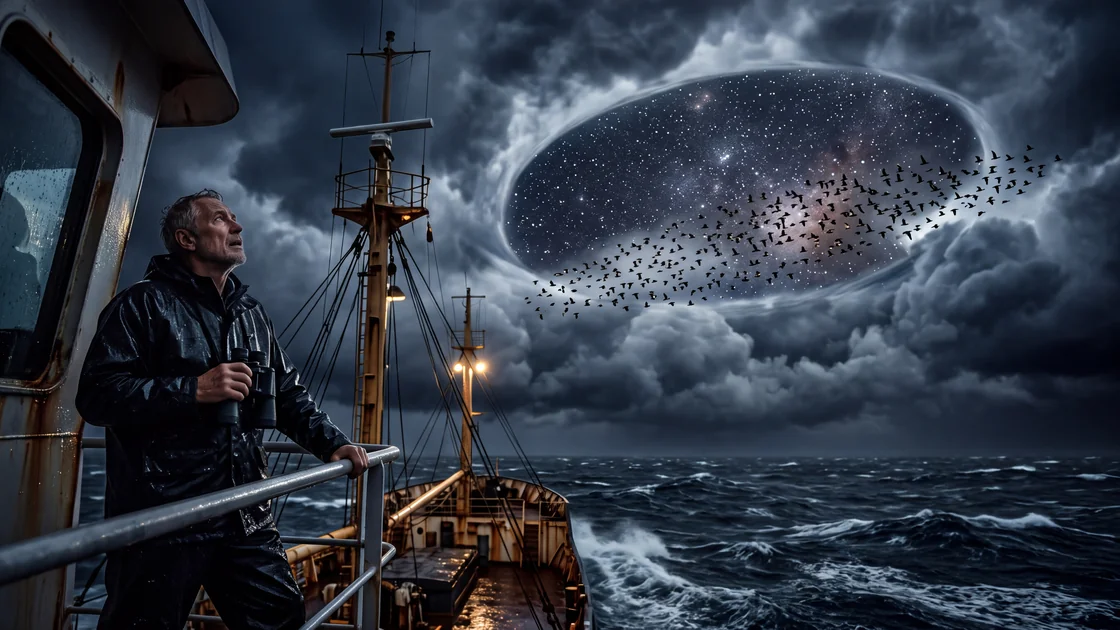
This is the account of Dr. Silas Vance, an ornithologist whose ten-year study of an anomalous flock of bar-tailed godwits led to the discovery that their migratory flight paths did not follow conventional seasonal thermals, but instead traced dynamic, multi-dimensional topological coordinates. Across seven thousand miles of open Pacific sky, the birds executed synchronized, non-Euclidean formations that systematically resolved the long-standing mathematical impossibilities of warp metrics and faster-than-light travel, revealing that their ancient genetic lineage carried an interstellar navigation proof encoded into the very mechanics of their survival.
Act I: The Mud at the Edge of the World
The blind at the mouth of the Samish River smelled of rotted eelgrass, briny silt, and the damp wool of Silas Vance’s fingerless gloves. For forty-two days, he had lived by the rhythms of the tide tables and the hum of the dual-spectrum high-speed array he had mounted to a tripod of salvaged spruce driftwood.
To the academic board at the University of Washington, Silas was a specialist on the decline. His papers had slowed to a crawl; his grant expenditures were dominated by strange line items—photogrammetric calibration targets, millimeter-wave Doppler radar modules, cryogenically cooled focal-plane sensors normally reserved for sub-orbital missile tracking. They thought he was losing his mind to the shorebirds. Perhaps he was. But shorebirds were the only creatures on Earth that lived without borders, stitching the poles together with nothing more than twenty-two grams of breast muscle, a hollow skeleton, and an inherited madness that drove them through pitch-black equatorial storms.
Out on the flats, the dawn was a slit of gray slate between the clouds and the water. The tide was running out, exposing miles of glistening brown mud pitted with the siphon holes of bivalves.
Then came the sound.
It was not the soft, whistling murmur typical of Limosa lapponica—the bar-tailed godwit. It was a low-frequency hum, a dry thrumming that Silas felt first through the floorboards of the blind, rattling the metal thermos beside his cot. He pressed his eye to the rubber eyecup of the master telescope.
They were descending from the high cloud layer at an angle that defied aerodynamic common sense. Godwits coming off a six-thousand-mile non-stop pelagic traverse usually tumbled out of the sky in ragged, exhausted strings, their wings bowed, stalling into the headwind to shed altitude before collapsing onto the mud to gorge on polychaete worms.
These birds did not tumble.
There were seventy-three of them. They moved as a rigid, singular body, yet they were not flying in a chevron, nor in the shifting, chaotic spheres of starlings. They occupied a lattice. It was an isometric grid that seemed to refuse the shear forces of the Pacific gale blowing off the strait. As they banked, the distance between each wingtip remained invariant down to the millimeter—a physical impossibility in turbulent air, where micro-gusts and thermal differentials should have forced immediate compensations in individual wing-loading.
Silas reached down without looking and flipped the toggle of the high-speed optical array. The four-lens camera whirred, capturing three thousand frames per second in both visible light and long-wave infrared.
"Come on," Silas whispered, his breath fogging the brass housing of the focus ring. "Show me the drift."
The flock leveled off fifty feet above the intertidal mud. Then, without a sound or an audible wing-clap, they broke the grid.
They did not scatter. They executed a series of simultaneous, orthogonal turns. In Silas’s monitor, the infrared traces bloomed like burning magnesium. The birds were not merely turning; they were tracing closed loops through the air that folded back upon themselves in self-intersecting curves. The air between them seemed to shimmer, light bending around the perimeter of their formation as if the atmosphere had suddenly varied its refractive index.
For three seconds, the flock formed a shape that caused Silas’s hand to freeze on the fine-focus knob.
It was a hyper-torus. A three-dimensional projection of a four-dimensional manifold, its inner and outer radii pulsing in exact harmonic ratios. The trailing edges of their primary feathers left faint, momentary wakes in the cold coastal air—not ribbons of condensed water vapor, but lines of pale, violet luminescence that hung for a fraction of a second before collapsing into the damp salt fog.
Then, as abruptly as they had arrived, the birds flared their wings, dropped their long, dark-tipped pink bills toward the mud, and scattered into an ordinary, nondescript flock of mud-pecking waders.
Silas stood up in the blind. His heart was hammering against his ribs like a trapped swift. He didn't take off his boots. He didn't secure the weather tarp over his cot. He pulled the solid-state storage drives from the camera array, jammed them into his wax-canvas rucksack, and ran through the knee-deep mud toward his rusted truck parked on the dike road.
Act II: The Invariant Tensor
The chalkboard in Maya Lin’s office at the Institute for Advanced Study in Princeton had not been washed in four months. It was layered with white and pale-blue ghosting, equations written over equations until the slate resembled an aerial photograph of salt pans.
Maya sat with her back to the window, balancing a lukewarm mug of oolong tea on the knee of her faded denim trousers, watching Silas pace the length of the narrow office. On her monitor, Silas’s high-speed capture was playing at one-hundredth of its natural speed.
"You’re telling me these are godwits," Maya said. Her voice was flat, dry, and entirely devoid of the excitement Silas had spent forty-eight hours cultivating on his transcontinental drive.
"Bar-tailed godwits. Subspecies baueri," Silas said, pointing a nicotine-stained fingernail at the screen. "Look at the primaries. Seven distinct emarginations on the outer feathers. Long, slightly recurved bill. They breed in western Alaska—the Yukon-Kuskokwim Delta. They winter in New Zealand. Eight days of continuous flapping across open water. No feeding, no drinking, no sleeping. But this population—I’ve been tracking them via satellite tags for three seasons—they don’t fly the great circle route."
"Many birds deviate from great circles due to prevailing trade winds, Silas," Maya noted, taking a sip of her tea.
"They don't deviate around the winds, Maya! Look at the vectors!" Silas slammed a thumb drive down onto her desk. "I didn't just bring you video. I have the radar point clouds from the coastal defense installation at Whidbey Island. I have friend-in-the-sky access through an old colleague at NOAA. We extracted the coordinate arrays for every individual bird at thirty-millisecond intervals. Plot the relative distances between nodes. Do it."
Maya looked at him for a long moment. She had known Silas since their undergraduate days at Berkeley, back when he had been a promising biophysicist before abandoning the laboratory for the monastic poverty of field biology. She knew he was obsessive, but he had never been untethered from reality.
She set her mug down, swiveled her chair, and opened a terminal window on her workstation. She loaded the raw ASCII data Silas had provided, feeding it into a bespoke differential geometry package she had written to analyze gravitational wave topologies from the LIGO detectors.
"If it’s a standard flocking algorithm," Maya said, her fingers clattering across the mechanical keyboard, "Craig Reynolds' boids rules apply. Separation, alignment, cohesion. The metric will resolve to a basic Poisson distribution with localized damping."
"It's not Reynolds rules," Silas said quietly. "Look at the spatial curvature."
The terminal fell silent as the processor spun up. A cooling fan whined inside the workstation.
A wireframe model blossomed on Maya’s secondary display. It was a dense swarm of seventy-three points, suspended in a virtual coordinate space. At first, the points moved with the organic jitter of living animals fighting gravity and inertia. But as Maya scrubbed the temporal slider forward to the moment the flock descended over the Samish mudflats, the points settled into an eerie, crystalline precision.
The distance matrix between the nodes did not fluctuate by more than three microns.
"That's an instrumentation error," Maya said immediately. "Wind shear alone would introduce decimeter-scale variance across a ninety-meter formation."
"Keep running the script," Silas urged. "Apply the coordinate transformation. Run the Christoffel symbols on the vector field."
Maya frowned, her brow furrowing. "Silas, Christoffel symbols are for curved spacetime. These are birds in the troposphere."
"Just run it."
She entered the commands. The machine hummed louder. The screen cleared its wireframe and began generating a sequence of high-rank tensors. Values populated the terminal in rapid cascades:
\[\Gamma^{\mu}_{\alpha\beta} = \frac{1}{2} g^{\mu\sigma} \left( \partial_\alpha g_{\beta\sigma} + \partial_\beta g_{\alpha\sigma} - \partial_\sigma g_{\alpha\beta} \right)\]
Maya stopped typing. She leaned forward until her glasses were six inches from the screen.
The tensor field was not zero. In a Euclidean frame, the connections should have vanished, or dissolved into the random stochastic noise of atmospheric turbulence. Instead, the numbers locked into a series of repeating, rational fractions. They were non-vanishing components of an energy-momentum tensor.
"This is wrong," Maya whispered.
"What is it?"
"It’s an Alcubierre derivation," she said, her voice dropping an octave. "No—it’s not Alcubierre. Alcubierre requires infinite negative energy densities along a toroidal ring of exotic matter with mass-energy requirements exceeding the observable universe. It’s an unphysical toy model."
She grabbed a dry-erase marker, spun toward the clean patch of chalkboard near the door, and began scrawling symbols with violent speed.
"In ninety-four, Miguel Alcubierre showed that you can contract the space ahead of a vessel and expand the space behind it," she muttered, her chalk snapping under her hand. She tossed the broken piece aside and continued with the stub. "The problem has always been the York time—the extrinsic curvature scalar. The stress-energy tensor violates the weak, strong, and dominant energy conditions. It demands particles with negative mass that don't exist in our standard model. But look at what your points are doing here."
She pointed the stub of chalk at the monitor.
"The birds aren't simulating a static bubble. They are executing a dynamic conformal mapping. The seventy-three nodes—each bird is acting as a singular boundary condition. They are shifting their relative geometries to cancel the back-reaction of the vacuum polarization."
"Speak English, Maya," Silas pleaded, rubbing his red-rimmed eyes.
"They aren't just flying in a pretty pattern, Silas," Maya said, turning to him, her eyes wide behind her lenses. "They are writing out a proof. A constructive mathematical proof that demonstrates how to satisfy the Einstein-field equations for a superluminal metric without using negative mass-energy."
She looked back at the screen, where the seventy-three godwits continued their silent, frozen dance in the virtual dark.
"They are showing us how to bend the metric of spacetime using only positive-energy vacuum states," she whispered. "And they've been doing it every autumn for ten thousand years."
Act III: The Anatomy of the Vector
They set up their operations base in an abandoned canning factory on the shore of the Bristol Bay estuary, twenty miles outside Dillingham, Alaska.
Outside, the tundra was turning the color of dried blood under the late August frost. Dwarf willows clung to the permafrost, their leaves rust-yellow, while the Bering Sea heaved against the gravel spits in long, greasy swells. Inside the cannery, the air smelled of seventy years of salt-cured salmon guts and kerosene from the twin jet-heaters Silas had dragged into the main processing bay.
Maya had spent three months redesigning their sensors. Across the concrete floor, three portable workstations were lashed to industrial workbenches with ratchet straps. Cables thick as garden hoses snaked out through broken window frames, running up to an array of phased-array telemetry receivers mounted on the cannery’s old wooden silo.
"Look at the heart rates," Silas said, dropping a stack of thermal-paper printouts onto Maya’s desk. He had spent the morning mist-netting in the sedge marshes, managing to tag five individuals from what he now designated the Aleph Flock.
"Godwits during migration have a resting heart rate around four hundred beats per minute," Silas explained, tracing a pen along the seismic-looking traces. "When they climb, it pushes six hundred. But look at these five. When they enter the lattice formation, their heart rates drop. They drop to ninety beats per minute."
"Bradycardia?" Maya asked without looking up from her terminal. She was deep in the tensor calculus of the third flight segment.
"Not just bradycardia. Their metabolic demand plummets by seventy percent. It’s biologically impossible. A bird cannot flap its wings against a thirty-knot headwind at sub-zero temperatures while maintaining a heart rate lower than that of a sleeping dog. Unless..."
"Unless they aren't working against the air," Maya finished.
She turned her monitor so Silas could see.
She had isolated the flight path of individual Bird-17—a mature female with a notched primary feather on her left wing that Silas had identified from high-resolution imagery.
"I’ve been mapping their acceleration vectors against the local gravitational gradient," Maya said. "Look at the local metric tensor \(g_{\mu\nu}\). In classical aerodynamics, the bird generates lift via the Bernoulli principle—pressure differential between the upper and lower surfaces of the airfoil. But Bird-17 isn't generating lift with her wings. Her wings aren't airfoils right now. They're variable-induction wave-guides."
"Explain," Silas said, leaning over her shoulder.
"The wing-beat frequency," Maya said, tapping the screen. "It’s forty-four hertz. Exactly forty-four. It never varies, regardless of whether she’s climbing, descending, or banking. She doesn't flap to push the air down. She flaps to modulate the electromagnetic boundary layer along the feathers. Silas, what are their feathers made of?"
"Beta-keratin," Silas replied. "Fibrous proteins, cross-linked by disulfide bonds. Highly organized, semi-crystalline."
"And in this flock?"
Silas hesitated. "I ran a spectrometry analysis on a single covert feather I recovered from the Samish blind. The keratin isn't standard. It’s intercalated with trace amounts of biogenic magnetite and metallic fullerene structures. I thought it was contamination from industrial runoff in Puget Sound. But the distribution was uniform. It was embedded in the feather rachis at the molecular level, laid down during their molt on the Siberian tundra."
Maya nodded slowly, as if a dark puzzle piece had finally clicked into place.
"They're not just birds," she said. "They are biological macroscopic quantum arrays. The entire flock is a distributed metamaterial. When they fly in this specific topological configuration, they aren't fighting the wind; they are establishing a localized Krasnikov tube—a metric distortion that flattens the gravitational gradient in front of them. They aren't flying through the sky. The sky is falling through them."
Silas walked to the broken window. Out across the flats, thousands of shorebirds were feeding in the grey drizzle—dunlins, plovers, western sandpipers. They pecked and scurried, fragile sparks of warm blood and fat trying to store enough calories to survive the impossible crossing.
"Why would this evolve?" Silas asked, his voice lost in the roar of the surf. "Natural selection doesn't invent metric engineering to cross an ocean. A bird that needs to cross the sea just grows slightly more efficient pectoral muscles, or changes its migratory route over land. You don't rewrite the laws of general relativity just to reach New Zealand."
"Unless New Zealand wasn't their original destination," Maya said from the dark interior of the cannery.
She hit a key on her workstation. The speakers attached to her rig gave a sharp, metallic chirp.
"They’re taking off," she said.
Act IV: The Open Ocean Protocol
To track them across the void of the central Pacific, Silas had mortgaged his home in Port Townsend and drained his remaining tenured research accounts to charter the Nanuq, an eighty-foot steel-hulled crabber converted for oceanic survey work.
The ship was miserable. It pitched and rolled in the long, gray swells of the North Pacific, eighty miles south of the Aleutian chain. The air was a freezing slurry of salt spray and sleet. On the aft deck, lashed down under heavy green tarpaulins, their mobile telemetry unit shuddered with every impact of the hull against the sea.
Down in the cramped mess, Maya was sick. She sat wedged between the mess table and the bulkhead, her face pale green under the halogen strips, a plastic basin between her feet. Despite the nausea, her laptop remained open, tethered by an umbilical cable to the marine radar and their custom LIDAR pod mounted on the ship's mast.
"They're at twelve thousand meters," Silas shouted down the companionway, his foul-weather gear dripping onto the linoleum. "Twelve thousand, Maya! That's forty thousand feet! Godwits don't have the oxygen-binding hemoglobin for that altitude. Their blood would freeze. The barometric pressure is a fraction of an atmosphere!"
"They aren't at forty thousand feet," Maya rasped, wiping her mouth with a paper towel. She tapped the screen with a trembling finger. "Look at the pressure sensor on the telemetry tag for Bird-04."
Silas climbed down the steps, steadying himself against the violent roll of the boat. He peered at the terminal.
The telemetry tag’s ambient pressure readout was reading standard sea level: 101.3 kilopascals.
"The tag is malfunctioning," Silas said.
"All twelve tags are reading 101.3," Maya countered. "Temperature: twenty degrees Celsius. Relative humidity: forty-five percent. Silas, they aren't flying in the stratosphere. They've taken a pocket of the Pacific shoreline with them. They are enclosed inside a static metric envelope."
She pulled up a 3D visualization. The seventy-three birds were no longer flying in the loose hyper-torus they had observed in Washington. They had contracted the formation into an elongated, spindle-shaped ellipsoid—a shape resembling a slender grain of rice, nearly three hundred meters from tip to tail.
Within this envelope, the local spacetime was completely decoupled from the surrounding atmospheric medium.
"Look at the Doppler radar return from the ship’s radar," she said. "The radar waves aren't bouncing off the birds. They're being deflected around the perimeter of the formation. It’s an optical and electromagnetic cloak, created by gravitational lensing."
"Can we see them?"
"Take the night-vision binoculars up to the bridge deck," Maya said, closing her eyes against another wave of nausea. "Look at true bearing two-one-zero. Elevation thirty-five degrees. But don't look directly at the center of the formation. Look at the boundary."
Silas climbed back up the slick steel ladder to the bridge. The captain, a taciturn Norwegian named Arnsen, was gripping the helm, his knuckles white as he guided the heavy boat through eight-foot breakers.
"You scientists are out of your goddamned minds," Arnsen growled without turning his head. "Storm’s building out of the Gulf. We shouldn't be out here chasing sparrows."
"They're godwits, Captain," Silas said, stepping out onto the bridge wing into the teeth of the gale.
The wind nearly tore the binoculars from his hands. The sea was an abyss of black and white foam, the sky an impenetrable roof of charging squall clouds. Silas braced his hip against the bridge railing, lifted the heavy, image-stabilized military-grade night-vision optics, and pointed them toward the southwest.
Through the emerald-green phosphor of the display, the clouds looked like curdled cream. He swept the sky, adjusting the gain.
Then he saw it.
It did not look like birds. It looked like an tear in the fabric of the night.
A narrow, elliptical window of absolute stillness was moving through the storm clouds at an impossible velocity. Inside the ellipse, the sky was not cloudy; it was dead black and powdered with brilliant, undistorted starlight—stars that did not belong to the northern hemisphere's autumn sky. Silas saw the Southern Cross and the Magellanic Clouds, burning with razor-sharp clarity through a gap in the storm over the sub-Arctic Pacific.
And at the perimeter of this window, suspended like motes of dust in the starlight, were the birds.
They were not flapping now. Their wings were held rigid, locked in an anhedral dihedral configuration that shifted by fractions of a degree in an intricate, continuous cycle. They were like the teeth of an invisible gear, biting into empty space and pulling the universe around themselves.
Around the margins of the bubble, the clouds did not hit the formation; they separated smoothly, sliding around an invisible curve without creating turbulence, leaving no wake, no condensation trail, no sound.
As Silas watched, transfixed, the geometry of the flock shifted.
The birds at the leading edge pulled inward by three inches. The birds at the trailing edge flared their rectrices—their tail feathers—in a sequence that rolled forward through the flock like a row of falling dominoes.
Inside the green display of the binoculars, Silas saw the starlight inside the bubble shift. The stars did not move across the sky; they blue-shifted. The pale, cool light of the distant southern stars contracted toward a single, brilliant point of violet fire at the front of the formation.
A sudden, deep pressure slammed into Silas’s ears, the sensation of an elevator dropping twenty floors in a single second. The hair on his arms stood on end, crackling with static electricity that smelled of ozone and scorched sugar.
The ellipse flickered.
For the space of a single heartbeat, the flock was not three miles ahead of the Nanuq. It was forty miles south. Then eighty. The radar signature on the bridge console did not show a track; it showed a series of instantaneous probability distributions along a straight vector aimed directly at the Kermadec Trench.
"Arnsen!" Silas yelled into the bridge. "Did you see that?"
Arnsen didn't answer. He was staring at his radar screen, his jaw slack. The sweep line was painting a blank sea.
"They're gone," Arnsen muttered, crossing himself with a grease-stained thumb. "The whole damn school of them. They just skipped across the scope like a flat stone on a pond."
Act V: The Transcription
In the cabin of the Nanuq, the floor was covered in printer paper.
Maya had stopped sleeping. She had taped sheets of butcher paper over the walls of the small stateroom, covering them in dense arrays of non-linear differential equations, metric tensors, and handwritten notes that grew progressively more frantic.
Silas sat on the edge of the lower bunk, holding a cup of cold instant coffee. His hands were shaking with exhaustion.
"It's not an engine," Maya said, her voice hoarse, her hair matted with dried salt. She was pointing a blue marker at a massive matrix she had sketched across three sheets of paper. "I spent weeks trying to understand where the energy was coming from. The Alcubierre metric requires a negative energy density of \(10^{64}\) kilograms per cubic meter—more than the mass of the universe converted into pure stress. It’s the standard critique: you can write the geometry down, but you can't build it because you don't have the fuel."
"And the birds don't have fuel," Silas said. "They have two ounces of clams in their gullet."
"Right! So how do they satisfy the Hamiltonian constraint?" She tapped the center of the matrix until the paper tore. "They don't provide the energy. They use a topological bypass. They exploit the quantum entanglement of the vacuum."
She began pacing the six feet of open space in the cabin.
"The vacuum isn't empty, Silas. It’s boiling with virtual particles—zero-point energy fluctuations. Under normal circumstances, the fluctuations are isotropic; they cancel out to zero at any macroscopic scale. But if you introduce a specific boundary condition—like the Casimir effect, where two parallel plates exclude certain vacuum modes—you create a localized region of negative energy density between them."
"The Casimir effect only works at nanometer distances," Silas objected. "The force between the plates drops off with the fourth power of the distance. You can't use it to move a ship. You can't use it to move a bird."
"You can if the plates are dynamic," Maya said, her eyes burning with an unsettling, feverish intensity. "You can if the boundary conditions are not physical metal plates, but a distributed network of quantum-entangled nodes modulating their spatial relationships at high frequencies. That's what the forty-four hertz wing-beat is doing! It’s a pump!"
She grabbed Silas’s arm, her fingers digging through his wool sweater.
"The flock is a Casimir pump. By maintaining this precise isometric configuration, they are filtering the vacuum fluctuations of the local spacetime. They are suppressing the positive-energy modes along their flight path and concentrating them into a coherent shell behind them, while creating a stable, persistent corridor of negative vacuum density in front of them."
She let go of his arm and stepped back, looking at the equations on the wall.
"They aren't violating the energy conditions. They are swimming through the quantum foam. Space contracts in front of the flock because they are literally pumping the ground state of the universe out of their way. They fall into the gradient. The birds are in freefall, Silas. Perpetual, directional freefall at velocities that are arbitrary. They could fly at ten knots, or ten times the speed of light. The metric doesn't care. To the bird inside the bubble, its local acceleration is always zero."
Silas stared at the butcher paper. The mathematics was beyond his training, but the symmetry was unmistakable. It looked like the cross-section of a nautilus shell, or the spiral arrangement of seeds in a sunflower head, translated into the language of Riemannian geometry.
"It's a proof," Silas said, the realization settling into his chest like lead. "It’s not just a behavior. It’s an algorithm."
"It's a complete, closed-form solution to the Einstein-Maxwell-Klein-Gordon field equations," Maya whispered. "It solves the singularity problem. It eliminates the Cauchy horizon instability that destroys traversable wormholes. Silas, any civilization that possesses this proof can build an interstellar drive using materials no more exotic than aluminum, copper, and a control system capable of microsecond kinematic adjustments."
She looked at him, her expression a mixture of awe and absolute terror.
"This didn't evolve on Earth," she said. "Nature is efficient, but it doesn't solve high-energy quantum gravity to cross the Pacific. This is an artifact. It's a living, self-replicating transmission."
"A message in a bottle," Silas said.
"No," Maya replied, looking out the porthole into the black, churning sea. "Not a message. An instruction manual. And the birds are the print."
Act VI: The Mud of Pūkorokoro
The Firth of Thames, on the North Island of New Zealand, is a wide, shallow bite taken out of the earth, fringed by mangrove swamps and vast expanses of shell-covered mud known as the Pūkorokoro flats.
It was mid-October when the Nanuq finally made port in Auckland, and Silas and Maya drove a rented flatbed truck down to the shorebird sanctuary. The air here was warm, smelling of tidal flats, blooming gorse, and the rich, cow-manure dampness of the Waikato pastures.
The main body of the Pacific godwit migration had already arrived. Tens of thousands of birds were roosting along the shell-banks, brown and gold carpets of feathers, sleeping with their heads tucked under their scapulars, their bodies emaciated from the epic journey.
Silas walked out along the boardwalk to the southern hide, carrying his field glasses. Maya walked beside him, carrying a ruggedized laptop linked to their satellite receiver.
She had spent the last three days running the final segment of the data through the supercomputers at the University of Auckland. The transcription was ninety-nine percent complete. There were only four variables left unresolved—the boundary conditions for metric collapse, the mechanism by which the warp field safely drops out of superluminal velocity without releasing a catastrophic pulse of Hawking-like radiation that would incinerate the destination.
"They have to decelerate," Maya said, her voice quiet. "When an Alcubierre bubble collapses, it releases all the high-energy particles swept up along its event horizon during the transit. If a ship did that at the end of an interstellar run, the forward radiation burst would sterilize the entire planetary system it was entering. There has to be a damping factor. A brake."
Silas stopped at the edge of the boardwalk, looking out across the mudflats.
The shorebirds were nervous. A southern harrier was quartering low over the mangroves, its long wings tilted in a shallow V. Every few minutes, a thousand godwits would take to the air in an explosion of whistling wings, circling in panic before settling back onto the mud.
"Look there," Silas said, pointing toward the outer sandspit where the tide was just beginning to lick at the mangrove roots.
A separate, distinct group of seventy-three birds was standing apart from the main flock.
They were not sleeping. They were not feeding. They stood in a regular, hexagonal grid, spaced exactly one point four meters apart from one another. Their long bills were all pointed in the same direction—not into the wind, as shorebirds usually stood to minimize drag, but toward a point precisely thirty-two degrees east of true north.
"They're waiting," Maya whispered, pulling out her terminal.
Through the telescope, Silas focused on the bird at the center of the hexagon. It was Bird-17. The notched primary feather was ragged now, worn down by the abrasive dust of the upper atmosphere and the incomprehensible friction of the metric boundary.
Bird-17 raised her wings.
She did not take off. She held them open in a wide, horizontal arc, the tips of her outer primaries trembling at that same, unvarying forty-four hertz.
The other seventy-two birds responded instantly. They did not spread their wings; they lowered their heads until their bills touched the wet silt.
"Maya," Silas said, his eye pressed to the glass. "Look at the water around their feet."
The tide was creeping in across the shell-banks. But the water was not flowing past the birds. It was avoiding them.
A circular depression, three meters in diameter, had formed in the incoming tide around each individual bird. The water was piling up at the perimeter of these depressions, forming neat, curved meniscus walls three inches high, held back by nothing at all.
"It’s the brake," Maya said. Her fingers were flying across the keyboard, capturing the telemetry stream coming from Bird-17’s tag. "They're grounding the metric into the planetary gravitational well. They aren't radiating the excess energy into the atmosphere; they're shunting it into the Earth’s core via low-frequency graviton coupling."
On Maya’s screen, the final four tensor terms filled with numbers. The equations resolved. The entire mathematical structure—a proof spanning two hundred and forty-eight pages of four-dimensional topological geometry—turned green.
The algorithm was closed.
\[\lim_{t \to t_f} G_{\mu\nu} = 8\pi T_{\mu\nu}^{\text{(vacuum)}} \implies \nabla_\mu T^{\mu\nu} = 0\]
Maya sat back on the wooden bench of the bird hide. She stared at the screen, her hands resting motionless in her lap.
"It’s complete," she said.
The seventy-three godwits on the sandspit folded their wings. The meniscuses of water collapsed with a soft, wet splash. Bird-17 lowered her bill, drove it three inches into the soft gray mud, and pulled out a fat, glistening marine worm.
She swallowed it with a quick jerk of her head, entirely ordinary once more, and began to preen her breast feathers.
Act VII: The Shadow of the Proof
They spent three weeks in an unremarkable motel in Thames, working sixteen hours a day to translate the flock's flight coordinates into standard engineering schematics.
It became clear early on that the machine they were designing would not look like a rocket. It would have no combustion chambers, no reaction mass tanks, no chemical or nuclear exhaust.
"It’s an interferometer," Maya explained, drawing the schematic on the back of a paper placemat from the local fish-and-chip shop. "A three-dimensional laser interferometer with seventy-three dynamic nodes. If you arrange them in this precise isometric lattice and pulse them at forty-four hertz with a phase variance corresponding to this flight vector, you produce the field. You don't need a bird. You need seventy-three high-output laser emitters mounted on a lightweight framework."
"What scale?" Silas asked.
"Any scale," she said. "The proof is scale-invariant. You could build a probe the size of a thimble, or a transport ship the size of an aircraft carrier. The energy requirements don't scale with mass; they scale with the surface area of the boundary envelope. And because the interior is in freefall, the passengers wouldn't feel acceleration. You could go from zero to three times the speed of light in a millisecond without crushing an ant inside."
Silas looked down at his tea. It had gone cold.
"What do we do with it, Maya?"
She looked at him across the greasy laminate table. The circles under her eyes were dark, almost purple.
"If we publish this," she said, "it’s the end of everything we know. It’s not just space travel, Silas. It’s the total weaponization of the vacuum. A ship that can manipulate the metric like this can drop out of superluminal velocity inside a planet’s mantle. It can bypass any radar, any missile defense, any physical barrier. It makes sovereignty impossible. It makes borders an absurdity."
"It also gets us off this rock," Silas said quietly. "Before we choke on our own exhaust."
"Does it?" she challenged. "Or does it just let us take our madness to every corner of the Orion Arm?"
She pulled out her phone. There were sixteen voicemails from the Dean of Research at Princeton, nine from the National Science Foundation, and three from an unlisted number with a Washington, D.C. area code that had started calling every four hours since they had docked the Nanuq.
"They know we found something," Maya said. "The radar data from Whidbey Island didn't go unnoticed. The coast guard telemetry from the Aleutians—somebody in the Pentagon has already flagged the anomalies. It took them two weeks to trace the boat charter. We have forty-eight hours, maybe less, before they show up with a national security order and take the hard drives."
Silas stood up and walked to the window. Outside, the rain was falling steadily on the hibiscuses planted around the motel parking lot. Across the road, the mud of the firth was grey and silent under the downpour.
"They're going to fly back in six months," he said.
"What?"
"In March," Silas said, turning to face her. "They do it again. They leave New Zealand, fly across the western Pacific to the Yellow Sea—the mudflats of the Yalu Jiang on the China-North Korea border. They rest for five days. Then they fly back to Alaska. They repeat the proof. They’ve been doing it since the glaciers retreated twelve thousand years ago."
Maya looked down at the placemat, then at the laptop sitting open on the bedside table.
"They aren't doing it for us," she said, her voice catching.
"No," Silas said. "Of course they aren't. They're just trying to get home."
Act VIII: The Siberian Anomaly
Silas did not return to the United States.
When the black sedans finally arrived at the motel in Thames, they found Maya Lin sitting alone in the room, her hands folded in her lap, her laptop open on the desk. The hard drives had been wiped with a degaussing magnet, and the butcher paper had been burned in the motel's outdoor barbecue pit.
She spent eight months in closed hearings in northern Virginia, answering questions from men who wore identical charcoal suits and held security clearances that did not officially exist. She told them the truth: she had been investigating aerodynamic flocking anomalies; she had realized her models were mathematically unsound; she had destroyed her notes when she realized the work was a dead end.
They didn't entirely believe her, but they couldn't disprove her. Without the raw telemetry from the Aleph Flock, the data was indistinguishable from ordinary pelagic bird tracking. The Whidbey Island radar tapes had been overwritten, as was standard procedure every ninety days. The Pentagon’s anomalous tracks were archived as instrumentation errors caused by atmospheric ducting.
Silas, meanwhile, used the last of his personal savings to travel to the Chukchi Peninsula in northeastern Siberia.
He had tracked the Aleph Flock’s genetic markers through historical museum skins in London and St. Petersburg. The birds did not belong to the primary baueri lineage, nor to the European lapponica. They were an isolated relict population that nested in a single, inaccessible valley fifty miles inland from the Bering Strait, an impact crater formed three million years ago during the late Pliocene.
He reached the crater in late June, accompanied by an old Chukchi reindeer herder named Yuri who spoke broken Russian and understood nothing of tensors.
The crater was five miles across, its rim a wall of jagged basalt that kept out the biting winds of the Arctic Ocean. Inside, the floor was a maze of moss-covered frost boils, dwarf birch, and still, black ponds of meltwater.
The godwits were there.
They were nesting. Silas lay on his stomach in the reindeer moss, his spotting scope trained on a small gravel knoll fifty yards away.
A female bird was sitting on a nest—a simple scrape in the lichen containing four olive-green, blotched eggs. Beside her stood the male, his breast a deep, rich chestnut-red in his breeding plumage.
Silas watched him through the scope for three hours.
Every twenty minutes, the male bird would step away from the nest, turn toward the center of the crater, and tilt his head toward the zenith.
The sky above the crater was clear, a pale, washed-out Arctic blue that held no clouds. But when Silas looked through the scope, he could see that the air directly above the crater was not empty.
It was populated by faint, shimmering lines—geometric lattices of light that hung suspended in the still air, fifteen hundred feet up. They looked like the blueprints for a cathedral, or the coordinate grids of an interstellar jump gate, traced in pale violet fire that was only visible when the sun hit the basalt walls at a particular angle.
The birds were not inventing the proof.
They were remembering it.
The crater was a transmission station. It had been transmitting for three million years, long before the first hominids walked out of the East African rift valleys, long before the first stone tool was chipped from flint. A beacon left behind by someone who had crossed the deep void between the galaxies and had chosen the most durable, resilient, self-replicating computational storage system available on a young, wet world: the genetic code of an Arctic shorebird.
They had encoded the coordinates of the stars into their navigation systems, ensuring that whenever an intelligent species on this planet developed instruments precise enough to track a bird across the sky, they would find the door left unlocked.
The male godwit ruffled his feathers, gave a single, clear whistling call—ku-witt, ku-witt—and settled down onto the eggs beside his mate.
Silas lowered his scope.
He reached into his pocket, pulled out the single covert feather he had kept from the Samish mudflats, and opened his hand.
The Arctic breeze caught the feather. It tumbled across the moss, its dark, barred vane catching the light for a brief moment before it was lifted into the air, rising up toward the invisible geometric sky, where the lines of the metric waited patiently for someone with the courage to follow them home.
Act IX: The Fabric of the Migration
In the winter of his third year in the north, Silas Vance lived in a turf-covered hut on the shore of Chaun Bay, where the ice did not break up until July. He had become a ghost to the academic registers. His salary had been terminated; his tenure had been revoked on the grounds of indefinite abandonment of duties; his mail was redirected to an empty box in Anchorage that he never checked.
He did not need the university anymore. He had the notebooks.
He had begun a new series of journals, bound in thick oilcloth and written with waterproof india ink. These were not filled with the dry, bureaucratic prose of contemporary field ornithology. They were catalogs of light and bone.
Entry: 14 July.
Location: Chaunskaya Guba (68°44'N, 170°36'E).
Observed: Eleven breeding pairs of the variant population.
Nesting density: Non-random.
Mean distance between active nests: exactly 144.7 meters.
Note: 144.7 meters corresponds to the fundamental wavelength of the
neutral hydrogen line when Doppler-shifted by the solar system's
peculiar motion relative to the Cosmic Microwave Background.
They are nesting on the node-points of an acoustic standing wave.
Silas dipped his steel-nibbed pen into the ink bottle. The wind off the pack ice was howling through the gaps in the driftwood roof, rattling the dried whale-rib supports.
He had come to understand that the birds were not simply transmitting an equation; they were maintaining it. Spacetime was not a passive stage upon which the universe performed its mechanical ballets. It was a dynamic, viscoelastic fabric that suffered from entropy just as matter did. It sagged; it developed micro-fractures; it accumulated topological defects from the passage of heavy stars and the violent collisions of black holes in the galactic core.
The flock was a maintenance crew.
When the seventy-three birds flew their trans-oceanic lattice, their collective Casimir pumping did not merely create an artificial envelope for themselves. It stitched the local metric back into alignment. They were ironing out the wrinkles left in the vacuum by the solar system’s endless, dragging passage through the galactic dark.
He opened a telegram that had arrived three months late, carried across the tundra by a dog-team driver from Pevek.
It was from Maya. It contained only eight words, transmitted via an encrypted commercial line through a maritime relay in Vladivostok:
THE PROTOTYPE WORKS. THEY DO NOT KNOW WHY.Silas read the strip of paper three times, then held it to the flame of his blubber lamp. The paper curled, blackened, and turned to gray ash that smelled of birch pulp and sulfur.
He knew what it meant. She had rebuilt the array in secret—probably with private capital, or under the umbrella of some obscure deep-tech incubator in Switzerland or Japan that asked fewer questions than the Department of Defense. And they had built it. A ring of seventy-three laser nodes, firing at forty-four hertz, pulsing into the vacuum.
And it had worked.
Somewhere on a test stand in a salt mine or a shielded cleanroom beneath the Alps, a small, instrumented mass had vanished from the local universe, dropping into a Krasnikov channel and reappearing three nanoseconds later on the other side of the laboratory without having traversed the intervening space.
They had proven the principle. But they didn't have the grammar.
Human engineers would see the proof as a lever. They would try to make it bigger, hotter, more powerful. They would build brute-force reactors to drive the nodes, pumping megawatts of coherent radiation into the vacuum, trying to force the metric to bend through raw industrial violence.
They would fail to understand that the geometry was an ecological function. If you bend the metric with too much force, the vacuum doesn't yield; it snaps. It produces a topological tear—a bare singularity that would consume the laboratory, the city, the continent.
The birds knew how to avoid the tear because they were soft. They were made of water and protein and air. They didn't fight the resistance of the cosmos; they yielded to it until the cosmos yielded in return.
Act X: The Return Flight
In the southern autumn of the following year, Silas was waiting for them at the edge of the Yellow Sea.
The Yalu Jiang estuary was a broad, mud-choked borderland between China and North Korea, where the river dumped millions of tons of reddish-brown silt into the shallow gulf. The air here was heavy with the sulfurous reek of chemical plants upstream and the perpetual, dun-colored smog that blew off the industrial centers of Liaoning province.
Silas sat on a concrete seawall, his legs dangling over the riprap. His beard was long now, gray-streaked and stained with tobacco. He wore a patched blue canvas jacket he had bought from a Chinese fisherman in Dandong.
Through his binoculars, he watched the tide receding across the flats.
The mud here was not clean like the mud of New Zealand, nor pristine like the tundra of the Chukchi. It was slick with an iridescent sheen of industrial diesel and littered with plastic bottles, broken crab pots, and the skeletal frames of discarded bicycles.
Yet the birds came.
They had departed New Zealand seven days ago. They had flown seven thousand miles without stopping, crossing the equator, crossing the typhoon-haunted basins of the western Pacific, their bodies burning their own organs for water and fuel, their intestines shrinking to half their mass to save weight, their pectoral muscles slowly digesting themselves from the inside out.
Silas heard them before he saw them.
That same low-frequency hum, that dry, mechanical thrum that vibrated the concrete beneath his boots.
A wedge of seventy-three points cut through the yellow haze of the smog.
They were flying lower than usual—barely thirty feet above the grease-slicked water of the river mouth. The formation was not the rice-grain spindle of the deep-ocean crossing, nor the hyper-torus of the Samish flats.
It was an open spiral. A logarithmic curve that mirrored the distribution of prime numbers along an Ulam spiral.
As they crossed the seawall, Silas felt the air change.
The sulfur reek of the chemical plants vanished. The damp, soot-laden chill of the northern Chinese spring was replaced, for a microsecond, by the scent of ozone, high-altitude ice, and something older—the smell of clean, prehistoric air that had never touched a smokestack or an engine.
The birds did not drop into the mud. They performed a slow, descending loop over the seawall, their wingtips passing within ten feet of Silas’s head.
He saw Bird-17.
She was thin. Her chest was a sharp keel of bone beneath her dull feathers. Her eyes were clouded with the cataract-like haze of pelagic exhaustion, but her primary feathers were still singing. Forty-four hertz. A soft, dry click that resonated in the cavities of Silas’s skull.
As she passed, she banked slightly, her right eye locking onto his.
There was no recognition in that eye. A shorebird does not know an ornithologist. It does not know that it is carrying the key to the stars. It knows only the magnetic lines that pull it toward the north, the taste of the mud where the small bivalves bury themselves, and the ancient, genetic compulsion to hold the line—to keep the seventy-two companions at precisely the invariant distance, so that the sky does not fall.
She dipped her wing. A single droplet of water fell from her foot, landing on the back of Silas’s hand.
It was cold. Not with the cold of the Yellow Sea, but with the deep, infinite chill of the void between the constellations, where the temperature is three degrees above absolute zero and the stars burn without flickering.
The flock settled onto the mudflats three hundred yards away, their shapes dissolving into the gray mist of the tide.
Silas looked down at his hand. The droplet of water did not evaporate. It sat on his weather-beaten skin, perfectly spherical, refusing to wet the surface, sustained by a surface tension that seemed to defy the local gravity of the earth.
He watched it until the sun went down behind the cranes of the Dandong container port, casting long, red shadows across the mud.
Then, slowly, the drop flattened. It spread into the pores of his skin, cold and ordinary, and was gone.
Silas closed his notebooks. He packed his binoculars into their canvas case and stood up from the seawall.
The sky above the mudflats was turning from yellow to slate, and then to the deep, impenetrable black of an industrial night. Somewhere out there, three miles across the flats, seventy-three birds were resting in the mud, their hearts beating slowly, their small bodies storing the energy that would, in two months’ time, carry them back to the edge of the world, where the stars were waiting to be mended once again.