The Geometry of Unlived Lives
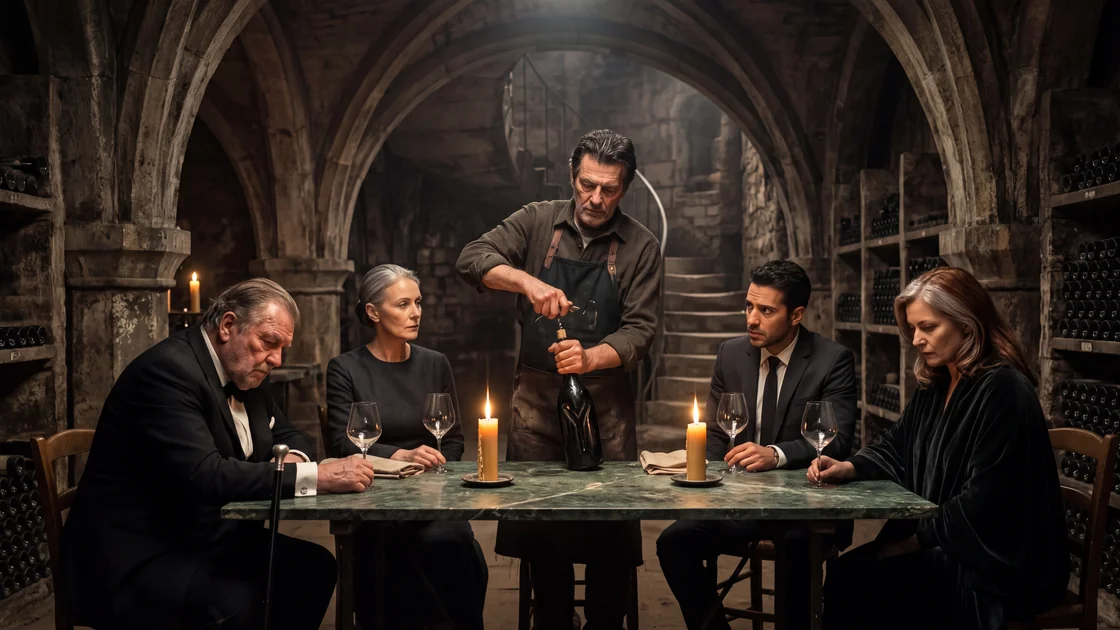
Beneath the cobblestones of Beaune, in a subterranean vault untouched by sunlight for three centuries, a reclusive master sommelier gathers four broken souls to open a bottle of legendary provenance—the 1947 Domaine de la Faille—only to discover that its burgundy nectar forces every person who drinks it to physically and emotionally re-inhabit the singular, catastrophic crossroads where their destiny divided, compelling them to confront the ghosts of who they chose not to become.
I. The Vault of Remnants
The temperature of true silence is twelve degrees Celsius. It smells of limestone weep, dormant penicillium, and iron-rich dust that has settled over glass with the patient malice of silt in an abandoned canal.
Jean-Luc Miller lived within that silence. He had traded sunlight for it thirty years ago, when his hair was still the color of charred oak staves and his palate could parse the slope, the prevailing wind, and the exact mineral deposit of an unlabelled Chablis from a single drop upon his tongue. Men called him l’Écorché—the flayed one—because he tasted wine not as a beverage, nor even as art, but as an open wound through which time bled into the present.
His sanctuary was the Sub-Bourse: a vaulted subterranean labyrinth beneath the oldest quarter of Beaune, built upon foundations laid by the Romans and forgotten by the French Republic. Above, the tourists bought industrially chaptalized pinot noir in plastic-draped souvenir shops; below, Jean-Luc guarded bottles that possessed neither commercial market nor earthly reason. They were wines born of freak frosts, of apocalyptic droughts, of vintners who had gone mad during the phylloxera plagues and pruned their vines with silver sickles while praying to forgotten deities of the rot.
And among them all, tucked into an alcove lined with dry river sand and iron shavings, rested the sole surviving bottle of the Cuvée du Bifur, 1947.
The glass was black, hand-blown, thick as a bull’s horn, and asymmetric. Its pontil mark was scarred with a violent thumb-print of sea-coal ash. There was no paper label; time had devoured whatever parchment once clung to its belly. Instead, directly into the heavy glass, an insignia had been acid-etched: a straight line that traveled upward for three inches before fracturing into a clean, brutal Y. A road that became two.
The provenance was written in the leather-bound ledger of Anatole Chenu, a vigneron from the Hautes-Côtes who had disappeared on the eve of the winter solstice in 1947, leaving behind a stone press-house coated in rime and five barrels of wine that hissed like trapped snakes. Chenu’s final journal entry, scrawled in an ink made of walnut gall and lees, had sat upon Jean-Luc’s desk for twenty years:
The grape does not merely record the weather of the sky; it records the intention of the soil. And the soil remembers that man was not meant for a singular path. In the fruit of the Bifur, the second road does not die. It waits. Drink only when you are prepared to see the corpse of what you abandoned walking beside you.
Jean-Luc was sixty-four years old. His knuckles were swollen from cellar damp, his eyes were grey as wet slate, and for five years, his palate had been dying. It began with an inability to register the subtle honeyed decay of botrytized Sauternes; it progressed until even the violent tannins of young Barolo felt like lukewarm river water against his gums. The doctors spoke of neurological atrophy; Jean-Luc knew better. His tongue was simply exhausted by reality. It refused to register any wine that belonged to this world, because this world had become an intolerable sequence of irreversible mornings.
He had decided that tonight would be the end. He would uncork the Bifur. He would not drink it alone, for Chenu’s notes warned that the wine demanded witnesses—the geometry of its magic required an audience of diverging souls to anchor its weight.
He had summoned four people. They were not friends; Jean-Luc had no friends, only clients who had paid him vast fortunes to curate their private collections, people who possessed everything that wealth, power, and prestige could bestow, and who were, in their own exquisite ways, completely hollowed out by their choices.
The dining table was a single slab of green marble salvaged from a demolished abbey, set upon iron trestles in the central vault. Four candles of unbleached beeswax guttered in drafts that rose from the deepest catacombs. At each setting rested a single hand-blown glass, its bowl shaped like a half-severed tulip.
The cellar door groaned at seven o’clock. Footsteps descended the twenty-eight spiraling stone stairs.
II. The Congregation
The first to arrive was Arthur Vance. He was seventy-one, a man who had built an international shipping conglomerate out of the postwar scrap iron of Liverpool and Rotterdam. He walked with a heavy silver-tipped cane, his frame broad and ruined, his eyes like two gun-slits set into a face of cured ham. His tuxedo was bespoke, cut by a Savile Row tailor who had spent forty years accommodating the hump of Vance’s right shoulder, a souvenir from his days as a dockland laborer.
"It smells like a crypt, Miller," Vance rumbled, dropping into a carved walnut chair with a grunt of iron joints. "Tell me you didn't drag me from Geneva just to drink moldy vinegar. My cardiologist thinks I’m in Gstaad drinking water."
"You came because your cardiologist cannot cure your insomnia, Arthur," Jean-Luc said softly, not looking up from the linen cloth with which he was buffing a glass. "And because you have spent thirty million euros on art you do not look at."
Vance’s jaw set into an ugly line, but he did not deny it. He pulled a gold lighter from his waistcoat, turned it over twice in his scarred fingers, and shoved it back into the darkness of his pocket.
The second and third arrivals came together, though they kept three paces of icy distance between them.
Dr. Eleanor Thorne, fifty-two, was the chief of neurosurgery at the Pitié-Salpêtrière. Her silvering hair was pulled back into a knot so tight it seemed to stretch the pale skin of her cheekbones. She wore a charcoal wool dress that seemed designed to deny the existence of her body, and her hands—the legendary hands that had resected six hundred glioblastomas without a tremor—were resting perfectly still atop the table, knuckles relaxed, fingers curved like dormant spiders. Behind her came Julian Reyes, thirty-six, the deputy minister of trade for the Spanish cabinet, a prodigy of neoliberal bureaucracy whose smile was as sharp and thin as an autopsy scalpel. His eyes twitched toward the corners of the vault, cataloging the exits, the dampness, the impossibility of wireless reception.
"No phones, Jean-Luc?" Julian asked, his voice melodic, practiced, completely devoid of interior truth. "I have three amendments on agricultural subsidies entering committee at midnight. If the French lobby catches me in a cellar without a tether, they’ll carve up the Andalusia quotas."
"Let them carve," Jean-Luc replied. "The Andalusia you represent was dead before you were born, Julian. Sit."
The final guest descended with the tentative, drifting cadence of a blind woman navigating a shoreline.
Sylvie Moreau. She was forty-eight, though under the merciless candlelight she appeared either twenty or eighty. Once, she had been the primary cellist for the Orchestre de Paris, a performer whose interpretations of Elgar were said to make atheists weep in the stalls. But for seven years, her cello had stayed in its carbon-fiber case. She suffered from musician’s focal dystonia—a neurological sabotage in which the third and fourth fingers of her left hand curled inward, locking against the fingerboard like the claws of a dying falcon whenever she touched the neck of the instrument. She wore a loose velvet shawl that hid her hands, her face half-veiled by curls of auburn hair streaked with silver.
She did not greet the others. She sat down, her gaze fixed on the empty glass before her.
"Why are we here, Jean-Luc?" she whispered. Her voice had the gravelly rustle of dry beech leaves. "You said in your note that you had found the antidote to regret. That is a cruel thing to write to a cripple."
Jean-Luc set down his cloth. He stood at the head of the green marble slab, his hands resting on the cool stone.
"Wine is an archive of sunlight that has ceased to exist," he said. His voice was steady, resonant in the vault, carrying the cadence of an ancient liturgy. "When you open an ordinary bottle, you are consuming a calendar: the frost of May, the storm of August, the rot of October. You drink the past as it occurred. But the soil is not obedient to the human clock. The vine sends its taproot thirty meters down, into bedrock that broke long before humanity invented the concept of a single, linear life."
He reached behind him and brought the black bottle into the circle of candle glow.
Arthur Vance leaned forward, his heavy brows knitting. Eleanor Thorne tilted her head, her surgical gaze dissecting the irregular glass. Julian Reyes smiled thinly, waiting for the sales pitch. Sylvie Moreau pulled her shawl tighter, her eyes widening.
"This is the Cuvée du Bifur, 1947," Jean-Luc said. "It is the only bottle left in the world. It was pressed from vines that grew in an abandoned quarry where three subterranean fault lines intersect. It was vinified by Anatole Chenu, who believed that when a human soul arrives at a crossroad—a true bifurcation, where two incompatible lives are offered—the life that was rejected does not vanish. It persists as a phantom current, waiting for a medium through which to speak."
"Metaphor," Eleanor Thorne said dryly. "Pungent, poetic, but biologically nonsensical. The brain does not harbor parallel tracks. Every synaptic pruning is final. Every choice is merely an elimination of alternative motor outputs."
"Is that why your hands tremble when you sleep, Eleanor?" Jean-Luc asked.
The surgeon’s mouth tightened. A muscle in her jaw twitched once, violent as an electric spark.
"What is in the bottle, Miller?" Arthur Vance demanded.
"A vintage that does not believe in your choices," Jean-Luc said. "If you drink it, you will not remember what you left behind. You will be returned to it. You will stand in the dirt of your own fork. You will smell the air, you will hold the breath in your lungs, and you will live the five minutes that broke your existence into two."
"A hallucination," Julian sneered, though his fingers tapped restlessly against his cufflink. "A psychotropic vintage. Ergoline alkaloids in the yeast? Ergotism from contaminated rye near the press?"
"Perhaps," Jean-Luc said. "You may call it ergot, or you may call it grace. But you will not call it a lie once it is down your throat. There are five glasses here. One for each of you. One for me. We will drink in the order of our pride, beginning with the youngest."
He reached for the corkscrew—not a modern lever, but a two-pronged Durand, designed to coax out ancient, fragile corks without crumbling their dry bellies into the broth.
III. The Uncorking
The cellar held its breath. The wax over the neck was not modern paraffin; it was pitch mixed with sheep tallow and powdered slate. Jean-Luc chipped it away with a small silver knife, the flakes falling onto the marble like black snow.
He inserted the longer prong of the Durand between the cork and the glass, easing it down with an agonizing, surgical pressure. The metal slid into the neck. Then the shorter prong. He rocked the handle with the precision of an engraver, feeling the cork resist, grip, and finally surrender.
With a slow, twisting pull, the plug emerged.
There was no pop. There was a sound like a tiny, subterranean gasp—a sudden inhalation of air that had been held for seventy-six years.
Instantly, the cellar ceased to smell of damp stone.
The scent that billowed from the neck of the bottle was impossible. It did not belong to the vocabulary of oenology. There was no cassis, no wet tobacco, no forest floor, no leather.
It smelled of wet asphalt after an August thunderstorm in a city none of them had visited in decades. It smelled of cheap clove cigarettes burning on a balcony; of turpentine and sun-bleached cotton; of an antiseptic hospital corridor where the lights hummed at sixty hertz; of salt spray hitting the rusty deck of an outward-bound freighter. It was the scent of a dozen departed worlds, violently compressed into an aerosol that made Arthur Vance gasp and grip the edge of the marble table until his knuckles turned the color of lard.
"My God," Sylvie whispered, her face pale as parchment. "It smells like... the platform at the Gare de Lyon. The old diesel trains. The yellow tobacco."
"Keep your seats," Jean-Luc commanded.
The wine was not purple. As it slid from the dark glass into Julian Reyes’s tulip, it poured with the consistency of motor oil, falling into the crystal with a heavy, dead sound. In the candlelight, its color was terrifying: a blackish-amber, edged with the lurid, phosphorescent orange of dying embers.
"Julian," Jean-Luc said. "Deputy Minister. Architect of trade. Drink."
Julian stared at the glass. The cynical grin that had protected his face for a decade had slipped, revealing the terrified, pale boy who had grown up in the slums of Lavapiés, terrified of being small.
"I have nothing to see," Julian said, his voice cracking slightly. "I made my career. I won every race I ran."
"Drink," Jean-Luc whispered. "Or leave this table and spend the rest of your nights knowing that you were too cowardly to face your own ghost."
Julian’s hand moved as if drawn by a wire. His fingers closed around the stem of the glass. He raised it. The orange rim flared against his lips. He closed his eyes and swallowed.
IV. The First Bifurcation: Julian Reyes
The room did not dissolve; it was overwritten.
Julian did not fall into a dream. He fell into the cold, sharp heat of Madrid in late June, 2011.
The sensation was so violently real that his lungs seized on the dry, baking air. He was twenty-four years old again. He was sitting in the cramped, third-floor apartment on Calle de la Fe, the air smelling of fried garlic, hot dust, and the sour laundry hanging from the ropes across the courtyard. The floor fan was rattling on its plastic stand, oscillating back and forth with an irritating, rhythmic clack-whir, clack-whir.
Before him on the plywood desk sat a laptop, its battery swollen, its screen illuminating two open documents.
To his left: a dossier containing the forged expense reports and offshore account numbers of Professor Mateo Althaus—his mentor, the man who had pulled Julian out of the immigrant slums, paid his tuition from his own research grants, and treated him like a son. The dossier was an execution order. Julian had discovered the discrepancies by accident; if he leaked it to the press that afternoon, Althaus would be ruined, his progressive think tank would collapse, and the conservative opposition party would offer Julian the directorship of their youth policy initiative by nightfall. It was the ladder. The only ladder out of the heat, out of the smell of poverty, out of the invisible cage of his birth.
To his right: an unsigned manuscript. A joint treatise on regional water sovereignty that he and Althaus had spent three years researching. If he signed it and defended it with Althaus at the university hearing the following morning, they would win the institutional grant. But there would be no power. No television appearances. No ministerial cars with tinted windows. Only thirty years of teaching underfunded seminars in Murcia, living in a flat that smelled of other people’s cabbage, holding the hand of a woman who loved his poetry rather than his titles.
In his historical life, Julian had not hesitated. He had sent the email to the investigative editor of El Mundo at 3:14 PM. By 6:00 PM, Althaus had suffered a coronary incident on the steps of the faculty building; two years later, he had died in obscurity. Julian had walked over his corpse into the ministry.
Now, he was back in the heat.
His finger hovered over the trackpad. The sweat running down his spine was real. The sting of salt in his eyes was real. He could feel the coarse texture of his cheap cotton undershirt against his ribs.
"Julian?"
A voice called from the doorway. He turned his head with an agonizing slowness that tore through twelve years of scar tissue.
It was Mateo Althaus. He was alive. He was wearing his absurd, paint-stained linen jacket, holding two glass bottles of cold Mahou beer, the condensation dripping onto his knuckles. His face was not the grey mask of the corpse Julian had viewed through the glass at the San Isidro mortuary; it was alive with that fierce, childish enthusiasm that Julian had despised because it was so utterly vulnerable.
"They just confirmed the committee schedule," Althaus said, smiling, handing Julian a bottle. The glass was shock-cold against Julian's palm. "Tomorrow at nine. If we stand together on the fifth chapter—the part about municipal autonomy—they can’t touch us. We have the data, Julian. We’re going to protect those valleys."
Julian looked down at his right hand.
In his memory, he had hidden the laptop screen with his shoulder, made an excuse, and waited for Althaus to leave before clicking Send.
Now, the wine inside his veins acted like an anchor dragged across the seabed of his destiny. He felt the terrifying, physical pull of the alternative. He could simply... close the tab. He could reach out, take the beer, clink the glass, and say: I’m with you, Mateo.
He felt the weight of that unchosen life descending upon him. He saw it: the modest apartment in Granada; the bookshelves bowing under second-hand volumes of agrarian law; the small garden where he would grow bitter tomatoes; the quiet mornings when he would wake beside a woman who knew the scars on his soul and did not care about the cabinet reshuffle. He saw himself at fifty: grey-haired, his clothes slightly frayed, his wallet thin, but his chest... his chest was broad and light. There was air in his lungs. He was not afraid of the mirror.
"Julian?" Althaus asked, the smile faltering slightly, noticing the terror in his student's eyes. "Are you alright? You look like you’ve seen a ghost."
Julian opened his mouth. He tried to speak the words that would undo twelve years of poison. He tried to say: Mateo, forgive me. Sit down. Let me show you what they wanted me to do.
He lunged toward the keyboard to delete the file—
And the room snapped.
Julian was back in the cellar.
He was on his knees. His forehead was pressed against the cold, damp flags of the vault floor. His hands were clawing at the stone, his breath coming in violent, ragged whoops that sounded like a dying dog. The glass had fallen; it had not shattered, but rolled against the leg of the marble table, a few dark drops glistening on the limestone like drops of dried blood.
"Mateo," Julian sobbed into the dirt. "Mateo... I didn't... I didn't want the car. I didn't want the car..."
Arthur Vance recoiled, his heavy jowls pale. "What did he see? What the hell did he see?"
Eleanor Thorne did not look at Vance. She was leaning over the table, her eyes dilated, her fingers pressed against the carotid artery of her own neck, checking her own accelerated pulse.
"He was not here," she said, her voice dropping its clinical armor. "His pupils were unresponsive. His respiration was Cheyne-Stokes. For ninety seconds, his nervous system was running a motor program that was not occurring in this room."
Julian lifted his head. His eyes were bloodshot, his elegant silk tie soaked with his own sweat and cellar dust. He looked at Jean-Luc with a hatred that was purer than love.
"You bastard," Julian hissed, his teeth clicking together. "You made me feel it. I had forgotten... I had finally forgotten the smell of the beer."
"You forgot nothing," Jean-Luc said coldly, filling the second glass. "You merely constructed a mausoleum of titles over the grave. Now the tomb is open. Sit back in your chair, Julian. You are among the honest now."
Julian crawled back into his seat, his hands shaking so violently he had to tuck them between his thighs to hide them.
Jean-Luc slid the second glass toward Sylvie Moreau.
"Sylvie," he said.
V. The Second Bifurcation: Sylvie Moreau
Sylvie did not look at Julian. She looked at the amber rim of the wine. A thin line of vapor seemed to rise from the surface, carrying that unmistakable, fatal aroma of wet platforms and coal-smoke.
"I know where it will take me," she said. Her voice was flat, hollowed out by twenty years of mourning. "I have lived there every night in my sleep anyway."
"No," Jean-Luc said. "In your sleep, you live in your memory. Memory is a coward; it softens the light, it edits the sound, it makes the tragedy seem inevitable so that you may survive it. The wine does not care about your survival. It will show you the cost."
Sylvie reached out. Her left hand—the hand whose fingers had betrayed her, whose tendons had clenched into a useless knot—trembled as it touched the crystal. But as she lifted the glass, a strange, metallic calm settled over her features.
She drank. She took a full, deep mouthful, holding the thick, bitter-orange liquid on her tongue before swallowing.
The cellar vanished.
There was no transition, no tunnel of light. She was standing in the driving rain on Platform 4 of the Leipzig Hauptbahnhof. It was November 14, 1997. The cold was a physical blow—it bit through her thin wool coat, smelling of sulphur, wet iron, and cheap chicory coffee from the station kiosk.
She was twenty-two.
In her right hand, she held a battered leather suitcase containing three changes of clothes, her scores of the Bach Cello Suites, and an envelope containing eight thousand Deutsche Marks—a full scholarship to the Juilliard School in New York, where she was scheduled to begin master classes with Rostropovich’s protégé on Monday morning.
In front of her stood Gabriel.
Gabriel was twenty-five then, an unkempt, red-headed carpenter from the Cévennes who had followed her through Germany like a faithful hound, who slept on the floor of her practice rooms, who had spent his last pennies to buy her a box of rosin made from Baltic amber. He was soaked to the skin. His hands, rough and nicked with saw-marks, were holding two second-class tickets for the night train to Marseille.
"Don't go to America, Sylvie," Gabriel said. The wind whipped the rain into his eyelashes. He wasn't pleading; his voice had that terrifying, quiet certainty that had always made her feel as though she were standing on the edge of a cliff. "The machine will eat you. They don't want you; they want an engine that can play forty-eight sixteenth-notes without a pulse. Come to the mountains. We will build the workshop. You can play in the stone chapel in Saint-Jean. You can play for the goats, you can play for the rain, you can play for me. But if you get on that boat, your music will turn into glass."
In her lived history, she had laughed at him. A cruel, terrified laugh born of ambition and vanity. She had called him a peasant, told him he was trying to drag her down into the mud, and boarded the train to Frankfurt without looking back through the soot-stained window. Five years later, she had made her Carnegie Hall debut. Ten years later, her fingers had curled into stone, locking her into silence. Gabriel had died in an avalanche in the Pyrenees in 2004; she had read his obituary in a two-line notice in a local paper she had found by accident in a café.
Now, she was on the platform again.
The steam from the engine was screaming through the valves, wrapping them in an opaque, white cloud that tasted of rust.
Gabriel reached out. His thumb, rough as sandpaper, pressed against the wet skin of her cheek.
"Come with me," he said.
The wine surged through her. It was not a vision; she could feel the cold water seeping through the thin soles of her leather boots. She could feel the heavy, leaden weight of the Juilliard envelope in her pocket—it felt like a brick made of dead souls.
And suddenly, the terrifying truth of the Bifur struck her: she had the choice. The moment was not sealed. The universe was completely, totally balanced on the edge of her will.
She looked at her left hand.
She held it up between them in the Leipzig rain. The fingers were long, supple, beautiful. They were alive. They did not cramp; they did not twist. She could feel the phantom pressure of the strings—the vibration of the C-string buzzing through the callus of her thumb.
If I go with him, she thought, the realization bursting through her with the force of an arterial rupture, my hand will never die. The dystonia was not in the nerves; it was the body’s refusal to keep serving an ambition that had murdered its love.
She saw the life that waited: the stone house above the gorge, smelling of cedar shavings and drying lavender. The long winter nights when she would sit by the cast-iron stove, playing the Sarabande from the Fifth Suite while Gabriel carved walnut bowls by the light of a kerosene lamp. She saw her children—two girls with Gabriel’s wild red hair, running barefoot across the grey limestone terraces. She saw herself at forty-eight: weathered, her skin lined by mountain sun, her knuckles thickened by domestic work, but her hands... her hands free, singing, pulling music out of the wood like water from a deep well.
"Sylvie," Gabriel whispered, his eyes searching hers through the rain. "The conductor is blowing the whistle."
She dropped the suitcase.
The leather hit the wet concrete with a heavy, wet slap.
She reached out with both arms, her fingers opening wide, supple and strong, and threw herself toward Gabriel’s chest—
And her fingers met empty air.
Sylvie screamed.
It was not a human cry; it was the sound of an animal caught in an iron trap. She was standing in the Beaune vault, her chair knocked backward, crashing against the stones.
She held her left hand in front of her face under the candlelight.
The hand was locked. The third and fourth fingers were curled into the palm, rigid as petrified wood, digging their nails into the soft skin until droplets of dark blood welled along the creases.
"Give it back!" she shrieked at Jean-Luc, her hair wild across her face, saliva glistening on her lip. "Give it back to me! I dropped the bag! I didn't get on the train! I dropped the bag, Miller!"
Jean-Luc did not flinch. His face was carved from the same limestone as the pillars.
"You got on the train, Sylvie," he said, his voice dropping into the darkness like a plumb line. "You spent thirty years on that train. The wine only shows you the door you slammed. It does not unlock it."
Sylvie collapsed back against the wall of the vault, sliding down until she was curled on the floor, weeping into the hem of her velvet shawl, rocking her clenched fist against her stomach as if it were a dead infant.
Arthur Vance’s face was grey. He slammed his heavy palm onto the green marble, making the candle flames leap and dance.
"This is sadism," he growled, his voice trembling with a rage that could not mask his terror. "You’re drugging us. You’ve put some bastard synthetic neurotoxin in the decanter. Thorne, tell him! You’re a doctor, for God’s sake! Tell him what this is!"
Eleanor Thorne did not answer immediately. She was looking at Sylvie’s hand. She had studied the neuropathology of focal dystonia for three decades; she had written the standard textbook on the cortical re-mapping of motor disorders in instrumentalists.
"It isn't a drug," Eleanor said. Her voice was terrifyingly calm, but it had the hollow resonance of an iron bell. "A drug produces generalized disinhibition or stereotyped hallucination. This... this is temporal re-projection. Their autonomic systems are responding to specific environmental stressors that left no physiological trace in their current records."
She looked up at Jean-Luc. Her face, usually so composed, had the look of an architect watching a skyscraper collapse in silence.
"You saved me for third," she said.
"You believe in evidence, Eleanor," Jean-Luc said, filling her glass. "You believe that every effect has a measurable cause, and that your life is simply the sum of rational decisions made under optimal conditions."
"I have saved four hundred lives," she whispered.
"And how many did you kill to buy the chair you sit in?"
Jean-Luc pushed the crystal across the green marble.
VI. The Third Bifurcation: Eleanor Thorne
Eleanor did not hesitate.
She was a scientist; she had spent her life confronting the horrors of the human interior—the malignant tumors that grew like cauliflower in the frontal lobes, the hemorrhages that drowned the consciousness of painters and poets in black venous blood. She picked up the glass with the steady, cold grip that had sliced through the dura mater of monarchs and beggars.
"To the truth," she said, her voice dry as salt. "Whatever its chemical structure."
She drank the glass dry in three long, deliberate swallows.
The limestone of the vault dissolved into a roar of muddy water and the deafening clatter of corrugated tin sheets under tropical rain.
The heat hit her like a wet, dirty blanket thrown over her face. It was 104 degrees Fahrenheit, with ninety-eight percent humidity. The air smelled of woodsmoke, diesel exhaust, human excrement, and the sweet, sickening stench of gangrenous tissue rotting under damp gauze.
Bukavu. Eastern Congo. August 12, 1998.
She was thirty-two.
She was standing in the triage tent of the International Red Cross station, wearing scrubs that had turned from green to an indistinguishable rust-brown from forty-eight hours of continuous surgery. Outside, the second war of the Congo was erupting; the town was surrounded by two competing militias, and the sound of mortar fire rolled through the green hills like distant thunder.
On the wooden operating table before her lay an eight-year-old girl named Beatrice.
Beatrice had a piece of shrapnel from an antipersonnel mine lodged two millimeters from her middle cerebral artery. The field hospital had no CT scanner, no surgical microscope, no bipolar cautery. Eleanor had only a manual drill, an ophthalmoscope, a pair of dissecting forceps, and a single tank of oxygen that was whistling its final bar of pressure.
In the doorway of the tent stood Colonel Jacques, the French liaison officer. He was holding a satellite phone and an evacuation manifest.
"Thorne!" he screamed through the noise of the rain. "The last helicopter is lifting off the tarmac in twenty minutes! The rebels have taken the river road! If you don't leave the kit now, you’re staying for the massacre! Sign the release and move!"
In her historical life, Eleanor had looked at Beatrice’s open skull. She had calculated the odds: a three percent chance of successful extraction without a microscope; a ninety-seven percent chance of intraoperative exsanguination on the table. And even if she saved her, the hospital would be overrun by morning. If she stayed, she would die in a ditch behind the clinic.
She had laid down her forceps. She had packed her surgical notes, signed the evacuation voucher, and walked to the Puma helicopter. Six months later, she was an assistant professor at Johns Hopkins. Ten years later, she was the head of neurosurgery in Paris, operating in an auditorium that looked like a spacecraft, earning eight hundred thousand euros a year, and dining with ministers.
Now, she was back over Beatrice’s skull.
The rain was hammering the tin roof with the force of machine-gun fire.
"Thorne! Move!" Jacques screamed, his hand grabbing her shoulder.
The smell of the child’s exposed brain—that delicate, terrifying scent of warm phosphorus and lipids—filled Eleanor’s nostrils.
Under the influence of the Bifur, the calculation vanished. The cold, probabilistic logic that had sustained her entire glittering career peeled away like rotten bark. She saw what that logic had truly been: not wisdom, not pragmatism, but an exquisite, gilded cowardice. She had chosen to be a queen in a palace of machines rather than a soldier in the dirt where she was needed.
"Get your hands off me," she heard herself say.
Jacques stared at her. "You’re insane! You’ll be dead by sunset!"
"Get out," she whispered.
She picked up the manual forceps. Her hands—those extraordinary instruments that had never known fear—felt heavy, warm, and utterly alive.
She didn't run for the helicopter. In this second road, she stayed.
She felt the five hours that followed with a granularity that made her lived life seem like a faded charcoal sketch. She felt the shrapnel give way under the steel tip; she felt the terrifying, sudden spurt of dark blood, and the miraculous, desperate pressure of her finger against the vessel until the spasm stopped. She felt the rebels arrive; she felt the terror of the clinic doors being kicked down; she felt herself standing between the bayonets and the children, holding her blood-soaked hands up in the dim kerosene light, screaming in Lingala that she was a doctor, that there were only children here.
And she lived what followed: she did not die in a ditch. She survived. She spent twenty years in that valley. She built three hospitals out of sun-dried brick. She had no penthouse on the Île Saint-Louis, no honorary doctorates from Uppsala, no articles in The Lancet. Her skin was ruined by malaria; her joints were swollen with dengue; her hair turned grey at forty.
But when she walked through the market in Bukavu, three hundred women called her mother. And Beatrice—Beatrice was thirty-two now, a teacher in the brick schoolhouse, holding a child of her own.
Eleanor saw her own face in the reflection of a dirty window in that African clinic: old, exhausted, deeply lined, but her eyes... her eyes were like burning lamps. They were not the cold, dead stones that looked back at her from the mirrors of the Pitié-Salpêtrière.
"I could have saved them," she murmured in the rain. "I could have saved them all..."
And then the geometry of the wine snapped shut.
Eleanor Thorne did not scream like Sylvie. She sat bolt upright, her eyes wide, staring at the candle flame as if she could see the entire continent of Africa burning within its wick.
A single, thick tear gathered in the corner of her left eye, hung suspended for a second on the pale prominence of her cheekbone, and dropped onto the marble table.
She looked at her hands.
The hands were pristine. The nails were manicured, scrubbed with surgical soap, unscarred by the sun or the dirt of the Kivu.
"I was a coward," she whispered. She did not say it with self-pity; she pronounced it as a final diagnosis, a pathology report from which there was no appeal. "Every paper I wrote... every medal they pinned on my lapel... it was all blood money. I traded three hundred lives for a penthouse with a view of the Seine."
Julian Reyes looked up from the floor, his face hollowed by his own private hell. He reached out and touched Eleanor’s arm. For the first time in their lives, the bureaucrat and the surgeon looked at one another without their masks, two survivors of an execution that had taken place inside their own skulls.
Arthur Vance looked between them, his breathing heavy and wet, like an old bellows leaking air.
"No," Vance said, his voice rising, thick with the panic of an animal backed into a corner. "No. I’m not drinking it. I don't give a damn about your little theatrical séance, Miller. You’re insane. You belong in an asylum. I’m leaving."
He reached for his silver cane, planted it against the stone floor, and began to heave his bulk out of the chair.
"Sit down, Arthur," Jean-Luc said.
The voice was not loud, but it had the weight of fifty feet of earth above them.
"You won't leave," Jean-Luc said. "Because you know that the thing you ran from in Liverpool has followed you into every boardroom, every yacht, every bedroom you ever bought. You have spent eighty million pounds trying to buy the thing you left in the garage on Kirkdale Road. And you are dying of prostate cancer, Arthur. You have six months. Do you really want to die without ever knowing what the painting looked like?"
Vance froze.
His fingers clamped around the silver skull that formed the handle of his stick until the metal bit into his flesh. His mouth opened, worked wordlessly for three seconds, and then closed.
"How do you know about Kirkdale Road?" he rasped. "Nobody knows about that. Nobody."
"The soil knows," Jean-Luc said. He poured the fourth glass.
The liquid fell like black honey. It did not splash; it settled into the crystal with a dark, oily sheen, reflecting the candle flame as a tiny, malevolent eye.
"Fifty years, Arthur," Jean-Luc said. "Fifty years of iron and coal. Go back and look at the canvas."
VII. The Fourth Bifurcation: Arthur Vance
Vance did not take the glass by the stem. He grabbed it by the bowl with his huge, liver-spotted paw, his knuckles white, and brought it to his mouth as if he were draining a glass of bitter medicine before an execution.
He drank.
The cellar did not vanish; it exploded.
The sound that hit Arthur Vance’s ears was the deafening, rhythmic clang-whack of a pneumatic press in the Cammell Laird shipyard, and the bitter, damp, freezing stench of the Mersey estuary in January 1972.
He was twenty.
He was standing in the lean-to garage behind his mother’s terraced house in Kirkdale. The roof was corrugated iron, leaking a steady, miserable drip into an old zinc bucket in the corner. The only heat came from an oil heater that smelled of paraffin and fish-glue.
Before him, mounted on an easel made of scavenged scaffolding planks, was a canvas six feet high and four feet wide.
It was painted with boat-paint, coal-dust, red lead, and linseed oil stolen from the dock stores. It was not a landscape; it was an inferno. A massive, terrifying depiction of the men who worked the ship-plates—their bodies twisted into the iron, their faces half-smudged by grease, their chests opening up into cathedral arches of raw muscle and bone. It had the violent, raw genius of Francis Bacon, but it had something else: it had the rage of the Liverpool docks, the beauty of men who were being ground into industrial meat and refused to go down without a song.
On an upturned orange crate beside the easel lay two documents.
One was a contract from the Mersey Docks and Harbour Board: an apprenticeship in the administrative office, thirty-five pounds a week, guaranteed pension, a company tie, and a small office with a window overlooking the coal-wharves. The first step into the machinery of British capital. The ladder that would lead him to the boardrooms of London, the shipping registries of Monrovia, the tax-havens of Jersey, and the eighty-meter superyacht currently docked in Antibes.
The other was an acceptance letter from the Slade School of Fine Art in London.
A scholarship. Twelve pounds a week for subsistence. A warning that the school provided neither lodging nor materials.
His mother, her face yellow with the bronchitis that would kill her by autumn, stood in the kitchen door behind him, wiping her hands on her apron.
"You take the dock job, Arthur," she wheezed, her voice whistling through her ruined lungs. "Your father died in the hold of a grain boat with sevenpence in his pocket. You take the clean shirt. You paint your pictures on Sunday. Don't you dare go to London and starve like a fancy boy. Don't you dare break my heart."
In his lived life, Arthur had looked at the canvas. He had looked at his hands—hands that could bend an iron bolt, hands that smelled of paint thinners. He had looked at his mother’s yellow eyes.
He had picked up a bucket of black creosote from the corner.
He had thrown it across the painting. He had watched the black, oily tar run down the faces of the dockers, obliterating their eyes, their ribs, their cathedral chests, turning the work of three years into a shiny, dripping smear of industrial waste. Then he had walked into the kitchen, picked up the pen, and signed the dock contract.
He had never held a paintbrush again. He had bought pictures instead. He had bought Turners, Constables, Picassos, Bacons; he had locked them in climate-controlled vaults in Geneva, visiting them once a year, staring at them with a dry, murderous envy that made him want to rip them from their stretchers with his bare teeth.
Now, he was standing in front of the wet canvas again.
The bucket of creosote was at his feet. The handle was cold in his hand.
"Arthur," his mother wheezed from the door. "Be sensible, son."
The Bifur tore through Vance’s seven-decade-old heart with the force of an iron wedge.
He did not pick up the bucket.
He looked at the painting. In the damp grey light filtering through the cracked skylight, the colors were not paint; they were his blood. They were his soul, crying out against the death of the human spirit in the iron yards.
"No, Mum," he heard his twenty-year-old voice say. It was a voice that hadn't spoken in fifty years—raw, northern, melodic, free of the polished, gravelly drawl he had acquired in the clubs of Mayfair. "I’m not taking the clean shirt."
He set the bucket down.
He walked to the orange crate, picked up the letter from the Slade, and folded it into his pocket.
The timeline branched, and Arthur Vance fell down the second road.
He lived it. He lived the tiny, freezing garret in Camden Town where the water froze in the jug every January. He lived the hunger—the days when he ate raw oats soaked in tap-water and painted on the backs of discarded theatrical posters because he couldn't afford linen. He lived the rejections, the sneers of the Bloomsbury critics who thought his work was too crude, too violent, too working-class.
And he lived the night in 1984, in an unheated warehouse in Wapping, when the light broke through.
He saw the exhibition. He saw thirty of his massive, brutal canvases hanging in the Whitechapel Gallery. He saw the dockers from Liverpool who had taken the excursion train down to London, standing in front of his pictures in their Sunday coats, their caps in their hands, weeping because someone had finally painted their lives with the dignity of kings.
He had no yacht in Antibes. He had no thirty-million-pound collection. He had two rooms overlooking the railway cutting in Hackney, a hip that clicked when it rained, and a drawer full of unpaid gas bills.
But on his easel sat a portrait of his wife—a woman who had loved him when his shoes were stuffed with newspaper—and as he looked at her face on the canvas, he knew that he had captured the light. He had beaten time. He had taken his twenty years of Liverpool mud and turned it into an immortal, burning fire that would speak to men long after the shipping registries had rotted to dust.
"I made it," he sobbed in the Leipzig cold of his own mind. "I was a painter... by God, I was a painter..."
And then the canvas was torn away.
Arthur Vance fell across the green marble table with a crash that shattered his glass into fifty sparkling teeth of crystal.
His great, heavy head rested in the pool of spilled wine. The dark red liquid soaked into his stiff white shirt-front, spreading across his chest like an enormous, mortal wound. His broad shoulders heaved with dry, racking sobs that shook the entire slab, making the beeswax candles flutter and smoke.
"I killed it," he wept, his voice muffled by the stone. "I threw the tar on it. It was alive, and I drowned it in tar... for what? For a pile of papers in a Swiss bank... for an empty bed..."
Julian Reyes did not move to help him. Eleanor Thorne did not reach for her stethoscope. Sylvie Moreau did not lift her head from her shawl.
They sat around the table like the damned in the ninth circle of the Inferno—not punished by fire or ice, but by the unbearable, crystalline revelation of their own complicity in their ruin.
The cellar was quiet now, save for the wet sniffling of the industrialist and the steady, ancient drip of water from the vaulting above.
Jean-Luc Miller stood at the head of the table.
He picked up the bottle of the Cuvée du Bifur, 1947.
There was exactly one glass left.
VIII. The Sommelier's Glass
Jean-Luc looked down into the dark neck of the bottle.
His hands did not shake, but they felt light, empty, like dry leaves ready to be carried off by the first breath of November wind.
"You knew," Eleanor Thorne said. Her voice was steady now, stripped of all human vanity. She looked at Jean-Luc through the smoke of the guttering candles. "You knew what it would do. You brought us here as a vivisection."
"I brought you here because the wine required a chorus," Jean-Luc said. "One voice cannot bear the weight of what Chenu left behind. A single bifurcation creates a vacuum; five create an architecture."
"And you?" Julian asked, his voice bitter with the humiliation of his exposed youth. "What is your excuse, Miller? You sit there like an inquisitor, judging our careers, our cowardice. What did you abandon in the cellar thirty years ago?"
Jean-Luc did not answer with words. He tilted the black glass.
The last of the Cuvée du Bifur slid into his glass. It was darker than the rest—the dregs, thick with the sediment of seventy-six years, carrying the microscopic debris of the oak, the skins, the yeast, and the ash of Anatole Chenu’s final fire.
"I did not abandon a career," Jean-Luc whispered. "I abandoned the light."
He brought the tulip to his nose.
His dead palate—the palate that had refused to taste the grandest crus of Bordeaux, the greatest vintages of Romanée-Conti for five long years—suddenly woke.
It was not an awakening of pleasure. It was an electric shock that pierced through his tongue, his soft palate, his trigeminal nerve, straight into the amygdala. The wine tasted of iron, of salt, of wild thyme crushed between sun-hot stones, and of a perfume made of orange blossoms and sea-spray: Fleurs d’Oranger by Serge Lutens.
The perfume Clara had worn on the fourteenth of June, 1989.
Jean-Luc drank.
He did not sip. He emptied the glass, letting the thick, sandy lees coat his tongue, his throat, his soul.
The Sub-Bourse vanished.
Jean-Luc was standing on the gravel path between the vines of the Clos de la Roche, high above the village of Morey-Saint-Denis.
The sun was blinding. It was five o’clock in the afternoon on a Tuesday in midsummer. The limestone slopes were radiating a golden, benevolent heat that tasted of chalk and ripening fruit. The air was full of the buzz of cicadas and the distant sound of a tractor idling in the hollow.
He was thirty-four years old.
His palate was at the height of its terrifying, sovereign power. He had just been named the Meilleur Sommelier du Monde; he was the golden child of French gastronomy. The cellars of the Élysée, the palaces of Monaco, the private cellars of Tokyo and New York were open to him like conquered cities.
Beside him stood Clara.
She was twenty-eight then. She was wearing a simple white sundress that the summer wind pressed against her brown thighs. Her hair, the color of chestnuts, was tied back with a bit of blue string she had found in the vine-rows. Her eyes were green, clear, and completely unimpressed by his medals, his titles, or the five-hundred-franc bottles of Montrachet he had poured for her the night before.
Behind them stood an old Citroën 2CV, its canvas roof rolled back, packed to the gunwales with two suitcases, an easel, four crates of books, and an old iron stove.
"The ferry leaves Saint-Malo tomorrow morning, Jean-Luc," Clara said.
She was holding his hands. Her palms were warm, slightly dry from the limestone dust. She wasn't crying; she had that serene, terrifying stillness of a woman who has reached the end of her patience and is offering one last, miraculous mercy.
"We have the house on the cliffs in Belle-Île," she said. "My uncle’s apple orchard. We will make cider. We will grow vegetables. We will look at the Atlantic instead of looking at the bottoms of glasses. You can write your book. But you have to leave the cellars. If you stay in Paris, if you take the directorship at the Tour d’Argent, you will turn into a shadow. You will spend your life tasting other men’s harvests while your own garden turns to briars."
In his lived life, Jean-Luc had looked at her hands. He had loved her—loved her with a ferocity that made his teeth ache.
And then he had looked down at the valley: at the golden, manicured slopes of the Côte de Nuits, where every square meter of earth was worth a king’s ransom, where the names were not names but incantations: Chambertin, Musigny, Romanée. He had thought of the cellar beneath the Quai de la Tournelle—the four hundred thousand bottles resting in the holy dark, waiting for his tongue to tell them what they were.
He had felt the cold, narcissistic vanity of the high priest.
I am the one who understands them, he had thought. A cider press is for peasants. I am the arbiter of time.
He had kissed her cheek. He had told her that he would follow her in a year, once the cellar reorganization was complete. It was a lie, and they both knew it. She had looked at him for three seconds—three seconds in which her green eyes had cataloged the death of his soul—then she had climbed into the Citroën, turned the key, and driven down the hill toward the N74.
She had died of meningitis in Brest six years later. He had not attended the funeral because he was conducting a retrospective tasting of Château d'Yquem for twelve Japanese industrialists in a private salon at the Ritz.
Now, he was standing in the Clos de la Roche again.
The gravel was crunching under her sandals. The Citroën’s engine was not running.
The wind brought the smell of her skin—orange blossom and sea-salt, untainted by the sulfur of ancient bottles or the damp mold of the vaults.
"Jean-Luc," she said.
The wine inside him was a fire that threatened to consume his marrow.
He looked down at his own hands. They were thirty-four years old. They were smooth, un-swollen by arthritis, free of the cellar-stains that had turned his current fingers into yellow claws.
He had the choice.
The road was open. The Y of Anatole Chenu was not a monument; it was a fork that had never ceased to wait for him.
He felt the weight of the alternative life descending like a warm, salt-scented cloak. He saw the house on the cliffs of Belle-Île: the grey slate roof lashed by Atlantic gales; the kitchen that smelled of burning applewood and rising sourdough; the mornings when he would wake not to the dead silence of twelve degrees Celsius, but to the thunder of the surf against the granite needles. He saw his children—a boy who would have Clara’s long legs, a girl who would inherit her clear, green eyes.
He saw himself at sixty-four: not l’Écorché, not the ghost of the Sub-Bourse, but a man whose skin was cured by salt and wind, who drank cider from ceramic bowls, whose tongue was alive to the simple, holy taste of fresh butter, cold well-water, and the bread baked by the woman he had loved.
"Jean-Luc?" she asked, her voice trembling slightly. "The tide won't wait for us."
He looked at the Citroën. He reached out his hand toward the door handle.
His fingers touched the hot, blue-painted metal. The reality was absolute. It was not a dream; the vibration of the heat off the bonnet was against his skin. He could step in. He could sit on the springy, canvas seat beside her. He could put his arm around her shoulders and smell the sea in her hair.
All I have to do is turn my back on the cellar, he thought.
And then, from the depths of his being, the terrible, incurable monster that had made him a master sommelier spoke from the dark.
He looked over his shoulder.
Beneath the vines of the Clos de la Roche, he saw the earth. He saw through the topsoil, through the marl, down into the limestone fissures where the roots clung like starving fingers to the cold, dead rock.
He realized what he was.
He was not a man of the sun. He was not a creature of the sea. He was the guardian of the dead. He had been born to dwell in the dark, to preserve the forgotten sunlight of centuries that had failed, to be the mouth through which the dead earth spoke its final, desperate grief.
If he went with her, the Atlantic would heal him. But the silence—the great, noble, terrifying archive of human suffering preserved in glass—would have no witness.
"Jean-Luc?" she whispered. Her hand was slipping from his.
He looked into her green eyes. He saw the life he was murdering. He saw it with a clarity that made the sun black out.
And with a deliberate, agonizing slowness that tore his heart out of his ribs, he pulled his hand away from the car door.
"Go, Clara," he said.
His voice was sixty-four years old. It was the voice of the vault.
"Go to the island," he told her. "Do not wait for me. I am already under the ground."
IX. The Morning After
The candles had burned down to their lead saucers, drowning in their own grey wax.
A single shaft of pale, cold dawn light—the first light of a winter Thursday—filtered down through the iron grating twenty feet above, cutting through the damp cellar air like a dusty broadsword. It struck the green marble table, illuminating the debris of the night: the shattered shards of Arthur Vance’s glass; the dark, sticky pools of spilled vintage; the empty black bottle of the Cuvée du Bifur, 1947, standing like an abandoned monument in the center of the slab.
No one had spoken for three hours.
Julian Reyes sat with his head tilted back against the limestone pillar, his eyes open, staring up into the shadows. The boy from Lavapiés was gone; the deputy minister was gone. What remained was a man who looked upon his life as a soldier might look upon a field of friendly dead after a battle he had won for an unjust king.
"I’m resigning on Monday," Julian said. His voice was flat, dried out, completely calm. "The Andalusia quotas can go to the cooperatives. I am going back to Granada."
Eleanor Thorne did not look at him, but her hand moved across the marble and rested on Julian’s wrist—a light, human touch, devoid of professional distance.
"I have eight patients scheduled for Monday," she said. Her silvering hair had come loose from its pins, falling across her face in soft, grey waves. "I will operate. I will operate with my own hands. But when they are healed... I am going back to Bukavu. The Red Cross still has the clinic at the river bend. They need someone who knows how to use a manual drill."
Sylvie Moreau stood up.
She did not use her cane. She held her left arm across her chest, but her face was no longer contorted by the agony of her lost music. Her features had settled into an expression of austere, monumental grief—the expression of a queen who has buried her entire dynasty and now walks alone through the ruins of her palace, without fear, because there is nothing left to lose.
She walked to the foot of the stairs. Before she mounted the first step, she turned back toward Jean-Luc.
"You gave us our lives, Miller," she said softly. "The real ones. Not the ones we invented to keep from hanging ourselves. It was a terrible gift. But it was not a lie."
She mounted the stairs, her footsteps steady, rhythmic, fading into the upper world of Beaune.
Arthur Vance was the last of the four to move.
He pushed himself up from the table with his great, ruined arms. His tuxedo was stained with burgundy lees that had turned brown, like old gore. His eyes were small, red-rimmed, and sunken into his skull, but the heavy, brutal slouch of his right shoulder seemed less pronounced.
He looked at the empty bottle. He reached out with his thick finger and traced the acid-etched Y on the cold, black glass.
"I’m buying the warehouse in Kirkdale," he said to the wall. "The council wants to knock it down for a container depot. I’m buying it today. I’m going to put easels in it. Forty of them. For the lads from the docks."
He turned his heavy head toward Jean-Luc.
"What about you, Miller? What do you do now that the bottle is empty?"
Jean-Luc did not answer. He was sitting at the head of the marble slab, his hands resting in his lap, his grey eyes fixed on the shaft of morning light that illuminated the dust motes dancing in the vault.
Vance nodded once, heavily, understanding the silence. He turned and limped up the spiral stairs, the iron tip of his cane clicking against the limestone until the heavy oak door above groaned shut, cutting off the sound of the world.
X. Terroir
Jean-Luc sat alone in the silence.
Twelve degrees Celsius. It was the same. The limestone weep was the same. The dormant penicillium on the walls was the same.
He stood up. His joints clicked; his back was stiff with the dampness of sixty-four winters.
He walked around the table, gathering the glasses. He picked up the broken shards of Vance’s glass, tossing them into an iron bucket where they clattered like dry bones. He took a linen cloth and began to wipe down the green marble, clearing away the dark, circular stains left by the dregs of the Cuvée du Bifur.
When he reached the bottle, he picked it up.
It was light now. It had no more ghosts to give. It was merely three pounds of hand-blown glass, scarred by coal-ash, bearing the mark of an old man who had vanished into the rime of 1947.
Jean-Luc brought the opening of the empty bottle to his nose one last time.
The scent of wet platforms, of tropical rain, of paraffin heaters, of Fleurs d’Oranger—it was all gone.
It smelled only of wine. Old wine. Dead wine. The smell of vinegar, crushed dead violets, iron filings, and cold earth. The past had returned to its proper place: six feet beneath the present, inaccessible, immutable, and silent.
He carried the bottle to the far corner of the vault, where the river sand lay deep in the bins. He did not place it on a shelf. He set it down in the sand, leaning it against the wall, among the unlabeled relics of vintages that had no names.
He walked to the small sink in the corner of the cellar, turned the brass tap, and let the cold, municipal water run over his hands. He washed the dust from his knuckles. He washed the sticky, dried sediment from his fingers.
Then, he filled an ordinary glass tumbler with tap water.
He stood under the shaft of dawn light that was broadening now, turning from the blue-grey of winter dawn to the pale, honey gold of full morning.
He brought the tumbler to his lips.
He took a sip of the Beaune tap water.
For five years, water had tasted of nothing—a dead, neutral fluid that merely moistened his throat.
Now, as the liquid hit his tongue, Jean-Luc froze.
His eyes widened in the gloom.
The water was cold. It tasted of the limestone hills above Bouze-lès-Beaune. It tasted of the iron deposits in the lower marl; it tasted of the pine needles that had fallen into the reservoir three miles north; it tasted of the light snow that had melted on the plateau forty-eight hours ago, filtering down through twenty feet of cracked Jurassic rock, gathering the salt of ancient seas that had dried before humanity had a name.
It was hard. It was bitter. It was alive.
Jean-Luc Miller closed his eyes.
A long, trembling breath escaped his lips, rising into the cold cellar air as a plume of white steam.
His palate had returned. Not to taste the mythical vintages of emperors, nor to judge the work of dead men who had fled their own lives, but to taste the present—the brutal, irreversible, glorious present, with all its coldness, its solitude, and its terrifying, unalterable weight.
He emptied the tumbler, set it upon the green marble, and began to sweep the floor.