The Geometry of Unlived Years
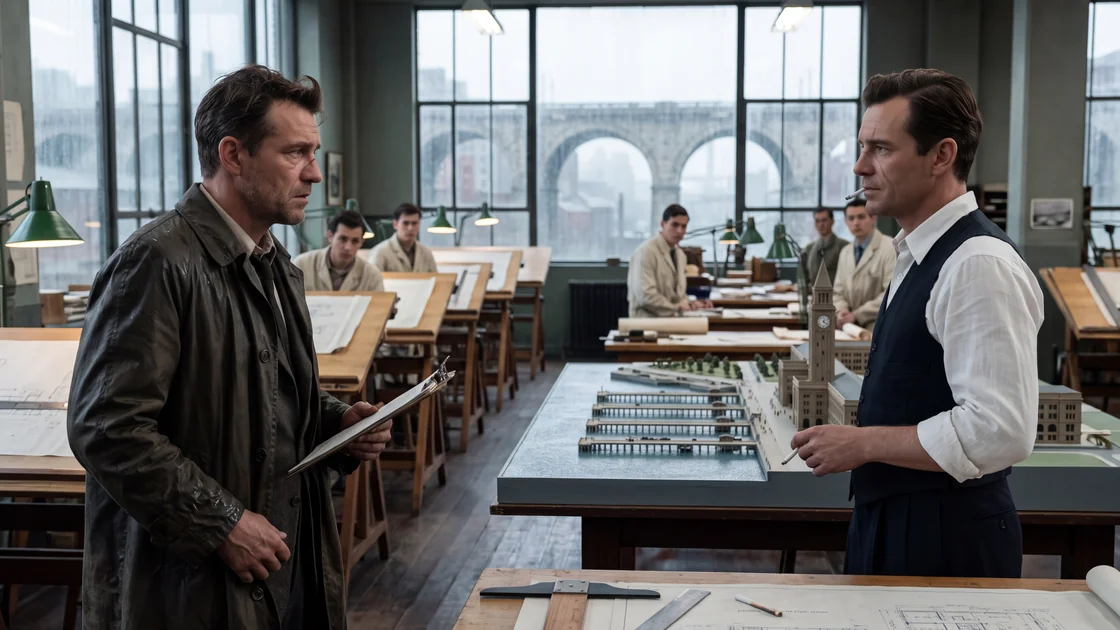
When cynical private investigator Silas Vance is hired by an eccentric, anonymous benefactor to shadow a rising architectural prodigy named Julian Cross, he expects a routine infidelity or corporate espionage case; instead, as he documents Cross’s meticulously charmed life, Silas is confronted by an impossible truth—Cross possesses his own face, his childhood scars, and his exact memories up until the fateful night fifteen years ago when Silas abandoned his architectural dreams for a gun and a badge. Trailing his double through the rain-drenched streets of a city that seems subtly altered around them, Silas is pulled into a psychological and metaphysical labyrinth that forces him to interrogate the grief that defined his youth, the terrifying weight of unchosen paths, and the mysterious architect of the surveillance itself.
Chapter I: The Retainer
The envelope had not arrived by post, nor had it been slipped beneath the frosted glass door of the office during the nocturnal hours when the steam pipes in the hallway rattled like dry bones. It had been placed directly upon the blotter of Silas Vance’s desk while Silas had stepped out to buy two crullers and a cardboard cup of bitter chicory coffee from the cart on the corner of 4th and Haverstraw.
Silas noticed three things before he touched his coat to the brass rack. First, the latch on the sash window was still thrown, locked from the inside against the soot of the lower quarter. Second, the single deadbolt on the door bore no scratches, and the strip of cellophane tape he had affixed near the floor jamb remained unbroken until his own knee breached it. Third, the envelope was heavy, vellum-bound, and sealed with a wafer of black Spanish wax stamped with an emblem that made Silas’s teeth ache with an ancient, half-forgotten familiarity: a compass and an unblinking ocular lens, the old mark of the Department of Civil Drafting at the Saint Jude Institute of Technology.
He set the coffee down. He did not eat the cruller. Instead, he drew his bone-handled pocketknife, slit the wax cleanly, and tipped the contents onto the green baize.
Three thousand dollars in non-sequential, crisp fifty-dollar certificates. A silver key with no ward markings, only a series of radial dimples along its spine. And three glossy black-and-white photographs clipped to a single index card typed on an Underwood standard.
The card bore no greeting:
Julian Cross. Thirty-six years of age. Principal designer, Cross & Hallowell Associates, Architects. Residing at the Belfry Penthouse, 14 St. Jude Crescent. You are to observe him for fourteen days. You will record his movements between the hours of six in the evening and four in the morning. You will not approach him. You will not make inquiry of his associates. At the conclusion of the fortnight, leave your daybooks in Locker 419 at the Haverstraw Transit Concourse. The balance of seven thousand dollars will follow.
Silas laid the index card flat with the ball of his thumb.
"Julian Cross," he muttered to the empty room.
He turned the first photograph toward the pale grey light seeping through the soot-filmed window. The picture had been captured from an elevated angle—likely a high second-story window or a municipal balcony—looking down into the courtyard of the newly dedicated Queen’s Terrace Arcade. A tall man in a tailored Chesterfield coat stood with his back half-turned, gesturing toward a soaring rib-vault of patinated bronze and fluted glass. In his right hand, the man held a roll of linen drafting paper; his left hand was thrust into his pocket, thumb hooked out.
Silas squinted. The stance was ordinary enough—the confident, relaxed posture of an architect who had convinced a municipal board to spend five million crowns on an impractical curve of roofline.
He picked up the second photograph. This one was closer, taken with a long telephoto lens through the plate-glass window of a restaurant. Cross sat across from a woman whose profile was blurred by the glare of a chandelier. Cross’s face was turned three-quarters into the lens, caught mid-sentence, the corner of his mouth hooked in a dry, asymmetric smirk that Silas knew better than the veins in his own wrists.
Silas did not drop the photograph, because fifteen years of divorce work, insurance fraud, and blood-spattered walk-ups had drilled the tremor out of his nervous system. But his breath caught in his throat, a sharp, cold hook that snagged somewhere behind his collarbone.
The man in the photograph had his jawline: the square, heavy mandible with the faint cleft that Silas shaved around every morning. He had the same hairline, breaking high over the right temple with a persistent cowlick that resisted pomade. But it was the bridge of the nose that made the room tilt on its axis. Running from the inner corner of the left eye down to the cartilage was a fine, pale thread—a scar left behind by a shattered mason jar dropped in the summer of his seventh year on a gravel road in the valley of Saint Jude.
Silas lifted his hand to his own face, his calloused forefinger tracing that very scar.
The third photograph was the most intimate. Julian Cross was sitting on a stone bench in the park at dusk, his coat thrown open, his head tilted back against the limestone balustrade as if exhausted by the weight of his own eyes. His collar was undone. At the base of his throat, precisely three centimeters above the sternal notch, sat a small, dark mole shaped like a crescent moon.
Silas turned the photograph over. On the back, written in black fountain pen ink that had dried weeks ago, was a single handwritten line:
The work that was waiting for you.
Chapter II: The Shadow on the Crescent
The rain in Saint Jude did not fall; it drifted, a suspended mist of river salt and anthracite coal smoke that settled like grease upon the wool of Silas’s overcoat. He sat in the cab of his battered Plymouth Savoy, parked thirty yards down from the wrought-iron gates of 14 St. Jude Crescent. The motor was cut. Every twenty minutes he ran a dry rag across the inside of the windshield to clear the fog of his own breath.
Through the telephoto viewfinder of his Leica, the world was reduced to silver grain and sharp vignettes.
The Crescent belonged to that part of the city where the old money had retreated when the rail yards swallowed the lower basin: four-story mansions of rusticated granite, their mansard roofs plated in slate, their windows glowing with the warm, amber respiration of gas-fed chandeliers and shaded reading lamps.
At 6:15 PM, a black Daimler landaulet pulled up to the curb before Number 14.
The chauffeur, an older man in a livery coat that smelled of damp wool even from thirty yards away, stepped out, opened the rear door, and extended an umbrella. Julian Cross emerged.
Silas adjusted the focus ring. The lens clicked smoothly against its stops.
Cross was wearing the Chesterfield coat from the dossier photograph. He moved with an easy, unhurried cadence that Silas found almost offensive. He had the gait of a man who had never spent five consecutive hours standing on cold pavement waiting for a defaulting debtor to emerge from a rooming house, a man whose spine had not been compressed by the recoil of a police-issue .38 or the stiff springs of departmental patrol cars.
Yet the mechanics of his stride were Silas’s own: the slight drag of the left heel, the peculiar hitch in the shoulder when shifting weight, the habit of reaching into the left pocket for matches before he had even cleared the street.
"Look at you," Silas whispered. The glass of the viewfinder grew warm against his brow. "You look like you’ve never had a head cold in your life."
Cross paused on the second step of the granite stoop. He did not turn around, but he did something that caused Silas’s fingers to lock against the shutter release: he stopped, raised his head toward the drizzle, and pressed the knuckles of his left hand against his lower ribs, precisely where Silas’s fractured seventh rib had healed crookedly after a dockside brawl in the winter of ’49.
Cross stood that way for five seconds, suspended in the rain, then turned his key in the heavy oak door and slipped inside.
Silas did not take his eye from the glass until the fourth-floor windows illuminated.
He knew that layout. He had never been inside Number 14, but he knew the architecture of the Crescent houses because he had spent three semesters in the archives of the Institute copying their cross-sections onto tracing linen. The fourth floor would be the old ballroom, usually converted in modern times into a studio or a formal library: eighteen-foot ceilings, north-facing dormers, and a massive chimney piece carved from Belgian black marble.
Silas opened his notebook on the steering wheel and wrote:
18:18. Subject enters residence. Unaccompanied. No callers. Studio lights active on north elevation.
He sat in the dark for three hours. The cold seeped up through the floorboards of the Savoy, stiffening his shins.
At 9:42 PM, the light in the fourth-floor studio moved. Cross appeared at the window. He was in his shirtsleeves—white linen, the cuffs rolled to the elbows. He carried a heavy glass tumbler filled with dark amber liquor, and in his left hand, clamped between his middle fingers, was a drafting pencil.
He leaned against the frame and looked directly down into the street.
Silas shrank into the shadow of the A-pillar, his pulse knocking hard against his ribs. It was impossible that Cross could see him; the Savoy was unlit, swallowed by the overhang of an ancient horse chestnut tree, and the streetlamps were yellow and dim. Yet Cross remained there, motionless, his gaze anchored to the dark rectangle of the Plymouth’s windshield.
Then, Cross raised his tumbler. It was not a grand gesture. It was the brief, sardonic salute of an old acquaintance spotted across a crowded train station.
Silas lowered the camera. His breath came fast, sour with old coffee.
"He doesn't know me," Silas said aloud, his voice flat against the dashboard. "He's looking at his own reflection. That’s all. The glass is mirrored from the inside."
Cross drank, turned, and disappeared back into the amber rectangle of the studio.
Chapter III: The Ledger of Departures
A man who follows another man through a city inevitably begins to inhabit his shadow.
By the fourth day, Silas knew Julian Cross’s geography. It was a Saint Jude that Silas had glimpsed only in the margins of architectural quarterlies and municipal tenders before he had abandoned the profession. Cross did not drink in the dive bars of the Lower Reach where the barmaids knew Silas by his first name and poured his rye without asking. Cross drank at the Athenaeum, behind leaded-glass doors where men discussed the tensile strength of prestressed concrete and the moral philosophy of structural honesty.
Cross ate his lunch at a small table beneath the potted palms of the Conservatory Café, reading French architectural journals and sketching details of ironwork on the margins of his napkins.
Silas sat four tables away, behind a folded copy of the Saint Jude Herald, wearing an old tweed cap pulled low and spectacles he did not need. He watched the way Cross handled his pen. It was an Pelikan 100 with a broad gold nib—the exact pen Silas’s father had promised to buy him if he took first honors in his final examinations at the Institute.
Silas had never taken those examinations.
On the night of March 14th, fifteen years ago, Silas’s brother, Caleb, had been pulled from the black, sludge-thick water of the canal basin behind the chemical works. Silas had spent that night in the waiting room of the municipal morgue, sitting on a varnished bench that smelled of carbolic acid, while his father wept into his rough, grease-stained hands. The scholarship had lapsed. The draft board had been waiting. And three weeks later, Silas had walked into the precinct station house on Haverstraw Street and sworn an oath to the Commonwealth, exchanging his ruling pens and India ink for a wooden baton and an eight-pound leather holster.
He looked at Julian Cross’s fingers. They were long, pale, and unscarred. The thumb bore the calloused pad that came from decades of pressing down on a drafting rule, not the rough, cross-hatched scarring that Silas carried from a broken bottle in an alley off the docks.
At 2:15 PM, Cross rose, paid his bill with a folded note, and left the napkin behind.
Silas waited forty seconds. He stood, tossed two silver coins onto his own table, and walked past Cross’s vacated seat. With the smooth, unthinking sleight-of-hand of an experienced thief, his coat pocket swallowed the linen napkin.
In the cab of the Savoy, he unfolded it.
It was not a sketch of a cornice or an entablature. It was an axonometric projection of the Haverstraw Street police precinct—the old red-brick station house where Silas had worked the night desk for six years. The drawing was precise down to the millimeter: the three arched windows of the holding pen, the coal chute at the side, the rusted emergency ladder.
And below it, written in the small, rigid block lettering that had been beaten into them by Professor Hallowell in their first year of drafting:
THE CELLAR IS STILL DAMP, SILAS. DID YOU EVER GET THE STOVE TO DRAW?
Silas crushed the linen in his fist.
A cold, greasy sweat broke across his forehead. He threw the Savoy into gear, the transmission grinding like gravel in an iron hopper, and tore out into the traffic of St. Jude Crescent, the wipers slapping uselessly against the grey deluge.
Chapter IV: The Master of the Works
The firm of Cross & Hallowell occupied the top two floors of the Titan Building, an eighteen-story monument to limestone and structural steel that dominated the financial center.
Silas did not carry his Leica. He carried his badge case—the old brass shield from his municipal days, expired seven years ago, its enamel chipped at the corners—and a clipboard he had stolen from a dry-goods clerk three blocks back. He wore a clean mackintosh and carried himself with the rigid, incurious boredom of a city building inspector.
The elevator boy didn't even look at his face. "Seventeen, sir?"
"Seventeen," Silas said.
The elevator rose with an oily hiss of counterweights. Silas watched the floor indicators click past, his jaw set so hard his molars ached.
The offices of Cross & Hallowell smelled of cedar shavings, ozone from an electric blueprint machine, and fresh water colors. It was a soundscape Silas remembered with the violence of an amputee’s phantom limb: the whisper of parallel bars sliding across horsehair-dusted boards, the rhythmic tap of eraser shields, the quiet, monastic murmuring of twenty men bent over white paper under green-shaded lamps.
"Can I help you, officer?"
A woman with silver-streaked hair and horn-rimmed spectacles looked up from a walnut reception counter. A brass plaque before her read: MISS VANCE.
Silas stopped. His feet felt rooted into the cork tile.
She was older—much older than she should have been—but the set of her eyes, the wide, pale grey pupils, and the slight, aristocratic turn of her chin were unmistakable.
"Aunt Clara?" Silas’s voice was barely a croak.
The woman frowned, her spectacles slipping down her nose. "I beg your pardon? Are you from the Fire Marshal’s office? Mr. Cross is in the south drafting hall, but he’s not to be disturbed until the city commissioners leave."
Silas stared at her. His Aunt Clara had died in an asylum in Leeds when he was twelve years old. He had attended her funeral in a rain-soaked churchyard where the grass grew in coarse, yellow clumps. He remembered the smell of the damp earth and the black crepe of his mother's veil.
This woman was seventy, perhaps seventy-two. She had a silver fountain pen pinned to the lapel of her tailored charcoal suit. She looked prosperous, irritable, and entirely alive.
"Inspector?" she said, her voice sharpening. "Are you unwell?"
"The south drafting hall," Silas managed. "Which... which way?"
"Through the double oak doors, of course. Just as it has been for twenty years." She shook her head, muttering something about the deterioration of city personnel, and returned to her ledger.
Silas pushed through the double doors.
The south hall was an immense room, fifty yards long, bounded on three sides by walls of uninterrupted plate glass that looked out over the smoky expanse of Saint Jude. Down the center ran a line of drafting tables, each occupied by an apprentice in a brown smock.
At the far end, silhouetted against the grey sky, stood Julian Cross.
He was surrounded by three men in dark broadcloth suits—commissioners from the harbor authority, Silas recognized them from the papers. Between them sat a scale model of the Saint Jude Waterfront Development: six piers of reinforced concrete, an elevated promenade with glass windbreaks, and a clock tower that rose like a spear into the overcast.
Cross was speaking. His voice carried across the room—clear, resonant, possessing that effortless baritone Silas had lost during the three years he had spent smoking cheap Navy Cut cigarettes on the dawn watch.
"...the public will not tolerate an iron cage," Cross was saying, his pencil point hovering over the miniature promenade. "They want the water, gentlemen. They want to believe that the river belongs to them, even while we extract their customs fees. If you build the seawall as Alderman Grout suggests, you will create a ditch for suicides and coal barges. If we terrace it—if we use the limestone from the Haverstraw quarries—they will walk there until November. It is a question of dignity."
"Limestone absorbs the salt, Julian," one of the commissioners objected. "It’ll flake within twenty years."
"Then we will seal it with lead silicate," Cross countered, not missing a beat. "As the Romans did at Ostia. I will not have my city looking like an iron foundry."
My city.
Silas took three steps forward. His boots squeaked on the parquet floor.
One of the apprentices looked up, then another. The room seemed to contract, the light through the vast windows dimming as if a storm cloud were descending directly upon the glass.
Cross stopped speaking.
He did not look startled. He did not look annoyed. He looked up from the scale model with the patient, weary indulgence of a man who had been expecting a train that was twenty minutes behind schedule.
"Gentlemen," Cross said smoothly to the commissioners. "Excuse me for five minutes. The city has sent its conscience to audit my footings."
The commissioners chuckled—dry, compliant sounds—and stepped back toward the window to admire the view.
Cross walked toward Silas.
He was neither taller nor shorter. Up close, the resemblance was not a likeness; it was an identity. Silas saw his own pores, the small scar on the left earlobe where a fishhook had caught him at eight, the slightly yellowed enamel of the canine that had never grown in straight. But Julian Cross’s eyes were clear, untroubled by the yellow tinge of bad whiskey and the gray fatigue of three hundred nights spent in the company of corpses and unfaithful spouses.
Julian stopped three feet away.
"You’re late," Julian said quietly.
"Who are you?" Silas’s hand drifted toward his coat, where the cold steel of his revolver rested against his ribs.
Julian looked down at Silas’s hand with mild disgust. "Still reaching for the iron, Silas? Is that the only grammar you have left? A cylinder and six lead slugs?"
"Who hired me?" Silas rasped. "Who’s paying for this?"
"You hired yourself," Julian said. He took an ivory cigarette case from his pocket, opened it, and offered it.
Silas did not move.
Julian shrugged, took a cigarette, and struck a match on the underside of an adjacent drafting table. The sulfur smell was sharp and immediate.
"Or rather," Julian continued, exhaling a thin, blue feather of smoke, "a certain mutual friend thought it was time we settled the estate."
"What estate? Caleb died with seven shillings in his pocket. My father died owing twelve hundred crowns to the drayage company."
Julian’s face went very still. The smoke drifted between them, curling around the lapels of their coats.
"Caleb didn't die," Julian said.
Silas felt the floor beneath his boots become uncertain, as if the massive steel girders of the Titan Building were yielding to some invisible shear stress.
"I pulled him out of the basin," Silas said, his voice dropping to a vicious hiss. "I sat with his body until the ice melted in the trays. Don't lie to me, you bastard. I buried him in the north ditch."
"In your city, perhaps," Julian said softly. He turned and gestured toward the glass wall, out over the gray, sprawling labyrinth of Saint Jude. "Look out the window, Silas. Look at the Haverstraw Bridge."
Silas didn't want to look. Every instinct honed in twenty years of street survival screamed at him to keep his eyes on the man's throat. But his head turned, drawn by a terrible, magnetic necessity.
The Haverstraw Bridge was there, spanning the black, oily channel of the Saint Jude River.
Except it wasn't the bridge he had crossed this morning.
The Haverstraw Bridge Silas knew was an ugly, rusted Pratt truss of black iron, built in ’98 to carry coal wagons, its timbers groaning under every dray.
The bridge outside the glass was a magnificent triple-arched span of white granite, its piers shaped like the prows of triremes, its roadway suspended by slender, vertical ribs that caught the failing light like the strings of a harp. It was the bridge Silas had drawn for his final graduation project—the drawing that had won the Institute Gold Medal in the spring he had never lived.
"The design was sound," Julian said, his voice dropping until it sounded like Silas’s own internal monologue, that low, caustic narrator that had inhabited his skull since childhood. "We had to deepen the footings by twelve cubits because of the silt, but the arches hold. They will always hold."
"This isn't real," Silas said. His fingers found the butt of the .38 through his pocket. The checkering of the walnut grips was sharp and real. It hurt his skin. "You’re an actor. Some syndicate... some competitor trying to break me."
Julian laughed—a dry, barking sound that Silas had made a thousand times in station house locker rooms.
"A syndicate? To what purpose, Silas? To steal your vast wealth? Your three-room flat above the laundry on Haverstraw Street? Your collection of half-empty bottles and pawn tickets?" Julian stepped closer, until Silas could smell his shaving soap—bay rum and almond, the exact brand their father had used on Sunday mornings. "You were the one who went into the water after him. You jumped. And because you jumped, you caught the pneumonia that settled in your lungs, and Caleb died anyway while you were delirious in the charity ward."
Julian tapped his own chest.
"I didn't jump," Julian whispered. "I threw him the mooring line. I stayed on the stone. He pulled himself out. He’s running the municipal docks right now, Silas. He has three daughters. The eldest is named after Clara."
Silas felt a roaring in his ears, like the sound of the Atlantic crashing against the harbor wall during an equinoctial gale. "Why am I here?"
"Because the ledger doesn't balance," Julian said. He reached into his coat and drew out an envelope—identical to the one Silas had found on his desk, sealed with the same black wax. "A man cannot spend twenty years imagining what he might have been without leaving a scar on the world. You’ve been looking across the river for fifteen years, Silas. Every time you passed the site of the Library, every time you saw an elevation drawing in the newspapers, you threw a hook into this room."
Julian held out the envelope.
"Take it," Julian said. "It’s the rest of your retainer."
Chapter V: The Room at the Center
Silas did not take the elevator down. He took the fire stair, descending seventeen flights of concrete steps in a plunging spiral, his boots slamming against the treads until his knees felt as though they were packed with glass.
He burst into the alley through the emergency door, the cold rain hitting him like a fist.
The alley was different.
The bricks of the neighboring warehouse were not common red stock; they were vitreous cream-colored tile, clean and reflective. The cobbles were squared granite, laid in concentric fans, without the ruts and horse manure of the Haverstraw he knew.
He ran.
He ran three blocks down toward the transit concourse. The signs above the shops were wrong. Harrow’s Apothecary was Harrow & Son, Stationers. The electric tramway did not run on overhead wires; it glided silently on a central conduit between rails of polished brass. The people who passed him did not wear the greasy caps and rain-slicked oilskins of the dockside poor; they wore felt, wool, clean broadcloth, their faces open and untroubled by the sour, defensive squint of the lower city.
He reached Locker 419 at the Haverstraw Transit Concourse.
The concourse was a vast, vaulted hall of white faïence and ribbed glass, five times the size of the miserable brick shed he had left that morning. Hundreds of commuters moved beneath a monumental four-sided clock suspended from the iron rafters by decorative chains.
Silas’s hands shook so violently he could barely insert the silver key into Locker 419.
The lock turned with a smooth, oiled click.
Inside was no bundle of seven thousand dollars.
Inside was a single cardboard box, tied with hairy jute twine.
Silas took it down, sat on a bench of polished ash beneath the great clock, and cut the twine with his thumb.
Inside were his instruments.
Not the cheap, nickel-plated tools he had pawned in his second year on the force, but his grandfather’s set: the German silver dividers, the ivory-handled ruling pens, the beam compass with its micrometric screw, all resting in their fitted recesses of purple velvet.
Beneath the tray was a sheet of linen drafting cloth, fresh and unrolled.
At the top, drafted in Julian Cross’s elegant, confident hand, was the floor plan of an office:
ROOM 4B, 114 HAVERSTRAW STREET. SILAS VANCE, CONSULTING ARCHITECT.
The plan showed the desk, the sash window, the brass coat rack, and the green baize blotter. But in place of the frosted glass door that read CONFIDENTIAL INQUIRIES, the drawing showed a wide, double-hung casement opening into a courtyard filled with plane trees and stone benches.
Silas looked up from the drawing.
Across the concourse, standing beneath the arrivals board, was Caleb.
He was forty years old, heavy in the shoulders, wearing the dark blue peacoat of a harbor master. His hair was thick and salted with gray at the temples. By his side stood a young girl of perhaps nine, wearing a yellow mackintosh and holding a red paper windmill that spun in the draft from the train gates.
Caleb looked across the crowded concourse.
His eyes caught Silas’s.
There was no shock in Caleb’s face. There was only a long, quiet recognition—the look of a man who sees an old debt finally cleared from the ledger. Caleb raised his heavy, calloused hand, touched the brim of his cap, and then took his daughter’s fingers and turned toward the platform where the 5:15 to the Valley was boarding.
Silas stood up. His knees did not crack.
He looked down at his own hands. The dirt beneath the nails—the grease of twenty years of cleaning revolvers and searching through the ashcans of other people’s ruined lives—was gone. His skin was clean, smelling faintly of sandalwood and the cedar shavings of forty drafting boards.
He reached into his pocket.
The Colt .38 was not there.
In its place was a pocket sketchbook, bound in black morocco leather, and a newly sharpened graphite pencil, 2B, soft enough to catch the shadow of an arch before the light changed.
Silas Vance walked out of the concourse into the rain, but the rain did not smell of anthracite or river rot. It smelled of wet slate, river stone, and the clean, cold lime of mortar that had not yet set.
He walked toward Haverstraw Street, not to follow a shadow, but to see if the drafting ink was dry upon the linen.