The Ghost Frequency of Low Earth Orbit
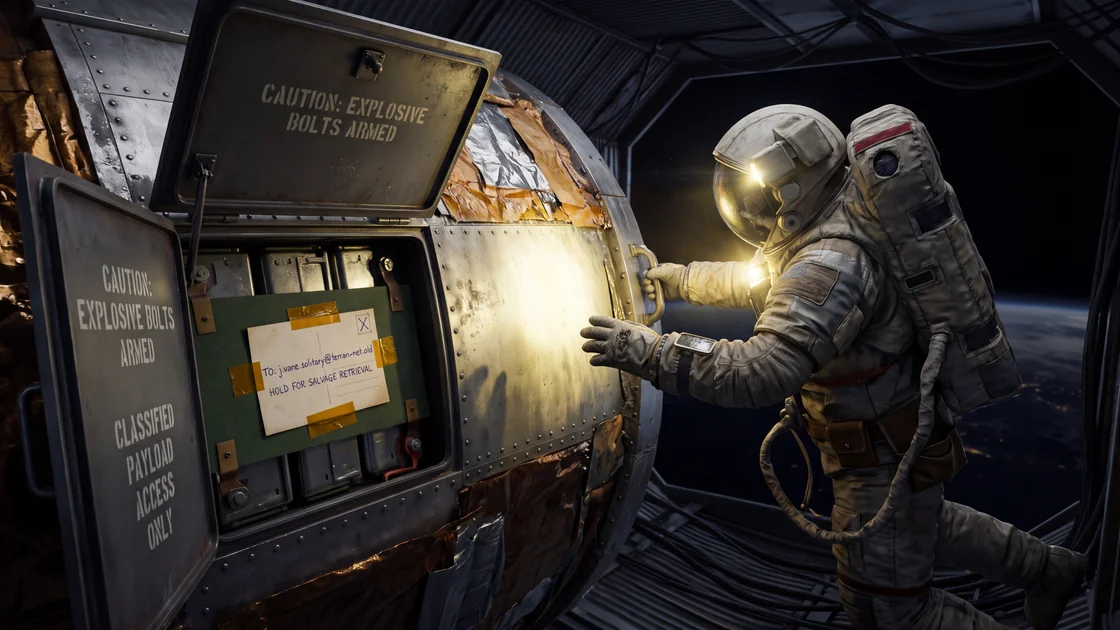
This is the story of Jonas Vane, a solitary orbital salvage contractor who pulls dead reconnaissance platforms out of the crowded graveyard altitudes of Low Earth Orbit, and the morning he grappled an uncatalogued military satellite called Aethelgard-7. Expecting nothing more than twenty metric tons of strip-salvage titanium, degraded solar cells, and volatile hydrazine dregs, Jonas dragged the frozen relic into the depressurized hold of his tug, only to find an impossible artifact preserved under layers of thermal foil: an ordinary, terrestrial paper postcard, secured to the radiation-shielded battery casing with faded amber polyimide tape, bearing a message inscribed in ballpoint ink and addressed directly to an unlisted personal email account he had abandoned twenty years before.
Part I: The Mechanics of Drifting
The graveyard orbits are neither quiet nor still, though men who have never visited them always imagine them as cathedrals. Down in the atmosphere, people picture silence as a soft thing, a blanket thrown over a bedroom. Up at eight hundred kilometers, where the thermosphere peters out into an imperceptible whisper of atomic oxygen, silence is purely mechanical: it is the total absence of any medium capable of carrying a scream, accompanied by the ceaseless, bone-conducted whine of your own life-support pumps grinding through their ninth thousand hour of bearing wear.
Jonas Vane lived in the throat of that noise.
His vessel was the Cormorant, an orbital utility tug registered out of Port Stanley under an flags-of-convenience salvage registry that had changed ownership four times since the Kessler cascades of the late twenty-forties. The Cormorant was shaped like an iron potato. It had no aerodynamic lines, no grace, no aerodynamic surface area except for the wide, radiator-finned shoulders that shed heat from its twin closed-loop methane-oxygen burners. Its bow was dominated by a three-jawed hydraulic capture collar lined with high-friction silicone pads, scarred and pitted by thousands of microscopic impacts from paint flecks and frozen urine droplets traveling at eight kilometers per second.
Jonas did not look like an astronaut of the classic posters. He was forty-eight years old, his spine slightly compressed from two decades spent transitioning between the punishing four-G burns of Hohmann transfers and the spongy, calcinating slack of weeks in free-fall. His beard was clipped down to grey stubble so it wouldn't foul the neck-ring seals of his Orlan-pattern pressure suit, and his skin had the yellowish, waxy hue common to long-shift orbital haulers who subsist on recycled greywater and desalinated cabbage protein.
"Target acquired on boresight," the automated navigation bus muttered through his headset. The voice was an ancient synthetic cadence modeled on a long-dead Canadian hydro-electric operator, flat and nasal. "Range: forty-two meters. Relative velocity: zero point one two meters per second. Radial spin: point zero eight radians per second along the tertiary axis. Grapple solution confirmed."
Jonas rested his palms on the twin flight controllers. His gloves were worn smooth at the thumbs, the white Nomex fabric frayed into pale halos around the toggle studs. Through the thick quartz-borosilicate laminate of the forward viewing port, the target did not look like a fortune. It looked like an iron coffin wrapped in gold leaf that had been chewed by dogs.
It was designated on his scrap manifest as Object 1984-089-B, known informally in the decommissioned files of the United States Space Command as Keyhole-11-Sub-Echo, and referred to in the salvage docket that had paid Jonas his fuel deposit only as Aethelgard-7.
It had been launched in the late autumn of the late Cold War, just as the digital revolution was beginning to replace wet-film return canisters with charge-coupled silicon arrays. It was huge—nearly nineteen meters long from its blunt sunshade to the ribbed nozzles of its orbital maneuvering engine—and heavy. For forty-two years, it had spun through the sun-synchronous lanes, ducking the lower edge of the Van Allen belts twice a day, blind and deaf, its solar arrays long ago sheared off by a collision with a spent Russian upper-stage bolt in the winter of 2011.
"Easy, you old bitch," Jonas murmured. He touched the left thruster block, venting a cold burp of nitrogen from the port attitude jets.
The Cormorant slid forward along its invisible rail of inertia. The hull groaned, a low, structural shiver that travelled through Jonas's pelvis. The three great grapple arms opened like the petals of a carnivore's mouth.
Out beyond the glass, the planet rotated beneath them: a dizzying, cloud-streaked expanse of the southern Indian Ocean, deep navy blue marbled with turquoise eddies of plankton, utterly indifferent to the two specks of grease and steel floating above it.
The capture collar struck the forward docking collar of Aethelgard-7. The sound was an astonishingly clear clang, carried directly through the hull plates into the frame of the tug.
"Capture latched," the nasal voice said. "Secondary locks engaged. Spin damping initiated."
The steering thrusters of the Cormorant fired in rhythmic, rhythmic coughing sequences—poot-poot-chuff, poot-poot-chuff—soaking the kinetic tumble out of the nineteen-ton satellite until the two vessels became one rigid, awkward dumbbell hanging over the terminator line.
Jonas exhaled. The breath fogged the lower rim of his visor.
"Good," he said to the empty cabin. "Nobody died."
He unbuckled his four-point harness, floating free of the foam-padded seat. His knees made three small, sharp popping sounds as they straightened in zero gravity. The cabin of the Cormorant was four meters wide by six meters long, choked with cable harnesses, velcro-fastened diagnostic tablets, half-empty squeeze bags of lukewarm electrolyte broth, and the faint, permanent smell of scorched phenolic resin and drying sweat.
The manifest called for a simple mission: rendezvous with Aethelgard-7, safe the monomethylhydrazine tanks to prevent a fragmentation event during atmospheric re-entry, sever the beryllium-copper camera barrel for industrial reclamation by the maritime scrap syndicate in Mumbai, and push the remaining chassis down into the South Pacific Oceanic Uninhabited Area. Jonas stood to clear sixty-two thousand New Swiss Francs after his reaction-mass debt was settled with the orbital fuel depot at Lagrange-1.
It was enough to pay his slip rent for eight months. It was enough to buy forty tins of real Irish butter from the supply shuttle. It was enough to keep him from having to go down to the surface, where the air was thick as wet wool and people walked too close to one another.
He hooked his tool belt to his harness, clicked his helmet ring into the locked position until the brass dogs barked home, and reached for the manual purge valve of the Cormorant's rear equipment airlock.
Part II: The Cold Bay
The salvage bay of the Cormorant was not an interior room in the terrestrial sense; it was an unpressurized cavity behind the crew module, sheltered from micrometeorites by a wrap-around carapace of woven Kevlar and corrugated aluminum. When Jonas vented the residual atmosphere, the pressure needle fell off its pin with a dry, mechanical flutter, and the double hatch swung open into total blackness.
The stars here did not twinkle. They were hard, cold drill-holes in a floor of slate.
Jonas clicked on his chest-mounted halogen lamps. Two wide cones of yellow light sliced through the shadows of the hold, illuminating the skin of Aethelgard-7.
Up close, the machine was terrifying in the way that all twentieth-century military engineering was terrifying: it had been constructed without any consideration for the comfort, convenience, or aesthetics of future human beings. Its skin was made of thick, hand-riveted sheets of aluminum-lithium alloy, wrapped in multi-layered insulation blankets that had once been amber-colored Kapton but had now been roasted by four decades of unmitigated ultraviolet radiation into a brittle, cracked charcoal grey. Long trails of dried, brown thermal paste had leaked from the joints between its electronics bays, looking uncomfortably like dried arterial blood against the grey metal.
"Let's see what they left inside you," Jonas muttered. His voice inside his helmet sounded small, moist, and close.
He tethered himself to the interior track of the bay and kicked off gently, drifting along the flank of the dead spy. His magnetic work-boots clicked against the hull with dull, reverberating snaps.
The front third of the satellite was occupied by the telescope: a folded-optic Schmidt-Cassegrain system whose aperture was covered by a heavy motorized door. The door was frozen shut, its hinge pins bent by thermal stress. Jonas ignored it; optical lenses of that era were made of leaded glass that was heavily browned by cosmic ray exposure, worth virtually nothing on the modern scrap exchange.
The middle third held the propulsion module: four titanium sphere-tanks containing the remains of its maneuvering propellants. Jonas unscrewed his diagnostic scanner from his thigh pouch and pressed the ultrasonic transducer against the flank of the primary hydrazine tank.
The display on his wrist flickered, calculating the acoustic echo through the metal.
"Empty," he said. A small prickle of surprise touched the back of his neck. "Dry as a bone."
He checked the second tank. Empty. The third. Empty.
The ullage vents were open. At some point in its long drift, someone—or something—had commanded the satellite to vent every drop of its fuel into the void. That was standard de-orbit preparation today, but in 1984? In 1984, the Americans and the Soviets left their birds fully fueled until the tanks exploded from internal corrosion, creating clouds of shrapnel that would drift for centuries. It was unusual for a bird this old to have undergone a clean, controlled blow-down.
"Somebody put you to bed properly," Jonas said.
He moved aft, toward the electronics cradle and the primary power distribution module.
This was where the money was. The early spy satellites used silver-zinc and nickel-cadmium battery packs that were heavily reinforced with platinum-coated busbars and gold-plated terminal leads to prevent cold-welding in the hard vacuum. If he could saw off the primary battery tray with his pneumatic cutting wheel, he could load it into his return capsule and walk away with thirty kilograms of precious metals.
The battery casing was housed behind a hinged structural maintenance panel marked with stenciled white lettering:
CAUTION: EXPLOSIVE BOLTS ARMED
CLASSIFIED PAYLOAD ACCESS ONLY
RESTRICTED UNDER THE NATIONAL SECURITY ACT OF 1947
The explosive bolts had not been fired; they had been manually backed out with an ordinary three-quarter-inch hex socket. The heads of the bolts were scored and scratched, their zinc plating stripped away in neat, counter-clockwise spirals.
Jonas paused. His boots remained locked to the hull, but his hands hovered above the panel.
A manual release. In orbit.
Spacecraft did not have hand-turned hex bolts on the exterior of their classified housings unless they were designed to be visited by a shuttle crew. But Aethelgard-7 had been launched into an eighty-two-degree inclination orbit—a near-polar track that no Space Shuttle had ever reached. The shuttle launches from Vandenberg had been cancelled after the Challenger disaster in eighty-six. Nothing human had ever met this satellite in the sun-synchronous lanes.
"Or so they told the newspapers," Jonas whispered.
He gripped the edge of the panel with his gloved fingers. The aluminum was thick, stiff with the forty-below cold of the shadow-side pass. He pulled.
The hinges groaned, screaming through the direct bone-conduction of his knuckles into his gauntlets, and swung wide.
The beam of his halogen light dropped into the battery bay.
The bay was roughly the size of an upright freezer. The silver-zinc cells were stacked in three neat rows, each wrapped in green vulcanized fiberboard and secured with stainless steel banding. The platinum busbars were intact, gleaming with a pure, frosted white sheen under the halogens, unoxidized by the vacuum.
And there, fixed directly across the center of the middle battery pack's terminal cover, was a piece of cardboard.
Jonas did not move. He did not breathe. For three long seconds, the only sound in the universe was the rhythmic, five-cycle hum of the water-chiller running inside the backpack of his suit.
The object was rectangular, approximately four inches by six inches. It was made of heavy, cream-colored paper pulp—a postcard. It was taped to the beryllium-copper battery casing using three strips of yellowed, brittle Kapton film.
The side facing outward was the message side.
It was covered in handwriting. Neat, slanted, slightly spidery handwriting, executed with a blue ballpoint pen whose ink had dried, separated, and crystallized into tiny, iridescent violet scales under forty years of thermal extremes, but remained entirely, legibly intact.
At the top right corner, where an airmail stamp ought to have been, someone had drawn a tiny, perfect square with an 'X' inside it.
At the bottom right, in the space reserved for the recipient's address, three lines were written:
TO:
j.vane.solitary@terran-net.old
SUBSCRIBER IDENT: 4099-ALPHA-L
HOLD FOR SALVAGE RETRIEVAL
Jonas felt the blood leave his face. It was not a metaphorical sensation; he felt the actual, physical drop of pressure in his temples, the sudden, icy constriction of the vessels in his cheeks that made his vision fringe with grey pixels.
He reached out his right hand. The fingers of his pressurized glove were thick, cumbersome three-ply Kevlar with silicone grip pads. He stopped two inches from the paper.
j.vane.solitary@terran-net.old
It was not an address from the modern meshes. It was an account from the early civilian dial-up days—the first personal account he had ever owned, created through a terminal in the basement of the applied physics annex at the University of Washington when he was twenty-one years old. He had used it for four years while working as a junior telemetry contractor for the National Reconnaissance Office, monitoring the tracking stations at Thule and Diego Garcia. He had deleted the account in the autumn of 2004, when the old Terran-Net backbone had been bought out and scuttled by the trans-continental telecom conglomerates.
Nobody had sent a message to that address in almost a quarter of a century.
Nobody alive should have remembered it existed.
And yet here it was, taped to an orbital spy platform that had supposedly ceased all operations and communications before Jonas had even finished his second year of primary school.
Part III: The Postcard from 1984
With fingers that shook with an uncontrollable, sickening tremor, Jonas reached into his thigh kit and pulled out his micro-scalpel—a tool meant for slicing through delicate fiber-optic telemetry ribbons.
He approached the three strips of Kapton tape with the precision of a bomb technician. The tape had become glassy from decades of high-vacuum exposure; as the edge of the blade met the adhesive, the polyimide didn't slice—it shattered like amber sugar, breaking into tiny, microscopic shards that floated away from the hull like golden sparks.
He caught the postcard between the rubberized tips of his tweezers.
The paper was stiff, thick, and surprisingly heavy. It did not have the limp, synthetic feel of the cellulose-derivative papers manufactured in the orbital stations. This was real Earth-grown wood pulp, bleached with chlorine, smelling—though he could not smell it through the helmet—of rain, river mud, and dead pine needles.
Holding it within the pool of his chest-light, he turned it over.
The front of the postcard was a photographic print. It showed a view of an airfield in the high desert. The light was that long, bronze-colored slant of late October in the American Southwest. In the foreground were two white trailers, their corrugated aluminum walls bleached by sun, surrounded by a perimeter fence of zinc-plated chain-link. Beyond the trailers, parked on a wide asphalt turnaround, sat an unmarked Boeing 707 with a bulbous, non-standard radome grafted onto its upper fuselage. A single figure in a brown canvas flight jacket was leaning against the nose gear of the aircraft, holding a paper cup.
The figure had no face. The print in that area had been rubbed away, as if someone had scrubbed it with a thumb coated in grease until the emulsion had peeled back to the white raw fibers of the backing board.
Jonas turned the card back over to the message side.
Beneath his email address, written in that same spidery, blue-violet ballpoint script, was a paragraph of text:
Jonas,
If your orbital mechanics are as good as you swore they would be over the ham sandwiches at the Red Lion in Bellevue, you are thirty-seven minutes behind schedule on your grapple burn. Don't blame the thrusters; you always had a tendency to over-correct for secondary precession.
The casing is not cold-welded. The seals are still greased with DC-4 fluorosilicone. We took them off the shelf at Edwards on a Tuesday when the wind was blowing from the dry lake bed.
Inside the housing of the third primary sensor well, where the redundant cryogenic helium dewar used to sit, there is a copper cylinder marked with red lead paint. It weighs about four kilograms. It does not belong to the Air Force, and it does not belong to the people who bought your fuel debt from the Mumbai syndicate.
Do not vent the dewar bay, Jonas. If you expose the seals to the sun before the temperature has equalized, the glass inside will craze, and then you'll spend the rest of your life wondering what we were looking at when we were twenty-five and thought we were going to live long enough to see the turn of the century.
Check the date on the postmark. Then check the date on your wrist.
We'll be at the diner down by the water in Tacoma. The one with the green vinyl booths where they don't charge for refills on chicory coffee.
— M.
Jonas stared at the ink.
The postmark was stamped in black carbon pigment in the upper corner, over the hand-drawn square.
It read:
U.S. POSTAL SERVICE — MOJAVE CONTRACT FACILITY
14 OCT 1984
The date on his wrist display, synced via the GPS-Navstar constellation to the universal time standard in Paris, was:
22 OCT 2046 — 04:18:02 UTC
"M.," Jonas whispered.
The word died in his throat.
There was only one person who had ever eaten ham sandwiches with him at the Red Lion Inn in Bellevue, Washington, while arguing about orbital mechanics and sun-synchronous resonance.
Her name was Dr. Margaret "Marlo" Vance.
She had been thirty years older than him. She had been one of the pioneering optical engineers for the Perkin-Elmer Corporation who worked on the focal-plane assemblies for the original Hexagon satellites. She had been his first department supervisor when he had arrived at the National Reconnaissance Office as a twenty-year-old student intern with grease under his fingernails and an obsession with mathematical trajectories.
Marlo Vance had died of pancreatic cancer in a hospice facility in Port Angeles, Washington, on the sixteenth of August, 1999.
Jonas had attended her funeral. He had stood in the rain near the rear of the cemetery while four men from the local Veterans of Foreign Wars post folded a flag that had never touched the ground, because her work for the government had been so deeply black-budgeted that her service record officially listed her as a civilian procurement clerk for the Bureau of Land Management.
He had helped carry her trunk of textbooks to the Goodwill in Bremerton. He had personally tossed her old rubber-banded stacks of IBM punch cards and her worn slide rules into a green municipal dumpster behind the library.
He looked down at the postcard.
The ink was dried. The edges of the paper were slightly yellowed by the microscopic trace emissions of the satellite's insulation adhesives. It had been sitting in this vacuum, in this dark, silent bay, for forty-six years.
"That's impossible," he said aloud. The sound of his own voice was sharp, cracking with a wild, dry panic that made his pulse jump in his neck. "You died in ninety-nine. You were an old woman. You died when I was a boy."
The Cormorant passed across the terminator.
Below them, the earth plunged into darkness. The brilliant, searing turquoise of the ocean vanished, replaced by the immense, velvety black of the night-side hemisphere. In an instant, the temperature outside the suit began to drop toward eighty Kelvin. The hull of Aethelgard-7 began to tick and pop as the metal contracted, shrinking in the sudden freeze like an animal drawing its limbs inward against the snow.
Part IV: The Archaeology of the Camera
Jonas did not scrap the battery pack.
He did not touch the platinum busbars. He did not hook up the cutting wheel.
Instead, using a pair of wide, padded extraction tongs, he placed the postcard into a vacuum-rated aluminum sample case, closed the double-o-ring latch, and fastened the case to his chest harness. Then, moving with a strange, deliberate slowness that felt like walking through waist-deep grease, he crawled deeper into the central bay of the satellite.
The Aethelgard-7 was not built like modern satellites, which are modular, clean, and dominated by flat printed circuit cards. Its interior was a maze of thick copper-shielded cables, tied down by hand every two inches with waxed linen cord. The knots were uniform, square, and neat—the work of technicians who had learned their trade on submarine telegraph switches and radar consoles during the Korean War.
He reached the housing of the third primary sensor well.
It was located behind the main mirror baffle, in a recess that should have contained the liquid helium cooling system for an early infrared scanning array. The access hatch was secured by four knurled brass knobs.
They were not safety-wired. The safety wire had been snipped, the twisted remnants left dangling from their mounting lugs like little curls of copper hair.
Jonas set his gloves against the first brass knob. It turned easily, smoothly, coated in a sticky film of transparent fluorosilicone grease that had remained liquid under the pressure of the seals.
He unscrewed all four knobs and lifted the cover.
Inside, resting in the cradle where the cryogenic dewar should have been bolted, was a cylinder.
It was eight inches in diameter, fourteen inches long, turned out of a single billet of oxygen-free copper. It was painted with lead-primer red, the coating thick and orange-peeled, exactly as the postcard had described. On the flat top of the cylinder was a single, standard BNC coaxial connector and a mechanical rotary switch with five positions, labeled simply:
OFF — STANDBY — READ — EXPOSE — PURGE
The switch was set to STANDBY.
Around the base of the cylinder, stamped into the metal with hand-held steel letter punches that were slightly out of alignment, were four words:
PROJECT CHRONOS — FLIGHT UNIT 01
Jonas felt an icy, vibrating hum in his teeth. It was not a physical vibration; it was the psychological shockwave of a man who has stepped into his own living room and found that the furniture has been rearranged by someone who died before he was born.
He knew what Project Chronos was.
Every telemetry operator who had ever cleared a Top Secret / Sensitive Compartmented Information background check in the late nineties had heard the ghost stories. Chronos was the mythological program that never had an appropriation line in the Congressional black budgets. It was the rumor passed around over stale coffee in the windowless basements of the Peterson AFB blockhouses: the story that in the late seventies, before the rollout of the KH-11 digital arrays, the Air Force and the CIA had tried to solve the orbital recon delay problem by launching an automated system that didn't just take pictures of what was there, but could predict what would be there based on advanced algorithmic modeling of atmospheric and electronic emissions.
The rumors said the program had been cancelled because the hardware was too heavy, the telemetry too noisy, the data unreadable.
The rumors said the engineers had gone crazy trying to filter out the feedback loops.
The rumors said nothing about a postcard.
Jonas unhitched his utility sling. He looped two high-tensile nylon straps around the red cylinder, secured them with carabiners, and pulled his battery-powered ratchet driver from his hip.
The mounting bolts were standard aviation-grade steel. They came out with clean, sharp cracks.
The cylinder was free.
It did not feel light, even in zero gravity. It had mass—four kilograms of dense copper, brass, and whatever glass or silicon was sealed within its guts.
"I am an orbital debris technician," Jonas said to himself, speaking the words loudly, enunciating each syllable until his spit hit the interior plastic of his visor. "My scrap permit is issued by the Marine Salvage Authority of the Republic of India. My registration is valid. I am contracted to clear this lane to prevent an orbital intersection with the European Space Agency's weather network. That is all this is. It is scrap."
He looked at the cylinder in his hands.
The lead paint was chipped near the base, revealing the pinkish-gold gleam of the pure copper beneath.
"Scrap," he repeated.
He turned and pushed himself back toward the airlock of the Cormorant.
Part V: The Ghost in the Circuit
The cabin of the Cormorant felt smaller than it had two hours ago.
Jonas sat on the edge of his folded bunk, still in his blue Nomex inner flight suit. The suit was damp with his sweat, cold around the armpits and between the shoulder blades. His helmet and gloves were velcroed to the bulkhead above his head, staring down at him with their blank, dark plastic expressions.
The red cylinder sat on his small folding navigation table, wedged between a plastic bowl of cold oatmeal and an open chassis containing the tug's auxiliary guidance gyros.
Next to it lay the postcard, now free of the vacuum case.
Without the vacuum to preserve it, Jonas had been terrified the paper would disintegrate or curl into ash when the warm, moist air of the cabin hit it. But it hadn't. It sat on the laminated tabletop, utterly banal. It smelled of old libraries, faintly of vanilla, and very distinctly of the machine oil they used to wipe down milling tables in the Boeing manufacturing plants south of Seattle.
He had turned on the cabin's directional desk lamp—a small, flexible goose-neck with a cluster of bright white LEDs.
Under the harsh light, he could see something he hadn't noticed in the bay.
In the lower right-hand corner of the photograph—the one showing the sun-bleached trailers and the unmarked 707 at the desert airfield—someone had scratched a set of geographic coordinates into the emulsion with the point of a needle:
35°21'44"N 116°53'12"W
Jonas pulled his personal data terminal toward him. It was a ruggedized, clunky tablet running an offline version of the global geographic survey database, its maps twenty years out of date but functional enough for low-orbit tracking correlations.
He typed the numbers into the search bar.
The cursor blinked. The disk spun, its read-head chattering against the solid-state cache.
A red dot appeared on the screen.
It was in California, on the edge of the Goldstone Deep Space Communications Complex, deep in the Mojave Desert. The site was marked:
ABANDONED — FACILITY 4-B
ORIGINALLY DESIGNATED: PROJECT LONG-LOOK RECEIVING STATION
DECOMMISSIONED: 1989
CURRENT STATUS: TRANSFERRED TO BUREAU OF LAND MANAGEMENT / UNCONTROLLED RUIN
"Long-Look," Jonas muttered.
He had seen that name once before, on an old carbon-copy shipping manifest he had pulled out of Marlo Vance's desk after she had died. It was the project code for the optical relays that connected the Vandenberg launch pads to the digital correlation engines in Washington.
He looked at the red cylinder.
The BNC connector was dry, its silver threads tarnished with a dull, yellowish patina. It was a 75-ohm high-frequency video output, the kind used in the late twentieth century to carry composite television signals from broadcast cameras to studio monitors.
Jonas was fifty-six years old. He had been an orbital scavenger for twenty years, but before that, he had been a boy who built his own radio receivers out of junked television sets in his uncle's garage in Tacoma. He knew what a BNC connector was. He had an entire drawer of adapters under the galley counter: brass and nickel fittings meant to bridge the gap between ancient analog test gear and modern digital busses.
He stood up, his socks sliding against the textured floor tape of the cabin.
He found an old BNC-to-USB-C conversion bridge—a grey, brick-shaped piece of hardware he had used five years ago to diagnose an abandoned Japanese communications satellite whose telemetry had locked up in an analog loop.
He connected the cable to the red cylinder with a sharp, quarter-turn twist. The bayonet lock clicked home.
He plugged the other end into the diagnostic port of his navigation console.
The terminal screen blinked once.
A message appeared in the lower status tray:
NEW HARDWARE DETECTED: UNKNOWN ANALOG SAMPLING DEVICE
INPUT SIGNAL: 525-LINE INTERLACED COMPOSITE (NTSC)
FRAME RATE: 29.97 FPS
SAMPLING FREQUENCY: DETECTED
SIGNAL LOCK: STABLE
Jonas's hand hung above the rotary switch on the cylinder.
The switch was still set to STANDBY.
His heart was hitting his ribs with a hard, irregular cadence—thump-thump, flutter, thump. The air in the cabin tasted like tin and old water.
"You're dead, Marlo," he whispered. "You've been in the dirt at Mountain View Cemetery for forty-seven years."
He turned the rotary switch one click clockwise.
To: READ.
Part VI: The Screen at the Edge of Time
The navigation monitor did not display a modern graphical interface. It did not display folders or data logs.
The screen flickered, the modern high-definition pixels suddenly struggling to render a wave of analog horizontal scan lines. A burst of white noise erupted through the cabin speakers—a loud, coarse SHHHHHHH that sounded like grease frying in a deep pan.
Then the noise settled into a rhythmic, sixty-cycle hum.
An image resolved.
It was black and white, shot through a lens with severe barrel distortion at the corners. The contrast was brutal: absolute, washed-out whites and deep, oily blacks with almost no mid-tone grey.
The camera was pointing down through a round quartz porthole.
Beneath the porthole was the curved limb of the Earth.
Jonas knew that view better than he knew the face of his own mother. It was the view from eight hundred kilometers: the wide, sweep-shouldered horizon of the Pacific Northwest. He could see the jagged hook of the Olympic Peninsula, the dark, evergreen mass of the Puget Sound, and the three white teeth of the Cascade volcanoes—Rainier, Adams, and St. Helens—casting long, jagged morning shadows toward the east.
In the lower right-hand corner of the screen, an analog time-code was ticking upward in green phosphorescent digits:
18 OCT 1984 — 14:22:09 UTC
The camera was fixed inside the satellite. It was the view from Aethelgard-7 during its fifth day in orbit, two weeks after its launch from Vandenberg.
As Jonas watched, the camera shifted.
It did not move on a motorized servo. The movement was jerky, handheld, accompanied by the distinct reflection of a human hand in the edge of the quartz glass.
Someone was holding the camera.
Someone was inside the satellite.
Jonas leaned forward until his nose was an inch from the screen.
The Aethelgard-7 had no pressurized crew cabin. It was an unmanned reconnaissance platform, sixteen inches of aluminum and gold foil packed with fuel tanks and high-voltage electronics. There was no room for a human being inside its skin; there was no life support, no nitrogen-oxygen mix, no heat.
And yet, in the dark reflection of the porthole glass, Jonas could see a helmet.
It was not a NASA helmet. It was an old David Clark high-altitude pressure suit helmet—the type worn by U-2 and SR-71 pilots in the nineteen-sixties and seventies, its rounded white dome painted with two wide diagonal stripes of orange reflective tape. Inside the visor, illuminated only by the faint bounce of sunlight reflecting off the Pacific Ocean eight hundred miles below, was a face.
A woman's face.
She was young—perhaps twenty-eight or thirty. Her dark hair was clipped short around her ears, pinned back with silver hairpins so it wouldn't drift into her eyes. Her lips were pale, cracked with dry cold, and she was breathing through an ancient rubber oxygen mask that hung loose around her chin.
She looked directly into the lens.
She did not look surprised. She looked exhausted, her eyes sunken into deep, purple shadows that spoke of days spent without sleep, fighting the nausea of free-fall and the killing cold of an unheated suit.
She raised her right hand.
In her gloved fingers, she held a piece of cardstock.
A postcard.
She held it up to the lens of the camera.
The video quality was poor, the scan lines tearing across the image every few seconds as the tape heads struggled to maintain synchronization, but Jonas could see the print clearly: the sun-bleached trailers in the Mojave Desert. The unmarked 707.
The woman turned the postcard around.
On the back, written in fresh, dark blue ballpoint ink that had not yet crystallized under the vacuum, were the words:
TO: j.vane.solitary@terran-net.old
The woman moved her lips.
There was no audio track on the recording—the 525-line NTSC format didn't have sound channels enabled on this test rig—but Jonas could read her mouth with the terrible, effortless clarity of a man who has watched the same person speak across a hundred seminar tables:
Hello, Jonas, she said.
Then she looked down at the rotary switch on the red cylinder she was holding in her lap.
She reached out with her thumb and turned it from READ
to EXPOSE.
The video screen exploded into white light.
Part VII: The Long-Look Log
The screen did not return to static.
The whiteout lasted for three seconds, followed by a sequence of high-resolution digital frames that flashed across the monitor faster than Jonas's brain could process them. They were not analog scans; they were clean, square-pixel files—millions of them, scrolling through the memory bus of his diagnostic bridge with the speed of an uncoiling spring.
His terminal began to beep frantically, its internal storage warning light flashing from blue to amber, then to angry, solid crimson.
SYSTEM WARNING: MASS STORAGE BUFFER EXCEEDED
INCOMING TELEMETRY STREAM: 400 GIGABITS / SECOND
SOURCE: HARDWARE CACHE / CRYPTOGRAPHIC SUB-CHANNEL
RECORD IDENT: LONG-LOOK / RECON-ACT-1984-FINAL
"Stop," Jonas whispered. He hit the escape key on his keyboard. "Pause. Freeze frame."
The terminal obeyed.
The image that froze on the screen was not from 1984.
It was a satellite photograph of the Port of Tacoma, Washington.
Jonas knew the dock. It was the Old Sitcum Terminal, down at the end of the Blair Waterway, where the rusty container ships from Yokohama used to offload their stacks of industrial steel before the sea walls failed in the late thirties.
The photograph had been taken from orbit. The resolution was terrifying—sub-centimeter clarity that revealed every rust flake on the crane gantries, every oil sheen on the brackish brown water of the inlet.
At the end of the pier, parked near the edge of the rip-rap barrier, was a small, white pickup truck: an ancient 1994 Ford Ranger with a dented tailgate and a faded green canopy.
Standing beside the truck was a man.
He was wearing an orange high-visibility foul-weather jacket and carrying a canvas duffel bag over his shoulder. He was looking upward, his hand shielding his eyes against the grey, overcast Washington sky.
It was Jonas.
He was wearing the jacket he had bought at the Army-Navy Surplus in Seattle three weeks before he took the salvage contract on the Cormorant. He had his old wool watch cap pulled down over his ears.
He checked the time-stamp burnt into the bottom margin of the digital file:
12 OCT 2046 — 11:14:02 UTC
Ten days ago.
Ten days ago, Jonas had stood on that dock in Tacoma, waiting for the water-taxi that would take him out to the Bremerton shuttle depot to catch his ride to the Lagrange fuel station. He had stopped at the diner on the water—the one with the green vinyl booths—and bought two cups of chicory coffee in paper cups, drinking one and leaving the other on the table because he had felt, for reasons he couldn't have explained to anyone, that he was waiting for someone who hadn't arrived.
He stared at the photograph.
The Aethelgard-7 had been dead for forty years. Its cameras were supposedly frozen, its lenses blind, its attitude control tanks vented to the vacuum.
And yet here was an image, taken from its focal array, showing him standing on the edge of the Puget Sound ten days before he had grappled the satellite in orbit.
He scrolled backward through the frames.
Frame 00984: The city of Los Angeles, underwater after the winter
storm surges of 2039.
Frame 00812: The burning of the oil platforms off Santa Barbara in
2028.
Frame 00411: The launch of the European exploratory module from Kourou
in 2018.
Frame 00102: The fall of the Berlin Wall in November 1989.
Every frame was taken from the same orbital altitude. Every frame had the same microscopic optical signature of the Aethelgard-7's folded-optic mirror—the faint, crescent-shaped flaw in the peripheral glass that Marlo Vance had told him about over lunch thirty years ago, the one that the technicians had accidentally ground into the primary blank during the final polishing stage in Danbury, Connecticut, and covered up with a software patch because they couldn't afford the delay to re-cast the substrate.
The machine hadn't stopped taking pictures.
It hadn't been dead.
It had been falling through time like a lead weight through water, recording everything as it passed through the years, not by looking down at the surface, but by receiving the reflections that were bouncing back from somewhere else.
Jonas sat back in his seat.
The cabin of the Cormorant had gone deathly cold. The secondary heater had clicked off, its thermostat tricked by the heat bleeding from the diagnostic terminal's processors.
"Marlo," he said. His voice was steady now. The fear had passed through him, leaving in its place that vast, hollow clarity that comes to men who have worked alone in the dark for so long that nothing can surprise them except the return of light. "What did you do?"
Part VIII: The Equation in the Margin
The final file in the cylinder's memory was not an image.
It was a text document, encoded in the ancient seven-bit ASCII format that Jonas had learned to read off paper tapes when he was an intern. It opened in an unformatted terminal window, its letters harsh, green, and monospaced:
MEMORANDUM FOR: JONAS VANE (CIVILIAN CONTRACTOR)
FROM: DR. M. VANCE (DIRECTOR, PROJECT CHRONOS)
DATE OF TRANSMISSION: 14 OCTOBER 1984
SUBJECT: THE RETURN OF THE PAYLOAD
Jonas,
If you are reading this on the monitor of the Cormorant, then the orbital resonance has stabilized within four meters of my original projection. I would tell you that I'm sorry for the deception, but you always hated apologies almost as much as you hated bad orbital math.
We didn't launch an empty camera on October 9.
The Air Force thought we were testing a new focal plane for the KH-11 series. The CIA thought we were testing a real-time signal relay to bypass the ground stations in West Germany. They were both wrong. What we were testing was the reflection.
In 1979, we found that under certain conditions of high-inclination orbit, where the magnetic field of the planet intersects the upper edge of the auroral electrojet at an angle of eighty-two degrees, the electromagnetic pulse of our transmissions doesn't leave the thermosphere. It enters a closed timelike curve—a resonance cavity formed by the Earth's core and the ionization layers.
If you broadcast a signal into that cavity, it doesn't travel outward into space. It travels around the shell. And it doesn't just travel forward. It stays where it is while the planet turns beneath it.
We didn't build a camera that predicts the future, Jonas. We built a mirror that catches the light that has already left the ground, before it disperses into the interstellar background.
The woman you saw on the tape was not me.
Her name was Lieutenant Sarah Miller. She was an Air Force test pilot from the Edwards group. She volunteered to fly the third stage because the automated attitude systems were too slow to catch the alignment with the Mojave ground station before the orbit degraded.
She knew she wasn't coming back down.
The life support in that bay was designed for forty-eight hours. She had an oxygen supply from an SR-71 suit and three liters of water. She stayed until the last frame was exposed and the tape was locked into the copper dewar.
Before she ran out of air, she asked me what I wanted her to leave behind.
I told her to leave a note for the boy who would come to pick it up.
I knew it would be you, Jonas. It had to be you. Because nobody else would ever be stubborn enough to keep flying an obsolete tug in the polar lanes when all the real money moved out to the GEO belt. I knew you'd take the salvage bid on Aethelgard-7 because the Indian scrap registry uses the same procurement numbers we used at Thule in ninety-two, and your eyes always stopped on the things that looked like old paper.
The cylinder does not contain images of what is going to happen tomorrow. It contains what happened while you were looking the other way.
Take the cylinder, Jonas. Do not sell it to the scrap yard in Mumbai. If you give it to them, they will melt it down for the copper and use the silicon for cheap navigational chips in shipping containers, and nobody will ever know that Sarah Miller sat in the dark over Hudson Bay and looked at the world before it got so crowded that you had to go to orbit to find a place to breathe.
The diner in Tacoma is still there. I bought the deed in eighty-five, through a land trust that doesn't expire until fifty-one. The coffee is paid for.
Drink a cup for me.
And Jonas: safe your thrusters before you make the descent burn. Your port nozzle always leaks three pounds of pressure when you throttle past ninety percent. You never could keep your gaskets clean.
— Marlo
Part IX: The Descent Arc
The navigation computer gave a soft, high-pitched chime.
"De-orbit window approaching," the Canadian voice said. "Time to ignition: twelve minutes, forty seconds. Target trajectory: South Pacific Graveyard Basin. Entry angle: minus two point four degrees."
Jonas stood up from the desk.
He did not touch the terminal again. He did not download the rest of
the four hundred gigabits. He reached out and clicked the rotary switch
on the red cylinder from READ back to OFF.
He pulled the BNC adapter from the plug. The screen flickered, the green scan lines collapsed into a single, bright point of light in the center of the phosphor, and then the display returned to its standard, boring blue-and-black navigation grid.
He walked to the equipment locker, pulled out his tool kit, and walked back to the airlock.
Outside, the Aethelgard-7 was still clamped in the jaws of the Cormorant's capture collar. It looked no different than it had three hours before: a dead, frozen cylinder of metal and plastic, swinging silently through the shadow of the Earth.
Jonas did not use the pneumatic cutting wheel.
He used a manual socket wrench. One by one, he backed out the four heavy titanium mounting pins that held the satellite's telescope assembly to the structural frame. The work was slow, cold, and heavy. Every turn of the wrench sent a metallic clink through his arms, vibrating through his clavicles and into his jaw.
When the last pin fell free, he did not hook the camera barrel to the scrap winch.
He attached a small, solid-propellant retrograde kick-motor to the mounting bracket—a "pusher" unit meant for clearing jammed debris from the tug's slip.
He floated back to the hatch of the Cormorant, hooked his umbilical to the frame, and reached for the remote firing trigger on his chest panel.
"Goodbye, Sarah," he said.
He squeezed the switch.
The kick-motor ignited with a silent, blinding flare of white flame that lit the entire interior of the salvage bay with the brilliance of noon.
The telescope barrel of Aethelgard-7 slid backward out of the bay, moving smoothly along its guide rails until it cleared the mouth of the capture collar. It did not tumble. It moved with a clean, stately dignity, dropping slowly downward toward the curving darkness of the atmosphere.
In sixty minutes, it would strike the upper layers of the mesosphere over the western Pacific. The beryllium-copper alloy would burn with a strange, emerald-green light, trailing a tail of ionized vapor thirty miles long across the sky above Samoa. The people on the beaches would look up from their fishing nets and think they were seeing a falling star, or a dying piece of some weather satellite that had outlived its usefulness.
They would not know that forty-six years of photographs were turning into green fire over their heads.
Jonas climbed back into the tug, sealed the inner airlock hatch, and dog-latched the pressure lugs.
He took the red copper cylinder and placed it inside his personal travel footlocker, wrapping it in an old wool blanket that had belonged to his father. He placed the postcard on top of the blanket, inside a clear plastic document pouch that had once held his orbital pilot's license.
He sat down in the pilot's chair.
He buckled the four-point harness, clicked his helmet into the bulkhead rack, and took the flight controllers in his hands.
"De-orbit solution confirmed," the computer said. "Initiating attitude burn in five, four, three..."
The Cormorant's methane burners fired.
The sound was an immense, chest-crushing roar that filled the small cabin with the vibration of thirty thousand pounds of thrust. The acceleration hit Jonas like an iron plate laid across his sternum, pressing him down into the mold of his seat, forcing the breath out of his lungs in a long, ragged hiss.
Through the forward quartz port, he watched the stars begin to slide upward.
The horizon tilted. The black curved rim of the Earth rose to meet him, not like a ball hanging in the void, but like a great, dark floor coming up to catch a falling man.
He looked at the telemetry display on his wrist.
The port thruster pressure was holding steady at eighty-nine percent.
He smiled, his lips peeling back from his yellowed teeth in the G-force grin of an old man who has finally remembered who he was before he went up into the sky.
He reached out his thumb and tapped the fuel trim toggle twice, backing the port pressure down to eighty-seven percent.
The vibration smoothed out. The roar became a hum—a steady, clean, deep-throated song that carried him down through the thermosphere, through the aurora, through the clouds, down toward the water where the rain was falling on the green vinyl booths and the coffee was already waiting.