The Ghost of Runway Zero-Four
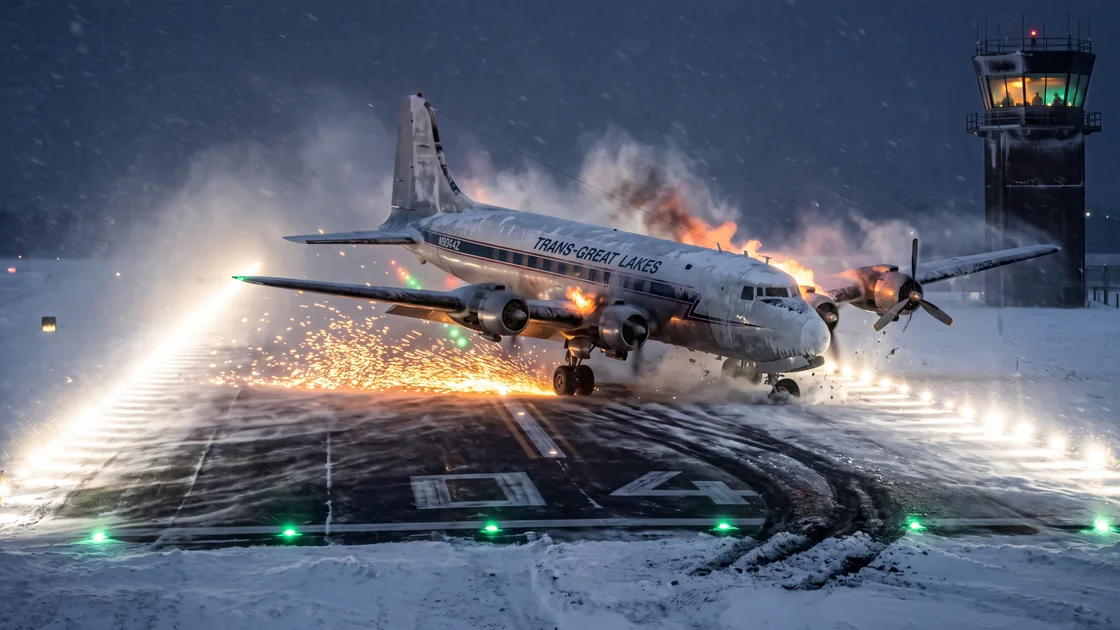
Raymond Vance, a veteran air traffic controller nearing retirement on the lonely midnight shift at a remote Great Lakes regional airport, receives a faint distress call over an obsolete radio frequency from Flight 19, a four-engine Douglas DC-4 that vanished over Lake Superior during a ferocious autumn blizzard in 1957. Over the course of three harrowing, fog-drenched hours, Raymond must reconcile the impossible mechanics of a time-slipped aircraft with his duty to save lives, relying on forgotten dead-reckoning procedures and obsolete navigational lore to talk a crew of frostbitten ghosts through zero-visibility skies and down onto a runway that did not exist when they took off.
Act I: The Graveyard Watch
The night cab of the tower at Northport Regional Airport hung suspended seventy feet above the tarmac, an island of green glass, black plastic, and amber indicator lights floating between the black earth and a vault of low, churning cloud. It was 02:14 on a Tuesday in mid-November. Outside, the wind blew hard off Lake Superior, sixty miles to the north, carrying with it that distinct northern smell: crushed pine needles, cold granite, and the iron-scented bite of sleet that had not yet decided whether to become snow.
Raymond Vance sat low in his high-backed ergonomic chair, his stockinged feet resting on the lower crossbar of the console. His heavy wool sweater, unraveling at the left cuff where his wristwatch buckle constantly snagged the yarn, smelled of black coffee and woodsmoke from the cast-iron stove he had stoked before leaving his cabin three hours ago. At fifty-eight, Ray had eyes that were permanently narrowed, mapped with fine red tributaries from thirty-one years of squinting through radar wash and salt-rimed glass.
His headset—a lightweight Telex that felt weightless compared to the clamping metal bands he’d worn in the Air Force during the late 1980s—rested over his left ear, leaving his right ear open to the low, comforting hum of the tower cab: the cycling hum of the climate control, the rhythmic clicking of the automated weather observation system (AWOS) terminal, and the occasional dry squawk of high-altitude transcontinental traffic being handed off between Minneapolis and Chicago Center high above the ceiling.
"Quiet night, Ray," muttered Jerry Kester, the ground controller, from three consoles down. Jerry was twenty-four, with skin still smooth enough to make him look like an adolescent playing dress-up in high-visibility nylon, and his eyes were glued to a glowing handheld tablet where a silent football game was replaying. "Freight from Duluth canceled. Runway de-icing rig had a hydraulic leak down by Taxiway Delta. Maintenance says they won't touch it until dawn."
"Don't say that word," Ray said, his voice like gravel rolled in a tin can.
"What word? Duluth?"
"Quiet." Ray took a slow sip from his thermos mug. The coffee was scalding, bitter, and thick. "Say it out loud and the sky drops an engine through the glass just to spite you. Call it 'uneventful.' Call it 'routine.' Don't call it quiet."
Jerry gave an exaggerated roll of his eyes, but he turned down the brightness of his screen. "Old-timer superstition. There's three birds between here and Green Bay. A FedEx feeder Caravan ten miles south of Ironwood, an empty King Air out of Wausau climbing to niner-thousand, and a life-flight helicopter sitting on the pad at St. Jude’s waiting for the wind to drop below thirty knots. Sky’s dead, Ray."
"The sky’s never dead," Ray murmured, more to himself than to Jerry. "It’s just resting."
Ray turned his attention back to his primary radar scope—the bright, high-resolution color display that translated raw returns into crisp alphanumeric tags. Modern aviation was clean, bright, and sterile. Every aircraft was a computer with wings, constantly interrogating the ground, whispering its identity, its altitude, its groundspeed, its rate of climb, and its fuel state in neat hexadecimal bursts. The screen showed the King Air, a tidy yellow triangle marked EJA412, tracking south-southeast at 210 knots. Below it, the Caravan crept along like an amber bead.
Beyond them, toward the vast, ink-colored expanse of the lake, the screen was an immaculate void. The Canadian border lay somewhere beyond that empty sweep, masked by rain clutter that the digital signal processor scrubbed out with mathematical ruthlessness. Modern radar didn't like ambiguity; if a target didn't announce itself with a Mode S squawk or maintain a doppler-verifiable velocity vector, the software swept it away, classifying it as sea return, migrating geese, or thermal ducting.
Ray reached out with a dry finger and adjusted the gain on the radar display, bypassing the digital filter to reveal the raw, unscrubbed analog sweep beneath. It was an old habit, one his sector supervisor had repeatedly told him to break. Trust the automation, Vance, the memos said. The automation has greater fidelity than human perception.
The screen flickered. The digital map remained sharp, but behind it, faint, ghostly clouds of raw echo drifted across the perimeter. A squall line fifty miles out. The high ridges of the Porcupine Mountains. And there, near the northern rim of the circle, right at the jagged boundary where Michigan airspace bled into the freezing waters of Keweenaw Bay, something blinked.
It was not a transponder return. There was no square data block, no four-digit beacon code, no altitude readout.
It was just a smear. A pale, crescent-shaped thumbprint of light that blossomed once as the sweep passed over it, faded into the phosphorus gloom, and then, twelve seconds later, blossomed again three miles south of its original position.
Ray didn't move. He lowered his mug to the rubber mat beside his keyboard. "Jerry."
"Yeah?"
"Check the NOTAMs for the Canadian border. Ottawa send over any military alerts? Exercise out of Trenton or Cold Lake?"
Jerry tapped his tablet twice. "Negative. Everything’s cold through 1200 Zulu. Why? You got a smuggler?"
"No," Ray said, watching the smear. It was moving too fast for a light utility plane fighting a forty-knot headwind, yet too slow for a regional jet. Roughly two hundred knots across the ground. It was tracking south-southwest, straight down the throat of the gale, heading directly for the Northport VOR. "No transponder. No ADS-B out."
"Puddle jumper with an alternator failure?" Jerry asked, finally standing up and walking over to Ray’s console, leaning his palms on the edge of the linoleum deck. "Look at that sweep. It’s wide. Radar reflection looks like a boxcar."
"A boxcar with wings," Ray said.
The radio console between them—the bank of multichannel emergency transceivers that had remained silent since 22:00—hissed.
It wasn't the clean, frequency-modulated pop of modern solid-state electronics. It was an old sound, a sound Ray hadn't heard since he was a teenage radio amateur listening to skip-waves on his father's hammer-tone Hallicrafters receiver in the basement. It began with a deep, liquid warble—the heterodyne whistle of two vacuum-tube carrier waves beating against each other across the ionosphere. Then came the hum of a heavy dynamo, a mechanical whine that rose and fell with the throttle of a motor, followed by the dry, paper-thin crackle of a carbon microphone opening up.
Ray reached for the volume knob on the 121.5 MHz VHF guard frequency. The knob was stiff with disuse.
"...orth... port... tow... er..."
The voice was thin, reedy, and shredded by static, yet it possessed a distinct cadence—flat, Midwestern, and impossibly calm, the cadence of men who had flown multi-engine bombers through flak over the Ruhr Valley and treated sudden engine fires as minor clerical errors.
"...orthport Tower, this is... Flag... ship Lake... perior... call... ing on one-two-one-point-five... four... zero-zero... do you read?"
Jerry frowned, his brow furrowing as he leaned closer to the overhead speaker. "Flagship? What is that, an old company callsign? Like American?"
Ray’s fingers had gone completely still on the desk. His memory, cataloged through decades of FAA incident reports, airframe registrations, and regional history, was usually slow to engage these days, but now it fired with the sudden, agonizing clarity of an exposed nerve.
Flagship Lake Superior.
"Jerry," Ray whispered. "Turn off your tablet."
"Ray, what is—"
"Turn it off. And get me the historical sector ledger from the bottom drawer of the archive cabinet behind the supervisor’s desk. The green cloth binder."
"The paper binder? That stuff hasn't been touched since—"
"Get it," Ray barked, his voice losing all its gravel and hardening into steel.
He pressed the transmit switch on his headset with his thumb.
"Unidentified aircraft calling Northport Tower on guard," Ray said, his voice level, slow, and measured. "Transmission broken and unreadable. You are coming in weak. Say again your callsign and intentions."
Act II: The Signal from the Ice
The silence that followed was long enough for the sweep to make three full rotations. Outside, a squall struck the tower cab, hurling a handful of icy pellets against the northwest panes with the rattle of dropped birdshot. The heavy plate glass groaned within its rubber gaskets.
Then the heterodyne returned, howling like a wolf across a frozen lake before settling into that strange, mechanical resonance.
"Northport Tower, Flagship Lake Superior, Trans-Great Lakes Flight One-Niner. We have an ADF malfunction and our magnetic compass is swinging wild. We are in heavy snow, zero visibility, picking up severe rime on the leading edges. We have lost numbers three and four engines."
A pause. In the background of the transmission, clear beneath the frying-pan sizzle of atmospheric noise, Ray heard something that chilled him deeper than the wind against the glass: the deep, guttural, uneven throbbing of enormous piston engines. Not the smooth, sewing-machine buzz of a modern turboprop, but the wet, violent snort of large-displacement radial engines, struggling against the drag of feathered propellers.
"Flight One-Niner," the voice continued, unwavering despite the words it carried. "We are declaring an emergency. We estimate we are twenty miles north of the Apostle Islands, but our dead reckoning is compromised. Requesting radar vector to the nearest active field with minimum four thousand feet of hard surface."
Jerry was standing by the archive cabinet, holding a thick, dust-caked cloth-bound binder with faded gold lettering: CIVIL AERONAUTICS ADMINISTRATION – REGION III – CONTINGENCY LOGS 1950–1962.
"Ray," Jerry said, his face pale in the green fluorescence. "Trans-Great Lakes? They went out of business fifty years ago. My granddad worked for their baggage line in Duluth."
"Open the binder," Ray said, never taking his eyes off the radar scope. "Look for November 1957. Mid-month."
"What am I looking for?"
"Flight 19."
Jerry’s fingers fumbled against the yellowed, brittle paper. The rustling was loud in the small room.
Ray keyed his mic. "Aircraft calling Northport Tower, callsign Flagship Lake Superior, Flight One-Niner. I have a primary target forty-two miles north-northwest of Northport. Say your current altitude and your fuel remaining."
The carrier wave fluttered.
"Northport, One-Niner. We are struggling to maintain four-thousand feet. We've dropped the gear by manual crank to inspect for ice accretion, but we can't get the mains locked. Altimeter setting two-niner-point-eight-two. Fuel state is... we have approximately twenty-five minutes of usable fuel remaining in the main tanks. Cross-feed is frozen. Captain Campbell in command. We have twenty-two passengers aboard, including two infants, and four crew. Please advise runway conditions at Northport."
Ray felt his throat tighten until it felt like a dry pipe.
"Jerry," Ray said softly. "Read it."
Jerry’s voice was barely a squeak. He was leaning over the binder, his hand trembling as he traced a column of mimeographed text.
"November 18, 1957," Jerry read. "Trans-Great Lakes Airlines, Flight 19. Douglas DC-4, registration N-9-0-4-4-Z. Departed Sault Ste. Marie en route to Minneapolis-St. Paul, scheduled intermediate stop at Duluth. Last radio contact 02:18 Central Standard Time over Lake Superior, reporting heavy icing and engine trouble. Air search suspended November 27. No wreckage recovered. Twenty-six souls presumed lost."
Jerry looked up from the page, his eyes wide and vacant. "Ray... that’s twenty-six people. That’s sixty-six years ago. To the night."
"Altimeter setting two-nine-eight-two," Ray muttered. He looked at his modern digital barometer readout. The digital display read 29.81.
He keyed the mic. "Flight One-Niner, Northport Tower. Squawk... disregard squawk." Ray caught himself. A 1957 DC-4 had no transponder. No Mode A, no Mode C, no squawk codes. It had an old pulse beacon at best, tuned to obsolete ground interrogation systems that had been dismantled during the Kennedy administration.
"Flight One-Niner, Northport Tower," Ray began again, his voice dropping into the quiet, rhythmic authority of an airman who had talked dozens of terrified pilots down into the dirt when everything had gone sideways. "I have you on radar. You are forty miles north-northwest of the Northport airfield. Turn left heading one-six-five. I repeat, heading one-six-five. This will vector you for an approach to our Runway Zero-Four."
"One-six-five, roger," Captain Campbell replied. The transmission was clearer now, as if the aircraft were descending beneath an invisible ceiling between worlds. "Coming left to one-six-five. We are throwing boots, but number two is beginning to surge. Oil pressure on two is dropping through thirty pounds. We are losing manifold pressure."
On the radar scope, the raw smear of light began a sluggish, wide-radius turn to the south.
It was real. Whatever was up there—whether it was an electronic echo trapped in a freak ionospheric duct, a ghost made of radio waves and cold vapor, or three hundred thousand pounds of aluminum and flesh tearing through the freezing night—it was behaving according to the laws of aerodynamics. It turned with the sluggish, heavy slip of an overloaded four-engine transport that had lost half its powerplants on the starboard wing.
"Ray," Jerry whispered, backing toward the center of the cab. "We need to call Minneapolis Center. We need to call the watch supervisor at home. We need to tell somebody."
"And tell them what, Jerry?" Ray said without turning around. "Tell them that Arthur Campbell is flying a DC-4 out of 1957 toward our runway with twenty-two passengers who have been at the bottom of Lake Superior since before my parents bought their first house?"
"Yes! No! I don't know! But we can't just—"
"If I take my eyes off this scope to call the regional manager in Chicago, Campbell’s going to drift east into the Porcupines. Look at his descent rate. He’s losing two hundred feet every minute. If he drops below three thousand feet before he crosses the coastline, he’s going to clip the ridgeline at White Pine and pancake into fifty miles of black timber."
Ray reached over to the runway lighting panel—a bank of toggle switches that controlled the high-intensity approach lamps, the runway edge lights, and the precision approach path indicators (PAPI). He flipped the master switch from the standard 10% brightness setting straight to 100%.
Outside the tower, the darkness was instantly shattered.
Two parallel miles of white quartz-halogen lights exploded into life along Runway 04/22, blazing through the freezing fog with such blinding fury that the mist turned into a luminous, glowing tunnel stretching into the trees. At the threshold, the green end-marker lamps burned like emeralds dropped in snow.
"Runway Zero-Four is illuminated," Ray said into his mic. "Flight One-Niner, wind is three-three-zero at one-eight, gusts to two-six. Altimeter two-niner-eight-two. The field is yours if you can reach it."
Act III: The Man with the Logbook
The voice that answered was not Captain Campbell’s. It was younger, higher-pitched, and trembling with an exhaustion that sounded bone-deep.
"Northport... this is First Officer Miller. Captain Campbell is... he’s got both feet on the left rudder pedal trying to hold the crab. We can't trim out the yaw. The trim tab cable on the empennage snapped five minutes ago. It sounded like an artillery shell went off in the tail."
A heavy breath, ragged and wet.
"The cabin is freezing, Tower. Our cabin heaters were tied to the exhaust muffs on number three. When three went, the heaters died. We’ve got women and children back there wrapped in overcoats and mail sacks. The windows on the inside are frosted two inches thick. We can't see the wingtips. Can you tell us... can you give us an altimeter check on the terrain between here and your strip?"
Ray looked down at his sectional chart, the paper map he kept pinned beneath a sheet of plexiglass on the side table. The modern chart was cluttered with controlled airspace boundaries, GPS waypoints with nonsense five-letter names like GABSO and WUDMI, and cell tower obstructions marked with tiny red antennas.
He stripped all of that away with his mind. He looked only at the brown contour lines, the elevation numbers: 1,680... 1,940... 2,020.
"Flight One-Niner, you have a ridge twelve miles ahead of you," Ray said. "The crest is at nineteen hundred feet. You must maintain at least twenty-five hundred feet until you cross the shoreline. Do you have twenty-five hundred?"
"We are at twenty-six hundred," Miller replied. "We're trading airspeed for altitude. Airspeed is... one-one-five knots. We are close to stall buffet, Northport. If we pull the nose up any higher, the wing’s going to drop."
"Keep your nose down, son," Ray said, his tone softening into something almost paternal. "Trade the altitude. If you hit the stall, you won't recover in this soup. Keep it at one-one-five. The terrain drops off four miles ahead as you hit the river basin. You’ll have a clear trough all the way to the threshold if you stay on one-six-five."
"Understood," Miller said. Then, his voice dropped lower, away from the microphone, though the carbon element still picked up his words: "Art, he says keep the nose down. Don't fight it. Let it ride the glide."
And then, faintly: "Tell him... tell him we can smell smoke from the radio rack."
"Northport," Miller’s voice returned, tighter now. "We've got an electrical fire behind the main junction box. We’re going to have to pull the master breaker on the DC bus if it flares. If we lose radio contact, we are going to continue on heading one-six-five and look for your lights. If you have any flares... if you have an Aldis lamp... please put somebody out on the field."
Jerry sat down hard in the chair beside Ray. He was holding the cloth binder open on his lap like a shield.
"Ray," Jerry said, his voice shaking. "Look at this. Look at the passenger manifest from the Duluth evening paper, November 19, 1957."
Ray didn't want to look, but his eyes were drawn down to the yellowed newsprint clipping pasted into the CAA ledger.
PASSENGERS ABOARD TRANS-GREAT LAKES 19: Mr. and Mrs. Harold Henderson, Duluth Miss Clara Danforth, Ironwood Pvt. First Class Robert Vance, United States Army...
Ray stopped breathing.
The cab was completely silent except for the sleet against the glass.
Pvt. First Class Robert Vance.
Ray’s hand rose slowly from the console, hovering in the air as if he were trying to touch the name without touching the paper.
"My uncle," Ray whispered.
"What?" Jerry breathed.
"My uncle Robert. My dad’s younger brother. He... they told me he died in a training accident. Fort Leonard Wood. They said his body was never sent home because of... they said it was a transport crash in the snow. My dad never spoke about him. Not once. Just kept a photo on the mantle: a kid in an olive-drab garrison cap with large ears and a crooked smile."
Ray leaned down, his eyes scanning the clipping.
Pfc. Vance was returning to his family home in Superior, Wisconsin, on emergency leave following the death of his mother...
"Ray," Jerry said, his eyes wild with a sudden, superstitious panic. "Ray, this isn't an airplane. This is... this is some kind of echo. It’s an anomaly. It’s some kind of atmospheric atmospheric feedback loop. The cold front, the solar activity—there was a coronal mass ejection warning on the NOAA feed this afternoon! It’s picking up old signals stored in the crust or the lake and—"
"Shut up, Jerry," Ray said. His voice was completely flat, drained of fear, drained of confusion, filled only with a terrible, crystalline focus.
"Ray, you can't land a ghost."
"I’m not landing a ghost," Ray said, staring at the green smear on the scope, which was now twenty-two miles away and descending through twenty-three hundred feet. "I’m landing my uncle."
Act IV: The Blind Descent
"Flight One-Niner," Ray spoke into the mic, his thumb pressing the switch with a firm, unyielding pressure. "Northport Tower. Be advised, I am activating the runway alignment beacons. We do not have a low-frequency radio range here anymore—our old A-N four-course beacon was decommissioned in 1968. You will not hear the Morse tones. You must rely entirely on my vectors. I am going to talk you down using Precision Approach procedure. Do you understand?"
Static roared across the channel, a rhythmic chug-chug-chug like the blades of a giant windmill spinning through wet air.
"...opy, Northport. Precision approach. No range tones. We have... we have lost the cockpit glass, Tower! The captain’s windshield just caved under the ice load! The storm window is holding, but we’ve got fifty below zero in the cockpit! Miller’s hands are... his fingers are split, he can't hold the yoke!"
It was Campbell’s voice again. It was older, cracked with agony, the voice of a man being beaten with frozen hammers.
"I have the controls," Campbell shouted over the roar of the wind inside his plane. "I have her, Miller! Wrap your scarf around your face! Keep your feet on those pedals! Tower... Northport... give us the line! Give us the goddamn line!"
"Flight One-Niner, you are eighteen miles out," Ray said. His voice was steady, rhythmic, almost hypnotic. It was the voice used by military controllers during the Berlin Airlift, the cadence that held men’s souls in their bodies when their instruments were broken and their engines were quitting. "Turn right five degrees. Heading one-seven-zero. I say again, heading one-seven-zero."
"One-seven-zero," Campbell gasped.
On the scope, the blip nudged slightly to the west.
"Good," Ray said. "You are tracking down the center of the Montreal River valley. The terrain to your left is twelve hundred feet. The terrain to your right is eleven hundred feet. You are at two thousand feet. Do not descend below eighteen hundred until I give you the call. Do you understand?"
"Eighteen hundred... hold eighteen hundred... we are trying, Tower. Number two is backfiring through the intake. We're getting fire in the nacelle. Miller’s discharging the CO2 bottle... bottle discharged! The fire is out, but she’s windmilling. The drag is... she wants to roll, Northport! She wants to roll on her back!"
"Step on that left rudder, Captain!" Ray barked. "Kick it! Don't let her tip! You’ve got fifteen miles of open air ahead of you! Look through that broken pane! You’re coming out from under the scud in four miles! The lake is behind you!"
"I can't see the ground!" Campbell yelled. "It’s black! It’s all black!"
"The lights are there, Art," Ray said, using the pilot’s first name without thinking, speaking directly into the dead man's ear across sixty-six years of darkness. "Look for two parallel lines of high-intensity white. It’ll look like a ladder lying in the snow. You aim for the foot of that ladder."
Beside him, Jerry was standing with his back against the glass, his hands pressed flat against the wall. "Ray... the weather sensors. Look at the AWOS."
Ray glanced at the weather terminal.
The automated system was registering an impossible local drop in temperature. Outside the tower, the temperature had been twenty-eight degrees Fahrenheit five minutes ago. Now, the digital readout was spinning downward like a broken stopwatch: 22... 16... 08... -04... -18.
Frost—thick, white, fern-like crystals of rime—was blooming across the inside of the tower cab windows. The glass was cracking with small, sharp reports like pistol shots as the sudden, violent cold contracted the heavy panes against their steel mountings.
The air in the room turned white. Ray’s breath billowed from his lips in thick, frozen clouds. The coffee in the mug beside his hand skinned over with a pale layer of ice.
"Ray," Jerry sobbed, his teeth chattering uncontrollably. "Ray, it’s cold. Why is it so cold?"
"Hold your position, Jerry," Ray said, his own teeth clicking together. His fingers were growing numb, but he kept his thumb locked over the transmit button.
The heterodyne howl in his headset had reached a crescendo. It was no longer coming just from the speaker; the metal frame of the console itself seemed to be singing, vibrating like the prong of a tuning fork. The scent of ozone filled the cab—not the modern smell of melted plastic insulation, but the heavy, pungent stink of burnt castor oil, high-octane leaded aviation gasoline, and the bitter copper tang of old blood.
"Flight One-Niner, twelve miles," Ray said. "You are slightly above the glide path. Begin your descent now. Bring her down at four hundred feet per minute. Heading one-six-eight. Adjust heading two degrees right. One-seven-zero."
"One-seven-zero," Campbell whispered. The fury had gone out of his voice; he was down to the dregs of his life now, his breath whistling through lungs that were filling with fluid from the freezing air. "I see a glow. Forward and to the left. Is that you, Northport?"
Ray looked out through the frosted glass, down the two-mile shaft of Runway 04.
At the far end, five miles out over the black timber where the runway approach lights ended and the wilderness began, the low, gray ceiling of the blizzard was torn open.
Something was coming through.
It was not a light. It was an absence of light, a heavy, four-engine shadow flanked by long, trailing plumes of orange fire spitting from the exhaust stacks of two dying radial engines. The props on the starboard wing were dead—one feathered and still, the other windmilling slowly, a three-bladed cross cutting through the swirling sleet.
The landing gear was down, but it hung crookedly, the left main gear dangling at an awkward, broken angle, the hydraulic struts weeping black oil into the wind.
"I have you in sight, Art," Ray whispered into the mic, tears freezing on his cheeks as he leaned his forehead against the shuddering glass. "You’re high. You’re coming in hot. Drop your flaps. Drop everything you’ve got."
"Flaps are frozen," Campbell’s voice came back, thin as tissue paper. "We’re coming in slick. We’re going to have to ground-loop her at the end of the roll, Northport. We have no brakes. Hydraulic lines are severed."
"There's two miles of asphalt, Art," Ray said. "When you touch down, keep her straight as long as you can. When she runs out of concrete, there’s an overrun of soft sand and peat. It’ll stop you. She’ll slide, but she’ll stop."
"Tell... tell the company..." Campbell’s voice was fading, drowning in a rising ocean of white noise. "Tell the company the crew stayed at their posts. Miller... Miller’s gone, Ray. His head’s down on the quadrant. It’s just me."
"You’re not alone, Art," Ray said, his voice breaking. "I’m right here. I’m holding the lights for you. Come to Papa, Captain. Right down the middle."
Act V: Touchdown on Runway Zero-Four
The aircraft crossed the threshold at 02:44.
It did not make the sound of a modern plane. It didn't have the high-pitched whistle of a turbofan or the dry hiss of composite materials cutting the wind.
It came with the sound of an iron foundry falling through the sky.
The roar of the two remaining Pratt & Whitney R-2000s was a physical blow that struck the tower cab, rattling the ceiling tiles and sending a shower of dried plaster dust down onto Ray’s shoulders. The sound was accompanied by the rhythmic, deafening clack-clack-clack of broken piston rings and the scream of the windmilling starboard propeller, its hub screaming for grease that had burned away forty minutes ago.
As the shadow passed fifty feet below the cab, Ray looked down into the cockpit through the shattered green glass of the greenhouse roof.
He saw two figures.
One was slumped sideways against the right window, his head lolling against his shoulder, his flight cap gone, his hair white with rime.
The other figure—broad-shouldered, wearing a heavy sheepskin B-3 jacket with the leather cracked and blackened by oil—had both hands locked around the control wheel. His head was thrown back, his teeth bared in an animal snarl of concentration, his face a mask of gray frost.
And behind them, through the small, circular passenger portholes along the silver fuselage of the DC-4, Ray saw faces.
They were not screaming. They were pressed against the round panes of glass, looking out at the blazing runway lights with eyes that were wide, dark, and impossibly clear. There was an older woman in a blue felt hat with a small cloth bird pinned to the brim. There was a young man in an olive-drab uniform with corporal’s stripes on his sleeve, his face pressed so close to the glass that his breath left no condensation—only the dry impression of his features against the frosted circle.
The boy looked up.
For a tenth of a second, as the aircraft flashed through the cone of light beneath the tower, the boy’s eyes met Ray’s.
The boy had Ray’s nose. He had the Vance jaw, that square, slightly off-center chin that Ray saw every morning when he shaved in his cabin mirror.
The boy smiled. It was the crooked, easy smile from the photo on the mantle. He raised one gloved hand, two fingers lifted in a clumsy, hesitant V-for-Victory, before the wing drifted between them and cut off the view.
"Down," Ray screamed into the microphone, though the radio had gone completely dead, drowned in a high, pure sine wave that sounded like a church bell ringing in a deep well. "Get her down, Art! Put her on the ground!"
The DC-4 struck the asphalt three hundred yards past the threshold.
The impact was violent. The left main gear, its strut already fractured, gave way instantly with a shower of orange sparks that sprayed fifty feet into the darkness. The left wing dropped, the tip scraping along the runway surface, tearing off aluminum skin and throwing a roostertail of fire and shredded metal into the blowing snow.
The aircraft slewed wildly to the left, the tail swinging around like a pendulum as the good tires on the right gear bit into the frozen slush. The two operating engines roared one last time—a frantic, desperate surge of power as Campbell kicked the right brake with everything he had left in his dying body, trying to hold the four-engine beast on the narrow centerline of the runway.
"She’s holding," Jerry gasped, his voice a dry croak from the corner of the room. "Ray... she’s holding the pavement!"
The DC-4 slid down the center of Runway 04, a great, dying bird of silver and fire, its fuselage drifting sideways at a thirty-degree angle. The screech of tearing metal was loud enough to penetrate the double-paned storm glass of the tower, a sound like a locomotive derailing on a bridge of tin.
It passed the 5,000-foot marker.
It passed the 6,000-foot marker.
Its speed was decaying rapidly—eighty knots, sixty knots, forty knots—leaving behind it a black, scorched scar of burnt rubber and shredded aluminum that smoked in the freezing air.
At the 7,000-foot intersection, where Runway 04 crossed the inactive Taxiway Charlie, the aircraft finally stopped.
It sat there, tilted heavily to the port side, its left wingtip resting on the frozen asphalt, its tail high in the air, the windmilling propeller slowly grinding to a halt with one last, wheezing compression hiss from the cylinders.
The twin ribbons of fire from the exhaust stacks flickered, turned blue, and went out.
The runway was silent.
The wind howled across the open tarmac, blowing plumes of snow around the tires, but the roar of the engines was gone.
Act VI: The Ledger at Dawn
Ray stood at the glass for a long time.
His headset was dead. The volume knob was still cranked to the stops, but there was no static. No heterodyne. No hiss. Not even the dry hum of the tower amplifier.
The temperature in the cab was rising. The thick sheets of frost that had coated the inside of the windows were already beginning to melt, weeping down the glass in long, clear runs that collected on the sills and dripped onto the linoleum floor with a steady plink... plink... plink.
Jerry was on his knees by the console, his head in his hands, his breath coming in short, ragged gasps. "Ray... did you... did you see that?"
Ray didn't answer. He picked up his binoculars from the shelf beside the radar scope.
He focused the lenses on the intersection of Runway 04 and Taxiway Charlie.
The quartz-halogen approach lights blazed with clean, modern brilliance, cutting through the swirling sleet. The runway surface was white with a thin dusting of snow that had fallen over the last twenty minutes.
There was no airplane.
There was no crumpled DC-4 resting on its broken wing. There were no scorched trails of rubber. There was no fire.
There was only the long, empty stretch of asphalt, white and undisturbed, vanishing into the gray curtains of the morning blizzard.
"Jerry," Ray said softly.
Jerry looked up, his eyes bloodshot, his face gray. "Is it... is it gone?"
"Get the field truck," Ray said. "Get your coat and the keys to the four-wheel drive. We’re going down."
"Ray, I’m not going out there. There's nothing out there. It was... it had to be a mirage. Some kind of radar inversion—"
"Get the truck, Jerry."
They rode down the elevator in total silence, the mechanical hum of the car sounding loud and vulgar after the spectral roar of the radials. When the doors opened to the maintenance bay, the air smelled of diesel, floor wax, and road salt—the boring, comforting smells of the twentieth century.
They climbed into the yellow airport operations truck, its amber roof beacon throwing rotating flashes across the snow as Jerry backed it out of the hangar.
The wind on the runway was ferocious, thirty knots out of the north, driving the sleet straight into their windshield. The wipers slapped rhythmically against the glass, clearing semicircles through the gray crust.
Jerry drove slowly, following the runway centerline lights. "Where was it, Ray? Where did you see it stop?"
"Taxiway Charlie," Ray said. "Seven thousand feet from the threshold."
As they approached the intersection, Jerry slowed the truck to a crawl, then brought it to a complete stop.
The headlights illuminated the runway surface.
"See?" Jerry whispered, his voice trembling with a mixture of relief and hysteria. "Nothing. Not a scratch. Not a drop of oil. Ray, there wasn't an airplane. We had some kind of... some kind of shared hypoxia. The ventilation system—"
"Jerry," Ray said, pointing through the window. "Look at the snow."
The snow was falling heavily, but it had only been falling for twenty minutes.
On the runway surface, cutting through the thin, two-inch crust of white, were two deep, ragged ruts.
The right rut was narrow, pressed into the asphalt by the high-pressure tread of a vintage 36-inch multi-rib airplane tire.
The left rut was broad, jagged, and six feet wide—the distinct, violent gouge of an aluminum wingtip and a collapsed landing gear forging through frozen slush, tearing into the gravel at the edge of the pavement.
The tracks ran for four hundred yards down the center of the lane.
They ended abruptly at the intersection of Taxiway Charlie.
There, right where the nose gear would have rested, the snow had been completely melted away in a circular patch twelve feet across, revealing the dark, dry asphalt beneath. In the center of that dry circle lay a small, dark object.
Ray opened the truck door before Jerry could stop him. The cold struck him like an axe, but he didn't feel it. He walked through the blowing sleet, his boots crunching in the fresh powder, until he reached the edge of the dry circle.
The asphalt was warm. He could feel the heat radiating through the soles of his boots—the heat of four massive engines that had worked themselves to death sixty-six years ago.
He bent down and picked up the object.
It was an envelope.
It was made of heavy manila cardstock, stiff with salt and yellowed with age, its edges stained with dried, amber engine oil. The front was franked with a red three-cent stamp bearing the likeness of the Statue of Liberty, postmarked SAULT STE. MARIE, MICH., NOV 18 1957 8:00 PM.
On the front, written in a bold, hurried hand with blue fountain-pen ink, was an address:
Mr. Thomas Vance 1412 West Seventh Street Superior, Wisconsin
Ray turned the envelope over.
The flap was sealed with a small circle of red wax. Written across the back, beneath the seal, were three lines in the same clear, boyish hand:
Dear Tom, I’m coming home. Don't worry about the weather—we’ve got a good pilot. Bob.
Ray stood in the center of the empty runway, holding the letter against his chest.
The wind off the lake blew hard, carrying with it the cold, clean breath of the deep water, but the smell of castor oil and ozone lingered in his wool sweater, heavy and warm, like an arm draped over his shoulder in the dark.
High above the clouds, far beyond the reach of the blizzard, the morning sun was beginning to touch the upper rim of the stratosphere, turning the sky from black to gray, and then to a pale, cold rose.
Ray pulled his small handheld radio from his heavy pocket and keyed the mic.
"Northport Tower, this is Vance on the field."
Inside the truck, Jerry picked up the microphone. "Go ahead, Ray."
Ray looked down the runway toward the south, where the trees stood tall and dark against the gray light of dawn, their branches heavy with the new snow.
"Runway Zero-Four is clear," Ray said. His voice was completely steady, clear and deep in the cold morning. "Log it in the book, Jerry. Trans-Great Lakes Flight One-Niner. Arrived. Zero-two-forty-four Zulu."
A pause.
"And Jerry?"
"Yeah, Ray?"
"Tell the relief shift they can turn off the approach lights. The weather’s breaking."