The Glass Horizon of 1904
When retired antiquarian and photographic conservator Arthur Pendergast purchases a bespoke, brass-bound panoramic camera crafted in 1904 by an eccentric New England horologist, he discovers an unexposed spool of nitrocellulose film still sealed within its airtight brass magazine. Upon carefully developing the hundred-and-twenty-year-old strip using period-accurate pyrogallol chemistry, Arthur expects to reveal long-lost streetcars, gaslit cobblestones, or turn-of-the-century pastoral landscapes. Instead, the chemical bath yields an impossible revelation: three ultra-wide, razor-sharp negatives depicting modern glass-and-steel megaliths, swirling highway interchanges jammed with late-model automobiles, and a high-bypass commercial jet airliner slicing through the clouds. Driven by equal parts obsession and dread, Arthur embarks on a forensic, optical, and historical investigation to determine whether he is holding the most elaborate darkroom forgery in history or the terrifying mechanical proof that someone in 1904 managed to photograph the future.
Chapter I: The Darkroom on Benefit Street
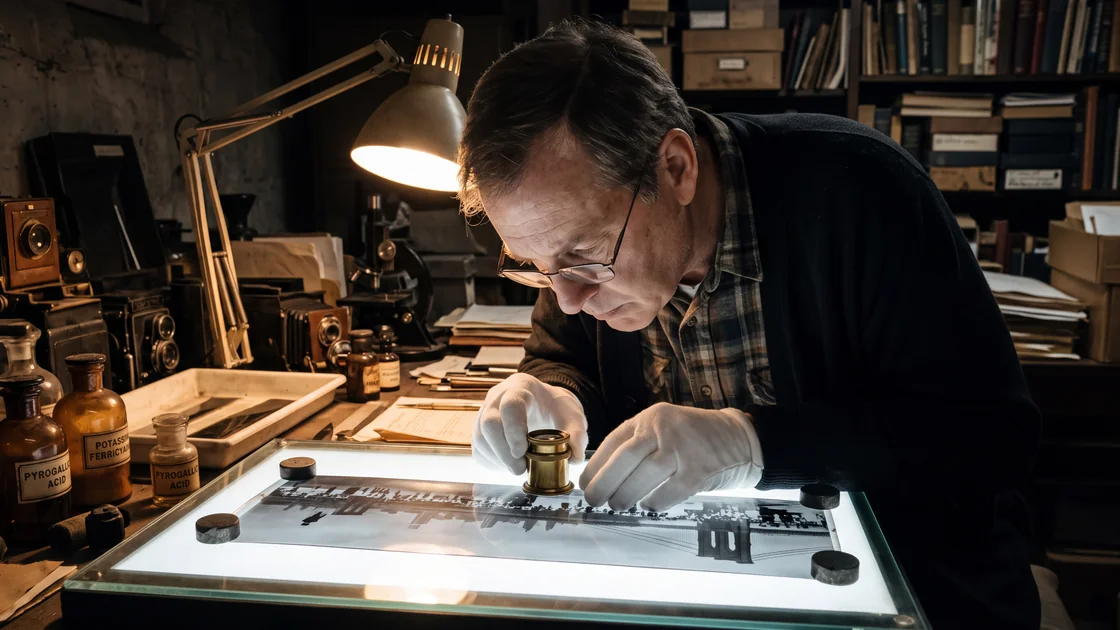
The basement of the house on Benefit Street smelled of cedar shavings, glacial acetic acid, and the sweet, almond-scented rot of decomposing nitrocellulose. To the casual visitor, the subterranean workshop would have seemed like the laboratory of a Victorian alchemist who had lost his faith in gold and turned instead to the capture of shadows. Along the granite foundation walls hung rows of blackened pine drying racks, slotted brass printing frames, and glass bottles with ground stoppers, their paper labels foxed with age: Potassium Ferricyanide, Pyrogallic Acid, Mercuric Chloride, Sodium Hyposulfite.
Arthur Pendergast stood over his stainless steel sink under the dim, ruby glow of an ancient amber-red safelight. He was sixty-two years old, with nicotine-stained fingers that had spent four decades handling things too fragile for the open air: daguerreotypes buffed to a mirror finish, albumen prints curling like dried leaves, and glass lantern slides whose collodion skins threatened to turn to dust at the vibration of a passing truck.
On the slate counter beside him rested the prize of the previous Tuesday’s estate sale in Worcester: a mahogany and nickel-plated panoramic apparatus that defied standard catalog classification.
The auction listing had described it merely as: Lot 412: Custom Clockwork Field Camera, c. 1900–1905, attributed to Lucien Vane. Functional condition unknown.
Arthur had known the name Lucien Vane. In the footnote-choked appendices of turn-of-the-century optical history, Vane occupied a strange, disquieting niche. He had not been an itinerant tintypist or an employee of Eastman’s burgeoning empire in Rochester. Vane had been an eccentric master horologist, a lapidary, and an amateur fellow of the Boston Optical Society who had vanished from Providence in the autumn of 1906, leaving behind an empty boarding house room, a mountain of unpaid brass bills, and a collection of notebooks written in an unreadable private shorthand.
The camera was a marvel of pre-industrial precision. Its body was carved from Cuban mahogany, cross-banded with lignum vitae to resist the warping of sea air. Instead of the accordion bellows typical of the period, it utilized a drum-shaped interior housing that revolved upon a geared bronze azimuth base. A tempered steel spring motor, governed by a three-ball centrifugal escapement similar to those found in fine lighthouse clocks, sat beneath the tripod mount. The lens was not an off-the-shelf Goerz Dagor or a Bausch & Lomb Rapid Rectilinear; it was an unbranded, thick-walled barrel of blackened gunmetal housing six elements of dense, violet-cast flint glass, fronted by an adjustable brass slit shutter barely a millimeter wide.
Most extraordinary of all was the magazine. Bolted to the rear of the revolving drum was an airtight cylindrical canister of lead-lined brass, sealed with three knurled thumb screws and seated against a strip of vulcanized rubber that had somehow remained soft and pliable in the vacuum grease of its seating.
When Arthur had undone the thumb screws in total darkness the night before, his sensitive fingertips had confirmed what he had barely dared to hope: inside lay an uncut ribbon of film, roughly three and a half inches wide, wound tightly around a slotted boxwood spindle.
It was not modern triacetate or polyester. By touch alone, he recognized the faint stiffness, the smooth, cold glaze, and the unmistakable camphoraceous odor of early nitrocellulose film stock—Eastman’s early, hand-slit flexible base, or perhaps a custom French stock from Lumière, manufactured before the industry settled on standard perforations and widths.
Now, Arthur prepared to coax whatever latent shadows might remain upon that century-old gelatin.
"You are a fool, Arthur," he murmured to the darkness, his voice raspy from decades of breathing fixer fumes. "The latent image fade has wiped it clean. You're going to wash a blank strip of boiled bones and silver salt down the drain."
He knew the science. A latent image—the microscopic cluster of reduced silver atoms formed when photons strike a silver halide crystal—was not permanent. In the absence of development, thermal agitation, atmospheric sulfur, and the slow, inevitable oxidation of the emulsion would tear those clusters apart. After five years, an exposed roll of antique film generally yielded muddy, indistinct ghosts. After twenty, it produced nothing but chemical fog. After a hundred and twenty years, an unexposed strip should have been utterly inert, or worse, fused by nitric acid decay into a brick of unrollable caramel.
Yet the film had come free from the spindle with a supple, clean snap. The vulcanized rubber and lead lining had created a miraculous microclimate, preserving the gelatin against moisture and the creeping rot of time.
Arthur checked the temperature of his chemistry with an ancient mercurial thermometer: precisely sixty-five degrees Fahrenheit. For this strip, modern developers like D-76 or Rodinal were out of the question; their modern alkalinity would instantly strip the delicate, unhardened gelatin emulsion from the celluloid base. He had mixed a traditional 1904 pyrogallol formula: pyro, sodium sulfite, and potassium carbonate, with a generous pinch of potassium bromide to restrain the heavy fog that inevitably afflicted old silver.
He turned off the amber safelight. The darkroom plunged into the profound, sensory-depriving blackness required for orthochromatic film.
With practiced, trembling fingers, Arthur unspooled the first twenty inches of the strip and fitted it into an adjustable bakelite developing trough. He poured the amber pyro solution into the tank.
The ticking of the laboratory timer sounded like a mechanical heart in the stillness.
One minute. Two minutes. He agitated the tank with slow, rhythmic tilts, keeping the liquid moving over the emulsion to prevent streaks. The smell of pyrogallol—earthy, bitter, faintly medicinal—filled the small room.
Four minutes. Six.
At eight minutes, he poured off the developer, flooded the tank with an acid stop bath of dilute acetic acid, and then poured in the sodium thiosulfate fixer. Only when the fixer had done its work for ten minutes, dissolving away the unexposed silver halides and clearing the milky veil of the emulsion, did Arthur reach out and flip the switch for the white overhead lamp.
The sudden glare was blinding. Arthur squinted, blinking through his wire-rimmed bifocals. He reached into the wash tray, lifted the dripping ribbon of film by its celluloid borders, and held it up against the frosted glass of the overhead light bank.
He had expected blank, amber celluloid. He had prepared himself for the mottled gray lace of catastrophic chemical fog.
Instead, the wet strip displayed three long, razor-sharp, panoramic negatives, dense with silver, their highlights glistening like burnished lead against the glass.
Arthur caught his breath, his hands freezing mid-air. Water droplets fell from the bottom edge of the film, pattering softly onto the zinc drainboard.
He brought the wet film closer, his eyes traveling across the first panoramic frame. It was an ultra-wide composition, nearly twelve inches long, taking in a sweep of almost one hundred and forty degrees.
"No," he whispered.
The word did not leave his throat as a sound, but as an exhalation of cold air.
The perspective of the first negative was taken from an elevation—perhaps three or four hundred feet above a broad body of water. In the foreground, spanning the bottom third of the frame, was a wide concrete walkway bordered by a brushed-steel railing. But beyond the water, rising into the sky with an authority that defied comprehension, stood a wall of impossibly tall, geometric towers.
They were not the stone and brick masonry of turn-of-the-century New York or Chicago. There were no Beaux-Arts cornices, no Victorian mansard roofs, no steam-belching chimneys or cast-iron water tanks.
They were sheer prisms of glass.
In the center of the frame, dominating the skyline, rose a colossal, chamfered monolith that tapered into an octagonal spire, flanked by crystalline towers whose surfaces reflected the bright glare of an afternoon sun with mirror-like clarity. Down along the riverbanks, where wooden piers and square-rigged schooners should have clustered, were flat-topped concrete ferry terminals, and carving through the water were twin-hulled, low-slung catamarans throwing up sharp, foaming wakes.
Arthur dropped the strip back into the wash water as if it had burned him. His heart hammered violently against his ribs. He gripped the edge of the slate sink, his knuckles turning white, staring down into the clear running water where the film swayed like a ribbon of dark kelp.
"A modern roll," he said aloud, his voice cracked and frantic. "Someone took a vintage body, retrofitted modern film, shot it last week, and re-spooled it into the Vane canister. A parlor trick. A student project from RISD."
He stood upright and took three deep breaths, forcing the panic down into the cold, clinical cellar of his mind. He was a conservator. He was a material forensicist. He did not believe in miracles, and he certainly did not believe in time travel. There was a rational, mechanical explanation, and the materials would surrender it under magnification.
He removed the strip from the water, carefully hung it in the dust-free drying cabinet with a weighted stainless-steel clip at its base, turned on the low-velocity fan, and locked the darkroom door behind him.
Chapter II: The Grain of the Impossible
By two in the morning, the film was bone-dry.
Arthur sat at his main work table, bathed in the cool light of a halogen inspection lamp. On the green self-healing cutting mat lay his most powerful tools: a brass Bausch & Lomb binocular microscope, a digital micrometer, a long cold-cathode light box, and a pair of goat-hair negative brushes.
He took the dried strip from the cabinet. The film had the natural curl characteristic of heavy-gauge celluloid. Using soft cotton gloves, he smoothed it out across the light box and pinned the edges with polished lead weights.
He bent over the light box with a 10x Schneider loupe pressed to his eye.
The clarity of the image was terrifying.
In nineteenth-century photography, even the finest lenses suffered from field curvature, astigmatism, or chromatic aberration along the margins. But Lucien Vane’s six-element gunmetal optic, paired with the continuous rotation of the slit shutter, had laid down an image that was geometrically rectilinear and biting in its sharpness from the left edge to the right.
Arthur adjusted the focus of the loupe on the central skyscraper.
The negative was inverted, of course; the sky was a deep, metallic black, while the buildings stood out in luminous, ghostly shades of white and gray. Through the loupe, he examined the curtain-wall facades. He could see the individual horizontal mullions of the windows. He could see the interior suspended ceilings, the miniature modular desks, and the glowing square monitors of personal computers sitting inside modern corporate offices.
"This is Lower Manhattan," Arthur said, his hand trembling so hard the loupe rattled against the glass of the light box. "That is the Freedom Tower. That is One World Trade Center."
He moved the loupe down to the river. The boat slicing through the water was not a steam ferry. It was a modern New York Waterway commuter vessel, its hull shape unmistakable. On the shoreline, along the West Side Highway, the traffic was frozen mid-motion by the camera's high-speed slit: late-model SUVs, yellow hybrid taxicabs with aerodynamic roof displays, and low-slung delivery trucks bearing logos that had not existed twenty years ago, let alone a hundred.
He slid the loupe to the second panoramic frame.
This exposure had been made at ground level, seemingly from the center of a wide pedestrian plaza or park. Arthur immediately recognized the location: the High Line, the elevated rail line turned public park on Manhattan's West Side.
The foreground was crowded with people.
They were dressed in down-filled puffer jackets, denim jeans, running shoes with thick synthetic foam soles, and baseball caps. A young woman leaned against a weathering-steel planter, holding a slim, rectangular pane of glass to her ear—a smartphone. Beside her, a man walked a dog with a retractable nylon leash. Every garment bore the loose, unstructured draping of twenty-first-century synthetic fabrics.
Then Arthur looked at the sky of the second frame.
Hovering just above the skyline, descending toward what must have been an approach to Newark or LaGuardia, was an aircraft.
Arthur pulled the binocular microscope over the light box, racked the coarse focus down, and brought the aircraft into the twin eyepieces under thirty-power magnification.
The detail was immaculate.
It was a wide-body commercial jet airliner. Arthur recognized the severe, elegant sweep of the wings, the raked wingtips curving gracefully upward, and the massive, high-bypass turbofan engines slung beneath the pylons. The scalloped edges of the engine nacelles—the chevrons used for noise reduction on modern Boeing 787 Dreamliners—were distinctly resolved in the silver grain.
"Grain," Arthur muttered, his breath hitching.
He adjusted the microscope to fifty-power magnification, centering on the engine nacelle, then on the cheek of the woman with the phone, and finally on the sky.
A modern darkroom hoax, created by an artist or a forger, would have used modern film. Modern film—Ilford Delta, Kodak T-Max, or even classic Tri-X—utilized tabular silver crystals: flat, engineered hexagonal plates of silver halide grown in chemical reactors to maximize speed while minimizing visible clumping.
What Arthur saw through the eyepieces was not tabular grain.
It was the chaotic, filamentary, pebble-like clusters of an early twentieth-century polydisperse emulsion. The silver grains were wildly varied in size: microscopic boulders of reduced silver alongside dustings of fine particles, clustered together in the distinct, slightly curdled pattern that characterized manual, small-batch gelatin preparation.
Furthermore, the tonal scale was wrong for modern panchromatic film. The deep blues of the sky were heavily exposed, almost solid black in the negative, while the reds and warm tones in the clothing of the pedestrians were thin and clear.
The emulsion was orthochromatic. It was blind to red.
Arthur pulled back from the microscope, his face bathed in the cold light of the table. His chest felt constricted, as if the air in the room had suddenly lost its oxygen.
"If this is a fake," he whispered to the empty room, "then someone has manufactured a nineteenth-century orthochromatic emulsion by hand, coated it onto an authentic nitrocellulose base, slit it to a non-standard width of three and a half inches, loaded it into an antique magazine, and somehow projected a digital file of twenty-first-century Manhattan onto it with an optical resolution that exceeds any digital projector on earth."
He reached for the micrometer.
He measured the thickness of the film base along the clear margins where the slit shutter had not exposed it. The gauge read 0.0078 inches—nearly double the thickness of modern acetate film.
Next, he took a surgical scalpel with a fresh No. 11 blade and approached the very end of the roll—a sliver of trailing margin half a millimeter wide. With a steady hand honed by decades of paper conservation, he pared away a microscopic shaving of the base, no larger than a grain of sand.
He walked the shaving over to the chemical fume hood at the back of the shop. He placed the particle in a porcelain crucible, set the crucible on a fireproof pad, and took up an electric spark lighter.
He touched the spark to the sliver.
There was no melting, no slow, smoky charring like acetate or polyester would display.
FWOOM.
A brief, instantaneous flash of blinding white-violet flame consumed the particle in less than a tenth of a second, leaving behind a faint smudge of pale gray ash and the sharp, unmistakable stench of nitric oxide.
It was nitrocellulose. Pure, unstable, highly nitrated cotton gun-base.
And no commercial factory had poured a continuous web of photographic nitrocellulose since the middle of the twentieth century.
Chapter III: The Chemical Autopsy
By dawn, the rain had begun to lash against the high, iron-barred windows of the basement. Arthur had not slept. His eyes were red-rimmed and burning behind his spectacles. He had made four pots of black coffee and spent the intervening hours pacing the narrow lanes between his bookshelves, pulling down volumes on historical emulsion chemistry, optical patents from the United States Patent Office, and monographs on New England watchmaking.
At eight in the morning, he packed the dried negative strip into an acid-free archival sleeve, placed the sleeve between two heavy slabs of museum board, and slipped them into his leather portfolio.
He drove his ancient Volvo through the rain-slicked streets of Providence, climbing the steep grade of College Hill toward the campus of Brown University.
In the basement of the Barus and Holley engineering building, Dr. Eleanor Vance was running an infrared spectrometer when Arthur walked through the heavy fire doors. Eleanor was fifty, a brilliant materials scientist who specialized in the non-destructive analysis of historical artifacts. She and Arthur had spent years collaborating: she analyzed the pigments of questionable Renaissance drawings or the alloy composition of Roman coins, and he provided her with rare, historically authenticated materials for her baseline spectral databases.
"Arthur," she said without looking up from her monitor. "You smell like a burning chemical dump. Did you set another box of nitrate prints on fire?"
"I need five minutes on the Raman spectrometer, Eleanor," Arthur said, his voice flat and brittle. "And I need an X-ray fluorescence assay of an organic binder."
Eleanor turned her swivel chair, her sharp, dark eyes narrowing behind her titanium frames. She looked at his pale, drawn face and the white-knuckle grip he had on his leather portfolio.
"What do you have?" she asked, dropping her bantering tone.
Arthur set the portfolio on a clean workbench and opened it. He drew out the archival sleeve and laid it on the light table beneath her inspection hood.
"I need to know the age of the substrate," Arthur said. "And the binder."
Eleanor leaned down. For a long moment, she said nothing. Her gaze traveled across the panoramic frames. Her eyebrows twitched.
"Is this a joke?" she asked, looking up at him. "Where did you get these prints of Hudson Yards?"
"They aren't prints. They are camera-original negatives. And they were inside Lucien Vane’s 1904 panoramic field camera."
Eleanor laughed—a short, incredulous bark. "Arthur, that’s One Vanderbilt in the background of that third frame. That building wasn't completed until 2020. This is a digital composite printed onto film."
"Look at the base, Eleanor. Test the base."
Ten minutes later, Eleanor had a tiny micro-core of the margin mounted inside the chamber of the Fourier-transform infrared (FTIR) spectrometer.
Arthur stood behind her, watching the spectral graph generate in real time on her screen. Peaks rose like jagged mountain ranges across the grid: the high nitrate ester peaks at 1650 and 1280 inverse centimeters, the characteristic camphor plasticizer dips, and the complete absence of any synthetic triacetate or phthalate plasticizers.
"It’s nitrocellulose," Eleanor muttered, her fingers dancing over the keyboard. "High degree of substitution. Cellulose dinitrate with residual trinitrate. But Arthur, you can cast nitrocellulose in a boutique lab today if you're a lunatic with a death wish and a hood."
"Look at the plasticizer degradation," Arthur insisted. "Look at the camphor curve."
Eleanor zoomed in on the spectrum. Her posture stiffened.
Camphor—the volatile compound distilled from the wood of the camphor laurel—was added to early celluloid to make it pliable. Over time, camphor sublimates out of the plastic matrix. The rate of loss was a well-documented clock; it was the bane of cinematic archivists worldwide. Modern nitrocellulose had a camphor-to-nitrocellulose ratio of approximately ten to twelve percent. After fifty years, it dropped to six. After a century, it hovered below two percent.
The readout on Eleanor’s monitor displayed the ratio: 1.14%.
"That’s impossible," she said softly. "This celluloid wasn't poured yesterday. It wasn't poured in the seventies. The molecular breakdown of the cellulose chains... the scission index is consistent with an age of not less than one hundred and ten years."
"Test the gelatin," Arthur urged. "Look at the silver salts."
Eleanor moved the sample to the scanning electron microscope with energy-dispersive X-ray spectroscopy (SEM-EDS).
For an hour, they sat in the darkened instrument room as the electron beam traced across the surface of the emulsion. The screen displayed the silver grains at ten-thousand-power magnification.
"There are no modern anti-halation dyes," Eleanor said, reading the elemental spectrum. "No modern sensitizing agents. Arthur, there’s no rhodium, no gold salts, no synthetic polyethylene glycols. But look here."
She pointed to an anomalous peak on the EDS readout.
"What is that?" Arthur asked.
"Bismuth," Eleanor said, frowning. "And... tellurium? In a photographic emulsion? That makes no sense. Bismuth was never used as a photographic halide. It’s an optical modifier used in high-refractive-index crystals, or in heavy thermoelectric materials. Why the hell would someone put colloidal tellurium into a gelatin binder in 1904?"
"Unless it wasn't an impurity," Arthur said, the room suddenly feeling ice-cold. "Unless it was part of how the emulsion interacted with light."
Eleanor turned to him, her expression shifting from scientific skepticism to genuine alarm. "Arthur, what are you saying? Are you telling me that someone walked around New York City three years ago with a camera built before the Russo-Japanese War, loaded with a strip of museum-grade, dangerously unstable film that has somehow been degrading in a box since the McKinley administration?"
"No," Arthur said, his eyes fixed on the negative of the Boeing 787. "I’m saying no one walked around New York City three years ago."
"Then where did the pictures come from?"
"I think," Arthur whispered, "they were taken in 1904."
Chapter IV: The Archive of the Disappeared
The Providence Athenaeum was quiet on Wednesday afternoon, save for the rhythmic patter of rain against the clerestory windows and the dry rustle of old paper. Arthur sat in the mezzanine of the Special Collections room, surrounded by municipal tax rolls, patent office gazettes from the turn of the century, and the personal papers of Rhode Island inventors.
The name Lucien Vane appeared infrequently, like a shadow drifting across the margins of the Industrial Revolution.
According to the 1900 Federal Census, Vane had been born in Pawtucket in 1861, the son of a master machinist who had worked on steam governors for the Corliss Engine Works. The younger Vane had apprenticed as a clockmaker, spending seven years in Geneva studying high-precision marine chronometers and compensated tourbillon escapements.
Upon his return to Providence in 1892, he had opened a small, independent shop on Weybosset Street: L. Vane & Co., Optical Instruments & Chronometric Regulators.
Arthur turned the yellowed pages of the Transactions of the American Institute of Electrical Engineers, Volume XXII, 1903.
There, tucked away between papers on high-voltage transmission lines and the arc lighting of city streets, was a brief transcript of an address delivered by Lucien Vane on December 14, 1903. The paper was titled: On the Temporal Refraction of Radiant Energy within High-Index Tellurite Glasses under Mechanical Resonance.
The paper was short—barely three pages—and the transcription of the discussion period that followed revealed that the audience had treated Vane with an awkward, embarrassed silence, followed by polite ridicule.
Arthur read Vane’s words with a sensation of static electricity prickling the nape of his neck:
"We are accustomed, Gentlemen, to regard the photographic camera as an instrument purely spatial in its operation. We believe that the objective lens merely collects those rays of light which exist concurrently in our present instant of time, refracting them upon a planar surface coated with haloid salts of silver.
"Yet what is light itself, if not an undulation of the universal ether whose velocity is finite? If light travels across distance in time, then distance and time are conjugate variables within the optical medium. When light traverses a substance of anomalous dispersion—wherein the group velocity is decoupled from the phase velocity through extreme mechanical rotation and resonant electromagnetic stress—the focal plane ceases to be a simple spatial slice of the present.
"The light that strikes the sensitized silver does not necessarily originate from the moment the shutter is released. By proper configuration of the refractive medium, we do not focus upon a point in space; we focus upon an interval. The future of a city is already inscribed in the luminiferous ether; it is merely an issue of refractive index and mechanical resonance to bring that horizon into focus upon the film."
The record showed that one Professor Ward of Harvard had risen to ask whether Mr. Vane had forgotten his medication, to which Vane had reportedly replied:
"The photograph does not lie, Professor. It is the eye that is deficient, trapped as it is within the biological present. The camera, properly constructed, is not a memory box. It is an instrument of anticipation."
That was the last public statement Lucien Vane had ever made.
Arthur closed the volume and pulled toward him a folder of municipal records from the Providence Police Department, dated October 1906.
It was an investigation into the disappearance of Lucien Vane.
The report, written in the cramped, beautiful cursive of an Edwardian desk sergeant, noted that Vane’s landlord had reported him missing on October 12, 1906, after three weeks of silence from the workshop. The patrolman who had forced the door found the gas jets burning low and the workshop in complete, immaculate order.
There were no signs of struggle. No money had been taken from the small cast-iron safe, which contained twenty-four gold eagles and several deeds to small parcels of land in Cranston.
What the patrolman had noted, however, was recorded in a single, bizarre paragraph at the end of the report:
"In the center of the large workroom was mounted a heavy oak tripod upon which sat a panoramic camera of brass and mahogany, its mechanism running continuously with a quiet clicking sound, though no person was present to wind it. The lens was pointed out the southern window toward the city. The floor beneath the tripod was covered in a fine, white powder that smelled strongly of sulphur and scorched glass. Upon the work-table lay a slip of paper upon which the missing man had written: 'The shutter has opened wider than the glass can bear. The vista is magnificent, but the light is very cold.' Mr. Vane has not been seen at his usual eating-house or at the bank."
The police had eventually closed the file, concluding that the inventor had suffered a mental collapse brought on by chemical vapors and had thrown himself into the waters of Narragansett Bay. His machinery and personal effects had been sold at auction to satisfy his creditors in the spring of 1907.
Arthur sat back in the oak chair of the Athenaeum. The library was warm, but a violent shiver ran through his limbs.
The camera had not been modernly retrofitted.
The film had not been taken to New York in 2023.
The camera had sat on its geared tripod in Lucien Vane’s workshop on Weybosset Street in 1904, pointing out the window—or it had been carried through the streets of turn-of-the-century Manhattan by a man who had discovered that if you twist the light hard enough, you can peel back the skin of the century.
Chapter V: The Dissection of the Objective
Arthur returned to Benefit Street with his mind burning. He locked the heavy oak doors of his house, drew the velvet curtains across the street-facing windows, and went straight to his basement workbench.
The Vane panoramic camera sat in the center of the light, its polished brass fittings reflecting the halogen bulb like gold.
Arthur took up his finest jeweler’s screwdrivers, a set of brass tweezers, and a pair of white lint-free gloves. He was no longer treating the camera as a valuable antique; he was treating it as an unexploded bomb.
He began by removing the lens barrel from the revolving mahogany drum.
The lens was secured to the front standard by a heavy, four-bolt brass flange. As Arthur backed the screws out, he noticed that the threads were sealed with a hard, red resin—caban wax and shellac, designed to make the mount completely light-tight and impervious to vibration.
When the last screw came free, the entire barrel slid forward into his gloved palm.
It was astonishingly heavy for its size. A standard portrait lens or rapid rectilinear of the era weighed perhaps eight to twelve ounces. This gunmetal barrel, barely three inches long, weighed nearly three pounds.
Arthur set the barrel on a padded v-block and examined the front and rear elements.
Through the glass, the aperture mechanism was visible: not a modern iris diaphragm made of overlapping curved blades, but a fixed, precision-ground rectangular slit of blackened nickel-silver, barely wider than a human hair.
He brought a small penlight to the rear element and peered into the interior of the glass assembly.
What he saw made him drop the light.
In a normal photographic lens, the glass elements are spherical or flat: double-convex, plano-concave, or meniscus lenses arranged symmetrically along a single optical axis.
Inside Vane’s barrel, the central element was not a lens at all.
It was a multifaceted, rotating polygon—a twenty-sided barrel prism made of an intensely dense, faintly amber-tinted crystalline material that possessed an oily, iridescent sheen.
And it was connected to the camera’s clockwork mechanism.
Arthur peered through his loupe at the perimeter of the lens barrel. Running through the wall of the blackened gunmetal casing was a tiny, jewel-mounted pinion gear made of phosphor bronze. When Arthur manually engaged the main spring-drive of the camera's rotating drum, the pinion turned.
Through an intricate reduction train hidden within the double walls of the lens barrel, the twenty-sided prism inside the optical path was geared to spin at a terrifyingly precise ratio to the rotation of the camera body.
"It wasn't just a slit shutter," Arthur whispered, the mechanics resolving in his mind with the terrible clarity of a geometrical proof. "The prism was shearing the wavefront. As the camera swung across the horizon, the prism rotated, shifting the phase of the incident light..."
He remembered the tellurium and bismuth Eleanor had detected in the emulsion.
Tellurium was a photoconductive element. When combined with silver halides and exposed to light that had been phase-shifted through an anomalous refractive index, the emulsion was not merely recording the intensity of photons; it was recording an interference pattern—a temporal hologram.
Vane had not built a camera that looked into the future like someone peering through a telescope.
He had built a mechanical frequency down-converter for light.
Just as a superheterodyne radio receiver takes a high-frequency signal that is impossible to detect and beats it against a local oscillator to produce an audible frequency, Vane’s rotating prism had taken the electromagnetic fluctuations of light from an intersecting future temporal coordinate and beaten them down against the resonant frequency of his tellurium-doped emulsion.
The camera did not record the light that was there in 1904.
It recorded the light that would be there when the phase cycle of the space-time manifold completed its rotation.
Arthur felt a wave of dizziness wash over him. He had spent his entire life cataloging the dead: fixing the fleeting faces of nineteenth-century soldiers, forgotten children, and lost landscapes into permanent silver, preserving the past against the decay of memory.
Now, sitting on his workbench, was a machine that had done the exact opposite.
It had reached forward across the abyss of a hundred and twenty years, reaching into the modern city that Arthur walked through every time he visited Manhattan, and had dragged its image backward into the gaslit, horse-drawn world of 1904.
And then Arthur remembered the third frame.
In his shock at seeing One World Trade Center and the Boeing 787, he had barely glanced at the third panorama on the strip.
He left the lens on the bench, picked up his loupe, and walked back to the light box where the long negative strip still lay pinned beneath the lead weights.
Chapter VI: The Face on the Bridge
The third panoramic negative was different from the first two.
The first two had been broad, objective views: the skyline from the river, the crowd on the High Line with the jet above. They were panoramic landscapes, grand and impersonal.
The third frame had been taken from the pedestrian promenade of the Brooklyn Bridge.
Arthur bent low over the light box, his loupe touching the celluloid.
The panoramic sweep began on the Brooklyn side, taking in the massive, Gothic stone arches of the bridge’s tower—anchors of granite that Arthur knew had stood since 1883. The web of steel suspension cables radiated outward like the strings of a giant harp, their thin lines biting into the emulsion with miraculous sharpness. Through the cables, the lower tip of Manhattan was visible, bristling with the modern towers of the financial district.
The promenade was filled with people, frozen in mid-stride.
There were bicycle riders on sleek carbon-fiber road bikes, tourists with backpacks, and joggers wearing wireless earbuds. A group of teenagers stood together near one of the cable stays, laughing, one of them making a hand sign toward a camera phone held by another.
Arthur slowly slid the loupe along the walkway toward the center of the frame, moving from the right side of the negative to the left.
Near the central tower, leaning against the wooden timber railing of the pedestrian deck, stood a solitary figure.
Arthur stopped the loupe. His breath caught in his throat.
Unlike every other person on the bridge, this man was not wearing athletic clothing, denim, or down.
He was dressed in a heavy, charcoal-wool sack coat with wide, notched lapels. On his head sat a tall, hard-crowned bowler hat of dark felt. His collar was a stiff, white celluloid wing collar, fastened with a brass stud and a narrow cravat of dark silk. His trousers were cut wide through the hip and tapered sharply toward high-buttoned leather gaiters that covered his boots.
He looked forty years old, with a hollow, angular face, high cheekbones, and a thick, dark mustache that drooped slightly over the corners of his mouth.
He was not looking at the skyscrapers. He was not looking at the river or the boats.
He was looking directly into the camera lens.
In his left hand, the man held a heavy open-face pocket watch, suspended from his waistcoat by a braided gold fob. His right hand rested upon the timber railing, his index finger tapping against the wood as if counting the beats of a metronome.
Under the ten-power magnification of the loupe, Arthur could see the man’s eyes.
They were wide, pale, and filled with an expression that Arthur recognized instantly, because he had seen it in the mirror every morning for the past three days: the hollow, terrifying glaze of a man who had looked behind the curtain of the world and realized that the mechanism could never be unseen.
Beside the man’s feet on the wooden deck of the bridge sat an object.
Arthur brought the 30x microscope over the light box, centering the optic on the boards at the man's feet.
It was an open, fitted wooden case lined with green baize. Inside the case lay a second lens barrel of blackened gunmetal, three empty brass film magazines, and a small, leather-bound notebook with the initials L. V. stamped in tarnished gold leaf upon the cover.
Arthur felt his blood run cold.
"He didn't take the picture from 1904," Arthur whispered, the words rattling in his teeth. "He didn't project the future into his workshop."
Arthur stared through the eyepieces at the face of Lucien Vane.
The background was the Brooklyn Bridge in the year 2023. The tourists were twenty-first-century tourists. The towers of Manhattan were twenty-first-century towers.
Lucien Vane was standing on the bridge with them.
"He didn't look forward," Arthur said, the sheer impossibility of the realization pressing down upon his chest like an iron weight. "He went."
The camera hadn't merely focused light across time. The clockwork mechanism, the rotating tellurite prism, the intense mechanical resonance described in Vane’s 1903 paper—it was not a passive viewing system.
It was an optical displacement engine.
Vane had mounted his camera on the tripod in his Weybosset Street shop in October 1906, engaged the spring motor, set the prism in motion, and the anomalous refraction had not merely pulled the future’s light into his lens—it had pulled the lens, the camera, and the man himself through the focal plane and cast them onto the shores of the century to come.
Arthur stared at the negative.
Then he noticed something else.
In the man’s right hand, held against the railing of the bridge, was a slip of paper. Under thirty-power magnification, the tiny letters written upon it in black ink were just barely legible against the grain of the silver halides:
To Whosoever Develops the Spool: The light here is very bright, but no one sees it. I am returning the magazine by the counter-beat. Do not look for me. I am going to see the end of it.
Chapter VII: The Counter-Beat
Arthur sat in the silence of his basement workshop, listening to the rain fade into a steady, rhythmic drip from the street eaves above.
The mystery was solved, and it had left him entirely hollow.
He looked at the mahogany camera sitting on his bench. The lead-lined brass magazine had not been found in the estate sale in Worcester by accident. Vane had somehow sent it back—perhaps by engaging the spring drive in reverse, using the "counter-beat" mentioned in his note, dropping the magazine through the optical aperture back into his workshop, where it had sat, sealed and dark, while the room gathered dust, the building was demolished, and the contents were scattered into the antique trade of Massachusetts and Rhode Island.
Vane had not died in 1906. He had stepped across the threshold.
He was out there now—or he had been, three years ago—a ghost from the Edwardian era wandering through the crowded, digital canyons of Manhattan, lost in the roar of jet engines and the glare of glass towers, clutching his pocket watch and his bowler hat, walking deeper and deeper into the future until he found whatever terminus he was seeking.
Arthur picked up the negative strip.
The film was dangerous. Nitrocellulose was inherently suicidal; within decades, the nitric esters would break down, releasing gases that would liquefy the gelatin and turn the entire strip into a pile of combustible, corrosive powder. Even now, the air in the workshop carried the faint, sharp smell of acid.
If he revealed the negatives to the world, what would happen?
The scientific community would brand it an elaborate, digitally fabricated hoax, despite the camphor ratios and the tellurium-doped emulsion. The art world would treat it as a curious, sensational novelty. And if anyone, by some terrifying chance, actually believed the material evidence, they would come for the camera.
They would tear Lucien Vane’s gunmetal lens apart with laser spectrometers and diamond saws. They would try to replicate the tellurite prism. They would try to turn the temporal aperture into a weapon, a corporate tool, an engine of espionage or conquest.
Arthur stood up.
He walked over to his archival copy stand. With meticulous care, using a modern medium-format digital camera mounted on a vertical column, he made ultra-high-resolution, sixty-megapixel digital captures of every inch of the three panoramic negatives. He saved the raw, uncompressed files onto three separate encrypted solid-state drives.
One drive he placed in his bank safety deposit box in downtown Providence. One he mailed in a sealed, padded envelope to Eleanor Vance, accompanied by a letter explaining everything they had discovered.
The third drive he kept in his pocket.
Then, Arthur returned to his basement darkroom.
He took the negative strip—the irreplaceable, impossible ribbon of 1904 nitrocellulose that held the modern world trapped in its antique silver—and laid it back inside the lead-lined brass magazine of Lucien Vane’s camera.
He took the gunmetal lens barrel, carefully re-threaded the four brass screws through the flange, and tightened them down until the caban wax sealed the joint once more.
He slid the magazine into its brass tracks on the rear standard of the mahogany drum. He tightened the three knurled thumb screws against the vulcanized rubber gasket.
The camera was whole again.
Arthur lifted the heavy mahogany apparatus from the bench. It was balanced and solid, a masterpiece of nineteenth-century craftsmanship, smelling of linseed oil, brass polish, and the cold, ozone tang of an open window.
He carried it up the basement stairs, through his quiet, book-lined house, and out into the small, walled garden at the rear of the property.
The rain had stopped. Above the brick chimneys of Benefit Street, the clouds were breaking, revealing a pale, washed-out blue autumn sky. Far above, carving its way through the upper atmosphere toward Boston, the silver needle of a jet airliner caught the late morning sun, trailing a straight, white line of condensation across the zenith.
Arthur set the camera upon the stone garden table.
He looked at the geared brass winding key of the spring motor.
I am going to see the end of it, Vane had written.
Arthur reached out his nicotine-stained fingers and touched the key.
He knew what would happen if he wound the spring. He knew that the multifaceted prism inside the barrel would begin its quiet, furious rotation, that the phosphor bronze pinions would engage, and that the slit shutter would slice through the light of the garden.
Would it pull him through? Or would it merely flash a glimpse of some distant, unimaginable millennium—a world after the glass towers had fallen, when the sky was empty again and the trees had grown back over the concrete foundations of Manhattan?
Arthur stood in the garden for a long time, the wind rustling the dead leaves of the hydrangeas against the brick wall.
He thought of the look in Lucien Vane’s eyes on the Brooklyn Bridge: the terrifying, absolute loneliness of a man who had escaped his own time only to find that every world, no matter how bright, is made of people who cannot see the light they are living in.
Arthur took his hand away from the winding key.
He walked back to the kitchen, fetched an iron bucket, a bag of charcoal, and a bottle of mineral spirits.
He placed the camera inside the iron bucket. He poured the spirits over the mahogany, soaking the wood, the vulcanized rubber, and the gunmetal barrel. He did not open the magazine; he left the film where it belonged, sealed in the darkness of its lead casing.
He struck a wooden match against the rim of the bucket and dropped it inside.
The nitrocellulose did not burn slowly.
When the heat penetrated the brass walls of the magazine, there was a muffled thump, followed by a towering column of brilliant, blinding white-gold flame that shot six feet into the autumn air, hissing like an angry dragon. The heat was so intense that Arthur had to step back against the brick wall, shielding his eyes with his arm.
In that blazing, instantaneous column of light, Arthur saw no skyscrapers, no airplanes, and no ghosts.
He saw only the silver, returning to the earth; the glass, cracking into dust; and the past, finally letting go of the world it had dreamed.