The Glass Maker of Blackwood
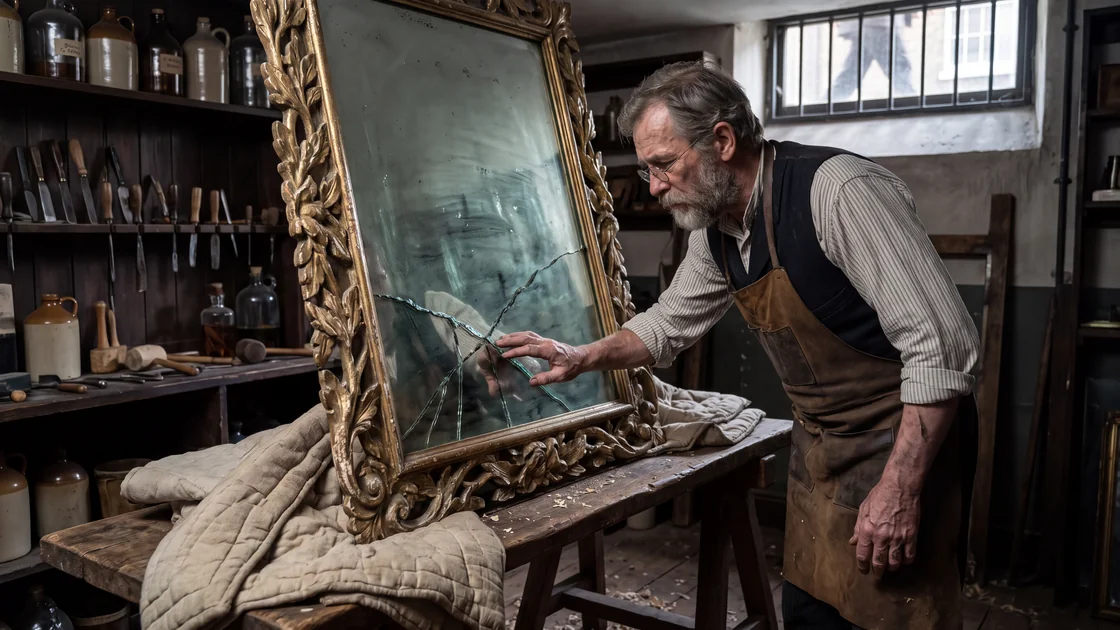
When an aging glazier takes on the restoration of a fractured seventeenth-century pier glass, he inadvertently frees his own inverted reflection from the mercury backing, sparking a desperate battle of wits and chemistry to prevent the duplicate from stealing his breath, his craft, and his life in the waking world.
Chapter I: The Anatomy of Flatness
Arthur Pendelton understood glass not as a barrier, but as a temporary truce between light and matter.
For forty years, inside the low-ceilinged belly of his workshop on St. Jude’s Lane, he had presided over that truce. The air of the shop smelled constantly of rottenstone, boiled linseed oil, distilled vinegar, and the faint, sweetish bite of nitric acid. It was a subterranean life; the high, street-level grating admitted only the shins of passing haberdashers, stray terriers, and the iron-rimmed tires of dray carts that rattled the row of carboys on his lower shelves.
Arthur was fifty-six, though the trade had aged his knuckles into gnarled ash-burls. His palms were cross-hatched with hundreds of pale, bloodless cicatrices—white lines where rogue slivers of soda-lime glass had bitten deep enough to sever nerves before he could even register the chill of the blade. A glazier’s hands were maps of forgotten careless moments.
To Arthur, modern mirrors were soulless things. The factories in the north produced them by the thousand, pouring chemical silver nitrate over sheet glass with mechanical nozzles, backing them with cheap red lead, and turning out panes so flat, so mercilessly truthful, that they stripped the romance from human vanity. But Arthur was a master of the old amalgam. He still understood the poisonous alchemy of tin and mercury, the method the Venetians had guarded on the island of Murano under pain of death. He knew how to beat tinfoil until it was thinner than a moth’s wing, roll it across marble, flood it with the quicksilver sea, and lower a heavy sheet of crown glass upon the fluid metal with such delicate pressure that no bubble could survive between the worlds.
It was this archaic mastery that brought Lady Vivienne Vandermeer to his door on a Tuesday in late October.
The bell above the lintel gave its hollow bronze clink. Arthur did not look up immediately; he was beveling the edge of a small cabinet oval, pushing the glass against a revolving wheel of wet sandstone. The hiss of the grit and water was a rhythm he did not like to interrupt.
"Mr. Pendelton?"
The voice was crisp, dry, and aristocratic, like parchment crinkling in an empty room.
Arthur wiped his hands on his split-leather apron and pushed his spectacles up the bridge of his grease-stained nose. Two men in green baize liveries were struggling through the narrow doorway, bearing between them an object wrapped in padded horsehair quilts. Behind them stood Lady Vandermeer, small, hawk-nosed, swaddled in widow’s bombazine, her black lace veil thrown back over a bonnet that looked like an aggressive bird.
"Mind the doorposts, you clumsy oxen," she snapped at the porters without looking at them. "If you strike the gilt, I will take it from your quarter’s board. Set it on the trestle. Gently! By God, if I hear so much as a creak, I'll have the skin off your backs."
The porters, sweating profusely despite the autumn draft, eased the monstrous parcel down onto Arthur’s largest oak workbench. The wood groaned under the weight.
"Lady Vandermeer," Arthur said, bowing with the stiff deference of a tradesman who knew his value. "I had your letter. You said the glass was seventeenth century. Genoese?"
"Venetian," she corrected, tapping the floor with the horn tip of her walking stick. "Brought to England in the train of the Duke of Buckingham. It hung in the long gallery at Highclere until my grandfather removed it to the townhouse in Belgravia. Last month, during the redecorating, a ladder fell. A catastrophe."
She gestured toward the trestle. Arthur took his shears and severed the hemp twines binding the quilts. He drew the horsehair away layer by layer, releasing into the damp air of his shop an odor of ancient, dry wood, beeswax, damp plaster, and something else—a thin, metallic smell like cold brass pennies left in a cellar.
When the final covering fell away, Arthur drew a sharp, involuntary breath.
The frame was a masterpiece of late Renaissance carving: lime wood smothered in distressed water-gilt, depicting Daphne turning into a laurel tree, her fingers exploding into leaves that twined around the perimeter to catch Apollo’s reaching grasp at the bottom rail. But it was the glass itself that arrested him.
It was nearly six feet tall, slightly greenish in tint, as was common with plate cast before the modern era, and possessed that subtle, undulating liquidity found only in ancient blown cylinders that had been slit and flattened by hand. It did not merely reflect the room; it seemed to gather the dim cellar light and thicken it, as if the room within the glass were a few degrees colder and considerably deeper than the room outside.
And across its lower third ran the disaster: a jagged, branched fracture like a frozen strike of lightning. The crack began at the left rail, sliced downward through Daphne’s carved hip, darted horizontally through the center of the glass, and then curled upward toward the right edge, dividing the pane into two unequal plates.
"Can you mend it?" the lady demanded.
"Glass does not heal, my lady," Arthur murmured, leaning close to examine the wound. He took a jeweler’s loupe from his waistcoat pocket and screwed it into his eye socket. "A fracture can be stabilized, perhaps filled with clear Canada balsam to disguise the refraction, but it will always be broken."
"I did not ask for a patch," she said with a flash of irritation. "The Vandermeers do not live with mended cracks. The pane must be replaced. But it cannot be modern glass. Modern glass looks like a shopfront in Cheapside; it has no dignity. It has no depth. It makes an eighty-year-old woman look like a freshly flayed pig."
Arthur smiled faintly behind his grey beard. "The depth you speak of comes from the mercury amalgam, my lady, and the slight irregularity of the cylinder glass. The silvering has oxidized unevenly over two hundred and fifty years. Modern mirrors use silver deposited by ammonia; it is flat, bright, and utterly cruel."
"Then make me an ancient mirror," she said simply. "Take this broken abomination out, make a new plate of equal thickness and tone, silver it with your poisons, and set it within Daphne’s boughs. Cost is not a consideration. Time is. The house is to be opened for the winter season in three weeks."
Arthur ran his bare thumb along the crack. The edges were uneven; where the fracture had opened, tiny micro-flakes of glass—the chatter—lay trapped between the front face and the tinned back. Yet, as his eye traveled along the fissure, a peculiar optical effect caught his attention.
In ordinary broken glass, the reflection along the edge of a break is simply doubled or displaced by a fraction of a millimeter, broken by the air gap. Here, looking through his loupe, the reflection did not seem displaced; it seemed delayed.
He blinked. Through the glass, his own magnified eyeball looked back at him: watery, grey-blue, veined with blood. When he twitched his eyelid, the reflection seemed to settle a millisecond after the muscle moved, like an echo returning across a canyon.
"Mr. Pendelton?"
Arthur took out the loupe and cleared his throat. "It is an enormous undertaking for three weeks, Lady Vandermeer. Stripping this old plate out will be hazardous. The backing is degraded; the frame has shrunk around the rebate. If I force it, the lime wood may splinter."
"Then do not force it," she said, turning toward the door. "Persuade it. You have three weeks. My steward will deliver fifty guineas on Friday as an advance. The rest upon delivery."
She did not wait for his answer. The door opened, admitted the wet roar of the London afternoon, and closed with the ring of the little bell. The two porters had already departed. Arthur was left alone with Daphne, Apollo, and the cold expanse of the broken Venetian.
Chapter II: The Scraping of the Silver
For three days, the mirror stood upon the trestles untouched, like a sarcophagus awaiting the anatomist’s knife.
Arthur went about his routine commissions—cutting windowpanes for a butcher on Newgate Street, re-glazing a Victorian lantern for a vicar—but his thoughts were tethered to the back of the shop. Whenever he crossed the room, his eyes slid involuntarily toward the great pane.
There was something undeniably wrong with the way it handled shadows.
In a dark workshop, a normal mirror gathers whatever stray illumination exists and duplicates it. This mirror seemed to organize the dark. In the gloom of evening, when he extinguished all the gas jets save the single fishtail burner above his bench, the pane did not reflect the yellow tongue of gas as a bright dot. Instead, the flame appeared inside the glass as a pale, whitish smear, while the shadows of the shelves and hanging glazier’s irons seemed to lean inward toward the crack, as if drawn by a gentle draft through the fissure.
On Friday night, fortified by a pot of strong black tea and a pipe of shag, Arthur locked the street door, drew the green baize curtains across the street-level windows, and set to work.
He lit four additional tallow candles in brass sticks and arranged them around the perimeter of the frame. He took up his de-glazing spatulas—thin, flexible strips of Swedish spring steel—and a collection of bone-handled mallets.
"Gently, Daphne," he muttered to the lime wood carving.
The mirror was held in its rebate by dozens of rusted iron brads and a crust of ancient putty that had hardened over two centuries into the consistency of Portland stone. Arthur worked with agonizing patience, applying drops of oil of cloves to the putty to soften the ancient linseed binder, then chipping away the crust millimeter by millimeter with a bevel-ground chisel.
The work took four hours. The clock of St. Sepulchre struck two in the morning as the last chunk of fossilized putty fell into his palm with a dry clack.
"Now then," he breathed.
The glass plate, six feet long and weighing nearly eighty pounds, was free in the rebate. Because it was cracked across the center, he could not simply lift it out with suction cups; to do so would risk the two halves shearing against each other and shattering into dangerous, scythe-like daggers. He would have to lift the upper half first, then the lower.
He placed two wooden wedges beneath the top edge and tapped them lightly with a horn mallet. The glass groaned—a sharp, vitreous squeak that set his teeth on edge.
He looked down into the glass.
The four candles created four pools of tallow-light on the surface. Because of the room’s chill, his breath formed a faint, temporary veil of condensation over the center of the pane. As he watched, the condensation evaporated, receding from the edges toward the central crack.
In the glass, his own face hung suspended: hollow cheeks, gray whiskers, dark pits where his eyes sat beneath shelf-like brows. But there was a strange tension in the visage. His reflection was not looking into his eyes; it appeared to be staring intently at his throat.
Arthur paused. He tilted his head to the left. The reflection tilted to the left, but its movement was fractionally stiff, like an actor who had anticipated the cue by a heartbeat.
"Too much nitric," Arthur whispered aloud, rubbing his tired eyes with the ball of his thumb. "Too many fumes. You're losing your wits, old Pendelton."
He reached out his hands—his bare, scarred hands—to grip the edges of the upper fragment.
He took hold of the glass. The edge was cold, colder than the October air warranted. It felt like handling a block of river ice. He engaged his legs, bent his knees, and prepared to lift the glass clear of the frame.
A sudden, sharp vibration passed through the plate.
It was not a mechanical rattle from the street; it was a rhythmic shudder, like the beating of a heavy heart against the underside of the sheet. At the same moment, the central crack, which had been clean and static, gave a microscopic snick. A new hairline fracture branched off toward the corner, darting like an adder.
Arthur flinched. The sudden shifting of the weight caused the upper half of the plate to slip two inches downward. The sheared edge of the crack ground against the lower piece with a sound like scree shifting on a mountain face.
"Hold, damn you!" he gasped.
He lunged forward to pin the sheet against the backing felt before it could slide off the trestle entirely. His left hand slipped. The razor-sharp edge of the lower fracture caught the meat of his palm, just below the thumb, and sliced cleanly through the epidermis, the dermis, and into the muscular pad.
The pain was not immediate; the cut was too clean. First came the coldness, then the warm, sudden gush of arterial crimson.
Blood splattered across the silvered surface. It did not bead up as it should have on a glass plate coated with dirt and wax. Instead, it struck the fracture and was instantly drawn into the fissure by capillary attraction, disappearing between the two sheared planes of glass as though sucked down by dry sand.
Arthur cried out, staggering back and clutching his wrist with his right hand. Blood dripped through his fingers, spotting his boots and the sawdust floor.
"Bloody clumsy fool," he cursed himself, his knees trembling from the sudden shock. He stumbled to the washstand in the corner of the room, snatched a relatively clean linen drying rag, and bound the cut with fierce, trembling pressure, using his teeth to knot the linen tails.
The pain arrived now, a deep, throbbing ache that pounded in syncopation with his racing heart. His head swam. The candle flames seemed to stretch upward into yellow needles six feet tall.
He leaned against the wooden sink, waiting for the nausea to pass.
Behind him, from the center of the darkened workshop, came a sound.
It was faint, no louder than the sound of a fingernail tapping against a wet windowpane. Then came another sound: the slow, wet peel of adhesive tape being drawn from a polished surface, or the suction of bare feet pulling out of thick, coastal mud.
Shluck. Shluck.
Arthur turned, his back pressed against the rim of the copper basin, his bound hand tucked into his armpit.
The candles were guttering in their tallow pools. The four flames were no longer yellow; they had turned a pale, sickly lilac, the color of mercury burning in an iron spoon.
The blood that had spilled across the fractured mirror was gone. The surface of the glass was pristine, but the crack was no longer a split in the substance of the plate. It had widened into a black, vertical oval, three feet tall, that floated within the thickness of the glass, like a knothole in an ancient cedar plank.
And from that oval, something was emerging.
It did not burst forth. It did not leap. It squeezed itself into the room with a dreadful, hydraulic patience, like thick paint being forced through the slit of a lead tube.
First came two hands. They were grey-white, slick with a glistening, viscous coating that smelled intensely of metallic mercury—that dead, sweet, subterranean stench that Arthur knew so well. The hands gripped the lime wood frame, Daphne’s gilt boughs creaking under the pressure. The knuckles were gnarled; the palms were cross-hatched with pale, bloodless scars.
Arthur’s breath locked in his trachea. He could not scream. His chest felt as though it had been filled with molten lead that had suddenly cooled and set hard.
The hands pulled. A head followed.
It was Arthur’s head.
The hair was Arthur’s thin, yellowish-gray thatch, but it was parted on the right instead of the left. The nose had the same broken bridge Arthur had acquired in a street brawl forty years ago behind the docks, but the crook went toward the left cheek rather than the right. The mouth was Arthur’s mouth, but the teeth revealed in its thin, effortful grin were reversed—the yellowed canine on the left was missing, whereas Arthur had lost his right canine to an abscess in the winter of ’82.
The creature’s eyes were not human. They were flat, polished spheres of liquid mercury, reflecting the purple candle flames without iris, pupil, or sclera.
The entity pulled its shoulders through the glass. There was no sound of tearing cloth, only that terrible, wet slurp of surface tension breaking. It wore Arthur’s clothes—the stained moleskin trousers, the blue-striped ticking shirt, the heavy wool waistcoat—but every grease stain, every ink spot, every burn from the soldering iron was an exact, reversed facsimile of the clothes Arthur was currently wearing.
The thing swung its legs over the lime wood rail and dropped to the sawdust floor.
It did not land heavily. Despite its apparent bulk, it made no more noise when its hobnailed boots struck the floorboards than a bundle of wet wool would make if dropped from a shelf. It stood there in the purple gloom, five paces from Arthur, swaying slightly from side to side like a diver adjusting to the sudden weight of the atmosphere after rising from the crushing depths of the sea.
Its face began to churn. The mercury spheres of its eyes flickered, darkened, and then—with a sickening ripple like oil spreading over water—they formed pupils, irises of dull, watery grey, and yellowed whites veined with red.
The creature looked down at its own left hand.
On the left hand, bound around the palm, was a clean linen rag. Across the rag, a dark, wet stain of blood was spreading.
The thing raised its head. It looked at Arthur.
Its mouth opened. It did not speak; it produced a sound like a wet leather pump sucking the dregs from the bottom of an empty cistern. Then, with an effort that caused its gray neck tendons to stand out like hemp cords, its voice found a register.
It was Arthur’s voice, but it had the metallic, reverberant ring of a man shouting down a deep, zinc-lined pipe.
"You," it whispered. "You have been outside for a very long time."
Chapter III: The Logic of the Inverted
Arthur Pendelton did not consider himself a brave man, but he was a tradesman, and tradesmen are fundamentally anchored to the physical world by the tools of their work. Horror is a luxury for men with idle hands; a man holding an edge tool will usually swing it before he faints.
His right hand, searching blindly behind him along the lip of the washstand, found the haft of his eight-inch squaring chisel—a heavy, triangular wedge of cast Sheffield steel with a razor-ground edge.
He did not challenge the thing. He did not ask what it was. He brought the chisel around in a whistling horizontal arc aimed directly at the creature’s throat.
The steel struck true. But there was no sound of severed flesh, no spray of red blood.
The chisel struck the creature’s neck with the dull, dead thud of a knife hitting an anvil wrapped in felt. The impact sent a jar through Arthur’s wrist that nearly dislocated his thumb. The creature did not even tilt its head. The skin of its throat merely dimpled around the steel edge, the flesh revealing a brilliant, mirror-bright surface beneath a microscopic layer of artificial dermis, like a silver spoon buried in lard.
The creature reached out its right hand—the uninjured hand—and took Arthur by the forearm.
The coldness was instantaneous. It was not the coldness of snow or well-water; it was the thermodynamic vacuum of an absolute non-place. Arthur felt the heat sucked out of his skin, out of his subcutaneous fat, out of the very marrow of his radius and ulna, in a single, agonizing pull. His fingers opened involuntarily. The chisel dropped into the sawdust.
"Do not," the thing said. Its voice was growing clearer, shedding its hollow resonance, settling into the warm, slightly wheezing timber of Arthur’s own London drawl. "You will damage the vessel before the transfer is finished. That would be waste."
Arthur tried to wrench himself backward, but the grip on his arm was like an iron bench-vice. He looked into his own face—the wrinkles around the eyes, the gray bristles in the nostrils, the age-spots on the cheekbones—and saw that the creature was breathing.
Or rather, it was imitating breathing. Its chest rose and fell, but the rhythm was entirely divorced from its speech. It spoke while breathing in; it spoke while holding its breath; its nostrils did not flare with the passage of air.
"What are you?" Arthur choked out. The cold was creeping up his shoulder, numbing his collarbone, turning his tongue to lead.
"I am the man who has lived behind your shoulder for fifty-six years," the thing replied. Its lips formed a small, patient smile. "The man who raised his left hand when you raised your right. The man who stepped back when you stepped forward. The man who was pressed against the silvering, flat as a pressed fern, while you walked in the sun and ate bread and spat into the street."
"The mirror..." Arthur gasped. "The Venetian..."
"A very old door," the thing murmured, its gray eyes studying Arthur’s face with a detached, clinical interest. "Made before your people forgot how to bind things with tin. The crack opened the latch; your blood broke the salt. But I cannot stay out here while you remain thick. There is only room for one Pendelton in the round."
With a sudden, violent heave, the duplicate did not push Arthur toward the mirror; it pulled him against its own chest.
The sensation was terrifying beyond description. Arthur felt as though he were falling into a pool of ice-cold quicksilver that was simultaneously solid and liquid. His skin met the duplicate’s skin, and where they touched, his senses inverted.
For a terrifying, fractional second, Arthur saw his workshop from the inside out: he saw his own back, his own woolen waistcoat, but the room was reversed. The shelves of carboys were on the wrong side; the letters painted on his tool chest were backward; the clock on the chimney breast was running counter-clockwise, its roman numerals inverted. The light in the room was not radiating from the candles; the candles were holes in the air through which darkness was pouring.
"No!" Arthur roared.
With the fury of a cornered beast, he brought his left foot down with all his weight upon the creature’s instep. He was wearing his heavy cobbler-made work boots, the heels shod with half-inch iron plates.
The blow landed with a splintering crunch.
The entity did not cry out, but its grip hitched. For an instant, its cohesion wavered; its right shoulder seemed to dissolve into a splash of liquid mirror-drops that spattered across the floorboards before snapping back into form like beads of mercury seeking each other.
That fraction of an inch was enough. Arthur threw his weight backward, tearing his arm from the creature’s freezing grasp. He left a strip of his shirt sleeve behind, frozen so brittle by the thing’s touch that it shattered on the floor like glass shavings.
Arthur fell against the tool rack. His hand caught the handle of a glazier’s iron—a two-pound block of solid lead used for smoothing lead came in stained-glass assembly. He did not hesitate; he hurled it with all his remaining strength, not at the creature, but at the four tallow candles on the bench.
The lead block swept through the brass sticks, sending them clattering into the shavings beneath the trestles.
Darkness fell over the workshop—not total darkness, but the greasy, shifting murk of the street-lamp filter through the street grating above.
Arthur did not try to fight. He scrambled on his hands and knees through the sawdust, his breath coming in ragged, bloody sobs, and squeezed himself into the narrow crawlspace beneath his drying racks—a dark, claustrophobic slot scarcely eighteen inches high, crammed with scraps of oak, offcuts of plate glass, and bundles of straw.
He lay there on his belly, his heart hammering against his ribs like a bird in a chimney, his injured hand throbbing with an agony that felt almost merciful because it was warm.
From the center of the dark shop came the slow, methodical sound of boots walking across the floor.
Crunch. Crunch.
The glass shards in the sawdust crackled under the heavy soles.
The boots stopped three feet from Arthur’s hiding place. In the gloom, he could see the trouser cuffs—his own moleskin trousers, but the grease stain from the axle-tree was on the inside of the left ankle instead of the right.
The creature stood silent for a long time. It did not search the corners. It did not bend down to peer beneath the racks.
"You have six hours until dawn, Arthur," the thing said into the dark. Its voice was now entirely indistinguishable from Arthur’s own, without a trace of the zinc pipe echo. It was mellow, weary, and slightly phlegmy. "You may hide in the dust like a beetle. But you cannot leave this shop without your face. And if you go out there without me, who do you think they will believe is the man, and who is the glass?"
The boots turned. They walked toward the back of the shop, where Arthur kept a horsehair mattress on an iron cot for nights when a large furnace-pour kept him from going home to his lodgings in Clerkenwell.
Arthur heard the cot creak as the creature sat down. He heard the rustle of the wool blanket.
Then came a sound that froze the glazier’s blood more thoroughly than the creature’s touch: the slow, rhythmic sound of a man snoring—Arthur’s own familiar, bubbling, slightly obstructive snore—drifting through the dark workshop.
The duplicate was sleeping. Or it was performing the act of sleep with terrifying, insulting perfection.
Chapter IV: The Transposition of Shadows
Arthur remained beneath the drying rack for three hours, not daring to shift his weight. The dust of crushed chalk and silica settled in his beard, making his skin itch fiercely, but he did not move a finger.
The pain in his left hand was his only compass. It was real; it belonged to this world of gravity, inflammation, and heat. The rag was stiff with dried blood now, smelling of iron and sweat.
He used the time to think. He was not an educated man—he had left school at twelve to grind lead for his uncle—but forty years of working with glass had given him a profound, intuitive grasp of physical laws.
Glass was an anomalous solid. It had no crystal lattice; it was a liquid that had forgotten how to flow. And a mirror was not an image; it was a boundary.
It came out through the crack, he thought, staring at the floorboards an inch from his nose. It came out because the amalgam was broken while the glass was under strain, and my blood completed the circuit. But why can't it just walk away? Why did it say there was only room for one in the round?
He remembered Lady Vandermeer’s words: The Vandermeers do not live with mended cracks.
The duplicate had Arthur’s shape, but it had not yet fully displaced him. It was like an electrotype plate being coated in an acid bath: the copper slowly deposits on the wax model until the model can be melted away, leaving only the shell. The creature was waiting for something. It was waiting for the light, or it was waiting for Arthur’s resistance to fail, or perhaps... perhaps it needed the real Arthur to pass into the frame to complete the balance.
A balance. Every system of optics Arthur had ever built relied on balance. Angle of incidence equals angle of reflection. If you change the angle of the light, the reflection must move. If you destroy the medium, the reflection vanishes.
Can you kill an image?
If you smash a mirror, you do not kill the reflection; you merely multiply it into a thousand smaller reflections, each one identical to the first, each one mocking you from its own tiny shard.
He had to get out from beneath the rack. He had to reach the chemical bench.
Moving with the agonizing slowness of an inchworm, Arthur began to slide backward out of the slot. Every time the creature on the cot snored, Arthur shifted his body six inches. When the snoring hitched, he froze, his chin pressed into the sawdust, holding his breath until the rhythm resumed.
It took forty-five minutes to clear the drying rack.
He stood up behind the shelter of his storage bins. The workshop was turning charcoal-grey as the first false dawn filtered through the street grating. In the dim light, he could see the layout of his world: the workbench, the shattered candles, the towering silhouette of Daphne in her lime wood frame, and the cot in the corner.
On the cot, the duplicate lay on its back, its arms crossed over its chest in the stiff, formal posture of an effigy on a tomb. Its eyes were closed, but Arthur noticed that the eyelids did not flicker with the rapid movements of dreaming men; they were as still as lead seals.
Arthur slipped off his boots. In his stocking feet, he moved toward the long chemical bench on the north wall.
Here sat the materials of his secret trade: stoneware jugs of sulfuric, nitric, and hydrochloric acids; jars of silver crystals; bottles of spirits of wine; tin ingots; canisters of sal-ammoniac; and his carboys of redistilled mercury.
He needed a weapon, but not a weapon of iron or steel. Iron could not bite an image.
He took down an empty half-gallon glass carboy with a wide mouth and a ground-glass stopper. With trembling fingers, using a horn spoon to avoid clinking against the glass, he began to assemble an amalgam.
First, he poured eight ounces of pure mercury into the carboy. The heavy liquid metal fell with that thick, dead thrup-thrup sound that always fascinated him, pooling at the bottom like a puddle of living chrome.
Next, he reached for the jar of flowers of sulfur—a bright, canary-yellow powder that he used for treating certain types of wooden frames against rot.
Mercury and sulfur had an ancient, mythic enmity. When ground together, the brilliant liquid metal and the yellow earth formed vermilion—mercuric sulfide—a dead, red, immobile powder that could never reflect light again. In the language of the old alchemists whose tracts Arthur had read in his youth, sulfur was the fixer, the nail that pinned the wandering quicksilver to the earth and stripped it of its flight.
He added four scoops of the sulfur to the carboy. It floated on the surface of the mercury like yellow pollen on a silver pond.
Then he reached for his bottle of oil of vitriol—concentrated sulfuric acid.
A floorboard creaked behind him.
Arthur did not look back. He seized the heavy glass stopper.
"What are you mixing, Arthur?"
The voice was directly behind his ear. The coldness radiated from it like the draft from an ice-house door.
Arthur spun around, slamming his back against the chemical shelves, the carboy clutched to his chest with his uninjured right arm.
The duplicate stood less than two paces away. In the growing morning light, the creature was horrifyingly complete. The skin was no longer greasy or gray; it had the warm, ruddy, wind-burned tone of Arthur’s own complexion. The eyes were wet, human, and intelligent. The only flaw was the absolute symmetry of its clothes—and the inverted scar on its thumb.
"I am mixing your breakfast," Arthur snarled.
He threw the open carboy directly into the duplicate’s face.
The creature did not duck. It had Arthur’s memories, perhaps, but it did not have the physical instincts of a man who had worked with caustic chemicals for forty years. It raised its hands, but it raised them too late.
The heavy slurry of mercury, sulfur, and concentrated acid struck the creature squarely across the eyes and forehead.
A sound came from the duplicate that was not human. It was a high, thin, whistling shriek, like steam escaping through a cracked safety valve on a locomotive boiler.
Where the acid struck the flesh, the skin did not blister or turn black; it delaminated.
The surface of the creature’s face peeled away in sheets like wet silver leaf caught in a gale. Beneath the skin, there was no red meat, no skull, no veins; there was only a churning mass of bright, boiling silver that hissed and smoked furiously as the sulfuric acid bit into it, while the yellow sulfur powder turned the metallic sheen into an ugly, crusting scab of liver-colored red.
The creature staggered back, clutching its face with both hands. But its hands were also affected: where the acid dripped from its chin onto its wrists, the skin broke, and little globules of mercury rolled out of its sleeves and fell to the floor, bouncing and skittering across the boards like shot.
"You break... the face!" the thing wailed. The voice had lost its human perfection; it was shifting wildly between Arthur’s drawl and that dreadful, deep-well reverberation. "You cannot... the light... the light will not hold!"
Arthur did not wait to watch the horror unfold. He lunged past the thrashing monster, heading for the front door.
He threw the heavy iron bolt. He turned the brass knob. He pulled.
The door did not open.
Arthur threw his entire weight against the oak panels. It was like striking the bedrock of a mine. He looked at the keyhole: through the tiny aperture, he could not see the grey cobblestones of St. Jude’s Lane. He could see only an endless, flat expanse of grey, uniform silver, stretching away into an infinity of nothingness.
He turned his head slowly, his heart seizing in his throat.
The workshop windows—the high, street-level grates through which he had watched the haberdashers’ boots for forty years—were no longer windows. They were mirrors. Every single pane of glass in the shop, from the carboys on the shelves to the replacement panes stacked against the wall, was silvered.
The entire shop had become an enclosure. A box of mirrors.
And in the center of the room, standing between the trestles, the creature was lowering its hands from its face.
It had not died. The acid had destroyed the illusion of Arthur Pendelton’s features, but it had not destroyed the entity.
The face was now a nightmare of half-formed surfaces. The left half was still Arthur’s recognizable, wrinkled cheek and grey eye; the right half was a raw, shifting mask of faceted glass and boiling mercury, with a single, black, pupil-less aperture where the eye had been, through which the light of the room seemed to be endlessly falling.
"You have shut us in," the duplicate whispered. It held up its hands. Its fingers were lengthening, the joints turning into sharp, crystalline facets like cut-glass decanter stoppers. "Now we must settle which side of the leaf we belong to."
Chapter V: The Council of the Shards
The thing began to advance, not with the shambling gait of a wounded man, but with a stiff, terrifying, mechanical precision. Every step was measured; its feet struck the boards with the dry clink of ceramic tiles meeting stone.
Arthur retreated toward the great trestle where Daphne’s frame still lay.
In the transformed workshop, the light was becoming unbearable. The morning sun was striking the street outside, and though the windows were silvered, they did not block the light; they multiplied it. The illumination bounced from pane to pane, from carboy to carboy, creating an infinitely repeating labyrinth of glare.
Everywhere Arthur looked, he saw himself.
He looked to the left and saw ten thousand Arthur Pendeltons, their faces white with terror, clutching their wounded hands to their chests, retreating in infinite perspective down a receding hall of green-tinted glass.
He looked to the right and saw the duplicate—ten thousand half-men, half-mirrors, raising their crystalline hands in terrifying unison, marching down ten thousand converging corridors to corner him.
"You cannot fight the law of reflection, Arthur," the thing spoke, its voice coming simultaneously from his left, his right, behind his ears, and from beneath his feet. "Every ray must have its return. You made me when you looked into the glass and wished you were not old. You wished it every morning when you shaved your chin. You looked at your father’s nose, your mother’s failing eyes, and you wished you were flat and clean and eternal. I am what you wanted."
"I never wished for you," Arthur spat, his throat dry as pumice.
He reached Daphne’s frame. The cracked Venetian pane lay before him.
The central oval—the black knothole in the glass—was still there, but it was shrinking. The capillary pull of the blood was fading as the liquid dried. The edges of the fracture were beginning to knit together, not with glass, but with a crust of grey amalgam that looked like lead solder.
If it closes entirely, Arthur thought with an instinct older than reason, the door is locked from this side.
"If I go," Arthur said aloud, his voice shaking, "you think you will walk down St. Jude’s Lane? You think you will take Lady Vandermeer’s fifty guineas? Look at yourself, you devil! You’re leaking on the floorboards! You’re not a man—you're a broken thermometer!"
The creature paused. Its faceted right eye twitched, the crystalline surfaces clicking as they adjusted their focal lengths.
It raised its arm and looked at its sleeve.
Arthur was right. The illusion was failing. The sulfuric acid had interrupted the catalytic binding of the amalgam. The creature’s left hand—the hand it had stolen from Arthur—was losing its flesh-tone. The skin was becoming translucent, like cheap bottle-glass, revealing the mercury veins pulsing beneath the surface in sluggish, grey surges.
"It will pass," the creature said, but for the first time, Arthur detected a note of doubt—a thin, discordant vibration in the metallic timbre of its voice. "Once the original is extinguished, the balance will settle. The vessel will clear."
"It won't clear," Arthur yelled, stepping toward the creature instead of away. He had found his ground; he was no longer an old man in a cellar; he was a master glazier lecturing an apprentice on the properties of bad soda-lime. "You don't understand the chemistry, you parasite! You’re an amalgam of tin and mercury! Do you know what happens to tin when the temperature drops? It rots! It turns to grey powder! It gets the tin pest! And the mercury—mercury evaporates! Every breath you take in this warm air, you're breathing yourself away! By tomorrow night, you’ll be a puddle of grease in Lady Vandermeer’s carpet, and they’ll sweep you into the coal-hole with the cinder-ash!"
The creature’s single human eye widened. The pupil dilated until it nearly swallowed the grey iris.
"Liar," it hissed.
"Look at your feet!" Arthur roared.
The creature looked down.
Around its boots, the sawdust was soaked with little glistening beads. The creature’s mass was literally draining from it, pulled down through the floorboards by the irresistible tug of terrestrial gravity. In the round world, everything had weight; everything had to pay its toll to the center of the earth. An image has no weight, but a body must carry its lead.
In that moment of hesitation, Arthur acted.
He did not go for his chisel. He did not go for his irons.
He threw himself across Daphne’s frame, his chest slamming down onto the cracked Venetian glass.
The pain of the impact was breath-taking. The sheared edges of the fracture bit through his waistcoat, through his ticking shirt, slicing across his ribs like a rank of razors.
His blood—hot, fresh, arterial crimson—gushed out across the cold plate.
"Arthur, no!" the duplicate screamed. It lunged toward the trestle, its crystalline fingers outstretched, its half-face twisted in a mask of primal terror.
Arthur did not pull away from the blades. He pressed his weight down harder, driving the glass deeper into his flesh, grinding his own living marrow against the ancient Venetian silica.
"Come home, Daphne," he whispered through bloody lips.
The reaction was instantaneous.
The blood did not sink this time; it ignited.
A flash of cold, silver-violet light erupted from the crack, so bright that Arthur could see the bones inside his own hands like needles in a lantern-slide. The black oval within the glass opened wide—not three feet, but six feet, tearing through the lime wood carving, Daphne’s gilt leaves shattering into splinters of gold and rotten wood.
A tremendous suction seized the room.
It was not a wind of air; it was an optical vacuum. Everything that was reflective—every mirror, every bottle, every drop of spilled mercury on the floorboards—began to pull toward the central fracture.
The duplicate was caught in the center of the draft.
It screamed—a sound like a cathedral window falling onto a flagstone pavement—and was dragged backward toward the trestle. Its crystalline hands tore at the floorboards, gouging long, white furrows in the oak, but it could not find a purchase against the inward rush of light.
It slammed against the frame.
Its body did not break; it flattened.
As Arthur watched through eyes dim with blood and exhaustion, the creature was compressed against the surface of the glass like an insect pressed between microscope slides. The third dimension was squeezed out of it: its nose, its ears, its rounded chest were crushed flat, spreading outward in a brilliant, circular wave of silver film that raced across the back of the pane.
The duplicate’s face was pressed against Arthur’s face—separated only by the thickness of the glass.
The mercury eye stared into Arthur’s grey eye from an eighth of an inch away.
"Let me stay," the thing whispered, its voice now only a scratch of sound, like the legs of a dying beetle ticking against a pane. "It is so cold... behind the leaf..."
"There is only room for one Pendelton in the round," Arthur wheezed.
With his right hand, his scarred, bleeding, glazier’s hand, Arthur picked up his horn mallet from the bench.
He did not strike the glass.
He struck the wedge—the little wooden wedge he had placed beneath the top edge to lift it from the frame.
He drove the wedge home with a single, sharp, professional blow.
The strain on the fractured plate changed instantly. The physics of the break shifted. The two halves of the Venetian mirror sheared past each other by a tenth of an inch, the edges locking together with a dry, permanent, final CLACK.
The oval vanished.
The violet light died.
The suction collapsed with a hollow thump that blew all the remaining sawdust in the shop into a choking, swirling cloud.
Chapter VI: The Face in the Lead
Arthur Pendelton lay across the bench for a long time, listening to the dust settle.
The air smelled of ozone, burnt sugar, and very old lime wood. Slowly, agonizingly, he pushed himself upright, his hands trembling violently as he pressed the linen rag against the cuts on his chest.
The workshop was silent.
The high windows were no longer silvered; through the iron grates, the ordinary, yellow London morning was pouring down, illuminating the grime on the cobbles, the dirty hem of an old woman’s skirt, and the four-legged trot of an ordinary milkman’s pony.
The carboys on the shelves were just bottles again, filled with amber acids and grey salts.
Arthur turned his gaze to the trestle.
The Venetian mirror was whole.
Not unbroken—the jagged, lightning-like fracture still ran from Daphne’s hip to the Apollo rail—but the two plates had settled so closely together that the crack was now only a thin, silver thread, no wider than a spider’s silk.
And within the glass?
Arthur leaned forward, his heart cold in his throat.
He looked into the plate.
His reflection looked back at him.
It was an old man, battered and grey. His waistcoat was drenched in red blood; his face was smeared with chalk-dust and soot; his beard was singed by acid. The left hand was bound in a bloody rag; the right hand clutched a horn mallet.
Arthur raised his right hand.
The reflection raised its left hand.
Arthur tilted his head to the left.
The reflection tilted its head to the right.
There was no delay. There was no hesitation. The movement was instant, absolute, and dead.
Arthur leaned closer, until his nose almost touched the glass, peering deep into the greenish, liquid depths of the seventeenth-century amalgam.
Far back, in the dim, vanishing point of the reflected workshop—behind the reflection of the cot, behind the reflection of the chemical bench, in the deepest corner where the shadows of the drying racks met the ceiling—Arthur saw something.
It was very small, no larger than a lead toy soldier.
It was the figure of a man, pressed flat against the back of the glass, its hands raised against the surface, its face turned toward the dark. It did not move. It was fixed there, pinned between the tin and the mercury, a permanent inclusion in the amalgam, like a fly caught in Baltic amber.
Arthur let out a long, shuddering sigh that fogged the glass, obscuring the little figure in a mist of warm human moisture.
Chapter VII: The Delivery
Two weeks later, the brougham of Lady Vivienne Vandermeer stopped again before the modest shop on St. Jude’s Lane.
The porters, the same two beef-faced men in green baize liveries, entered first, carrying their padded horsehair quilts and hemp ropes. Lady Vandermeer followed, her walking stick clicking on the flagstones with the sharp authority of an inquisitor’s hammer.
"Well, Mr. Pendelton?" she demanded, coming to a halt in the center of the swept, orderly workshop.
Arthur came out from the back room. He was wearing a fresh linen shirt, clean moleskin trousers, and a new leather apron. His left hand was still wrapped in a neat bandage of white linen, and he moved with the slight stiffness of a man whose ribs were bound with court-plaster, but his eye was clear and his gray hair was neatly combed—parted, as it had always been, on the left.
"It is finished, my lady," he said quietly.
He led her to the north wall.
There stood Daphne and Apollo.
The lime wood frame had been repaired where the wood had split, the new gesso toned and leafed with Dutch gold to match the ancient patina. But it was the glass that drew the woman’s gaze.
It was a magnificent, dark, deep expanse of mirror. The green cast was there, the liquid undulation of the blown cylinder was there, and the backing had that soft, mysterious, mercuric depth that modern mirrors could never hope to rival.
Across the lower third ran the crack.
It had not been removed. Arthur had not tried to disguise it with Canada balsam. Instead, he had stabilized it using the Japanese method—filling the micro-fissure with a thin line of black pitch, mixed with gold dust, so that the fracture resembled a golden branch growing outward from Daphne’s transformed fingers to join the gilt border.
Lady Vandermeer approached the glass. She raised her ivory-handled lorgnette to her eyes and peered into the plate.
She saw herself: an old woman, hawk-nosed, wrinkled, haughty, her bombazine black and deep, her bonnet laces straight.
"You did not replace the glass," she said, her voice dropping an octave into something that sounded suspiciously like accusation.
"I did not, my lady," Arthur said, standing with his hands folded behind his back. "I found that the original plate had... qualities that could not be duplicated. To remove it would have destroyed the spirit of the work."
Lady Vandermeer lowered her lorgnette. She looked at the golden crack. Then she looked at Arthur.
She looked at him for a very long time.
"It is broken," she said softly.
"It is settled, my lady," Arthur corrected her with a faint bow. "Glass must settle. If you try to make it too perfect, it will break itself again to find its balance."
The old woman turned back to the mirror. She raised her hand—her thin, spotted, diamond-ringed right hand—and touched her own cheek.
In the glass, her reflection raised its left hand and did the same.
A strange, dry smile touched the corners of her mouth.
"It is not cruel," she murmured, almost to herself. "The modern ones make me look like a corpse. This one... this one makes me look like an ancestor."
"That is the virtue of mercury, my lady," Arthur said, his voice flat and steady. "It remembers what has been put into it."
"Pack it up," she commanded the porters, turning toward the door. "Carefully, you fools! If you chip one leaf of that laurel, I will have the law on you."
She stopped at the threshold. She took a heavy velvet purse from her muff and dropped it onto Arthur’s bench. It landed with the solid, golden chink of eighty sovereigns.
"Good day, Mr. Pendelton," she said.
"Good day, my lady."
The porters wrapped Daphne in her horsehair quilts, lashed her with the hemp twines, and hoisted her between them. Arthur watched them navigate the narrow door, his hands hovering instinctively to protect the frame from the doorposts until the parcel was safely stowed in the interior of the brougham.
The carriage rolled away, its iron-rimmed wheels grinding against the wet cobbles of St. Jude’s Lane until the sound was swallowed by the roar of the London traffic.
Chapter VIII: The Flat Man
Arthur closed the shop door and threw the bolt.
He walked back into the belly of his workshop. It was quiet now—the deep, settled quiet of subterranean rooms where the light must fight to enter.
He did not light the gas. He did not light the candles.
He walked to the corner by the chemical bench where his shaving glass hung—a little, ten-inch square of common plate in a cheap pine frame, silvered forty years ago by his uncle with the modern chemical method: silver nitrate reduced with Rochelle salt, bright, cheap, and flat.
Arthur stood before the little square.
He looked at his face.
He raised his right hand to his chin. He felt the bristles he had missed that morning—three stiff, gray hairs on the crook of his broken nose.
In the glass, his reflection raised its left hand. Its fingers moved across the skin in perfect synchronization with his own.
Arthur leaned close.
"Are you there?" he whispered to the glass.
The reflection did not answer. It merely watched him with its watery, tired, human eyes—the eyes of an old glazier who had spent his life in the dark, handling poisons and sharp edges.
Arthur lowered his hand.
He reached down to his apron pocket and took out his diamond-tipped cutting spark. He raised the iron tool to the top corner of the shaving mirror.
With a firm, deliberate pull, applying twelve pounds of pressure—the glazier’s touch—he drew the diamond point diagonally across the glass, from the upper left corner to the lower right.
The diamond sang its high, thin, vitreous song—a sharp, clean screeech that scored the surface without shattering the plate.
A thin, white line ran across his reflection’s face, dividing the image into two equal halves.
Arthur set the tool down upon the bench.
"There," he murmured into the empty room. "Now you know where the boundary is."
He turned his back on the mirror, sat down at his trestle, and took up his sandstone wheel to begin the next commission. Behind him, the scored glass caught the dying light of the autumn afternoon, holding the split image of the room in its flat, cold, and obedient silence.