The Glassblower of Murmur and Ash
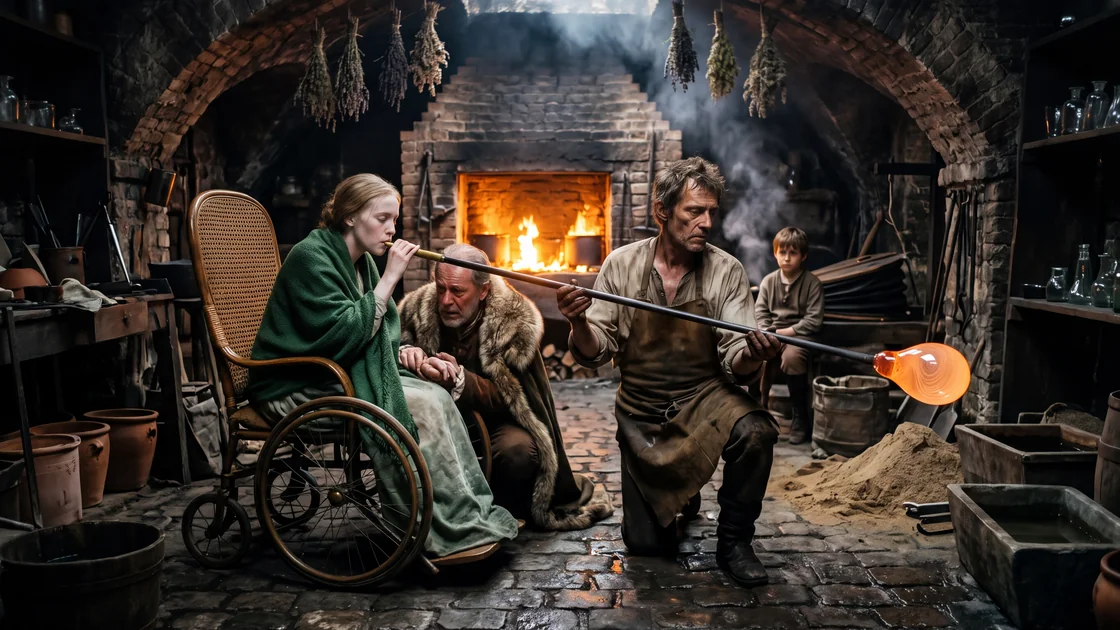
This is the account of Elian Vael, a master artisan in the fog-drenched port city of Oakhaven, who discovered that molten silica, tempered under a specific celestial alignment and quenched with brine-soaked ash, could capture the final breath and spoken words of the dying before the glass solidified into cold crystal. As the wealthy, the guilty, and the desperate flocked to his subterranean workshop to preserve love confessions, secret wills, and dying curses in delicate, chime-toned phials, Elian became both a keeper of sacred grief and a pawn in a ruthless political conspiracy orchestrated by the city’s ruling council. Caught between the haunting weight of thousands of trapped voices echoing beneath his floorboards and the monstrous demands of an inquisitor who sought to turn his art into an instrument of silence and terror, Elian was forced to craft a vessel of impossible scale—an act of ultimate defiance that would either shatter Oakhaven’s corrupt hierarchy or silence his own breath forever.
Chapter I: The Gathering of Sand and Breath
The heat in the undercroft of the Rue des Lampeurs was not the honest heat of an afternoon hearth, nor the dry, baking warmth of a baker’s oven at dawn. It was a subterranean fever. It rolled out from the brick throat of the three-pot furnace in great, invisible waves that scorched the eyebrows, tasted of burnt sulfur and borax, and turned wool shirts into sodden shrouds against the skin.
Elian Vael stood before the glory hole with his feet planted wide upon the damp cobblestones. In his calloused hands, scarred by thirty years of spitting embers and flying shards, he held a five-foot iron blowpipe—his canna. He had turned the rod slowly across the rests for twelve minutes, gathering a glowing honey of soda-lime glass from the belly of the central crucible. The gather was the size of a pigeon’s egg at first, then a fist, turning continually, fighting the pull of gravity with the rhythmic, hypnotic twist of his wrists.
"Keep the roll steady, Tomas," Elian murmured, not turning his head.
Behind him, sitting upon a three-legged stool near the cooling troughs, the boy Tomas nodded silently. Tomas did not speak; his vocal cords had been severed by a fever when he was seven, leaving him with only the whistling hiss of his windpipe and large, observant eyes that understood the color of fire better than most men understood the moods of their wives. Tomas pulled the hemp cord of the small bellows, feeding the secondary flue a measured lungful of air.
The furnace roared back, its yellow light painting the sweat on Elian’s hollow cheeks. Elian was fifty-four, though the trade made him look sixty-five. His lungs rasped like dry husks when the rain blew off the salt marsh, and the skin around his eyes was etched with the spider-webbing lines of a man who spent his life squinting into the incandescent heart of miniature suns.
The gather was ready. It shone like an apricot plucked from the orchards of noon, dripping with liquid light.
Elian brought the pipe to the marver—the thick slab of polished cast iron bolted to the floor. With firm, rolling strokes, he smoothed the molten mass into an even cylinder, cooling its outer skin just enough to give it tensile resistance. Then, with a practiced touch that seemed careless only because it was absolute, he lifted the horn mouthpiece to his lips.
He did not blow.
Not yet.
He waited for the visitor sitting in the shadowed alcove near the door to clear his throat.
The visitor was a merchant named Coram, dressed in the heavy, vair-trimmed mantle of the River Guild. Coram was shivering, despite the oppressive heat of the shop. Beside him, propped up in a high-backed wicker invalid chair wheeled down through the cellar ramp, sat his daughter, Lucille. Her skin possessed the translucent, bluish cast of skimmed milk; her collarbones were two sharp ridges beneath an emerald shawl, and her breathing was a shallow, bubbling rattle that everyone in the room knew would not see the tide turn at midnight.
"Is the glass receptive, Master Vael?" Coram’s voice was thin, edged with the frantic desperation of gold that had failed to purchase health.
"The cullet is pure quartz from the upper river," Elian answered, his voice low, pitched beneath the roar of the flue. "Washed three times in distilled rainwater and fluxed with the ash of mountain ferns. The silica is soft enough to yield, hot enough to thirst. If she speaks now, while the core is amber, the vessel will drink it."
Coram fell to his knees beside the wicker chair. He took his daughter’s hand, which was limp and cold as dredged clay. "Lucille. My heart. The notary has come and gone, and the ledgers are burned. Speak only what you wish me to carry. Speak to your brother. Tell him... tell him what you told me in the garden."
The girl’s eyelids flickered. They were veined with violet, like bruised petals. She looked past her father, past the soot-stained rafters where dried bundles of wormwood and mint hung to cut the stench of coal, straight toward the glowing ball of glass at the end of Elian’s pipe.
To the dying, Elian knew, the glass did not look like glass. It looked like an exit. It looked like a small, warm sun waiting to welcome what the body could no longer hold.
Elian stepped forward, holding the heavy iron pipe with balanced grace. He knelt on one knee before the girl, bringing the cool brass mouthpiece to within two inches of her parched, chapped lips. The heat radiating from the bulb at the far end cast a feverish blush over her gray skin.
"Do not strain, child," Elian said gently. "Take the air that remains. Do not think of the world behind you. Let your breath find the hollow."
Lucille parted her lips. A faint, wet shudder ran through her chest.
She leaned forward. Her mouth closed over the brass tip.
She did not breathe in; she had nothing left to take. She exhaled. It was a single, long, shuddering sigh, carrying with it the final remnant of her spirit, her pain, and three whispered words:
“Forgive the garden.”
As the words passed from her throat into the bore of the iron pipe, Elian felt a sharp, electric vibration travel up the metal shaft into his palms. It was not the mere kinetic force of air; it was a rhythmic pulse, like the strike of an invisible needle against a crystal bell. At the far end of the pipe, the glowing apricot bubble expanded. It did not bloom into a simple spherical globe; the molten glass writhed, sending up tiny, spiraling whorls of white opalescence through the transparent amber wall, like cream dropped into hot tea.
Elian moved with furious precision. He pulled the pipe back, rose to his feet, and turned to the workbench.
"Tomas! The pontil!"
The boy was already there, thrusting forward a second rod tipped with a small button of hot glass. Elian caught the base of the bubble onto the pontil, scored the neck near the blowpipe with an iron file wetted with cold water, and tapped the metal sharply. With a musical ting, the vessel broke free from the blowpipe.
Now came the perilous moment. The vessel was open at the mouth—a jagged, glowing aperture. The trapped breath swirled within, visible as an iridescent, pearlescent vapor that pressed against the inner walls, seeking escape back into the cold draft of the cellar.
Elian seized his jacks—the long, tweezer-like iron tools—and caught the glowing lip of the neck. With three swift, circular twists of his wrist, he drew the soft glass inward, folding the mouth upon itself, collapsing the aperture until it sealed completely, trapping the air, the vapor, and the words inside an airtight teardrop of fire.
"The shears," he snapped.
Tomas slapped the heavy, curved blade into his palm. Elian snipped the excess tail, rounded the sealed lip with a cherry-wood paddle that burst into sweet-smelling smoke upon contact, and stepped immediately toward the annealing lehr—the long, low-temperature tunnel where the glass would cool across three days.
"Is it done?" Coram wept, his face buried in his daughter’s dead lap. Lucille’s head had lolls to the left, her eyes fixed in an unseeing gaze upon the furnace door. "Is she... is it there?"
Elian did not answer until he had slid the vessel into the warm mouth of the lehr with an iron peel. He closed the iron hatch, leaving only a hairline vent for the embers to fade slowly. If the glass cooled too quickly, the internal tension between the cooling exterior and the warm, living breath inside would cause the vessel to detonate into ten thousand needle-sharp daggers.
Only when the hatch was latched did Elian wipe his forehead with his soot-stained apron.
"She is in the lehr," Elian said quietly. "On Friday morning, when the anneal is complete, you may take her home. Touch the foot of the flask with a warm silver spoon, or hold it between the palms of your hands until the glass takes your body’s heat. You will hear her."
Coram did not look at the lehr. He only gathered the limp, cooling hands of his child against his beard and began the dry, ugly sobbing of a man who has realized that an eternity preserved in crystal is not the same thing as five minutes more of life.
Chapter II: The Anatomy of a Trapped Voice
In the quiet hours between midnight and dawn, when the furnace was banked with coal slack and the cellar smelled only of cooling sand and damp lime, Elian sat at his high drafting desk.
A single oil lamp cast a pool of amber light over his ledger. The book was bound in pigskin, its pages thick with the fiber of water-rotted hemp. It was not an account of money, though money came to him in quantities that frightened him. It was a catalogue of resonance.
Entry 412: Master Coram’s daughter, Lucille. Three words. Weight of vessel: fourteen ounces. Tint: Amber with sea-coal flux. Acoustic pitch upon testing: high F-sharp, fading into the sound of wind through dry rushes.
Entry 413: Captain Kenneth of the Brigantine 'Albatross'. Sunk at the bar. Two words: "Cut away." Tint: Deep cobalt, fluxed with bone ash. Acoustic pitch: low C, muffled, smelling faintly of brine when the pontil was smoothed.
Elian set down his goose quill and picked up a small, egg-shaped object from a felt-lined tray on the desk.
It was made of clear flint glass, no larger than a plum, perfectly spherical save for a flattened base that allowed it to stand upright. Inside the glass, frozen in the center like an insect in amber, was a swirl of faint, silver frost. It looked like the track left by a snail across a slate roof, or the delicate filigree that winter paints upon a bedroom windowpane.
This was his mother.
She had died twenty-two years ago, in this very workshop, on the straw pallet behind the clay-mixing troughs. Elian had been thirty-two then, a newly minted master of the Guild of Glassmakers, arrogant in his command of the furnace, believing that heat was merely an adversary to be conquered with draft and lime.
When her chest had failed, rattling with the stonemason’s rot she had inhaled through three decades of washing his father’s quarry clothes, Elian had panicked. He had not possessed the prayers of the priests, nor the herbs of the apothecaries. He had had only the blowpipe in his hand and a gather of clear Bohemian crystal he had been preparing for an altar lamp.
He had placed the pipe to her mouth, not knowing what would happen, driven by some blind, animal instinct to take what was leaving her and keep it from dissolving into the vast, uncaring dark of the ceiling beams.
She had whispered only his name: “Elian.”
He had sealed the glass in a frenzy, weeping so hard the tears had hissed against the hot iron of the marver. He had thrown it into the embers of the annealing pit, certain it would craze and crack into gravel by sunrise.
It had not cracked.
Three days later, lifting the cooled crystal egg from the ash, he had felt it tremble. When he pressed his ear against the smooth, cold dome, he had heard nothing. But when he held it against his chest, warming the crystal against his ribs where his own heart thumped, the air inside had expanded against the rigid vitrified walls.
The silver frost inside had pulsed. And from the heart of the stone had come her voice—not an echo, not an illusion, but her specific, raspy, warm voice, sounding as though she were speaking through a three-inch door of polished cedar:
“Elian.”
It was not a ghost. Elian was too much of an artisan to believe in ghosts. Ghosts were things of theology and terror; they wandered churchyards and wailed in chimneys.
This was physics. It was the capture of an energetic wave within an elastic lattice before the lattice locked into an amorphous solid. The breath of a dying person was different from the breath of a healthy man; it carried the final, desperate surge of the nervous fluid—the pneuma, as the old Greek treatises in the city library called it. When that breath struck the molten silica at precisely twelve hundred degrees Fahrenheit, the molecular structure of the glass did not settle into random tetrahedral rings; it aligned itself along the acoustic frequencies of the vocal cords. The glass became a mechanical memory. It became a phonographic fossil.
Word of the miracle had not spread through the town criers—Elian was not so foolish as to invite the stake and the pyre from the Bishop’s Consistory. But grief is a freemasonry more efficient than any church. A physician would whisper to a weeping widow; a notary would mention it to a merchant whose only heir was turning blue from the croup.
They came by night, down the alley behind the tanners' pits, where the reek of dog dung and oak bark hid the sweet smell of the soda ash.
They brought their dying in carts, in litters, on the backs of weeping brothers. And Elian blew the vessels.
He made them in all forms. For lovers, he blew double-walled amphorae of pale rose, where two breaths could be captured together, circling one another in an eternal, silent convection like two pale moths pinned behind glass. For soldiers, he blew thick, squat flasks of dark bottle-green, sturdy enough to be carried into battle in a leather pouch, so that their sons might hear the grandfather’s war-cry when the night before the siege grew too cold.
For the magistrates and the tax-farmers, who began to arrive as the years passed, he blew vessels of cold, leaded crystal—clear, heavy, and silent until touched by gold.
He hated the magistrates.
"They do not want their mothers to speak," Tomas had written once upon his slate, his chalk squeaking against the stone. "They want to make sure the dead do not change their minds about the houses."
Elian had wiped the slate clean with the palm of his hand, leaving a smear of gray dust. "It is not our business what they buy, Tomas. We sell the cooling. What is said inside the vessel belongs to the furnace."
But it was a lie, and Elian knew it.
Every voice that entered the glass left a ghost-taste in his own mouth. When he worked the pontil, when he shaped the neck with the jacks, the vibration came up the steel into his bones. Over thirty years, he had felt five hundred people die through the medium of his tools. He felt the flutter of their hearts in the iron; he tasted the vinegar of their bile, the honey of their apologies, the salt of their terror.
His workshop was no longer a shop. It was a reliquary.
Along the north wall of the cellar, hidden behind a false partition of pine boards where he stacked his bags of ground feldspar and pearl-ash, sat the shelves he called the Mute Choir.
These were the vessels that had never been claimed.
Sometimes the family was too poor to pay the balance of thirty groats for the annealing coal. Sometimes the family had died of the same plague that took the speaker before the three days in the lehr were up. And sometimes—most terribly—the family had come to collect the vessel, had warmed it in the back room, heard what the dying had actually said instead of what they were supposed to say, and had walked out into the rain, leaving the glass upon the bench with the stopper cold and untouched.
There were seventy-two of them.
Elian rose from his drafting desk, his joints creaking like ungreased hinges. He walked to the pine partition and slipped the catch.
The shelves inside were narrow, lined with black baize. In the dim lantern light, the vessels looked like rows of sleeping sea creatures preserved in brine. There were tear-bottles, alembics, retorts, globes, and flattened flasks. In each one, a faint wisp of silver or pearl frost hung motionless in the center of the dark glass.
He reached out and lightly ran his fingertip over an oval flask of dark cobalt. It was Entry 109—an old washerwoman named Gisle, who had died forty years before. Her son had refused the bottle because she had used her last breath not to bless him, but to name the alderman who had fathered him in the hayloft behind the guildhall.
Elian did not need to warm it. He remembered the sound.
“The red-headed one,” she had whispered. “The one with the rings.”
Beside it sat a tiny phial of clear crystal, no longer than his little finger. It contained the breath of a child—a boy of five who had drowned in the millrace. The parents had both jumped from the town bridge two days after the funeral, leaving the phial behind.
Elian picked it up. He did not warm it with an oil lamp. He simply held it in the hollow of his palm and closed his fingers around it, letting the blood-heat of his own body seep through the lead glass.
He waited.
Slowly, the wisp of frost inside began to turn, spiraling like a water-beetle in a quiet pool. The glass grew warm.
He held the neck to his ear.
From the heart of the drop came a sound like the ringing of a tiny silver thimble against an iron kettle, followed by a soft, piping giggle:
“Look, Elian. The trout have wings.”
Elian’s eyes stung. He did not know why the child had used his name—perhaps the boy had confused the face of the glassblower leaning over his deathbed with some half-remembered uncle, or perhaps the dying saw through the artisan into the instrument itself.
He placed the phial back upon the black cloth.
"I am looking," he whispered into the empty cellar. "I see them."
A heavy knock rattled the street-level trapdoor above his head.
It was not the timid, fluttering rap of a grieving relative, nor the measured tap of a guild messenger. It was the iron-shod heel of an officer’s boot striking three times against the oak planks—hard, impatient, and carrying the authority of those who do not wait for the door to be opened.
Chapter III: The Inquisitor’s Commission
The man who descended the brick stairs was named Master Kaelen Vance, though the street called him The Needle.
He was the Chief Investigator for the Council of the Eight—the oligarchic circle of merchant-princes who held the charter of Oakhaven from the Crown. Vance was a tall man, narrow-shouldered and sharp-featured, dressed in the austere black broadcloth of the High Court, with no ornament save for a heavy gold signet ring depicting an owl clutching a pair of closed shears.
Behind him came two guards in leather brigandines, their halberds held horizontally to avoid striking the low, soot-blackened ceiling beams of the undercroft.
Vance did not cough at the sulfurous air. He did not blink at the furnace glare. He paused at the foot of the stairs, drew a linen handkerchief scented with clove water across his nose, and surveyed the workshop with the cold inventory of a taxman inspecting a brothel.
"Master Vael," Vance said. His voice was like scissors cutting dry parchment. "You keep irregular hours for a registered member of the Guild of Glaziers and Potters."
Elian did not wipe his hands. He stood behind his drafting table, his fingers curled around the iron handle of his scoring knife. "The fire does not observe the bells of Saint Jude, Councilor. When a pot of glass is molten, it must be worked, or it devours the clay crucible."
Vance walked slowly toward the furnace, his leather boots clicking against the flagstones. He stopped three feet from the glory hole, his eyes reflecting the orange glow like two polished bits of jet.
"A magnificent engine," Vance remarked. "Primitive, but absolute. It dissolves everything, does not it? Stones, bone, lead. It turns the filth of the earth into something transparent. One might almost call it... redemptive."
"It makes bottles, Councilor," Elian replied flatly. "And window-panes for the church of Saint Jude, though the church is six months behind on their tithe for the clerestory."
Vance smiled. It was a momentary tightening of his gray lips that did not reach his eyes. "Do not play the clod-hopping mud-carver with me, Elian. I did not walk through the fish-gutters at two in the morning to discuss leaded church-lights."
He turned his back to the fire and fixed his gaze upon Elian.
"Yesterday afternoon," Vance said softly, "in the deep cells beneath the Water Gate, a prisoner died. His name was Julian Haddon."
Elian’s hand tightened slightly on the knife beneath the desk.
Julian Haddon had been the leader of the dock-worker’s league—a man who had organized the lighter-men and the coal-heavers to strike against the new salt-tax imposed by the Eight. He had been taken three weeks ago during a night raid on an illegal printing shop in the Shambles.
"I am sorry for his family," Elian said carefully. "The damp in the Water Gate is known to rot the lungs quickly."
"He did not die of damp," Vance said. "He died of questions. We asked him three hundred and twelve of them over the course of fourteen hours. He was an obstinate man. A stubborn, iron-headed peasant who believed that silence was an article of faith."
Vance stepped closer to the drafting table. The two halberdiers remained by the stairs, their faces hidden in the shadows of their iron sallets.
"At the end," Vance continued, "about the fourth hour of the morning, when his fingers were no longer of any use to him and the surgeon told us that the heart was about to surrender its office, Julian Haddon began to laugh. He looked up at me through his hair, and he said: 'You have the skin, Vance. But the name of the prince is in the furnace.'"
Vance leaned both palms on Elian’s desk, leaning forward until Elian could smell the cloves on his breath and the damp leather of his gloves.
"He died twenty minutes later," Vance whispered. "Before he could be persuaded to clarify that remark. But my scribes are thorough men. They cross-referenced his associates. They spoke to his sister. They spoke to an old woman who sells fried eels near the fish-wharf. And they discovered that three months ago, Julian Haddon paid sixty silver crowns to a certain artisan in the Rue des Lampeurs for a commission that does not appear in the Guild Hall register."
The cellar became very quiet. The only sound was the dry huff-huff of the furnace flue and the distant, rhythmic dripping of canal water through the brick foundations.
Tomas, sitting in the dark corner behind the clay bins, had stopped moving entirely. He was as still as a stone dog on a tomb.
"I blow many things for many men," Elian said, his voice level, drained of all color.
"You blow vessels for the dead," Vance hissed. "Do not lie to me, Elian. I have the confessions of four merchants in my pocket. I know what you do with the pipe. I know what you trap in the crystal."
Vance reached inside his mantle and withdrew a small pouch of oiled calfskin. He tossed it onto the desk. It landed with the heavy, dead thud of gold.
"Julian Haddon had a confederate within the High Council," Vance said. "A traitor among the Eight. Someone who has been feeding the league the shipping manifests, the watch-rotas, and the private codes for the city treasury. Haddon knew the name. He told his sister he had left that name where no torturer could reach it, but where his people could claim it when the time was ripe."
Vance tapped his long, manicured index finger against the calfskin pouch.
"I want the bottle, Elian."
"If such a bottle existed," Elian said, looking straight into Vance’s colorless eyes, "it would belong to the man who paid for the fire. That is the law of the Guild."
"The Guild is a guild of carpenters, potters, and cobblers," Vance spat. "I am the law of the city. If you have that vessel, you will yield it to the Council. If you have already delivered it to his people, you will tell me who carried it out of this shop. If you refuse..."
Vance gestured slightly toward the furnace.
"A three-pot furnace reaches two thousand degrees, I am told. It would take very little effort for my men to throw you into the central crucible. We would tell the Guild that you dropped your blowpipe in an apoplexy. They would mourn you for three days and elect a new master on Monday."
Elian did not move. He felt the cold iron of the scoring knife against his wrist. He could kill Vance—he was within striking distance, and he was twice as strong as the spindly investigator, his muscles tempered by decades of lifting fifty-pound irons. But the halberdiers were at the stairs. And Tomas was in the corner. If Elian died here, Tomas would be fed to the dogs in the ditch outside the North Gate.
"I do not have the bottle," Elian said.
Vance’s eyes narrowed. "Do not test my patience, artisan."
"I do not have it," Elian repeated, his voice dropping into the rhythmic, flat cadences of an artisan explaining his craft to an ignorant customer. "Julian Haddon was brought here three weeks ago, on a dray-cart, by four men who smelled of the rope-walks. He was already spitting black blood. He could not sit in the chair. We had to hold him up with ropes beneath his armpits."
"And?"
"And he blew into the pipe," Elian said. "He spoke his words. The vessel was formed. It was sealed. It was placed in the lehr."
"Where is it?"
"It never came out," Elian said.
Vance frowned. "What do you mean, it never came out?"
"Glass is not iron, Councilor," Elian said, stepping around the desk and walking toward the annealing lehr. He tapped the cold iron plate of the outer hatch with his knuckle. "It is a liquid that has forgotten how to flow. It is held together by an internal war between the cold surface and the hot heart. If there is a grain of unslaked lime in the sand, if the coal drops three degrees during the second night, if the speaker’s breath contains too much vinegar from his bile... the vessel shatters."
Elian turned to Vance.
"Julian Haddon’s breath was full of hate," he lied, smoothly, without a single hitch in his chest. "His lungs were rotten with prison fever. On the second morning, while the lehr was at six hundred degrees, we heard the pop from across the cellar. It sounded like an egg hitting an iron pan. When we drew the iron trays yesterday, there was only this."
Elian reached into a stone crock beneath the lehr bench and pulled out a handful of blue-gray glass gravel—the jagged, sharp cullet left over from a failed batch of inkwells he had scrapped three months ago. He let the pieces cascade through his fingers back into the crock with a harsh, musical clatter.
"A handful of salt," Elian said. "The voice broke its house. The words are in the flue, Master Vance. They are out over the salt marshes by now, feeding the gulls."
Vance stared at the stone crock. His nostrils flared. He walked to the lehr, reached down, and took a single shard of the blue glass from the pot. He held it up to the lantern light, squinting at its clean, fractured edges.
"You have a very convenient craft, Master Vael," Vance said. "Things appear. Things disappear. Things speak, and then they turn to sand."
"It is the nature of the fire," Elian said.
Vance dropped the shard. It chimed against the flagstones, splitting into three pieces.
"We shall see," the investigator said. He wiped his fingers on his handkerchief as though he had touched something infected. "My men will remain in the Rue des Lampeurs. If Julian Haddon’s friends come to collect their handful of salt, they will find the Council waiting for them."
He turned toward the stairs, then paused, looking back over his shoulder.
"And Elian?"
"Councilor?"
"There is an old saying among the law-scribes: A tongue that cannot speak cannot commit treason. But you have found a way to make the dead commit treason from the grave. Be very careful with your fire, Master Vael. The Council has many men who can blow windows. We have very few who can blow sedition."
He climbed the stairs, his boots thumping against the oak risers. The halberdiers followed him, their weapons scraping against the low archway. The trapdoor slammed shut above them, and the heavy bolt rattled into place from the outside.
They were locked in.
Chapter IV: The Whispering Cellar
Tomas did not move until the sound of the horses’ hooves had died away down the cobblestones of the Rue des Lampeurs.
Then, with the silent agility of a ferret, he slipped from behind the clay bins, crossed the floor, and bolted the secondary timber bars across the cellar door. He turned to Elian, his large brown eyes wide with terror, his hands flying in the swift, frantic sign-language of the mute:
THEY WILL BURN THE HOUSE. THEY WILL KILL US BOTH.
"No," Elian said quietly. He walked to the central furnace and peered through the sight-hole into the middle crucible. The glass was still good—fluid, clear, bubbling faintly like thick honey. "They will not burn the house yet. Vance is a terrier. He does not kill the rat until he knows which hole the rat came from. He thinks the bottle is still in Oakhaven."
Tomas stopped his hands. He tilted his head, his eyes questioning.
DID IT BREAK? the boy signed. IN THE LEHR?
Elian did not answer with words. He walked to the far corner of the cellar, where the great wooden barrels of potash were stored against the stone damp. He moved the third barrel aside—it took all his remaining strength, his shoulder groaning against the staves—revealing a low, dry recess carved into the Roman foundation stones behind the wall.
From the recess, he pulled out a wooden box stuffed with dry river moss.
He lifted the moss. Nestled inside was an amphora of clear, uncolored crystal, about eight inches tall.
It was unlike any vessel Elian had ever blown. The glass was impossibly thin—barely thicker than the skin of an onion—yet it possessed the structural tension of a drawn bow. Inside the crystal, the captured breath was not a faint, sluggish wisp of gray vapor like the others.
It was bright gold.
It turned within the bulb with a violent, rhythmic urgency, swirling in double helices, beating against the transparent walls like a trapped hornet. Every few seconds, a tiny thread of gold light would trace the inner circumference of the neck, where Elian had sealed it with a drop of liquid lead-flux, sending a faint, high hum into the cellar air—a tone so pure and sharp that the clean wine-glasses on the drying racks chimed in sympathy.
Tomas drew back, his hands covering his mouth.
HADDON, the boy signed.
"Yes," Elian whispered.
"What did he say?" Tomas’s hands asked the air, his fingers trembling. "Did he name the Eight?"
"I did not listen," Elian lied.
It was the second lie he had told that night, but this one was for Tomas’s sake.
Elian had listened. He had listened three nights ago, when the anneal was finished and the glass had cooled to the touch of his calloused fingers. He had sat in this very corner, in the dark, and he had held the amphora against the skin of his belly until the cold glass drank his warmth and gave up its dead.
Julian Haddon had not named a single councilor.
He had named all of them.
“The charter is a fraud,” the dying man had whispered from the crystal, his voice rich and deep, vibrating with the terrible, clear sanity that sometimes visits men in the hour before their execution. “The Eight did not buy the city from the King. They murdered the King’s commissioner forty years ago in the salt marshes and forged the Great Seal. Every tax they have gathered, every hanging they have ordered, every acre of common land they have sold to the wool-merchants is theft. The true parchment is sewn inside the lead lining of the high altar at Saint Jude’s. Tell the people. Tell the apprentices. Break the glass in the square.”
Elian had sat in the dark for three hours after hearing those words, his heart hammering against his ribs like a sledge against granite.
He was not a rebel. He was a glazier. He wanted only to buy his sand from the river-barges, his soda from the Spanish traders, his coal from the northern pits. He wanted to sit at his drafting desk and listen to the old washerwomen and the drowned children. He did not want to pull down the Eight. He did not want to see the market square running with blood and the militia firing their culverins into the crowds of weavers and smiths.
If he gave the amphora to Vance, Vance would reward him with a purse of gold and a quiet slit across the windpipe forty-eight hours later in an alleyway.
If he gave the amphora to the league, the city would burn, and he would burn with it.
And if he kept it...
Elian looked down at the gold vapor swirling within the glass.
As he watched, the vapor shifted. It formed the clear, distinct profile of a human mouth against the curve of the bowl. The lips moved. No sound came out—the vessel was too cold to speak—but the silent articulation was unmistakable:
TRUTH.
"It cannot stay here," Elian said to Tomas. "Vance will return with a search-warrant from the High Court by noon. They will pull the pine partitions down. They will dig up the flagstones. They will find the choir."
Tomas pointed to the trapdoor, then to the chimney flue.
WHERE CAN WE GO? THE WATCH IS IN THE STREET.
Elian looked at the three-pot furnace.
The furnace was the heart of the workshop, but it was also connected to the ancient drainage system of the city. Behind the main flue, where the sulfurous gases escaped into the brick stack that rose four stories through the tenements to the Oakhaven sky, was a clean-out crawlway—a narrow, soot-caked tunnel through which the chimney-sweeps’ boys used to squeeze to scrape the creosote from the dampers.
It led down into the old Roman culvert that emptied into the salt canal beneath the Fishmarket.
It was narrow. It was hot. It was choked with three decades of toxic dust. A grown man could not pass through it without stripping the skin from his ribs, and even then, he might stick and bake to death if the draft reversed.
"We have two days of coal left in the bunkers," Elian said, his voice tightening with a sudden, desperate resolution. "If we bank the pots with wet turf, the glass will hold its heat for thirty-six hours without new fuel. That is enough time."
ENOUGH TIME FOR WHAT? Tomas signed.
Elian looked from the small gold amphora of Julian Haddon to the shelves of the Mute Choir behind the pine wall.
"To give them their voices back," Elian said.
Chapter V: The Great Annealing
What followed was a madness born of silica, lime, and thirty years of accumulated grief.
Elian did not sleep. He sent Tomas into the coal-bunkers to wet down the peat and slack, damping the draft until the furnace produced a heavy, sluggish, red heat—not hot enough to melt new batch, but hot enough to keep the working pots at thirteen hundred degrees, the consistency of soft tallow.
Then, one by one, Elian brought the seventy-two vessels of the Mute Choir to the bench.
He did not open them with files. To break the neck of a cold vessel was to destroy the acoustic structure; the breath would rush out in a violent, hiss of equalization, tearing the delicate frequency patterns to tatters like a silk flag caught in a gale.
They had to be re-absorbed.
He had conceived an idea so monstrous, so technically impossible, that any master of the Murano guild would have called him an insane suicide.
He would blow a single, final vessel.
A vessel large enough to hold them all.
He had in his storage bin a block of pure, crystalline quartz—five hundred pounds of mountain stone brought down from the Bohemian crags thirty years ago by his father, intended for a cathedral rose-window that had never been commissioned. It was pure silica, without iron, without salt, without a single bubble of trapped air.
For twenty-four hours, while the watchmen paced the street above and the rain beat a relentless tattoo against the iron trapdoor, Elian broke the quartz with an iron sledge. He ground it in the stone mortar until his palms were raw and weeping blood. He fluxed it with his finest refined potash, triple-sifted through linen, and fed it into the great central pot, shovelful by shovelful.
The furnace screamed. The blue flames of the coal gas rose through the throat of the stack, lighting the subterranean gloom with an unearthly, violet glare.
Tomas worked like a demon beside him, his hair singed white at the temples, his chest slick with black sweat, hauling the crucible tongs, skimming the dross from the surface of the molten bath with a green-wood ladle that screamed and spat sparks into the dark.
By midnight of the second day, the glass was ready.
It was not amber. It was not cobalt. It was completely, terrifyingly clear. When Elian peered through the sight-hole, he could not see the surface of the liquid; he could see only the white-hot bottom of the clay pot itself. It was liquid diamond.
Elian stripped to the waist. He bound his forearms in wet linen rags to keep the radiant heat from blistering his meat from his bones. He took his heaviest pipe—the grand-canna, a seven-foot tube of Swedish iron with a two-inch bore, balanced with lead counterweights at the grip.
"Now, Tomas," he whispered.
The boy opened the pine partition.
He brought the first vessel—Entry 1: an old cobbler who had died in the year of the frost.
Elian did not warm it. He laid the cold flask upon the marver. He took the pontil rod, gathered a tiny drop of fresh, liquid quartz from the pot, and touched it to the seal of the old flask.
The old seal softened.
At the same instant, Elian brought the mouth of the grand-canna down over the aperture.
He inhaled.
It was a terrible, agonizing act. He did not blow into the pipe; he drew the air inward, through the bore, using his own lungs as an intermediate bellows, taking the dead cobbler’s breath into his own throat, his own chest, holding it there for a fraction of a second while the heat of the iron scorched his palate, then driving it back down into the glowing gather of quartz he had gathered on the main pipe.
“Mercy,” the cobbler’s voice rasped through Elian’s teeth, vibrating in his skull like a swallowed bell.
The quartz bubble expanded.
Tomas brought the second vessel: Entry 2, a girl who had died of the green sickness.
Again the touch of the pontil; again the sharp, burning intake of breath; again the long, lung-bursting expulsion into the new gather.
“Do not forget the ribbon,” she whispered into his marrow.
The bubble grew.
Thirty vessels. Forty vessels. Fifty.
Elian was no longer a man. He was a human flue. His eyes were bloodshot, the vessels in the whites ruptured by the sheer physical pressure of drawing and driving the air. His lips were cracked and blackened; his tongue was swollen to twice its size, tasting of sulfur, salt, dried rosemary, vomit, wine, and the sweet, terrible odor of gangrene and dying roses.
With every breath he drew, a voice entered him.
They did not speak in sequence. They spoke all at once.
The seventy-year-old weaver cursed his landlord inside Elian’s left ear; the infant whimpered for milk behind his breastbone; the drowned sailor called for the helm in the base of his spine. His body became a sounding board for thirty years of Oakhaven’s agony. He felt his ribs cracking under the acoustic pressure; the veins in his neck stood out like thick blue cables.
"More," he croaked, blood dripping from his nostril onto the wet linen of his forearm. "Tomas. More."
The boy was weeping, the tears leaving pale gutters down his soot-blackened cheeks, but his hands did not falter. He brought the vessels. He broke the seals with the hot wire. He held the bases while Elian drank the dead and spat them into the diamond womb.
The bubble was enormous now. It was four feet in diameter—a monstrous, shimmering sphere of quartz that hovered at the end of the iron pipe like a captured moon. It was so heavy that Elian could no longer lift it alone; Tomas had to support the center of the pipe with an iron yoke suspended from an iron chain hooked to the central ceiling timber.
The glass was not smooth. Its surface rippled with complex, standing wave-patterns—nodes and antinodes where different voices clashed and harmonized within the vitrified skin. It sounded like an entire cathedral filled with people whispering at the moment the Host is elevated: a vast, sibilant, rushing sound, like the sea breaking over a shingle beach three miles away.
Only two vessels remained upon the bench.
The phial of his mother.
And the gold amphora of Julian Haddon.
Tomas looked at Elian, his hands shaking so violently he nearly dropped the little egg of clear crystal.
"Give her to me," Elian whispered. His voice was no more than a dry gasp, the sound of dead leaves scuttling across a tombstone.
He took his mother’s egg. He did not use the pontil. He simply placed it against his own chest until it grew warm, until he heard her whisper his name one last time in the silence of his ribs. Then, with a quick, clean tap of his file, he broke the tip and drew her in.
“Elian.”
She went into the quartz not as a word, but as a clear, stabilizing current of pale blue light that swept through the turbulent sphere, calming the chaotic ripples, knitting the seventy voices into a single, cohesive lattice of crystalline harmony.
And then, Haddon.
Elian took the gold amphora. He did not hesitate. He touched the lead seal to the glory hole for a single beat of his heart. The seal melted.
He put his mouth to the tube.
Julian Haddon’s breath did not taste like the others. It did not taste of sickness or regret.
It tasted of ozone. It tasted of cold lightning, of iron bars broken by hammers, of the bitter salt of the open sea that no merchant-prince could fence or tax.
It tore into Elian’s lungs like a handful of needles. His vision went white. For a moment, he did not know if he was standing on the flagstones of the Rue des Lampeurs or hanging from the gallows-tree outside the South Gate with the rope singing against his neck.
“TELL THEM!” Haddon’s voice roared through every bone in Elian’s skeleton, shaking his teeth in their sockets, blowing his eyes wide.
Elian drove the gold breath into the pipe with the last ounce of muscular power left in his heart.
The great sphere did not expand; it condensed.
The four-foot globe drew inward, its walls thickening, its diameter shrinking to three feet, then two. The gold vapor from Haddon’s breath did not mix with the pale blue of his mother or the gray mists of the others. It formed a central axis—a brilliant, golden spindle around which the seventy-one other voices revolved like planets around a miniature, blinding star.
The vessel was finished.
It was an ovoid urn, three feet high, with walls an inch thick, resting upon a foot of twisted crystal cords that looked like the roots of an ancient oak. It had no neck; its top was sealed with a solid, polished lens of quartz that focused the light of the furnace into a single, diamond beam that struck the low ceiling beams like a lantern.
It was silent.
It was so cold that the moisture in the cellar air condensed upon its outer surface in a coat of white rime, even though it stood only three feet from the roaring glory hole.
Elian let the heavy pipe drop into the ash-pit. The iron clattered against the grate with a dull, hollow ring.
He fell to his knees on the damp flagstones, his chest heaving, his mouth open, drawing in the cold, dirty cellar air that tasted of nothing—nothing at all, only nitrogen and dust—and found it sweet.
Tomas knelt beside him, wrapping an old horse-blanket around his shivering shoulders.
Above them, the trapdoor began to shake.
Chapter VI: The Breaking of the Charter
The heavy timber door did not yield to boots this time. It yielded to an iron crowbar.
With a screech of pulled iron spikes and the splintering of dry oak, the trapdoor was levered upward. The pale, wet light of a rainy dawn spilled down the brick stairs, cutting through the sulfurous gloom of the undercroft like a gray sword.
Master Kaelen Vance descended first.
He did not wear his broadcloth mantle now. He wore a buff-leather coat with iron plates riveted between the linings, and in his right hand he carried a short, heavy wheel-lock pistol with a brass-bound butt. Behind him came six city guardsmen with drawn cutlasses and two sergeants of the Watch carrying heavy pine torches that sputtered and smoked in the damp air.
"Master Vael," Vance said, his voice flat with an icy, lethal satisfaction. "The street has been smelling of your chimney for twenty-four hours. My sweeps tell me you have been burning your reserves of coking coal. That is a suspicious expenditure of fuel for a man who claims his furnace is dying."
Vance reached the foot of the stairs and stopped.
His eyes fell upon the center of the workshop.
The great quartz urn stood upon the marver, illuminated from behind by the dying red embers of the banked pots. It was covered in a skin of frost that seemed to drink the torchlight, giving off a pale, phosphorescent glow that had no business existing in an artisan’s cellar.
Inside the two-inch glass walls, the gold spindle was turning.
It turned slowly, with the stately, terrifying momentum of a mill-wheel beneath deep water, dragging the pale threads of silver and blue frost in its wake.
Vance lowered his pistol an inch, his eyes widening. He was a man who lived by registers, by depositions, by the cold mathematics of the rack and the purse; he had never seen anything that did not have a price marked in groats upon its skin.
"What is that?" the investigator whispered.
Elian did not rise from his knees. He sat with his back against the clay bins, his hands limp in his lap, the horse-blanket pulled around his shoulders.
"It is the order you came for, Councilor," Elian said, his voice a dry croak that sounded as though it came from the bottom of an abandoned dry well.
Vance stepped toward the urn, his boots crunching on the glass gravel that littered the floor. The guards remained near the stairs, their eyes darting nervously toward the glowing sphere. One of them made the sign of the cross against his leather jerkin; another spat into the corner to ward off the evil eye.
"Haddon?" Vance asked. He reached out a gloved finger, then hesitated, his hand hovering two inches from the frosted crystal. "You lied to me. You kept it."
"I did not keep it," Elian said. "I only gathered it. It was too heavy for a single bottle. The dead do not like to travel alone."
Vance smelled the ozone. He smelled the faint, sharp tang of lightning and mountain quartz that was seeping through the microscopic pores of the cooling vessel.
A slow, greedy light came into the investigator’s eyes.
He saw it now. He did not merely see the solution to the Haddon conspiracy; he saw his own seat at the head of the High Council. If he held this vessel—if he held the literal breath and voice of the rebellion’s leader, along with the seventy other secrets Elian had hoarded over three decades—there was not an alderman, not a judge, not a bishop in Oakhaven who would not kneel to him.
"You are an extraordinary craftsman, Master Vael," Vance said, his voice trembling with an excitement he could not entirely suppress. "A criminal, certainly. A blasphemer against the Guild’s charter and the King’s peace. But an artist."
He turned to the sergeants.
"Bring the iron basket from the cart. Wrap it in horsehair blankets. If a single scratch appears upon the polish of this glass, I will have the ears off both of you before sunset."
"Do not touch it, Councilor," Elian said softly.
Vance scoffed, not looking back. "You have no say in this matter, artisan. Your workshop is condemned. Your assets are forfeited to the city treasury. You and this mute animal will spend the remainder of your days in the lower ditch of the Water Gate, where you may blow bubbles in your porridge."
"I am not warning you for my sake," Elian said.
He leaned forward, his hands flat against the cold flagstones.
"Glass is an amorphous solid, Master Vance. It does not possess a crystalline lattice like iron or gold. It has no slip-planes. When it is subjected to internal shear, it does not bend. It does not yield."
Vance paused, his hand still hovering near the urn. "What are you babbling about?"
"A voice is a wave," Elian said. He looked at Tomas, who was already crawling on his belly toward the dark recess behind the potash barrels. "And seventy-two waves, when they are brought into the same chamber, must find an equilibrium. If they do not find it through the air... they find it through the glass."
Vance frowned. He looked closely at the frosted surface of the urn.
The frost was melting.
Not from the heat of the cellar—the furnace was dying, its embers fading into a dull, brick-red crust.
It was melting from within.
The gold spindle at the center of the quartz was turning faster now. The high-pitched humming that had chimed in the wine-glasses an hour ago was no longer high-pitched. It was dropping through the octaves, becoming a deep, visceral thrum that resonated in the stone floor, in the brick walls, in the iron bands of the barrels, in the teeth of the men standing in the room.
BZZZZZZZZ-UMMMMM.
"Get the basket," Vance barked, though his voice had lost its edge of certainty. "Now! Pick it up!"
The two sergeants stepped forward, their heavy leather-gloved hands reaching for the base of the urn.
They never touched it.
From the heart of the quartz came a sound that was not a voice, not a chime, not a word.
It was a sigh.
It was the collective exhalation of seventy-two human beings who had reached the end of their strength, their blood, their hope, and their breath. It was the sound of a city dying in cellars, in attics, in ditches, on scaffolds, and in childbed.
The sound struck the inner wall of the two-inch quartz urn like an iron battering ram.
A hairline crack—no wider than a horsehair, perfectly straight—appeared along the equator of the sphere.
PING.
The note was so pure, so loud, that the two sergeants dropped their torches, their hands flying to their ears as blood instantly welled from their ear canals. The torches fell into the pool of spilled oil beneath the workbench, and the fire caught with a soft, hungry whoosh, sending a wall of yellow flame up the dry pine boards of the partition.
"Seize it!" Vance screamed, drawing his pistol, pointing it wildly at Elian, then at the urn, then at the stairs. "Seize it, you dogs!"
The crack did not branch. It circled the urn like a wedding ring.
And then, the gold spindle struck the lens.
Chapter VII: The Voice of the City
The detonation of two hundred pounds of mountain quartz under internal acoustic pressure does not sound like an explosion of black powder.
Black powder is dull; it thumps; it pushes.
The glass shattered with the sound of a world splitting in two. It was a sonic snap so violent that it blew the remaining embers out of the three-pot furnace, blew the flames of the burning partition flat against the wood, and threw Vance and his six guardsmen backward against the brick stairs in a tangled, screaming heap of limbs and iron.
The air in the cellar did not fill with smoke.
It filled with speech.
It did not come through the ears. It came through the skin, through the marrow, through the roof of the mouth, through the blood itself.
“THE CHARTER IS A FRAUD!” Julian Haddon’s voice did not speak from a single point; it spoke from the walls, from the floor, from the ceiling, magnified ten thousand times by the concave curve of the brick barrel-vaulting. It rolled out of the undercroft, up the stairs, through the shattered trapdoor, and into the Rue des Lampeurs like a tidal wave of brass horns.
Behind it came the seventy-one others.
“The red-headed one! The one with the rings!” Gisle the washerwoman shrieked into the faces of the guardsmen as they crawled across the flagstones, their eyes rolling in terror.
“Look, Elian! The trout have wings!” the drowned child piped, his laugh chiming like a thousand silver coins dropped from the church tower onto the stones below.
“Cut away! Cut away the mainmast! She’s taking the bar!” Captain Kenneth bellowed, the smell of deep-sea brine suddenly blowing through the burning cellar, extinguishing the reek of sulfur and oil with the bitter freshness of an Atlantic gale.
“Forgive the garden!” Lucille’s dying sigh wept through the flames, softening the heat, turning the smoke from black soot to an iridescent, violet mist that smelled of sweet cicely and crushed boxwood.
And through it all, beneath it all, weaving the sixty years of murder, theft, love, and terror into a single, unbreakable cord of judgment, came his mother’s voice:
“ELIAN. LET IT GO.”
The sound did not remain in the cellar.
It was too loud for the cellar. It was too loud for the Rue des Lampeurs.
The acoustic wave, trapped for thirty years behind the silica lattice, poured up through the chimney stack into the morning fog that hung over Oakhaven. It struck the clouds like an iron hammer against a sheepskin drum.
In the Great Market, where five thousand weavers, dockers, and apprentices were gathering with their baskets and carts, the sky suddenly spoke with the voice of the man they had seen dragged to the Water Gate three weeks before.
“THE CHARTER IS A FRAUD! THE TRUE SEAL IS IN THE ALTAR OF SAINT JUDE!”
The market stopped.
The fishwives dropped their gutting knives. The carters dropped their reins. The apprentices looked up into the gray, swirling mist where the voice of Julian Haddon rolled between the church spires like summer thunder, repeated by the echo from the cliff-face behind the castle, bouncing from slate roof to lead gutter until every cobble in the city seemed to be vibrating with the confession of its dead leader.
"Haddon," a weaver whispered, his hands trembling against his shuttle. "It is Haddon."
"The altar," an old woman cried, pointing her wooden ladle toward the square where the gray towers of Saint Jude pierced the rain. "He said the altar!"
A sound began in the market—a low, rhythmic rumble that had nothing to do with the glass and everything to do with the people. It was the sound of wooden clogs striking the cobblestones in unison, five thousand pairs of feet turning away from the stalls, turning away from the bread-carts, moving toward the High Street like a river that had broken its dyke.
Chapter VIII: Ash and Ocean
In the cellar beneath the Rue des Lampeurs, the silence that followed the explosion was absolute.
The fire had died. The sonic concussion had snuffed the flames as cleanly as a wet rag dropped over a tallow candle, leaving only the charred, smoking timbers of the pine partition and the sweet, lingering smell of boxwood, brine, and quartz-dust.
Master Kaelen Vance lay at the foot of the stairs.
He was not dead. Glass had not touched his face; the fragments of the great urn had not flown outward like shrapnel. They had dropped straight down, collapsing into a neat, shimmering mound of fine, diamond sand around the marver—a cairn of crushed light three feet high.
Vance was on his hands and knees. His hat was gone; his fine buff coat was covered in black soot and white lime; his pistol lay ten feet away, its lock broken, its powder wet.
He looked at Elian.
His eyes were wide, empty, and milky with a horror that had nothing to do with the High Court or the Council of the Eight. He had heard the voices. He had felt the seventy-two lives pass through his own lungs, stripping away the thin veneer of his laws, his ledgers, and his titles, leaving him as small and naked as a grub turned up by a plowshare.
From the street above came the distant, terrifying roar of the market crowd reaching the gates of Saint Jude’s. The great bells of the church began to toll—not the slow, measured pace of the Angelus, but the frantic, clanging tocsin of a city that had discovered its masters were thieves.
Vance did not look toward the stairs. He did not call for his guards, who had already fled through the open trapdoor, their cutlasses dropped in the mud of the alley.
He looked only at the pile of white sand upon the marver.
"What did you make?" Vance whispered, his lips gray, his chin wet with spit. "What was that?"
Elian rose from the corner.
He did not take the horse-blanket. He left it upon the floor. His work-shirt was torn, his forearms were blackened with soot, and his chest was marked with the pale, circular scars of old burns where the glory hole had spat its iron teeth at him over thirty years.
He did not answer the investigator. He did not even look at him.
"Tomas," Elian said.
The boy emerged from behind the potash barrels. He was coughing, his small hands gray with coal-dust, but his eyes were clear, bright, and calm.
"Take the small tongs," Elian said. "And the box with the river-moss."
The boy nodded. He reached into the dark recess and retrieved the leather satchel containing their food-crusts, their spare socks, and the three gold crowns Elian had kept hidden in the hollow base of the anvil.
Elian walked to the three-pot furnace.
The brickwork was cold. The fire had been drawn; the crucibles inside were empty, their clay sides cracked by the sudden cooling of the draft. For the first time in thirty-six years, the Rue des Lampeurs was dark.
Elian reached his hand into the mouth of the central pot. He did not wear a glove. He did not need one. The fire was out.
From the bottom of the pot, he picked up a single, rounded teardrop of glass—the prill that had settled into the lowest corner of the crucible, where the mountain quartz had met the clay for the first time. It was clear, cold, and heavy as lead.
He slipped it into his waistcoat pocket.
"Come," he said to Tomas.
They did not take the stairs that led to the Rue des Lampeurs. They did not want the High Street; they did not want the square where the crowd was already battering down the cedar doors of Saint Jude’s with the tongue of a timber-dray.
Elian stepped behind the furnace, unlatched the iron clean-out door of the chimney flue, and helped Tomas climb into the narrow, soot-caked crawlway that led down into the Roman drains.
Before he crawled in after the boy, Elian paused.
He looked back at the cellar.
The morning light from the trapdoor was growing brighter, turning from gray to pale, watery gold as the sun broke through the coastal fog. It struck the heap of quartz sand upon the marver.
A light draft—the cool, clean draft of the falling tide—blew down the brick stairs.
It caught the top of the sand-heap.
A tiny wisp of white dust rose into the air, spiraling upward toward the open door, toward the sky, toward the sea.
As it went, it made no sound at all.
Not a curse. Not an apology. Not a name.
It was only air.
Elian smiled—the first true smile his lips had known since his mother had closed her eyes thirty-six years before—and pulled the iron door shut behind him, disappearing into the dark, clean silence of the earth.