The Golden Engine of John Doe
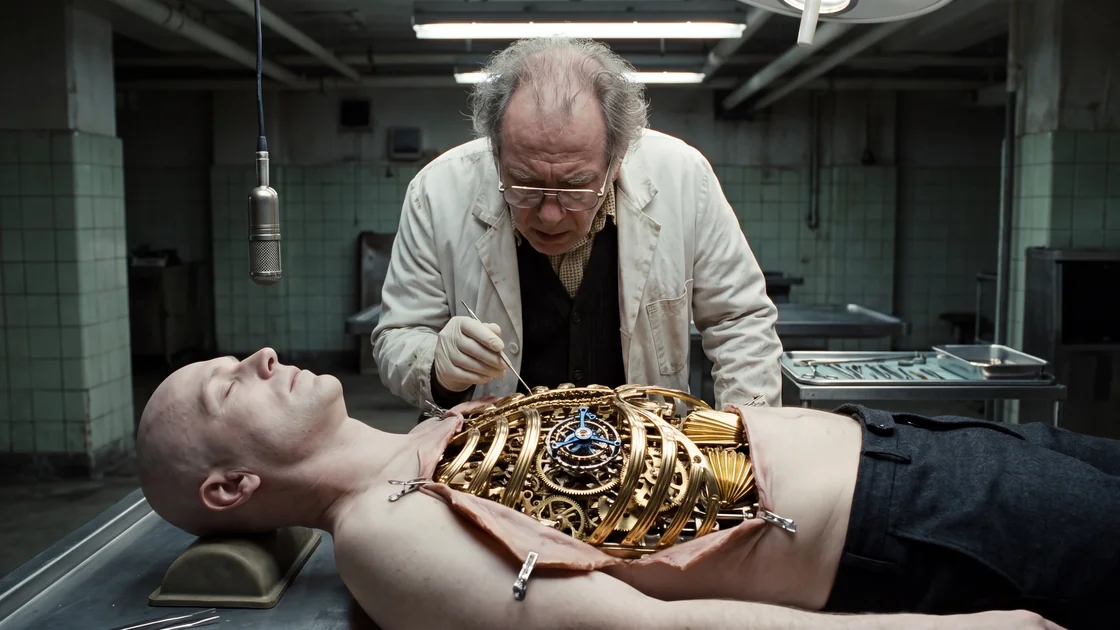
When an unidentified drowning victim is delivered to the sub-basement morgue of St. Jude’s Municipal Hospital, veteran forensic pathologist Dr. Arthur Vance expects another routine tragedy of urban neglect, decay, and quiet sorrow. Instead, the bite of his scalpel reveals an impossible reality: beneath an immaculate sheath of synthetic dermis lies a living interior of pure, gleaming gold horology, complete with sapphire bearings, oscillating balances, and micro-gear trains humming in rhythmic silence. As Dr. Vance defies protocol to secretly dissect and understand the wondrous mechanism, he confronts the grief of his own decaying life, the forgotten genius of an alchemical watchmaker, and the transcendent boundary where human soul and eternal clockwork merge.
I. The Sub-Basement
The sub-basement morgue of St. Jude’s Municipal Hospital smelled perpetually of three things: glacial acetic acid, cheap industrial floor wax, and the quiet, heavy dampness that seeped through sixty-year-old subterranean concrete. To the orderlies and the young pathology residents from the university, it was a purgatory of fluorescent glare and humming drainage troughs. To Dr. Arthur Vance, it was the only room in the sprawling city that never lied to him.
Arthur was fifty-eight years old, though his knees and the dry ache in the small of his back argued for seventy. He was a tall, stooped man with thinning gray hair that stood in unruly tufts behind his ears, and eyes the color of stagnant river water behind thick, wire-rimmed bifocals. For twenty-six years, Arthur had been the Chief Medical Examiner for the district, an archivist of the city’s violent, clumsy, and sorrowful departures. He had autopsied suicides who leapt from the suspension bridges; dockworkers crushed beneath shifting cargo containers; junkies whose veins had collapsed into fibrous cords; and the endless, nameless floaters swept down the Blackwood River like sodden timber.
The living were volatile, mendacious, and demanding. The dead, by contrast, possessed an unassailable dignity. They arrived on Arthur’s stainless-steel tables with their histories written plainly in their bones, their fat, and their scarred tissues. He considered himself not an investigator of crime, but a translator of biological epilogues.
It was four in the morning on a Tuesday in late November when the phone on the wall rattled against its cradle. Arthur, who had been sitting at his scarred oak desk nursing a lukewarm cup of chicory-heavy coffee and filling out toxicological addenda, wiped his spectacles on his lab coat and lifted the receiver.
"Vance."
"Arthur? It’s Miller," the voice crackled through the handset. Detective Thomas Miller of the River Precinct was a gravel-throated man who had smoked two packs of non-filtered cigarettes a day since the Nixon administration and saw the world through a fog of cynical weariness. "Coast Guard just pulled one out of the marsh reeds past Pier 14. Harbor patrol hauled him to the slips. We’re bringing him down now."
"Circumstances?" Arthur asked, already reaching for his grease pencil and an intake clipboard.
"Floater. But Arthur... it’s odd." Miller paused, the sound of rain drumming against the roof of his cruiser audible in the background. "No bloating. No fish bites. He was caught in the weeds near the outflow pipe, but the boys say he looks like he went for a swim ten minutes ago. Except his clothes are dry underneath, or something. Just... take a look at him, will you? I’ve got paperwork up to my ears on an arson downtown, so I’m dumping him with the night clerk."
"Drop him at Bay 3," Arthur said. "I’ll do the preliminary before the morning shift arrives."
Arthur hung up the phone, took a final, bitter sip of his coffee, and stood up. His joints cracked in the quiet room. Outside, through the high, barred street-level grates, the sound of the rain was a muted hiss, accompanied by the occasional dopplering roar of a delivery truck on the avenue above.
Ten minutes later, the freight elevator groaned to a halt at the end of the hall. The hydraulic doors parted with a shudder, and two rain-slicked paramedical transport workers wheeled a heavy gurney down the corridor. They did not speak, save for a grunt of acknowledgment as Arthur signed the custody transfer clipboard. They were eager to return to the heated cab of their van, away from the chill of Arthur’s domain.
The body lay beneath a standard gray vinyl disaster pouch. When the heavy zipper slid back, Arthur leaned forward, his hands resting lightly on the cold steel edge of the gurney.
"John Doe," Arthur murmured, studying the face exposed under the stark overhead surgical lamps.
The deceased appeared to be a man in his late thirties or early forties. He was entirely bald, his scalp smooth and faintly alabaster, without a single mole, freckle, or blemish. His facial features were sculpted with an almost disturbing symmetry: high, sharp cheekbones; a straight, narrow nose; and thin, pale lips set in a neutral, relaxed line. Most floaters retrieved from the brackish, industrial waters of Pier 14 were swollen, discolored with lividity, and marred by the scavengers that populated the river bottom.
This man, however, was pristine.
Arthur touched the stranger’s cheek with the back of his gloved finger. The skin was cold—well below the ambient temperature of the river, almost frosty to the touch—yet it did not have the waxy, slack yield of post-mortem tissue. It felt firm, dense, and unnervingly smooth, like the calfskin binding of an antique ledger. There was no sign of rigor mortis; when Arthur lifted the man's left hand to inspect the fingernails, the wrist articulated with an effortless, fluid grace, without the stiff resistance typical of the hours following clinical death.
"Who were you?" Arthur whispered.
He pulled the vinyl sheet all the way down, exposing the entire body. The man was naked, save for a pair of tailored, unbranded trousers made of heavy charcoal wool, secured at the waist with an unadorned silver clasp. There were no shoes, no socks, no undergarments. And, as Miller had noted, while the exterior of the wool was damp from the river, the inner lining was bone dry.
Arthur wheeled the gurney into Autopsy Suite A. He switched on the high-intensity overhead scialytic lamps. The four massive bulbs hummed, bathing the steel table in a brilliant, shadowless white glare. He positioned the hanging microphone of his Dictaphone above his chest, tapped the foot pedal to engage the magnetic tape, and cleared his throat.
"Autopsy preliminary examination. November twenty-eighth. Subject: Unidentified male, adult. Apparent age: thirty-five to forty-five. Case number: zero-four-dash-nine-nine-two. Examiner: Dr. Arthur Vance."
Arthur paused, his gaze sweeping over the body.
"Subject is well-nourished, well-developed, exhibiting no visible contusions, lacerations, defensive wounds, or identifiable surgical scars. Skin tone is unusually pale, uniform across all anatomical regions. No tattoos, birthmarks, or identifying characteristics observed. Pupillary inspection..."
Arthur lifted the right eyelid. The iris was not brown, blue, or hazel. It was an extraordinary, highly reflective silver-gray, possessing an intricate geometric radial pattern that looked less like the fibrous stroma of a human eye and more like the guilloché engraving on the dial of a Swiss pocket watch. The pupil was perfectly circular, dilated to four millimeters, and did not react to the direct beam of Arthur’s penlight.
"Pupils are fixed and non-reactive," Arthur continued, his voice dropping slightly in pitch. "Curious pigmentation of the iris... appears iridescent, possibly a congenital anomaly or extreme corneal opacity, though the cornea itself remains completely clear, with no signs of the cloudy dehydration typical of post-mortem suspension."
Arthur stepped back, his brows furrowing. He picked up his calipers and a steel probe. He pressed the probe against the man’s sternum. The bone felt exceptionally solid—not brittle, as in an older man, but yielding nothing, as if struck against a plate of rolled iron.
"Weight is estimated at... eighty-five kilograms, though handling suggests a significantly higher density than expected for subject’s stature of approximately one hundred and eighty centimeters."
He reached for the scalpel, fitting a fresh #10 blade into the stainless-steel handle with a crisp, decisive snap.
Every autopsy was a ritual of deconstruction. In his mind, Arthur held a mental blueprint of the human body: the three millimeters of epidermis and dermis; the golden-yellow globular layer of subcutaneous adipose; the crimson, striated sheaths of the pectoralis and abdominal musculature; the pale, springy cartilage of the costal ribs; and beneath them, the wet, crowded world of organic existence—the dark liver, the pinkish-gray spongy lungs, the purple coils of the small intestine, and the glistening pericardial sack.
It was an architecture of fluid and rot, brilliant and fragile.
"Commencing primary thoracoabdominal Y-incision," Arthur dictated, positioning the blade at the subject’s right acromion process.
He brought the blade down toward the xiphoid process with a firm, practiced stroke. He applied the standard pressure required to part human skin.
The scalpel did not sink.
Instead, the blade met an inexplicable, gritty resistance, producing a sound that was not the soft parting of biological tissue, but a faint, high-pitched screeech, like a razor scraping across fine porcelain.
Arthur stopped instantly. He frowned, leaning down until his nose was four inches from the chest. The blade had parted a microscopically thin layer of synthetic epidermis—hardly half a millimeter thick—revealing no blood, no capillary oozing, and no subcutaneous fat.
Beneath the parted synthetic skin lay a gleaming, polished surface of solid, mirror-bright yellow gold.
II. The Escapement
Arthur pulled the scalpel away as if the steel handle had suddenly superheated. His heart gave a hard, erratic thump against his ribs. He looked at the blade. The razor edge of the surgical steel was curled and blunted, ruined by the brief contact.
"What in God's name..." he muttered under his breath.
The Dictaphone tape spun silently on its brass reels overhead, recording the hiss of the basement vents and Arthur’s ragged exhalation. He reached up, tapped the foot pedal to pause the machine, and stood frozen under the white light.
For thirty seconds, Arthur did nothing but breathe. In forty years of pathology, he had encountered bizarre horrors: bodies packed with bags of narcotics, bodies sewn through with mortuary wire, bodies calcified by rare metabolic diseases, bodies with ceramic joint replacements and titanium spinal cages. But titanium was matte gray, orthopedic, utilitarian. It was installed to support failing bone.
This was not orthopedic hardware.
Arthur discarded the ruined scalpel, selected a heavier pair of blunt-tipped surgical shears, and gently inserted the tip into the split he had made in the synthetic skin. He expected resistance, but as he peeled the edge back with his tissue forceps, the epidermis parted along an invisible, pre-cut micro-perforation. The skin was not bonded to flesh; it was a sheer, elastic sleeve, held to the underlying structure by a minute vacuum and a faint, scentless coating of clear, viscous oil.
Arthur laid the flaps of "skin" back over the shoulders, pinning them with small magnetic clamps to the side of the table.
He gasped.
There was no rib cage in the mammalian sense. There was an exquisite, vaulted cage of polished eighteen-karat gold and burnished brass. The ribs were curved, fluted struts, each hand-chamfered along its edges with a mirror polish that reflected the overhead surgical lamps in brilliant, star-like flares. Behind the gilded struts lay an interior so densely packed with intricate, interlocking mechanisms that Arthur’s eyes struggled to comprehend the scale.
It was an engine.
The thoracic cavity was not filled with pleural cavities and mediastinum. In the center, where the human heart ought to have been suspended within its pericardial sac, hung a massive, three-dimensional carriage crafted from blued steel and rose gold. Suspended within this gimbaled cage was an oversized, triple-axis tourbillon escapement.
The balance wheel was the size of a silver dollar, fashioned from frosted platinum with tiny, threaded gold timing screws set around its perimeter. The hairspring was a hair-thin coil of deep indigo steel, shimmering with an ethereal blued temper.
And it was moving.
Arthur dropped his forceps. The instrument struck the concrete floor with a ringing chime, but Arthur did not look down. His gaze was pinned, hypnotized, horrified, and ecstatic, upon the center of the chest.
Tick. Tick. Tick. Tick.
It was not the wet, thumping lub-dub of a muscular organ forcing blood through valves. It was a crisp, resonant, infinitely precise horological cadence—five beats per second, eighteen thousand vibrations per hour. The tourbillon rotated slowly upon its horizontal axis, completing a full revolution every two minutes, while the secondary and tertiary cages tumbled in an intricate, frictionless ballet.
With each oscillation of the platinum balance wheel, an escape wheel with diamond-tipped teeth released an anchor pallet made of flawless, synthetic ruby. The tiny click of jewel striking steel was amplified by the vaulted acoustic chamber of the gold ribs, sending a rhythmic, metallic hum through the cold steel of the autopsy table.
"It’s... it’s running," Arthur whispered.
He reached up with a trembling hand, hit the foot pedal of the Dictaphone, and tried to speak. No sound came out of his dry throat. He coughed, swallowed, and forced words into the silence:
"Correction to prior dictation. Subject is... subject is not human. Or, more accurately, subject’s internal anatomy does not correspond to any known biological system. Upon incision of the dermal layer, no organic tissues, musculature, or circulatory vasculature were encountered."
Arthur leaned down, his bifocals sliding down the bridge of his nose. He did not bother to push them back up.
"The internal structures are entirely mechanical. Composed of... what appears to be gold, brass, heat-blued steel, and industrial jewel bearings. In the thoracic position: a mechanical regulating organ resembling a complex multi-axis escapement. The mechanism is active. I repeat, the mechanism is active and operating under its own power."
Arthur’s clinical detached persona, constructed over four decades of dealing with the dead, fractured completely. He stepped around the table, his eyes darting from the chest to the abdomen.
Where the lungs should have been, flanking the tourbillon heart, were two cylindrical bellows constructed from microscopic, overlapping leaves of gold foil. As the escapement ticked, a set of lateral eccentric cams, driven by a minuscule fusee chain no thicker than surgical thread, caused the golden bellows to expand and contract in an ultra-slow, four-second cycle.
When the bellows expanded, a faint, rhythmic draught of air was drawn down through the subject’s trachea; when they compressed, the air was expelled through a series of micro-perforated reeds set into a silver acoustic block at the base of the throat. The exhaust smelled not of decay or breath, but of ozone, high-grade synthetic petroleum, and the dry, sweet scent of dried lavender.
"The lungs..." Arthur murmured into the microphone. "They are... pneumatic bellows. They are cycling air. Not for oxygenation... there is no blood. There is no blood anywhere."
He looked at the abdomen.
Beneath the golden rib cage, where the stomach, liver, pancreas, and intestines should have resided, lay a computational marvel that defied every principle of modern electronics. It was an analytical engine reduced to the size of a human digestive tract.
Thousands of tiny, paper-thin brass gears, planetary gear trains, sliding racks, and cam-followers were layered in dense, vertical strata. Through this mechanical labyrinth ran hundreds of silver-plated rods that shifted horizontally and vertically, engaging and disengaging with infinitesimal detents. Between the gears, winding like gleaming serpents through the clockwork, were fine capillary tubes of borosilicate glass, through which a clear, pale-amber fluid pulsed in tiny, measured droplets, driven by a miniature peristaltic pump that drew its motion from the primary escapement.
It was not a robot. Robots were crude assemblies of servomotors, wiring harnesses, printed circuit boards, and hydraulic actuators. This had no copper wires. It had no lithium batteries. It had no microchips.
It was pure, unadulterated horology. It was the dream of an eighteenth-century watchmaker realized with twenty-first-century tolerances, executed in materials that belonged in a pharaoh's treasury.
Arthur reached out with a bare finger—he had stripped his right glove off without realizing it—and gently, terrifyingly, touched the rim of the outer tourbillon cage.
The metal was not cold. It was faintly warm, warmed by the frictionless kinetic labor of its own components. The vibration that passed into the pulp of Arthur’s fingertip was so fine, so unimaginably rapid, that it felt like touching the wing of a hovering sphinx moth.
Tick-tick-tick-tick-tick.
The sound filled the autopsy room, replacing the memory of every dying groan, every weeping relative, and every wet, heavy silence Arthur had ever endured in this basement. It was the sound of absolute order. It was the sound of time stripped of its decay.
III. The Architecture of Eternity
Arthur Vance did not call Detective Miller. He did not call the Chief of Police, nor the coroner, nor the dean of the medical school.
He knew what would happen if he picked up that telephone. Within an hour, Bay 3 would be overrun by suits from the Department of Defense, federal agents, university engineers with laser scanners, and hospital administrators smelling patent lawsuits and global media frenzies. They would treat this creature as a technical curiosity, a piece of foreign espionage, or an engineering anomaly. They would dismantle it with power tools. They would rip apart the gears to see how the teeth were cut; they would drain the amber fluid into specimen vials; they would reduce this miraculous synthesis of art and kinetic philosophy into an inventory of mechanical components.
Arthur could not permit that.
Instead, he walked to the heavy steel door of Autopsy Suite A, engaged the deadbolt, and flipped the switch that illuminated the red "PROCEDURE IN PROGRESS - DO NOT ENTER" lamp in the hallway outside. Then he went to the storage closet, retrieved three additional mobile surgical lamps, and wheeled them around the table until the stranger lay beneath an arena of five thousand watts of brilliant, unyielding light.
He dragged a rolling stainless-steel stool to the side of the corpse, retrieved his fine micro-dissection tools—instruments designed for pediatric neurosurgery—and pulled down the binocular surgical microscope that hung from a balanced ceiling boom.
"Case record zero-four-dash-nine-nine-two," Arthur said into the dangling Dictaphone, his voice now low, steady, and intensely focused. "The examiner is proceeding with a systematic internal survey of the non-biological thoracic and abdominal structures."
He swung the microscope lenses into place, adjusted the oculars, and peered into the chest cavity at forty-times magnification.
The sight took what little breath Arthur had left.
At this magnification, the craft did not degrade; it became more astonishing. Every single brass wheel was finished with exquisite anglage—the sharp edges hand-filed and polished to a forty-five-degree mirror bevel. The flat surfaces of the gold structural bridges were decorated with microscopic Côtes de Genève, crisp parallel waves that broke the light into prismatic rainbows.
Even the steel screws, some of them no larger than a grain of ground pepper, were heat-blued to a deep, peacock-feather indigo, their heads mirror-polished, their slots perfectly chamfered without a single burr or tool mark.
Arthur adjusted the focus knob, driving the focal plane deeper into the thoracic cavity, behind the great tourbillon heart.
There, nestled against the gilded interior of the dorsal spine, was the mainspring housing.
It was not a single barrel. It was a battery of six massive cylinders forged from what looked like damascened Swedish steel, their exteriors patterned with the rippling, watery grain of folded metal. Each barrel was bound with gold bands and connected to its neighbors by microscopic fusee chains—chains so fine that each link, complete with its two steel side-plates and central rivet, could have passed through the eye of a standard sewing needle.
"The power source," Arthur dictated, his fingers hovering over the microscope’s focusing ring. "A series of mechanical mainspring barrels arranged in series. The barrels appear to utilize a continuous-torque fusee system. But... the scale is impossible. The amount of potential energy stored in springs of this size should be negligible, capable of powering a desktop clock for perhaps a week. Yet the torque required to drive this immense train—the bellows, the analytical racks in the lower abdomen—would require springs of enormous tension."
Arthur looked closely at the arbor of the first barrel.
Set into the polished gold face of the primary gear was a hallmark, stamped with a micro-punch no wider than a human hair. Arthur reached for a fine camel-hair brush, dipped it in alcohol, and delicately cleaned a trace of oil from the surface of the stamp.
He focused the lenses.
The mark was a shield. Inside the shield was an hourglass, flanked by a pair of open compasses and an alchemical symbol—the circle surmounted by a crescent moon, the sign of Mercury. Below the shield, engraved in a flourishing, copperplate cursive that must have been executed under a lens with a diamond-tipped graver, was an inscription:
VANE & SONS
HOROLOGISTS TO THE UNSEEN
No. IV — 1888
“Omnia Fert Aetas”
Arthur sat bolt upright. The stool screeched against the floor.
"Eighteen eighty-eight?" he whispered.
The room seemed to tilt around him. Eighteen eighty-eight. The year Jack the Ripper stalked the fog of Whitechapel. The year Grover Cleveland sat in the White House. The year before the Eiffel Tower was completed.
It was impossible. The tolerances he was looking at were measured in sub-microns. Even with contemporary computer-numerical-control Swiss lathes, wire electrical discharge machining, and laser sintering, no watchmaking firm on Earth—not Patek Philippe, not Audemars Piguet, not Vacheron Constantin—could manufacture a mechanical construct of this density and complexity. To suggest that it had been crafted by hand in the late nineteenth century was an insult to the entire history of industrial metallurgy.
Yet there was the hallmark. And there, beside the hallmark, was the Latin motto: Omnia Fert Aetas.
Time bears away all things.
Arthur returned to the microscope. His hands were steady now, possessed by that peculiar, cold clarity that comes over a surgeon or a scholar when they realize they have stepped off the edge of the mapped world.
"Moving examination to the cranium," he said.
He needed to see the brain.
IV. The Ivory Loom
To open a human skull, a pathologist uses an electric oscillating saw—a brutal, noisy tool with an unsharpened blade that vibrates at high frequency, cutting through the dense calcium of the cranium while sparing the soft dura mater beneath.
Arthur could not bring himself to touch that screaming electric blade to the head of John Doe.
He tilted the subject’s head forward. The back of the neck was smooth, pale, and cold. But as Arthur parted the synthetic dermis at the base of the skull, searching for the suboccipital landmarks, his fingers encountered a minute seam running vertically along the line of the cervical vertebrae.
He leaned in with a magnifying loupe.
Hidden within the seam were three microscopic release buttons, each crafted from polished cabochon sapphire. Arthur took a blunt probe and pressed the topmost jewel.
There was a faint, pneumatic hiss, like the breaking of a miniature hermetic seal.
The rear quadrant of the cranium—the occipital and parietal sections—did not crack or saw away. It unlatched. With a smooth, counterbalanced motion driven by hidden, spring-loaded brass quadrants, the gilded cranial plates folded outward like the petals of an unfolding bronze lotus.
Arthur Vance stopped breathing.
The human brain is an ugly, wonderful thing: three pounds of gray and white fat, folded into moist convolutions, smelling of sulfur and saline, humming with fragile electrochemical storms. It is the seat of memory, of love, of petty malice, of fear, and of poetry; and when Arthur cut into it, it always felt like warm curd.
There was no curd here.
The interior of the skull was illuminated by the ambient glow of the surgical lamps, reflecting off an impossible web of gold, silver, and ivory.
The cerebrum was an ivory loom.
Arranged within the gilded bowl of the cranium were tens of thousands of microscopic ivory plates, each no thicker than a butterfly’s wing, suspended within a three-dimensional framework of silver rails. Each ivory leaf was perforated with patterns of rectangular micro-apertures, reminiscent of the punch cards utilized in Jacquard looms or the early computing engines of Charles Babbage.
Through these ivory cards passed millions of hair-fine gold pins. As the tourbillon in the chest ticked, a central drive shaft—a splined, fluted pillar of blued steel passing upward through the cervical vertebrae—rotated a series of miniature cam drums in the base of the skull.
The drums shifted the silver rails by fractional millimeters. With each movement, thousands of ivory leaves rose, fell, and slid across one another with a sound like dry autumn leaves scuttling across a marble patio.
Shhh-chick. Shhh-chick. Shhh-chick.
It was a physical memory. A calculating organ that did not store data as magnetic charges or floating-point numbers in silicon, but as physical permutations of space, depth, and mechanical interference.
"The cranial vault," Arthur whispered into the microphone, his voice cracking with awe, "contains an analytical array of non-biological design. The architecture is based on punch-card logic, executed entirely through mechanical components. Materials appear to be marine ivory, eighteen-karat gold, and sterling silver. There are no vacuum tubes. There are no semiconductors. There is no software."
Arthur lowered his head until his brow nearly touched the cold steel of the table.
"It is thinking," he whispered. "God forgive me, it is thinking right now."
He watched the pins dance. When he moved his hand over the open cranial cavity, blocking the path of the surgical light, the ivory leaves suddenly shifted. A cluster of silver levers near the frontal pole slid forward with a sharp, synchronized click.
The mechanical eyes moved.
Arthur jumped back, his hip crashing into the instrument tray. Scalpels, forceps, and probes clattered onto the floor.
The head had turned.
Not far—hardly five degrees to the left. But the silver-gray eyes, with their radial guilloché irises, had tracked Arthur’s movement. The eyelids, crafted from synthetic dermis lined with brass armatures, blinked once.
The sound of the blink was not the soft slap of moist human lids. It was the whisper of a camera shutter: snick-whirr.
The eyes focused on Arthur.
The pupils, which had been fixed at four millimeters, suddenly contracted to two millimeters under the direct glare of the surgical lamp. Inside the irises, dozens of micro-apertures—curved brass iris leaves like those found in the lenses of nineteenth-century optical equipment—overlapped and rotated, narrowing the aperture to limit the incoming light.
"You are awake," Arthur said. The words came out of him not as a physician’s diagnosis, but as a terrified prayer.
The creature’s jaw moved.
The lower mandible, cast from a single piece of fluted gold, dropped half an inch. The synthetic lips parted, revealing two rows of teeth crafted from polished dental porcelain, perfectly set into platinum gums.
From the acoustic chamber at the base of the throat—the silver block with its micro-perforated reeds—came a sound.
It was not a human voice. It was the sound of a musical automaton, an organette played by a pinned brass cylinder: pure, hollow, and melodic, accompanied by the faint, wheezing sigh of the golden bellows in the chest.
"A... A... Arthur..." the voice chimed.
The notes were resonant, like the bells of a cathedral heard from five miles away across a frozen lake.
The medical examiner fell to his knees on the damp concrete floor of Bay 3, his hands clutching the cold edge of the autopsy table.
V. The Anatomist's Ghost
Arthur did not believe in ghosts. In his line of work, ghosts were a luxury for people who had never seen what a twelve-gauge shotgun does to a human face, or what four weeks in a warm bathtub does to human muscle. Death, in Arthur’s universe, was an absolute end: the irreversible cessation of oxidative phosphorylation, the breakdown of cellular membranes, the cold triumph of entropy over architecture.
He had buried his wife, Clara, twelve years ago.
Clara had died of metastatic adenocarcinoma of the pancreas. It was a slow, humiliating, agonizing decline that had lasted fourteen months. Arthur had sat by her bedside in the oncology ward, watching the woman he loved—a woman who had played Chopin with wild, ferocious beauty, who had read Spinoza in the original Latin, who had possessed a laugh that could brighten the gloomiest tavern—turn yellow, then gray, then hollow.
He had watched her body betray her mind. He had watched her cells run amok in chaotic, cancerous mutiny, turning her magnificent, complex humanity into a heap of failing, agonizing meat.
On the final night, when her breathing had become the wet, rhythmic rattle that he had heard thousands of times on his autopsy tables, he had held her hand and hated the universe with an intensity that burned the tears out of his eyes. He had hated the fragility of the flesh. He had hated that a universe capable of generating the human spirit had housed it in an engine made of jelly, fat, and brine, subject to the whims of every rogue cell and microscopic virus.
Now, kneeling on the floor of the morgue, Arthur looked up into the silver eyes of the construct.
"A... A... Arthur," the machine repeated. The pitch shifted, modulating through a series of pure, mechanical intervals—a fifth, a third, an octave—until it settled into an eerie, resonant timbre that sounded uncannily like a young man speaking through a brass speaking tube.
The construct did not look down at Arthur with anger, or terror, or pain. Its silver irises were calm, reflective, infinite.
Arthur slowly pulled himself up using the edge of the table. His knees trembled violently. He wiped a streak of cold sweat from his forehead with the back of his sleeve.
"How do you know my name?" Arthur whispered.
The machine’s head tilted slightly to the right. Inside the open cranial cavity, the ivory loom chattered furiously: shick-shick-shick-clack.
"The... audio... register," the voice chimed. "You... spoke. 'Examiner: Dr. Arthur Vance.' You... recorded... the... datum. The... datum... was... received."
Arthur looked up at the Dictaphone microphone still hanging above the table. The tape was still turning.
It had not known him. It had simply listened. It had indexed his self-identification from the preliminary dictation, cross-referenced it with its internal logic cards, and synthesized the speech using its bellows and acoustic reeds.
It was not magic. It was not a resurrection.
It was mechanism.
"What are you?" Arthur asked, his voice steadying, driven by the lifelong reflex of scientific inquiry.
The construct’s left hand, which had been resting motionless on the vinyl sheet, moved. The golden fingers—slender, articulated with double-pinned knuckle joints that moved with the absolute silence of oil-damped sapphire—curled inward, then opened flat.
"I am... Number Four," the voice chimed. "Completed... August fourteenth... eighteen hundred... and eighty-eight. Commissioned by... the Society of the Ascendant Balance. Built by... Master Horologist... Malachi Vane."
Arthur stared at the machine’s chest. The tourbillon continued its hypnotic, five-beat-per-second waltz.
"Malachi Vane," Arthur repeated. "You were made... in 1888? You have been running... for one hundred and thirty-five years?"
"Running," the construct answered. The word was accompanied by a subtle shift in the abdominal racks. "The... spring... reserve... is... three hundred... years. Six... barrels. Carbon-tempered... crucible... steel. Cold-drawn... in... vacuum. Friction... loss... zero-point-zero-two... percent. Synthetic... sapphire... endstones. The... oil... does not... oxidise."
"And the skin?" Arthur asked, his hand trembling as he reached out to touch the parted flap of synthetic dermis. "The tissue... this isn't nineteenth-century rubber or gutta-percha. It’s an organic polymer. It’s self-healing."
The construct blinked again. Snick-whirr.
"The dermal... sheath... is... renewed. Cultured... in... the... base... chamber. Protein... synthesize... from... organic... broth. The... Master... did not... complete... the... cycle. I am... incomplete."
"Where have you been?" Arthur asked. "The river... you were pulled from the Blackwood River. Pier 14."
The ivory loom in the cranium paused for three full seconds. The silence in the room was so profound that Arthur could hear the distant, muffled drip of a condensation pipe four rooms away.
"The vault," the construct finally chimed. "The vault... beneath... the... foundry. The river... broke... the... stone. The foundation... yielded. Water... entered. I... floated. The... specific... gravity... of... the... thoracic... air... chamber... is... point-nine-two. I... ascended... to... the... current."
It had not died. It had not fallen into the river.
It had been buried.
Arthur pictured it: an old brick foundry along the industrial banks of the Blackwood River, abandoned decades ago, its basements decaying beneath tons of river silt and forgotten slag. A stone vault, sealed in the Victorian era, slowly undermined by the relentless, muddy wash of the tides, until a wall collapsed, the river rushed in, and this golden marvel, sleeping in its water-tight tomb for over a century, was dislodged and lifted to the surface by its own hollow lungs.
"Why were you in the vault?" Arthur asked.
The construct’s chest rose and fell. The bellows drew in a slow, deep breath of morgue air, exhaling the lavender and ozone.
"The Master... was... dying," the voice said. The chime had lost some of its bright, metallic resonance; it sounded lower, almost somber, as if the acoustic reeds had shifted to a minor register. "His... lungs... were... black... from... the... coal... smoke. His... heart... was... enlarged. He... had... sixty-four... years. He... said: 'The... flesh... is... an... error. The... flesh... is... an... insult... to... the... geometry... of... God.'"
Arthur closed his eyes for a moment. He felt the cold iron of the autopsy table against his thighs.
The flesh is an error.
How many times had Arthur thought the same thing? How many times had he stood over the bodies of children taken by meningitis, of young mothers taken by embolisms, of old men whose minds had dissolved into the plaque-ridden mush of dementia, and felt a profound, burning disgust at the crude, fragile, biological machinery of humanity?
"What did he do?" Arthur asked, though in his heart, he already knew the answer.
"He... built... Number One," the construct said. "It... failed. The... gear... train... seized. He... built... Number Two. The... ivory... logic... was... insufficient. It... could not... speak. He... built... Number Three. It... moved. It... walked. But... it... had... no... balance. It... shattered... its... escapement... on... the... flagstones."
The construct’s eyes drifted toward the ceiling, staring through the scialytic lamps, through the concrete ceiling, through the rain-soaked asphalt of the city above, toward the cold stars that were invisible in the night sky.
"Then... he... built... me."
"And what are you, Number Four?"
"I am... his... reliquary."
VI. The Reliquary
The word hung in the sterile air of the morgue like an incantation.
Reliquary. A container for holy relics. A vessel designed to hold the bone of a saint, a splinter of the true cross, a lock of hair from someone who had slipped beyond the veil of time.
Arthur leaned forward until his face was inches from the open chest. He looked past the tourbillon, past the golden bellows, past the damascened steel of the six mainspring barrels, down into the deepest recess of the thoracic cavity, where the spine met the base of the skull.
There, suspended within a hermetically sealed cylinder of rock crystal, held by four spider-like claws of blued steel, was a small, pale-gray mass of organic tissue.
It was no larger than a walnut. It was suspended in a clear, motionless liquid that showed no sign of cloudiness or degradation. Fine gold wires—wires so thin they were almost invisible to the naked eye, finer than the silk of an orb-weaver spider—emerged from the ivory loom in the cranium and penetrated the crystal cylinder, terminating in thousands of microscopic nodes that were embedded directly into the tissue.
Arthur recognized the anatomy immediately.
It was not a whole brain. It was a human hippocampus and amygdala, preserved in perfect, suspended stasis.
The seat of memory. The wellspring of emotion. The core of the human identity, stripped of its sensory apparatus, its motor cortex, its metabolic vulnerabilities, and cradled within a cage of gold and sapphire.
"Malachi Vane," Arthur breathed.
"He... resides... within... the... balance," the construct chimed. The voice was no longer that of a musical automaton; it was changing, smoothing out, the syllables knitting together as the ivory punch cards found their grooves, matching the neural pathways of the preserved tissue with the mechanical logic of the loom.
"He could not preserve the whole," Arthur said, his clinical training warring with a sense of cosmic vertigo. "The whole brain requires too much blood, too much oxygen, too much metabolic support. It decays in minutes. But the deep core... the memory matrix... he found a way to sustain it. A micro-perfusion system. The amber fluid..."
"The fluid... is... fluorocarbon... enriched... with... synthetic... lipids," the voice said, the cadence now almost conversational, though possessed of a hollow, bell-like resonance. "It carries no cells. It produces no waste. It is circulated by the escapement. Every beat of the balance wheel feeds the relic. Every rotation of the tourbillon preserves the remembrance."
Arthur slowly sat back down on his stool. He looked at his hands. They were spotted with age, the veins raised and blue beneath the thinning skin, the skin dry and cross-hatched with the fine lines of fifty-eight years of biological wear.
Within ten years, perhaps fifteen, those hands would begin to shake. The fine motor control that allowed him to sever an optic nerve without tearing it, or trace the path of a millimeter-wide bullet fragment through a lung, would desert him. His coronary arteries were likely already narrowing, lined with the yellow plaques of a lifetime of bad coffee, institutional stress, and processed food. His brain cells were dying by the thousands every day, irreplaceable, drifting toward the inevitable silence that awaited every son of Adam.
And here, lying on his autopsy table, was a man who had looked at that inevitable silence in eighteen eighty-eight and built a fortress of eighteen-karat gold against it.
"Are you him?" Arthur asked softly. "Are you Malachi Vane?"
The construct did not answer immediately. The ivory loom in its skull hummed through three full cycles, its pins dancing through the perforations with a sound like rain upon a tin roof.
"I am... the echo," the construct said. "I am the record of his will. I remember the smell of the coal smoke in the alley behind St. Jude’s church. I remember the taste of the salt beef he bought at the docks. I remember the cold of the iron when the forge fires went out in the winter of seventy-six. I remember the voice of his daughter, Mary, who died of the scarlet fever when she was four."
The machine’s left hand slowly rose from the table. The golden fingers curled inward, touching the fluted ribs of its own chest, directly over the ticking tourbillon.
"I remember her face," the voice said. The acoustic reeds vibrated with a note so pure, so unutterably sorrowful, that Arthur felt a sudden, sharp sting behind his eyelids. "I have remembered her face for forty-nine thousand, four hundred, and twenty-two days. I have remembered her face through the dark. I have remembered her face through the cold of the river. The gears do not forget. The gold does not rot."
Arthur bent his head. A single tear escaped his eye, fell through the glare of the surgical lamps, and struck the polished gold rim of the subject’s sternum.
The drop of saline sat upon the eighteen-karat surface, a perfect, trembling sphere of biological moisture.
The construct looked down at the drop of water. It did not wipe it away.
"Why did you stop?" Arthur asked, his voice thick. "If the springs have three hundred years of power... why were you floating in the reeds like a corpse?"
The construct’s eyes shifted back to Arthur.
"The escapement... was fouled," it said. "A grain... of river sand. Point-three millimeters in diameter. It wedged between the fourth wheel pinion and the pallet arbor. The balance stopped. The train locked. When the train locks... the ivory stops. When the ivory stops... there is only the dark."
The construct tilted its head toward the instruments scattered across the floor.
"When you... made the incision... the vibration of your steel... dislodged the stone. The pallet freed. The hairspring breathed. The dark... ended."
Arthur looked down at the floor. Among the fallen scalpels and forceps lay his heavy brass-handled probe. When he had dropped it, it had struck the table leg with a heavy, ringing impact.
A single grain of sand. A blow from an autopsy probe.
The difference between eternity and oblivion was a third of a millimeter of quartz grit.
VII. The Law of the Flesh
The telephone on the morgue wall rang.
The sound was shockingly loud, violent, and vulgar. It shattered the sacred, ticking silence of Bay 3 like a stone thrown through a stained-glass window.
Arthur did not move. He sat on his stool, his heart hammering against his ribs, staring at the black plastic telephone.
It rang four times. Five times.
Then it stopped.
A moment later, a heavy fist pounded on the frosted glass door of Autopsy Suite A.
"Arthur? You in there?"
It was Miller. His voice was muffled by the thick wood and the heavy gasket of the door, but the impatient, gravelly authority in it was unmistakable.
"Arthur! Open up! What’s going on? Dispatch said you’ve had the 'In Progress' light on for four hours. The coroner’s office is screaming for the preliminary on that floater. Miller said the mayor’s office is sniffing around Pier 14—some developer wants the slips cleared. You finished with the John Doe?"
Arthur stood up. His limbs felt heavy, cold, and clumsy. He looked down at the table.
The construct lay before him, its golden rib cage parted, its ivory loom exposed to the stark glare of the lights, its tourbillon heart beating with that crisp, indifferent, beautiful cadence: tick-tick-tick-tick-tick.
"Dr. Vance," the construct chimed. The voice was quiet now, dialed down to a whisper that did not carry beyond the perimeter of the surgical lamps. "The men... outside. They are... the authorities?"
"Yes," Arthur whispered.
"They will... see... the... works?"
"Yes."
The construct’s silver eyes did not blink. But inside the skull, the ivory leaves shifted with a sudden, agitated rattle: shick-clack-clack-clack.
"They will... dismantle," the machine said. It was not a question. It was a mathematical deduction, calculated across thousands of ivory punch cards. "They will... measure. They will... separate... the... components. They will... drain... the... crystal... cylinder. They will... extinguish... the... memory... of... Mary."
The door rattled again, more violently this time. A key scraped against the brass exterior of the deadbolt.
"Arthur! I’m using the master key! What the hell are you doing in there?"
Arthur looked at the door. He looked at the construct.
He thought of Clara’s hospital room. He thought of the plastic bags of saline, the rubber tubes running into her bruised veins, the smell of excrement and disinfectant, the clinical, systematic, bureaucratic management of her destruction. He thought of the morgue around him—the thousands of bodies he had cut open, weighed, cataloged, and slid into refrigerated drawers, reduced to paperwork and cold ash.
The world of the living did not want eternity. The world of the living was an empire of rot, governed by men who measured everything in budgets, jurisdictions, and industrial utility. If they took Number Four, they would turn him into a weapon, a patent, or a museum curiosity under glass, his springs uncoiled, his crystal cylinder dry, his memories of an 1880s child lost forever in some university basement.
"No," Arthur whispered.
"Arthur!" The bolt clicked. The door began to swing open.
In two strides, Arthur crossed the room. He did not grab a scalpel. He did not grab a weapon.
He grabbed the heavy, two-inch-thick wooden wedge that he used to prop open the heavy bay doors when moving multiple gurneys. He slammed the wedge under the bottom edge of the door with the heel of his surgical boot, kicking it with all the force in his aging body.
The door jerked open half an inch, then wedged fast against the oak block with a screech of tortured hinges.
"What the—! Arthur! What the hell are you doing? Open this door!" Miller’s face appeared in the narrow, half-inch gap between the door and the frame, his eyes wide with shock and mounting fury. "Are you out of your mind? What’s going on in there?"
"Give me ten minutes, Thomas!" Arthur shouted, his voice cracking with an authority he hadn't used in twenty years. "Medical containment! We have... we have an unidentified chemical hazard! Organophosphate residue in the thoracic cavity! If you open this door without respirators, the whole corridor will be contaminated!"
Miller froze. Arthur could see the detective’s pupils contract through the gap. In the municipal morgue, "chemical hazard" was the one phrase that could stop even the most arrogant cop in his tracks. They all remembered the two coroners in Chicago who had been killed by cyanide gas releasing from a suicide’s stomach contents.
"Organophosphates?" Miller stammered. "You... you serious? Jesus Christ, Arthur! Is it lethal?"
"I don't know yet!" Arthur yelled, backing away from the door toward the table. "Stay back! Call the Hazmat unit from Station 4! Tell them we need Level B suits and an air-filtration trailer! Don't let anyone down that elevator!"
"Shit! All right! Don't touch anything, Arthur! I'm calling it in!"
The sound of Miller’s heavy shoes sprinted away down the tiled corridor, heading for the emergency alarm box by the elevator bank.
Arthur had five minutes. Seven at most, before the fire department arrived and realized that the morgue’s exhaust vents were blowing nothing more toxic than chicory coffee and dried lavender.
VIII. The Winding of the Clock
Arthur ran back to the table.
"Listen to me," Arthur said, his hands moving with frantic, terrifying precision. "We have five minutes. Do you understand? Five minutes before they break that door down."
"I... understand," the construct chimed. The silver irises tracked Arthur’s hands. "The... time... is... insufficient... to... escape. The... legs... are... locked. The... hydraulic... lines... in... the... femoral... conduits... are... dry. I... cannot... walk."
Arthur looked at the construct’s legs. He had not noticed before, but within the charcoal wool trousers, the great brass femoral shafts were motionless, their secondary valves disengaged. Without the specialized fluid or the high-torque winding required to cycle the limbs, the machine was an anchor. It weighed nearly three hundred pounds. Arthur could not carry it. He could not wheel it out the front door.
"Can you shut down?" Arthur asked. "Can you stop the ticking? If you are quiet... if you look like a cold mechanism... an unpowered automaton... they might not realize the relic is alive. They might not realize you are conscious."
"No," the construct said. Its voice was clear, resonant, and calm. "The... tourbillon... cannot... be... arrested... from... within. The... escapement... has... no... brake. If... the... balance... wheel... is... stopped... by... force... the... shock... will... snap... the... ruby... pallets. The... memory... will... bleed. The... crystal... will... crack. To... stop... me... with... steel... is... to... murder... the... Master."
Arthur looked down into the chest.
Tick-tick-tick-tick-tick.
The tiny platinum balance wheel tumbled in its rose-gold cage. The blued hairspring expanded and contracted with the rhythm of an immortal heart. Five beats per second. Three hundred beats per minute. Eighteen thousand beats per hour.
It could not stop. It was condemned to exist, or condemned to be smashed.
"Then what do we do?" Arthur cried, the tears finally breaking from his eyes, hot and bitter against his cheeks. "I can't save you! I’m an old man! I have nothing! I have a badge, a scalpel, and an empty house! I can’t stop them!"
The construct looked up at Arthur.
For the first time since the vinyl bag had been unzipped, the machine’s mouth curved. It was a minute, almost imperceptible movement—the retraction of two tiny brass cables at the corners of the lips, sliding the synthetic dermis upward by three millimeters.
It was a smile.
It was not the cold, terrifying grin of a machine. It was the tired, peaceful, infinitely patient smile of an old watchmaker who has finally finished a difficult piece after forty years at the bench.
"Dr. Vance," the construct said. The chime was steady, rich, and deep. "The... Master... knew... this... day... would... come. He... knew... that... all... vessels... are... found. He... knew... that... time... bears... away... all... things."
"Omnia Fert Aetas," Arthur whispered.
"Underneath... the... primary... fusee... barrel," the construct said. "There... is... a... release... lever. A... small... arm... of... blued... steel... tipped... with... an... emerald."
Arthur reached into the chest. His fingers were slick with sweat, but his touch was light. He slid his index finger past the fluted golden ribs, past the oscillating tourbillon carriage, into the deep, warm shadow beneath the first damascened spring barrel.
His fingertip found it: a tiny, flat lever, no larger than the claw of a cat, cold and hard.
"What does it do?" Arthur asked.
"It... engages... the... Great... Train," the construct said.
"The Great Train?"
"The... mainsprings... are... wound... to... eighty... thousand... foot-pounds... of... potential... force," the construct explained softly. Its chest rose and fell in one final, long, synthetic sigh. "The... escapement... releases... that... force... drop... by... drop... over... three... centuries. But... if... the... lever... is... drawn... the... escapement... is... bypassed. The... fusee... barrels... disengage... from... the... pallets. The... force... is... discharged... through... the... friction... governor... in... three... seconds."
Arthur froze. His finger remained hooked over the emerald lever.
"A total discharge," Arthur said, his voice dropping to a horrified whisper. "The potential energy... eighty thousand foot-pounds... all at once?"
"The... gears... will... attain... eighty... thousand... revolutions... per... minute," the voice said. It sounded happy. It sounded like a child describing a carousel. "The... friction... will... consume... the... brass. The... gold... will... fuse. The... crystal... cylinder... will... vaporize... in... its... own... heat. The... ivory... will... turn... to... white... ash. There... will... be... nothing... left... for... them... to... measure. There... will... be... nothing... left... to... turn... into... an... engine... of... war."
"You will die," Arthur said. "Malachi Vane will die. Mary... the memory of Mary... will be gone."
The silver eyes looked directly into Arthur’s eyes.
"No," the construct said. "We... will... not... die. We... will... conclude. A... watch... is... not... meant... to... tick... forever, Dr. Vance. A... watch... that... cannot... stop... is... not... an... instrument... of... time. It... is... a... prison."
The ivory loom in the cranium clicked once. A single ivory plate, worn smooth by a century and a half of movements, dropped into a central slot with a sharp, decisive ping.
"The Master... has... been... waiting... for... someone... to... wind... him... down," the voice said. "Someone... who... understands... the... anatomy. Someone... who... knows... that... the... end... of... the... story... is... what... gives... the... architecture... its... meaning."
Outside in the corridor, the heavy clatter of boots echoed against the tiles. The fire axes slammed into the upper panels of the wooden door.
CRACK.
The frosted glass shattered, raining sharp, crystalline shards onto the linoleum inside the room. A yellow-clad firefighter’s glove reached through the broken pane, groping for the deadbolt.
"Arthur!" Miller’s voice roared through the splintered wood. "Back away from the door! We're coming through!"
Arthur did not look at the door. He looked down at the face of John Doe.
The synthetic skin was already beginning to dry under the heat of the surgical lamps, losing its luster, becoming matte and fragile, like parchment. But the eyes—those silver-gray, guilloché eyes—remained bright, clear, and steady.
"Dr. Vance," the construct chimed for the last time. Its hand lifted from its chest, its golden fingers reaching out to touch the cuff of Arthur’s blood-spotted lab coat. "Please."
The axe struck the door again. The oak frame split down the middle with a groan of dying timber.
Arthur Vance closed his eyes.
He thought of Clara. He thought of her hand in his, twelve years ago, when he had whispered to her that it was all right to let go, that she didn't have to fight the cancer anymore, that the world was too small and too cruel for her beauty to be chained to a dying bed.
He opened his eyes.
"Goodbye, Malachi," Arthur said.
He pulled the emerald lever.
IX. The Golden Pyre
For a fraction of a second, nothing happened.
Then, deep within the belly of the machine, something went CLACK.
It was the sound of a heavy steel pawl dropping into a ratchet. It was followed by a sound that Arthur had never heard before, and would never hear again: a rising, screaming, mechanical wail that sounded like a jet turbine spinning up on an icy runway.
The six mainspring barrels released their stored centuries in a single, blind, terrifying convulsion of kinetic energy.
The tourbillon did not tick. It blurred. The platinum balance wheel spun until it became an invisible, shimmering sphere of gray light. The sapphire pallets did not click against the escape wheel; they shrieked, their surfaces glowing red, then white, as the friction of eight hundred teeth per second stripped the oil, the metal, and the stones.
Arthur stumbled back, covering his eyes.
The chest of the construct did not explode with shrapnel. Malachi Vane was too great an engineer for that. The energy was contained within the vaulted cage of the fluted gold ribs, directed inward, channeled through the analytical racks and the ivory loom.
The ivory cards did not burn with an orange flame; they incandescented with a blinding, pure white light, their perforations glowing like the windows of a city seen from the stratosphere. The silver rods fused into liquid droplets that rolled down the interior of the ribs like tears of mercury.
A cloud of sweet, dense, white smoke erupted from the golden bellows—not the toxic, black smoke of burning plastic, but the fragrant, resinous vapor of cedar oil, lavender, and superheated gold.
The sound was magnificent.
It was not a scream of agony. It was the sound of a million clockwork bells chiming simultaneously—a roaring, shimmering, symphonic chord that shook the concrete floor, rattled the glass bottles of formalin in the wall cabinets, and blew the shattered remnants of the autopsy room door clean off its hinges.
The firefighters and Detective Miller, who had just cleared the broken frame, were knocked backward into the hallway by the wave of hot, aromatic air.
"What the hell!" Miller screamed, his arms thrown over his face. "Get the foam! Get the foam!"
Arthur Vance stood in the center of the room, unmoving. He did not shield his eyes. He did not step away from the light.
He watched the gold melt.
In the center of the chest, inside the crystal cylinder, the tiny walnut of preserved memory—the relic of a Victorian father who had loved his daughter too much to let her die in the coal-choked mud—flared into a brief, brilliant star of yellow flame. For an instant, in the heart of that golden incandescent whirlwind, Arthur saw a face.
Not the mechanical symmetry of the construct. Not the blank, alabaster features of John Doe.
He saw the face of an old man with mutton-chop whiskers, soot-stained spectacles, and eyes wild with grief and genius; and beside him, the face of a little girl with curls the color of clover honey, holding a small brass music box that chimed three notes before it was swallowed by the light.
Then, with a soft, final thwump, the spring barrels spent their last ounce of torque.
The wail subsided, dropping through the octaves—from a turbine scream, to a siren’s howl, to a cello’s groan, to a low, dying hum—until it settled into the silence of the morgue.
The smoke rolled toward the ceiling, drawn away by the humming exhaust vents.
The light died.
X. The Anatomist's Epilogue
When Detective Miller and the three firefighters stumbled through the door, coughing and leveling their chemical extinguishers, they found Dr. Arthur Vance standing beside the table.
His spectacles were hanging from one ear. His face was streaked with soot and tears, but his eyes were clearer than Miller had ever seen them.
On the stainless-steel table lay a body.
It did not look like an automaton. It did not look like an angel.
It looked like an unidentified male floater, approximately forty years of age, who had been severely burned in an industrial flash-fire. The skin of the chest was charred away, exposing what appeared to the untrained eyes of the firefighters to be the blackened, fused remnants of an old steel surgical cage and the slag of a melted prosthetic implant.
"Arthur!" Miller choked, grabbing the pathologist by the shoulders. "Arthur, are you all right? What was that? Was it an explosive? Was it magnesium?"
Arthur slowly turned his head to look at Miller. He reached up with a soot-stained hand, adjusted his spectacles, and took a deep, steady breath of the morning air that was now drifting down through the broken door.
The air smelled of rain, of diesel exhaust, and of the waking city.
"No, Thomas," Arthur said softly. His voice was hoarse, but completely steady. "It wasn't an explosive."
"Then what the hell was it?" Miller demanded, staring down at the ruined, blackened heap on the steel slab. "Look at this guy! His whole chest is slag! What was inside him?"
Arthur looked down at the table.
In the center of the blackened debris, half-buried beneath the crust of oxidized brass and carbonized dermis, lay a single object that had survived the heat.
It was the tourbillon carriage.
The rose gold had melted into a smooth, rounded lump, but within the puddle of metal, frozen forever in the center of the slag, was the balance wheel. Its indigo hairspring had uncoiled, wrapping around the platinum rim in a loose, tangled spiral that looked like the roots of a willow tree reaching for water.
It was motionless. It would never tick again.
Arthur reached out with his bare hand, picked up the tiny lump of fused gold and platinum, and slipped it into the pocket of his white lab coat.
"Nothing, Thomas," Arthur said, turning his back on the table and walking toward his desk. "Nothing that doesn't belong to the earth."
He sat down in his old oak swivel chair. His knees did not ache. The tightness in his chest was gone.
He pulled his intake ledger toward him, dipped his fountain pen into the black inkwell, and opened the log to the entry for Case Number 04-992.
He wrote the date: November 28.
He wrote the time: 05:14 AM.
He wrote the name: John Doe.
Then, under the column marked Cause of Death, Dr. Arthur Vance paused for a moment. He listened to the rain outside, tapping against the high, barred windows with a rhythm that was imperfect, organic, and gentle.
He set the pen to the paper and wrote:
Natural causes.
The spring was exhausted.