The Great Arterial Sea
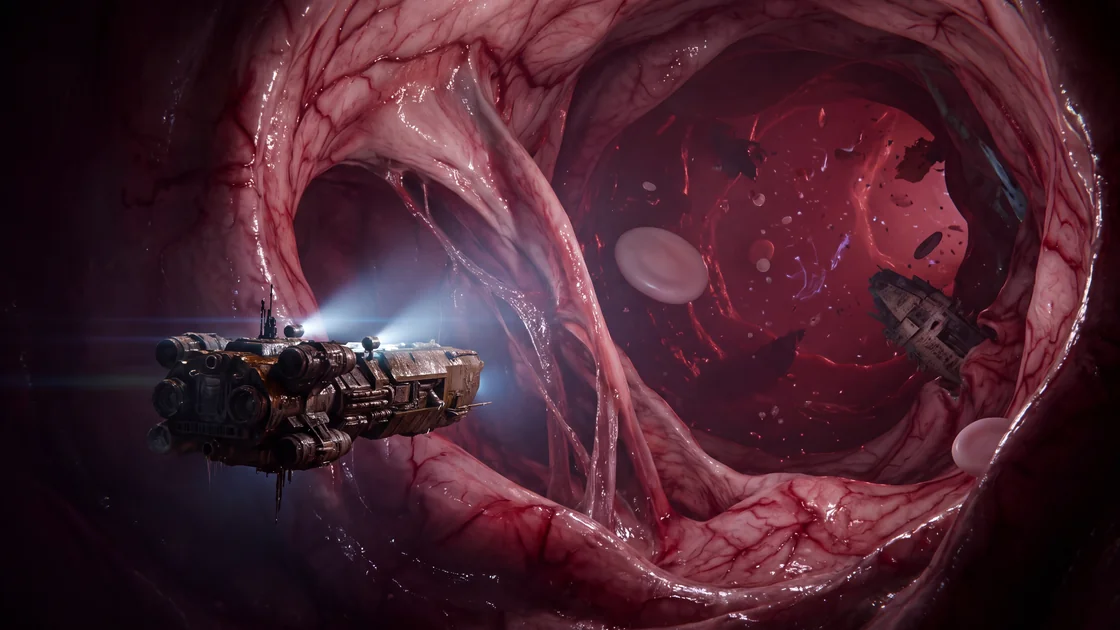
This is the account of Captain Jeremy Vance and the crew of the deep-range surveyor Eidolon, who, during a high-risk transit through the uncharted trans-Sagittarian slipstream, uncovered the horrifying physical reality underlying humanity’s interstellar empire. What generations of stellar cartographers cataloged as an abiotic sub-dimensional continuum—the frictionless, tachyonic river known as the Veil—was never an empty mathematical fold of space-time, but the pressurized, living circulatory system of an entity stretching across galactic superclusters. Caught in the violent throes of a cosmic immune response triggered by their own ship's drive emissions, Vance and his crew were forced to navigate a monstrous biological architecture of endothelial walls, phagocytic leviathans, and systolic gravitational shocks, ultimately realizing that every faster-than-light jump humanity had ever made was an act of parasitic infection within the flesh of an unthinking god.
Act I: The Salt on the Hull
The hull of the Eidolon was weeping.
It was not water, nor was it the thin, bitter condensation that accumulated in the utility crawlspaces where the atmospheric scrubbers failed to equalize. It was a pale, amber grease, smelling faintly of cold iron and curdled sea-brine. Chief Engineer Taelen had scraped three ounces of it from the secondary heat-exchangers after their emergence near the edge of Sector Nine, sealing the viscous curd into a Teflon centrifuge tube.
"Not coolant," Taelen had muttered, dropping the vial onto Jeremy Vance’s slate desk. The vial was warm to the touch. "Not reaction mass. Not lubricating gel from the drive gimbal. It’s got an iodine rating off the charts, Captain, and when I ran a thermal arc across a micro-drop, it didn't scorch like petroleum. It charred. It smelled like fried liver."
Jeremy Vance did not touch the tube. He sat behind his desk in the command deck of the Eidolon, his boots hooked into the deck-retaining straps to resist the faint, rhythmic shuddering that had haunted the ship for seventy hours. The Eidolon was a long-range exploration cruiser, two hundred and twenty meters of dull tungsten-carbide plating and reinforced titanium ribbing, leased by the Pan-Colonial Cartographic Bureau to map the deep tributaries of the Veil.
"You’re tired, Taelen," Vance said, his voice flat with the gravel of recirculated air.
"I’m forty-eight hours into a double shift, Jeremy, but the mass spectrometer doesn't get hallucinations," Taelen snapped. His graying beard was stained with grease at the chin, his eyes red-rimmed behind magnifiers. "The Veil isn't clean vacuum. It never was. The Academy told us it was a hyper-spatial manifold, a non-baryonic folded topology. They told us that friction inside the corridor was an artifact of frame-dragging."
"It is," Vance said mechanically. He had recited the texts at the Admiralty in Geneva thirty years ago until his mouth felt full of chalk. The slipstream is a non-Euclidean geodesic gradient. Ships do not travel; they are displaced along the slope of least resistance.
"Then explain why the drive blades are dull," Taelen whispered. He leaned over the desk, his knuckles planted on the brushed aluminum. "The bow shields are eroded, Jeremy. Not pitted by micro-meteorites. They’re smoothed. Lapped down, like stones in the bed of a river. There is matter in the drift. High-density, complex organics. And the ship is choking on them."
From the forward bulkhead, the intercom chimed once—a clean, three-tone pulse that sounded hollow in the low-pressure atmosphere of the bridge.
"Bridge to Captain," came the voice of Mara Chen, the astrogator. "We’re approaching Transition Marker Forty-Two. The gradient is steepening. If we’re going to drop out for the scheduled maintenance cycle, we need to spin down the coils now. Otherwise, the current takes us into the Marianas Throat."
Vance pressed the comm-toggle. "Is the current within five percent of the Bureau’s tables, Mara?"
A pause. Through the speaker, Vance could hear the high, thin whine of the inertial dampeners struggling against a low-frequency hum that seemed to originate from nowhere—or everywhere.
"Negative, Captain," Chen replied, her cadence clipped, professional, but brittle. "The drift speed is up twelve percent. Pressure against the dynamic keel is... well, it’s forty atmospheres equivalent, Jeremy. Space isn't supposed to have pressure. We’re being pulled."
Vance stood up. His knees made a dry, cracking sound. At fifty-two, he had spent half his life in the hollow guts of exploratory ships, chasing lines drawn by mathematicians who had never seen the dark between the arms of the galaxy. He had buried two navigators to radiation sickness and watched a third go blind from staring into the chronos-wells. He had believed, with the quiet secular faith of an engineer, that the universe was cold, vast, indifferent, and made of math.
"I'm coming up," he said.
The bridge of the Eidolon was not a panoramic deck of sweeping glass. Glass was an absurdity under the stresses of the Veil; a window was merely a weak point waiting to implode under the shear forces of dimensional compression. Instead, the bridge was an armored egg buried deep inside the ship’s primary citadel, its walls lined with synthetic phosphor monitors that translated the sensor arrays into three-dimensional approximations of reality.
When Vance stepped through the pressure hatch, the room was bathed in the dull, rust-red light of the tactical display. Mara Chen sat slouched in the astrogation couch, her fingers flying over the brass-rimmed keys of the coordinate input array. Beside her, Dr. Aris Thorne, the civilian xenobiologist assigned to the mission by the Directorate of Resource Allocation, was staring at an auxiliary screen with his spectacles pushed up onto his bald forehead.
"Look at the shear line," Chen said without turning around. She pointed a manicured, soot-stained finger at the central holotank.
Suspended in the air above the console was the slipstream. In standard navigation manuals, the Veil was rendered as a pale blue tube, a clean geometric cylinder cutting through the crumpled gray sheets of realspace. But the representation in the tank was not blue, and it was not straight.
It was pulsing.
The stream curved through the void like an endless, undulating ribbon of deep carmine. At irregular intervals—roughly every eight seconds—the diameter of the tunnel contracted by three percent, then surged outward with a violent, elastic snap. The Eidolon was rendered as a tiny green needle trapped in the center of that convulsing path, its drive trail fluttering behind it like thread behind an erratic bobbin.
"The rhythm is steady," Thorne said. His voice was unusually soft, carrying the breathy cadence of a man who had spent forty years in lecture halls and had suddenly found himself in a slaughterhouse. "Eighty-two contractions per standard minute, Vance. It hasn't deviated since we crossed the threshold of the Sector Nine node."
"It’s an harmonic oscillation," Vance said, stepping up to the edge of the tank. "A standing wave produced by the resonance of our own Alcubierre rings. We’ve seen resonance flutter before on the Cygnus run."
"No," Thorne whispered. He reached out, his long fingers cutting through the light of the holographic beam. "Resonance decays or amplifies exponentially until the vessel suffers catastrophic hull failure. This doesn't amplify. It compensates. When we throttled back our main reactor twenty minutes ago to test your hypothesis, the wave didn't subside. The walls thickened. The ambient temperature in the slip-stratum rose three degrees Kelvin. It was... adjusting."
"Adjusting to what?" Vance asked.
"To an obstruction," said Thorne.
A heavy, shuddering groan passed through the Eidolon. The sound did not come through the hull’s exterior microphones—there was no sound in the vacuum, even in the semi-substantive medium of the Veil. The noise came from the frame itself, the massive longitudinal ribs of the ship vibrating as if gripped by an immense, greasy hand.
"Captain," Chen called out, her voice rising an octave. "We’ve dropped past the abort threshold. We’re entering the Marianas Throat. The drift is... God, Jeremy, the drift is fifty knots tachyonic. We’re being siphoned."
"Reverse main thrusters," Vance ordered instantly. "Dump the aux-coils. Drop us back into baryonic space. Punch a hole through the shear wall."
"We can't," Chen said. Her hands were trembling now; she hit the release for the drive-sync, and the console chattered back a string of sharp red errors. "The exterior gradient is too dense. If we fire the transition charges against that wall, the back-blast will invert our own slip-bubble. It would be like firing an artillery shell into a mountain of wet rubber. It’ll pancake us."
Vance lunged toward the command station, his fingers clearing the locks on the master environmental boards. "Thorne, get off the tactical net. Taelen, I need every megawatt from the secondary core into the lateral deflectors. We don't fight the current; we trim. Treat it like a white-water rapid. Keep the nose along the vector of least resistance."
"Vance," Thorne said, not moving from his station. His eyes were wide, the pupils dilated until the irises were mere rings of watery hazel. "Listen to the hull."
Vance froze.
The groan of the titanium had changed. The mechanical shriek of metal under stress had smoothed into something else. It was a dull, rhythmic thrumming, a colossal thump-shhh, thump-shhh, thump-shhh that vibrated up through the soles of their boots, rattling the dental fillings in their jaws, vibrating the vitreous humor inside their eyes until the monitors seemed to double.
Thump-shhh.
Thump-shhh.
"Eighty-two beats," Thorne murmured. "Systole. Diastole. Jeremy... we aren't in a fold of space."
"Quiet," Vance hissed.
"We aren't in a vacuum," Thorne repeated, his voice rising, cracked and wet. "We never were. Why did the early jump-probes report that the slipstream smelled of ozone? Vacuum has no smell! It was the burning of organic lipids by the ionization of the transition fields! The whole network... the thousands of light-years of mapped routes... the trade lines from Sol to the Rim..."
"Shut up, Aris!" Vance roared. "Chen, give me real-time exterior optics. I don't care about the sensor translation. Strip the false-color filters. Turn the high-intensity searchlights along the dorsal plane."
"Captain, there’s nothing out there to see," Chen cried. "It’s a blind spectrum!"
"Burn the lamps, Mara!"
Chen slammed her palm onto the overrides.
The phosphor monitors flickered. The mathematical models vanished, replaced by the raw feed from the four-million-lumen exploratory lamps mounted along the Eidolon’s spine. The beams were designed to cut through planetary dust clouds and the dense methane fogs of gas giants.
They did not cut through the darkness outside.
The light illuminated a wall.
It lay less than two hundred meters from the starboard hull, curving above and below them until it disappeared into the violet-black haze of the slipstream. It was not stone. It was not the crystalline lattice of exotic matter.
It was a glistening, ridged plane of translucent, pearlescent tissue, pale pink and veined with sprawling, branching ribbons of deep, throbbing crimson. Miles wide, it arched over the ship like the vault of an infinite cathedral, slick with a thick, shimmering mucus that sheared off in ribbons under the wash of the Eidolon’s ion wake. Huge, pale folds of flesh, each larger than a dreadnought, rippled in a coordinated, undulating wave that drove the river forward.
And embedded within the tissue, directly beneath the glistening endothelial lining, were structures that made Vance’s breath freeze in his throat.
They were valves.
Vast, fibrous flaps of white, gristly cartilage, each five kilometers across, opening and closing with an awful, mechanical regularity. As the Eidolon was swept toward them, one of the massive leaves swung back, parting with a wet, vacuum-defying suction that sent a shockwave of liquid pressure crashing against the ship's shields.
"God above," Chen whispered. Her hands dropped from the keys. She shrank back into the padded leather of her seat, curling her knees to her chest like a frightened child. "God above, what are we inside of?"
The ship was hurled through the center of the valve. As they cleared the threshold, the searchlights caught the interior walls of the chamber beyond.
There were other things in the stream.
Dozens of them. Hundreds.
Some were the crushed, rusted hulks of ships that had gone missing decades before—the Covenant, the Persephone, an old freighter from the First Expansionary War, its midsection snapped clean in half and coated in a thick, velvety moss of gray, fungal filaments. But most of the objects were not ships.
They were disk-shaped, pale, and twenty times the size of the Eidolon. They tumbled through the red current without propulsion, their surfaces dimpled and smooth, rolling over one another like monstrous, blind coins. Vance watched, his heart hammering against his ribs in time with the roaring pulse of the corridor, as one of the disks drifted near an old cargo pod.
The disk did not collide with the pod. It simply flowed around it. The gray metal of the container did not shatter; it began to bubble, to dissolve into a froth of brown acid, its iron and lead drawn into the translucent mantle of the disk until nothing remained but a phantom smudge of carbon.
"Leukocytes," Dr. Thorne breathed, his fingers clawing at his spectacles until they fell against his chest. "Not an anomaly. Not an engine trail. A lymph system. Jeremy... we are in the blood."
Act II: The Anatomy of the Void
The Eidolon drifted down the length of the great conduit for forty hours without firing a single burst from its main drives.
Taelen had insisted on it. He had come up from the engineering bay with his face gray with engine-sludge, his hands shaking so violently he could barely hold his diagnostic pad. He had stood in the center of the bridge and told Vance, in terms that admitted no compromise, that if they ignited the magnetic ram-jets again, they would die.
"It knows where we burn," Taelen had said. "The engine wash isn't just propellant to this... to this thing. It’s an irritant. It’s like pouring boiling acid onto the inside of your cheek. Every time the drives flare, the wall secretes. The mucus gets thicker. And those... those flat things... they turn toward the heat. They’re drawn to the ionization."
"We can't drift indefinitely," Vance said. He sat at the command console, his face illuminated by the low-gain optical screens. "The current is accelerating. Look at the telemetry."
He pointed to the lower quadrant. The Eidolon was moving at an impossible rate, even for the slipstream. In conventional space, their speed would have translated to nearly eight hundred times the speed of light; here, it was measured simply as a function of the vessel’s fluid displacement. The density of the medium was rising. The ambient temperature against the outer hull was thirty degrees Celsius now—the temperature of fresh, living blood.
"Where is it going?" Chen asked. She had not left her station, but she had stopped looking at the astrogation charts. The charts were useless. They had been drawn by surveyors who believed they were charting the geometry of empty space, naming sectors like The Perseus Arm, The Cygnus Loop, The Sagittarius Reach.
Now, those names felt obscene.
"If the model holds," Thorne said, standing behind Chen with a pencil and a pad of scrap paper—he had abandoned his electronic slates, claiming their high-frequency signals were 'too loud'—"then the major trade corridors correspond to primary vascular bundles. The Sol-Vega run is an anterior carotid. The Rim Route... that’s an extremity. A capillary bed. That’s why the jumps out there are so narrow, so volatile. Ships disappear out there all the time. We thought it was gravitational shearing from dark matter clusters."
He let out a dry, rattling laugh that had no humor in it.
"It wasn't shear. It was thrombosis. A ship drops out of the slipstream because the capillary collapses, or because an embolus—one of those calcified mineral masses we’ve been tracking—sweeps down the channel and crushes it to powder."
"And the Core?" Vance asked quietly. "The Great Central Hub? Where all the slipstreams converge?"
Thorne looked at him. In the dim red light, the xenobiologist’s eyes looked like black holes bored into his skull.
"The heart," Thorne said. "Or the liver. A mass of muscular tissue twenty light-years wide, pumping eighty-two times every three minutes, driving the energetic flux through five hundred billion light-years of baryonic universe. Jeremy... humanity didn't discover faster-than-light travel. We didn't crack the code of the universe. We found a tick-bite. We found a way to drill our hollow needles into the flesh of a beast so vast that the whole Milky Way is nothing more than a parasite-nest on its ribs."
"Captain," Chen interrupted. Her voice had lost its panic, settling into a flat, dead calm that was far more terrifying. "Look at the bow sensors. We have a contact."
Vance leaned forward, his hand dropping to the alert horn before he remembered Taelen’s warning and pulled it back. "Is it an immune body?"
"No," Chen said. "It has a transponder. It’s faint... very faint. The signal is being attenuated by the fluid density. But it’s an Admiralty registry. Pan-Colonial Registry 88-Beta. The Kestrel."
Vance’s stomach dropped.
The Kestrel had been the pride of the Third Survey Fleet. It had vanished twelve years ago during a reconnaissance run through the Marianas Sector. Vance had known her captain—Marcus Lowe. They had shared a bunkhouse at the Ganymede Training Station when they were both midshipmen, drinking synthetic gin and arguing about whether the stars had purpose.
"Show me," Vance said.
Chen adjusted the focus of the optical array.
The Kestrel was not floating free. It was pinned against the side of the conduit, three kilometers to the port side of their current trajectory.
The ship was half-buried in the pinkish-white flesh of the wall. Vast, fibrous bands of tissue—glistening with yellow, translucent serum—had grown over its command bridge and through the ruptured gaps in its radiator arrays. The metal of the hull had not been torn apart; it had been integrated. The titanium ribs had become a scaffolding for a thick, spongy growth of veined meat that pulsed with a slow, sickening rhythm independent of the main arterial beat.
From the shattered ruin of the Kestrel’s secondary hangar, a long, cord-like growth trailed out into the current, swaying in the slipstream like a deep-sea kelp frond. At its tip was a cluster of pale, milky orbs, each the size of a shuttlecraft.
"It’s being digested," Thorne whispered, leaning down until his nose nearly touched the glass of the display. "No... not digested. Assimilated. The organism doesn't discard foreign matter if it contains heavy metals. It encases it. It uses the iron from the hull to strengthen its own vascular walls. Look at the plating. That isn't rust. It’s hemoglobin-binding."
"The transponder," Vance said, his voice dropping to a gravelly rasp. "Why is the transponder still broadcasting? The Kestrel’s batteries should have decayed a decade ago."
Chen did not answer. She manipulated the controls, magnifying the signal trace.
The transponder was not sending the standard automated distress code. The three-digit binary ping had been altered. The intervals were wrong.
Dot... dot... dash... pause.
Dot... dot... dash... pause.
"That’s not the emergency beacon," Vance said. "That’s manual keying."
"It can't be," Taelen said, his voice trembling from the hatchway. "Twelve years, Jeremy. The air scrubbers alone... the water reserves... there’s no way."
"The transponder is drawing power from the organism," Thorne said. He took off his spectacles and wiped them on his torn shirt, his eyes glittering with a strange, manic light. "Don't you see? The ship has been plugged into the nervous system. If the hull has been integrated into the tissue, the electrical potential across those membranes is immense. Thousands of volts per meter. The Kestrel isn't dead. It’s an organ now. A sensory node."
"Then who is keying the code?" Vance demanded.
The bridge fell silent. The only sound was the heavy, wet thump-shhh of the conduit outside, vibrating through the bulkheads, through their bones, through their teeth.
Dot... dot... dash...
"Mara," Vance said. "Match speed with the Kestrel. Use the cold-gas thrusters only. No plasma. No magnetic leakage. Just nitrogen bursts."
"Jeremy, no," Taelen said, stepping forward, his hands raised. "We can't stop here. The current is pulling us toward the central channel. If we pull out of the main drift, we’ll get caught in the boundary layer. The shear will tear our fins off!"
"There may be survivors, Taelen," Vance said, though he did not believe it.
"There are no survivors!" Taelen shouted, his voice cracking with hysteria. "There is only meat! Look at it! That isn't a ship anymore, it’s a gallstone! We have to punch through! We have to take the chance with the transition charges—"
"I am the Captain of this vessel," Vance said, his voice dropping into that cold, level register that had seen him through two reactor scuttles and the famine on Ceres. "And you will secure your station, Chief Engineer. Mara, trim the gas. Bring us within fifty meters of the Kestrel’s primary lock. We’re going to look inside."
Act III: The Calcified Tomb
The boarding party consisted of Vance, Thorne, and a junior technician named Miller, who had not spoken a word since the searchlights had first revealed the walls of the conduit.
They did not wear standard EVA suits. Standard suits were designed for the dry, clean vacuum of baryonic space, equipped with radiation shielding and low-emissivity thermal layers. Instead, they had donned the heavy-duty salvage suits—bulky, rubberized diving envelopes intended for work inside flooded fuel tanks and chemical reservoirs.
The airlock of the Eidolon cycled with a wet, sucking gasp.
When the outer hatch swung open, there was no rush of air into the void. The pressure inside the conduit was nearly equal to the ship’s internal atmosphere. What entered the airlock was not space, but an odor.
It swept through the filtration units of their helmets—a smell of warm, copper-scented mud, rotting kelp, and something sickeningly sweet, like the breath of a cow that had been eating sugar beets.
"Pressure nominal," Miller whispered, his voice tinny in Vance’s earphones. "Atmosphere is... seventy percent nitrogen, eighteen percent dissolved helium, four percent oxygen... and the rest is an aerosolized lipid vapor. Captain, we don't even need the tanks. We could... we could breathe this."
"Keep your helmets sealed," Vance commanded. "The vapor has an acid index of four. It would eat your mucous membranes in ten minutes. Step out. Mind the lines."
They walked out onto the Eidolon’s hull.
It was like standing on a ledge above a river of liquid amethyst. Below their boots, the hull was covered in an inch of that thick, amber scum, slick as grease. Above them, the ceiling of the conduit arched away into an infinity of glistening pink, ribbed like the palate of a blue whale’s mouth.
Every few seconds, the whole horizon shifted. The wall would drop toward them, the pink tissue tightening until it turned white, then expand with a tremendous, wet whuff that sent ripples through the amber fluid on the hull.
"Look at the Kestrel," Thorne said.
The salvage vessel had drifted to within forty meters of the derelict. Between the two ships, the gap was bridged by hundreds of thick, fibrous tendrils, white and semi-opaque, like the hyphae of an enormous mold. They had anchored into the Eidolon’s hull-welds, their tips flattening into wide, suction-tipped pads that oozed a clear, rubbery glue.
Vance drew his sidearm—a heavy cutting torch modified for demolition—and stepped onto the largest tendril.
It did not yield under his weight. It was as firm as cured timber, vibrating with a high-frequency shudder that he could feel through his magnetic boots. He walked along it, his searchlight beam cutting through the dense, violet mist that hung between the ships.
The Kestrel’s outer airlock had been ripped away. In its place was a sphincter of thick, purplish flesh that contracted and relaxed in sync with the pulse of the main corridor.
"We have to cut through," Miller said, his voice climbing toward panic as he pointed his own torch at the meat.
"No," Thorne said, reaching out to slap Miller’s arm down. "Don't burn it. If it’s an integrated nervous structure, pain will cause an involuntary reflex. It could contract and crush the airlock corridor. Look at the rim. It has sensory papillae."
Thorne stepped past Vance, his gloved hands reaching toward the edge of the fleshy opening. He touched the pink folds with a strange, gentle rhythm, stroking the outer margin in long, circular sweeps.
The sphincter trembled. It hesitated, then slowly, with a sickening sound like a boot pulling out of deep mud, it dilated.
"Fascinating," Thorne whispered. "It recognizes organic tactile stimulus. It thinks we’re an internal secretion. A gland."
"Inside," Vance said, his skin crawling. "Keep your torches on low-intensity. If anything moves that doesn't have an Admiralty uniform on it, don't wait for my order."
The interior of the Kestrel was a charnel house of biomechanics.
The corridors were half-filled with an amber fluid that reached to Vance’s knees, thick and warm, resisting their motion like cold syrup. The bulkheads were no longer flat; they had been lined with an irregular, cobblestone pavement of bone-white calcium plates, secreted by the thousands of tiny, worm-like organisms that clustered in the angles of the ceiling.
These worms were six inches long, blind, their bodies made of clear, jelly-like flesh through which their own red circulatory loops were visible. They did not attack; they merely swayed in unison as the men passed, their mouthparts working the fluid for suspended nutrients.
"This was the mess deck," Vance said, his light sweeping across a row of stainless steel tables that had been half-submerged in a mound of gray, fibrous marrow.
In the center of the room, seated at the head of the largest table, was a figure.
It wore the tattered blue uniform of an Admiralty Commander. The gold braid on the shoulders had been turned green by acid, and the brass buttons had been replaced by small, barnacle-like crustaceans that opened and closed their shells with tiny, clicking snaps.
Vance approached, the amber liquid sloshing against his thighs.
The figure did not have a face.
Where the nose and mouth should have been, a dense cluster of white, root-like fibers had sprouted from the skull, penetrating the control panel set into the table before it. The eyes were gone, their sockets filled with small, amber pearls of calcified fluid that caught the beam of the flashlight like cat’s eyes.
Yet, the hands were whole.
The skin of the fingers was gray, leathery, and dry, preserved by some chemical process that had prevented standard putrefaction. The right index finger was taped to the contact-arm of a manual telegraph key, wired directly into the copper leads of the ship’s emergency beacon.
And the finger was moving.
Click.
Click-click.
Click.
It was not an autonomous reflex of the muscles. The movement was driven from within the table itself. Vance looked beneath the console and saw that the white roots had grown up through the floorboards, through the boots, up the hollow shafts of the leg bones, and into the tendons of the wrist. The dead man was not keying the machine.
The organism was using the dead man’s hand to complete the circuit.
"He isn't signaling for help," Thorne whispered. He had leaned down, his faceplate inches from the Commander’s eyeless skull. "He’s... it’s an impedance check. Like a nerve ending testing its own continuity. Marcus Lowe isn't a pilot anymore, Jeremy. He’s a receptor."
"Turn it off," Miller choked out. "Turn it off, Captain, please, God, turn it off—"
"Wait," Vance said.
He reached down and gently placed his gloved hand over the leathery fingers of his old friend.
Under the rubber of his glove, he could feel the pulse. It was not eighty-two beats a minute. It was faster. Irregular. Thready.
Like the pulse of a man running for his life.
"It’s sick," Vance said.
Thorne looked up at him. "What?"
"The rhythm," Vance said, his own voice sounding distant to his ears. "Back on the Eidolon, you said eighty-two beats. But feel this. It’s up to one hundred and ten. The walls are hotter. The current is faster. It isn't just pulling us along, Aris. It’s in tachycardia."
"The drives," Thorne said, his eyes widening behind his visor. "The hundreds of ships... the thousands of trade routes... the Core Fleet... they’ve been expanding the slipstream network for forty years. Every time they deploy a Slip-Node, they use graviton drills to 'stabilize' the channel."
"They aren't stabilizing," Vance said, the horror dawning on him with the cold finality of an execution. "They’re cauterizing. They’re running hot wires through the veins to keep them open. We’ve turned the entire arterial tree into an inflamed, scarred ruin."
A sudden, violent spasm threw them against the bulkhead.
The amber fluid in the corridor sloshed toward the ceiling, drenching their helmets. Outside, through the torn hull-plates of the Kestrel, they heard a sound that was not a mechanical groaning, but a high, whistling scream—the sound of gas and liquid being forced at astronomical pressures through a narrowing pipe.
"The Eidolon!" Miller shrieked. "Look at the line!"
Vance lunged to the doorway.
The umbilical tendril connecting them to their ship was stretching. The Eidolon was being dragged backward, its hull bucking against the current as a vast, dark shape emerged from the red murk of the channel behind them.
It was not a leukocyte.
It was a cylinder of black, segmented armor, three miles long, ringed with rows of pale, waving limbs that ended in hooked claws the size of transport shuttles. Its center was an open, circular maw lined with concentric rings of triangular, obsidian teeth—not teeth of bone, but of compressed carbon-silicate, spinning within the gullet like the heads of industrial tunnel-boring machines.
"Thrombocyte," Thorne whispered, his voice hollow with awe. "A clot-former. It’s coming to seal the leak."
"Back to the ship!" Vance roared, grabbing Miller by the harness and shoving him toward the airlock sphincter. "Move, Miller! Run!"
They scrambled across the tendril, their magnetic boots skittering on the greasy surface as the black leviathan bore down on them. The current was so strong now that Vance had to lean his body forward at a forty-five-degree angle just to keep from being swept off his feet and into the red abyss.
The Eidolon’s searchlights were flickering.
Through the forward viewports of their ship, Vance could see Mara Chen’s face, pale as paper, her mouth open in a scream he could not hear. Beside her, Taelen was at the auxiliary controls, his hands moving with the desperate fury of a man about to die.
The black beast did not ram them.
It opened its maw.
The vacuum between the ships collapsed. A wave of black, thick sludge—pure cellular debris, dense with the wreckage of half-digested starships and the iron-rich hulls of centuries—erupted from its throat, burying the Kestrel in an avalanche of suffocating black mud.
The tendril snapped.
Vance leaped. His hands caught the edge of the Eidolon’s outer airlock frame just as the Kestrel was wrenched free from the wall, swallowed whole by the black cylinder, and dragged down into the roaring red throat of the deep slipstream.
Miller slipped.
"Jeremy!"
Vance lunged downward, his fingers locking into the nylon webbing of Miller’s chest rig. The technician was dangling over the void, the slipstream current tearing at his boots like the drag of an ocean rapid.
Beneath them, the black beast rolled its blind, segmented body, its obsidian teeth grinding through the titanium framing of the Kestrel with a sound like iron filings being dropped into a blender.
"Hold on!" Vance screamed.
"I can't!" Miller sobbed. "Captain, it’s pulling my legs! Something’s... something’s in the fluid!"
Vance looked down.
Climbing up Miller’s legs were thousands of tiny, hair-like threads, red and translucent, boring through the rubberized fabric of the salvage suit, anchoring themselves into the seams of his boots. They weren't just dragging him; they were drinking him. The suit’s pressure integrity gauge was dropping through the red.
"Cut them!" Miller wailed. "Cut them!"
Thorne appeared beside Vance, his cutting torch flaring into a pale blue needle of fire. He swept the flame across Miller’s legs.
The smell of burning rubber and scorched meat filled the airlock. Miller screamed, his body thrashing, but the red threads withered under the heat, blackening into curling ash.
Together, Vance and Thorne hauled the technician through the hatch, slamming the manual override.
The outer door clanged shut.
The pumps did not cycle air. They cycled blood.
The amber grease surged through the drainage grates, filling the small chamber to their knees before the high-pressure scrubbers could equalize the volume. Inside their helmets, the three men lay panting, listening to the hull ring like an anvil under the blows of the debris field outside.
Over the intercom, Mara Chen’s voice was broken by static and the heavy, rhythmic thrumming of the great engine.
"Jeremy," she wept. "Jeremy, the current... we’re through the Marianas. We’ve entered the Ventricle."
Act IV: The Great Ventricle
The Eidolon was no longer in a pipe.
When Vance climbed back onto the bridge, his suit half-stripped, his skin reeking of the bitter iron grease that had leaked through the seals, he looked at the main display and felt his mind tilt on its axis.
The concept of size ceased to have meaning.
They were inside a chamber that could have swallowed a solar system.
The walls were not visible as distinct barriers; they were horizons of dark, liver-colored flesh that rose like mountains on all sides, miles-high ridges of muscle that contracted and relaxed with the weight of entire moons. The ceiling was lost in a violet-black storm of bio-electric discharge—lightning bolts three hundred kilometers long that leaped from the crests of muscular ridges, grounding themselves into the bubbling sea below.
And the sea—
The floor of the chamber was a boiling, churning ocean of red hemolymph, dotted with floating continents of bone and pale, fatty tissue. Islands of calcified debris, each the size of a continent, drifted across the surface, covered in forests of waving, luminescent cilia that reached up into the sky like trees of fiber-optic wire.
"The heart," Thorne said.
He was sitting on the deck plates, his back against the bulkhead, his knees drawn to his chin. He had not taken off his helmet, though the visor was fogged with his own breath. He was rocking back and forth, his fingers tapping out that eighty-two-beat tempo against his shins.
"The Core," Vance said, his voice a whisper.
He looked at the astrogation display. The nav-computer, still trying to interpret the environment through the lens of geometric physics, had mapped the chamber as an impossible multi-dimensional singularity. It showed seven different stellar exits—the great trade routes of the galaxy.
The Orion Way. The Cygnus Arterial. The Sagittarius Trunk.
All of them were here.
They were great, gaping orifices in the walls of the chamber, thirty light-minutes wide, ringed with massive muscular sphincters that dilated and constricted in a horrific, staggered sequence. Every time the floor of the chamber rose—every time that miles-thick ocean of muscle contracted—millions of tons of the red fluid were driven up into those holes with the force of a supernova.
And trapped in that chamber were thousands of ships.
Not all of them were derelicts.
Vance could see them through the tele-arrays: standard bulk-haulers of the Pan-Colonial Mercantile Fleet; sleek, silver passenger cruisers from the Core worlds; long, wedge-shaped destroyers of the Admiralty Patrol.
They were all drifting.
Some had their engines dead, their hulls dark and silent, bobbing on the surface of the red ocean like dead bugs in a rain barrel. Others were fighting—their fusion drives flaring with blinding white-blue brilliance as they tried to claw their way toward the exit sphincters.
"Why aren't they jumping?" Vance asked, his hand gripping the back of Chen’s chair. "Why don't they execute a transition jump back to realspace?"
"They can't," Chen said. Her voice was flat, her eyes fixed on the radio spectrum. "Listen."
She turned the audio monitor on.
The speaker did not produce the whistle of cosmic rays or the white noise of radiation. It was a cacophony of human voices, layered five hundred deep, a chorus of despair that had been broadcasting for weeks, months, years.
—This is Hauler 404, we are caught in the down-well, our coils are blown, we have no—
—Mayday, Mayday, Admiralty vessel Iron Duke, our drives have ignited the surrounding medium, the gas is burning, the whole space is on fire, we cannot—
—Do not use your drives! If you burn, they come! The white ones... they come from the floor! They smell the—
—My God, my God, it’s a lung, it’s not a space, it’s a—
—Please, someone tell my wife on Mars that the—
Chen cut the audio.
"The drives don't work here because the pressure is too high," she said. "The transition fields require a flat space-time metric to establish the Alcubierre bubble. Here... the metric is curved into knots by the mass of this... this meat. If you try to open a jump-window, the field collapses back onto the reactor. You just vaporize yourself."
"And if you drift?" Vance asked.
"Look down," she said.
Vance looked at the lower optical screens.
The sea was moving.
Rising from the depths of the red ocean were structures like white islands. But they were not islands. They were the leukocytes Vance had seen earlier, but grown to the size of provinces. Pale, amoeboid masses of clear, jelly-like protoplasm, they moved with a terrifying, purposeful slowness, their surfaces undulating as they rose toward the drifting ships.
One of them—a glistening disk five miles across—surfaced beneath a three-hundred-meter ore carrier.
The carrier’s captain fired his maneuvering thrusters. A plume of orange flame washed across the white membrane.
The organism did not retreat.
A single, massive pseudopod, thick as a skyscraper, erupted from the center of the disk. It came down across the ship’s spine, not smashing it, but enveloping it. The metal began to glow cherry-red, then white, not from heat, but from some violent, enzymic dissolution. The ship did not explode; its tanks were breached, its fuel absorbed, its crew...
Vance turned his head away.
"It’s an infection," Thorne said from the floor. His voice was louder now, ringing inside the small bridge. "Don't you see the poetry of it, Jeremy? We thought we were the masters of creation. We thought we had built a network that unified the stars. But we’re bacteria. We’re staphylococcus, breeding in the warm, wet crevices of a body we can't comprehend."
He began to laugh—a high, piping giggle that ended in a coughing fit.
"And what does a body do when it has an infection, Vance? What does it do when the parasites burrow too deep into the heart?"
The deck tilted under them.
The Eidolon was not being drawn toward one of the exit conduits. It was being pulled toward the center of the chamber.
There, in the middle of the red ocean, was a pit.
It was not a hole through the floor; it was a depression, a whirlpool fifty miles wide, where the fluid plunged down into an abyss of absolute darkness. Above the vortex, suspended in the bio-electric sky, was a cluster of black, pulsing nodes, each the size of a small moon, connected to the walls by cables of gristly nerve tissue twenty miles thick.
"The pacemaker," Vance said.
"Jeremy," Taelen called out through the crawlspace hatch. He had dragged himself back to the bridge, his hands wrapped in wet rags where the acid had burned his palms. "The drive coils are fully charged. I didn't spin them down. If we ignite them all at once—if we bypass the safety limiters—we can get one three-second burst of maximum acceleration."
"You said that would kill us," Vance said.
"It will," Taelen said, his face dead, his eyes steady on the Captain. "It will burn the shields out in one second. In two seconds, the hull will reach five thousand degrees. In three seconds, the core will breach. But we’ll be moving at ninety percent of light speed. We might... we might punch through one of those valves before the ship melts."
Vance did not answer immediately.
He walked to the main console, stepping over Thorne’s outstretched legs. He looked at the displays.
The Eidolon was five minutes from the lip of the central vortex. The whirlpool was not empty; it was a grinder. He could see the wreckage of twenty different civilizations down there—ancient, non-human hulls made of blue ceramic, strange spiral ships that looked like dried shell-casings, all of them caught in the teeth of that colossal, rotating valve, crushed into a fine, gray slurry to be fed back into the metabolic current.
He looked at the pacemaker.
The black nodes were firing. Every eight seconds, a burst of blue-violet fire, thick as a continent, exploded from the central node, rippling through the nerve cables into the walls of the chamber.
And with every burst, the heart jumped.
Thump-shhh.
Thump-shhh.
"Mara," Vance said.
"Yes, Captain?"
"What is the resonant frequency of the pacemaker?"
She looked up, her fingers hesitating over her keys. "What?"
"The nerve nodes," Vance said. His voice was steady now, the panic burning away, replaced by the cold, tactical clarity that comes to a doomed sailor when the water hits his chin. "Everything in biology has an action potential. A nerve impulse isn't magic; it’s an electrical gradient. A depolarization of sodium and potassium ions across a lipid membrane. Thorne—am I right?"
Thorne stopped laughing. He blinked through his fogged visor, his mouth open. "Jeremy... you can't... you can't kill it. It’s light-years across. It would be like a flea trying to shoot an elephant."
"I don't want to kill it," Vance said. "If we kill it, the slipstream collapses. Every ship in the galaxy drops into the void or gets crushed by the dead meat. I don't want to kill it. I want to give it a heart attack."
The bridge went utterly silent, save for the wet, roaring pulse of the sea outside.
"A cardiac arrest," Vance said. He pointed his finger at the central node. "A localized arrhythmia. If we hit that node with our transition charges—not to jump, but to create a localized metric distortion—we break the pacing sequence. What happens to a heart when the ventricle goes into fibrillation, Aris?"
Thorne stared at him, his spectacles sliding down his nose inside his helmet.
"It... it flutters," the biologist whispered. "The pressure drops. The valves fall open. The muscular walls go flaccid until the node can reset its polarization."
"And the exit conduits?"
"They stay open," Mara Chen gasped, her eyes flying across the holotank. "The sphincters... they’re muscular. If the current fails, the sphincter muscles lose their tone. They don't clamp shut—they relax!"
"Taelen," Vance turned to the engineer. "Can you route the transition charges through the main sensor array? Focus the whole field into a needle instead of a bubble?"
Taelen looked at his bandaged hands, then at the central screen where the black node pulsed with blue fire.
"It’ll blow the bridge," the engineer said quietly. "The array is right above our heads. The back-scatter will cook the forward half of the ship. We’ll have to run the ship from the auxiliary engine bunker in the stern."
"Then get down there," Vance said. "Take Mara and Miller with you."
"Captain," Chen said, rising from her couch. "You need an astrogator to calculate the vector."
"The vector is straight ahead, Mara," Vance said. He did not smile, but his eyes softened as he looked at her. "There’s no astrogation here. It’s just downstream. Go. Now."
She looked at him for three seconds, then turned and followed Taelen down the narrow ladder into the crawlway. Miller, weeping quietly through his respirator, crawled after them.
Thorne did not move.
"You too, Aris," Vance said.
"No," Thorne said. He settled his back more comfortably against the bulkhead. "I'm fifty-eight years old, Jeremy. I’ve spent my life studying beetles and algae on dead moons. I have seen the face of God, and it’s a tapeworm. I don't want to go back to the Bureau. I don't want to write papers on resource allocation. I want to see if it works."
Vance looked at him, then nodded once. "Fair enough."
Vance sat down in the astrogator’s couch. He strapped himself in, pulling the five-point harness tight until the buckles bit through his heavy salvage suit. He linked the manual trigger for the transition coils to his own console.
Outside, the Eidolon entered the outer rim of the vortex.
The ship was tilted on its side, the hull dragging through the red sea with a screaming roar of boiling spray. Through the forward screens, the black node was directly overhead now, a vast, craggy moon of dark, glistening meat, hung with thousands of miles of twitching, white fibers.
The bio-electric charge was so intense that sparks were leaping from the metal rivets on the bridge walls. Vance’s teeth ached; the iron filling in his lower jaw tasted like galvanized zinc.
"Distance to target: two hundred kilometers," Vance said aloud to the empty room.
The pacemaker was gathering charge. A blue light, bright as a welding arc, was spreading through its base, preparing for the next systolic blast that would drive the Eidolon down into the grinder.
"One hundred kilometers."
"Jeremy," Thorne said quietly from the deck. "Do you think it knows we’re here?"
Vance put his thumb on the arming switch.
"I hope not," he said.
The node flared.
Vance threw the switch.
Act V: The Great Systole
There was no sound.
A metric distortion does not produce sound waves; it produces an instantaneous inversion of local geometry. The space between the Eidolon’s bow and the central pacemaker was suddenly zero. For a microsecond, the ship’s sensor array occupied the exact same coordinate in eleven dimensions as the core of the living node.
The transition charges fired.
The flash was not white. It was a color that Vance had never seen, a color that existed only on the far side of human perception—a violent, electric violet that tasted of copper and burned through his closed eyelids, through his skull, through his dreams.
The bridge exploded.
The ceiling buckled downward, torn like wet cardboard by the back-scatter of the gravitational wave. A wall of blue fire swept through the instrumentation, vaporizing the phosphor screens, turning the plastic dials into liquid slag in a thousandth of a second.
Vance was thrown against the straps, the air driven from his lungs in a bloody spray that splattered the inside of his visor. Through the haze of his failing vision, he saw Dr. Thorne.
The xenobiologist was not strapped down.
He did not scream. He was lifted by the pressure wave, his arms thrown wide, his body silhouetted against that impossible, violet fire. For a single, eternal fraction of an instant, Vance saw Thorne’s face through his melted visor.
He was smiling.
Then the fire took him, and he was gone.
And then—the beat stopped.
The roaring, rhythmic thump-shhh that had vibrated through the ship for five days did not fade; it snapped.
The entire universe seemed to lurch to the left. The miles-high walls of the Great Ventricle did not contract—they shuddered, their ridges turning loose and pale, like the flesh of an old man’s arm. The boiling red ocean did not surge; it fell flat, its waves collapsing into an oily, glass-smooth sheet of dead carmine.
The vortex stopped spinning.
The Eidolon was still moving.
Taelen’s three-second burn fired from the stern. The ship was hit by forty gravities of instant, brutal acceleration. The inertial dampeners, starved of power by the explosion on the bridge, shrieked and died. Vance felt his ribs crack, one by one, like dry kindling beneath the heel of a boot. His vision turned black at the margins, then red, then gray.
Through the shattered hole where the bridge ceiling had been, he saw the sky.
The sphincter of the Orion Way was not closing.
It was slack.
A circular mouth fifty thousand miles wide, its gristly white lips hanging loose, paralyzed by the sudden cessation of the nerve pulse. Beyond it, through the long, pale throat of the conduit, Vance did not see the red murk of the slipstream.
He saw stars.
Cold, hard, pin-prick points of clean, white light, set into the perfect, dead, empty black of a baryonic vacuum.
The Eidolon tore through the opening.
The hull screamed as it scraped against the limp, rubbery cartilage of the valve. The secondary radiator arrays were sheared off, the communication antennas flattened, the outer armor plates lapped away like fish scales under an iron blade.
Then came the silence.
It was not the damp, heavy silence of the biological chamber. It was the vast, indifferent silence of three degrees Kelvin.
The amber grease on the hull froze instantly, turning into a brittle, white frost that cracked and drifted away into the dark like powdered bone.
Vance lay in the broken wreckage of his seat.
The emergency indicators were dead. The red tactical lights were dead. There was only the starlight, streaming through the jagged hole in the bridge deck, cold and clean and merciless.
He coughed. Blood hit the inside of his visor, dark and warm, but his lungs were still drawing air—thin, stale air that whistled through the emergency seals of the crawlway hatch.
The hatch moved.
Mara Chen dragged herself onto the bridge. Her uniform was burned away at the shoulder, her face smeared with soot and blood, her left arm hanging limp at her side. She looked at Vance, then at the empty space where the console had been, then up through the hole in the hull.
She fell to her knees beside him, her good hand reaching out to touch his broken chest.
"We’re out," she whispered.
Vance could not speak. He moved his head an inch to the side.
"We’re out," she repeated, her voice cracking into dry, rattling sobs. "We’re in the Orion Spur. Three light-months from the Barnard Node. Jeremy... we’re in realspace."
Vance closed his eyes.
He listened.
There was no pulse. There was no eighty-two-beat thrumming. There was only the faint, metallic pinging of the Eidolon’s cooling engines, and the hiss of oxygen through his torn suit.
They were safe. They were in the vacuum. The clean, dead, mechanical vacuum of the maps.
Then, from the far side of the bulkhead—from the deep, cold metal of the ship’s keel—he felt it.
It was very faint.
A hundred light-years away. Or perhaps five hundred.
A slow, massive, shuddering thump.
Pause.
Thump-shhh.
The pacemaker had reset.
The beat had resumed.
Vance opened his eyes and looked up at the stars.
They were not lonely lamps burning in an empty house. They were not diamonds scattered on black velvet.
They were the white tips of cells. They were the burning, incandescent nerve-endings of a body that filled the night, cold and ancient and hungry, waiting for its next breath, while deep inside its veins, the tiny, blind iron needles of humanity continued to crawl.