The Great Berceuse of the Spheres
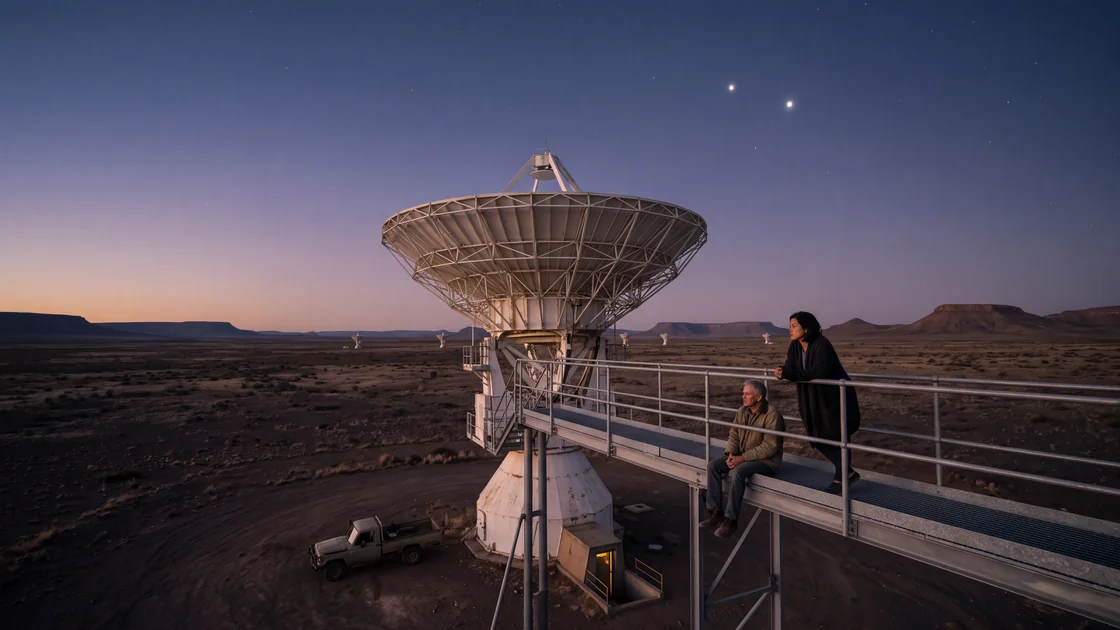
This is the account of Dr. Arthur Finch, an aging radio astronomer stationed in the arid quiet of South Africa’s Karoo desert, who detected a recurring mathematical anomaly in the long-wavelength magnetospheric emissions of the solar system’s outer planets. What initially appeared to be instrumental drift or solar wind noise revealed itself through deep Fourier analysis to be an intricate, non-random system of gravitational and electromagnetic harmonics produced by orbital resonances. Assisted by celestial dynamicist Dr. Maya Lin, Finch determined that the planets have been locked in an evolving, millions-of-years-long polyphonic composition that mirrors terrestrial musical structures—specifically, an ancient, cyclical berceuse. As the research progressed, the mathematical trajectory of these celestial ratios unveiled a chilling and sublime truth: the orbital variations are moving toward a terminal resonance that will subtly shift Earth’s climate and magnetic envelope, bringing a gentle, irreversible conclusion to the biosphere. Rather than a catastrophe of fire or impact, the solar system was discovered to be an enormous, indifferent music box playing a vast and tender farewell lullaby for mankind.
I. The Karoo Silence
The Karoo does not forgive vanity. It is an ancient, flattened plateau where time has been baked out of the mudstone and dolerite, leaving only iron, shale, and the scrubby gray-green bushes that sheep chew down to the root. For thirty miles in any direction from the central dish cluster, the human voice is a trespass, and the electromagnetic spectrum is defended with the ferocity of a border war. No spark plugs; no cellular signals; no unshielded microwave ovens heating frozen soup in the staff cottages. Even the maintenance trucks are archaic, diesel-chugging things whose engines rely on mechanical compression rather than electrical timing, crawling over the gravel like beetles across an anvil.
Arthur Finch liked the silence because it did not demand his participation.
He sat in the subterranean operations room of the array, beneath three meters of compacted earth and copper mesh, surrounded by the faint, low-frequency hum of liquid helium pumps cooling the receiver heads. On the monitors before him, the sky was not a dark blue dome speckled with diamond dust, but a dynamic, undulating topography of microjansky fluxes, hydrogen lines, and synchrotron gradients. The MeerKAT dishes—sixty-four white parabolic steel eyes standing out in the scrub—were turned south-southwest, drinking in the diffuse, non-thermal emissions of the heliosphere.
Arthur was sixty-one, though his spine and knuckles claimed an extra decade. His hair was the color of unpolished zinc, kept cropped short enough that he didn't need to comb it, and his eyes had that slightly watery, unfocused glaze common to people who spent their working hours translating six-dimensional phase-space tensors into two-dimensional false-color maps.
"You're drifting again, Arthur," Maya Lin said, not looking up from her terminal across the aisle.
Maya was thirty-four, possessed a posture so rigidly upright it looked painful, and possessed an intellect that treated orbital mechanics not as a branch of physics, but as an aggressive form of architecture. She was on a two-year fellowship from the Institute of Astronomy in Cambridge, though she had spent most of her adult life moving between radio observatories: Mauna Kea, the Atacama, and now this hot, wind-scoured basin where the dust got into the keyboard switches no matter how carefully the pressure seals were maintained.
"I’m not drifting," Arthur murmured. "The baseline on dish thirty-two is wobbling. Look at the phase residuals on the cross-correlation."
"It’s ground vibration. There’s a road crew grading the R63 forty kilometers out."
"At two in the morning?"
"Road crews in the Karoo work whenever the diesel doesn't boil," she replied dryly, her fingers clattering across a mechanical keyboard with the rhythm of hail on corrugated iron. "Besides, dish thirty-two has always had an unsteady elevation bearing. It's thermal contraction. The desert drops twenty degrees the moment the sun slips behind the Swartberg."
"No," Arthur said. He picked up his mug, found the coffee stone-cold and filmed with a faint iridescence from the non-dairy creamer, and drank it anyway. "The residuals aren't stochastic. White noise doesn't have a cadence."
"Everything has a cadence if you stare at it long enough to give yourself a migraine."
Arthur didn't argue. Argument required an expenditure of air and heat that felt inappropriate in the Karoo night. Instead, he pulled up the raw data stream from the low-frequency feed.
He was not looking at pulsars, nor at the majestic, spinning disks of distant Seyfert galaxies whose light had set out when the Earth was nothing more than an anoxic soup of sulfur-breathing archaea. He was looking at our own front yard. For three years, Arthur had been running an unauthorized background process on the array’s auxiliary correlator—a low-priority sweep of magnetospheric low-frequency emissions from the Jovian and Saturnian systems, specifically looking for secular perturbations caused by the solar wind’s interaction with the interplanetary magnetic field.
It was boring, unglamorous work. Most astronomers wanted the edge of the visible universe; they wanted the cosmic microwave background’s polarization B-modes, or the high-redshift lighthouses of the epoch of reionization. The solar system was considered settled history, a completed chapter where nothing remained except the cataloging of cold gravel in the Kuiper belt and the robotic prospecting of regolith on Mars.
Yet Arthur had spent his career listening to the near-field. To him, the planets were not cold rocks pinned to Newtonian orbits; they were massive, roaring dynamos moving through an ocean of plasma, their magnetic tails stretching out across astronomical units, brushing against one another like the whiskers of sea beasts in the dark.
He applied an inverse Fast Fourier Transform to the week’s integrated phase data, stripping out the diurnal signature of the Earth's rotation, the ionospheric refraction, and the high-frequency chatter of the sun's coronal mass ejections.
What remained was an ultra-low-frequency waveform: a modulation in the microhertz regime. One cycle every few days, folded within larger cycles that spanned months, decades, centuries.
He leaned forward. The screen cast a pale, cold luminescence across his weathered forehead.
"Maya," he said softly.
"If it’s the road crew, Arthur, I swear I will—"
"Look at the ratio of the peaks."
She sighed, a sharp exhalation of breath through her nose, and wheeled her chair across the anti-static matting. She leaned over his shoulder, one hand braced on the edge of the console. Her scent was a mixture of sandalwood soap and the bitter, roasted smell of chicory.
"It’s an artifact of your windowing function," she said immediately. "You’ve used a Blackman-Harris filter and you’re seeing side-lobes."
"I used a flat-top window. Then I checked it with an unwindowed Dirichlet kernel. The side-lobes aren't computational. They're physical." He pointed a blunt, nicotine-stained finger at the screen. "Look at the primary peak. Two point four microhertz. Now look at the secondary peak: three point zero microhertz. And the tertiary: four point zero."
Maya frowned. Her eyes narrowed, tracking the green lines against the charcoal background. "Two point four, three point zero, four point zero. Reduce them."
"Twelve, fifteen, twenty," Arthur whispered. "Or, if you prefer: four-fifths, three-fourths."
Maya was quiet for several seconds. The hum of the cryo-pumps seemed to swell into the room, a rhythmic chug-chug-chug that kept the detectors hovering three degrees above absolute zero.
"A major third," she said, her voice losing its dismissive edge. "And a fourth. A major triad in second inversion."
"It's just numbers," Arthur said, though his heart was hammering against his ribs with a sudden, strange intensity. "Nature likes simple integer ratios. Resonance is just energy taking the path of least resistance. You know that better than anyone."
"Yes," Maya said, her hand tightening slightly on the console's plastic rim. "In orbital periods. Three to two for Neptune and Pluto. Four to two to one for Io, Europa, and Ganymede. But this isn't an orbital period, Arthur. This is an electromagnetic modulation. This is magnetospheric flux. The planets don't emit radio waves at musical intervals. They emit them through cyclotron maser instability—it’s broadband, chaotic, governed by plasma density and magnetic shear."
"Then why," Arthur asked, reaching out to trace the screen again, "is Jupiter singing in E-flat?"
II. The Harmonics of the Void
In 1619, while the Thirty Years' War was beginning to turn the soil of Central Europe into a trench of blood and ash, Johannes Kepler sat in Linz and published Harmonices Mundi.
He was half-blind, his mother had narrowly escaped being burned as a witch, and he had no money to pay his rent. Yet in the fifth book of that sprawling, mystical, brilliant treatise, Kepler asserted that the planets did not merely move; they sang. He calculated their angular velocities at aphelion and perihelion as seen from the sun, converting those velocities into musical intervals. Mercury was a shrill, skittering soprano; Venus sang a single, almost unwavering note; Earth hummed a plaintive mi-fa-mi, which Kepler interpreted as miseria et fames—misery and famine; Mars was an energetic tenor; Jupiter and Saturn were deep, rumbling basses, moving in slow, stately steps across the bottom of the staff.
For three hundred years, science had treated Kepler’s Harmonice as an embarrassing, poetic appendix to his three great laws of planetary motion. It was the mystical detritus of a mind caught between the medieval monastery and the modern laboratory.
"He was wrong about the mechanism," Arthur said three weeks later.
They were sitting in the library of the observatory, where shelves of bound volumes of the Astrophysical Journal from the 1970s smelled slowly of decomposing lignin. On the center table, four laptops were linked together, processing three terabytes of historical telemetry from the Voyager probes, Cassini, the Galileo orbiter, and forty years of archived ground-based radio observations from Arecibo, Jodrell Bank, and the Karoo array.
Maya had circles under her eyes that looked like bruises. She had stopped wearing her hair in its neat, architectural bun; it hung in dark, loose strands around her sharp face. "He wasn't just wrong about the mechanism, Arthur. He was calculating the wrong thing. He was using angular velocities relative to an observer at the barycenter. That's purely perspectival. The sun doesn't hear the planets."
"No," Arthur agreed, leaning back in his swivel chair, which groaned under his weight. "The sun doesn't hear them. But the gravitational field feels them. And the interplanetary medium carries them."
He tapped a key. A composite graph materialized across all four monitors.
It was not a simple spectrum. It was an ephemeris of resonant coupling.
To understand the solar system, one must understand that it is not a set of concentric grooves on a brass clock, but a web of coupled pendulums. Every time Jupiter laps Saturn, it gives the ringed planet a gravitational tug, stretching its ellipse. Every time Saturn pulls back, Jupiter’s semi-major axis trembles by a few parts per billion. Over millions of years, these tiny, cyclical shoves accumulate. They are the secular resonances: the Great Inequality, the Laplace chains, the Kozai-Lidov mechanisms that cause asteroids to dance like dust motes in a shaft of sunlight.
What Arthur and Maya had found was that these gravitational interactions were not simply mechanical levers; they were transducers.
As the giant planets swung through their orbital cycles, their colossal magnetospheres—bubbles of magnetic field millions of kilometers wide—were compressed and relaxed by the solar wind and their mutual gravitational proximity. When Jupiter and Saturn entered their five-to-two orbital resonance, their magnetic tails intersected, producing an alternating electromagnetic field with a wavelength measured in millions of kilometers.
It was an electrical generator the size of an astronomical unit.
And it was not static.
"It’s an evolving system," Maya said, her voice dropping to a low, intense whisper. She pointed at a curve that wound its way through the decades of data. "Look here at the 1980 baseline. The primary frequency was two point four one one microhertz. In 2000, it was two point four zero eight. By 2020, two point four zero four."
"It's dropping," Arthur said.
"It's not just dropping. It's retuning. The entire system is shifting down. It's a ritardando."
"Or a decrescendo," Arthur added.
"No, Arthur, look at the amplitude. The amplitude isn't decreasing. The energy is constant. But the frequencies are moving into closer alignment. Look at the fifth harmonic: the Earth-Moon barycentric wobble. It shouldn't be coupled to the Jovian magnetosphere at all—the distances are far too great, the solar wind is too turbulent. But it is coupled. Look at the cross-correlation coefficient: zero point nine eight four."
She turned her laptop toward him. A Fourier analysis of the Earth's long-term orbital eccentricity—the Milankovitch cycles that dictate the coming and going of ice ages every hundred thousand years—was mapped directly over the radio spectrum they had pulled from MeerKAT’s dishes.
The two lines were indistinguishable.
"The Earth isn't just an observer," Maya said, her fingers curling into her palms. "Our orbit is the resonator. The Earth-Moon system is the soundboard of the instrument."
Arthur sat in the dim library, looking at the two overlapping curves. The Karoo was entirely quiet outside. The sun had risen an hour before, turning the shale flats into a blinding white glare that made the low scrub look like scraps of rusted wire.
"Play it," he said.
"What?"
"You built the synthesizer model. You took the phase-space coordinates of the inner and outer planets, mapped their magnetospheric coupling functions to the audio band, and preserved the true frequency ratios. Play it."
"Arthur, it's a model. It's not music. It's just dynamic data transposed sixty octaves up so the human ear can resolve the periodicity."
"Play it, Maya."
She hesitated, her face pale in the morning light that filtered through the dusty louvers. Then she clicked an icon on her taskbar.
The observatory’s monitors had tiny, tinny speakers built into their bezels, but Arthur had brought in two heavy wooden reference monitors from his cottage—relics from the 1990s with paper cones and heavy magnets.
The sound that came out of them did not roar. It did not sound like the science-fiction whooshes of Hollywood spacecraft, nor the random, frying-pan hiss of raw cosmic radio noise.
It was a chord.
It was low, ancient, and impossibly heavy, like the sound of an iron pipe five miles long struck with a wooden mallet under water. But within that bass tone—a fundamental that seemed to vibrate the very linoleum beneath their boots—there were higher, purer voices moving with excruciating slowness.
It was an open fifth that hovered, hung, and then, after an eternity of forty seconds, dropped a microtone into a suspended fourth. A flute-like voice, clear as mountain water, drifted across the top of the chord, sliding downward through an antique, modal scale that sounded neither Western nor Eastern, neither major nor minor.
It sounded like a mother humming to a child in a room where the lamps are being turned out one by one.
Arthur closed his eyes.
He felt an inexplicable tightening in his throat, a sharp, cold ache behind his sternum. It was not a terrifying sound. That was the horror of it—there was no threat in it, no violence, no jagged edges of planetary catastrophe. It was beautiful. It was an astonishing, heartbreakingly tender piece of polyphony, moving with the glacial grace of celestial bodies that had spent four and a half billion years finding their positions in the dance.
"The tempo," Arthur whispered, his eyes still closed. "What is the tempo?"
Maya did not answer for a long time. When she did, her voice was barely louder than the hum of the cooling fans.
"One measure every twelve thousand years," she said.
III. The Architecture of Decay
The paper was never published in Nature. It was never submitted to the Astrophysical Journal.
Scientists are trained to suspect their own desires above all else. When an astronomer finds a pattern that looks like a message, she assumes it is a systematic error: a ground loop in the receiver electronics, an uncalibrated local oscillator, or the psychological phenomenon of pareidolia—the human brain’s desperate, tragic tendency to find faces in clouds and voices in the wind.
For four months, Arthur and Maya lived in a state of intellectual quarantine.
They told the station director, an amiable, overworked administrator named Dr. Gideon Van der Merwe, that they were running an extensive calibration study of the array’s digital beamformers. They requested more time on the deep-sky correlator. They ordered three hundred meters of double-shielded coaxial cable to ensure that dish thirty-two wasn't picking up cross-talk from the diesel generators.
They dismantled their own equations twenty times over, hunting for the flaw.
"It has to be the ephemeris model," Maya said one evening in mid-winter. The Karoo cold was bitter now; frost formed on the metal stairways of the dishes, and the desert wind came down from the mountains smelling of snow and dead grass. She was wrapped in an oversized wool cardigan, her breath steaming in the library’s unheated air. "The Jet Propulsion Laboratory’s DE440 ephemeris uses post-Newtonian approximations for general relativity. If there’s an error in the post-Newtonian coefficients for Saturn’s quadrupole moment, it would feed back into the secular perturbation matrix as a false resonance."
"We checked it against the French INPOP model," Arthur replied, cleaning his spectacles with the hem of his flannel shirt. "We checked it against the numerical integration of the Russian Institute of Applied Astronomy. The error margin is less than one part in ten to the twelfth. The resonance is real, Maya."
"Then it's an anthropic artifact. We're picking the frequencies that sound like a scale because we're primates whose auditory cortices evolved to recognize vocal inflection in grasslands."
"Then explain the resolution."
Maya fell silent.
That was the discovery that had broken their skepticism two weeks prior.
A piece of music is not merely a collection of ratios; it is a system of tension and release. In terrestrial music, the Western tonal system relies on the movement from tonic to dominant and back to tonic. The fifth creates a question; the octave resolves it. In the ancient Greek hypodorian mode, or the ragas of the Indian classical tradition, the movement is different—circular, contemplative, built around a drone that represents the unchanging ground of being—yet the principle remains the same: a theme is stated, it wanders through variations, it accumulates harmonic tension, and eventually, it resolves.
The planetary system was not in a steady state.
When they projected the orbital elements forward—using a symplectic integrator running on the South African Center for High Performance Computing’s cluster in Cape Town—they saw that the orbital resonances were not stable over deep time.
The solar system was often described in textbooks as a model of dynamical stability, but every celestial mechanician knew that the three-body problem was fundamentally chaotic. Over hundreds of millions of years, the Lyapunov times of the inner planets were short—only about five million years. A butterfly's wing of gravitational perturbation could, in theory, tilt Mercury into an intersection with Venus, or fling Mars out into the cold dark between the stars.
Yet the chaos of the inner planets was being dampened.
It was being dampened by the outer planets’ electromagnetic torque—by that very chord they had been listening to.
The planets were coupled like the balance wheels of a master clock. But it was not a clock designed to run forever.
"It’s an envelope," Maya said, her fingers tracing the simulation output on her screen. "Look at the eccentricity of Earth's orbit. It’s currently at zero point zero one six seven. It varies between nearly zero and zero point zero six over a four-hundred-thousand-year cycle. But look at what happens when the Jovian-Saturnian chord resolves to the tonic."
Arthur didn't need to look. He had stared at that curve until its shape was burned into his retinas.
In approximately ninety-four thousand years—a mere fraction of a second in the geological life of the planet—the planetary chord was scheduled to complete its cadence.
The fifth would drop to the third. The suspended fourth would resolve to the fundamental. The modal wanderings of the inner planets’ magnetic interactions would align into a single, massive, phase-locked state: a perfect, unmoving, crystalline unison.
And in that unison, the dampening would cease.
The Earth’s orbital eccentricity would not explode into catastrophic chaos. It would not plunge the planet into the sun, nor cast it adrift into the interstellar night.
Instead, the orbit would become a near-perfect circle.
"Zero eccentricity," Arthur whispered. "Zero axial tilt variation. The Milankovitch cycles won't just damp out; they will freeze."
To the layperson, a circular orbit sounded idyllic: a permanent spring, an end to the brutal extremes of climate. But to a paleoclimatologist, it was the signature of biological death.
The Earth’s complex life depended entirely on the instability of its cradle. The ice ages, the shifting monsoons, the seasonal pulses that drove the migration of birds, the blooming of plankton, the overturn of oceanic nutrients—all of it was driven by the restless, imperfect, off-center wobble of the Earth as it was yanked back and forth by the other planets.
Without that wobble, the oceanic conveyor belt would stall within five thousand years. The deep currents would cease to circulate oxygen to the abyss. The equatorial regions would bake under an unvarying, vertical sun, turning into a desert of cracked clay and salt, while the poles would lock into permanent, stagnant domes of high-pressure ice that grew thicker each millennium, trapping the world's freshwater in an immovable tomb.
The carbon cycle would slow to an infinitesimal crawl. The weathering of silicate rocks would drop below the volcanic outgassing rate, and then, as the tectonic plates settled into the cold rigidity of an oceanless crust, the volcanoes themselves would choke on their own slag.
The biosphere would not die in an explosion.
It would simply fail to wake up.
It was a thermal death, slow, beautiful, and complete. A biological twilight that would begin in less than a hundred millennia and conclude within three hundred thousand years—a span of time so short that, compared to the four-billion-year history of life on Earth, it was equivalent to the last three minutes of a long summer afternoon.
"It's not an accident," Maya said. Her voice was flat, hollowed out of all academic distance. "Arthur, look at the initial conditions. In the early solar system, during the Grand Tack, Jupiter migrated inward to one point five AU, then was pulled back by Saturn when Saturn grew to its full mass. That migration was supposed to clear out the terrestrial zone. It should have left the inner solar system with no more than two small, dry planets. Instead, it left four. And it left them with precisely the mass ratios required to couple with the Jovian magnetosphere."
She turned to him, her eyes wide, dark, and terrifyingly clear.
"The odds of this resonance forming by stochastic gravitational capture are one in ten to the fourteenth. It’s not a consequence of the solar system’s evolution, Arthur. The solar system is this resonance. Everything else—the formation of the crust, the emergence of the seas, the origin of RNA, the rise of the dinosaurs, us sitting in this room—is an epiphenomenon. We are the moss that grew on the sounding board while the cello was being tuned."
Arthur looked down at his old, spotted hands. He felt his pulse at the wrist: sixty-eight beats per minute. A tiny, fragile cadence inside a larger, heavier one.
"And the tune," he said, "is almost over."
"It's in the final movement," Maya corrected him. Her voice shook, just once, before she mastered it. "It’s a berceuse, Arthur. Do you know the form? It’s always in six-eight time. It always has a rocking bass—tonic to dominant, tonic to dominant—like a cradle being pushed with a foot. It never changes its key. It just ornaments the theme, over and over, until the ornamentations become so thin and quiet that they disappear into the fundamental."
She reached out and closed her laptop. The click of the plastic latch was shockingly loud in the quiet library.
"It’s not an executioner's song," she said. "It’s a lullaby. It was composed before the first trilobite ever opened a calcite eye to look at the Cambrian sea. It has been playing for four billion years, and it will finish playing right on time."
IV. The Ephemeris of Sleep
In August, Arthur took his first leave of absence in seven years.
He did not go far. He drove his battered Land Cruiser three hundred miles south, over the Swartberg Pass, down into the green, folded valleys of the Western Cape where the air was thick with the salt of the Atlantic and the smell of ripening grapes.
His daughter, Clara, lived outside Stellenbosch, in an old Cape Dutch house with whitewashed gables and thick, cool walls of sun-dried brick. She was thirty-two, an architect who designed schools out of timber and rammed earth, and she had Arthur’s long, awkward fingers and his quiet, stubborn jaw.
She had a child now—a boy named Leo, fourteen months old, who had just learned to walk with the unsteady, drunken determination of a creature new to gravity.
Arthur sat on the wide veranda in the late afternoon, watching the boy stumble through the thick Kikuyu grass, chasing an old domestic cat that regarded him with bored disdain. The mountains of the Jonkershoek Valley rose behind the house, their sandstone cliffs glowing a deep, bruised orange in the declining sun.
"You look tired, Dad," Clara said, setting a bowl of green figs and a pot of rooibos tea on the low wooden table between them.
"I’m always tired," Arthur said, offering a dry smile. "It's the job. The universe is very large, and it doesn't keep reasonable office hours."
"How is the Karoo?"
"Dry. Quiet. Maya sends her regards."
"Maya," Clara said, leaning back in her wicker chair and looking at him with that sharp, perceptive squint that always made him feel as though his shirt was buttoned incorrectly. "You talk about her like she's a colleague, but you write about her in your letters like she’s a fellow survivor of a shipwreck."
Arthur looked at the tea. The steam rose in a faint, spiraling wisp, catching the amber light. "In our line of work, Clara, you spend so much time looking at things that are dead—light that left stars millions of years ago, cold radiation from galaxies that tore themselves apart before our sun was even an accretion disk—that when you find someone who is looking at the same present moment as you, it feels... intimate. Even if you’re just looking at numbers."
"Is that all you’re looking at? Numbers?"
He reached out and picked up a fig. Its skin was cool, smooth, slightly dusty with bloom. He split it open with his thumbs; the interior was a wet, intricate labyrinth of pink seeds, smelling of sugar and wild grass.
How could he tell her?
How could he tell this woman, who had spent the last two years designing structures intended to last for a hundred years, whose body had just carried a child into the world, that the world was not an open road, but a closed garden whose gates were already swinging shut?
Ninety-four thousand years.
To a politician, to an economist, even to a historian, ninety-four thousand years was an eternity. It was ten times the length of recorded human history. It was fifteen times the distance between the construction of the Great Pyramid and the launch of the James Webb Space Telescope. Entire languages would be born, diverge, become incomprehensible, and rot away to dust in that time. The continents would drift by a mile or two. The mountains would lose a few yards of height to the rain.
Why should anyone care about an ending so distant?
Because, Arthur realized as he watched his grandson reach out with both hands to touch a dandelion, it changed the nature of the house.
Human beings could endure hardship; they could endure war, pestilence, the collapse of empires, and the slow, grinding injustice of history, so long as they believed that the story was open. We were a species that lived on the credit of the future. We endured the ditch because we believed our great-grandchildren would walk upon the ridge. Every cathedral, every library, every treaty, every lullaby sung to an infant in the dark was an act of faith in an endless horizon.
If you knew that the horizon was a wall—if you knew that the theater had a fixed closing time, and that the music was already moving into its final, terminal cadence—the cathedral did not fall down, but its shadow grew impossibly long.
"Dad?" Clara's voice was soft, laced with sudden concern. "Where did you go just now?"
Arthur blinked. He looked from the dandelion to his daughter’s face. She had a smudge of gray charcoal on her temple—she had been sketching elevations before he arrived.
"I was thinking about Kepler," he said.
"The three laws guy?"
"The three laws guy. He believed that the planets were arranged according to the five Platonic solids. He thought God was a geometer who had built the universe like a set of Russian nesting dolls—an octahedron between Mercury and Venus, an icosahedron between Venus and Earth, a dodecahedron between Earth and Mars. He spent twenty years trying to force the data to fit that fantasy."
"Why?"
"Because he couldn't bear the thought of an untidy creation," Arthur said, taking a sip of the tea. It was hot, earthy, faintly sweet. "He wanted the world to be a palace. He didn't want it to be a campsite in the wind."
"And what did he find instead?"
"He found that the orbits were ellipses. Not circles. Not perfect spheres. Flattened, off-center circles. He found that the planets sped up when they were close to the sun and slowed down when they were far away. He found that the universe wasn't a static cathedral at all. It was an engine."
"That sounds better," Clara said, smiling. "An engine does something. A cathedral just sits there."
"Yes," Arthur murmured, looking down at his grandson, who had finally caught the cat’s tail, only to have the animal slip from his grasp with an indignant twitch of its haunches. "An engine does something. But every engine has a fuel supply, Clara. And every engine eventually cools down."
That night, Arthur slept in the guest room under the high thatch of the roof.
The Karoo had no sounds at night except the wind, but here there were crickets, the distant, muffled barking of a farm dog across the vineyards, and the wet, rhythmic sigh of an oak tree brushing against the copper gutter outside his window.
He woke at three in the morning.
The house was cold. He got out of bed, slipped his feet into his sheepskin slippers, and walked down the terracotta-tiled hallway to the nursery.
The door was ajar. A nightlight in the shape of a porcelain star cast a warm, pale yellow circle on the pine floorboards.
Clara was sitting in the rocking chair, her head tilted back against the wall, her eyes closed in the total, selfless exhaustion of young motherhood. In her lap lay Leo, his mouth open against the flannel of her nightgown, his chest rising and falling with that rapid, fluttering rhythm unique to the young of any species.
Clara was humming.
She was not conscious of it; her breathing was deep, her face slack with sleep, but her vocal cords were vibrating with a low, repetitive, circular phrase. Two notes, descending by a minor third, rising again to the fifth, dropping back to the tonic. Over and over.
The rocker went creak-creak against the floorboards.
Creak-creak.
Creak-creak.
Arthur stood in the doorway, his hand braced against the doorframe, watching them.
The entire solar system was doing precisely this.
It was not a cold machine. It was not a clock that had been wound up by a blind watchmaker and left to tick down to mechanical rust. It was a cradle. The vast, empty spaces between the planets—the freezing corridors of vacuum through which the solar wind howled at four hundred kilometers per second—were not empty at all. They were the resonant chamber of an instrument that had been rocking humanity for three million years.
It had rock-abye'd the Australopithecus on the savannah; it had sung through the skull of the Neanderthal staring up at the reindeer-skin sky; it had hummed beneath the foundations of Ur and Jericho; it was humming now, beneath the concrete of the large hadron collider, beneath the traffic of Tokyo, beneath the quiet breathing of this woman and her child in the Stellenbosch valley.
It was not an engine that was breaking down.
It was an engine that was finishing its work.
A child does not stay in the cradle forever. But what if the child has nowhere else to go? What if the room outside the nursery is not a house, but five light-years of absolute zero, punctuated only by stars that do not know its name?
Arthur felt a tear, cold and thin, run down the dry furrow beside his nose. He did not wipe it away. He stood in the doorframe, matching his breath to his daughter’s humming, until the star-shaped nightlight began to fade in the gray, steel light of the dawn.
V. The Great Inequality
When Arthur returned to the Karoo in September, Maya was not in the library.
He found her out on the pad of dish twenty-four—the central antenna of the array. It was midday, and the steel surface of the sixty-foot dish was blazing with heat, creating a shimmering mirage that turned the distant dolerite koppies into floating islands of black basalt.
Maya was sitting on the service gantry halfway up the dish’s pedestal, her legs dangling through the galvanized steel grating into the sixty-foot drop below. She was wearing a wide-brimmed khaki hat and dark sunglasses, holding an analog volt-ohm meter with two long test leads, though she wasn't testing anything. She was just looking up into the concave white curve of the dish, where the feed horns hung suspended on their quadripod legs like the stingers of mechanical wasps.
Arthur climbed the metal ladder slowly, his breath coming hard in the dry, thin air. His knees made an audible popping sound with each rung.
When he reached the gantry, he sat down beside her, his boots hanging over the edge, next to hers.
"You're going to get heatstroke," he said.
"The air is cleaner up here," she replied. She didn't turn her head. "Down in the bunker, I can hear the air conditioning. It sounds like a flat C-sharp. It was driving me mad."
"Maya."
"I ran the terrestrial atmospheric coupling model," she said. Her voice was flat, dried out by the Karoo wind until it sounded like paper rubbing together. "I sent the code to a friend at the Max Planck Institute for Meteorology. I told him it was an idealized paleoclimate simulation for the mid-Cretaceous, stripped of greenhouse gas forcing."
"And?"
"He ran it on their earth system model. It took forty-eight hours on sixteen thousand cores." She turned her head toward him then, her dark lenses reflecting two tiny, distorted images of the white dish above them. "He called me on an unencrypted line, Arthur. He sounded like he was drunk, but he doesn't drink. He asked me where I got the boundary conditions. He said that whoever designed those parameters had found an analytical solution to the climate sensitivity problem that bypassed the entire Lorenz attractor."
Arthur looked down at the scrub. A pair of springbok were grazing near the fence line of the array, their white-and-tan flanks twitching against the flies. They moved with a light, effortless grace, utterly unconscious of the sixty-four steel dishes that stood over them like an assembly of silent gods.
"What did you tell him?"
"I told him it was a theoretical toy model from an undergraduate thesis. I told him the data was corrupted and that he should delete the output."
"Did he?"
"No," she said softly. "Of course he didn't. He’s a scientist. He’s probably running it again right now, trying to understand why the Arctic sea ice thickens to three kilometers without a single watt of solar irradiance being lost at the top of the atmosphere. He thinks it’s a bug in his cloud-microphysics module."
She reached out and took off her sunglasses. Her eyes were bloodshot, the skin around them pale and tight.
"Arthur, why isn't it terrifying?"
"Isn't it?"
"No," she said, and her voice finally broke, a small, ragged tear in its smooth fabric. "That’s what’s making me sick. I want to scream. I want to run into the streets of Cape Town or London and grab people by their lapels and tell them to look up, to listen, to stop building roads and buying insurance policies and writing five-year plans. But when I sit down at the terminal, when I put on the headphones and listen to the translated spectrum... I don't feel terror. I feel... dismissed."
She looked up at the feed horn, where the sunlight was concentrated into a fierce, blinding diamond of light.
"It’s like being a five-year-old child whose parents have quietly, without any anger, started putting away the toys," she said. "They aren't punishing you. They aren't throwing the blocks into the fireplace. They’re just picking them up, one by one, and putting them into the wooden box in the closet. Because it’s eight o’clock. Because the light is gone from the garden. Because it’s simply time to go to sleep."
"And the morning?" Arthur asked quietly.
"There is no morning in this score, Arthur. That’s the whole point of a terminal cadence. A piece of music doesn't have an afternoon. It doesn't have a sequel. It exists to define its own end. The silence that comes after a symphony isn't a failure of the orchestra. It’s the only thing that gives the notes their shape."
They sat together on the steel gantry for a long time, the Karoo wind whipping their shirts against their ribs, while the great dish above them turned—imperceptibly, three millimeters per second—tracking the invisible position of Jupiter as it climbed the noon sky, roaring its low, sweet, terminal song into the listening sand.
VI. The Resolution of the Seventh
In October, the rains came to the Karoo.
It was rare for the rains to be heavy, but that spring the sky turned the color of lead for four days, and the water fell in sheets, turning the dry riverbeds—the dweepas—into boiling torrents of red mud that carried away fence posts, dead acacia branches, and the occasional drown sheep.
The array was shut down. You cannot observe the heavens when the atmosphere is a wall of liquid water; the twenty-one-centimeter line is scattered into meaningless static by the raindrops.
The operations room was empty save for Arthur and Maya.
Gideon Van der Merwe had gone to Carnarvon to deal with a flooded supply road, and the rest of the technical staff were holed up in their quarters, drinking brandy and playing darts by the light of kerosene lamps after the main power grid tripped.
The auxiliary diesel generator in the bunker was chugging faithfully, its exhaust pipe puffing white smoke into the wet gray scrub above.
Maya had spent the last seventy-two hours doing something that had no relation to astrophysics.
She had been working on the reconstruction.
Using the full dataset from MeerKAT, combined with the historical archives and the symplectic orbital models, she had constructed a complete sonic map of the solar system’s grand cadence, transposing it from the microhertz regime into the human audible range with absolute fidelity to its mathematical ratios.
She had not added any instruments. She had not used electronic synthesizers or midi filters. She had simply let each planet’s magnetospheric torque and orbital eccentricity act as an oscillator, driving a mathematical wave-table whose timbre was determined by the physical composition of its atmosphere and magnetic field.
"It's forty-seven minutes long," she said, leaning against the back of Arthur’s chair. She was wearing an old, oversized fleece that smelled faintly of damp wool and tea.
"Does it cover the whole period?"
"No. It’s an acceleration. Each minute represents approximately two thousand years of dynamical evolution. It begins fifty thousand years ago—at the peak of the last glacial maximum, when human beings were painting horses on the walls of Chauvet cave—and it ends fifty thousand years from now, when the final cadence resolves."
Arthur reached out his hand. His fingers were stiff with the damp cold. "Let me hear it."
Maya didn't sit down. She reached over his shoulder and pressed the spacebar.
The wooden monitor speakers crackled once, and then the operations room ceased to be a room in the Northern Cape.
The opening was not silent. It was a vast, oceanic swell—a deep, rhythmic breathing that Arthur recognized immediately as the interaction between the solar wind and the bow shock of Earth's magnetic field. It was a fifth, but a fifth that was slightly, painfully wide: thirty-one cents sharp of pure mathematical harmony. It was an unsettled, searching sound, full of an ancient, cold restlessness.
Across this drone, there moved a skittering, percussive sound—Mercury, dancing in its sharp, eight-eight-day eccentricity, clicking like the beads of an abacus against the heavy, slow cello of Venus.
And then, Jupiter entered.
It did not enter as a melody; it entered as the foundation of the world. A sound so low that Arthur felt it in the soles of his boots rather than in his ears—a massive, resonant growl that sounded like the singing of an entire mountain range being drawn across an iron floor. It was coupled with Saturn in a five-to-two ratio, but because the resonance was not yet locked, the two planets produced a slow, undulating beat note—an acoustic interference that rose and fell like the swell of a black ocean:
Woom... woom... woom...
One pulse every six seconds.
Years passed in the music. Millennia slipped by in the room.
Arthur closed his eyes.
He saw the ice retreat. He saw the great sheets of white that had covered Scandinavia and Canada pull back like a sleeve being rolled up from an arm. He heard the Earth-tone—that clear, flute-like voice—brighten, its harmonics multiplying as the biosphere expanded, the oceans warming, the forests rushing north behind the meltwater.
The music was becoming more complex. It was entering the agricultural era, the historical era—that tiny, frantic five-thousand-year flourish where the human voice began to scream into the radio spectrum, though in this recording, that scream was nothing more than a faint, metallic hiss, like a dry leaf caught in the wheel of a watermill.
The sixth minute arrived. The present moment.
Arthur leaned forward.
Here, in the score, the dissonance was at its maximum.
The major third between Jupiter and Saturn was straining against the fourth of Earth's coupling. It was an unresolved suspended chord, a musical question that had been hung in the air for ten thousand years. It was the sound of a modern world that felt its own fragility—a world of concrete and glass, of silicon and anxiety, of human beings living in the sharp, narrow crevice between an ice age that had ended and a stillness that was to come.
The chord held.
It held for seven minutes—fourteen thousand years.
Arthur felt his breath catch. The tension was almost unbearable. It was not the dramatic, theatrical tension of a movie score; it was the biological tension of a muscle that has been contracted for so long that it has forgotten how to relax. It was the tension of human history: of cities built, of wars fought, of generations weeping over the graves of their children, of minds struggling to understand the stars, of all that desperate, beautiful, terrified motion.
And then, around the fifteenth minute, the movement began.
It was so subtle that Arthur did not hear it at first; he felt it as an easing of the pressure in his temples.
The bass note—the five-to-two beat of Jupiter and Saturn—began to change. The interference slowed.
Woom....... woom....... woom.......
The pulses were stretching out. The two great giants were slipping into their terminal groove. Their orbital axes were locking. The eccentricities were falling away like autumn leaves dropping from an oak.
As the bass settled, the flute-tone of the Earth began to descend.
It was not a fall into the abyss; it was a descent down the steps of an ancient, modal porch. It dropped from the sharp fourth into the third. It was a pure, sweet, long-drawn-out sigh that seemed to echo through every bone in Arthur’s body.
The dissonance was evaporating.
One by one, the higher overtones—the complex, jagged frequencies that had represented the wild swings of the Earth’s climate, the catastrophic storms, the volcanic paroxysms, the restless, feverish pulse of human civilization—were being reabsorbed into the fundamental.
The music was becoming simpler.
It was returning to the open fifth. But it was no longer the sharp, restless fifth of the beginning. It was a fifth of absolute, diamond purity.
By the thirtieth minute—sixty thousand years from now—the texture had thinned until there were only three voices remaining.
Jupiter. Saturn. Earth.
The inner planets had been quieted. Mercury and Venus were locked in an unvarying, circular embrace with the sun’s gravitational gradient, their voices reduced to a faint, silver chime that sounded once every forty seconds. Mars was a quiet, distant bell that rang only on the off-beats.
There was only the rocking.
Tonic.
Dominant.
Tonic.
Dominant.
It was the berceuse.
It was Chopin’s Opus 57, but written in units of astronomical mass and gravitational potential. It was the song that every mother has hummed since the first hominid stood upright in the Rift Valley and looked at the shadows lengthening across the grass.
It was saying: It is enough.
It was saying: You ran very hard. You built very high. You suffered very much. You tried to understand everything, and you understood so little, but you were very brave, and you were very small, and now the day is over.
Arthur opened his eyes.
Maya was standing beside him. Her hands were covering her mouth, her shoulders shaking with silent, rhythmic sobs that mirrored the tempo of the speakers.
The music was dying down now.
The ornamentations had disappeared. The flute-tone of the Earth had dropped into the bass, merging with the Jovian fundamental until there was only a single, warm, unchanging chord.
It was an E-flat.
A major triad, complete and unmoving.
The sound did not cut off. It did not end with a drumbeat or a cymbal crash.
It simply lengthened. The wavelengths stretched out, growing longer, wider, cooler, until their frequency dropped below twenty hertz, below ten hertz, below five hertz, passing out of the range of human hearing and back into the silent, eternal domain of celestial mechanics.
The speakers clicked.
The white noise of the Karoo rain returned.
It was falling steadily outside, drumming against the concrete roof of the bunker with a soft, indifferent murmur: hush, hush, hush.
Neither of them spoke for five minutes.
Maya lowered her hands. Her face was wet, her eyes rimmed with red, but her expression was strangely peaceful—the face of someone who has looked at an incurable diagnosis and found that the fear was worse than the fact.
"We have to preserve it," she said.
"The recording?" Arthur asked, his voice thick and hoarse.
"Not just the recording. The paper. The derivation. The whole proof."
"Why?" Arthur asked, turning his chair to face her. "If there's no one to read it in a hundred thousand years, Maya, who is it for?"
Maya walked to the other side of the operations room, where the emergency exit led up to the surface. She pushed the heavy metal door open an inch.
The smell of the Karoo after the rain came in—the sharp, medicinal tang of wet creosote scrub, the cold scent of damp dolerite, and the clean, electrical freshness of an atmosphere that had been scrubbed of dust by four inches of cloudburst.
She looked out through the crack into the gray, misty light.
"It’s not for them," she said, looking back at him over her shoulder. "It’s for us. Now."
"How does it help us?"
"Because we don't have to be afraid of the silence anymore," she said softly. "All this time, Arthur—ever since Galileo, ever since Copernicus—we thought we were an accident. We thought we were a skin of mold on a wet cinder that had been dropped by chance into a furnace that didn't care about us."
She pointed toward the open door, where the rain was already beginning to slacken, revealing a long, narrow strip of pale turquoise sky between the mountains and the clouds.
"We aren't an accident, Arthur. We are the audience. That’s what we were here for. The whole four billion years—every lung that dragged itself out of the Devonian mud, every eye that opened to look at the stars, every radio telescope we built in this desert—it was all just so that the music would have someone to listen to it before it ended."
She wiped her face with the sleeve of her cardigan. A faint, real smile touched the corners of her mouth.
"A lullaby doesn't mean anything," she said, "if the room is empty."
VII. The Evening Star
In December, the Karoo dried out again.
The mudstone cracked into its familiar geometric pavements; the dweepas became dry furrows of red sand; the sheep returned to their endless, stoic search for scrub along the fences.
Arthur Finch's retirement was processed by the university council in Cape Town with the usual bureaucratic efficiency. There was a small reception in the faculty lounge with dry sherry, triangular cucumber sandwiches, and a bronze medal commemorating thirty-four years of service to South African radio astronomy.
He gave a short speech. He did not mention the Jovian resonances. He did not mention the berceuse. He spoke instead about the early days of the array, about the difficulty of keeping the cryo-coolers running when the diesel trucks broke down in the summer heat of 1994, and about the quality of the light in the Karoo at five in the morning.
Maya Lin did not attend the reception. She had already left for the Atacama, where a new sub-millimeter array was being built at five thousand meters above sea level, in an air so dry and thin that human beings could not work without supplementary oxygen.
She and Arthur had agreed. The data remained in the archives, labeled as a twenty-year integrated study of solar wind modulation. It was there for anyone who had the eyes to see the Fourier components and the heart to survive the cadence.
Perhaps someone would find it in a century; perhaps in a millennium; perhaps never. It didn't matter. The music box was wound; the gears were turning; the teeth were striking the steel combs with absolute, mathematical grace.
Arthur moved into a small stone cottage three miles outside Prince Albert, on the southern side of the Swartberg.
It had a stoep that faced north, toward the great plains of the Great Karoo. It had two olive trees, a grape arbor that provided a pool of deep green shade in the afternoons, and an old, upright Broadwood piano that had been brought out from Scotland on an ox wagon in 1880, its walnut veneer cracked by a century of desert heat, its soundboard slightly warped so that the middle octaves had a dry, wooden timbre like a marimba.
On a Tuesday evening in late January, Clara brought Leo to visit.
The boy was two now, running through the garden with absolute confidence, his knees perpetually green from the grass, his vocabulary growing by three words a day. He had found a tortoise near the well-house and was crouched over it, watching with wide, serious eyes as the ancient reptile slowly extended its wrinkled, leathery head from its shell.
Arthur sat on the stoep with a glass of dry white wine.
The sun had just slipped behind the jagged wall of the Swartberg. The sky was not dark yet; it was that luminous, translucent lilac that comes only to the desert twilight—a color that seemed to have no source, but rather to be the sky itself remembering the light after the sun had gone.
Low in the northwest, hanging just above the blue-black silhouette of the ridge, was Venus.
It was blazing with a steady, unblinking silver flame, so bright that it cast a faint, delicate shadow of the stoep’s railing against the whitewashed wall behind Arthur’s chair.
A few degrees above it, paler and smaller, was Jupiter.
They were approaching a conjunction. To the naked eye, they appeared to be separated by no more than the width of a finger, two drops of liquid light hanging in the evening air.
Clara came out from the kitchen, drying her hands on a linen tea towel. She leaned against the post of the arbor, looking down at her son and then up at the two planets.
"They're close tonight," she said.
"They are," Arthur said, taking a sip of his wine.
"Are they talking to each other?" she asked, smiling down at him. "In that language you and Maya found?"
Arthur reached out and took his grandson’s hand as the little boy wandered over to the stoep, his fingers sticky with apricot jam. He pulled the child gently up onto his lap. Leo leaned back against Arthur’s chest, his small body warm, his hair smelling of sun and dusty leaves, his eyes fixed on the evening star.
"They aren't talking, Clara," Arthur said softly.
"No?"
"No," he said, resting his chin against the top of the boy’s head, feeling the small, rhythmic pulse of the child’s breathing against his ribs—sixty beats a minute, eighty beats a minute, while beneath them, the great rock of the continent turned on its axis, carrying them through the twilight at nine hundred miles an hour.
"They aren't talking," Arthur repeated, his eyes watching Venus as the sky deepened from lilac to indigo, and the first faint stars of the southern cross began to prick the velvet overhead. "They're just singing the house to sleep."