The Highway Across Orthys
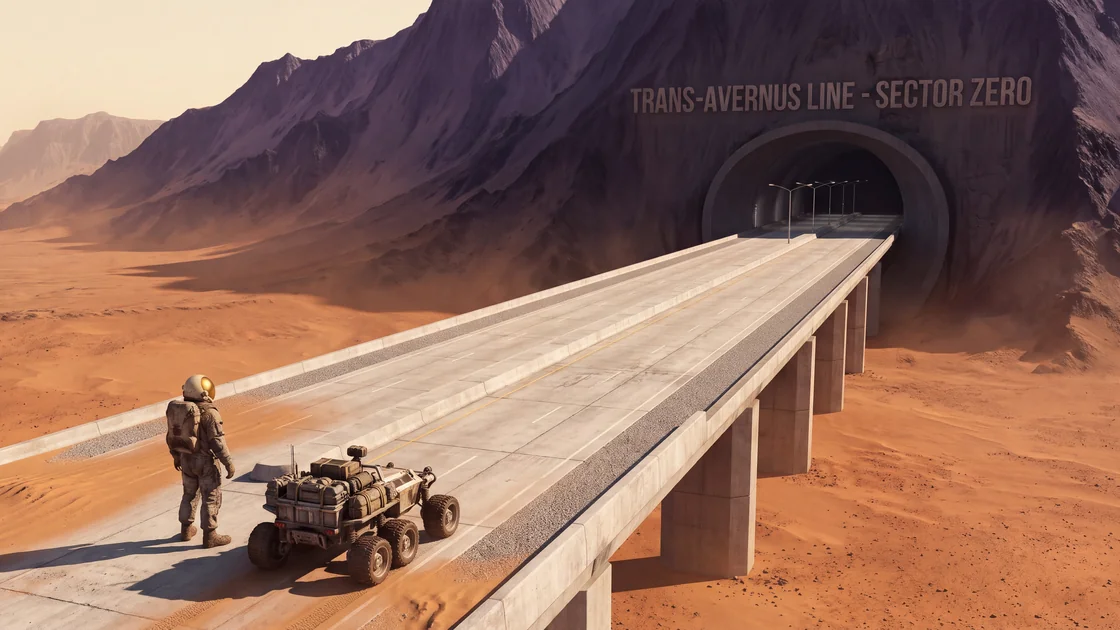
This chronicle details the expedition of Senior Planetary Engineer Jonas Kael to the desolate world of Avernus-4, where an ostensibly sterile, pre-biotic wasteland yields an impossible artifact of terrestrial engineering: a four-lane, reinforced concrete highway maintained in absolute pristine condition across an arid basin, terminating within a colossal, precision-excavated portal piercing the roots of the Orthys mountain range. Through systematic material analysis, perilous subterranean descent, and the eventual activation of an automated subterranean transit infrastructure older than human civilization, Kael uncovers the chilling operational reality of an interstate network engineered not for alien titans, but for a humanity that has not yet arrived to claim it.
Act I: The Lithology of a Dead Cradle
The descent module Bucephalus groaned as it sheared through the mesosphere of Avernus-4, shedding kinetic energy against an atmosphere composed predominantly of nitrogen, argon, and an abrasive soup of suspended ferric dust. Jonas Kael sat suspended within the gimbaled crash couch, his eyes tracking the cascading telemetry across his retina-projected heads-up display. He was forty-eight years old, with thirty of those years etched into his knuckles and the tight, squinting lines around his temples—the indelible marks of a man who spent his life measuring the crusts of worlds that had never known a seed.
His designation was Grade-IV Planetary Engineer under the unilateral mandate of the Far-Reach Reclamation Authority. His profession was unromantic: he was a surveyor of dead dirt. Before the terraforming fleets departed their slipways at Ganymede, before the atmospheric condensers and the cometary nudgers were even fueled, men like Kael were dropped alone onto barren rocks to hammer stakes into the basement granite, drop seismic needles into ancient faults, and assess whether a planet had the tectonic spine to support cities.
Avernus-4 had been cataloged as a zero-class prospect. It was a world of four-fifths Earth gravity, possessed of a cold, dying iron core and an oceanless surface split between low-albedo basaltic plains and jagged, uplifted cordilleras that had ceased volcanic venting three hundred million years prior. The orbital spectrographs had registered no chlorophyll, no methane blooms, no hydrologic cycle beyond thin seasonal frosts of carbon dioxide at the southern pole. It was a tomb, dry and quiet.
"Approaching surface interface," the automated voice of the lander’s core droned, its synthesized timbre stripped of inflection. "Descent velocity seventy meters per second. Aerobraking terminated. Chemical retro-thrusters initializing in three, two, one."
A dull, shuddering roar punched through the hull plates. The g-force spiked, driving Kael back against the memory-foam lining of his couch as the hydrazine-tetroxide engines flared against the descending plain. Outside the armored viewport, the world was a uniform, blinding rust-orange, occluded by the hurricane of debris kicked up by the landing burn. The Bucephalus settled onto its four hydro-pneumatic outriggers with a sharp hydraulic hiss and a resonant clang that vibrated through Kael’s boots.
Silence followed. It was the heavy, absolute silence peculiar to worlds without wind-stirred foliage or the hum of insect life.
Kael unbuckled his five-point harness, his joints popping in the light gravity. He did not immediately move toward the airlock. Instead, he initiated the standard post-landing diagnostics, watching the system status bars crawl from amber to green. Hull integrity: one hundred percent. External pressure: four hundred and ten millibars. Surface temperature: minus eighteen degrees Celsius. Radiation: within acceptable occupational thresholds, governed by a lazy, distant yellow-orange dwarf star hanging low on the eastern horizon.
"All systems nominal," Kael murmured into his suit recorder, his voice raspy from twenty days of cryo-stasis transit. "Touchdown verified within Target Basin C-7. Regolith is dry, unconsolidated silicates over dense continental basalt. Deploying primary survey drone array."
He turned to the equipment rack, pulling down his environment suit—a heavy, multi-layered skin of Kevlar-neoprene weave, titanium-ceramic micro-plates, and an internal thermal circulatory system designed to keep his blood flowing in liquid-methane pools or vulcanian ash beds. He hauled the suit over his frame, sealing the inner seals until the neck ring gave a double click of engagement. He hoisted the life-support pack, slotted the umbilical hoses, and finally locked down the gold-tinted hemispherical helmet.
The suit pressurized with an audible shuck. His world narrowed to the sound of his own pulmonary rhythm, the faint hum of the carbon-dioxide scrubbers, and the crisp, high-resolution readouts hovering in the lower quadrant of his vision.
He cycled the outer airlock. The ramp lowered into the rust-tinted dust of Avernus-4.
The basin was wider than the eye could reckon from ground level. In all directions, the topography was a low, undulating expanse of hematite grit, punctuated occasionally by the black, wind-carved teeth of volcanic vent pipes. Fifty kilometers to the north, jagged and purple against the cold pale sky, stood the Orthys Range—a titanic wall of thrust-faulted rock rising eight thousand meters above the plain, its peaks sharp as surgical tools, unsoftened by rainfall or glacial flow.
Kael walked down the ramp. His boots sank four centimeters into the powdery regolith, leaving crisp, tread-marked depressions that would, under ordinary conditions, persist for tens of thousands of years. He unlatched the survey kit from the Bucephalus’s flank, hauling the tripod-mounted ground-penetrating radar unit out onto the flat.
"Beginning preliminary transect," he logged. "Geophone array armed. Calibrating impulse sensors."
He drove the first steel ground-pin into the dirt. He expected uniform stone: a layer of fine dust, a fractured sub-regolith zone of breccia and basalt, then the dense, unyielding shelf of the proto-continental plate.
He struck the pin with the pneumatic mallet.
The acoustic return flashed into his visor’s receiver. Kael paused. He blinked, cleared the HUD cache, and struck the pin again.
The trace was wrong. The primary return did not display the messy, chaotic scattering of natural fractured rock. At a depth of exactly two meters below the blowing sand, three hundred meters east of his landing site, the seismic wave had struck something flat. Something with a razor-sharp impedance boundary that reflected the shockwave with uniform amplitude.
Kael stood upright. He turned his helmet toward the east. The plain looked identical there—just the same endless, wind-rippled dunes of red-brown grit rolling toward the horizon.
"Sensor artifact," he muttered to himself. He reached down, unholstered his handheld density-flux meter, and adjusted the receiver frequency. He began to walk.
The dust swirled around his shins like dry water, parted by the heavy stride of his boots. The wind was rising, whistling thin and mournful against the angles of his life-support pack, carrying with it the faint static crackle of triboelectric charges jumping across the synthetic fabric of his suit. With every step, the flux meter’s needle crept upward, indicating an impossible uniformity in the dielectric constant of the sub-surface strata.
At two hundred meters, he stopped.
The wind had scooped out a shallow deflation trough between two migrating dunes. In the bottom of the hollow, the dust had been swept clean by the prevailing northwest gale.
Kael did not see rock.
He saw a line.
It was a narrow, black seam, two centimeters wide, filled with an elastomeric compound that had neither cracked nor degraded under the bombardment of solar ultraviolet radiation. On either side of the seam lay a pale, gray surface, smooth yet subtly textured with the unmistakable cross-hatched sweep of a mechanical broom finish.
Kael dropped to his knees. The movement was fast, undignified for an engineer of his seniority. He tore off his heavy work gauntlet, exposing the thinner, tactile-sensitive under-glove, and pressed his palm against the gray expanse.
The material was cold, hard, and unmistakably artificial. It possessed the microscopic grit, the particulate heterogeneity, and the unmistakable pore structure of hydraulic cement.
"Negative," Kael whispered, his breath fogging the corner of his visor before the heaters chased it away. "Negative, this is... this is an aggregate matrix."
He reached for his belt, pulled his diamond-tipped core-sampler, and pressed the spinning bit against the gray stone. The motor whined under high torque, biting into the surface. A puff of pale gray dust blossomed around the bit. When he pulled the tool away, it had left a shallow, cylindrical scar three millimeters deep.
He picked up a pinch of the powdered tailings, holding it to his faceplate’s macro-imager. The spectral analyzer took three seconds to break down the minerals:
Calcium silicate hydrate. Silicon dioxide quartz aggregate, graded four to twelve millimeters. Traces of aluminum oxide and ferric oxide. Trace presence of calcium carbonate.
It was Portland concrete.
It was standard, terrestrial-grade, hydraulic infrastructure concrete, poured with expansion joints, laid out under the sky of an unvisited star four hundred light-years from the nearest human construction yard.
Act II: The Ribbon in the Dust
Kael returned to the lander with long, hurried strides, his heart hammering against his ribs in an irregular, frantic cadence. His training was comprehensive, encompassing astrophysics, orbital mechanics, petrology, and macro-structural engineering, but nowhere in the four thousand pages of the Far-Reach Surveyor’s Handbook was there a protocol for finding civil infrastructure on an uninhabited planet.
Protocol dictated immediate containment and transmission of an anomalous artifact priority flash to the Relay Station at Sigma Draconis. But the relay was forty light-years distant; an answer would not return in his lifetime. He was alone with the stone.
Inside the Bucephalus, Kael bypassed the sleep cycle he desperately needed. He dragged the heavy multi-spectral surveyor drone from its bay, slinging its launch cradle over the ship’s cargo crane. He manually entered the survey parameters: a low-altitude grid flight, five hundred meters above ground level, stripping the thermal and radar masking from a square sector fifty kilometers on a side.
"Launch drone Alpha-One," he commanded.
The turbofan-assisted rocket drone roared off its rail, climbing steeply into the thin air before leveling out and vanishing into the orange haze toward the north.
Kael sat at the workstation, his hands poised over the interface deck. As the drone reached its cruising altitude, the telemetry stream populated the main tactical display. The radar swept through the loose mantle of ferric sand, burning away the superficial dunes to reveal the bedrock density profiles.
What appeared on the screen made Kael’s jaw tighten until his teeth ached.
It was not a foundation. It was not the floor of a buried installation or the landing apron of an forgotten exploratory mission.
It was a highway.
The display revealed a ribbon of uniform density, precisely forty-eight meters wide, cutting across the basin in an unwavering, laser-straight vector. It possessed four distinct travel lanes separated by a central median strip, flanked on both margins by graded, compacted shoulders of crushed granite. The expansion joints occurred at mathematically invariant intervals of fifteen meters.
There were no cloverleafs. There were no access ramps, no toll plazas, no feeder arteries, and no off-ramps. It did not curve to follow the natural contours of the basin’s gentle swales; where the bedrock dipped, the highway rose upon a perfectly leveled embankment of basalt rip-rap and compacted fill. Where low ridges of metamorphic slate intruded upon the plain, the highway cut through them in clean, vertical-walled trenches, their slopes pinned back with patterned patterns of rock bolts and shotcrete.
The highway began nowhere.
Kael adjusted the drone’s search footprint, tracing the road back to its southern terminus. Twenty kilometers south of the Bucephalus, the pavement simply ceased. It did not taper or show signs of aborted construction; the concrete ended in a clean, formed header joint, with the rusted fingers of threaded steel dowel bars protruding twenty centimeters into the empty desert sand, waiting for the next pour that had never occurred.
To the north, however, the road did not end.
The drone tracked the ribbon north-northwest across the basin floor. Forty kilometers. Fifty kilometers. The highway crossed the dry, ancient outwash fans at the base of the mountains without a single deflection of its centerline. It maintained an uncompromising grade of zero point zero percent across the lowlands, then tilted upward at an unyielding six-degree incline as it met the base of the Orthys Range.
And there, where the vertical face of the basalt massif met the sky, the highway drove straight into the mountain.
The drone’s optical feed resolved the northern terminus. It was an opening. A portal carved out of the solid root of the mountain, shaped like a flattened catenary arch, eighty meters wide at its base and forty meters high at its apex. The portal was dark. The radar could not penetrate its depth; the signal simply vanished into an acoustic and electromagnetic sink that swallowed the drone’s chirps without returning an echo.
Kael leaned back in his seat, his fingers trembling slightly as he rubbed his eyes.
"The age," he whispered to the empty cabin. "What is the age?"
He pulled up the core sample data he had gathered from the deflated hollow. He had dropped the sample into the automated mass spectrometer before launching the drone. The machine had finished its work.
The aggregate inside the concrete was terrestrial quartz, but its cosmic-ray exposure history was anomalous. The stone had been shielded from interstellar flux until approximately one hundred and twenty thousand years ago, at which point it had been quarried, crushed, washed with demineralized water, mixed with cement, and cast into forms.
One hundred and twenty millennia.
During Earth’s late Pleistocene epoch. When anatomically modern humans were chipping flint points in the Levant and hunting red deer across the frozen steppes of Eurasia, someone had mobilized the equivalent of twenty mechanized engineering divisions to this desolate world around a dying star. They had brought heavy grading machinery, aggregate crushers, form-work slip-pavers, and millions of tons of Portland cement.
They had built a four-lane interstate highway across fifty kilometers of bone-dry volcanic basin.
And then they had left it. Unmarked. Unused. Pristine.
Kael stood up. He did not eat. He did not log a report. He pulled his field pack from the storage locker, double-checked the battery reserves on his life-support module, and strapped his heavy surveyor's transit and a seismic pulse gun to his hips.
He walked out the airlock, down the ramp, and toward the deflated dune.
He was not going to wait for a relief ship that was forty light-years away. He was a road surveyor. And there was a road.
Act III: The Long Alignment
Kael deployed the all-terrain rover—a low-slung, six-wheeled vehicle driven by high-torque electric hub motors and wrapped in puncture-proof tires of woven titanium mesh. He loaded the rear cargo bed with auxiliary oxygen tanks, two additional drone units, an array of seismic transceivers, and an emergency shelter tent.
He drove the rover off the Bucephalus’s deployment pad and turned it toward the line of the buried highway. As the wheels mounted the edge of the graded shoulder, the harsh, jolting vibration of the rough regolith vanished, replaced by a smooth, rhythmic hum that traveled up through the vehicle’s chassis.
Even through the thick layer of drifting sand, the concrete beneath was true. There were no potholes. There was no frost-heaving; the cold on Avernus-4 was dry, devoid of the moisture that wedges natural stone apart through freeze-thaw cycles. The expansion joints were still flush, their elastomeric seals resilient despite more than a thousand centuries of silence.
Kael set the rover’s autopilot to follow the sub-surface radar track of the centerline at forty kilometers per hour. He sat high in the open-frame seat, his hands resting lightly on the control yoke, his head turning from left to right as the desert slid past.
The road was an architectural monolog. It ignored the landscape with a contemptuous, rational geometry. When a field of volcanic rubble—boulders the size of cargo haulers that had tumbled from some long-eroded rim—threatened its path, the road did not divert. The builders had blasted a trench fifty meters wide straight through the boulder field. The talus slopes on either side of the cut were neatly stepped at thirty-degree bench angles, secured with diamond-patterned steel mesh that showed only the faintest patina of surface oxidation.
"The steel," Kael spoke into his suit recorder, his voice rhythmic, matching the click-clack of the rover’s wheels over the buried joint lines. "The rebar inside the core sample and the wire mesh on the cuts... it’s high-chromium austenitic stainless. Low carbon, nickel-stabilized. Zero martensitic conversion. It doesn't rot because there's no free water in the air column, but even if there were, it wouldn't oxidize. This wasn't built to last fifty years. It wasn't built for a municipal budget cycle."
He paused, watching a low ridge approach.
"It was built for geologic time."
At kilometer twenty-five, the sand drifts began to thin. The prevailing katabatic winds descending from the Orthys peaks gathered speed here, scouring the pavement clear of its mantle.
Kael cut the rover’s drive motors and came to a stop. He stepped down from the running board.
Here, the highway was naked.
It stretched ahead of him for twenty-five kilometers, a gray, uninterrupted spear aimed at the mountain portal. The four lanes were clearly demarcated, not by painted stripes—which would have flaked away under the abrasive scouring of the dust—but by thin ribbons of white porcelain aggregate embedded flush into the concrete matrix during the finishing pass.
There were no tire tracks. No scorch marks from chemical thrusters. No drops of oil, no hydraulic fluids, no scuffs, no scratches. The broomed texture was so sharp that when Kael ran his gloved hand across it, the rubber of his palm squeaked against the ridges.
He looked up at the sky. The yellow-orange sun hung at the mountain’s shoulder, casting long, razor-edged shadows from the western ridge across the pavement. The light made the road seem almost liquid, a pale canal of stone cutting through a sea of hematite rust.
"Why four lanes?" he asked the wind.
It was the most disturbing detail. One lane might be an access conduit, an exploratory spur, an umbilical line for an extraction facility. But four lanes—two northbound, two southbound, separated by a slightly concave concrete median ditch designed to shed non-existent rainwater—implied traffic. It implied mass, density, throughput. It implied thousands of vehicles moving at speed, carrying people or things from a point of origin to a destination.
Yet the southern end terminated in an unpoured joint in the middle of a blank basin that held nothing but dust and dead iron.
He climbed back into the rover, his throat dry despite the water straw in his helmet. He accelerated to eighty kilometers per hour. The electric motors screamed in the thin air, the titanium tires singing their metallic song against the broomed concrete:
Thump-thump. Thump-thump. Thump-thump.
The cadence of the expansion joints was hypnotic. Fifteen meters. At eighty kilometers per hour, that was 1.47 seconds per joint.
Thump-thump.
He passed the thirty-kilometer mark.
Thump-thump.
Thirty-five kilometers. The mountain wall now dominated the sky, swelling from a distant ridge into an oppressive, black wall of stone that blotted out the northern horizon. The peaks rose into the stratosphere, their upper crags catching thin plumes of white cirrus that were not water ice, but crystalline methane.
Thump-thump.
At kilometer forty-two, Kael noticed the first vertical structures.
They stood at the edge of the shoulder, spaced at two-hundred-meter intervals: slender, tapered pylons of spun-cast concrete, twelve meters high, curving gently at their tips over the outer lanes. They looked precisely like modern highway luminaire masts, but they lacked light fixtures. Instead, their terminal brackets ended in smooth, hemispherical pods of milky, semi-translucent glass, cold and dark.
He did not stop to inspect them. The mountain pulled him forward like a gravitational sink.
The grade began to rise. The rover’s motors groaned as they pulled against the six-degree incline. The highway lifted itself off the basin floor on a massive, reinforced concrete viaduct that bridged the scree slopes at the mountain’s foot. The pillars supporting the deck were massive—octagonal piers of reinforced concrete twelve meters in diameter, rising fifty meters from the rubble, bedded into the basalt bedrock with massive drilled-shaft caissons.
Kael looked over the viaduct's railing as he drove. Below him, in the shadows of the piers, lay the debris of the mountain: giant boulders that had broken from the heights and rolled down the slopes over millennia. Several of these multi-ton projectiles had struck the piers.
The basalt boulders had shattered into angular shards. The concrete piers bore only white, chalky bruises where the impact energy had been absorbed without structural failure.
The engineering was absolute. It did not negotiate with nature; it executed a sentence upon it.
The viaduct leveled out. Ahead lay the portal.
Act IV: The Mouth of Orthys
Up close, the opening was not merely large; it was catastrophic in its scale.
The catenary arch had been cut directly out of the mountain's vertical cliff face. The rock above the portal did not show the irregular marks of rotary tunnel boring machines or the ragged scars of explosive blasting. The stone had been sliced. The basalt walls were smooth as polished obsidian, cut with molecular precision through crystal boundaries and olivine inclusions without a single fracture line propagating into the surrounding rock mass.
Above the entrance, carved into the stone face in relief characters eight meters tall, was a single word.
It was not in a script of alien glyphs. It was not cuneiform, nor was it the mathematical pictograms favored by the First Contact committees.
It was Latin alphabet. Clean, sans-serif, deep-cut Roman capitals, proportioned with the balanced clarity of mid-twentieth-century architectural signage:
TRANS-AVERNUS LINE - SECTOR ZERO
Kael slammed the brakes. The rover skidded to a halt ten meters from the threshold, its tires smoking slightly against the concrete.
He sat motionless, his hands frozen on the yoke.
"Trans-Avernus Line," he read aloud. The sound of his own voice inside the helmet was thin, strange, and entirely inadequate. "That's... that's English. That's Old Terran Standard."
He looked down at his own suit. On his left breastplate was the emblem of the Far-Reach Reclamation Authority, with its corporate motto stamped below the crest in the same clear, utilitarian font: Toward the Empty Verge.
The letters above the portal were identical. The kerning, the stroke weight, the precise radius of the curve on the letter R—it was the standard typography of the Department of Logistics and Infrastructure, Earth-Moon System, circa 2140.
Except this concrete had been poured when the Neanderthals were still tracking mammoth herds across the Dordogne valley.
"This is an operational impossibility," Kael whispered. He pulled his helmet seal check, confirming his telemetry recording was live. "Log update. Location: Mount Orthys portal. The inscription is in English. Repeat, English. The style matches late-unification Terran administrative fonts. Either... either I am experiencing an advanced stage of nitrogen narcosis or toxic psychosis caused by a compromised life-support scrubber, or our entire cosmological and temporal framework is invalid."
He tapped his suit’s medical diagnostic. The readouts were insultingly stable: blood oxygen ninety-nine percent; pulse seventy-two; neural latency zero point twelve milliseconds; no trace of volatile hydrocarbons or psychotropic contaminants in the breathing mix.
He was sane. The mountain was real. The sign was real.
Kael unclipped the seismic pulse gun and stepped off the rover. He walked toward the threshold.
The wind from the basin seemed to die the moment he crossed under the shadow of the arch. The air inside the portal was completely still, but it was not dead. As he took his first steps into the subterranean bore, his suit’s external audio pickups detected a sound.
It was not the wind. It was a vibration.
A low, deep, foundational drone that registered less as a sound and more as a periodic pressure wave against his chest plate. A frequency around sixteen hertz—well below human hearing, but high enough to make his teeth hum in their sockets.
He raised his wrist lamp. The twin halogen beams cut through the gloom, painting a long, receding corridor of white light.
The highway did not narrow inside the mountain. It maintained its full forty-eight-meter width, flanked on either side by wide, raised walkways lined with steel railings and recessed drainage channels. The walls of the tunnel were lined with precast concrete segments, curved and bolted together with heavy internal flanges, forming a continuous, circular tube eighty meters across.
Every fifteen meters, a luminaire pod hung from the crown of the tunnel.
As Kael took his tenth step into the interior, a sharp, metallic clack echoed down the length of the bore.
Fifty meters ahead of him, one of the luminaire pods flickered. It sputtered with a pale, violet discharge, died, flickered again, and then snapped into a brilliant, steady daylight-white radiance.
Then the next one ignited.
Then the next.
The luminaires fired in rapid, cascading succession, a sequential fuse of artificial noon that race down the tunnel, deeper and deeper into the mountain’s heart, until the line curved out of sight three kilometers ahead.
The highway was illuminated.
It lay before him, dry, clean, and silent, waiting for traffic that had not arrived in one hundred and twenty thousand years.
Act V: Subterranean Six Percent
Kael walked back to the rover, his movements mechanical, drained of fear by the sheer absurdity of the scale. He climbed into the seat, turned the key, and drove across the threshold into the light.
Inside the tunnel, the telemetry systems on his dashboard began to shift. The ambient temperature reading, which had held at eighteen below zero on the plain, began to climb with every hundred meters he advanced: minus twelve, minus five, zero.
At kilometer three, the suit’s atmospheric sensor chimed.
"External atmosphere composition changing," the HUD text alerted him. "Nitrogen seventy-six percent. Oxygen twenty-two percent. Argon one point five percent. Carbon dioxide four hundred parts per million. Pressure: nine hundred and ninety millibars."
Kael slowed the rover. He reached for the locking latch of his helmet.
Every survival instinct he possessed—honed through decades of hostile-environment operations—screamed at him to keep the seal closed. A surveyor does not break his seal on an unverified world; it was the first rule of the service, the iron law that kept men from dying of strange molds or caustic mists.
He looked at the digital readout. The gas mix was not merely breathable; it was optimized. It had the precise humidity—forty-five percent—and sea-level pressure of a mid-latitude spring morning on Earth.
He unlatched the collar.
The seal broke with a soft sigh. Kael lifted the helmet from his head, setting it on the seat beside him.
The air struck his face. It was cool, faintly metallic, and smelled of ozone, damp limestone, and the unmistakable, chalky dry scent of setting grout. There was no rot, no dust, no ancient mold. The air was moving; a gentle, steady draft was blowing from the depths of the mountain toward the portal, warm and clean.
He took a long, deep breath. His lungs did not burn. His eyes did not water. It was the best air he had breathed since leaving the orbital station at Ganymede.
"Who are you?" he asked the white-lit arch above him.
His voice did not echo. The precast tunnel segments were perforated with millions of microscopic acoustic attenuation holes, designed to swallow the deafening roar of high-speed internal combustion engines or turbine drives. The tunnel was engineered for speed.
He pressed the accelerator. The rover shot forward down the six-degree grade.
Kilometer ten. The tunnel remained straight as a rifle barrel. The walls were clean, free of water seepages or calcified stalactites. The drainage troughs were bone-dry. Every five hundred meters, an emergency alcove was recessed into the right-hand wall, complete with a cast-iron door, a dead internal telephone cradle, and a dry-chemical fire extinguisher whose inspection tag—stamped into brass foil—read:
MAINTENANCE CYCLE 004 - NEXT SERVICE DUE: 2185 A.D.
Kael did not stop to read the tags anymore. The numbers had ceased to have meaning. If the dates were human, the timeline was broken. If the timeline was human, then the world outside this mountain was a lie.
At kilometer twenty, the road made its first turn.
It was a transition curve of vast radius, banked at an angle of exactly four degrees to counteract the lateral acceleration of vehicles traveling at two hundred kilometers per hour. The concrete was scored with directional grooving to provide wet-weather traction—a detail so mundane, so thoroughly bureaucratic, that it made Kael’s skin prickle with cold terror.
As the rover rounded the sweeping curve, the tunnel walls fell away.
Kael slammed the brakes, bringing the vehicle to an abrupt halt at the edge of a precipice that opened into a cavern of impossible dimensions.
He had reached the Subterranean Interchange.
Act VI: The Hub of the Void
The space was so vast that it generated its own micro-climate. Thin, wispy layers of stratus clouds hung two hundred meters above the floor, illuminated from below by the continuous grid of amber and white light that covered the subterranean plain.
Kael stood at the edge of the roadway, which had become a soaring concrete arch bridge leaping across an abyss three hundred meters deep.
Below him lay a transportation hub that dwarfed any terrestrial terminal he had ever witnessed. It was an oval chamber at least eight kilometers across, excavated from the mantle rock of the mountain range. Into this central arena converged not one highway, but twelve.
Twelve four-lane superhighways, identical to the one he had traversed, entered the chamber from radial portals spaced around its circumference. They looped, descended, and intertwined through a breathtaking labyrinth of multi-level interchanges, flyover ramps, braided collector-distributor roads, and subterranean underpasses.
At the geographic center of the complex sat an octagonal structure the size of an offshore drilling platform, constructed from ribbed, board-formed concrete and structural steel painted in industrial safety yellow.
Above the central structure, suspended from the roof of the cavern by sixteen colossal steel cables, hung an inverted pyramid of black glass—a sensor or communication array fifty meters tall, its apex pointing directly at the center of the interchange.
And across the entire eight-kilometer expanse, on all the ramps, through all the flyovers, across all twelve highways...
Nothing moved.
There were no stranded cars. No abandoned transports. No skeletons behind steering wheels. The roads were clean, empty, and brilliant under the amber sodium lamps that lined the ramps.
The system was ready. It was powered. It was ventilated. It was waiting for an influx of traffic that had never crossed its thresholds.
Kael looked down at his instruments. The rover’s radio was buzzing with a periodic, rhythmic click. He switched the receiver to speaker.
Click... click... click... whirr.
A voice broke through the static. It was flat, mid-Atlantic, recorded on magnetic tape, its tonal quality thick with the characteristic frequency clipping of mid-century telephony:
"Attention all incoming logistical units. Sector Zero transit infrastructure is fully operational. All drivers are advised that speed limits are strictly enforced by automated radar interlocks. Northbound freight to the Orthys Deep Storage array should maintain lane three. Southbound passenger traffic to the Surface Connector is currently experiencing no delays. Welcome to the Trans-Avernus Network. Safe transit is everyone's responsibility."
The loop repeated.
Click... click... click... whirr.
"Attention all incoming logistical units..."
Kael gripped the bridge railing. His knuckles turned white through his under-gloves.
"There's nobody here," he screamed into the cavern.
His voice was lost, swallowed by the thousands of perforations in the concrete deck, dispersed into the humid, warm, ozone-scented air of the abyss.
"There's nobody here!" he yelled again. "The planet is dead! You built a road to a desert!"
The tape clicked.
"...Southbound passenger traffic to the Surface Connector is currently experiencing no delays..."
Kael turned the rover toward the central octagonal platform, following the looping sweep of the Bridge Three Collector ramp as it spiraled down toward the subterranean floor.
Act VII: The Master Control Office
The central platform was reached via a short, concrete causeway protected by counterbalanced crash gates of heavy steel tubing. The gates were swung wide, their hydraulic cylinders locked in the open position.
Kael parked the rover beside a flight of concrete stairs that led up to the structure’s second tier. He left his seismic gun behind. If there was something in this mountain that meant him harm, a four-bore rock splitter was not going to save him. He carried only his hand lamp, his tablet interface, and a sample pouch containing the drill cores from the plain.
The door at the top of the stairs was unpainted marine-grade aluminum, fitted with a standard brass lever handle and a rectangular window of wire-reinforced safety glass.
Above the handle was a small stencil:
TRANS-AVERNUS LOGISTICS AUTHORITY CENTRAL MONITORING - SHIFT SUPERVISOR AUTHORIZED PERSONNEL ONLY
Kael pressed the lever. It swung down smoothly on greased brass hinges. He pushed the door open and stepped inside.
The office was quiet, save for the low, sixty-cycle hum of electrical transformers.
It smelled of paper.
In the center of the room sat four steel desks, their surfaces enameled in gray crackle-finish paint. On each desk was a green-tinted cathode-ray terminal, a desk lamp with a beige metal shade, an empty coffee mug bearing the logo of the Pan-Pacific Reclamation Cartel, and an overflowing Bakelite ashtray filled with the dry, white ash of filterless tobacco cigarettes that had burned down to their ends forty thousand years before the dawn of agriculture.
Along the back wall ran a thirty-meter-long schematic board. It was a mosaic of thousands of small, square acrylic tiles, backlit with miniature incandescent bulbs.
The board depicted a map.
Kael walked slowly to the map, his boots clicking on the linoleum-tile floor.
It was not a map of Avernus-4.
It was a continental map. He recognized the coastlines immediately, though they were warped, altered by sea levels eighty meters lower than those of his own historical era. He saw the British Isles connected to the French coast by a low, gray plain; he saw the Mediterranean split into two inland lakes; he saw the land bridge crossing the Bering Strait, thick and green with tundra.
Across this Pleistocene Earth, drawn in bright, glowing lines of red, green, and amber, was a network of superhighways.
One line began in the Scottish Highlands, crossed Doggerland, traversed the northern European plain, cut through the Ural gaps, leaped the frozen expanse of Siberia, crossed the dry floor of the Bering Sea, drove through Alaska, down the spine of the Rockies, through Central America, and terminated at the tip of Tierra del Fuego.
Another line branched at Tehran, driving down across the Indian subcontinent, leaping the Indonesian archipelagos via a sequence of cyclopean causeways, and terminating in the Australian red center.
And from every major hub—from the Ural Junction, from the Denver Interchange, from the Chad Basin, from the Tibetan Gate—a single line ran perpendicular to the earth’s surface.
A line that did not go across the ground.
A line that pointed up.
A vertical vector labeled: DISPLACEMENT ARTERY - TRANSIT AXIS AVERNUS.
Kael felt a cold, leaden weight settle in his stomach. He looked down at the desk in front of him.
Lying on the blotter was an open logbook, its pages bound in red buckram cloth. The entries were typed in violet carbon ink from an electric ribbon typewriter.
He bent over the page.
LOG ENTRY: 12-OCTOBER-1974 (REVISED CHRONOLOGY) OFFICE OF THE CHIEF ENGINEER, TASK FORCE SIX
The pouring of the Sector Zero Surface Connector was completed this morning at 0400 hours. Basin C-7 alignment verified to within four arc-seconds of the primary displacement gradient. Total concrete laid: six million four hundred thousand metric tons. All expansion systems stabilized.
The gateway interlocks remain aligned with the primary Terran focus. However, telemetry from the low-end collector confirms the collapse of the terrestrial ingress corridor.
The war on the other side was not conventional. The atmospheric ignition in the northern hemisphere has resulted in a ninety-eight percent disruption of the civilian mobilization pipeline. The convoys are not coming.
The displacement gate will close permanently in seventy-two hours as the orbital alignments decay. Task Force Six has received orders to initiate final abandonment protocols.
We are leaving the lights on.
We are leaving the scrubbers running.
If the survivors find the road down there, they will follow the markers. If they have the vehicles, they have the line. We left fifty kilometers of header joint out on the basin plain so they know where to start pouring when they get here.
God forgive us for the earth. At least we built them a way out.
Signed, Marcus Vance, Col., U.S. Army Corps of Engineers Director of Logistics, Project Exodus-Prime
Act VIII: The Sweep of the Scrapers
Kael stood by the desk for a long time. The humming transformers seemed to grow louder, filling the empty room with their steady, indifferent frequency.
He walked to the window overlooking the grand interchange.
The lights were on. The air was sweet and clean. The signs pointed to cities that had burned a thousand centuries ago, on a world four hundred light-years distant, whose light was only now reaching his own telescope arrays with the dim, cold sparkle of ancient history.
They had not been aliens. They had not been gods.
They were engineers. Men with slide rules, surveying transits, hydraulic slip-forms, and blueprints drawn on tracing linen with India ink. Men who had seen the sky catch fire in some forgotten, alternate branch of a broken century, who had discovered a fissure in the geometry of space-time, and who had done the only thing an engineer knew how to do when faced with the end of the world:
They had built a road.
They had poured four lanes of reinforced concrete across an alien desert, driven a tunnel through a mountain range of basalt, and set up an automated, four-thousand-mile subterranean transit network to receive the great evacuation of a species that had died before it could reach the staging ground.
Kael walked back to the logbook.
Beside the book sat a small, red toggle switch under an acrylic safety guard. The label beneath the switch read:
TERMINAL MAINTENANCE SWEEP - ALL SECTORS AUTOMATIC RETURN TO STANDBY
He reached out. His gloved finger hovered over the plastic guard.
If he flipped the switch, what would happen? Would the automated sweepers emerge from their subterranean berths to clear the non-existent tire rubber from the lanes? Would the luminaires burn for another hundred and twenty millennia, waiting for the Ford trucks, the GMC tractors, and the family sedans that were now nothing more than microscopic layers of rust in the sedimentary rocks of a distant, scarred cradle?
He looked out the window again.
Down on the interchange floor, three levels below him, something shifted.
A door in the face of the octagonal foundation clicked open.
Out from the dark bay rolled an automated maintenance drone. It was not a sleek, anti-gravity disc. It was a six-wheeled, diesel-hydraulic sweeping rig with rotary steel brushes, painted in faded highway-department orange, with a revolving amber beacon flashing on its cab.
The machine’s engine coughed—a sharp, rattling bark that settled into a steady, four-stroke chug that echoed through the vast cavern.
The sweeper moved out onto Bridge Three. Its steel brushes descended to the concrete with a harsh, scratching hiss. It began to sweep the clean, immaculate deck, clearing away the invisible dust that Jonas Kael had tracked in on the soles of his boots.
It worked with patient, mindless efficiency. It followed the white porcelain lane markers, its beacon casting long, swinging yellow shadows against the catenary arches and the polished basalt walls of the void.
Kael looked down at the open page of the logbook.
He unclipped the surveyor's stylus from his breastplate—the diamond-point marker he used to scratch reference numbers into rock cores and triangulation pegs.
He turned to the next clean line beneath the signature of Colonel Marcus Vance.
He held the stylus against the dried, yellowed paper.
LOG ENTRY: 14-JULY-2488 (RECLAMATION SERVICE ERA) JONAS KAEL, GRADE-IV PLANETARY SURVEYOR FAR-REACH AUTHORITY
Basin C-7 alignment inspected. Concrete condition: exceptional. Expansion joints intact. Sub-surface reinforcement shows zero degradation.
The displacement artery remains cold. No convoys detected.
I have checked the air scrubbers. They are green across the board. The road is clear.
He paused, his hand resting on the buckram cover.
He thought of the Bucephalus sitting forty kilometers behind him on the rust plain, its chemical engines cold, its communication array pointing toward a corporate civilization that calculated human life in terms of atmospheric conversion cost per hectare. He thought of the landing apron, the sterile dirt, the endless surveys of barren worlds that would never be loved, only consumed.
He thought of the four-lane ribbon pointing into the mountain, straight as a spear, built by men who had spent their last breaths pouring concrete so their children might have a highway to drive on when the sky fell.
Kael did not flip the maintenance cutoff switch.
Instead, he reached into his pocket, pulled out the brass ignition key to his rover, and laid it neatly on the green blotter beside the ash-filled Bakelite tray.
He closed the logbook.
He walked out of the office, down the concrete stairs, and past the open aluminum door.
He did not get into the rover. He did not turn back toward the portal.
He walked down the ramp to the lowest level of the interchange, where Highway One entered the southern tube—the road that the glowing board had designated as the Deep Storage Artery.
The tunnel ahead was bright. The white luminaires stretched away into the deep interior of the planet, thirty kilometers, sixty kilometers, three hundred kilometers, curving smoothly through the living rock toward some final, subterranean terminal that had never seen a passenger.
Kael looked down at his boots.
They were clean now. The sweeper had done its work.
He took his first step along the white porcelain line, his gait steady, rhythmic, and unhurried.
Thump-thump.
The sound of his boots on the expansion joints was the only noise in the mountain. It was an engineer’s rhythm. It was the measure of the work.
He walked south into the lit stone, following the empty highway home.