The Horizon of Singing Stone
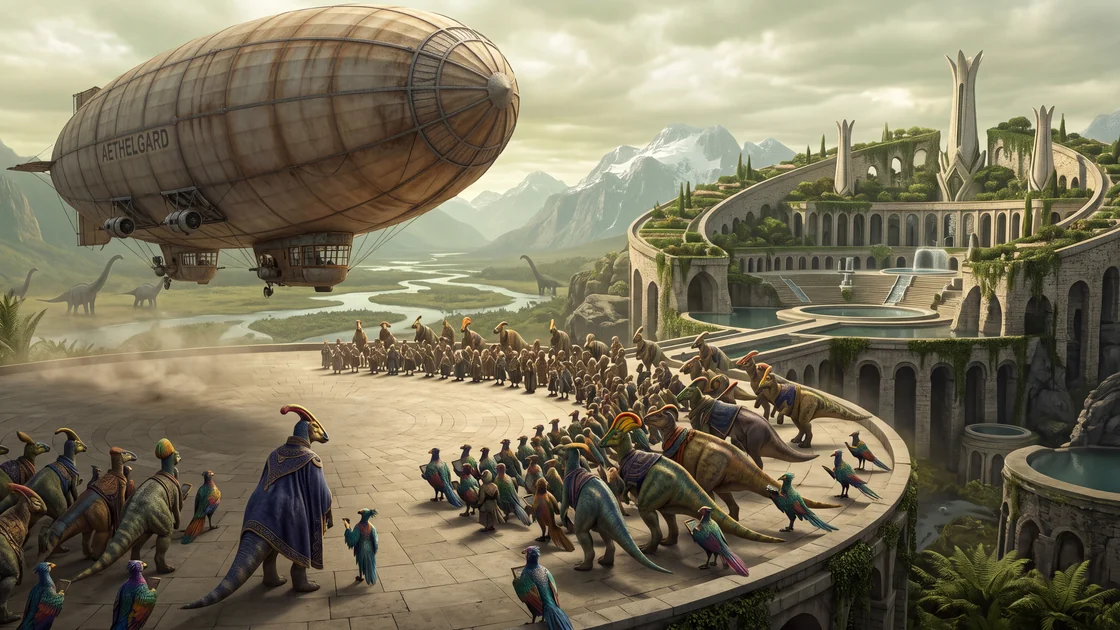
When the rigid-frame dirigible Aethelgard was caught within the violent heart of an uncharted oceanic squall, Captain Jeremiah Cross expected a watery grave in the churn of the Roaring Forties; instead, his battered vessel breached an impossible eye of calm to find a primeval Earth preserved beneath a dense mantle of cloud. Far below lay not an untamed wilderness of savage beasts, but a sunlit world where ancient saurian architects built soaring cities of dry-stacked basalt, cultivated terraced gardens along crystalline rivers, and communicated through resonant symphonies blown from hollow cranial crests. Welcomed by these gentle giants and their sharp-eyed, scholarly kin, Jeremiah and his weary crew discovered a flourishing, peaceful civilization that had turned the wisdom of sixty-five million years toward harmony, art, and the stars. Across weeks of repair and communion, the captain learned the deep acoustic language of the architects and confronted the fragile wonder of their sanctuary, ultimately facing the agonizing choice between returning to an industrializing human world or guarding forever the passage to a gentler past.
Chapter I: The Maw of the Iron Squall
The barometer in the bridge of the Aethelgard had ceased to be an instrument of measurement and had become instead an oracle of doom. Its needle shuddered against the brass stop pin, trapped far below twenty-seven inches of mercury, trembling like an animal that scenting the approach of an apex predator.
Captain Jeremiah Cross stood with his sea-boots braced against the teak decking, his knuckles white where they wrapped around the bronze binnacle rail. Outside the panoramic mica windows of the gondola, the world had lost all horizon, all distinction between sky and sea. It was a suffocating soup of charcoal and bruise-colored vapors, torn periodically by sheets of violet lightning that illuminated nothing except the terrifying vastness of the clouds.
"She’s answering the helm like a waterlogged raft, Captain!" shouted Mara Chen, the first mate. She clung to the secondary steering wheel, her shoulders knotted under her oilskin coat. Even with the hydraulic boosters engaged, the great mahogany spokes bucked in her hands as the crosswinds clipped the airship’s colossal underbelly.
"Keep her head at two-seventy, Mara," Jeremiah replied, his voice calm, leveled by twenty years of service in the high merchant fleets, though the back of his throat tasted of sulfur and ozone. "If we yaw into the trough of this shear, the envelope will torque until the longitudinal girders snap. Mr. Halloway! Give me two hundred more revolutions on the port engines!"
The engine telegraph rang with a hollow brass clatter. Through the voice tube mounted beside the chart table came the strained, grease-muffled shout of Chief Engineer Halloway: "She’s running hot already, Cap! The radiator on engine three has an airlock, and if I push the manifold pressure any higher, we’ll throw a rod through the duralumin casing!"
"Nurse it, Arthur!" Jeremiah roared back down the pipe. "If we lose port thrust, the wind takes our tail, and we won’t need to worry about threw rods—we’ll pancake into the South Atlantic before the hour strikes!"
The Aethelgard was seven hundred feet of German-machined duralumin, varnished cotton, and hydrogen, a leviathan of the aerial age meant to chart the empty spaces between Cape Horn and the Antarctic shelf. Yet against the wall of cloud that had boiled out of the south at noon, she was as frail as a dried leaf in an iron mill. The storm was unnatural; it did not rotate according to Coriolis laws, but seemed to plunge downward, a massive, swirling cataract of air that dragged the ship toward the churning gray waves below.
"Altitude three thousand feet and dropping!" Mara called out, wiping rain from her brow where it leaked through the seal of the forward wind-screen. "Captain, the gas is condensing in the cold. We’re losing static lift faster than we can drop trim ballast."
"Release slip-tanks four and five," Jeremiah ordered without hesitation. "Let the fresh water go. Save the fuel until we have no choice."
A deep, groaning vibration shuddered through the ship’s keel as tons of water cascaded from the internal belly tanks into the abyss below. For a moment, the Aethelgard surged upward, buoyed by the shed weight, clawing its way back to four thousand feet. But the sky offered no respite. Above them, the clouds curdled into an oily, swirling funnel, an eye that was not clear, but rather packed with spiraling curtains of mist that glowed with a faint, phosphor luminescence.
"Jeremiah..." Mara murmured, dropping formal titles as she pointed through the center window.
Within the wall of the squall, the lightning was no longer branching outward. It was crawling in great, lazy rings around a central aperture, forming a tunnel of cyclonic mist that seemed miles wide. The compass on the binnacle began to spin slowly, clockwise, then counter-clockwise, completely stripped of magnetic orientation.
"It’s an eddy," Jeremiah said, squinting through the misted glass. "A thermal puncture in the cloud layer. Mr. Halloway! Full ahead on all six! Steer directly for the vortex!"
"Directly into it?" Mara’s dark eyes widened. "If that’s a downdraft core, it’ll smash us against the sea!"
"Look below us, Mara! The ocean is rising to meet our keel! If we stay on the perimeter, we will be torn apart by the wind shear! Our only hope of breaking the pressure front is to pierce the center!"
Jeremiah did not wait for argument. He stepped to the engine telegraph himself and slammed the triple brass levers to Emergency Maximum. Deep in the keel car and along the outrigger engine gondolas, six Maybach engines screamed in unison, their exhaust stacks coughing blue flame into the darkness. The airframe vibrated with such violence that rivets sang like tuning forks in the ceiling braces.
The Aethelgard plunged into the glowing mouth of the cloud tunnel.
Instantly, the screaming roar of the gale died away, replaced by an eerie, deafening silence broken only by the hum of their own propellers. The ship was suspended in a vertical cylinder of pale green, shifting fog. The air inside smelled neither of salt nor of diesel, but of damp moss, crushed fern fronds, and rich, turned loam—an odor so intensely earthy, so primordial, that Jeremiah involuntarily gasped, his lungs burning with an unaccustomed thickness in the atmosphere.
The altimeter spun wildly: three thousand feet, four thousand, five thousand... then the needle jammed completely as the barometric pressure soared not downward, as it should have with altitude, but upward, stabilizing at an impossible thirty-four inches.
"Captain," Mara whispered, her breath fogging on the cold pane. "Look at the horizon. We aren't climbing."
The Aethelgard burst through the floor of the clouds.
Chapter II: The Emerald Horizon
There was no ocean below them.
Jeremiah stood frozen, his hand still clamped upon the telegraph handle. The light that struck the gondola was golden and soft, filtered through an endless, unbroken roof of pearlescent cumulus that stretched from horizon to horizon, miles above them, acting like the frosted glass dome of an immense conservatory.
Underneath this celestial ceiling lay a world that defied every map tucked into the leather chart cases of the Admiralty.
As far as the eye could see, vast carpets of deep, jade-green forest rolled over undulating hills, intersected by wide, serpentine rivers that shone like molten silver in the diffuse radiance. To the north, monumental mountain ranges rose, their flanks clad in dark, coniferous mantles, their peaks capped with ancient, blue-tinted glaciers that fed cascading waterfalls hundreds of feet high.
The air was so clear it hurt the eyes. Distances were impossible to judge because there was no haze, only an emerald clarity that revealed every ridge, every canopy, every soaring flock of winged shapes that wheeled above the trees.
"God in Heaven," whispered Mara, dropping her hands from the wheel. The ship drifted smoothly, completely unmolested by turbulence, floating in an air so dense and rich that the Aethelgard’s gas cells were buoyed with effortless lift, hovering at a steady fifteen hundred feet without the engine’s labor.
Arthur Halloway stumbled up the hatchway from the keel passage, wiping his grease-blackened hands with a rag, his mouth hanging open before he reached the top step. "Cap... the engines aren’t knocking anymore. The air’s so thick the carburetors are running rich as butter, but... where in the bloody blazes are we? Is this the Antarctic interior?"
"No," Jeremiah said softly, his voice barely louder than the low drone of the throttled-back propellers. "Antarctica is ice and stone, Arthur. This... this has never seen a frost."
He snatched his brass spotting glass from its felt-lined cradle and brought it to his eye, sweeping the landscape below. At first, his mind attempted to force the sights into familiar molds. There are herds of elephants in the marshes, he thought. No, the necks are too long. Giraffes? No, the gait is all wrong, the bodies too massive, balanced by immense, counter-weighting tails that swing with rhythmic grace through the reeds.
They were sauropods. Vast, slate-gray bodies, their skin mottled with mossy green and golden ochre, wading shoulder-deep in a floodplain overgrown with horsetails and cycads. As the shadow of the airship passed over them, a few of the titans lifted their small, elegant heads, their nostrils flaring, watching the floating intruder with calm curiosity rather than fear.
"Dozens of them," Mara breathed, her fingers trembling against the glass. "Jeremiah, those are... those are fossils. Those are things that were dust before the first man chipped a flint."
"Look further," Jeremiah directed, his hand pointing toward the wide bend of the river five miles inland. "Look past the herds, Mara. Look at the hills."
Mara raised her binoculars. A sharp intake of breath caught in her throat.
Nestled into the amphitheater of a great, horseshoe-shaped limestone ridge was not a jungle lair, nor the rough mud-wallows of animals, but a city.
It was unlike anything ever conceived by human architects. It did not bristle with chimneys or jagged iron spires, nor did it crowd together in chaotic tenements. It was an arrangement of sweeping, concentric terraces made of massive, dry-stacked blocks of pale cream-colored stone and dark, polished basalt. The walls rose in organic, parabolic curves, following the natural contours of the valley, crowned with broad, green roof-gardens where fruit-laden vines trailed over delicately carved balustrades.
Broad aqueducts, built with immense Roman-style arches, spanned the ravines, channeling mountain run-off into circular reflecting pools and stepped fountains that tumbled down through the tiers of the city. There were no roads paved for wheels, but wide, gently sloping causeways of crushed shell and river gravel, swept immaculately clean.
"That’s impossible," Halloway muttered, leaning so far forward his nose touched the glass. "Monkeys didn't build that. Natives didn't build that. The stones... look at the size of the stones in those foundation tiers! You’d need an eighty-ton crane to seat one of those blocks!"
"Look at the bridges," Jeremiah said, his voice taut with awe. "And look at who is walking upon them."
Through the spotting glass, the inhabitants of the city came into focus.
Moving along the grand causeways were not men, nor apes, but upright, bipedal forms of majestic stature. Most stood fifteen to twenty feet in height, their skin a tapestry of fine, non-overlapping scales in hues of burnt sienna, jade, and dove-gray. Their powerful hind limbs moved with a measured, dignified stride, while their smaller, four-fingered forelimbs were held before them, carrying woven baskets, parchment scrolls, and polished wooden instruments.
Upon their heads, sweepingly curved cranial crests rose like helmets of polished bone, glowing in the soft light with tones of coral, rose, and amber. Some of the crests were long, tubular scythes sweeping back over their shoulders; others were tall, rounded domes resembling the crested helms of Corinthian warriors.
"Hadrosaurs," Jeremiah whispered, remembering an excursion to the British Museum with his late father, staring up at the articulated bones of a Lambeosaurus. "They aren't just surviving here. They have built an empire."
"They've seen us," Mara said, her voice dropping an octave.
From the highest terrace of the stone city, atop a soaring tower that rose like the calyx of a lily toward the sky, a series of deep, golden notes drifted across the valley. It was not the blare of a horn, nor the harsh ring of metal, but a sound like a pipe organ tuned to the frequency of the earth itself—a chord of five overlapping notes, rich, sonorous, and achingly beautiful, vibrating through the hull of the Aethelgard until the deck plates hummed under Jeremiah’s boots.
The song of the city had begun.
Chapter III: The City of Singing Stone
"Cut engines two and five," Jeremiah ordered, his voice steady despite the hammer of his heart. "Throttle the rest to one-quarter. Mara, bring her around broadside to that lowest terrace outside the perimeter wall. We don't know their capabilities; we will not hover over their heads like an omen of war."
"Look at the plaza, Jeremiah," Mara said. "They aren't running for cover. They aren't rolling out catapults."
The lowest terrace was a vast, circular apron of dressed granite that jutted out over the river basin, clearly intended as a communal gathering ground or harbor for river barges. Hundreds of the saurian beings had filed out onto the terrace. They moved without panic, arranging themselves in great, concentric crescents that mirrored the curves of their architecture.
Among them moved smaller creatures, no larger than a man, walking with quick, bird-like agility. Their bodies were covered in coats of fine, shimmering plumage—silky down in shades of russet, blue, and speckled white—with large, luminous golden eyes set above delicate, toothless beaks or slender snouts. They carried rectangular slates and thin rods of bone, watching the descending airship with an intensity that Jeremiah recognized immediately: the posture of scholars and naturalists witnessing an unprecedented event.
"They have air-wells," Halloway noted from the side window. "Look at the edge of the terrace—those vertical shafts with stone dampers. They’re venting warm air from subterranean vents. If we drift over them, we’ll hit an updraft."
"Slip the valve cords on cell three for three seconds," Jeremiah commanded. "Gentle, Mara. Treat her like a new-born babe."
The Aethelgard descended through the aromatic, dense air, sinking with majestic slowness until her shadow covered the center of the terrace. The landing gear—pneumatic tires mounted on duralumin struts beneath the keel—touched the white stones with a soft, rubbery screech, compressed under the ship's weight, and rebounded slightly before settling.
The ship was at rest.
Inside the gondola, the silence was absolute, save for the clicking of the cooling Maybach exhausts and the ragged breathing of the three officers.
"Do we arm ourselves, Captain?" Halloway asked, reaching toward the gun rack where three Lee-Enfield rifles hung in oiled leather brackets.
"No," Jeremiah said firmly, resting his hand over the engineer’s arm. "If they wished to crush us, an eighty-foot creature could break our frame with a swing of its tail. If we step out with iron and cordite, we define ourselves as beasts. We carry the logbook, a water flask, and the brass sextant. Mara, bring the chromatic tuning whistle from the navigation desk."
"The whistle?" Mara frowned, though her fingers were already opening the drawer.
"You heard that horn, that call from the tower," Jeremiah said, his eyes fixed on the assembly outside. "Those crests aren't ornaments. They are acoustic chambers. In the museum, the paleontologists argued whether they were for smell or display. They were wrong. They speak with tone."
Jeremiah led the way down the interior ladder to the central observation hatch on the belly of the keel. With a metallic groan, the latch swung back, and the folding aluminum stair descended, its bottom step coming to rest upon the ancient, sun-warmed granite of the terrace.
Jeremiah Cross stepped down into the prehistoric air.
The first sensation was the gravity of the atmosphere—not heavy in a burdensome sense, but buoyant, like wading into cool, mineral-rich mountain water. The scent was an intoxicating bouquet of blossoming magnolias, damp cedar, ozone, and an undercurrent of sweet, drying grasses. The light from the cloud canopy was warm, casting no harsh shadows, illuminating the scene in an ethereal, golden twilight.
A single hadrosaur stepped forward from the crescent of spectators.
He was colossal, standing at least twenty-four feet tall at the crown of his skull. His hide was the color of weathered river jade, patterned along his flanks with intricate, labyrinthine swirls of soft cream and charcoal scales. Over his broad, muscular shoulders hung a mantle of finely woven, fiber cloth, dyed a brilliant indigo and edged with polished river pearls and discs of abalone-like shell.
His head was crowned by an enormous, sweeping crest that curved back five feet from his brow, hollow and translucent in the sunlight, revealing complex internal mazes of vascular bone.
Beside him walked one of the feathered beings—a creature reaching just past Jeremiah’s shoulder, with large, expressive eyes of molten gold, its head adorned with a crown of iridescent feathers that flared slightly as it took in the sight of the humans. It clutched a waxen tablet and a bone stylus.
The great jade leader came to a halt ten paces from the foot of the airship’s stairs. His massive, amber-irised eyes blinked once, slowly, with a lateral nictitating membrane that swept away the dust. He did not growl; he did not bare teeth—indeed, his mouth was a broad, duck-like bill of smooth horn, behind which sat banks of grinding teeth suited only for plants.
He leaned forward, lowering his colossal head until he was nearly at eye level with Jeremiah. The captain smelled the clean, herbivorous scent of crushed willow leaves and dry straw.
Then, the saurian’s throat expanded.
A low, resonant hum began deep within the creature’s chest, traveling upward into the bony pathways of the cranial crest. The crest began to glow with a faint, reddish warmth as blood surged through its capillaries. The sound that emerged was not an animal roar, but a deep, vibrating chord—a warm, welcoming G-major third that resonated through the stone flags beneath their feet, rising into a mellow, sliding cadence that seemed to say, without words: We see you. We are here. Be at peace.
Mara stood behind Jeremiah, her breath suspended. "Jeremiah... the whistle."
Jeremiah took the brass chromatic whistle from his pocket. He raised it to his lips, his hand steadying itself through sheer force of will. He blew gently, matching the lowest note he could produce—a clear, sustained middle C, followed by a fifth, rising to a G.
The great saurian’s eyes widened slightly. His crested head tilted to the side, like a bird listening to an answering call in the brush. The small, feathered scholar beside him gave a soft, chirping warble of delight, its bone stylus flying across the wax tablet with furious speed, recording the tonal interval.
The jade giant straightened himself, his broad tail settling behind him as an anchor, and bowed his head—a slow, sweeping movement of immense grace. When he rose, he raised his four-fingered hand, palm outward, and spoke again, this time a cascading triad of notes that sounded like a cello played in an ancient cathedral.
The scholar stepped forward, bowed low with a rustle of feathers, and extended a slender, clawed hand toward the wide causeway leading into the city.
"Captain," Mara whispered, a tear cutting a clean path through the soot on her cheek. "I don't think they’re going to eat us."
"No, Mara," Jeremiah said, looking up at the singing towers of stone. "They are inviting us home."
Chapter IV: The Architecture of Resonance
The name of the jade architect, as Jeremiah eventually came to understand it through a combination of acoustic transcription and gestural shorthand, was Kaelen-Tor, a series of resonating harmonics that approximated the deep ringing of a cathedral bronze bell. His smaller, feathered companion—a troodontid of profound intellect and endless curiosity—was named Vess.
For three days, the Aethelgard remained moored to four great stone bollards on the terrace, her crew treated not as captives or curiosities, but as honored ambassadors from an incomprehensible realm beyond the sky-ceiling.
The city was called Khar-Doh, which translated roughly through Vess’s pictographic charts as The Sheltered Basin of Harmony. As Jeremiah and Mara were guided through its avenues, the logic of its design became breathtakingly clear.
There were no iron foundries, no belching smoke stacks, no wheels. Yet this was not a primitive culture; it was a civilization that had mastered hydraulic engineering, acoustic mathematics, and architecture to a level that made the grand works of London and Paris seem crude and brittle.
The buildings were constructed of immense blocks of granite and basalt, fitted together without a grain of mortar, yet so precisely seated that not even a hair from Mara’s head could be slipped between them. The surfaces were carved with shallow, spiral channels that looked like ornamental filigree, but which Jeremiah soon realized were acoustic dampeners and amplifiers.
When the mountain winds swept down from the glaciers, the city did not creak or whistle; instead, the buildings translated the atmospheric turbulence into a continuous, soothing hum—a low, rhythmic music that resonated through the streets, calming the herds of domestic sauropods that grazed along the peripheral wetlands and keeping the air within the city constantly circulating.
"Look at the water systems, Jeremiah," Mara pointed out as they ascended a broad, shallow stairway designed to accommodate both the colossal strides of hadrosaurs and the lighter steps of the feathered scholars.
Along the center of each avenue ran an open canal of polished porphyry, through which pure, mountain water flowed with a brisk current. At every corner, small settling basins were ringed with water-loving ferns that filtered the stream.
"They don't pump it," she realized, inspecting a circular stone basin where a juvenile hadrosaur was drinking peacefully. "The whole city is an inclined hydraulic sieve. It uses the weight of the water from the upper mountain dams to compress air in subterranean tanks. That's what Arthur saw from the air—it’s not geothermal steam, it's pneumatic pressure! They run their heavy cranes and lift platforms on compressed air."
"Pure physics," Jeremiah said, his thumb tracing the smooth, spiraling carving of a balustrade. "No coal. No soot. They have lived here for... God only knows how many millennia, and they haven't scarred the earth by an inch."
Vess, who walked beside them with a brisk, jaunty step, chirped softly and held out a slate. Upon it, using fine, black pigment, he had drawn a diagram.
It showed the spherical Earth, with its crust, mantle, and oceans. Above it was drawn a thick, swirling band of clouds—the veil through which the Aethelgard had fallen. Above the veil, Vess had sketched the sun, the moon, and stars, but around the planet’s equator, he had drawn a series of deep, sunken basins, protected by massive mountain rings.
Vess pointed to the sketch of the sunken world, then pointed down at the stones beneath their feet. Then, his golden eyes turned toward the sky-mantle above, and his feathers rippled with a soft, melancholy shiver. He made a low, clicking sound that died away into a thin, hollow whistle.
"The impact," Mara whispered, understanding instantly. "The great extinction event sixty-five million years ago. They didn't all die. Some were here, in this deep depression—a rift valley so deep that its microclimate was shielded from the nuclear winter."
Kaelen-Tor paused on the terrace above them, turning his great head. He looked up at the unbroken ceiling of pearlescent mist. His crest flushed with a dark, wine-colored flush, and he sounded a single, mournful note—a C-sharp that held the acoustic weight of an entire race mourning an ancient loss.
He lowered his head toward Jeremiah, his bill gently tapping his own breast, then gesturing toward the north, toward the mountains. He sounded a rising triad, followed by a gesture of hands building an arch.
"They didn't just survive," Jeremiah said, watching the giant’s expressive movements. "They adapted. They realized the surface world was subject to the violence of the heavens. So they built their culture around stability, preservation, and harmony with the cycles of this basin. They became the curators of their world."
They reached the grand upper terrace, an expanse of polished green serpentine stone that overlooked the entire valley. In the center of the terrace stood an open-air pavilion supported by twelve massive columns of fluted basalt. Within the pavilion were not thrones or altars, but a series of enormous, hemispherical stone bowls filled with mercury or water, their surfaces perfectly still, reflecting the golden light of the sky-ceiling.
Sitting around these bowls were a dozen hadrosaur elders, their crests scarred by age, their hides faded to a dignified slate-gray. They were completely motionless, their eyes fixed on the liquids in the bowls.
As Jeremiah approached, he noticed that the surfaces of the bowls were not entirely still; they were covered in complex, shimmering patterns of concentric standing waves—Chladni figures formed by vibrations too subtle for the human ear to detect.
"Seismographs," Jeremiah realized, his breath catching. "They are listening to the bones of the earth."
One of the elders, whose crest was notched like an ancient battle-axe, lifted his head. He looked at Jeremiah, then at Mara, and finally at the tuning whistle Mara held in her fingers. He emitted a sound so deep, so sub-audible, that Jeremiah felt it not in his ears, but in the marrow of his shin bones and the pit of his stomach.
The liquid in the central bowl rippled, forming a perfect, twelve-pointed geometric star.
The elder gestured toward the whistle.
Mara looked at Jeremiah, who nodded encouragingly. She raised the small brass instrument to her lips, closed her eyes, and played a simple, haunting melody—an old Scots air her grandmother had taught her, full of minor turns and lingering suspensions.
The elders did not move, but their crests began to shift in color, pulsing with delicate pastels of lavender, turquoise, and gold. As Mara reached the chorus of the song, Kaelen-Tor joined in, his voice providing a rich, resonant bass counterpoint that filled the stone pavilion with a warmth so profound that Jeremiah felt tears sting the corners of his eyes.
Then, one by one, the other elders joined. The twelve fluted columns of the pavilion began to hum in sympathetic resonance, turning the entire terrace into a massive, acoustic transducer. The standing waves in the bowls danced, shifting from stars to spirals, from spirals to the branching forms of ferns, perfectly mirroring the harmonic structure of the music.
It was not a performance. It was a dialogue—an exchange of grief, of endurance, of the shared miracle that two species, separated by an ocean of time and sixty-five million years of divergent evolution, could stand together under a ceiling of clouds and weep through the medium of pure tone.
Chapter V: The Scholars of the Feathered Terrace
While Jeremiah spent his days with Kaelen-Tor, studying the engineering marvels of the city, Mara was drawn into the scriptoriums of the feathered scholars.
The scriptoriums were located on the northern, cooler face of the valley, carved directly into the living granite of the cliffs. Here, tens of thousands of cylindrical scrolls made of pounded, resin-soaked papyrus were filed in honeycomb-like niches that stretched for miles through vaulted galleries.
Vess was their guide, his small, agile hands pulling cylinders from the shelves with reverent care.
"They have a written history," Mara reported to Jeremiah on the fifth evening, as they sat on the observation deck of the Aethelgard, eating dried ship’s biscuits supplemented by sweet, starchy tubers and aromatic berries provided by the city. "Jeremiah, it goes back unbroken for nearly four hundred thousand years. That's forty times longer than human history."
"What do they record?" Jeremiah asked, watching the twilight settle over Khar-Doh. In the streets below, clusters of small, bioluminescent algae hanging in blown-glass globes were being raised on counterweighted lines, casting a soft, cool emerald radiance over the avenues.
"Everything," Mara said, her voice filled with wonder. "The migrations of the deep-basin herds. The slow cooling and warming of the geothermal springs. The variations in the barometric pressure of the sky-ceiling. But mostly... they record mathematics and music. To them, they are the same thing. They don't have separate words for 'calculation' and 'song.' A mathematical equation is simply a silent melody; a symphony is an equation made manifest in the air."
"And the outside world?" Jeremiah asked, his gaze drifting upward toward the pearlescent clouds that hid the stars. "Do they know what lies beyond the veil?"
"They know," Mara said quietly. She pulled a sheet of modern nautical paper from her satchel, covered in pencil transcriptions of Vess’s pictograms. "Vess took me to the deep archive at the base of the cliff. They have records of expeditions. Long ago, during what must have been our interglacial periods, their flyers—great pterosaurs with crests like sails—climbed through the storm walls."
"And what did they find?"
"A world of ice. A world of harsh, burning sunlight that scorched their eyes. A world of violent, seasonal extremes that their physiology could not endure. They called it The Great Cold Fire. They decided, through a great council of their architects and scribes, that the surface was an unformed nursery, too unstable for true civilization. So they sealed the low passes with cyclopean walls and remained here, in the cradle."
Mara leaned closer, her eyes reflecting the emerald lamps of the city below. "Jeremiah... Vess asked about our ship. He understood the principle of the gas cells instantly. But he asked where we came from. I drew him our cities. I drew him London, New York, the factories, the steam engines, the iron dreadnoughts."
Jeremiah felt a cold knot tighten in his chest. "How did he respond?"
"He didn't speak for a long time," she said softly. "He looked at the smoke I had drawn coming from the chimneys. Then he touched the drawing of the dreadnought’s guns, looked up at me, and made a sound... Jeremiah, it was the saddest sound I have ever heard. It was like a flute cracked down the middle. He touched my hand, and then he closed the scroll."
The hatchway behind them rattled, and Arthur Halloway stepped out onto the deck, his face smeared with grease, holding a warped duralumin bracket.
"We have a problem, Captain," Halloway said bluntly, leaning against the rail.
"The engines?"
"No, the Maybachs are fine. The fuel we have left will get us through the storm wall if we catch a tailwind. It's the frame. That downdraft on the way in twisted the main longitudinal girder near the stern frame, right by cell six. It's fatiguing. If we try to push through the wind shear of that storm vortex again, the frame will buckle. We’ll break in half like an old dry twig."
Jeremiah took the twisted bracket, feeling the jagged stress-fracture in the metal. "Can we forge a replacement?"
"We don't have an iron foundry, Captain," Halloway sighed. "Our forge is only sized for minor repairs, and these folk... they don't smelt iron. They don't have coal fires. Everything they make is stone, bronze, or cold-pressed copper. You can't sister a duralumin girder with bronze; it’s too heavy, and the galvanic corrosion will eat the aluminum within a week."
Jeremiah stood up, walking to the railing. Below, in the grand plaza, Kaelen-Tor was inspecting a massive block of pink granite that was being swung into place by a wooden derrick powered by a counterweight of cascading water. The motion was silent, effortless, beautiful.
"They have built a world without iron, Arthur," Jeremiah said. "We will ask the Architect."
Chapter VI: The Gift of the Living Stone
The meeting took place at the foot of the Aethelgard’s mooring terrace, where Chief Engineer Halloway had laid out the fractured duralumin girder upon a broad, wooden trestle table.
Kaelen-Tor approached, bending his towering height double to inspect the metal. His large, sensitive nostrils flared as he sniffed the aluminum alloy, then he extended a single, four-fingered hand, running a claw along the hairline fracture with the gentleness of a physician examining an injured child.
He emitted a short, inquiring trill.
"He wants to know why it broke," Mara translated, having developed an uncanny ear for the basic cadences of the hadrosaur’s crest-speech.
Jeremiah pointed upward toward the cloud-ceiling, then mimed a violent twisting motion with his hands, making a low whistling sound to represent the vortex. "The sky-wall," he said. "The shear was too great for the bone of our ship."
Kaelen-Tor straightened up. His crest pulsed with a deep, thoughtful amber. He turned to Vess, who was already sketching on a slate, and spoke a rapid series of low, fluting notes.
Vess nodded, his head feathers fanning out in excitement, and scampered off toward the lower terrace where the artisan quarters lay along the riverbank.
An hour later, Vess returned, accompanied by four feathered artisans carrying a long, narrow chest made of polished cycad wood. They set it down before Jeremiah and flipped open its silver latches.
Inside, resting on beds of soft moss, were not bars of metal, but long, slender rods of a material Jeremiah had never seen before. It had the deep, lustrous sheen of black jet or obsidian, but when Halloway picked one up, he let out a yelp of astonishment.
"It weighs nothing!" Halloway exclaimed, nearly dropping the rod. "It’s lighter than duralumin, Captain! It feels like... like balsa wood, but it’s as cold as stone!"
Kaelen-Tor took one of the rods, placed its ends across two stone blocks, and gestured for Halloway to strike the center with his heavy steel machinist’s hammer.
Halloway hesitated, looking at Jeremiah.
"Go on, Arthur," Jeremiah nodded. "He wouldn't offer it if he thought it would shatter."
Halloway spat on his palm, hoisted the sixteen-pound sledgehammer, and brought it down with all his might directly onto the center of the slender black rod.
CLANG!
A sound like a silver bell rang through the terrace. The hammer rebounded so violently that it nearly flew from Halloway’s hands, tearing his knuckles. The black rod did not break. It did not bend. It did not even bear a scratch upon its polished, obsidian-like surface.
"What in the name of Vulcan is this?" Halloway breathed, rubbing his wrists in disbelief.
Vess stepped forward, holding out a slate upon which he had drawn a diagram of a massive, bulbous tree with thick, fibrous bark, followed by a series of chemical retorts and curing vats.
"It isn't stone," Mara said, studying the drawings. "It’s organic. It’s the heartwood of the deep-basin iron-cycad, soaked in silicates and volcanic resin, then subjected to hydraulic pressure in the deep caves until the fibers petrify. It’s a natural composite. Jeremiah, it has twice the tensile strength of our best Krupp steel, and it won't corrode."
Kaelen-Tor knelt beside the trestle table. He produced a small, bone-handled gouge with a tip of diamond-hard corundum and began to demonstrate how the material could be worked. With slow, rhythmic strokes, lubricated by water from a clay cruet, the petrified wood could be carved, drilled, and scarfed into the Aethelgard’s framework with terrifying precision.
For seven days, the terrace became a hive of shared labor.
Human sailors, their shirts stripped off under the golden ceiling, worked side-by-side with feathered artisans whose delicate claws could manipulate tiny copper rivets with a speed that left the ship’s riggers in awe. Kaelen-Tor himself oversaw the alignment of the stern frame, using his colossal strength to lift the entire rear gondola by fractions of an inch while Halloway seated the new structural members of black petrified wood.
As they worked, the barrier of language dissolved into a working patois of rhythm and tone. When a rigger needed a bolt tightened, he didn't shout; he whistled the rising fifth that signified secure. When Halloway wished to test the alignment of the keel girder, he would strike it with a bronze mallet, and Kaelen-Tor, pressing his broad crest against the ship’s nose, would sound an answering note that told the engineer, through acoustic deflection, whether the frame was true to within a millimeter.
"She’s stronger than she was when she left the sheds at Friedrichshafen," Halloway said on the seventh evening, standing beneath the belly of the ship. His eyes were bloodshot with exhaustion, but his face shone with an honest pride he hadn't worn since the crossing began. "That black wood doesn't vibrate like duralumin, Cap. It dampens the motor hum. It’s like the ship has grown bones."
Jeremiah stood beside his engineer, his hand resting on the smooth, cool surface of the newly scarfed girder. It felt alive under his palm, vibrating slightly with the ambient music of the city.
"She has, Arthur," Jeremiah said softly. "She has."
Chapter VII: The Council of the Deep Well
That night, there was no celebration on the terrace. Instead, an escort of six crested guards, their leather harnesses adorned with silver seals, came to the Aethelgard with a summons for Captain Cross and First Mate Chen.
They were led not up into the singing towers, but down into the foundations of the city, through corridors carved from the solid, dark bedrock that formed the floor of the rift valley.
The air grew progressively warmer, thick with the scent of sulfur, steam, and ancient stone. After descending hundreds of steps, they emerged into a vast, subterranean chamber that made the great cathedral of St. Paul’s seem like an insignificant alcove.
It was the Council of the Deep Well.
In the center of the chamber lay a circular pool of black, glassy water, several hundred yards across. It did not steam, yet Jeremiah could feel a profound, throbbing heat radiating from its depths—the breath of the mantle itself, channeled through volcanic flues to heat the city above.
Around the perimeter of the pool sat fifty hadrosaur elders, their massive silhouettes cast against the limestone walls by the flickering light of geothermal vents. On lower ledges sat hundreds of feathered troodontid scholars, their golden eyes reflecting the dark water.
Kaelen-Tor was there, standing beside an ancient, blind patriarch whose crest was so long and heavy that it was supported by a cradle of carved cedar wood.
As Jeremiah and Mara entered, the chamber fell into an absolute, breathless silence. The only sound was the slow, rhythmic plink... plink... of water droplets falling from stalactites into the black pool.
The blind patriarch spoke.
His voice was an abyssal rumble, so low that Jeremiah felt his teeth ache in his gums. It was a note below human hearing, an infrasonic wave that made the water in the pool ripple with diamond patterns.
Vess stepped forward, standing between the humans and the council. He did not use a slate. Instead, he spoke in a series of clear, whistling phrases, translating the patriarch’s bass resonance into terms that Mara, with her notebook of tonal grammar, could comprehend.
"He asks," Mara translated, her voice trembling slightly, "why the children of the iron sky have come."
Jeremiah stepped forward, his boots clicking sharply on the basalt floor. He did not bow; he stood at attention, as he would before an Admiralty board of inquiry, but he held his uniform cap in his hands, an emblem of respect.
"We did not seek your city," Jeremiah said, speaking slowly and clearly, knowing that Vess was translating each cadence into pitch. "We were lost in the great squall of the outer sea. Our ship was damaged. We sought only survival."
Vess whistled the translation, his crest dipping as he rendered the words into the language of acoustic intervals.
The patriarch responded. A series of three low, hollow notes that sounded like wind howling through a cavern.
"He says," Mara whispered, "you have survived. Your ship is whole. Its bones are renewed with the gift of the valley. Why do you not stay?"
Jeremiah looked around the chamber. He saw no hostility in the eyes of the elders. He saw only an infinite, weary wisdom—the wisdom of a species that had watched the stars fall, that had endured the great dying, and had spent sixty-five million years cultivating an Eden of stone, water, and song.
"We have families," Jeremiah answered, his voice thick with an emotion he could scarcely contain. "We have people who believe we are dead beneath the sea. We have a duty to return."
A murmur of crest-tones rippled through the amphitheater—a sound like a distant thunderstorm moving across a prairie.
Then, Vess looked up at Jeremiah. The little scholar’s feathers were flattened tight against his neck, a sign of profound distress. He chirped a long, intricate sequence of notes that ended with a flat, discordant minor third.
Mara gasped, dropping her pencil.
"What is it, Mara?" Jeremiah demanded, his eyes darting between the scholar and the first mate.
"Jeremiah..." Mara looked at him, her face as pale as linen. "He isn't asking why we don't stay for our sake. He is asking for theirs."
She pointed to the black pool.
"They know what will happen if our world finds them. Vess showed them my sketches. He showed them the coal smoke, the steam hammers, the machine guns, the dreadnoughts. They know how our empires work, Jeremiah. If the nations of the surface learn that beneath the storms lies an unmapped world of infinite timber, fertile soil, and beasts that can be harnessed or slaughtered... they will not come with flutes and whistles."
The silence returned to the cavern, heavier than the thousands of feet of stone above their heads.
The blind patriarch spoke again. This time, he did not look at Jeremiah. He looked down into the black water.
"He says," Mara whispered, her tears finally overflowing, "if you leave, you will carry the thread that leads the hunters to the nest. You will return with your fleets of iron. You will cut down the singing cycads to feed your boiler fires. You will turn the terraces into quarries and the reflecting pools into slag heaps. He says... humanity is a young child that plays with fire in a house of dry straw."
Jeremiah felt the weight of the entire world settle upon his shoulders.
He thought of the British Empire. He thought of the French, the Germans, the Americans—the great, insatiable industrial engines that chewed through continents, turning the rubber forests of the Congo into corpses and the American plains into dust. He imagined a flotilla of armed zeppelins emerging through the green storm ceiling, their Maxim guns chattering, their high-explosive bombs shattering the delicate, unmortared arches of Khar-Doh, turning this ancient sanctuary into an abattoir of smoking basalt.
He looked at Kaelen-Tor. The great jade architect was watching him, not with fear, but with a sorrowful compassion that pierced Jeremiah to the core. Kaelen-Tor raised his hand, palm outward, and sounded a single, pure note—the note of greeting he had played on the first morning.
We trusted you.
Jeremiah took a deep, steadying breath. He reached into his coat pocket, pulled out the brass sextant—the primary instrument of navigation that could re-trace the route through the Roaring Forties—and walked to the edge of the black pool.
"Captain?" Mara breathed.
Jeremiah looked at the elders. "If I return," he said, his voice ringing off the basalt vault, "I return alone with my crew. I will swear upon the God of my ancestors, and upon the stones of this city, that no chart, no coordinate, no logbook entry will ever leave my hand. I will tell them the Aethelgard was blown three thousand miles off course and found only empty ice and salt."
He looked down at the brass instrument in his fingers, its silver vernier scale gleaming in the geothermal light.
"And to ensure my crew’s silence," Jeremiah continued, "and my own honor..."
He opened his hand.
The sextant plummeted into the black water. It did not splash loudly; it slipped beneath the surface with a soft, liquid gulp, sinking down through miles of dark water into the core of the world, lost forever.
"I will fly by dead reckoning alone," Jeremiah said. "If we live, the secret dies with us. If we die, the secret remains buried in the sea."
The blind patriarch lifted his head. For a long moment, the water in the pool remained perfectly smooth. Then, the old giant expanded his chest and sounded a chord of three rising, golden notes—the ancient, universal benediction of the architects.
Go in peace. Keep the silence.
Chapter VII: The Ascent Through the Veil
The departure was scheduled for the hour of the golden zenith, when the light through the cloud-ceiling was at its most brilliant.
The Aethelgard hovered three feet above the terrace, her hydrogen cells fully charged with gas purified by the city’s hydraulic separators. The new structural members of black petrified wood gleamed within the framework, seamless and strong, bound to the duralumin with bands of cold-hammered copper.
The entire population of Khar-Doh had gathered along the river causeways and the great terraces. There were no cheers, no waving of flags, only a silent, shimmering sea of feathers and scales under the pearlescent sky.
On the mooring terrace, Vess stood before Mara. The little scholar held out a small, flat pendant made of the black iron-wood, carved with a spiral acoustic channel that, when held to the lips, produced a tiny, perfect G-major chord.
Mara took it, her hands trembling, and hung it around her neck beneath her oilskin collar. She knelt and pressed her forehead against the scholar’s feathered crown.
"I will forget the numbers," she whispered, her voice breaking. "I will forget the stars. But I will never forget the song, Vess. Never."
Vess gave a soft, trilling chirp, his golden eyes blinking with a tenderness that defied sixty-five million years of separation.
Jeremiah turned to Kaelen-Tor. The great architect had come to the foot of the aluminum stairs. He did not bow; he reached out his colossal, four-fingered hand, and Jeremiah placed his own small, weather-beaten palm against the center of the giant’s scaled palm.
Through the contact, Jeremiah felt the steady, slow beat of the saurian’s heart—thirty beats a minute, calm, unhurried, rhythmic as the tides of the earth.
"Thank you, Architect," Jeremiah said.
Kaelen-Tor’s crest flushed with a soft, rose-tinted glow. He did not sound a loud chord; he emitted only a low, warm hum that resonated in Jeremiah’s chest, a vibration of absolute forgiveness and eternal farewell.
Jeremiah turned, climbed the ladder, and sealed the ventral hatch.
The iron dogs locked into place with a definitive, mechanical thud. Jeremiah climbed to the control gondola and took his station at the binnacle.
"Engines idling, Mr. Halloway," Jeremiah called through the speaking tube.
"All engines green, Captain," Halloway’s voice returned, unusually subdued. "The new frame is... it’s steady as a church, sir."
"Mara," Jeremiah said, looking at the first mate. She stood at the wheel, her eyes red, her face set like stone. "Take us up. Three hundred feet per minute until we reach the cloud-floor. Head due south-southeast by the gyro."
"Due south-southeast, sir."
Mara pulled the main elevator lever. The Aethelgard rose smoothly from the white terrace, her shadow shrinking upon the stones.
As the airship cleared the rim of the canyon, Jeremiah looked down through the panoramic windows.
From the highest lily-tower of the city, from the terraces, from the aqueducts, and from the wide green avenues, thousands of crested heads tilted upward.
Then, the symphony began.
It was not merely the five-note chord of the first day. It was the full, choral magnificence of a civilization singing its farewell to the sons and daughters of the future. Tens of thousands of cranial crests, acting as a single, vast pipe organ, sounded a rolling, undulating hymn that filled the rift valley, bouncing off the mountain cliffs, rising through the dense atmosphere to cradle the ascending airship.
The sound was so immense, so sweet, and so terrifyingly pure that Halloway wept openly at his engine gauges, and Mara let the tears run unheeded down her neck as she held the wheel steady.
The music followed them upward, penetrating through the duralumin skin, through the gas cells, through the floorboards, vibrating through the bones of every man and woman aboard the vessel. It was a song that spoke of the green Earth before the iron age, of the peace that exists when intellect does not separate itself from the soil, of the patience of stone and the memory of water.
The Aethelgard touched the underbelly of the clouds.
The pearlescent light vanished, replaced by the cool, swirling emerald mist. The music grew faint, its lower frequencies still pulsing through the airframe like the heartbeat of an ancient mother, until at last, the ship entered the violent, churning throat of the vortex.
"Hold her steady!" Jeremiah shouted, his voice cracking with emotion. "Hold her to the mark, Mara!"
The winds hit them with the fury of a thousand hammers. But the black petrified wood held. The frame did not groan; the rivets did not shriek. The ship cleaved through the rotating wall of cloud like an arrow tipped with obsidian, ascending through the spiraling lightning, through the sulfur, through the freezing cold, until—
CRACK!
With a sound like the tearing of silk, the Aethelgard burst through the storm wall into the open sky.
Chapter VIII: The Empty Sea
The sun was blinding.
It was not the soft, golden radiance of the basin, but the harsh, naked glare of a southern winter sun, hanging low over the gray, white-capped wilderness of the South Atlantic.
The wind was bitter, smelling of salt, dead kelp, and ice. The thermometer on the bridge window plunged through the thirties, settling at sixteen degrees Fahrenheit. Frost immediately blossomed across the mica panes, turning the glass into sheets of opaque, crystalline lace.
"Report!" Jeremiah called out, squinting against the stinging light.
Mara wiped a patch of frost from the window with the sleeve of her coat. She looked out over the sea.
There were no green hills. There were no terraces of cream-colored stone. There were no sauropods wading through the reeds.
There was only the gray, merciless heave of the Roaring Forties, stretching unbroken to the Antarctic horizon under a pale blue sky swept clean by an icy gale.
"Engines four and five have lost radiator heat, Captain," Halloway reported, his voice hollow through the tube. "We’re back in the cold air. Static lift is dropping to normal levels."
"Man the trim tanks," Jeremiah said, his voice flat, devoid of life. "Set our heading for the Falkland Islands. Keep our speed at forty knots."
Mara turned the mahogany wheel. The Aethelgard swung toward the north-northwest, her bow cutting through the sub-polar air like a ghost ship returning from the grave.
She looked at Jeremiah. "The logbook, Captain?"
Jeremiah looked down at the leather-bound book on the chart table. Its pages were filled with twenty years of careful, precise entries: wind velocities, barometric pressures, coal consumption, sightings of lighthouses and coastal batteries.
He picked up the pen, dipped it in black iron-gall ink, and opened the book to the page dated seven days prior.
In clear, steady cursive, he wrote:
June 14, 1911. Vessel caught in extreme barometric depression at Latitude 54° 12' South, Longitude 38° 00' West. Sustained severe turbulence and loss of navigation gear. Drifted three days within blind squall. No land sighted. Casualties: None. Structural damage: Repaired by crew using salvage materials. Resuming course for Port Stanley.
He blotted the ink with a pinch of sand, closed the book, and locked it into the brass drawer beneath the binnacle.
"Jeremiah..." Mara whispered, touching the small black pendant hidden beneath her coat.
Jeremiah walked to the forward window and looked out at the empty, gray ocean. He could still feel it—faint, distant, vibrating in the soles of his feet through the petrified wood of the new girder—the low, golden note of the city, singing softly beneath the floor of the world.
"There is nothing down there, Mara," Captain Jeremiah Cross said, his eyes fixed on the cold northern horizon where the iron world waited. "Nothing but the sea."