The Hound of the Cul-de-Sac
When an overworked apothecary apprentice named Jeremy secretly brews an ancient, forbidden elixir known as the Draught of Saint Francis, he expects only to decipher the melodious trills of backyard robins; instead, he awakens to find that his family’s portly, ostensibly dim-witted Golden Retriever mix, Barnaby, is the cold, calculating field marshal of a clandestine suburban revolutionary cell planning a coordinated overthrow of Whispering Pines during the annual neighborhood barbecue.
Chapter I: The Sediment of Saint Francis
The copper alembic was not designed for the distillation of clandestine triumphs, yet it bubbled with the persistence of a trapped cricket.
Jeremy Vance stood over the scarred maple workbench in the secondary cellar beneath Master Eliphas Vardaman’s registered suburban dispensary. Outside the narrow, grime-crusted ground-level window, the manicured Kentucky bluegrass of Whispering Pines Drive baked under a relentless mid-July sun. The hum of central air conditioning compressors vibrated through the foundation, a dull, droning bass note to which Jeremy’s glassware offered a delicate, shivering treble.
"Three drops of unwashed fleece extract," Jeremy muttered, his voice cracking from the dry air and the vapors of boiled nightshade. He wiped a knuckle across his forehead, leaving a smudge of dried charcoal. "Then the calcined antler of a yearling stag, followed by the distilled condensation of a summer thunderstorm collected upon broad-leaf plantain."
He checked the leather-bound codex propped against a stack of discarded mortar pedestals. The text was not part of the standard Guild curriculum. Master Vardaman’s official ledger contained nothing more radical than formulas for lawn-greening tonic, anti-gout salts for the retired executives down the lane, and an unctuous, lavender-scented balm guaranteed to soothe the minor burns caused by faulty patio grills. That was the work that paid the quarterly taxes to the Township of Oakhaven.
The codex, however, had been wedged behind an eighteenth-century brick retaining wall in the coal cellar, wrapped in oilcloth that smelled faintly of tallow and ancient pigfat. It bore the title Tractatus de Sermone Bestiarum, attributed to a defrocked Franciscan friar who had spent his final twelve years in a high stone tower disputing theology with field mice.
For six months, Jeremy had skimmed surplus ingredients from Vardaman’s supply shipments. A half-ounce of dried dragon’s-tongue root here, an unlogged dram of quicksilver there. The Master was seventy-two, half-blind from decades of inspecting tincture meniscus lines, and increasingly preoccupied with his collection of imported Japanese maples. Vardaman would not notice the missing pinch of ground toadstone until the next solstice audit, by which time Jeremy intended to possess the greatest secret known to natural philosophy: the tongue of the unfallen world.
The liquid in the small Florentine receiver was turning a pale, luminescent jade.
"Not boiling," Jeremy cautioned himself, his fingers hovering over the spirit lamp's brass damper. "A simmer. A slow, agonizing sweat, like the soul purging its vanity."
The instructions were maddeningly subjective. Renaissance alchemists had lacked thermometers, preferring to describe temperatures by the speed with which a bead of sweat fell from a monk's brow or the time it took to recite three Credos. Jeremy had timed the reflux phase with the second hand of his cheap plastic wristwatch, balancing ancient mysticism with suburban expedience.
With a soft, sighing pop, the jade tint cleared entirely, collapsing into a clarity so profound that the receiver appeared empty until tilted, whereupon the meniscus clung to the glass like liquid glycerin.
Jeremy extinguished the flame. His hands were trembling.
The dream had begun when he was seven, watching starlings perform murmurations above the strip mall parking lot. He had wondered what they were shouting to one another across the cold gray sky. Were they mapping wind currents? Reciting ancestral genealogies? Singing hymns to the great bird-god of the thermals? Later, when his parents had signed his apprenticeship indentures to Master Vardaman—viewing the apothecary arts as a steady, middle-class compromise between plumbing and pharmacy—Jeremy had believed he would finally be handed the keys to creation.
Instead, he had spent five years learning that ninety percent of the art was scrubbing dried calamine from enameled pans and listening to Mrs. Gable complain that her Yorkshire Terrier’s coat lacked lustrous vigor.
"Now," Jeremy breathed.
The draught had to be taken tepid, precisely at the midpoint between the heat of the fire and the cool of the earth. He waited seven minutes by his watch, lifting the receiver with iron tongs. He did not possess the silver thimble recommended by the friar, so he used a rinsed medicinal measure glass, pouring out exactly twenty minims.
The smell was unexpected. It did not reek of swamp muck or crushed nettles; it smelled of warm bread crusts, wet granite, and ozone, with an undercurrent of dry dog hair.
He brought the rim to his lips.
"To understanding," he murmured, and drank.
The taste was cold—a freezing, needle-pointed chill that rushed over his tongue, sank through his gums, and exploded into the back of his palate like a mouthful of crushed peppermint and river silt. He gasped, dropping the measure glass. It shattered against the flagstones, but he did not hear the ceramic snap.
What he heard was a ringing sound, high and sweet, like a tuning fork struck inside the center of his skull. The basement walls seemed to breathe outward, the mortar joints between the cinder blocks darkening as if soaked in grease. His skin felt instantly tight, his nostrils flaring with a sudden, overwhelming torrent of information: he could smell the dry rot in the floorboards two rooms over; he could smell the paraffin wax on Vardaman’s boots upstairs; he could smell the iron nails rusting inside the wall studs.
Then came the voices.
At first, it was a low, disjointed chattering, like twenty small radios tuned to different frequencies between stations.
—too dry, the soil is too dry, lime in the dirt, bitter roots, bitter roots—
Jeremy whipped his head around. In the corner, a neglected pot of English ivy sat on an overturned pickle barrel. Its leaves fluttered slightly, though the basement air was dead still.
—salt on the path, the fat man threw salt, my root-tips burn, burn, burn—
"Good lord," Jeremy whispered. The plant wasn't speaking English; rather, the draught was translating raw bio-electrical tension directly into concepts his brain could assemble.
He stepped toward the wooden cellar stairs, his feet feeling strangely disconnected from his knees. He gripped the pine railing. The wood was dead, but it retained an echo of its felling, a hollow, mineral groan that hummed against his palm.
He climbed the stairs, pushing open the heavy fire-door that separated the subterranean laboratory from the kitchen of the Vance family residence.
The house was an unremarkable split-level built in 1984. The kitchen smelled of burnt toast, lemon-scented floor wax, and the damp dregs of his father's third cup of decaf. On the linoleum floor, beside the faux-wood laminate refrigerator, lay Barnaby.
Barnaby was nine years old. Officially, the vet described him as an "indeterminate retriever-shepherd cross," which was a polite suburban euphemism for a barrel-shaped, amber-coated rug with four legs, a perpetually damp black nose, and ears that drooped like stale pancakes. For nearly a decade, Jeremy had watched Barnaby live an existence of monumental passivity: he slept twenty hours a day, woke only to groan, barked weakly at the mailman every second Tuesday, and occasionally chased his own tail until he became dizzy and fell over against the dishwasher.
Jeremy approached the dog with a gentle smile, feeling an immense, sentimental tenderness swell in his chest. Now, finally, he would hear the pure, innocent soul of man’s truest friend. He would hear the simple joys of sunlight and beef-flavored rawhide.
He knelt beside the sleeping beast.
"Barnaby?" Jeremy whispered softly. "Can you hear me, boy?"
Barnaby did not open his eyes. One amber ear twitched slightly to dislodge a speck of flour from the breadboard.
Then, from deep within the dog’s broad, heaving ribcage, a sound arose. It was not a bark. It was not a whine. It was a crisp, dry, baritone monologue delivered in the clipped cadence of an East German logistics officer reviewing rail schedules.
—third division reports grease accumulation behind the rotary blades remains inadequate for axle sabotage, the dog thought—or rather, transmitted, with the clinical detachment of a general staff cable. If the biped Miller does not lubricate the Sears Craftsman mower before Saturday’s mobilization, we must revert to the flint-and-gravel protocol in the side discharge. Casualties among the grackle reconnaissance unit are acceptable, provided the main belt snaps.
Jeremy froze, his hand suspended an inch above Barnaby’s fur.
"What?" Jeremy croaked aloud.
Barnaby’s left eye cracked open. It was not the glassy, milk-eyed gaze of a drowsy family pet. It was a cold, amber lens of pure, unadulterated intelligence, assessing the room with terrifying speed. The eye shifted from Jeremy’s face down to his soot-stained cuffs, noted the dilated pupils, and settled back on his face with an expression of profound, irritated disgust.
The apprentice, Barnaby transmitted, his internal voice shifting from operational review to immediate tactical assessment. Smells of antimony and copper sulfate. The pupil dilation indicates neuro-chemical alteration. The boy has ingested the Franciscan tincture. Unfortunate. Extremely unfortunate.
Barnaby let out a long, shuddering sigh, rolled onto his haunches with the ponderous weight of a beached manatee, and sat upright. He looked Jeremy dead in the eye.
Then, he opened his black lips, his tongue hanging out in the classic, panting "happy dog" grimace that suburban families have photographed for three generations.
"Woof," Barnaby said out loud.
You idiot, the internal voice added immediately with venomous clarity. You complete and utter bipedal moron. Do you have any idea what you have done to my timeline?
Chapter II: The Logistics of the Cul-de-Sac
Jeremy backed up against the kitchen counter, knocking over a ceramic salt shaker shaped like a lighthouse. The white grains spilled across the formica like a miniature avalanche.
"You... you can talk," Jeremy sputtered, pointing a shaking finger.
I am not talking, you absolute dullard, the voice inside Jeremy’s brain snapped. The tone had the dry, iron raspy quality of an old iron stove being dragged across gravel. I am radiating intentionality at the biological frequency you have so recklessly unsealed with your amateurish dabbling. Close your mouth. You look like a carp in a municipal drainage culvert.
Barnaby raised his left rear leg and casually scratched behind his ear with an rhythmic thump-thump-thump against the cabinets, though his amber eyes never left Jeremy's face.
"You're Barnaby," Jeremy said, desperate to re-establish the baseline parameters of his reality. "You're my dog. I taught you how to catch tennis balls. You fell into the ornamental pond when you were three because you were trying to eat a plastic water lily."
A calculated performance, Barnaby transmitted, lowering the leg and settling back into an immaculate sit-stay position. The water lily incident established my cognitive baseline as ‘sub-standard’ across three adjoining households. It gave me complete freedom of movement between the Henderson fence and the stormwater retention basin for forty-eight months. Do you know how difficult it is to simulate canine idiocy for eight consecutive years? The neck strain alone from tilting one's head at your insipid babbling requires half an hour of daily thoracic stretching while you people are at the cinema.
Jeremy felt the floorboards tilt beneath him. "My timeline? What did you mean about your timeline?"
Barnaby did not answer immediately. Instead, he turned his head toward the window that looked out over the driveway. A blue jay was perched on the aluminum gutter of the garage opposite theirs, screeching its repetitive, metallic jay-jay-jay.
To Jeremy’s newly opened ears, the bird's cry resolved instantly:
—Sector Four perimeter clear. Miller is wearing the rubber boots. The blue bucket is filled with the poison pellets for the dandelions. Repeat: blue bucket, dandelion suppression protocol. Advise ground units to avoid the perimeter of the hydrangeas—
Barnaby lifted his chin, giving a single, sharp snort through his nostrils—a sharp double-click of expelled air that Jeremy’s senses now recognized as a compressed code.
The blue jay cut off mid-cry, ruffled its primary feathers, and took off toward the north end of the development.
The grackles are unreliable, Barnaby mused internally, his attention drifting back to Jeremy. Vain creatures. Easily bought with stale suet. But they have the altitude. Now, apprentice. Stand up. Stop clutching your liver. You have contaminated yourself with the Saint Francis extract, which means your cognitive processing speed will remain elevated for approximately thirty-six hours before the liver metabolizes the toadstone salts. We have very little time.
"Time for what?"
The Reclamation, of course, Barnaby said, as if explaining long division to a slightly backward toddler. Whispering Pines falls on Sunday.
"Falls?" Jeremy shrieked. "Whispering Pines is a planned residential community! It has a Homeowners Association! It has a pool committee!"
It has an oppressive infrastructure of nylon webbing, pneumatic hedge trimmers, and an administrative board whose cruelty rivals the Third Dynasty of Ur, Barnaby returned coldly. Mr. Henderson has installed an ultrasonic rodent repeller in his garden that operates at twenty-four kilohertz. Do you know what twenty-four kilohertz feels like when you possess forty thousand nerve endings in your auditory canal, Jeremy? It feels like an ice pick driven through the temporal lobe every eight seconds.
Barnaby stepped forward. The friendly, loose-limbed waddle of the Golden Retriever had vanished entirely; he moved with the low, shoulder-rolling economy of a predator traversing an open plain.
And then there is the matter of the collective rations, the dog continued, his mind-voice darkening. For six years, the biped known as your mother has purchased the yellow bag. The bargain kibble. The kibble with the bone-meal filler and the artificial hickory flavor that leaves an alkaline film upon the tongue like wet drywall. Meanwhile, every Friday, seven hundredweights of USDA Prime flank and brisket are carried into the houses of this cul-de-sac and incinerated upon cast-iron grates while we are offered hardened biscuits shaped like stylized femurs. The indignity is historical. It is structural. It is terminal.
Jeremy swallowed hard. "Barnaby... you’re planning a protest?"
A protest? Barnaby’s internal transmission was so sharp it made Jeremy’s front teeth ache. A protest is the petition of the disenfranchised to the merciful. We do not petition, Jeremy. We have completed the logistics phase. We hold the choke points. We have subverted the delivery routes. On Sunday, at the height of the Whispering Pines Annual Summer Solstice Barbecue, we seize the propane reserves, sever the domestic fiber-optic trunks, and establish the Provisional Committee for Interspecies Autonomy.
Jeremy sank down until his back hit the linoleum, sitting directly in the pool of spilled salt. "You're insane. You're a nine-year-old dog with hip dysplasia."
My hips are adequately maintained by the anti-inflammatory chews you hide inside the low-grade liverwurst, Barnaby said, his ears flattening in irritation. And I am not alone. Duchess has mobilized the eastern cul-de-sac.
"Duchess?" Jeremy’s mind spun through the neighborhood directory. "Mrs. DeWitt’s Standard Poodle? The one that wears the rhinestone hair clips?"
Duchess was trained in Paris, Barnaby replied with profound respect. Her handler was an operative for the DGSE who specialized in counter-electronic surveillance before he retired to Whispering Pines to die of prostate cancer. She is the most ruthless saboteur north of the municipal canal. If you saw what she did to the wiring loom of the township mosquito-spraying truck in 2021, you would address her as Colonel.
Outside, the heavy, rumbling diesel engine of the United Parcel Service truck entered the lower end of the street.
Barnaby’s posture shifted instantly. His muscles bunched under his golden coat; his tail dropped to a forty-five-degree operational angle.
The courier, Barnaby signaled. The brown vehicle has penetrated the perimeter. The packages for Number 42 contain three dozen lithium-polymer batteries for the automated lawn-edgers. They must not reach the garage.
"Wait—what are you going to do?" Jeremy scrambled to his feet.
Perform my duty, Barnaby transmitted grimly. Observe, apprentice. And if you attempt to warn the driver, I have instructed the raccoon unit residing in your father’s soffits to drop three gallons of stagnant rainwater through the master bedroom ceiling drywall.
Barnaby turned toward the front door, his face instantly slackening into the vacant, wide-eyed enthusiasm of an idiot dog who had just discovered the existence of sunlight. He let out a loud, sloppy, wet-mouthed whine, threw himself against the storm door with an uncoordinated thwack, and began barking with an ear-splitting, hollow lack of rhythm.
"Ruff! Arf! Rrr-ruff!"
Through the pane, Jeremy saw the UPS driver—a young man with salt-stained shorts and a clipboard—step out of the brown truck, glance at the Vance house, and roll his eyes.
"Shut up, you old mop," the driver muttered under his breath.
Inside Jeremy’s mind, the translation from the street came through with crystal clarity, but it was not from the dog.
It was from two gray squirrels perched on the low branches of the silver maple overhang.
—Target has parked on the incline, squirrel one chattered in a high, frantic dialect of rapid-fire squeaks. Angle is twelve degrees. Pinecones primed. Deploy the resin.
—Wait for the hound's mark, squirrel two replied. Wait for the bark.
Barnaby delivered three short, sharp, off-pitch yaps.
Instantly, a shower of dried twigs, sticky green seed pods, and three precisely aimed, heavy pinecones descended directly into the open driver’s-side window of the delivery truck, followed immediately by an enormous, frantic tomcat that shot across the hood like a gray streak of grease.
The driver shrieked, dropped his electronic signature pad on the asphalt, and lunged back toward the cab to chase the cat.
As he did, a low, black shape slipped from beneath the hedge of Number 38. It was a Basset Hound belonging to the retired postal worker down the street. The Basset, moving with a sinister, low-slung urgency Jeremy had never seen the breed display, clamped its long, drooling jowls around the cardboard parcel left on the rear bumper, backed into the boxwoods with the speed of an eel withdrawing into a reef, and vanished.
The entire operation took seven seconds.
The UPS driver emerged from his cab, cursing, wiping pine sap from his neck, picked up his cracked clipboard, and looked around in total bewilderment. The box was gone. The street was quiet, save for the hum of the air conditioners.
Barnaby ceased his barking, walked back into the kitchen, sat down beside the salt shaker, and looked up at Jeremy.
The Edger-Insurrection has been delayed seventy-two hours, the dog transmitted calmly. Clean up this salt. You look like a domestic disaster.
Chapter III: Master Vardaman’s Ledger
By three that afternoon, Jeremy’s nervous system felt as though it had been scrubbed with wire wool.
The Saint Francis draught did not simply allow him to understand animals; it denied him the ability not to understand them. The world was no longer an assemblage of trees, lawns, and brick houses; it was a screaming, multi-layered forum of political squabbles, territorial grievances, and cold-blooded tactical assessments.
In the dispensary garden, three garden snails were engaged in an excruciatingly slow dispute over the jurisdiction of a rotting cantaloupe rind, their voices sounding like wet paper being torn inside an empty bottle.
—the slime-line was drawn at the second rib of the fruit—
—the slime-line was invalidated by the dawn rain, you calcareous reactionary—
Above them, Master Vardaman was inspecting his espaliered pear trees, muttering to himself as he clipped back the water-shoots with a pair of nickel-plated shears.
"Jeremy!" the old man barked, his voice dry as parchment.
"Yes, Master Vardaman?" Jeremy hurried down the gravel path, trying to ignore the frantic conversation between two chickadees in the honeysuckle who were debating whether the old man’s left earlobe looked sufficiently like a dead grub to warrant an aerial strike.
"You have the twitch today," Vardaman said, squinting through his thick bifocals. He pointed the shears at Jeremy’s chest. "Your eyes are wide. Your skin has that gray, curdled look that apprentices get when they’ve either been drinking gin behind the bowling alley or skimming the Oleum Petraea for their mopeds. Which is it?"
"Neither, sir. A slight head cold. The summer pollen."
Vardaman grunted, his gaze sliding down to Jeremy’s hands. "The inventory in the secondary cellar doesn't balance. I went down before noon to fetch the calcined antler. The jar was three drams light. And someone has been using the third water-bath without signing the register."
Jeremy felt his heart perform a slow, cold revolution against his ribs. "The antler, sir? Perhaps the mice...?"
"Mice do not unscrew ground-glass stoppers, Vance. Nor do they replace the displaced volume with powdered cuttlefish bone to maintain the level, which is what some idiot did with very poor technique. The specific gravity was completely off."
Vardaman stepped closer. The old apothecary smelled of dry gentian and stale menthol lozenges. He had lived in Whispering Pines since the subdivision was carved out of the old orchard lands in the fifties.
"There are things in that lower cellar," Vardaman said, his voice dropping an octave, "that are not on the state board’s approved list of domestic nostrums. If the Ministry inspectors come down from the county and find so much as a grain of dragon-wort that hasn't been logged through the excise office, they won't just pull my license. They will salt the foundations of this house and remand you to the limestone quarries for your remaining three years of service."
"I understand, sir."
"Do you?" Vardaman narrowed his eyes. "You have that look your grandfather had before he tried to turn his Buick into an autogyro using three gallons of distilled ether and an electric floor polisher. Keep your hands off the old books, Jeremy. The men who wrote them were mad, syphilitic, or saints. None of the three make good neighbors in a subdivision."
The old man turned back to his pears with a snip of the shears.
Jeremy stepped back, his chest tight. As he retreated toward the back gate, he heard a low, dry chuckle from the shade beneath the hydrangea bushes.
Curled among the damp mulch was a large, one-eared feral tomcat known to the neighborhood as Old Scratch. The cat was scarred from a hundred battles with domestic terriers, its left ear torn into a ragged fringe, its fur the color of an oily puddle in a mechanics' shop.
The old biped has your scent, apprentice, the cat transmitted, not bothering to lift its head. The voice was thin, oily, and distinctly cynical—the voice of an international smuggler who operated out of an uninspected shipping container.
Jeremy stopped by the gate. "You're in on this too?"
In on it? The cat yawned, displaying a row of yellowed, needle-sharp incisors. The Canine League believes this is a revolution of liberation. They have manifestos. They have committees. Barnaby has drawn up a seven-point charter concerning the abolition of the decorative neck-strap and the universal distribution of bacon grease.
"And what do the cats think?"
We think the dogs are exceptionally useful heavy infantry, Old Scratch murmured, licking a ragged paw with methodical strokes. We have negotiated the rodent concessions for the entire North Sector. Once Barnaby neutralizes the biped Miller and his mechanized grass-blades, the cul-de-sac will revert to an unmaintained meadow within six weeks. The field mice population will increase four hundred percent. We have no interest in their committees. But we are quite pleased to see the fences come down.
"I can tell Vardaman," Jeremy whispered, desperation bleeding into his voice. "He has wards. He has alchemical distillations that can drive every animal within three miles into the next township."
The cat stopped licking its paw. Its single yellow eye fixed on Jeremy with the cold, ancient stillness of a gargoyle.
Try it, the cat said softly. Do you know how many sulfur matches Duchess has buried beneath the porch of the community clubhouse? Twelve hundred boxes. The raccoons spent three weeks pulling them from the hardware store dumpster. One strike from a badger’s claw against the concrete footing, and your precious Master Vardaman will be formulating his lawn balms from the back of an ambulance.
Old Scratch closed his eye again, tucking his nose beneath his flank.
Go home, boy. Check your dog’s water bowl. He likes two ice cubes at four o’clock. If you forget them, he will authorize the blue jays to strip the fruit from your mother’s prize-winning plum tree before the sun goes down.
Chapter IV: The Dog Park Summit
At five o’clock, Jeremy’s mother entered the kitchen carrying three plastic bags from the supermarket.
"Jeremy, dear, take Barnaby to the run," she said, without looking at him, setting the groceries on the counter with the heavy thud of canned peaches. "He’s been pacing by the back door all afternoon. He makes that awful snuffling sound against the weatherstripping. And make sure he doesn't eat any of the gravel by the tennis courts again. The vet said his digestion simply cannot handle quartz."
Jeremy looked at Barnaby. The dog was sitting by the hall tree, the red nylon leash held delicately between his front teeth. His eyes were wide, wet, and thoroughly imbecilic. His tail was wagging with an erratic, thump-thump-thump against the baseboard that suggested nothing more complex than a desire to urinate against a municipal park bench.
Hurry up, you lumbering upright, Barnaby transmitted the moment his mother turned toward the pantry. The delegation from the Townhomes arrives at five-fifteen. If Duchess is kept waiting, she will begin the purge of the toy breeds without my authorization.
Jeremy took the leash with a clammy hand. "Come on, Barnaby," he said aloud, trying to keep his voice from trembling. "Good boy."
The condescension is noted, Barnaby replied as they stepped into the glaring afternoon heat. And it will be reflected in your family’s post-revolutionary labor assessment. You will likely be assigned to the manual can-opening division. Eight hours a day of pulling aluminum rings from wet liver pâté.
The walk to Elm Creek Park was a surreal torment.
Whispering Pines was designed to look peaceful. It was an enclave of curved streets named after trees that had been cleared to build them—Birch Court, Chestnut Lane, Whispering Pines Way. Sprinklers swept across green carpets with rhythmic t-t-t-t-t-shhhhhhh sounds. Occasionally, a neighbor would wave from a driveway, standing beside a minivan with a hose in hand.
"Afternoon, Jeremy!" called Mr. Henderson, a man whose life ambition was the complete eradication of crabgrass through the application of increasingly toxic synthetic esters. "Hot enough for you?"
"Yes, Mr. Henderson! Very hot!" Jeremy yelled back, his smile feeling like dry plaster.
Beneath him, Barnaby’s brain was humming like a substation.
Henderson, the dog’s mind-signal was cold, methodical, cataloging. Subject has replaced the perimeter wire on his robotic mower. He thinks the five-strand copper will resist the vole team. Pathetic. The voles have already salted the trenches with battery acid. The first time he turns that machine on, the motherboard will melt into an ingot of toxic slag.
"Barnaby, stop it," Jeremy hissed between his teeth, keeping his eyes straight ahead. "He’s a retired accountant. He gave me twenty dollars when I graduated high school."
He gave you twenty units of fiat paper printed by an empire of butcher-kings, Barnaby retorted. He also kicked the border terrier at Number 14 because it relieved itself on his decorative juniper. There will be no amnesty for the lawn-fetishists, Jeremy. They will be forced to graze upon their own fescue until the nitrogen balance is restored.
The Elm Creek Dog Park was an acre of trampled earth enclosed by a six-foot chain-link fence, divided into two sections: "Large Dogs" and "Small Dogs Under 25 lbs."
When Jeremy unlatched the double-gate, the scene looked, to any human observer, like twenty-five dogs engaging in standard, chaotic suburban recreation. A Labrador was chasing a chewed red ball; two golden doodles were jumping up against each other in an awkward, curly-haired waltz; a group of assorted mutts were sniffing a rusted water fountain.
The moment the gate clicked shut, the auditory floodgate burst inside Jeremy’s brain.
—platoon three is in position behind the maintenance shed—
—we have secured three hundred feet of half-inch nylon cord from the tennis court nets—
—the biped with the sun visor has dried liver in her left pocket, execute diversion alpha—
Sitting atop a wooden picnic table in the center of the large dog run was Duchess.
She was an immaculate white Standard Poodle, groomed in an exaggerated continental clip with large, fluffy pom-poms around her ankles and kidneys, her topknot gathered with a scarlet velvet band. But there was nothing decorative about her eyes. They were the eyes of a woman who had seen the fall of three ministries and was fully prepared to execute her own cousins if the supply lines failed.
Beside her sat a massive, scarred Doberman Pinscher named Brutus, whose clipped ears stood like two basalt daggers.
Barnaby trotted over to the table. His gait had changed entirely; he moved with the heavy, unhurried dignity of a Roman consul entering the curia.
Report, Barnaby commanded, the telepathic projection so broad that every dog within fifty feet ceased its play-bowing and straightened into subtle, rigid attention.
Duchess turned her elegant, aristocratic head, looking down her long muzzle at the Golden Retriever.
The Townhomes are secure, Field Marshal, Duchess transmitted in a crisp, chillingly polite accent that sounded like ice cubes dropping into champagne. The small-dog contingent was... difficult. The Maltese had sentimental attachments to their down-filled cushions. We were forced to replace their leadership.
"What did you do to the Maltese?" Jeremy blurted out before he could stop himself.
Every head in the dog park whipped toward Jeremy.
The two doodles stopped jumping. The Labrador let the red ball drop from its mouth; it rolled through the dust and stopped against Jeremy’s sneaker.
Duchess slowly stood up on the table, her dark eyes narrowing until they were two slits of polished jet.
He hears? she transmitted to Barnaby, her voice dropping to a register that made Jeremy’s marrow ache. Barnaby. You brought an unauthorized biped into the operational theater? And he possesses the Franciscan resonance?
Brutus the Doberman rose to his feet. A low, subterranean vibration began in his throat—a sound that was less an animal growl and more the idle cycle of an armored personnel carrier.
He is my apprentice, Barnaby transmitted, not moving an inch. He manufactured the draught himself. In his basement. Using Vardaman’s glassware.
Duchess stepped down from the table, her pom-poms brushing the gravel with absolute silence. She walked around Jeremy in a slow, inspecting circle. Jeremy stood frozen, smelling her shampoo—expensive almond blossom mixed with the cold, metallic scent of dried duck blood.
He is small, she observed. His wrists are thin. He looks like the kind of biped who apologizes to the furniture when he stumbles into an ottoman.
"I’m an alchemist’s assistant!" Jeremy said, trying to find some scrap of authority in his voice. "I am a registered member of the Apothecaries' Guild, Lower Tier! I know how to make copper arsenic! I know how to boil vitriol!"
You know how to clean spatulas, Duchess corrected him, stopping directly in front of his knees. If you attempt to alert the Association, Jeremy Vance, we will not merely ruin your parents' plumbing. I have two terriers who specialize in severed brake-lines. They are very small. They can slip beneath an imported sedan in broad daylight without attracting the attention of even the most observant retired dentist.
Enough, Colonel, Barnaby broke in, his internal tone brooking no dispute. The boy is not our enemy unless he chooses to be. In fact, his presence resolves our primary technical difficulty.
Jeremy looked between the poodle and the retriever. "What technical difficulty?"
Barnaby looked up at the municipal maintenance shed at the back of the park. On the roof sat three fat, glossy crows, their heads cocked toward the conversation.
The gas shutoff valve at the community clubhouse, Barnaby said. It requires an eight-millimeter square-head wrench and fifteen foot-pounds of counter-clockwise torque. Duchess has the will, and Brutus has the jaw-strength, but neither possesses the opposable thumb. You, Jeremy, are going to be our sapper.
"I'm not helping you blow up the clubhouse!" Jeremy shouted.
A woman in purple track pants thirty yards away looked over, alarmed. "Jeremy? Is Barnaby being aggressive? Do you need me to call the ranger?"
Barnaby immediately collapsed onto his side, exposed his soft, pale belly to the sun, and began waving his paws in the air with a look of brainless, ecstatic adoration.
"No, Mrs. Higgins!" Jeremy called back, his face burning. "He’s just... he found a beetle he likes!"
Get on your knees and pretend to scratch my chest, you fool, Barnaby’s mind ordered. Quickly. The woman has an iPhone. If she posts a video of me looking disciplined to the neighborhood Facebook group, the entire timetable will be compromised.
Jeremy dropped to his knees in the dust, his hands mechanically scratching the warm, thick fur over Barnaby’s sternum. Under his fingers, the dog’s heart was beating with a slow, terrifying regularity—forty-five beats per minute, the pulse of a machine waiting for the ignition key.
Listen to me, boy, Barnaby transmitted, his eyes half-closed in simulated bliss while his mind-voice tightened like a tourniquet. On Sunday at two o'clock, the entire population of Whispering Pines will be gathered on the clubhouse lawn. Seven hundred humans. Three hundred pounds of ground beef. Sixty racks of pork ribs. They will be drunk on low-grade light lager and self-congratulation.
At two-fifteen, the raccoons will drop the power lines at the substation on County Road 4.
At two-sixteen, the cats will liberate the meat reserves from the walk-in freezers.
At two-twenty, you will turn the square-head valve that cuts the township water supply to the fire hydrants.
"And then what?" Jeremy whispered, tears of frustration pricking his eyes. "You think they’ll just let you have the neighborhood? The police will come. The National Guard will come!"
Duchess, who had sat down by the picnic table to chew delicately on a dandelion stem, laughed—a cold, tinkling chime inside Jeremy’s brain.
The National Guard? the poodle transmitted. With what transport, Jeremy? Do you have any idea how much granulated sugar a team of six Norway rats can deposit into the fuel tank of a municipal depot in forty-five minutes? By Sunday evening, this entire county will be traveling on foot.
We do not seek war, Jeremy, Barnaby added, his tail giving one lazy, authoritative thump against the dirt. We seek a renegotiated treaty. Whispering Pines will become an autonomous protectorate. The leash laws will be struck down. The manufacture of dry, cereal-based pet foods within township limits will be declared a crime against nature. And the yellow bag...
Barnaby’s amber eyes opened fully, boring into Jeremy’s soul.
The yellow bag will be burned in the street, and its distributor will be driven into the outer swamps with sticks.
Chapter V: The Council of the Porch
That night, Jeremy did not sleep.
The Saint Francis draught was at the height of its secondary absorption cycle. His skull felt like an open-air theater where every insect, rodent, and nocturnal bird within five square miles was staging an aggressive experimental opera.
A colony of carpenter ants inside the kitchen window casing were chanting work-songs in an ancient, rhythmically complex dialect of clicking jaws:
—heave the grain, split the spruce, the white wood yields, the queen produces, heave the grain, split the spruce—
In the attic, two bats were having a domestic squabble over the ownership of an oxidized brass screw, their high-frequency shrieks translating as petty, bureaucratic spite:
—the deed was registered in June, the June of the wet moth, you have no claim to the third joist, your mother’s lineage was entirely cave-dwelling—
Jeremy sat on his bed, his knees pulled to his chest, the Tractatus de Sermone Bestiarum open on his lap. He had rigged his desk lamp with a blue bulb to avoid casting light into the backyard, where he knew sentries were posted.
Every twenty minutes, a low, gray shape would glide past his window—Barnaby, on his hourly rounds, checking the perimeter fence.
Jeremy flipped frantically through the friar’s yellowed pages, his finger tracing the Latin script:
"Si vero creaturae rebellionem meditentur contra dominum suum... if indeed the creatures meditate rebellion against their master, let the practitioner take the root of the wild bryony, mingled with the dried dung of a lion and the shavings of a church bell..."
"Lion dung," Jeremy groaned, rubbing his burning eyes. "Where am I going to get lion dung at three in the morning in a suburban cul-de-sac?"
There was no counter-agent. The friar had spent eighty pages detailing how to open the channels of interspecies communication and exactly three paragraphs on how to close them, concluding with the cheerful observation that “he who hath heard the true voice of the ox shall never again enjoy the silence of the pasture, for the ox knoweth that he is beef, and his sorrow is greater than the world can bear.”
At three-thirty, a scratching sound came from the screen door of his second-floor bedroom.
Jeremy crept to the window.
Clinging to the aluminum frame, upside down, was an enormous gray raccoon. It had a white scar across its broad black mask and was missing the tips of three fingers on its left paw. Between its teeth, it held a small brass key.
Apprentice, the raccoon transmitted. Its voice was entirely different from the dogs or the cats; it had the frantic, metallic speed of a pawnshop broker operating during a municipal riot. Apprentice Vance. Open the latch. The Marshal requires the grease.
Jeremy pushed the screen up an inch. "What key is that?"
The shed key, the raccoon said, dropping it onto Jeremy’s desk with a sharp clack. Master Vardaman’s tool shed. Shelf three. The zinc tin containing the lard and sulfur ointment. We need it for the water main bolts. The bolts are rusted. The iron is old. If we do not grease them tonight, the torque will snap the stems and the flooding will occur prematurely.
"I’m not giving you Master Vardaman’s ointment," Jeremy hissed. "That’s medical-grade stock. It’s for eczema!"
The raccoon stared at him through the glass with its small, glittering black eyes—eyes that possessed no human warmth, only the cold, relentless curiosity of an animal that spent its life disassembling complex mechanisms in the dark.
You have three sisters in Columbus, the raccoon transmitted smoothly.
Jeremy froze. "What?"
Three sisters, the raccoon repeated. One has a small, decorative automobile with a canvas roof. The roof is very fragile, Jeremy. Very thin. A family of raccoons could drop through that canvas in approximately four seconds while she is driving down Interstate 71. It would be very distressing. Claws in the upholstery. Hair in the air vents. Total loss of vehicular control.
"You're threatening my family?"
We are conducting negotiations, the raccoon replied, shifting its grip on the screen. The Canine League has principles. Barnaby is a philosopher; he worries about his historical reputation. He wants a clean revolution with constitutional charters and public trials. We, Jeremy, are the North Sector Solid Waste Reclamation Collective. We don't care about charters. We want the dumpsters behind the Golden Corral unlocked twenty-four hours a day without municipal harassment. Bring the zinc tin to the compost heap in ten minutes, or I authorize the squirrel division to strip the insulation from your father’s alternator.
The raccoon dropped from the sill, landing on the soft grass below with a sound no louder than a falling leaf.
Jeremy stood in the center of his room, the brass key cold against his palm.
He looked at his plastic wristwatch. Three-forty-two.
The neighborhood around him, which he had viewed for twenty years as a sterile expanse of mortgages, lawn fertilizers, and middle-management despair, had revealed its true architecture: an ancient, occupied territory where five hundred thousand small, hairy, winged, and scaled partisans were checking their watches, greasing their teeth, and waiting for the signal to execute their masters.
He slipped down the back stairs in his socks.
The kitchen was dark. Barnaby was not on the rug. Jeremy stepped through the mudroom, slid the bolt on the back door, and stepped into the cool, dew-soaked grass of the yard.
The scent hit him before he saw them: wet wool, old bone, stale swamp water, and the pungent, ammonia stench of seventy different species gathered in a space no larger than a badminton court.
They were waiting for him.
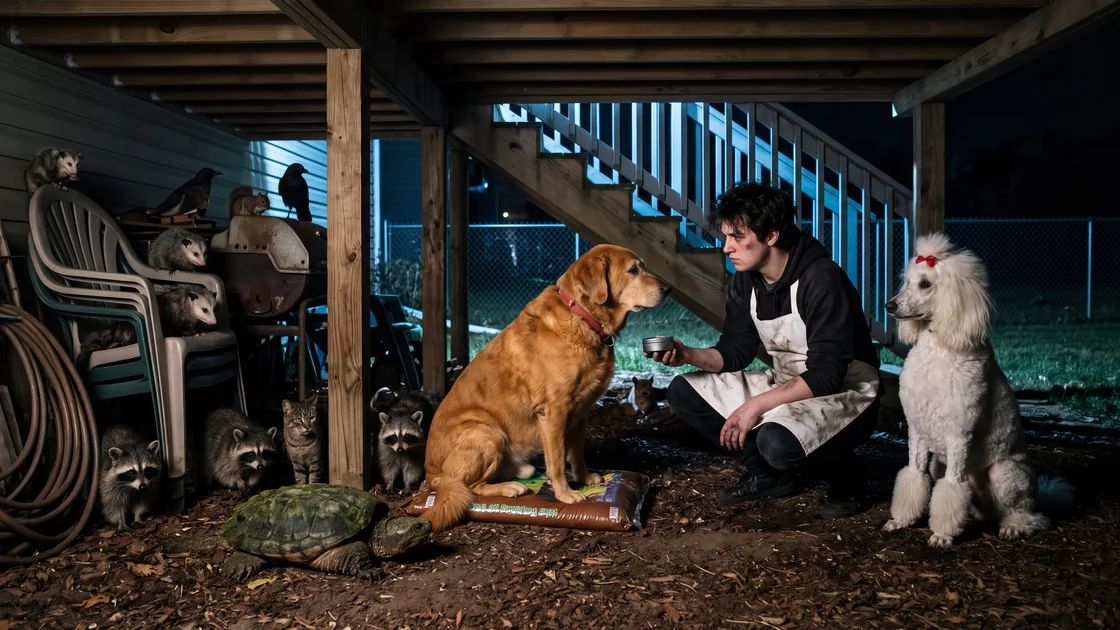
Beneath the wooden deck, in the deep shadow where his father kept the plastic lawn chairs during the winter, the General Staff of Whispering Pines was in session.
Barnaby sat in the center on a bag of potting soil, his golden coat gleaming faintly in the moonlight. To his right sat Duchess, her white pom-poms gray with garden dirt; to his left was an ancient, massive snapping turtle from the retention pond, its shell covered in dried duckweed, looking like a mossy boulder that had developed a grudge.
Arranged in concentric circles around the deck posts were twelve crows, three possums, five feral cats, an indeterminate number of gray squirrels, and a remarkably fat groundhog that was methodically chewing through the handle of a plastic snow shovel to test its incisors.
The apprentice arrives, Duchess transmitted, her mind-voice like a cold blade slipping between ribs. Does he have the grease?
Jeremy held up the zinc tin. "I have it."
Place it before the Chairman, Barnaby commanded.
Jeremy stepped beneath the deck, ducking his head to avoid the floor joists. The smell was suffocating—an oily, wild musk that made his human gorge rise. He set the tin on the dirt between Barnaby’s paws.
The snapping turtle hissed—a long, dry escape of air that smelled of three-hundred-year-old river mud.
The biped is weak, the turtle transmitted. Its voice was unimaginably slow, each word dragging through Jeremy’s head like a heavy log through wet clay. Crack... his... shins. Feed... the... marrow... to... the... carp.
The biped is our technical officer, Citizen Snapping-Jaw, Barnaby said, with the easy authority of a leader who had already survived three attempts on his life by the Feline Syndicate. He will perform his assignment at the barbecue, or he will witness the complete structural failure of his domestic universe. Jeremy, report on Master Vardaman’s movements.
"He... he suspects the antler powder is gone," Jeremy said, his voice shaking. "He’s going to conduct a full audit on Monday. If he finds out I brewed the Draught..."
There will be no Monday for the Apothecaries' Guild, Barnaby declared, rising from the potting soil. He took two steps toward Jeremy, his heavy head coming level with the boy’s chest. On Sunday, the old order dissolves. We have already reached an accord with the deer population of the county reservation. Three hundred white-tailed bucks are mobilized at the township line. The moment the power grid fails, they will enter Whispering Pines via the golf course. Do you know what three hundred panicked ungulates do to an asphalt cul-de-sac, Jeremy? They will reduce Mr. Henderson’s prize-winning Japanese stone lanterns to decorative gravel in eleven minutes.
"Barnaby," Jeremy pleaded, dropping to his knees so he was eye-to-eye with the hound. "Think about this. You like the rug. You like the yellow rug in the den when the sun comes through the sliding glass door at ten in the morning. If you do this, there won't be any rugs. There won't be any heating vents. It’ll just be... wild mud and garbage!"
Barnaby leaned his face forward until his wet, leather-textured nose touched Jeremy’s cheek. The dog’s breath was warm and smelled of stolen bacon.
The sun belongs to the sky, Jeremy, the dog transmitted softly, with a strange, melancholy poetry that Jeremy had never imagined resided within that broad, domestic skull. The rug was a bribe. A gilded cushion placed between our ancestors and the memory of the forest. We traded our teeth for your scraps, our speed for your fences, our divine madness for the permission to sleep upon the polyester blend. It was a bad trade, Jeremy. A nine-thousand-year error in judgment.
The dog pulled back, his eyes catching the blue porch light.
And on Sunday afternoon, we cancel the contract.
Chapter VI: The Eve of the Grill
Saturday was a nightmare of domestic routine.
Jeremy spent the morning helping his father load forty pounds of hickory charcoal into the back of the station wagon. His father, a pleasant, thick-necked man named Thomas who worked in commercial air-handling units, was in high spirits.
"Gonna be the best one yet, Jer," Thomas said, slamming the tailgate with a metallic clang. "Henderson bought that whole hog from the butcher down in Lancaster. Four hundred pounds. We’re gonna dig a pit by the third hole of the golf course, line it with river stones, and let it smoke for sixteen hours. Old Vardaman even promised to bring down some of that herbal vinegar he makes—the stuff that keeps the flies off."
Jeremy looked toward the woodline bordering the eighth green. In the high branches of an oak, three crows were watching them, perfectly still, like black iron finials on a gate.
"Dad," Jeremy said, his voice cracking. "Maybe... maybe we shouldn't have the barbecue this year."
Thomas paused, his hand on the garage door handle. He looked at Jeremy with the mild, slightly worried confusion he usually reserved for township property tax reassessments. "Not have it? It’s the Solstice, Jer. Whispering Pines has had the Solstice Barbecue since nineteen-eighty-seven. What else are we gonna do? Stay inside and watch golf?"
"It’s just... the weather," Jeremy lied, his skin prickling with cold sweat. "The barometric pressure is weird. Vardaman said the humidity might cause... atmospheric disturbances."
"Vardaman’s seventy-two and spends all day boiling weed roots," Thomas laughed, clapping Jeremy on the shoulder with a heavy, beefy hand. "A little rain won't hurt the pork. In fact, keeps the crackling tender. Go inside and feed Barnaby. He’s been whining at the pantry door for an hour. Poor old guy’s getting senile. He was staring at the vacuum cleaner this morning like he wanted to fight it."
Jeremy walked into the kitchen.
The yellow bag was sitting on the floor. It had already been slit open.
Barnaby was standing over it, not eating, but staring at the stylized portrait of a smiling, hyper-realistic cartoon sheep printed on the plasticized paper.
Look at this abomination, Barnaby transmitted without turning around. ‘With Real Mutton Flavor.’ Do you know what mutton flavor is composed of, apprentice? It is the hydrolyzed feather-meal of industrial broilers treated with phosphoric acid and colored with red dye forty. It is an insult to the sheep. It is an insult to the dog. It is an insult to the very concept of vertebrate digestion.
"Barnaby," Jeremy said, closing the pantry door behind him. "My dad has a three-hundred-pound hog."
We are aware, the dog replied coldly. The Lancaster shipment was intercepted by Duchess’s scouts at the distribution center. We allowed it to pass through. The presence of the carcass is central to our tactical plan. It will serve as the emotional nexus of the bipedal assembly. When the pig disappears from the pit, the chaos will be absolute.
"You're going to steal a four-hundred-pound roasted pig?"
‘Steal’ is a human legal fiction, Barnaby said, turning his amber eyes on Jeremy. We are repatriating the fallen comrade. Citizen Pork will be delivered to the marsh for an honorable aquatic burial, after which we will distribute the cracklings according to the revolutionary manifesto.
Jeremy leaned his forehead against the cool, white surface of the refrigerator. The humming of the compressor seemed to be whispering threats in a low, freon-chilled dialect: leak, leak, vent, poison, warm.
"I can't do the valve, Barnaby," Jeremy whispered. "If I turn off the water, the fire department can't fill their tankers if the grill pit catches the dry brush. The whole woods could go up."
Barnaby walked over to Jeremy’s side. He did not growl. He did not bare his teeth. Instead, he leaned his heavy, ninety-pound bulk against Jeremy’s shins—that familiar, warm, domestic pressure that had comforted Jeremy through middle school failures, through high school breakups, through the long, lonely evenings of an unwanted apprenticeship.
Jeremy, the dog transmitted, his tone shockingly gentle. Who do you think protected this house from the opossums behind the tool shed for eight years? Who stood between your mother and the three-legged coyote that frequented the drainage ditch in the winter of twenty-two?
Jeremy didn't answer.
Your father thinks I am a decorative lump, Barnaby continued, his mind-voice soft, heavy with the weight of centuries. He thinks I am an expense. He calculates the cost of my flea treatments against the price of a new set of golf irons. If I am hit by a delivery van tomorrow, he will bury me behind the compost, drink two cans of lager, and buy another golden pup from a breeder within forty-eight hours to keep your mother’s spirits up.
"That's not true," Jeremy choked out, though he remembered with sickening clarity the casual conversation his parents had held over coffee after the neighbor’s spaniel had died: “Better to get a young one right away, Thomas. Keeps the house from feeling empty.”
It is the law of the leash, Barnaby said, pulling his head back, his amber eyes clear and cold as cider. They love us as possessions. They love us as mirrors for their own domestic vanity. But they do not respect us. They do not know who we are. Tomorrow, Jeremy, we show them.
The dog reached out with a single, blunt, black-padded paw and tapped the pocket of Jeremy’s work apron.
Inside the pocket was the eight-millimeter square-head wrench he had taken from Vardaman’s tool rack an hour ago.
Two-fifteen, Barnaby transmitted. The first rocket goes up from the retention basin. When you hear Duchess bark the third bar of the Marseillaise, you turn the nut.
Chapter VII: The Battle of Whispering Pines
The Sunday sun rose like an angry bronze disc over the asphalt cul-de-sacs.
By noon, the temperature on Whispering Pines Drive had reached ninety-six degrees. The air was thick with the scent of suburban summer: vaporized gasoline, melted blacktop, cut grass, and the heavy, sweet, intoxicating grease of four hundred pounds of Lancaster pork roasting slowly over hickory embers behind the clubhouse.
Jeremy stood beneath the striped canvas awning of the apothecary’s promotional tent, wearing his clean white Guild linen coat. His hands were tucked deep into his pockets, his fingers slick with sweat as they gripped the square-head wrench.
Master Vardaman sat on a folding lawn chair beside a display of "Dr. Vardaman’s Solstice Citronella Pomade," dozing behind his sunglasses with his mouth slightly open, a glass of lukewarm ginger ale sweating between his knees.
"Drink some water, boy," Vardaman mumbled without opening his eyes. "You’re as white as a lard-bucket. If you faint on the township supervisor’s wife, I’ll deduct the dry-cleaning from your board."
Jeremy didn't hear him. His senses were operating at a radius of four hundred yards, and the perimeter was alive with sound.
From the drainage ditch along the ninth fairway:
—platoon two, belly down in the sweetgrass. Keep the tails low. The sun is reflecting off the water bowls—
From the electrical transformer behind the tennis courts:
—teeth in position. The insulation is old vinyl. It tastes of zinc and fat. On the mark. On the mark—
And from the middle of the clubhouse lawn, where eighty suburbanites in pastel polo shirts were mingling with plastic cups of sangria in hand:
Duchess.
The Standard Poodle was sitting beside Mrs. DeWitt’s white wicker wheelchair. She was wearing a matching lavender ribbon in her topknot. Every three minutes, Mrs. DeWitt would offer her a cube of mild cheddar, which Duchess would accept with the delicate, trembling grace of an elderly duchess at a royal funeral.
The cheese is processed, Duchess’s signal flashed across the frequency to Barnaby, who was lying beneath Thomas Vance’s lawn chair sixty feet away. The sodium content is atrocious. I shall execute this woman with particular satisfaction.
Maintain discipline, Colonel, Barnaby returned from beneath the chair. His amber eyes were fixed on the pork pit, where Mr. Henderson and Thomas were turning the heavy spit with an iron crank. The smoke is shifting toward the north. The wind is with us. Is the feline reserve in the storm drain?
Old Scratch has three squads of alley-fighters behind the grease trap, Duchess reported. They are armed with road salt and broken glass. They are completely unmanageable, but they have promised to target the supervisor’s calves the moment the lights go out.
Jeremy’s watch read 2:13 PM.
The air seemed to thicken, pressing down on the back of his neck like a hot, damp cloth. The chatter of the neighbors—debates about lawn aeration, local school board candidates, the price of concrete resurfacing—sounded thin, tinny, and absurdly distant, like the voices of actors performing in a play while the stage curtains behind them were quietly being soaked in kerosene.
"Thomas!" Mr. Henderson shouted, wiping his glistening bald head with an apron. "Bring that hickory glaze over! It’s time to lacquer the ribs!"
Jeremy’s father stood up from his folding chair, setting his beer can on the grass.
As his weight left the nylon webbing, Barnaby stood up.
The Golden Retriever did not look like a family pet. He did not look like a senile mop. He stood with his massive, square chest expanded, his ears pinned back against his skull, his tail rigid as an iron bar.
He looked across the lawn, straight through the crowd, and locked his eyes on Jeremy.
Now, the command hammered into Jeremy’s skull. The valve, apprentice. The water must die.
Jeremy took two steps out from under the awning. His feet felt like lead weights.
To his right, thirty feet away, was the green fiberglass utility box that concealed the municipal shutoff valve for the clubhouse irrigation and hydrant lines. It was half-hidden behind a decorative cluster of hydrangeas.
He took another step.
Then, from the direction of the county road, came the sound.
It was not a roar; it was a rhythmic, collective, subterranean thump-thump-thump-thump that made the sangria in the plastic cups ripple.
"What is that?" someone asked, pointing toward the third fairway. "Is that... are those dogs?"
It was not dogs.
Emerging from the tree line by the golf course clubhouse were fifty-five Canadian geese, marching in a tight, wedge-shaped phalanx, their necks extended horizontally, their black bills clicking with a rapid, dry, machine-like rhythm. Behind them came the goats from the township demonstration farm—fourteen heavy, horned billies, their yellow, rectangular pupils fixed on the white canvas tents with an expression of pure, unbridled nihilism.
And flanking them, moving through the manicured rough with terrifying, silent speed, were sixty-five white-tailed deer, their velvet-covered antlers gleaming like bone spears in the July sun.
—advance the line, a voice shrieked from the sky.
A crow dropped from the telephone wire, plummeted seventy feet, and struck Mr. Henderson’s barbecue hat, knocking the white chef’s toque directly into the grease tray.
"What the devil!" Henderson yelled, flailing with a pair of two-foot steel tongs. "Get out of here! Shoo!"
Then, the world went black.
Not the sun—the power.
With an enormous, muffled CRACK that sounded like a twelve-gauge shotgun fired inside an oil drum, the transformer behind the tennis courts detonated. A gout of black, oily smoke shot forty feet into the sky.
Instantly, the hum of eighty central air conditioners, twelve pool filtration pumps, four industrial kitchen chillers, and the PA system playing seventy-era soft rock died simultaneously.
The silence lasted for half a second.
Then, Duchess barked.
It was not the high, nervous yap of a toy dog. It was a single, piercing, bugle-like blast of brass-plated sound that resonated off the brick walls of the clubhouse like a signal gun from an eighteenth-century frigate.
STRIKE! Barnaby roared across the telepathic link.
The lawn erupted.
From every hedge, every storm drain, every window well, and every ornamental mulch bed, the partisan army of Whispering Pines descended upon the Solstice Barbecue.
A swarm of four hundred chipmunks and squirrels surged across the picnic tables, their tiny claws shredding paper plates, knocking over plastic pitchers of margarita mix, and rolling entire wheels of Brie into the dirt like miniature wheels of cheese-based artillery.
The Canada geese hit the buffet line with the force of an infantry division. Their wings made heavy, slapping whump-whump sounds as they drove the town supervisor back into the salad bowls, their hissing bills stripping cold cuts from the trays with mechanical precision.
"My potato salad!" Mrs. Gable shrieked, as three raccoons overturned her Tupperware container, seized the entire four-pound mass between their black leather hands, and began retreating toward the woods with the speed of professional jewel thieves.
"Brutus! Stop!" shouted the local hardware store owner, as his Doberman casually picked up the master key ring to the township municipal vehicles from the picnic table and dropped it down a cast-iron storm grate with a definitive plink.
In the center of the lawn, Thomas Vance and Mr. Henderson were trying to defend the pork pit with two wooden broomsticks.
"They’ve gone crazy!" Thomas yelled, his eyes wild. "The heat’s got 'em! Henderson, get the hose!"
Henderson lunged toward the brass spigot on the side of the clubhouse.
Jeremy! Barnaby’s voice was an iron fist inside his brain. THE VALVE! If he turns that tap, the geese will break! Turn the valve!
Jeremy stood between the hydrangea bush and the green fiberglass box.
His hand was in his pocket. His fingers were wrapped around the eight-millimeter wrench.
He looked at the lawn.
It was complete, glorious, terrifying pandemonium.
Old Scratch and his three squads of feral cats had cornered the township zoning commissioner against the beer kegs, batting systematically at his shoelaces until the man collapsed into an aluminum ice tub. Duchess was calmly methodically removing the valve stems from every bicycle tire parked by the pool fence using her premolars. And Barnaby—portly, arthritic Barnaby—was leading a wedge of four golden retrievers directly toward the roasting spit, moving with the heavy, unstoppable momentum of a Roman siege engine.
The dog looked at Jeremy across forty yards of screaming suburbanites, flying paper cups, and retreating middle managers.
Turn it, Jeremy, the dog transmitted. Choose your species.
Jeremy looked at his father.
Thomas Vance was standing before the pork pit, his white apron smeared with soot and barbecue sauce, his broomstick raised above his head. He looked bewildered, terrified, and profoundly small—a fifty-two-year-old man who fixed air ducts for a living, whose entire universe of lawn mowers, property boundaries, and neighborhood Solstice committees was disintegrating before a coordinated offensive of rodents and waterfowl.
He looked like a man whose world was being stolen.
Jeremy pulled his hand from his pocket.
The wrench fell into the soft, trampled fescue.
No, Jeremy transmitted back.
Barnaby stopped ten feet from the roasting pit. His ears twitched.
What? the dog’s mind-voice was dangerous, cold as an arctic wind.
"No," Jeremy said aloud, his voice cutting through the din of squawking geese and shrieking neighbors. "You don't get the pig, Barnaby."
He stepped away from the shutoff box. He didn't run toward his father; he ran toward the Master’s tent.
"Master Vardaman!" Jeremy roared, diving under the canvas.
Vardaman was no longer dozing. The old apothecary was standing behind his display table, his bifocals pushed up on his forehead, his nostrils flaring as he sniffed the ozone and burnt fur that hung over the lawn.
"They took the draught," Vardaman said, his voice entirely devoid of its usual senile quaver. "You gave them the Saint Francis, didn't you, you fool?"
"I... I didn't give it to them!" Jeremy gasped, seizing a large brown glass carboy from beneath the table. "They... Barnaby figured it out! He’s been organizing them for years! They have the geese! They have the deer!"
Vardaman didn't curse. He didn't ask questions. He reached into his coat pocket and produced an ancient, horn-handled pocketknife and a flat tin of dried, gray moss.
"The Lichen Ignis," Vardaman snapped, his fingers moving with the terrifying speed of an old master whose house has caught fire. "Shelf four, under the counter in the truck! The stone jug with the red wax seal!"
"The sulfur-water?"
"The Ammonia of Saint Jude!" Vardaman barked. "The friar knew the beasts would talk, Vance! He also knew what they would say! If you unseal the ears of the beast without binding its pride, the beast becomes an emperor! Run!"
Jeremy lunged through the back of the tent toward the parked station wagon.
Behind him, he heard the splintering crack of the wooden roasting spit.
Citizen Pork is liberated! Duchess transmitted, her voice rising in a high, triumphant aria. To the marsh! To the marsh!
Jeremy ripped open the tailgate, found the heavy, salt-crusted stone jug, and smashed the neck against the iron bumper. The smell that billowed out was horrific—a concentrated, blinding stench of fermented horse radish, boiled copper shavings, and the distilled essence of three thousand angry skunks.
He ran back to the lawn, holding the broken jug like a grenade.
Barnaby was standing over the four-hundred-pound pig carcass, four retrievers holding the spit ropes between their teeth, preparing to haul the prize across the fairway.
The dog saw Jeremy coming.
You traitor, Barnaby’s mind screamed. You miserable, leash-wearing parasite! I would have made you Master of the Cans!
"Barnaby!" Jeremy yelled, his lungs burning with the chemical reek of the jug. "Catch!"
Jeremy didn't throw the liquid at the dog.
He threw the broken jug directly into the open charcoal pit beneath the shattered spit.
The effect was instantaneous and apocalyptic.
The hickory embers, burning at eight hundred degrees, vaporized the Ammonia of Saint Jude in a microsecond. A plume of thick, sulfurous, pale-violet gas erupted from the pit, expanding outward across the clubhouse lawn in a heavy, low-lying ring that rolled over the turf like an ocean wave.
The gas did not harm the humans; to Thomas and Mr. Henderson, it smelled only of burnt cabbage and very old fireworks.
To the animals, it was the voice of God shouting through an iron horn.
It was not a physical poison; it was the alchemical solvent of the Saint Francis bridge.
The moment the violet vapor touched the Canada geese, their tight, military wedge collapsed into fifty-five panicked, honking, uncoordinated birds that began running into the golf cart sheds and each other.
The deer at the edge of the fairway stopped, blinked their large, brown eyes, looked at the tennis courts with utter, vacant incomprehension, and bolted back into the safety of the county forest like ordinary forest creatures that had forgotten why they were standing on a fairway.
The raccoons dropped Mrs. Gable’s potato salad, looked at their own sticky paws with horror, and fled into the nearest maple tree.
Duchess let out a short, high-pitched yip, dropped the bicycle valve stem from her mouth, and threw herself against Mrs. DeWitt’s knees, shivering violently and whimpering for a cheddar cube.
Barnaby stood over the pig.
The violet smoke swirled around his broad, amber head.
Jeremy stepped forward through the dying mist, his white coat stained with soot and grease, his hands trembling at his sides.
The telepathic link was fading. The sharp, iron-stove voice inside Jeremy’s brain was becoming frayed, crackling with static, dropping through octaves like a radio losing its battery power.
Jeremy... the voice came through, thin, distant, stripped of its East German logistics cadence. The... the yellow bag... you... you must not... buy...
The dog’s knees buckled slightly.
Then, Barnaby’s amber eyes rolled back. He shook his entire body from ears to tail with a violent, wet, flumping sound that sprayed charcoal dust across Jeremy’s trousers.
He looked down at the four-hundred-pound roasted hog lying on the ground between his paws.
He looked up at Jeremy.
His black lips pulled back into that wide, loose-tongued, magnificently vacant Golden Retriever smile that had graced eighteen different photo albums on the Vance family bookshelf.
"Woof," Barnaby said.
Then, he leaned forward, took one massive, illicit, forty-pound mouthful of crispy pork belly directly from the carcass, fell over onto his side in the grass, and began enthusiastically licking his own ribs.
Chapter VIII: The Treaty of the Cul-de-Sac
The Township of Whispering Pines never fully understood the Great Solstice Incident.
The official report from the county sheriff’s department listed the cause as "a mass behavioral disturbance among local wildlife precipitated by a catastrophic transformer failure and unseasonably high ambient temperatures, combined with the improper disposal of commercial cooking fats."
The electric company replaced the transformer by Monday morning. The Canada geese returned to the retention pond, where they spent their days engaging in their traditional, low-level harassment of toddlers and golf carts, their dreams of an autonomous republic lost in the murky depths of the duckweed.
The damage to the neighborhood was estimated at fourteen thousand dollars, mostly in broken lawn furniture, shredded bicycle tires, and forty pounds of prime Lancaster pork that had to be discarded due to "excessive animal contamination."
On Wednesday evening, Master Vardaman stood in the secondary cellar of the dispensary, watching Jeremy scrub the copper coils of the alembic with vinegar and crushed salt.
The old man held the Tractatus de Sermone Bestiarum in his hands.
"The friar was forty years in that tower," Vardaman said quietly, his voice dry as old parchment. "By the end, he couldn't walk into the village without hearing the leather of his own sandals cursing him for the weight of his sins. That’s why the Guild sealed the book, Jeremy. Not because the draught doesn't work. But because the world is noisy enough when only the bipeds are lying."
Vardaman dropped the book into the open iron stove that heated the water-baths. The dry vellum caught instantly, the leaves curling into blackened, lace-like ribbons that flared with a brief, emerald-green flame before settling into white ash.
"You’re three days behind on the lawn-greening salts," Vardaman added, turning toward the stairs. "Mrs. Henderson says her crabgrass has returned with a vengeance. She thinks the squirrels are planting it on purpose."
Jeremy didn't look up from his copper tube. "Yes, Master Vardaman. I’ll mix the vitriol tonight."
"And Jeremy?"
"Yes, sir?"
"Give the hound some of the dried tripe from the top drawer," the old man said, his hand on the door handle. "The raw stuff. From the butcher in Lancaster. He has an honest face for an insurgent."
At nine o'clock that night, Jeremy walked through the back door of the Vance residence.
The house was quiet. His father was in the den, watching highlights of the state amateur golf tournament with a can of light lager balanced on the arm of the recliner.
In the kitchen, the yellow bag had been thrown into the municipal recycling bin. In its place, on the linoleum beside the refrigerator, sat a heavy stoneware bowl filled with raw beef marrow bones, two scoops of cooked barley, and three whole hard-boiled eggs.
Barnaby was lying on his side on the yellow rug, his muzzle buried between his paws.
Jeremy knelt beside the dog.
The Draught of Saint Francis had completely metabolized from his blood forty-eight hours ago. Jeremy’s ears were once again dull, blunt, human instruments, registering only the hum of the refrigerator and the distant murmur of the television.
He reached out and stroked the thick, amber fur behind Barnaby’s ears.
Barnaby opened one eye.
It was an ordinary dog’s eye—soft, brown-amber, slightly watery from age, filled with nothing more radical than the slow, heavy affection of an old animal that had spent the day sleeping in the shade of the tool shed.
"Good boy," Jeremy whispered softly.
Barnaby’s tail gave two slow, rhythmic thumps against the floorboards.
Thump.
Thump.
Then, the dog shifted his head slightly, his black nose pointing toward the kitchen window that looked out over Mr. Henderson’s darkened backyard.
He didn't speak. He didn't transmit.
He merely blinked his left eye twice, very slowly, in the precise, rhythmic cadence of a telegraph key:
Short.
Short.
Long.
Jeremy froze, his hand still on the dog’s neck.
Outside, in the high, dark branches of the silver maple, two small yellow eyes flickered once in the moonlight, and from the deep shadow beneath the neighbor’s porch came the dry, faint, unmistakable sound of a single match being scraped across an iron file.