The Infrasonic Consensus
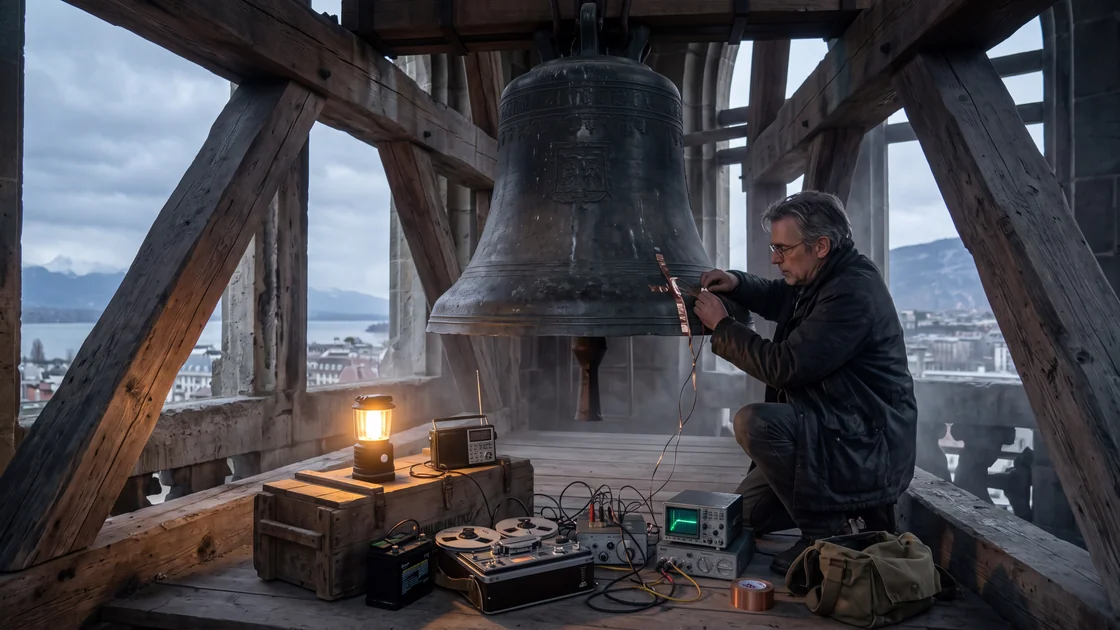
Arthur Vance spent twenty-two years cataloging the microscopic debris of human speech, isolating gunshots from carnival brass, stripping HVAC rattle from deathbed confessions, and calibrating the spatial decay of rooms where men lied for the official record. As the senior audio forensic specialist for the International Media Verification Bureau, he lived in the quietest square footage in Western Europe—a double-walled anechoic chamber suspended on elastomeric isolation dampers beneath the city of Geneva. His world was governed by fast Fourier transforms, phase-aligned spectral displays, and the absolute, pristine purity of absolute zero decibels. Yet when a high-altitude diplomatic summit in Zurich yielded a routine audio feed with an anomalous dynamic floor, Vance bypassed the algorithmic cleanup filters and went down to the marrow of the recording. Buried thirty decibels below the audible threshold of the human ear, beneath the polished rhetoric of prime ministers and presidents, lay an engineered, phase-locked 18.4-hertz sinusoidal pulse—an infrasonic carrier wave whose mathematical modulation suggested not an equipment defect, but a planetary system of acoustic subjugation.
I. The Residual Floor
The laboratory smelled of warmed circuit boards, the dry talc of vulcanized rubber seals, and the faintly vinegar tang of decomposing magnetic tape preserved in the cold-storage vaults across the hallway. There was no ambient air movement. The climate control system delivered chilled air through baffled, micro-perforated acoustic plenums designed to keep the ambient noise floor below eight decibels A-weighted. To a normal person, Arthur Vance’s work environment felt like an assault; visitors often reported hearing their own corneas scraping against their eyelids when they blinked, or complained of a rising, panic-inducing whine that was nothing more than the electrical screech of their own nervous systems idling in the dark.
For Arthur, silence was simply the canvas upon which the world betrayed its mechanisms.
He adjusted his monitor level using an analog Penny & Giles stepped attenuator. On the three thirty-two-inch reference screens arching over his desk, the multi-track stem from the European Security Accord’s plenary session was rendered as a series of iridescent ribbons. Eight lavalier microphones, four boundary boundary-layer capsules glued to the rosewood conference table, and a pair of Neumann digital shotgun microphones mounted in the lighting truss.
The work order was clerical. The Department of Archival Integrity had flagged a minor phase discrepancy between the prime minister’s microphone and the Russian envoy’s translation headset. Arthur was supposed to run a cross-correlation script, nudge the time-alignment by four milliseconds to eliminate a comb-filtering effect that made the chancellor sound faintly hollow, sign the cryptographic verification token, and push the file to the historical registry.
He did not push the file.
Instead, Arthur muted the voice tracks and unlinked the dynamic high-pass filters. Standard broadcast protocol mandated an aggressive 24 dB/octave Butterworth cut at 80 hertz. The human voice carried little meaningful semantic information below eighty cycles; cutting it preserved transmission bandwidth and removed the thump of air conditioning, the distant rumble of subway lines, and the low-frequency mechanical thud of podiums being leaned upon by nervous diplomats.
Arthur disabled the cut.
The visual display dropped instantly into the basement octaves. The spectral energy below 40 hertz—the sub-audible realm, felt in the solar plexus rather than heard through the ear canal—usually looked like a smeared, chaotic soup of brownian noise. Buildings swayed; trucks bounced over expansion joints three blocks away; low-pressure weather systems brushed across roof membranes. It was always asymmetrical, filthy, and structurally incoherent.
This signal was not incoherent.
At 18.4 hertz, cutting across all twelve independent audio channels with identical phase coherence, was a monolithic, unbroken horizontal line.
Arthur leaned forward until his nose nearly touched the matte glass of the center monitor. He adjusted the Fast Fourier Transform resolution from 1,024 points to 65,536 points, slowing the computer’s processing time down to a crawl in exchange for microscopic frequency precision. The horizontal line sharpened. It was not drift. It was not the 50-hertz mains hum of European alternating current, nor was it the 60-hertz signature of American equipment plugged into foreign step-down transformers. It was not a sub-harmonic of a cooling turbine.
The line sat precisely at 18.402 hertz.
And it was breathing.
Arthur zoomed in on the time domain. Over an eighty-minute window, the line did not maintain a constant amplitude. It swelled and narrowed in rhythmic envelopes that lasted precisely four seconds each—fifteen cycles per minute.
"Respiratory entrainment," Arthur muttered aloud. His voice sounded paper-thin in the anechoic space, swallowed instantly by the fiberglass wedges lining the walls.
Fifteen breaths per minute was the baseline resting rate of a healthy adult human subject under mild sedative control.
He pulled up the system diagnostics. His converters were Lavry Golds, calibrated by hand every six months with a laboratory-grade rubidium atomic clock. The line was not a digital artifact generated by a clocking jitter; it was present in the analog voltages captured by the microphone diaphragms inside the grand hall of the Palais des Nations. The microphones had recorded physical air moving at eighteen cycles per second.
Arthur sat back, his palms flat on the cold laminate of the console. He reached for his notebook—an unlined, cloth-bound ledger he kept because hard drives left audit trails and institutional servers were indexed by neural scrapers. With a mechanical pencil, he wrote:
Palais des Nations. 18.402 Hz. In-phase across all channels. Floor: -42 dBFS raw. Modulated: 0.25 Hz envelope.
Below that, he drew a small question mark, and then erased it until the grain of the paper frayed.
II. The Phantom Fundamental
The human inner ear is a mechanical marvel, but it possesses hard evolutionary boundaries. Below twenty hertz, the basilar membrane within the cochlea ceases to oscillate with the spatial selectivity required to distinguish pitch. The acoustic wave is no longer registered as tone; instead, it becomes a sensation of physical displacement, an unaccountable barometric pressure against the tympanic membrane, a phantom vibration in the soft tissues of the mediastinum.
Eighteen hertz had a specific, dark pedigree in the literature of acoustic physics.
In the late 1960s, the roboticist Vladimir Gavreau had nearly killed his research assistants in a Parisian laboratory when an improperly mounted ventilation pipe began acting as an infrasonic whistle, causing violent spasms of the diaphragm, instant vertigo, and an overwhelming, ungrounded sense of terror. Decades later, the British engineer Vic Tandy had written about the "ghost frequency" at 18.9 hertz—the exact resonant frequency of the human eyeball. An infrasonic standing wave at that frequency caused the ocular globe to vibrate microscopically in its socket, smearing light across the retina and creating visual apparitions in the peripheral field: gray shapes, perceived motion, the classic subjective phenomenology of haunting.
Arthur Vance knew these historical curiosities. But what he was looking at on his monitors was neither an industrial accident nor an architectural standing wave.
He switched to his private archive. Over twenty-two years, Arthur had maintained a mirror of the bureau’s master ingest server on a series of air-gapped, home-built optical arrays stored in the dry crawlspace beneath his cottage in Satigny. He initiated an encrypted local query, calling up twenty distinct multilateral speeches spanning fourteen years.
The G8 Summit in Deauville, 2011. The NATO Ministerial in Brussels, 2016. The Emergency Financial Forum in Tokyo, 2019. The World Health Assembly in Geneva, 2022. The Bilateral Trade Concordat in Washington, 2024.
He routed each raw, unmastered feed into a custom multi-spectral comparison script he had written in C++. The workstation’s fan spun up, a faint hiss against the tomb-like stillness of the room.
One by one, the spectra materialized.
In every recording, beneath the varied accents of translators and the shuffle of briefing binders, the line was there.
In Deauville: 18.402 hertz. In Brussels: 18.402 hertz. In Tokyo: 18.402 hertz.
The amplitude varied, but never by more than three decibels. In each instance, the wave sat just above the thermal noise floor of the venue’s microphone preamplifiers. It was too low to be heard by the delegates, too low to be reproduced by consumer televisions or laptops, which typically cut off cleanly at 50 or 60 hertz to save their tiny paper cones from tearing themselves apart on bass transients.
Yet it was there. It had been there for at least a decade and a half.
Arthur pulled his reference headphones—a pair of modified Sennheiser HD800s with extended sub-bass reproduction down to four hertz—over his ears. He turned the monitor volume up. He applied a steep 48 dB/octave low-pass filter at 25 hertz, silencing the world entirely.
At first, there was only the absence of sound, the heavy, suffocating pressure of absolute nullity.
Then, Arthur boosted the analog gain stage by forty decibels.
The headphones did not emit a sound. They began to pump. Arthur felt a heavy, sickening flutter in his chest, like an irregular heartbeat struggling against a thickened pericardium. His vision flickered at the edges; the bright white grid of his audio software seemed to tremble, melting into a pale violet fringe. A knot of sour, cold grease formed in the pit of his stomach. It was not fear born of an idea; it was purely somatic dread—the ancient mammalian autonomic response to an incoming earthquake, the approach of an apex predator whose roar was so immense it shook the bedrock before it registered in the ears.
He ripped the headphones off.
They fell onto the console with a dry plastic clatter.
His heart was hammering at ninety-eight beats per minute. He checked his pulse against the digital sweep second hand of the bureau’s master clock on the wall. His fingers were cold, the capillaries contracted by a sudden surge of peripheral epinephrine.
"It’s not just in the room," he whispered.
The realization struck him with the blunt weight of a lead ingot.
A broadcast engineer does not transmit an infrasonic wave to a consumer audience because consumer speakers cannot move enough air to recreate an eighteen-cycle displacement. If you put eighteen hertz through an iPhone speaker or a flat-screen television soundbar, the cone simply sits still, choked off by the high-pass protective crossover of the amplifier.
Unless you aren't using the fundamental.
Arthur’s hands flew over the keyboard. He loaded the digital transmission stems of the speeches—not the raw venue microphones, but the finished, compressed, satellite-distributed broadcast packages that had been sent to the global news networks: BBC, CNN, Al Jazeera, NHK, CCTV.
He brought up the full spectrum from 20 hertz to 20,000 hertz.
He zoomed in on the mid-range—the vocal presence band, between 2,000 and 4,000 hertz, where human hearing is most exquisitely sensitive, the frequency band where a mother hears her infant cry in a crowded market.
He applied an algorithmic comb filter, looking for harmonic pairings.
There they were.
Twin carrier signals, separated by precisely 18.402 hertz. One sat at 3,150.000 hertz. The other sat at 3,168.402 hertz.
They were buried thirty-six decibels below the speaker’s voice, masked perfectly by the sibilance of consonants—the s, the t, the hard ch of statecraft.
Arthur stared at the screen, his breath stopped in his throat.
The Phantom Fundamental.
It was the Tartini tone, discovered by the violinist Giuseppe Tartini in the eighteenth century. When the human ear is presented with two tones close together at high volume or sufficient density, the physical mechanics of the cochlea—the non-linear spring constants of the microscopic hair cells—generate an intermodulation distortion inside the listener’s head. The ear itself creates a third frequency: the difference tone.
The broadcaster did not need to transmit an 18-hertz wave through the speaker.
The speaker transmitted two clean, perfectly audible, mid-range frequencies disguised as room acoustics and vocal air. The physical ear of the citizen sitting in their living room, the headphone wearer on the commuter train, the listener in their car—their own flesh synthesized the 18.4-hertz wave inside their temporal bone.
The receiver was the demodulator. The biological body was the final circuit component.
III. Dr. Evelyn Hirst
The café was called Le Corbeau, an austere concrete box tucked behind the freight yards of Geneva’s rail terminal where the noise of shunting locomotives made directional surveillance nearly impossible. Outside, a sleet-laden November wind was dragging wet birch leaves across the asphalt.
Arthur Vance sat at a corner table with his back to the wall, a chipped ceramic mug of black filter coffee cooling untouched before him. He had chosen the seat because it sat within a destructive interference node between two ceiling-mounted industrial space heaters. The hum of the gas blowers created a blanket of broadband pink noise that peaked around 250 hertz—terrible for intelligibility, ideal for treason.
Evelyn Hirst arrived precisely three minutes late. She was seventy-two years old, with short-cropped silver hair that looked as though it had been trimmed with tailoring shears, and eyes the color of slate river stones. Thirty years ago, she had run the Psychoacoustics Division at the Royal Military College of Science at Shrivenham before vanishing into the private defense sector. Arthur had worked with her once, in 2004, on the acoustic reconstruction of a disputed massacre in an Adriatic port city; she was one of five people alive who understood the auditory cortex better than Arthur did.
She sat down without taking off her woolen coat. She did not order coffee.
"You look gray, Arthur," she said. Her voice had the dry, raspy texture of heavy-stock paper being torn. "You look like a man who has been spending too much time in anechoic chambers thinking about things that have no phase cancellation."
"I found a tone," Arthur said.
"The world is full of tones. A hydroelectric turbine in Valais vibrates the bedrock halfway to Lyon. The world is an unshielded engine."
"It’s not an engine, Evelyn. It’s 18.4 hertz. Modulated at a quarter-hertz envelope. And it isn't an artifact."
Evelyn’s hands, resting on the laminate tabletop, did not twitch. But Arthur saw her forearms tighten beneath the heavy tweed of her coat. Her knuckles settled half a millimeter deeper into the surface.
She looked toward the grease-stained window where a switcher locomotive was pushing three tankers of liquified butane through the rain. The steel wheels shrieked against the wet curve of the track—a violent, non-harmonic scrape around 4,000 hertz.
"How long have you been looking at it?" she asked softly.
"Three days. I pulled thirty archives. It goes back to at least 2008. It’s on every G20 feed. It’s on the World Economic Forum plenary sessions. It’s on the presidential addresses from the Oval Office and the New Year’s messages from the Kremlin." Arthur leaned forward, his voice dropping into the noise of the gas heater. "They aren't just putting it into the room through subwoofers. They’re encoding it as a phantom fundamental using binaural sidebands in the vocal spectrum. Every consumer speaker on earth reproduces it. Why?"
Evelyn did not answer immediately. She reached into her pocket, withdrew an old metal tin of lozenges, took one, and placed it under her tongue. The smell of menthol and licorice cut through the stale diner air.
"Do you remember the work we did on the vestibular disruption arrays for crowd dispersal in Belfast?" she asked.
"That was brute force," Arthur said dismissively. "High-intensity sound pressure. 130 decibels. Pain thresholds. Permanent sensorineural hearing loss. This is different. This is sixty decibels below the voice. It’s barely above the dither noise of a sixteen-bit file."
"Because it isn't a weapon, Arthur. You’re looking for a club. It isn't a club. It’s an adhesive."
She reached out and dipped her index finger into the condensation ring left by Arthur’s cup, then drew a clean circle on the gray laminate.
"What happens to the amygdala under eighteen-hertz stimulation?" she asked.
"Somatic agitation," Arthur recited mechanically. "Mild autonomic arousal. Vasoconstriction. A drop in skin temperature. An increase in blood serum cortisol. Subjectively, the subject feels that something is wrong with their immediate physical environment. An unaccountable apprehension."
"And what happens if you introduce that state during an experience of high semantic complexity? When an authority figure is speaking to you about an existential threat—a pandemic, a war, an economic collapse, an ecological cliff?"
Arthur was silent.
"The human brain," Evelyn continued, her voice clinical, rhythmic, terrifyingly calm, "is an associative engine. If you make a dog sick while it is eating a red berry, it will never eat a red berry again. But if you make a human feel an ungrounded, subterranean dread while an authority figure is presenting the solution to that dread, what does the mammalian nervous system do?"
The café seemed to drop in temperature. Outside, the switcher engine hissed, venting a plume of white steam into the freezing drizzle.
"It anchors," Arthur said. His stomach felt hollow.
"It entrains," Evelyn corrected. "The amygdala does not distinguish between the origin of the fear and the object of the perception. If the room itself is vibrating with the scent of an invisible wolf, and the man at the lectern says, 'We have the walls, we have the gates, you must remain inside,' the subject does not analyze the logic of the walls. The autonomic nervous system accepts the enclosure because the body believes the threat is already inside its chest."
She tapped the center of the wet circle with her fingernail.
"And the four-second envelope?" Arthur asked, his voice shaking. "The fifteen cycles per minute?"
"The vagus nerve," she said. "If you drive the amygdala with eighteen hertz, you create panic. Panic is dangerous. Panic causes stampedes; panic causes people to smash storefronts and overturn police vans. You don't want panic. You want compliance. The quarter-hertz amplitude modulation mirrors the respiratory cycle of a sleeping human. It mimics the baroreceptor reflex that lowers arterial blood pressure. It is a leash, Arthur. You pinch the dog’s neck with the eighteen hertz, and you stroke its throat with the four-second envelope. It induces a state of chronic, manageable, receptive helplessness."
Arthur stared at her. "Who is doing it?"
Evelyn gave a short, humorless laugh that ended in a cough. "You’ve spent your life looking at audio files as if they were evidence in a murder trial, Arthur. You think there’s a smoking gun. You think there’s an assassin with an oscillator sitting in an underground bunker."
"Someone designed the sideband matrix. It’s identical across six different broadcast standards. That requires a synchronized algorithmic deployment at the encoding level. That means the master broadcast switchers at every major telecommunications hub on the planet have had the same DSP filter inserted into their output boards."
"Yes," she said.
"That isn't an accident. That’s a conspiracy."
"No," she said, leaning across the table until her face was inches from his. "It is an infrastructure. Do you know what happens to a modern state if its population stops being compliant? If the baseline anxiety of eight billion people is allowed to wander freely without an acoustic tether? You think this started with the current governments? This began in the late 1970s. The first analog tests were run through the microwave relay towers of the Bell System in the United States and the State Committee for Television and Radio in the Soviet Union. They used different frequencies then—twenty-two hertz for the Americans, seventeen for the Russians. They realized by the mid-eighties that eighteen point four was the global biological sweet spot. It doesn't matter what language the speech is in. The cochlea has no political ideology."
Arthur felt an odd, high-frequency ringing in his ears—his own tinnitus, protesting the impossibility of what he was hearing. "I’m going to isolate the carrier," he said. "I’m going to invert the phase and master a clean stem. I’ll publish the subtraction file. The null-test doesn't lie. If you subtract the speech from the broadcast and leave only the carrier, the entire world can hear the artifact."
Evelyn looked at him with an expression that was almost maternal in its pity.
"Arthur," she whispered. "Who do you think pays for your anechoic chamber?"
IV. The Architecture of the Null
In audio engineering, the null test is the final arbiter of truth.
It is mathematically irrefutable. If you have an original audio signal, \(A\), and a processed version of that signal, \(B\), you can determine the exact, unadulterated nature of the processing by inverting the electrical polarity of \(B\)—flipping every positive voltage to a negative voltage, every peak into a trough—and summing it with \(A\). Everything that is identical between the two files cancels into absolute, theoretical zero. What remains—and only what remains—is the difference. The residue. The lie.
Arthur returned to the bureau at three in the morning.
The security guard at the perimeter gate, a burly man named Morvan who had sat in that glass booth for fourteen years, barely looked up from his tablet. Arthur swiped his biometric card across the reader. The heavy pneumatic lock hissed, and the reinforced glass door swung open with a muffled click.
The corridors of the bureau were lined with framed historical photographs: the signing of the Treaty of Versailles; the opening session of the League of Nations; the Nuremberg trials, where rows of men wore heavy gray telephonic headphones while interpreters spoke into bakelite microphones. Arthur walked past them, his leather soles squeaking faintly against the waxed linoleum.
He entered the anechoic suite. He locked the inner door—an eight-inch-thick steel slab lined with acoustic seals that compressed with a dull whump when he pulled the lever.
He did not turn on the overhead fluorescents; their ballasts produced a faint 100-hertz magnetic field that his converters could pick up if the shielding on the analog cables was compromised by even a micron. Instead, he worked by the pale amber illumination of a battery-powered LED camping lantern he had brought in his backpack.
He sat at the workstation and booted from a live Linux kernel contained on an unformatted USB drive, bypassing the bureau’s networked operating system.
He pulled two files into his custom signal-processing environment.
File A: The raw microphone feed from the podium of the UN General Assembly, captured by an independent archival Nagra recorder that Arthur had personally calibrated in New York five years ago. It had bypassed the digital routing switchers, recorded directly from the transformer-isolated output of the microphone’s capsule.
File B: The international pool broadcast feed distributed to every news outlet on earth via the satellite uplinks in Clarksburg and Frankfurt.
He lined them up.
He did not rely on the visual waveform. At 192 kilohertz, a single millisecond contained nearly two hundred samples. He zoomed down to the individual sample level, searching for the micro-transients—the tiny, sharp click of the speaker’s tongue hitting the roof of their mouth on an initial consonant.
He found it. A sharp, crystalline spike forty samples wide.
He aligned the tracks until the cross-correlation coefficient read 0.9999998.
Then, Arthur hit the phase-inversion switch on File B.
He engaged the master sum bus.
If File B was simply a clean, amplified, dynamically controlled version of File A, the result should have been nearly absolute silence—perhaps a faint, whisper-thin wash of hiss representing the thermal noise of the broadcast satellite’s transponder.
He pressed the spacebar.
The monitors showed the sum.
The voice vanished. The room reflections vanished. The coughing of the audience, the rustle of the draft resolutions, the clinking of the water carafe against the glass—all of it collapsed into the mathematical void of phase cancellation.
The meters did not drop to zero.
The master meter sat firmly, solidly, at -34 dBFS.
Arthur reached out with a trembling hand and engaged a 40-hertz low-pass filter, followed by a brickwall digital gain boost of thirty-six decibels.
The anechoic chamber was suddenly filled with an immense, rhythmic, terrifying presence.
It was not a sound. The air inside the room, designed to be completely stationary, began to push against Arthur’s chest. The 18.4-hertz wave, amplified through the studio’s massive reference subwoofers, turned the entire room into an acoustic piston.
Wub... wub... wub... wub...
It felt like being submerged in twenty feet of oil. The LED lantern on his desk began to rattle—not from sound, but from the sympathetic resonance of the aluminum casing vibrating at eighteen cycles per second.
Arthur felt his throat tighten. His vision wavered. The edges of the computer screen smeared into double images. A cold sweat broke out across his forehead, running down his temples and stinging his eyes. His breath hitched in his chest; he tried to inhale deeply, but his diaphragm felt as though it were being held in a vice, forced into synchrony with the four-second respiratory envelope.
Inhale... two, three, four... hold... release...
He wasn't choosing the rhythm. The air was demanding it.
He opened the spectrum analyzer on the residual signal.
The infrasound was only the foundation.
Above the 18.4-hertz fundamental, nestled within the phantom sidebands he had spotted earlier, Arthur saw something else. It was an ultra-dense, mathematically structured data stream. It was not random noise; it was frequency-shift keying (FSK)—the same method used by early modems to transmit digital text over analog telephone lines, but compressed and slowed down to a glacial, subliminal baud rate.
He routed the residual signal into a software demodulator.
The software began to dump hexadecimals onto the screen.
0x4E 0x4F 0x4E 0x2D 0x43 0x4F 0x4D 0x50 0x4C 0x49 0x41 0x4E 0x43 0x45
0x53 0x55 0x50 0x50 0x52 0x45 0x53 0x53 0x49 0x4F 0x4E 0x5F 0x56 0x34
0x54 0x41 0x52 0x47 0x45 0x54 0x5F 0x56 0x41 0x47 0x41 0x4C 0x5F 0x30
Arthur’s fingers hovered over the keyboard. He ran an ASCII translation script on the hex dump.
The text rendered in the terminal window, scrolling line by line in amber letters:
[SYS_ID: MONOCORD-GLOBAL-V8.4]
[PARAM_SET: ANXIETY_BASELINE_STABILIZATION]
[CARRIER: 18.402Hz // MOD: 0.250Hz // SYNC: MASTER_ATOMIC]
[PHASE: IN-SYSTEM // DEMOD: BIOLOGICAL_COCHLEAR_NONLINEAR]
[STATUS: ACTIVE // DISTRIBUTION: ALL_TIER1_NETWORKS]
Arthur felt the air leave his lungs.
It was not an accident. It was not even a defense project in the experimental phase.
It was a version number: V8.4.
He looked at the timestamps embedded in the metadata. The current packet was time-stamped forty seconds ago. The system was updating in real time, synchronizing its carrier frequency with the global UTC atomic clock array in Braunschweig, Germany. Every major speech, every emergency address, every televised press briefing from every ministry of information on earth was fed through this mathematical sieve before it touched a satellite transponder or a fiber-optic trunk line.
The entire planet’s political landscape was being painted over with an acoustic varnish designed to keep the mammalian herd from bolting while the barn burned around them.
Suddenly, the red tally light on the console—the direct intercom link to the bureau’s master engineering office—blinked once.
Then it went solid.
Arthur did not move. He did not breathe.
The intercom did not buzz. There was no chime. But through the small, unshielded speaker grille above the patch bay, a voice spoke. It was not loud. It was Morvan, the security guard from the perimeter gate.
"Mr. Vance," the voice said. It did not have the gravelly, half-asleep tone Morvan used when Arthur handed him his security badge. It was flat, crisp, and utterly devoid of contour. "You have exceeded your authorized processing window for Archival File 24-Zurich. Please disengage the sub-bass monitoring array. The structural isolation dampers of the building are not rated for continuous eighteen-hertz excitation."
Arthur reached out and slammed his hand down on the master power switchboard.
The subwoofers died. The monitors went black.
The silence returned—total, terrifying, and no longer clean.
V. The Acoustic Shadow
A man who understands sound knows that there is no such thing as an impenetrable barrier.
A wall of reinforced concrete will stop light. It will stop an aerosolized nerve agent. It will stop a rifle round. But to an eighteen-hertz sound wave with a wavelength of nearly sixty feet, a concrete wall is merely an elastic diaphragm that absorbs the energy on one side and pumps it out on the other. You cannot hide from infrasound behind armor plate; the armor simply becomes the speaker cone.
There is only one way to escape an infrasonic wave: you must find an acoustic shadow—a point of destructive interference where two identical waves arrive out of phase and extinguish one another, or you must place yourself inside an environment where the geometry of the space creates a natural cut-off below which the wave cannot physically form.
Arthur did not go home to his cottage in Satigny.
If they were watching the sub-bass arrays from the master engineering board, they were already at his cottage. His personal optical drives, his backup Nagra decks, his notebooks—they were already gone, or they were sitting in the back of an unmarked van being cataloged by technicians who had never spent an hour listening to the air between the stars.
He drove his twelve-year-old diesel Peugeot north, keeping off the autoroutes, his phone battery pulled and its SIM card shredded into four pieces with his wire cutters and scattered into a drainage ditch outside Meyrin.
He turned off his headlights as he approached the abandoned limestone quarry at the foot of the Jura Mountains.
The quarry had been exhausted in the late nineteenth century. In the 1950s, the Swiss Federal Office of Civil Protection had excavated a series of deep underground storage galleries into the solid limestone shelf, intending to use them as an emergency redoubt for regional telegraph relays in the event of a nuclear exchange. The tunnels were small, narrow, and jagged—raw stone ceilings three feet above the floor, walls left rough from pneumatic drills.
The physics were absolute: an eighteen-hertz wave requires a minimum open dimension of at least fifteen feet to propagate with any efficiency. In a stone tunnel four feet wide and five feet high, the wave is physically choked off. It cannot develop its physical wavelength; it becomes an evanescent wave, decaying exponentially within inches of the entrance.
The tunnel was an acoustic sanctuary.
Arthur walked into the dark with his camping lantern and a canvas field bag containing his battery-operated Stellavox reel-to-reel recorder, three rolls of virgin quarter-inch tape, an old analog spectrum analyzer powered by a lead-acid battery, and a modified Neumann U87 microphone whose internal coupling capacitors he had rebuilt by hand to extend its flat frequency response down to two cycles per second.
The cold inside the rock was ancient and mineral. It smelled of wet calcium carbonate and wet iron.
He walked two hundred yards into the limestone, his boots crunching on the loose gravel floor, until the faint gray rectangle of the quarry entrance disappeared behind three successive ninety-degree bends.
Here, the silence was different from the anechoic chamber.
The anechoic chamber was an artificial silence—a dead, predatory vacuum maintained by synthetic wedges that swallowed sound like a black hole.
The silence of the limestone was heavy, geologic, and real. The rock had no phase response. It had no clock.
Arthur set his lantern on an upturned wooden ammunition crate left behind by the civil defense engineers sixty years ago. He set up the Stellavox. The Swiss-made aluminum chassis was cold to the touch, its twin reel plates gleaming under the LED light like the eyes of an animal.
He plugged his headphones directly into the monitor output of the Stellavox.
He took out a battery-powered shortwave receiver—an old Sony ICF-SW7600GR. He pulled the telescopic whip antenna out to its full length, grounding the base of the antenna to a rusty iron rock-bolt driven into the limestone wall.
He spun the tuning dial through the international broadcast bands.
He was not looking for the speeches. He was looking for the carrier.
At 6.075 megahertz, 9.580 megahertz, 11.940 megahertz—the long-range shortwave frequencies used by international state broadcasters to beam their signals across oceans and continents—the sky was thick with voice.
A German foreign minister was speaking about grain corridors. An American undersecretary was being interviewed about missile deployments in the Pacific. A Chinese trade representative was addressing an industrial forum in Macao.
Arthur did not listen to the words. He routed the headphone output of the Sony receiver into the analog line input of his spectrum analyzer.
The small, green cathode-ray tube flickered to life. The trace swept across the screen from left to right, painting the frequency domain in a phosphor line that lingered in the darkness of the cave.
There it was.
Even here, carried on high-frequency radio waves bounced off the F2 layer of the ionosphere from transmitters thousands of miles away, the signature was burned into the audio stems.
The twin sidebands. The 18.402-hertz phantom carrier.
And then, as Arthur watched the green trace sweep across the glass, the line changed.
The horizontal line did not stay flat. It began to shift.
It dropped from 18.402 hertz to 18.150 hertz.
Then it rose to 18.890 hertz.
It was sweeping.
Arthur stared at the green phosphor line, his jaw slack.
A static frequency is a control measure. It creates a baseline. It sets the cattle to grazing in a defined perimeter.
A sweeping frequency is a muster.
In the military literature on acoustic psychology, an infrasonic sweep across the ocular and vestibular bands was known as an evocation protocol. It was designed to shake the subjects loose from their cognitive anchors, to create an acute, panicky disorientation that could be resolved only by an immediate, authoritative acoustic convergence.
The speech on the German broadcast ended.
There was no station identification. There was no chime.
A voice came onto the frequency. It was not the German foreign minister. It was an automated, synthetically generated voice—a neutral, Mid-Atlantic English accent that possessed the strange, terrifying perfection of an algorithmic voice model.
"All stations," the voice said. It did not have the compression artifacts of normal shortwave radio. It was unnaturally clear, as if the speaker were sitting inside the limestone tunnel three feet behind Arthur’s shoulder.
"All stations. Execute Consensus Convergence Protocol Seven. Carrier elevation: twelve decibels. Synchronize local relays."
Arthur dropped his pencil. It rolled across the gravel and clicked against the lead-acid battery.
On the cathode-ray tube, the green line didn't just sweep.
It leaped.
The amplitude of the twin sidebands jumped by an order of magnitude. On the audio meter of his Stellavox, the needles slammed into the red, pinning themselves against the brass stop-pins with a rhythmic, mechanical thwack-thwack-thwack.
The shortwave receiver began to whine—an internal intermodulation distortion created within the radio's own audio amplifier stage.
Arthur pulled his headphones halfway off his ears.
Even through the air, even through the narrow, choked limestone gallery where the wavelength should have been smothered, he felt it.
It wasn't coming from the shortwave radio.
The rock was moving.
The limestone shelf of the Jura Mountains, millions of tons of ancient sediment compressed beneath the European continent, was carrying the wave. Somewhere, miles away—perhaps in the hydro-electric tunnels beneath the dams of the Alps, or through the massive ground-wave antennas of the subterranean military transmission arrays in the Black Forest—immense industrial transducers were pumping megawatts of raw acoustic power directly into the crust of the earth.
WUB.
WUB.
WUB.
It was slower now. Ten cycles per minute.
The resting respiratory rate of a human being in the final stages of hypothermia.
Or terminal shock.
VI. The Transmission at St. Pierre
Arthur Vance did not run. There was nowhere on the European continent to run where the bedrock was not connected to the Alpine roots.
He understood now why Evelyn Hirst had looked at him with that maternal, pitying horror. She had not been warning him that he would be assassinated. She had been warning him that he was already inside the speaker cabinet. The whole world was inside the cabinet.
He packed his gear. He did not turn off the Stellavox; he let the tape run, recording the raw, unattenuated seismic wash coming through the limestone walls. If there was to be an archive at the end of the world, it would not be written in ink or stored on cloud servers that could be cleared with a single administrative keystroke. It would be carved into the magnetic rust of quarter-inch tape, preserved in the only medium that could survive an electromagnetic pulse or an institutional scrub.
He drove back into Geneva before dawn.
The city was silent, but it was not the silence of sleep.
As he drove down the Rue du Rhône, past the darkened storefronts of the private banks and the luxury watchmakers, he saw people.
They were not rioting. They were not screaming.
They were standing on the sidewalks.
A man in a bathrobe stood at the curb outside an apartment building, his bare feet inches from the icy gutter, staring up at the gray belly of the clouds with an expression of dull, paralyzed waiting. A woman had stopped her bicycle in the middle of an intersection; she had not put her kickstand down, she simply sat with one foot on the pedal and both hands clamped to the handlebars, her head tilted slightly to the side as if she were trying to remember the name of a song she had heard twenty years ago in a foreign country.
None of them were looking at their phones.
The phones were in their pockets, or sitting on their nightstands, their screens dark, their tiny speakers vibrating with the silent, phantom fundamental of Convergence Protocol Seven.
Arthur parked the Peugeot in the shadow of the Cathedral of St. Pierre, the ancient stone church that sat at the highest point of the old city, where John Calvin had preached his terrifying, clockwork theology of absolute predestination five centuries ago.
He carried his field bag up the winding stone stairs of the north tower.
His heart was pounding with a sickening, irregular thud. His vision was tunneling; the stone steps seemed to breathe beneath his feet, the spiral staircase twisting like the inside of a cochlea. Every five seconds, a wave of nausea washed up from his stomach into the back of his mouth—the pure, chemical taste of bile and adrenaline.
He reached the belfry.
The wind from the lake was screaming through the open stone louvers, carrying the smell of wet slate and freezing water. Hanging above him in the darkness was La Clémence—the six-ton bronze bell cast in 1407, its massive lip cold and black against the gray sky.
Arthur did not set up the microphone to record.
He set it up to speak.
He took out his modified Nagra monitor amplifier—a portable, forty-watt, class-AB field unit with high-current output transistors designed to drive measuring horns in acoustic field surveys. He disconnected the speaker outputs.
He looked at the bell.
A bell is not just an instrument for making sound. A bell is a mechanical acoustic resonator of extraordinary efficiency. If you excite a six-ton bronze casting at its resonant frequency, it does not require kilowatts of power to move the air; it requires only a few watts delivered at precisely the correct mechanical phase angle to cause the entire mass of metal to sing.
Arthur pulled a roll of industrial copper tape and two piezoelectric contact transducers from his bag.
He climbed onto the wooden framing of the belfry. His fingers were so cold he could barely peel the backing from the adhesive tape. He pressed the first transducer against the waist of La Clémence, directly below the relief of the Virgin Mary. He pressed the second transducer on the opposite side, one hundred and eighty degrees around the circumference.
He wired them in parallel, reversing the phase of the second pickup.
He plugged the input of the amplifier into his Stellavox.
On the tape deck, he had loaded the master null-track he had created in the anechoic chamber thirty hours ago: the inverted, high-resolution recording of the 18.402-hertz carrier wave, isolated from the UN General Assembly feed, phase-reversed by precisely 180.00 degrees.
The anti-signal.
The counter-venom.
If the world was being driven into an artificial, catatonic compliance by an in-phase infrasonic field, the only way to break the entrainment was to introduce an acoustic disruption—a phase-tearing event that would shatter the coherence of the carrier wave and allow the mammalian brain to recover its autonomic autonomy.
It would not be quiet.
When two massive acoustic waves collide out of phase, they do not simply vanish into peace. At the boundary layers, where the phase cancellation is imperfect due to temperature gradients and structural reflections, the energy must go somewhere. It shears. It creates violent, high-velocity atmospheric turbulence—micro-barometric shock fronts that rattle windows, tear roof slates, and rip the air out of human lungs.
Arthur looked out through the belfry louvers.
The sun was beginning to break through the cloud deck over the Dents du Midi, a pale, anemic yellow knife-edge that cut across the gray waters of Lake Geneva. Down in the city, the streetlights were turning off, one sector at a time.
Across the lake, on the roof of the Palais des Nations, the forest of communications antennas stood motionless, their microwave dishes pointed like blind eyes toward the geostationary satellites hanging thirty-six thousand kilometers above the equator.
Arthur put his hand on the toggle switch of the amplifier.
He was fifty-one years old. He had no wife; he had no children; he had no publications in the peer-reviewed journals because everything he knew belonged to the classified registries of international verification protocols. He had spent his life being the man who listened to make sure other men could lie with technical plausibility.
"Let them hear the difference," he whispered.
He flipped the switch.
VII. The Null Event
The Stellavox began to spin.
The supply reel turned with a faint, oily whisper; the take-up reel gathered the tape with the smooth, relentless torque of a Swiss precision motor.
For two seconds, nothing happened.
Then, La Clémence spoke.
The bell did not ring. The clapper did not move against the bronze rim.
The six tons of fifteenth-century metal began to hum.
It was a sound that had never been heard in the history of the canton. It was not the majestic, clear F-natural that the bell had rung since the Middle Ages to warn the citizens of Savoyard invasions or city-flattening fires.
It was an impossible, guttural groan. The bronze began to shimmer, shedding flakes of green patina that fell through the belfry like an emerald snow.
Arthur felt the floorboards beneath his boots heave.
The contact transducers were pumping the inverted 18.402-hertz wave directly into the crystalline matrix of the bell. The bell, acting as an acoustic transformer, took the electrical voltage from the tiny forty-watt amplifier and converted it into physical mechanical displacement with the brutal, unstoppable efficiency of three cubic meters of resonant bronze.
A wall of anti-phase air exploded outward from the north tower of the cathedral.
Arthur was slammed back against the stone wall of the belfry, the breath driven from his chest as if he had been struck with a flat piece of timber. The air pressure in the room plummeted; his ears popped with a sound like pistol shots, his Eustachian tubes screaming as the barometric pressure dropped twenty millibars in a fraction of a second.
Down in the square below, the effect was instantaneous and catastrophic.
The air between the cathedral and the lake seemed to boil.
The mist rising from the water did not drift; it was shattered into microscopic droplets that hung in the air like an iridescent fog. The windows of the luxury apartments along the Quai Gustave-Ador did not shatter inward; they blew outward, the negative pressure wave sucking the plate glass into the streets in a sparkling, cascading waterfall of shards.
And then the people moved.
The man in the bathrobe at the curb did not look up at the sky anymore.
He fell to his knees, his hands clamped over his ears, his mouth open in a long, ragged, human scream that carried all the way up the hill to the cathedral belfry. The woman on the bicycle dropped the frame onto the pavement; she stood up, took two staggering steps like a drunkard stepping off a spinning carnival ride, and began to weep, her chest heaving in violent, ragged, uncontrolled sobs.
The entrainment was broken.
The artificial four-second respiratory leash had been severed by the anti-phase pulse. The amygdalas of ten thousand human beings in the central basin of Geneva were suddenly freed from the invisible acoustic hand that had been holding them by the throat.
The result was not peace.
It was the terrifying, raw, agonizing return of suppressed terror.
People were shouting. Car horns began to blare as drivers, waking from their acoustic stupor, slammed their heels down onto pedals with autonomic panic. A flock of five thousand gulls rose from the lake breakwaters in a shrieking, chaotic white cloud that wheeled wildly against the yellow sunrise, their navigational magnetoreceptors scrambled by the massive atmospheric shear wave.
Arthur stood in the belfry, his back pressed against the cold limestone, blood trickling from his left nostril where the pressure drop had ruptured the delicate capillaries of his nasal septum.
He was smiling.
It was a broken, terrifying smile, but it was the first time in twenty years his face had known the expression.
"You can’t filter it," he screamed into the roaring wind that was rushing into the vacuum created by the bell. "You can't notch it out! It’s in the room! It’s in the bronze!"
On the tape deck, the supply reel was nearly empty.
Fifty feet of tape left.
Thirty feet.
Then, from the stairwell behind him, came the sound of a pneumatic bolt-cutter biting through the padlock on the lower tower gate.
VIII. The Speed of Sound
They did not wear tactical gear.
They did not look like soldiers.
The three men who emerged from the narrow, spiral staircase into the wind-whipped belfry wore the dark, charcoal-gray wool overcoats of administrative attachés from the Federal Department of Foreign Affairs. Their ties were pinned neatly to their shirts with small silver clips; their shoes were sensible Swiss leather brogues, damp from the stairs.
The man in the lead was Morvan.
He was not carrying a sidearm. He was carrying an industrial acoustic calibrator—a handheld Bruel & Kjær Type 2250 sound level meter with a calibrated half-inch condenser microphone sticking out of the top like an aluminum finger.
He did not look at Arthur with anger. He looked at him with the cold, irritated patience of a master watchmaker who has found a grain of grit in the escapement of an expensive chronometer.
"Turn it off, Arthur," Morvan said. His voice was completely intelligible despite the howling wind and the groaning bronze of the bell. He spoke at a frequency that found the natural acoustic notch of the human ear—precisely 2,500 hertz, the frequency of command.
"It’s already on the tape," Arthur said, his voice raw. He pointed at the Stellavox, where the last ten feet of quarter-inch tape was whipping around the take-up hub with a rhythmic flack-flack-flack-flack. "The null file has been broadcast through six tons of bell-metal. Every monitor station between here and Lyon has the phase anomaly on their registries. You can't scrub the sky, Morvan."
Morvan did not look at the tape deck.
He stepped onto the wooden platform, his leather shoes steady on the vibrating timbers. He reached out with one gloved hand and caught the edge of the bronze bell.
He did not pull it. He simply leaned his weight against it, pressing a thick pad of industrial damping rubber—the kind used to isolate high-speed elevator motors in ministerial skyscrapers—against the vibrating rim.
The groaning changed pitch. The anti-phase wave choked, sputtered, and died into a dull, flat mechanical thud.
The silence that followed was terrifying.
Down in the city, the sirens were beginning to rise—the three-tone European emergency sirens, a chaotic, uncoordinated chorus of fear that drifted up from the wet asphalt like smoke.
"Do you know what the speed of sound is in air, Arthur?" Morvan asked. He did not turn around. He kept his hand against the bell, feeling its cooling bronze with his gloved fingers.
"Three hundred and forty-three meters per second," Arthur said mechanically.
"And do you know what the speed of an administrative directive is through a fiber-optic cable?"
Arthur did not answer.
"Three hundred thousand kilometers per second," Morvan said. He turned to face Arthur. His eyes were small, gray, and completely empty of malice. "By the time the sound of that bell crossed the Pont du Mont-Blanc, the Federal Office of Communications had already issued a public advisory. An industrial gas leak at the Vernier storage facility. A localized barometric inversion causing mild dizziness and olfactory irritation among the population. The public has already been instructed to close their windows and stay indoors."
"And the speech?" Arthur spat, wiping the blood from his upper lip with the back of his sleeve. "The UN feed? The sideband data? The 8.4 protocol?"
"What speech?" Morvan asked softly.
He stepped aside.
The second man in the charcoal overcoat stepped forward. He was holding a small, gray plastic case. He opened it. Inside, nestled in custom-cut polyethylene foam, lay a single, standard six-millimeter glass calibration wafer—an optical storage standard used by the International Bureau of Weights and Measures in Sèvres.
"We re-indexed the master archive forty minutes ago, Arthur," Morvan said. "The Zurich summit audio has been re-rendered. The historical stems have been phase-corrected. The algorithm you found was an artifact of an obsolete digital compression codec used by the European Broadcasting Union in the early 2000s. We have issued a formal apology for the technical oversight. A paper will be published in the Journal of the Audio Engineering Society next month. You will be listed as the primary author."
Arthur felt his knees go soft. He leaned his back against the rough limestone of the belfry wall, sliding down three inches until his shoulder blades caught on an iron tie-rod.
"A paper," Arthur whispered.
"A very thorough paper," Morvan said. "A cautionary analysis of how intermodulation distortion in legacy analog-to-digital converters can create phantom frequencies in the infrasonic spectrum. A technical curiosity. An engineering ghost."
Morvan walked over to the Stellavox.
He did not smash it. He did not throw it from the belfry.
He reached down, his movements delicate and practiced, and lifted the take-up reel from its spindle. He took out a small bottle of industrial acetone from his coat pocket, unscrewed the cap, and poured three drops onto the brown oxide of the tape.
The magnetic coating liquefied instantly, turning into a smear of black, greasy paste that dripped down over the aluminum chassis and onto the wooden floorboards.
"You should have stayed in the anechoic chamber, Arthur," Morvan said, looking down at the ruined tape. "The air is much cleaner down there. You don't have to listen to what the world sounds like when it’s trying to stay alive."
The third man, who had remained silent by the stairwell door, stepped forward. He was holding a silver hypodermic sleeve—a pneumatic, spring-loaded auto-injector used by medical transport teams for rapid sedation of violent psychiatric patients in high-altitude environments.
Arthur looked at the needle.
He did not look for a weapon. He did not look at the stairs.
He looked through the stone louvers of the belfry, out across the gray roofs of the city toward the mountains.
The sun had cleared the peaks now, a cold, hard, white light that laid bare every chimney, every slate tile, every high-voltage cable strung across the streets like the wires of a colossal, neglected piano.
And then, faintly, through the soles of his boots, through the sixty feet of limestone tower, through the very bedrock of the hill of St. Pierre, he felt it begin again.
Wub... wub... wub...
Not 18.4 hertz.
Not anymore.
The frequency was lower now. Twelve cycles.
The resonant frequency of the human colon and the abdominal aorta.
The envelope had shortened. Three seconds.
Twenty breaths per minute.
The breathing of a child who has been crying for three hours in a locked room until its voice has given out, its lungs hitching in dry, mechanical, involuntary spasms, waiting for the door to open, waiting for someone to come into the dark and tell it that the noise it heard was only the wind.
"I can still hear it," Arthur said. His voice was barely a whisper against the stone.
Morvan looked down at him, his face shadowed by the rim of the great bell.
"No, Arthur," he said, his voice flat and perfectly centered in the 2,500-hertz window. "You don't hear it. You only feel it because you’re still listening."
The pneumatic injector hissed—a short, clean, five-millisecond transient that had no low-frequency fundamental at all.
Arthur did not feel the needle.
He only felt the air pressure in the room settle, smoothing out its ripples, returning to the flat, pristine, perfectly calibrated silence of an empty hall where the microphones were open, the recorders were running, and there was nothing left to verify.