The Iron Leviathan of the Abyssal Floor
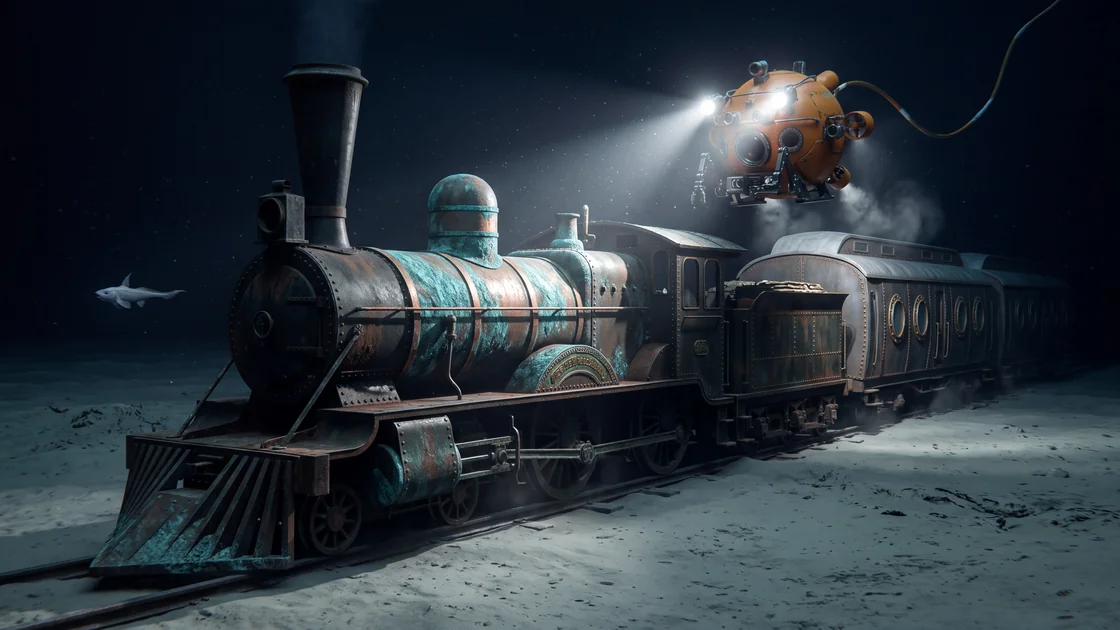
This is the account of the salvage vessel Cormorant Venture and its four-person specialist crew, who, while surveying a deep-sea grave in the North Atlantic three thousand meters below the surface, discovered not the steel hull of a lost merchantman, but an intact, sealed, and upright Victorian passenger train resting on an abyssal plain; it chronicles their descent into its dry, pressurized carriages, the revelation of the impossible engineering and tragic ambition that placed it there, and the harrowing minutes before the crushing weight of the deep reclaimed its secrets.
Act I: The Echo on the Silt
The North Atlantic at forty-eight degrees north, twenty-four degrees west does not welcome visitors. It is an expanse of gray-crested swell and violent squalls, situated above the western shoulder of the Mid-Atlantic Ridge, where the ocean floor drops into fractured canyons of volcanic basalt carpeted in pale pelagic ooze. At three thousand two hundred meters, the water exists under a hydrostatic pressure exceeding four thousand six hundred pounds per square inch. It is an environment of absolute blackness, chilled to a steady one point eight degrees Celsius, devoid of season, weather, or human intrusion.
Aboard the Cormorant Venture—a hundred-and-sixty-foot refitted Norwegian seismic vessel rigged for deep-submergence salvage—the only indications of this abyssal world were digital readouts, scrolling waterfall displays, and the heavy, rhythmic thrum of the twin Bergen diesels fighting the Atlantic drift.
Sean Vance, the salvage master and owner of the vessel, leaned over the consoles in the operations van, a converted shipping container bolted to the Cormorant’s work deck. The air inside the van was thick with the scent of lukewarm filter coffee, damp neoprene, and the hot electrical smell of sixty-cycle server racks.
"Run the pass again, Mara," Vance said, his voice scraped raw by two weeks of gale-force seas and broken sleep. "Tighten the beam by five degrees. If the transponder on the towfish is drifting, compensate at the winch."
Mara Diaz, sitting with her hands resting lightly on the twin joysticks of the side-scan sonar console, did not immediately answer. Her eyes, magnified slightly by round wire-rimmed glasses, remained fixed on the high-resolution monitor. The screen showed an acoustic shadow rendered in tones of amber and rust: the seabed was a flat, uniform expanse of gray mud, interrupted by a single, sharp anomaly.
"The towfish isn't drifting, Sean," she said quietly. "The Doppler velocity log has us locked to the bottom within three centimeters. The returns are real. Look at the hard edges."
Nikolai Reyes, the crew’s chief dive technician and marine engineer, leaned over her shoulder, a half-eaten sleeve of soda crackers in his hand. He squinted at the display, wiping salt-crusted grease from his forehead with the back of his wrist. "It's too straight. Nature doesn't build ninety-degree corners out of basalt at this depth. Is it a shipping container? One of those forty-foot reefers lost off a Maersk freighter?"
"Too long," Mara murmured. She dragged a crosshair across the amber smear. "A standard intermodal container is twelve meters. This target is sixty-eight meters from end to end. Narrow. Five meters across the widest profile. And look at the acoustic shadow cast behind it. It isn't flat. It has steps. Like vertebrae."
Standing near the door of the van, half in shadow, was Dr. Arthur Pendelton. Pendelton was not a salvage hand; he was an archival historian whose charter fees had paid for the fuel, the drydock time in Falmouth, and the expensive leasing of the deep-tow sonar. He was a frail man of sixty, dressed in an oversized woollen gansey that smelled of camphor, clutching a worn leather notebook bound with an elastic strap.
"Is it iron?" Pendelton asked, his voice trembling with an urgency that had irritated Vance for twelve days straight. "Tell me the density profile, Miss Diaz. Does it reflect as iron?"
"It’s high-density metallic, yes," Mara replied without looking back. "High acoustic impedance. The return is ringing like an anvil. But it isn't the Aethelgard."
Vance sighed, running a hand through his gray-streaked beard. "The SS Aethelgard was a three-thousand-ton tramp steamer. She had three Scotch boilers, an iron frame, and four cargo holds. Her signature should look like a scattered junkyard of plates and coal mounds across two hundred yards of mud. This... this looks like a spear."
"We drop the ROV," Pendelton insisted, stepping forward into the glow of the monitors. "Sean, that was our agreement. Any anomaly within five square miles of the coordinates indicated by the Lloyd’s salvage register from 1892 requires visual confirmation. You signed the contract."
Vance glanced at Nikolai. "How's Geryon looking?"
"Tether is dressed. Hydraulic power unit on the main arm was weeping a little fluid around the secondary seals, but I swapped the O-rings before breakfast," Nikolai said, tossing the cracker sleeve aside. "She’s ready to swim. If we launch now, she’ll be on the bottom in ninety minutes."
"Get the crane crew mustered," Vance said. "Mara, prep the control shack. Dr. Pendelton, if this is another lost navigation buoy or a fallen section of transatlantic telegraph cable, your foundation eats the crane mobilization fee."
"If it is what the manifests whisper it might be," Pendelton replied, his gaze locked onto the amber shadow, "money will cease to be a consideration for any of us."
The launch of the remotely operated vehicle Geryon-4 was an exercise in practiced industrial violence. The five-ton yellow cage swung from the stern A-frame over foaming, gray-green swells that smashed against the transom before the winch wire snapped taut, plunging the machine through the interface into the relative peace of the epipelagic zone.
For an hour, the crew watched the telemetry screens descend through the water column. The blue gave way to murky bottle-green, then to the indigo twilight of the mesopelagic, and finally into the pitch-black abyss. The water temperature dropped through thirty degrees, twenty, ten, until the probe hovered at three degrees Celsius, three thousand meters down, suspended thirty meters above the Atlantic mud.
"Altitude thirty," Mara announced, her voice flat with the professional cadence of a pilot. She sat in the darkened control pod, her fingers dancing across thruster toggles. "Kicking on the forward high-output metal-halide arrays. Turning sixty degrees south toward the acoustic fix."
The main monitor flickered as eighteen thousand lumens of pure white light punched into the darkness.
At first, there was only the marine snow—an endless, drifting drift of planktonic debris and organic silt that fell from the sunlit world miles above. Then, the silt floor emerged: an undulating desert of pale ooze, pitted here and there by the burrows of abyssal worms and the delicate, geometric tracks of sea cucumbers.
"Twenty meters out," Mara said. "I’m picking up a hard return on the vehicle's forward sector-scan. Dead ahead."
"Ease her in," Vance ordered, standing directly behind her, his hands gripping the back of her pilot’s chair. "Watch the umbilical. If there’s jagged rigging or torn plate down here, I don't want us snagging seventy thousand dollars worth of fiber-optic tether."
The lights reached forward. A shape began to materialize from the gloom—not with the soft, decayed outlines of a wooden ship, nor the torn, jagged violence of an exploded steam freighter, but with an astonishing, geometric purity.
A line. A long, dark, horizontal line of plate steel, punctuated by regular, rhythmic interruptions.
"What the hell is that?" Nikolai whispered.
Mara brought the Geryon five meters higher, titling the primary pan-and-tilt camera downward. The sediment was undisturbed around the object. There was no impact crater, no wide scar of a catastrophic descent through three miles of water. It sat upon the seabed as if it had been laid down upon a carpet.
"Look at the undercarriage," Nikolai said, his voice choking off. "Look at the... those aren't hull ribs. Sean, those are bogies. Those are leaf springs."
Mara maneuvered the ROV closer. The camera zoomed. The high-definition feed cleared, wiping away the drift of marine snow to reveal an object that defied every tenet of oceanographic experience.
Resting upright upon two parallel, rusted rails of bullhead iron—themselves half-swallowed by the sediment—was an unbroken line of four dark carriages, preceded by a colossal, blackened iron machine with a tall, tapered stack, a domed boiler, and an armored, angular prow.
"Merciful God," Pendelton breathed, falling to his knees on the steel deck of the van, his hands pressed against the glass of the monitor. "It survived. The line held."
It was a train.
It was an entire, four-coach passenger train of late-Victorian design, coupled together with heavy iron drawbars and screw links. Its wheels, four feet in diameter, rested solidly on tracks that seemed to emerge from the barren silt behind it and terminate twenty feet ahead of its cowcatcher. The entire assembly was coated in a paper-thin veneer of fine red dust and sediment, but beneath that veil, the dark, lustrous gleam of Brunswick green enamel and heavy plate iron shone through the clear water.
"That's impossible," Vance said, his voice flat, his heart hammering against his ribs with a sudden, sick rhythm. "Trains do not sink three thousand meters into the Atlantic Basin and land on tracks. If a ship carrying rolling stock foundered, the train would be scattered across square miles of bottom like dropped cutlery. The coaches would have collapsed. The air pockets would have crushed them into tin foil within the first fifty fathoms."
"Look at the clerestory roofs," Nikolai whispered, pointing a trembling finger at the screen. "Look at the ports."
Mara brought the camera within eighteen inches of the third carriage. The vehicle’s manipulator arm reached out, its rubber-coated jaw brushing away a century of marine dust from the side of the passenger car.
The coach was not constructed of light mahogany, ash, and leaded sheet tin, as were the standard parlor cars of the 1890s. The outer shell was comprised of segmented, curved plates of inch-and-a-half boiler iron, held together by double rows of cold-driven rivets spaced an inch apart. The windows were not flat panes of plate glass; they were thick, circular lenses of cast glass, three inches thick, set into heavy bronze bezels that were bolted directly into the structural ribs of the car body. Every seam was sealed with thick, black lips of vulcanized rubber and lead caulking that had expanded under the pressure, forming an unbroken, hermetic barrier.
"It's a pressure hull," Nikolai said, his mechanical instincts overtaking his shock. "That whole damn carriage isn't a train car. It's a submarine. It's a segmented, atmospheric pressure vessel built to look like a carriage."
"Not built to look like one," Pendelton said, his voice shaking with a terrible, ecstatic vindication. "It is one. That is the Pneumatic Trans-Atlantic Express. The personal transit engine of Alistair Sterling."
Vance turned slowly to face the historian. "Who?"
"In 1889," Pendelton whispered, his fingers tracing the outline of the locomotive on the screen, "Alistair Sterling, the principal shareholder of the Great Western and Hibernian Rail Syndicate, withdrew twelve million pounds from the Bank of England. He claimed that steamship travel was an insult to modern civilization—too slow, too vulnerable to the whims of surface weather. He proposed a sealed, atmospheric system: a continuous iron conduit laid along the sea floor from Valentia Island in Ireland to Trinity Bay in Newfoundland, through which pressurized, self-contained locomotive carriages could traverse the abyss in sixty hours."
"That's madness," Vance said. "A tube across the Atlantic? In the nineteenth century?"
"They never finished the conduit," Pendelton continued, his eyes wide and vacant, reflecting the amber light of the instruments. "The engineering failed at seventy miles out from the Irish shelf. The pressure collapsed the experimental caissons. The Syndicate went bankrupt. Sterling was declared a lunatic by his board of directors, and on the night of November 14th, 1891, he boarded his private test train at the coastal terminus in Bantry Bay, had the atmospheric locks sealed from within, and ordered the engine run out onto the offshore gantry—into the open sea."
"He committed suicide," Mara said, horror creeping into her tone.
"The world assumed so," Pendelton said. "The gantry had been dismantled, ending at the edge of an underwater drop-off into the Porcupine Seabight. The train plunged into the black. It was assumed that the carriages imploded instantly, that Sterling and his inner circle of engineers were crushed to pulp before they reached fifty fathoms."
Pendelton looked up at Vance, tears cutting clean lines through the dust on his cheeks. "They did not implode, Captain. The hull held. Look at her. Look at the glass. There is no water in those cars."
Mara tapped the screen displaying the acoustic return from the Geryon's sub-bottom profiler, which had been swept over the roof of the second coach.
"Sean," she said, her voice barely a breath. "The acoustic density inside the coaches... it's not water. The sonic wave isn't passing through liquid. It's reflecting off an air-gas boundary inside the hull."
Nikolai took a step back, hitting the bulkheads of the control shack. "You're saying that thing is dry? After one hundred and thirty years at three hundred atmospheres?"
"It’s sealed," Mara whispered. "It is an airtight iron coffin resting three miles under the ocean."
Act II: The Anatomy of a Chimera
For twelve hours, the Cormorant Venture held dynamic position above the site, its computer-controlled thrusters pulsing against the Atlantic swell while the ROV conducted a photogrammetric survey of the train.
The data assembled in the operations van was monstrous in its precision. The train consisted of five units:
First, the locomotive: an iron-sheathed behemoth sixty feet long, designated The Sovereign of the Deep on an arched brass nameplate bolted above the drive wheels. It possessed no open tender for coal; instead, behind its massive boiler lay a sealed, spherical compartment wrapped in banks of heavy copper piping, lead-acid galvanic cells, and pneumatic induction valves the size of ship’s capstans. It was not a conventional steam engine; it was a closed-cycle, hyperbaric thermal plant, designed to run on pressurized liquid oxygen and heavy hydrocarbon distillates, exhausting its gases through scrubbing chambers that condensed the residue into high-density slag.
Second was the tender car, which Nikolai identified as a mobile pneumatic storage vessel—a cluster of thirty-foot cold-drawn steel cylinders bound in wrought-iron straps, designed to carry compressed air at pressures that would have terrified any contemporary railway inspector.
Third was the salon coach: thirty-five feet of reinforced boiler-plate steel with clerestory portholes, its entryways protected by circular, screw-turned hatchways reminiscent of the torpedo tubes on early Nordenfelt submarines.
Fourth was a laboratory and mechanical workshop carriage, bristling with external sampling taps, brass thermometer wells, and heavy lead counterweights hung on massive leaf springs.
Fifth, at the tail, was the observation car: an aerodynamic, bullet-nosed chamber dominated by an arched array of thick glass ports looking out over the iron buffers, designed to allow Sterling and his guests to gaze upon the abyssal dark as they sped along their phantom rail.
"The tracks," Vance said, studying the three-dimensional reconstruction built by Mara’s software. "Explain the tracks to me. Pendelton, you said the conduit was never laid across the ocean."
"It wasn't," Pendelton said. He had not slept; he sat at the table surrounded by yellowed blueprints, patent applications pulled from archives in Bristol and Leeds, and fragile, silver-nitrate photographs of Alistair Sterling—a severe, bearded man with eyes like chipped flint. "The conduit project was abandoned. But Sterling’s patents included an apparatus he called the Dynamic Rail-Bed Layer."
Nikolai pointed to the locomotive's underside. "Under the cowcatcher. Mara, bring up frame forty-eight."
The image zoomed in. Beneath the triangular prow of the locomotive lay a heavy, hydraulically articulated sledge carrying a magazine of short, interlocking iron rails.
"The engine didn't need a pre-laid line," Nikolai said, awe and revulsion warring in his voice. "It was designed to lay its own track as it crawled, pick it up from the rear, or drop it into the sediment ahead of the wheels like an abyssal caterpillar. It wasn't meant to cross a finished line. It was an expeditionary tractor. He didn't just want to build a train line, Sean. He was trying to drive across the ocean floor."
"Three thousand miles of Atlantic trench," Mara whispered. "Through the abyssal plains, over the Mid-Atlantic Ridge, through hydrothermal vent fields and mud canyons. In an iron tube."
"He was an engineer of the Victorian zenith," Pendelton said softly. "They did not believe in limits. They had bridged the Menai Strait; they had carved the Great Western through Box Hill; they had laid the telegraph across the sea bed. To Sterling, the ocean was simply an engineering problem that had not yet yielded to sufficient iron, sufficient steam, and sufficient will."
"And he died here," Vance said. "The engine failed, or the fuel ran out, and they settled into the silt."
"Or the air ran out," Nikolai added.
Vance stood silent for a long time, watching the live feed from the Geryon. The ROV’s lights illuminated the brass letters of The Sovereign of the Deep. A ghostly deep-sea rat-tail fish, white-eyed and long-tailed, drifted lazily past the thick glass of the parlor car's central porthole, its shadow slipping across the green iron.
"We have the Orpheus," Vance said abruptly.
Mara looked up from her console, her eyes wide. "Sean, no. The Orpheus is rated for three thousand five hundred meters, yes, but it’s an inspection sub. We don't have the gear for a hyperbaric entry at this depth."
"We don't need a hyperbaric entry," Vance said, his mind moving with the cold, calculated logic that had kept him alive through twenty years of commercial salvage. "If that train is dry—if the atmospheric integrity has held for a hundred and thirty years—then the internal pressure isn't four thousand pounds per square inch. It’s one atmosphere. Or close to it."
"And if it isn't?" Nikolai asked grimly. "If the hull has a hairline fracture, and the inside is pressurized to the bottom ambient? The moment you turn a hatch dog, you don't open a door, Nikolai. You become a fluid dynamic experiment. You’ll be drawn through a two-inch gap like mince through a grinder."
"We test the hull first," Vance said. "The ROV has an ultrasonic thickness gauge and an acoustic sounder. We drill a pilot pressure-tap into the skin of the vestibule hatch. If the pressure inside is sea-ambient, we back off, pack our gear, and sell the coordinates to the British Museum or the highest bidder. But if it’s dry... if it’s one atmosphere..."
"Then the interior is the greatest time capsule ever preserved in human history," Pendelton said, his hands shaking violently. "Everything they carried. Their records, their instruments, their personal effects, Sterling’s private journals. The lost metallurgical formulas for his cold-cast nickel steel. It is worth tens of millions."
"It's not about the money, Pendelton," Vance said, looking at the dark train on the screen. "Look at it. It's been down there in the dark since before my grandfather was born, waiting for someone to knock. Nikolai, get the Orpheus on the deck crane. Charge the scrubbers, check the hydraulic umbilical, and verify the mating collar."
"The mating collar?" Nikolai asked, incredulous. "You're planning on docking with it?"
"The salon hatch," Vance said, pointing to the blueprint on Pendelton's table. "Sterling used a standard twenty-two-inch naval pattern clearance hatch on the upper vestibule for coastal servicing. It matches the emergency rescue skirt on the Orpheus. We can't lock on with high pressure, but we can pull a suction seal against the flat carriage roof using the secondary ballast pump. If the rubber gasket holds, we can open the outer hatch without letting a drop of the Atlantic inside."
"And if the seal slips?" Mara asked.
"Then the Atlantic comes in," Vance said, "and we won't have time to complain about it."
Act III: The Descent of the Orpheus
The submersible Orpheus was a sphere of high-tensile HY-100 steel, seven feet in internal diameter, painted safety orange and encased in a hydrodynamic fairing of syntactic foam. It was a machine built for cold, cramped endurance.
At nine o'clock the following morning, Vance, Nikolai, and Pendelton crawled through its top hatch, leaving Mara Diaz on the surface to manage the mothership, the dynamic positioning system, and the support ROV.
The interior of the sphere was a claustrophobic thicket of switches, valves, oxygen regulators, and small acrylic viewports. Nikolai sat on the left, his thighs pressed against the primary life-support rack, his fingers on the thruster controls. Vance occupied the center, facing the main forward viewport and the navigation compass. Pendelton was wedged behind them on a canvas equipment chest, clutching his notebook to his chest like an infant, his breathing already fast and shallow.
"Hatch dog secured," Nikolai announced, spinning the central handwheel until the brass dogs bit into the steel seat. "Internal pressure one atmosphere. Scrubbers online. Lithium hydroxide circulating. O2 feed set to point two-five liters per minute."
"Topside, this is Orpheus," Vance spoke into his headset. "We are ready for the slip."
"Copy that, Orpheus," Mara’s voice came back through the underwater acoustic telephone, thin and modulated by the ocean column. "Crane is taking the weight. Sea-state is two to three feet. Clear skies. Have a good ride, boys. See you on the platform."
A heavy jolt ran through the sphere as the stern crane lifted them from the chocks. Then came the swing, the nauseating roll as they hung between air and foam, and the sudden, muffling immersion as the Atlantic closed over them.
The descent was an endurance of silence. To conserve battery power, Nikolai switched off the internal cabin lights and the external halogen floodlights. The men sat in the green, phosphor glow of the primary instrument cluster.
The depth gauge unspooled like an out-of-control clock: Three hundred meters... six hundred... one thousand.
Outside, the water turned from gray to twilight blue, then to ink. At twelve hundred meters, Vance peered through the forward quartz port. Tiny sparks of bioluminescence—ctenophores, copepods, and deep-sea medusae—flashed against the glass like embers thrown from a chimney, triggered into cold luminescence by the passage of the steel hull.
Two thousand meters... two thousand five hundred... three thousand.
"Altitude forty meters," Nikolai said, his hand moving to the ballast pump controls. "Slowing descent rate. Kicking in main lights."
The blackness outside vanished, replaced by three cones of intense white light cutting through the crystal-clear abyssal water. There was no silt suspension here; the deep water was as clear as optical glass, save for the slow, eternal drift of marine snow.
"There she is," Vance said.
The train appeared beneath them not as an anomaly on a sonar screen, but as a colossal, physical reality. From above, the roofs of the carriages looked like the spine of an armored dragon. The clerestory roofs, with their rounded edges and heavy bronze exhaust cowls, were free of rust, coated only in that velvet layer of dead plankton.
"Look at the locomotive," Nikolai murmured, adjusting the vertical thrusters to hold them five meters above the train.
From this angle, The Sovereign of the Deep looked less like a machine and more like an archaic monument. Its massive boiler was wrapped in spiral bands of copper that had turned a pale, powdery turquoise. The cowcatcher, heavy and blunt as a chisel, was embedded three feet into the Atlantic mud. Behind the tall stack, the brass whistle—designed to scream with superheated steam across the iron plains—hung silent, its pull-lever wired down with heavy iron thread.
"Move us back toward coach three," Vance instructed. "The parlor car. That’s where the vestibule hatch is."
Nikolai manipulated the joysticks. The Orpheus drifted backward, its electric thrusters whining like distant hornets. The downdraft from the four-bladed props kicked up small, swirling clouds of pale sediment from the roof of the second coach, exposing the deep, lustrous Brunswick green beneath.
"There's the docking flat," Pendelton whispered, leaning over Vance’s shoulder, his breath hot against Vance's neck. "See it? That circular platform of plate steel just behind the clerestory lantern. That was Sterling’s service port. It was designed to receive an atmospheric diving bell from the surface support vessel The Great Herald during the sea trials."
"Bring us down, Nikolai," Vance said. "Slowly. Use the vertical verniers. If we hit that plate at more than point-one knot, we’ll crack the seating face."
Nikolai’s hands were steady, but the muscles along his jaw stood out like cordage. "Arming the skirt pump. Setting suction pressure to zero point five bar below ambient."
The Orpheus sank toward the carriage roof. The shadow of the submersible grew until it engulfed the green steel beneath them. Through the downward-looking viewport between Nikolai's boots, the circular iron collar of the train's hatch came into view: a heavy ring of gunmetal bronze, two feet in diameter, centered within an eight-foot expanse of flat, three-quarter-inch boiler plate.
A soft, metallic thud resonated through the sphere of the Orpheus.
"Contact," Nikolai said. "We're on the ring. Engaging suction pump."
Beneath their feet, an electric pump began to whine, evacuating the water trapped within the small space between the submersible's lower hatch and the train’s flat roof. The differential pressure did the rest: thousands of tons of Atlantic water pressed down upon the hull of the Orpheus, clamping it to the carriage roof with hydraulic force.
"Suction locked," Nikolai said, exhaling slowly. "Differential seal holding at forty-five hundred PSI. We are glued to her, Sean. She isn't moving, and neither are we."
"Topside," Vance said into the comms. "This is Orpheus. We have mated with the anomaly. Suction seal confirmed. We are proceeding to purge the inter-hatch cavity."
Mara's voice took three seconds to return from the world of sunlight. "...Copy that... Orpheus... telemetry looks solid... watch your atmospheric readouts... if the lower hatch yields... blow ballast immediately..."
Vance reached down between their seats and seized the T-handle of the submersible's lower hatch equalization valve. "Nikolai, sound the interior with the acoustic transducer. Is there any sign of water inside that vestibule?"
Nikolai tapped a piezo-electric sensor against the hull penetration rod. He listened through a pair of battered aviation headphones, his face blank. After thirty seconds, he lifted one earphone.
"It’s hollow," he said, his voice laced with disbelief. "It sounds like a dry tank. Sean, there’s no water in there. None."
Vance twisted the equalization valve.
There was a sudden, violent hiss of air—not the wet rush of high-pressure water, but the sharp, sucking scream of dry air being drawn into a partial vacuum. The needle on the cabin's differential manometer kicked, fluttered, and then settled.
"Inter-hatch space is dry," Vance said. "Opening lower sub hatch."
With a grunt of effort, Vance turned the six bronze dog-levers on the Orpheus's deck hatch. The heavy steel disk swung upward on its counterweighted spring, revealing a circular shaft two feet deep.
At the bottom of the shaft lay the upper surface of the train’s emergency hatch.
It was a masterwork of late-nineteenth-century industrial casting. The wheel was made of polished manganese bronze, embossed with the insignia of the Sterling Deep-Transit Company: an iron locomotive entwined with an anchor and a diving bell, bordered by the motto Per Profundum Ad Astra—"Through the Deep to the Stars."
The metal was dry. There was no rust, only a dull, powdery oxidation on the brass and the faint smell of old machine grease, cold rubber, and something else—something thin, mineral, and utterly dead.
"Nikolai," Vance said, his voice dropping to a whisper. "Hand me the atmospheric sniffer and the breaker bar."
Nikolai passed down a digital gas analyzer on an extendable wand and a three-foot length of steel pipe. Vance lowered himself into the shaft, his knees braced against the rubber seals, his boots resting upon the century-old bronze of the train.
He slotted the pipe into the spokes of the manganese wheel.
"Here goes nothing," Vance muttered.
He threw his weight against the bar.
For a second, the wheel resisted, frozen by a hundred and thirty years of cold and the dry friction of lead seals. Then, with a sound like a rifle shot that made Nikolai jump in his harness, the seal broke.
A long, deep, shuddering sigh echoed up through the shaft.
It was not the sound of water entering. It was the sound of air moving between two vessels that had been separated since the Victorian era. A draft of air rose from the cracked hatchway, striking Vance full in the face.
He froze, his nose wrinkling.
The air was bitterly cold, perhaps two degrees above freezing. It smelled intensely of paraffin oil, dry wool, coal soot, old leather bindings, and the sharp, coppery tang of ozone—the unmistakable breath of an enclosed, electrically illuminated space that had been sealed when Lord Salisbury was Prime Minister and Queen Victoria sat upon the throne.
Vance thrust the gas sniffer into the crack.
The digital readout blinked: Oxygen: 19.2% Carbon Dioxide: 1.8% Methane: 0.0% Hydrogen Sulfide: 0.0% Pressure: 0.94 atmospheres.
"The air is breathable," Vance whispered back into the sub cabin, his voice cracking with an emotion he could not name. "A little high on CO2, slightly hypoxic, but it’s air. Clean, dry air."
"God in Heaven," Pendelton wept, his forehead pressed against the control console. "God in Heaven, he did it. The hull held."
Vance gripped the manganese wheel with his gloved hands and spun it. The heavy triple dogs slid back from their bronze keepers with smooth, oiled clicks.
Vance took a deep breath of the abyssal chill, braced his hands against the lip of the Orpheus's shaft, and pushed the hatch downward.
It swung down into the darkness on counterbalanced hinges, opening into the silent belly of the iron train.
Act IV: The Carriages of the Drowned
Vance lowered his feet onto the rungs of an internal iron ladder, his dive lamp cutting through the absolute gloom of the carriage. He clicked his helmet intercom to local relay. "Nikolai, you stay on the hatch watch. Keep your hand on the ballast release. If you hear the seal whistle, or if the vacuum pump starts cycling faster than one stroke per minute, you dog that top hatch and blow us to the surface, do you understand?"
"Understood," Nikolai said, looking down into the hole with wide, white-rimmed eyes. "Don't... don't stay down there long, Sean. Being under this much water with nothing but an inch of iron between you and eternity... it ain't right."
"Pendelton," Vance said. "You coming down?"
The historian didn't answer with words; he simply slid his legs into the shaft, his movements clumsy with age and excitement, his woolen gansey catching on the brass dog-bolts until Vance caught him by the belt and guided his feet to the ladder rungs.
They stood on the floor of the parlor car.
Vance clicked on his high-intensity shoulder lamps. The dual beams sliced through the still, dead air, illuminating a scene that caused Pendelton to drop his notebook onto the floor with a soft, hollow thwack.
They were standing in an opulent, narrow salon twenty-eight feet long and seven feet wide. The walls were paneled in dark, lustrous Cuban mahogany, secured to the internal iron ribs of the carriage by hundreds of countersunk brass screws, each slot aligned horizontally with meticulous Victorian pride. Overhead, the clerestory roof was supported by curved arches of laminated ash, between which hung four elaborate chandeliers of cut lead crystal, their drop-pendants perfectly still, casting diamond-shaped reflections across the polished woodwork.
The furniture was untouched. Heavy, low-slung armchairs upholstered in deep crimson silk damask were bolted directly to the steel deck plates with ornate bronze brackets. Between the chairs stood low tables of figured walnut, upon which rested crystal carafes half-filled with dark, evaporated liquids that had left rings of deep amber crystals against the glass.
"Look at the tables," Pendelton whispered, his voice trembling as if he were standing in a cathedral. "The glasses... they haven't fallen."
On a side table near the forward bulkhead sat a half-empty glass of sherry, a silver dish containing the petrified rinds of dried lemons, and an open copy of The Illustrated London News.
Vance stepped forward, the rubber soles of his deck boots squeaking on the parquetry floor. The sound was horribly loud in the dead, dead silence of the carriage. He bent over the newspaper.
The page was dated Saturday, November 7, 1891. The headline read: THE CRISIS IN THE DARDANELLES: SPEECH BY THE PRIME MINISTER. Next to it was an engraving of a woman in an elaborate bustle dress advertising Pears’ Soap.
The paper was not brittle; the hypoxic, dry atmosphere of the sealed carriage had preserved the wood-pulp paper so perfectly that it looked as though it had been laid down twenty minutes before.
"The windows," Vance said, turning his lamp toward the sides of the car.
Set into the mahogany paneling were the circular, bronze-framed ports they had seen from the ROV. Through the three-inch-thick cast glass, the Atlantic was an impenetrable, velvety black. But as Vance approached the glass, he could see the cold, white beams of the ROV’s halogen lights illuminating the exterior of the coach from fifty feet away, casting the oval shadows of deep-sea amphipods against the glass.
They were looking out into three miles of ocean from a warm, dry room furnished like a gentlemen’s club on Pall Mall.
"How did he do it?" Vance murmured, touching the bronze bezel of a porthole. The metal was freezing cold, sweating tiny beads of condensation where the warmer, humid air from his breath touched the steel. "The pressure... the pressure should have crushed this car like a beer can."
"Look at the bulkheads," Pendelton said, his fingers tracing the junction between the wall and the ceiling. "It isn't a single hull. It's concentric. There is an outer hull of cold-rolled boiler plate, an inner hull of high-tensile nickel steel, and between them... see those valves?"
Pendelton pointed to a series of heavy brass manifolds mounted every three feet along the baseboards, each fitted with a glass-faced pressure gauge.
"The space between the hulls was filled with high-pressure gas," Pendelton said. "A counter-pressure jacket. Sterling didn't fight the ocean's weight with metal thickness alone; he balanced it. The pneumatic tender was feeding compressed air into the double skin to match the descent profile as the train went down the coastal shelf. It was an active, pneumatic pressure-equalization system."
"And when the air in the tender ran out?" Vance asked.
Pendelton was silent.
Vance turned his lamp toward the forward bulkhead. An arched mahogany door, fitted with an oval window of ground glass and a heavy bronze lever-latch, led into the next carriage.
Above the door, a brass clock manufactured by Dent of London—the makers of the Great Clock at Westminster—hung silent. Its pendulum was frozen at twelve minutes past four.
Vance laid his hand on the bronze latch. "Nikolai, you copy?"
Through the intercom, Nikolai’s voice came back, accompanied by the low, mechanical hum of the Orpheus's life-support systems. "I copy, Sean. All gauges green up here. The seal is rock solid. But don't push your luck. You’ve been down there fifteen minutes."
"We’re moving into the second carriage," Vance said. "Keep the line open."
Vance pushed the lever. It turned with a dry, mechanical scrape, and the door swung inward.
The second coach was the Dining Salon and Library.
Here, the atmosphere was different. The scent of paraffin was stronger, mingled with the unmistakable, sweetish odor of desiccation.
Two long tables ran down the center of the car, their white damask cloths still immaculate, pinned to the tabletops with silver-plated clamps to prevent them from sliding during motion. Pewter plates, bone-handled knives, and heavy silver forks were laid out for twelve guests. At each setting stood a menu printed on heavy vellum, edged in gold leaf:
Potage à la Reine
Turbot sauce Hollandaise
Saddle of Mutton with Redcurrant Jelly
Chartreuse of Pheasant
Pudding Diplomate
November 14, 1891
Under silver-plated serving cloches, resting upon the platters, lay the mummified remains of the meal: dark, shriveled, carbonized lumps of meat and bone, preserved from bacterial decay by the total absence of moisture and the rapid consumption of the interior oxygen by the occupants before the cold took them.
"Sean," Pendelton said. His voice was no longer excited; it was hollow, hushed, drained of all academic triumph. "Look at the chairs."
Vance raised his lamp.
They were not alone.
Seated at the head of the center table was a man.
He was dressed in a three-piece suit of heavy black Scots tweed, a high starched wing collar, and a silk cravat secured with a gold pin shaped like a locomotive piston. He sat perfectly upright, his hands resting on the carved mahogany arms of his chair, his head tilted slightly backward as if he were listening to a distant melody.
His skin was not gray or rotted; it was the color of old parchment, drawn tightly across the angular bones of his skull like the vellum on the menus. His eyes were gone, sunken into deep, shadowy sockets beneath prominent, bushy gray eyebrows that remained entirely intact. A full, iron-gray beard fell down over his waistcoat, clean and combed.
Across from him sat two other men in formal evening dress, their mummified faces frozen in the same calm, terrible repose, their desiccated fingers curled around silver cordial glasses that were empty.
"Alistair Sterling," Pendelton breathed, stepping toward the figure at the head of the table. "And his chief engineers. Kenneth MacLeod. Arthur Braithwaite."
Vance did not move. He felt the cold of the abyss creeping through the soles of his boots, through the leather, through his bones. "They didn't drown. They didn't panic."
On the table in front of Sterling lay an open logbook bound in pigskin, a heavy brass inkwell, and an ivory-handled dip pen resting in the groove of the stand.
Pendelton reached out a trembling hand toward the book.
"Don't touch it," Vance snapped. "If you disturb the draft, it might crumble."
"It won't," Pendelton whispered. "The air is dry. Look at it."
Using the tip of a silver pen-knife from his pocket, Pendelton delicately lifted the corner of the heavy paper page. The ink, faded from black to a deep sepia, was written in an aggressive, precise engineering hand:
November 14, 1891. 11:45 P.M.
The gantry at Bantry Bay has been passed. The sea-locks were tripped
by MacLeod at the three-fathom mark. As predicted by the board’s
ignorant consultants, there was an initial shuddering of the forward
bulkheads as the hydrostatic counter-valves engaged, but the secondary
nickel sleeves have seated perfectly. The sound of the exterior water is
a magnificent, low roar, not unlike the passage of a gale through an
alder grove.
November 15, 1891. 08:30 A.M.
Depth: 840 fathoms. We have descended the continental slope onto the
terrace of the Porcupine Bank. The track-layer functions with exquisite
rhythm. Every three hundred yards, the forward sled seats an iron link;
the engine crawls upon it with no more vibration than one would
experience on the London and North Western line between Rugby and
Crewe.
The passengers—MacLeod, Braithwaite, and myself—dined heartily upon
mutton and hock. The exterior ports reveal a darkness that no human eye
has contemplated since the Creation. It is a world of pure silence. The
fools in the City believed they could auction my dreams for scrap. They
will find that my kingdom is wider than theirs, and free of their
bailiffs.
November 16, 1891. 02:15 P.M.
Depth: 1,600 fathoms. A casing on the secondary pneumatic reservoir
has developed a fracture along the riveted shoulder. The loss of
pressure is small, but continuous. Braithwaite has recalculated our
balance. We cannot arrest the descent to make repairs without venting
our working steam into the hydrostatic jacket, which would cause an
irreversible loss of thermal buoyancy.
We have chosen not to stop.
The engine carries us forward into the Great Abyssal Plain. We are
thirty miles west of our last calculated surface position. The lights in
the coaches are steady. The batteries show fifty hours of
reserve.
November 17, 1891. [Undated]
The track-layer has struck a field of erratic granite boulders,
dropped by ancient icebergs into the sediment. The forward guide-frame
is bent. The drive wheels are spinning upon the mud.
We are halted.
Depth: 1,760 fathoms. The pressure on the outer hull is three
hundred and twenty atmospheres. The iron sings. It is a strange,
beautiful note—an E-flat, sustained like an organ pipe in the temple of
the sea.
The coal-oil for the heaters is exhausted. The scrubbers grow cold.
We have dressed in our best tweeds and shared the last of the
Madeira.
MacLeod believes that in fifty years, this floor will be crossed by
dozens of lines, that our journey will be remembered as the first
hesitant steps across a new continent. I do not think so. Men love the
sun too much. They are insects who crawl upon the skin of an orange,
terrified of the meat beneath.
We shall remain here, in the grandest salon on earth, waiting for
the rails to reach us.
The glass holds.
The iron holds.
The writing ended with a long, trailing flourish of the pen that ran off the edge of the leaf, as if the writer’s hand had simply grown too cold to lift the nib from the paper.
"They just sat here," Vance said, his voice dropping into the frozen air. "They ran out of power, the cold came in, the oxygen drifted down, and they went to sleep."
"Not in defeat," Pendelton whispered, looking into the hollow eye sockets of Alistair Sterling. "In defiance."
Act V: The Song of the Iron
"Sean," Nikolai’s voice crackled through the comms. It was tight, high-pitched, stripped of its usual laconic calm. "Sean, come in. Look at your watch."
Vance glanced down at his wrist. They had been inside the train for forty-two minutes.
"We’re wrapping up, Nikolai," Vance said. "Pendelton has the logbook. We’re coming back through the salon."
"You don't understand," Nikolai said, his words coming in a rapid, panicky staccato. "The sonar on the mothership is picking up a regional pressure wave. Mara says there’s a turbidity current—an underwater mudslide—coming off the continental margin thirty miles north. It’s moving down the slope into the trench. It’s displacing millions of tons of water."
Vance felt a sudden, cold prickle of alarm across the skin of his scalp. "What’s our window?"
"Ten minutes. Maybe less. The current will kick up a sediment cloud that will blind the Orpheus, and if the mud hits the train’s flank, the lateral shear will rip us off that suction collar like a barnacle off a piling. If the collar breaks, the sub's bottom hatch is open to three tons of pressure. You will be flattened before you can take a breath."
"Move," Vance said, grabbing Pendelton by the elbow.
"The laboratory car!" Pendelton protested, struggling against Vance’s grip with surprising strength, his eyes wild with obsession. "The metallurgical samples! The nickel alloy data! It’s just through the next bulkhead—"
"Leave it!" Vance roared, shoving the older man toward the parlor car door. "We take the logbook and we go! If we lose the Orpheus, those mummies will have company!"
They stumbled through the dining salon, their boots sliding on the parquetry. As they crossed the threshold into the parlor car, Vance stopped dead.
A sound was echoing through the carriage.
It was not the sound of the Atlantic storm, nor the hum of the ROV thrusters. It was a sound that came from the iron itself: a deep, resonant, metallic groan that vibrated up through the floor plates, through the soles of their boots, and into their teeth.
E-flat.
The iron was singing.
"Sean!" Nikolai screamed through the headset. "The displacement wave just hit our tether! The train is shifting! The rails are settling into the silt!"
The carriage tilted.
It was not a catastrophic roll, but a slow, sickening list of three degrees to the port side. Above them, the cut-crystal chandeliers—which had hung motionless for a hundred and thirty years—began to swing. The crystal drops collided with clear, musical chimes that sounded like fairy bells in the frozen silence.
On the walnut side tables, the crystal sherry glasses began to slide. The half-empty glass Vance had seen earlier slid three inches, tipped over the edge, and shattered on the parquetry floor with a sharp, bright crash that sounded like an obscenity in that tomb.
"The pressure jacket," Pendelton cried out, pointing at the baseboard gauges.
The needle on the nearest brass manometer was spinning clockwise, its red pointer bouncing against the stop-pin. A small, violent hiss of white gas erupted from a packing gland near the ceiling—a jet of super-chilled, pressurized nitrogen that smelled of ancient rubber and machine oil.
"The outer hull is compressing!" Vance shouted. "The jacket is losing its balance! Move, Arthur! Get to the ladder!"
He shoved Pendelton ahead of him. The historian scrambled up the iron rungs into the docking shaft, his knuckles white as he dragged the pigskin logbook with him.
Vance seized the bottom rung of the ladder, then paused and turned back.
The high-intensity lamp on his shoulder cut across the parlor car one last time. In the doorway to the dining car, the mummified form of Alistair Sterling remained seated at the head of his table. As the carriage listed, the tycoon’s head had tilted slightly further back, so that his empty, shadowy sockets seemed to be looking directly up through the clerestory glass into the infinite, crushing ocean above him.
The chandeliers chimed their frantic, delicate song.
Another jet of white gas erupted from the bulkhead, screaming like an escaping spirit. The mahogany paneling along the starboard side groaned, and a long, three-foot splinter of varnished wood burst outward from the wall as the iron plate behind it bowed under four thousand pounds of pressure.
The glass ports were beginning to craze.
Not the entire lens, but the inner surfaces: tiny, star-shaped fractures appeared within the three-inch cast glass, catching the beam of Vance’s lamp and sparkling like diamonds.
"Vance! Now!" Nikolai’s arm reached down through the shaft, his heavy, grease-stained fingers seizing the collar of Vance’s survival suit.
Vance lunged upward, kicking off the rungs of the Victorian ladder.
He hauled himself through the narrow collar into the steel sphere of the Orpheus. Below him, the interior of the parlor car was a maelstrom of escaping white gas and swinging crystal.
"Seal it!" Vance shouted.
Nikolai didn't hesitate. He grabbed the manganese wheel of the train's upper hatch, spun it downward, and threw his weight onto the dogs. The three-inch bronze bolts slid home with a heavy, final thunk.
Vance slammed the lower hatch of the Orpheus shut, spinning the central handwheel until the indicator clicked against the stop.
"Pump inter-hatch flood!" Vance ordered, falling into his seat and reaching for the oxygen valves. "Equalize the skirt cavity!"
Nikolai threw the high-pressure sea-cock. A deafening roar filled the hull as seawater at forty-five hundred PSI slammed into the space between the two hatches, instantly equalizing the pressure and releasing the suction hold.
"Suction released!" Nikolai yelled, his hands flying across the vertical thruster toggles. "Blowing primary ballast! Thrusters full up!"
The Orpheus shuddered violently as its compressed-air ballast tanks emptied with a thunderous belch of bubbles. The electric thrusters screamed at maximum revolutions, fighting the downwelling currents of the incoming turbidity wave.
Through the downward viewport, Vance watched the train recede.
The Geryon-4, hovering fifty yards away on its automated tether, turned its floodlights toward the site. In the glare of those eighteen thousand lumens, Vance saw the end of the Pneumatic Trans-Atlantic Express.
The turbidity current—a wall of pale, turbulent mud twenty feet high—swept across the abyssal plain like a dust storm across the Kansas prairie. It struck the carriages broadside.
The train did not roll. It was too heavy, too rooted in its iron sled. But the ancient sediment beneath the parallel rails gave way. The seabed, liquefied by the shockwave, liquefied into a soup of pale ooze.
Slowly, majestically, the train began to sink into the floor.
As it went, the integrity of the aging hulls—disturbed by the shift in pressure and the intrusion of the current—finally yielded.
The observation car went first. Through the quartz port of the Orpheus, Vance saw a single, blinding flash of blue-white light—the violent luminescence of adiabatic compression as three thousand meters of Atlantic water pulverized the rear carriage in a fraction of a millisecond. The air inside the car, compressed to four hundred atmospheres in a hundredth of a second, ignited in a diesel-flash of incandescent heat that burned bright through the water before being instantly quenched by the freezing flood.
The dining car followed. Then the laboratory.
The locomotive, The Sovereign of the Deep, did not implode. Its solid boiler plates and cast-iron frame resisted the weight. It simply settled into the mud, the sediment rising over its cowcatcher, over its tall, tapered stack, over its turquoise-encrusted copper coils, until only the arched brass nameplate gleamed through the swirling murk:
THE SOVEREIGN OF THE...
Then the mud cloud rolled over it, and the ocean floor was white, churning chaos.
Epilogue: The Salt and the Ink
The climb to the surface took two hours.
Inside the sphere of the Orpheus, no one spoke. The only sound was the rhythmic rasp of the lithium hydroxide scrubbers and the thin, tinny crackle of Mara’s voice from the mothership, counting down the fathoms as they rose through the cold zones into the warm, living waters of the surface.
Two thousand meters... one thousand... four hundred... fifty.
With a sudden, violent surge of light and motion, the Orpheus broke the surface.
The submersible rolled upon the long, gray swells of the North Atlantic. Through the top ports, the daylight was blinding—a pale, milky, northern sun breaking through the scudding clouds, reflecting off water that looked impossibly bright, impossibly blue, and impossibly thin.
The stern crane of the Cormorant Venture caught them with a clanking iron hook, lifted the dripping sphere from the water, and seated it with a heavy mechanical groan into the deck chocks.
When the hatch was opened, the Atlantic wind rushed in—sharp with salt, wet with spray, and smelling of diesel exhaust, kelp, and life.
Vance was the first out. He hauled himself onto the wet steel deck, pulled his wool watch cap from his pocket, and stood looking down at his boots. His fingers were still trembling.
Nikolai followed, immediately leaning over the ship's gunwale to vomit into the sea, his shoulders shaking with the delayed shock of the descent.
Pendelton came out last.
He did not look at the ocean. He did not look at the sky. He carried the pigskin-bound volume against his chest, both arms wrapped around it as if he were sheltering a newborn child from the wind.
Mara Diaz came running down the companionway from the operations van, her face pale, her headset hanging around her neck. "The ROV... the ROV lost telemetry right after the collapse," she said, looking from Vance to the historian. "Did you... did you get out before—?"
"We got out," Vance said.
"And the train?"
"It’s gone," Vance said, turning his back to the sea. "The shelf settled. The mud took it. What didn't crush is buried under ten feet of abyssal silt. You couldn't find it again with a seismic array."
Pendelton walked slowly to the deckhouse bench and sat down. His hands, blackened with century-old coal dust and grease from the parlor car ladder, gently released their grip on the logbook.
The wind caught the edge of the leather cover, lifting it.
Vance walked over and stood above him. "Let me see it."
Pendelton did not object. His eyes were dull, drained of the manic fire that had driven him for two decades through the archives of Europe.
Vance turned the yellowed pages of the log.
The ink was there—the bold, arrogant strokes of Alistair Sterling, describing the descent down the Bantry gantry, the rhythm of the track-layer, the mutton eaten under eight hundred fathoms of water.
But as Vance watched, the North Atlantic air—warm, damp, and laden with eighty percent surface humidity—began to react with the desiccated paper.
The paper, starved of moisture for a hundred and thirty years, was drinking the sea air.
Before their eyes, the crisp, white vellum of the margins began to soften, puckering into gentle, wave-like ripples. The ancient ink, preserved in an oxygen-depleted vacuum, met the salt-laden oxygen of the surface world.
The letters did not disappear, but they began to bleed.
The sharp, black edges of Sterling’s handwriting softened into fuzzy, purple shadows. The E-flat note—the testament to the iron hull that had held the Atlantic at bay—drifted into a hazy, illegible smear of iron gall residue.
Pendelton gave a small, strangled whimper and reached out to close the book, pressing the pigskin against his chest to shield it from the wind.
"Leave it open," Vance said quietly.
"It’s dying," Pendelton wept. "The air is destroying it."
"It died in 1891, Arthur," Vance said, his voice softer than Nikolai or Mara had ever heard it. "He just took a long time to finish the sentence."
Vance turned and walked toward the bridge.
The diesels of the Cormorant Venture shifted into gear, the twin screws churning the gray Atlantic water into white foam as the vessel swung its head toward the east—toward the shelf, toward Ireland, toward the world of sun and dust, where men walk upon the skin of things and never look down.