The Joinery of Porcelain and Bone
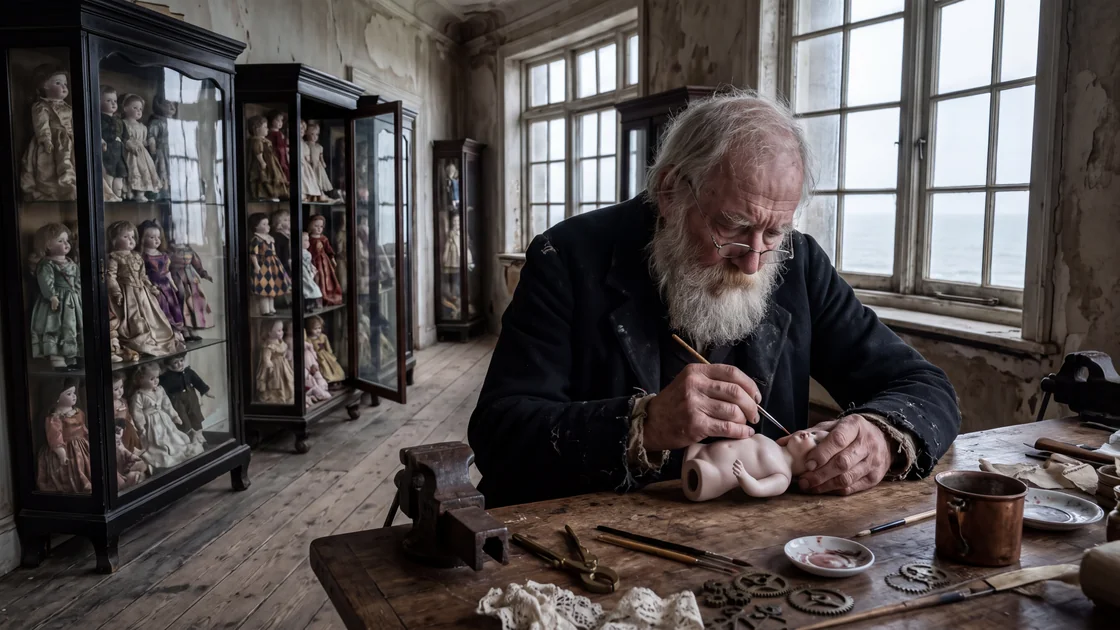
This is the history of Master Kenneth Bell, a widowed artisan living in a sinking manor house above the salt-bitten cliffs of Oakhaven, whose reclusive twilight years are quietly sustained by the very art to which he surrendered his youth. Weakened by age, failing eyesight, and an arthritic stiffness that robs him of his chisel and kiln, Kenneth believes his crumbling ancestral home is simply holding together by stubborn luck; in truth, each night when the grandfather clock strikes twelve, his masterwork creations—seventy-four ball-jointed porcelain dolls fashioned with clockwork hearts, counterweighted glass eyes, and kidskin ligaments—unlock their glass vitrines to wage a silent, desperate war against the rot, driving miniature wedges into sagging rafters, tucking lime mortar into weeping masonry, and repaying the craftsman for the life he breathed into their painted frames.
Part I: The Maker of Still Faces
The cold came off the sea like vinegar, sharp and grey, eating through the lath and plaster of High Chimneys until the corridors smelled of drowned lime and ancient chimney soot.
In the long gallery on the third floor, where the north-facing windows were cloudy with crystallized salt, Kenneth Bell sat at his worktable. The table was six inches thick, hewn sixty years ago from an English walnut tree felled during his grandfather’s time, but now it bowed slightly in the center, exhausted by the weight of iron vises, copper glue pots, and the steady, leaning sorrow of its master.
Kenneth was seventy-one. In the valley below, down where the cobbles of Oakhaven turned into slimy timber slips that met the tide, they spoke of him as though he were already timber himself—something left out in the weather until the sap had turned to brine. They called him the Dollmaker, though he had not sold a figure to the town shops in twenty years. The modern nurseries wanted celluloid; they wanted lithographed tin from Birmingham that could be dropped on stone flags without shattering; they wanted cheap, smiling things stamped out by steam presses in Leeds.
Kenneth did not make toys. He made likenesses that bordered on insolence toward God.
Before him lay the torso of a young girl, no longer than his forearm, cast from three-times-refined Cornish kaolin. Her belly was smooth as a gull’s egg, pierced at the hips by two perfectly spherical acetabula—the deep sockets that would receive the turned boxwood thigh-balls. Beside her lay a saucer of raw umber ground in walnut oil, a bundle of hog-bristle quills, and three brass calipers whose hinge-pins were loose with age.
Kenneth dipped the tip of a fine sable brush into the oil. His right hand—the hand that had once carved the lace-veils of Queen Victoria’s commemorative presentation dolls—trembled. It was not a violent shake, but a dry, rhythmic fluttering, like the wing of an imperial moth pinned to cork. He touched the sable to the doll’s left collarbone, attempting to shade the hollow beneath the clavicle where the light ought to soften into shadow.
The brush skittered. A muddy streak slashed across the porcelain breast.
"Damn," Kenneth whispered. The word had no fury left in it; it was merely the sound of an old bellows wheezing shut.
He reached for a rag soaked in turpentine, his thumb scraping against the fired clay. The solvent cleared the paint, but Kenneth’s hand jerked again, his knuckle knocking a bone-handled burnisher off the bench. It rolled across the walnut planks, slipped between two floorboards where the shrinkage had left a gap wide as a man’s finger, and fell with a dry clack into the dark spaces between the ceiling below.
He did not bend to look for it. He could not. If he knelt down now, the fluid in his knees would seize like cold tallow, and he would have to wait on the drafty boards until the sun rose high enough to warm his marrow through the windowpanes.
Instead, he looked up at the cabinets.
They lined the gallery from east to west: twenty-four tall vitrines of ebonized mahogany, their crown moldings carved with ivy leaves and dormant cicadas. Behind the wavy cylinder glass stood his life’s work. There was Corinne, dressed in violet silk that had begun to split along the pleats of her bustle; there was Barnaby, the harlequin whose limbs were linked with tempered steel coils so supple he could be folded into a hatbox; there was the Admiral, whose bicorne was edged with real gold bullion, now tarnished to the green of pond scum; and there was Rosalind, the last he had finished before his wife, Margaret, had taken to the bed from which she never rose.
Rosalind stood twenty-eight inches tall on a plinth of black serpentine stone. Her head was tilted three degrees to the left—an angle Kenneth had measured against his wife’s neck as she sat mending shirts by candlelight. Her wig was human hair, chestnut and fine, knotted strand by strand into an open-weave silk cap glued to the porcelain pate. In her sockets sat two eyes of German crystal, gray-blue, counterweighted with tiny lead slugs behind the bridge of her nose so that when she was laid flat, her lids fell shut with a tiny, liquid click.
"The house is going, my girl," Kenneth said to her. His voice was thin and fibrous, like dry corn husks rubbed together. "The sill beneath the scullery has turned to mush. The tide was in the coal cellar this morning. It won't be another winter before the chimney breast falls through the scullery ceiling."
Rosalind stared through the wavy glass. Her glass pupils, fixed with permanent dilated curiosity, took in the gray light, the dying peat in the grate, and the old man whose cuffs were frayed to ribbons of gray linen.
Kenneth reached down, turned the brass key in the central lock of her cabinet, and let the latch fall. He did not like them to be completely shut against the air; he had an old man’s foolish terror that porcelain might suffocate if deprived of drafts, though he knew well enough that kaolin and spar knew nothing of lungs.
"Sleep well, grand lady," he muttered.
He blew out the tallow candle on his worktable, took his hawthorn stick from its peg by the door, and began the long, agonizing descent down the back stairs to his bedchamber behind the kitchen, where the only warm hearth in the house still managed to breathe through a choked flue.
The gallery grew dark. The smell of turpentine lingered, mingling with the salt damp that crawled through the cracked panes.
Then, two hours after Kenneth’s heavy wool socks had ceased to shuffle along the lower floorboards, the grandfather clock in the hall struck the three-quarter chime, followed by the heavy, leaden toll of midnight.
Part II: The Midnight Mechanics
The latch on Cabinet Seven did not rattle; it swung.
It was Barnaby who came first. Because he was a harlequin, his weight was light—scarcely two pounds of hollow-cast porcelain and light beech-wood framing. His joints were not leather-strung like the cheaper French dolls, but linked by miniature brass turnbuckles that Kenneth had milled on an eight-inch watchmaker’s lathe in 1888.
Barnaby’s right hand, exquisitely formed with four separated fingers and an opposable thumb tipped with carved nails, gripped the edge of the mahogany shelf. His crystal eyes did not move—the lead weight within his skull kept them level—but his head rotated sixty degrees on its oiled ball joint with a sound no louder than an ant walking across parchment.
Sip. Click.
He swung his legs over the edge. His tiny slippers, made of kidskin no thicker than a moth’s wing, hit the walnut floor without a sound.
Behind him, Rosalind moved.
Her silk skirts were heavy; they rustled like dry birch leaves in October as she stepped down from her serpentine plinth. She reached back into the velvet gloom of the vitrine and brought forth two objects: an ivory-handled watchmaker’s screwdriver whose blade was no broader than an apple seed, and a small pigskin pouch tied with gut.
One by one, the doors of the twenty-four cabinets drifted inward on their brass butt-hinges.
There was no chatter. They had no reeds in their throats, no bellows in their chests to force air through pewter pipes. Kenneth had once contemplated giving Corinne a voice-box—one of those French cylinders that cried Maman when inverted—but had recoiled from the vulgarity of it. A true likeness, he had written in his leather ledger fifty years ago, must possess the dignity of stone. It is not our place to mock the Creator with tin squawks.
Instead, their speech was the language of tension and torque.
A sharp tap of Corinne’s porcelain knuckle against the skirt-board: The wet has reached the landing.
Two clicks of the Admiral’s wooden heel: The scullery joist.
Barnaby was already at the crack between the floorboards where Kenneth’s burnisher had fallen. He knelt, his blue-and-yellow diamond-patterned silk trousers stretching tight over the spherical porcelain knees. He did not reach down with his hand—his arm was too thick to pass the gap. Instead, he uncoiled a length of fine copper wire that he kept wound around his waist beneath his sash. He had shaped the end into a double fluke, like a whaler’s harpoon.
He lowered the wire into the dark. For several minutes, the only sound in the gallery was the rhythmic tick-tick-tick of the Admiral’s clockwork heart—a thirty-hour movement Kenneth had fitted into his ribcage to demonstrate his mastery of combined horology and dollcraft.
Clink.
The wire caught. Barnaby rose, setting his feet wide, his little porcelain hips locking into their grooves with a soft mechanical snap. He hauled upward, hand over hand, his fingers moving with the precision of an embroidery master. The bone burnisher emerged from the dust, pale and slick with sixty years of grease.
Barnaby did not lay it on the table. He carried it to the shadow beneath the corner vitrine, where a small square of baseboard had been cut away twenty years ago to allow a gas pipe that had never been installed.
There, in the dead space between the double walls of High Chimneys, was the depot.
It was an empire of fragments. Over forty years of Kenneth’s slow decline, the dolls had gathered what the old man dropped, what the mice dragged from the kitchen, and what the wind blew through the missing slates on the roof.
There were three hundred brass tacks, sorted into an empty fish-paste jar by the length of their shanks. There were strips of lead flashing, chewed from the parapet gutters by gulls and flattened out with small river stones. There were balls of cobweb gathered on cedar splints, soaked in pine resin to make a gray, fibrous putty that set harder than Portland cement. There were bottles of lavender oil, stolen drops at a time from Kenneth’s washstand, used to thin the drying varnishes that kept their own joints from squeaking.
Rosalind took the burnisher from Barnaby and passed it to Corinne.
Corinne was dressed in the severe gray wool of a governess. Her hands were larger than Rosalind's, cast from a heavier, unglazed biscuit porcelain that had a slightly rough tooth—a texture Kenneth had chosen because he had intended her to hold a miniature leather slate. That tooth gave her an extraordinary grip.
She took the burnisher and tucked it into her apron band. Then she turned to the stairs.
Part III: The Pathology of the Manor
High Chimneys was dying from three distinct diseases: the salt, the woodworm, and the weight.
The house had been built in 1740 by a merchant who had made his fortune in Barbados rum and had died of the gout before he could see the lime wash peel from his cellars. It stood upon a wedge of black shale three hundred feet above the Atlantic. When the south-westerly gales hit Oakhaven, the entire cliff face shuddered with a subterranean boom that rattled the teacups in Kenneth’s dresser.
The salt was the most insidious. It blew through the mortar between the granite exterior blocks like steam through wool. Once inside, the salt crystals grew within the pores of the brick backing, expanding like frost until the lime mortar turned to dry meal that ran out from behind the wainscot like sugar from a torn sack.
The dolls knew every pocket of meal in the house.
To a man six feet tall, High Chimneys was a series of drafty rooms connected by drafty doors. To an army of seventy-four figures between twelve and thirty inches high, the house was a mountainous landscape of vertical shafts, cavernous floor-cavities, and precarious timber highways suspended over bottomless drops.
Rosalind led the party down the central staircase.
They did not use the carpeted steps where Kenneth’s slippers walked. They traveled down the balustrade. The handrail was broad, carved from Cuban mahogany and polished by three generations of Bell palms until it was smooth as an oilstone.
Barnaby went first, sliding down the mahogany spiral on his belly, his little kidskin-shod toes dragging behind him to check his descent. At each newel post, he caught the acanthus carvings with his brass-reinforced elbows, swung himself out over the twelve-foot drop into the stairwell, and landed neatly on the next rake.
Behind him came the laborers: ten dolls of the "Common Order"—figures Kenneth had cast in the 1870s as studies in peasant costume. They had no names, only numbers stamped inside their neck-tenons: No. 14, Fishwife of Boulogne; No. 18, Peasant of the Black Forest; No. 22, Welsh Gleaner. Their clothes were coarse fustian and linsey-woolsey, well-suited to the filth of the floor-timbers.
Each of the peasant dolls carried a burden. Number 14 carried a horn spoon filled with fresh lime putty, mixed at the bottom of the dry cistern three nights before from slaked garden lime and rain-water. Number 18 carried four three-inch cut nails, balanced across his shoulders like muskets. Number 22, whose porcelain jaw had been cast with a perpetual, cheerful grimace, dragged a strip of oiled canvas three feet long.
Their destination tonight was the Great Joist beneath the library floor.
Kenneth had noticed the sag in November. He had cursed his knees, pushed a walnut bookcase six inches to the left to "distribute the load," and then had sat in his wingback chair with a glass of sour elderberry wine, waiting for the floor to drop him into the coal cellar.
He did not know that forty feet of three-inch oak had rotted through its heartwood directly beneath the case of folio volumes on maritime law.
Rosalind reached the library door first. The door was shut, but the draft that blew beneath it was strong enough to ruffle her silk hem. There was a gap of three-quarters of an inch between the worn brass threshold and the bottom of the oak panel.
Barnaby dropped to his side, slipped through like an eel, and pulled the guide-string after him. One by one, the dolls squeezed beneath the door.
Inside, the library smelled of damp calfskin, mouldering rag paper, and the sharp, alkaline tang of dry-rot fungus—Serpula lacrymans.
The fungus had established its kingdom in the dark beneath the wainscot behind the maritime folios. It was a magnificent, terrible thing: an elephantine skin of gray-white mycelium, thick as a saddle-flap, edged with lilac and sulphur-yellow, sending out root-like rhizomorphs three yards long to drink the water from the cellar walls and carry it into the dry heart of the oak timbers.
The peasant dolls set their burdens down upon the turkey rug.
Rosalind approached the skirting board. At the base of the corner column, three inches above the floor, Kenneth had years ago driven an iron screw to hold an umbrella stand. The stand was long gone, but the screw remained, its head rusted into a red flower.
Rosalind tapped the screw with her screwdriver.
Clink.
From within the wall came an answering sound: three rapid, dry raps.
A section of the skirting, four inches long, pivoted inward on two needles that had been driven through its bottom edge to serve as trunnions. Out of the darkness crawled Master Peregrine.
Master Peregrine was the oldest doll in the house. Kenneth had cast him in 1862, when his own eyes were like eagles' and his fingers could carve three distinct gears from a single silver shilling. Peregrine was an anatomical model, eighteen inches tall, cast in ivory-tinted porcelain without a wig or clothes, his surface painted with the superficial muscles and major blood vessels of the human frame. Time had yellowed his varnish to the color of smoked bacon, and the red lines of his arteries had faded to a dry brick-brown, but his mechanism was intact.
Peregrine was the Engineer.
He looked at Rosalind. His face, frozen by Kenneth’s chisel into an expression of austere, scholarly skepticism, did not alter, but he raised his left hand—the fingers of which had been replaced with tiny iron tweezers—and pointed toward the darkness behind the baseboard.
The Great Joist was dying, but it was not yet dead.
Part IV: The Works in the Dark
To understand the work of the dolls, one must understand the geometry of smallness.
A human carpenter looks at a ten-foot oak joist that has rotted through six inches of its depth and sees an impossibility. To replace it requires jacks, balks of Scandinavian pine, four men with calloused palms, iron sledges, and a fortnight of screaming plaster.
To Master Peregrine, a rotted joist was not a single beam; it was an aggregate of millions of cellulose fibers, of which only forty percent were currently compromised. It was an engineering problem of micro-shores, of tension-wires, and above all, of lime.
Behind the skirting board, the space was five feet high, sloping down to eighteen inches where the rubble stone foundation rose to meet the floor timbers. The air was thick with the scent of fungus spores—a cinnamon-brown powder that settled upon the dolls’ porcelain cheeks like rust.
Barnaby was already forty feet along the joist, standing upon an inch-wide ledge formed by the top of a dwarf foundation wall. In his teeth he held the copper wire; his hands were busy clearing away the rotten "cubical" wood.
The dry rot breaks oak into neat, rectangular blocks, like charcoal biscuits. Barnaby worked with the bone burnisher Kenneth had dropped that afternoon. Using the flat end as a lever, he pried out the cubical rot chunk by chunk. Each piece fell into the crawlspace below with a tiny, dry thud.
Behind him came the Fishwife of Boulogne and the Welsh Gleaner.
They did not have the delicate balance of the parlor dolls; their bodies were squat, their feet weighted with melted buckshot to keep them steady on their display stands. They carried the horn spoons of lime putty.
Where Barnaby cleared the dead wood down to the sound, hard heartwood—that deep, dark, sour-smelling timber that had grown in the forest of Dean three centuries ago—the peasant dolls laid on the lime.
Lime is the enemy of the rot. It drinks the acid that the fungus breathes; it coats the timber in a caustic crust that no spore can pierce. With their porcelain thumbs, smooth and cold, they pressed the white grease into every fissure, every split where the wood had begun to craze.
Then came the surgery.
From the depot, Peregrine had ordered up sixty steel knitting needles. Kenneth’s wife had left three baskets of them in her work-basket in the cedar closet: needles of every gauge, from fine lace-pins to thick bone-pointed implements meant for heavy fishermen’s stockings.
Peregrine had notched these needles every sixteenth of an inch on an oilstone.
Now, working in the light of a single tallow night-light that Corinne held with steady hands, Peregrine drove the needles into the good wood. He had no mallet; a hammer blow would have shattered his porcelain wrists.
Instead, he used a mechanical screw-press that Kenneth had built thirty years ago to test the elasticity of gutta-percha washers. The press was no larger than an apple, made of gunmetal brass with a four-handled capstan.
The dolls wedged the press between the sound underside of the floorboards and the head of each needle. Four of them—two common dolls, Barnaby, and the Admiral—took the arms of the capstan.
They walked in a tiny circle, their little leather slippers scuffing against the joist.
Creep. Creep. Click.
The needle sank into the oak. One inch. Two inches. Three. It bypassed the rotted zone, pinning the sound timber above to the sound timber below, stitching the beam together with pins of cold Sheffield steel.
By three o'clock in the morning, forty needles had been driven through the Great Joist.
The beam no longer rested upon its rotted belly. It was an iron-ribbed hybrid now, bound with wire, plugged with lime, and held together by eighty thousand tiny friction-points that distributed the weight of Kenneth’s law books across twenty feet of sound stone wall.
Rosalind stood on the dwarf wall, her silk skirts pinned up around her waist with steel common pins to keep them from the cellar mold. Her crystal eyes caught the flicker of the tallow flame.
She looked up at the floor above her.
Directly overhead was Kenneth’s chair. She could hear the slow, rhythmic groan of his bed in the next room—the dry creak of iron springs as the old man turned in his sleep, muttering through his beard at the cold, or at Margaret, or at the seventy-four children who stood in their glass houses while he withered alone.
Rosalind reached down and touched the great beam.
Through the fired kaolin of her fingertips, through the hollow chamber of her forearm, through the brass elbow-joint and the shoulder-socket lined with velvet, she felt the vibration of the house.
It was settling. The south-east pier was moving toward the sea by the thickness of a fingernail every three months. The roof was pushing the upper walls apart like an opening book.
They could not stop the Atlantic. They could not turn the shale cliffs back into granite.
They could only stitch.
Part V: The Old Man’s Dawn
The sun rose behind a bank of leaden cloud that turned the sea to pewter.
Kenneth woke with a throat that tasted of copper and ash. His hip screamed as he swung his legs out from under the heavy horsehair quilts. For ten minutes he sat on the edge of the mattress, his head between his hands, waiting for his blood to accept the fact that he was not yet dead.
"Well," he told his slippers. "Another one."
He dragged himself through the kitchen. The water in the copper kettle was skimmed with ice. He broke it with the butt of his pocket-knife, filled the iron pot, and set it on the coals that he had banked the night before with dry turf.
As the kettle began to sing its low, salt-crusted song, Kenneth walked into the library.
He had his hawthorn stick in his left hand and a duster of cock-feathers in his right. He meant to look at the crack in the plaster above the maritime folios—that long, jagged lightning-bolt that had been widening since Martinmas. He had dreamed that the ceiling had come down upon him while he slept, burying him under eighty pounds of horsehair and lime.
He stopped in the center of the library rug.
He blinked. He took his spectacles from his waistcoat pocket, rubbed the thick lenses against his sleeve, and hooked them over his large, hairy ears.
The bookcase was straight.
It was not level—the whole room was slanted toward the cliff by three degrees—but the dreadful, drunken belly in the lower shelf, the one that had made the third volume of The Admiralty Reports lean over until it pinched the fourth, had vanished. The shelf was plumb.
Kenneth approached the case. He leaned his weight against the mahogany carving of the frieze.
The floor did not yield. For five years, every step in this corner had produced a hollow, spongy thrum, like walking on the drum-head of a water-butt. Now it was solid. When he brought his heel down with all the force his hip could muster, the floor answered with a dull, short thwack, like the root of an oak.
"God above," Kenneth breathed.
He looked down at his slippers.
Between the edge of the Turkey rug and the skirting board lay a tiny mound of white dust, no larger than a hazelnut.
Kenneth bent his stiff back, groaning as his vertebrae locked, and pinched a bit of the powder between his thumb and forefinger.
It was not plaster. Plaster was dead and chalky; it dissolved into gray grease if touched with a wet tongue. This had a sharp, alkaline bite that set his skin tingling. It smelled of river water and stone.
"Lime," he muttered. "Hydraulic lime."
He hadn't had a bag of hydraulic lime in the yard since they repaired the well-head in eighty-four.
He stood there for a long time, the dust between his fingers, looking around the silent, gloomy library. The folios slept in their calfskin coats. The dust motes turned their slow waltzes in the gray shaft of light that slanted through the salt-gummed window.
From the third floor came no sound at all.
Kenneth walked out of the library, down the hall, and climbed the stairs. It took him fifteen minutes to reach the gallery. Each step was a small siege against his hip, but a strange, prickling heat had started in his chest—a feeling he had not known since the day he found his first pocket of pure white clay in the ditch behind the parsonage sixty years ago.
He unlocked the gallery door.
The twenty-four cabinets stood in their solemn, ebonized rows.
The Admiral held his sword at the carry. Corinne looked down at her invisible slate. Barnaby smiled his triangular, cinnabar-red smile, his hands resting lightly upon his knees.
Kenneth went straight to Cabinet Eighteen.
Rosalind stood upon her serpentine block. Her gray-blue eyes were fixed on the horizon, where a coal-brig was beating its way south toward Bristol against the tide. Her hair was smooth, her lace tucker neat, her violet silk skirt arranged in deep, architectural folds that hid her feet completely.
Kenneth stepped close to the wavy glass.
"Rosalind?" he said.
The doll did not blink. Her lead rockers were steady; her glass eyes had no light in them except what the gray clouds offered.
Kenneth’s gaze traveled down her skirt.
At the hem, caught in the intricate open-work of the Brussels lace he had bought from an old peddler for seven sovereigns when Margaret was still laughing in the garden, was a single, cinnamon-colored smear.
It was the spore-dust of Serpula lacrymans.
And beside her small kidskin shoe, half-hidden beneath the violet hem, lay a tiny sliver of blue-and-yellow diamond silk, no longer than an eyelash, freshly torn from a harlequin’s trousers.
Kenneth did not reach for his key. He did not open the door.
He stood with his forehead against the cold cylinder glass, his breath fogging the surface until Rosalind’s face blurred into a pale, oval moon. His hawthorn stick fell from his fingers and struck the walnut floor with a great, clattering hollow roar that went echoing through all the empty, dying rooms of High Chimneys.
He began to weep.
He was not weeping for his dead wife, nor for his crooked hands, nor for the century that had forgotten him. He wept with the terrifying, holy dread of a man who discovers that his loneliness has been an illusion—that he has been watched, loved, and defended by the work of his own hands.
Part VI: The Parlor Council
That afternoon, the village sent its ambassador.
Her name was Martha Clout. She was fourteen, with red wrists that were always chapped from scrubbing salt-cod for her uncle, and she was the only creature in Oakhaven whom Kenneth permitted beyond the kitchen flags. She came twice a week, bringing three loaves of soda bread, a crock of skimmed milk, and whatever salt beef Kenneth’s small annuity could purchase from the butcher’s cart.
She entered through the scullery, her pattens clicking on the blue flags.
"Master Bell?" she called out. "The wind’s coming round from the west. Uncle says there’ll be a sea on before nightfall. You want the shutters barred on the salt-side?"
Kenneth came out of the buttery. He looked different to her.
His coat was still the same greenish-black broadcloth with the horn buttons, but he had combed his white beard, and he had not put on his greasy working apron. In his hand he did not carry his chisel or his rag, but an old brass-bound ledger with marbled boards.
"Martha," he said.
"Yes, Master?"
"Go to the blacksmith. Tell John Garrow that I want three bundles of copper wire—the gauge they use for bottling cider. Tell him I want two dozen small steel files—needle files, the finest he has from Sheffield. And tell him that if he has any of the old pig-lead from the church roof, I will take fifty pounds of it."
The girl stared at him with her mouth open. Her tongue was thick and pink between her teeth.
"Pig-lead? Master, John Garrow won't give no credit on lead. He says you haven't cleared the bill for the coal-shovels from last Martinmas."
Kenneth opened the ledger. He did not turn to the pages of figures; he reached into a pocket in the sheepskin lining of the back cover and pulled out three coins. They were gold sovereigns, their edges crisp, their faces bearing the young head of the Queen. They had lain in that pocket since 1874, intended for a holiday in Florence that had never been taken.
"Tell John Garrow," Kenneth said softly, "that Master Bell pays his debts in gold. And tell him that if the wire is greasy, I will make him wipe every yard of it on his own apron before I take it."
The girl took the coins. Her thumb went over the milled edge of the first sovereign, her eyes widening until they were as round as Barnaby’s.
"Master," she whispered, looking at the ceiling, where the water stains formed the shape of an old bull’s head. "Is the house... are you selling the ladies?"
"The ladies?" Kenneth asked.
"The dolls. In the big cases. Down in the village they said some dealer came from London on the mail-coach. They said he was going to take the whole lot to an auction in Bath."
Kenneth’s hand went to the girl’s shoulder. His fingers were crooked as crab claws, but they had an astonishing, sudden strength that made her wince.
"The ladies do not leave High Chimneys," he said. "The ladies are the only thing holding the roof off our heads. Now run down the slip before the tide catches the lower road. Go."
She ran. Her pattens sounded like a pair of muskets going off on the wet cobbles outside.
Kenneth returned to the long gallery.
The afternoon light was dying quickly, squeezed out by a bank of indigo cloud that had risen from the horizon like an iron wall. The wind had begun its low, bass pipe in the chimney throats.
He did not sit at his bench. He dragged his heavy armchair—the one covered in dry red morocco leather—up from the library, hauling it step by step up the three flights of stairs with an obstinate fury that left his heart knocking against his ribs like a bird in a basket.
He placed the chair in the center of the gallery floor, directly opposite the central vitrines.
He sat down. He laid the brass-bound ledger across his knees. He placed his horn-handled magnifying glass upon the leather cover.
Then he waited.
The dusk deepened. The salt on the windows turned from gray to silver, then from silver to black. In the garden below, the dead hydrangeas clicked their dry flower-heads together in the wind.
Inside the cabinets, the seventy-four pairs of glass eyes reflected the last embers of the peat fire Kenneth had built in the gallery grate.
Kenneth did not move. He did not light a candle. He kept his hands flat upon the arms of the red chair, his breath coming slow and shallow through his nostrils.
Eight o'clock struck. Nine. Ten.
At eleven, the gale arrived.
It was not an ordinary blow; it was a Channel rake, a south-westerly storm that had gathered its weight across three thousand miles of open water. The first gust hit High Chimneys with a sound like a ship running aground on shingle. The great timbers of the roof groaned; the north window-frame bowed inward half an inch, the old lead-cames humming like fiddle-strings.
A tile tore loose from the stable roof below and went spinning into the darkness, smashing against the stones of the terrace with a sharp, ceramic crack.
Kenneth did not stir.
Then, five minutes before midnight, the latch of Cabinet Eighteen lifted.
Part VII: The Alliance of Bone and Kaolin
It was not done in secret now.
Rosalind stepped out first. She did not look at Kenneth, but she did not hide from him. Her head was held high on its boxwood tenon, her chestnut hair lifting slightly in the draft that came through the window-joints.
She reached her hand back into the vitrine. Barnaby took it.
He dropped to the floor, then turned and offered his shoulder to Corinne. One by one, the vitrine doors swung wide on their hinges until the long gallery was filled with the dry, rustling sound of forty yards of silk, velvet, linen, and wool.
The dolls gathered in the circle of light cast by the dying peat.
There were sixty of them now. Some of the smallest—the five-inch pocket figures Kenneth had cast in his youth as watch-fobs—stood upon the rungs of Kenneth’s red leather chair, their tiny painted eyes looking at the old man’s knuckles with grave unconcern.
Master Peregrine walked to the center of the Turkey rug.
He had a strip of lead-flashing tucked under his arm like a field-marshal’s baton. He looked up at Kenneth.
Kenneth slowly, with infinite care, leaned forward in his chair. He did not make any sudden gesture; he did not cry out. He lowered his right hand until it rested flat upon the carpet, palm upward, five inches from Peregrine’s ivory-tinted feet.
The doll did not flinch.
Peregrine stepped onto Kenneth’s palm.
The weight was nothing—no more than a dry thrush’s skull. But through the skin of his hand, Kenneth felt the astonishing complexity of the little creature: the faint, rhythmic pulse of the thirty-hour escapement in his chest; the heat generated by the miniature bronze friction-plates in his knees; the incredible, impossible will that lived in the kaolin clay.
"Peregrine," Kenneth whispered.
The doll did not speak. It tapped Kenneth’s index finger twice with its tweezers.
Then Peregrine pointed upward.
Kenneth followed the iron tip.
Above them, where the ceiling met the north wall, a dark triangular stain was spreading across the lime plaster. Even as they watched, a heavy, gray drop of water formed at the point of the triangle, hung for three seconds, and fell.
It struck the center of Kenneth’s walnut workbench with a loud, hollow drop.
A second drop followed. Then a third.
The parapet gutter had choked.
If the water got behind the north cornice, it would run down the inner wall into the brickwork of the second floor. Within forty-eight hours, the plaster of the nursery ceiling would drop; within a week, the laths would rot from their nails, and the great three-inch chimney-stack would begin its fatal lean toward the gallery floor.
Kenneth looked at his hands.
The knuckles were swollen like walnuts; the fingers were curled like dried fern fronds. He could not climb a ladder. He could not step onto the leads of the roof with the wind blowing seventy miles an hour off the Atlantic. A man of his years would be picked up by the skirt of his broadcloth coat and dropped three hundred feet onto the black shingle of the cove.
"I cannot go out there, Peregrine," Kenneth said. His voice was cracked with salt and tears. "I am too heavy. The wind will take me."
Peregrine hopped down from Kenneth’s palm.
He walked to Cabinet Three—the cabinet of the Trades.
From the dark interior came four figures who had not yet joined the council. They were Kenneth’s masterpiece from the year of the Great Exhibition: the Four Joiners of Nuremberg.
They were twelve inches tall, their bodies carved from solid lignum vitae, the densest, heaviest wood known to the trade. Their arms were brass; their chests were filled with miniature geared pulleys; their fingers were tiny, tempered steel chucks that could receive chisels, gouges, drills, or saws.
Behind them marched the Stonemason of Cremona, whose apron was made of real oil-cloth and who carried a miniature iron trowel whose blade had been beaten from a French horseshoe nail.
Peregrine turned back to Kenneth.
He pointed to the chimney breast.
Kenneth understood.
The chimney had a sweep’s flue—a narrow, square shaft of brick that ran straight from the gallery hearth up to the parapet, thirty feet above. It had not been swept in twenty years; it was lined with a crust of soot three inches thick, but it was sheltered from the wind. It was an internal road to the roof.
"The soot will ruin you," Kenneth cried softly. "It will get into your gears. The sulfur will eat the brass. It will blacken the biscuit."
Corinne stepped forward. She looked down at her gray governess skirt.
With a single, smooth movement of her porcelain arms, she reached behind her back, untied the linen tape of her apron, and pulled the garment over her head. She folded it into a neat, three-inch square and laid it upon Kenneth’s foot.
Then she took her place behind the Joiners.
She was going in her under-petticoats, her bare porcelain limbs exposed to the chimney soot and the gale.
One by one, thirty dolls formed a line before the hearth.
Barnaby was at the head. In his teeth he carried the end of the cider-wire that Martha Clout had brought from the forge at dusk. He had tied three needle-files to his waist with gut.
Kenneth fell to his knees before the grate. The pain in his joints was like knives driven into his marrow, but he ignored it. He reached into the dark fire-place, swept the cold peat ashes aside with his bare sleeve, and looked up into the black throat of the chimney.
Far above, thirty feet up in the darkness, he saw a single, wild blue eye: the opening of the flue against the storm-swept sky.
"Barnaby," Kenneth whispered.
The harlequin stepped into the soot.
He did not look back. His kidskin shoes found purchase in the mortar joints between the old bricks. His brass turnbuckles creaked as he took the weight of the wire.
Click. Scritch. Click.
The doll vanished into the vertical dark.
Part VIII: The Siege of the Parapet
What happened upon the leads of High Chimneys that night was witnessed only by the gulls and the stars that briefly showed between the tearing rifts of the gale.
The roof was forty feet long, a valley of lead between two high slate-covered pitches, terminating in a parapet of granite ashlar three feet high. At the north-west corner, where the downpipe carried the roof-water to the cistern, the lead had torn away from the stone.
The wind had gotten under the lap.
It was lifting the thirty-pound sheet of lead like a man lifting a blanket, banging it against the stonework with a sound like iron sheets falling from a wagon. At every lift, the sea-rain drove beneath the metal, pooling three inches deep in the cedar gutter-trough that lay directly above the gallery ceiling.
Barnaby emerged from the chimney pot like a chimney-sweep's terrier.
The soot had turned him from a yellow-and-blue harlequin into an ink-black imp. His crystal eyes were coated with coal-grease; his silk cap was gone, blown off into the sea three seconds after he cleared the ceramic rim.
The wind hit him like a solid board.
It would have swept him into the cove instantly had not his fingers—those four tiny, steel-pinned porcelain digits—closed around the lip of the chimney tile.
He hung there for two minutes, his body waving in the horizontal gale like a signal flag.
Then he pulled.
His boxwood shoulder-gears groaned. A lesser craftsman’s work would have sheared its pins; but Kenneth had milled those teeth from seasoned English pear-wood soaked in beef marrow for three winters. They held.
Barnaby dropped over the lip onto the wet slates.
Behind him came the Joiners.
They did not have his lightness; they were heavy as stone. They came out of the chimney pot on their hands and knees, their brass arms glistening with rain, their lignum-vitae bellies dragging across the wet lead.
They carried the line.
Down in the gallery, Kenneth felt the wire go taut.
He was sitting on the hearth-rug, his face gray with soot, the coil of cider-wire between his thighs. He knew what the tension meant. He had built the roof forty years ago; he knew every lap, every roll, every dripping valley.
"They are at the gutter," he told Rosalind.
The lady stood beside his knee. She had not gone up the flue; her skirts were too wide, her head-dress too tall. Her place was with the maker. She had laid one porcelain palm against Kenneth’s collarbone—a touch that was light as a dried oak leaf, but which seemed to the old man to carry all the warmth that had vanished from his house when Margaret died.
"The wire must be held," Kenneth said. "If I let go, the wind will take them over the coping."
He wrapped the copper wire three times around his swollen wrist. The metal bit into his flesh, but he leaned his whole seventy-pound body backward, using his old bones as an anchor against the Atlantic.
Upon the roof, Master Peregrine was conducting the battle.
The lead sheet was sixty pounds of dead, bucking weight. Every time the gust caught it, it rose four inches, spitting foam and salt-spray through the seam.
Peregrine did not try to hold it down. He knew the limits of leverage.
He directed the Joiners to the parapet wall.
In the granite ashlar, six inches above the lead, were the old iron rag-bolts that had held the flashing in his grandfather’s day. The iron had rusted away, leaving holes two inches deep and an inch wide, filled with red, crumbly oxide.
The Stonemason of Cremona went to work.
Using his miniature horseshoe-nail trowel, he dug the red meal from the holes. He worked in the dark, with the rain driving into his unglazed porcelain face like birdshot, his tiny plaster-crusted fingers moving with the mechanical fury of an insect.
When the first hole was clear, Peregrine brought up the lead flashing they had dragged from the depot.
It was not enough to nail it; the nails would pull from the soft stone. They had to lead it.
From the chimney came Corinne.
She carried a tin tea-can—one of Kenneth’s empty mustard tins—suspended from a wire bail. Inside the can were three red coals from the gallery hearth, kept alive by the gale that roared across the top of the tin.
Beside the coals lay three sticks of plumber's solder, stolen from the plumber’s bag when the scullery sink was mended twelve years before.
They set the tin in the shelter of the parapet.
Peregrine took the solder. He held the end of the gray stick against the coals.
The tin began to smoke. A smell of resin, zinc, and sweet, poisonous lead rose into the rain, mingling with the salt-spray.
The solder melted. It ran into the tin’s bottom in a bright, mercury-colored pool.
The Joiners worked with the speed of clockwork running down. They dipped their miniature iron ladles into the pool, carried the molten lead three inches through the howling dark, and poured it into the rag-holes around the copper wire Barnaby had threaded through the masonry.
The lead set almost instantly against the freezing granite.
Sssss.
A little puff of steam rose into the wind.
Barnaby pulled the wire taut. The copper sang like a harp-string.
The lead sheet came down. It did not flap now; it was pinned to the stone by three strands of cider-wire, anchored into the living rock with five pounds of hand-poured lead.
The gutter was still. The water ceased to pool; it found the mouth of the lead downpipe and went roaring down into the cistern with a deep, gurgling throat-sound that shook the gallery wall.
The Joiners dropped their ladles.
They lay flat upon the wet leads, their brass joints clicking against the stone, their lignum-vitae limbs sodden with rain.
Of the thirty dolls who had gone up the chimney, only twenty-eight came down.
Number 14—the Fishwife of Boulogne—had been caught by a gust as she cleared the chimney rim. She had not cried out; she had no voice. Kenneth only heard a faint, hard tink against the slates of the lower bay, followed thirty seconds later by the tiny sound of porcelain shattering upon the shale stones of the cove three hundred feet below.
Part IX: The Ledger of the House
At four in the morning, the wind veered to the north-west and died to a sullen whistle.
The long gallery was cold—colder than the shore. The fire had gone out in the grate, choked by the soot that had fallen during the ascent.
Kenneth Bell sat on the hearth-rug, his back against the mahogany base of Cabinet Twelve.
His hands were black with soot. The copper wire had cut a blue trench across his wrist, and his broadcloth coat was torn at the shoulder where he had leaned against the rough brickwork of the chimney jamb.
Before him, upon the Turkey rug, lay his army.
They did not return to their vitrines.
They were too filthy for the ebonized shelves. Their silks were sodden rags; their wigs were matted with soot and grease; their ball-joints were choked with grit that made their movements stiff and jerky, like men dying of the tetanus.
Corinne lay on her side, her bare porcelain chest smeared with black chimney tar, her counterweighted eyes half-closed as though she were too weary to keep her lead level against the floor.
Barnaby had lost his left hand. The turnbuckle had sheared when the wire snapped tight against the parapet stone; the four little fingers and the thumb remained somewhere up on the leads, buried in the cedar gutter-sludge. He sat with his stump held against his breast, his triangular smile still bright through the soot, staring into the cold fireplace.
Master Peregrine alone remained upright.
He stood upon Kenneth’s ledger. His red-and-brown painted arteries were almost invisible under the coating of grease, but his ivory-colored skull was clean—he had wiped it with the hem of Corinne’s abandoned apron before he descended the flue.
Kenneth looked down at him through his spectacles. One of the lenses had cracked from the heat of the hearth, splitting the world into two distorted halves.
"Peregrine," Kenneth said.
The doll did not move.
Kenneth reached down his hand—slowly, painfully, his fingers trembling with a palsy that had nothing to do with age.
He picked up the bone burnisher that Barnaby had retrieved from the floorboards the day before.
He dipped the point into the ink-pot that still sat upon his walnut workbench.
Then, with his left hand holding the marbled ledger steady, he opened the book to the last blank page—Page 340.
The last entry, dated September 14, 1889, read:
To one doll, "Rosalind." Bisque head, human hair, glass eyes with lead counterpoise. Body of turned boxwood with brass link-plates. Sold to no man. To remain with the maker.
Kenneth set the point of the bone burnisher to the paper. His hand was steady. For the first time in fifteen years, the fluttering wing in his knuckles was still.
Beneath the entry for Rosalind, he wrote:
Item: The Great Joist beneath the maritime law. Stitched with forty steel pins, caulked with lime, held against the dry rot.
Item: The Parapet of the North Lead. Wired with three strands of cider-copper, leaded into the granite with five ounces of church-lead.
Item: High Chimneys. A house built on shale, inhabited by seventy-three ladies and gentlemen of fired clay and boxwood, who have this night preserved the life of their servant.
Kenneth Bell, Dollmaker to Her Majesty (Retired).
He did not blot the ink. He let it stand wet and black upon the rag paper.
Then he laid the bone burnisher down between Peregrine’s feet.
"I have no more gold," Kenneth told them softly. "And John Garrow will not give me credit for another winter."
Rosalind moved then.
She walked across the Turkey rug, her violet silk rustling through the soot that lay upon the wool like black snow. She did not stop until her kidskin shoe touched the edge of Kenneth’s trousers.
She looked up at him.
Her head tilted—three degrees to the left.
With her two porcelain hands, she reached into the bosom of her dress.
For fifty years, Kenneth had wondered why he had made her chest so deep—why he had carved the boxwood core of her ribcage with a hollow chamber that served no purpose in the balance of her head or the hanging of her skirts. He had done it because Margaret had possessed a small silver locket that she kept tucked inside her stays—a locket containing a lock of hair from a child that had died before its name could be written in the family Bible.
Rosalind’s fingers vanished into the lace of her tucker.
When they emerged, they held a small, flat packet wrapped in oiled silk.
She laid it upon the open page of the ledger, directly over his fresh ink.
Kenneth picked it up. The silk was old; it smelled of orris-root and dead lavender.
He unfolded the corners.
Inside were four small, square pieces of paper—certificates from the Bristol and Exeter Railway, dated June 1852, made out to Kenneth Bell, Gentleman, for seventy pounds each at four-and-a-half percent interest.
He had forgotten them. He had bought them when the line was being surveyed through the valley, then had thought the company bankrupt when the branch was abandoned in sixty-one. He had hidden them in the doll’s chest on the night Margaret died, unable to bear the sight of anything that had been bought with her dowry.
They were worth two hundred and eighty pounds.
In Oakhaven, two hundred and eighty pounds would buy fifty tons of Welsh coal; it would buy four hundred yards of Scandinavian pine; it would pay John Garrow’s forge-bill until the century turned; it would bring three masons from Truro to point the entire sea-face of the cliff with blue lias lime.
Kenneth looked down at Rosalind.
"You knew," he said.
The doll’s glass eyes took the morning light that was now breaking through the salt-crusted north window. The clouds were gone; the sun came off the water like a white sword, filling the long gallery with an intolerable, blinding brightness that struck the ebonized cabinets until they looked like the pillars of an ancient church.
Rosalind did not answer.
She turned and looked at Barnaby, whose one hand was still tucked into his sash; she looked at Corinne, whose petticoats were gray with chimney tar; she looked at the Joiners, who lay like dead soldiers upon the rug.
Then she took two steps backward, turned her head sixty degrees on its oiled boxwood joint, and pointed her finger toward the worktable.
Upon the bench sat the three copper glue-pots, the bundle of hog-bristle quills, and the saucer of raw umber ground in walnut oil.
The table was ready.
Kenneth Bell looked at his wrist, where the copper wire had left its bloody ring. He looked at his fingers, crooked and swollen, but no longer trembling.
He rose from the hearth-rug. His knees made their old, terrible dry sound, but he did not groan.
He walked to the bench.
He took his hawthorn stick, laid it across the back of his chair, and reached for the horn-handled burnisher.
"Barnaby," he said. "Come here."
The harlequin rose from the soot. He walked across the rug with his light, springing step, his diamond trousers whispering against the floorboards, and leaped from the seat of the chair to the top of the walnut table.
He sat down upon the edge of the glue-stone, holding his broken left arm across his belly.
Kenneth pulled his spectacles down over his nose. He took a pair of small steel pincers from the rack above the bench.
"Hold still, my lad," the old man said, his voice dropping into that low, rhythmic cadence he had used when the century was young and his shop was full of the daughters of dukes. "Hold still. It is only a matter of a new pin. I have some three-sixteenths brass in the lower drawer, and John Garrow has not yet blown out his fire."
Outside, the tide went out across the shale, leaving the black rocks glistening with salt and weed.
Inside the long gallery, the grandfather clock struck five with a clear, silver chime that had no mourning in it; and Master Kenneth Bell, with a steady hand and his spectacles tied behind his ears with a bit of twine, began the work of putting his house back together, one miniature joint at a time.
Part X: The Anatomy of the Preservation
The summer of 1891 was the driest in sixty years.
By July, the shale cliffs of Oakhaven were bleached to the color of bone, and the sheep on the headland grazed upon pasture that rattled like dried laurel leaves. The great south-west face of High Chimneys, which had wept brine through its mortar every winter since the Battle of Trafalgar, was dry to the depth of four inches.
A wagon came up from the station three times a week.
It was driven by Martha Clout’s brother, a lad with his sister’s round eyes and an enormous respect for the old man who sat upon the porch in a broad-brimmed straw hat, paying for every timber with crisp five-pound notes issued by the Bank of England at Bristol.
The village did not understand the nature of the repairs.
"Master Bell’s gone mad," the blacksmith told the draper over their ale at the Lugger and Net. "He’s bought sixty bundles of lath—the best split heart-of-oak from the Devon woods—and two ton of grey hydraulic lime from the works at Lyme Regis. But he won't have no masons. He won't have no carpenters. He had young Clout dump the timber on the lawn, and when I offered to send my boy to help him frame the sill, he told me he had his own company."
"His own company?" the draper asked. "He hasn't a soul in the house but that girl Martha, and she only scrubs the flags."
"He has his company," John Garrow repeated, staring into his beer. "I went up there at dusk to take the bands for the well-curb. The house was full of small noises. Like fifty woodpeckers in an orchard. Tap-tap-tap behind the wainscot. Chink-chink in the chimney. I looked through the library window, and the old man was sitting there with his spectacles on, reading one of his great Latin books, while his workbench was covered in little brass shavings that looked like gold dust."
"And the dolls?"
"They were in their cases," Garrow said. "All seventy of 'em. Staring out through the glass with their painted cheeks. Only... when I went round to the scullery door, I’d have sworn upon the Book that the one with the violet gown—the big one he calls Rosalind—wasn't in Cabinet Eighteen at all. She was standing on the window-board behind the geraniums, holding a small brass level in her hand. But when I looked again, there was nothing there but an old zinc watering-pot."
The draper laughed, but it was an uneasy sound.
Nobody went up the cliff path after sunset. The fishermen, coming home with the mackerel drift-nets at two in the morning, looked up at the black profile of High Chimneys against the stars and saw strange lights—little yellow sparks, no larger than fireflies, that moved along the parapet gutters, down the valleys of the roof, and across the lintels of the great third-floor windows.
"The old man's lantern," the elders said.
"No lantern moves like that," the young men answered. "A lantern swings from a man's knee. Those sparks climb the corner-stones like beetles. They run along the water-tables where a goat couldn't stand."
Inside the house, the rot was in retreat.
It was a slow, scientific campaign. Peregrine had divided the basement into quadrants, marked out upon the flags with carpenter’s chalk.
The peasant dolls worked the lower levels. They were the sappers.
They wore little tunics of oiled canvas that Kenneth had tailored for them from an old carriage-blind, with lead weights sewn into the skirts to keep them from being carried off by the draft that blew through the cellar vents. They carried miniature picks that Garrow had forged from three-inch horseshoe nails, their handles turned from tough ash-wood by Kenneth’s own hand.
They cleared the shale footings down to the living rock. Where the old mortar had turned to salt-meal, they raked the joints clean, two inches deep, working in squads of four: two to hold the tiny iron scraper, one to sweep the dust into a copper spoon, and one to wet the stone with vinegar to kill the lime-rot.
Behind them came Kenneth.
The old man was no longer a prisoner of his chair.
His knees were still thick, his hip still ground in its socket when the weather was wet, but the strange, fiery purpose that had taken him on the night of the gale had burned the torpor from his blood.
He could not enter the crawlspaces; he could not squeeze his shoulders between the cellar piers. But he sat upon a low stool on the basement flags, with a great wooden trough of lime mortar between his boots.
He mixed the mortar according to Peregrine’s prescription: two parts sharp sand from the cove, washed three times in fresh rain-water to remove the salt; one part blue lias lime; and a half-part of powdered brick-dust to give it an hydraulic set.
When the mortar was like stiff butter, he filled the horn tubes.
Kenneth had made forty of them from cow-horns he had boiled and scraped until they were translucent as horn lanterns. At the tip of each horn was a nozzle of turned brass, no thicker than a tobacco-pipe.
He filled the horns with the white grease, sealed the wide ends with boxwood plugs, and laid them upon the low wall by the cellar door.
The dolls did the rest.
They carried the horns into the dark spaces beneath the dining room, three to a horn, rolling them along the sleeper-walls like artillerymen handling a gun.
With their brass-reinforced wrists, they drove the nozzles into the raked joints. Master Peregrine himself would tap the plug with his bone burnisher: Once. Twice. Three times.
The hydraulic lime went deep into the heart of the wall, filling the chambers where the salt had eaten the stones, surrounding the ancient granite boulders with a fresh, cold skin of artificial rock that set under water, under damp, under the weight of eighty tons of masonry.
Above them, in the long gallery, Rosalind kept the ledger.
She did not use ink—her fingers were too small to hold Kenneth’s goose-quills without splattering. She used a needle, its point heated in the candle until it was blue-hard, scratching tiny, exquisite marks into the sheepskin binding of the great book.
A triangle: The North Pier.
A cross: The Scullery Lintel.
A circle with three dots: The Great Joist secured.
Every evening at six, Kenneth would climb the three flights of stairs, take the ledger from the serpentine plinth where Rosalind stood, and hold the leather up to the magnifying glass.
He would read her scratches by the light of the setting sun.
"Good," he would murmur. "Good. The north-west angle has ceased its creeping. The plumb-line in the stairwell hasn't moved the thickness of a horsehair since Trinity Sunday."
Then he would look at her.
Her violet silk dress had been cleaned. He had spent three weeks with a bowl of benzine and a camel-hair brush, removing every trace of the chimney-soot from her pleats. Her human hair had been washed in rosemary water and combed out with an ivory comb until it lay against her shoulders in soft, chestnut ripples that smelled of a summer sixty years ago.
"You are a hard master, Rosalind," he told her. "You won't let an old man die in peace."
The doll stared through him, out through the cleaned panes of the gallery window toward the Atlantic, where the gulls were wheeling in great, white circles over the herring shoals.
Her lead rockers did not move. Her lids remained wide.
In her glass eyes was no pity, no sorrow, and no fear. There was only the immense, cold patience of the earth—the patience of kaolin that has slept three million years in the granite moors of Cornwall before the spade of the clay-cutter brings it to the light.
Part XI: The Winter of the Century
The century died in a gray, quiet cold that froze the foam upon the Oakhaven stones.
It was December 1899.
In the towns, they were talking of motor-cars, of electric underground railways, of the great war that had begun against the Dutch farmers in the south of Africa. In the shops at Bath, they were selling dolls made of painted rubber that could be squeezed until they squeaked—plump, pink, vulgar things that smelled of petroleum and had no joints at all.
Kenneth Bell was eighty.
He no longer went down to the village. Martha Clout, now a stout woman of twenty-three with a baby that she carried in a shawl against her breast, brought the flour and the tea to the scullery door every Saturday morning.
She did not see Master Bell now.
He left the money—clean, silver half-crowns—in a stone jar on the window-board. She left the bread and the butter on the slate table.
The house had changed.
It no longer groaned when the south-westerly came up from the Lizard. It did not rattle its sashes like a skeleton’s teeth.
The exterior walls were still gray and salt-bitten; the chimneys still leaned slightly toward the hill, as old trees lean away from the prevailing sea-wind. But the house stood upon its rock like a lighthouse.
The foundations had been grouted with two hundred horn-tubes of hydraulic lime; the roof was a web of copper wire and sound oak lath; the Great Joist beneath the library was stronger than the day the timbers had been felled in the forest of Dean.
The house was ready for another two hundred years of salt.
The dollmaker was not.
On the night before Christmas Eve, Kenneth did not light the grate in his bedchamber. He did not feel the cold.
A curious, sweet numbness had begun in his toes three days before—a feeling like walking on dry moss—and it had climbed slowly up his calves, through his scarred knees, and had settled into his pelvis like a lump of cold tallow.
He had managed the three flights of stairs to the gallery. It had taken him three hours. He had crawled the last twelve steps on his hands and knees, dragging his harelip coat behind him like a dead skin.
Now he sat in the red morocco armchair.
The gallery was dark, save for the blue, icy square of the north window, where the stars of Orion hung over the black water of the Channel.
The cabinets were open.
They had been open for six months. There was no need for keys now. The seventy-three dolls stood in a great semicircle around the red chair, five ranks deep: the peasants, the tradesmen, the common dolls, the harlequins, and the great ladies in their faded silks.
They were all clean.
Kenneth had spent his last strength through the autumn months, working by the light of three candles, repairing their wounds.
Barnaby had a new hand, turned from a piece of boxwood from his grandmother’s tea-caddy, with four fingers that could close around a needle. Corinne’s shoulders had been relined with velvet; her gray wool dress had been mended with silk thread until the tears in the pleats looked like the delicate veins of a leaf.
Master Peregrine stood upon Kenneth’s right knee.
His tiny tweezers rested upon the old man’s sleeve, directly over the pulse that fluttered in the wrist like a dying wren.
The clock in the hall began its chime.
One. Two. Three. Four.
Kenneth Bell looked down at the ivory skull of the engineer.
"It is finished, Peregrine," he whispered.
His voice was scarcely louder than the wind under the door.
"The roof will hold. The foundation will hold. The sea may take the shale, but the stones will stay together until the cliff is gone."
Peregrine did not tap his sleeve. The little escapement in his chest—the thirty-hour clockwork movement that Kenneth had wound every morning since the year of the exhibition—was ticking with a slow, heavy clink-clink-clink.
Kenneth’s hand moved.
It took him five minutes to lift his arm from the morocco leather. His fingers were white; they had no blood left in them; they were turning to the color of the biscuit porcelain that lay in the bin beneath his bench.
He reached into his waistcoat pocket.
He brought forth the last tool he possessed: the little watchmaker’s key, made of steel with an octagonal head of blued iron.
He laid it in the palm of his left hand.
Rosalind stepped forward.
She climbed the two books that Kenneth had placed beside his chair—the two volumes of The Admiralty Reports that had stood so long upon the Great Joist.
She stood upon the arm of the red chair.
Her violet dress was stiff with age; her Brussels lace was yellow as an old tooth; her human hair had begun to drift from its silk cap in fine, silver-brown cobwebs that stirred in the draft from the window.
She looked into Kenneth’s eyes.
Her counterweights were still. Her gray-blue crystal pupils did not waver.
Kenneth looked at her face—the face he had modeled fifty years ago from the face of a girl who had died of the quinsy while her garden was still full of white roses.
"Rosalind," he said.
He did not ask her to speak. He knew the law of the clay.
A likeness must possess the dignity of stone. It must not mock the Creator with tin squawks.
The doll reached out her right hand—that hand whose fingertips were cold as churchyard marble—and took the octagonal steel key from Kenneth’s palm.
She did not put it in her dress.
She turned to Peregrine.
She turned to Barnaby.
She turned to the seventy-one silent figures who stood upon the walnut boards in the blue star-light.
Then she leaned forward.
Her porcelain lips, fired in the kiln at fourteen hundred degrees until the kaolin had turned to glassy stone, touched the hollow of Kenneth Bell’s right collarbone—the exact spot where the sable brush had skittered and left its muddy streak sixty years before.
Kenneth closed his eyes.
The cold reached his heart. It was not bitter; it was merely the setting of the lime. It was the white hydraulic mortar, creeping into the cracks of the old timber, filling the porous, weary cells of the bone, turning the house of his flesh into something that would not rot, that would not fall, that would not weep when the salt came off the sea.
His head fell back against the red morocco leather.
His breath stopped.
Part XII: The Eternity of the Vitrines
When Martha Clout came up the cliff path on the morning of Saint Stephen’s Day, she found the front door unlocked.
It did not stick. For thirty years, that door had required a heavy shoulder to force the swollen bottom-rail over the worn flags of the hall; now it swung on its three iron strap-hinges with a smooth, silent sweep, as though the pins had been freshly dressed with mutton tallow.
"Master Bell?" she called into the gloom.
The house was silent, but it was not cold.
The draft that had always howled through the stairwell had ceased. The air was dry; it smelled of cedar-shavings, dried lavender, and the faint, clean, alkaline tang of new lime.
She walked up the central stairs, her thick shoes making no sound upon the oak treads.
At the landing, she stopped.
The long crack in the plaster—the one that had looked like a lightning bolt above the library door—was gone. In its place was a smooth, white band of plaster, three inches wide, troweled with an exquisite, hair-thin edge that no mason in Oakhaven could have matched with an eight-inch float.
She climbed to the third floor.
The door to the gallery was open.
The winter sun was high and clear, filling the room with an enormous, pale radiance that made the wavy glass of the cabinets shine like sheets of mica.
Master Kenneth Bell sat in his red leather chair.
His hands were folded upon his lap. His head was leaned back against the red morocco, his eyes closed as though he were listening to a sermon that pleased him. His beard was combed; his coat was brushed; his old hawthorn stick lay neatly across his knees like a scepter.
He looked younger than he had on the day of the gale. The lines around his mouth had softened, and the gray, greasy look of the salt-damp had vanished from his skin, leaving his forehead smooth and white as biscuit porcelain.
Martha did not scream. She was a village woman; she had seen four grandfathers and three sisters laid out in their woolens before she was twelve.
She walked into the room, her baby sleeping against her shoulder in its flannel wrap.
"Master," she whispered.
She looked at the cabinets.
They were all shut.
Behind the wavy cylinder glass, the seventy-three figures stood upon their mahogany plinths.
The Admiral held his sword at the carry. Corinne held her slate against her apron. Barnaby smiled his three-cornered red smile, his two hands resting upon his knees with their boxwood fingers neatly curled.
In Cabinet Eighteen, Rosalind stood upon her serpentine block.
Her violet silk dress fell in deep, unbroken folds to the polished mahogany. Her chestnut hair was neat; her gray-blue crystal eyes were fixed upon the horizon, where the sea met the sky in a hard, straight line of sapphire blue.
Everything was in its place.
The three copper glue-pots sat upon the bench, their lids in place. The brushes were clean, standing in their jars of turpentine with their bristles pointing upward. The brass calipers hung from their brass pegs, their hinge-pins newly oiled and bright.
Martha walked to the central vitrine.
She looked at Rosalind through the glass.
"Did you take care of him, then?" the girl asked the doll.
Rosalind did not move.
Her lead counterpoise was still; her eyelids remained open, taking the cold, brilliant light of the morning without a tremor.
Martha looked down at the mahogany rail of the cabinet.
There, resting upon the narrow molding directly below the brass escutcheon of the lock, lay a single object.
It was Kenneth’s octagonal watchmaker’s key.
Beside it lay a small piece of slate, three inches square, broken from a roof-tile.
Upon the slate, scratched with the point of an ivory-handled screwdriver in letters no larger than the eggs of a flea, was a single line of script:
The key is in the wood. The house is plumb.
Martha Clout reached out her chapped, red finger. She did not touch the key; she touched the wavy glass of the vitrine, directly over Rosalind’s kidskin shoe.
From within the mahogany case came a sound.
It was very faint—fainter than the death-tick in an old beam, fainter than the sound of a spider walking across a web.
It was the thirty-hour movement inside Master Peregrine’s chest.
Tick.
A second passed.
Tick.
Another second.
Tick.
Martha drew her hand back. She tucked her baby closer to her breast, turned her face toward the dead craftsman in his red chair, and dropped a small, clumsy curtsy to the silent company of High Chimneys.
Then she went down the stairs to fetch the parson, leaving the dolls to keep their watch over the great, iron-ribbed house that love and clay had built against the salt of the sea.