The Leviathan Toll
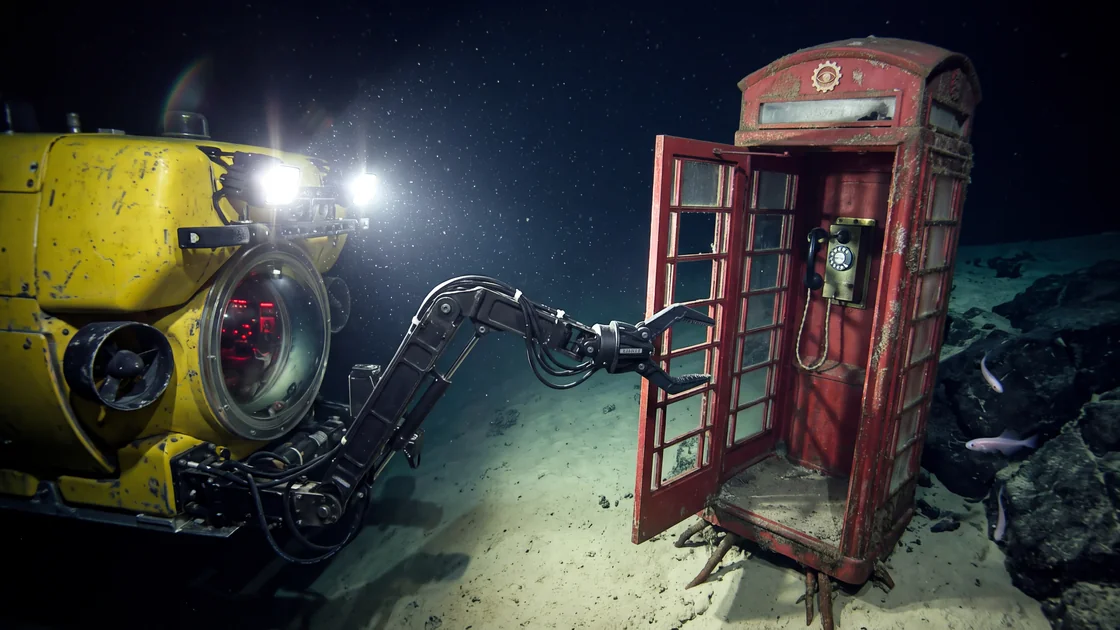
This is the account of the Caelum-4 expedition into the Challenger Deep, where an interdisciplinary oceanographic team discovered an uncrushed, operational cast-iron rotary telephone booth anchored into the hadal bedrock at a depth of 10,924 meters. Over the course of five days sealed in the abyssal silence, the crew of the deep-submergence vehicle Orpheus attempted to understand how a mid-twentieth-century terrestrial telecommunication artifact could survive 16,000 pounds per square inch of hydrostatic pressure, why its interior remained inexplicably dry, and who—or what—was placing the calls that began vibrating through the subduction zone when the receiver was lifted. What began as a survey of microbial extremophiles devolved into an existential encounter with a forgotten planetary nervous system, permanently altering our understanding of deep-earth acoustics, human memory, and the true age of the machines we believe we invented.
Day 1: The Benthic Floor
The transition from the bathypelagic to the hadopelagic zone was not a descent into empty water, but an entrance into an iron-cold compression chamber. At nine thousand meters, the ocean ceased to behave like a fluid and began to act like an architecture.
"Check your seals on the forward viewport housing, Lena," Dr. Alistair Finch said. His voice was flat, dried out by thirty-six hours of breathing recycled, desiccant-scrubbed nitrogen-oxygen. He was fifty-four, his knuckles swollen from decades of cold deckwork, his retinas permanently webbed with the red-light vascular ghosts that come from staring into sonar monitors in windowless spheres. "The thermal gradient is dropping faster than the descent profile modeled."
Lena Vance did not look up from the pilot’s console. Her hands rested lightly on the twin hydraulic joysticks that controlled the variable-buoyancy ballast and the six brushless DC thrusters of the DSV Orpheus. The submersible was an eight-meter-long oblong spheroid of forged titanium alloy, wrapped in a bright yellow shell of syntactic foam. It was engineered to bend microscopic fractions of a millimeter under pressure, shrinking around its three human occupants like a stiff shoe.
"Seals are nominal, Alistair," she said evenly. Her thumbs made micro-adjustments to the vertical thrusters, countering the downwelling hadal plume. "Manifold pressure is holding at one thousand and seventy atmospheres. If the viewport was failing, you wouldn’t have time to finish the sentence."
Behind them, squeezed into the narrow acoustic alcove between the oxygen candles and the primary battery banks, Dr. Maya Thorne adjusted her over-ear monitors. She was the expedition’s seismologist and acoustic oceanographer, hired to map the micro-fractures in the subducting plate margin. For six hours, she had listened to the mountain ranges of the Pacific grinding themselves into grease beneath the Marianas.
"Alistair," Maya said, her fingers dancing over the frequency spectrum analyzer. "Kill the port starboard telemetry ping for five seconds. I’m getting a secondary reflection that isn’t bouncing off the trench wall."
"Echo from the trench floor?" Finch asked, leaning his forehead against the damp neoprene rim of the center optical port.
"No. It’s too sharp. Sedimentary ooze scatters high-frequency pings into soft, rolling humps. This is a hard-corner return. A specular reflection. It looks like... a structural edge."
"A shipping container?" Lena asked, bringing the Orpheus into a nose-down hover, leveling off fifty meters above the theoretical bottom. "A stray from a Maersk freighter that broke its lashings in the North Pacific?"
"A standard shipping container would have imploded into a scrap pellet before it passed the midnight zone," Finch muttered. "At four thousand meters, the walls buckle. At six thousand, the corners pop like soda cans. By ten thousand, it’s a crushed wad of sheet metal the size of an engine block."
"I know what the math says, Alistair," Maya said, peeling one headphone cup off her ear. "Look at the trace yourself."
Finch twisted around in the pilot’s couch, his knees brushing Lena’s shoulder in the cramped two-meter sphere. On the waterfall display of the multibeam sonar, amid the murky blue-green smear of the Mariana Trench's eastern slope, a tiny, hard shard of yellow light burned. It had ninety-degree intersections. It cast a clean, long shadow across the flat hadal basalt.
"Bring up the external high-intensity halogens," Finch said. "All four banks. Turn on the sea-snow deflectors."
"Halogens at eighty percent," Lena said, her switches clicking with dry, heavy snaps. "Don't burn them long. We need the thermal dissipation, or we'll cook the transformer housings against this cold water."
Outside the five-inch-thick acrylic viewport, the eternal dark was split by twelve thousand lumens of raw, surgical white light.
For a few moments, there was only the marine snow—the endless, ghostly drift of dead plankton, diatom shells, and fecal pellets falling from the sunlit world miles above, glittering like mica dust in an abandoned cathedral. Then, the silt floor rose to meet them: pale, beige pelagic sediment, smooth as talcum, untouched by storms or sunlight for millions of years.
And there, forty meters ahead, perfectly upright, sat the booth.
It was not a wreckage. It had not settled at an angle. It was planted into the basalt bedrock like a surveyor’s monument, the pale silt drifted against its iron base in neat, miniature dunes shaped by hadal currents that moved at less than a centimeter per second.
Lena’s hands froze on the thruster controls. The Orpheus drifted forward on its momentum, the hull groaning as it met an eddy of colder water.
"Tell me you’re seeing that," she whispered.
"I see it," Finch said. He did not blink. He couldn't. His mind was rejecting the scale, attempting to reconstruct the image into something natural—a hydrothermal vent chimney, a basalt pillar dropped from a submarine landslide, a discard from an oil exploration platform.
It was a telephone kiosk.
It was constructed of heavy, paneled cast iron, painted an oxidized, salt-scoured crimson that was peeling in thick, leathery ribbons like dried arterial blood. Its design was archaic, evocative of the mid-twentieth century—reminiscent of the British Post Office K6 model, yet subtly altered: taller, narrower, its crown lacking the embossed St. Edward's crown, bearing instead an enameled relief of a three-toothed gear encircling an unblinking eye.
Every pane of glass was intact.
Under one thousand atmospheres of pressure—where every square inch of surface bore the weight of an elephant, where water sought every microscopic vacancy with a violent, erosive hunger—the flat, rectangular panes of window glass held back the abyss.
"That's impossible," Maya said. Her voice had dropped into the register people use when entering a mausoleum. "That is physically impossible. Flat plate glass fails at two hundred bars unless it's chemically tempered borosilicate five inches thick. Those panes... they can't be more than a quarter-inch."
"Look inside," Finch whispered, his face pressed so hard against the viewport that his breath fogged the cold plastic. "Lena. Bring the spot beam through the upper pane. Aim for the interior bulkhead."
Lena worked the auxiliary manipulator arm, swinging the boom-mounted searchlight three degrees starboard. The beam cut through the hadal sediment, slicing cleanly through the glass.
Inside the booth, suspended on a bracket of blackened brass, hung a heavy, black bakelite telephone handset. A coiled cord, wrapped in fraying braided cloth, drooped downward to an iron junction box mounted beneath a rotary dial plate.
The interior of the booth was empty of water.
It was not flooded. The light did not refract through liquid inside the glass; there were no suspended particles, no drifting flecks of marine snow, no shimmer of varying density. A single slip of yellowed paper was glued beneath the dial wheel, its typed text clearly legible through the clear, impossibly dry air inside:
THE LINE IS OPEN TO ALL POINTS DOWNSTREAM. DEPOSIT NO COIN. WAIT FOR THE OPERATOR TO CLEAR THE DRIFT.
Day 2: The Acoustic Anomaly
They sat on the bottom of the world for four hours without speaking more than fifty words. The Orpheus rested on its landing skids, sixty percent of its battery reserves dedicated to life support and the low-draw monitoring suite. The mother ship, the RV David Attenborough, was an invisible sliver of steel floating eleven kilometers above, separated from them by forty-two minutes of acoustic telemetry lag.
"Surface has answered our primary burst," Maya said, her fingers trembling against her keyboard. She read the decodes off the green phosphorus terminal. "'Attenborough lead science team to Orpheus. Re-check telemetry. Optical data corrupted by surface compression artifacts. Advise return to three thousand meters for sensor recalibration.' They think the video feed is a glitch. They think we’re seeing a ghost reflection from the trench wall."
"Send them the raw spectral data from the multi-beam," Finch said. "Send them the acoustic scatter. And tell them we are staying down until our scrubbers hit the redline."
"Alistair," Lena said, her eyes fixed on the power bus. "We have twenty-two hours of reserve oxygen on the primary loop before we have to crack the chlorate candles. We can't stay down here arguing with a desk committee in Honolulu."
"We aren't leaving," Finch said. His voice was not frantic; it had entered that terrifying, cold space of total fixation. "Do you understand what that is out there? If that were an uncharted tectonic structure, it would be the find of our careers. If it were a military drop from the Cold War—some forgotten deep-ocean sonar listening station from Project Colossus—it would be an international incident. But that... that thing isn't steel-reinforced titanium. It’s iron. It’s bakelite. It’s plate glass."
He pointed a finger at the window. Outside, an abyssal snailfish—translucent, pinkish-white, its internal organs visible through its gelatinous skin—drifted lazily past the red iron roof of the kiosk. It showed no fear of the structure. It brushed its paddle-like fins against the upper pane, leaving a streak of mucus on the ancient red lacquer, before vanishing into the dark.
"It has an anchor," Maya said suddenly.
She had stripped off her outer fleece, sitting in her wool undershirt despite the bitter chill seeping through the titanium hull. Her monitors were cascading with high-gain acoustic profiles.
"What do you mean, an anchor?" Finch asked.
"Look at the base. You thought it was bolted to the basalt?" Maya turned her screen toward them. "I ran a subsurface sub-bottom profiler pulse directly under the pedestal. There's no concrete footing. There's no mechanical plate. It's a root."
"A cable," Lena corrected.
"No. It’s an iron stem. It goes down forty meters through the soft hadal ooze, through the basalt crust, and then it branches. It threads into the seismic fault itself. It’s braided into the subduction fracture like a vine climbing an iron trellis."
She plugged her primary transducer into the cabin speaker.
Until now, the hadopelagic world had sounded like white noise—the low, churning roar of the Orpheus’s ventilation fans, the hum of the transformer coils, the intermittent crackle of crustal creaks miles to the west. But as Maya boosted the gain on the contact hydrophone—the tiny piezoelectric sensor pressed directly against the outside hull—the sound changed.
Click.
Whirrrrr-click.
It was the distinct, mechanical sound of an analog spring returning a geared dial to its stop position.
Whirrrrr-click.
Lena reached out and pulled the emergency ascent release safety pin half an inch from its gate, then stopped. Her knuckles were white. "That’s mechanical. That’s inside the cabin."
"No," Maya whispered. "It's through the water. It’s vibrating through the sediment. It's coming from inside the kiosk."
Finch hauled himself forward onto his knees. "Bring the port arm up. Deploy the high-definition macro lens on manipulator two. Push it right up against the glass."
"We risk hull strike," Lena warned. "The current—"
"The current is zero point zero two knots, Lena! Put the camera on the dial!"
Lena's jaw set in a hard line, but her training took over. Her hands moved over the hydraulic controls with buttery smoothness. Outside, the articulated yellow limb of the Orpheus hissed through the black water, its carbon-fiber digits unfolding like a praying mantis. The lens housing, protected by mineral-oil fluid compensation, swung within three inches of the booth’s central window pane.
On the high-resolution monitor above Finch’s head, the dial leaped into focus.
The dial was brass, patinated with green verdigris at the edges, but the finger holes were worn bright and silver from use. The numerals—1 through 0—were hand-enameled in an archaic, sharp-serifed font.
The dial was moving.
Slowly, smoothly, the hole for the number 7 was pulled clockwise until it struck the metal finger stop. A brief pause. Then the sound: whirrrrr-click, the brass gear train humming against the dead weight of the hadal sea.
Then the 3.
Whirrrrr-click.
Then the 0.
Whirrrrr-click.
Then the 9.
"Who is dialing?" Lena whispered. Her breath hitched. Her right hand drifted back to the ballast release. "Alistair. There's no one in there. There are no linkages. We’re forty miles from the nearest tectonic vent. What is pulling the wheel?"
"Listen," Maya said, her face pale in the phosphorescent glow.
Through the hydrophone came a new sound. It was not the dial. It was the low, rhythmic, double-stroke chime of an electromechanical telephone bell.
Brrr-ring.
A three-second pause.
Brrr-ring.
The sound was not muffled. It was not the dull, rounded thud of an underwater explosion or the hollow ping of a sonar transducer. It was dry. It was metallic. It was the sharp, domestic, invasive ring of a phone sitting on a hallway table in an empty house in the suburbs of 1952.
Brrr-ring.
"Surface is pinging us," Maya stammered, pointing at the acoustic modem. "They're reading... they're reading seismic micro-bursts centered precisely under our hull. They're telling us to abort. They think we’re sitting on an unmapped hydrothermal rupture."
"Ignore them," Finch said. "Extend the starboard claw."
Lena turned to him, her eyes wide, her pupils dilated until the dark brown irises were thin rings. "Alistair, no. We are not designed for direct mechanical intervention with an unidentified object. If that thing is under pressure differential—if that glass is holding back sixteen thousand PSI with an internal atmospheric bubble—and we crack it, the cavitation will hit us like fifty pounds of C4. It'll peel the outer skin right off our frame."
"Look at the glass, Lena! Does that look like it’s under stress? There’s no micro-cracking. There’s no strain birefringence in the polarizers!" Finch was shouting now, his voice cracking against the low roof of the sphere. "We have the claw. The claw has a fifty-pound rubberized grip. I want that receiver off the hook."
"Alistair, this is a violation of dive protocol—"
"I am the mission commander!" Finch roared, his hand coming down on the dashboard, rattling the diagnostic meters. "Pick up the goddamn phone, Lena, or I will take the manual overrides and drive this arm into the latch myself!"
Lena stared at him for four long seconds. Her chest rose and fell in jagged rhythms. Finch saw the sweat glistening on her collarbones, pooling in the hollow above her sternum.
"If the hull breaches," she said, her voice dropping into an icy, mechanical cadence, "I hope you have time to realize you were wrong."
She engaged the auxiliary hydraulics. The pump shrieked—a high, thin whine that caused Maya to clamp her hands over her headphones. Outside, the large three-clawed mechanical hand rose from its cradle beneath the battery tray. It moved forward, its black rubber pads dripping with water, pushing toward the door of the booth.
The door had no handle. It had only an iron push-plate, polished smooth.
The rubber pad made contact.
Day 3: The Circuit
The door did not resist.
It did not swing open with the violent rush of water that should have occurred had the kiosk been a vacuum or an atmospheric pocket. Nor did it burst open from interior pressure. It simply swung inward on its hinges with a silent, oiled grace that should have been impossible for iron exposed to salt water for even an hour.
As the door opened, the sediment around the threshold was not sucked in. The water did not enter.
Finch leaned closer, his eyes bloodshot, his vision tunneling until the entire universe consisted of the four-inch circle of the center viewport.
Where the sea met the threshold of the booth, there was no membrane. There was no sheet of plastic, no resin wall, no boundary layer of gel. There was only a line—a thin, vibrating horizon where the gray, hadal water ended, and the air began.
It was like looking at the surface of a pond from below, but turned ninety degrees vertical. The water bulged slightly outward, convex, held back by an invisible meniscus of infinite surface tension. Inside, Finch could smell—or he imagined he could smell—the faint, stale odor of dust, damp wool, and stale tobacco.
"The water isn't going in," Lena whispered. Her fingers remained on the joystick, frozen mid-stroke. "Alistair. The water is refusing to cross the threshold."
"Maya," Finch said without looking back. "Are you getting any change in the acoustic load?"
Maya didn't answer. She had taken off her headphones. She was staring at her display with her mouth slack, her tongue resting against her lower teeth.
"Maya?"
"It’s not an acoustic signal anymore," she said. Her voice was flat, hollowed out of all timber. "It’s... it’s on the inductive loops. It’s on the electrical ground. It’s coming through the hull's cathodic protection system."
She switched the cabin audio from the hydrophone to the internal intercom circuit.
The double-ring had stopped.
In its place was a voice.
It did not sound like it was coming from a radio. It had none of the digital jitter of the acoustic modem, none of the crackling phase-shift of high-frequency surface broadcasts. It sounded like an old carbon microphone pressed directly against a dry ear. It was the voice of an elderly woman, her accent mid-Atlantic, clipped, polite, and entirely devoid of urgency.
"Exchange," the voice said through the Orpheus’s interior speaker. "Exchange. I have a collect call from the lower terrace. Will you accept the charges?"
The cabin grew so cold that Finch could see his own breath plume into the air between his face and the acrylic glass. The thermal sensors on the hull read 1.2 degrees Celsius, standard for the hadal floor, but inside the titanium sphere, the temperature seemed to plummet past the frost point.
"Don't answer," Lena whispered. "Alistair, do not touch that claw."
Finch reached out. He did not use the joystick. He reached past Lena’s shoulder, his fingers finding the toggle switch for the manipulator’s wrist-rotate function. He flicked it down.
Outside, the yellow mechanical wrist rolled forty-five degrees. The rubberized fingers reached through the invisible vertical meniscus.
When the metal of the manipulator arm entered the booth, it did not splash. A circle of dry air instantly formed around the black steel wrist, the water peeling back like grease from a hot pan. The claw entered the booth, bone-dry. The rust on the iron frame inside didn't flake; it sat dry and powdery on the corners.
The claw hovered over the black bakelite handset.
"Exchange," the woman’s voice repeated. There was a faint sound of paper shuffling in the background—the dry, rustling rattle of ledger pages being turned in a large, drafty room. "I have seven hundred and forty thousand circuits waiting on this trunk. Please clear the key, caller. We cannot hold the carrier past the tide."
"Finch," Lena hissed, her hand coming down on his wrist, her nails digging through his cotton sleeve into the meat of his arm. "Look at the power draw! Look at the bus!"
On the master electrical panel, the main battery bank was draining. Not in the gradual, linear steps of normal operations, but in massive, rhythmic gulps, as if a gigantic capacitor bank were sucking the silver-zinc cells dry through an open valve. The voltage was dipping: 120 volts... 114... 108...
"She's pulling from the sub," Lena cried. "She’s using our ground to close the circuit!"
"Drop the claw!" Finch shouted, his hand wrestling Lena’s off the switch. "Just lift the receiver! Let her speak!"
"Alistair, we will lose life support in six minutes if the bus drops below ninety!"
Finch did not listen. He jammed the hydraulic lever forward.
The claw closed. The rubber pads gripped the narrow center of the bakelite handset. With a dry, scraping click, the receiver was lifted from its brass cradle.
Instantly, the acoustic hum that had filled the water for twenty miles around died.
The Mariana Trench fell into a silence so profound that Finch could hear the blood thumping behind his own eyeballs, could hear the wet clicking of his own eyelids. The groaning of the plate margin ceased. The tectonic shudder of the Pacific floor vanished.
Through the cabin speaker, the woman’s voice did not return.
Instead, there was breathing.
It was not human breathing. It was slow—one inhalation every forty-five seconds, long, dry, and cavernous, like the movement of air through an abandoned limestone mine. It had the volume of something immense, something whose lung capacity was measured in cubic kilometers, but compressed down through the microscopic carbon granules of a three-inch telephone transmitter.
Then, a man’s voice spoke.
The voice was rough, scarred by salt, its cadence rhythmic and measured, like someone reading coordinates from a ship’s logbook.
"We are at sixty-four fathoms off the Tail of the Grand Banks," the man said. His voice was distant, accompanied by the muffled, hollow ringing of an iron hull being struck by heavy seas. "The boiler has extinguished. The pumps are choked with coal dust. Mr. Murdoch has ordered the watertight doors dropped from the bridge, but the list is five degrees to starboard already. We can hear the ice along the plates. It sounds like gravel. It sounds like someone throwing handfuls of peas against the iron."
Finch’s breath caught in his throat. "Who is that?" he whispered.
"Alistair," Maya said, her eyes fixed on the spectrum analyzer. "The carrier signal... it’s not coming from the telephone wire."
"Where is it coming from?"
"It’s coming from the bedrock," she said. "The frequency is point zero zero three Hertz. That’s not a telecommunication band. That’s the resonant frequency of the whole oceanic plate. The whole Pacific basin is acting as a diaphragm."
The man's voice on the line faded into a hiss of salt-spray static, replaced immediately by another. This one was younger, high-pitched, frantic, speaking through the rapid stutter of a telegraph key clacking in the background.
"...convoy SC-107... we have six torpedoes in the water... starboard engine room is gone... water is over the floorplates in three... tell Mary the insurance is in the tin under the washstand... tell her we didn't go down fast... tell her—"
Click.
A new line opened.
"USS Thresher," a flat, disciplined voice said. Finch recognized the cadence—a submarine officer, steady, trained, fighting the rising panic of an uncontrollable down-angle. "...ninety-eight hundred feet... experiencing minor difficulties... attempting to blow main ballast... have positive angle... surface, please acknowledge... we are attempting to blow..."
The sound that followed was not water. It was the shriek of high-pressure air through pipes that were already pinching shut, followed by a dull, massive, metallic crump that shook the Orpheus on its landing skids.
"Turn it off," Lena screamed. She lunged across the console, her hands clawing at the primary hydraulic valve to dump the arm’s fluid pressure. "Alistair, turn it off! It’s pulling every dead vessel in the Atlantic through the hull!"
"No!" Finch knocked her back into the pilot’s chair. His eyes were wide, blood-spotted, manic. "It’s not just ships! Listen to the dates! Look at the geology!"
The voice in the speaker was no longer speaking English.
It was speaking something harsh, monosyllabic, guttural, its consonants clicking like stone knives struck together. Behind it was the roar of a deluge, the sound of an entire inland sea breaking through a collapsed limestone dam with the violence of a million Niagaras. It was the sound of a valley being drowned ten thousand years before the invention of writing.
And beneath that—beneath the drowned voices of sailors, of fishermen, of migration parties caught on sinking land bridges—there was a third sound.
It was the rotary dial.
In the booth, still held in the grip of the Orpheus’s robotic arm, the phone began to dial itself again.
Day 4: The Operator
They could not break the connection.
Lena had pulled the circuit breakers for the port manipulator arm, but the claw did not release. The hydraulic solenoids had welded themselves together; the electrical feedback from the booth had back-fed through the sub’s 24-volt control lines, fusing the copper relays into black, glassy beads of slag. The arm remained extended, its carbon fingers locked around the bakelite neck of the handset, a physical conduit joining the titanium skull of the Orpheus to the red iron kiosk.
The battery was at forty-one percent.
The surface had gone silent. Maya had spent six hours calling the David Attenborough on the acoustic modem, but the only return they received was their own pings, delayed by forty-two seconds, distorted until the digital tones sounded like high-pitched, metallic laughter.
"They've abandoned the station," Lena said. She was sitting on the floorboards between the pilot's pedals, her knees drawn up to her chin, her hands wrapped in her wool watch cap to stop their shaking. "They think we imploded. When the seismic surge hit the hydrophone array on the surface, they saw the trace of a hadal collapse. They think we’re grease on the basalt, Alistair."
"They're still up there," Finch said. He had not left the viewport in twenty-four hours. His beard was frosted with salt crystals from his own dried sweat; his eyes were ringed with deep, plum-colored bruises of exhaustion. "They can't leave. The cable is still tethered to the benthic package."
"What cable?" Lena pointed a trembling finger at the status screen. "The umbilical was severed forty minutes after the first call came through. We are on internal stores. When that dial finishes its sequence, the batteries will be at thirty percent. That’s the threshold for life-support heater failure. In twelve hours, we freeze. In eighteen, we asphyxiate."
"Maya," Finch said, ignoring her. "Who is on the line now?"
Maya was sitting cross-legged in her alcove, her head resting back against the cold titanium skin of the hull. Her skin had taken on the waxy, yellowish pallor of carbon dioxide toxicity. The scrubbers were struggling; the fans sounded like they were chewing wet sand.
"It’s not a voice anymore," she said. Her speech was slow, slurred at the edges, like someone speaking under a heavy dose of chloral hydrate. "It’s... an index."
She held up her logbook. The pages, usually filled with clean columns of wave velocities and shear-modulus calculations, were covered in dense, spidery rows of five-digit numbers.
"She’s reading off the registry," Maya murmured. "The operator. She has every displacement tonnage logged since the fourth millennium BC. Every dugout canoe that slipped off the shelf in the Sunda Strait. Every Spanish caravel that caught the reef off the Dry Tortugas. Every Soviet ballistic sub that dropped below test depth in the Norwegian Sea. She’s... she’s filing them."
"Filing them where?" Finch asked.
"In the trench." Maya smiled—a small, childlike, terrifying smile that did not touch her eyes. "Why do you think the plate subducts, Alistair? Do you really think it’s just convection? Do you think the mantle is just heat and olivine?"
She leaned her head closer to the bare titanium.
"The ocean floor is a conveyor belt," she whispered. "Everything that sinks—everything that drops through the water column and isn't eaten, isn't dissolved, isn't dispersed—it all ends up here. The trench is where the surface world clears its desk. The trench is the waste-pipe of the continents. And down here... someone has to answer the line when the pipe backs up."
Click-whirrrrr.
Outside, the dial completed another rotation. It had been dialing for fourteen hours. It was not a seven-digit number. It was not an international code. It was a sequence that had already exceeded four thousand digits.
Each time the brass wheel spun back to its stop, the sub’s internal lights dimmed to a brown, dying ember. Each time it struck the stop, a pulse of green luminescence traveled along the iron roots beneath the booth, lighting up the basalt floor of the Mariana Trench for hundreds of yards in every direction.
In those pulses of light, Finch saw what lay beneath the sediment.
It was not just basalt.
The floor of the trench was paved.
Under the three-foot layer of pelagic diatom ooze lay an endless, interlocking mosaic of drowned machinery. Not ships—or not only ships. There were printing presses, their iron rollers seized with salt; steam locomotives from the 1840s, their cowcatchers buried in hadal mud; rows of mechanical looms, their wooden shuttles preserved by the icy, oxygen-poor water; telegraph switchboards with thousands of rotting cotton-braided patch cables; and deeper down, half-melted into the volcanic rock, things that had dials but no numbers, things with levers and pistons that had never been seen by any human eye under the sun.
"It’s not an artifact," Finch said. His voice was barely a croak. "The booth... it’s an organ. It’s a sensory node."
"Alistair," Lena said, rising slowly from the floor. Her hand was behind her back. "We are blowing the ballast."
Finch turned his head slowly. "The ballast release is locked by hydraulic pressure, Lena. The pump is dead."
"The mechanical release isn't." She brought her hand forward. She was holding the heavy steel emergency override lever—a two-foot bar of painted iron that mechanically tripped the high-pressure nitrogen flasks to drop the ten-ton iron drop-weights from the sub’s belly.
"If you drop the weights while the arm is locked to that handset," Finch said, his voice dropping into a register of deadly calm, "you won't rise. You'll tear the arm off its mount. The hull will peel along the starboard penetration weld. You’ll kill us instantly."
"We are already dead, Alistair!" Lena screamed. Her face was contorted, her nose running, her cheeks slick with tears and condensation. "Look at the CO2 meter! We’re at three percent! The scrubbers aren't cycling! We’re having anoxia dreams! There is no telephone! There is no operator! It’s an acoustic hallucination caused by high-pressure nervous syndrome and nitrogen narcosis!"
"Nitrogen narcosis at ten atmospheres of internal pressure?" Finch laughed—a dry, rattling bark that ended in a fit of coughing. "We’re breathing a one-atmosphere mix, you idiot. Our lungs are at sea level. The machine is real. It’s right there."
He pointed through the port.
The receiver was no longer hanging from the claw.
The robotic arm had dropped open. The black bakelite handset was floating.
It did not drift upward as a hollow plastic object should have. It hung suspended in the exact center of the booth’s interior air space, perfectly balanced between the ceiling and the floor, vibrating with such intensity that the verdigris on the brass dial was shaking loose in a fine, emerald rain.
Through the hull, the operator spoke again.
This time, she did not ask for charges. She did not ask to clear the key.
"Alistair Finch," she said.
Her voice was no longer that of an elderly stranger. It was his mother's voice. It was the voice of Martha Finch, who had died in a hospice in Edinburgh when he was nineteen, whose hand he had held while the rain tapped against the hospital glass, whose face he had forgotten through thirty years of salt expeditions and deep-sea dives.
"Alistair," she said, the tone warm, brisk, smelling of paraffin stoves and damp wool coats. "You've left your shoes on the step again. The tide is coming up the lane, and you’ve left the door unbolted."
Finch fell to his knees before the center viewport. He pressed his forehead against the freezing acrylic, his breath smearing across the cold surface in a gray, wet oval.
"Mother?" he whispered.
"Alistair, don't," Maya said from her corner. She was no longer looking at her monitors. Her eyes were rolled back, her fingers tracing invisible five-digit numbers on the bare titanium of the pressure sphere. "That’s... that’s the carrier wave. It uses whatever is in the sediment. It uses the memories that were lost in the wrecks. It’s just... it’s just the line clearing."
"You must take the call, Alistair," the voice said, soft, close, as if her lips were pressed against the external acoustic diaphragm three inches from his temple. "The gentleman from the Board of Works has been waiting since the turn of the century. He says the drain is full. He says the bed of the world is choked with iron, and someone must sign the receipt."
"I’ll sign it," Finch whispered.
"Alistair!" Lena screamed.
She threw her entire body weight onto the emergency ballast release bar.
Day 5: The Toll
The mechanical dogs did not trip.
When the iron bar slammed down against its mechanical stops, there was no sharp thwack of exploding shear pins, no sudden, sickening leap of the deck as the five-ton drop-weights fell away into the hadal mud.
There was only a low, electrical clack from within the floorboards.
The Orpheus did not move.
The lights on the console died completely. The hum of the oxygen fans ceased. The displays flickered once, twice—thin green lines collapsing into central dots of dying phosphor—and then vanished.
The sub was dark.
The only illumination came from outside.
The telephone booth was glowing.
It was not an electrical light. It was the bioluminescence of the hadal trenches, but amplified a thousandfold. The red iron of the kiosk had become translucent, like an ember pulled from an ironmonger's furnace, veins of pale, sea-green fire coursing through the cast metal. Through the illuminated glass, they could see the rotary dial spinning continuously, a blur of brass and silver, a clock whose hands were moving at the speed of an engine shaft.
The handset was no longer floating.
A hand was holding it.
It was not an arm of flesh. It was an arm of compacted sediment, of blue clay and crushed globerigina ooze, threaded with fine strands of copper wire and the black, chitinous carapaces of deep-sea isopods. The fingers were long, five-jointed, made of cold river-silt and ancient anthracite coal, their tips pressed firmly into the bakelite handle.
The figure in the booth was tall, hunched beneath the iron crown, its face obscured by a veil of falling marine snow that drifted upward inside the dry air, rising like smoke from an open grate.
The speaker in the Orpheus’s ceiling did not need power anymore. The voice came through the hull itself, vibrating through the crystalline structure of the forged titanium, shaking the fillings in Finch’s teeth.
"Connection established," the operator said.
The voice was no longer one woman. It was a million women. It was the chorus of every manual switchboard that had ever operated in the dark of night in every drowned city, every coastal exchange, every underground bunker built during the long fear of the missiles.
"The party is on the line. Will you take the trunk?"
Lena was on the floor, her face buried in her arms, her body curled into the fetal position between the dead rudder pedals. She was whispering the Lord’s Prayer, over and over, her words stumbling, her voice reverting to the flat, rural drawl of her childhood in West Texas: "...on earth as it is in heaven... give us this day... give us this day..."
Maya had stopped writing. She was leaning against the viewport beside Finch, her eyes wide, reflecting the green, furnace-glow of the kiosk.
"It's not an artifact, Alistair," she said. Her voice was steady now, perfectly clear, cleared of all CO2 confusion, cleared of all terror. "It’s where the sea thinks."
"Yes," Finch said.
"The sea has been thinking for four billion years. It has all our iron. It has all our cables. It has every wire we ever dropped into its water to talk to each other across the shelves. It’s spliced them together."
"Yes," Finch said.
The door of the telephone booth swung fully open.
It swung out until it struck the iron stop with a chime that rang through forty miles of water, reaching the ears of whales hunting off the Bonin Islands, reaching the seismographs of the Japanese Meteorological Agency in Kagoshima, where the pens leapt six inches off the drum before tearing the paper.
The invisible meniscus broke.
The hadal sea did not rush into the booth.
Instead, the air inside the booth rushed out.
A single, massive bubble of dry, cold, mid-century air—air that smelled of damp wool, coal-gas, linoleum, and cheap tobacco—surged from the iron door and enveloped the DSV Orpheus.
The titanium hull, designed to withstand sixteen thousand pounds per square inch of inward fluid compression, was suddenly surrounded by a void.
For a tenth of a second, the physics of the hadal deep were inverted. The internal pressure of the submersible—a single, fragile atmosphere of nitrogen and oxygen—met a vacuum of equal proportion. The metal expanded. The titanium welds, held in check by the crushing weight of eleven kilometers of water, groaned as the stress reversed.
Finch did not look at the gauges.
He was looking through the open door of the kiosk.
The interior was no longer six feet tall. It was an avenue.
It was an endless, colonnaded gallery of red cast iron, stretching away not through the water, but through the bedrock of the descending Pacific plate, down through the Moho, down through the green, plastic mantle, down toward the nickel-iron core where the dynamo of the Earth spun in its white-hot cage.
Along the walls of the gallery hung millions of black bakelite telephones, their bells all chiming in a staggering, complex polyrhythm that sounded like the movement of a watch the size of a continent.
And at each station, a figure sat.
They were not ghosts. They were the operators. They were the ones who had remained at the switchboards when the water reached the lower decks of the Lusitania; the ones who had stayed at the telegraph keys in the post offices of Port Royal as the spit sank into the Caribbean; the hadal crewmen of every nation that had ever sent a cylinder of steel into the dark and forgotten to bring it back.
They were working the plugs.
They were plugging the copper cables of the living world into the deep, cold stone of the dead.
The figure in the center booth turned its head.
It had no eyes. Where its face should have been, there was only the circular, brass dial of a telephone, its finger holes open to the dark, the silver stop-lever gleaming like a single tooth.
It held out the handset.
The cord did not end at the junction box. It trailed away into the dark of the avenue, a thick, braided umbilical of black cloth and copper wire that disappeared into the mantle of the world.
"Alistair Finch," the chorus said, its voice ringing through the titanium sphere, shaking the dead control consoles, setting the needles of the dry meters dancing. "The line has been held for sixty-two years. Your party is waiting."
Finch reached out his hand.
He did not reach for the controls. He did not reach for the hatch release.
He reached for the dog-latches of the center viewport.
"Alistair!" Lena screamed, but she was too late. Her fingers caught the hem of his fleece, but he was already moving with the sudden, terrible strength of the fully possessed.
The dog-latches on the Orpheus’s optical port were four-inch steel pins, designed to be turned only from the inside with a three-foot breaker bar during maintenance in drydock. Under hydrostatic pressure, they were impossible to move; sixteen thousand pounds of force pressed the conical acrylic plug into its seat with the strength of a hydraulic press.
But there was no hydrostatic pressure.
The bubble held the water back. The acrylic plug was loose in its bronze frame.
Finch took the dog-pin in his bare, blistered hands.
He turned it.
The seal gave with a sound like a sigh.
There was no violence. There was no explosive decompression.
There was only the smell: the cold, dry, familiar smell of his grandmother’s parlor in Dunfermline; the faint scent of wet slate from the churchyard path; the smell of an old book opened after sixty years in a cellar.
The acrylic plug fell inward.
It struck the cabin floorboards with a dull, wooden thud.
The air that rushed into the submersible was not the black, icy brine of the Challenger Deep.
It was the air from the avenue.
It was seventy degrees Fahrenheit. It was dry. It smelled of ozone and tea.
Finch looked through the round, open port—an eight-inch circle of empty air looking directly into the crimson kiosk.
The figure with the dial face was standing there, its clay fingers offering the handset through the hole.
Finch stepped onto the console. His boots crunched against the plastic covers of the dead abort switches. He did not look at Lena, who had curled her body beneath the pilot's seat, her eyes shut, her hands over her ears, humming a church hymn into the dark. He did not look at Maya, who was sitting with her back against the battery box, her eyes open, her mouth curved in a faint, ecstatic smile, listening to the million bells of the mantle.
Finch put his head through the port.
The air was warm against his neck.
He took the receiver.
The bakelite was cool, smooth, completely dry. It smelled of carbolic acid and old wax.
He brought the ear-piece to his head.
"Finch," he said.
The voice that answered was his own.
It was not his voice as it was now—cracked, hoarse, dried out by fear and stale nitrogen. It was his voice from forty years in the future, old, calm, infinitely deep, speaking with the authority of someone who had lived at the bottom of the world since the oceans were first poured into the basins.
"Alistair," his voice said from the ear-piece. "The shift is over. You can let the water in now."
"Is the line clear?" Finch asked.
"The line is clear to all points downstream," the voice said. "We have logged the Attenborough. We have logged the three who followed. We have logged the continents. They are coming down the shelf now. They will be here by evening."
"I have the receipt," Finch said.
"Sign it, then."
Finch looked down at his right hand.
The skin was gray. His nails were dark, translucent, like the shell of an amphipod. Fine, white roots of sea-moss were growing from the cuticles, threading their way into the seams of his knuckles.
He did not pull his hand back.
He reached out with his left index finger.
He inserted it into the finger-hole for the numeral 0.
He pulled the brass wheel clockwise.
It moved with a sweet, heavy resistance, the internal gears humming against the weight of the Pacific.
He pulled it to the stop.
He let it go.
Whirrrrr-click.
The Log of the RV David Attenborough
Date: October 24, 2024
Position: 11°22.4' N, 142°35.5' E (Challenger
Deep)
Entry by: Dr. Marcus Cole, Chief Mission Specialist
At 04:15 UTC, the acoustic tracking station on the bridge recorded the sudden reappearance of the DSV Orpheus transponder at a depth of zero meters.
The recovery team was deployed immediately. The vessel was found floating forty meters off our port quarter, perfectly balanced on its waterline, its high-visibility yellow fairing scorched and blackened as if exposed to an open flame, though the hull was entirely cold.
The main hatch was unbolted from the inside.
When the deck crew opened the personnel sphere, they found the following:
Dr. Lena Vance was alive, though suffering from acute dehydration, stage-two hypothermia, and profound psychological catatonia. She has not spoken since recovery, except to repeat the word "Exchange" at six-minute intervals. She is currently under heavy sedation in the ship's medical bay.
Dr. Maya Thorne was deceased. The cause of death was determined by the ship's surgeon to be acute pulmonary edema consistent with rapid atmospheric decompression, although the pressure sphere itself remained structurally sound and at standard sea-level pressure. She was found sitting in the acoustic alcove, her logbook open on her lap. The last eighty pages of the book are filled with repetitive numerical sequences, written in her own hand, alternating between the numbers 7, 3, 0, and 9. Beneath them, written across the bottom of the final leaf in large, block letters, is the phrase: THE CHARGES HAVE BEEN ACCEPTED.
Dr. Alistair Finch was not inside the vessel.
The forward optical viewport—a five-inch-thick, solid conical plug of optical-grade acrylic—was missing from its housing. It has not been recovered. The steel dogs that secured the port were found turned to the open position; the threads on the locking pins were undamaged, indicating the port had been opened manually from within the sphere.
According to all known principles of naval architecture and deep-submergence engineering, the removal of an eight-inch viewport at a depth of 10,900 meters should have resulted in the instantaneous, explosive introduction of hadal water at a velocity exceeding three thousand feet per second, completely destroying the vessel's interior and obliterating its occupants in less than two milliseconds.
The interior of the Orpheus was completely dry.
There was no water in the cabin bilge. There was no salt residue on the scientific instruments. The air inside the sphere, sampled by the recovery team before ventilation was initiated, contained an unusually high concentration of coal-gas, ozone, and the dried spores of a terrestrial fern (Pteridium aquilinum) that has not grown in the Marianas archipelago since the late Pleistocene.
The forward manipulator arm of the submersible had been severed at the shoulder by a clean, mechanical cut, as if sheared through by an immense pair of tinning shears.
Mounted in the place of the missing viewport, held in the circular bronze frame by four neatly peened iron rivets that do not appear in the manufacturer's schematics, was a single, circular plate of cast iron.
In the center of the plate, raised in high, sharp relief, is the image of a three-toothed gear encircling an unblinking eye.
And from the center of the iron plate, through a brass gland that has been soldered shut with lead, runs an eight-gauge, braided-cloth telephone wire.
The wire does not lead into the submersible.
It leads downward.
When the recovery crew hoisted the Orpheus onto the stern slipway, the cable was found to be trailing beneath the ship's keel. The winch operator attempted to haul in the line, assuming it was a piece of fouling from our own arrays.
After twelve thousand meters of wire had been spooled onto the deck without the line slacking, the ship’s captain ordered the cable cut with an oxyacetylene torch.
As the flame touched the braided cloth, the acoustic array in the science lab—which had been switched off since the recovery operation began—emitted a single, clear, electromechanical ring.
The wire did not fall into the sea.
When the torch cut the copper core, the severed end did not drop beneath the waves. It remained upright for several seconds, stiff as an iron rod, vibrating with a frequency that could be felt through the deck-plates of the Attenborough, before it was pulled downward into the water with a speed that melted the bronze rollers on the fairlead.
The sound it made as it entered the trench was not a splash.
It was the sound of a receiver being placed, very gently, back into its cradle.