The Light in the Salt
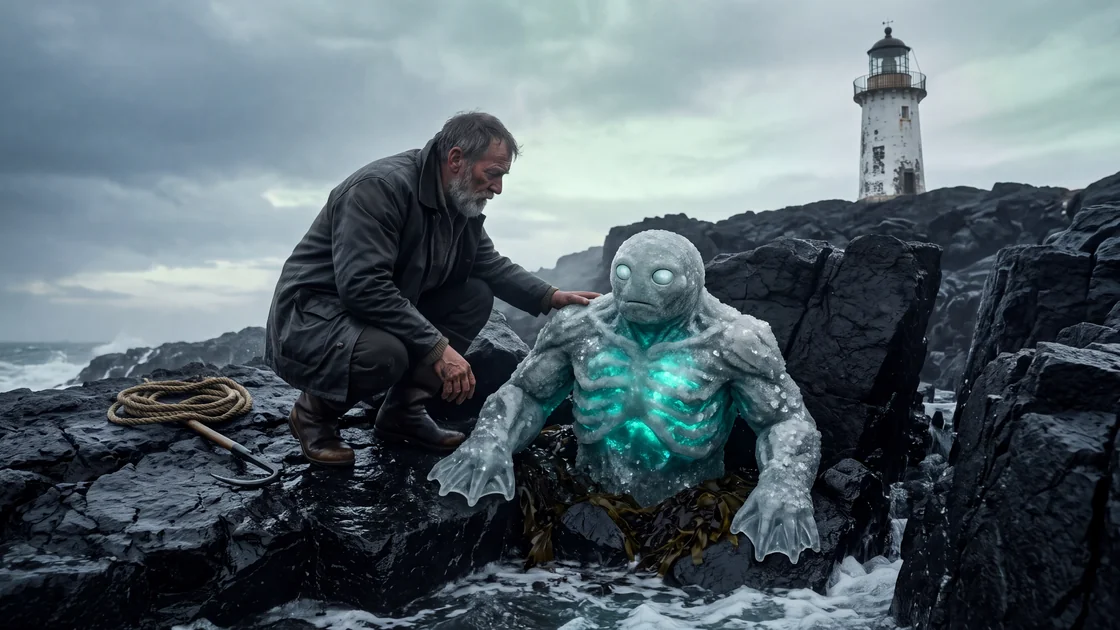
This is the account of Eamonn Vane, the solitary keeper of the basalt crag known as Gull’s Spine, who, in the bitter wake of an unnatural autumn tempest, pulled a dying creature of living mineral and cold oceanic fire from the surf; it chronicles the quiet weeks they shared within the damp stone heart of the lighthouse, where loneliness was translated into a language of salt and light, and how the salvation of one became the enduring preservation of the other against the ravages of sea and season.
Chapter I: The Spine and the Wheel
The rock was not shaped for men. It was an iron-colored tooth, sheared off at a spiteful angle by an ancient glacial retreat and left to rot in the gray thrashing of the North Atlantic, forty leagues from the nearest peat-smoked village of the mainland. The maps of the Admiralty designated it simply as Station 44 (Spine Reef), but the seal-hunters and the timber-ketches called it Gull’s Spine, though even the gulls rarely nested upon it. There was no soil for burrows, no thrift or sea-pink to cushion an egg—only slick basalt, greened over with rubbery dulse that smelled of iodine and rot, and deep fissures that coughed up white spray whenever the swell rolled in from Greenland.
Upon the highest ridge of this tooth sat the tower. It had been raised forty years earlier by an engineer named MacNair, who had lost three sloops and seven stonemasons to the undertow before the foundation was pinned with rolled-iron bolts into the granite core. It was sixty feet of interlocking millstone grit, white-washed once every three summers when the supply tender could brave the mooring, though by November the salt-mist always scoured the lime away, leaving the masonry looking like the bruised hide of a whale.
Eamonn Vane had lived inside the tooth for eleven years.
He was a dry, long-limbed man whose joints made a small ticking noise when he climbed the eighty-four spiral steps to the lantern room. His skin had taken on the color of kippered cod, cured by twenty years of coal-smoke, whale oil, and Atlantic spray. In his youth, there had been a parish on the mainland, a cobbler’s shop in a slate-roofed town, and a girl named Clara who had died of the lung-rot while the plum trees were still in blossom; but these things had smoothed away like soft shale under a waterfall. He remembered them only as one remembers a book read by firelight in childhood—the plot remained, but the ink was faded and the pages smelled of someone else’s house.
His world was measured by the drop of the clockwork weight.
Every four hours, Eamonn wound the cable on the iron drum. The weight—a cylinder of lead weighing two hundred pounds—hung down the hollow central tube of the staircase, descending foot by foot to turn the brass chariot that carried the lens. It was a second-order Fresnel lens, six feet tall, an intricate beehive of concentric glass prisms that caught the flame of the triple-wick concentric burner and bent it into a single, blinding spear of light. If the weight touched the flagstones of the cellar, the light stopped swinging, and if the light stopped swinging, the ketch from Archangel or the barque from Bristol would break its belly upon the Spine.
On the twenty-second day of October, the glass in the mercury barometer by the kitchen stove did not merely fall; it collapsed. The silver column dropped into the cistern as though the air of the world had been sucked out through a slit in the sky.
Eamonn stood by the gallery rail at noon, holding his woollen cap against his temple. The sea was an unnatural, greasy yellow, flat as tallow, yet lifting in long, breathless swells that had no wind behind them. The horizon to the northwest had vanished behind a wall of slate-purple haze that looked less like cloud than like a bruise upon the leather of the heavens. He could smell the deep bottom—not the clean, cold brine of the surface, but the stagnant, sulfurous musk of abyssal silt and crushed kelp-forests torn from ledges three hundred fathoms down.
He went down to the cellar. He checked the coal-bunkers, though he knew to the shovel-load how much remained. He carried two five-gallon cans of refined rapeseed oil up the eighty-four steps, his calves burning beneath his heavy frieze trousers, and set them within the bronze drip-pans beneath the pedestal. He trimmed the wicks with his small brass shears, cutting the char into a horn cup until the cotton edges were straight as a surveyor’s rule.
When he stepped out onto the iron gallery to grease the brass storm-shutters, the first puff of air struck him. It did not come from the sea. It came from straight above, as though an iron lid had been slammed shut upon the ocean, driving down a draft that was bitterly cold and tasted of powdered stone.
"A dead-man’s gale," he said to the empty sky. His voice sounded thin, dried out by his solitary years. "A torn-pocket gale."
By four in the afternoon, the sun had been snuffed out without an evening. The wind did not rise in gusts; it came all at once, a solid, screaming engine of air that ripped the crested tops off the rollers and turned the atmosphere into a stinging fog of horizontal foam. The lighthouse did not shake—MacNair had built it too well for that—but it hummed. It hummed like a great iron tuning fork struck by a mallet. Deep in the stone, in the mortar between the granite plugs, Eamonn could hear the vibration of the Atlantic grinding its teeth against the base.
He lit the lamp at five. The match flared thrice and died before the draft down the ventilator tube was checked; on the fourth strike, the wick took the flame, a pale yellow petal that swelled, sputtered, and then caught the great glass rings of the lens. Instantly, the tower sprang to life. Eight long beams of amber fire shot through the rain-lashed storm panes, wheeling across the churning abyss, striking the white crests of the breakers two miles out and illuminating nothing but fury.
Chapter II: The Tempest and the Void
All through the night, Eamonn lived in the lantern. To leave it was impossible; the draft through the cowl was so violent that the flame threatened to smoke the glass chimneys with soot every twenty minutes, and a smoked chimney meant a darkened sea. He sat upon his three-legged stool with a rag of boiled flannel in one hand and the brass wick-pick in the other, his eyes watering from the fumes of the hot brass and the tallow grease.
The sea did something it had never done in his eleven years upon the rock. At midnight, during the height of the flood, a wave struck the western buttress with a sound like the detonation of a powder magazine. The shock traveled up the stone spine; the mercury in the chariot bath slopped over its iron rim, splashing in silvery, heavy droplets across Eamonn’s sea-boots. A second later, a sheet of green water—not spray, but solid, heavy sea—rose sixty feet into the night, blotted out the lantern windows on the western quadrant, and smashed the outer storm pane of three-eighths-inch plate glass into a thousand blunt rhomboids.
The wind entered like a beast through the broken pane. The lamp shrieked; the flame whipped sideways, smoking black against the central bulls-eye.
Eamonn did not swear. He did not cry out. Solitude cures a man of the habit of theatrical despair. He threw himself across the brass railing, his coat billowed up over his head like a parachute, and dragged the canvas storm-blind from its hooks beneath the gallery door. The wind tore the skin from his knuckles against the jagged remnants of the pane; the brine stung his eyes until he was weeping red tears. He wrestled the heavy oil-soaked canvas across the iron frame, driving the wooden wedges home with the flat of his small hatchet until the blind drummed taut as a skin on a kettle-drum, cutting off the ocean’s breath and leaving the lantern room choked with kerosene smoke and the rank steam of his own woollen sleeves.
He spent the remainder of the dark on his knees, mopping the spilled mercury with small tin cards, herding the quivering, poisonous globules into a stoneware jar so the rollers of the lens would not skid and seize upon the track.
When the light finally grayed in the east, the wind had veered into the north and fallen into a low, exhausted moan. The sea remained monstrous—long, curdled ridges of foam forty feet high, running from the pole like gray horses with their manes torn away—but the sky was clear, a pale, washed-out green that looked cold as an icicle.
Eamonn extinguished the lamp. He pinched the wicks with his scarred fingers to prevent smoldering, wiped the brass drip-pan until it shone with a yellow, greasy luster, and went down the stairs. His legs were shaking with the sour fatigue of old age and terror. His knuckles were swollen, caked with dry sea-crust and blood.
He unbolted the lower door that led to the landing stage.
The landing stage was gone. The heavy oak timbers, three inches thick and bound with iron straps, had been sheared away as cleanly as if a shipwright’s adze had lopped them off. The iron derrick that hoisted the coal-casks was bent double, its arm twisted into the shape of a shepherd’s crook and trailing a tangle of weed-choked chain in the surge below.
The world had been scrubbed clean. There were no drift-logs, no dead gannets, no fragments of crates from some forgotten wreck. There was only the black slate of the reef, rinsed by the foam, and a vast, pale silence that felt heavier than the storm.
Then he saw the glow in the gullet.
The gullet was a deep, narrow slash in the eastern basalt where the sea boiled at low water—a natural trench twenty feet long and perhaps four feet wide, littered with rounded boulders that ground together in the swell like millstones. It was called Dead Man’s Cut because an apprentice keeper had fallen into it thirty years before and had been ground to meal before the tender could launch a gig.
Something lay wedged between the boulders at the high-water line.
It was not timber. It was not the white belly of a porpoise or the gray fat of a stranded seal. It was luminous. Even under the pale, watery dawn, it gave off a faint, pulsing radiance like the phosphorescence seen in the wake of a ship in midsummer, but cold, curdled, and pale emerald, like the heart of an iceberg.
Eamonn fetched his gaff-hook and his hemp coil from the oil-house. He scrambled down the wet, slime-filmed shelves of the rock, his rubber soles slipping on the kelp-ribbons, his breath whistling in his narrow chest. The spray still drifted across the Spine in blinding sheets, salt and bitter as gall.
He reached the lip of the cut and peered down.
The creature was jammed between two stones of black dolerite. At first glance, he thought it was an effigy carved from rock-salt—the kind of crude, white idols he had seen illustrated in the missionary journals in his father's house. It had a head, round and neckless, that sat directly upon broad, sloping shoulders; it had two long arms that ended in five-fingered paddles where the skin between the digits was thick and crystal-clear; it had a torso that tapered into two short, thick limbs ending in wide, spade-like heels without distinct toes.
Yet it was not stone.
As Eamonn watched, the creature’s side heaved. A long, shuddering sigh came from an opening beneath its collarbone—a sound like dry salt falling through an hourglass. A film of brilliant, milky-green light flared beneath its skin, rippled across the broad chest, and died away into an ash-gray dullness.
The tide was rising. In twenty minutes, the gullet would be a cauldron of foam. The heavy dolerite boulders were already beginning to shiver in their beds as the under-swell crept into the cut, nudging the pale form against the rock. With every surge, a small cloud of sparkling dust washed from its flanks, dissolving into the green sea like sugar in tea.
It was melting.
Chapter III: Cast Upon the Black Shingle
Eamonn did not consider whether the thing was a demon or an angel or some monstrosity born of the abyssal slime that the books on natural philosophy had failed to name. A keeper does not ask what flag a ship flies when it is breaking on the reef; he gets a line out, or he does not sleep for the rest of his life.
He dropped the loop of the hemp rope over the iron horn of a bollard above the cut and slid down the slime-coated rock into the crevice.
The water was up to his thighs, cold enough to drive the air from his lungs in a sharp bark. The creature lay before him, half-submerged in a pocket of weed. Close at hand, the smell of it was extraordinary—it did not smell of dead fish or mud; it smelled of an intense, violent purity, like the ozone after a lightning stroke mingled with the sharp, clean bitterness of dry table salt and old sea-ice.
He reached down and touched its shoulder.
The texture was miraculous. It was not wet like the hide of a seal, nor smooth like the belly of a shark. It felt like a dense, fine-grained mass of compacted salt crystals, cold as frozen iron, yet yielding slightly to the thumb like paraffin. Beneath the crusted surface, he could see tiny, microscopic facets—millions of cubic lattices of halite that shifted and slid over one another with a faint, dry crepitation, like the sound of crickets in an August field.
The creature’s eyes opened.
They were large, circular, and had no pupils. They were lenses of pure, polished selenite, clear as brook-water, behind which burned two steady points of cold, turquoise fire. They did not blink—they had no lids—but a thin, transparent nictitating membrane made of paper-thin salt-film flicked across the surface from the side, wiping away a smear of brown kelp-slime.
Those eyes fixed upon Eamonn.
There was no fear in them, nor any savagery. There was only a profound, crushing weight of pressure, the look of an entity that existed under the weight of three miles of vertical ocean and found the thin air of the earth to be an agonizing void. Its chest convulsed again. The vent below its throat opened, and a rasping whistle emerged:
“Khh-ssst... lll-t-t...”
Along the curve of its throat, where the gills of a cod would have been, three deep, horizontal folds opened. From them leaked not blood, but a heavy, syrupy brine that glowed with that same emerald coldness, dripping into the swirling sea-water and sinking to the bottom in bright, phosphorescent threads.
“Hold fast,” Eamonn whispered. He knew no other words for things that were drowning. “Hold fast, now.”
He slipped his hands beneath its armpits. The creature was shockingly heavy—its flesh had the density of marble, three times the heft of a man of similar stature. When he lifted, his spine groaned, and the salt water surged up his oilskin sleeves, freezing his elbows.
The creature did not fight him. It stiffened, its crystalline lattices grinding together with a sound like carriage wheels over dry gravel, and its long, paddle-like fingers closed around Eamonn’s forearm.
Where the fingers touched his woollen sleeve, the sea-water instantly froze into a white, brittle rime of salt. The cold passed through the heavy wool, through his flannel shirt, down into the marrow of his radial bone with a pain so acute he nearly cried out. It was not the cold of frost; it was the chemical cold of endothermic dissolution—the hunger of salt for moisture.
“None of that,” Eamonn grunted through his teeth. “I’m mostly water, boy. You’ll have me dry as a kipper.”
He threw his weight backward against the surge, dragging the thing up the sloping shelf of the cut. The tide caught them both, lifting them on a surge of yellow foam; for a terrifying second, Eamonn’s boots lost purchase on the slime, and he saw the black walls of the gullet wheeling past him toward the open sea. But his hemp line brought him up short, the rope biting into his ribs, and as the wave receded, he hauled the creature out of the wash and threw it like a sack of salt upon the flat ledge above.
He collapsed beside it, his heart hammering in his throat like a trapped puffin, his hands bleeding from a dozen small cuts where the creature’s crystalline edges had sheared his skin.
The being lay upon the basalt, unmoving now. The morning sun, rising through a gap in the northern clouds, struck its flank.
Instantly, a soft, hissing steam rose from the creature’s pale torso. The sunlight was attacking it. The outer skin, drying in the gale, was beginning to turn powdery, crumbling into a fine, white flour that the wind caught and whirled away in little sparkling drifts. The emerald light behind its ribs flickered, growing dim and brownish, like an oil-wick dying down in the socket.
Eamonn scrambled up. He seized the corners of his heavy, grease-stiffened canvas coat, stripped it off, and plunged it into a rock pool until it was dripping with sea-water. He threw the dripping canvas over the creature’s body, covering all but the head and the great, clear selenite eyes.
The hissing stopped. The creature’s eyes turned toward him once more, the turquoise points within flaring with a short, rhythmic pulsation: twice, then three times, then a long, low ember of light.
“You’re an ocean thing,” Eamonn breathed, kneeling over it, his hands on his knees, his breath clouding in the sharp air. “You can’t bear the wind. You can’t bear the sun.”
He looked up at the lighthouse. Sixty feet of vertical stone. Eighty-four steps.
He could not carry the thing up the spiral. It would weigh two hundredweight or more, and every step would crush the fragile lattices of its limbs.
Then he remembered the salt-cellar.
Beneath the oil-room, carved into the living basalt of the foundation by MacNair’s masons, was a low-vaulted cavern where the old builders had stored barrels of pickled pork and lime during the four years of construction. It had an iron drain that connected to the sea-face through a copper one-way valve, designed to let bilge out without letting the Atlantic in. It was dark. It was damp as a grave. The walls ran with brine-sweat winter and summer, and the sun had never touched a stone within it.
Eamonn reached down, gathered the ends of the wet canvas, and began to drag the creature across the slick flagstones toward the low iron door at the base of the tower.
Chapter IV: The Cistern of Brine
The salt-cellar was ten feet square, with a ceiling so low that Eamonn had to work with his head ducked between his shoulders. The air was thick with the smells of forty years: damp limestone, the mineral rust of ancient iron bands, and the faint, sweet grease of forgotten salt-pork. In the center sat an old oak trough, six feet long and three feet deep, once used for steeping the timber wedges that pinned the outer masonry.
It took him an hour to prepare it.
He carried down eight buckets of sea-water from the lower pool, his knuckles throbbing, his back a knot of spasms. He filled the trough until the brine reached halfway to the brim. Then, using two planks of driftwood as a ramp, he hauled the canvas-wrapped creature across the cellar flags and slid it, as gently as he could, into the tub.
The transformation was instantaneous.
The moment the creature’s body sank beneath the surface of the green Atlantic water, the dull, powdery film upon its skin dissolved. The lattices of its flesh cleared, turning from the dead white of chalk to a marvelous, watery translucence, like block-ice carved from the snout of a glacier.
Deep within its chest, the emerald heart flared.
It did not beat like a pump; it surged like a tide. A brilliant, sapphire-green luminesce blossomed beneath the breastplate of crystalline salt, traveled down the thick, clear bones of the arms, and burst into tiny, sparking points of light at the tips of the paddle-fingers. The water in the trough began to circulate of its own accord, drawn toward the vents beneath the creature’s throat and expelled through the gill-slits in two steady, phosphorescent plumes that made the oak timbers of the old tub glow like burning sulfur.
The creature settled to the bottom. It folded its short, thick legs beneath it, resting its hands upon the edges of the trough, its selenite eyes gazing through the three inches of brine directly at the keeper.
Eamonn sat down upon an overturned herring-firkin. He was shivering so hard that his teeth clicked together like bone buttons. His shirt was soaked with salt-water, his coat was gone, and his trousers were stiff with the black grease of the landing slip.
“Well,” he said.
The sound of his voice seemed to strike the water. The creature’s head tilted slightly. A soft, clear harmonic—like a wet finger run along the rim of a crystal goblet—rose from the tub. The sound did not come from a mouth; it came from the internal friction of its ribs, which moved against one another with the delicate precision of a musical box.
Tiii-nnnn-gg.
The note hung in the damp vault of the cellar, pure and cold, lasting long after an ordinary sound would have died against the porous stone.
Eamonn reached into his waistcoat pocket and found his tin of tobacco. The tin was dry, sealed with paraffin-paper, but his hands were shaking too badly to roll a leaf. He laid the tin upon his knee and simply stared.
Now that the creature was restored to its element, its structure was clearer to see. It was not flesh. There was no red blood, no fat, no sinew such as land-beasts possess. It was an architecture of mineral. Its "muscles" were interlocking chains of tiny, needle-shaped crystals that grew longer or shorter as the emerald light pulsed through them, pulling the heavier bones of dense, compacted halite into motion. Its skin was a delicate, self-healing rind of cubic crystals, continuously dissolving into the water and continuously reforming from the mineral salts held in solution.
It was an inhabitant of the high-saline vents—the places three miles down where the earth’s crust leaks brine hot enough to melt lead, but where the enormous pressure of seventy atmospheres keeps the water from boiling, packing the minerals into living lattices that could never exist under the thin, dry sky of the surface.
The storm had not merely blown it ashore. The Great Girdle Gale had torn up the bottom of the shelf, creating an upwelling that had flung the creature through the thermal layers into the light, where the lack of pressure was like a decompression sickness, and the fresh rain of the clouds was an acid that ate its flesh.
“You’re salt,” Eamonn said, his finger pointing at the tub. “Just salt and water and light.”
The creature raised one paddle-shaped hand above the surface.
The instant the limb left the water, the drying began; the surface turned milk-white, the light within dimmed, and the faint, singing note died away. The creature looked at its own hand with its clear, selenite eyes, then thrust it back into the brine with a quick, shuddering movement.
It understood. It was a prisoner of the tub as surely as Eamonn was a prisoner of the tower.
Chapter V: The Mineral Tongue
A lighthouse cannot be abandoned for the sake of a marvel.
By noon, the clouds had scudded away to the south, leaving an afternoon of brilliant, biting blue. Eamonn forced himself up the stairs. His joints screamed, his skin was caked with a white crust that made his eyelids burn, but the lens was waiting.
He spent four hours cleaning the storm-lantern. He scraped the soot from the brass cowls; he hauled up a new pane of heavy plate from the store-room, his shoulders aching as he set it into the western rebating, bedding it with lead-putty and securing the bronze clips. He filled the reservoirs. He wiped every prism of the great Fresnel lens with pure alcohol until the glass vanished, leaving only the refracted image of the empty Atlantic spinning inside the room like a vast, faceted eye.
Only when the lamp was lit at sunset—when the three concentric wicks were burning with their clear, smokeless orange coronas, and the clockwork was humming its rhythmic tick-tock, tick-tock through the stones—did he take an iron pot of boiled potatoes and salt herring down to the cellar.
He did not know what the thing ate. He had seen it breathe the water, but no living thing could sustain that cold emerald fire without fuel.
He brought a tallow candle with him and stuck it to a projection of the wall. In the yellow light of the tallow, the creature looked less miraculous and more frail. The water in the trough had become cloudy, thick with a white sediment that had settled to the bottom like flour. The emerald pulse within its chest had slowed; it came now only once every ten seconds, a faint, sluggish gleam that barely reached its throat.
Eamonn set his plate upon the floor. He broke a piece of the salt-herring and held it near the surface of the water.
“Fish?” he asked. “You know herring, surely? They run deep enough.”
The creature did not move. It watched the fish with its stone eyes, but there was no hunger in them.
Eamonn scratched his beard. He looked at the white sediment at the bottom of the tub. He dipped his finger into the water and touched it to his tongue.
The water was flat. It was Atlantic water, three percent salt, but to this creature, it was thin soup. It was starving for mineral. It was slowly, inevitably dissolving into the low-saline medium, losing its substance with every hour it sat in the wood.
“Wait,” Eamonn said.
He went to the small pantry off the kitchen. In the corner sat a wooden barrel with the iron hoops painted red: St. Ubes Solar Salt, five hundredweight, kept for curing fish and preserving the pork through the long winter. It was the coarse, gray, unrefined salt of Portugal, harvested from the sea-pans by the sun, full of magnesium, potassium, and the gray silt of the salt-marshes.
He dragged a forty-pound bag down the stairs, his heels bumping on every tread.
He hauled the sack to the edge of the trough, slit the coarse hemp with his rigging knife, and poured half of it directly into the water.
The effect was terrifying.
The water did not merely take the salt; it seized it. A sharp, violent cold radiated from the tub, so intense that the moisture on the outside of the oak staves instantly froze into a thick layer of hairy white frost. The creature’s head snapped back. Its mouth opened, and it let out a high, piercing chime—a sound like a silver bell struck with a hammer:
CLAAA-NNNG.
The gray crystals of the St. Ubes salt did not fall to the bottom. Before they could settle, they were drawn into the two glowing vents beneath the creature’s collarbones in a swirling vortex. As the minerals passed into its body, the emerald light inside its chest flared with a blinding, incandescent fury. The blue-green fire raced through every lattice of its limbs; its skin turned completely transparent, revealing the complex, geometrically perfect skeleton within—a system of nested, dodecahedral crystals that shifted and turned like the wheels of an astronomical clock.
The creature rose up in the water. Its arms reached out, catching the edge of the tub, and its torso emerged into the cellar air.
It did not turn white this time. The brine within its tissues was now so concentrated, so dense with dissolved solar salt, that the dry air could not immediately parch it. A faint vapor of cold steam rolled from its chest, smelling of the high sea, of salt-marshes, and of old sunlight locked in stone.
It reached its paddle-hand toward Eamonn.
Eamonn did not move back. He stood with his knife in his hand, his coat off, his grey hair sticking to his forehead with sweat and grease.
The creature’s hand rested upon the keeper’s sleeve. The cold was there, but it was no longer the hungry, sucking cold of the morning. It was a firm, steady weight. Through the coarse wool of his shirt, Eamonn felt a rhythmic, crystalline vibration—a pattern of short and long pulses that traveled through the bones of his own arm:
Pulse... pulse-pulse... pause. Pulse... pulse...
It was not a heart. It was a cadence.
It was the same cadence that Eamonn had heard through the soles of his boots for eleven years: the rhythm of the lighthouse clockwork, the steady descent of the lead weight within the stone tube, the turning of the great brass wheels that swung the light.
The creature had felt the tower. Through sixty feet of basalt and thirty feet of foundation, it had felt the rhythmic vibration of the lantern mechanism, and it was answering it.
Eamonn let his breath out in a long, ragged puff.
“Aye,” he whispered, his voice cracking. “Aye, boy. Four hours to the drop. That’s the measure of it.”
The creature’s fingers shifted. The selenite eyes cleared, glowing with an amber-tinted green that seemed to reflect the color of the rapeseed flame sixty feet above their heads. Its musical throat-ribs vibrated again, producing a three-note chord—a fifth, an octave, and a strange, flattened third that smelled, in Eamonn’s mind, of absolute silence and profound depth.
He did not know what to call it. In the logbook that lay on the kitchen table above, he would have to write something, or perhaps write nothing at all. To write ‘Found an amphibious man of mineral salt upon the rock’ would bring the inspection tender with two doctors from the asylum at Morningside and an order of dismissal for lunacy.
“Halite,” Eamonn said, remembering the name from an old book on the miner’s art he had bought in Newcastle forty years ago. “That’s what they call the rock. Halite.”
The creature’s ribs clicked. A soft, airy sound came from its vents:
“Haa-lyt.”
It was like the sound of the surge receding over fine pebbles.
Chapter VI: Days of Chime and Slate
For three weeks, the world did not exist beyond the perimeter of the reef.
The gale had broken the back of the autumn shipping; the timber-fleets had already run for the Baltic or the Clyde, and the steam-liners kept twenty miles to the westward to avoid the Spine in the November mists. Once every two days, the smoke of an iron collier would smudge the gray rim of the sky to the south, then slide away into the murk, leaving Eamonn alone with his rock and his guest.
A routine established itself, rigid and delicate as the prisms of the lens.
At dawn, Eamonn extinguished the light. He spent the morning scraping, filling, and trimming. At noon, he went to the cellar with a pail of sea-water and ten pounds of the solar salt.
The creature had grown stronger. Its tissues had recovered from the trauma of the surf; the ragged gashes where the dolerite had gouged its limbs had filled in with fresh, sparkling crusts of transparent crystal, smooth as glass. It had learned the limits of its tub. It would not leave the brine entirely, but it would sit for hours with its head and broad chest lifted above the surface, watching Eamonn as he cleaned the cellar, mended his oilskins, or cobbled his boots by the yellow light of an oil-cruisie.
It had no tongue, but it had its ribs.
The sounds it made were not speech, but they were not random. They were responses to the world around it. When the swell outside was heavy and long, the creature produced a low, droning hum that resonated in the cellar floor like an organ pipe. When the rain beat against the small copper ventilation pipe, it clicked in rapid, treble sequences, matching the impact of the drops.
And it listened to Eamonn.
Eamonn had not spoken five hundred words a year since the old keeper, Donald, had died of an apoplexy in the kitchen eight years back. He had forgotten the shape of conversation—the give-and-take, the waiting for an answer, the polite lies that grease the wheels of a village.
With Halite, there were no lies, because there were no words.
Eamonn talked to him about the oil. He brought down a pint-tin of the rapeseed and showed it to the creature, explaining the way the winter cold would turn it to a buttery tallow if the heater pipes were not kept clear. He showed him his small brass pocket-watch, opening the back to display the balance wheel spinning back and forth on its ruby jewel.
The creature reached out its glistening paddle-hand and held its fingertip an inch from the balance wheel.
A soft, bluish spark—a cold, static discharge of piezoelectricity—jumped from the salt-crystal to the brass balance. The watch did not stop; it began to run with an exquisite, whispering speed, the second hand sweeping around the dial like the shadow of a flying petrel.
The creature pulled its finger back and let out a short, ringing chime of satisfaction.
“You’ve a way with wheels,” Eamonn said, his face softening into the dry wrinkles that had once been a smile. “Though the watchmaker in Leith would have an apoplexy if he saw you oiling it with a spark.”
One night, the first hard frost of the winter descended upon the Spine.
The temperature plummeted twenty degrees in six hours; the spray that hit the gallery iron did not drain away—it froze into long, pendulous teeth of rime that dragged at the stanchions. The tower became a spire of ice, glittering like a diamond under a moon that was small, white, and cruel.
Eamonn came down from the gallery at midnight, his eyebrows white with frost, his mittens frozen stiff as shingles. His old knees were swollen; he could barely navigate the steep turn of the spiral where the stones were coldest.
He entered the cellar to fetch more coal.
Halite was not in the tub.
Eamonn stopped, his lantern swinging wild in his hand, his heart leaping into his gullet. The tub was full of brine, but it was still. A thick skin of needle-ice had formed over the corners where the salt was thinnest.
A trail of sparkling, crystalline fluid led across the flagstones toward the door that opened into the lighthouse base.
The creature had climbed out.
Eamonn followed the trail with his heart thumping against his ribs. The footprints were broad, spade-shaped pads, outlined in a glowing emerald slime that was already hardening into brittle, crusty salt. They led to the base of the spiral stairs.
And there, sitting upon the eighth step, was Halite.
He was not dying. The freezing cold of the tower, which brought Eamonn such misery, seemed to act upon the salt-man like a tonic. In the twenty-degree air, his flesh did not melt or turn powdery; it had contracted, becoming dense, hard, and clear as quartz. The emerald fire inside him was burning with a white-hot, diamond purity that illuminated the curving stones of the stairwell with a terrifying, unearthly beauty.
He was looking up the hollow throat of the tower.
Eighty feet above, through the iron grates of the landings, the lead weight was descending on its cable, ticking softly as the escapement released it tooth by tooth.
Halite looked at Eamonn. He pointed up the well with his clear, luminous hand, then touched his own breast.
Tiii-nnnn-gg.
The note was higher now, tuned to the frost, clear as an arrow.
“You want to see the light,” Eamonn said.
The creature rose. It stood five feet high, its torso broad and thick as an oak stump, its balance surprisingly sure upon its wide, flat heels. It moved with a stiff, rolling gait, like a sailor who had spent forty years on the deck of a ketch, its crystalline joints making a faint, grinding crunch—crick-crick, crick-crick—with every step.
“It’s dry up there,” Eamonn warned, though he knew the warning was useless. “The lantern is hot. It’ll drink you down, boy.”
The creature did not stop. It placed its hand upon the iron handrail.
Where the salt-skin met the cold iron, a faint shower of turquoise sparks flew out, crackling like dry heather in a blaze. Halite began to climb.
Eamonn followed him. It was the strangest procession the old tower had ever seen: the salt-man, burning with the cold green light of the deep ocean trenches, climbing through the dark stone cylinder, and behind him, the old keeper in his greasy woollens, carrying his tin of lard-oil and his brass shears, his shadow cast sixty feet up the curved wall by the living lantern that walked before him.
Chapter VI: The Convergence of Lights
They reached the watch-room beneath the light at two in the morning.
The heat from the concentric burner above was already drifting down through the iron trapdoor—a heavy, dry heat that smelled of scorching metal and parched cotton. Halite paused on the threshold. His crystalline skin immediately responded to the draft; the emerald glow flickered, turning slightly milky at the edges of his ears and shoulders.
He shrank back against the whitewashed stone, his vents whistling in distress.
Eamonn did not hesitate. He had an old woollen army blanket that Donald had left behind—a coarse, thick thing of gray Highland wool. He dipped it into the rainwater bucket kept in the corner for the stove until it was sodden, then draped it over the creature’s shoulders like an emperor’s mantle.
The wet wool hissed against the salt-skin, but it served. Protected from the parching draft, the creature straightened its thick neck and climbed the final six iron rungs into the lantern room itself.
The lantern room was an explosion of glory.
The three wicks were at their peak, throwing a furious, golden brilliance into the concentric rings of the Fresnel prisms. The eight great beams were swinging through the glass panes into the freezing night, striking the gray, ice-armored waves three miles away. The brass chariot groaned softly upon its steel rollers; the clockwork hummed; the mercury in the bath trembled like a silver dish.
Halite stood upon the iron grating, and for the first time since he had been pulled from the gullet, he raised both hands above his head.
He did not speak. His throat-ribs did not chime.
Instead, the cold, emerald light within his chest—the abyssal light that had never seen the sun, the light that lived under the weight of three miles of Atlantic brine—swelled. It rose through his neck, through the selenite lenses of his eyes, and poured out through the crystals of his skin in a solid, blinding wave of turquoise fire.
The two lights met.
The golden, oily light of the rapeseed burner and the cold, mineral fire of the salt-man intersected within the glass prisms of the Fresnel lens.
The lens did what MacNair had designed it to do: it gathered the rays. It did not care whether the light came from vegetable grease or an elemental being from the abyssal rift. It caught the yellow and it caught the green; it bent them through the concentric bullseyes, fused them into an impossible, double-hued lance of flame, and hurled them out across the North Atlantic.
The light that left the tower that night was neither yellow nor green. It was a pale, blinding beryl—a color that had never been seen upon the surface of the earth.
It did not merely illuminate the waves; it penetrated them.
Eamonn rushed to the seaward window, shielding his eyes with his blistered hands.
Where the beryl beam struck the ocean, the water did not reflect the light—it drank it down. The sea became transparent for two hundred fathoms. He could see the dark, shifting shapes of the cod-banks five miles out, schooling in the green depths like clouds of copper dust. He could see the jagged black teeth of the Spine’s sunken reefs, thirty feet beneath the froth, illuminated with the clarity of pebbles in a mountain brook.
And further out, where the continental shelf plunged down into the ink of the great trench, something answered.
From the black depths of the sea, five miles from the rock, a dozen tiny, phosphorescent embers rose toward the surface. They did not come up to breathe; they hovered in the cold, green twilight of the shelf, pulsing with that same slow, tide-like cadence:
Pulse... pulse-pulse... pause.
They were his kind.
They had been driven up by the tempest; they were searching the desert of the cold surface waters for the light that had been torn from them.
Halite pressed his broad face against the storm pane. The glass, three-eighths of an inch thick and cold as an anchor, did not crack, but where his forehead touched the pane, a perfect, circular rosette of crystalline salt bloomed across the surface of the plate, etching the glass with delicate, fern-like patterns that would never wash away.
His ribs began to sing.
It was no longer a single bell. It was a carillon. It was a chorus of mineral harmonics that seemed to shake the very mortar of the lantern room. The sound traveled down the central iron tube, through the watch-room, through the eighty-four stone steps, down into the basalt tooth of the island, and out through the roots of the rock into the ocean floor.
The embers in the deep trench flared in answer, brighter and closer, until the rim of the shelf looked like a city seen from a mountain at midnight.
Eamonn looked from the sea to the creature.
The woollen blanket was dry now. It had turned white, stiff with the salt that had migrated from the creature’s skin into the wet fibers. Halite’s arms were beginning to tremble; his clear, glacial skin was clouding over, turning the dead, chalky white of an old bone. His selenite eyes were sinking back into their sockets, their fire fading into an exhausted gray.
He was burning away. The heat of the concentric burner, the dry fury of the lantern, was turning his substance into dust. To stay here, to call to his kind from the summit of the tower, was to perish.
Eamonn seized him by the shoulder. The wool of the blanket cracked beneath his fingers like dry bark.
“Down,” Eamonn roared over the singing of the ribs and the hiss of the lamp. “Down, you damn fool! You’ll be nothing but a shovel of lime by dawn!”
Halite did not resist. He let his arms fall. The emerald light in his chest died down to a tiny, frightened ember, no larger than a hazelnut. He looked at Eamonn with his clouding selenite eyes, his paddle-fingers brushing the keeper’s sleeve with a faint, crumbling touch that left a streak of white flour upon the wool.
Eamonn dragged him to the rungs.
It was a nightmare descent. The salt-man’s joints had seized in the dry heat; he could not bend his knees, and he slipped down the iron ladder like an iron statue, his weight nearly carrying Eamonn through the open trapdoor.
Eamonn caught him around the chest, his muscles screaming, his boots skidding on the cold flagstones of the watch-room. He did not use the stairs—he could not. He laid Halite upon Donald’s old canvas sailcloth and dragged him, step by step, down the eighty-four stone treads.
Thump. Thump. Thump.
At every landing, a little drift of white crystals was left behind, sparkling in the yellow beam of the lantern Eamonn had left burning below. The creature made no sound now; its ribs were silent, locked together by the dehydration that had turned its internal machinery to stone.
By the time they reached the cellar, Eamonn’s mouth was filled with the copper taste of his own blood. He had burst a vessel in his chest; his shirt was soaked with sweat and red foam.
He threw the creature into the trough.
There was no solar salt left. He had used the last of the St. Ubes the week before.
Eamonn did not hesitate. He ran to the pantry. He seized the three crocks of pickled beef—the winter meat that was to keep him alive until the April tender—and smashed them upon the cellar floor with his hatchet. He gathered the gray, foul-smelling rock-salt that had encased the beef, scraping it from the flagstones with his bare, bleeding palms, and threw it by the double-handful into the water.
“Drink it,” he wheezed, his hands clawing at the oak staves of the tub. “Damn you, drink it down.”
The water cleared slowly.
The emerald spark within the hazelnut-sized core flickered, found a grain of salt, then another. A thin, wavering thread of turquoise light crept out along the left collarbone, reached the throat-vent, and expelled a single, cloudy bubble of air.
Halite’s chest rose. Once.
He did not rise up. He lay at the bottom of the oak trough, curled like an unhatched embryo, his selenite eyes dull as beach-pebbles, his long paddles folded over his breast.
Above them, through eighty feet of solid stone, the light of the Fresnel lens continued to turn, swinging its regular, mechanical circle across an empty, indifferent sea.
Chapter VIII: The Salt-Grave and the Spring
The frost did not lift for forty days.
It was the winter that was later remembered in the maritime records as The Long Iron. The Sound froze from shore to shore; the timber-ships at Christiania were crushed like eggshells in the docks, and the Spine became a desolate nun of ice, isolated from all humanity by fifty miles of pack-floes that groaned and grinded against the basalt like teeth in a nightmare.
Eamonn lived between two graves.
Above, the lantern room was an arctic hell where he had to heat the rapeseed oil in a copper kettle over his peat-stove before he could pour it into the burner, lest it freeze in the pipes and choke the wicks. He had no meat; he had sacrificed the salt-beef, and he lived on hard-bread, boiled water, and the three remaining bags of dried split-peas, his teeth growing loose in his gums from the scurvy that was beginning to taint his blood.
Below, in the cellar, Halite remained curled in the tub.
He was not dead, but he was no longer the creature that had climbed the tower. The dry heat of the lantern had done something to his mineral structure—the lattices had recrystallized in an irregular, brittle habit. He could no longer move his legs; they had fused into a single, dense mass of translucent halite that sat like a block of marble at the bottom of the trough.
His chest still glowed, but the light was very faint—a deep, bruised violet, the color of sea-water at thirty fathoms when the winter sun is setting.
Every day, Eamonn went down to him.
He had no more salt to give him. He could only bring down the buckets of fresh sea-water he chipped from the shore-leads between the floes, carrying them through the shrieking wind, his hands wrapped in strips of greasy sail-canvas because his mittens had worn to rags.
He would sit on the herring-firkin and talk.
He did not talk of the light now, or of the wheels. He talked of Clara.
He had not spoken her name aloud in thirty years. He had buried it beneath twenty leagues of sea and forty years of brass-grease. But now, in the frozen silence of the cellar, with his teeth loose in his head and his knees swollen to the size of gourds, the name came back to him, smooth and clean as a beach-stone:
“She had hair the color of an autumn birch,” he told the tub. “Not yellow like the light, mind you. More like the leaf when the frost first bites it, just before it drops into the ditch. She had a laugh that was small—not like a town-girl’s laugh. You could hardly hear it across the counter if the door was open.”
The violet light in the trough pulsed once. A single, low note—a third, flattened and dark—rose from the water:
Doo-nnn.
“She died of the lung-rot,” Eamonn said, his hands resting on his knees, his chin tucked into his woollen collar. “They said it was the damp from the mill-race. I thought if I came to the salt, you see... if I came out where the air was nothing but brine and wind, there’d be no rot in it. And there wasn’t. It keeps you. It keeps you like a side of bacon. But it don’t warm you, Halite. It don’t warm you none.”
The creature raised its right hand.
The paddle had changed. The webbing between the fingers had grown thick and encrusted with brilliant, needle-shaped crystals of gypsum—pure, white, and sharp as lancets. It reached out of the water, not with the brisk, metallic strength it had shown in November, but with a slow, agonizing effort that made the salt-crust on its wrist groan like timber.
The crystal fingers touched Eamonn’s boot.
They did not freeze the leather. The creature had no heat left to draw, and no cold to give. It simply rested there, an anchor of living mineral against the worn, grease-black hide of the old man’s gear.
They stayed that way for hours, while the pack-ice outside screamed against the foundation, and the wind from the Pole drove the snow through the microscopic fissures of the masonry until the cellar walls were silver with frost.
In the fourth week of February, the wind veered into the southwest.
It came with the sudden, violent sweetness of the Gulf Stream—a warm, wet air that smelled of rain, moss, and rotting grass from the distant Kerry hills. Within twelve hours, the ice on the Spine began to sweat. The pendulous rime on the gallery stanchions broke off in great, crashing swords that smashed upon the black slate below; the pack-floes split with sounds like cannon-shots, opening long, black ribbons of water that steamed in the mild air.
The thaw had come.
And with the thaw came the sound that Eamonn had dreaded through all the long, iron dark.
It was the sound of the upwelling.
The warm current striking the cold shelf forty miles out was creating a massive vertical drift—a great, subterranean river that rose from the three-mile abyss and swept across the reefs toward the shore. Eamonn felt it through the rock before he saw it; the tower was no longer humming with the wind—it was vibrating with the hydraulic weight of the Atlantic rising from the deep.
Halite had felt it too.
For the first time in two months, he had lifted his head above the oak staves. The violet light in his chest had vanished; in its place was a fierce, cold, turquoise flame that seemed three times brighter than it had been even on the night of the tempest.
His fused limbs were cracking.
Not with decay, but with a deliberate, muscular force. He was shearing his own recrystallized lattices, breaking the brittle, irregular growth of the winter to let the new, flexible mineral form beneath. Little flakes of white salt floated off him like feathers, revealing a skin of extraordinary, gem-like perfection—clear as distilled rainwater, through which the internal currents of brine raced with the speed of mountain brooks.
His ribs were no longer chiming. They were drumming.
A low, rapid, resonant vibration—t-t-t-t-t-t-t-k-k-k—that sounded exactly like the small stones that roll in the lip of the surf when the tide turns.
The sea was calling its salt.
Chapter IX: The Returning Tide
The tender arrived on the third day of March.
It was the Pharos, a black-hulled paddle-steamer with two raked funnels and a gilded crest upon her bow. She could not come close to the Spine; the swell was still six feet high on the landing stage, but she launched her red cutter with six oars and the second mate in the stern-sheets.
Eamonn stood upon the rebuilt landing slip, his hat in his hand, his coat buttoned to the chin. His hair had turned entirely white during the winter, and he had lost two stones of flesh; his trousers hung upon his hips like sacks upon a scarecrow, and his eyes were sunken deep into his skull, surrounded by black rings of scurvy-bruise.
The mate, a young man named MacCallum with cheeks like fresh beef, scrambled up the slippery kelp-ladder, holding a leather sack of mail and three lemons wrapped in tissue paper.
“You’re alive, then, Vane,” the mate said, his breath smelling of fresh bacon and tobacco. “We had you down for dead when the pack closed the Sound. The superintendent thought the light was out three nights back.”
“The light was never out,” Eamonn said.
His voice was so rusted, so dry and thin, that MacCallum blinked and stepped back half a pace.
“Aye,” the mate said, looking up at the tower. “Well. You’ve had a dusting. The whole western quadrant looks as though it’s been whitewashed with lime. What’s that crust on the storm panes?”
“Salt,” Eamonn said.
“Heavy spray, eh?”
“Heavy spray.”
The mate reached into his pocket and handed him the three lemons. “Squeeze ‘em into your tea, skin and all. Your gums look like liver, man. The tender will be back in a fortnight with the relief keeper. Mr. Craddock says it’s time you came ashore. Eleven years is too long for any man on a tooth like this. You’re to take the cottage at the North Head—soft work, garden for greens, no night-wheel.”
Eamonn held the lemons in his palm. They felt warm. They felt unnaturally soft, like the cheeks of babies.
“A fortnight,” he said.
“Aye. If the wind holds. We’ll leave the four casks of pork and the two bags of meal on the crane-sling. Get yourself some broth, Vane. You look like a ghost that’s missed its tide.”
Eamonn watched the red cutter pull back to the black steamer. He watched the Pharos turn her head to the southward, her paddle-boxes churning the green water into white curds, her smoke laying a long, greasy finger across the horizon until she vanished behind the shoulder of the headland.
A fortnight.
He went down to the cellar.
The oak trough was empty.
Halite had not waited for the sling or the crane. He had dragged himself across the flagstones, using his broad, powerful paddles, leaving a wide, wet track of brilliant, emerald-sparkling brine that led straight out through the low iron door to the eastern shelf.
Eamonn dropped the lemons upon the cellar floor and ran.
His boots slipped on the basalt. His knees buckled twice, throwing him onto his hands and knees among the rubbery dulse, tearing the skin from his palms; but he did not feel it. He scrambled over the ridge, down past the broken iron derrick, to the lip of Dead Man’s Cut.
The tide was at the full.
The water in the cut was not black today; it was a clear, deep, emerald jade, lit from beneath by the noon sun that stood straight above the Spine.
Halite was sitting upon the lowest shelf of the rock, five feet above the surge.
He was whole again. His limbs had separated; his paddles were wide, clear, and fringed with tiny, vibrating cilia of crystalline halite that caught the sunlight and broke it into little rainbows. He was not wearing the woollen blanket. He sat naked in the sun, but the sun did not dry him now; he was saturated with the deep brine, his internal emerald light so fierce that the black rock beneath his flanks seemed to turn to glass.
He heard Eamonn’s boots. He turned his head.
His selenite eyes were clear as air. Behind them, the two points of turquoise fire were steady, tranquil, and deep as the trench itself.
He raised his hand.
In his paddle-fingers, he held something. It was a stone—or what appeared to be a stone. It was a single, perfect cube of crystalline salt, four inches on each face, but it was not white. It was an intense, sapphire blue, clear as a sapphire from Ceylon, with a tiny, trapped bubble of liquid at its very center—a droplet of the water that had been upon the earth before the mountains were raised, preserved under the pressure of three miles of ocean.
Halite laid the cube upon the black basalt shelf.
Then he looked at Eamonn, and for the first time, his throat-ribs did not chime a solitary note.
They sang.
It was an entire sequence—a long, rolling phrase of six notes that rose, curved, and fell like a swell passing over a reef. It was the rhythm of the clockwork; it was the hum of the lens; it was the name of Clara; it was the sound of the Atlantic when the wind is dead and only the old bones of the sea are moving.
“Vaa-nnne.”
The sound was as distinct as the bell of a church.
The creature leaned backward.
He did not dive. He did not jump. He simply opened his arms, let his body go slack, and allowed the rising surge of the emerald tide to gather him up.
The water caught him.
For a second, two seconds, Eamonn saw him through the green transparency of the cut—a luminous, crystal shape that did not kick or paddle, but seemed to dissolve into the sea’s own motion, drawn down into the deep trench by the returning river of the upwelling.
A cloud of tiny, sparkling points of cold light—like emerald stars—drifted back toward the surface, floated for a moment in the foam of the surge, and then vanished into the vast, gray, indifferent Atlantic.
Chapter X: The Unfading Beacon
The relief keeper, a fat, red-whiskered man named Thomas who smelled of plug-tobacco and onions, arrived on the seventeenth of March.
He brought two deal sea-chests, an accordion in a baize bag, and a formal letter from the Board of Northern Lights informing Eamonn Vane that his service at Station 44 was concluded with the commendation of the Commissioners, and that his pension of twenty-two pounds per annum would be payable quarterly at the post-office in Oban.
Thomas looked around the kitchen with a sour eye.
“Old MacNair had an odd notion of comfort,” he said, kicking the iron leg of the stove. “The place smells like a curing-house. What’s that you’ve got on the mantel, Vane?”
Eamonn was tying his small canvas sea-bag with a length of tarred marline. He did not look up.
“A stone,” he said.
“A blue stone? It don’t look like slate. Where’d you get it? Off the shingle?”
“Aye,” Eamonn said. “Off the shingle.”
Thomas picked up the blue cube. He hefted it in his thick, hairy palm. He was about to spit on his thumb to rub the dust from it when he stopped, his mouth hanging slightly open.
“It’s cold,” he muttered. “Damned if it ain’t like a piece of well-ice. And it smells... what’s that smell? Like the air after a thunder-burst.”
“Leave it be,” Eamonn said.
His voice was not loud, but it had the flat, heavy weight of an iron anchor dropping into sand.
Thomas set the cube back upon the mantle-shelf, wiping his palm against his trouser-leg. “No offence, mate. No offence. Every man has his notions. Though if you’re leaving it here, I’ll likely chuck it in the gullet. I don’t like odd stones about the stove.”
“You won’t chuck it,” Eamonn said, slinging his bag over his shoulder. “If you move it from that shelf, the clockwork will seize before the third watch. You’ll have to haul the lead by hand every twelve minutes from midnight to dawn.”
Thomas turned pale beneath his red whiskers. “Who says that?”
“MacNair,” Eamonn said.
He walked out the door and did not look back.
He did not go to the cottage at North Head. He took his twenty-two pounds and his canvas bag and he found a room in a slate-hung house at the edge of the harbor in Stornoway—a high, attic room with a single dormer window that looked out past the herring-skiffs, past the low headland of the Lews, straight out toward the empty, gray horizon where the Spine sat thirty miles beyond the sight of men.
He lived there for seven years.
He did not buy a dog. He did not plant a garden. He went down to the quays once a week to buy five pounds of the coarse, gray solar salt from the Portuguese schooners, which he kept in an open stoneware jar upon his window-sill.
On clear nights in December—when the frost was hard and the sky was a black bowl of icy stars—he would sit by the open dormer, with his old army blanket over his knees, and look to the north-northwest.
The people of the town said that the light on Gull’s Spine had been ruined by the great gale of the Long Iron.
They said the new keepers could never get the lantern right. No matter how carefully they trimmed the wicks, no matter how pure the rapeseed oil was rendered, the beam that swung from the tower was never the honest, golden yellow of the other stations.
It was green.
A pale, piercing, emerald-tinted beryl that cut through forty miles of Atlantic murk when every other light upon the coast was smothered in the fog. The seal-hunters claimed that when the green light crossed the water, the fish would rise from eighty fathoms to follow it, and that the sea-bottom beneath the Spine could be seen as clearly as a meadow at noon, with the great, white arches of old whale-skeletons shining like marble gates upon the sand.
And sometimes, when the wind was straight from the pole, the fishermen who lay off the reef with their long-lines would hear a sound over the thump of the surf.
They said it was the iron bolts of the foundation working in the stone. They said it was the copper cowl of the chimney turning upon its grease.
They said it sounded like a bell.
A great, silver bell struck three miles beneath the sea, ringing a fifth, an octave, and a strange, cold third, whose note did not die upon the wind, but lingered upon the surface of the brine—pure, crystalline, and unfading—until the rising of the sun.