The Liturgy of the Abyssal Lantern
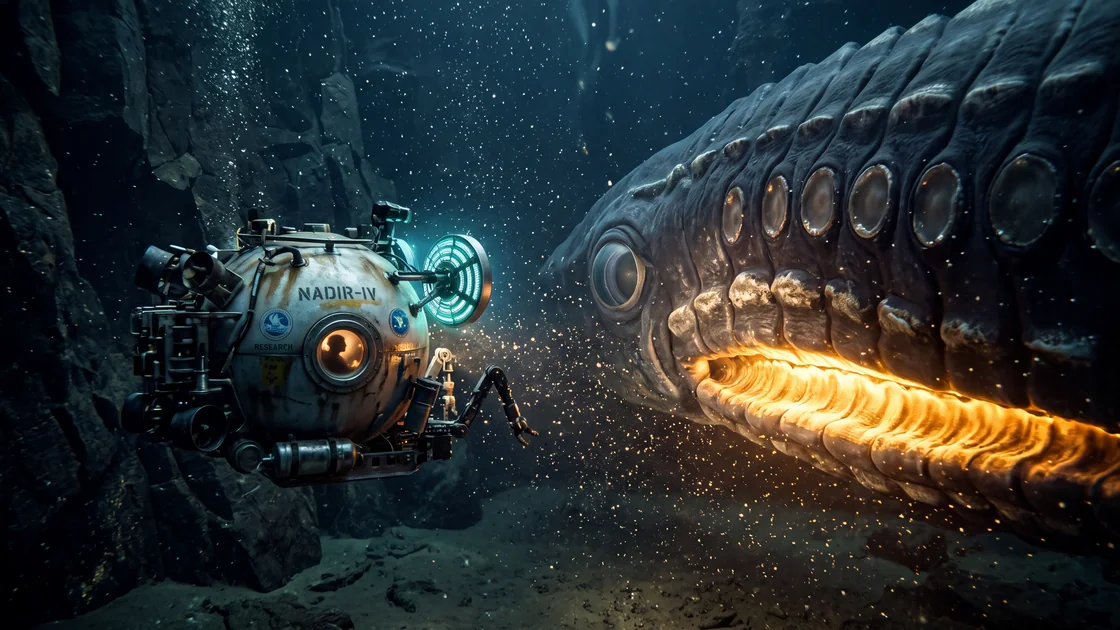
In the lightless depths of the Tonga Trench, deep-sea oceanographer Dr. Elena Vance establishes a historic, fragile communion with an ancient, miles-long leviathan through an array of high-intensity optical strobe projectors. Over weeks of descent inside a specialized submersible, she decodes a bioluminescent syntax that reveals the creature has not merely existed in the hadal zone for half a billion years, but has meticulously recorded the rise, folly, and fall of human civilizations through the chemical, acoustic, and particulate debris drifting down into the eternal silt. What begins as a scientific investigation of abyssal gigantism becomes an existential testament to humanity's fleeting place in geological time, told through the medium of cold, rhythmic light against the crushing black of the ocean floor.
Act I: The Descent to Ten Thousand
The Nadir-IV did not plunge; it fell with the slow, agonizing precision of an anchor dropped into wet concrete.
Inside the spherical pressure cabin—a two-meter orb of forged titanium-nickel alloy cradled within a structural foam skin—Dr. Elena Vance checked her oxygen partial pressure for the third time in nine minutes. The digital gauge read 0.21 atmospheres. Her exhalations tasted of stale copper, recirculated through lithium-hydroxide canisters that hissed with the dry, rhythmic breathing of an artificial lung. Outside the eight-inch borosilicate viewport, the universe had long since ceased to be blue. It had passed through the emerald twilight of the mesopelagic, swallowed the bruised violet of the bathypelagic, and now dissolved into the hadal void: 9,800 meters beneath the surface of the South Pacific, within the narrow tectonic scar known as the Horizon Deep.
"Telemetry steady, Achelous," Elena said into the hydrophone mic. Her voice was flat, conserved, pitched low to save air. "Passing three-two-thousand feet. Hull deformation monitors showing nominal displacement. Core temperature fifteen degrees Celsius. All strobe banks are charged to ninety-eight percent."
A delay of seven seconds followed—the time required for sound to crawl through nearly six miles of vertical seawater, reach the hydrophone array swinging beneath the research vessel Achelous, and return.
When the voice of her surface director, Dr. Ronald Kalu, arrived, it was stripped of fidelity, shredded into a metallic croak by thermoclines and acoustic shear: "...opy, Nadir. Surface weather holding... swell four feet. You are... approaching the sill of the terrace. Remember the thermal gradients... don't cook your coils."
"Understood," she murmured, though the surface was already an abstract rumor. Up there, the sun existed. Up there, wind pushed salt spray across warm metal decks, and gulls screamed against the horizon. Down here, the hydrostatic pressure was one thousand one hundred times that of the atmosphere—roughly the weight of three locomotives resting on every square inch of her skull. The titanium sphere groaned, a deep, resonant ping that traveled through the metal and settled directly into the marrow of Elena’s teeth. It was the sound of the hull settling into its compression envelope. One learned not to flinch, or one did not dive.
She flipped the breakers for the optical array.
Mounted to the exterior boom of the Nadir-IV was not a standard submersible lighting rig of continuous halogen or diffuse LED panels. Continuous light at this depth was an act of blindness; it washed out the natural phosphorescence of the trench and scattered uselessly off marine snow like high beams in a blizzard. Instead, Elena had designed the Loom: a circular bank of thirty-six custom xenon-quartz strobe emitters, arranged in concentric rings and driven by high-voltage capacitor banks. The Loom could fire pulses lasting mere microseconds, delivering bursts of sixty thousand lumens in precisely timed, mathematically modulated cadences, with wavelengths variable from the deep violet-blue of oceanic transparency (460 nanometers) to the rare, startling amber-reds that carried only feet before being strangled by the water.
She had not built the Loom to see. She had built it to speak.
Eight months earlier, autonomous seismic probes deployed along the Kermadec-Tonga subduction zone had begun recording optical anomalies. At first, the geophysicists had dismissed the data as sensor noise caused by radioactive decay in the seabed basalt, or perhaps the erratic flashes of deep-dwelling siphonophores. But Elena, analyzing the raw telemetry in her windowless laboratory at Scripps, had detected something impossible: an autocorrelation coefficient that spiked at regular, non-random intervals.
The signals were not continuous waves. They were strobes. Pulses of light, separated by prime intervals of milliseconds, echoing off the basalt walls of the hadal trench. When she ran the optical logs through a Fourier transform, the frequency spectrum did not match any known bioluminescent courtship display or predatory lure. It had structure. It had syntax.
It had an echo that did not bounce from stone, but answered from flesh.
At 10,200 meters, the bathymetric sounder began to chirp. Ten-two-eighty. Ten-three-forty.
Elena leaned her forehead against the neoprene brow-pad of the viewport. Her breath clouded the glass, and she wiped it away with the sleeve of her flame-retardant flight suit.
Outside, the darkness was absolute, thick and tangible, an ancient ink that pressed against the thick window. Then, she saw the snow.
Marine snow: the eternal detritus of the living world above. Microscopic fragments of dead diatoms, the fecal pellets of salps, flecks of whalebone, soot from terrestrial fires, the dust of continents carried out to sea by the trade winds and slowly, relentlessly falling through the water column. It took weeks, sometimes months, for a single particle to reach the bottom of the trench. It fell like an endless, slow-motion blizzard in a world without wind.
"Approaching target coordinates," Elena whispered to the recording log. "Engaging low-frequency search pulse. Sequence Alpha."
She reached for the custom control console beside her—a weighted mechanical keyboard whose keys triggered individual capacitor banks. She typed a sequence she had rehearsed for two years on dry land: four beats of blue light at 470 nanometers, spaced by intervals of one, two, three, and five seconds, followed by an emerald flash at 510 nanometers.
Click. Thrum.
The Loom discharged.
Through the viewport, the universe ignited. For a microsecond, the hadal trench was carved out of the primordial dark: towering walls of dark, fractured peridotite and serpentinite, slick with sediment, sheer cliffs plunging into an abyss that seemed to swallow the light before it could strike bottom. The marine snow froze in mid-fall, an explosion of silver sparks suspended in the crystal flash.
Then, blackness returned, heavier and more absolute than before.
Elena held her breath. Her heart beat against her ribs with a slow, heavy thud. She counted: one, two, three, four, five.
Nothing. Just the hum of the transformer recharging the capacitors.
"Sequence Alpha complete," she told the tape. "No immediate optical return. Hull depth ten thousand four hundred meters. Drifting along the eastern scarp."
She reached for the switch to initiate Sequence Beta—the Fibonacci cadence.
Before her finger could touch the toggle, the abyss answered.
Act II: The First Dialect
It did not begin as a flash. It began as an inversion of darkness.
Two hundred meters ahead of the Nadir-IV, out in the empty, freezing brine where there should have been nothing but water under eight hundred atmospheres of compression, a point of pale, cold illumination blossomed. It was not the electric, blue-white glare of Elena’s xenon tubes. It was an organic, milk-pale luminescence, the color of moonlight filtered through twenty feet of sea ice.
The light did not simply turn on; it welled. It expanded from a central node, sliding along invisible conduits that stretched across the dark like the roots of a world-tree.
Elena caught her breath. Her fingers hovered over the console, paralyzed by the sheer, staggering scale of what was unfolding in the beam-path.
The conduits were veins. They ran along the flank of an anatomy so vast that her mind struggled to assemble its boundaries. It was not a fish. It was not a squid, nor a siphonophore, nor any phylum cataloged in the manuals of benthic biology. It was an organism that seemed constructed from the very architecture of the seabed itself: an elongated, segmented titan whose dorsal ridge rose like a mountain range of translucent, organic calcite and fibrous chitin. Its flesh was a deep, velvet slate, interspersed with plates of biogenic silica that gleamed like wet slate in the creature's own radiance.
It stretched beyond the cone of the Nadir’s small tracking monitors. Elena engaged the high-frequency multibeam sonar; the acoustic return flared across her monitor in violent shades of crimson and amber.
The target was three hundred and forty meters in length.
"Dear God," she whispered. The hydrophone mic was dead; she had forgotten to key the surface line. It did not matter. The surface did not exist. There was only this room, this window, and the giant.
The creature’s photophores were not simple chemical cups like those of an anglerfish or a lanternshark. They were complex, compound optical organs the size of dinner plates, set in double rows along the margins of its massive, fluted mantle. Each photophore was ringed with an iris of dark, muscular tissue that contracted and expanded with rhythmic, terrifying deliberate-ness.
Flash.
The creature fired a burst of light.
It was an exact optical reproduction of Elena’s Sequence Alpha: four beats of 470-nanometer blue, followed by an emerald flare at 510 nanometers. But it did not stop there. The emerald flare did not die; it shifted smoothly through the spectrum, dropping into a deep, resonant amber—a color that possessed almost no transmission distance in clear water, yet here, concentrated by some unknown biological lens, reached the Nadir’s viewport as a warm, blood-red pulse that illuminated Elena’s face inside the cabin.
Along the creature’s flank, the light began to crawl.
It was not static. The photophores fired in running cascades, waves of luminescence that rippled from the creature’s anterior lobes back down the three-hundred-meter length of its body, breaking like surf against its ribbed caudal fin. The patterns moved with the fluid logic of an oscilloscope: sine waves that compressed and expanded, interrupted by sudden, sharp spikes of blinding white light that left purple afterimages burned onto Elena's retinas.
"It’s not mimicking," she breathed into the cabin’s voice recorder, her hand shaking as she reached for the keyboard. "It’s... it’s acknowledging the syntax. It repeated my scale, and now it’s... it’s offering a predicate."
She cleared the capacitor banks. Her mind raced through the lexicons she had spent years constructing: mathematical progressions, chemical bond lengths, the ratios of the hydrogen line. She needed to establish an anchor—a common point of reference that owed nothing to human biology and everything to the physical universe.
She typed the prime sequence: two, three, five, seven, eleven, thirteen, seventeen.
Click-thrum. Click-thrum. Click-thrum.
The Loom fired its rapid-fire staccato, the xenon tubes singing their high, whistling whine as the transformers sucked power from the lithium-sulfur batteries. The light punched through the water, illuminating the creature’s skin. For the first time, Elena saw its eye.
It was set back from the blunt, armored prow of its head—a sphere of clear, crystalline material two meters across, resting within an orbit of segmented chitin plates. It had no pupil in the human sense; instead, within the deep, dark fluid of the eye, three luminous bands rotated like the gimbals of a nautical compass. The eye did not look at the Nadir-IV with curiosity or fear. It looked with the cold, immovable patience of a glacier regarding a pebble that had tumbled onto its surface.
The creature waited until the final flash of seventeen had died into the silt.
Then, it answered.
It did not repeat the primes. It fired two, three, five, and seven. Then it paused for precisely three seconds—an interval measured with an accuracy that matched the atomic clock on Elena's instrument panel. Following the pause, it fired nineteen, twenty-three, twenty-nine, thirty-one.
It had skipped the numbers she had provided and continued the series.
A sob caught in Elena’s throat, dry and sharp. "It knows," she said to the empty sphere. "It knows the set."
The creature began to drift closer. It moved without the frantic undulations of an animal; it displaced the hadal water with the ponderous dignity of a tectonic plate. Huge, transparent pectoral veils—delicate as bridal lace, yet thick as ship’s canvas—unfurled along its flanks, undulating in long, slow waves that barely stirred the sediment on the seabed thirty meters below.
As it drew near, the character of the light changed.
The photophores ceased their mathematical firing. They dimmed to a soft, continuous pearlescence, and from the creature's skin, a secondary system of illumination awoke. Millions of microscopic, point-source light organs—chromatophores that had evolved into luminous pixels—began to shift and swirl across the vast slate of its mantle.
It was no longer sending pulses. It was projecting imagery.
Act III: The Stratigraphy of Ruin
The skin of the leviathan became a canvas of moving frost.
Elena watched, transfixed, as bands of cold light drifted across the creature's broad sides like cloud shadows over an empty prairie. The resolution was uncanny; it was not a digital screen, but a continuous, analog field of bioluminescent fluid shifting under the guidance of millions of individual neural clusters.
The first pattern was geometric: a series of interlocking hexagonal lattices that expanded and contracted in a rhythmic breathing motion. Elena recognized it instantly—it was the crystalline geometry of sea ice, rendered with absolute physical accuracy.
Then, the geometry dissolved into motion.
Light flowed across the beast’s flanks, depicting a surface world that the leviathan itself could never have touched without boiling its internal organs in the low pressure of the upper sea. Yet, it knew that world. It knew it with the intimate, forensic precision of an archivist who collects what falls from the ceiling of a grand, decaying house.
On the creature’s side, an image formed of a vast, flat expanse of water seen from beneath: the mirror of the air-sea interface, silvered by sunlight that Elena had not seen in three days. Through that shimmering ceiling, things were falling.
They were rectangular, jagged, tiny. Elena leaned closer to the viewport, her nose nearly touching the chilled acrylic.
Wood.
The falling shapes were beams of squared timber, charred at the ends. They tumbled through the projected water column with agonizing slowness, trailing plumes of tiny, luminescent bubbles. Beside them fell other shapes: circular objects that tumbled like coins, jars with twin handles that settled into the silt and broke, spilling dark, billowy clouds that the leviathan’s skin rendered in shades of dull, pulsing violet.
"Amphorae," Elena murmured, her fingers flying over the console, entering the diagnostic timestamps. "Wine. Olive oil. Phoenician... no, early Mediterranean. Bronze Age."
The creature fired a sharp, double-pulse from its dorsal photophores—flash-flash—at an interval of 1.4 seconds. It was a delimiter, a structural punctuation mark.
The image shifted.
The rain of timber grew denser. Now it was not single wrecks, but entire flotillas of shattered cedar and oak that drifted down into the black. Elena watched hulls with high, curved stems—triremes, quinqueremes, galleys with their banks of oars snapped like dry twigs—spiral down into the depths. She saw the debris of Salamis, of Actium, recorded not as human triumphs or tragedies, but as a sudden, inexplicable increase in the hadal carbon budget.
To the leviathan, humanity had not begun as an idea, a culture, or an empire. Humanity had begun as a sudden, foreign precipitation.
For hundreds of millions of years, the hadal zone had known only the steady, predictable snowfall of the sea: the slow rain of plankton, the rare, magnificent windfall of a whale fall, the fine mineral dust washed out from rivers that had ceased to flow before the continents drifted apart. The abyss was a place of radical constancy. Its temperature did not change by a tenth of a degree across millennia; its pressure was an unyielding vise; its darkness was absolute and holy.
And then, roughly four thousand years ago by the creature’s chronometer—a blink, an afternoon in its long consciousness—the nature of the snowfall had altered.
The sea had begun to drop metal.
The leviathan’s skin flared with a sudden, violent brilliance: a wash of harsh, sulfuric yellow that made Elena squint. The projection shifted from the silhouettes of sinking timber to a microscopic, structural rendering. It was displaying crystalline lattices again, but not of ice. These were lattices of copper, bronze, and, finally, iron.
The creature modulated the light, pulsing it in rhythm with a low-frequency acoustic rumble that Elena felt through the soles of her boots—a vibration that bypassed the ear and resonated directly in her diaphragm.
Look, the light said. Look at what you dropped into my house.
The iron did not dissolve like the wood. In the leviathan’s projection, the iron objects—spear points, anchors, chains, armor—settled into the abyssal sediment. Around them, the hadal bacteria, organisms that had lived for eons on a sparse diet of sulfur and methane, clustered in sudden, frantic blooms, oxidizing the metal into strange, orange halos that stained the eternal white of the pelagic clay.
Elena touched the keys of the Loom. She did not use words; she had no words for this. She keyed a sequence of soft, low-intensity blue pulses, dropping the cadence to match the slow, resting rhythm of the leviathan’s undulating veils. It was an interrogation, a gentle, reverent prompt: And then?
The creature received the blue light. The amber halos on its skin faded.
Its enormous head swung slightly, a movement of thousand-ton displacement that sent a slow, rhythmic surge of displacement water against the Nadir-IV, causing the submersible to rock gently in its cradle of trim-tanks. The crystalline eye rolled in its socket, fixing Elena with those three concentric rings of spinning luminescence.
Then, the creature showed her the fire.
Act IV: The Century of Lead and Smoke
The display was no longer silent.
As the leviathan’s skin began to churn with new, frantic patterns, it opened its ventral acoustic chambers—cavities within its armored mantle that functioned like titanic pipe organs, driven by the muscular compression of deep-sea water.
The sound that emerged was a chord of sub-audible frequencies, a groan that registered between eight and twelve hertz. The titanium hull of the Nadir-IV began to sing in sympathy, a dry, metallic buzz that rattled the pencils in their magnetic trays and set the water in Elena’s hydration pouch dancing in tight, concentric ripples.
Across the creature’s flank, the rain of debris became a torrent.
The shapes of the ships had changed. The graceful, curved ribs of oak and cedar were gone, replaced by massive, rectangular blocks of iron plate, riveted together in endless, repetitive seams. Elena saw the ironclads of the nineteenth century; she saw the great, blunt-nosed merchantmen of the World Wars, their hulls torn open by torpedoes, spilling cargoes of coal, locomotives, shells, and oil.
The oil was rendered on the leviathan’s mantle as a crawling, suffocating darkness—a negative light that spread across the luminous pixels like a necrosis.
The creature’s strobes fired with a new, frantic tempo: rapid, jagged bursts of 420-nanometer violet—the highest-energy, most abrasive light its biology could produce. The pulses came at irregular, broken intervals, mimicking the stutter of machine-gun fire or the detonations of depth charges.
It felt them, Elena realized, a cold terror gripping her throat. It didn't just see what sank. The ocean is an acoustic lens. Every depth charge dropped in the Atlantic, every sea-mine in the Pacific, every boiler that collapsed as a torpedoed tanker went under... it felt all of it.
The hadal trenches were not isolated from the surface; they were the acoustic sinks of the planet. Sound waves, trapped within the deep sound channel—the SOFAR layer—were focused by the thermal gradients and refractively bent downward, driving their concussive energy straight into the trenches. For two centuries, as humanity turned its oceans into an industrial highway and a battleground, the hadal zone had ceased to be silent. It had become an echo chamber of war.
The creature’s skin flashed white—a single, blinding stroke that washed out the cabin monitors and left Elena gasping, her hands instinctively flying to her eyes.
When the purple bloom cleared from her vision, the leviathan was showing her a single date.
It did not use human numerals. It showed an element.
Across its side, fifty meters wide, was the structural model of an atom: ninety-two protons, an outer shell of electrons, and then a sudden, catastrophic fission. The projection flared with an unbearable, sterile blue—the color of Cherenkov radiation.
November 1, 1952.
Ivy Mike. Enewetak Atoll. The first thermonuclear detonation.
The acoustic groan from the creature’s ventral chambers dropped to a frequency so low it was no longer sound; it was nausea. It was the sensation of the earth’s crust being struck by a hammer.
In the projection, Elena saw the shockwave strike the deep sea. It was not a gentle wave. It was an invisible wall of pressure that had shattered benthic glass-sponges that had been growing since the time of the Pharaohs. It had triggered underwater landslides along the trench walls, sending millions of tons of sediment roaring down into the hadal depths, burying entire ecosystems under choking, blinding clouds of pulverized basalt.
And then came the fallout.
The leviathan showed her the snow again, but it was no longer white. In the creature's memory-light, the snow glowed with a sick, persistent phosphorescence.
Cesium-137. Strontium-90. Carbon-14.
The creature showed how these isotopes had settled into the hadal sediment, forming a micro-layer of radioactive silt no thicker than a fingernail, but as indelible as a scar on bone. It showed how the isotopes had entered the food chain: taken up by deep-sea amphipods, concentrated in the tissues of liparid snailfish, and finally, absorbed into its own chitinous shell, incorporated into the very plates of silica that armored its body.
The leviathan had not merely observed humanity’s nuclear age. It had become an archive of it. Its very body was a ledger written in radionuclides dropped from skies it had never seen.
Elena sat in the dark of her sphere, tears tracking silently through the salt-crust on her cheeks. The Loom was quiet beside her. What could she flash back? What cadence of xenon pulses could say: We didn't know you were down here? We didn't think anything could live in the dark?
The defense was pathetic. The light from the leviathan did not ask for an apology. It was not angry. The coldness of its communication was more terrible than any wrath; it was the clinical, indifferent record of an ancient accountant noting the arrival of an erratic, self-immolating parasite in the upper branches of the biosphere.
The creature's light shifted again, softening from the radioactive violet back into the pale, milky green of its native syntax.
It had reached the present.
Act V: The Message of the Silt
The cadence slowed. The creature was no longer showing historical projections. It was looking at the Nadir-IV.
The immense, crystalline eye rolled back toward the viewport. In the dark water between the submersible and the titan, something was drifting.
It was not marine snow. It was modern snow.
A single object tumbled down through the beam of the Nadir's running lights: a white plastic cup, its red printed logo faded to a dull gray, its rim cracked and colonized by a thin film of manganese-oxidizing bacteria. It settled onto the sediment near the creature’s anterior palp with a soundless, weightless finality.
Beside it lay other relics: fragments of nylon monofilament long-line, looped like snare wire; a blister-pack of pharmaceutical tablets; the aluminum casing of an expended sonobuoy; microplastic flakes that sparkled in the strobe light like crushed diamonds.
The creature’s ventral photophores fired three slow, rhythmic beats.
One. (Pause: six seconds). Two. (Pause: six seconds). Three.
Then, it projected a single, continuous image across the entire visible surface of its mantle.
It was not a memory of the past. It was an extrapolation of the future.
Elena saw the oceans above, but the mirror was dark. The sun was obscured by a thick, brown atmospheric haze. The rain of organic snow—the diatoms, the salp pellets, the whale falls—had dwindled to a vanishingly thin trickle. The life above was dying, starved of oxygen by stratified, overheated surface layers that had ceased to overturn.
Yet, the rain of artificial debris did not stop. It increased.
It fell in avalanches: the pulverized skeletons of coastal cities swallowed by rising tides; millions of tons of plastics that did not degrade, but broke into finer and finer powders, forming a dense, synthetic silt that choked the benthic feeding filters; heavy metals that leached from sunken reactors and chemical repositories, pooling in the hadal deeps like liquid mercury.
In the creature’s projection, the leviathan itself did not die immediately. It was tough; it had survived the Permian-Triassic extinction, had slept through the impact that ended the Cretaceous, had witnessed the oceans turn anoxic and recover over ten million years.
Instead, it became barren.
The light showed its photophores flickering, their organic fuel supplies exhausted as the chemical pathways that sustained them—pathways dependent on the delicate geochemical balances of the deep water—collapsed. One by one, the lanterns went out. The miles-long body drifted down onto the sediment of the trench floor, not to decompose, but to be slowly covered by the falling plastic dust, fossilized in a matrix of petrochemical stone.
A bell began to chime inside the Nadir-IV.
It was the main battery monitor. The banks were down to twenty-two percent. The lithium-hydroxide scrubbers were beginning to saturate; the cabin air smelled distinctly of sweet almonds and wet chalk—the first signs of rising carbon dioxide.
"Elena," a voice crackled through the hydrophone, fragmented and urgent. "...turn... you must... battery reserve critical... storm on the surface... Achelous is... pull you up..."
She reached for the communications toggle, clicked it open, and said: "Acknowledge, Achelous. Beginning ascent procedures in ten minutes. I have... I have secured the data."
She switched off the mic.
Ten minutes. That was all the power she had left for the Loom. That was all the time she had to answer five hundred million years of history.
Her fingers were stiff with cold. The cabin temperature had dropped to six degrees. She blew on her knuckles, positioned her hands over the weighted keys of the Loom’s console, and closed her eyes for a moment to clear her mind of the horrors the creature had painted in light.
She could not promise that humanity would change. She could not flash a lie through the water; the creature's syntax was based on the immutable constants of mathematics and the physical realities of the hadal silt. If she transmitted a falsehood, the grammar would fail.
She had to answer within its own system.
She opened her eyes and began to type.
Act VI: The Syntax of Remorse
Elena did not use the primes. She did not use the chemical elements.
She began with the geometry of a circle: the fundamental ratio of circumference to diameter, \(\pi\), encoded as a series of pulses at 460 nanometers. But at each decimal place, she varied the intensity of the strobe, modulating the lumen output from a soft, gentle whisper to a sharp, hard flare that illuminated the sediment beneath the creature’s head.
With each digit, she introduced an intentional error.
At the third decimal, she dropped the pulse count by one. At the seventh decimal, she increased it by two.
The leviathan did not move. Its eye remained fixed on the Loom. Along its dorsal ridge, the photophores flickered with a low, questioning amber—a chromatic tilt that indicated an anomaly in the received data.
Why are you broken? the light asked. You know the ratio. You transmitted it correctly forty minutes ago. Why is your circle imperfect?
Elena continued to type. She was not presenting mathematics as an absolute; she was presenting mathematics as an aspiration.
She shifted the strobe colors from the blue of pure seawater to a sequence that mirrored the creature's own historical ledger: from the timber-brown of the ancient wrecks, through the iron-gray of the industrial age, to the radioactive violet of the mid-century. But she did not end on the violet.
She forced the Loom’s variable filters to their absolute limit, mixing wavelengths until she achieved a color that was almost unknown in the hadal zone: a clear, soft, solar gold—the color of dawn on a calm sea, the color of photosynthesis, the light that drives the engine of the living world above.
It was an inefficient light down here. The water absorbed it ruthlessly; it traveled less than twenty meters before its energy was dissipated into heat, swallowed by the cold brine.
To the leviathan, which had lived its entire existence in the blue-green transmission window of clear water, this golden light was an impossibility. It was a color that belonged to another universe, a color that spoke of a surface it had never visited and could never touch.
With that gold light, Elena transmitted the sequence for entropy.
She pulsed the rate of decay: the half-lives of the isotopes the creature carried in its shell. But she inverted the sequence. She showed the decay not as an end, but as a measurement of elapsed time—a clock that ran down, but left behind a baseline of stable lead, stable carbon, stable stone.
She was telling the creature: We are short.
We are not like you, the strobes said, flashing in quick, urgent triplets that made the transformer hum its dying song. We are not five hundred million years old. We are not the stone. We are not the deep water. We are the surface. We are the wind that lives for an hour and dies. We are the fire that burns its fuel too quickly.
She keyed a sequence that mimicked the human heartbeat: seventy-two pulses per minute, delivered in that soft, fragile, gold-amber light.
We are fast, she told it. We are violent because we are brief. We dropped our iron into your dark because we did not know how to hold it. We dropped our fire because we could not contain it.
Then, she stopped.
She left the Loom dark.
The silence rushed back into the cabin, punctuated only by the shallow, rapid hiss of her own breathing and the distant, metallic groaning of the Nadir's hull as the cooling internal air caused the pressure sphere to contract by fractions of a millimeter.
The leviathan remained motionless.
For two full minutes, nothing happened. The creature lay before the submersible like an underwater range of hills, its photophores extinguished, its vast bulk invisible except where its silhouette blotted out the faint, ambient bioluminescence of the distant trench wall.
Elena thought she had failed. Perhaps the message had been meaningless—the frantic, incoherent babbling of an ape trapped in a metal bubble, flashing nonsensical colors into a world that understood only the cold grammar of deep time.
She reached for the ascent controls to blow the primary drop-weights.
Then, the creature spoke for the last time.
Act VII: The Liturgy of the Silt
It did not use its skin to project images. It did not use its dorsal banks to flash numbers.
The creature began to roll its body, slowly, majestically, turning its pale ventral surface toward the submersible.
Along the entire three-hundred-meter length of its belly was a single, continuous organ of illumination: a deep, ventral groove lined with millions of fibrous, crystalline plates that held a thick, viscous fluid. The fluid was not illuminated by chemical reaction alone; it was seeded with symbiotic colonies of hadal bacteria that lived within the creature's flesh, organisms whose lineage reached back to the Archean eon, before the atmosphere had breath, when the earth was only water and steam.
The groove opened like the doors of a cathedral.
The light that emerged was not blue. It was not violet.
It was gold.
It was the exact wavelength Elena had just fired from the Loom—a color the creature had never produced in its half-billion years of existence, synthesized now through some instantaneous, miraculous biochemical calibration. It flooded the trench. It turned the black water into a hall of liquid amber, reflecting off the peridotite cliffs, illuminating the ancient silt until it gleamed like a field of fallen stars.
In that golden light, the creature fired a single, sustained phrase.
It was not a mathematical constant. It was an echo of her own heartbeat: seventy-two pulses per minute.
Pulse. (One second). Pulse. (One second). Pulse.
It maintained the rhythm for three full cycles—three human heartbeats, mirrored by three hundred meters of ancient, abyssal flesh.
And then, it modulated the cadence.
It did not speed up; it did not slow down. It began to add harmonics. Between each of the human heartbeats, it inserted three micro-pulses of deep, indigo blue—the color of the hadal trenches, the color of the home it had occupied since the world was young.
Thump-click-click-click. Thump-click-click-click.
The message was an integration. It was the inclusion of her brief, frantic, seventy-two-beat lifespan within the long, dark, indigo rhythm of the hadal deep. It was not forgiveness. Forgiveness was a human concept, small and domestic, born of courts and altars.
It was incorporation.
The leviathan was recording her.
Not as an empire. Not as a species that had split the atom and filled the sea with plastic. It was recording her, Dr. Elena Vance, a solitary organism suspended in a titanium sphere at 10,800 meters, who had spoken to it in the gold light of the sun and confessed her transience.
She was being entered into the ledger.
She was being written into the silica plates, alongside the radioactive fallout of Ivy Mike, the shattered hulls of Salamis, the cedar beams of the Levant, and the three hundred million years of diatom shells that had fallen before the first human ancestor had stood upright on the savannah.
The creature’s ventral groove began to close.
The gold light faded, narrowing to a thin, bright slit, then to a line, then to a memory. The indigo harmonics pulsed three more times—soft, distant, receding into the water like the final notes of a bell rung under ice.
Then, with an effortless, serpentine sweep of its caudal fin that did not even kick up the silt, the titan turned.
It did not ascend. It did not sink. It slid along the axis of the Horizon Deep, moving toward the south, where the trench plunged into regions where no probe had ever descended, where the pressure was a wall and the earth was being slowly swallowed back into the mantle.
Within thirty seconds, it was gone.
The multibeam sonar screen went blank, clearing from violent crimson to a smooth, uniform blue. The water was empty. The hadal snow fell through the dark, silent and steady, settling onto the white clay as if nothing had ever disturbed its passage.
Elena sat in the dark.
The battery alarm was no longer chiming; it had settled into a flat, continuous tone. The oxygen gauge read 0.16 atmospheres. Her fingertips were numb, blue-white at the beds of the nails.
She reached down, took hold of the mechanical release lever for the emergency ascent weights, and pulled.
Beneath the Nadir-IV, three two-ton blocks of lead clattered free from their electromagnets and fell into the silt. The submersible shuddered, freed from the earth's grip, and began its long, silent journey back toward the sun.
Act VIII: The Upper World
The ascent took five hours.
Elena did not turn on the cabin lights. She did not speak into the hydrophone, even when the Achelous began to break through the interference with clear, frantic queries about her life support status and her telemetry logs.
She sat with her forehead against the viewport, watching the world reverse itself.
At eight thousand meters, the water was still black, but the quality of the blackness changed; it lost the dense, mineral weight of the hadal trenches and became the hollow, cavernous dark of the abyssopelagic.
At four thousand meters, she saw the first bioluminescence of the mid-waters: the nervous, blue sparks of copepods and the delicate, trailing ribbons of ctenophores that flashed and vanished like falling stars. They were beautiful, but they were toys. They were fireflies drifting past the window of a train that was leaving a continent behind.
At eight hundred meters, the world became violet.
Elena blinked against it. It was the faintest, most ghostlike intrusion of sunlight, filtering down through miles of blue water, but to her dilated pupils, it felt like an explosion. She covered her eyes with her hands, groaning as the light pierced her retinas like needles.
When she looked again, the violet had become blue.
The blue was vast, clean, and terrifyingly empty. There were no walls here. There was no peridotite, no serpentinite, no ancient floor of pelagic clay that remembered the birth of the continents. There was only the open pelagic—a desert of light where nothing could hide and nothing could endure.
At two hundred meters, the Nadir-IV hit the thermocline. The submersible bucked as it crossed the boundary between the cold, dense deep water and the warm, sun-whipped surface layer. The cabin temperature began to rise; the condensation that had coated the titanium walls began to run in warm, clear rivulets, like sweat on skin.
Then, the Nadir-IV broke the surface.
It did not slide out; it wallowed, bursting through the interface like a cork, the viewport suddenly clearing of water and filling with the sky.
The sky was white.
The sun was an engine of unbearable, violent gold that beat down upon the sea, turning the swell into a blinding field of shattered mirrors. Elena cried out, throwing her arm across her face, her eyes streaming with reflex tears.
The sound of the upper world rushed in through the hull: the roar of the diesel generators aboard the Achelous, the rhythmic slapping of four-foot swells against the buoyancy foam, the frantic, mechanical clatter of the recovery winch, the screams of terns wheeling through the air.
It was so loud.
It was an unbearable, chaotic cacophony of engines, wind, and voices.
"We have her!" a man's voice shouted through the external speaker. "Hull secure! Hooking up the bridle! Dr. Vance, do you read? Elena, can you hear me?"
She reached for the hatch release, but her hand stopped on the lever.
Through the viewport, bobbing in the foam between the submersible's skin and the steel hull of the recovery ship, was a plastic water bottle. It was new, its clear PET body gleaming in the noon sun, its blue cap tightly sealed. It danced upon the waves with a buoyant, frantic lightness, dipping with every swell, riding the wind.
It was beginning its journey.
It would drift across the South Pacific for months, perhaps years. Its label would peel; its plastic would fragment under the ultraviolet glare of the sun. It would break into flakes, smaller and smaller, until it was no larger than a grain of pollen.
And then, it would begin to fall.
It would take two months to sink through the blue. It would drift past the ctenophores, pass through the SOFAR channel, settle through the anoxic layers, and tumble down into the Horizon Deep.
And there, in the cold, unyielding black, ten thousand meters beneath the wind, a pair of eyes the size of shields would watch it land.
The lanterns along the ancient flank would flicker. The silica plates would shift.
The ledger would be kept.
Elena pressed her palm against the glass, her hand trembling as she took one last look at the infinite, terrifying blue of the surface sea before the recovery crew hauled her up into the light.
"I hear you," she whispered into the dead mic. "I hear all of you."